International Baccalaureate · MYP 4
Simultaneous Equations
I
Systems of Two Equations
I.1
A System of Two Equations
A cycle-hire point rents only bicycles, which have two wheels, and tricycles, which have three wheels. This morning, \(26\) vehicles are parked there, with \(61\) wheels in all.
- Could there be \(20\) bicycles and \(6\) tricycles?
- Give two other possible numbers of bicycles and tricycles for \(26\) vehicles. Do they give \(61\) wheels?
- How many bicycles and how many tricycles are parked?
- \(20 + 6 = 26\) vehicles: the first piece of information holds. But \(2 \times 20 + 3 \times 6 = 40 + 18 = 58\) wheels, not \(61\): the second one fails. So no.
- For example \(18\) bicycles and \(8\) tricycles: \(36 + 24 = 60\) wheels; \(16\) bicycles and \(10\) tricycles: \(32 + 30 = 62\) wheels. Many repartitions give \(26\) vehicles, but these ones do not give \(61\) wheels.
- Replacing one bicycle by one tricycle keeps \(26\) vehicles and adds one wheel:
Bicycles \(20\) \(19\) \(18\) \(17\) \(16\) Tricycles \(6\) \(7\) \(8\) \(9\) \(10\) Wheels \(58\) \(59\) \(60\) \(61\) \(62\)
Definition — Linear Equation in Two Unknowns
An equation that can be written \(ax + by = c\), where \(a\), \(b\) and \(c\) are given numbers and \(a\) and \(b\) are not both \(0\), is a linear equation in two unknowns \(x\) and \(y\). A solution of this equation is a pair of numbers \((x, y)\), written in this order, that makes the equality true when the numbers replace the letters.For example, \((17, 9)\) is a solution of \(2x + 3y = 61\), since \(2 \times 17 + 3 \times 9 = 61\); so are \((29, 1)\) and \((-1, 21)\). Such an equation has infinitely many solutions.
Definition — System of Two Equations
Two equations in the same two unknowns, to be satisfied at the same time, form a system of two equations, also called simultaneous equations. The system is written with a brace: $$\begin{cases} x + y = 26 \\
2x + 3y = 61 \end{cases}$$ A solution of the system is a pair \((x, y)\) that is a solution of each of the two equations. To solve the system is to find all its solutions. Method — Checking Whether a Pair Is a Solution
To check whether a pair \((x, y)\) is a solution of a system: - Replace \(x\) and \(y\) by the numbers of the pair in the first equation, and compute each side.
- Do the same in the second equation.
- Conclude: the pair is a solution of the system when both equalities are true. One false equality is enough to reject it.
Example
Is the pair \((3, -1)\) a solution of the system \(\begin{cases} 2x + 5y = 1 \\ 4x - y = 13 \end{cases}\)? And the pair \((-2, 1)\)?
The pair \((3, -1)\). In the first equation: $$\begin{aligned}[t] 2 \times 3 + 5 \times (-1) &= 6 - 5 && \text{(replace } x \text{ by } 3 \text{ and } y \text{ by } -1\text{)} \\
&= 1, \end{aligned}$$ and \(1 = 1\) is true. In the second equation: $$\begin{aligned}[t] 4 \times 3 - (-1) &= 12 + 1 && \text{(replace } x \text{ by } 3 \text{ and } y \text{ by } -1\text{)} \\
&= 13, \end{aligned}$$ and \(13 = 13\) is true. Both equalities hold: \((3, -1)\) is a solution of the system.
The pair \((-2, 1)\). In the first equation, \(2 \times (-2) + 5 \times 1 = -4 + 5 = 1\): true. In the second equation, \(4 \times (-2) - 1 = -8 - 1 = -9\), and \(-9 = 13\) is false. The pair satisfies the first equation only: it is not a solution of the system.
The pair \((-2, 1)\). In the first equation, \(2 \times (-2) + 5 \times 1 = -4 + 5 = 1\): true. In the second equation, \(4 \times (-2) - 1 = -8 - 1 = -9\), and \(-9 = 13\) is false. The pair satisfies the first equation only: it is not a solution of the system.
Proposition — Graphical Meaning of a System
Consider a system whose two equations can be rearranged in the forms \(y = m_1x + c_1\) and \(y = m_2x + c_2\). In a coordinate plane, each of them is the equation of a line. A pair \((x, y)\) is a solution of the system if and only if the point with coordinates \((x, y)\) lies on both lines: the solutions of the system are the coordinates of the intersection points of the two lines. 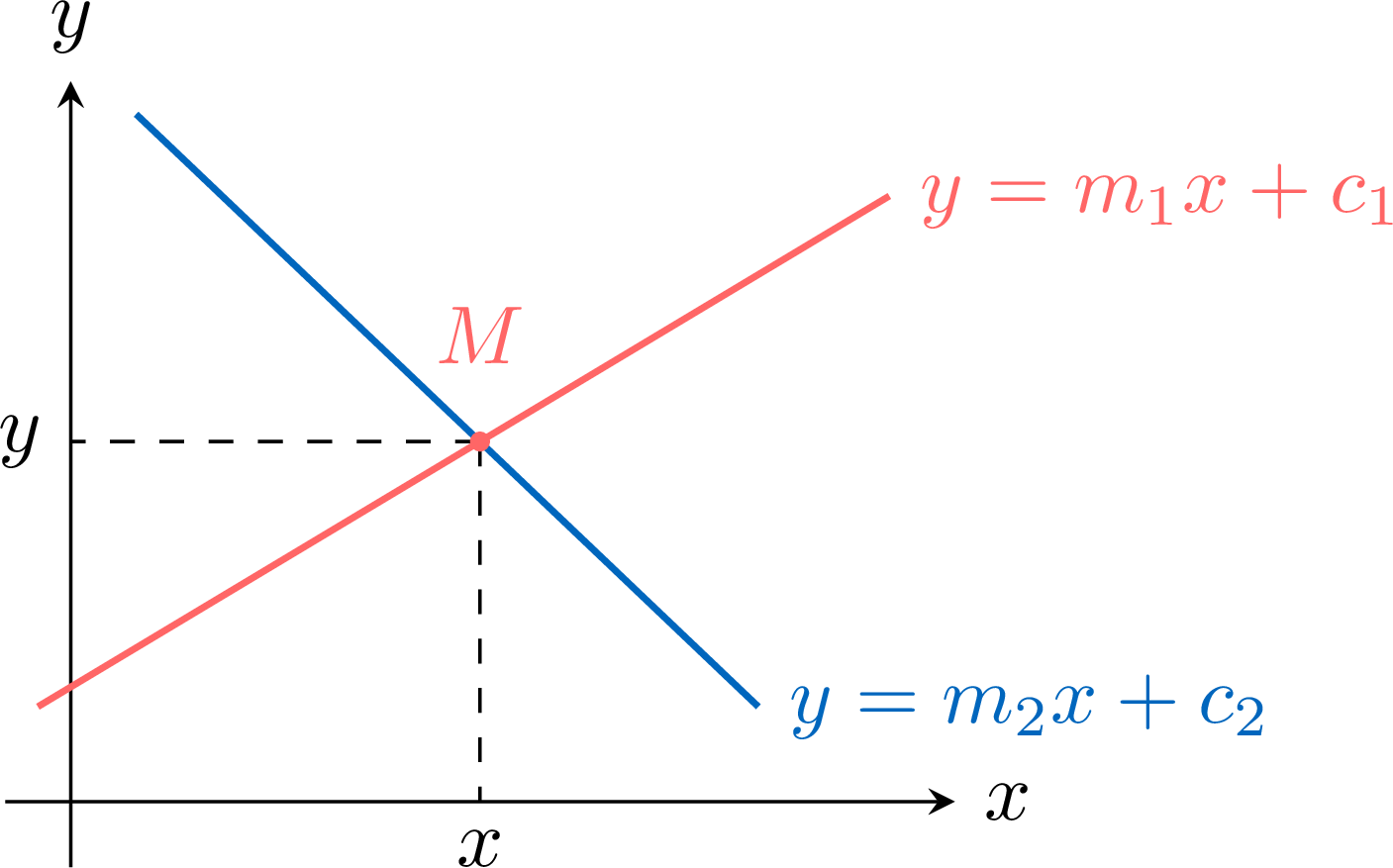
Rearranging an equation with balance moves does not change its solutions, so the system has the same solutions as \(\begin{cases} y = m_1x + c_1 \\ y = m_2x + c_2 \end{cases}\). Let \(M\) be the point with coordinates \((x, y)\). By the definition of the equation of a line, \(M\) lies on the first line if and only if \(y = m_1x + c_1\) is true, and \(M\) lies on the second line if and only if \(y = m_2x + c_2\) is true. Hence \(M\) lies on both lines if and only if \((x, y)\) satisfies both equations, that is, if and only if \((x, y)\) is a solution of the system.
Method — Solving a System Graphically
- Rearrange each equation in the form \(y = mx + c\). An equation with no \(y\), such as \(x = 2\), is the equation of a vertical line, drawn directly.
- Draw the two lines in the same coordinate plane, each one from two of its points (Method “Graphing a Line Using Two Points”).
- Read the coordinates of their intersection point.
- Check the pair read by substitution in both equations: a reading is only as precise as the drawing.
Example
Solve graphically the system \(\begin{cases} x + y = 5 \\ 2x - y = 1 \end{cases}\).
Each equation is rearranged in the form \(y = mx + c\): $$\begin{aligned}[t] x + y &= 5 \\
y &= -x + 5 && \text{(subtract } x \text{ from both sides)} \end{aligned} \qquad\qquad \begin{aligned}[t] 2x - y &= 1 \\
2x &= 1 + y && \text{(add } y \text{ to both sides)} \\
y &= 2x - 1 && \text{(subtract } 1 \text{ from both sides)} \end{aligned}$$ Two points of each line: \((0, 5)\) and \((5, 0)\) for \(y = -x + 5\); \((0, -1)\) and \((3, 5)\) for \(y = 2x - 1\). 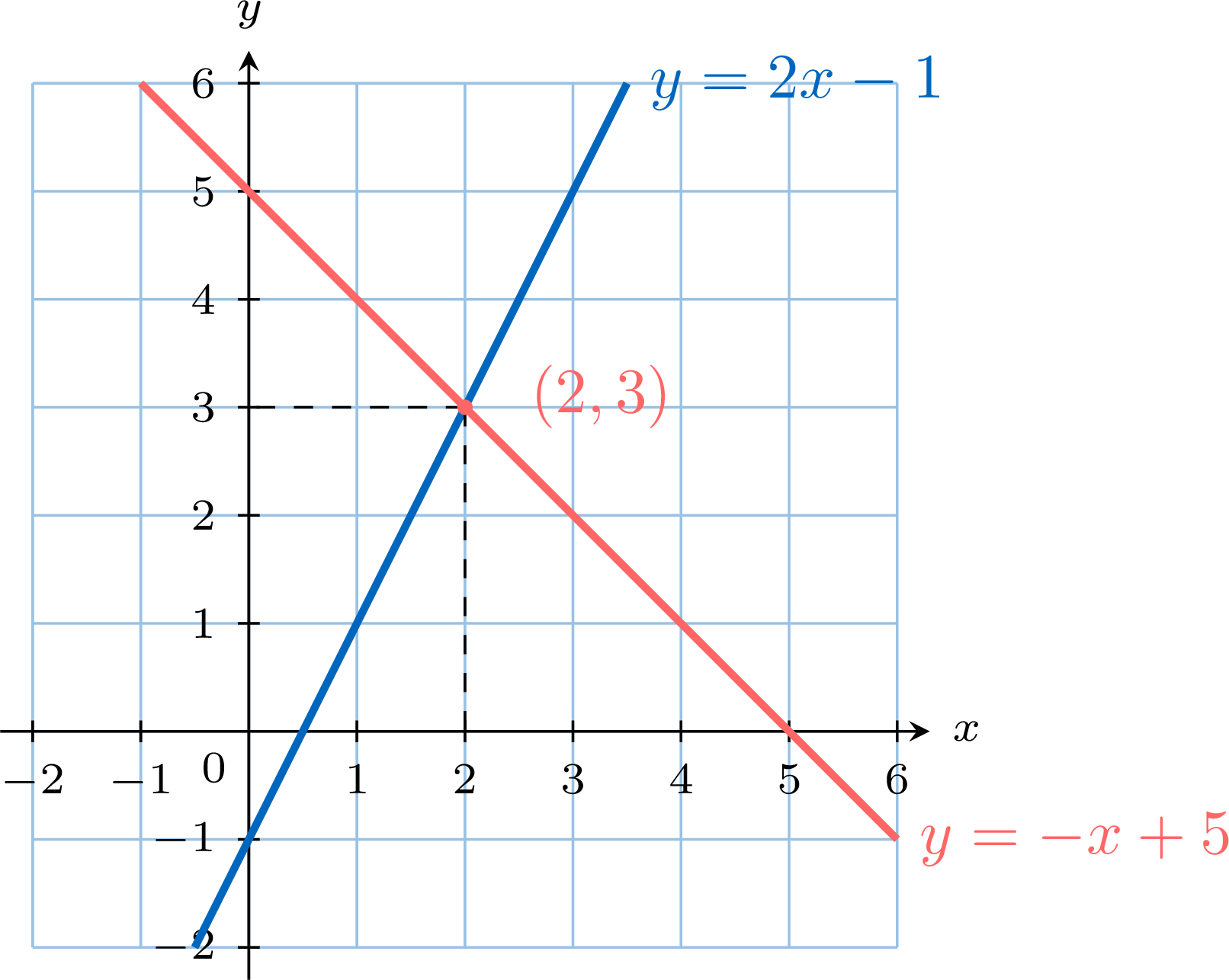
The lines meet at the point read as \((2, 3)\). Check: \(2 + 3 = 5\) and \(2 \times 2 - 3 = 1\), both true. The solution of the system is the pair \((2, 3)\).
Example
The lines of equations \(y = x + 1\) and \(y = -2x + 3\) are drawn on a fine grid. Read the coordinates of their intersection point, then check the pair read in the system \(\begin{cases} y = x + 1 \\ y = -2x + 3 \end{cases}\). 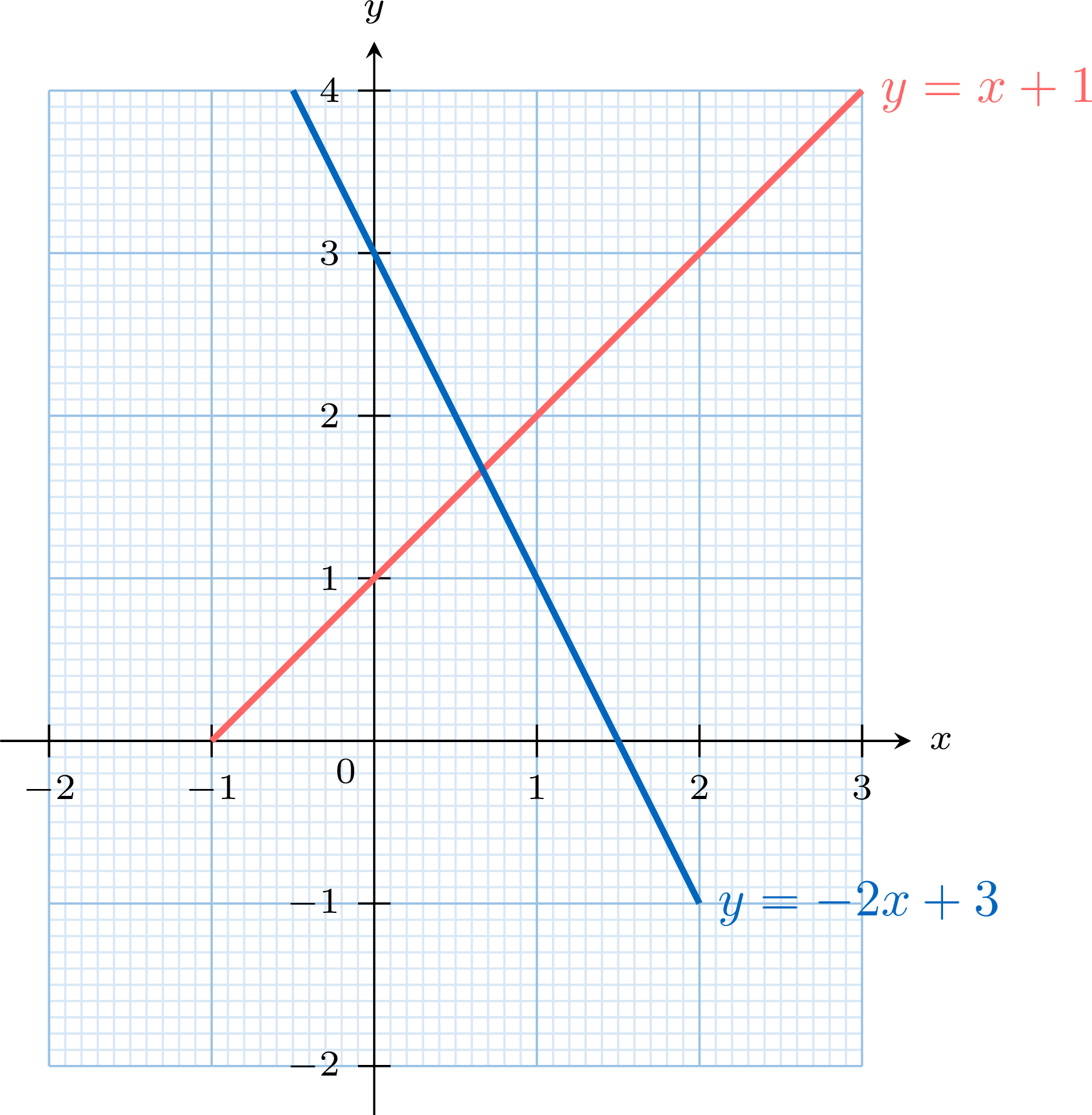
The lines seem to meet at about \((0.7, 1.7)\). Check: in the first equation, \(0.7 + 1 = 1.7\), true; in the second one, \(-2 \times 0.7 + 3 = -1.4 + 3 = 1.6\), and \(1.6 = 1.7\) is false. The pair read is not the solution: the intersection point does not fall on a line of the grid, and a reading only gives an approximation. Equating the two expressions of \(y\) gives the solution exactly: \(x + 1 = -2x + 3\), so \(3x = 2\) and \(x = \dfrac{2}{3}\), then \(y = \dfrac{2}{3} + 1 = \dfrac{5}{3}\). The exact solution is \(\left(\dfrac{2}{3}, \dfrac{5}{3}\right)\), with \(\dfrac{2}{3} \approx 0.67\) and \(\dfrac{5}{3} \approx 1.67\).
Skills to practice
- Recognising a Solution of a System
- Reading the Solution on a Graph
- Solving a System Graphically
I.2
Equating the Values of \(y\)
Method — Finding the Intersection of Two Lines
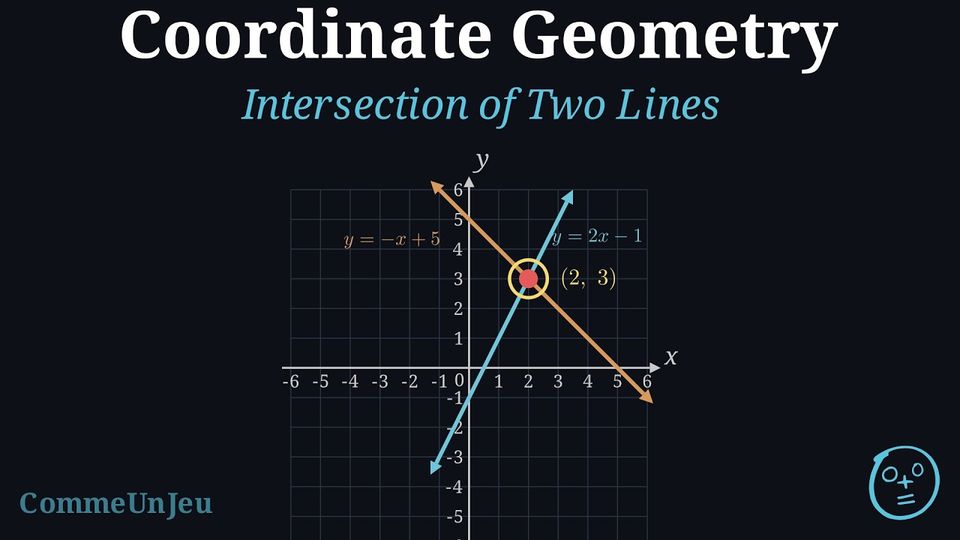
To find the point of intersection of two lines given by \(y = m_1x + c_1\) and \(y = m_2x + c_2\): - Check the gradients.
- If \(m_1 = m_2\) and \(c_1 \neq c_2\), the lines are parallel and there is no point of intersection.
- If \(m_1 = m_2\) and \(c_1 = c_2\), the lines coincide and have infinitely many common points.
- If \(m_1 \neq m_2\), continue to the next steps.
- Set the expressions for \(y\) equal to each other, since at the intersection point, the \(y\)-coordinates are the same: $$ m_1x + c_1 = m_2x + c_2. $$ (If one of the lines is vertical, \(x = k\), substitute \(x = k\) into the other equation instead.)
- Solve for \(x\). This will give the \(x\)-coordinate of the intersection.
- Substitute the value of \(x\) back into either of the original line equations to find the corresponding \(y\)-coordinate.
Example
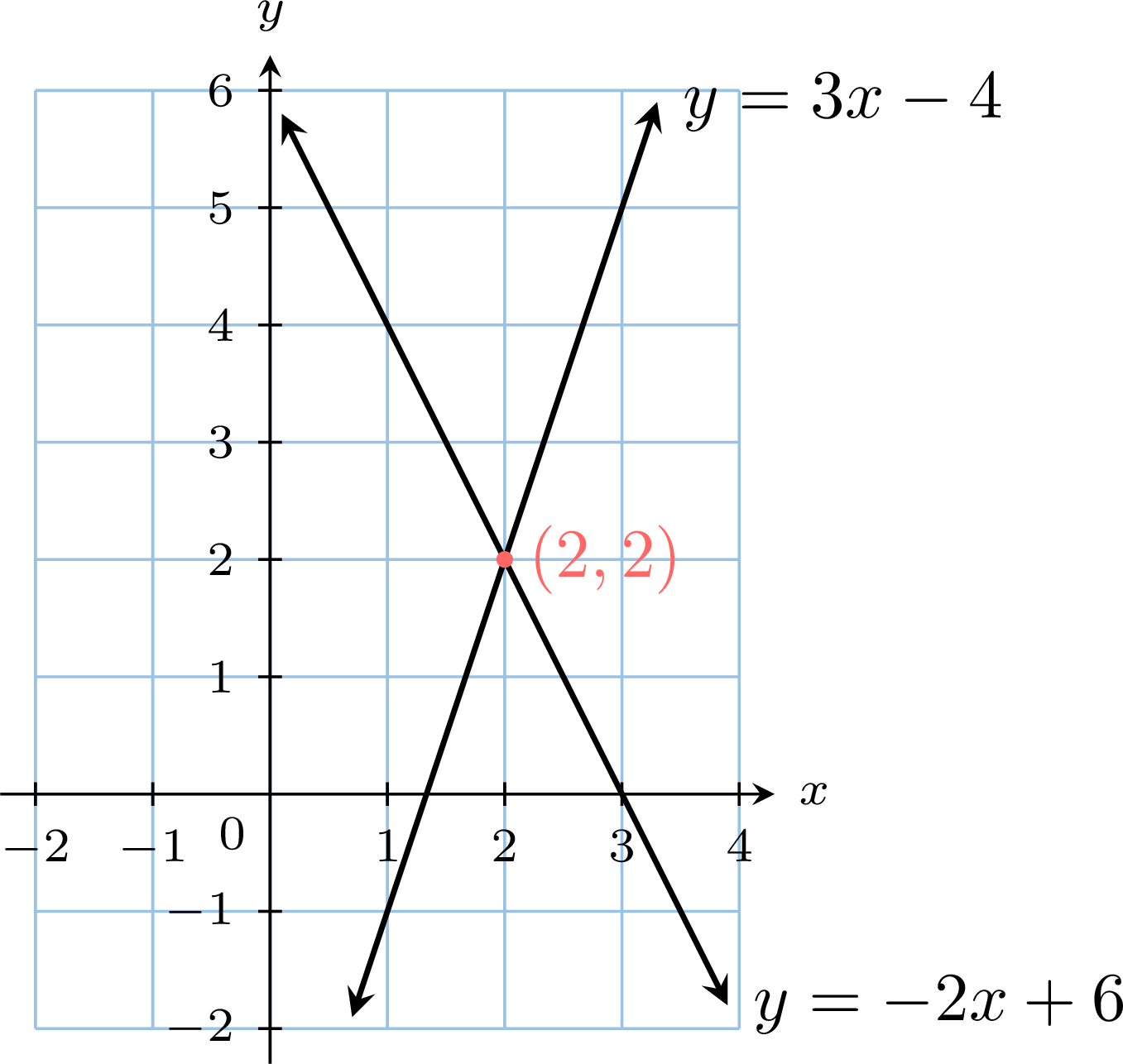
Find the point of intersection of the lines \(y=3x-4\) and \(y=-2x+6\). - Set the expressions for \(y\) equal to each other: $$ 3x-4 = -2x+6. $$
- Solve for \(x\): $$ \begin{aligned} 3x + 2x &= 6 + 4 \\ 5x &= 10 \\ x &= 2. \end{aligned} $$
- Substitute \(x=2\) into either equation to find \(y\): $$ y = 3(2) - 4 = 6-4 = 2. $$
Example
Determine the point of intersection of the lines \(d\) with equation \(x = -2\) and \(d'\) with equation \(y = 3x + 4\).
The line \(d\) is vertical and the line \(d'\) is not: they meet at exactly one point \(M\). Every point of \(d\) has \(x\)-coordinate \(-2\), so \(M\) has \(x\)-coordinate \(-2\), and its \(y\)-coordinate is given by the equation of \(d'\): $$\begin{aligned} y &= 3 \times (-2) + 4 && \text{(substitute } x = -2 \text{ into } y = 3x + 4\text{)}\\
&= -6 + 4 \\
&= -2 \end{aligned}$$ The lines intersect at \(M(-2, -2)\). Check: \(M\) lies on \(d\) (its \(x\)-coordinate is \(-2\)) and on \(d'\), since \(3 \times (-2) + 4 = -2\). 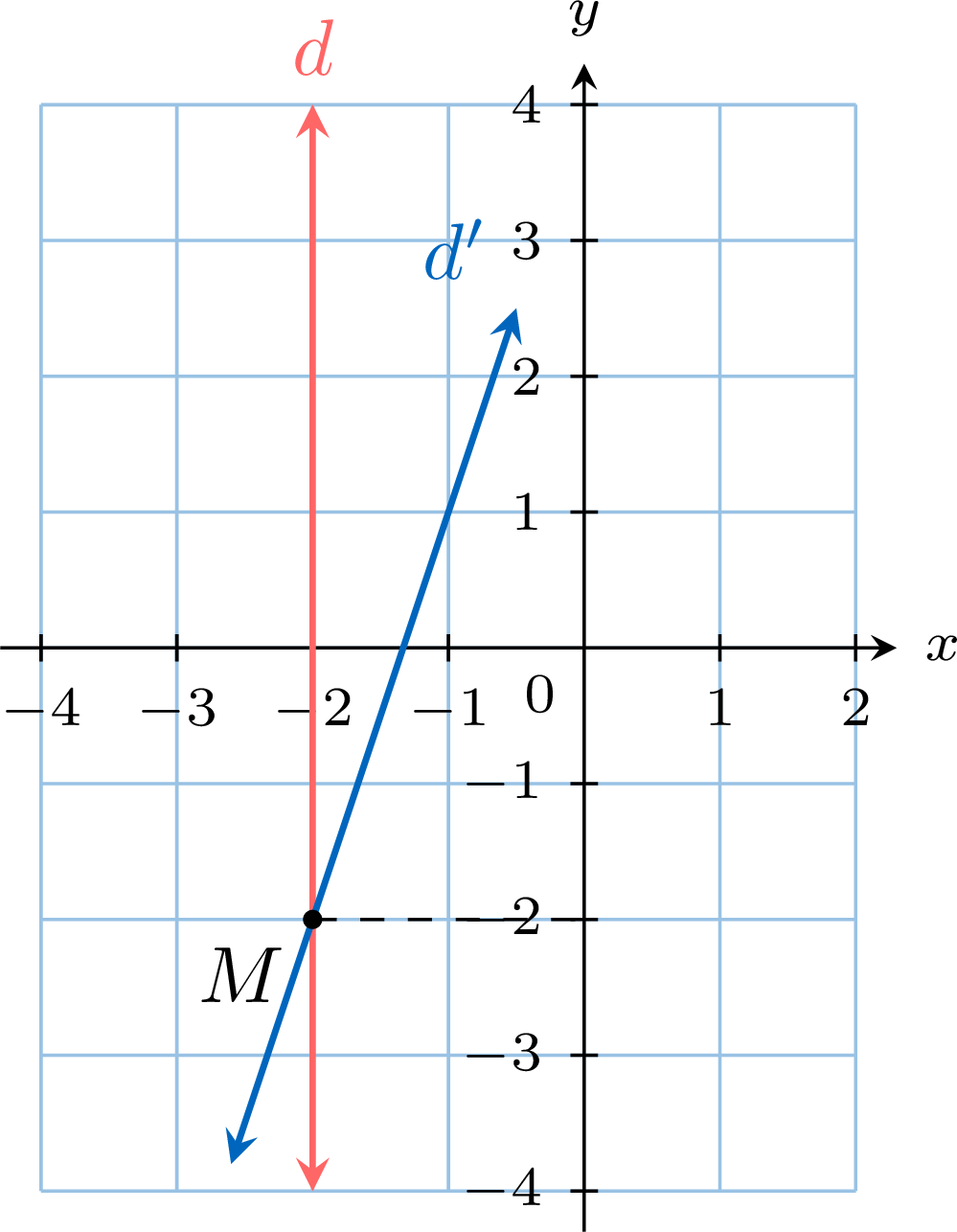
Skills to practice
- Finding the Intersection of Two Lines
II
Solving by Calculation
II.1
Solving by Substitution
In the system \(\begin{cases} y = 3x - 5 \\ 2x + y = 10 \end{cases}\), the first equation says what \(y\) is: \(y\) is the number \(3x - 5\). In the second equation, \(y\) can therefore be replaced by \(3x - 5\). What remains is an equation with the single unknown \(x\), solved with the balance moves.
Method — Solving by Substitution
- Isolate one unknown in one of the equations: preferably an unknown whose coefficient is \(1\) or \(-1\), which avoids fractions.
- Substitute: in the other equation, replace this unknown by the expression found, written between brackets.
- Solve the equation obtained: it has only one unknown.
- Back-substitute: replace the value found in the expression of step 1 to get the other unknown.
- Check the pair in both original equations, then conclude.
Example
Solve the system \(\begin{cases} y = 3x - 5 \\ 2x + y = 10 \end{cases}\).
The first equation already gives \(y\). It is substituted into the second one: $$\begin{aligned}[t] 2x + (3x - 5) &= 10 && \text{(replace } y \text{ by } 3x - 5\text{)} \\
5x - 5 &= 10 && \text{(collect the like terms)} \\
5x &= 15 && \text{(add } 5 \text{ to both sides)} \\
x &= 3 && \text{(divide both sides by } 5\text{)} \end{aligned}$$ Then \(y = 3 \times 3 - 5 = 4\). Check: \(3 \times 3 - 5 = 4\) and \(2 \times 3 + 4 = 10\), both true. The solution is the pair \((3, 4)\).
Example
Solve the system \(\begin{cases} x - 2y = 1 \\ 3x + 4y = 23 \end{cases}\).
The unknown \(x\) has coefficient \(1\) in the first equation, so it is isolated there: adding \(2y\) to both sides gives \(x = 1 + 2y\). It is substituted into the second equation, with brackets: $$\begin{aligned}[t] 3(1 + 2y) + 4y &= 23 && \text{(replace } x \text{ by } 1 + 2y\text{)} \\
3 + 6y + 4y &= 23 && \text{(expand)} \\
3 + 10y &= 23 && \text{(collect the like terms)} \\
10y &= 20 && \text{(subtract } 3 \text{ from both sides)} \\
y &= 2 && \text{(divide both sides by } 10\text{)} \end{aligned}$$ Then \(x = 1 + 2 \times 2 = 5\). Check: \(5 - 2 \times 2 = 1\) and \(3 \times 5 + 4 \times 2 = 15 + 8 = 23\), both true. The solution is the pair \((5, 2)\). Without the brackets, \(3 \times 1 + 2y\) would multiply only the \(1\) by \(3\).
Example
Solve the system \(\begin{cases} y = 2x + 7 \\ y = -x + 1 \end{cases}\), and interpret the solution graphically.
Both equations give \(y\). Substituting \(2x + 7\) for \(y\) in the second equation amounts to equating the two expressions of \(y\): $$\begin{aligned}[t] 2x + 7 &= -x + 1 && \text{(replace } y \text{ by } 2x + 7\text{)} \\
3x + 7 &= 1 && \text{(add } x \text{ to both sides)} \\
3x &= -6 && \text{(subtract } 7 \text{ from both sides)} \\
x &= -2 && \text{(divide both sides by } 3\text{)} \end{aligned}$$ Then \(y = 2 \times (-2) + 7 = 3\). Check: \(2 \times (-2) + 7 = 3\) and \(-(-2) + 1 = 3\), both true. The solution is the pair \((-2, 3)\): the lines of equations \(y = 2x + 7\) and \(y = -x + 1\) meet at the point \((-2, 3)\).
Skills to practice
- Substituting Correctly
- Solving by Substitution
- Writing a Solution by Substitution
II.2
Solving by Elimination
Nour buys an umbrella and a walking cane for \(\dollar 120\) in all. The umbrella costs \(\dollar 54\) more than the cane. What is the price of each object? 
The two bars share the same hidden part \(\square\) (the price of the cane); the umbrella bar has an extra piece of \(54\). Without that extra piece, the total would be \(120 - 54 = 66\), made of two equal parts: \(\square = 66 \div 2 = 33\). The cane costs \(\dollar 33\) and the umbrella \(33 + 54 = \dollar 87\). Check: \(33 + 87 = 120\).
With two letters, \(x\) for the price of the umbrella and \(y\) for the price of the cane, the statement becomes the system \(\begin{cases} x + y = 120 \\ x - y = 54 \end{cases}\). Removing the extra piece of \(54\) from the total, as the bar model does, is subtracting the second equation from the first: \((x + y) - (x - y) = 120 - 54\), that is \(2y = 66\). The unknown \(x\) has disappeared. This idea, making one unknown disappear by combining the two equations, works for every system, even when no bar model is in sight.
Proposition — Combining Two Equations
If a pair \((x, y)\) satisfies two equations \(A = B\) and \(C = D\), then it also satisfies: - \(A + C = B + D\) and \(A - C = B - D\): the two equations can be added or subtracted side by side;
- \(kA = kB\) for any number \(k\): an equation can be multiplied by a number.
Suppose that the pair \((x, y)\) satisfies \(A = B\) and \(C = D\): with these values of \(x\) and \(y\), the expressions \(A\) and \(B\) are the same number, and so are \(C\) and \(D\). Then $$\begin{aligned}[t] A + C &= B + C && \text{(since } A = B\text{)} \\
&= B + D && \text{(since } C = D\text{)} \end{aligned}$$ In the same way, \(A - C = B - C = B - D\). Finally, multiplying the same number, \(A = B\), by \(k\) gives the same product: \(kA = kB\). So the pair satisfies the three new equations.
Method — Solving by Elimination
- Write both equations in the form \(ax + by = c\), with the unknowns lined up.
- Choose the unknown to eliminate. If needed, multiply one equation, or both, by nonzero numbers so that the two coefficients of this unknown become opposite (or equal).
- Add the two equations when these coefficients are opposite, subtract them when they are equal: the chosen unknown disappears.
- Solve the equation obtained, which has only one unknown.
- Back-substitute the value found in one of the original equations to find the other unknown.
- Check the pair in both original equations, then conclude. When the combinations lead to one value of each unknown, they only show that no other pair is possible; the check shows that this pair is indeed a solution. When both unknowns disappear, the Method “Recognising the Case While Solving” applies.
Example
Solve the system \(\begin{cases} x + y = 120 \\ x - y = 54 \end{cases}\) by elimination, and give the price of the umbrella and the price of the cane.
The coefficients of \(y\) are \(1\) and \(-1\): they are already opposite, so adding the equations eliminates \(y\): $$\begin{aligned}[t] (x + y) + (x - y) &= 120 + 54 && \text{(add the two equations)} \\
2x &= 174 && \text{(the terms in } y \text{ cancel out)} \\
x &= 87 && \text{(divide both sides by } 2\text{)} \end{aligned}$$ Back-substituting in the first equation, \(87 + y = 120\), so \(y = 33\). Check: \(87 + 33 = 120\) and \(87 - 33 = 54\). The solution is the pair \((87, 33)\): the umbrella costs \(\dollar 87\) and the cane \(\dollar 33\). Subtracting the equations would have eliminated \(x\) instead, giving \(2y = 66\): the route of the bar model.
Example
Solve the system \(\begin{cases} 2x + 5y = 1 \\ 2x + y = -3 \end{cases}\).
The coefficients of \(x\) are equal, so subtracting the second equation from the first eliminates \(x\). The brackets keep every sign: $$\begin{aligned}[t] (2x + 5y) - (2x + y) &= 1 - (-3) && \text{(subtract the second equation from the first)} \\
2x + 5y - 2x - y &= 1 + 3 && \text{(remove the brackets)} \\
4y &= 4 && \text{(collect the like terms)} \\
y &= 1 && \text{(divide both sides by } 4\text{)} \end{aligned}$$ Back-substituting in the second equation, \(2x + 1 = -3\), so \(2x = -4\) and \(x = -2\). Check: \(2 \times (-2) + 5 \times 1 = 1\) and \(2 \times (-2) + 1 = -3\), both true. The solution is the pair \((-2, 1)\).
Example
Solve the system \(\begin{cases} 3x + 2y = 12 \\ 5x - 3y = 1 \end{cases}\).
No coefficient is \(1\) or \(-1\), so elimination avoids fractions. To eliminate \(y\), whose coefficients are \(2\) and \(-3\), the first equation is multiplied by \(3\) and the second by \(2\): the coefficients of \(y\) become \(6\) and \(-6\), which are opposite. $$\begin{aligned}[t] 9x + 6y &= 36 && \text{(first equation multiplied by } 3\text{)} \\
10x - 6y &= 2 && \text{(second equation multiplied by } 2\text{)} \\
19x &= 38 && \text{(add the two new equations)} \\
x &= 2 && \text{(divide both sides by } 19\text{)} \end{aligned}$$ Back-substituting in the first equation, \(3 \times 2 + 2y = 12\), so \(2y = 6\) and \(y = 3\). Check: \(3 \times 2 + 2 \times 3 = 12\) and \(5 \times 2 - 3 \times 3 = 1\), both true. The solution is the pair \((2, 3)\). Eliminating \(x\) first, with the multipliers \(5\) and \(3\) and a subtraction, gives the same pair.
Skills to practice
- Preparing an Elimination
- Solving by Elimination
- Writing a Solution by Elimination
II.3
Choosing a Method
Method — Choosing a Method
- First tidy each equation: expand the brackets, clear fractions or decimals by multiplying both sides by a suitable number, and bring the unknowns to the left-hand side.
- If an unknown has coefficient \(1\) or \(-1\), or if an equation already gives \(y = \ldots\) or \(x = \ldots\), substitution is quick.
- If no coefficient is \(1\) or \(-1\), or if two coefficients of the same unknown are already equal or opposite, elimination avoids fractions.
- Both methods give the same solutions, whether there is one, none or infinitely many: the choice only changes the amount of computation. A graph gives a picture of the solution and a reading of it; only a check by calculation shows that a pair read is exact.
Example
For each system, choose a method, justify the choice, then solve the system. - \(\begin{cases} y = 4 - x \\ 3x - 2y = 7 \end{cases}\)
- \(\begin{cases} 4x + 3y = 5 \\ 6x - 5y = 17 \end{cases}\)
- The first equation already gives \(y\): substitution. $$\begin{aligned}[t] 3x - 2(4 - x) &= 7 && \text{(replace } y \text{ by } 4 - x\text{)} \\ 3x - 8 + 2x &= 7 && \text{(expand)} \\ 5x - 8 &= 7 && \text{(collect the like terms)} \\ 5x &= 15 && \text{(add } 8 \text{ to both sides)} \\ x &= 3 && \text{(divide both sides by } 5\text{)} \end{aligned}$$ Then \(y = 4 - 3 = 1\). Check: \(1 = 4 - 3\) and \(3 \times 3 - 2 \times 1 = 7\). The solution is \((3, 1)\).
- No coefficient is \(1\) or \(-1\): elimination. The coefficients of \(x\), \(4\) and \(6\), both become \(12\) after multiplying the first equation by \(3\) and the second by \(2\): $$\begin{aligned}[t] 12x + 9y &= 15 && \text{(first equation multiplied by } 3\text{)} \\ 12x - 10y &= 34 && \text{(second equation multiplied by } 2\text{)} \\ 19y &= -19 && \text{(subtract the second new equation from the first)} \\ y &= -1 && \text{(divide both sides by } 19\text{)} \end{aligned}$$ Then \(4x + 3 \times (-1) = 5\), so \(4x = 8\) and \(x = 2\). Check: \(4 \times 2 - 3 = 5\) and \(6 \times 2 + 5 = 17\). The solution is \((2, -1)\).
Example
Tidy each system, then solve it. - \(\begin{cases} 2(x + 1) - y = 7 \\ \dfrac{x}{2} + \dfrac{y}{3} = 3 \end{cases}\)
- \(\begin{cases} 0.2x + 0.5y = 1.6 \\ x - y = 1 \end{cases}\)
- Expanding the first equation, \(2x + 2 - y = 7\), so \(2x - y = 5\). Multiplying both sides of the second one by \(6\), the common denominator, gives \(3x + 2y = 18\). In \(2x - y = 5\) the coefficient of \(y\) is \(-1\): substitution, with \(y = 2x - 5\). $$\begin{aligned}[t] 3x + 2(2x - 5) &= 18 && \text{(replace } y \text{ by } 2x - 5\text{)} \\ 7x - 10 &= 18 && \text{(expand and collect the like terms)} \\ 7x &= 28 && \text{(add } 10 \text{ to both sides)} \\ x &= 4 && \text{(divide both sides by } 7\text{)} \end{aligned}$$ Then \(y = 2 \times 4 - 5 = 3\). Check in the original system: \(2(4 + 1) - 3 = 7\) and \(\dfrac{4}{2} + \dfrac{3}{3} = 2 + 1 = 3\). The solution is \((4, 3)\).
- Multiplying both sides of the first equation by \(10\) gives \(2x + 5y = 16\). In the second one, \(x = 1 + y\): $$\begin{aligned}[t] 2(1 + y) + 5y &= 16 && \text{(replace } x \text{ by } 1 + y\text{)} \\ 2 + 7y &= 16 && \text{(expand and collect the like terms)} \\ 7y &= 14 && \text{(subtract } 2 \text{ from both sides)} \\ y &= 2 && \text{(divide both sides by } 7\text{)} \end{aligned}$$ Then \(x = 1 + 2 = 3\). Check: \(0.2 \times 3 + 0.5 \times 2 = 0.6 + 1 = 1.6\) and \(3 - 2 = 1\). The solution is \((3, 2)\).
Skills to practice
- Tidying a System Before Solving
- Solving Systems with Any Method
- Choosing and Justifying a Method
III
Solutions and Problems
III.1
The Number of Solutions
Solving \(\begin{cases} x - 2y = 5 \\ x - 2y = 7 \end{cases}\) by subtraction removes \(x\) and \(y\) at the same time and leaves \(0 = -2\): false, whatever the pair. Solving \(\begin{cases} x - 2y = 5 \\ 2x - 4y = 10 \end{cases}\) after multiplying the first equation by \(2\) also removes both unknowns, and leaves \(0 = 0\): an equality that no longer says anything about \(x\) and \(y\). In the first case no pair can be a solution; in the second one, which pairs are solutions? The two lines of a system explain what happens.
Proposition — Number of Solutions of a System
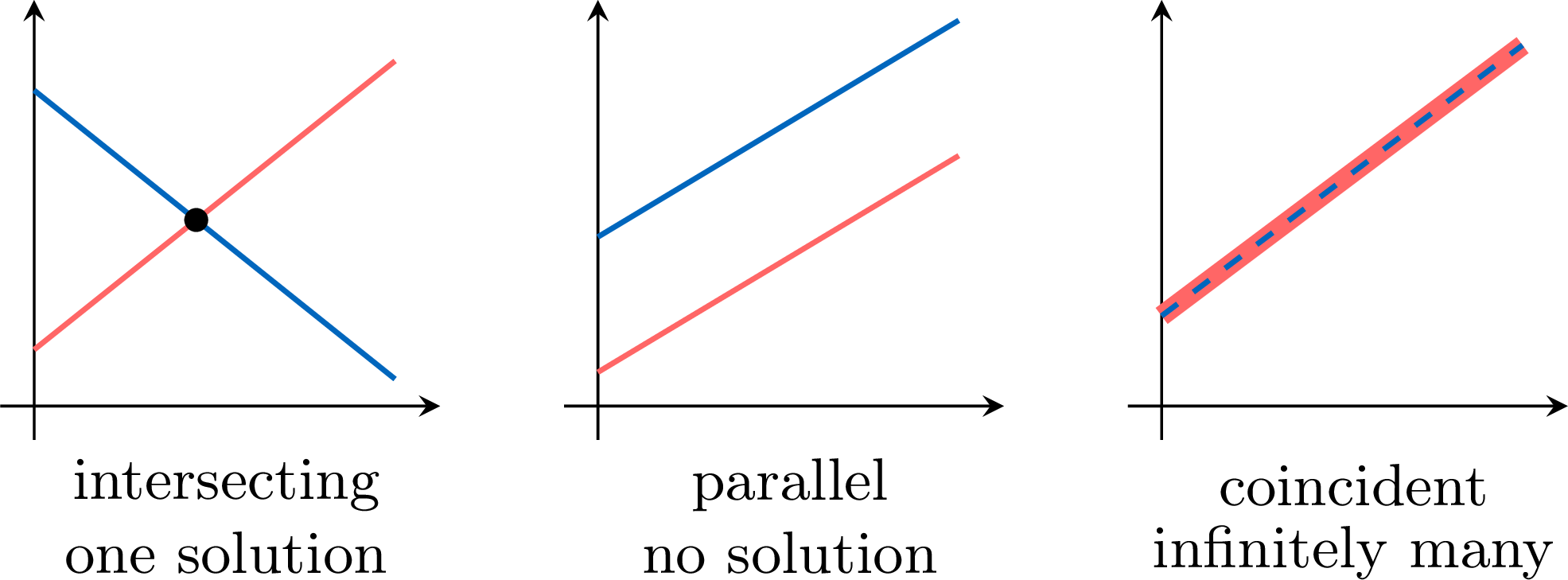
Consider a system whose equations can be rearranged as \(y = m_1x + c_1\) and \(y = m_2x + c_2\), where \(m_1\) and \(m_2\) are the gradients (also called slopes) of the two lines. - If \(m_1 \neq m_2\), the lines are intersecting: the system has exactly one solution.
- If \(m_1 = m_2\) and \(c_1 \neq c_2\), the lines are parallel and distinct: the system has no solution.
- If \(m_1 = m_2\) and \(c_1 = c_2\), the lines are coincident (they are the same line): the system has infinitely many solutions, all the pairs \((x, m_1x + c_1)\).
A solution \((x, y)\) satisfies \(y = m_1x + c_1\) and \(y = m_2x + c_2\), so the two expressions of \(y\) are equal: $$\begin{aligned}[t] m_1x + c_1 &= m_2x + c_2 && \text{(both are equal to } y\text{)} \\
m_1x - m_2x + c_1 &= c_2 && \text{(subtract } m_2x \text{ from both sides)} \\
m_1x - m_2x &= c_2 - c_1 && \text{(subtract } c_1 \text{ from both sides)} \\
(m_1 - m_2)x &= c_2 - c_1 && \text{(factorise by } x\text{)} \end{aligned}$$
- If \(m_1 \neq m_2\), then \(m_1 - m_2 \neq 0\), and dividing by it gives the single value \(x = \dfrac{c_2 - c_1}{m_1 - m_2}\), then the single value \(y = m_1x + c_1\). For this \(x\) the two expressions of \(y\) are equal, so this pair satisfies both equations: exactly one solution.
- If \(m_1 = m_2\), the last equation reads \(0 \times x = c_2 - c_1\). When \(c_1 \neq c_2\), it is false for every \(x\): no solution. When \(c_1 = c_2\), the two equations are the same equation, and every pair \((x, m_1x + c_1)\) satisfies both: infinitely many solutions.
Method — Recognising the Case While Solving
When substitution or elimination makes both unknowns disappear: - a false equality, such as \(0 = -2\), means that no pair is a solution: the lines are parallel and distinct;
- an equality that is always true, such as \(0 = 0\), means that the two equations describe the same line: the solutions are all the pairs \((x, y)\) satisfying one of the equations, written \(y = mx + c\).
Example
Solve each system, then interpret the result with the two lines. - \(\begin{cases} 2x - y = 3 \\ -4x + 2y = 1 \end{cases}\)
- \(\begin{cases} x + 3y = 6 \\ 2x + 6y = 12 \end{cases}\)
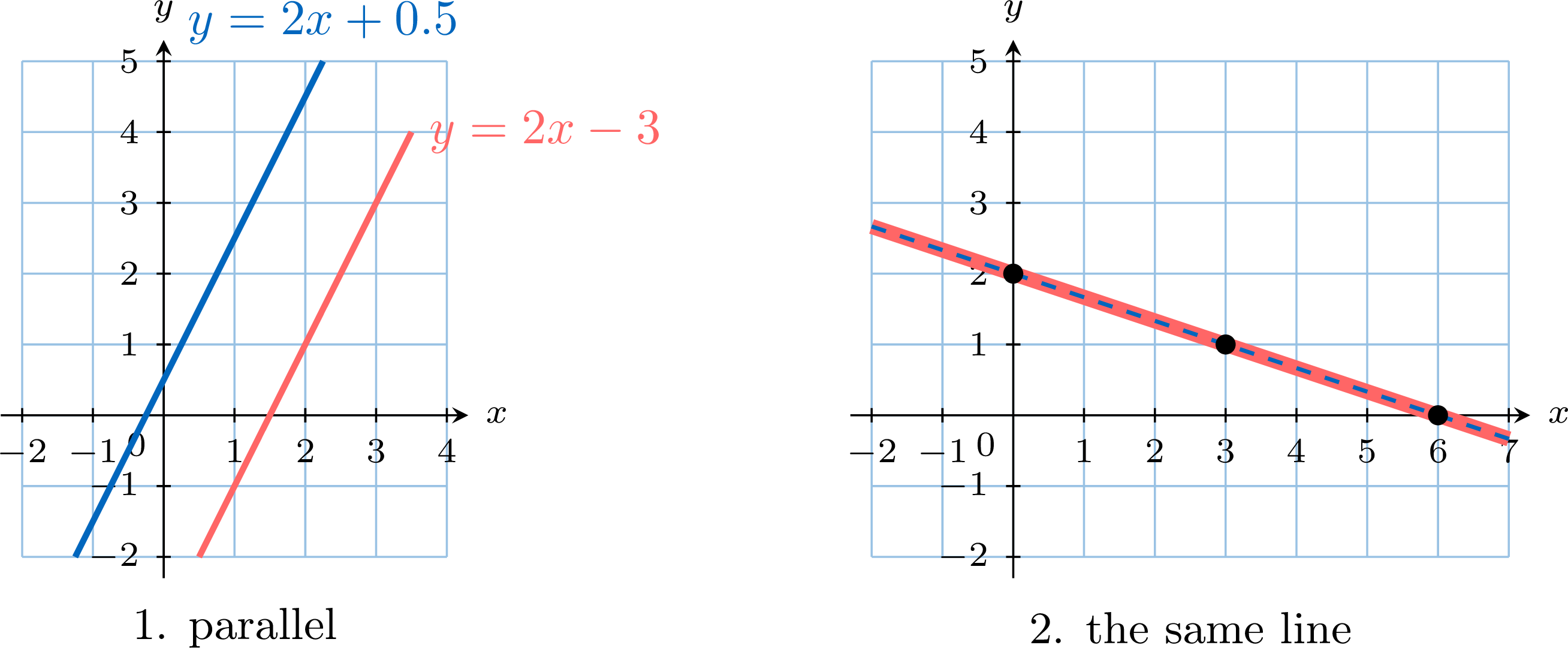
- Multiplying the first equation by \(2\) makes the coefficients of \(x\) opposite: $$\begin{aligned}[t] 4x - 2y &= 6 && \text{(first equation multiplied by } 2\text{)} \\ 0 &= 7 && \text{(add the second equation)} \end{aligned}$$ The equality \(0 = 7\) is false: the system has no solution. Indeed, the equations rearrange as \(y = 2x - 3\) and \(y = 2x + 0.5\): the same gradient \(2\), different \(y\)-intercepts. The lines are parallel and distinct.
- Multiplying the first equation by \(2\) gives \(2x + 6y = 12\), exactly the second equation: subtracting leaves \(0 = 0\), always true. The system has infinitely many solutions: the two equations describe the same line, \(y = -\dfrac{1}{3}x + 2\). The solutions are all the pairs \(\left(x, -\dfrac{1}{3}x + 2\right)\), for example \((0, 2)\), \((3, 1)\) and \((6, 0)\).
Example
Without solving, give the number of solutions of each system. - \(\begin{cases} y = 3x - 2 \\ y = -x + 6 \end{cases}\)
- \(\begin{cases} y = \dfrac{1}{2}x + 1 \\ x - 2y = 4 \end{cases}\)
- The gradients are \(3\) and \(-1\): they are different, so the lines are intersecting and the system has exactly one solution.
- The second equation is rearranged in the form \(y = mx + c\): $$\begin{aligned}[t] x - 2y &= 4 \\ -2y &= -x + 4 && \text{(subtract } x \text{ from both sides)} \\ y &= \dfrac{1}{2}x - 2 && \text{(divide both sides by } -2\text{)} \end{aligned}$$ Both gradients are \(\dfrac{1}{2}\), and the \(y\)-intercepts, \(1\) and \(-2\), are different: the lines are parallel and distinct, and the system has no solution.
Skills to practice
- Predicting the Number of Solutions
- Finding a Coefficient for a Given Case
- Interpreting a Special System
- Justifying and Finding an Intersection
III.2
Solving Problems with a System
A situation with two unknown quantities and two pieces of information is modelled by a system. When one piece of information already expresses one quantity in terms of the other, such as “\(54\) more than”, a single letter is enough, as in a bar model. When the two pieces of information are separate, such as a number of objects and a total price, two letters and a system describe the situation directly.
Method — Solving a Problem with a System
- Choose the unknowns: name them with letters, and state what each one represents, with its unit.
- Translate each piece of information of the statement into an equation.
- Solve the system, by the method of your choice.
- Check the values in the statement itself, not only in the equations: a mistake made while translating survives a check in the equations.
- Answer the question with a sentence and the units, after making sure that the values make sense (whole numbers of people, prices that are not negative, …).
Example
For a school play, an adult ticket costs \(\dollar 8\) and a pupil ticket costs \(\dollar 5\). In all, \(150\) tickets were sold, for \(\dollar 921\). How many adult tickets and how many pupil tickets were sold?
Unknowns: \(x\) is the number of adult tickets, \(y\) the number of pupil tickets.
Equations: \(150\) tickets in all gives \(x + y = 150\); the takings of \(\dollar 921\) give \(8x + 5y = 921\).
Solving: the first equation gives \(y = 150 - x\), substituted into the second one: $$\begin{aligned}[t] 8x + 5(150 - x) &= 921 && \text{(replace } y \text{ by } 150 - x\text{)} \\ 8x + 750 - 5x &= 921 && \text{(expand)} \\ 3x + 750 &= 921 && \text{(collect the like terms)} \\ 3x &= 171 && \text{(subtract } 750 \text{ from both sides)} \\ x &= 57 && \text{(divide both sides by } 3\text{)} \end{aligned}$$ Then \(y = 150 - 57 = 93\).
Check in the statement: \(57 + 93 = 150\) tickets, and \(8 \times 57 + 5 \times 93 = 456 + 465 = 921\) dollars.
Answer: \(57\) adult tickets and \(93\) pupil tickets were sold.
Example
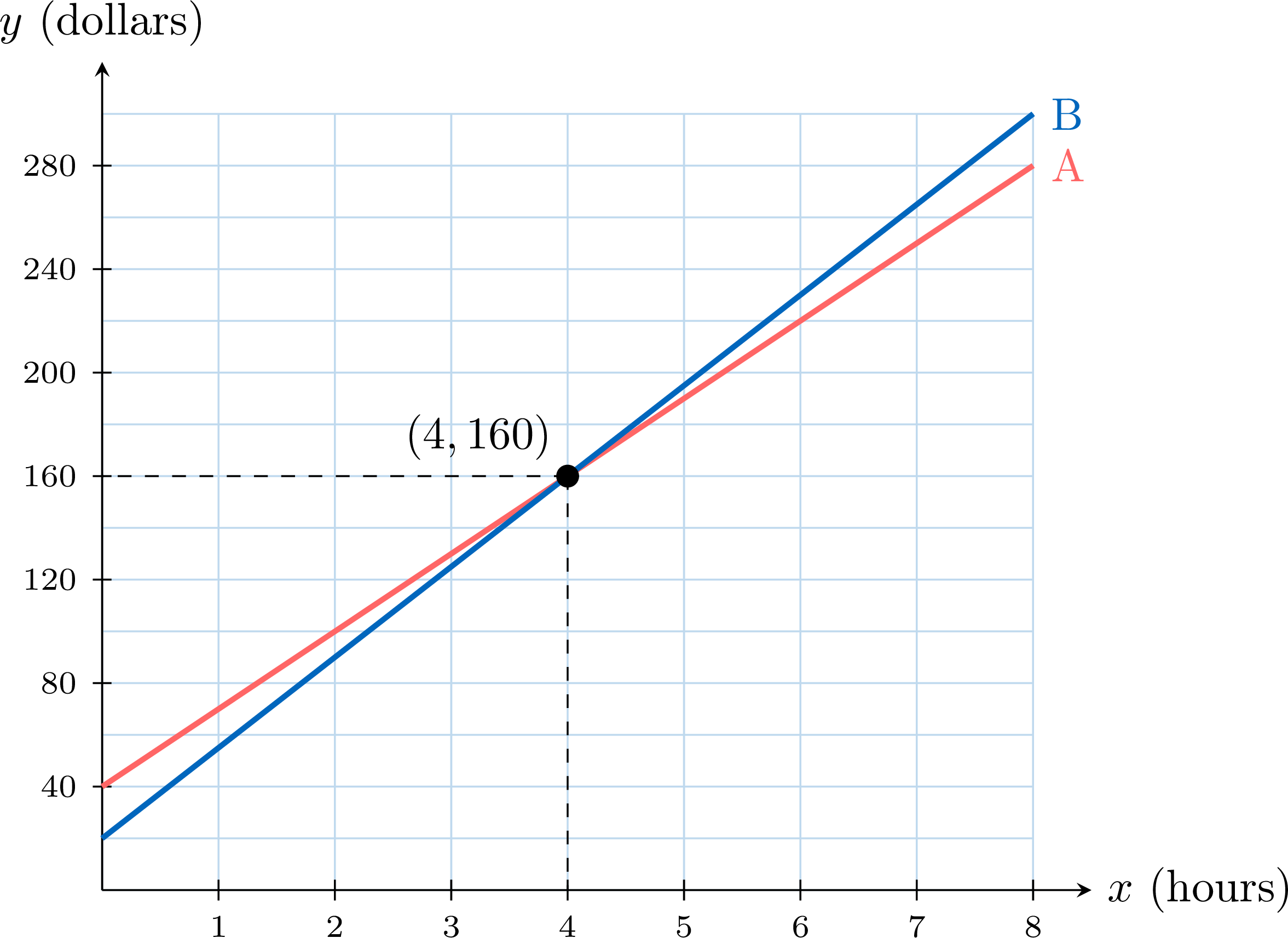
Plumber A charges a call-out fee of \(\dollar 40\) plus \(\dollar 30\) per hour of work. Plumber B charges a call-out fee of \(\dollar 20\) plus \(\dollar 35\) per hour. - Write the cost \(y\), in dollars, of \(x\) hours of work with each plumber.
- For how many hours of work do the two plumbers charge the same price? What is this price?
- Draw the two lines for \(0 \le x \le 8\) in the same coordinate plane, and read the answer: which plumber is cheaper for \(6\) hours of work?
- Plumber A: \(y = 30x + 40\). Plumber B: \(y = 35x + 20\).
- The same price for the same number of hours means a solution of the system \(\begin{cases} y = 30x + 40 \\ y = 35x + 20 \end{cases}\). Equating the two expressions of \(y\): $$\begin{aligned}[t] 30x + 40 &= 35x + 20 && \text{(both are equal to } y\text{)} \\ 40 &= 5x + 20 && \text{(subtract } 30x \text{ from both sides)} \\ 20 &= 5x && \text{(subtract } 20 \text{ from both sides)} \\ x &= 4 && \text{(divide both sides by } 5\text{)} \end{aligned}$$ Then \(y = 30 \times 4 + 40 = 160\). Check: \(35 \times 4 + 20 = 160\) as well. For \(4\) hours of work, both plumbers charge \(\dollar 160\).
- The two lines are drawn below, each from two of its points: \((0, 40)\) and \((8, 280)\) for plumber A, \((0, 20)\) and \((8, 300)\) for plumber B. Their intersection point is \((4, 160)\). To its right, the line of plumber A is below the line of plumber B: for more than \(4\) hours, plumber A is cheaper. For \(6\) hours: \(30 \times 6 + 40 = 220\) against \(35 \times 6 + 20 = 230\), so plumber A is cheaper, by \(\dollar 10\).
Skills to practice
- Translating a Situation into a System
- Solving Word Problems: Level 1
- Solving Word Problems: Level 2
IV
Going further
Skills to practice
- Solving Problems in Context
- Investigating Patterns in Systems of Equations
- Quiz
Jump to section