International Baccalaureate · MYP 2
Volume, Capacity and Mass
I
Finding the Volume of a Solid of Uniform Cross-Section
Proposition — Volume of a Rectangular Prism
The volume of a rectangular prism (also called a cuboid) is found by multiplying its length, width, and height: $$\text{Volume} = \textcolor{colordef}{\text{length}} \times \textcolor{colorprop}{\text{width}} \times \textcolor{olive}{\text{height}}$$ $$V = \textcolor{colordef}{l} \times \textcolor{colorprop}{w} \times \textcolor{olive}{h}$$ 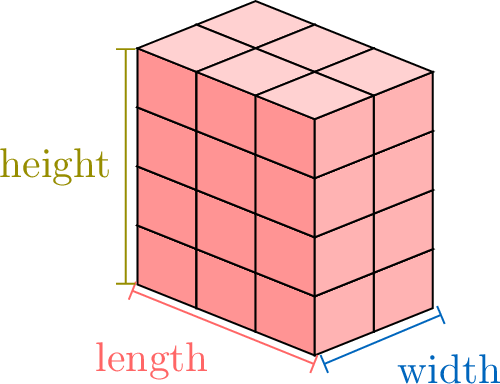
Counting the cubes inside a solid to find its volume can be time-consuming, especially for solids with a uniform cross-section. Instead, we can explore a faster method by examining the solid layer by layer to identify a pattern for calculating the volume.
- Area of the Base:
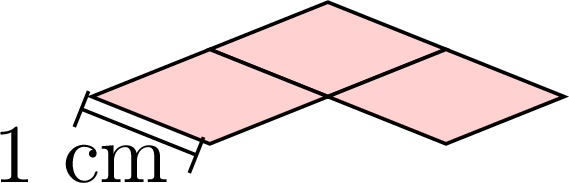
- Volume with Height of 1 cm:

- Volume with Height of 2 cm:

- Volume with Height of 3 cm:

- General Formula:

Proposition — Volume of a Solid of Uniform Cross-Section
$$\text{Volume} = \textcolor{colordef}{\text{area of the cross-section}} \times \textcolor{olive}{\text{length}}$$ The length is the distance between the two ends, measured perpendicular to them; for a solid standing on an end, it is its height. Example
Find the volume of the figure. 
- Area of
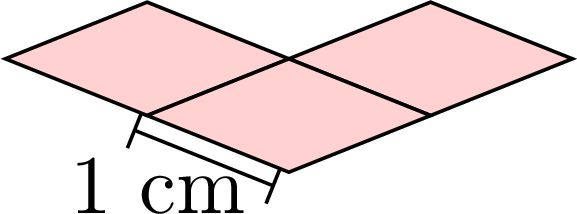 = \(3 \, \text{cm}^2\)
- height = \(4 \, \text{cm}\)
- $$ \begin{aligned}[t] V &= \text{area of base} \times \text{height} \\ &= 3 \, \text{cm}^2 \times 4 \, \text{cm} \\ &= 12 \, \text{cm}^3 \end{aligned} $$
Skills to practice
- Calculating Volumes Layer by Layer
- Calculating Volumes of Prisms
II
Linking Volume, Capacity and Mass
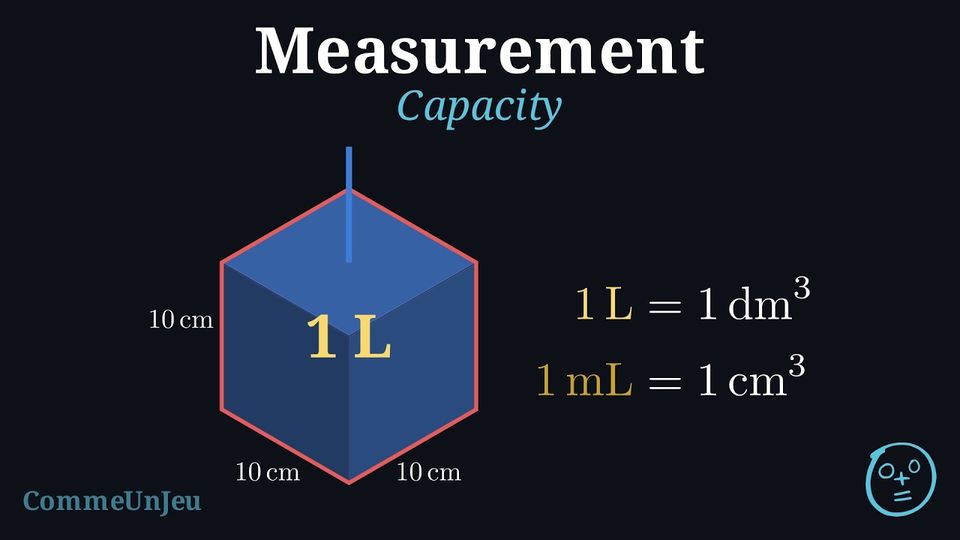
Example — From Cubic Centimetres to Litres
Leo has a cube-shaped box. Measured on the inside, it is \(10~\mathrm{cm}\) long, \(10~\mathrm{cm}\) wide and \(10~\mathrm{cm}\) high. 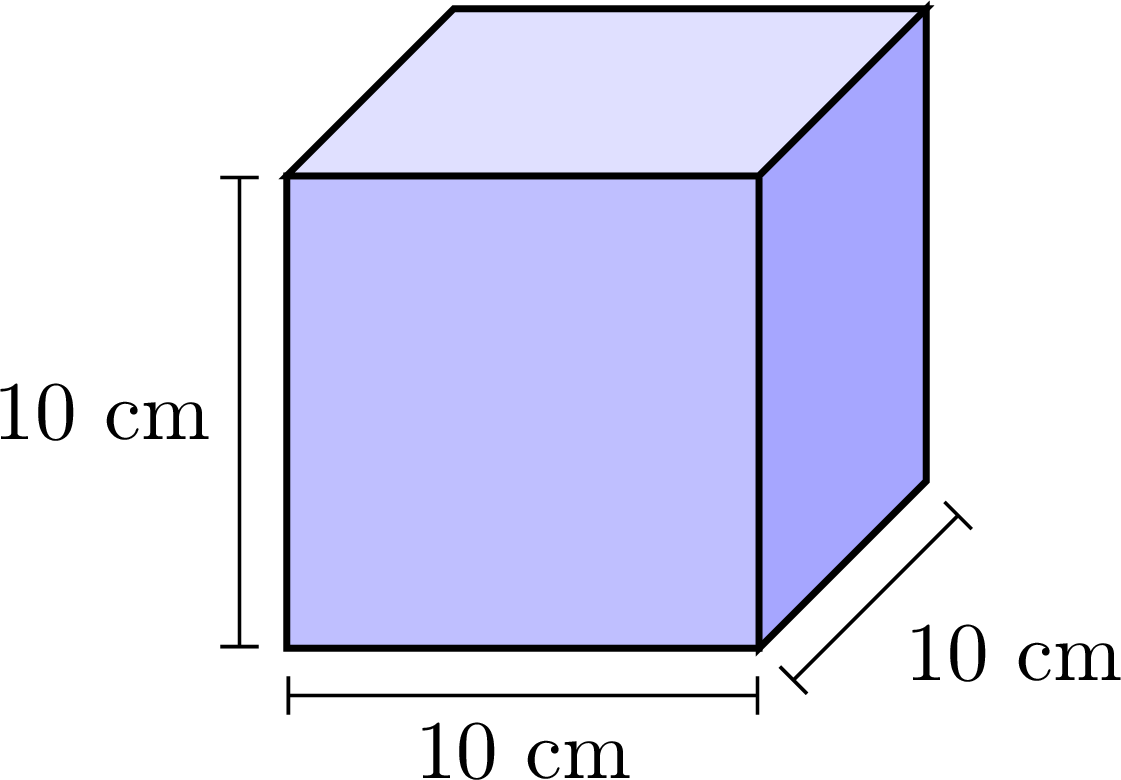
- Find the volume of the box in cubic centimetres.
- Leo fills the box to the top with water. How much water does it hold, in millilitres, then in litres?
- A water tank has a volume of \(1~\mathrm{m}^3\). How many litres of water does it hold?
- Inside, the box is a rectangular prism whose three edges measure \(10~\mathrm{cm}\): $$\begin{aligned} V &= \text{length} \times \text{width} \times \text{height} &&\text{(volume of a rectangular prism)}\\ &= 10~\mathrm{cm} \times 10~\mathrm{cm} \times 10~\mathrm{cm}\\ &= 100 \times 10~\mathrm{cm}^3\\ &= \textcolor{colorprop}{1\,000~\mathrm{cm}^3} \end{aligned}$$
- One millilitre of water fills exactly one cubic centimetre, so each of the \(1\,000\) cubic centimetres of the box holds \(1~\mathrm{mL}\): $$\begin{aligned} 1\,000~\mathrm{cm}^3 &= 1\,000~\mathrm{mL} &&\text{(}1~\mathrm{cm}^3 = 1~\mathrm{mL}\text{)}\\ &= (1\,000 \div 1\,000)~\mathrm{L} &&\text{(}1\,000~\mathrm{mL} = 1~\mathrm{L}\text{)}\\ &= \textcolor{colorprop}{1~\mathrm{L}} \end{aligned}$$ The box holds \(1\,000~\mathrm{mL}\), that is \(1~\mathrm{L}\). Its edges measure \(10~\mathrm{cm} = 1~\mathrm{dm}\): it is the cubic decimetre. So one litre is one cubic decimetre: $$1~\mathrm{L} = 1~\mathrm{dm}^3 = 1\,000~\mathrm{cm}^3.$$
- A cubic metre is a cube of edge \(1~\mathrm{m}\), that is \(100~\mathrm{cm}\), and each of its cubic centimetres holds one millilitre: $$\begin{aligned} 1~\mathrm{m}^3 &= (100 \times 100 \times 100)~\mathrm{cm}^3 &&\text{(}1~\mathrm{m} = 100~\mathrm{cm}\text{)}\\ &= 1\,000\,000~\mathrm{cm}^3 &&\text{(conversion of volume units)}\\ &= 1\,000\,000~\mathrm{mL} &&\text{(}1~\mathrm{cm}^3 = 1~\mathrm{mL}\text{)}\\ &= (1\,000\,000 \div 1\,000)~\mathrm{L} &&\text{(}1\,000~\mathrm{mL} = 1~\mathrm{L}\text{)}\\ &= \textcolor{colorprop}{1\,000~\mathrm{L}} \end{aligned}$$ The tank holds \(1\,000~\mathrm{L}\) of water: \(1~\mathrm{m}^3 = 1\,000~\mathrm{L}\).
The Mass of Water
Water links volume, capacity and mass: \(1 \,\text{cm}^3\) of water, that is \(1 \,\text{mL}\), has a mass of about \(1 \,\text{g}\). Multiplying by \(1\,000\) twice gives the whole table:
This is why a full one-litre bottle of water is a good reference mass for \(1\) kg (Proposition “Reference Masses”). These values hold almost exactly for pure water at \(4^\circ\)C, and very closely for tap water; other liquids differ: \(1\) L of cooking oil has a mass of about \(0.9\) kg, \(1\) L of honey about \(1.4\) kg.
| Volume | Capacity | Mass of the water |
| \(1 \,\text{cm}^3\) | \(1 \,\text{mL}\) | about \(1 \,\text{g}\) |
| \(1 \,\text{dm}^3\) | \(1 \,\text{L}\) | about \(1 \,\text{kg}\) |
| \(1 \,\text{m}^3\) | \(1\,000 \,\text{L}\) (\(1 \,\text{kL}\)) | about \(1 \,\text{t}\) |
Example
An aquarium is a cuboid \(50\) cm long, \(30\) cm wide and \(40\) cm high on the inside. - Find its capacity in litres.
- Find the mass of the water when it is full.
- The empty aquarium has a mass of \(12\) kg. Two people can each carry \(30\) kg. Can they carry the full aquarium together?
- $$\begin{aligned}[t] V &= l \times w \times h && \text{(volume of a cuboid)}\\ &= 50 \times 30 \times 40 = 60\,000 \,\text{cm}^3 &&\\ &= 60\,000 \,\text{mL} = 60 \,\text{L}. && \text{(\(1 \,\text{cm}^3 = 1 \,\text{mL}\), \(1 \,\text{L} = 1\,000 \,\text{mL}\))} \end{aligned}$$
- \(1\) L of water has a mass of about \(1\) kg, so \(60\) L of water have a mass of about \(\mathbf{60}\) kg — as much as \(60\) one-litre bottles of water.
- Full aquarium: about \(12 + 60 = 72\) kg. Together the two people carry \(2 \times 30 = 60\) kg, and \(60 < 72\): no, they cannot. The aquarium is filled where it stands.
Skills to practice
- Finding the Mass of Water
III
Going further
Skills to practice
- Solving Volume and Capacity Problems
- Investigating Prism Volumes
- Quiz
Jump to section