International Baccalaureate · DP 2: Analysis and Approaches HL
Rules of Differentiation
I
Products, Quotients and Composites
I.1
Product Rule
While the derivative of a sum is the sum of the derivatives, the same is not true for a product. To find the derivative of a function that is the product of two other functions, such as \(f(x) = (x^2+1)\sqrt{x}\), we must use a specific formula called the Product Rule.
Proposition — Product Rule
If \(f(x)=u(x)v(x)\) with \(u\) and \(v\) differentiable, then$$ f'(x) = u'(x)v(x) + u(x)v'(x) $$ In Leibniz notation, if \(y=u\cdot v\) :$$ \dfrac{\mathrm{d}y}{\mathrm{d}x}= \dfrac{\mathrm{d}u}{\mathrm{d}x}v + u\dfrac{\mathrm{d}v}{\mathrm{d}x} $$
Let \(u\) and \(v\) be differentiable at \(x\). In the numerator of the rate of change, we subtract and add the same term \(u(x)v(x+h)\): $$\begin{aligned} \dfrac{f(x+h)-f(x)}{h} &= \dfrac{u(x+h)v(x+h) - u(x)v(x)}{h} \\
&= \dfrac{u(x+h)v(x+h) - u(x)v(x+h) + u(x)v(x+h) - u(x)v(x)}{h} \\
&= \dfrac{u(x+h)-u(x)}{h}\times v(x+h) + u(x)\times \dfrac{v(x+h)-v(x)}{h}. \end{aligned}$$ Now let \(h\) approach \(0\):
- \(\dfrac{u(x+h)-u(x)}{h} \xrightarrow[h \to 0]{} u'(x)\) and \(\dfrac{v(x+h)-v(x)}{h} \xrightarrow[h \to 0]{} v'(x)\) (definition of the derivative);
- \(v(x+h) \xrightarrow[h \to 0]{} v(x)\), because \(v(x+h) - v(x) = h \times \dfrac{v(x+h)-v(x)}{h} \xrightarrow[h \to 0]{} 0 \times v'(x) = 0\).
In words: “The derivative of the first times the second, plus the first times the derivative of the second.”
Example
Find the derivative of \(f(x) = (x+1)(x^2+3)\). - Using prime notation:
For \(f(x)=u(x)v(x)\) where \(u(x)=x+1\) and \(v(x)=x^2+3\), the derivatives are \(u'(x)=1\) and \(v'(x)=2x\).$$\begin{aligned}f'(x) &= u'(x)v(x) + u(x)v'(x) \\ &= (1)(x^2+3) + (x+1)(2x) \\ &= x^2+3 + 2x^2+2x \\ &= 3x^2+2x+3\end{aligned}$$ - Using Leibniz's notation (\(y=f(x)\)):
For \(y=uv\) where \(u=x+1\) and \(v=x^2+3\), the derivatives are \(\frac{\mathrm{d}u}{\mathrm{d}x}=1\) and \(\frac{\mathrm{d}v}{\mathrm{d}x}=2x\).$$\begin{aligned}\dfrac{\mathrm{d}y}{\mathrm{d}x} &= \dfrac{\mathrm{d}u}{\mathrm{d}x}v + u\dfrac{\mathrm{d}v}{\mathrm{d}x} \\ &= (1)(x^2+3) + (x+1)(2x) \\ &= x^2+3 + 2x^2+2x \\ &= 3x^2+2x+3\end{aligned}$$
Skills to practice
- Differentiating with the Product Rule
I.2
Quotient Rule
Proposition — Reciprocal Rule
If \(v\) is differentiable on an interval \(I\) and does not vanish on \(I\), then the function \(f = \dfrac{1}{v}\) is differentiable on \(I\) and $$ f'(x) = \left(\dfrac{1}{v}\right)'(x) = -\dfrac{v'(x)}{[v(x)]^2}. $$ For \(v(x) = x\), we recover \(\left(\dfrac{1}{x}\right)' = -\dfrac{1}{x^2}\).
Let \(x \in I\) and \(h \neq 0\) small enough that \(x + h \in I\); then \(v(x+h) \neq 0\) and $$\begin{aligned} \dfrac{f(x+h)-f(x)}{h} &= \dfrac{\frac{1}{v(x+h)} - \frac{1}{v(x)}}{h} \\
&= \dfrac{v(x) - v(x+h)}{h\, v(x)\, v(x+h)} && \text{(common denominator)} \\
&= -\dfrac{v(x+h)-v(x)}{h} \times \dfrac{1}{v(x)\,v(x+h)}. \end{aligned}$$ As \(h\) approaches \(0\), the first factor tends to \(v'(x)\) (definition of the derivative) and \(v(x+h)\) tends to \(v(x)\), because \(v(x+h) - v(x) = h \times \dfrac{v(x+h)-v(x)}{h} \xrightarrow[h \to 0]{} 0 \times v'(x) = 0\). Hence the rate of change tends to \(-v'(x) \times \dfrac{1}{v(x)\,v(x)} = -\dfrac{v'(x)}{[v(x)]^2}\).
Just as with products, finding the derivative of a quotient of two functions requires a specific formula. The Quotient Rule is used to differentiate functions of the form \(f(x) = \dfrac{u(x)}{v(x)}\), such as \(f(x) = \dfrac{2x+1}{x^2+1}\).
Proposition — Quotient Rule
If \(f(x)=\dfrac{u(x)}{v(x)}\) with \(u\) and \(v\) differentiable and \(v(x) \neq 0\), then$$ f'(x) = \dfrac{u'(x)v(x) - u(x)v'(x)}{[v(x)]^2} $$ In Leibniz notation, \(y=\dfrac{u}{v}\), then$$ \frac{\mathrm{d}y}{\mathrm{d}x} = \dfrac{\frac{\mathrm{d}u}{\mathrm{d}x}v - u\frac{\mathrm{d}v}{\mathrm{d}x}}{v^2} $$
We write the quotient as a product with a reciprocal: \(f(x) = \dfrac{u(x)}{v(x)} = u(x) \times \dfrac{1}{v(x)}\). By the reciprocal rule, \(\left(\dfrac{1}{v}\right)'(x) = -\dfrac{v'(x)}{[v(x)]^2}\). Applying the product rule: $$\begin{aligned} f'(x) &= u'(x) \times \dfrac{1}{v(x)} + u(x) \times \left(-\dfrac{v'(x)}{[v(x)]^2}\right) \\
&= \dfrac{u'(x)}{v(x)} - \dfrac{u(x)v'(x)}{[v(x)]^2} \\
&= \dfrac{u'(x)v(x)}{[v(x)]^2} - \dfrac{u(x)v'(x)}{[v(x)]^2} && \text{(common denominator)} \\
&= \dfrac{u'(x)v(x) - u(x)v'(x)}{[v(x)]^2}. \end{aligned}$$
Example
Find the derivative of \(f(x) = \frac{x}{x+1}\). - Using prime notation:
For \(f(x)=\frac{u(x)}{v(x)}\) where \(u(x)=x\) and \(v(x)=x+1\), the derivatives are \(u'(x)=1\) and \(v'(x)=1\).$$\begin{aligned}f'(x) &= \frac{u'(x)v(x) - u(x)v'(x)}{[v(x)]^2} \\ &= \frac{(1)(x+1) - (x)(1)}{(x+1)^2} \\ &= \frac{x+1-x}{(x+1)^2} \\ &= \frac{1}{(x+1)^2}\end{aligned}$$ - Using Leibniz's notation \((y=f(x))\):
For \(y=\frac{u}{v}\) where \(u=x\) and \(v=x+1\), the derivatives are \(\frac{\mathrm{d}u}{\mathrm{d}x}=1\) and \(\frac{\mathrm{d}v}{\mathrm{d}x}=1\).$$\begin{aligned}\frac{\mathrm{d}y}{\mathrm{d}x} &= \frac{\frac{\mathrm{d}u}{\mathrm{d}x}v - u\frac{\mathrm{d}v}{\mathrm{d}x}}{v^2} \\ &= \frac{(1)(x+1) - (x)(1)}{(x+1)^2} \\ &= \frac{x+1-x}{(x+1)^2} \\ &= \frac{1}{(x+1)^2}\end{aligned}$$
Skills to practice
- Differentiating with the Quotient Rule
I.3
Derivative of \(x \mapsto g(ax+b)\)
Many functions are obtained by plugging a linear expression \(ax+b\) into a reference function \(g\): \(\sqrt{2x+1}\) (with \(g(X) = \sqrt{X}\)), \((3x-1)^2\) (with \(g(X) = X^2\)), \(\dfrac{1}{4x+2}\) (with \(g(X) = \dfrac{1}{X}\)). Their derivative follows from the derivative of \(g\) by a simple rule.
Proposition — Derivative of \(x \mapsto g(ax+b)\)
Let \(g\) be a function differentiable on an interval \(J\), and \(a\), \(b\) two real numbers. The function \(f\) defined by \(f(x) = g(ax+b)\) is differentiable at every \(x\) such that \(ax+b \in J\), and $$ f'(x) = a \times g'(ax+b). $$
If \(a = 0\), then \(f(x) = g(b)\) is constant, so \(f'(x) = 0 = a \times g'(b)\).
Assume \(a \neq 0\) and set \(X = ax+b\). For \(h \neq 0\), \(f(x+h) = g(a(x+h)+b) = g(X + ah)\). Let \(k = ah\): then \(k \neq 0\), and \(k\) tends to \(0\) when \(h\) tends to \(0\). Hence $$ \dfrac{f(x+h)-f(x)}{h} = \dfrac{g(X+k)-g(X)}{h} = \dfrac{g(X+k)-g(X)}{k} \times \dfrac{k}{h} = a \times \dfrac{g(X+k)-g(X)}{k} \xrightarrow[h \to 0]{} a \times g'(X) = a \times g'(ax+b). $$
Assume \(a \neq 0\) and set \(X = ax+b\). For \(h \neq 0\), \(f(x+h) = g(a(x+h)+b) = g(X + ah)\). Let \(k = ah\): then \(k \neq 0\), and \(k\) tends to \(0\) when \(h\) tends to \(0\). Hence $$ \dfrac{f(x+h)-f(x)}{h} = \dfrac{g(X+k)-g(X)}{h} = \dfrac{g(X+k)-g(X)}{k} \times \dfrac{k}{h} = a \times \dfrac{g(X+k)-g(X)}{k} \xrightarrow[h \to 0]{} a \times g'(X) = a \times g'(ax+b). $$
Example
Find the derivative of each function. - \(f(x) = (3x-1)^2\) for all real \(x\).
- \(f(x) = \sqrt{2x+1}\) for \(x > -\dfrac{1}{2}\).
- \(f(x) = \dfrac{1}{4x+2}\) for \(x \neq -\dfrac{1}{2}\).
- \(f(x) = g(3x-1)\) with \(g(X) = X^2\), \(g'(X) = 2X\) and \(a = 3\): $$ f'(x) = 3 \times 2(3x-1) = 6(3x-1) = 18x - 6. $$ Check: expanding, \(f(x) = 9x^2 - 6x + 1\), whose derivative is indeed \(18x - 6\).
- \(f(x) = g(2x+1)\) with \(g(X) = \sqrt{X}\), \(g'(X) = \dfrac{1}{2\sqrt{X}}\) (for \(X > 0\)) and \(a = 2\): $$ f'(x) = 2 \times \dfrac{1}{2\sqrt{2x+1}} = \dfrac{1}{\sqrt{2x+1}}. $$
- \(f(x) = g(4x+2)\) with \(g(X) = \dfrac{1}{X}\), \(g'(X) = -\dfrac{1}{X^2}\) (for \(X \neq 0\)) and \(a = 4\): $$ f'(x) = 4 \times \left(-\dfrac{1}{(4x+2)^2}\right) = -\dfrac{4}{(4x+2)^2}. $$
This rule is a special case of the chain rule, which gives the derivative of \(g(u(x))\) for any differentiable function \(u\), not only a linear one \(ax+b\).
Skills to practice
- Differentiating \(g(ax+b)\) and Its Products
- Writing Up Derivatives with the Rules
I.4
Chain Rule
Many complex functions are created by composing simpler ones. A composite function has the form \(f(x) = v(u(x))\), where one function (the “inner” function, \(u\)) is the input to another (the “outer” function, \(v\)). For example, in the function \(f(x) = (x^2+1)^3\), the inner function is \(u(x)=x^2+1\) and the outer function is \(v(x)=x^3\).
The Chain Rule provides a powerful method for differentiating such functions by finding the derivatives of the inner and outer functions separately.
The Chain Rule provides a powerful method for differentiating such functions by finding the derivatives of the inner and outer functions separately.
Proposition — Chain Rule
If \(u\) is differentiable at \(x\) and \(v\) is differentiable at \(u(x)\), then the function \(f\) defined by \(f(x)=v(u(x))\) is differentiable at \(x\) and:$$ f'(x) = v'(u(x)) \cdot u'(x) $$ In Leibniz notation, if \(y=v(u)\) then$$ \dfrac{\mathrm{d}y}{\mathrm{d}x} = \dfrac{\mathrm{d}y}{\mathrm{d}u} \cdot \dfrac{\mathrm{d}u}{\mathrm{d}x} $$ Example
Find the derivative of \(f(x) = (x^2+1)^3\). - Using prime notation:
Let the outer function be \(v(x)=x^3\) and the inner function be \(u(x)=x^2+1\). We have \(f(x)=v(u(x))\). The derivatives are \(v'(x)=3x^2\) and \(u'(x)=2x\).$$\begin{aligned}f'(x) &= v'(u(x)) \cdot u'(x) \\ &= 3(u(x))^2 \cdot (2x) \\ &= 3(x^2+1)^2 \cdot (2x)\\ &= 6x(x^2+1)^2\end{aligned}$$ - Using Leibniz's notation (\(y=f(x)\)):
For \(y=u^3\) and \(u=x^2+1\), the derivatives are \(\frac{\mathrm{d}y}{\mathrm{d}u}=3u^2\) and \(\frac{\mathrm{d}u}{\mathrm{d}x}=2x\).$$\begin{aligned}\dfrac{\mathrm{d}y}{\mathrm{d}x} &= \dfrac{\mathrm{d}y}{\mathrm{d}u} \cdot \dfrac{\mathrm{d}u}{\mathrm{d}x} \\ &= (3u^2) \cdot (2x) \\ &= 3(x^2+1)^2 \cdot (2x)\\ & = 6x(x^2+1)^2\end{aligned}$$
Skills to practice
- Choosing a Differentiation Rule
- Differentiating with the Chain Rule
I.5
Implicit Differentiation
So far, we have differentiated functions that were defined explicitly, in the form \(y=f(x)\). However, some curves are defined implicitly by a relation between \(x\) and \(y\), such as the circle \(x^2+y^2=25\). In these cases, it may be difficult or impossible to solve for \(y\) directly. Implicit differentiation allows us to find \(\dfrac{\mathrm{d}y}{\mathrm{d}x}\) without solving for \(y\).
Method — Implicit Differentiation Procedure
- Differentiate both sides of the equation with respect to \(x\).
- Treat \(y\) as a function of \(x\) (this holds on an arc of the curve where the tangent is not vertical), whose derivative is \(\dfrac{\mathrm{d}y}{\mathrm{d}x}\): differentiate a function of \(y\) alone with the chain rule, for example \(\dfrac{\mathrm{d}}{\mathrm{d}x}(y^3) = 3y^2 \cdot \dfrac{\mathrm{d}y}{\mathrm{d}x}\), and a term such as \(xy\) with the product rule as well.
- After differentiating, solve the resulting equation for \(\dfrac{\mathrm{d}y}{\mathrm{d}x}\).
Example
Find \(\dfrac{\mathrm{d}y}{\mathrm{d}x}\) for the circle \(x^2+y^2=3\).
Differentiate both sides with respect to \(x\):$$\begin{aligned} \dfrac{\mathrm{d}}{\mathrm{d}x}(x^2+y^2)& = \dfrac{\mathrm{d}}{\mathrm{d}x}(3) \\
\dfrac{\mathrm{d}}{\mathrm{d}x}(x^2) + \dfrac{\mathrm{d}}{\mathrm{d}x}(y^2)& = 0 \quad (\text{linearity})\\
2x + 2y \cdot \dfrac{\mathrm{d}y}{\mathrm{d}x} &= 0 \quad (\text{chain rule})\\
2y\dfrac{\mathrm{d}y}{\mathrm{d}x} &= -2x \\
\dfrac{\mathrm{d}y}{\mathrm{d}x}&= -\dfrac{x}{y} \quad (\text{for }y\neq 0)\\
\end{aligned} $$ The gradient of the tangent at any point \((x,y)\) on the circle is given by \(-x/y\).
For example, at the point \(P(1, \sqrt{2})\) on the circle, the gradient of the tangent is \(\dfrac{\mathrm{d}y}{\mathrm{d}x} = -\dfrac{1}{\sqrt{2}}\). 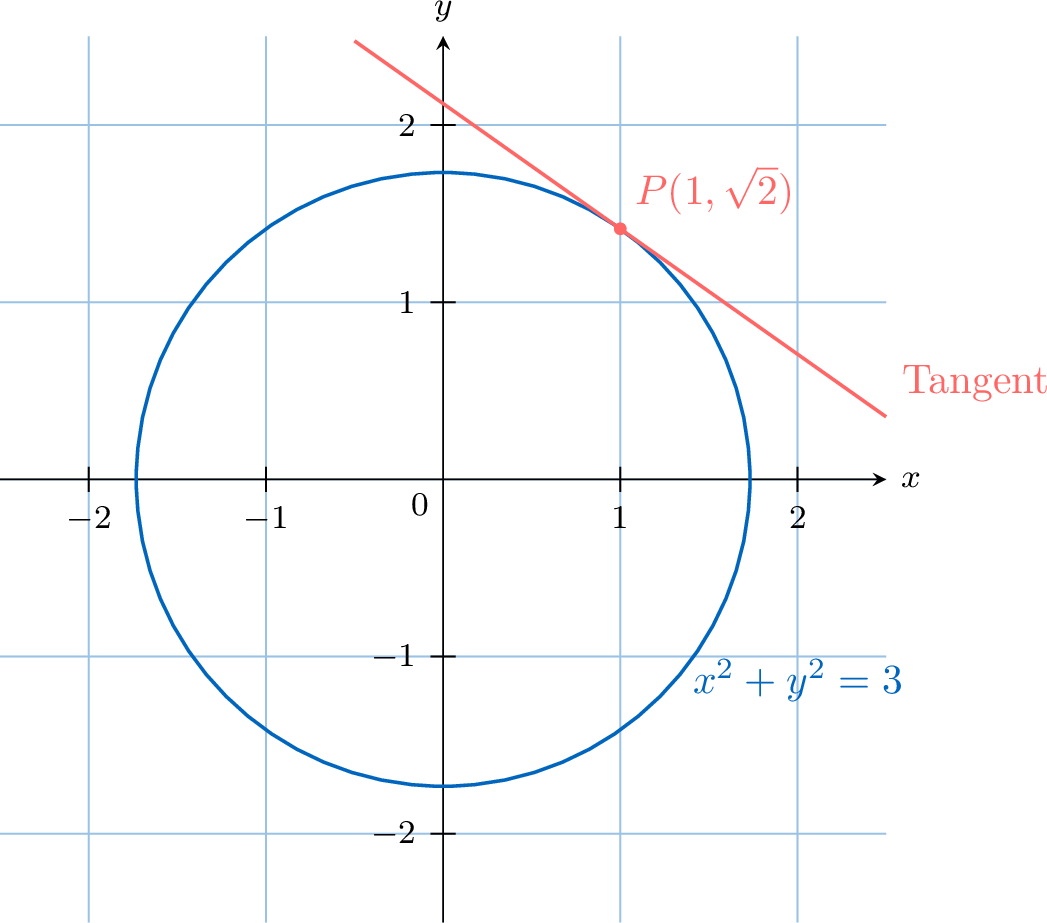
For example, at the point \(P(1, \sqrt{2})\) on the circle, the gradient of the tangent is \(\dfrac{\mathrm{d}y}{\mathrm{d}x} = -\dfrac{1}{\sqrt{2}}\).
Skills to practice
- Differentiating Implicitly
II
Derivatives of Standard Functions
II.1
Exponential Functions
The exponential function, particularly \(f(x)=e^x\), holds a unique and fundamental place in calculus. Its rate of change is directly proportional to its value, which makes it the mathematical language of many natural processes like population growth and compound interest. This function has a remarkably simple derivative.
Proposition — Derivative of \(e^x\)
The derivative of the natural exponential function is itself:$$ \dfrac{\mathrm{d}}{\mathrm{d}x}(e^x) = e^x $$
Using the limit definition of the derivative:$$ \dfrac{\mathrm{d}}{\mathrm{d}x}(e^x) = \lim_{h \to 0} \dfrac{e^{x+h} - e^x}{h} = \lim_{h \to 0} \dfrac{e^x e^h - e^x}{h} = \lim_{h \to 0} e^x \left(\dfrac{e^h - 1}{h}\right) $$ Since \(e^x\) does not depend on \(h\), we can move it outside the limit:$$ = e^x \cdot \lim_{h \to 0} \left(\dfrac{e^h - 1}{h}\right) $$ The limit \(\lim_{h \to 0} \frac{e^h-1}{h}\) is a fundamental limit which is equal to 1.
Therefore, \(\dfrac{\mathrm{d}}{\mathrm{d}x}(e^x) = e^x \cdot 1 = e^x\).
Therefore, \(\dfrac{\mathrm{d}}{\mathrm{d}x}(e^x) = e^x \cdot 1 = e^x\).
Proposition — Chain Rule for \(e^{u(x)}\)
The derivative of an exponential function with a function in the exponent is given by:$$ \left(e^{u(x)}\right)' = e^{u(x)}u'(x) $$ In Leibniz notation:$$ \dfrac{\mathrm{d}}{\mathrm{d}x}\left(e^{u}\right) = e^{u}\dfrac{\mathrm{d}u}{\mathrm{d}x} $$
Let the outer function be \(v(u) = e^u\) and the inner function be \(u(x)\).
Then, \(e^{u(x)} = v(u(x))\).
Then, \(e^{u(x)} = v(u(x))\).
- The derivative of the outer function \(v(u) = e^u\) with respect to \(u\) is \(v'(u) = e^u\).
- The derivative of the inner function \(u(x)\) with respect to \(x\) is \(u'(x)\).
Example
Find the derivative of \(f(x)=e^{x^2}\).
Here, the inner function is \(u(x)=x^2\), so \(u'(x)=2x\).$$\begin{aligned}f'(x) &= e^{u(x)}u'(x)\\
&= e^{x^2}2x\end{aligned} $$
Proposition — Derivative of \(a^x\)
For any base \(a>0\), the derivative of \(f(x)=a^x\) is:$$ \dfrac{\mathrm{d}}{\mathrm{d}x}(a^x) = \ln(a) \cdot a^x $$
$$\begin{aligned}\dfrac{\mathrm{d}}{\mathrm{d}x}(a^x) &= \dfrac{\mathrm{d}}{\mathrm{d}x}(e^{x\ln(a)})&(a^x = e^{\ln\left(a^x\right)} = e^{x\ln(a)})\\
&= e^{x\ln(a)}\dfrac{\mathrm{d}}{\mathrm{d}x}\left(x\ln(a)\right) \\
&= a^x\cdot \ln(a) \\
\end{aligned}$$
Skills to practice
- Differentiating Exponential Functions
II.2
Logarithmic Functions
The natural logarithm function, \(f(x)=\ln(x)\), is the inverse of the exponential function \(e^x\). This inverse relationship is the key to finding its derivative. Just as the exponential function has a remarkably simple derivative, so does the logarithm. This derivative is fundamental in calculus, particularly in integration, as it gives an antiderivative of \(x \mapsto 1/x\) on \((0, +\infty)\).
Proposition — Derivative of \(\ln x\)
The derivative of the natural logarithm function for \(x>0\) is:$$ \dfrac{\mathrm{d}}{\mathrm{d}x}(\ln x) = \dfrac{1}{x} $$
Let \(y = \ln x\). By the definition of the natural logarithm, this means \(e^y = x\). We can now differentiate this implicit equation with respect to \(x\), using the chain rule on the left side:$$\begin{aligned}\dfrac{\mathrm{d}}{\mathrm{d}x}(e^y) &= \dfrac{\mathrm{d}}{\mathrm{d}x}(x) \\
e^y \cdot \dfrac{\mathrm{d}y}{\mathrm{d}x} &= 1 \\
\dfrac{\mathrm{d}y}{\mathrm{d}x} &= \dfrac{1}{e^y}\end{aligned}$$ Since we know that \(e^y = x\), we substitute this back into the expression:$$ \dfrac{\mathrm{d}y}{\mathrm{d}x} = \dfrac{1}{x} $$
Proposition — Chain Rule for \(\ln(u(x))\)
If \(u\) is differentiable and strictly positive on an interval \(I\), then \(\ln(u)\) is differentiable on \(I\) and:$$ \left(\ln(u(x))\right)' = \dfrac{u'(x)}{u(x)} $$ In Leibniz notation:$$ \dfrac{\mathrm{d}}{\mathrm{d}x}\left(\ln(u)\right) = \dfrac{1}{u}\,\dfrac{\mathrm{d}u}{\mathrm{d}x} $$ Example
Find the derivative of \(f(x) = \ln(2x+3)\).
This is of the form \(\ln(u(x))\) where the inner function is \(u(x)=2x+3\).
The derivative of the inner function is \(u'(x)=2\).
Using the chain rule for logarithms:$$ f'(x) = \dfrac{u'(x)}{u(x)} = \dfrac{2}{2x+3} $$
The derivative of the inner function is \(u'(x)=2\).
Using the chain rule for logarithms:$$ f'(x) = \dfrac{u'(x)}{u(x)} = \dfrac{2}{2x+3} $$
Method — Simplify Before Differentiating
For a complicated logarithmic function, the laws of logarithms are used to expand or simplify the expression before differentiating, on an interval where the arguments of the logarithms are positive. This can turn a difficult problem into a very simple one.Recall the laws, for \(a>0\) and \(b>0\): \(\ln(ab)=\ln(a)+\ln(b)\), \(\ln(a/b)=\ln(a)-\ln(b)\), and \(\ln(a^n)=n\ln(a)\).
Example
Find the derivative of \(f(x) = \ln\left(\dfrac{x+1}{x}\right)\).
\(f\) is defined where \(\dfrac{x+1}{x} > 0\), that is for \(x < -1\) or \(x > 0\). For \(x > 0\), both \(x+1\) and \(x\) are positive, so the law \(\ln(a/b)=\ln(a)-\ln(b)\) simplifies the expression:$$ f(x) = \ln(x+1) - \ln(x) $$ Now, we can differentiate this much simpler expression term by term:$$\begin{aligned}f'(x) &= \dfrac{\mathrm{d}}{\mathrm{d}x}(\ln(x+1)) - \dfrac{\mathrm{d}}{\mathrm{d}x}(\ln x) \\
&= \dfrac{1}{x+1} - \dfrac{1}{x}\end{aligned}$$ For \(x < -1\), the rule for \(\ln(u)\) with \(u = \dfrac{x+1}{x}\) gives the same expression of \(f'(x)\).
Proposition — Derivative of \(\log_a(x)\)
For any base \(a>0, a\neq 1\), the derivative of \(f(x)=\log_a(x)\) is:$$ \dfrac{\mathrm{d}}{\mathrm{d}x}(\log_a x) = \dfrac{1}{x\ln(a)} $$
We use the change of base formula to express the function in terms of the natural logarithm, and then differentiate.$$\begin{aligned}\dfrac{\mathrm{d}}{\mathrm{d}x}(\log_a x) &= \dfrac{\mathrm{d}}{\mathrm{d}x}\left(\dfrac{\ln x}{\ln a}\right) & (\text{change of base formula}) \\
&= \dfrac{1}{\ln a} \cdot \dfrac{\mathrm{d}}{\mathrm{d}x}(\ln x) & (\text{since } \ln a \text{ is a constant}) \\
&= \dfrac{1}{\ln a} \cdot \dfrac{1}{x} \\
&= \dfrac{1}{x\ln a}\end{aligned}$$
Skills to practice
- Differentiating Logarithmic Functions
- Differentiating Logarithms in Base \(a\)
II.3
Trigonometric Functions
Trigonometric functions describe periodic phenomena, which are common in physics and engineering. Their derivatives follow a cyclical pattern that is both elegant and powerful. The derivatives of \(\sin(x)\) and \(\cos(x)\) come from the limit definition of the derivative, with \(x\) measured in radians.
Proposition — Fundamental Trigonometric Limits
For \(x\) in radians:$$ \lim_{x \to 0} \dfrac{\sin(x)}{x} = 1 \quad \text{and} \quad \lim_{x \to 0} \dfrac{\cos(x)-1}{x} = 0 $$ Proposition — Derivatives of Sine and Cosine
For \(x\) in radians, the derivatives of the basic trigonometric functions are:$$ \dfrac{\mathrm{d}}{\mathrm{d}x}(\sin x) = \cos x \quad \text{and} \quad \dfrac{\mathrm{d}}{\mathrm{d}x}(\cos x) = -\sin x $$
For \(f(x) = \sin(x)\), the limit definition of the derivative, the addition formula \(\sin(x+h) = \sin x \cos h + \cos x \sin h\) and the two limits above give$$\begin{aligned}\dfrac{\sin(x+h)-\sin(x)}{h} &= \dfrac{\sin(x)\cos(h) + \cos(x)\sin(h) - \sin(x)}{h} &&\text{(addition formula)} \\
&= \sin(x)\cdot\dfrac{\cos(h)-1}{h} + \cos(x)\cdot\dfrac{\sin(h)}{h} \\
&\xrightarrow[h \to 0]{} \sin(x)\cdot 0 + \cos(x)\cdot 1 = \cos(x). &&\text{(fundamental limits)}\end{aligned}$$ For \(f(x) = \cos(x)\), the addition formula \(\cos(x+h) = \cos x \cos h - \sin x \sin h\) and the two limits above give$$\begin{aligned}\dfrac{\cos(x+h)-\cos(x)}{h} &= \cos(x)\cdot\dfrac{\cos(h)-1}{h} - \sin(x)\cdot\dfrac{\sin(h)}{h} &&\text{(addition formula)} \\
&\xrightarrow[h \to 0]{} \cos(x)\cdot 0 - \sin(x)\cdot 1 = -\sin(x). &&\text{(fundamental limits)}\end{aligned}$$
Proposition — Derivative of Tangent
The derivative of the tangent function is:$$ \dfrac{\mathrm{d}}{\mathrm{d}x}(\tan x) = 1+\tan^2 x $$
We use the quotient rule on \(f(x) = \tan x = \dfrac{\sin x}{\cos x}\).
Let \(u=\sin x\) and \(v=\cos x\). Then \(u'=\cos x\) and \(v'=-\sin x\).$$\begin{aligned}f'(x) &= \dfrac{u'v - uv'}{v^2}\\ &= \dfrac{(\cos x)(\cos x) - (\sin x)(-\sin x)}{(\cos x)^2} \\ &= \dfrac{\cos^2 x + \sin^2 x}{\cos^2 x}\\ &= \dfrac{\cos^2 x}{\cos^2 x} + \dfrac{\sin^2 x}{\cos^2 x} \\ &= 1+ \dfrac{\sin^2 x}{\cos^2 x}\\ &= 1+\tan^2 x \\ \end{aligned}$$
Let \(u=\sin x\) and \(v=\cos x\). Then \(u'=\cos x\) and \(v'=-\sin x\).$$\begin{aligned}f'(x) &= \dfrac{u'v - uv'}{v^2}\\ &= \dfrac{(\cos x)(\cos x) - (\sin x)(-\sin x)}{(\cos x)^2} \\ &= \dfrac{\cos^2 x + \sin^2 x}{\cos^2 x}\\ &= \dfrac{\cos^2 x}{\cos^2 x} + \dfrac{\sin^2 x}{\cos^2 x} \\ &= 1+ \dfrac{\sin^2 x}{\cos^2 x}\\ &= 1+\tan^2 x \\ \end{aligned}$$
Proposition — Chain Rule for Trigonometric Functions
For a differentiable function \(u\): - \((\sin(u(x)))' = u'(x)\cos(u(x))\)
- \((\cos(u(x)))' = -u'(x)\sin(u(x))\)
- \((\tan(u(x)))' = u'(x)\bigl(1+\tan^2(u(x))\bigr)\), where \(\cos(u(x)) \neq 0\)
- \(\dfrac{\mathrm{d}}{\mathrm{d}x}(\sin(u)) = \cos(u)\dfrac{\mathrm{d}u}{\mathrm{d}x}\)
- \(\dfrac{\mathrm{d}}{\mathrm{d}x}(\cos(u)) = -\sin(u)\dfrac{\mathrm{d}u}{\mathrm{d}x}\)
- \(\dfrac{\mathrm{d}}{\mathrm{d}x}(\tan(u)) = \bigl(1+\tan^2(u)\bigr)\dfrac{\mathrm{d}u}{\mathrm{d}x}\)
Example
Find the derivative of \(f(x) = \cos(x^2+3x)\).
This is of the form \(\cos(u(x))\) where the inner function is \(u(x)=x^2+3x\).
The derivative of the inner function is \(u'(x)=2x+3\).
Using the chain rule for cosine:$$\begin{aligned}f'(x) &= -u'(x)\sin(u(x)) \\ &= -(2x+3)\sin(x^2+3x)\end{aligned}$$
The derivative of the inner function is \(u'(x)=2x+3\).
Using the chain rule for cosine:$$\begin{aligned}f'(x) &= -u'(x)\sin(u(x)) \\ &= -(2x+3)\sin(x^2+3x)\end{aligned}$$
The derivatives of the remaining trigonometric functions—secant, cosecant, and cotangent—can be found by expressing them in terms of sine and cosine and then applying the Quotient Rule.
Proposition — Derivatives of sec, csc, cot
$$ \dfrac{\mathrm{d}}{\mathrm{d}x}(\sec x) = \sec x \tan x $$ $$ \dfrac{\mathrm{d}}{\mathrm{d}x}(\csc x) = -\csc x \cot x $$ $$ \dfrac{\mathrm{d}}{\mathrm{d}x}(\cot x) = -\csc^2 x $$
Proof for \(f(x) = \sec x\):We write \(f(x) = \dfrac{1}{\cos x}\) and use the quotient rule with \(u=1\) and \(v=\cos x\). Then \(u'=0\) and \(v'=-\sin x\).$$\begin{aligned}f'(x) &= \dfrac{u'v - uv'}{v^2} = \dfrac{(0)(\cos x) - (1)(-\sin x)}{(\cos x)^2} \\
&= \dfrac{\sin x}{\cos^2 x} = \dfrac{1}{\cos x} \cdot \dfrac{\sin x}{\cos x} \\
&= \sec x \tan x\end{aligned}$$ The proofs for \(\csc x\) and \(\cot x\) are similar.
Skills to practice
- Recognising Derivatives of Standard Functions
- Differentiating Trigonometric Functions
- Differentiating Secant, Cosecant and Cotangent
II.4
Inverse Trigonometric Functions
The inverse trigonometric functions (\(\arcsin\), \(\arccos\), \(\arctan\)) are essential in problems involving angles. Their derivatives are algebraic functions and are found using implicit differentiation.
Proposition — Derivatives of Inverse Trig Functions
$$ \dfrac{\mathrm{d}}{\mathrm{d}x}(\arcsin x) = \dfrac{1}{\sqrt{1-x^2}} $$ $$ \dfrac{\mathrm{d}}{\mathrm{d}x}(\arccos x) = -\dfrac{1}{\sqrt{1-x^2}} $$ $$ \dfrac{\mathrm{d}}{\mathrm{d}x}(\arctan x) = \dfrac{1}{1+x^2} $$
Proof for \(y = \arcsin x\):If \(y = \arcsin x\), then \(\sin y = x\). We differentiate implicitly with respect to \(x\):$$\begin{aligned}\dfrac{\mathrm{d}}{\mathrm{d}x}(\sin y) &= \dfrac{\mathrm{d}}{\mathrm{d}x}(x) \\
\cos y \cdot \dfrac{\mathrm{d}y}{\mathrm{d}x} &= 1 \\
\dfrac{\mathrm{d}y}{\mathrm{d}x} &= \dfrac{1}{\cos y}\end{aligned}$$ Since \(y = \arcsin x\) lies in \(\left[-\frac{\pi}{2}, \frac{\pi}{2}\right]\), \(\cos y \geq 0\), so the identity \(\cos^2 y + \sin^2 y = 1\) gives \(\cos y = \sqrt{1-\sin^2 y}\). Since \(\sin y = x\), we have \(\cos y = \sqrt{1-x^2}\), which is not zero for \(-1 < x < 1\): the division by \(\cos y\) above is then allowed.
Substituting this back gives \(\dfrac{\mathrm{d}y}{\mathrm{d}x} = \dfrac{1}{\sqrt{1-x^2}}\).
Substituting this back gives \(\dfrac{\mathrm{d}y}{\mathrm{d}x} = \dfrac{1}{\sqrt{1-x^2}}\).
Example
Find the derivative of \(f(x) = \arctan(e^x)\).
We use the chain rule. The outer function is \(v(u) = \arctan(u)\) and the inner function is \(u(x)=e^x\).
The derivatives are \(v'(u) = \dfrac{1}{1+u^2}\) and \(u'(x)=e^x\).$$\begin{aligned}f'(x) &= v'(u(x)) \cdot u'(x) \\ &= \dfrac{1}{1+(e^x)^2} \cdot e^x \\ &= \dfrac{e^x}{1+e^{2x}}\end{aligned}$$
The derivatives are \(v'(u) = \dfrac{1}{1+u^2}\) and \(u'(x)=e^x\).$$\begin{aligned}f'(x) &= v'(u(x)) \cdot u'(x) \\ &= \dfrac{1}{1+(e^x)^2} \cdot e^x \\ &= \dfrac{e^x}{1+e^{2x}}\end{aligned}$$
Skills to practice
- Differentiating Inverse Trigonometric Functions
III
The Second Derivative
III.1
Second Derivative
Definition — Second Derivative
The second derivative of \(f\), denoted \(f''\), is the derivative of the first derivative, \(f'\).$$ f''(x) = \dfrac{\mathrm{d}}{\mathrm{d}x}(f'(x)) \quad \text{ or in Leibniz notation, } \quad \dfrac{\mathrm{d}^2 y}{\mathrm{d}x^2}= \dfrac{\mathrm{d}}{\mathrm{d}x}\left(\dfrac{\mathrm{d}y}{\mathrm{d}x} \right) $$ Example
Find the second derivative of \(f(x)=x^4 - 5x^2\).
First, we find the first derivative:$$ f'(x) = 4x^3 - 10x $$ Now, we differentiate again to find the second derivative:$$ f''(x) = \dfrac{\mathrm{d}}{\mathrm{d}x}(4x^3 - 10x) = 12x^2 - 10 $$
Skills to practice
- Calculating First and Second Derivatives
- Showing That a Function Satisfies a Relation
III.2
Higher Derivatives
The second derivative \(f''\) is the derivative of \(f'\): it measures how fast the gradient changes. Nothing stops the process there. As long as the result can still be differentiated, we can differentiate again, and again: this gives the third derivative, the fourth derivative, and so on. For a polynomial, the derivatives become the zero function after a few steps and stay zero; for \(e^{2x}\) or \(\sin x\) none of them is the zero function, and a pattern appears that describes every derivative at once.
Definition — Higher Derivatives
Let \(n\) be a positive integer and \(f\) a function that can be differentiated \(n\) times in succession. The \(n\)th derivative of \(f\), denoted \(f^{(n)}\), is the function obtained by differentiating \(f\) \(n\) times: \(f^{(1)} = f'\) and, whenever \(f^{(n)}\) is itself differentiable, $$f^{(n+1)} = \left(f^{(n)}\right)'.$$ Thus \(f^{(2)} = f''\) and \(f^{(3)} = f'''\). With \(y = f(x)\), the Leibniz notation is $$\dfrac{\mathrm{d}^n y}{\mathrm{d}x^n} = f^{(n)}(x).$$ The derivatives \(f''\), \(f'''\), \(\dots\), \(f^{(n)}\) are the higher derivatives of \(f\). The brackets matter: \(f^{(3)}(x)\) is the third derivative, whereas \(\sin^3 x\) denotes the power \((\sin x)^3\). Example
Let \(f(x) = 2x^4 - x^3 + 5x - 7\). Find \(f'(x)\), \(f''(x)\), \(f'''(x)\), \(f^{(4)}(x)\) and \(f^{(5)}(x)\). What are the derivatives of order \(n \geq 5\)?
Each derivative is the derivative of the previous one, by the power rule and the sum rule: $$\begin{aligned}[t] f'(x) &= 8x^3 - 3x^2 + 5, \\
f''(x) &= 24x^2 - 6x, \\
f'''(x) &= 48x - 6, \\
f^{(4)}(x) &= 48, \\
f^{(5)}(x) &= 0. \end{aligned}$$ Each differentiation lowers the degree by one: the polynomial of degree \(4\) becomes the constant \(48\) after four differentiations, then the zero function. The derivative of the zero function is the zero function, so \(f^{(n)}(x) = 0\) for every \(n \geq 5\).
Example
Let \(f(x) = \sin 2x\). Find the first four derivatives of \(f\), then deduce \(f^{(10)}(x)\).
By the chain rule for trigonometric functions, \((\sin 2x)' = 2\cos 2x\) and \((\cos 2x)' = -2\sin 2x\): $$\begin{aligned}[t] f'(x) &= 2\cos 2x, \\
f''(x) &= -4\sin 2x, \\
f'''(x) &= -8\cos 2x, \\
f^{(4)}(x) &= 16\sin 2x. \end{aligned}$$ After four differentiations we come back to \(f\), multiplied by \(2^4 = 16\): \(f^{(4)} = 16f\). Differentiating both sides four more times gives \(f^{(8)} = 16f^{(4)} = 256f\), and twice more \(f^{(10)} = 256f''\): $$\begin{aligned}[t] f^{(10)}(x) &= 256 f''(x) \\
&= 256 \times (-4\sin 2x) \\
&= -1024\sin 2x. \end{aligned}$$
Method — Finding a Formula for the \(n\)th Derivative
To find \(f^{(n)}(x)\) for every positive integer \(n\): - Compute the first derivatives \(f'\), \(f''\), \(f'''\), writing each one in the same factored form, so that a pattern can be seen.
- Conjecture a formula for \(f^{(n)}(x)\), and check it against the derivatives computed.
- Prove the formula by mathematical induction on \(n\): the base case \(n = 1\) is the computed \(f'\); in the inductive step, differentiate once the formula assumed for \(f^{(n)}\), since \(f^{(n+1)} = \left(f^{(n)}\right)'\).
Example
Let \(f(x) = xe^{2x}\), for every real \(x\). - Find \(f'(x)\), \(f''(x)\) and \(f'''(x)\), each in the form \((ax + b)e^{2x}\).
- Conjecture a formula for \(f^{(n)}(x)\), for every positive integer \(n\).
- Prove this formula by mathematical induction.
- With \((e^{2x})' = 2e^{2x}\), each derivative comes from the product rule \((uv)' = u'v + uv'\): $$\begin{aligned}[t] f'(x) &= 1 \times e^{2x} + x \times 2e^{2x} && \text{(product rule)} \\ &= (2x + 1)e^{2x}, \\ f''(x) &= 2e^{2x} + (2x + 1) \times 2e^{2x} && \text{(product rule)} \\ &= (4x + 4)e^{2x}, \\ f'''(x) &= 4e^{2x} + (4x + 4) \times 2e^{2x} && \text{(product rule)} \\ &= (8x + 12)e^{2x}. \end{aligned}$$
- Factoring out a power of \(2\) in each bracket: $$f'(x) = 2^0(2x + 1)e^{2x}, \qquad f''(x) = 2^1(2x + 2)e^{2x}, \qquad f'''(x) = 2^2(2x + 3)e^{2x}.$$ The conjecture is \(f^{(n)}(x) = 2^{n-1}(2x + n)e^{2x}\).
- For every integer \(n \geq 1\), let \(P(n)\) be the proposition “\(f^{(n)}(x) = 2^{n-1}(2x + n)e^{2x}\) for every real \(x\)”.
- Base case \(n = 1\): by part 1, \(f'(x) = (2x + 1)e^{2x} = 2^0(2x + 1)e^{2x}\), so \(P(1)\) is true.
- Inductive step: assume \(P(n)\) is true for an arbitrary integer \(n \geq 1\). Then $$\begin{aligned}[t] f^{(n+1)}(x) &= \left(f^{(n)}\right)'(x) && \text{(definition)} \\ &= 2^{n-1}\left[(2x + n)e^{2x}\right]' && \text{(induction hypothesis)} \\ &= 2^{n-1}\left[2e^{2x} + (2x + n) \times 2e^{2x}\right] && \text{(product rule)} \\ &= 2^{n}(2x + n + 1)e^{2x}, \end{aligned}$$ which is \(P(n+1)\).
- Conclusion: since \(P(1)\) is true and \(P(n) \Rightarrow P(n+1)\) for all integers \(n \geq 1\), by the principle of mathematical induction, \(f^{(n)}(x) = 2^{n-1}(2x + n)e^{2x}\) for every integer \(n \geq 1\).
Skills to practice
- Reading and Computing Higher Derivatives
- Computing Higher Derivatives
- Proving Results on Higher Derivatives
IV
Going further
Skills to practice
- Solving Problems without Technology
- Quiz
Jump to section