International Baccalaureate · DP 1: Analysis and Approaches HL
Further Trigonometry
I
Reciprocal Trigonometric Functions
I.1
The Secant, the Cosecant and the Cotangent
Definition — Reciprocal Trigonometric Functions
- The cosecant is \(\csc(x) = \frac{1}{\sin(x)}\), for \(\sin(x) \neq 0\). It is also written \(\operatorname{cosec}(x)\).
- The secant is \(\sec(x) = \frac{1}{\cos(x)}\), for \(\cos(x) \neq 0\).
- The cotangent is \(\cot(x) = \frac{\cos(x)}{\sin(x)}\), for \(\sin(x) \neq 0\). It equals \(\frac{1}{\tan(x)}\) where \(\tan(x)\) exists and is non-zero; at \(x = \frac{\pi}{2}\), for instance, \(\tan(x)\) does not exist and \(\cot(x) = 0\).
Proposition — Graph of the Cosecant Function
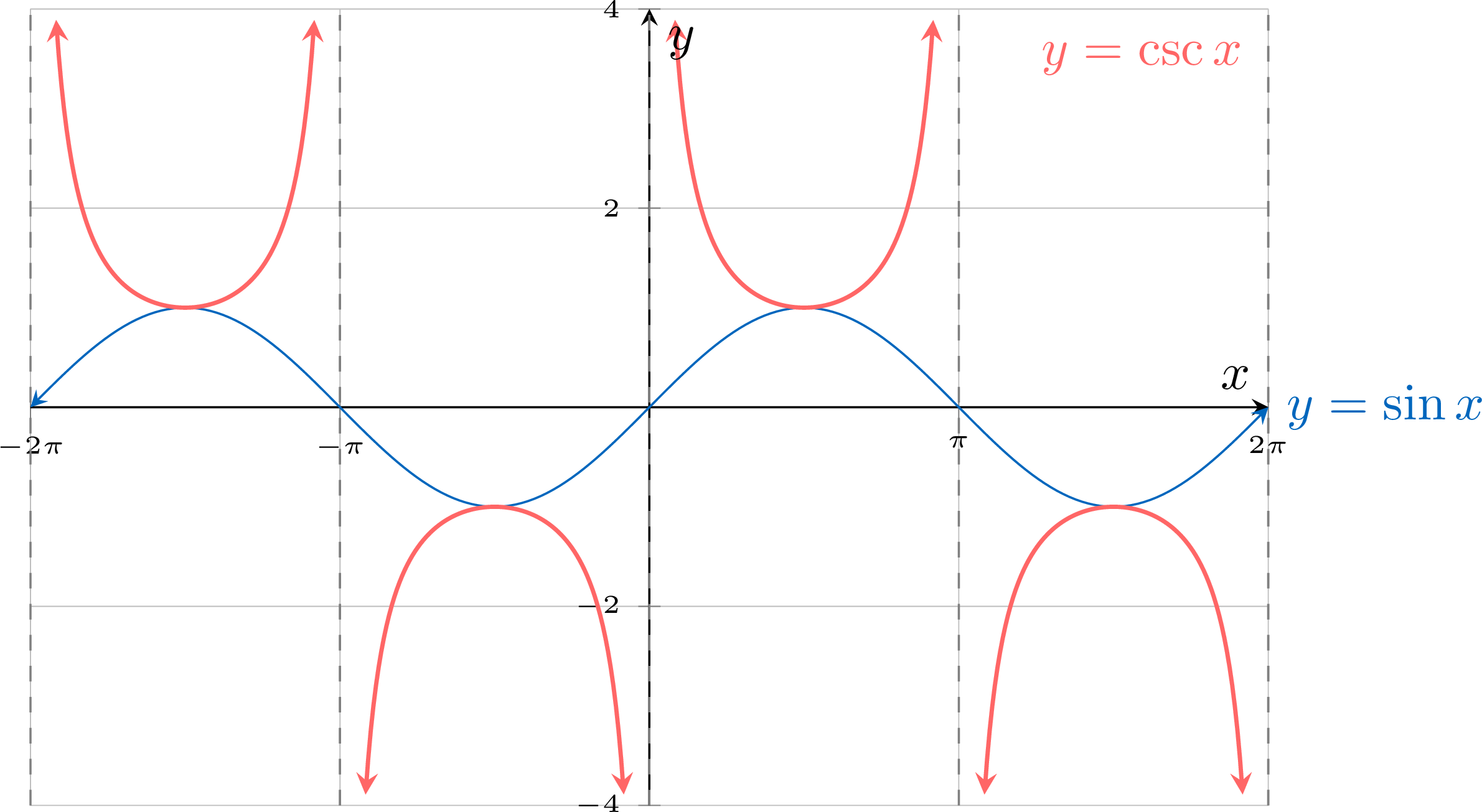
The graph of \(y = \csc(x) = \frac{1}{\sin(x)}\) is shown below. - Period: \(2\pi\).
- Vertical Asymptotes: At \(x = k\pi\), \(k \in \mathbb{Z}\) (where \(\sin x = 0\)).
- Range: \(({-\infty}, -1] \cup [1, \infty)\).
Proposition — Graph of the Secant Function
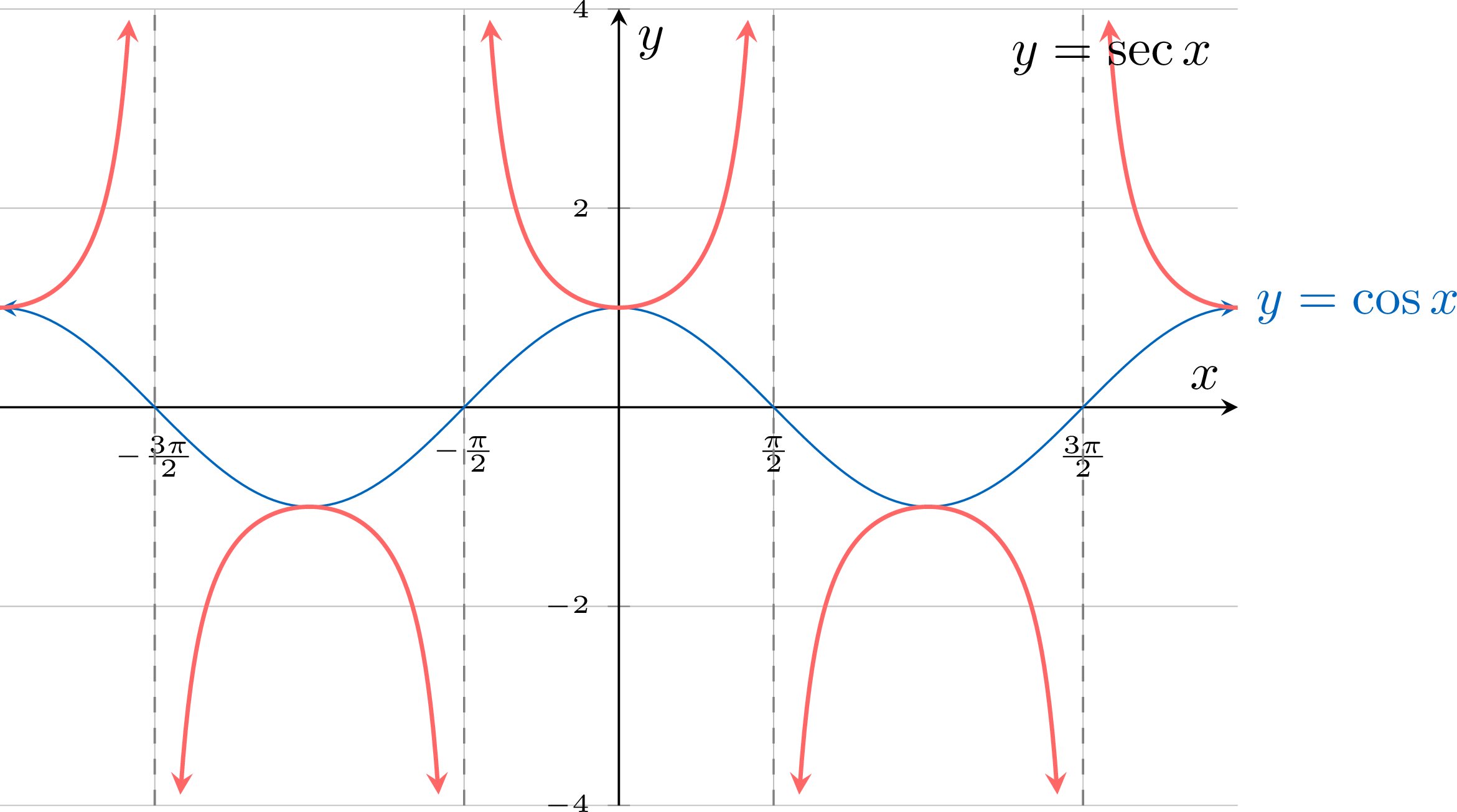
The graph of \(y = \sec(x) = \frac{1}{\cos(x)}\) is shown below. - Period: \(2\pi\).
- Vertical Asymptotes: At \(x = \frac{\pi}{2} + k\pi\), \(k \in \mathbb{Z}\) (where \(\cos x = 0\)).
- Range: \(({-\infty}, -1] \cup [1, \infty)\).
Proposition — Graph of the Cotangent Function
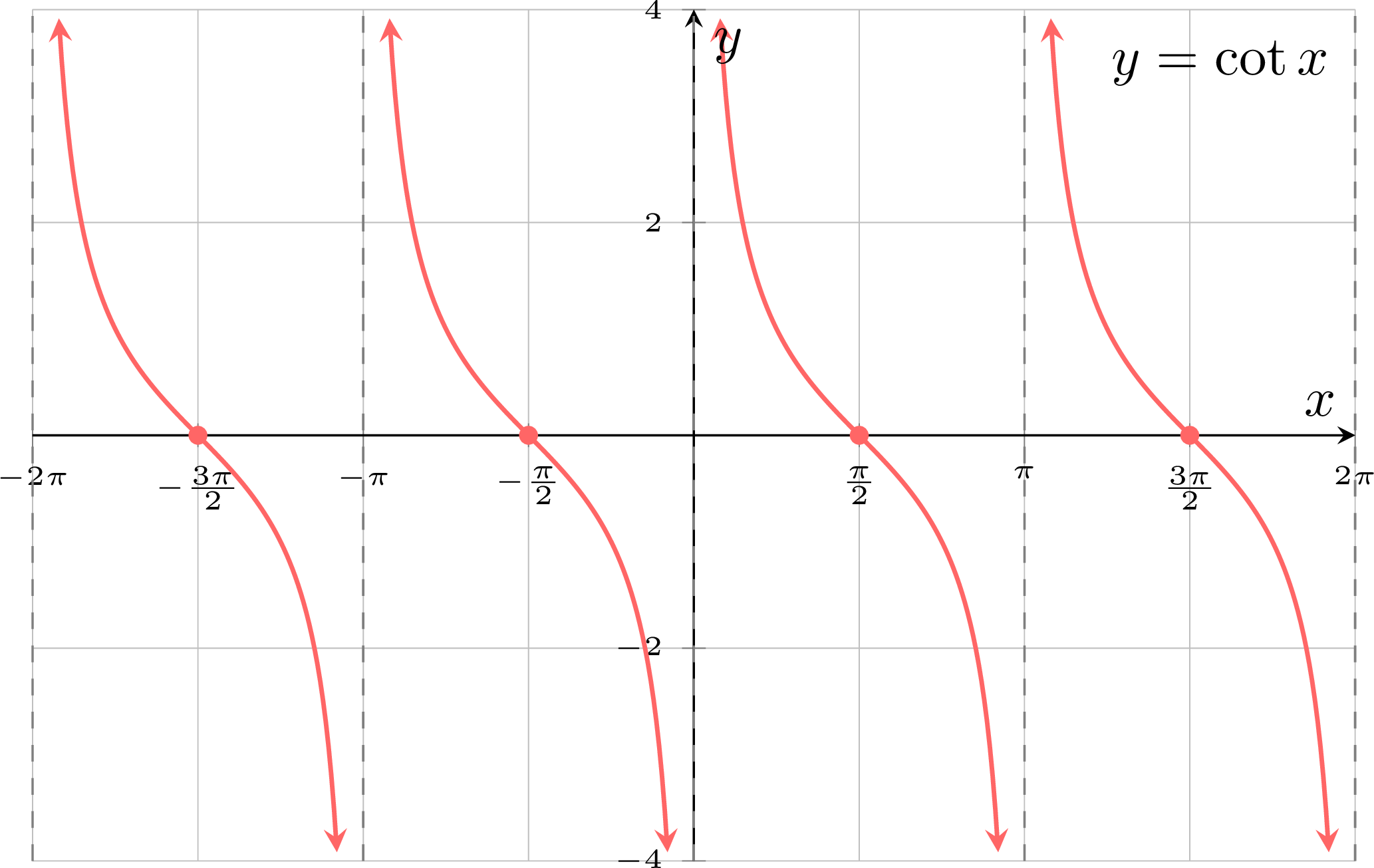
The graph of \(y = \cot(x) = \frac{\cos(x)}{\sin(x)}\) is shown below. - Period: \(\pi\).
- Vertical Asymptotes: At \(x = k\pi\), \(k \in \mathbb{Z}\) (where \(\sin x = 0\)).
- Zeros: At \(x = \frac{\pi}{2} + k\pi\), \(k \in \mathbb{Z}\) (where \(\cos x = 0\)): there \(\tan x\) does not exist, but \(\cot x = 0\).
- Range: \(\mathbb{R}\).
Skills to practice
- Recognising Asymptotes and Simplifying
- Evaluating the Reciprocal Functions at Special Angles without Technology
I.2
Pythagorean Identities for the Secant and the Cosecant
Proposition — Pythagorean Identities for the Secant and the Cosecant
For every real number \(x\) such that \(\cos x \neq 0\): $$1 + \tan^2 x = \sec^2 x.$$ For every real number \(x\) such that \(\sin x \neq 0\): $$1 + \cot^2 x = \csc^2 x.$$ Together with \(\cos^2 x + \sin^2 x = 1\), they are the three Pythagorean identities. The cosecant is also written \(\operatorname{cosec} x\).
Let \(x\) be a real number such that \(\cos x \neq 0\). Starting from the left side: $$\begin{aligned}[t] 1 + \tan^2 x &= 1 + \frac{\sin^2 x}{\cos^2 x} && \text{(definition of the tangent)}\\
&= \frac{\cos^2 x + \sin^2 x}{\cos^2 x} && \text{(common denominator)}\\
&= \frac{1}{\cos^2 x} && \text{(Pythagorean identity)}\\
&= \sec^2 x, \end{aligned}$$ by the definition of the secant. In the same way, let \(x\) be a real number such that \(\sin x \neq 0\), so that \(\cot x = \dfrac{\cos x}{\sin x}\): $$\begin{aligned}[t] 1 + \cot^2 x &= 1 + \frac{\cos^2 x}{\sin^2 x} && \text{(definition of the cotangent)}\\
&= \frac{\sin^2 x + \cos^2 x}{\sin^2 x} && \text{(common denominator)}\\
&= \frac{1}{\sin^2 x} && \text{(Pythagorean identity)}\\
&= \csc^2 x, \end{aligned}$$ by the definition of the cosecant. Hence both identities hold wherever their two sides are defined.
Method — Proving a Trigonometric Identity
To prove that an equality between trigonometric expressions is an identity: - State where both sides are defined: no denominator is \(0\), and every \(\tan x\), \(\sec x\), \(\csc x\) or \(\cot x\) that appears exists.
- Start from one side, usually the more complicated one, and transform it through a chain of equalities until the other side appears. Do not transform both sides at once, unless every step is an equivalence.
- Useful moves: write \(\tan x\), \(\cot x\), \(\sec x\) and \(\csc x\) in terms of \(\sin x\) and \(\cos x\); put fractions over a common denominator; replace \(\cos^2 x + \sin^2 x\) by \(1\), \(1 + \tan^2 x\) by \(\sec^2 x\) and \(1 + \cot^2 x\) by \(\csc^2 x\), or the reverse; factorise, for instance \(\sec^2 x - 1 = (\sec x - 1)(\sec x + 1)\).
- Name the rule used at each step, in the justification column.
Example
Given that \(\tan x = -2\) and \(\dfrac{\pi}{2} < x < \pi\), find the exact values of \(\sec x\), \(\cos x\), \(\sin x\), \(\csc x\) and \(\cot x\).
Since \(\dfrac{\pi}{2} < x < \pi\), the point of the unit circle associated with \(x\) lies in the second quadrant: \(\cos x < 0\) and \(\sin x > 0\). $$\begin{aligned}[t] \sec^2 x &= 1 + \tan^2 x && \text{(Pythagorean identity for the secant)}\\
&= 1 + (-2)^2\\
&= 5, \end{aligned}$$ so \(\sec x = \sqrt{5}\) or \(\sec x = -\sqrt{5}\). Since \(\cos x < 0\), its reciprocal \(\sec x\) is negative: \(\sec x = -\sqrt{5}\). Then $$\begin{aligned}[t] \cos x &= \frac{1}{\sec x} = -\frac{1}{\sqrt{5}} = -\frac{\sqrt{5}}{5}, && \text{(definition of the secant)}\\
\sin x &= \tan x \cos x && \text{(definition of the tangent)}\\
&= (-2) \times \left(-\frac{\sqrt{5}}{5}\right) = \frac{2\sqrt{5}}{5},\\
\csc x &= \frac{1}{\sin x} = \frac{5}{2\sqrt{5}} = \frac{\sqrt{5}}{2}, && \text{(definition of the cosecant)}\\
\cot x &= \frac{\cos x}{\sin x} = \frac{1}{\tan x} = -\frac{1}{2}. && \text{(definition of the cotangent; } \tan x \neq 0\text{)} \end{aligned}$$ Check: \(\sin x > 0\), as expected in the second quadrant, and \(\cos^2 x + \sin^2 x = \dfrac{5}{25} + \dfrac{20}{25} = 1\).
Example
Show that each equality is an identity, and state for which real numbers \(x\) it holds. - \((\sec x - 1)(\sec x + 1) = \tan^2 x\);
- \(\tan x + \cot x = \sec x \csc x\).
- Both sides are defined when \(\cos x \neq 0\). Let \(x\) be such a real number. Starting from the left side: $$\begin{aligned}[t] (\sec x - 1)(\sec x + 1) &= \sec^2 x - 1 && \text{(difference of two squares)}\\ &= (1 + \tan^2 x) - 1 && \text{(Pythagorean identity for the secant)}\\ &= \tan^2 x, \end{aligned}$$ which is the right side. The identity holds for every real \(x\) such that \(\cos x \neq 0\).
- Both sides are defined when \(\cos x \neq 0\) and \(\sin x \neq 0\). Let \(x\) be such a real number. Starting from the left side: $$\begin{aligned}[t] \tan x + \cot x &= \frac{\sin x}{\cos x} + \frac{\cos x}{\sin x} && \text{(definitions of the tangent and the cotangent)}\\ &= \frac{\sin^2 x + \cos^2 x}{\sin x \cos x} && \text{(common denominator)}\\ &= \frac{1}{\sin x \cos x} && \text{(Pythagorean identity)}\\ &= \frac{1}{\cos x} \times \frac{1}{\sin x}\\ &= \sec x \csc x, \end{aligned}$$ which is the right side. The identity holds for every real \(x\) such that \(\cos x \neq 0\) and \(\sin x \neq 0\).
Skills to practice
- Finding the Other Ratios from One Ratio
- Proving Identities with the Secant, the Cosecant or the Cotangent
II
Inverse Trigonometric Functions
II.1
The Arcsine, Arccosine and Arctangent Functions
The inverse trigonometric functions, also known as arc functions, give the angle from the value of a trigonometric ratio. They are the inverses of the sine, cosine and tangent functions, each restricted to an interval on which it is one-to-one.
Definition — Inverse Sine Function
The inverse sine function, denoted \(\arcsin\) or \(\sin^{-1}\), is defined on \([-1, 1]\): for every \(x\) in \([-1, 1]\), \(\arcsin x\) is the number \(y\) in \(\left[-\frac{\pi}{2}, \frac{\pi}{2}\right]\) such that \(\sin y = x\). - Domain: \([-1, 1]\)
- Range: \(\left[-\frac{\pi}{2}, \frac{\pi}{2}\right]\)
Proposition — Graph of the Inverse Sine Function
The graph of \(\textcolor{colordef}{y = \arcsin x}\) is the reflection in the line \(\textcolor{olive}{y = x}\) of the graph of \(\textcolor{colorprop}{y = \sin x}\) restricted to \(\left[-\frac{\pi}{2}, \frac{\pi}{2}\right]\). It stops at its two endpoints, \(\left(-1, -\frac{\pi}{2}\right)\) and \(\left(1, \frac{\pi}{2}\right)\). 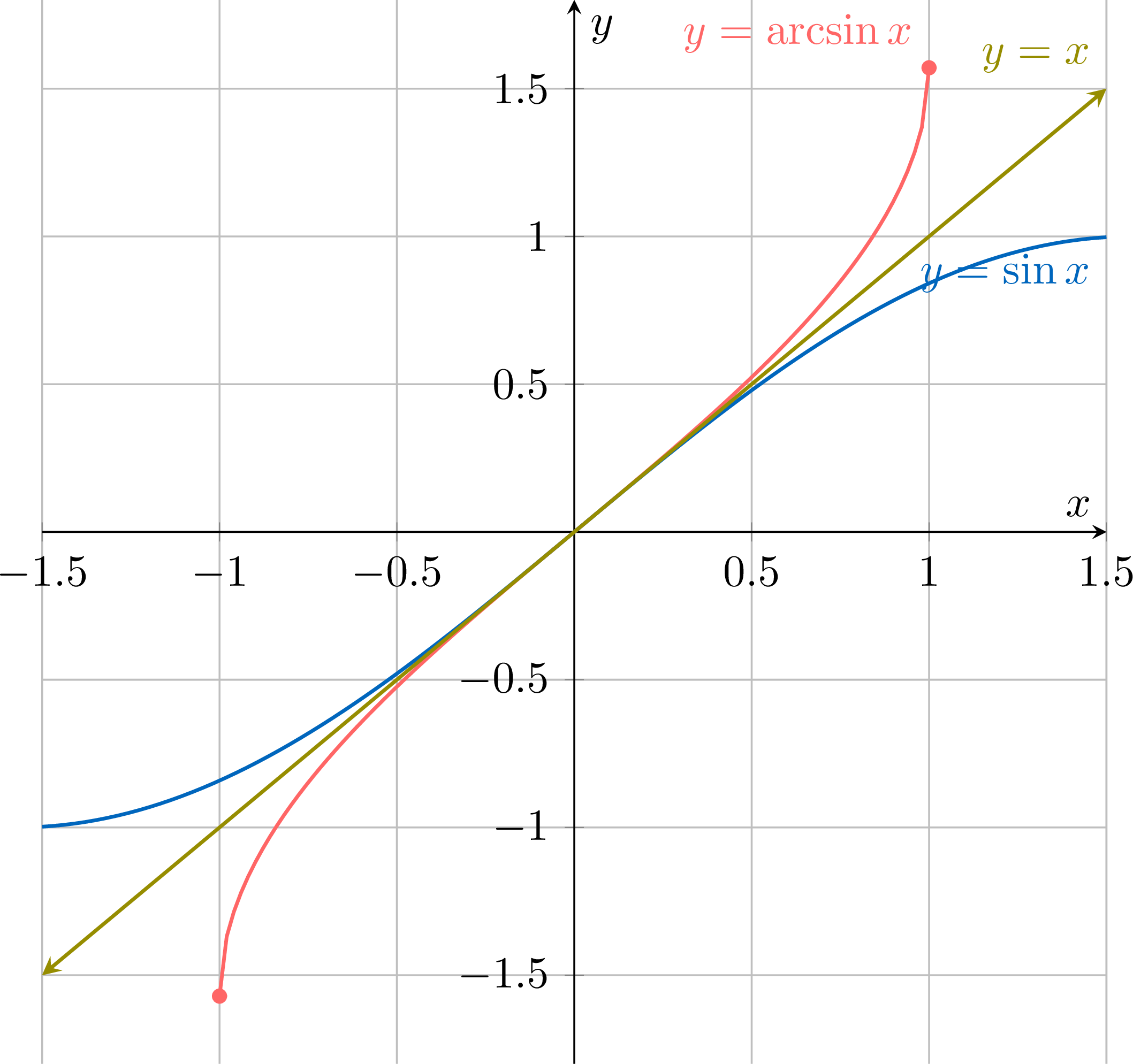
Definition — Inverse Cosine Function
The inverse cosine function, denoted \(\arccos\) or \(\cos^{-1}\), is defined on \([-1, 1]\): for every \(x\) in \([-1, 1]\), \(\arccos x\) is the number \(y\) in \([0, \pi]\) such that \(\cos y = x\). - Domain: \([-1, 1]\)
- Range: \([0, \pi]\)
Proposition — Graph of the Inverse Cosine Function
The graph of \(\textcolor{colordef}{y = \arccos x}\) is the reflection in the line \(\textcolor{olive}{y = x}\) of the graph of \(\textcolor{colorprop}{y = \cos x}\) restricted to \([0, \pi]\). It stops at its two endpoints, \((-1, \pi)\) and \((1, 0)\). 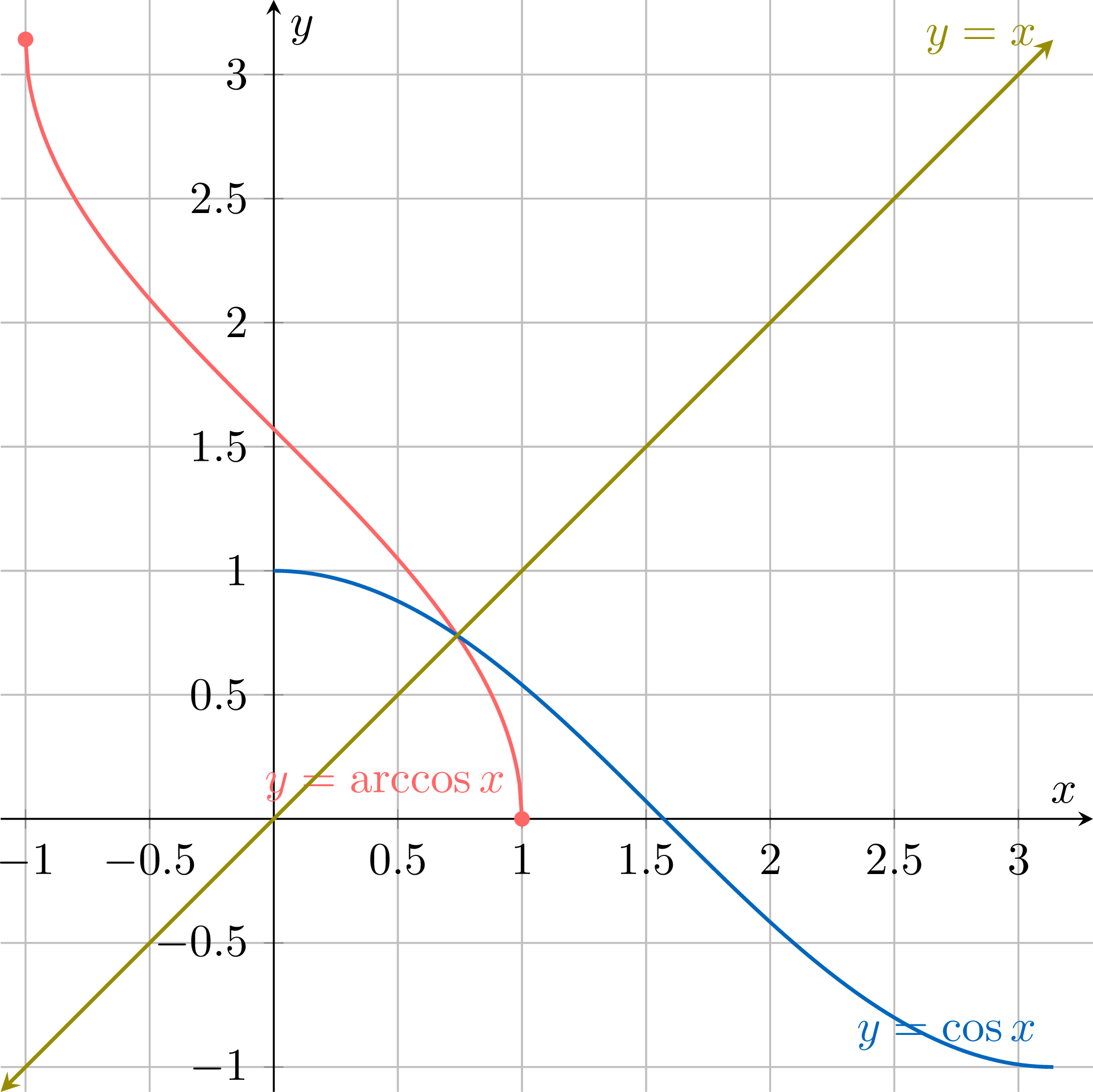
Definition — Inverse Tangent Function
The inverse tangent function, denoted \(\arctan\) or \(\tan^{-1}\), is defined on \(\mathbb{R}\): for every real number \(x\), \(\arctan x\) is the number \(y\) in \(\left(-\frac{\pi}{2}, \frac{\pi}{2}\right)\) such that \(\tan y = x\). - Domain: \(\mathbb{R}\)
- Range: \(\left(-\frac{\pi}{2}, \frac{\pi}{2}\right)\)
Proposition — Graph of the Inverse Tangent Function
The graph of \(y = \arctan x\) is the reflection in the line \(y = x\) of the graph of \(y = \tan x\) restricted to \(\left(-\frac{\pi}{2}, \frac{\pi}{2}\right)\). The lines \(y = -\frac{\pi}{2}\) and \(y = \frac{\pi}{2}\) are horizontal asymptotes. 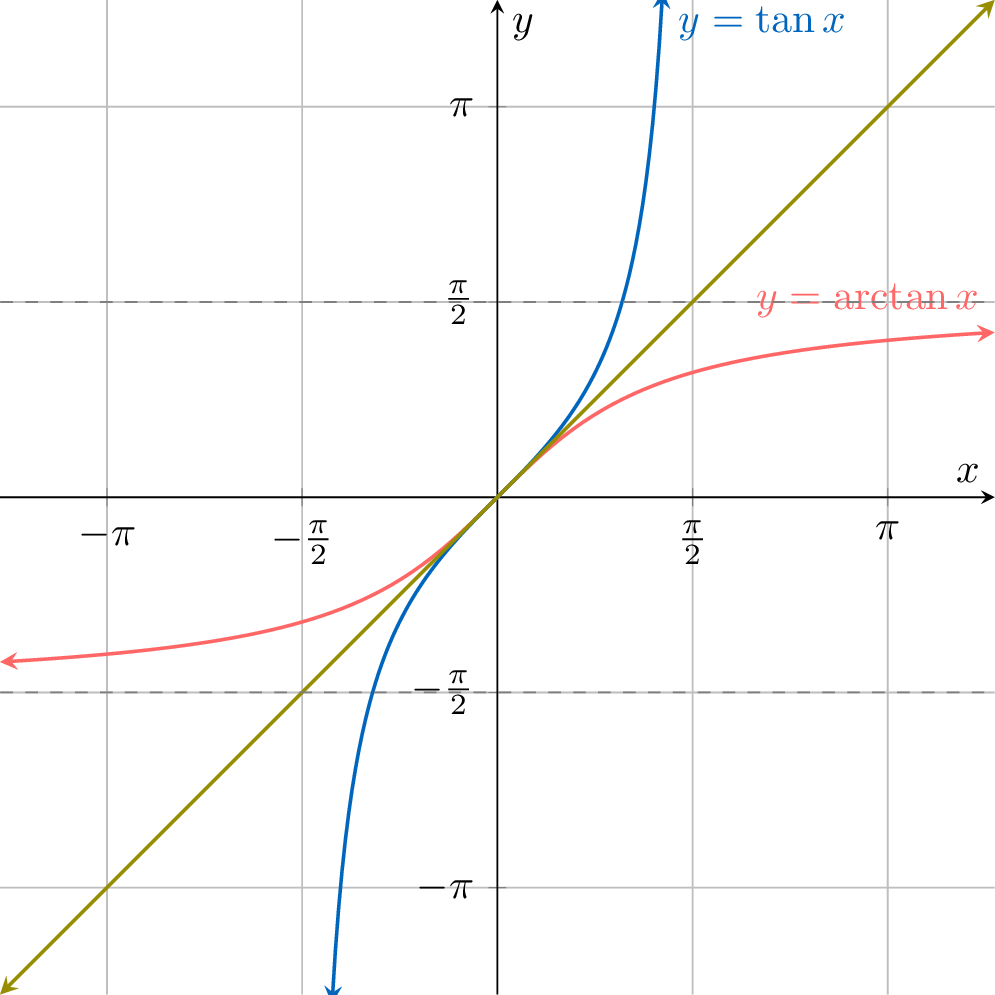
Proposition — Properties of Inverse Trigonometric Functions
- \(\arcsin(\sin x) = x\) for \(x \in \left[-\frac{\pi}{2}, \frac{\pi}{2}\right]\), and \(\sin(\arcsin x) = x\) for \(x \in [-1, 1]\)
- \(\arccos(\cos x) = x\) for \(x \in [0, \pi]\), and \(\cos(\arccos x) = x\) for \(x \in [-1, 1]\)
- \(\arctan(\tan x) = x\) for \(x \in \left(-\frac{\pi}{2}, \frac{\pi}{2}\right)\), and \(\tan(\arctan x) = x\) for every real number \(x\)
Example
Evaluate \(\arcsin\left(\frac{\sqrt{3}}{2}\right)\).
We look for the number \(y\) in \(\left[-\frac{\pi}{2}, \frac{\pi}{2}\right]\) such that \(\sin y = \frac{\sqrt{3}}{2}\). Since \(\sin\frac{\pi}{3} = \frac{\sqrt{3}}{2}\) and \(\frac{\pi}{3} \in \left[-\frac{\pi}{2}, \frac{\pi}{2}\right]\), $$\arcsin\left(\frac{\sqrt{3}}{2}\right) = \frac{\pi}{3}.$$ The number \(\frac{2\pi}{3}\) also has sine \(\frac{\sqrt{3}}{2}\), but it is not in \(\left[-\frac{\pi}{2}, \frac{\pi}{2}\right]\).
Example
Find the exact value of: - \(\sin\left(\arccos\dfrac{1}{3}\right)\);
- \(\tan\left(\arcsin\left(-\dfrac{2}{3}\right)\right)\).
- Let \(\theta = \arccos\dfrac{1}{3}\). By the definition of \(\arccos\), \(\cos\theta = \dfrac{1}{3}\) and \(0 \le \theta \le \pi\), so \(\sin\theta \ge 0\). $$\begin{aligned}[t] \sin^2\theta &= 1 - \cos^2\theta && \text{(Pythagorean identity)}\\ &= 1 - \frac{1}{9}\\ &= \frac{8}{9}. \end{aligned}$$ Since \(\sin\theta \ge 0\), \(\sin\theta = \sqrt{\dfrac{8}{9}} = \dfrac{2\sqrt{2}}{3}\). Hence \(\sin\left(\arccos\dfrac{1}{3}\right) = \dfrac{2\sqrt{2}}{3}\).
- Let \(\theta = \arcsin\left(-\dfrac{2}{3}\right)\). By the definition of \(\arcsin\), \(\sin\theta = -\dfrac{2}{3}\) and \(-\dfrac{\pi}{2} \le \theta \le \dfrac{\pi}{2}\), so \(\cos\theta \ge 0\). $$\begin{aligned}[t] \cos^2\theta &= 1 - \sin^2\theta && \text{(Pythagorean identity)}\\ &= 1 - \frac{4}{9}\\ &= \frac{5}{9}, \end{aligned}$$ so \(\cos\theta = \dfrac{\sqrt{5}}{3}\), which is not \(0\). Then $$\begin{aligned}[t] \tan\theta &= \frac{\sin\theta}{\cos\theta} && \text{(definition of the tangent)}\\ &= -\frac{2}{3} \times \frac{3}{\sqrt{5}}\\ &= -\frac{2\sqrt{5}}{5}. \end{aligned}$$ Hence \(\tan\left(\arcsin\left(-\dfrac{2}{3}\right)\right) = -\dfrac{2\sqrt{5}}{5}\).
Skills to practice
- Evaluating Inverse Trigonometric Functions at Special Values without Technology
- Simplifying an Inverse Function of a Trigonometric Function
- Finding Exact Values of Compositions
III
Double Angle Identities
III.1
Compound Angle and Double Angle Formulas
Recappreviously studied — click to reread
Proposition — Cosine of Difference
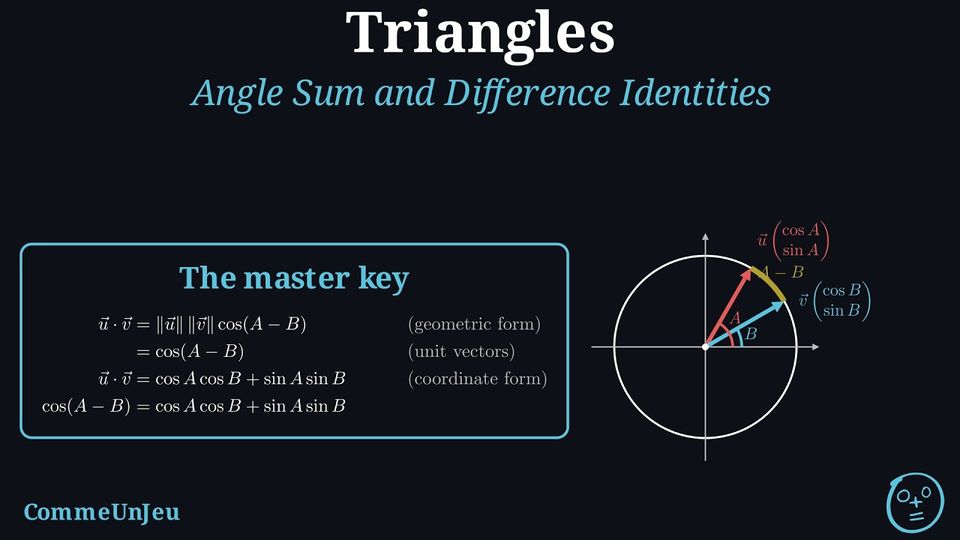
$$\cos (A - B) = \cos A \cos B + \sin A \sin B.$$
Consider the two unit vectors whose tips are the points of the unit circle associated with \(A\) and \(B\): $$\vec{u} = \begin{pmatrix}\cos A \\
\sin A \end{pmatrix} \quad\text{and}\quad \vec{v} = \begin{pmatrix}\cos B \\
\sin B \end{pmatrix}.$$ The geometric angle \(\theta \in [0, \pi]\) between \(\vec{u}\) and \(\vec{v}\) is equal to \(A - B\) or to \(B - A\), up to a multiple of \(2\pi\). Since cosine is even and \(2\pi\)-periodic, \(\cos\theta = \cos(A - B)\).
The scalar product \(\vec{u} \cdot \vec{v}\) can be computed in two ways: 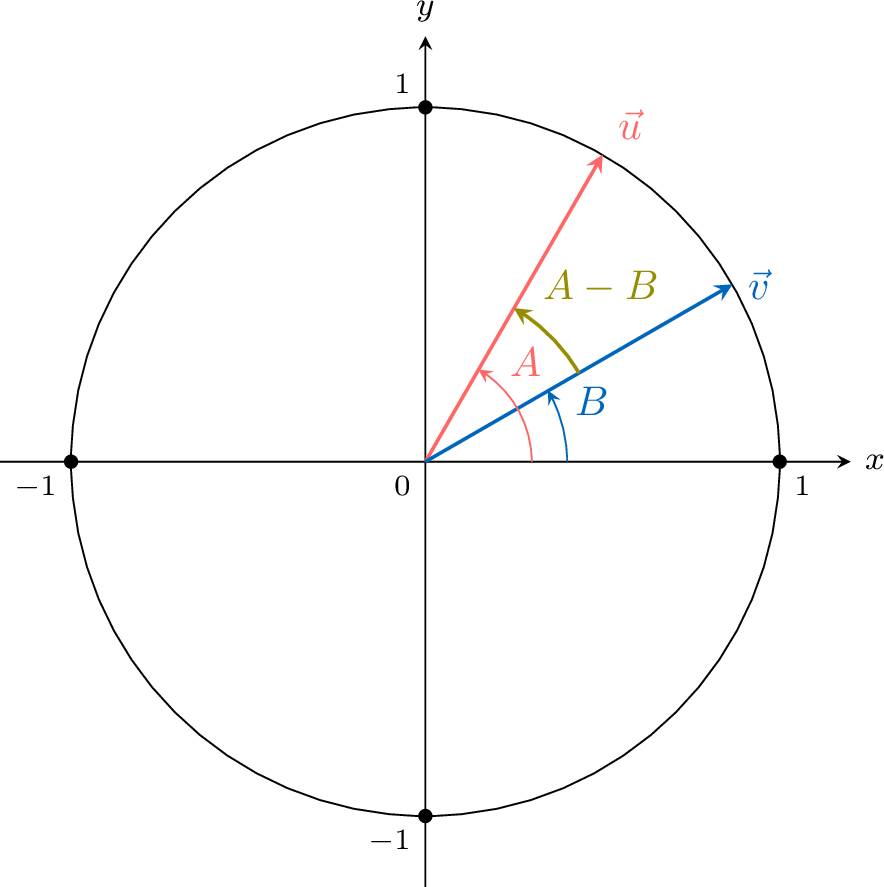
Another proof, with distances. Let \(P\) and \(Q\) be the points of the unit circle associated with \(A\) and \(B\): \(P(\cos A, \sin A)\) and \(Q(\cos B, \sin B)\). Then $$\begin{aligned}[t] PQ^2 &= (\cos A - \cos B)^2 + (\sin A - \sin B)^2 && \text{(distance between two points)}\\
&= \cos^2 A + \sin^2 A + \cos^2 B + \sin^2 B\\
&\quad - 2(\cos A\cos B + \sin A\sin B) && \text{(expanding)}\\
&= 2 - 2(\cos A\cos B + \sin A\sin B). && (\cos^2 + \sin^2 = 1) \end{aligned}$$ The rotation about \(O\) through the angle \(-B\) keeps distances. It sends \(Q\) to the point \(Q'(1, 0)\), of angle \(0\), and \(P\) to the point \(P'\big(\cos(A - B), \sin(A - B)\big)\), of angle \(A - B\). So $$\begin{aligned}[t] PQ^2 = P'Q'^2 &= \big(\cos(A - B) - 1\big)^2 + \sin^2(A - B) && \text{(distance between two points)}\\
&= \cos^2(A - B) + \sin^2(A - B) - 2\cos(A - B) + 1 && \text{(expanding)}\\
&= 2 - 2\cos(A - B). && (\cos^2 + \sin^2 = 1) \end{aligned}$$ The two expressions of \(PQ^2\) are equal: \(2 - 2\cos(A - B) = 2 - 2(\cos A\cos B + \sin A\sin B)\), which gives the identity again, without the scalar product.
The scalar product \(\vec{u} \cdot \vec{v}\) can be computed in two ways:
- From the angle between the vectors: $$\vec{u} \cdot \vec{v} = \|\vec{u}\| \,\|\vec{v}\| \cos\theta = 1 \cdot 1 \cdot \cos(A - B) = \cos(A - B).$$
- From the components: $$\vec{u} \cdot \vec{v} = \begin{pmatrix}\cos A \\ \sin A \end{pmatrix} \cdot \begin{pmatrix}\cos B \\ \sin B \end{pmatrix} = (\cos A)(\cos B) + (\sin A)(\sin B).$$
Proposition — Cosine of Sum
$$\cos (A + B) = \cos A \cos B - \sin A \sin B.$$
Substitute \(B\) by \(-B\) in the cosine difference formula: $$\begin{aligned} \cos(A + B) &= \cos\bigl(A - (-B)\bigr)\\
&= \cos A \cos(-B) + \sin A \sin(-B)\\
&= \cos A \cos B + \sin A (-\sin B)\quad(\text{since } \cos(-\theta) = \cos \theta\text{ and }\sin(-\theta) = -\sin \theta)\\
&= \cos A \cos B - \sin A \sin B. \end{aligned}$$
Proposition — Sine of Sum and Difference
$$\sin (A + B) = \sin A \cos B + \cos A \sin B,$$ $$\sin (A - B) = \sin A \cos B - \cos A \sin B.$$
Using the complementary angle identity \(\sin \theta = \cos\left(\dfrac{\pi}{2} - \theta\right)\): $$\begin{aligned} \sin(A + B) &= \cos\left(\frac{\pi}{2} - (A + B)\right)\\
&= \cos\left( \left(\frac{\pi}{2} - A\right) - B \right)\\
&= \cos\left(\frac{\pi}{2} - A\right) \cos B + \sin\left(\frac{\pi}{2} - A\right) \sin B\\
&= \sin A \cos B + \cos A \sin B. \end{aligned}$$ For the difference, write $$\begin{aligned} \sin(A - B) &= \sin\bigl(A + (-B)\bigr)\\
&= \sin A \cos(-B) + \cos A \sin(-B)\\
&= \sin A \cos B - \cos A \sin B. \end{aligned}$$
Proposition — Tangent of Sum and Difference
For angles \(A\) and \(B\) such that all expressions below are defined, $$\tan (A + B) = \frac{\tan A + \tan B}{1 - \tan A \tan B},$$ $$\tan (A - B) = \frac{\tan A - \tan B}{1 + \tan A \tan B}.$$
Assume \(\cos A \cos B \neq 0\) and \(\cos(A + B) \neq 0\) so that all ratios below are defined: $$\begin{aligned} \tan(A + B) &= \frac{\sin(A + B)}{\cos(A + B)} \\
&= \frac{\sin A \cos B + \cos A \sin B}{\cos A \cos B - \sin A \sin B} \\
&= \frac{\dfrac{\sin A \cos B + \cos A \sin B}{\cos A \cos B}}{\dfrac{\cos A \cos B - \sin A \sin B}{\cos A \cos B}} \quad \text{(divide numerator and denominator by } \cos A \cos B\text{)} \\
&= \frac{\dfrac{\sin A}{\cos A} + \dfrac{\sin B}{\cos B}}{1 - \dfrac{\sin A \sin B}{\cos A \cos B}}\\
&= \frac{\tan A + \tan B}{1 - \tan A \tan B}. \end{aligned}$$ The formula for \(\tan(A-B)\) is obtained by replacing \(B\) with \(-B\) and using \(\tan(-B) = -\tan B\).
Proposition — Double Angle Formulas
For every real number \(A\): $$\cos 2A = \cos^2 A - \sin^2 A = 2\cos^2 A - 1 = 1 - 2\sin^2 A,$$ $$\sin 2A = 2\sin A\cos A.$$ They are obtained by taking \(B = A\) in the formulas for \(\cos(A + B)\) and \(\sin(A + B)\), which gives \(\sin 2A\) and \(\cos^2 A - \sin^2 A\), then using \(\cos^2 A + \sin^2 A = 1\) for the other two forms of \(\cos 2A\). Example
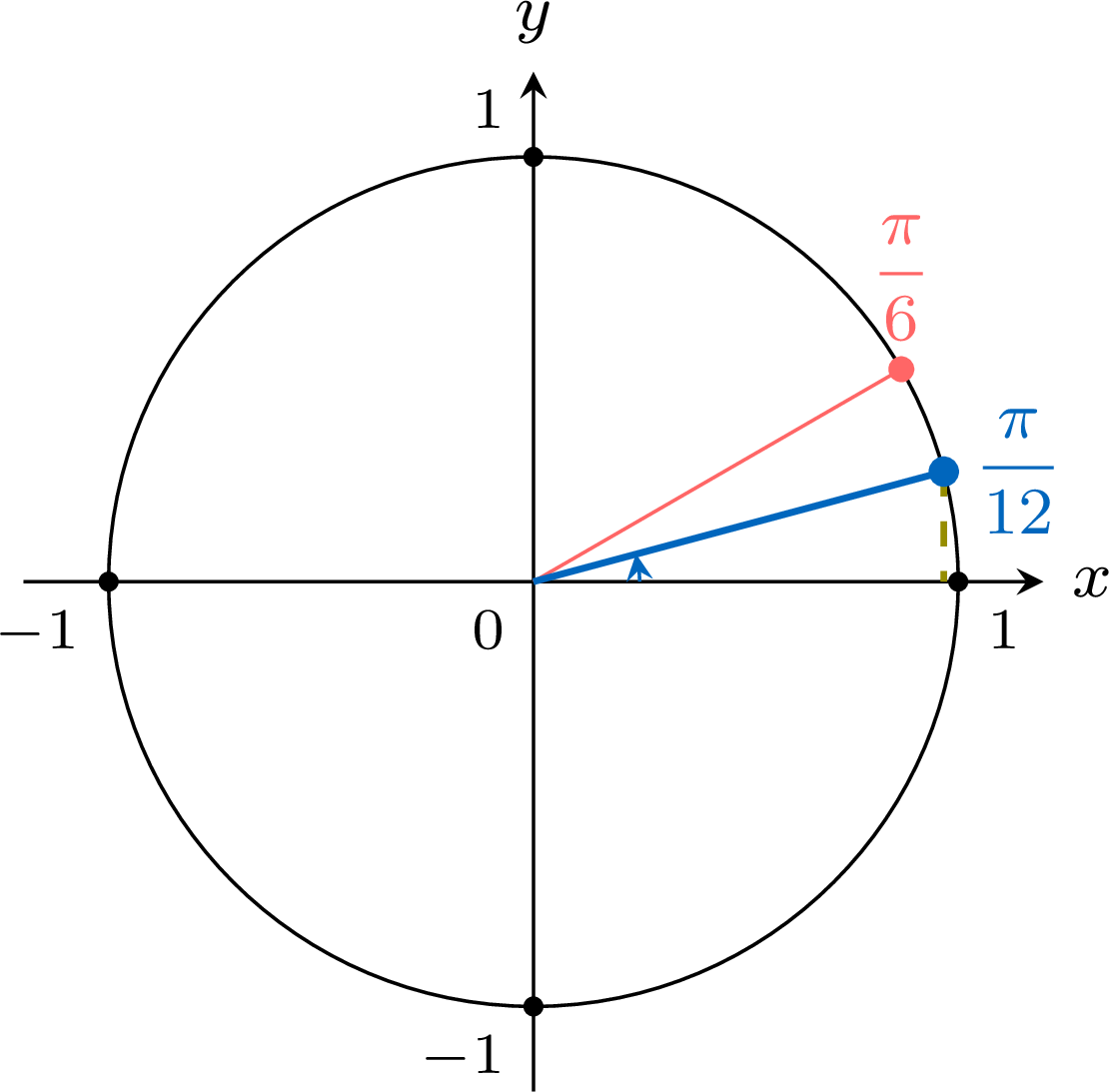
Compute the exact value of \(\cos\dfrac{\pi}{12}\) in two ways: - with an addition formula, writing \(\dfrac{\pi}{12} = \dfrac{\pi}{3} - \dfrac{\pi}{4}\);
- with a double angle formula, since \(2 \times \dfrac{\pi}{12} = \dfrac{\pi}{6}\).
- With the cosine of a difference: $$\begin{aligned}[t] \cos\frac{\pi}{12} &= \cos\left(\frac{\pi}{3} - \frac{\pi}{4}\right) &&\\ &= \cos\frac{\pi}{3}\cos\frac{\pi}{4} + \sin\frac{\pi}{3}\sin\frac{\pi}{4} && \text{(cosine of a difference)}\\ &= \frac{1}{2} \times \frac{\sqrt{2}}{2} + \frac{\sqrt{3}}{2} \times \frac{\sqrt{2}}{2} && \text{(special values)}\\ &= \frac{\sqrt{2} + \sqrt{6}}{4}. \end{aligned}$$
- With \(A = \dfrac{\pi}{12}\), the formula \(\cos 2A = 2\cos^2 A - 1\) gives \(\cos\dfrac{\pi}{6} = 2\cos^2\dfrac{\pi}{12} - 1\), so $$\begin{aligned}[t] \cos^2\frac{\pi}{12} &= \frac{1}{2}\left(1 + \cos\frac{\pi}{6}\right) &&\\ &= \frac{1}{2}\left(1 + \frac{\sqrt{3}}{2}\right) = \frac{2 + \sqrt{3}}{4}. \end{aligned}$$ Since \(\dfrac{\pi}{12} \in \left[0, \dfrac{\pi}{2}\right]\), \(\cos\dfrac{\pi}{12} \ge 0\), hence \(\cos\dfrac{\pi}{12} = \dfrac{\sqrt{2 + \sqrt{3}}}{2}\).
Skills to practice
- Calculating Exact Values with the Compound and Double Angle Formulas
III.2
The Double Angle Formula for the Tangent
Proposition — Double Angle Formula for the Tangent
For every real number \(A\) such that \(\cos A \neq 0\) and \(\cos 2A \neq 0\): $$\tan 2A = \frac{2\tan A}{1 - \tan^2 A}.$$ Under these conditions, \(1 - \tan^2 A \neq 0\).
Let \(A\) be a real number such that \(\cos A \neq 0\) and \(\cos 2A \neq 0\). Take \(B = A\) in the formula for the tangent of a sum: its conditions \(\cos A \cos B = \cos^2 A \neq 0\) and \(\cos(A + B) = \cos 2A \neq 0\) hold, so $$\begin{aligned}[t] \tan 2A &= \tan(A + A)\\
&= \frac{\tan A + \tan A}{1 - \tan A \tan A} && \text{(tangent of a sum)}\\
&= \frac{2\tan A}{1 - \tan^2 A}. \end{aligned}$$ The denominator is not \(0\): $$\begin{aligned}[t] 1 - \tan^2 A &= 1 - \frac{\sin^2 A}{\cos^2 A} && \text{(definition of the tangent)}\\
&= \frac{\cos^2 A - \sin^2 A}{\cos^2 A} && \text{(common denominator)}\\
&= \frac{\cos 2A}{\cos^2 A}, && \text{(double angle formula)} \end{aligned}$$ which is not \(0\) since \(\cos 2A \neq 0\).
Example
Given that \(\cos\theta = -\dfrac{1}{3}\) and \(\pi < \theta < \dfrac{3\pi}{2}\), find the exact values of \(\sin 2\theta\), \(\cos 2\theta\) and \(\tan 2\theta\), without finding \(\theta\).
Since \(\pi < \theta < \dfrac{3\pi}{2}\) (third quadrant), \(\sin\theta < 0\). $$\begin{aligned}[t] \sin^2\theta &= 1 - \cos^2\theta && \text{(Pythagorean identity)}\\
&= 1 - \frac{1}{9} = \frac{8}{9}, \end{aligned}$$ so \(\sin\theta = -\dfrac{2\sqrt{2}}{3}\). Then $$\begin{aligned}[t] \sin 2\theta &= 2\sin\theta\cos\theta && \text{(double angle formula)}\\
&= 2 \times \left(-\frac{2\sqrt{2}}{3}\right) \times \left(-\frac{1}{3}\right) = \frac{4\sqrt{2}}{9},\\
\cos 2\theta &= 2\cos^2\theta - 1 && \text{(double angle formula)}\\
&= \frac{2}{9} - 1 = -\frac{7}{9},\\
\tan 2\theta &= \frac{\sin 2\theta}{\cos 2\theta} && \text{(definition of the tangent)}\\
&= \frac{4\sqrt{2}}{9} \times \left(-\frac{9}{7}\right) = -\frac{4\sqrt{2}}{7}. \end{aligned}$$
Example
Given that \(\cos\theta = -\dfrac{1}{3}\) and \(\pi < \theta < \dfrac{3\pi}{2}\), find the exact value of \(\tan\theta\), then use the double angle formula for the tangent to find \(\tan 2\theta\), without finding \(\theta\).
Since \(\pi < \theta < \dfrac{3\pi}{2}\) (third quadrant), \(\sin\theta < 0\), and \(\sin^2\theta = 1 - \cos^2\theta = \dfrac{8}{9}\) (Pythagorean identity), so \(\sin\theta = -\dfrac{2\sqrt{2}}{3}\). Then $$\begin{aligned}[t] \tan\theta &= \frac{\sin\theta}{\cos\theta} && \text{(definition of the tangent)}\\
&= \left(-\frac{2\sqrt{2}}{3}\right) \times (-3) = 2\sqrt{2}. \end{aligned}$$ \(1 - \tan^2\theta = 1 - 8 = -7 \neq 0\), so the double angle formula for the tangent applies: $$\begin{aligned}[t] \tan 2\theta &= \frac{2\tan\theta}{1 - \tan^2\theta} && \text{(double angle formula for the tangent)}\\
&= \frac{4\sqrt{2}}{-7} = -\frac{4\sqrt{2}}{7}. \end{aligned}$$ Check: the double angle formulas for the sine and the cosine give \(\sin 2\theta = 2\sin\theta\cos\theta = \dfrac{4\sqrt{2}}{9}\) and \(\cos 2\theta = 2\cos^2\theta - 1 = -\dfrac{7}{9}\), and \(\dfrac{\sin 2\theta}{\cos 2\theta} = -\dfrac{4\sqrt{2}}{7}\) as well.
Skills to practice
- Finding the Ratios of the Double Angle from One Ratio
- Proving Identities with the Double Angle Formulas
IV
Equations and Identities
IV.1
Solving Equations with an Identity
Example
Solve each equation for \(0 \le x \le 2\pi\), giving exact values. First use a double angle formula to write the equation with a single trigonometric function of \(x\), or as a product, then solve it. - \(\cos 2x + 3\sin x = 2\);
- \(\sin 2x = \sqrt{3}\cos x\).
- The form \(\cos 2x = 1 - 2\sin^2 x\) of the double angle formula leaves only \(\sin x\): $$\begin{aligned}[t] \cos 2x + 3\sin x = 2 &\iff 1 - 2\sin^2 x + 3\sin x = 2 && \text{(double angle formula)}\\ &\iff 2\sin^2 x - 3\sin x + 1 = 0 && \text{(every term on one side)}\\ &\iff (2\sin x - 1)(\sin x - 1) = 0 && \text{(factorise)}\\ &\iff \sin x = \frac{1}{2} \ \text{ or } \ \sin x = 1. && \text{(null factor law)} \end{aligned}$$ On the unit circle, \(\sin x = \dfrac{1}{2}\) for \(x = \dfrac{\pi}{6}\) and \(x = \dfrac{5\pi}{6}\), and \(\sin x = 1\) for \(x = \dfrac{\pi}{2}\). The solutions are \(\dfrac{\pi}{6}\), \(\dfrac{\pi}{2}\) and \(\dfrac{5\pi}{6}\).
- The form \(\sin 2x = 2\sin x\cos x\) of the double angle formula leaves a common factor \(\cos x\). The equation is not divided by \(\cos x\), which can be \(0\): $$\begin{aligned}[t] \sin 2x = \sqrt{3}\cos x &\iff 2\sin x\cos x - \sqrt{3}\cos x = 0 && \text{(double angle formula)}\\ &\iff \cos x\,(2\sin x - \sqrt{3}) = 0 && \text{(common factor)}\\ &\iff \cos x = 0 \ \text{ or } \ \sin x = \frac{\sqrt{3}}{2}. && \text{(null factor law)} \end{aligned}$$ \(\cos x = 0\) for \(x = \dfrac{\pi}{2}\) and \(x = \dfrac{3\pi}{2}\); \(\sin x = \dfrac{\sqrt{3}}{2}\) for \(x = \dfrac{\pi}{3}\) and \(x = \dfrac{2\pi}{3}\). The solutions, in increasing order, are \(\dfrac{\pi}{3}\), \(\dfrac{\pi}{2}\), \(\dfrac{2\pi}{3}\) and \(\dfrac{3\pi}{2}\). Dividing by \(\cos x\) would have lost \(\dfrac{\pi}{2}\) and \(\dfrac{3\pi}{2}\).
Example
Solve \(\sec^2 x = 3\tan x - 1\) for \(0 \le x \le 2\pi\), giving exact values. First use the Pythagorean identity for the secant to write the equation with \(\tan x\) only, then solve it as an equation of quadratic type.
The equation is defined when \(\cos x \neq 0\). The Pythagorean identity for the secant leaves only \(\tan x\): $$\begin{aligned}[t] \sec^2 x = 3\tan x - 1 &\iff 1 + \tan^2 x = 3\tan x - 1 && \text{(Pythagorean identity for the secant)}\\
&\iff \tan^2 x - 3\tan x + 2 = 0 && \text{(every term on one side)}\\
&\iff (\tan x - 1)(\tan x - 2) = 0 && \text{(factorise)}\\
&\iff \tan x = 1 \ \text{ or } \ \tan x = 2. && \text{(null factor law)} \end{aligned}$$ \(\tan x = 1\) for \(x = \dfrac{\pi}{4}\) and \(x = \dfrac{5\pi}{4}\). The value \(2\) is not the tangent of a special angle: the solution of \(\tan x = 2\) between \(-\dfrac{\pi}{2}\) and \(\dfrac{\pi}{2}\) is \(\arctan 2\), which lies between \(\dfrac{\pi}{4}\) and \(\dfrac{\pi}{2}\) since \(1 < 2\); the tangent has period \(\pi\), so the other solution on the interval is \(\pi + \arctan 2\). None of these values makes \(\cos x = 0\). The solutions, in increasing order, are \(\dfrac{\pi}{4}\), \(\arctan 2\), \(\dfrac{5\pi}{4}\) and \(\pi + \arctan 2\).
Skills to practice
- Solving Equations with the Secant, the Cosecant or the Cotangent with Technology
- Solving Equations with the Secant, the Cosecant or the Cotangent
- Solving Equations with a Double Angle
V
Going further
Skills to practice
- Reasoning and Solving Problems
- Quiz
Jump to section