International Baccalaureate · DP 2: Analysis and Approaches HL
Introduction to Differential Calculus
I
The Derivative
I.1
Average Rate of Change
Take two points \(A\) and \(B\) on the curve of a function \(f\). The line through \(A\) and \(B\) is called a secant line of the curve. Its slope measures how much \(f\) changes, on average, between the \(x\)-coordinates of \(A\) and \(B\): this is the rate of change of \(f\).
Definition — Rate of Change
The rate of change of a function \(f\) between two points \(A(a, f(a))\) and \(B(b, f(b))\) (with \(a \neq b\)) is the gradient of the secant line through \(A\) and \(B\).$$ \textcolor{colordef}{\text{Rate of change} = \dfrac{f(b)-f(a)}{b-a}} $$ 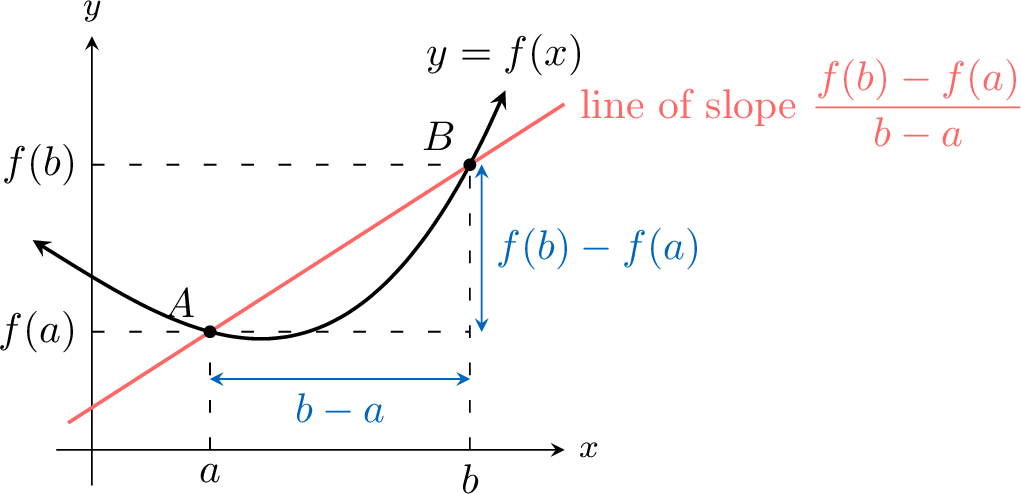
Example
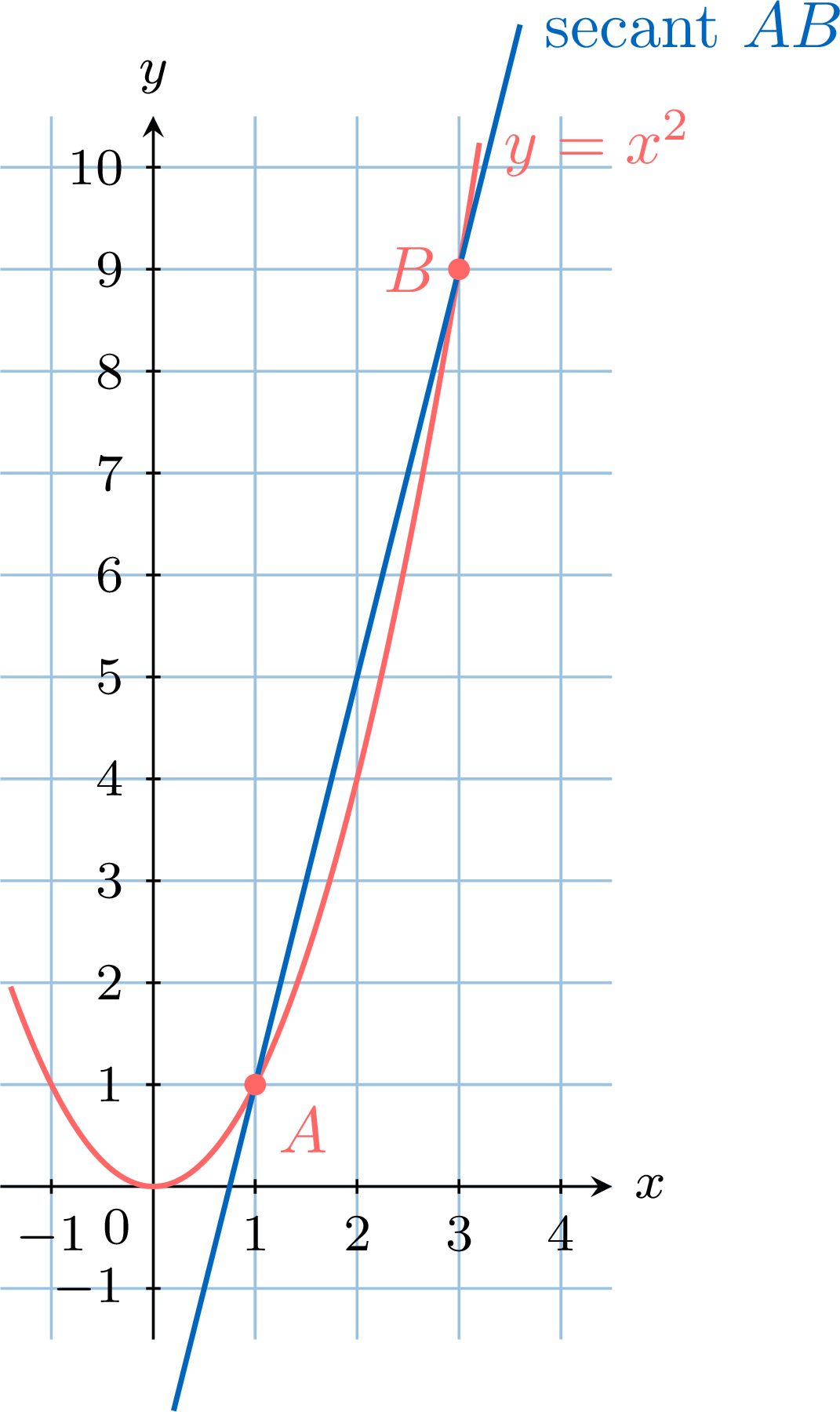
Let \(f(x) = x^2\). - Compute the rate of change of \(f\) between \(1\) and \(3\), and interpret it with the secant line.
- Compute the rate of change of \(f\) between \(-1\) and \(2\).
- \(f(1) = 1\) and \(f(3) = 9\), so $$ \dfrac{f(3)-f(1)}{3-1} = \dfrac{9-1}{2} = 4. $$ The secant line through \(A(1, 1)\) and \(B(3, 9)\) has slope \(4\): between \(x = 1\) and \(x = 3\), \(f(x)\) increases on average by \(4\) when \(x\) increases by \(1\).
- \(f(-1) = 1\) and \(f(2) = 4\), so $$ \dfrac{f(2)-f(-1)}{2-(-1)} = \dfrac{4-1}{3} = 1. $$
Definition — Monotonic Function
A function \(f\) is monotonic on an interval \(I\) if it is increasing on \(I\) or decreasing on \(I\): on \(I\), it never changes direction. Here increasing on \(I\) means: for all \(a\) and \(b\) in \(I\) with \(a \leq b\), \(f(a) \leq f(b)\); decreasing on \(I\) means: for all \(a\) and \(b\) in \(I\) with \(a \leq b\), \(f(a) \geq f(b)\). Proposition — Monotonic Functions and the Sign of the Rate of Change
Let \(f\) be a function defined on an interval \(I\). - \(f\) is increasing on \(I\) if and only if, for all distinct numbers \(a\) and \(b\) of \(I\), \(\dfrac{f(b)-f(a)}{b-a} \geq 0\).
- \(f\) is decreasing on \(I\) if and only if, for all distinct numbers \(a\) and \(b\) of \(I\), \(\dfrac{f(b)-f(a)}{b-a} \leq 0\).
Exchanging \(a\) and \(b\) changes the sign of both \(f(b)-f(a)\) and \(b-a\), so it does not change the rate of change: it is enough to take \(a \lt b\). Then \(b - a \gt 0\), so the rate of change \(\dfrac{f(b)-f(a)}{b-a}\) has the sign of \(f(b)-f(a)\). Hence all the rates of change on \(I\) are positive or zero if and only if \(f(a) \leq f(b)\) whenever \(a \lt b\) in \(I\), that is, if and only if \(f\) is increasing on \(I\). The decreasing case is identical, with \(f(a) \geq f(b)\).
Example
Let \(f(x) = x^2\). - Show that, for all distinct numbers \(a\) and \(b\), the rate of change of \(f\) between \(a\) and \(b\) is \(a + b\).
- Deduce that \(f\) is increasing on \([0, \infty)\) and decreasing on \((-\infty, 0]\).
- The rate of change of \(f\) between \(-1\) and \(3\) is positive. Is \(f\) monotonic on \([-1, 3]\)?
- \(\begin{aligned}[t]\dfrac{f(b)-f(a)}{b-a} &= \dfrac{b^2-a^2}{b-a} \\ &= \dfrac{(b-a)(b+a)}{b-a} \\ &= a+b\end{aligned}\)
- If \(a\) and \(b\) are distinct numbers of \([0, \infty)\), then \(a + b \gt 0\): all the rates of change are positive, so \(f\) is increasing on \([0, \infty)\). If \(a\) and \(b\) are distinct numbers of \((-\infty, 0]\), then \(a + b \lt 0\): all the rates of change are negative, so \(f\) is decreasing on \((-\infty, 0]\).
- Between \(-1\) and \(3\) the rate of change is \(-1 + 3 = 2\), but between \(-1\) and \(0\) it is \(-1 + 0 = -1\). The rates of change on \([-1, 3]\) do not all have the same sign: \(f\) is not monotonic on \([-1, 3]\). One positive rate of change does not prove that \(f\) is increasing: the property asks for all of them.
Skills to practice
- Linking Monotonicity and the Sign of the Rate of Change
- Finding Average Rates of Change
- Finding Average Rates of Change from a Graph
- Interpreting Rates of Change
I.2
The Derivative at a Point
To find the rate of change at a single point \(A\), we can examine the average rate of change over a very small interval. Let the second point be \(B(a+h, f(a+h))\), where \(h\) is a small change in \(x\). The gradient of the secant line through \(A\) and \(B\) is given by:$$ \dfrac{f(a+h) - f(a)}{(a+h)-a} = \dfrac{f(a+h) - f(a)}{h} $$ As we let \(B\) get closer to \(A\), the value of \(h\) approaches 0. The secant line approaches the tangent line at point A. The limit of the secant slopes is the slope of the tangent, which we define as the instantaneous rate of change. 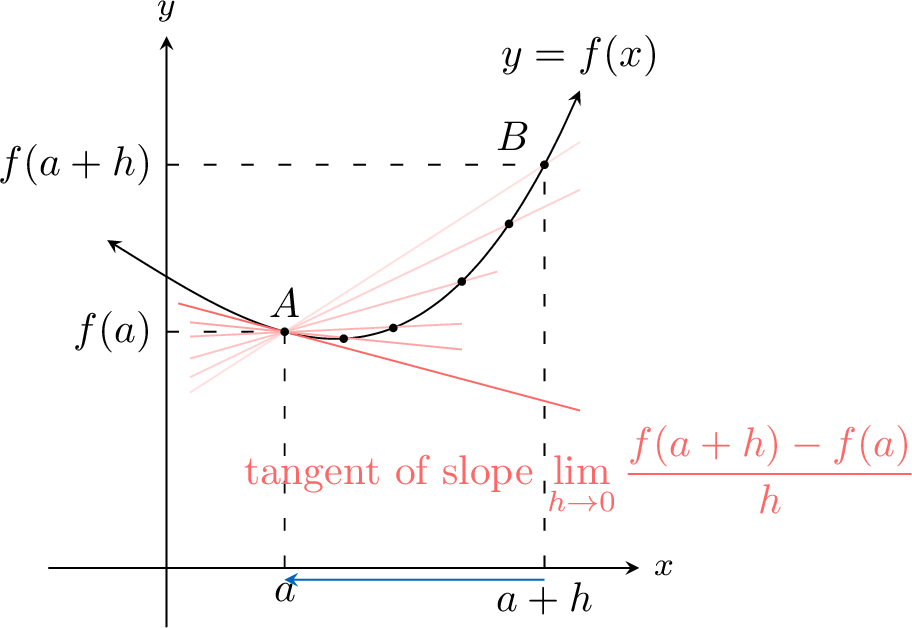
Definition — The Derivative at a Point
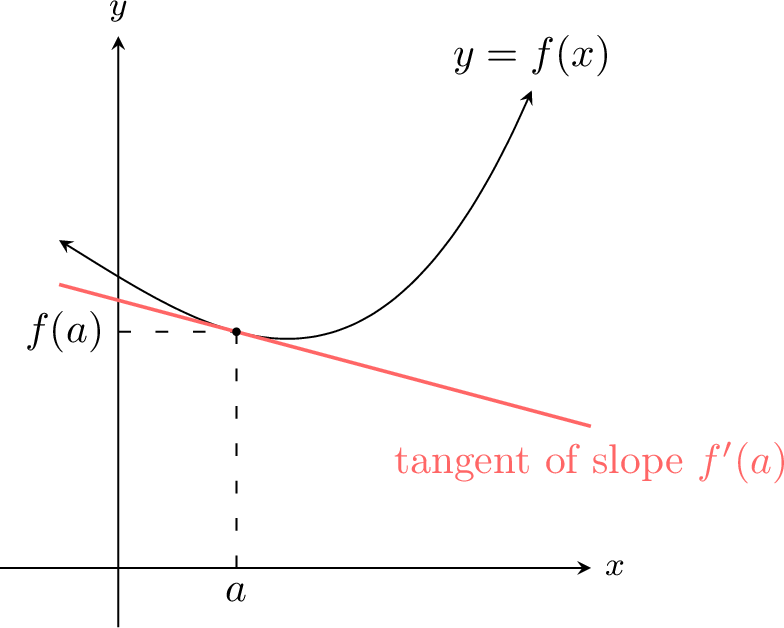
Let \(f\) be a function defined on an open interval containing \(a\). When the limit of the rate of change below exists and is a real number, \(f\) is said to be differentiable at \(a\), and that limit is called the derivative of \(f\) at \(a\), written \(f'(a)\):$$ \textcolor{colordef}{f'(a) = \lim_{h \to 0} \dfrac{f(a+h)-f(a)}{h}} $$ Geometrically, \(f'(a)\) is the slope of the tangent line to the graph of \(f\) at the point \((a, f(a))\). It is also the instantaneous rate of change of \(f\) at \(a\).When this limit does not exist, or is infinite, \(f\) is not differentiable at \(a\): the curve has no tangent of finite slope at that point.
Example
Using the definition of the derivative, find the derivative of \(f(x)=x^2\) at the point \(x=1\).
We evaluate the limit of the rate of change as \(h \to 0\).$$\begin{aligned}\dfrac{f(1+h)-f(1)}{h} &= \dfrac{(1+h)^2 - 1^2}{h} \\
&= \dfrac{(1+2h+h^2) - 1}{h} \\
&= \dfrac{2h+h^2}{h} \\
&= \dfrac{h(2+h)}{h} \\
&= 2+h \quad (\text{for } h \neq 0)\end{aligned}$$ Now, we take the limit:$$ f'(1) = \lim_{h \to 0} (2+h) = 2 $$ The derivative at \(x=1\) is 2. This means the slope of the tangent line to the graph of \(f(x)=x^2\) at the point \((1,1)\) is 2. The diagram below shows how the slope of the secant line from \((1,1)\) to \((1+h, f(1+h))\) approaches the slope of the tangent as \(h\) gets smaller. 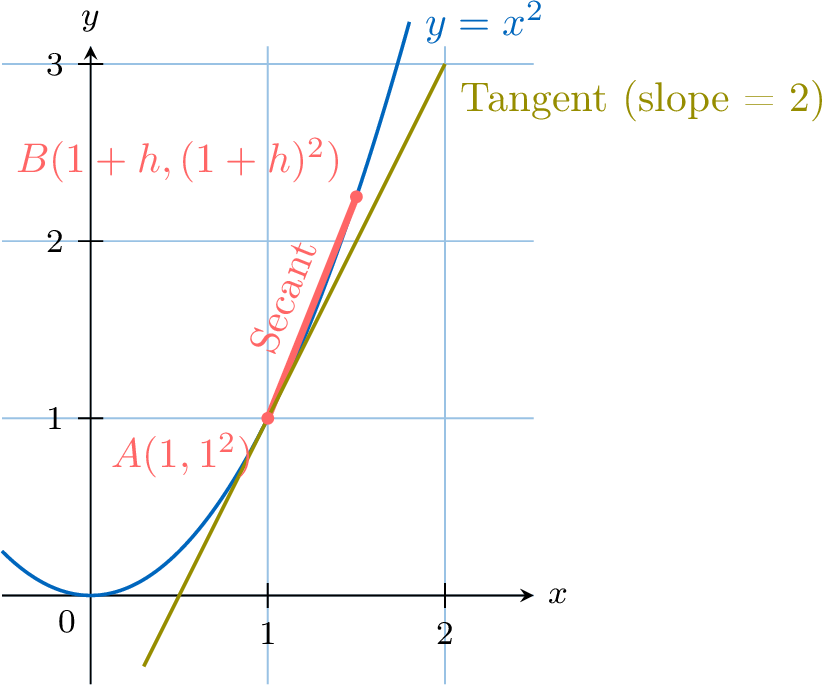
The derivative \(f'(a)\) is an instantaneous rate of change: it tells how fast \(f(x)\) changes at the very moment when \(x = a\). Depending on what \(f\) measures, this number has a concrete meaning.
- Geometry: \(f'(a)\) is the slope of the tangent to the curve at the point with \(x\)-coordinate \(a\).
- Motion: if \(d(t)\) is the distance travelled after \(t\) seconds, the rate of change \(\dfrac{d(t_0+h)-d(t_0)}{h}\) is the average speed between the times \(t_0\) and \(t_0+h\), and \(d'(t_0)\) is the instantaneous speed at time \(t_0\) (the one shown by the speedometer).
- Economics: if \(C(q)\) is the cost of producing \(q\) items, \(C'(q)\) is the marginal cost: approximately the cost of producing one more item beyond \(q\), since \(C(q+1)-C(q) = \dfrac{C(q+1)-C(q)}{1}\) is a rate of change with \(h = 1\), close to \(C'(q)\) when one item is small compared with the quantities produced, so that \(C'\) varies little between \(q\) and \(q+1\).
Example
A ball is dropped from a tower. The distance it has fallen after \(t\) seconds is \(d(t) = 5t^2\) (in metres). - Compute the average speed of the ball between \(t = 2\) and \(t = 3\).
- Using the definition of the derivative, compute \(d'(2)\) and interpret this number.
- The average speed is the rate of change of \(d\) between \(2\) and \(3\): $$ \dfrac{d(3)-d(2)}{3-2} = \dfrac{45 - 20}{1} = 25\ \text{m/s}. $$
- For \(h \neq 0\), $$\begin{aligned} \dfrac{d(2+h)-d(2)}{h} &= \dfrac{5(2+h)^2 - 20}{h} \\ &= \dfrac{20 + 20h + 5h^2 - 20}{h} \\ &= \dfrac{h(20 + 5h)}{h} \\ &= 20 + 5h \xrightarrow[h \to 0]{} 20. \end{aligned}$$ So \(d'(2) = 20\): at the instant \(t = 2\), the ball falls at the instantaneous speed of \(20\ \text{m/s}\). It is smaller than the average speed on \([2, 3]\) because the ball keeps accelerating.
Skills to practice
- Reading the Derivative on a Tangent
- Finding a Derivative at a Point from the Definition
I.3
The Derivative Function
By finding the derivative at a general point \(x\) instead of a specific point \(a\), we can construct a new function, \(f'(x)\), whose value at any \(x\) is the slope of the tangent to the original function \(f(x)\) at that point.
The process of finding the derivative using this limit is called differentiation from first principles.
The process of finding the derivative using this limit is called differentiation from first principles.
Definition — The Derivative Function
The derivative function of \(f\), denoted \(f'\), is the function defined by:$$ f'(x) = \lim_{h \to 0} \dfrac{f(x+h)-f(x)}{h} $$ Example
For \(f(x)=x^2\), find \(f'(x)\).
We evaluate the limit of the rate of change.$$\begin{aligned}\dfrac{f(x+h)-f(x)}{h} &= \dfrac{(x+h)^2 - x^2}{h} \\
&= \dfrac{x^2+2xh+h^2-x^2}{h} \\
&= \dfrac{2xh+h^2}{h}\\
&= \dfrac{h(2x+h)}{h}\\
& = 2x+h \quad (\text{for } h \neq 0)\\
&\xrightarrow[h \to 0]{ } 2x.\end{aligned}$$ So$$ f'(x) = \lim_{h \to 0} \dfrac{f(x+h)-f(x)}{h} = 2x $$
While the “prime” notation \(f'(x)\) is compact, an alternative notation developed by Gottfried Wilhelm Leibniz is often more descriptive: it names the variable with respect to which the function is differentiated.
Definition — Leibniz Notation
Let \(y\) be a function of \(x\), i.e., \(y=f(x)\).The derivative function can be written as:$$ \dfrac{\mathrm{d}y}{\mathrm{d}x}=f'(x)$$ This is read as “dee y by dee x” and represents the derivative of \(y\) with respect to the variable \(x\).
- The term \(\dfrac{\mathrm{d}y}{\mathrm{d}x}\) should be thought of as one single symbol, not a fraction. However, it is derived from the idea of the fraction \(\dfrac{\Delta y}{\Delta x}\) as the change in \(x\) becomes infinitesimally small.
- We can also use the notation \(\dfrac{\mathrm{d}}{\mathrm{d}x}[f(x)]\), which is read as “the derivative with respect to \(x\) of \(f(x)\)”. Here \(\dfrac{\mathrm{d}}{\mathrm{d}x}\) is the operator: it turns a function into its derivative.
- At a point \(x_0\), \(\dfrac{\mathrm{d}y}{\mathrm{d}x}(x_0)\) or \(\dfrac{\mathrm{d}f}{\mathrm{d}x}(x_0)\) denotes the derivative at \(x_0\), \(f'(x_0)\); when the variable is the time \(t\), one writes \(\dfrac{\mathrm{d}f}{\mathrm{d}t}(t_0) = f'(t_0)\).
Example
For \(y=x^2\), find \(\dfrac{\mathrm{d}y}{\mathrm{d}x}\).
The derivative of \(x^2\) is \(2x\). In Leibniz notation, we write:$$ \dfrac{\mathrm{d}y}{\mathrm{d}x} = 2x $$
Skills to practice
- Differentiating from First Principles
I.4
Differentiability and Continuity
Theorem — Continuity and Differentiability
If a function \(f\) is differentiable at a point \(a\), then \(f\) is continuous at \(a\).If a function \(f\) is differentiable on an interval \(I\), then \(f\) is continuous on \(I\).
Let \(f\) be differentiable at \(a\). For \(x \neq a\), the difference \(f(x) - f(a)\) is written with the rate of change: $$\begin{aligned}[t] f(x) - f(a) &= \dfrac{f(x) - f(a)}{x - a} \times (x - a) &&\text{(for } x \neq a\text{)} \\
&\xrightarrow[x \to a]{} f'(a) \times 0 = 0 \end{aligned}$$ since the rate of change tends to \(f'(a)\), which is the definition of differentiability at \(a\), and \(x - a\) tends to \(0\). So \(f(x)\) tends to \(f(a)\) when \(x\) tends to \(a\): \(f\) is continuous at \(a\). As continuity on an interval \(I\) is continuity at every point of \(I\), the second assertion follows from the first.
Note
The converse of this theorem is false. A function can be continuous at a point without being differentiable there.
The classic example is the absolute value function \(f(x) = |x|\) at \(x=0\): 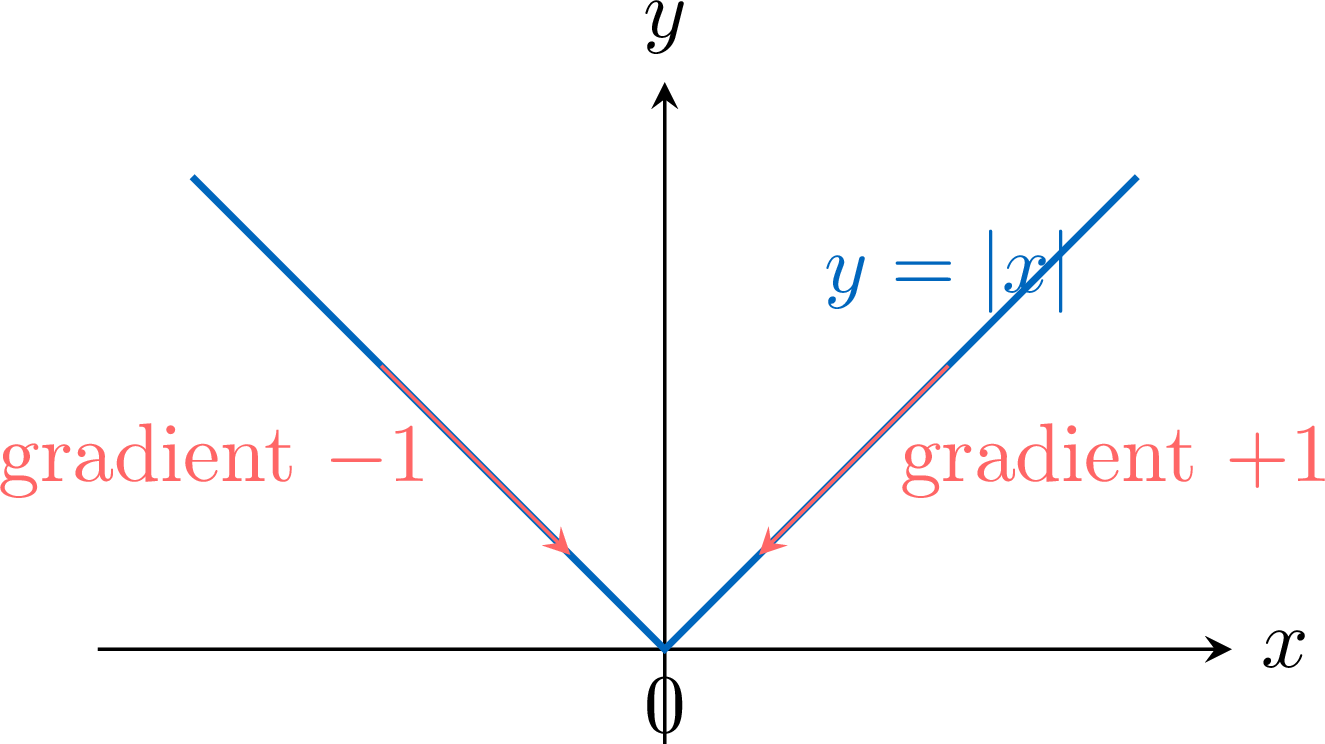
The classic example is the absolute value function \(f(x) = |x|\) at \(x=0\):
- It is continuous at 0 because \(\displaystyle\lim_{x \to 0} |x| = 0 = f(0)\).
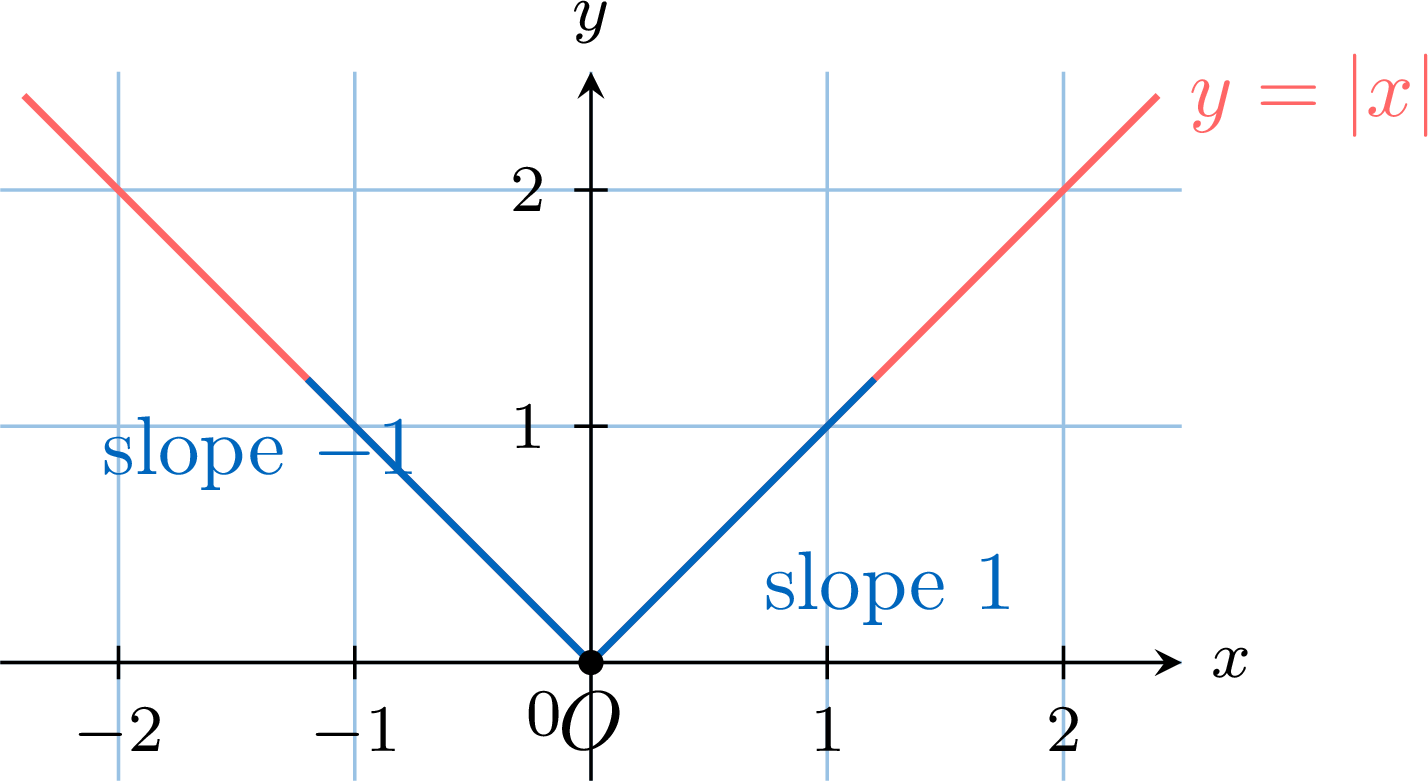
- It is not differentiable at 0 because the gradient on the left is \(-1\) and the gradient on the right is \(+1\).
Skills to practice
- Relating Continuity and Differentiability
I.5
Conditions of Differentiability
Two properties of a function at a point must be distinguished: continuity and differentiability.
- A function \(f\) is continuous at \(a\) when \(\displaystyle\lim_{x \to a} f(x) = f(a)\). A function continuous at every point of an interval has, on that interval, a graph with no break, hole or jump.
- A function is differentiable at a point when the rate of change has a finite limit there. A “smooth” graph — no sharp corner, no vertical tangent — is the usual sign of it; corners and vertical tangents are the two obstacles met most often, but they are not the only ones.
Proposition — When a Function is Not Differentiable
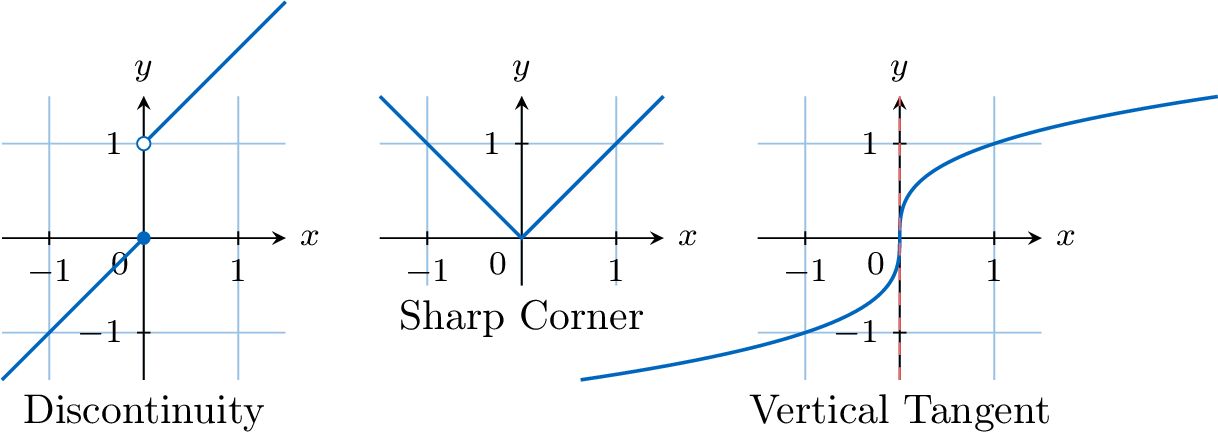
A function \(f\) is not differentiable at a point \(x=a\) if its graph has: - A discontinuity (a hole or jump).
- A sharp corner (where the slope from the left does not equal the slope from the right).
- A vertical tangent (where the slope is infinite).
Example
The graph of a function \(y=f(x)\) is shown. At which x-values is the function not differentiable, and why? 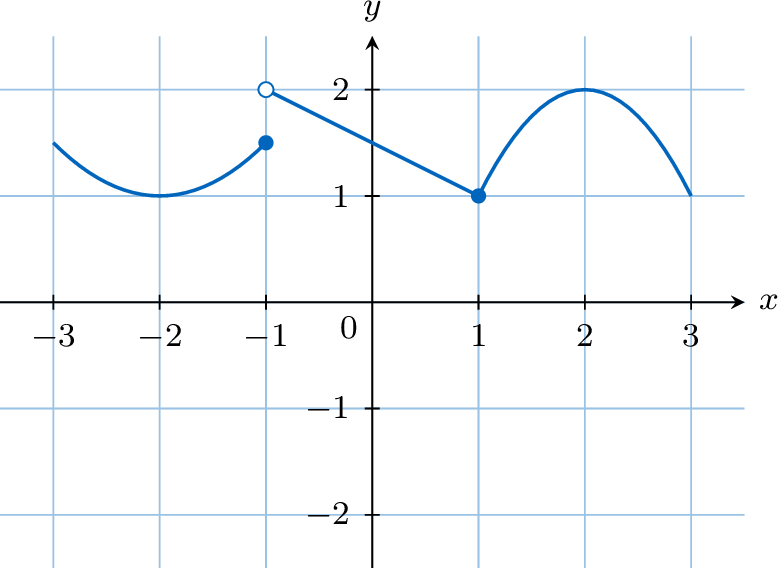
The function is not differentiable at two points:
- At \(\boldsymbol{x=-1}\), there is a jump discontinuity. Since the function is not continuous here, it cannot be differentiable.
- At \(\boldsymbol{x=1}\), there is a sharp corner. The slope of the line segment from the left is \(-0.5\), while the tangent to the parabola from the right has a slope of \(-2(1-2)=2\). Since the left and right slopes are not equal, the function is not differentiable at this point.
Not every usual function is differentiable everywhere. Two important examples fail at \(0\), each in its own geometric way: the square root function, whose curve leaves the origin vertically, and the absolute value function, whose curve has a corner at the origin.
Proposition — The Square Root Function Is Not Differentiable at 0
The function \(x \mapsto \sqrt{x}\), defined for \(x \geq 0\), is not differentiable at \(0\).Graphically, the secant lines through the origin become steeper and steeper: the curve has a vertical tangent at the origin.
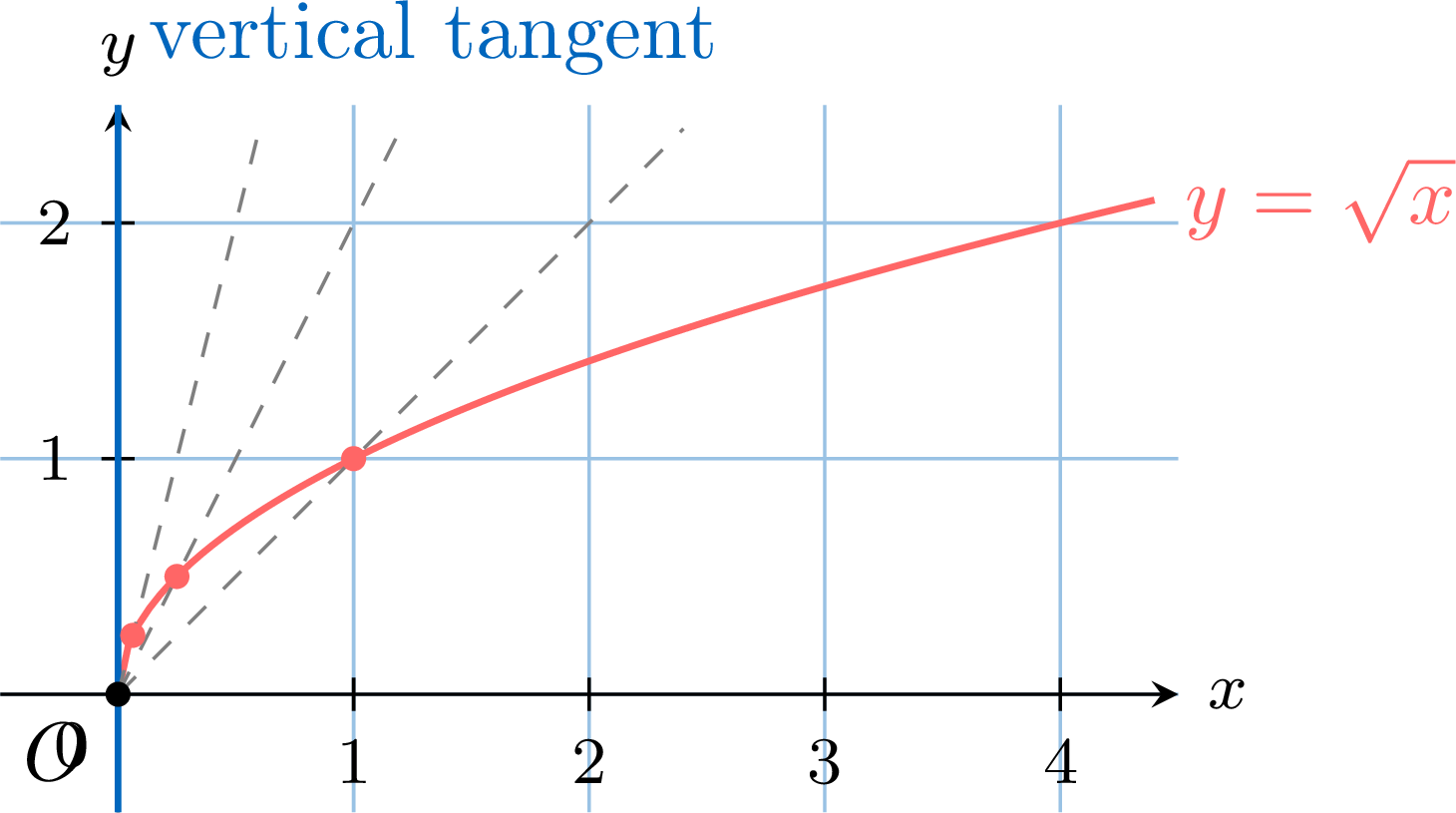
Since \(\sqrt{x}\) is only defined for \(x \geq 0\), we take \(h > 0\). The rate of change between \(0\) and \(h\) is $$ \dfrac{\sqrt{0+h}-\sqrt{0}}{h} = \dfrac{\sqrt{h}}{h} = \dfrac{\sqrt{h}}{\sqrt{h}\times\sqrt{h}} = \dfrac{1}{\sqrt{h}}. $$ When \(h\) gets closer to \(0\), \(\sqrt{h}\) gets closer to \(0\) and \(\dfrac{1}{\sqrt{h}}\) becomes larger than any fixed number: for \(h = 10^{-2}\) it equals \(10\), for \(h = 10^{-4}\) it equals \(100\), for \(h = 10^{-6}\) it equals \(1000\). The rate of change has no finite limit, so \(\sqrt{x}\) is not differentiable at \(0\).
Since the slopes of the secant lines through \(O\) grow without bound, these lines get closer to the vertical axis: the curve has a vertical tangent at the origin.
Since the slopes of the secant lines through \(O\) grow without bound, these lines get closer to the vertical axis: the curve has a vertical tangent at the origin.
Proposition — The Absolute Value Function Is Not Differentiable at 0
The function \(x \mapsto |x|\), defined on \(\mathbb{R}\), is not differentiable at \(0\).Its curve is made of two rays, \(y = -x\) for \(x \leq 0\) and \(y = x\) for \(x \geq 0\), which meet at the origin with the slopes \(-1\) and \(1\): a corner.
Recall that \(|h| = h\) if \(h \geq 0\) and \(|h| = -h\) if \(h < 0\). For \(h \neq 0\), the rate of change between \(0\) and \(h\) is $$ \dfrac{|0+h|-|0|}{h} = \dfrac{|h|}{h} = \begin{cases} \dfrac{h}{h} = 1 & \text{if } h > 0, \\
\dfrac{-h}{h} = -1 & \text{if } h < 0. \end{cases} $$ When \(h\) approaches \(0\) through positive values, the rate of change is constantly \(1\); through negative values, it is constantly \(-1\). A limit would have to be one single number, so the rate of change has no limit: \(|x|\) is not differentiable at \(0\).
Graphically, the curve arrives at the origin with the slope \(-1\) and leaves it with the slope \(1\): two different one-sided tangents, hence a corner.
Graphically, the curve arrives at the origin with the slope \(-1\) and leaves it with the slope \(1\): two different one-sided tangents, hence a corner.
Skills to practice
- Identifying and Proving Non-Differentiability
II
Finding Derivatives
II.1
Basic Rules and Power Functions
We begin with the foundational rules that apply to the most common components of functions, such as constants, powers, and simple arithmetic combinations. These rules can be used to differentiate any polynomial function, as well as many other simple functions, without having to use the limit definition each time.
Proposition — Derivatives of the Reference Functions
| Function \(f\) | \(f\) is differentiable for | Derivative \(f'\) |
| \(f(x) = k\) (constant) | all \(x \in \mathbb{R}\) | \(f'(x) = 0\) |
| \(f(x) = x\) | all \(x \in \mathbb{R}\) | \(f'(x) = 1\) |
| \(f(x) = x^2\) | all \(x \in \mathbb{R}\) | \(f'(x) = 2x\) |
| \(f(x) = x^3\) | all \(x \in \mathbb{R}\) | \(f'(x) = 3x^2\) |
| \(f(x) = x^n\) with \(n \in \mathbb{Z}\), \(n \geq 1\) | all \(x \in \mathbb{R}\) | \(f'(x) = nx^{n-1}\) |
| \(f(x) = \dfrac{1}{x}\) | \(x \neq 0\) | \(f'(x) = -\dfrac{1}{x^2}\) |
| \(f(x) = x^n\) with \(n \in \mathbb{Z}\), \(n \leq -1\) | \(x \neq 0\) | \(f'(x) = nx^{n-1}\) |
| \(f(x) = \sqrt{x}\) | \(x > 0\) | \(f'(x) = \dfrac{1}{2\sqrt{x}}\) |
Proposition — Basic Derivative Rules
- Constant Rule: If \(f(x)=c\), then \(f'(x)=0\).
- Power Rule: If \(f(x)=x^n\), then \(f'(x)=nx^{n-1}\) for any integer \(n\) — at every \(x \neq 0\) when \(n < 0\); for \(n = 0\), \(f\) is constant and \(f' = 0\) (and, accepted without proof, for any real \(n\) when \(x > 0\)).
- Constant Multiple Rule: If \(f(x)=c \cdot u(x)\) with \(u\) differentiable, then \(f'(x)=c \cdot u'(x)\).
- Sum Rule: If \(f(x)=u(x) + v(x)\) with \(u\) and \(v\) differentiable, then \(f'(x)=u'(x) + v'(x)\).
Proof for if \(f(x)=u(x)+v(x)\), then \(f'(x)=u'(x)+v'(x)\):
We evaluate the limit of the rate of change.$$\begin{aligned}\dfrac{f(x+h)-f(x)}{h} &= \dfrac{\left[u(x+h)+v(x+h)\right] - \left[u(x)+v(x)\right]}{h} \\ &= \dfrac{\left[u(x+h)-u(x)\right] + \left[v(x+h)-v(x)\right]}{h} \\ &= \dfrac{u(x+h)-u(x)}{h} + \dfrac{v(x+h)-v(x)}{h} \\ &\xrightarrow[h \to 0]{ } u'(x) + v'(x)\quad \text{(sum of limits)}.\end{aligned}$$ So \( f'(x) = u'(x)+v'(x) \).
The constant multiple rule is proved in the same way, from the definition of the derivative.
One Formula for the Powers
The lines of the table from the constant to \(\dfrac{1}{x}\) are one and the same formula, \((x^n)' = nx^{n-1}\), applied with an integer \(n \geq -1\) (at \(x \neq 0\) when \(n \leq 0\)): \renewcommand{\arraystretch}{1.5}
Remembering this single formula is enough to rebuild these lines: writing \(\dfrac{1}{x}\) as \(x^{-1}\) and a constant \(k\) as \(k\,x^0\) lets it be applied term by term. (A constant function also has derivative \(0\) at \(x = 0\), as the table says: the restriction \(x \neq 0\) only comes from the power \(x^{-1}\) in \(0 \times x^{-1}\).)
| \(n\) | \(x^n\) | \(nx^{n-1}\) | line of the table |
| \(-1\) | \(x^{-1} = \dfrac{1}{x}\) | \((-1)\,x^{-2}\) | \(-\dfrac{1}{x^2}\) |
| \(0\) | \(x^0 = 1\) | \(0 \times x^{-1} = 0\) | constant: \(0\) |
| \(1\) | \(x^1 = x\) | \(1 \times x^0 = 1\) | \(1\) |
| \(2\) | \(x^2\) | \(2x^1\) | \(2x\) |
| \(3\) | \(x^3\) | \(3x^2\) | \(3x^2\) |
Example
Find the derivative of \(f(x) = 4x^3 - 5x^2 + 7x - 2\).
We apply the rules to each term:$$\begin{aligned}f'(x) &= \dfrac{\mathrm{d}}{\mathrm{d}x}(4x^3) - \dfrac{\mathrm{d}}{\mathrm{d}x}(5x^2) + \dfrac{\mathrm{d}}{\mathrm{d}x}(7x) - \dfrac{\mathrm{d}}{\mathrm{d}x}(2) \\
&= 4(3x^2) - 5(2x) + 7(1) - 0 \\
&= 12x^2 - 10x + 7\end{aligned}$$
Example
Let \(f(x) = x^3 - 3x^2 + 2\). - Compute \(f'(x)\).
- Give the slope of the tangent to the curve of \(f\) at the points with \(x\)-coordinates \(0\), \(1\) and \(2\).
- Check that \(f'(x) = 3x(x - 2)\), then give the points of the curve where the tangent is horizontal.
- \(\begin{aligned}[t]f'(x) &= 3x^2 - 3 \times 2x + 0 &&\text{(sum and constant multiple)}\\ &= 3x^2 - 6x\end{aligned}\)
- The slope of the tangent at the point with \(x\)-coordinate \(a\) is \(f'(a)\): \(f'(0) = 0\), \(f'(1) = 3 - 6 = -3\) and \(f'(2) = 12 - 12 = 0\).
- \(3x(x - 2) = 3x^2 - 6x = f'(x)\). The tangent is horizontal when \(f'(x) = 0\), that is \(3x(x - 2) = 0\), so \(x = 0\) or \(x = 2\). Since \(f(0) = 2\) and \(f(2) = 8 - 12 + 2 = -2\), the tangent is horizontal at the points \((0, 2)\) and \((2, -2)\).
Skills to practice
- Recognising the Derivative of a Polynomial
- Interpreting Rates, Derivatives and Their Notations
- Applying the Power Rule
- Differentiating Polynomials
- Differentiating Fractional and Negative Powers
- Expanding or Simplifying Before Differentiating
- Finding Gradients with the Derivative
- Writing Up Derivatives and Gradients
- Proving the Basic Rules from the Definition
II.2
The Derivative at a Point with Technology
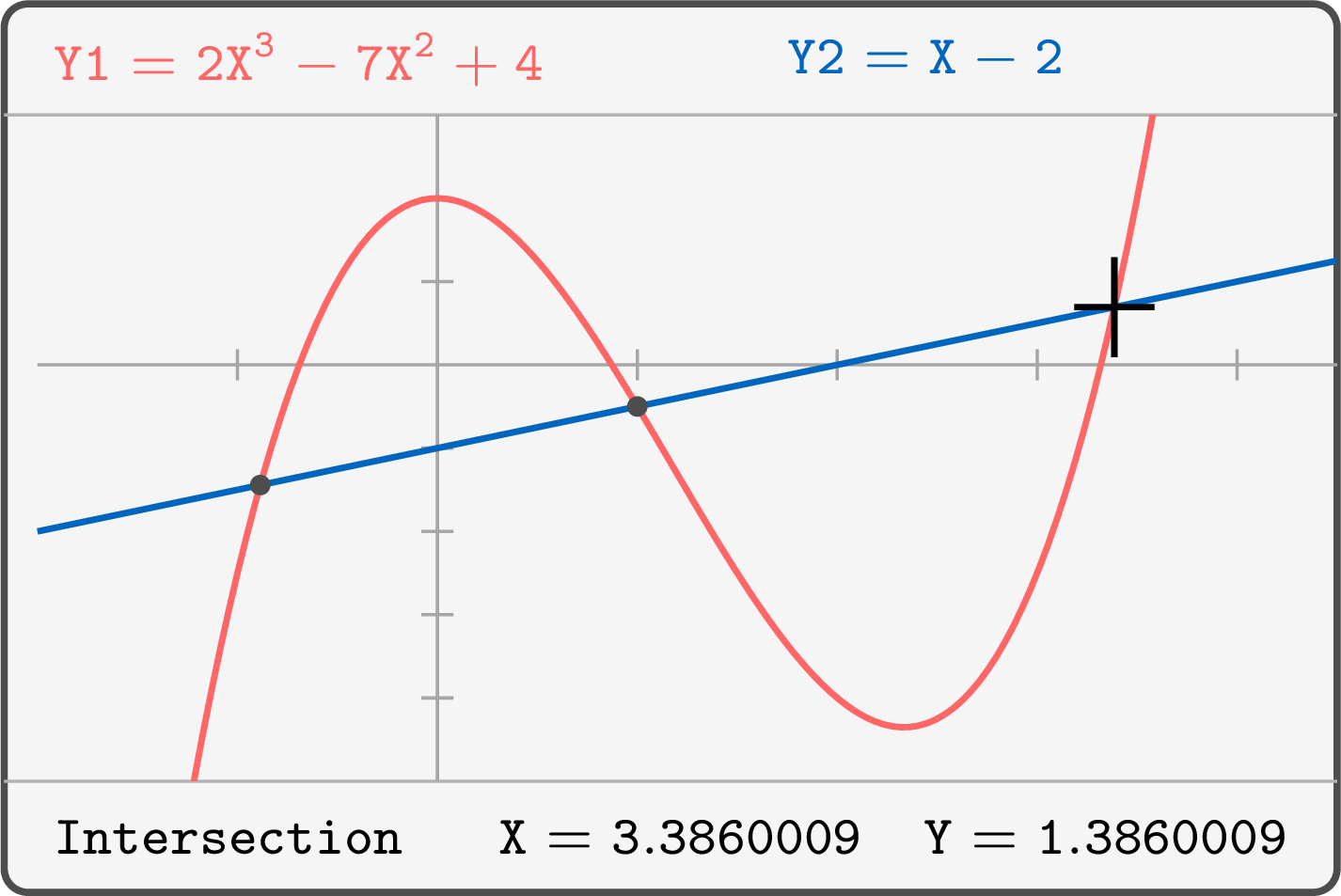
Computing \(f'(a)\) from the limit definition takes several lines of algebra, and for some functions, such as \(x \mapsto 2^x\), algebra alone does not give the limit. A graphing calculator, or graphing software, gives a numerical value of \(f'(a)\) at once. Most models do not differentiate: they compute the rate of change of \(f\) between two values of \(x\) very close to \(a\), one on each side, for example \(a - h\) and \(a + h\) with \(h = 0.001\): $$\dfrac{f(a + h) - f(a - h)}{(a + h) - (a - h)} = \dfrac{f(a + h) - f(a - h)}{2h}.$$ When \(f\) is differentiable at \(a\), this rate of change tends to \(f'(a)\) as \(h\) tends to \(0\); with \(h = 0.001\) it is usually very close to \(f'(a)\), without always being equal to it: for \(f(x) = x^3\) the difference is exactly \(h^2 = 0.000001\). The screen shows the exact value, or a value such as \(4.750001\) whose last digit is the error of the method.
When \(f\) is not differentiable at \(a\), the calculator may still display a number. For \(f(x) = |x|\) at \(a = 0\): $$\dfrac{|0.001| - \left|-0.001\right|}{2 \times 0.001} = \dfrac{0.001 - 0.001}{0.002} = 0,$$ although the graph has a corner at the origin and no tangent there. A number read on the screen is a derivative only once the function is known to be differentiable at that point.
When \(f\) is not differentiable at \(a\), the calculator may still display a number. For \(f(x) = |x|\) at \(a = 0\): $$\dfrac{|0.001| - \left|-0.001\right|}{2 \times 0.001} = \dfrac{0.001 - 0.001}{0.002} = 0,$$ although the graph has a corner at the origin and no tangent there. A number read on the screen is a derivative only once the function is known to be differentiable at that point.
Method — Finding a Derivative at a Point with Technology
To find \(f'(a)\) with a graphing calculator: - Make sure that \(f\) is differentiable at \(a\), from what is known about \(f\): the calculator cannot tell, since it displays a number even where no derivative exists. A value \(a\) outside the domain of \(f\), or a break, a corner or a vertical tangent of the graph at the point with \(x\)-coordinate \(a\), shows that \(f'(a)\) does not exist.
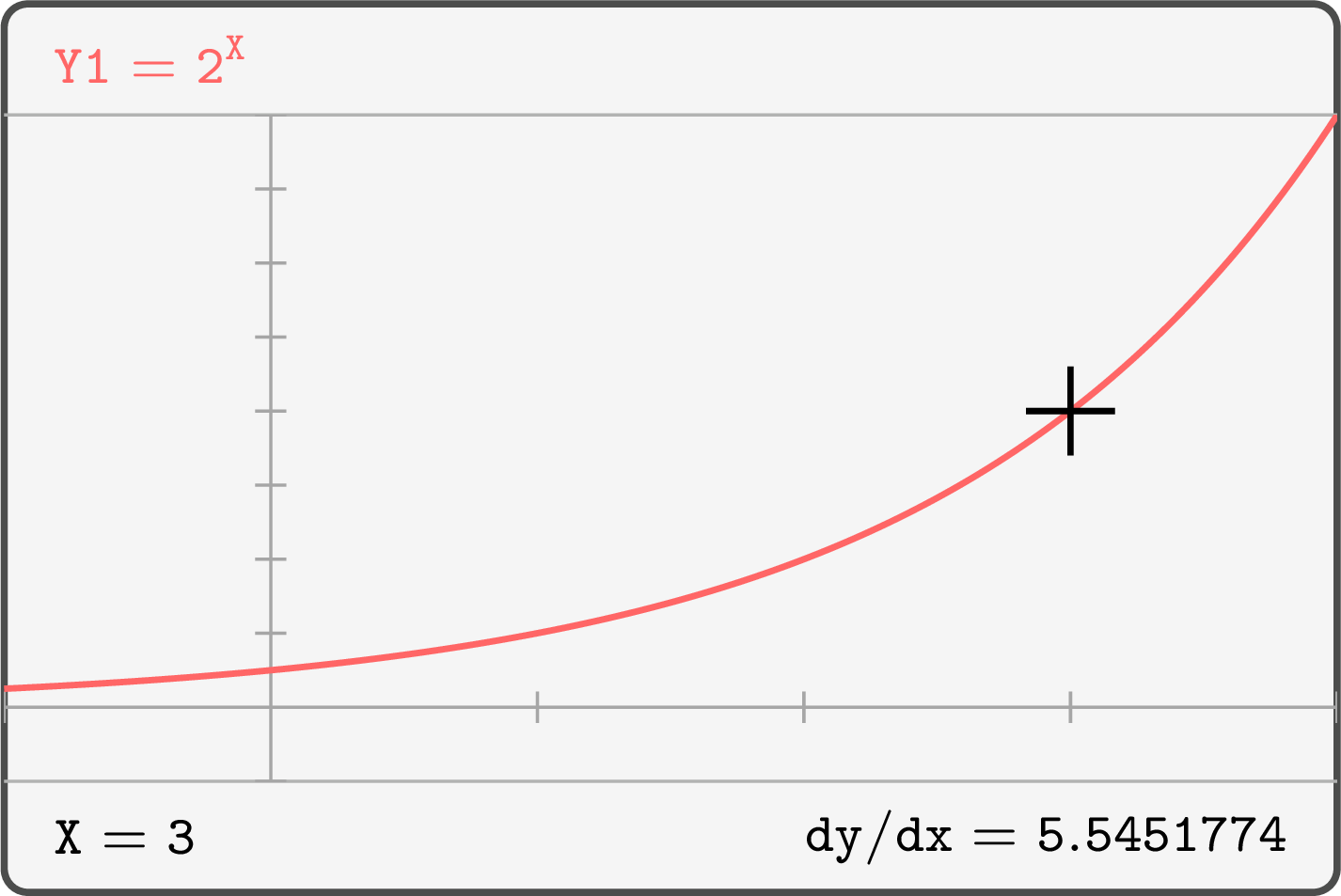
- Use the derivative command of the calculation menu, written \(\frac{\mathrm{d}}{\mathrm{d}x}\) or nDeriv depending on the model: enter the expression of \(f(x)\) in the variable \(X\), then the value \(a\). On the graph screen, the tool \(\mathrm{d}y/\mathrm{d}x\) of the analysis menu gives the same number at the point of the curve where \(x = a\).
- Report the value to 3 significant figures, unless the question asks for another accuracy: a display such as \(4.750001\) is reported as \(4.75\), and \(5.545177444\) as \(5.55\).
Example
Answer with a graphing calculator. - Find the derivative of \(f(x) = x^3 - 2x\) at \(x = 1.5\).
- Find the gradient of the tangent to the curve \(y = \sqrt{x}\) at the point where \(x = 5\), to 3 significant figures.
- The derivative command, applied to \(g(x) = |x - 1|\) at \(x = 1\), displays \(0\). Explain why \(0\) is not \(g'(1)\).
- \(f\) is a polynomial function, differentiable at every real number. The derivative command, with \(X^3 - 2X\) and \(X = 1.5\), displays \(4.75\) (or \(4.750001\) on some models). So \(f'(1.5) \approx 4.75\); the rules of differentiation give the exact value, \(3 \times 1.5^2 - 2 = 4.75\).
- The function \(x \mapsto \sqrt{x}\) has a vertical tangent at the origin only, and \(5 > 0\): it is differentiable at \(5\). The command, with \(\sqrt{X}\) and \(X = 5\), displays about \(0.223607\) (the last digits depend on the model). The gradient of the tangent is \(f'(5) \approx 0.224\).
- A calculator that uses the rate of change of \(g\) between \(0.999\) and \(1.001\) obtains exactly \(0\): $$\dfrac{g(1.001) - g(0.999)}{1.001 - 0.999} = \dfrac{0.001 - 0.001}{0.002} = 0.$$ But \(g\) is not differentiable at \(1\). For \(h \neq 0\), $$\dfrac{g(1 + h) - g(1)}{h} = \dfrac{|h|}{h},$$ which equals \(1\) for \(h > 0\) and \(-1\) for \(h < 0\): the rate of change has no limit as \(h \to 0\). The graph has a corner at \((1, 0)\), and \(0\) is the slope of a chord joining its two branches, not the slope of a tangent.
Example
The number of bacteria in a culture, \(t\) hours after the start of an experiment, is modelled by \(N(t) = 500 \times 1.3^t\). Use technology to find \(N'(4)\), and interpret it in context.
\(N\) is an exponential function, differentiable at every real number, a property accepted here without proof. The derivative command, with \(500 \times 1.3^X\) and \(X = 4\), displays about \(374.669\) (the last digits depend on the model), so \(N'(4) \approx 375\).
\(N'(4)\) is the instantaneous rate of change of \(N\) at \(t = 4\), in bacteria per hour: four hours after the start, the number of bacteria is increasing at a rate of about \(375\) bacteria per hour. It is not the average rate over the first four hours: $$\dfrac{N(4) - N(0)}{4 - 0} = \dfrac{1428.05 - 500}{4} \approx 232 \text{ bacteria per hour},$$ which is smaller, because the growth speeds up.
\(N'(4)\) is the instantaneous rate of change of \(N\) at \(t = 4\), in bacteria per hour: four hours after the start, the number of bacteria is increasing at a rate of about \(375\) bacteria per hour. It is not the average rate over the first four hours: $$\dfrac{N(4) - N(0)}{4 - 0} = \dfrac{1428.05 - 500}{4} \approx 232 \text{ bacteria per hour},$$ which is smaller, because the growth speeds up.
Skills to practice
- Reading a Derivative on the Screen
- Finding a Derivative with Technology
III
Going further
Skills to practice
- Diagnosing and Correcting Errors
- Solving Problems without Technology
- Solving Problems with Technology
- Quiz
Jump to section