International Baccalaureate · DP 2: Analysis and Approaches HL
Proof by Mathematical Induction
I
The Principle of Mathematical Induction
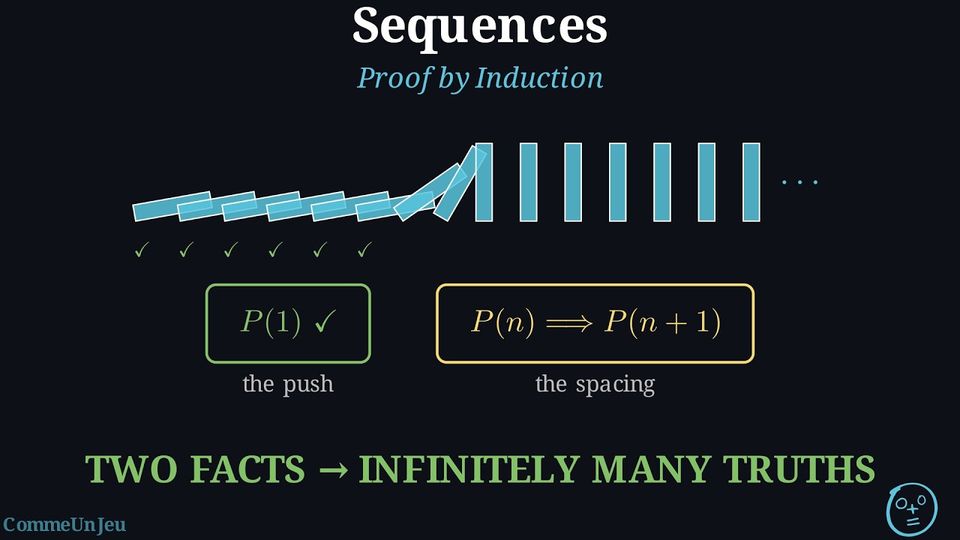
Proof by induction is a powerful technique used to prove that a proposition \(P(n)\) is true for all integers \(n\) above a certain starting value. It is analogous to knocking over a line of dominoes: if you can knock over the first one, and you know that each domino will knock over the next, then all dominoes will eventually fall. 
Method — The Principle of Mathematical Induction
To prove by induction that a proposition \(P(n)\) is true for all integers \(n \ge n_0\): - Base case (initialisation): check that \(P(n_0)\) is true.
- Inductive step (hérédité): assume \(P(n)\) is true for an arbitrary integer \(n \ge n_0\) (the induction hypothesis), and prove that \(P(n+1)\) is then true.
- Conclusion: by the principle of induction, \(P(n)\) is true for all integers \(n \ge n_0\).
Example
Prove by mathematical induction that for all integers \(n \ge 1\), $$ 1 + 2 + 3 + \dots + n = \frac{n(n+1)}{2}. $$
Let \(P(n)\) be the proposition $$ P(n): \quad 1 + 2 + 3 + \dots + n = \frac{n(n+1)}{2} $$ for integers \(n \ge 1\).
- Base case \(n=1\):
On the left-hand side, we have \(1\). On the right-hand side, $$ \frac{1(1+1)}{2} = \frac{2}{2} = 1. $$ So \(P(1)\) is true. - Inductive step:
Assume \(P(n)\) is true for an arbitrary integer \(n \ge 1\), that is, $$ 1 + 2 + 3 + \dots + n = \frac{n(n+1)}{2}. $$ We must show that \(P(n+1)\) is true: $$ 1 + 2 + 3 + \dots + n + (n+1) = \frac{(n+1)(n+2)}{2}. $$ Starting from the left-hand side of \(P(n+1)\): $$ \begin{aligned} 1 + 2 + \dots + n + (n+1) &= \left(1 + 2 + \dots + n\right) + (n+1) \\ &= \frac{n(n+1)}{2} + (n+1) \quad &&\text{(by the induction hypothesis)}\\ &= \frac{n(n+1)}{2} + \frac{2(n+1)}{2} \\ &= \frac{(n+1)(n+2)}{2}. \end{aligned} $$ Thus \(P(n+1)\) is true. - Conclusion:
Since \(P(1)\) is true and \(P(n) \Rightarrow P(n+1)\) for all integers \(n \ge 1\), by the principle of mathematical induction, \(P(n)\) is true for all integers \(n \ge 1\).
Both Steps Are Needed
Neither step of an induction can be left out.
- Without the inductive step, checking cases, however many, does not prove a statement for every \(n\): \(n^2 + n + 41\) takes the prime values \(41\), \(43\), \(47\), \(53\) for \(n = 0, 1, 2, 3\), and a check value by value shows that it is prime for every \(n\) from \(0\) to \(39\); yet for \(n = 40\) it equals \(40 \times 41 + 41 = 41^2\), which is not prime.
- Without the base case, the inductive step does not prove the statement either. Let \(P(n)\) be the proposition “\(4^n + 1\) is divisible by \(3\)”. If \(4^k + 1 = 3m\) for an integer \(m\), then $$\begin{aligned}[t] 4^{k+1} + 1 &= 4\left(4^k + 1\right) - 3\\ &= 4 \times 3m - 3 && \text{(assumption \(4^k + 1 = 3m\))}\\ &= 3(4m - 1), \end{aligned}$$ so \(P(k) \Rightarrow P(k+1)\) holds for every \(k\). But \(P(1)\) is false, since \(4^1 + 1 = 5\): no domino is pushed. The statement is not proved, and indeed \(4^2 + 1 = 17\) and \(4^3 + 1 = 65\) are not divisible by \(3\) either.
Example
Prove by mathematical induction that, for every integer \(n \ge 1\), $$\sum_{r=1}^{n} r(2r-1) = \frac{n(n+1)(4n-1)}{6}.$$
Let \(P(n)\) be the proposition \(\displaystyle\sum_{r=1}^{n} r(2r-1) = \frac{n(n+1)(4n-1)}{6}\), for integers \(n \ge 1\).
- Base case \(n = 1\): the left-hand side is \(1 \times (2 - 1) = 1\) and the right-hand side is \(\dfrac{1 \times 2 \times 3}{6} = 1\). So \(P(1)\) is true.
- Inductive step: assume \(P(k)\) is true for some integer \(k \ge 1\) (the inductive hypothesis). The sum up to \(k + 1\) is the sum up to \(k\) plus the term of rank \(k + 1\): $$\begin{aligned}[t] \sum_{r=1}^{k+1} r(2r-1) &= \sum_{r=1}^{k} r(2r-1) + (k+1)(2k+1) && \text{(last term split off)}\\ &= \frac{k(k+1)(4k-1)}{6} + (k+1)(2k+1) && \text{(inductive hypothesis)}\\ &= \frac{(k+1)\left[k(4k-1) + 6(2k+1)\right]}{6} && \text{(factoring out \(\tfrac{k+1}{6}\))}\\ &= \frac{(k+1)\left(4k^2 + 11k + 6\right)}{6}\\ &= \frac{(k+1)(k+2)(4k+3)}{6}. \end{aligned}$$ Since \(k + 2 = (k+1) + 1\) and \(4k + 3 = 4(k+1) - 1\), this is the formula at rank \(k + 1\): \(P(k+1)\) is true.
- Conclusion: since \(P(1)\) is true and \(P(k) \Rightarrow P(k+1)\) for every integer \(k \ge 1\), by the principle of mathematical induction, \(P(n)\) is true for every integer \(n \ge 1\).
Example
Prove by mathematical induction that \(6^n + 4\) is divisible by \(5\) for every natural number \(n\).
Let \(P(n)\) be the proposition “\(6^n + 4\) is divisible by \(5\)”, for natural numbers \(n\).
- Base case \(n = 0\): \(6^0 + 4 = 5 = 5 \times 1\). So \(P(0)\) is true.
- Inductive step: assume \(P(k)\) is true for some natural number \(k\) (the inductive hypothesis). By the definition of divisibility, there is an integer \(m\) such that \(6^k + 4 = 5m\), that is \(6^k = 5m - 4\). The power \(6^{k+1}\) is written with \(6^k\), which the hypothesis replaces: $$\begin{aligned}[t] 6^{k+1} + 4 &= 6 \times 6^k + 4\\ &= 6(5m - 4) + 4 && \text{(inductive hypothesis)}\\ &= 30m - 20\\ &= 5(6m - 4). \end{aligned}$$ Since \(6m - 4\) is an integer, \(6^{k+1} + 4\) is divisible by \(5\): \(P(k+1)\) is true.
- Conclusion: since \(P(0)\) is true and \(P(k) \Rightarrow P(k+1)\) for every natural number \(k\), by the principle of mathematical induction, \(P(n)\) is true for every natural number \(n\).
Skills to practice
- Analyzing a Proof by Induction
- Proving Sums by Induction
- Proving Products by Induction
- Proving Divisibility Properties by Induction
II
Inequalities
Proposition — Bernoulli's Inequality
For every real number \(a \ge 0\) and every integer \(n \ge 0\),$$(1+a)^n \ge 1 + na.$$
We prove \(P(n): (1+a)^n \ge 1+na\) by induction on \(n\).
- Base case. For \(n=0\): \((1+a)^0 = 1\) and \(1 + 0 \times a = 1\), so \(P(0)\) is true.
- Inductive step. Assume \((1+a)^n \ge 1+na\) for some \(n \ge 0\). Since \(1+a > 0\), multiplying both sides by \(1+a\) preserves the inequality:$$\begin{aligned}[t] (1+a)^{n+1} &= (1+a)^n (1+a) \\ &\ge (1+na)(1+a) && {\scriptstyle(\text{induction hypothesis, } 1+a>0)} \\ &= 1 + (n+1)a + na^2 \\ &\ge 1 + (n+1)a && {\scriptstyle(na^2 \ge 0)}. \end{aligned}$$So \(P(n+1)\) holds.
- Conclusion. By induction, \((1+a)^n \ge 1+na\) for every \(n \ge 0\).
Example
Prove by mathematical induction that \(n! > 3^n\) for every integer \(n \ge 7\).
Let \(P(n)\) be the proposition “\(n! > 3^n\)”, for integers \(n \ge 7\).
- Base case \(n = 7\): \(7! = 5040\) and \(3^7 = 2187\), and \(5040 > 2187\). So \(P(7)\) is true.
- Inductive step: assume \(P(k)\) is true for some integer \(k \ge 7\), that is \(k! > 3^k\) (the inductive hypothesis). Then $$\begin{aligned}[t] (k+1)! &= (k+1) \times k!\\ &> (k+1) \times 3^k && \text{(inductive hypothesis, \(k + 1 > 0\))}\\ &\ge 3 \times 3^k && \text{(\(k + 1 \ge 3\), since \(k \ge 7\))}\\ &= 3^{k+1}. \end{aligned}$$ So \(P(k+1)\) is true.
- Conclusion: since \(P(7)\) is true and \(P(k) \Rightarrow P(k+1)\) for every integer \(k \ge 7\), by the principle of mathematical induction, \(n! > 3^n\) for every integer \(n \ge 7\).
Skills to practice
- Proving Inequalities by Induction
III
Recursive Sequences
Definition — Increasing and Decreasing Sequences
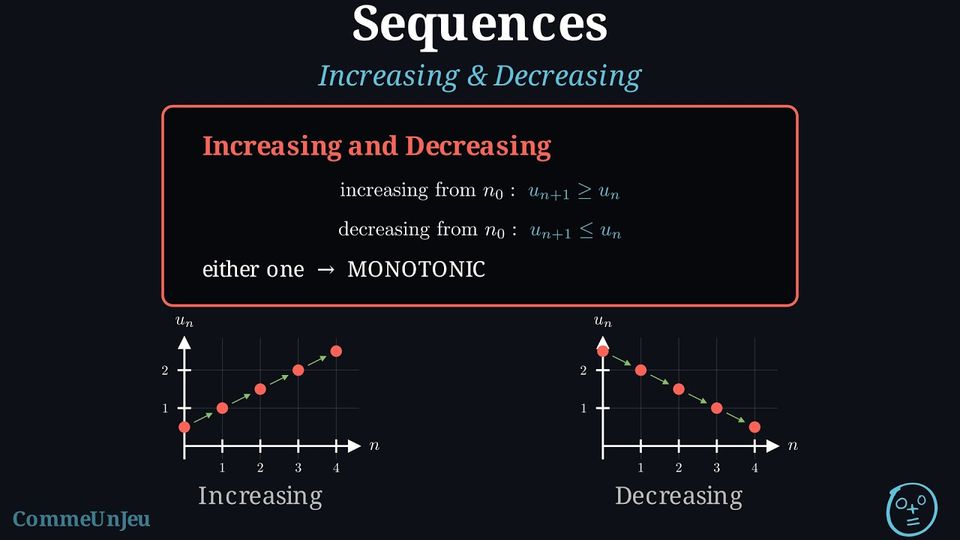
Let \((u_n)\) be a sequence. - The sequence \((u_n)\) is increasing from index \(n_0\) if for all \(n \ge n_0\), \(\boldsymbol{u_{n+1} \ge u_n}\).

- The sequence \((u_n)\) is decreasing from index \(n_0\) if for all \(n \ge n_0\), \(\boldsymbol{u_{n+1} \le u_n}\).

- A sequence that is either increasing or decreasing is said to be monotonic.
Definition — Upper and Lower Bounds
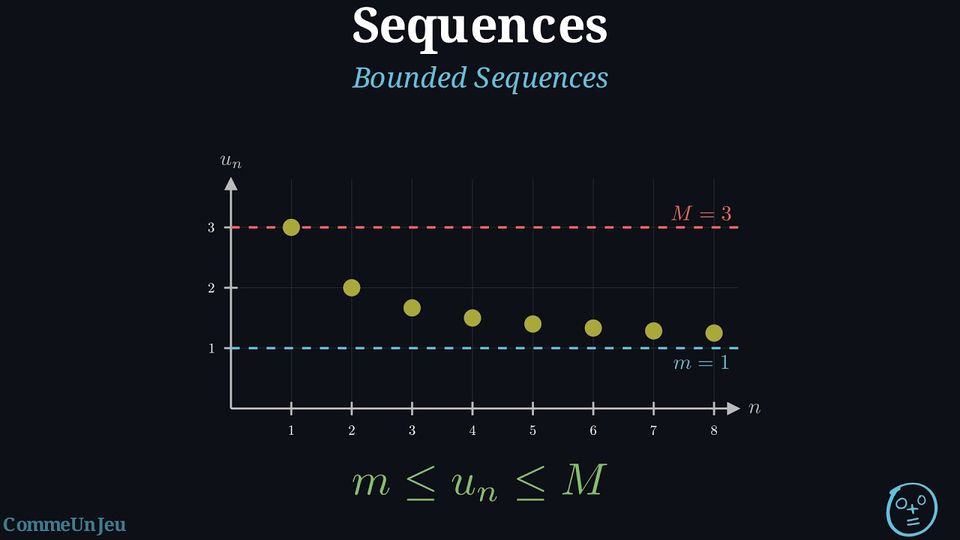
Let \((u_n)\) be a sequence. - \((u_n)\) is upper bounded if there exists a real \(M\) such that for all \(n\), \(\boldsymbol{u_n \le M}\). \(M\) is an upper bound.
- \((u_n)\) is lower bounded if there exists a real \(m\) such that for all \(n\), \(\boldsymbol{u_n \ge m}\). \(m\) is a lower bound.
- \((u_n)\) is bounded if it is both upper and lower bounded.
Example — An Induction on a Recursive Sequence
The sequence \((u_n)\) is defined by \(u_0 = 1\) and, for every natural number \(n\), \(u_{n+1} = \dfrac{1}{2}u_n + 2\). - Prove by induction that \(u_n \le 4\) for every natural number \(n\).
- Deduce that the sequence \((u_n)\) is increasing.
- Prove by induction that \(u_n = 4 - \dfrac{3}{2^n}\) for every natural number \(n\).
- Let \(P(n)\) be the proposition “\(u_n \le 4\)”, for natural numbers \(n\). Base case: \(u_0 = 1 \le 4\), so \(P(0)\) is true. Inductive step: assume \(u_k \le 4\) for some natural number \(k\) (the inductive hypothesis). Multiplying by \(\frac{1}{2} > 0\) keeps the direction of the inequality: $$\begin{aligned}[t] u_{k+1} &= \frac{1}{2}u_k + 2\\ &\le \frac{1}{2} \times 4 + 2 && \text{(inductive hypothesis)}\\ &= 4. \end{aligned}$$ So \(P(k+1)\) is true. Conclusion: since \(P(0)\) is true and \(P(k) \Rightarrow P(k+1)\) for every natural number \(k\), by the principle of mathematical induction, \(u_n \le 4\) for every natural number \(n\).
- For every natural number \(n\), $$\begin{aligned}[t] u_{n+1} - u_n &= \frac{1}{2}u_n + 2 - u_n\\ &= \frac{1}{2}\left(4 - u_n\right)\\ &\ge 0 && \text{(part 1: \(u_n \le 4\))}. \end{aligned}$$ So \(u_{n+1} \ge u_n\) for every \(n\): the sequence \((u_n)\) is increasing.
- Let \(Q(n)\) be the proposition \(u_n = 4 - \dfrac{3}{2^n}\), for natural numbers \(n\). Base case: \(4 - \dfrac{3}{2^0} = 4 - 3 = 1 = u_0\), so \(Q(0)\) is true. Inductive step: assume \(u_k = 4 - \dfrac{3}{2^k}\) for some natural number \(k\) (the inductive hypothesis). Then $$\begin{aligned}[t] u_{k+1} &= \frac{1}{2}u_k + 2\\ &= \frac{1}{2}\left(4 - \frac{3}{2^k}\right) + 2 && \text{(inductive hypothesis)}\\ &= 2 - \frac{3}{2^{k+1}} + 2\\ &= 4 - \frac{3}{2^{k+1}}. \end{aligned}$$ So \(Q(k+1)\) is true. Conclusion: by the principle of mathematical induction, \(u_n = 4 - \dfrac{3}{2^n}\) for every natural number \(n\). This formula confirms parts 1 and 2: \(\dfrac{3}{2^n} > 0\), and it decreases as \(n\) increases.
Skills to practice
- Proving an Explicit Formula for a Sequence
- Proving Properties of a Sequence
IV
Going further
Skills to practice
- Solving Problems by Induction
Jump to section