International Baccalaureate · DP 1: Analysis and Approaches HL
Functions
I
Functions and Their Graphs
I.1
What Is a Function?
Recappreviously studied — click to reread
A function is like a machine that follows a specific rule. For every number you put in, you get exactly one number out.
Consider a machine whose rule is "multiply by 2". 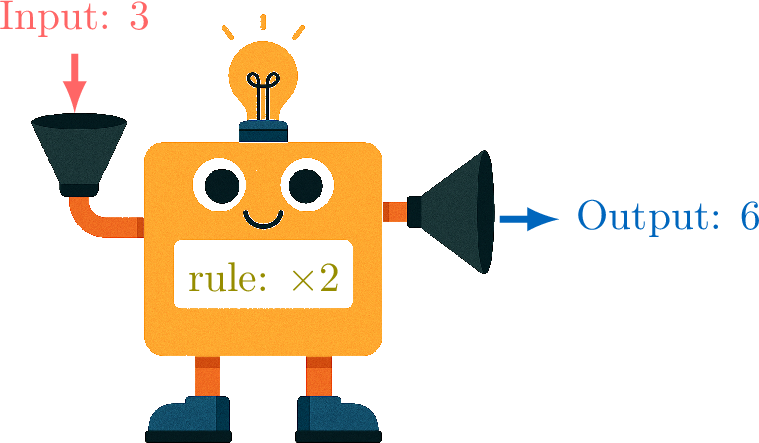
If we put in a 3, we get out a 6. If we put in a 5, we get out a 10. A table of values helps us organize these pairs:
To work with these rules more efficiently, mathematicians developed a special notation.
To represent this machine, we write \(\textcolor{olive}{f}(\textcolor{colordef}{\text{input}}) = \textcolor{colorprop}{\text{output}}\). The parentheses \((\) \()\) indicate the action of the function \(\textcolor{olive}{f}\) on the input.
We use function notation to name functions and their variables, replacing "\(\textcolor{colordef}{\text{input}}\)" by "\(\textcolor{colordef}{x}\)" and "\(\textcolor{colorprop}{\text{output}}\)" by "\(\textcolor{colorprop}{f(x)}\)".
A function maps every element from a set of inputs, the domain \(X\), to an element in a set of possible outputs, the codomain \(Y\). This is written as \(f: X \to Y\). The specific rule that maps an individual element \(x\) from the domain to an element \(f(x)\) in the codomain is written as \(x \mapsto f(x)\).
In general we write $$\Function{\textcolor{olive}{f}}{\textcolor{colordef}{X}}{\textcolor{colorprop}{Y}}{\textcolor{colordef}{x}}{\textcolor{colorprop}{f(x)}}$$ For example, if the rule is "twice the input" and we are mapping real numbers to real numbers, \(f: \mathbb{R} \to \mathbb{R}\): 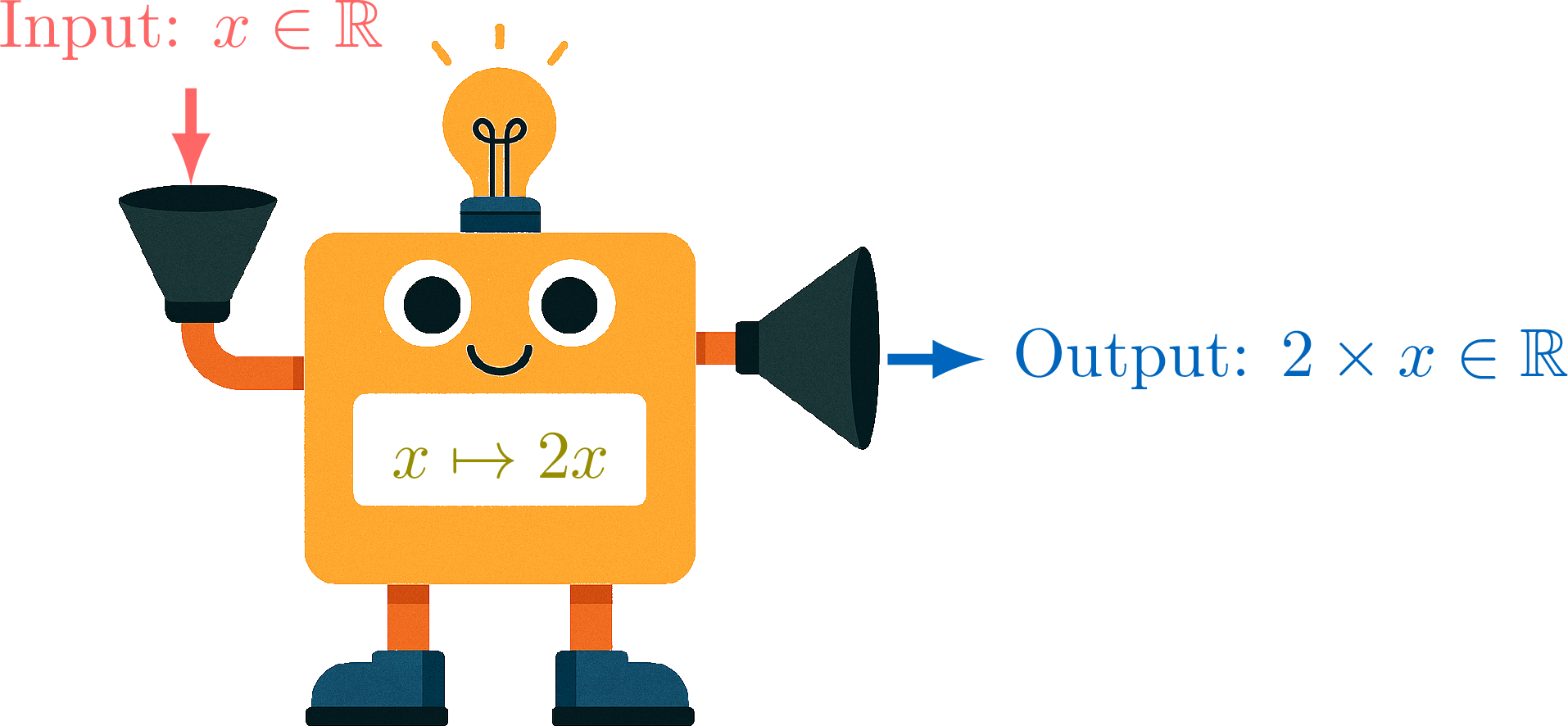
we have \(\textcolor{olive}{f}(\textcolor{colordef}{x}) = \textcolor{colorprop}{2x}\), which is written in full as:$$\Function{\textcolor{olive}{f}}{\textcolor{colordef}{\mathbb{R}}}{\textcolor{colorprop}{\mathbb{R}}}{\textcolor{colordef}{x}}{\textcolor{colorprop}{2x}}$$ When the input is \(\textcolor{colordef}{x} = \textcolor{colordef}{1}\), we get:$$\begin{aligned}\textcolor{olive}{f}(\textcolor{colordef}{1}) &= 2 \times \textcolor{colordef}{(1)}\\
&= \textcolor{colorprop}{2}\end{aligned}$$
Consider a machine whose rule is "multiply by 2".
| Input | 3 | 5 | 8 | 10 |
| Output | 6 | 10 | 16 | 20 |
To represent this machine, we write \(\textcolor{olive}{f}(\textcolor{colordef}{\text{input}}) = \textcolor{colorprop}{\text{output}}\). The parentheses \((\) \()\) indicate the action of the function \(\textcolor{olive}{f}\) on the input.
We use function notation to name functions and their variables, replacing "\(\textcolor{colordef}{\text{input}}\)" by "\(\textcolor{colordef}{x}\)" and "\(\textcolor{colorprop}{\text{output}}\)" by "\(\textcolor{colorprop}{f(x)}\)".
A function maps every element from a set of inputs, the domain \(X\), to an element in a set of possible outputs, the codomain \(Y\). This is written as \(f: X \to Y\). The specific rule that maps an individual element \(x\) from the domain to an element \(f(x)\) in the codomain is written as \(x \mapsto f(x)\).
In general we write $$\Function{\textcolor{olive}{f}}{\textcolor{colordef}{X}}{\textcolor{colorprop}{Y}}{\textcolor{colordef}{x}}{\textcolor{colorprop}{f(x)}}$$ For example, if the rule is "twice the input" and we are mapping real numbers to real numbers, \(f: \mathbb{R} \to \mathbb{R}\):
Definition — Function
A function \(f: X \to Y\) is a rule that assigns to each element \(x\) in a set \(X\) exactly one element \(f(x)\) in a set \(Y\). - The set \(X\) of all possible inputs is called the domain of \(f\).
- The set \(Y\) is called the codomain of \(f\).
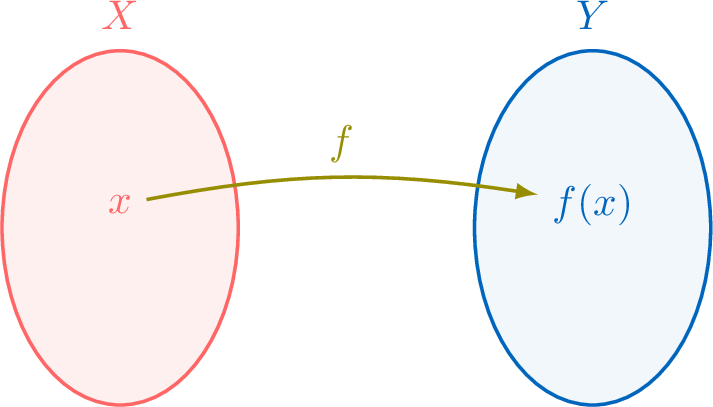
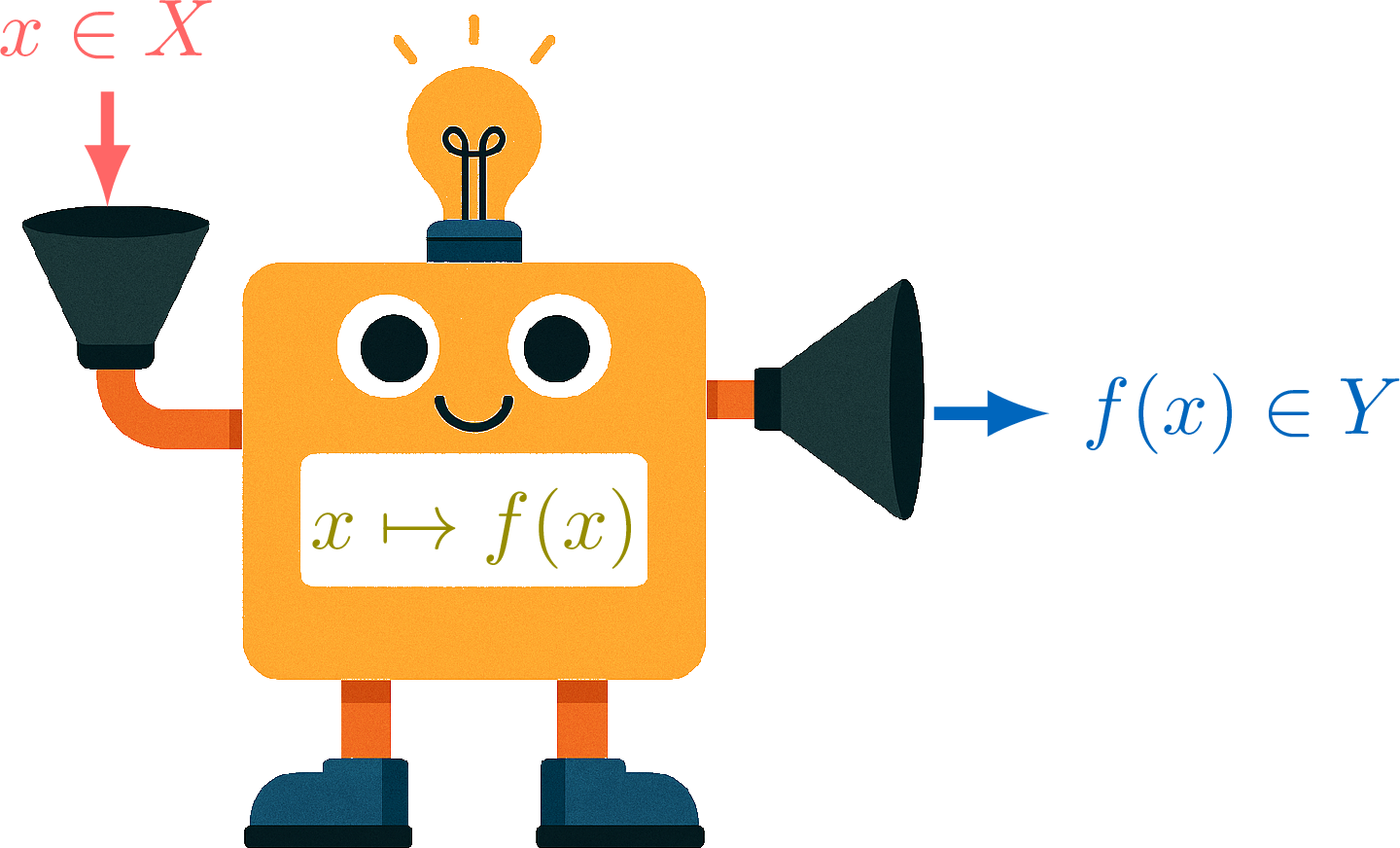
- \(f\) is the name of the function.
- \(x\) is the input variable, an element from the domain.
- \(f(x)\) is the output value in the codomain when the input is \(x\). It is read as "\(f\) of \(x\)".
- \(f(x)\) is the image of \(x\) under \(f\).
- \(x\) is a preimage of \(y=f(x)\).
Example
Let the function \(\Function{f}{\mathbb{R}}{\mathbb{R}}{x}{2x-1}\). Find the image of \(5\) under \(f\).
To find \(f(5)\), we substitute the input value \(x=5\) into the function's rule:$$\begin{aligned}[t]f(5) &= 2(5) - 1 \\
&= 10 - 1 \\
&= \boldsymbol{9}\end{aligned}$$
Method — Finding Inputs from Outputs Algebraically
To find the preimage(s) of a value \(y\) for a function \(f(x)\): - Set the function's formula equal to the output value: \(\boldsymbol{f(x) = y}\).
- Solve the resulting equation for \(x\).
Example
Let \(f(x) = 3x + 12\). Find all values of \(x\) such that \(f(x)=0\).
We need to find the value of \(x\) such that \(f(x)=0\). We set up the equation and solve: $$\begin{aligned} f(x) &= 0 \\
3x + 12 &= 0 \\
3x &= -12 && \color{gray}\text{(subtract 12 from both sides)} \\
x &= \frac{-12}{3} &&\color{gray}\text{(divide both sides by 3)} \\
x &= -4 \end{aligned}$$ The preimage of \(0\) is \(\boldsymbol{x = -4}\).
Check: \(f(-4) = 3(-4) + 12 = -12 + 12 = 0\). The answer is correct.
Check: \(f(-4) = 3(-4) + 12 = -12 + 12 = 0\). The answer is correct.
Skills to practice
- Finding Preimages
I.2
Domain and Range
Recappreviously studied — click to reread
Definition — Range
The range of a function \(f:X\to Y\) is the set of all actual output values produced by the function. It is the set of all images of the elements in the domain.$$ \text{Range} = f(X)=\{f(x):x\in X\} $$ The range is a subset of the codomain (\(f(X) \subseteq Y\)). While the codomain is the set of potential outputs, the range is the set of actual outputs. 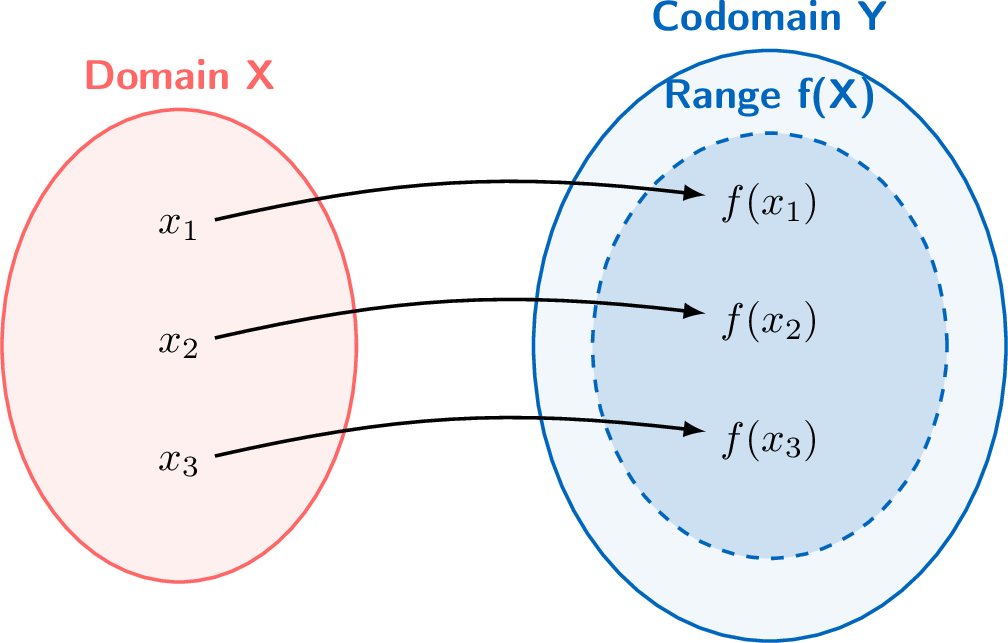
Example
For the function \(\Function{f}{\mathbb{R}}{\mathbb{R}}{x}{x^2}\): - The domain is \(\mathbb{R}\) (all real numbers).
- The codomain is also \(\mathbb{R}\).
- However, since \(x^2\geq 0\), the range is \([0, \infty)\), which is a subset of the codomain.
Definition — Natural Domain
When a function is given by a formula and the domain is not explicitly specified, the natural domain is the largest set of real numbers for which the formula yields a defined real number.
Note
When a function's rule is given without explicitly specifying the domain and codomain, we assume the natural domain as the domain and the set of all real numbers, \(\mathbb{R}\), as the codomain.
For example, when we write \(f:x\mapsto \sqrt{x}\), we implicitly assume the domain is the set of non-negative real numbers, \([0, \infty)\), and the codomain is \(\mathbb{R}\). Thus, it is shorthand for \(\Function{f}{[0, \infty)}{\mathbb{R}}{x}{\sqrt{x}}\).
Sometimes, we simply refer to "the function \(\sqrt{x}\)". This is also a shorthand for the function defined on its natural domain.
Method — Finding the Natural Domain
To find the natural domain of a function, we assume the domain is all real numbers (\(\mathbb{R}\)) and then exclude any values of \(x\) that would lead to an undefined mathematical operation. The restrictions looked for are caused by: - Rational Functions: The denominator of a fraction cannot be zero. We solve
denominator = 0to find values to exclude. - Even Roots: The expression inside an even root (like a square root, \(\sqrt{\cdot}\), or fourth root, \(\sqrt{\cdot}\)) must be non-negative (\(\ge 0\)).
- Logarithms: The argument of a logarithm must be strictly positive (\(> 0\)).
Example
Find the natural domain of the function \(f:x\mapsto\frac{1}{x-2}\).
The function involves division. Division is undefined when the denominator is zero. Therefore, we must exclude any value of \(x\) that makes the denominator \(x-2\) equal to zero.
Set the denominator to zero and solve for \(x\):$$x-2 = 0 \Leftrightarrow x=2$$ The natural domain is the set of all real numbers except \(2\). Using set notation, we write:$$\text{Domain} = \{x \in \mathbb{R} \mid x \neq 2\} \quad \text{or} \quad \mathbb{R} \setminus \{2\}$$ In interval notation, this is \((-\infty, 2) \cup (2, \infty)\).
Set the denominator to zero and solve for \(x\):$$x-2 = 0 \Leftrightarrow x=2$$ The natural domain is the set of all real numbers except \(2\). Using set notation, we write:$$\text{Domain} = \{x \in \mathbb{R} \mid x \neq 2\} \quad \text{or} \quad \mathbb{R} \setminus \{2\}$$ In interval notation, this is \((-\infty, 2) \cup (2, \infty)\).
Skills to practice
- Finding the Natural Domain and the Range
I.3
Graphs of Functions
Recappreviously studied — click to reread
While a table of values is useful for listing some input–output pairs of a function, a graph is a powerful tool for visualising how the output changes when the input changes. A graph gives us a picture of the function's behaviour.
Definition — Graph of a Function
The graph of a function \(f\) is the set of all points with coordinates \((x, f(x))\) plotted on a coordinate plane. The input, \(x\), is plotted on the horizontal axis (the x-axis), and the output, \(f(x)\), is plotted on the vertical axis (the y-axis). When we connect these points, we form the curve of the function.$$\text{Graph of } f = \{(x,f(x)): x \in X\}$$ 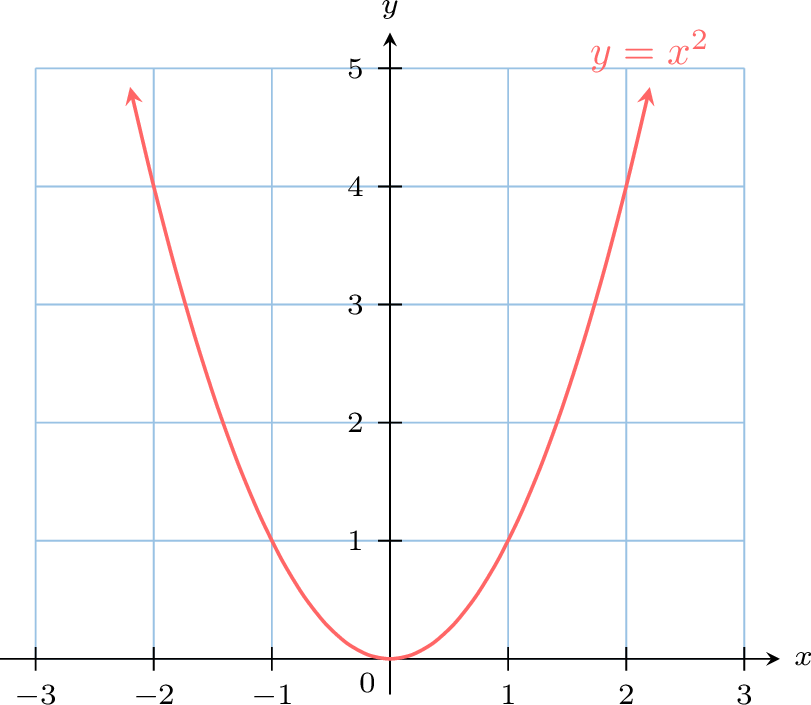
Method — Plotting a Graph from a Table
To plot the graph of a function from its table of values: - Draw a coordinate plane with a suitable scale on each axis and label the axes.
- For each pair \((x, f(x))\) in the table, plot the corresponding point on the coordinate plane.
- If the function is defined for all \(x\) in the interval shown, connect the points with a straight line or a smooth curve.
Method — Finding the Value of \(f(x)\) from a Graph
To find the output \(f(x)\) for a given input \(x\) using a graph: - Locate the input value on the horizontal x-axis.
- Move vertically from that point to the curve of the function.
- Move horizontally from the intersection point to the vertical y-axis and read the corresponding value. This y-value is the output \(f(x)\).
Example
Using the graph of the function \(f\) below, find the value of \(f(2)\). 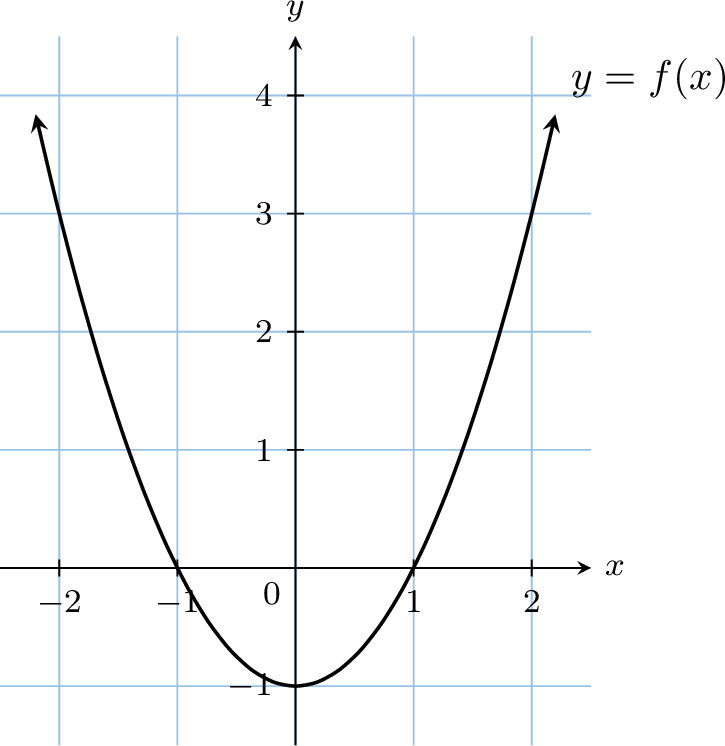
We follow the graphical method: 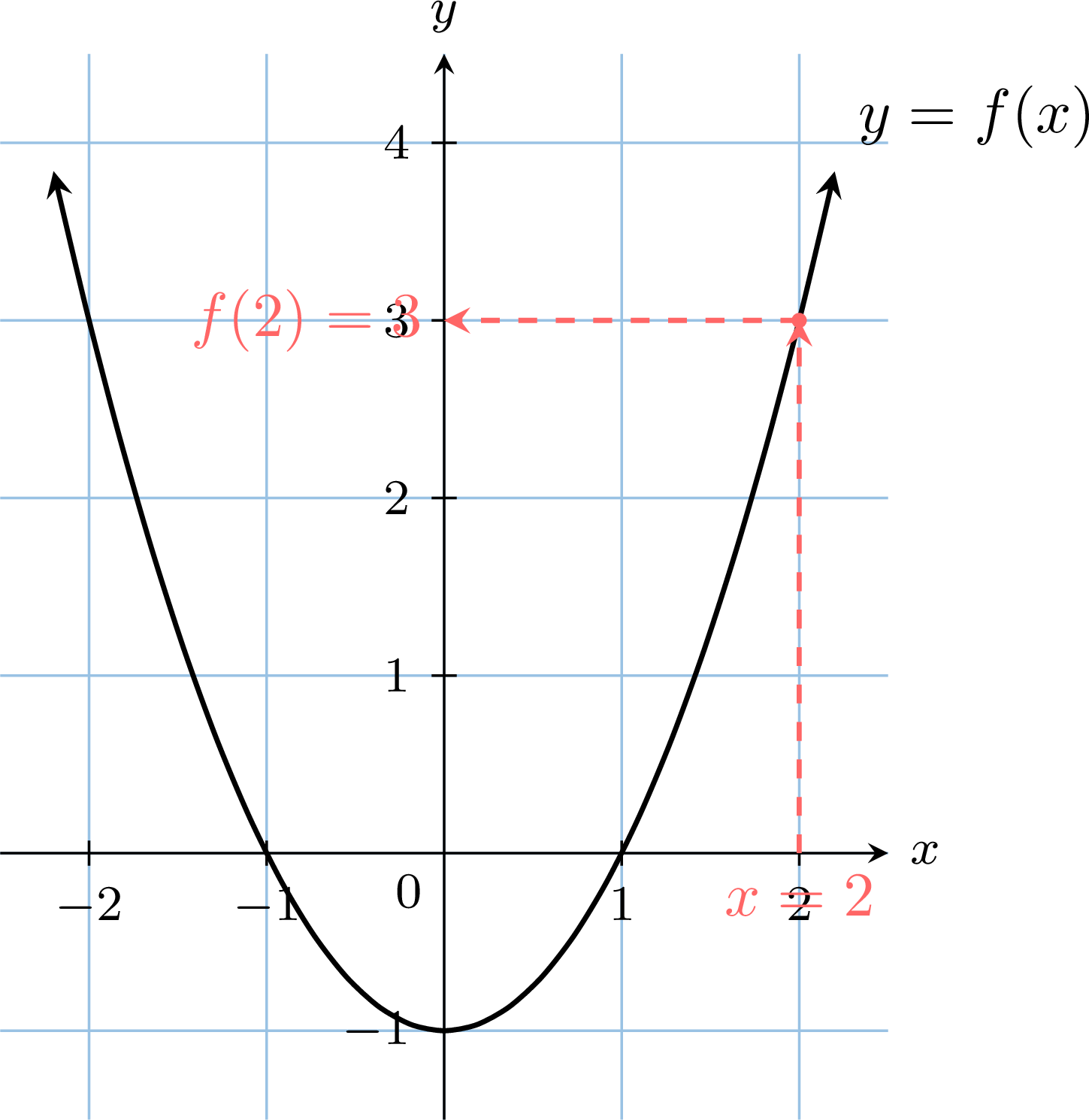
Therefore, \(\boldsymbol{f(2) = 3}\).
- Start at \(x=2\) on the horizontal axis.
- Move up to meet the curve.
- Move horizontally to the vertical axis and read the value, which is \(3\).
Method — Finding Inputs from Outputs on a Graph
To find the preimage(s) of a value \(y\) (i.e., find all \(x\) such that \(f(x)=y\)): - Locate the output value \(y\) on the vertical y-axis.
- Draw a horizontal line from this value across the graph.
- Find the intersection point(s) where the horizontal line crosses the function's curve.
- Move vertically to the x-axis from each intersection point to read the corresponding input value(s). These are the preimages.
Example
Using the graph of the function \(f\) below, find all values of \(x\) such that \(f(x)= 3\).
We apply the graphical method: 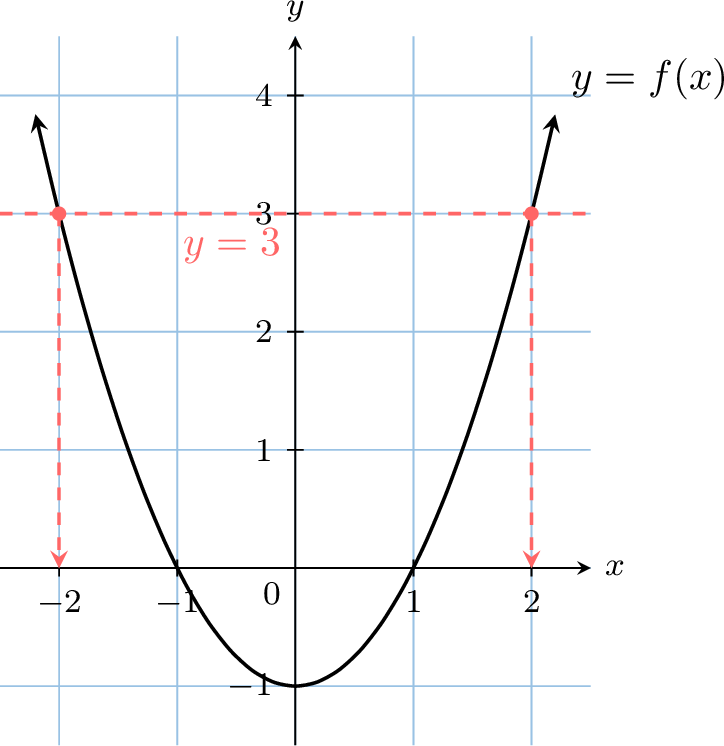
The preimages of \(3\) are \(\boldsymbol{-2}\) and \(\boldsymbol{2}\).
- We locate \(y=3\) on the vertical axis.
- We draw a horizontal line at \(y=3\).
- The line intersects the curve at two points.
- We move vertically from these points to the x-axis to read the values, which are \(-2\) and \(2\).
Skills to practice
- Graphs of Functions
I.4
Injective, Surjective and Bijective Functions
For a function to be perfectly reversible (i.e., to have an inverse), it must create a perfect pairing between the elements of its domain and its codomain. This leads to the concept of a bijection, which is a function that is both injective and surjective.
Definition — Injective, Surjective, and Bijective Functions
Let \(f: X \to Y\) be a function. - \(f\) is injective (one-to-one) if different inputs produce different outputs. For any \(x_1, x_2 \in X\), if \(x_1 \neq x_2\), then \(f(x_1) \neq f(x_2)\).
- \(f\) is surjective (onto) if its range is equal to its codomain (\(f(X)=Y\)). This means every element in the codomain \(Y\) is the image of at least one element from the domain \(X\).
- \(f\) is bijective if it is both injective and surjective. This means every element in the codomain is the image of exactly one element from the domain.
Example
Consider two versions of the squaring function: - \(\Function{f}{\mathbb{R}}{\mathbb{R}}{x}{x^2}\)
- \(\Function{g}{[0,\infty)}{[0,\infty)}{x}{x^2}\)
- The function \(f\) is not bijective. It is not injective because \(f(-2)=f(2)\). It is not surjective because its range, \([0, \infty)\), is not equal to its codomain, \(\mathbb{R}\).
- The function \(g\) is bijective. It is injective because its domain is restricted to non-negative numbers. It is surjective because its range, \([0, \infty)\), is equal to its specified codomain, \([0, \infty)\).
Method — The Horizontal Line Test for Bijectivity
To determine visually if a function \(f: X \to Y\) is bijective: - Draw the graph of the function \(f(x)\).
- Imagine drawing horizontal lines across the graph for every possible \(y\)-value in the codomain \(Y\).
- Conclusion:
- The function is bijective if and only if every horizontal line (for all \(y \in Y\)) intersects the graph exactly once.
- Intersecting at most once shows it is injective.
- Intersecting at least once shows it is surjective.
- The function is bijective if and only if every horizontal line (for all \(y \in Y\)) intersects the graph exactly once.
Example
Use the horizontal line test to determine if the function \(\Function{f}{\mathbb{R}}{\mathbb{R}}{x}{x^2}\) is a bijective function.
First, we graph the function \(f(x) = x^2\). The specified codomain is \(\mathbb{R}\). 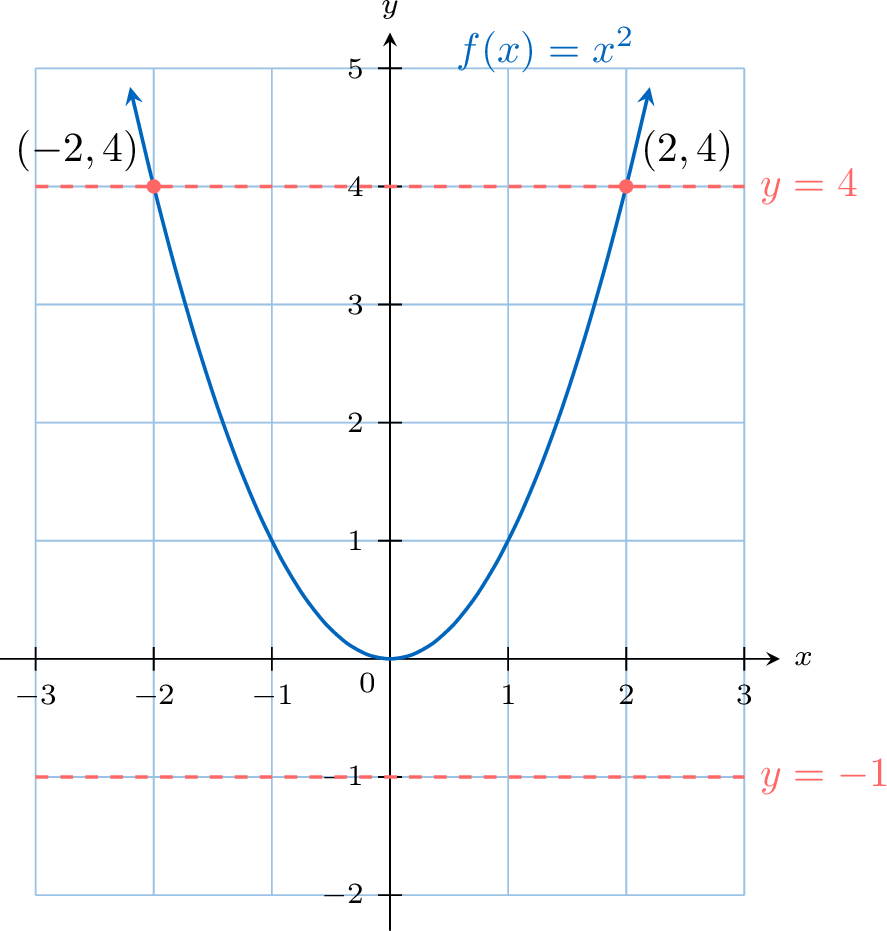
We test for both conditions:
- Injectivity: The horizontal line \(y=4\) intersects the graph at two distinct points, \((-2,4)\) and \((2,4)\). Since a horizontal line intersects the graph more than once, the function is not injective.
- Surjectivity: The horizontal line \(y=-1\) is in the codomain (\(\mathbb{R}\)) but does not intersect the graph at all. This means that \(-1\) has no preimage. Since there is an element in the codomain that is not in the range, the function is not surjective.
Skills to practice
- Deciding Whether a Function Is Injective, Surjective or Bijective
II
Operations on Functions
II.1
Sums, Differences and Products of Functions
Recappreviously studied — click to reread
Let \(\textcolor{colordef}{f(x)=2x+1}\) and \(\textcolor{colorprop}{g(x)=x^2}\).
\(\textcolor{olive}{(f+g)(x)}\) means that, for any input \(x\) that belongs to the domains of both functions, \(\textcolor{colordef}{f(x)}\) and \(\textcolor{colorprop}{g(x)}\) are calculated separately, then the results are added. In other words, \((f+g)\) is a new function defined by \((f+g)(x)=f(x)+g(x)\).
This is illustrated by the function machine below: 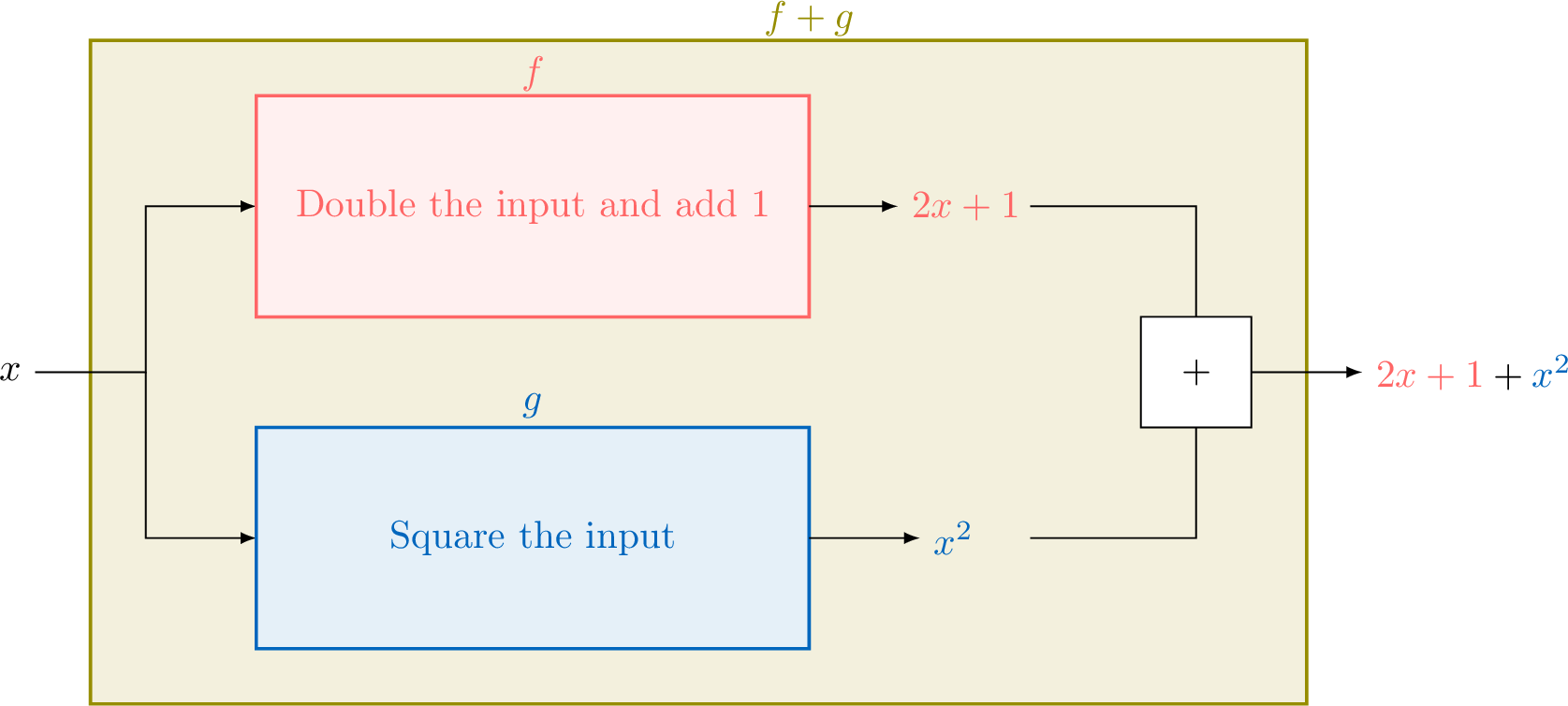
So, $$\begin{aligned}[t]\textcolor{olive}{(f+g)(x)} &= \textcolor{colordef}{f(x)} + \textcolor{colorprop}{g(x)} \\
&= \textcolor{colordef}{2x+1} + \textcolor{colorprop}{x^2}.\end{aligned}$$
\(\textcolor{olive}{(f+g)(x)}\) means that, for any input \(x\) that belongs to the domains of both functions, \(\textcolor{colordef}{f(x)}\) and \(\textcolor{colorprop}{g(x)}\) are calculated separately, then the results are added. In other words, \((f+g)\) is a new function defined by \((f+g)(x)=f(x)+g(x)\).
This is illustrated by the function machine below:
Definition — Operations on Functions
Given two functions \(f\) and \(g\), we can define new functions by performing arithmetic operations on their outputs, for each \(x\) where both are defined: - Sum: \((f+g)(x) = f(x) + g(x)\)
- Difference: \((f-g)(x) = f(x) - g(x)\)
- Product: \((fg)(x) = f(x) \times g(x)\)
- Quotient: \(\displaystyle\left(\frac{f}{g}\right)(x) = \frac{f(x)}{g(x)}\), provided that \(g(x) \neq 0\).
For the quotient, the domain is the intersection of the domains of \(f\) and \(g\), excluding any \(x\) such that \(g(x)=0\).
Example
Let \(f(x)=2x+1\) and \(g(x)=x^4-1\). Find \((f+g)(x)\).
\(\begin{aligned} (f+g)(x) &= f(x) + g(x) \\ &= (2x+1) + (x^4-1) \\ &= x^4 + 2x. \end{aligned}\)
Since both \(f\) and \(g\) are polynomials, \((f+g)(x)\) is defined for all real numbers \(x\).
Since both \(f\) and \(g\) are polynomials, \((f+g)(x)\) is defined for all real numbers \(x\).
Skills to practice
- Sums, Differences and Products of Functions
II.2
Composite Functions
Recappreviously studied — click to reread
Let \(\textcolor{colordef}{f(x)=x^2}\) and \(\textcolor{colorprop}{g(x)=2x+1}\).
The composition \(\textcolor{olive}{(f \circ g)(x)}\) means that \(g\) is applied to \(x\) first, and then \(f\) is applied to the result. In other words, \(x\) goes through machine \(g\) (becoming \(2x+1\)), and that output then goes through machine \(f\). 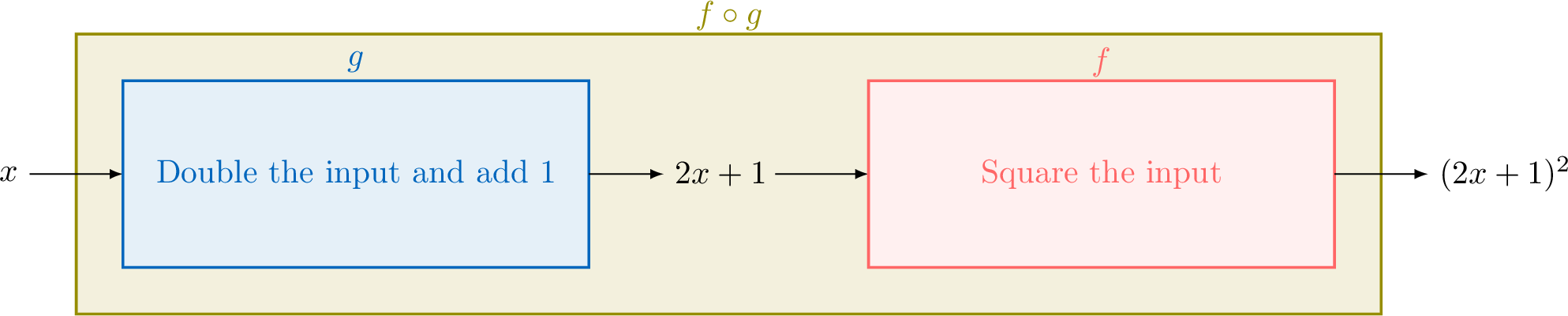
Algebraically, we write this as: $$\begin{aligned}[t](f \circ g)(x) &= \textcolor{colordef}{f}(\textcolor{colorprop}{g(x)}) \\
&= \textcolor{colordef}{f}(2x+1) \\
&= (2x+1)^2.\end{aligned}$$
The composition \(\textcolor{olive}{(f \circ g)(x)}\) means that \(g\) is applied to \(x\) first, and then \(f\) is applied to the result. In other words, \(x\) goes through machine \(g\) (becoming \(2x+1\)), and that output then goes through machine \(f\).
Definition — Composition of Functions
Given two functions \(f\) and \(g\), the composite function, denoted \(\boldsymbol{f \circ g}\) (read “\(f\) composed with \(g\)”), is defined by: $$\boldsymbol{(f \circ g)(x) = f(g(x))}$$ for every \(x\) that belongs to the domain of \(g\) and for which \(g(x)\) belongs to the domain of \(f\). We first apply the function \(g\) to \(x\), and then apply the function \(f\) to the result \(g(x)\).
Example
Let \(f(x)=x^2\) and \(g(x)=2x+1\). - Find \((f \circ g)(x)\).
- Find \((g \circ f)(x)\).
- Is composition commutative? (i.e., is \((f \circ g)(x) = (g \circ f)(x)\)?)
- \(\begin{aligned}[t] (f \circ g)(x) &= f(g(x)) \\ &= f(2x+1) \\ &= (2x+1)^2 \\ &= 4x^2 + 4x + 1. \end{aligned}\)
- \(\begin{aligned}[t] (g \circ f)(x) &= g(f(x)) \\ &= g(x^2) \\ &= 2(x^2) + 1 \\ &= 2x^2 + 1. \end{aligned}\)
- No. Since \(4x^2 + 4x + 1 \neq 2x^2 + 1\), the two composite functions are different, so function composition is not commutative in general.
Skills to practice
- Evaluating Composite Functions
- Solving Equations with Composite Functions
II.3
Inverse Functions
Recappreviously studied — click to reread
In arithmetic, we are familiar with inverse operations. For example, subtraction is the inverse of addition because it “undoes” the addition. Starting with 5, adding 3 gives 8, and subtracting 3 then returns to 5: $$(5+3) - 3 = 5.$$ Similarly, division is the inverse of multiplication: $$(5\times 3) \div 3 = 5.$$ The concept of an inverse function follows the same idea. An inverse function, denoted \(\boldsymbol{f^{-1}}\), is a function that “undoes” or reverses the action of another function, \(f\).
If a function \(f\) takes an input \(x\) to an output \(y\), the inverse function \(f^{-1}\) takes that output \(y\) back to the original input \(x\). This creates a perfect loop: 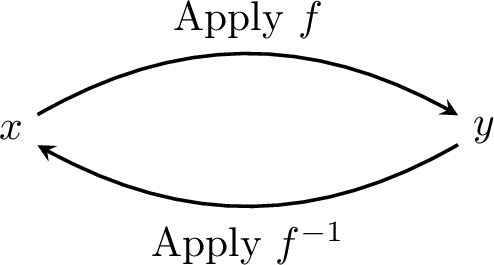
However, not every function has an inverse function. For an inverse to exist, each output \(y\) must come from exactly one input \(x\) (the function must never take the same value twice on its domain).
If a function \(f\) takes an input \(x\) to an output \(y\), the inverse function \(f^{-1}\) takes that output \(y\) back to the original input \(x\). This creates a perfect loop:
Definition — Inverse Function
Let \(f: X \to Y\) be a bijective function.The inverse function, denoted \(f^{-1}\), is the function \(\boldsymbol{f^{-1}: Y \to X}\) that reverses the action of \(f\).
This means that if \(f\) maps an input \(x\) to an output \(y\), then \(f^{-1}\) maps that output \(y\) back to the original input \(x\). This relationship is defined by:$$ f(x) = y \iff f^{-1}(y) = x $$
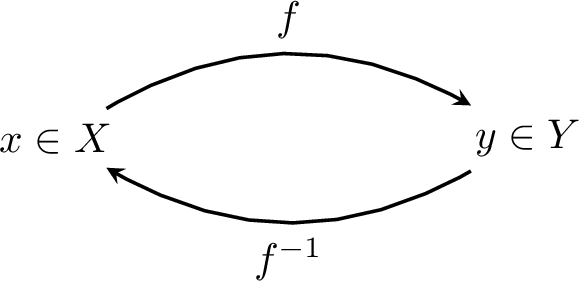
- \(\boldsymbol{(f^{-1} \circ f)(x) = x}\) for all \(x\) in the domain of \(f\) (\(X\)).
- \(\boldsymbol{(f \circ f^{-1})(y) = y}\) for all \(y\) in the domain of \(f^{-1}\) (\(Y\)).
Method — Finding the Inverse Function
To find the inverse of a function \(f\) (when it exists): - Set \(y = f(x)\).
- Solve the equation for \(x\) in terms of \(y\). This gives an expression of the form \(x = f^{-1}(y)\).
- Swap the variables \(x\) and \(y\) to write the inverse in terms of \(x\). The result is \(y = f^{-1}(x)\).
Example
Find the inverse of the function \(\Function{f}{[0,\infty)}{[0,\infty)}{x}{\sqrt{x}}\).
The function is \(f(x) = \sqrt{x}\) with Domain: \([0, \infty)\) and Range: \([0, \infty)\).
- Set \(y = \sqrt{x}\).
- Solve for \(x\): Since the domain of \(f\) is non-negative, \(x \ge 0\), and the range is non-negative, \(y \ge 0\). We can square both sides: $$ y^2 = x \Leftrightarrow x = y^2 $$
- Swap variables to get the rule: \(y = x^2\).
- The domain of \(f^{-1}\) is the range of \(f\), which is \([0, \infty)\). The range of \(f^{-1}\) is the domain of \(f\), which is \([0, \infty)\).
Proposition — Symmetry of Inverse Functions
The graph of a function \(f\) and its inverse \(f^{-1}\) are reflections of each other across the line \(\boldsymbol{y = x}\). 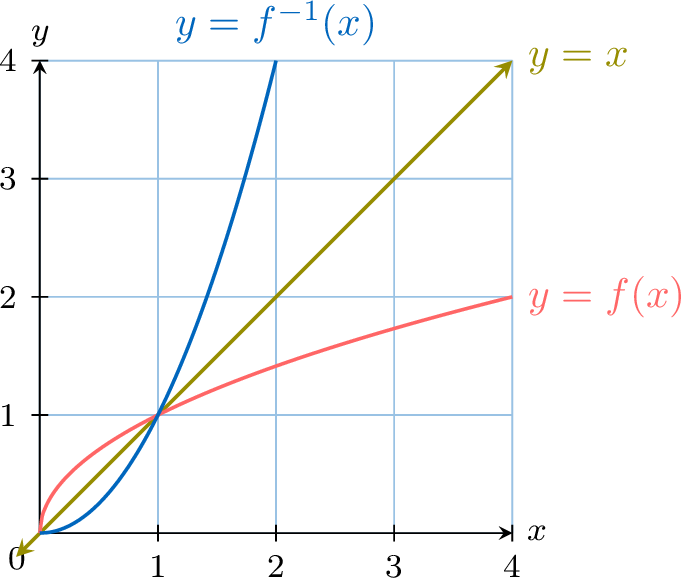
Skills to practice
- Graphing and Finding Inverse Functions
III
Rational Functions
III.1
The Reciprocal Function
Recappreviously studied — click to reread
Definition — Reciprocal Function
The reciprocal function is defined on \(\mathbb{R} \setminus \{0\}\) (all real numbers except \(0\)) by \(f(x) = \frac{1}{x}\). 
- Domain: \(\mathbb{R} \setminus \{0\}\), also written \((-\infty, 0) \cup (0, +\infty)\).
- Shape: A curve called a hyperbola.
Do not confuse the reciprocal function \(x \mapsto \frac{1}{x}\) (which takes the reciprocal of the output value) with the inverse function \(f^{-1}\) of a bijection, which undoes the action of \(f\). In French, fonction inverse names \(x \mapsto \frac{1}{x}\), while \(f^{-1}\) is called the fonction réciproque.
Proposition — Properties
- The reciprocal function is strictly decreasing on \((-\infty, 0)\) and strictly decreasing on \((0, +\infty)\).

- The reciprocal function is odd (symmetric about the origin).
Let \(a\) and \(b\) be two real numbers such that \(0 < a < b\).$$f(b) - f(a) = \frac{1}{b} - \frac{1}{a} = \frac{a - b}{ab}$$ Since \(a < b\), then \((a - b) < 0\). Since \(a\) and \(b\) are positive, \(ab > 0\).
The quotient is strictly negative, so \(f(b) < f(a)\). The order is reversed; \(f\) is strictly decreasing on \((0, +\infty)\).
For \(a < b < 0\), the same computation applies: \(ab > 0\) (product of two negatives) and \(a - b < 0\), so again \(f(b) < f(a)\): \(f\) is strictly decreasing on \((-\infty, 0)\) as well.
Parity: for every \(x \neq 0\), \(f(-x) = \frac{1}{-x} = -\frac{1}{x} = -f(x)\): \(f\) is odd.
Skills to practice
- The Reciprocal Function
III.2
The Functions \(x \mapsto \frac{k}{x}\)
A rectangle has an area of \(12\)~cm\(^2\). One of its sides measures \(x\)~cm and the other one \(y\)~cm.
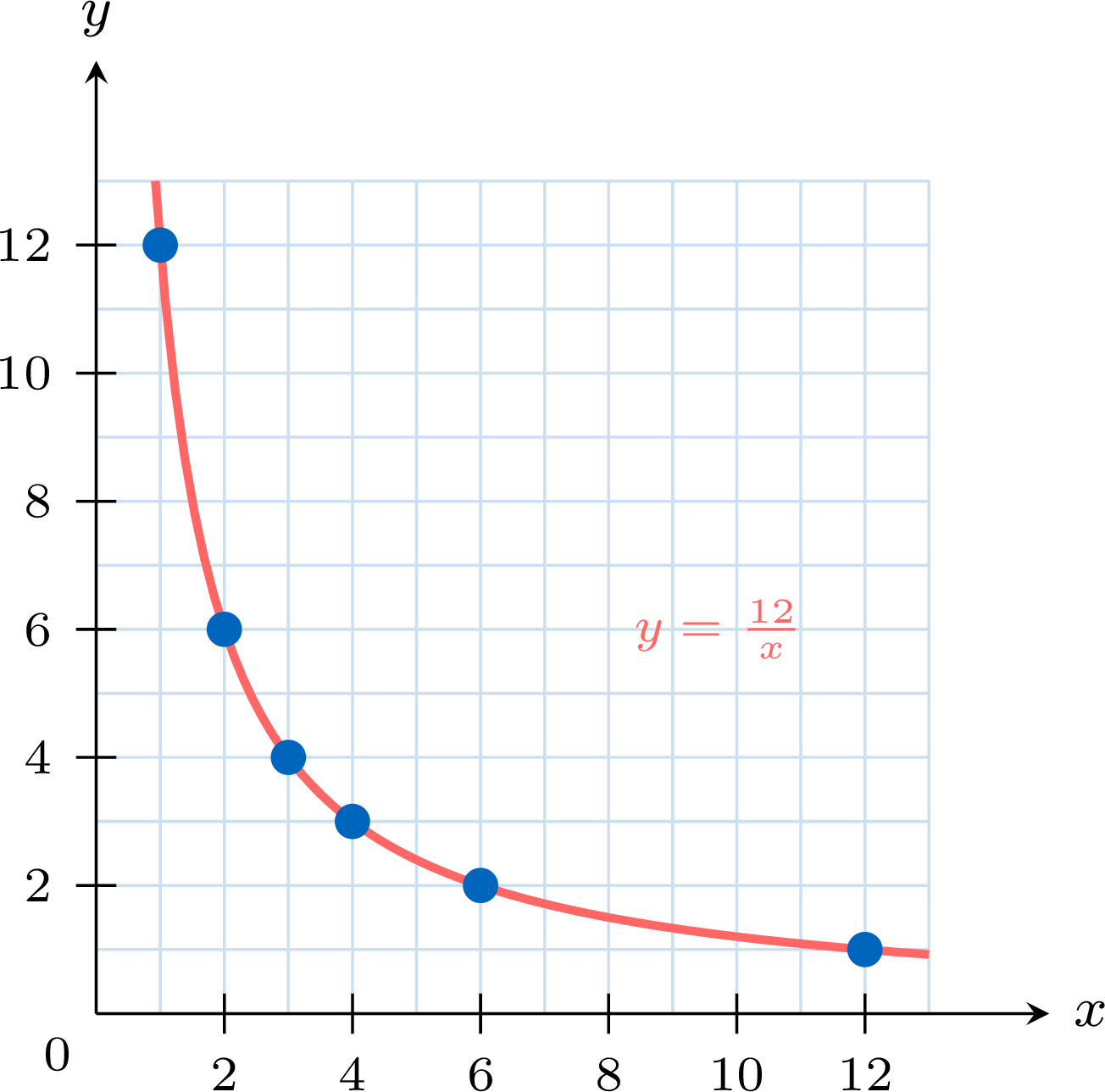
- Give \(y\) when \(x = 1\), \(2\), \(3\), \(4\), \(6\) and \(12\).
- Express \(y\) in terms of \(x\).
- What happens to \(y\) when \(x\) becomes very large? When \(x\) gets very close to \(0\)? Can \(y\) be equal to \(0\)?
- The rectangle \(3\)~cm by \(4\)~cm gives the pair \((3, 4)\), and it also gives the pair \((4, 3)\). Explain why, for every pair \((x, y)\) found, the pair \((y, x)\) is also found.
- The area gives \(x \times y = 12\):
\(x\) \(1\) \(2\) \(3\) \(4\) \(6\) \(12\) \(y\) \(12\) \(6\) \(4\) \(3\) \(2\) \(1\) - From \(xy = 12\) and \(x \neq 0\): \(y = \dfrac{12}{x}\).
- When \(x\) becomes very large, \(y = \dfrac{12}{x}\) becomes as small as desired: \(x = 1200\) gives \(y = 0.01\). But \(y\) is never \(0\), since \(x \times 0 = 0 \neq 12\). When \(x\) gets very close to \(0\), \(y\) becomes as large as desired: \(x = 0.01\) gives \(y = 1200\). The curve gets as close as desired to the two axes without meeting them: the axes are called the asymptotes of the curve.
- The rectangle \(x\) by \(y\) and the rectangle \(y\) by \(x\) are the same rectangle, and \(yx = xy = 12\). On the graph, the point \((y, x)\) is the reflection of the point \((x, y)\) in the line \(y = x\): the curve is symmetric in this line.
Definition — The Functions \(x \mapsto \frac{k}{x}\)
Let \(k\) be a nonzero real number. The function \(f\) given by $$f(x) = \frac{k}{x}$$ is defined for every real number \(x \neq 0\): its domain is \(\mathbb{R} \setminus \{0\}\). Its graph is a hyperbola, made of two separate branches. For \(k = 1\), \(f\) is the reciprocal function \(x \mapsto \dfrac{1}{x}\). Such a function describes two quantities whose product is constant: \(x \times f(x) = k\). Definition — Vertical and Horizontal Asymptotes
Let \(f\) be a function and \(\mathcal{C}\) its graph. - The vertical line \(x = p\) is a vertical asymptote of \(\mathcal{C}\) when, as \(x\) gets closer and closer to \(p\) (from one side at least), the absolute values \(|f(x)|\) become as large as desired: the curve climbs or falls along the line.
- The horizontal line \(y = q\) is a horizontal asymptote of \(\mathcal{C}\) when, as \(x\) becomes as large as desired, positive or negative (in one direction at least), the values \(f(x)\) get as close to \(q\) as desired: the curve flattens along the line.
Proposition — Graph of \(y \equal \frac{k}{x}\)
Let \(k \neq 0\). The graph of \(y = \dfrac{k}{x}\): - has the vertical asymptote \(x = 0\), the \(y\)-axis, and the horizontal asymptote \(y = 0\), the \(x\)-axis;
- has domain \(\mathbb{R} \setminus \{0\}\) and range \(\mathbb{R} \setminus \{0\}\);
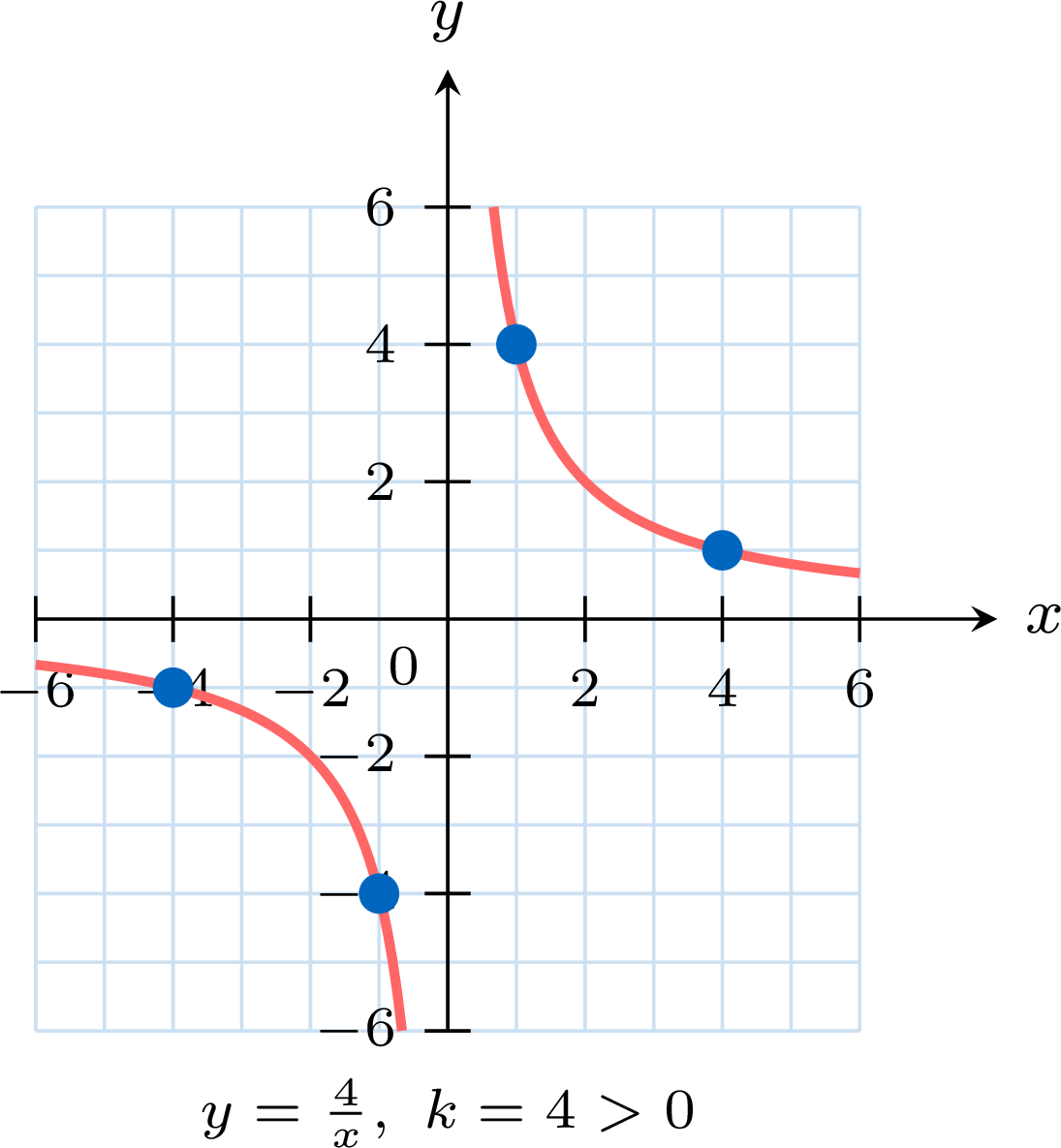
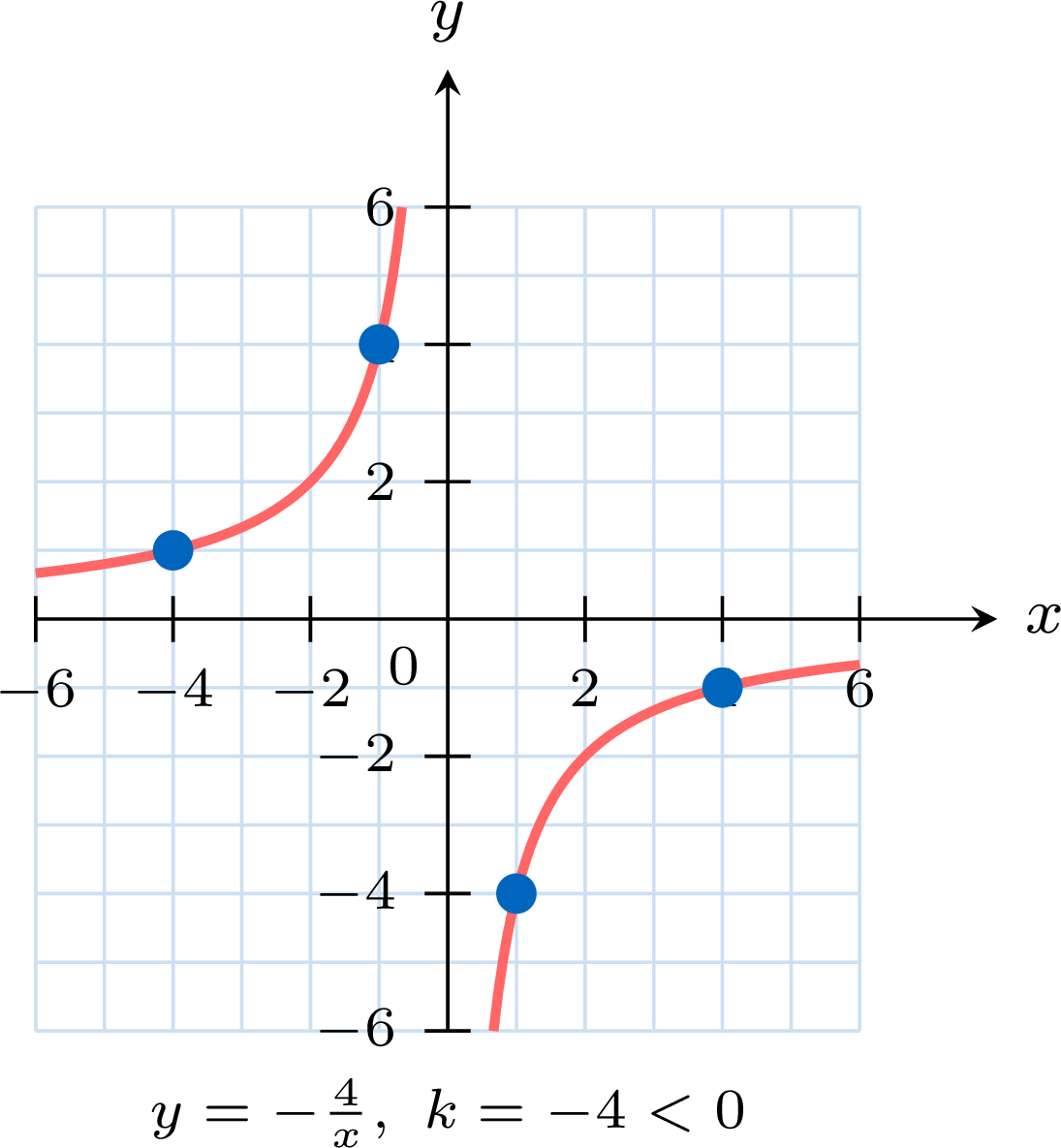
- lies in the first and third quadrants if \(k > 0\), in the second and fourth quadrants if \(k < 0\);
- passes through the points \((1, k)\), \((k, 1)\), \((-1, -k)\) and \((-k, -1)\);
- is symmetric in the line \(y = x\), and symmetric about the origin.
Let \(f(x) = \dfrac{k}{x}\), with \(k \neq 0\).
- Asymptotes. For \(x \neq 0\), \(|f(x)| = \dfrac{|k|}{|x|}\). When \(|x|\) becomes large, this quotient becomes as small as desired: for instance \(|x| > 1000|k|\) gives \(|f(x)| < 0.001\). So the \(x\)-axis is a horizontal asymptote. When \(x\) gets close to \(0\), the quotient becomes as large as desired: \(0 < |x| < \dfrac{|k|}{1000}\) gives \(|f(x)| > 1000\). So the \(y\)-axis is a vertical asymptote.
- Domain and range. Division by \(0\) is impossible, so the domain is \(\mathbb{R} \setminus \{0\}\). The value \(0\) is never taken, since \(\dfrac{k}{x} = 0\) would give \(k = 0\). Every \(y \neq 0\) is taken, at \(x = \dfrac{k}{y}\): $$f\left(\frac{k}{y}\right) = \frac{k}{\frac{k}{y}} = k \times \frac{y}{k} = y.$$ So the range is \(\mathbb{R} \setminus \{0\}\).
- Quadrants. The quotient \(\dfrac{k}{x}\) has the sign of \(k\) when \(x > 0\), and the opposite sign when \(x < 0\). For \(k > 0\), a positive \(x\) gives a positive \(y\) (first quadrant) and a negative \(x\) a negative \(y\) (third quadrant); for \(k < 0\), the signs are opposite (fourth and second quadrants).
- Points. \(f(1) = k\), \(f(k) = \dfrac{k}{k} = 1\), \(f(-1) = -k\) and \(f(-k) = \dfrac{k}{-k} = -1\).
- Symmetries. A point \((u, v)\) with \(u \neq 0\) lies on the graph when \(v = \dfrac{k}{u}\), that is when \(uv = k\). Then \(vu = k\) too, with \(v \neq 0\), so the point \((v, u)\) also lies on the graph: the reflection in the line \(y = x\), which swaps the coordinates, maps the graph onto itself. Likewise \((-u)(-v) = uv = k\): the point \((-u, -v)\), symmetric of \((u, v)\) about the origin, lies on the graph.
Proposition — The Function \(x \mapsto \frac{k}{x}\) Is Its Own Inverse
Let \(k \neq 0\) and \(f : \mathbb{R} \setminus \{0\} \to \mathbb{R} \setminus \{0\}\), \(f(x) = \dfrac{k}{x}\). Then \(f\) is a bijection and \(f^{-1} = f\): the function \(f\) is self-inverse. Equivalently, \((f \circ f)(x) = x\) for every \(x \neq 0\). In particular, the reciprocal function \(x \mapsto \dfrac{1}{x}\) is its own inverse function.
Let \(y \neq 0\). Following the Method “Finding the Inverse Function”, the equation \(y = f(x)\) is solved for \(x\), with \(x \neq 0\): $$\begin{aligned}[t] y &= \frac{k}{x} \\
xy &= k && \text{(multiply by } x \neq 0\text{)} \\
x &= \frac{k}{y}. && \text{(divide by } y \neq 0\text{)} \end{aligned}$$ Each \(y \neq 0\) has exactly one antecedent, \(\dfrac{k}{y}\), which is nonzero: \(f\) is a bijection of \(\mathbb{R} \setminus \{0\}\) onto itself. Swapping the letters gives \(f^{-1}(x) = \dfrac{k}{x} = f(x)\). Check, for \(x \neq 0\): $$(f \circ f)(x) = f\left(\frac{k}{x}\right) = \frac{k}{\frac{k}{x}} = x.$$ This agrees with the graph: the graph of \(f^{-1}\) is the reflection of the graph of \(f\) in the line \(y = x\) (Proposition “Symmetry of Inverse Functions”), and here this reflection leaves the graph unchanged.
Example
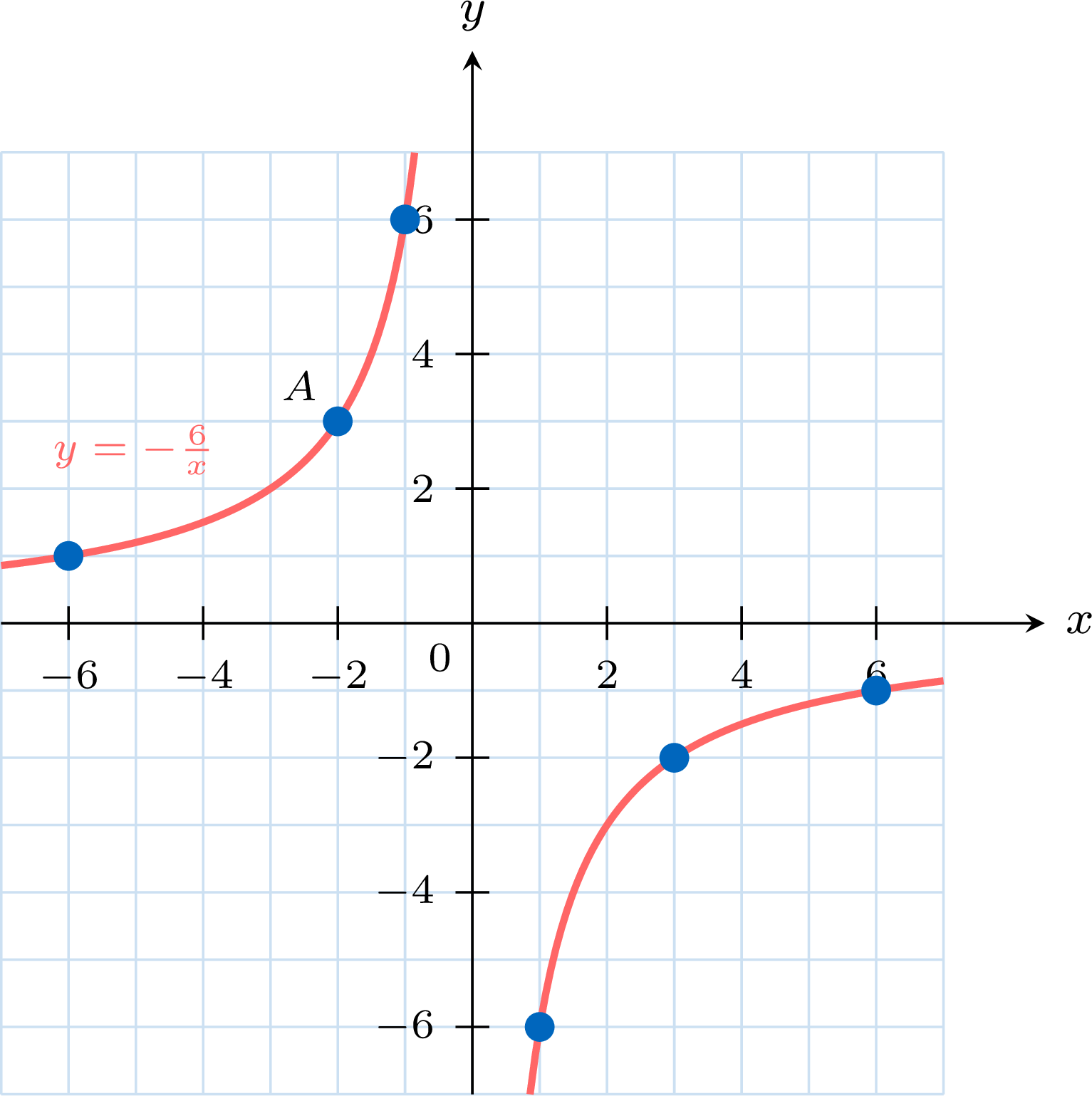
The graph of a function \(f(x) = \dfrac{k}{x}\) passes through the point \(A(-2, 3)\). - Find \(k\).
- State the domain, the range and the asymptotes of the graph.
- In which quadrants does the graph lie?
- Sketch the graph, showing \(A\) and the points \((1, k)\), \((k, 1)\), \((-1, -k)\) and \((-k, -1)\).
- The point \(A(-2, 3)\) lies on the graph, so \(f(-2) = 3\): $$\begin{aligned}[t] \frac{k}{-2} &= 3 \\ k &= -6. && \text{(multiply by } -2\text{)} \end{aligned}$$ So \(f(x) = -\dfrac{6}{x}\).
- By the Proposition “Graph of \(y = \frac{k}{x}\)”: the domain and the range are both \(\mathbb{R} \setminus \{0\}\), the vertical asymptote is \(x = 0\) and the horizontal asymptote is \(y = 0\).
- Since \(k = -6 < 0\), the graph lies in the second and fourth quadrants; \(A(-2, 3)\) is indeed in the second quadrant.
- The four points are \((1, -6)\), \((-6, 1)\), \((-1, 6)\) and \((6, -1)\). The point \((3, -2)\), reflection of \(A\) in the line \(y = x\), also lies on the graph.
Skills to practice
- Recognising the Graph of \(y \equal \frac{k}{x}\)
- Finding \(k\) from a Point
- Describing and Justifying \(y \equal \frac{k}{x}\)
III.3
Rational Functions of the Form \(\frac{ax+b}{cx+d}\)
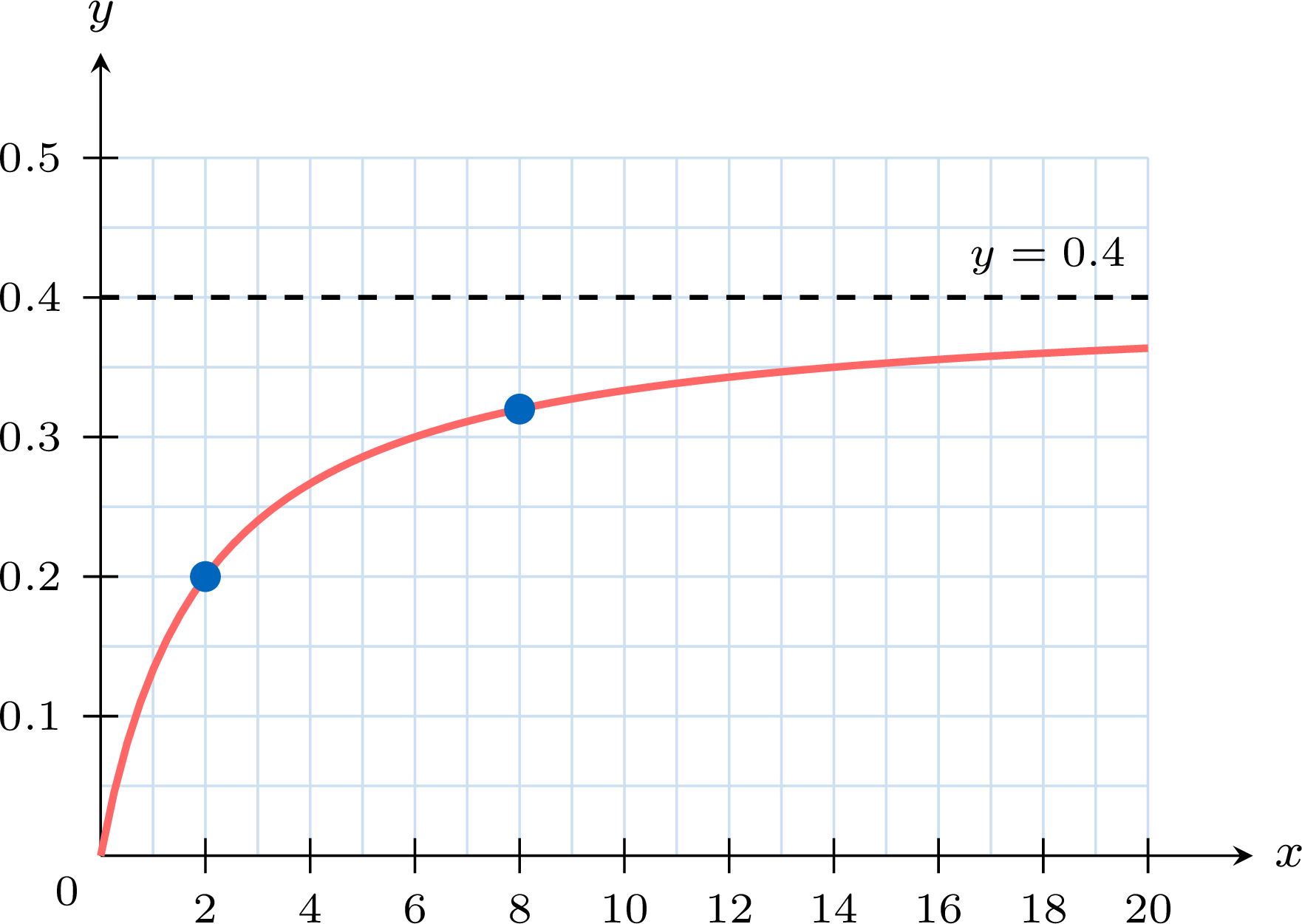
A jug contains \(2\) litres of water. A drink made of \(40\pourcent\) fruit juice is poured into it. After \(x\) litres of drink have been poured, the jug contains \(0.4x\) litres of juice in \(x + 2\) litres of liquid, so the proportion of juice in the jug is $$p(x) = \frac{0.4x}{x + 2}, \quad x \geq 0.$$
Rewriting the numerator around the denominator made the asymptote visible: this is the key step for every function \(x \mapsto \dfrac{ax + b}{cx + d}\).
- Compute \(p(2)\), \(p(8)\) and \(p(98)\).
- Can the proportion of juice in the jug reach \(0.4\), that is \(40\pourcent\)?
- Check that \(0.4x = 0.4(x + 2) - 0.8\), and deduce that \(p(x) = 0.4 - \dfrac{0.8}{x + 2}\). Explain what the formula gives when \(x\) becomes very large, as if the container had no size limit.
- \(p(2) = \dfrac{0.8}{4} = 0.2\), \(p(8) = \dfrac{3.2}{10} = 0.32\) and \(p(98) = \dfrac{39.2}{100} = 0.392\): the proportion rises towards \(0.4\).
- The equation \(p(x) = 0.4\) has no solution: $$\begin{aligned}[t] \frac{0.4x}{x + 2} &= 0.4 \\ 0.4x &= 0.4x + 0.8 && \text{(multiply by } x + 2 > 0 \text{ and expand)} \\ 0 &= 0.8. && \text{(subtract } 0.4x\text{)} \end{aligned}$$ The last line is false: the proportion never reaches \(40\pourcent\), because the \(2\) litres of water are always there.
- \(0.4(x + 2) - 0.8 = 0.4x + 0.8 - 0.8 = 0.4x\). So $$\begin{aligned}[t] p(x) &= \frac{0.4(x + 2) - 0.8}{x + 2} && (0.4x = 0.4(x + 2) - 0.8) \\ &= 0.4 - \frac{0.8}{x + 2}. && \text{(divide each term by } x + 2\text{)} \end{aligned}$$ For a real jug the amount poured is limited; the formula itself goes on. When \(x\) becomes very large, the fraction \(\dfrac{0.8}{x + 2}\) becomes as small as desired, and it stays positive: \(p(x)\) gets as close to \(0.4\) as desired, always below it. The line \(y = 0.4\) is a horizontal asymptote of the graph of \(p\).
Definition — Rational Functions of the Form \(\frac{ax+b}{cx+d}\)
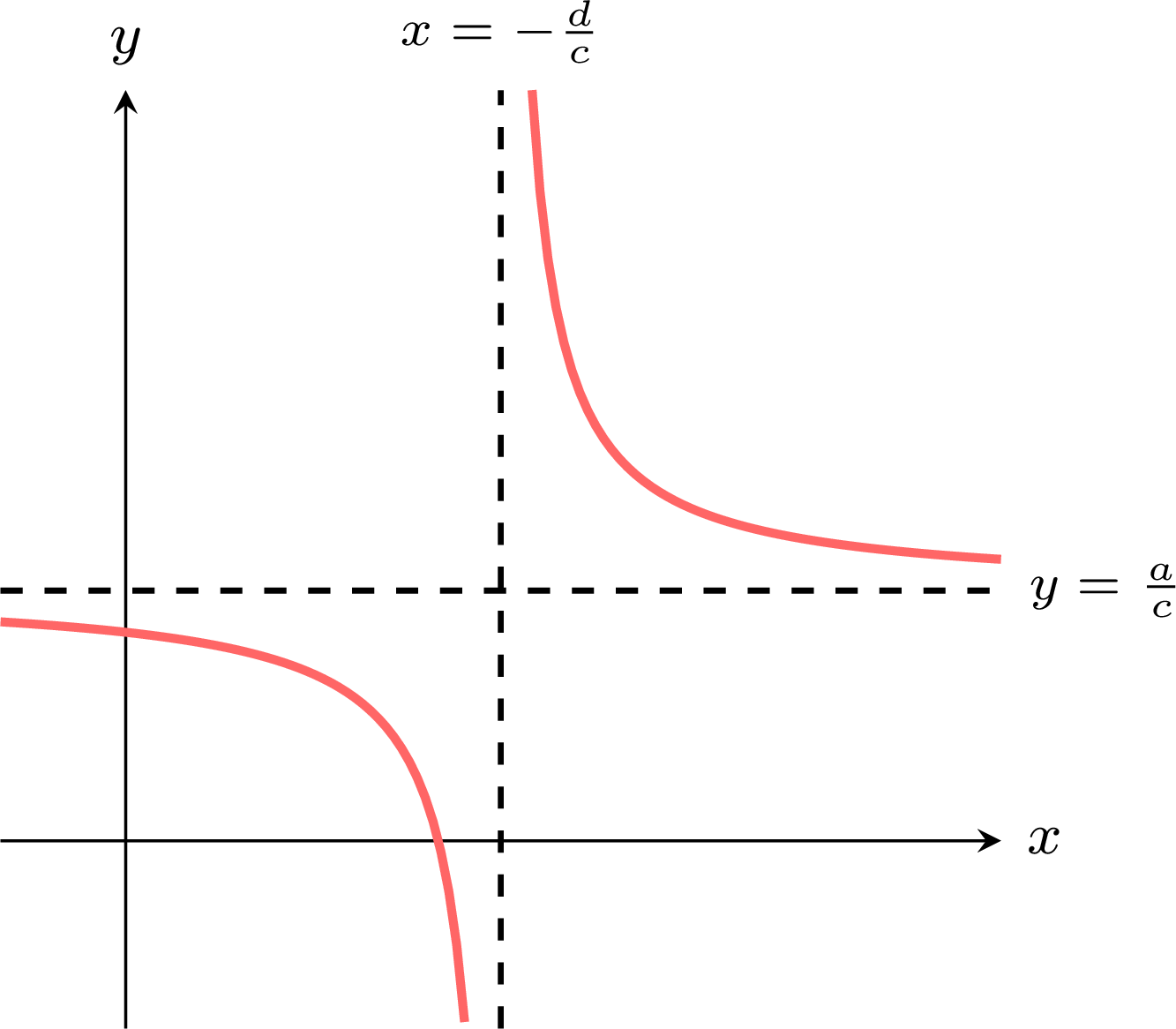
A rational function is a quotient of two polynomials. Let \(a\), \(b\), \(c\) and \(d\) be real numbers with \(c \neq 0\) and \(ad - bc \neq 0\). The function $$f(x) = \frac{ax + b}{cx + d}$$ is defined when \(cx + d \neq 0\), that is for \(x \neq -\dfrac{d}{c}\): its domain is \(\mathbb{R} \setminus \left\{-\dfrac{d}{c}\right\}\). Such a function is also called a linear fractional function; its graph is a hyperbola. The two conditions exclude two degenerate cases: - if \(c = 0\), then \(d \neq 0\) (since \(ad - bc = ad \neq 0\)) and the function \(x \mapsto \dfrac{a}{d}x + \dfrac{b}{d}\) is linear: its graph is a line;
- if \(c \neq 0\) and \(ad - bc = 0\), the numerator is a multiple of the denominator and \(f\) is constant: for instance \(\dfrac{2x + 6}{x + 3} = \dfrac{2(x + 3)}{x + 3} = 2\) for every \(x \neq -3\).
Proposition — Asymptotes of \(y \equal \frac{ax+b}{cx+d}\)
Let \(f(x) = \dfrac{ax + b}{cx + d}\), with \(c \neq 0\) and \(ad - bc \neq 0\). - For every \(x \neq -\dfrac{d}{c}\), $$f(x) = \frac{a}{c} + \frac{r}{cx + d}, \quad \text{where } r = \frac{bc - ad}{c} \neq 0.$$
- The graph of \(f\) has the vertical asymptote \(x = -\dfrac{d}{c}\) and the horizontal asymptote \(y = \dfrac{a}{c}\).
- The domain of \(f\) is \(\mathbb{R} \setminus \left\{-\dfrac{d}{c}\right\}\) and its range is \(\mathbb{R} \setminus \left\{\dfrac{a}{c}\right\}\): the graph never meets its horizontal asymptote.
- The identity. Since \(rc = bc - ad\), for every \(x \neq -\dfrac{d}{c}\): $$\begin{aligned}[t] \frac{a}{c} + \frac{r}{cx + d} &= \frac{a(cx + d) + rc}{c(cx + d)} && \text{(common denominator)} \\ &= \frac{acx + ad + bc - ad}{c(cx + d)} && (rc = bc - ad) \\ &= \frac{c(ax + b)}{c(cx + d)} && \text{(factor } c\text{)} \\ &= \frac{ax + b}{cx + d}. && (c \neq 0) \end{aligned}$$ Moreover \(r \neq 0\), because \(bc - ad \neq 0\).
- Vertical asymptote. As \(x\) gets closer to \(-\dfrac{d}{c}\), the denominator \(cx + d\) gets as close to \(0\) as desired, while \(r\) is a fixed nonzero number: \(\left|\dfrac{r}{cx + d}\right|\) becomes as large as desired, and so does \(|f(x)|\), which only adds the constant \(\dfrac{a}{c}\) to this fraction.
- Horizontal asymptote. As \(x\) becomes large, positive or negative, \(|cx + d|\) becomes as large as desired, so \(\dfrac{r}{cx + d}\) gets as close to \(0\) as desired: \(f(x)\) gets as close to \(\dfrac{a}{c}\) as desired.
- Range. Since \(r \neq 0\), the fraction \(\dfrac{r}{cx + d}\) is never \(0\): \(f(x) \neq \dfrac{a}{c}\) for every \(x\). Conversely, let \(y \neq \dfrac{a}{c}\). The equation \(f(x) = y\) becomes \(\dfrac{r}{cx + d} = y - \dfrac{a}{c}\), whose right side is nonzero, so $$cx + d = \frac{r}{y - \frac{a}{c}}, \quad \text{that is} \quad x = \frac{1}{c}\left(\frac{r}{y - \frac{a}{c}} - d\right).$$ This \(x\) is not \(-\dfrac{d}{c}\), since \(\dfrac{r}{y - \frac{a}{c}} \neq 0\). Every \(y \neq \dfrac{a}{c}\) is taken: the range is \(\mathbb{R} \setminus \left\{\dfrac{a}{c}\right\}\).
Method — Finding the Asymptotes of \(y \equal \frac{ax+b}{cx+d}\)
- Vertical asymptote: solve \(cx + d = 0\). Its solution \(x = -\dfrac{d}{c}\) is excluded from the domain, and the line \(x = -\dfrac{d}{c}\) is the vertical asymptote. The numerator is not \(0\) there, since \(ad - bc \neq 0\).
- Horizontal asymptote: rewrite the numerator around the denominator, \(ax + b = \dfrac{a}{c}(cx + d) + r\) with \(r = b - \dfrac{ad}{c}\), then divide each term by \(cx + d\): $$f(x) = \frac{a}{c} + \frac{r}{cx + d}.$$ The line \(y = \dfrac{a}{c}\), the quotient of the coefficients of \(x\), is the horizontal asymptote.
- State the domain \(\mathbb{R} \setminus \left\{-\dfrac{d}{c}\right\}\) and the range \(\mathbb{R} \setminus \left\{\dfrac{a}{c}\right\}\), and draw each asymptote as a dashed line labelled with its equation.
Example
Find the asymptotes, the domain and the range of \(f(x) = \dfrac{4x + 1}{2x - 6}\). - Vertical asymptote. \(2x - 6 = 0\) for \(x = 3\), and the numerator equals \(4 \times 3 + 1 = 13 \neq 0\) there: the vertical asymptote is \(x = 3\).
- Horizontal asymptote. The quotient of the coefficients of \(x\) is \(\dfrac{4}{2} = 2\), and \(2(2x - 6) = 4x - 12\), so \(4x + 1 = 2(2x - 6) + 13\): $$\begin{aligned}[t] f(x) &= \frac{2(2x - 6) + 13}{2x - 6} && (4x + 1 = 2(2x - 6) + 13) \\ &= 2 + \frac{13}{2x - 6}. && \text{(divide each term by } 2x - 6\text{)} \end{aligned}$$ The horizontal asymptote is \(y = 2\).
- Domain and range. The domain is \(\mathbb{R} \setminus \{3\}\) and the range is \(\mathbb{R} \setminus \{2\}\).
Method — Sign Table for a Quotient
Build the table as for a product, with two extra rules: - In the last row, mark each zero of the denominator with a double bar: the quotient is undefined there.
- When concluding, a double-bar value is excluded from the solution set even for \(\le\) or \(\ge\); a zero of the numerator is included for \(\le\) or \(\ge\) (provided the denominator is not zero there), excluded for \(<\) or \(>\).
Method — Sketching the Graph of \(y \equal \frac{ax+b}{cx+d}\)
- Draw the asymptotes, found with the Method “Finding the Asymptotes of \(y = \frac{ax+b}{cx+d}\)”, as dashed lines.
- Find the axes intercepts: the \(y\)-intercept is \(f(0) = \dfrac{b}{d}\) (when \(d \neq 0\)); the \(x\)-intercept is the solution of \(ax + b = 0\), that is \(x = -\dfrac{b}{a}\) (when \(a \neq 0\)).
- Place each branch with the sign of \(f(x) - \dfrac{a}{c} = \dfrac{r}{cx + d}\), on one side of the vertical asymptote at a time (or with the Method “Sign Table for a Quotient”). Where this sign is positive, the branch lies above the horizontal asymptote and climbs along the vertical asymptote; where it is negative, the branch lies below the horizontal asymptote and falls along the vertical asymptote.
- Plot the intercepts and one or two more points on each branch, then draw each branch, closer and closer to both asymptotes.
Example
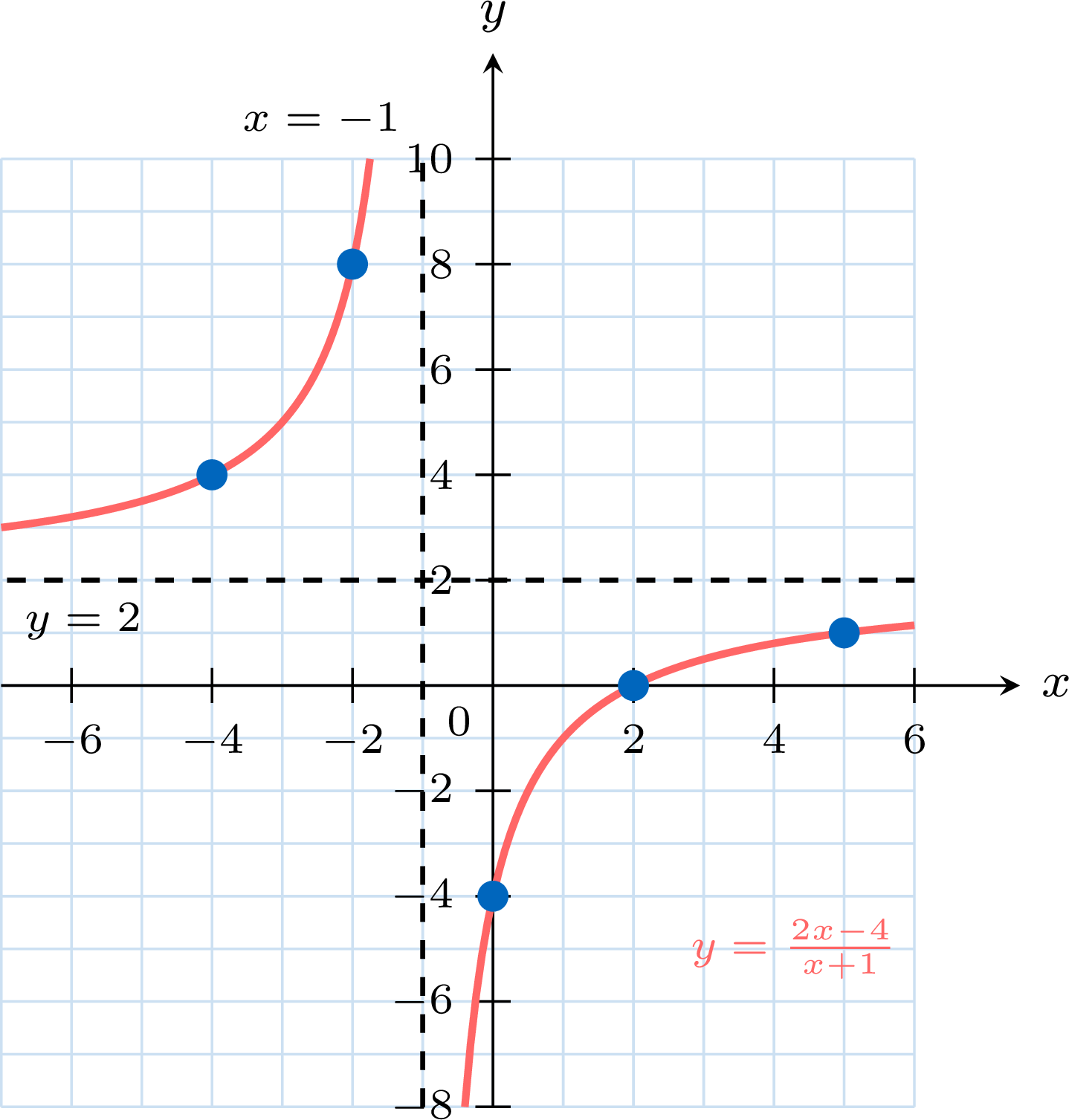
Sketch the graph of \(f(x) = \dfrac{2x - 4}{x + 1}\), showing its asymptotes and its axes intercepts. - Asymptotes. \(x + 1 = 0\) for \(x = -1\), where the numerator equals \(-6 \neq 0\): the vertical asymptote is \(x = -1\). Since \(2x - 4 = 2(x + 1) - 6\), $$\begin{aligned}[t] f(x) &= \frac{2(x + 1) - 6}{x + 1} && (2x - 4 = 2(x + 1) - 6) \\ &= 2 - \frac{6}{x + 1}, && \text{(divide each term by } x + 1\text{)} \end{aligned}$$ and the horizontal asymptote is \(y = 2\).
- Intercepts. \(f(0) = \dfrac{-4}{1} = -4\): the \(y\)-intercept is \(-4\). \(2x - 4 = 0\) for \(x = 2\): the \(x\)-intercept is \(2\).
- Branches. \(f(x) - 2 = -\dfrac{6}{x + 1}\). For \(x > -1\), \(x + 1 > 0\), so \(-\dfrac{6}{x + 1} < 0\): the right branch lies below \(y = 2\) and falls along \(x = -1\). For \(x < -1\), \(x + 1 < 0\), so \(-\dfrac{6}{x + 1} > 0\): the left branch lies above \(y = 2\) and climbs along \(x = -1\).
- Points. \(f(5) = \dfrac{6}{6} = 1\), \(f(-2) = \dfrac{-8}{-1} = 8\) and \(f(-4) = \dfrac{-12}{-3} = 4\).
Example
The graph of \(f(x) = \dfrac{px + 5}{x + q}\) has the asymptotes \(x = 2\) and \(y = -3\). Find \(p\) and \(q\), then the axes intercepts of the graph. - The vertical asymptote comes from \(x + q = 0\), that is \(x = -q\). So \(-q = 2\) and \(q = -2\).
- The horizontal asymptote is \(y = \dfrac{p}{1} = p\), the quotient of the coefficients of \(x\). So \(p = -3\).
- \(y\)-intercept: \(f(0) = \dfrac{5}{-2} = -\dfrac{5}{2}\).
- \(x\)-intercept: \(-3x + 5 = 0\) for \(x = \dfrac{5}{3}\).
Example
Let \(f(x) = \dfrac{x + 3}{x - 2}\). - State the asymptotes, the domain and the range of \(f\).
- Find \(f^{-1}(x)\).
- Compare the asymptotes of the graphs of \(f\) and \(f^{-1}\).
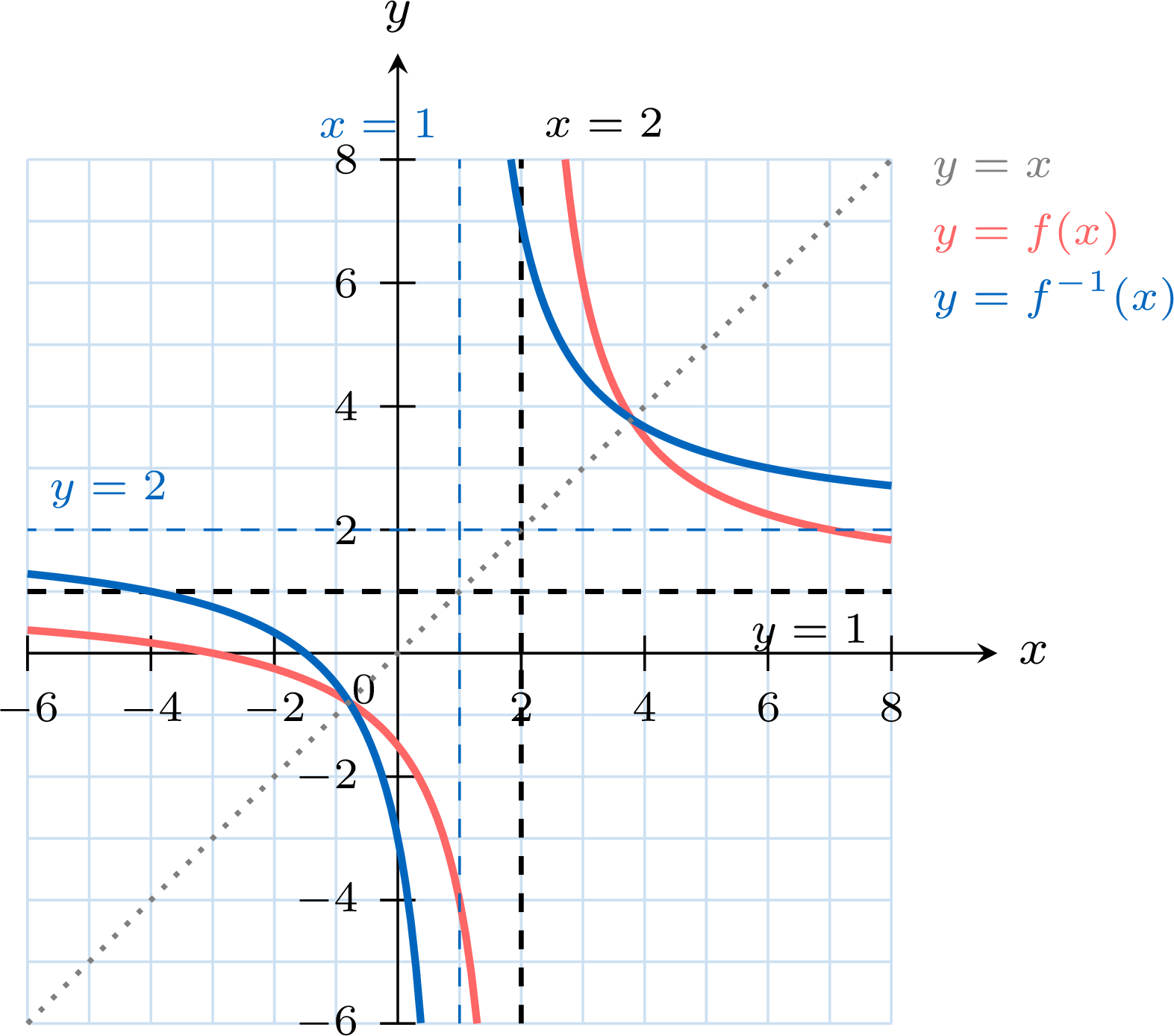
- \(x - 2 = 0\) for \(x = 2\) and \(\dfrac{a}{c} = \dfrac{1}{1} = 1\): the asymptotes are \(x = 2\) and \(y = 1\), the domain is \(\mathbb{R} \setminus \{2\}\) and the range is \(\mathbb{R} \setminus \{1\}\).
- By the Method “Finding the Inverse Function”, \(y = \dfrac{x + 3}{x - 2}\) is solved for \(x\), with \(x \neq 2\) and \(y \neq 1\): $$\begin{aligned}[t] y(x - 2) &= x + 3 && \text{(multiply by } x - 2 \neq 0\text{)} \\ xy - 2y &= x + 3 && \text{(expand)} \\ xy - x &= 2y + 3 && \text{(collect the terms in } x\text{)} \\ x(y - 1) &= 2y + 3 && \text{(factor } x\text{)} \\ x &= \frac{2y + 3}{y - 1}. && \text{(divide by } y - 1 \neq 0\text{)} \end{aligned}$$ Swapping the letters: \(f^{-1}(x) = \dfrac{2x + 3}{x - 1}\), whose domain \(\mathbb{R} \setminus \{1\}\) is the range of \(f\). Check: \(f(0) = -\dfrac{3}{2}\) and \(f^{-1}\left(-\dfrac{3}{2}\right) = \dfrac{-3 + 3}{-\frac{5}{2}} = 0\).
- The graph of \(f^{-1}\) has the asymptotes \(x = 1\) and \(y = 2\). The asymptotes are swapped: the vertical asymptote \(x = 2\) of \(f\) becomes the horizontal asymptote \(y = 2\) of \(f^{-1}\), and the horizontal asymptote \(y = 1\) becomes the vertical asymptote \(x = 1\). The reflection in the line \(y = x\) turns vertical lines into horizontal lines.
Example
Let \(g(x) = \dfrac{2x - 1}{x + 1}\), for \(x \neq -1\). Graph \(g\) with technology. Give the intercepts of the graph and the equations of the asymptotes that the screen suggests, then confirm each asymptote with the formula.
The graph of \(g(x) = \dfrac{2x - 1}{x + 1}\), in the window \(-6 \le x \le 4\), \(-4 \le y \le 8\), shows two branches, one on each side of the vertical line \(x = -1\); both flatten towards the horizontal line \(y = 2\). 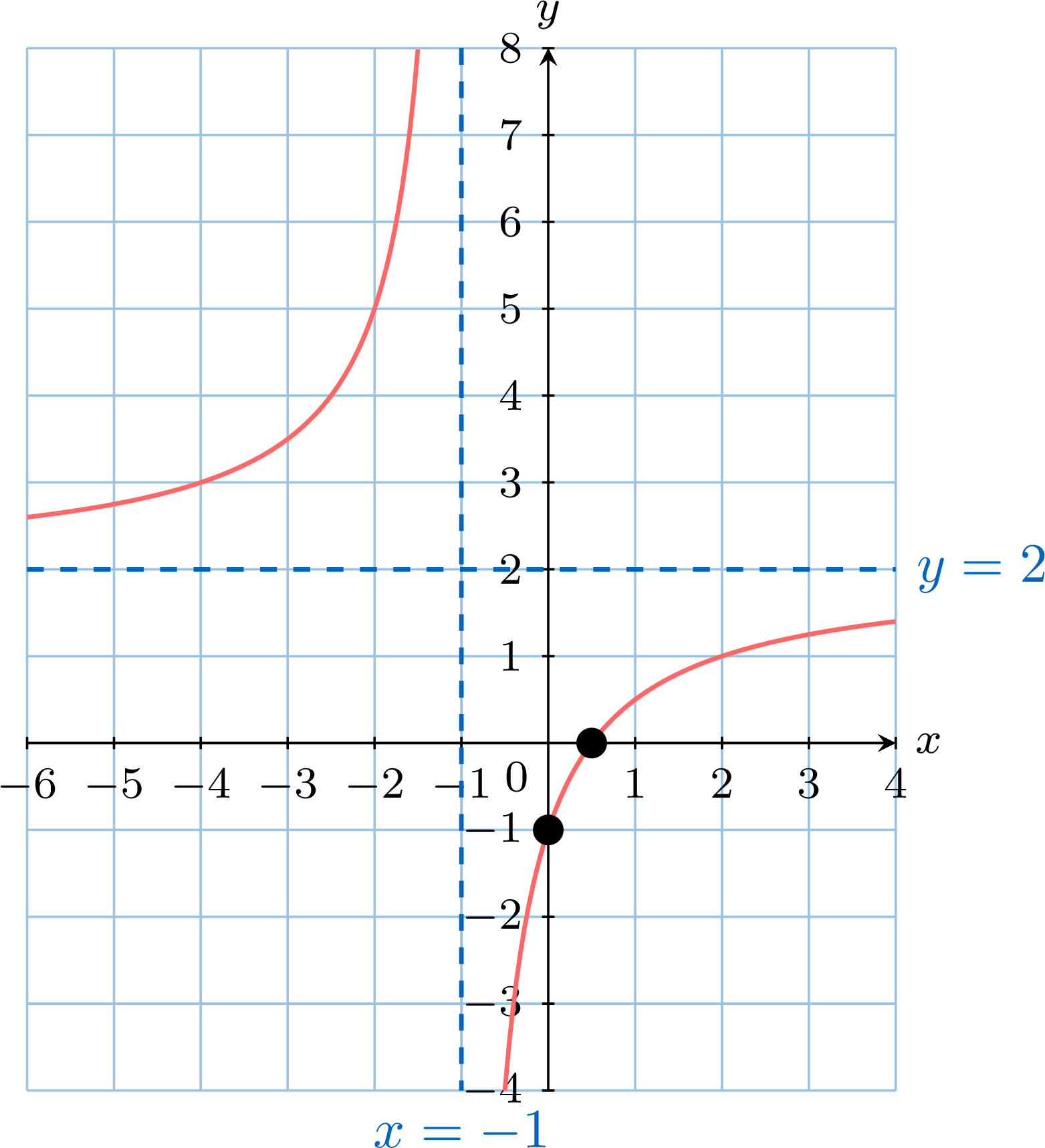
- Intercepts. The value of \(g\) at \(0\) is \(g(0) = \dfrac{-1}{1} = -1\): the \(y\)-intercept is \(-1\). The zero tool displays \(X = 0.5\), an exact value, since \(2x - 1 = 0\) for \(x = \dfrac{1}{2}\): the \(x\)-intercept is \(0.5\).
- Vertical asymptote. The denominator \(x + 1\) is zero for \(x = -1\), while the numerator equals \(-3 \neq 0\) there: the line \(x = -1\) is a vertical asymptote.
- Horizontal asymptote. The numerator is rewritten around the denominator: $$\begin{aligned}[t] g(x) &= \frac{2(x + 1) - 3}{x + 1} &&\text{(}2x - 1 = 2(x + 1) - 3\text{)} \\ &= 2 - \frac{3}{x + 1}. &&\text{(divide each term by } x + 1\text{)} \end{aligned}$$ When \(x\) is large, positive or negative, the fraction \(\dfrac{3}{x + 1}\) is as small as desired, so \(g(x)\) is as close to \(2\) as desired: the line \(y = 2\) is a horizontal asymptote.
Example
Use technology to find the points of intersection of the graph of \(f(x) = \dfrac{2x - 4}{x + 1}\) and the line \(y = x - 3\), to \(3\) significant figures. Then find their exact \(x\)-coordinates by algebra.
The two sides are entered as \(Y_1 = \dfrac{2x - 4}{x + 1}\) and \(Y_2 = x - 3\), in the window \(-6 \le x \le 6\), \(-8 \le y \le 10\). The line meets the right branch twice. With bounds around each point, the intersection tool displays \(X = 0.26794919\), \(Y = -2.7320508\), then \(X = 3.7320508\), \(Y = 0.73205081\). To \(3\) significant figures, the points are \((0.268, -2.73)\) and \((3.73, 0.732)\). 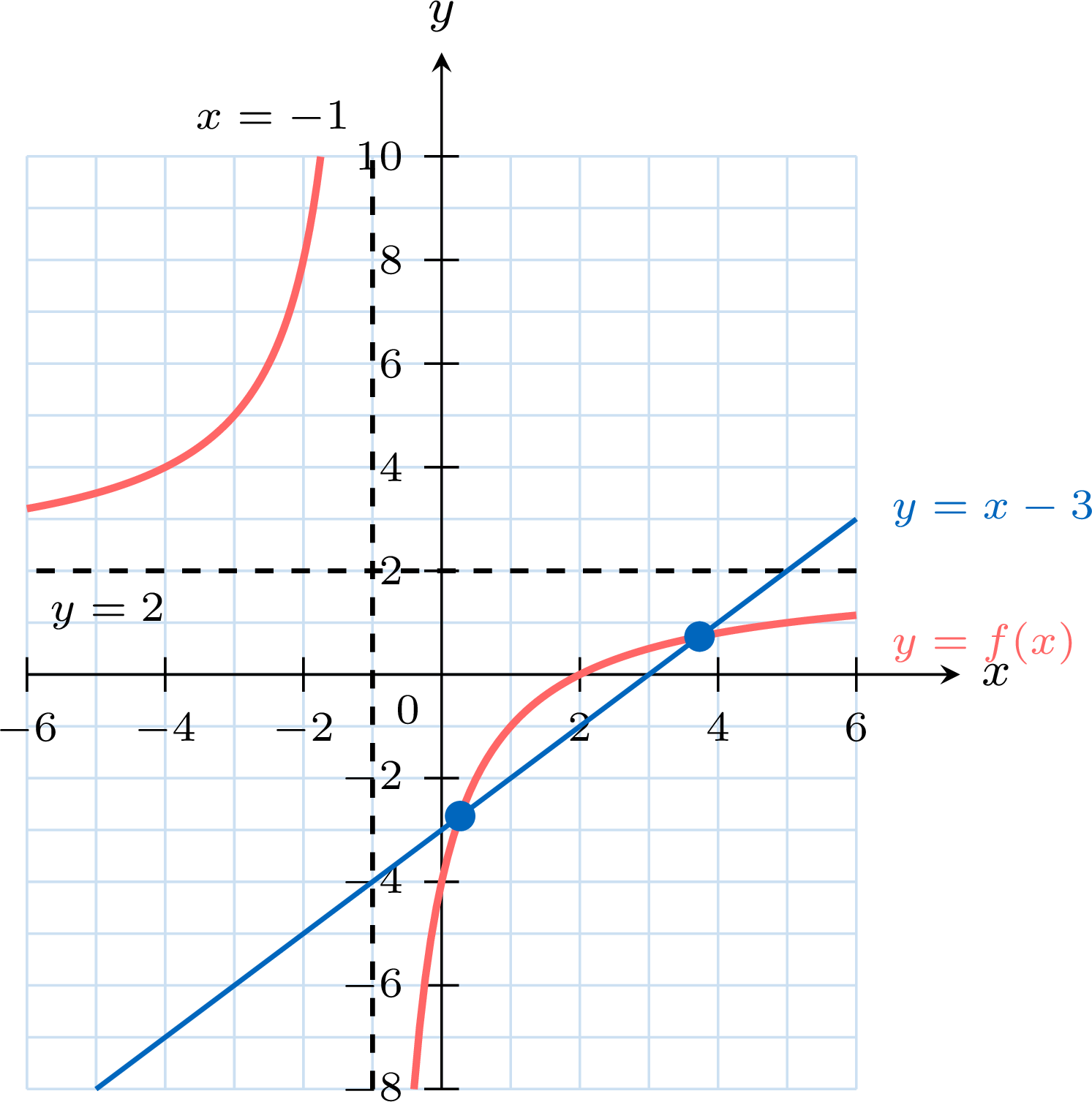
By algebra, for \(x \neq -1\): $$\begin{aligned}[t] \frac{2x - 4}{x + 1} &= x - 3 \\
2x - 4 &= (x - 3)(x + 1) && \text{(multiply by } x + 1 \neq 0\text{)} \\
2x - 4 &= x^2 - 2x - 3 && \text{(expand)} \\
0 &= x^2 - 4x + 1. && \text{(subtract } 2x - 4\text{)} \end{aligned}$$ The discriminant is \(\Delta = (-4)^2 - 4 \times 1 \times 1 = 12\), so \(x = \dfrac{4 \pm \sqrt{12}}{2} = 2 \pm \sqrt{3}\). Neither value is \(-1\), and \(2 - \sqrt{3} \approx 0.268\), \(2 + \sqrt{3} \approx 3.73\) match the screen.
Skills to practice
- Recognising Asymptotes and Ranges
- Finding Asymptotes and Intercepts without Technology
- Finding a Function from Its Asymptotes
- Studying Rational Functions with Technology
- Sketching Rational Functions
IV
Going further
Skills to practice
- Reasoning and Problem-Solving
- Solving Problems on Functions
- Reasoning on Rational Functions
- Solving Problems with Rational Functions
- Quiz
Jump to section