International Baccalaureate · DP 2: Analysis and Approaches HL
Techniques of Integration
I
Inspection, Substitution and Standard Forms
I.1
Integration by Inspection
While we can integrate basic functions by reversing the rules of differentiation, many functions require more advanced techniques. Two key methods are the reverse of the chain rule and the product rule: integration by substitution and integration by parts.
Method — Integration by Inspection
A common strategy is to make an educated guess for the antiderivative, differentiate it, and adjust any constant factors. This is often called “integration by inspection” or “guess and check”. - Guess: Look at the function and guess a possible antiderivative.
- Differentiate: Differentiate your guess.
- Adjust: Compare your result with the original integrand and multiply by a constant factor to correct any discrepancies.
Example
Find the integral of \(\sin(3x)\). - Guess: The integral of \(\sin\) is \(-\cos\). A good guess for the antiderivative is \(F(x) = -\cos(3x)\).
- Differentiate: Using the chain rule, the derivative of our guess is \(F'(x) = -(-\sin(3x)) \cdot 3 = 3\sin(3x)\).
- Adjust: Our result, \(3\sin(3x)\), is 3 times larger than the original integrand, \(\sin(3x)\). We must therefore divide our initial guess by 3.
Skills to practice
- Finding Antiderivatives by Inspection
I.2
Integration by Substitution
Integration by substitution is a powerful technique that reverses the chain rule for differentiation. It is used when an integrand contains both a function and its derivative.
Consider the integral \(\int (2x^3+1)^7 (6x^2) \, \mathrm{d}x\). We can see that the expression contains an “inner function”, \(u = 2x^3+1\), and its derivative, \(u'(x) = 6x^2\). This structure is a clear indicator for substitution.
Let's define a new variable, \(u = 2x^3+1\). Differentiating this with respect to \(x\) gives \(u'(x)=6x^2\). In differential form, we can write \(\mathrm{d}u = 6x^2\,\mathrm{d}x\). Now we can substitute both \(u\) and \(\mathrm{d}u\) into the original integral: $$\begin{aligned} \int \underbrace{(2x^3+1)^{7}}_{u^{7}} \underbrace{(6x^2)\,\mathrm{d}x}_{\mathrm{d}u} &= \int u^{7}\,\mathrm{d}u \\ &= \frac{1}{8}u^{8}+C\end{aligned}$$ Finally, we substitute back to express the result in terms of \(x\): $$ \int (2x^3+1)^7 (6x^2) \, \mathrm{d}x =\frac{1}{8}(2x^3+1)^{8}+C $$
Proposition — Integration by Substitution
- Indefinite Integral: $$\int f(u(x))u'(x) \, \mathrm{d}x = \int f(u) \, \mathrm{d}u $$
- Definite Integral: $$\int_a^b f(u(x))u'(x) \, \mathrm{d}x = \int_{u(a)}^{u(b)} f(u) \, \mathrm{d}u $$
Example
Find \(\displaystyle\int_0^1 2x(x^2 + 1)^3\;\mathrm{d}x\). - Substitution: Let \(u = x^2+1\). Then \(\mathrm{d}u = 2x\,\mathrm{d}x\).
- Change limits:
- When \(x=0\), \(u = 0^2+1=1\).
- When \(x=1\), \(u = 1^2+1=2\).
- Integrate: We substitute to get a simpler integral in terms of \(u\): $$\begin{aligned} \int_0^1 \underbrace{(x^2 + 1)^3}_{u^3} \underbrace{2x\;\mathrm{d}x}_{\mathrm{d}u} &= \int_1^2 u^3 \, \mathrm{d}u \\ &= \left[\frac{u^4}{4}\right]_1^2 \\ &= \frac{2^4}{4} - \frac{1^4}{4} \\ &= 4 - \frac{1}{4}\\ &= \frac{15}{4} \end{aligned}$$
Skills to practice
- Integrating by Substitution
- Evaluating Definite Integrals by Substitution
I.3
Further Standard Antiderivatives
Proposition — Antiderivative of \(1/\cos^2 x\)
On every interval where \(\cos x \neq 0\), $$\int \frac{1}{\cos^2 x}\,\mathrm{d}x = \tan x + C.$$ The integrand is also written \(\sec^2 x\), or \(1 + \tan^2 x\). More generally, for constants \(k \neq 0\) and \(b\), on every interval where \(\cos(kx + b) \neq 0\), $$\int \frac{1}{\cos^2(kx + b)}\,\mathrm{d}x = \frac{1}{k}\tan(kx + b) + C.$$
For \(\cos x \neq 0\), the quotient rule applied to \(\tan x = \dfrac{\sin x}{\cos x}\) gives $$\begin{aligned}[t] (\tan x)' &= \frac{\cos x \cos x - \sin x\,(-\sin x)}{\cos^2 x} &&\text{(quotient rule)}\\
&= \frac{\cos^2 x + \sin^2 x}{\cos^2 x}\\
&= \frac{1}{\cos^2 x}. &&(\cos^2 x + \sin^2 x = 1) \end{aligned}$$ Splitting the second fraction instead gives \(1 + \dfrac{\sin^2 x}{\cos^2 x} = 1 + \tan^2 x\). So \(\tan\) is an antiderivative of \(\dfrac{1}{\cos^2 x}\) on every interval where \(\cos x \neq 0\). For the composite, the chain rule with \(u(x) = kx + b\) and \(u'(x) = k\) gives $$\begin{aligned}[t] \left(\frac{1}{k}\tan(kx + b)\right)' &= \frac{1}{k} \times k \times \frac{1}{\cos^2(kx + b)} &&\text{(chain rule)}\\
&= \frac{1}{\cos^2(kx + b)}. \end{aligned}$$
Example
- Find \(\displaystyle\int \frac{1}{\cos^2(3x - 1)}\,\mathrm{d}x\).
- Calculate \(\displaystyle\int_0^{\pi/6} \frac{1}{\cos^2(2x)}\,\mathrm{d}x\).
- The integrand has the form \(\dfrac{1}{\cos^2(kx + b)}\) with \(k = 3\) and \(b = -1\). On every interval where \(\cos(3x - 1) \neq 0\), $$\int \frac{1}{\cos^2(3x - 1)}\,\mathrm{d}x = \frac{1}{3}\tan(3x - 1) + C.$$ Check: \(\left(\dfrac{1}{3}\tan(3x - 1)\right)' = \dfrac{1}{3} \times 3 \times \dfrac{1}{\cos^2(3x - 1)} = \dfrac{1}{\cos^2(3x - 1)}\).
- For \(0 \le x \le \dfrac{\pi}{6}\), \(0 \le 2x \le \dfrac{\pi}{3}\), so \(\cos(2x) \neq 0\) on the whole interval. With \(k = 2\), $$\begin{aligned}[t] \int_0^{\pi/6} \frac{1}{\cos^2(2x)}\,\mathrm{d}x &= \left[\frac{1}{2}\tan(2x)\right]_0^{\pi/6} &&\text{(antiderivative of } 1/\cos^2(kx + b)\text{)}\\ &= \frac{1}{2}\tan\frac{\pi}{3} - \frac{1}{2}\tan 0 &&\\ &= \frac{\sqrt{3}}{2}. &&\Big(\tan\frac{\pi}{3} = \sqrt{3}\Big) \end{aligned}$$
Proposition — Reciprocal Trigonometric and Exponential Antiderivatives
With \(\sec x = \dfrac{1}{\cos x}\), \(\csc x = \dfrac{1}{\sin x}\) (also written \(\operatorname{cosec} x\)) and \(\cot x = \dfrac{\cos x}{\sin x}\), on every interval where the functions involved are defined: $$\begin{array}{|c|c|}\hline \textbf{Function }f(x) & \textbf{An antiderivative }F(x) \\
\hline \sec x\tan x & \sec x \\
\hline \csc^2 x & -\cot x \\
\hline \csc x\cot x & -\csc x \\
\hline a^x \text{, with } a > 0 \text{ and } a \neq 1 & \dfrac{a^x}{\ln a} \\
\hline\end{array}$$ For constants \(k \neq 0\) and \(b\), the antiderivative of a composite with \(kx + b\) is divided by \(k\); for example $$\int \csc^2(kx + b)\,\mathrm{d}x = -\frac{1}{k}\cot(kx + b) + C \qquad\text{and}\qquad \int a^{kx + b}\,\mathrm{d}x = \frac{a^{kx + b}}{k\ln a} + C.$$
Each antiderivative \(F\) is differentiated with the derivatives of \(\sec\), \(\csc\) and \(\cot\) and the derivative of \(a^x\), \((a^x)' = \ln(a)\,a^x\): $$\begin{aligned}[t] (\sec x)' &= \sec x\tan x, &&\text{(derivative of sec)}\\
(-\cot x)' &= -\left(-\csc^2 x\right) = \csc^2 x, &&\text{(derivative of cot)}\\
(-\csc x)' &= -\left(-\csc x\cot x\right) = \csc x\cot x, &&\text{(derivative of csc)}\\
\left(\frac{a^x}{\ln a}\right)' &= \frac{\ln(a)\,a^x}{\ln a} = a^x. &&(\ln a \neq 0 \text{ since } a \neq 1) \end{aligned}$$ For a composite with \(kx + b\), the chain rule multiplies the derivative of \(F(kx + b)\) by \(k\), and the factor \(\dfrac{1}{k}\) cancels it: \(\left(\dfrac{1}{k}F(kx + b)\right)' = f(kx + b)\).
Example
Find: - \(\displaystyle\int \left(3^x + \csc^2 x\right)\mathrm{d}x\);
- \(\displaystyle\int \sec(2x)\tan(2x)\,\mathrm{d}x\);
- \(\displaystyle\int \tan^2 x\,\mathrm{d}x\).
- By linearity, each term is integrated with the table, on every interval where \(\sin x \neq 0\): $$\int \left(3^x + \csc^2 x\right)\mathrm{d}x = \frac{3^x}{\ln 3} - \cot x + C.$$
- The integrand is \(\sec u \tan u\) with \(u = 2x\), so \(k = 2\): on every interval where \(\cos(2x) \neq 0\), $$\int \sec(2x)\tan(2x)\,\mathrm{d}x = \frac{1}{2}\sec(2x) + C.$$
- No entry of the tables has \(\tan^2 x\) as its function: the identity \(1 + \tan^2 x = \dfrac{1}{\cos^2 x}\) turns it into one that is known. On every interval where \(\cos x \neq 0\), $$\begin{aligned}[t] \int \tan^2 x\,\mathrm{d}x &= \int \left(\frac{1}{\cos^2 x} - 1\right)\mathrm{d}x &&\Big(\tan^2 x = \frac{1}{\cos^2 x} - 1\Big)\\ &= \tan x - x + C. &&\text{(linearity)} \end{aligned}$$ Check: \((\tan x - x)' = 1 + \tan^2 x - 1 = \tan^2 x\).
Skills to practice
- Integrating \(1/\cos^2(kx + b)\)
- Integrating Reciprocal Trigonometric and Exponential Functions
I.4
Inverse Trigonometric Forms
Two standard integrals produce inverse trigonometric functions. Completing the square reduces many quadratic denominators to these forms.
Proposition — Inverse Trigonometric Integrals
For a constant \(a>0\): $$\begin{array}{|c|c|}\hline \textbf{Integrand} & \textbf{Antiderivative} \\
\hline \dfrac{1}{a^2+x^2} & \dfrac{1}{a}\arctan\dfrac{x}{a}+C \\
\hline \dfrac{1}{\sqrt{a^2-x^2}} & \arcsin\dfrac{x}{a}+C \\
\hline \end{array}$$ Example
Calculate \(\displaystyle\int \frac{1}{x^2+2x+5}\,\mathrm{d}x\).
Complete the square: \(x^2+2x+5=(x+1)^2+2^2\). With \(a=2\) and the shift \(x\mapsto x+1\), $$\begin{aligned} \int \frac{\mathrm{d}x}{x^2+2x+5} &= \int\frac{\mathrm{d}x}{(x+1)^2+2^2} &&\text{(canonical form)}\\
&= \tfrac{1}{2}\arctan\tfrac{x+1}{2}+C &&\text{(inverse-trig rule)} \end{aligned}$$
Skills to practice
- Integrating with Inverse Trigonometric Forms
II
Integration by Parts and Partial Fractions
II.1
Integration by Parts
Integration by parts applies when the integrand is a product that neither the reverse chain rule nor substitution handles, such as \(x e^x\) or \(x\sin x\).
Proposition — Integration by Parts
For two differentiable functions \(u(x)\) and \(v(x)\): - Indefinite Integral: $$ \int u(x)v'(x) \, \mathrm{d}x = u(x)v(x) - \int u'(x)v(x) \, \mathrm{d}x $$
- Definite Integral: $$ \int_a^b u(x)v'(x) \, \mathrm{d}x = \left[u(x)v(x)\right]_a^b - \int_a^b u'(x)v(x) \, \mathrm{d}x $$
The product rule for differentiation states that for two functions \(u(x)\) and \(v(x)\): $$ \left(u(x)v(x)\right)' = u'(x)v(x) + u(x)v'(x) $$ Integrating both sides with respect to \(x\): $$ \int \left(u(x)v(x)\right)' \, \mathrm{d}x = \int u'(x)v(x) \, \mathrm{d}x + \int u(x)v'(x) \, \mathrm{d}x $$ Since integration is the antiderivative, the left side simplifies to \(u(x)v(x)\): $$ u(x)v(x) = \int u'(x)v(x) \, \mathrm{d}x + \int u(x)v'(x) \, \mathrm{d}x $$ Rearranging this equation gives the formula for integration by parts: $$ \int u(x)v'(x) \, \mathrm{d}x = u(x)v(x) - \int u'(x)v(x) \, \mathrm{d}x $$
Note
The key to using this method is to choose \(u\) and \(v'\) strategically. The goal is to select a \(u\) that becomes simpler when differentiated (e.g., a polynomial) and a \(v'\) that is easy to integrate. The new integral, \(\int u'v \, \mathrm{d}x\), should be easier to solve than the original one.
Example
Find \(\displaystyle\int_0^1 x e^x \; \mathrm{d}x\).
We have a product of two functions, \(x\) and \(e^x\). We choose \(u\) and \(v'\):
- Let \(u=x\) (since its derivative \(u'=1\) is simpler).
- Let \(v'=e^x\) (since its antiderivative \(v=e^x\) is easy to find).
Example
Find \(\displaystyle\int \ln x\,\mathrm{d}x\) for \(x > 0\).
The integrand does not look like a product, and no antiderivative of \(\ln x\) is known yet. It is written \(1 \times \ln x\), and \(\ln x\) is the factor that is differentiated:
- let \(u(x) = \ln x\), so \(u'(x) = \dfrac{1}{x}\);
- let \(v'(x) = 1\), so \(v(x) = x\).
Example
Find \(\displaystyle\int e^x \sin x\,\mathrm{d}x\).
Neither factor becomes simpler when differentiated: two integrations by parts bring the integral back, and it is then found by solving an equation. Let \(I = \displaystyle\int e^x \sin x\,\mathrm{d}x\). Both times, \(e^x\) is the factor that is integrated.
Check: \(\left(\dfrac{1}{2}e^x (\sin x - \cos x)\right)' = \dfrac{1}{2}e^x (\sin x - \cos x) + \dfrac{1}{2}e^x (\cos x + \sin x) = e^x \sin x\).
Had \(\sin x\) been integrated in the second step, the first step would have been undone and the computation would only give back \(I = I\).
- First integration by parts, with \(u(x) = \sin x\) and \(v'(x) = e^x\), so \(u'(x) = \cos x\) and \(v(x) = e^x\): $$I = e^x \sin x - \int e^x \cos x\,\mathrm{d}x.$$
- Second integration by parts, with \(u(x) = \cos x\) and \(v'(x) = e^x\), so \(u'(x) = -\sin x\) and \(v(x) = e^x\): $$\begin{aligned}[t] \int e^x \cos x\,\mathrm{d}x &= e^x \cos x - \int e^x \times (-\sin x)\,\mathrm{d}x\\ &= e^x \cos x + I. \end{aligned}$$
Check: \(\left(\dfrac{1}{2}e^x (\sin x - \cos x)\right)' = \dfrac{1}{2}e^x (\sin x - \cos x) + \dfrac{1}{2}e^x (\cos x + \sin x) = e^x \sin x\).
Had \(\sin x\) been integrated in the second step, the first step would have been undone and the computation would only give back \(I = I\).
Skills to practice
- Evaluating Definite Integrals by Parts
- Integrating by Parts with a Factor 1 or Twice
- Writing Integrations by Parts in Full
II.2
Partial Fractions
Recappreviously studied — click to reread
Definition — Proper and Improper Rational Fractions
A rational fraction is a quotient \(\dfrac{P(x)}{D(x)}\) of two polynomials with \(D\) not the zero polynomial. It is proper when \(\deg P < \deg D\), and improper when \(\deg P \geq \deg D\). By convention, the zero fraction (\(P = 0\)) is proper. Proposition — Partial Fraction Decomposition
Let \(\dfrac{P(x)}{(x-a)(x-b)}\) be a proper rational fraction with \(a \neq b\). Then there exists a unique pair of real numbers \((A, B)\) such that, for every \(x \neq a, b\): $$\frac{P(x)}{(x-a)(x-b)} = \frac{A}{x-a} + \frac{B}{x-b}.$$
We use twice the following elementary fact: a polynomial of degree at most \(1\) that vanishes at two distinct points is the zero polynomial (if \(cx + d\) vanishes at two distinct points, then \(c = 0\), and then \(d = 0\)).
Putting the right-hand side over the common denominator, the identity to establish means that the polynomials \(P(x)\) and \(A(x-b) + B(x-a)\) — both of degree at most \(1\), since \(P\) is proper — take the same values for every \(x \neq a, b\). Their difference then vanishes at two distinct points, so by the elementary fact the identity is a polynomial identity, valid for all \(x\): $$P(x) = A(x-b) + B(x-a).$$ Finding the only candidates. Suppose the identity holds. Setting \(x = a\) makes the term in \(B\) vanish: $$P(a) = A(a-b), \quad \text{so} \quad A = \frac{P(a)}{a-b}.$$ Setting \(x = b\) makes the term in \(A\) vanish: $$P(b) = B(b-a), \quad \text{so} \quad B = \frac{P(b)}{b-a}.$$ Hence there is no other possible pair: uniqueness is proved.
These values do work. With this choice, the difference \(P(x) - A(x-b) - B(x-a)\) is a polynomial of degree at most \(1\) vanishing at the two distinct points \(x = a\) and \(x = b\): by the elementary fact it is the zero polynomial, which proves existence. (The elementary fact is a special case of a general result: a polynomial of degree \(n\) has at most \(n\) roots.)
Method — Decomposing into Partial Fractions
- Make the fraction proper: if \(\deg P \geq \deg D\), first perform the long division \(P = D \times Q + R\); then \(\frac{P}{D} = Q + \frac{R}{D}\) with \(\frac{R}{D}\) proper.
- Factor the denominator into distinct linear factors.
- Write the template with one unknown constant per linear factor — for \((x-a)(x-b)\): \(\frac{A}{x-a} + \frac{B}{x-b}\).
- Determine the constants: multiply through by the denominator, then either evaluate at the roots of the denominator (each evaluation isolates one constant), or expand and equate coefficients.
- Check by recombining the simple fractions.
Skills to practice
- Partial Fractions
II.3
Integrating with Partial Fractions
When the integrand is a proper rational function whose denominator factorises into distinct linear factors, its partial-fraction decomposition turns the integral into a sum of standard logarithmic integrals. A repeated factor \((x - a)^2\) also gives a term in \(\dfrac{1}{(x - a)^2}\), whose antiderivative is \(-\dfrac{1}{x - a}\), not a logarithm.
Method — Integrating a Rational Function by Partial Fractions
- Decompose: factorise the denominator and write the proper fraction as a sum \(\frac{A}{x-r}\) (one per simple root \(r\); a repeated root needs \(\frac{A}{x-r}+\frac{B}{(x-r)^2}\)).
- Find the constants by substituting convenient values of \(x\) or identifying coefficients.
- Integrate each term: \(\int \frac{A}{x-r}\,\mathrm{d}x = A\ln|x-r|+C\).
Example
Calculate \(\displaystyle\int \frac{5x-4}{(x-2)(x+1)}\,\mathrm{d}x\).
Writing \(\frac{5x-4}{(x-2)(x+1)}=\frac{A}{x-2}+\frac{B}{x+1}\) gives \(5x-4=A(x+1)+B(x-2)\). Substituting \(x=2\) then \(x=-1\) yields \(A=2\), \(B=3\). Hence $$\begin{aligned} \int \frac{5x-4}{(x-2)(x+1)}\,\mathrm{d}x &= \int\!\Big(\tfrac{2}{x-2}+\tfrac{3}{x+1}\Big)\mathrm{d}x &&\text{(substitute)}\\
&= 2\ln|x-2|+3\ln|x+1|+C &&\text{(integrate)} \end{aligned}$$
Skills to practice
- Integrating Rational Functions by Partial Fractions
II.4
Double-Angle Identities
Recappreviously studied — click to reread
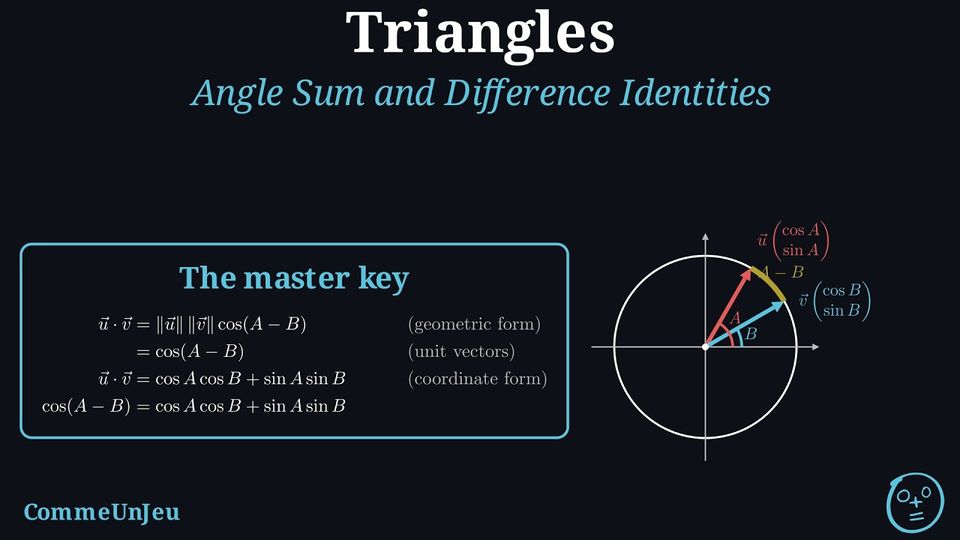
Proposition — Double Angle Formulas
For every real number \(A\): $$\cos 2A = \cos^2 A - \sin^2 A = 2\cos^2 A - 1 = 1 - 2\sin^2 A,$$ $$\sin 2A = 2\sin A\cos A.$$ They are obtained by taking \(B = A\) in the formulas for \(\cos(A + B)\) and \(\sin(A + B)\), which gives \(\sin 2A\) and \(\cos^2 A - \sin^2 A\) (this derivation is proposed in the exercises), then using \(\cos^2 A + \sin^2 A = 1\) for the other two forms of \(\cos 2A\). Skills to practice
- Double-Angle Identities
III
Going further
Skills to practice
- Solving Problems without Technology
- Quiz
Jump to section