International Baccalaureate · MYP 1
Location
I
Positive and Negative Coordinates
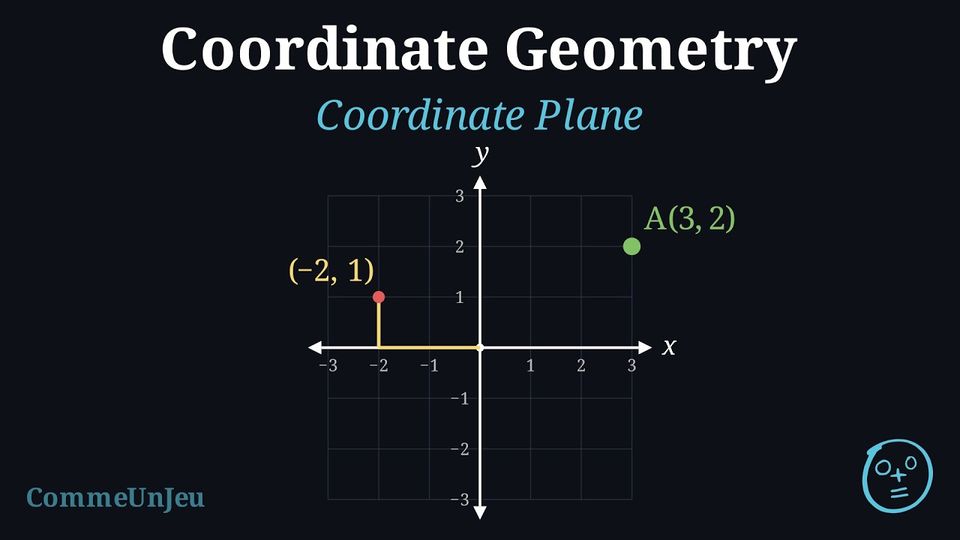
Maya and Tom plan to meet in the city park. Maya texts: “near the big oak tree”. Tom waits for an hour... under the other big oak tree, on the far side of the lawn. Next time, the meeting point will be given by numbers. The park map is covered by a grid of lines. How can numbers describe one exact point of the map — how many numbers are needed, and does their order matter?
The nodes of a grid, named by two numbers, become the points of a coordinate plane: the two lines numbered \(0\) become the axes, and the node \((0,0)\) is the origin.
Definition — Coordinate Plane
A coordinate plane is formed by two perpendicular number lines that intersect at their zero point, called the origin. The origin has coordinates \((0,0)\). 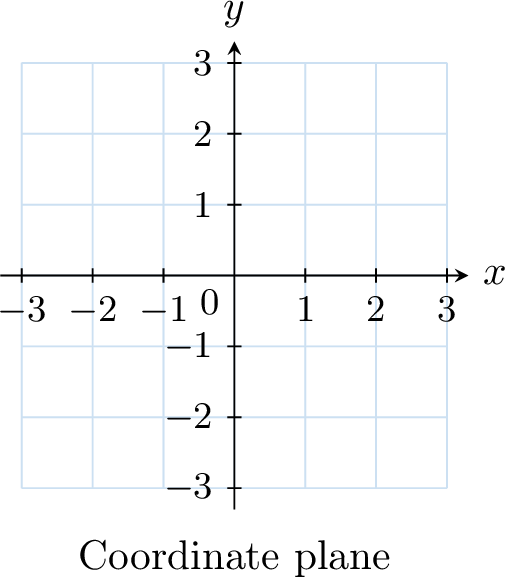
- The horizontal number line is called the \(x\)-axis.
- The vertical number line is called the \(y\)-axis.
Definition — Coordinates of a Point
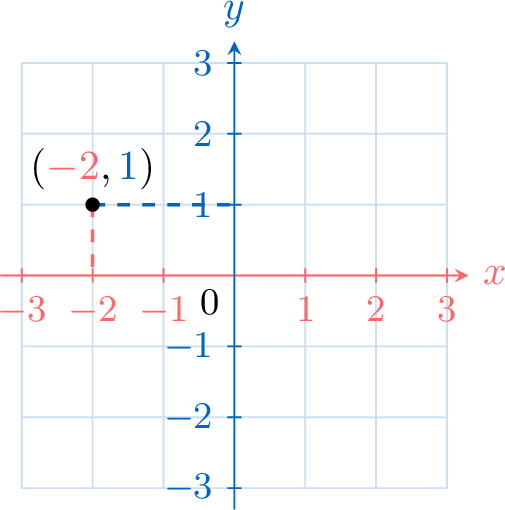
The coordinates of a point are an ordered pair of numbers (the order matters), written as \((x, y)\), where \(x\) is the \(x\)-coordinate and \(y\) is the \(y\)-coordinate: - The \(x\)-coordinate indicates the horizontal position along the \(x\)-axis, with positive numbers to the right of the origin and negative numbers to the left.
- The \(y\)-coordinate indicates the vertical position along the \(y\)-axis, with positive numbers above the origin and negative numbers below.
Definition — Quadrants
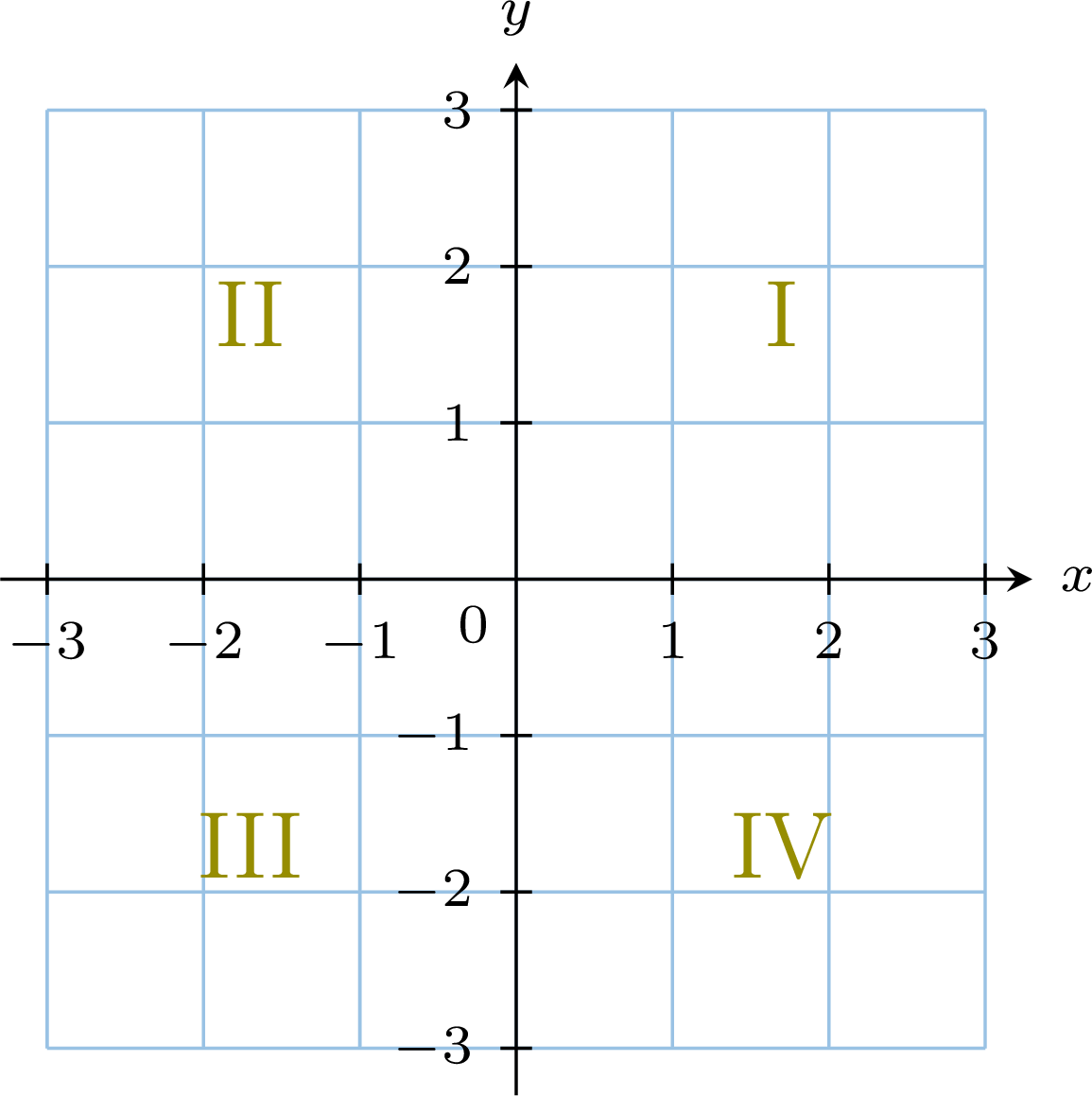
The two axes divide the coordinate plane into four regions called quadrants, numbered anticlockwise starting from the top right: - the first quadrant: \(x>0\) and \(y>0\);
- the second quadrant: \(x<0\) and \(y>0\);
- the third quadrant: \(x<0\) and \(y<0\);
- the fourth quadrant: \(x>0\) and \(y<0\).
Example
Plot these points on a coordinate plane: $$A(-2,3),\quad B(3,-1),\quad \text{and}\quad C(-3,-2).$$
For each point, start at the origin and read the coordinates in order — first \(x\) (right if positive, left if negative), then \(y\) (up if positive, down if negative): 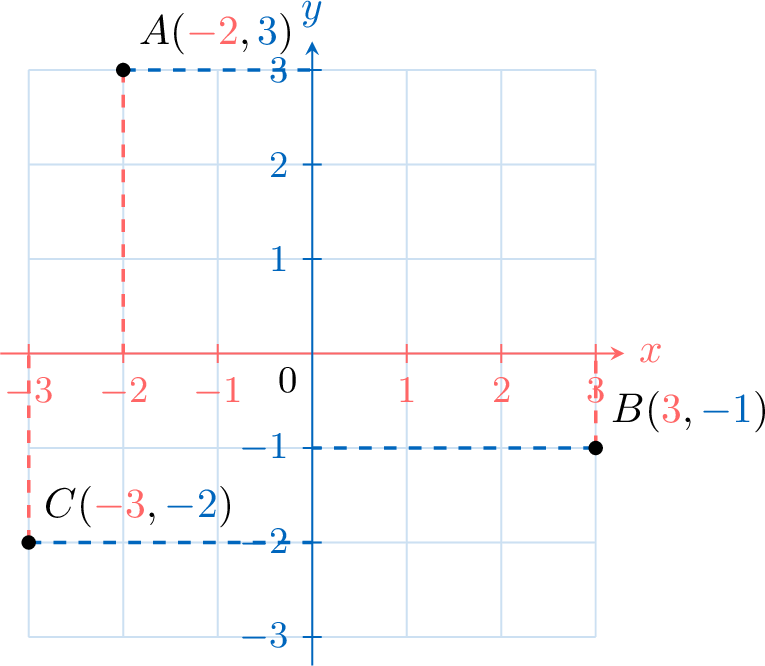
- \(A(-2,3)\): \(x=-2\), move 2 units left; \(y=3\), move 3 units up.
- \(B(3,-1)\): \(x=3\), move 3 units right; \(y=-1\), move 1 unit down.
- \(C(-3,-2)\): \(x=-3\), move 3 units left; \(y=-2\), move 2 units down.
Skills to practice
- Reading Coordinates and Quadrants
- Plotting Points in the Four Quadrants
- Explaining the Order and the Signs of Coordinates
II
Going further
Skills to practice
- Reasoning and Solving Problems
- Quiz
Jump to section