International Baccalaureate · MYP 5 Extended
Number Sequences and Finance
I
Number Sequences
I.1
Terms of a Sequence
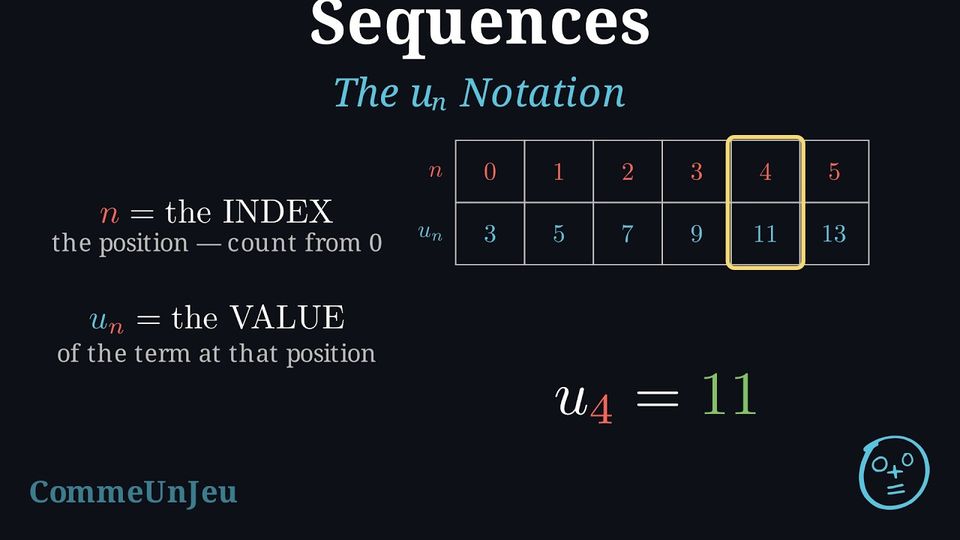
In mathematics, a sequence is more than just a pattern; it is an ordered list of numbers where each number has a specific position (its place in the list). To work with sequences effectively, we use a special notation to distinguish a term's position from its value.
Definition — Numerical Sequence
A numerical sequence is an ordered list of numbers, called terms. We use the notation \(u_n\) to describe a term in the sequence. - The subscript \(n\) is the index, which tells us the position of the term (often starting from \(n=0\)). The index \(n\) usually takes integer values: \(0,1,2,\dots\)
- \(u_n\) represents the value of the term at that specific position.
| Index (\(n\)) | 0 | 1 | 2 | \(\dots\) |
| Term (\(u_n\)) | \(u_0\) | \(u_1\) | \(u_2\) | \(\dots\) |
Example
Given the sequence defined by the table below, find the value of the term \(u_4\). | \(n\) | 0 | 1 | 2 | 3 | 4 | 5 | \(\dots\) |
| \(u_n\) | 3 | 5 | 7 | 9 | 11 | 13 | \(\dots\) |
To find \(u_4\), we look in the table for the column where the index is \(n=4\). The value in the row below it is \(11\).
Therefore, \(u_4 = 11\).
This sequence starts at \(u_0\), so \(u_4\) is its fifth term. A sequence may also start at \(u_1\): its first term is then \(u_1\), and \(u_4\) is its fourth term.
Therefore, \(u_4 = 11\).
This sequence starts at \(u_0\), so \(u_4\) is its fifth term. A sequence may also start at \(u_1\): its first term is then \(u_1\), and \(u_4\) is its fourth term.
Two Notations for the Same Term
A sequence is a function whose variable is a whole number: to each index \(n\) it associates the term in position \(n\). This is why the term is also written \(u(n)\), with the usual notation of functions. For instance, if \(u(n)\) is the population of a town \(n\) years after a reference year, then \(u(0)\) is the population in the reference year, \(u(1)\) the population one year later, \(u(2)\) two years later, and \(u(n + 1) - u(n)\) is the increase during the year that follows year \(n\). The two notations name the same object: \(u(n)\) and \(u_n\) are the same term, and \(u(n + 1) = u_{n+1}\). The functional notation \(u(n)\) keeps in sight that a sequence is a function and reads naturally when the sequence models a quantity year after year; the index notation \(u_n\) is lighter and is the one used in the rest of this chapter. A spreadsheet shows the terms in a column, one per row; the sequence application of a calculator and a function
u(n) written in Python use the functional notation.
Skills to practice
- Terms of a Sequence
I.2
Recursive Definition
Consider a sequence where the first term is \(2\), and each term is obtained by adding \(3\) to the previous term. The terms are: 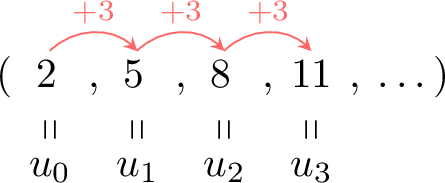
Here the sequence is indexed starting from \(n=0\): \(u_0 = 2\), \(u_1 = 5\), \(u_2 = 8\), \(u_3 = 11\), etc. We can describe the relationship between the terms using formal notation: 
- \(5 = 2\textcolor{colordef}{+3} \longrightarrow u_1 = u_0\textcolor{colordef}{+3} \longrightarrow u_{0+1} = u_0+3\)
- \(8 = 5\textcolor{colordef}{+3} \longrightarrow u_2 = u_1\textcolor{colordef}{+3} \longrightarrow u_{1+1} = u_1+3\)
- \(11 = 8\textcolor{colordef}{+3} \longrightarrow u_3 = u_2\textcolor{colordef}{+3} \longrightarrow u_{2+1} = u_2+3\)
Definition — Recursive Definition
A recursive definition of a sequence includes two parts: - The first term (or initial term), denoted for example by \(u_0\) or \(u_1\). This is the starting point.
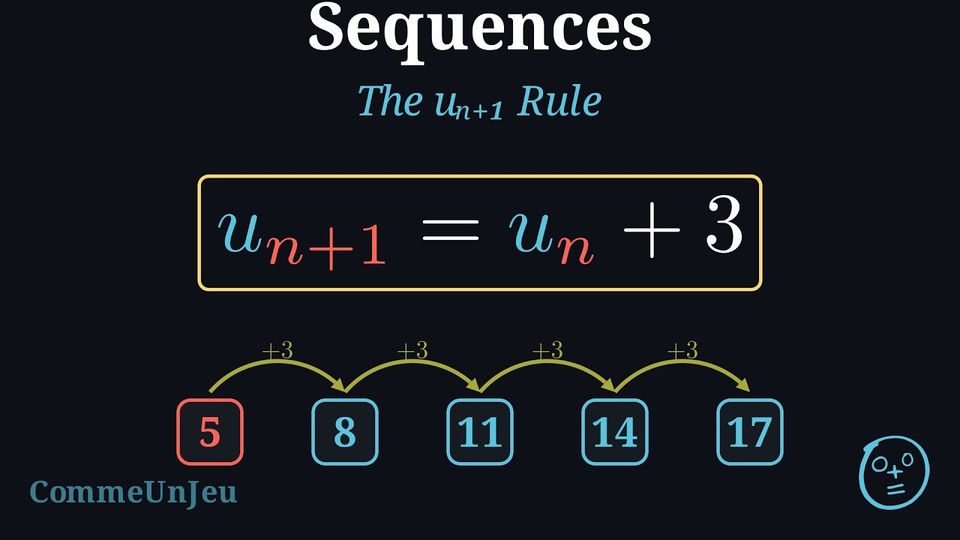
- The recursive rule (or recurrence relation), which is a formula that connects the next term, \(u_{n+1}\), to the current term, \(u_n\), for all appropriate integers \(n\) (such as \(n \ge 0\) or \(n \ge 1\)).
Example
A sequence is defined recursively by: - \(u_1 = 5\) (The first term is \(5\)).
- \(u_{n+1} = u_n + 3\) (The rule is to add \(3\) to the previous term, for all integers \(n \ge 1\)).
We build the sequence step by step using the recursive definition. $$5 \textcolor{olive}{\xrightarrow{\;+3\;}} 8 \textcolor{olive}{\xrightarrow{\;+3\;}} 11 \textcolor{olive}{\xrightarrow{\;+3\;}} 14 \textcolor{olive}{\xrightarrow{\,+3\,}} 17$$ The first five terms are: \(5, 8, 11, 14, 17\).
- 1\(^{\text{st}}\) term: The starting term is given: \(\boldsymbol{u_1 = 5}\).
- 2\(^{\text{nd}}\) term: Use the rule with \(n=1\). \(\boldsymbol{u_2} = u_1 + 3 = 5 + 3 = \textbf{8}\).
- 3\(^{\text{rd}}\) term: Use the rule with \(n=2\). \(\boldsymbol{u_3} = u_2 + 3 = 8 + 3 = \textbf{11}\).
- 4\(^{\text{th}}\) term: Use the rule with \(n=3\). \(\boldsymbol{u_4} = u_3 + 3 = 11 + 3 = \textbf{14}\).
- 5\(^{\text{th}}\) term: Use the rule with \(n=4\). \(\boldsymbol{u_5} = u_4 + 3 = 14 + 3 = \textbf{17}\).
Skills to practice
- Calculating Terms from a Recursive Rule
- Modelling Real Situations with Sequences
- Writing about Recurrence Relations
I.3
Explicit Definition
While a recursive rule tells how to get from one term to the next, it is not very efficient for finding a term far into the sequence (like the \(100^{\text{th}}\) term), because all the terms before it would have to be calculated.
An alternative and often more powerful way to define a sequence is with an explicit rule. An explicit rule is a formula that gives the value of \(u_n\) directly from the position \(n\) in the sequence. A value of \(n\) is chosen, and the rule gives \(u_n\) immediately.
An alternative and often more powerful way to define a sequence is with an explicit rule. An explicit rule is a formula that gives the value of \(u_n\) directly from the position \(n\) in the sequence. A value of \(n\) is chosen, and the rule gives \(u_n\) immediately.
Definition — Explicit Rule
An explicit rule (or explicit formula) defines the \(n\)th term of a sequence, \(u_n\), directly as a function of its position \(n\).$$u_n = f(n)$$
Note
The key advantage is that it allows us to calculate any term in the sequence directly, without first having to find all the previous terms one by one.
Example
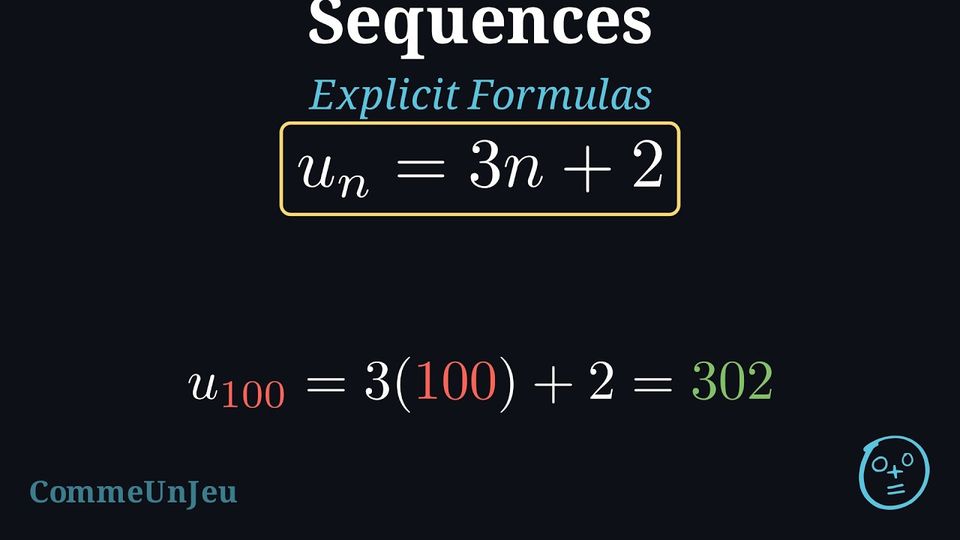
Consider the sequence defined by the explicit formula: $$u_n = 3n + 2$$ Calculate \(u_{100}\).
To find the value of \(u_{100}\), we substitute \(n = 100\) into the explicit formula: $$\begin{aligned}[t] u_{100} &= 3(100) + 2 \\
&= 300 + 2 \\
&= \boldsymbol{302} \end{aligned}$$ We did not need to know any of the previous terms in the sequence.
Skills to practice
- Calculating Terms Using an Explicit Formula
- Writing about Explicit Formulas
II
Arithmetic and Geometric Sequences
II.1
Arithmetic Sequences
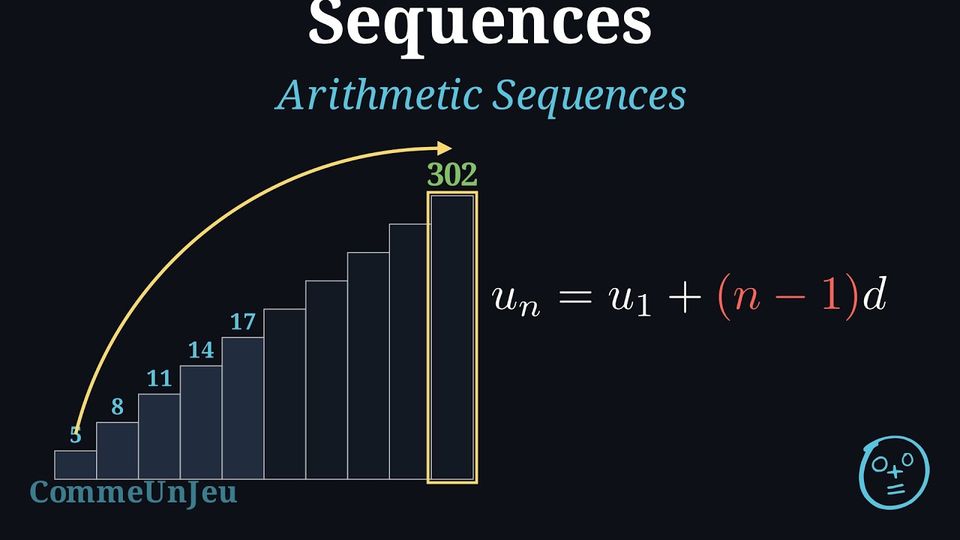
An arithmetic sequence is a fundamental type of sequence that follows a recursive rule. It is defined by a starting term and a constant change between consecutive terms.
Consider an arithmetic sequence with a first term \(u_1 = 5\) and a common difference \(d = 3\).
We can write out the first few terms by repeatedly adding 3:
We can write out the first few terms by repeatedly adding 3:
- \(u_1 = 5\)
- \(u_2 = 5 + 3\)
- \(u_3 = 5 + 3 + 3\)
- \(u_4 = 5 + 3 + 3 + 3\)
- \(u_1 = 5 + \textcolor{colordef}{0} \times 3\)
- \(u_2 = 5 + \textcolor{colordef}{1} \times 3\)
- \(u_3 = 5 + \textcolor{colordef}{2} \times 3\)
- \(u_4 = 5 + \textcolor{colordef}{3} \times 3\)
Definition — Arithmetic Sequence
An arithmetic sequence is a sequence where each term after the first is found by adding a constant value to the previous term. This constant is called the common difference, denoted by \(d\). - Recursive Definition: The rule for finding the next term from the previous one is:$$u_{n+1} = u_n + d$$
- Explicit Formula: We can also find any term directly using its position, \(n\).
- If the sequence starts with \(u_1\): $$u_n = u_1 + (n-1)d$$
- If the sequence starts with \(u_0\): $$u_n = u_0 + nd$$
Example
In an arithmetic sequence, \(u_3 = 14\) and \(u_8 = 34\). - Find the common difference \(d\) and the first term \(u_1\).
- Find the explicit formula of \(u_n\).
- At which position is the term \(98\)?
- From \(u_3\) to \(u_8\), the common difference is added \(8 - 3 = 5\) times: $$\begin{aligned}[t] u_8 &= u_3 + 5d && \text{(add } d \text{ five times)} \\ 34 &= 14 + 5d && \text{(} u_3 = 14,\ u_8 = 34\text{)} \\ 20 &= 5d && \text{(subtract } 14 \text{ from both sides)} \\ d &= 4. && \text{(divide both sides by } 5\text{)} \end{aligned}$$ From \(u_1\) to \(u_3\), the common difference is added twice: \(u_1 = u_3 - 2d = 14 - 2 \times 4 = 6\).
- With \(u_1 = 6\) and \(d = 4\): $$\begin{aligned}[t] u_n &= u_1 + (n-1)d && \text{(explicit formula)} \\ &= 6 + (n-1) \times 4 \\ &= 6 + 4n - 4 && \text{(expand)} \\ &= 4n + 2. \end{aligned}$$ Check: \(u_3 = 4 \times 3 + 2 = 14\) and \(u_8 = 4 \times 8 + 2 = 34\).
- We look for the position \(n\) such that \(u_n = 98\): $$\begin{aligned}[t] 4n + 2 &= 98 && \text{(} u_n = 4n + 2\text{)} \\ 4n &= 96 && \text{(subtract } 2 \text{ from both sides)} \\ n &= 24. && \text{(divide both sides by } 4\text{)} \end{aligned}$$ The term \(98\) is at position \(\boldsymbol{24}\): \(u_{24} = 98\).
In the arithmetic sequence \(5\), \(8\), \(11\), \(14\), \(17\), each term lies halfway between its two neighbours: \(8 = \dfrac{5 + 11}{2}\), \(11 = \dfrac{8 + 14}{2}\). This “halfway” number has a name.
Definition — Arithmetic Mean of Two Numbers
The arithmetic mean of two numbers \(a\) and \(c\) is the number \(m = \dfrac{a + c}{2}\). It is the midpoint of \(a\) and \(c\): it is at the same distance from both. Proposition — Three Consecutive Terms of an Arithmetic Sequence
Three numbers \(a\), \(b\), \(c\), in this order, are consecutive terms of an arithmetic sequence if and only if \(b\) is the arithmetic mean of \(a\) and \(c\): $$\textcolor{colorprop}{b = \dfrac{a + c}{2}}, \qquad \text{that is} \qquad b - a = c - b.$$ To decide, compare the two differences \(b - a\) and \(c - b\): equal, the three numbers are consecutive terms of an arithmetic sequence whose common difference is that value; different, they are not.
If \(a\), \(b\), \(c\) are consecutive terms of an arithmetic sequence with common difference \(d\), then \(b = a + d\) and \(c = b + d\), so \(b - a = d = c - b\); adding \(a + b\) to both sides of \(b - a = c - b\) gives \(2b = a + c\), that is \(b = \dfrac{a+c}{2}\). Conversely, if \(b - a = c - b\), call \(d\) this common value: then \(b = a + d\) and \(c = b + d\), which is the recursive rule of an arithmetic sequence of common difference \(d\) starting at \(a\).
Example
Are the following numbers, in this order, consecutive terms of an arithmetic sequence? If so, give its common difference; when a term is missing, find it. - \(3\), \(8\), \(13\)
- \(5\), \(11\), \(15\)
- \(2\), \(x\), \(20\): for which value of \(x\)?
- \(8 - 3 = 5\) and \(13 - 8 = 5\): the two differences are equal, so \(3\), \(8\), \(13\) are consecutive terms of an arithmetic sequence with common difference \(5\). Check: \(\dfrac{3 + 13}{2} = 8\).
- \(11 - 5 = 6\) and \(15 - 11 = 4\): the differences differ, so they are not.
- \(x\) must be the arithmetic mean of \(2\) and \(20\): \(x = \dfrac{2 + 20}{2} = 11\). Then \(2\), \(11\), \(20\) has common difference \(9\).
Skills to practice
- Finding the Common Difference
- Finding the Term Number in an Arithmetic Sequence
- Finding the Explicit Formula from Two Terms
- Finding the Middle Term of Three Consecutive Terms
II.2
Geometric Sequences
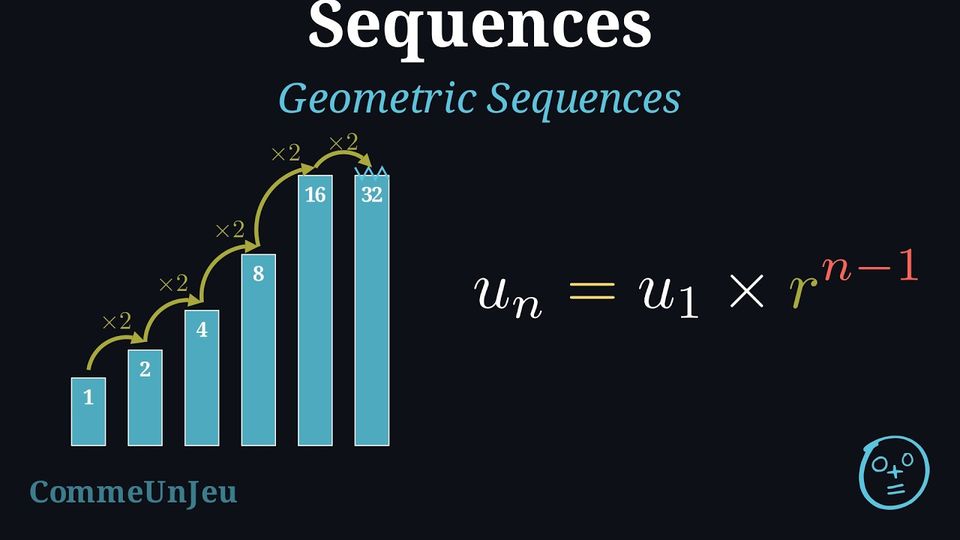
A geometric sequence is another fundamental type of sequence that follows a recursive rule. It is defined by a starting term and a constant multiplicative factor: to get from one term to the next, the term is always multiplied by the same number.
Consider a geometric sequence with a first term \(u_1 = 2\) and a common ratio \(r = 3\).
We can write out the first few terms by repeatedly multiplying by 3:
We can write out the first few terms by repeatedly multiplying by 3:
- \(u_1 = 2\)
- \(u_2 = 2 \times 3\)
- \(u_3 = 2 \times 3 \times 3\)
- \(u_4 = 2 \times 3 \times 3 \times 3\)
- \(u_1 = 2 \times 3^{\textcolor{colordef}{0}}\)
- \(u_2 = 2 \times 3^{\textcolor{colordef}{1}}\)
- \(u_3 = 2 \times 3^{\textcolor{colordef}{2}}\)
- \(u_4 = 2 \times 3^{\textcolor{colordef}{3}}\)
Definition — Geometric Sequence
A geometric sequence is a sequence where each term after the first is found by multiplying the previous term by a constant non-zero value. This constant is called the common ratio, denoted by \(r\). - Recursive Definition: The rule for finding the next term from the previous one is:$$u_{n+1} = r \times u_n $$
- Explicit Formula: We can also find any term directly using its position, \(n\).
- If the sequence starts with \(u_1\): $$u_n = u_1 \times r^{n-1}$$
- If the sequence starts with \(u_0\): $$u_n = u_0 \times r^n$$
Example
In a geometric sequence with a positive common ratio, \(u_2 = 10\) and \(u_4 = 250\). - Find the common ratio \(r\) and the first term \(u_1\).
- Find the explicit formula of \(u_n\).
- At which position is the term \(1\,250\)?
- From \(u_2\) to \(u_4\), the sequence is multiplied by the common ratio twice: $$\begin{aligned}[t] u_4 &= u_2 \times r^2 && \text{(multiply by } r \text{ twice)} \\ 250 &= 10 \times r^2 && \text{(} u_2 = 10,\ u_4 = 250\text{)} \\ r^2 &= 25. && \text{(divide both sides by } 10\text{)} \end{aligned}$$ So \(r = 5\) or \(r = -5\); the common ratio is positive, so \(r = 5\). From \(u_1\) to \(u_2\), the sequence is multiplied by \(r\) once: \(u_1 = \dfrac{u_2}{r} = \dfrac{10}{5} = 2\).
- With \(u_1 = 2\) and \(r = 5\): $$\begin{aligned}[t] u_n &= u_1 \times r^{n-1} && \text{(explicit formula)} \\ &= 2 \times 5^{n-1}. \end{aligned}$$ Check: \(u_2 = 2 \times 5 = 10\) and \(u_4 = 2 \times 5^3 = 250\).
- We look for the position \(n\) such that \(u_n = 1\,250\): $$\begin{aligned}[t] 2 \times 5^{n-1} &= 1\,250 && \text{(} u_n = 2 \times 5^{n-1}\text{)} \\ 5^{n-1} &= 625 && \text{(divide both sides by } 2\text{)} \\ 5^{n-1} &= 5^4 && \text{(} 625 = 5 \times 5 \times 5 \times 5\text{)} \\ n - 1 &= 4 && \text{(same base, so same exponent)} \\ n &= 5. \end{aligned}$$ The term \(1\,250\) is at position \(\boldsymbol{5}\): \(u_5 = 2 \times 5^4 = 2 \times 625 = 1\,250\).
Example
A geometric sequence has a first term \(u_1 = 2\) and a common ratio \(r = 2\).Find the first five terms of this sequence.
The recursive rule is \(u_{n+1} = u_n \times 2\). We start with \(u_1 = 2\) and apply the rule repeatedly.
- \(u_1 = \boldsymbol{2}\) (given)
- \(u_2 = 2 \times u_1 = 2 \times 2 = \boldsymbol{4}\)
- \(u_3 = 2 \times u_2 = 2 \times 4 = \boldsymbol{8}\)
- \(u_4 = 2 \times u_3 = 2 \times 8 = \boldsymbol{16}\)
- \(u_5 = 2 \times u_4 = 2 \times 16 = \boldsymbol{32}\)
In \(2\), \(4\), \(8\), \(16\), \(32\) above, a term is no longer halfway between its neighbours (\(4 \neq \dfrac{2 + 8}{2} = 5\)), but its square is their product: \(4^2 = 2 \times 8\). This is the other mean.
Definition — Geometric Mean of Two Positive Numbers
The geometric mean of two positive numbers \(a\) and \(c\) is the positive number \(g = \sqrt{a \times c}\): the number whose square is the product \(ac\). For instance, the geometric mean of \(4\) and \(25\) is \(\sqrt{100} = 10\), while their arithmetic mean is \(14.5\). Proposition — Three Consecutive Terms of a Geometric Sequence
Three positive numbers \(a\), \(b\), \(c\), in this order, are consecutive terms of a geometric sequence if and only if \(b\) is the geometric mean of \(a\) and \(c\): $$\textcolor{colorprop}{b = \sqrt{a \times c}}, \qquad \text{that is} \qquad b^2 = a \times c, \qquad \text{or again} \qquad \dfrac{b}{a} = \dfrac{c}{b}.$$ To decide, compare the two quotients \(\dfrac{b}{a}\) and \(\dfrac{c}{b}\): equal, the three numbers are consecutive terms of a geometric sequence whose common ratio is that value; different, they are not.
If \(a\), \(b\), \(c\) are consecutive terms of a geometric sequence with common ratio \(r\), then \(b = ra\) and \(c = rb\), so \(\dfrac{b}{a} = r = \dfrac{c}{b}\); the cross products of \(\dfrac{b}{a} = \dfrac{c}{b}\) give \(b^2 = ac\), and since \(b\) is positive, \(b = \sqrt{ac}\). Conversely, if \(\dfrac{b}{a} = \dfrac{c}{b}\), call \(r\) this common value: then \(b = ra\) and \(c = rb\), the recursive rule of a geometric sequence of common ratio \(r\) starting at \(a\).
Example
Are the following positive numbers, in this order, consecutive terms of a geometric sequence? If so, give its common ratio; when a term is missing, find it. - \(4\), \(10\), \(25\)
- \(2\), \(6\), \(20\)
- \(9\), \(x\), \(16\): for which positive value of \(x\)?
- \(\dfrac{10}{4} = 2.5\) and \(\dfrac{25}{10} = 2.5\): the two quotients are equal, so \(4\), \(10\), \(25\) are consecutive terms of a geometric sequence with common ratio \(2.5\). Check: \(10^2 = 100 = 4 \times 25\).
- \(\dfrac{6}{2} = 3\) and \(\dfrac{20}{6} \approx 3.33\): the quotients differ, so they are not.
- \(x\) must be the geometric mean of \(9\) and \(16\): \(x = \sqrt{9 \times 16} = \sqrt{144} = 12\). Then \(9\), \(12\), \(16\) has common ratio \(\dfrac{12}{9} = \dfrac{4}{3}\).
Skills to practice
- Finding the Common Ratio
- Finding the Term Number in a Geometric Sequence
- Finding the Explicit Formula from Two Terms
- Finding the Middle Term of Three Consecutive Terms
- Proving that Three Numbers Are Consecutive Terms
III
Sequences in Finance
III.1
Percentage Change as a Geometric Sequence
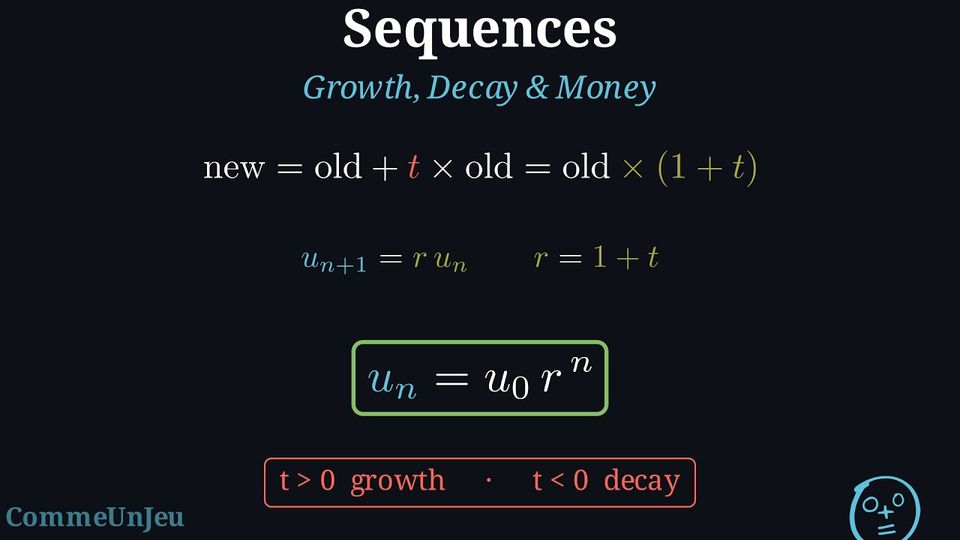
A sum of money is invested at a fixed rate of \(3\pourcent\) a year: each year the interest is added to the account, and then itself earns interest the next year (compound interest). Why is such a situation modelled by a geometric sequence? Each year the amount is not increased by a fixed sum, but by a fixed fraction of itself:$$\text{new amount} = \text{old amount} + \frac{3}{100} \times \text{old amount} = \text{old amount} \times 1.03.$$ So from one year to the next we multiply by the same factor \(1.03\). That is exactly the recurrence of a geometric sequence, \(u_{n+1} = 1.03\,u_n\), whose explicit form is \(u_n = u_0 \times 1.03^n\). The same reasoning covers any constant percentage change of \(t\pourcent\) per period, whose factor is \(1 + \dfrac{t}{100}\) — a population growing at a steady rate, a car losing value each year.
Method — Modelling a Constant Percentage Change
For a quantity changing by a fixed rate of \(t\pourcent\) each period, starting from \(u_0\): - The rate \(t\) is signed: \(t > 0\) for a growth, \(-100 < t < 0\) for a decay (a decrease by \(100\pourcent\) or more is not a percentage change of a positive quantity).
- In every case the common ratio is the multiplier \(\;r = 1 + \dfrac{t}{100}\): \(+5\pourcent\) gives \(t = 5\) and \(r = 1.05\); \(-15\pourcent\) gives \(t = -15\) and \(r = 1 + \dfrac{-15}{100} = 0.85\).
- After \(n\) periods: \(\;u_n = u_0\, r^n\).
Example — Compound interest
An amount of \(\dollar 1000\) is invested at a fixed annual interest rate of \(5\pourcent\). What is its value after \(3\) years?
Each year the balance is multiplied by \(1 + 0.05 = 1.05\), so the yearly amounts form a geometric sequence:$$\begin{aligned}[t] u_1 &= 1000 \times 1.05 \\
u_2 &= (1000 \times 1.05) \times 1.05 = 1000 \times 1.05^2 \\
u_3 &= 1000 \times 1.05^3. \end{aligned}$$ Hence \(u_n = u_0\, r^n\) with \(u_0 = 1000\) and \(r = 1.05\), and$$u_3 = 1000 \times 1.05^3 = 1000 \times 1.157625 \approx \dollar 1157.63.$$
Example — Depreciation
A car bought for \(\dollar 20\,000\) loses \(15\pourcent\) of its value each year. What is its value after \(4\) years?
The value decays by \(15\pourcent\) each year, so \(t = -15\) and the multiplier is \(r = 1 + \dfrac{t}{100} = 1 + \dfrac{-15}{100} = 0.85\), giving \(u_n = 20\,000 \times 0.85^n\).$$u_4 = 20\,000 \times 0.85^4 = 20\,000 \times 0.52200625 \approx \dollar 10\,440.13.$$
Skills to practice
- Modelling Growth and Decay with Sequences
III.2
Compound Interest per Period
Proposition — Annual Compound Interest Formula
The final amount \(A\) of an investment with interest compounded annually is: $$A = P (1 + r)^t$$ where: - \(P\) is the principal (initial amount),
- \(r\) is the annual interest rate (as a decimal),
- \(t\) is the time (in years).
A bank pays \(5\pourcent\) per year on \(\dollar 1\,000\), and adds the interest to the account every quarter. How much is in the account after \(2\) years?
Compound interest can be calculated more frequently than once a year, such as monthly or quarterly. In such cases:
Compound interest can be calculated more frequently than once a year, such as monthly or quarterly. In such cases:
- the annual interest rate is divided by the number of compounding periods per year;
- the exponent (time) is multiplied by the number of compounding periods.
Proposition — Compound Interest Formula per Period
The final amount \(A\) after \(t\) years with interest compounded \(c_y\) times per year is: $$A = P \left(1 + \frac{r}{c_y}\right)^{c_y t}$$ where: - \(P\) is the principal,
- \(r\) is the annual interest rate (as a decimal),
- \(c_y\) is the number of compounding periods per year,
- \(t\) is the time in years.
With \(c_y = 1\) this is \(A = P(1 + r)^t\): the amounts from one year to the next form a geometric sequence whose common ratio is the multiplier \(1 + r\) (here \(r\) is the rate as a decimal, and \(t\) the number of years).
Example
Calculate the final amount on a principal of \(\dollar 1\,000\) at an annual rate of \(5\pourcent\) compounded quarterly over \(2\) years.
$$\begin{aligned}[t] A &= 1\,000 \left(1 + \frac{0.05}{4}\right)^{4 \times 2} \\
&= 1\,000 \left(1 + 0.0125\right)^{8} \\
&= 1\,000 \times (1.0125)^8 \\
&\approx \dollar 1\,104.49 \end{aligned}$$ The final amount is approximately \(\dollar 1\,104.49\).
Skills to practice
- Finding the Total Amount
- Finding the Number of Compounding Periods
III.3
Using a Financial Solver
Method — Finding Any Value Using a TVM Solver
The TVM Solver (Time Value of Money) can be used to find any unknown variable if all the other variables are given. - \(PV\) is the principal (present value), considered as an outgoing cash flow, and is entered as a negative value (\(PV = -P\)).
- \(FV\) represents the final amount (\(FV = A\)).
- \(I\pourcent\) is the annual interest rate \(r\) expressed as a percentage (for a rate of \(5\pourcent\), \(I\pourcent = 5\)).
- \(C/Y\) is the number of compounding periods per year (\(C/Y = c_y\)).
- \(N\) is the total number of compounding periods, not the number of years (\(N = c_y \times t\)).
- \(PMT\) and \(P/Y\) are not used in this case. We set \(PMT = 0\) and \(P/Y = C/Y\).
Example
Find the final amount on a principal of \(\dollar 23\,000\) at a rate of \(3.45\pourcent\) per year over \(6\) years compounded quarterly.
Using the TVM Solver with: $$N = 6 \times 4 = 24,\quad I\pourcent = 3.45,\quad PV = -23\,000,\quad C/Y = 4,\quad (PMT = 0,\ P/Y = 4)$$ we find the final amount: $$FV \approx \dollar 28\,264.50$$
Skills to practice
- Comparing Investments and Compounding Periods
- Finding the Final Amount with the Solver
- Finding the Principal with the Solver
IV
Going further
Skills to practice
- Explaining and Diagnosing
- Solving Problems
- Investigating Patterns in Sequences
- Quiz
Jump to section