International Baccalaureate · MYP 1
Volume, Capacity and Mass
I
Comparing Volumes
Hugo and Zoe each build a solid with the same small cubes. Hugo's tower is taller, so he claims that it takes up more space. Zoe is not convinced: she counts the cubes. 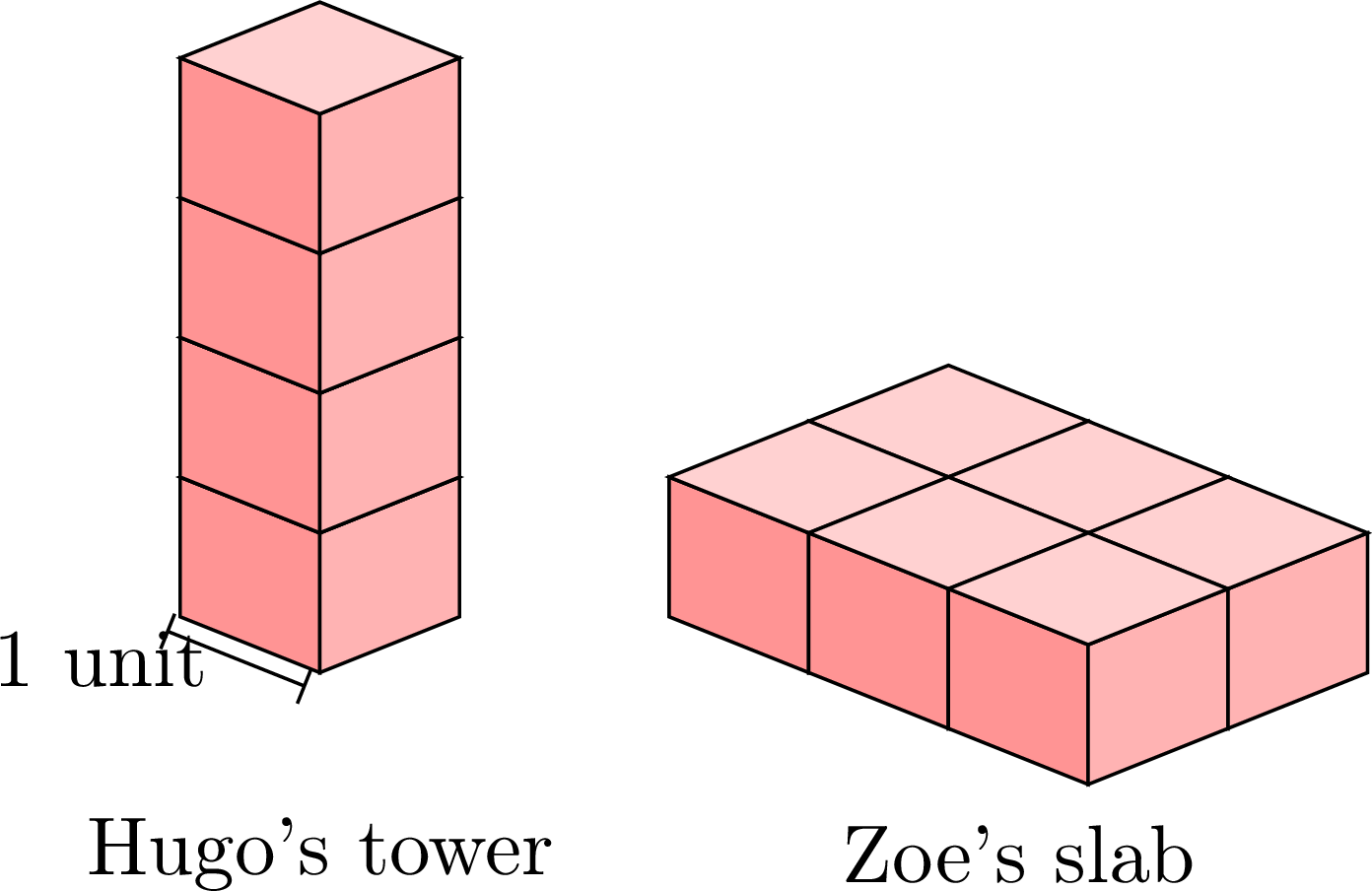
Hugo's tower is made of \(4\) cubes; Zoe's slab of \(6\) cubes. With identical cubes, the solid made of more cubes takes up more space: the slab has the greater volume, even though it is lower. The height alone does not decide the volume: the cubes have to be counted.
Method — Comparing Volumes by Counting
To compare the volumes of two solids made of identical cubes: - take the small cube as the unit of volume and count the cubes of each solid — including the cubes hidden by the others on the drawing;
- compare the two numbers: the solid made of more cubes has the greater volume;
- two solids made of the same number of cubes have the same volume, even if their shapes are different.
Example
Compare the volumes of the three solids below, made of identical cubes. 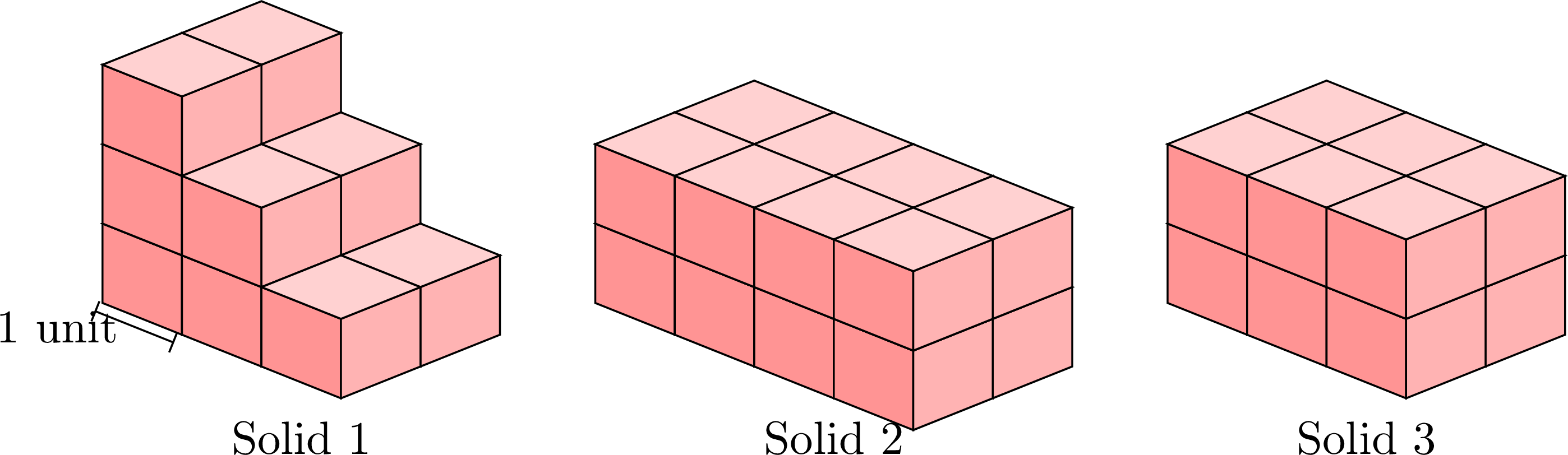
Count layer by layer, without forgetting the hidden cubes.
- Solid 1: \(6\) cubes at the bottom, \(4\) in the middle, \(2\) at the top: \(6+4+2=12\) cubic units.
- Solid 2: two identical layers of \(8\) cubes: \(8+8=16\) cubic units.
- Solid 3: two identical layers of \(6\) cubes: \(6+6=12\) cubic units.
Skills to practice
- Judging a Comparison of Volumes
II
Determining a Volume by Counting
Hugo and Zoe measure the volume of the same small box by filling it with cubes. Hugo uses his building blocks and counts \(12\) of them; Zoe uses smaller cubes and counts \(96\). Who is correct?
Both are: the box has not changed, but the unit has. To agree, everyone must use the same cube, a standard unit. The unit of volume of reference is the cubic centimetre, written cm\(^3\): the volume of a cube of edge \(1\) cm. For large volumes, the cubic metre, written m\(^3\), is used.
Both are: the box has not changed, but the unit has. To agree, everyone must use the same cube, a standard unit. The unit of volume of reference is the cubic centimetre, written cm\(^3\): the volume of a cube of edge \(1\) cm. For large volumes, the cubic metre, written m\(^3\), is used.
A small box is \(4\) cm long, \(3\) cm wide and \(2\) cm high on the inside. How many cubes of edge \(1\) cm can it hold? Each of these cubes has a volume of \(1\) cm\(^3\): the answer gives the volume of the inside of the box. 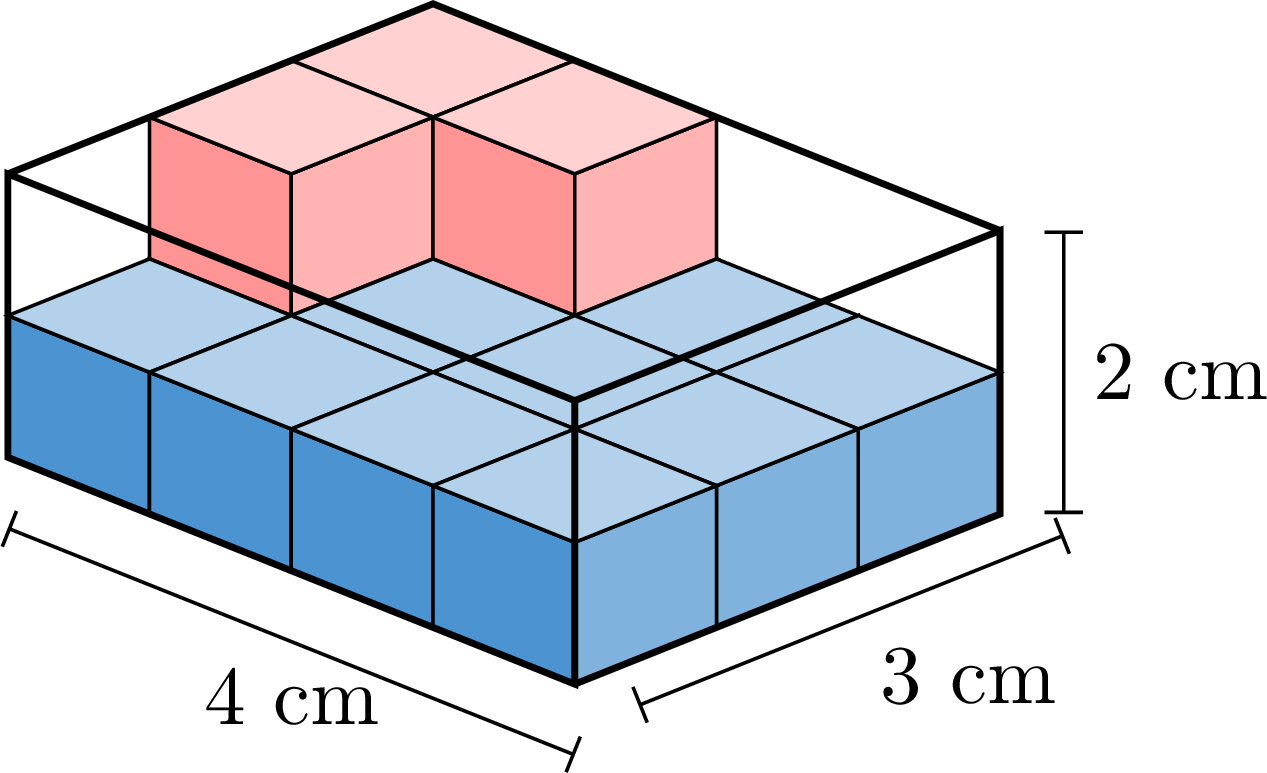
The bottom of the box is covered by \(3\) rows of \(4\) blue cubes: \(4 \times 3 = 12\) cubes make one layer. The box is \(2\) cm high, so a second layer (started in red) fits on top: \(2\) layers in all. In total: \(12 + 12 = 12 \times 2 = 24\) cubes. The inside of the box has a volume of \(24\) cm\(^3\).
There is no need to count the cubes one by one: one layer, then the number of layers, are enough.
There is no need to count the cubes one by one: one layer, then the number of layers, are enough.
Method — Counting Layer by Layer
To determine the volume of a solid made of identical cubes: - choose the unit: the small cube. If its edge is \(1\) cm, its volume is \(1\) cm\(^3\);
- count the cubes of one layer;
- count the number of layers;
- if all the layers are identical (a box, a rectangular prism), multiply: $$\text{volume} = \text{cubes in one layer} \times \text{number of layers};$$ otherwise, add the layers one after the other.
Example
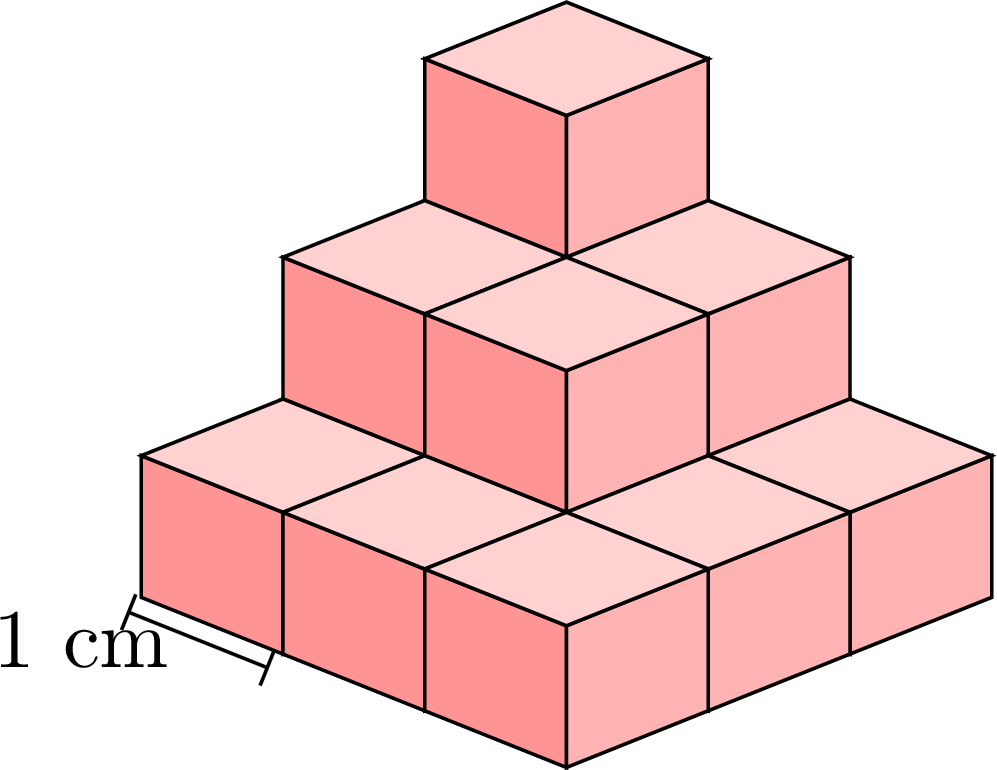
Determine the volume of each solid, made of cubes of edge \(1\) cm. 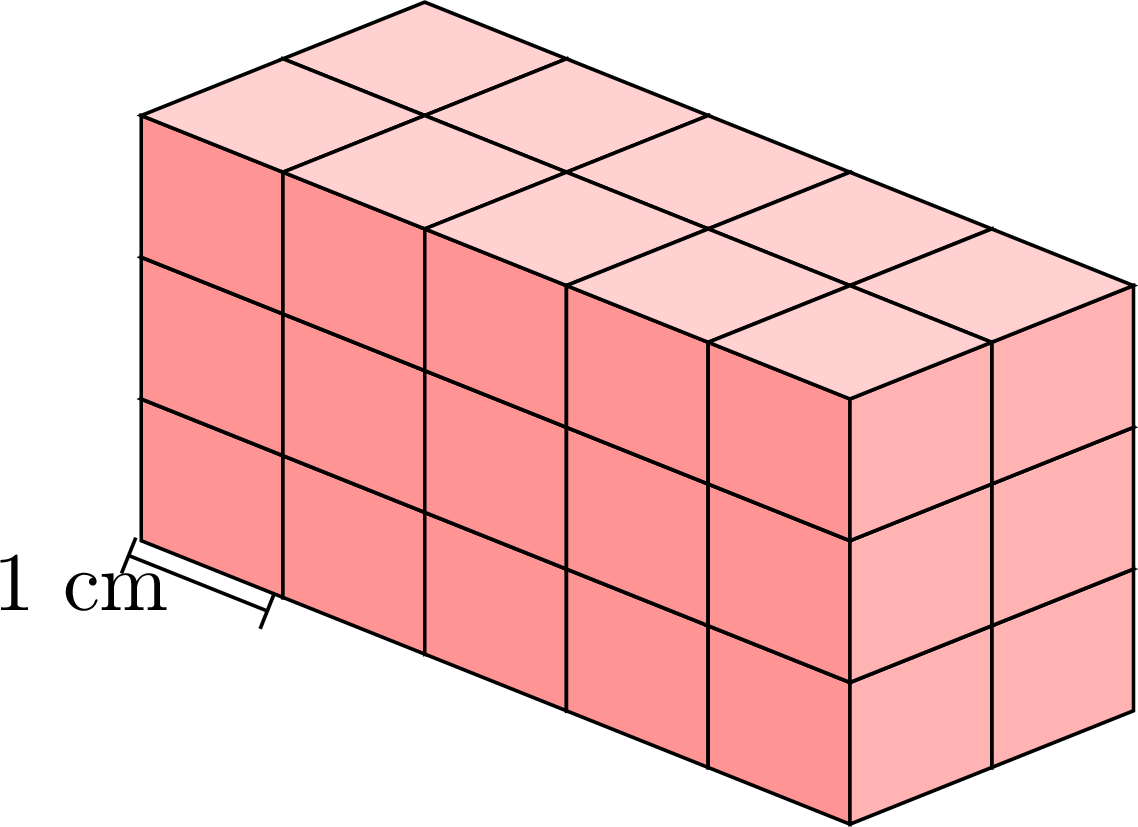
- The solid is a rectangular prism: all its layers are identical. One layer has \(2\) rows of \(5\) cubes: \(5 \times 2 = 10\) cubes. There are \(3\) layers: $$V = 10 \times 3 = 30\ \text{cm}^3.$$
- The layers are different, so they are added: the bottom layer is a square of \(3\) rows of \(3\) cubes, \(3 \times 3 = 9\) cubes (\(4\) of them, under the middle layer, are hidden on the drawing; the other \(5\) can be seen), the middle one \(2 \times 2 = 4\) cubes, the top one \(1\) cube: $$V = 9 + 4 + 1 = 14\ \text{cm}^3.$$
Proposition — Volume of a Rectangular Prism
The volume of a rectangular prism (also called a cuboid) is found by multiplying its length, width, and height: $$\text{Volume} = \textcolor{colordef}{\text{length}} \times \textcolor{colorprop}{\text{width}} \times \textcolor{olive}{\text{height}}$$ $$V = \textcolor{colordef}{l} \times \textcolor{colorprop}{w} \times \textcolor{olive}{h}$$ 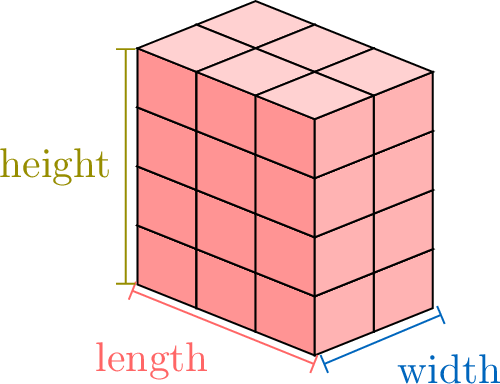
Skills to practice
- Comparing and Counting Layer by Layer
- Filling a Box
III
Using the Kilolitre
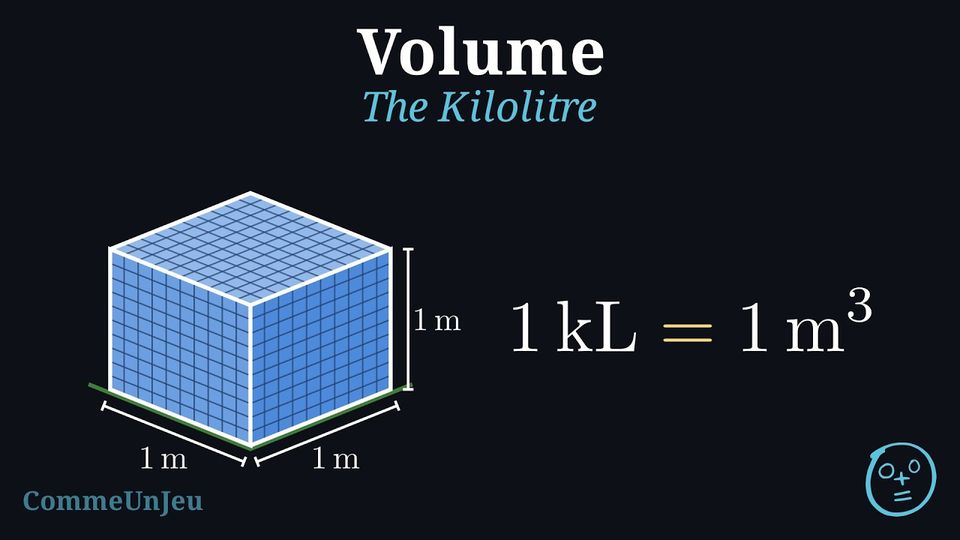
The Kilolitre
For very large capacities — a swimming pool, a water tower, the water a family uses in a year — we use the kilolitre (\(\mathrm{kL}\)): $$1 \,\text{kL} = 1\,000 \,\text{L}.$$ A cube of edge \(1\) m holds \(10 \times 10 \times 10 = 1\,000\) cubes of edge \(10\) cm, and each of them holds \(1\) L: so \(1 \,\text{m}^3 = 1\,000 \,\text{L}\), and one kilolitre is one cubic metre: \(1 \,\text{kL} = 1 \,\text{m}^3\). Water bills count the water used in kilolitres or in cubic metres: both give the same number.
Example
A swimming pool holds \(375\) kL of water. Convert this capacity to litres, then to cubic metres.
$$\begin{aligned} 375 \,\text{kL} &= 375 \times 1\,000 \,\text{L} &&\text{(}1 \,\text{kL} = 1\,000 \,\text{L)}\\
&= \textbf{375\,000 L} \end{aligned}$$ Since \(1 \,\text{kL} = 1 \,\text{m}^3\), the pool holds \(\textbf{375 m}^{\textbf{3}}\) of water.
Skills to practice
- Converting with Kilolitres
IV
Solving Mass Problems
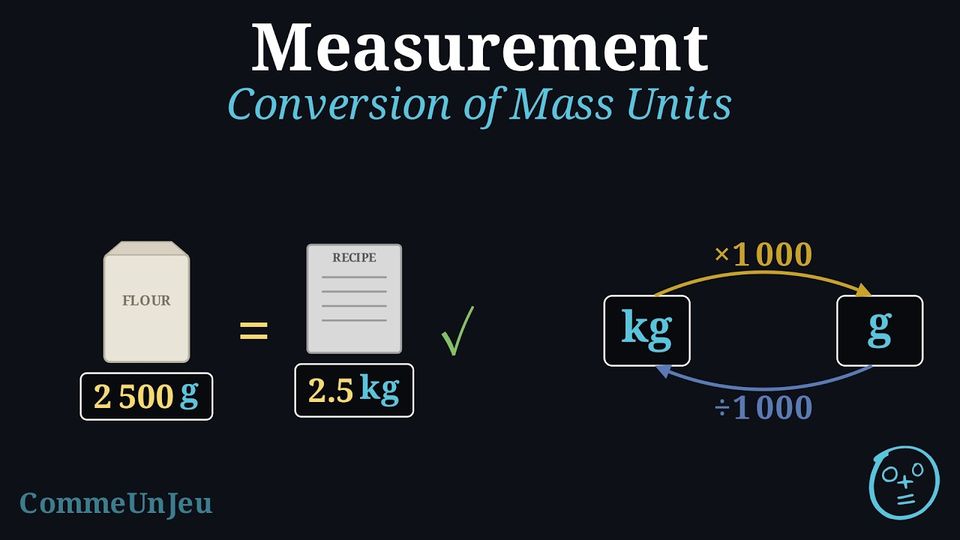
Method — Converting Using Multiplication or Division
- Use multiplication to go from a bigger unit to a smaller one (like tonnes to kilograms, kilograms to grams, or grams to milligrams).
- Use division to go from a smaller unit to a bigger one (like milligrams to grams, grams to kilograms, or kilograms to tonnes).
- Each step to the right in the diagram means “\(\times 1\,000\)”. Each step to the left means “\(\div 1\,000\)”.

Skills to practice
- Solving Mass Problems in Several Steps
V
Going further
Skills to practice
- Solving Volume and Capacity Problems
- Investigating Volume Patterns
- Quiz
Jump to section