International Baccalaureate · MYP 5 Extended
Vectors
I
Vectors and Their Components
I.1
Vectors
A cable car moves along a cable from A to B: 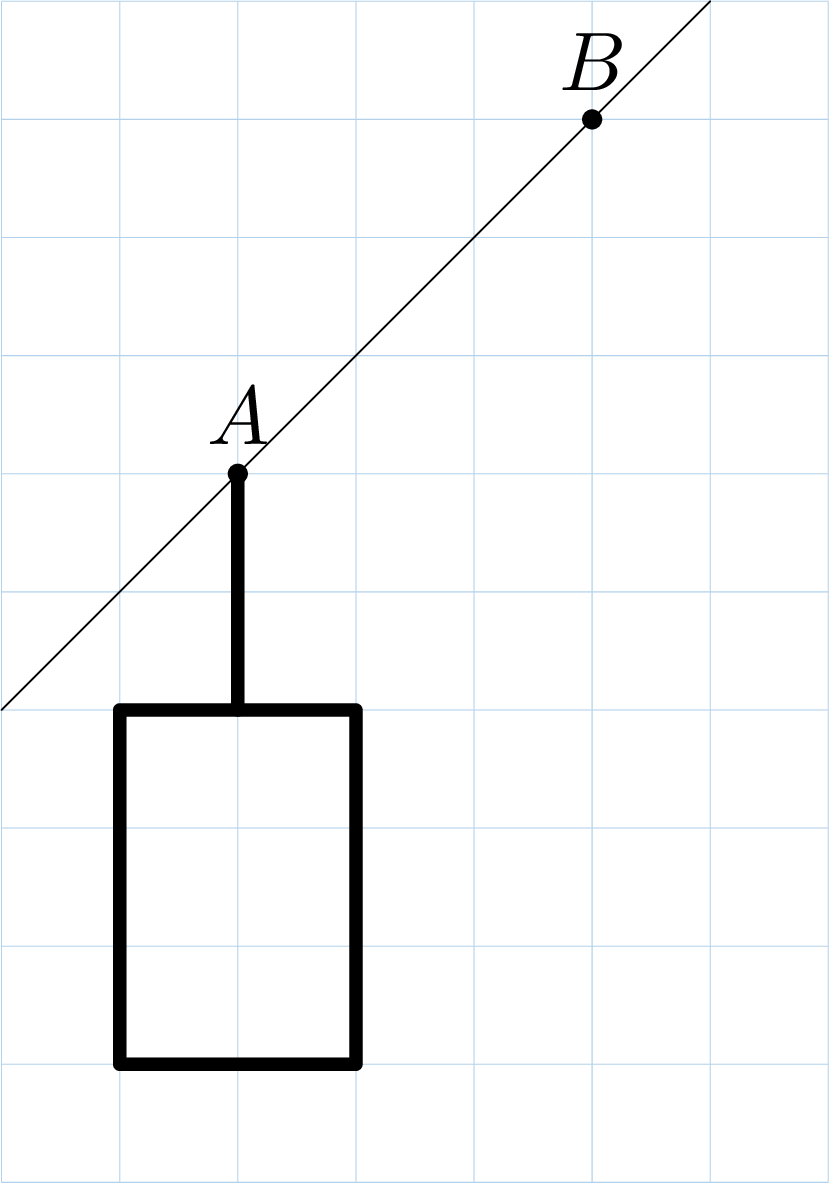
Draw the cable car when it arrives at B.
The cable car's move can be read on the grid: \(3\) squares to the right and \(3\) squares up. Two numbers are enough to describe the whole displacement — and the arrow from \(A\) to \(B\) gathers them into a single object: a vector. 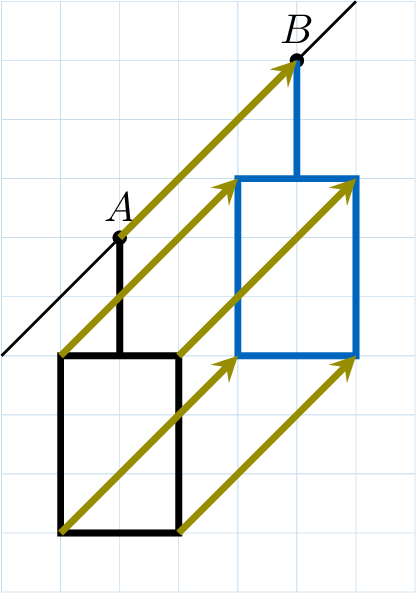
Moving a figure by translation means sliding the figure without rotating it. To describe this movement, we use an arrow \(\vec{u}\) called a vector: every point of the figure slides along the same direction, in the same sense, by the same length — the ones given by the arrow.
Definition — Vector
A non-zero vector \(\vec{u}\) is defined geometrically by a direction, a sense (orientation along that direction) and a magnitude (length). 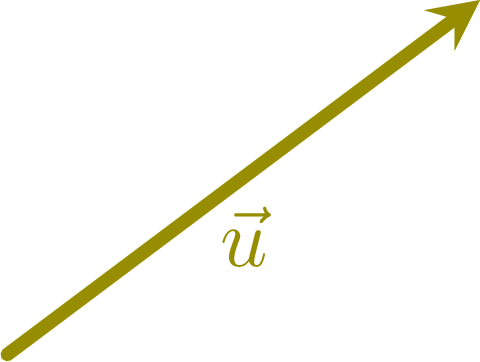
Example
Describe the vector \(\vec{w}\) drawn below: give its direction, its sense and its length. 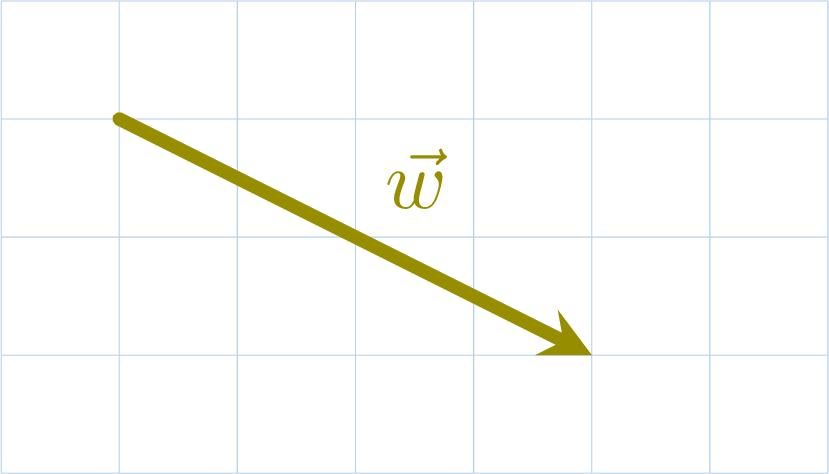
The vector \(\vec{w}\) has an oblique direction (the line it sits on), its sense is towards the bottom right, and its length is the length of the arrow — located by its moves on the grid: \(4\) squares to the right and \(2\) squares down (with Pythagoras' theorem, \(\sqrt{4^2 + 2^2} \approx 4.5\) squares). Any arrow with these three features represents the same vector \(\vec{w}\).
Definition — Vector Components
A vector \(\vec{u}\) can also be defined algebraically, as an ordered pair of components \(\begin{pmatrix} \textcolor{colordef}{x-\text{step}}\\\textcolor{colorprop}{y-\text{step}}\end{pmatrix}\): how many units to the right or left, and how many units up or down. 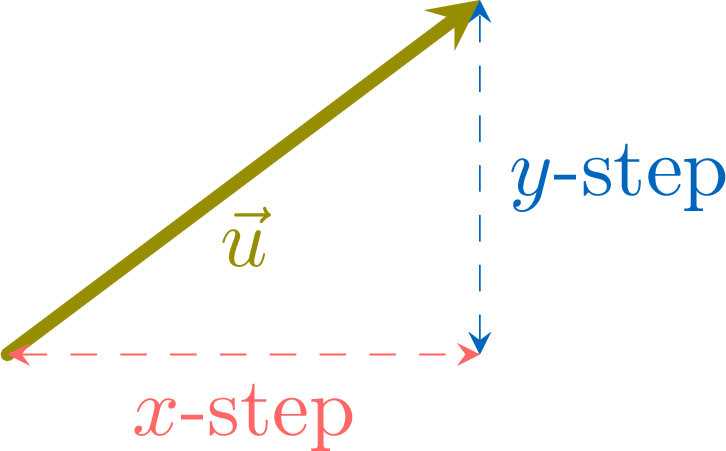
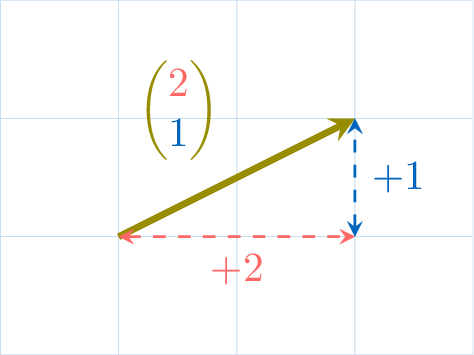
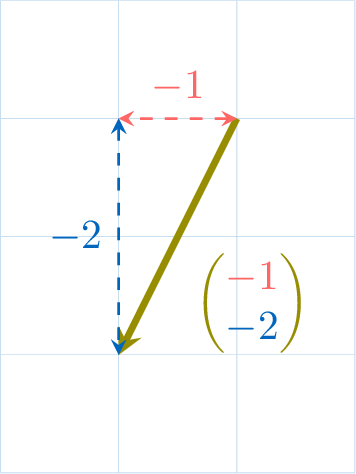
- The \(x\)-step is positive if the movement is to the right and negative if to the left.
- The \(y\)-step is positive if the movement is upwards and negative if downwards.
Example
 \(\quad\quad\quad\)
Skills to practice
- Identifying Vectors
- Finding the Components of a Vector
I.2
Two-Point Notation
Definition — Two-Point Notation
The notation \(\Vect{AB}\) names the vector with origin \(A\) and endpoint \(B\): the arrow that starts at \(A\) and ends at \(B\). 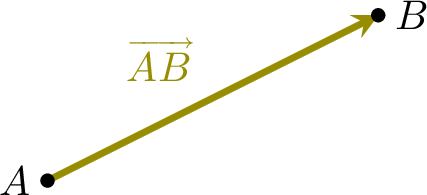
Proposition — Components of \(\Vect{AB}\)
Let \(A(x_A,\,y_A)\) and \(B(x_B,\,y_B)\) be two points. The components of the vector \(\Vect{AB}\) are:$$\Vect{AB} = \begin{pmatrix}x_B - x_A \\
y_B - y_A\end{pmatrix}$$ The components \(x_B - x_A\) and \(y_B - y_A\) are exactly the \(x\)-step and \(y\)-step from \(A\) to \(B\). 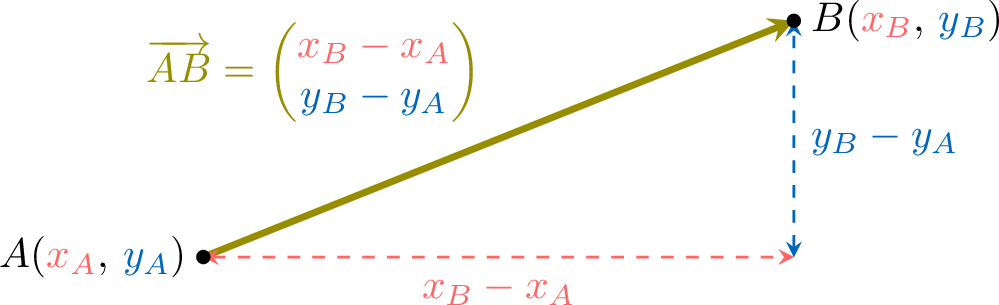
Displacement Vector and Position Vector
Two names borrowed from physics make the two roles of a vector visible. 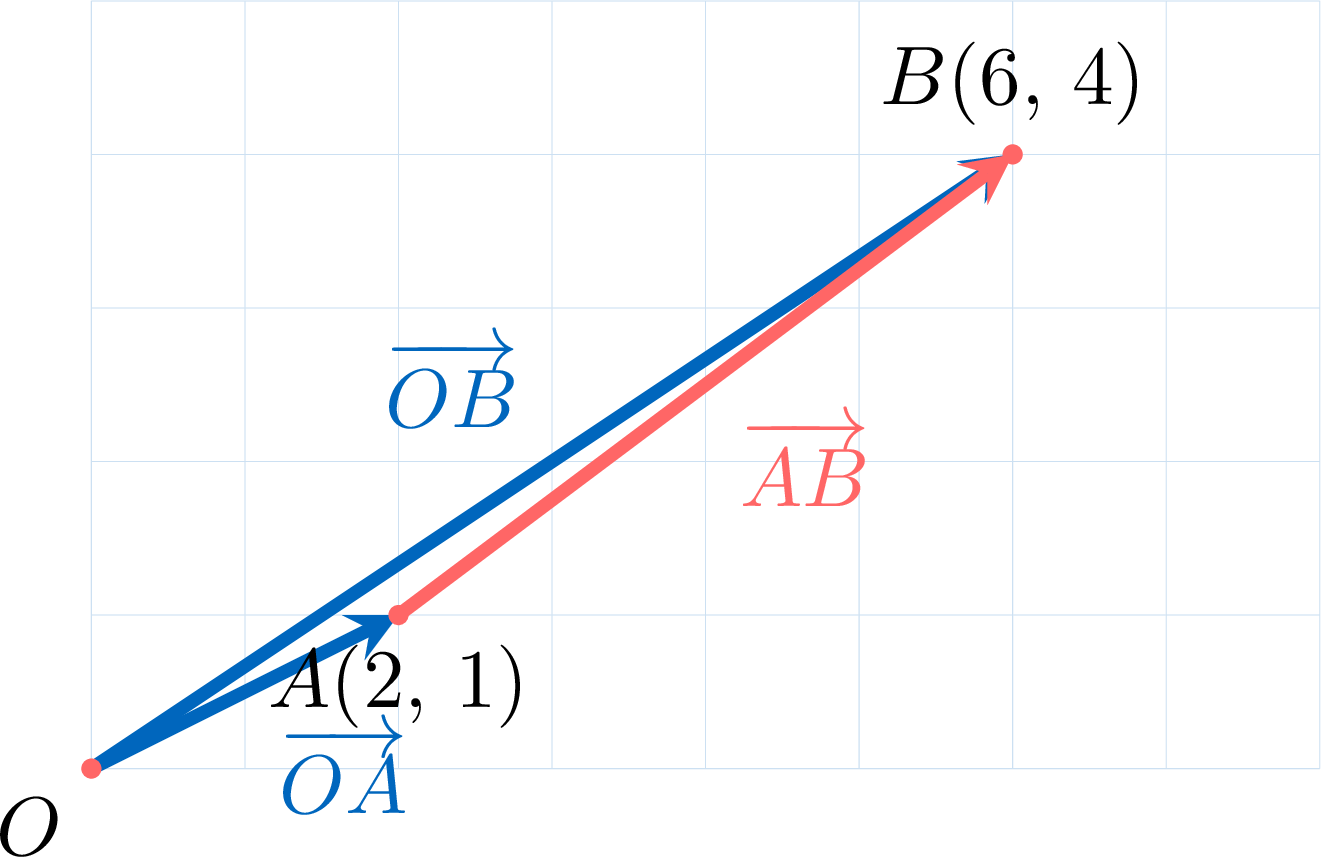
On the figure, \(\Vect{OA}\begin{pmatrix} 2 \\ 1 \end{pmatrix}\) and \(\Vect{OB}\begin{pmatrix} 6 \\ 4 \end{pmatrix}\) are the position vectors of \(A\) and \(B\), and \(\Vect{AB}\begin{pmatrix} 6 - 2 \\ 4 - 1 \end{pmatrix} = \begin{pmatrix} 4 \\ 3 \end{pmatrix}\) is the displacement from \(A\) to \(B\).
- The vector \(\Vect{AB}\) can be called the displacement vector from \(A\) to \(B\): it records the move from \(A\) to \(B\) — its coordinates \(x_B - x_A\) and \(y_B - y_A\) are the horizontal and the vertical steps of that move. Two moves with the same steps, from different starting points, are the same displacement: the same vector.
- Once an origin \(O\) is chosen, the vector \(\Vect{OM}\) can be called the position vector of the point \(M\) (relative to \(O\)). Its coordinates are \(x_M - 0 = x_M\) and \(y_M - 0 = y_M\): the coordinates of the position vector are the coordinates of the point. A point is thus located by one vector, and the displacement from \(A\) to \(B\) is read from the two position vectors: the coordinates of \(\Vect{AB}\) are those of \(\Vect{OB}\) minus those of \(\Vect{OA}\).
Skills to practice
- Calculating the Components of a Vector from Two Points
I.3
Equal Vectors
Two vectors are said to be equal if they represent the same translation.
Definition — Geometric Equality of Vectors
Two non-zero vectors are equal if they have: - the same direction (parallel lines),
- the same sense (same orientation),
- and the same magnitude (same length).
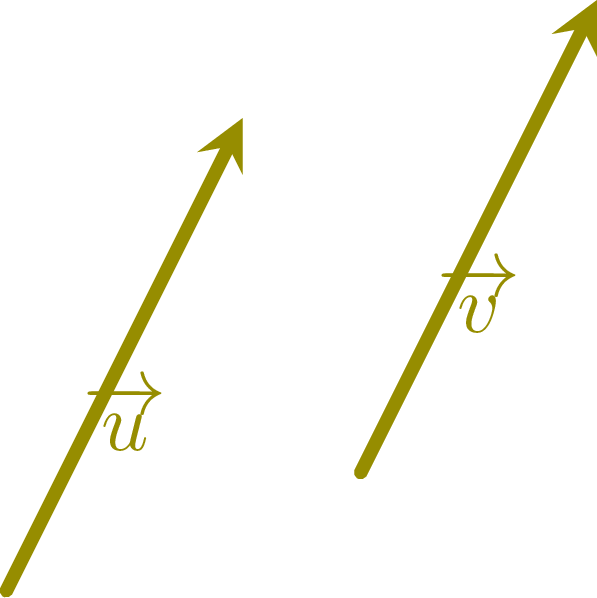
\(\textcolor{olive}{\Vect{u}} = \textcolor{olive}{\Vect{v}}\)
Definition — Algebraic Equality of Vectors
Two vectors \(\begin{pmatrix}x\\y\end{pmatrix}\) and \(\begin{pmatrix}x'\\y'\end{pmatrix}\) are equal if and only if \(x = x'\) and \(y = y'\). Proposition — Parallelogram criterion
Two vectors \(\Vect{AB}\) and \(\Vect{DC}\) are equal if and only if \(ABCD\) is a parallelogram (possibly flattened). 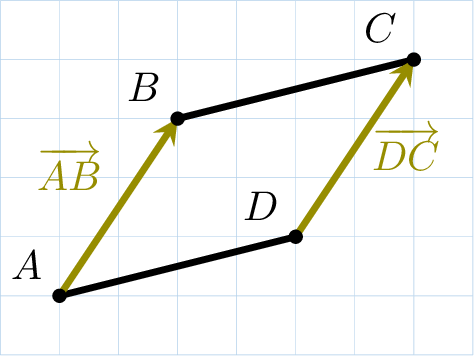
Skills to practice
- Finding a Point from a Vector
- Constructing a Parallelogram
II
Operations on Vectors
II.1
Addition of Vectors
Suppose we translate the point \(A\) to \(B\), then we translate the point \(B\) to \(C\). What single move replaces the two? 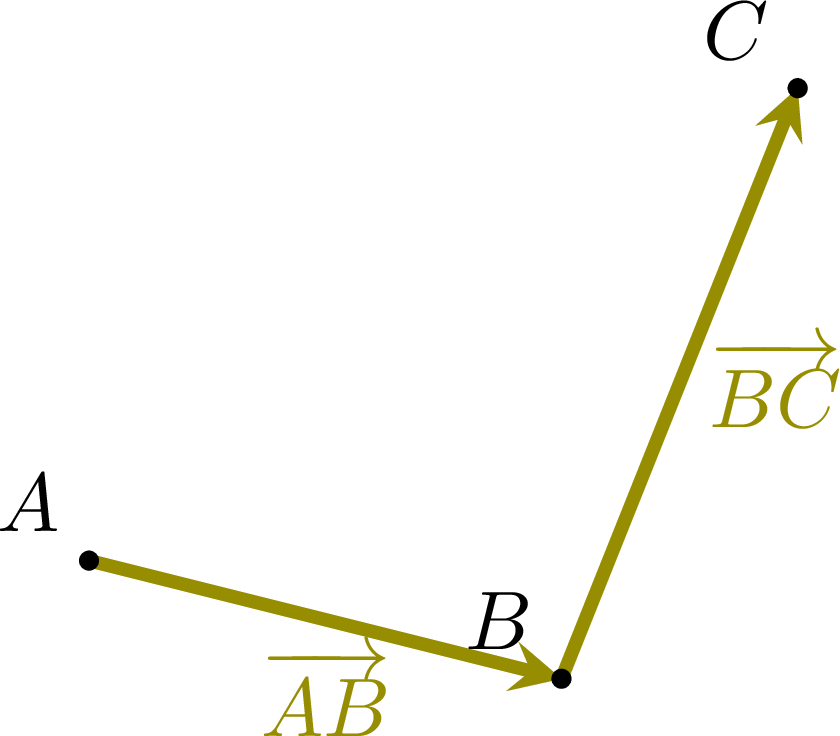
Translating the point \(A\) directly to \(C\) gives the same result. In vector terms, this is written as the sum \(\Vect{AB}+\Vect{BC}=\Vect{AC}\), where the \(+\) symbol can be read as “followed by”. 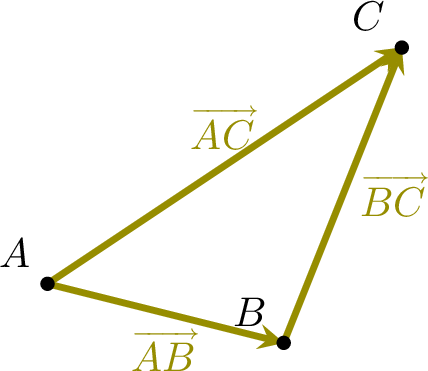
Definition — Vector Addition
The sum of two vectors \(\vec{u}\) and \(\vec{v}\), written \(\vec{u} + \vec{v}\), is the vector corresponding to performing the translation by \(\vec{u}\) followed by the translation by \(\vec{v}\). 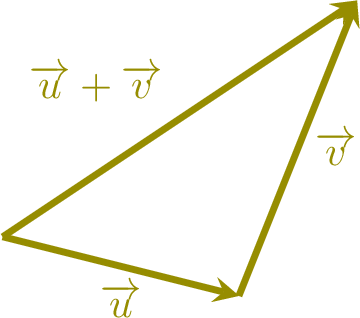
The geometric operations on vectors — sum, opposite, difference, multiplication by a real number — can all be carried out directly on the coordinates: each rule below computes, coordinate by coordinate, the vector that the geometric construction would produce.
Definition — Algebraic Vector Addition
$$\begin{pmatrix}x\\
y\end{pmatrix}+\begin{pmatrix}x'\\
y'\end{pmatrix}=\begin{pmatrix}x+x'\\
y +y' \\
\end{pmatrix}$$ Proposition — Chasles' Relation
For any points \(A\), \(B\), and \(C\),$$\Vect{AB} + \Vect{BC} = \Vect{AC}$$ This is Chasles' relation (also called the triangle law). 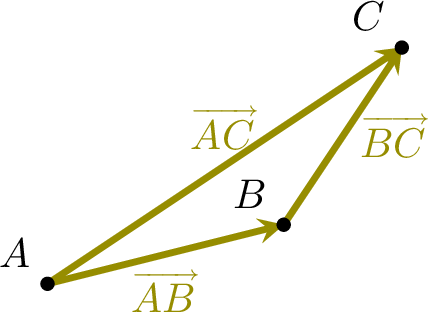
Definition — Zero Vector
The vector associated with the translation that transforms any point into itself is the zero vector, denoted \(\Vect{0}\).$$\Vect{v} + \Vect{0} = \Vect{0} + \Vect{v} = \Vect{v}$$ Proposition — Vector from a Point to Itself
For any point \(A\):$$\Vect{AA} = \Vect{0}$$ Proposition — The Sum Does Not Depend on the Order
For all vectors \(\vec{u}\) and \(\vec{v}\): $$\vec{u} + \vec{v} = \vec{v} + \vec{u}$$ Starting from a point \(A\), the path “\(\vec{u}\) then \(\vec{v}\)” and the path “\(\vec{v}\) then \(\vec{u}\)” reach the same point \(D\): the two paths close a parallelogram (possibly flattened), and the sum \(\Vect{AD}\) is its diagonal from \(A\) — the parallelogram rule. 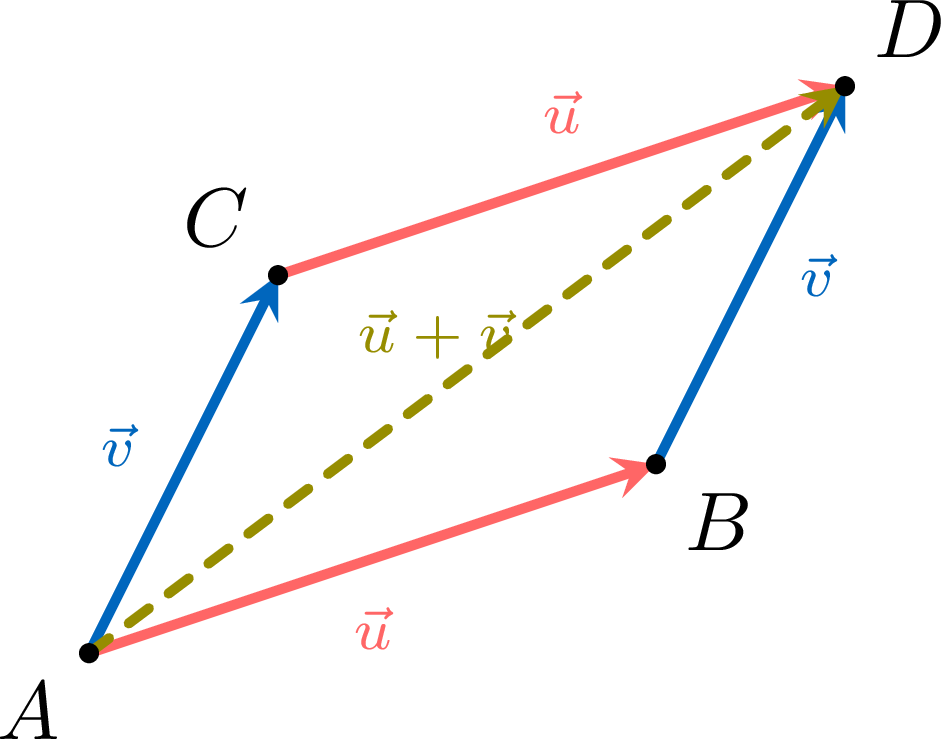
Skills to practice
- Recognising Sums of Vectors
- Calculating Sums of Vectors
II.2
Subtraction of Vectors
Suppose we translate the point \(A\) to \(B\), then we translate the point \(B\) back to \(A\). What single move replaces the two? 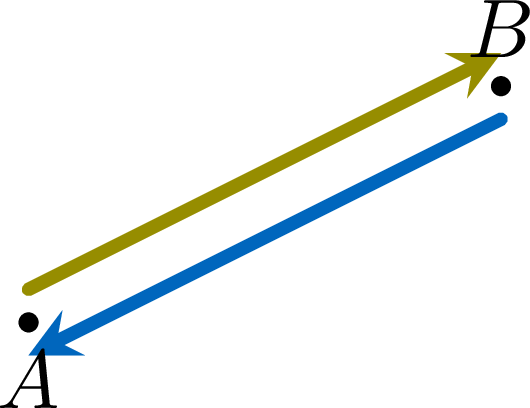
No move at all: the point \(A\) comes back to itself. In vector terms, \(\Vect{AB} + \Vect{BA} = \Vect{AA} = \Vect{0}\), the zero vector: the vector \(\Vect{BA}\) undoes the vector \(\Vect{AB}\).
Definition — Negative Vector
The negative vector of a non-zero vector \(\vec{u}\) is the vector with the same direction, the same length, but the opposite sense (orientation). It is denoted by \(-\vec{u}\). The negative of the zero vector is the zero vector. Definition — Algebraic Negative Vector
$$-\begin{pmatrix}x\\
y\end{pmatrix}=\begin{pmatrix}-x\\
-y \\
\end{pmatrix}$$ Proposition — Negative of \(\Vect{AB}\)
The vector \(\Vect{BA}\) (from \(B\) to \(A\)) is the negative of the vector \(\Vect{AB}\) (from \(A\) to \(B\)):$$\Vect{BA} = -\Vect{AB}$$ 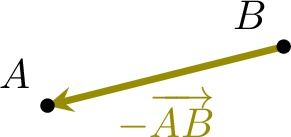
Proposition — Sum of a Vector and its Negative
For any vector \(\vec{u}\):$$\vec{u} + \left(-\vec{u}\right) = \Vect{0}$$ In particular, for any points \(A\) and \(B\): \(\Vect{AB} + \Vect{BA} = \Vect{AA} = \Vect{0}\) (Chasles' relation).
To subtract one vector from another, we simply add its negative (opposite).
Definition — Subtraction of Vectors
The subtraction of vectors \(\Vect{u} - \Vect{v}\) is defined as adding the negative of the second vector:$$\Vect{u}-\Vect{v} = \Vect{u} + (-\Vect{v})$$ 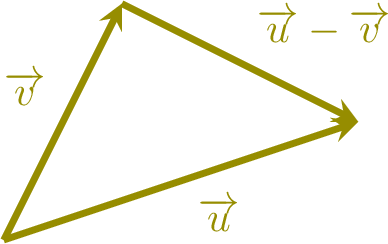
Example
Calculate \(\Vect{AB}-\Vect{CB}\).
$$\begin{aligned}\Vect{AB}-\Vect{CB} &= \Vect{AB} + (-\Vect{CB})\\
&= \Vect{AB} + \Vect{BC}\\
&= \Vect{AC}\end{aligned}$$
Definition — Algebraic Vector Subtraction
$$\begin{pmatrix}x\\
y\end{pmatrix}-\begin{pmatrix}x'\\
y'\end{pmatrix}=\begin{pmatrix}x-x'\\
y-y' \\
\end{pmatrix}$$ Skills to practice
- Recognising the Negative of a Vector
- Calculating Differences of Vectors
II.3
Multiplying a Vector by a Scalar
Let \(\Vect{v} = \begin{pmatrix} 2\\1\end{pmatrix}\). The notation \(2\Vect{v}\) means \(\Vect{v}+\Vect{v}\). Find the coordinates of the vectors:
- \(\textcolor{olive}{2} \Vect{v}\)
- \(\textcolor{olive}{3} \Vect{v}\)
- \(\vdots\)
- \(\textcolor{olive}{k} \Vect{v}\)
- \(\begin{aligned}[t] \textcolor{olive}{2} \Vect{v} &= \Vect{v} + \Vect{v} \\ &= \begin{pmatrix} 2 \\ 1 \end{pmatrix} + \begin{pmatrix} 2 \\ 1 \end{pmatrix} \\ &= \begin{pmatrix} \textcolor{olive}{2} \times 2 \\ \textcolor{olive}{2} \times 1 \end{pmatrix} \\ &= \begin{pmatrix} 4 \\ 2 \end{pmatrix} \end{aligned}\)
- \(\begin{aligned}[t] \textcolor{olive}{3} \Vect{v} &= \Vect{v} + \Vect{v} + \Vect{v} \\ &= \begin{pmatrix} 2 \\ 1 \end{pmatrix} + \begin{pmatrix} 2 \\ 1 \end{pmatrix} + \begin{pmatrix} 2 \\ 1 \end{pmatrix} \\ &= \begin{pmatrix} \textcolor{olive}{3} \times 2 \\ \textcolor{olive}{3} \times 1 \end{pmatrix} \\ &= \begin{pmatrix} 6 \\ 3 \end{pmatrix} \end{aligned}\)
- \(\vdots\)
- \(\begin{aligned}[t] \textcolor{olive}{k} \Vect{v} &= \Vect{v} + \Vect{v} + \dots + \Vect{v} \quad \text{(\)k\( times)} \\ &= \begin{pmatrix} 2 \\ 1 \end{pmatrix} + \begin{pmatrix} 2 \\ 1 \end{pmatrix} + \dots + \begin{pmatrix} 2 \\ 1 \end{pmatrix} \\ &= \begin{pmatrix} \textcolor{olive}{k} \times 2 \\ \textcolor{olive}{k} \times 1 \end{pmatrix} \end{aligned}\)
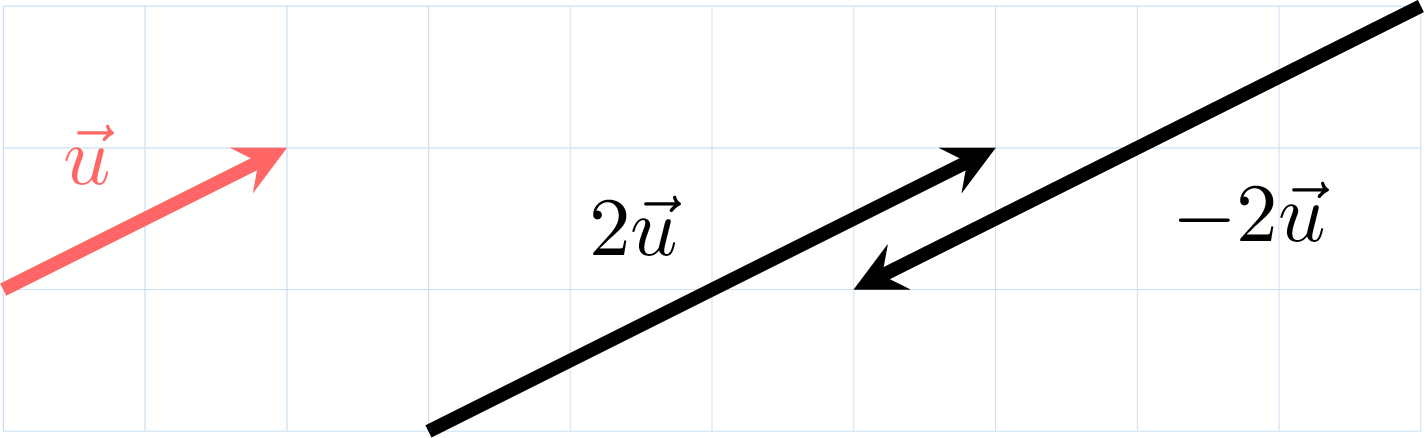
Definition — Geometric Scalar Multiplication
Let \(k\) be a non-zero real number and \(\vec{u}\) a non-zero vector. The vector \(k\vec{u}\) is defined by: - its direction: the same as \(\vec{u}\);
- its sense: the same as \(\vec{u}\) if \(k > 0\), the opposite if \(k < 0\);
- its length: \(|k|\) times the length of \(\vec{u}\).
Example
The points \(A\), \(B\) and \(C\) are collinear, in this order, with \(AB = 2\)~cm and \(BC = 4\)~cm. Express \(\Vect{AC}\) and \(\Vect{BA}\) as multiples of \(\Vect{AB}\). 
\(AC = AB + BC = 6\)~cm, and \(\Vect{AC}\) has the same direction and sense as \(\Vect{AB}\): so \(\Vect{AC} = 3\Vect{AB}\). \(\Vect{BA}\) has the same length as \(\Vect{AB}\) but the opposite sense: \(\Vect{BA} = -\Vect{AB}\).
Definition — Scalar Multiplication
Let \(k\) be a real number. The product \(k\Vect{v}\) is defined by:$$k\begin{pmatrix}x\\
y\end{pmatrix}=\begin{pmatrix}kx\\
ky\end{pmatrix}$$
Remark
- \(2\Vect{v}\) has the same direction and sense as \(\Vect{v}\), and is twice as long.
- \(-2\Vect{v}\) has the same direction but the opposite sense, and is twice as long as \(\Vect{v}\).
- If \(0 < k < 1\), the vector \(k\Vect{v}\) has the same direction and sense as \(\Vect{v}\), but is shorter.
- \(0\Vect{v} = \Vect{0}\), the zero vector.
Example
Let \(\Vect{u}\begin{pmatrix} -2 \\ 3 \end{pmatrix}\) and \(\Vect{v}\begin{pmatrix} 4 \\ -1 \end{pmatrix}\). Calculate the coordinates of \(\Vect{u} + \Vect{v}\), of \(-\Vect{v}\), and of \(2\Vect{u} - 3\Vect{v}\).
$$\Vect{u} + \Vect{v} = \begin{pmatrix} -2+4 \\
3+(-1) \end{pmatrix} = \begin{pmatrix} 2 \\
2 \end{pmatrix}, \qquad -\Vect{v} = \begin{pmatrix} -4 \\
1 \end{pmatrix},$$ $$2\Vect{u} - 3\Vect{v} = \begin{pmatrix} 2\times(-2) - 3\times 4 \\
2\times 3 - 3\times(-1) \end{pmatrix} = \begin{pmatrix} -16 \\
9 \end{pmatrix}.$$ Watch the signs: \(2 \times (-2) - 3 \times 4 = -4 - 12 = -16\) and \(6 - (-3) = 9\).
Definition — Orthonormal Basis
Let \(\Vect{i}\) and \(\Vect{j}\) be two vectors of the plane that are perpendicular and of length \(1\) (unit vectors). The pair \((\Vect{i},\,\Vect{j})\) is called an orthonormal basis of the plane. Together with a point \(O\), the triple \((O,\,\Vect{i},\,\Vect{j})\) is an orthonormal coordinate system. 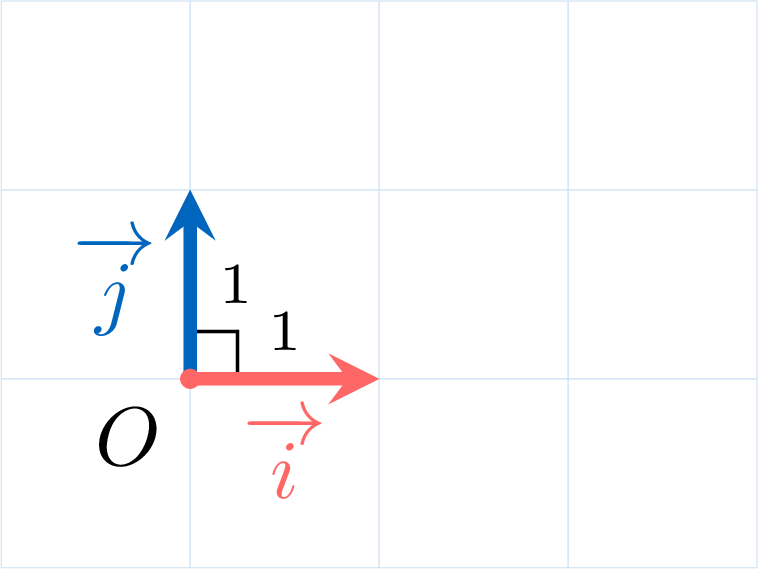
Proposition — Coordinates in a Basis
Every vector \(\Vect{u}\) of the plane can be written in a unique way as $$\Vect{u} = x\,\Vect{i} + y\,\Vect{j},$$ where \(x\) and \(y\) are real numbers: the coordinates of \(\Vect{u}\) in the basis, written \(\Vect{u}\begin{pmatrix} x \\ y \end{pmatrix}\). Example
On the grid, the basis \((\Vect{i},\,\Vect{j})\) and the vector \(\Vect{v}\) are drawn. Write \(\Vect{v}\) in the form \(x\,\Vect{i} + y\,\Vect{j}\) and give its coordinates. 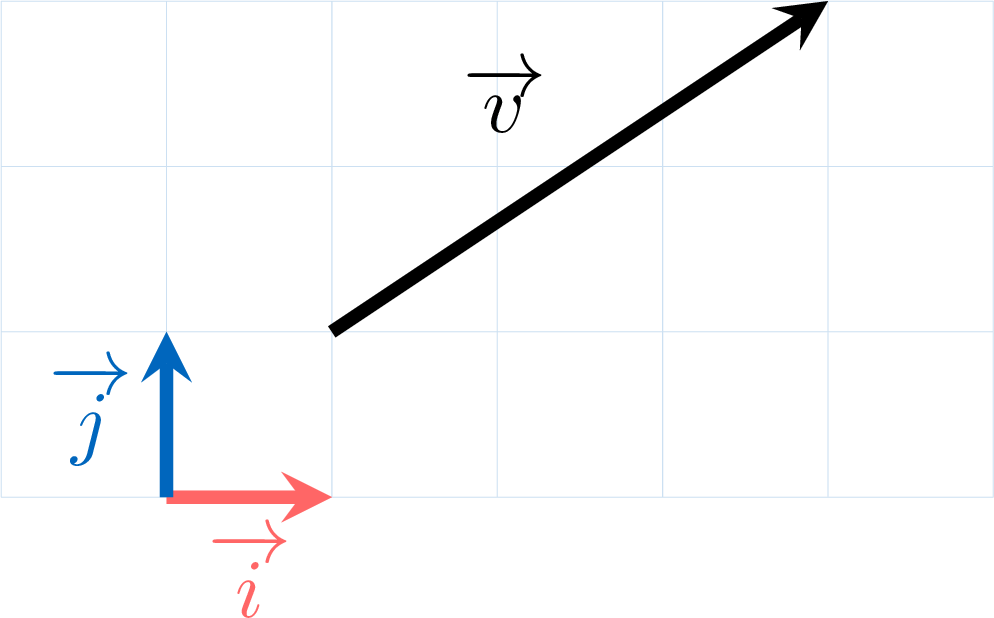
To follow \(\Vect{v}\), one moves \(3\) squares in the direction of \(\Vect{i}\) and \(2\) squares in the direction of \(\Vect{j}\): $$\Vect{v} = 3\,\Vect{i} + 2\,\Vect{j}, \qquad \Vect{v}\begin{pmatrix} 3 \\
2 \end{pmatrix}.$$
Skills to practice
- Recognising Multiples of a Vector
- Calculating Linear Combinations of Vectors
III
Midpoints and Magnitudes
III.1
Midpoint of a Segment
Proposition — Vector Characterisation of the Midpoint
Let \(A\) and \(B\) be two distinct points and \(I\) a point of the plane. The following statements are equivalent: - \(I\) is the midpoint of the segment \(\Segment{AB}\);
- \(\Vect{AI} = \Vect{IB}\);
- \(\Vect{AI} = \dfrac{1}{2}\Vect{AB}\);
- \(\Vect{IA} + \Vect{IB} = \Vect{0}\).
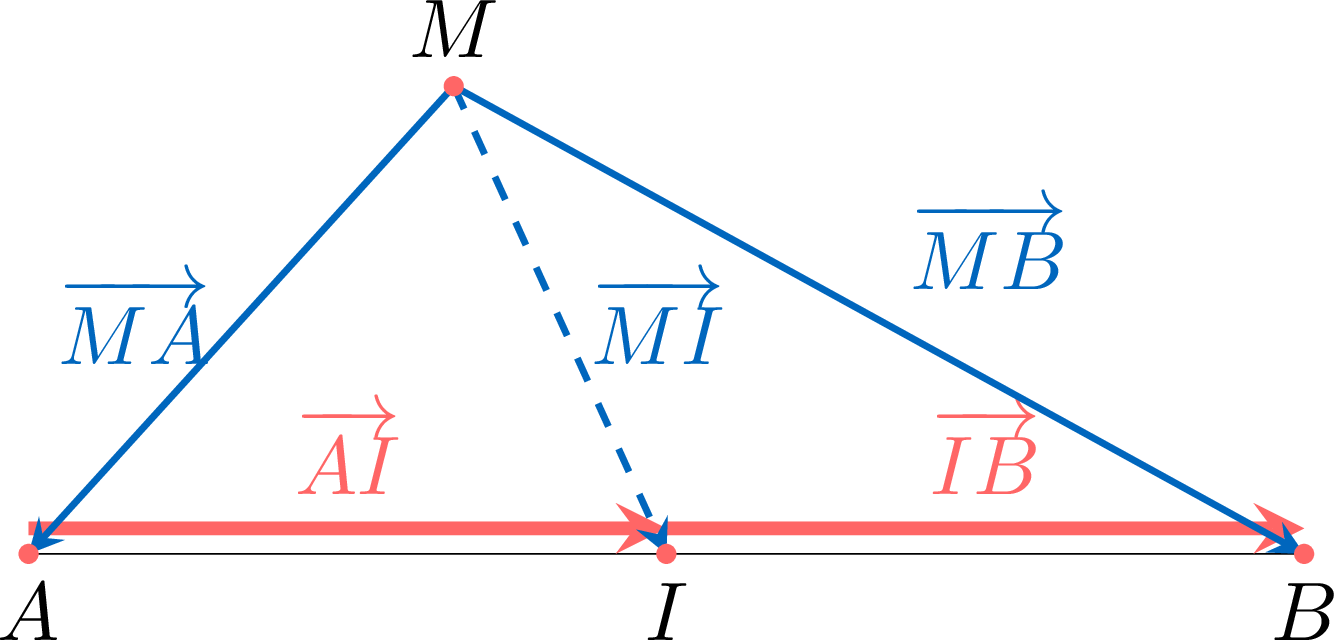
(When \(A = B\), the segment is the single point \(A\) and each of the four statements says \(I = A\); we assume \(A \neq B\), so that the line \(\Line{AB}\) exists.)
- (1) \(\Leftrightarrow\) (2). If \(I\) is the midpoint of \(\Segment{AB}\), the vectors \(\Vect{AI}\) and \(\Vect{IB}\) have the same direction (the line \(\Line{AB}\)), the same sense (from \(A\) towards \(B\)) and the same length (\(AI = IB\)): they are equal. Conversely, if \(\Vect{AI} = \Vect{IB}\), the two arrows have the same direction, so \(I\) lies on the line \(\Line{AB}\); the same sense, so \(I\) is between \(A\) and \(B\); and the same length, so \(AI = IB\): \(I\) is the midpoint.
- (2) \(\Leftrightarrow\) (3). By Chasles' relation, \(\Vect{AB} = \Vect{AI} + \Vect{IB}\). If \(\Vect{AI} = \Vect{IB}\), then \(\Vect{AB} = 2\,\Vect{AI}\), that is \(\Vect{AI} = \dfrac{1}{2}\Vect{AB}\). Conversely, if \(\Vect{AI} = \dfrac{1}{2}\Vect{AB}\), then \(\Vect{IB} = \Vect{AB} - \Vect{AI} = \Vect{AB} - \dfrac{1}{2}\Vect{AB} = \dfrac{1}{2}\Vect{AB} = \Vect{AI}\).
- (2) \(\Leftrightarrow\) (4). Since \(\Vect{IA} = -\Vect{AI}\), the relation \(\Vect{IA} + \Vect{IB} = \Vect{0}\) means \(-\Vect{AI} + \Vect{IB} = \Vect{0}\), that is \(\Vect{AI} = \Vect{IB}\).
- The relation with \(M\). Splitting each vector at \(I\) by Chasles' relation: $$\Vect{MA} + \Vect{MB} = (\Vect{MI} + \Vect{IA}) + (\Vect{MI} + \Vect{IB}) = 2\,\Vect{MI} + (\Vect{IA} + \Vect{IB}) = 2\,\Vect{MI},$$ since \(\Vect{IA} + \Vect{IB} = \Vect{0}\) by (4).
Example
\(ABCD\) is a parallelogram, so that \(\Vect{AB} = \Vect{DC}\). Let \(I\) be the midpoint of the diagonal \(\Segment{AC}\). Show, with vectors, that \(I\) is also the midpoint of the other diagonal \(\Segment{BD}\). 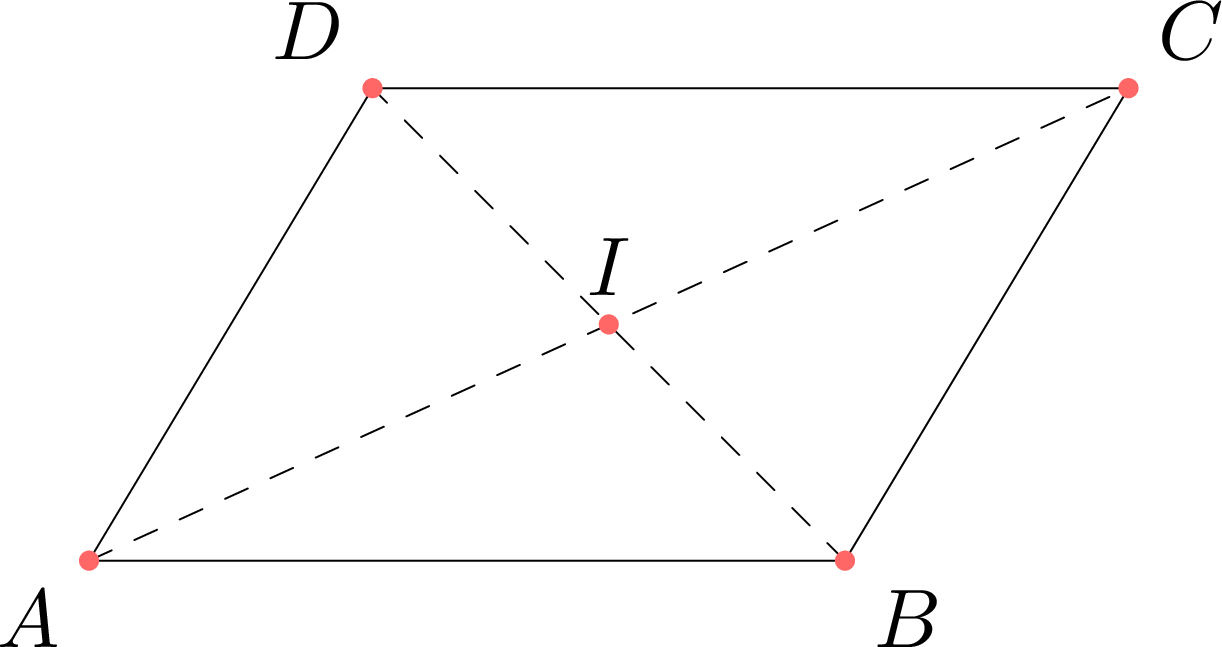
Since \(I\) is the midpoint of \(\Segment{AC}\), \(\Vect{IA} + \Vect{IC} = \Vect{0}\) (characterisation (4)). We compute \(\Vect{IB} + \Vect{ID}\) by passing through \(A\) and \(C\): $$\begin{aligned} \Vect{IB} + \Vect{ID} &= (\Vect{IA} + \Vect{AB}) + (\Vect{IC} + \Vect{CD}) && \text{(Chasles' relation)} \\
&= (\Vect{IA} + \Vect{IC}) + (\Vect{AB} + \Vect{CD}) && \text{(regroup)} \\
&= \Vect{0} + (\Vect{AB} - \Vect{DC}) && \text{(\(I\) midpoint of \(\Segment{AC}\); \(\Vect{CD} = -\Vect{DC}\))} \\
&= \Vect{0}. && \text{(\(\Vect{AB} = \Vect{DC}\))} \end{aligned}$$ By the characterisation (4), \(I\) is the midpoint of \(\Segment{BD}\): the diagonals of a parallelogram have the same midpoint.
Proposition — Coordinates of the Midpoint
Let \(A(x_A,\,y_A)\) and \(B(x_B,\,y_B)\) be two points. The midpoint \(M\) of the segment \(\Segment{AB}\) has coordinates $$M\left(\dfrac{x_A+x_B}{2},\ \dfrac{y_A+y_B}{2}\right).$$
\(M\) is the midpoint of \(\Segment{AB}\) exactly when \(\Vect{AM} = \dfrac{1}{2}\Vect{AB}\). Reading the first coordinates: $$x_M - x_A = \dfrac{1}{2}(x_B - x_A) \quad\text{so}\quad x_M = x_A + \dfrac{x_B - x_A}{2} = \dfrac{x_A+x_B}{2},$$ and the same computation on the second coordinates gives \(y_M = \dfrac{y_A+y_B}{2}\).
Example
Let \(A(1,\ 5)\) and \(B(7,\ 1)\). Calculate the coordinates of the midpoint \(M\) of \(\Segment{AB}\).
$$M\left(\dfrac{1+7}{2},\ \dfrac{5+1}{2}\right) = M(4,\ 3).$$ 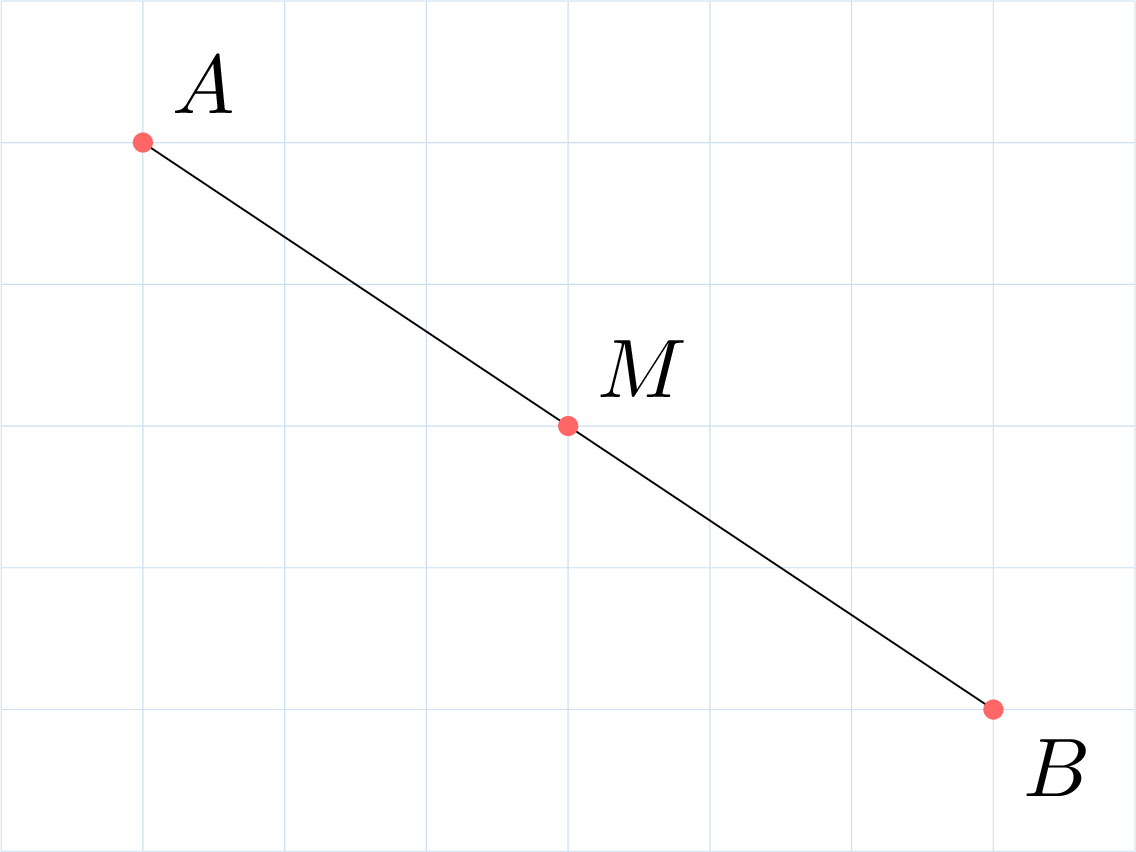
Skills to practice
- Justifying with Midpoints and Vectors
III.2
Magnitude of a Vector
By Pythagoras' theorem, the magnitude is the length of the hypotenuse of the right-angled triangle formed by the two components:
Proposition — Magnitude of a Vector
If \(\Vect{v}=\begin{pmatrix}x\\y\end{pmatrix}\) in an orthonormal basis, the magnitude (length) of \(\Vect{v}\), written \(|\Vect{v}|\) (also written \(\|\Vect{v}\|\)), is $$|\Vect{v}|=\sqrt{x^2+y^2}$$ 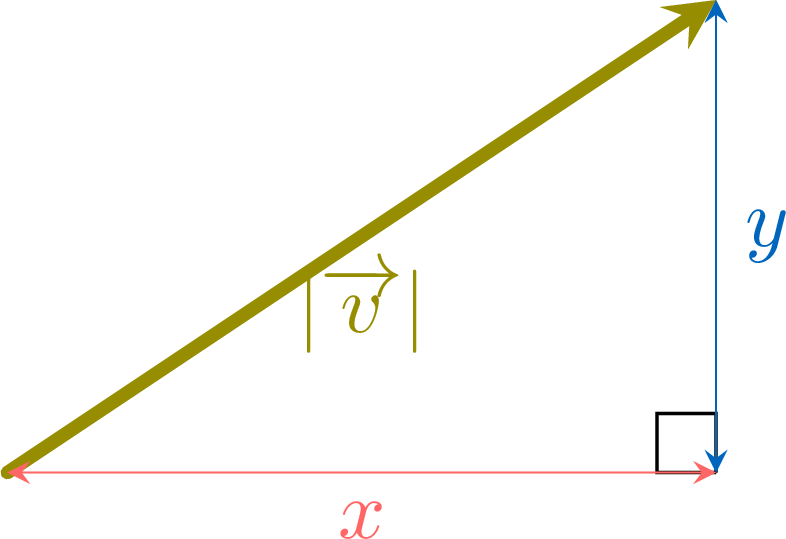
Example
Calculate the magnitude of \(\Vect{v}=\begin{pmatrix}4\\3\end{pmatrix}\).
$$\begin{aligned}[t]|\Vect{v}| & =\sqrt{4^2+3^2}\\
& =\sqrt{16+9}\\
& =\sqrt{25}\\
&=5 \text{ units}\\
\end{aligned}$$
Proposition — Distance between Two Points
The distance between points \(A(x_A, y_A)\) and \(B(x_B, y_B)\) in an orthonormal coordinate system is the magnitude of the vector \(\Vect{AB}\):$$AB = |\Vect{AB}| = \sqrt{(x_B - x_A)^2 + (y_B - y_A)^2}$$ Example
Calculate the distance between the points \(A(1,\ 2)\) and \(B(5,\ 5)\).
$$\begin{aligned}[t]AB &= |\Vect{AB}|\\
&= \sqrt{(x_B - x_A)^2 + (y_B - y_A)^2} \\
&= \sqrt{(5 - 1)^2 + (5 - 2)^2} \\
&= \sqrt{4^2 + 3^2} \\
&= \sqrt{16 + 9} \\
&= \sqrt{25} \\
&= 5\ \text{units}\end{aligned}$$
Skills to practice
- Calculating the Magnitude of a Vector
IV
Collinearity
IV.1
Collinear Vectors
Definition — Collinear Vectors
Two non-zero vectors \(\Vect{u}\) and \(\Vect{v}\) are said to be collinear if there exists a real number \(k\) such that:$$\Vect{u} = k \Vect{v}$$ By convention, the zero vector is collinear with every vector. Proposition — Collinearity and Geometry
- Two lines \(\Line{AB}\) and \(\Line{CD}\) are parallel if and only if the vectors \(\Vect{AB}\) and \(\Vect{CD}\) are collinear.
- Three points \(A\), \(B\), and \(C\) are collinear (lie on the same straight line) if and only if the vectors \(\Vect{AB}\) and \(\Vect{AC}\) are collinear.
Example
On the grid, the vectors \(\Vect{AB}\) and \(\Vect{CD}\) are drawn. Are the lines \(\Line{AB}\) and \(\Line{CD}\) parallel? 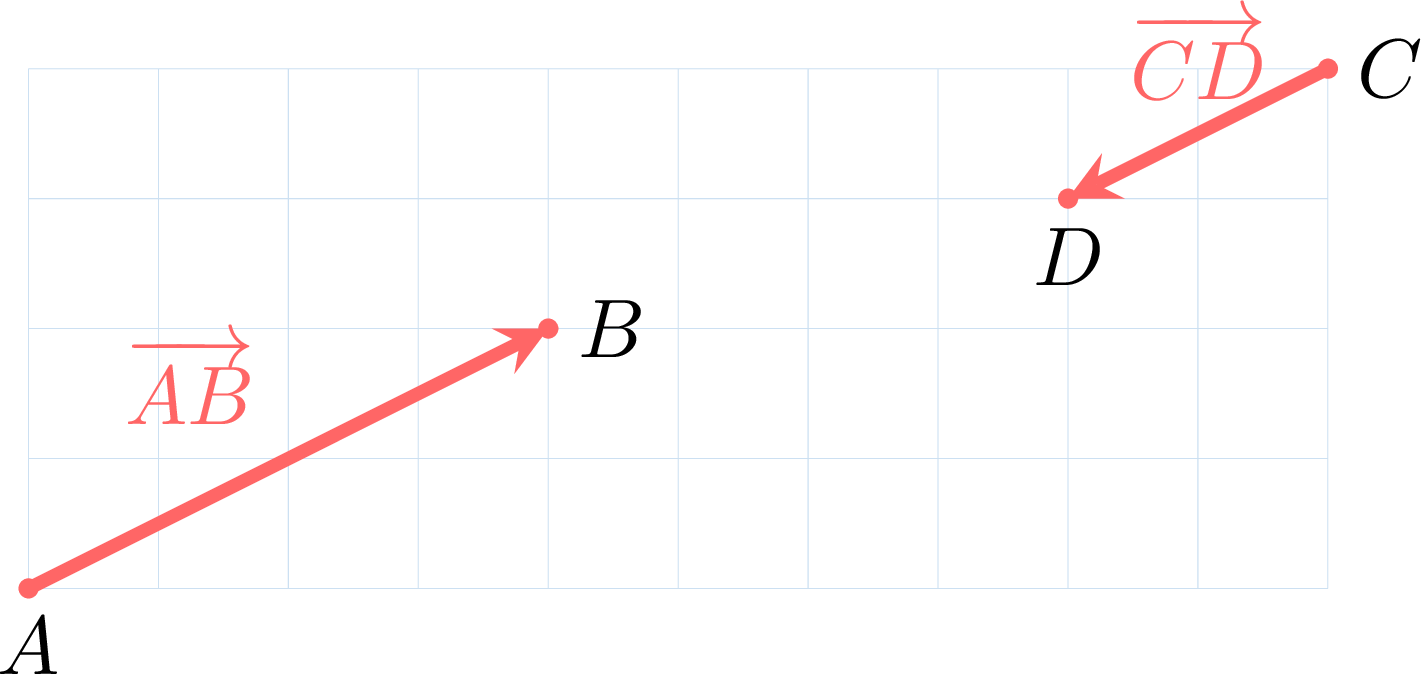
\(\Vect{AB}\) goes \(4\) right and \(2\) up; \(\Vect{CD}\) goes \(2\) left and \(1\) down: same direction, half as long, opposite sense — \(\Vect{CD} = -\dfrac{1}{2}\Vect{AB}\). The vectors are collinear, so the lines \(\Line{AB}\) and \(\Line{CD}\) are parallel.
Definition — Determinant of Two Vectors
Let \(\Vect{u} = \begin{pmatrix} x \\ y \end{pmatrix}\) and \(\Vect{v} = \begin{pmatrix} x' \\ y' \end{pmatrix}\) be two vectors in the plane. The determinant of \(\Vect{u}\) and \(\Vect{v}\), denoted \(\det(\Vect{u},\,\Vect{v})\), is defined as:$$\det(\Vect{u},\,\Vect{v}) =\begin{vmatrix}x & x' \\
y & y'\end{vmatrix}= x \cdot y' - y \cdot x'$$ Proposition — Collinearity and Determinant
Two vectors \(\Vect{u}\) and \(\Vect{v}\) are collinear if and only if$$\det(\Vect{u},\,\Vect{v}) = 0$$
Let \(\Vect{u}\begin{pmatrix} x \\ y \end{pmatrix}\) and \(\Vect{v}\begin{pmatrix} x' \\ y' \end{pmatrix}\). If \(\Vect{u} = \Vect{0}\), both statements are true: the zero vector is collinear with every vector, and \(\det(\Vect{u},\Vect{v}) = 0 \cdot y' - 0 \cdot x' = 0\). Suppose now \(\Vect{u} \neq \Vect{0}\).
- If the vectors are collinear, then \(\Vect{v} = k\,\Vect{u}\) for some real \(k\), so \(x' = kx\) and \(y' = ky\), and $$\det(\Vect{u},\,\Vect{v}) = x \cdot ky - y \cdot kx = k(xy - yx) = 0.$$
- Conversely, suppose \(\det(\Vect{u},\,\Vect{v}) = x\,y' - y\,x' = 0\). Since \(\Vect{u} \neq \Vect{0}\), one of its coordinates is not zero.
- If \(x \neq 0\): set \(k = \dfrac{x'}{x}\). Then \(x' = kx\), and \(x\,y' = y\,x' = ykx\) gives \(y' = ky\): so \(\Vect{v} = k\,\Vect{u}\).
- If \(x = 0\), then \(y \neq 0\) and \(0 = x\,y' - y\,x' = -y\,x'\) gives \(x' = 0\): set \(k = \dfrac{y'}{y}\), then \(\Vect{v} = k\,\Vect{u}\).
Example
Let \(A(1,\ 2)\), \(B(5,\ 4)\), \(C(-1,\ -1)\), and \(D(5,\ 2)\). Are the lines \(\Line{AB}\) and \(\Line{CD}\) parallel?
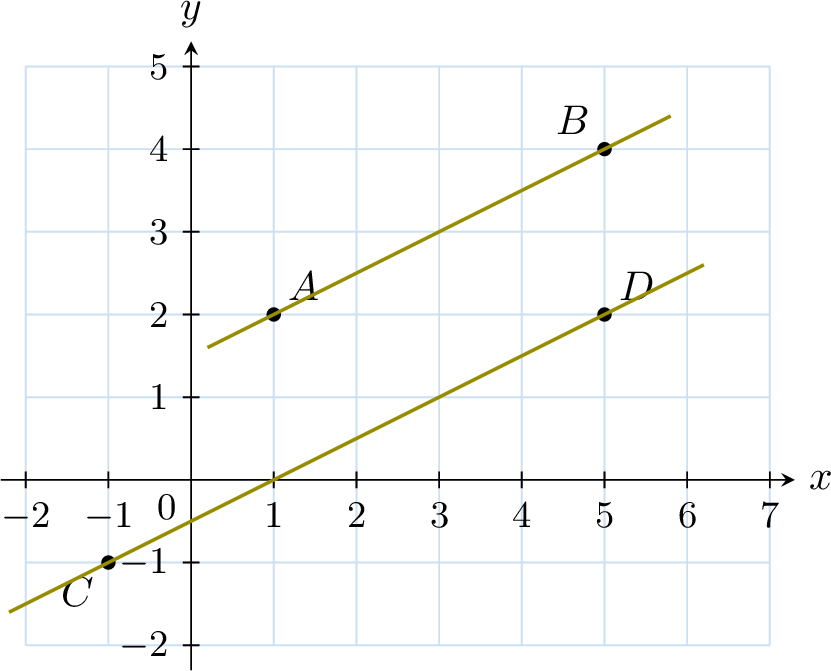
First, compute the vectors:$$\Vect{AB} = \begin{pmatrix}5-1 \\
4-2\end{pmatrix} = \begin{pmatrix}4 \\
2\end{pmatrix}, \quad\Vect{CD} = \begin{pmatrix}5-(-1) \\
2-(-1)\end{pmatrix} = \begin{pmatrix}6 \\
3\end{pmatrix}$$ Calculate the determinant:$$\det(\Vect{AB},\,\Vect{CD}) =\begin{vmatrix}4 & 6 \\
2 & 3\end{vmatrix}= 4\times 3 - 6\times 2 = 12 - 12 = 0$$ The determinant is zero: by the criterion \(\det = 0\), the vectors are collinear, so the lines are parallel. (Double-check: \(\frac{6}{4} = \frac{3}{2} = 1.5\), indeed \(\Vect{CD} = 1.5\,\Vect{AB}\).)
Proposition — Collinearity and Proportional Coordinates
Let \(\Vect{u}\begin{pmatrix} x \\ y \end{pmatrix}\) and \(\Vect{v}\begin{pmatrix} x' \\ y' \end{pmatrix}\) be two non-zero vectors. The following statements are equivalent: - \(\Vect{u}\) and \(\Vect{v}\) are collinear;
- the coordinates of \(\Vect{v}\) are proportional to those of \(\Vect{u}\): there is a real number \(k\) such that \(x' = kx\) and \(y' = ky\);
- the cross products are equal: \(x\,y' = y\,x'\).
| first coordinate | second coordinate | |
| \(\Vect{u}\) | \(x\) | \(y\) |
| \(\Vect{v}\) | \(x' = kx\) | \(y' = ky\) |
- (1) \(\Rightarrow\) (2). If \(\Vect{u}\) and \(\Vect{v}\) are collinear and non-zero, then by definition there is a real number \(k'\) such that \(\Vect{u} = k'\,\Vect{v}\); since \(\Vect{u} \neq \Vect{0}\), \(k' \neq 0\), and \(\Vect{v} = \dfrac{1}{k'}\Vect{u} = k\,\Vect{u}\) with \(k = \dfrac{1}{k'}\). The coordinates of \(k\,\Vect{u}\) are \(kx\) and \(ky\), so \(x' = kx\) and \(y' = ky\).
- (2) \(\Rightarrow\) (1). If \(x' = kx\) and \(y' = ky\), then \(\Vect{v}\) and \(k\,\Vect{u}\) have the same coordinates: \(\Vect{v} = k\,\Vect{u}\). Since \(\Vect{v} \neq \Vect{0}\), \(k \neq 0\) and \(\Vect{u} = \dfrac{1}{k}\Vect{v}\): the vectors are collinear.
- (2) \(\Rightarrow\) (3). If \(x' = kx\) and \(y' = ky\), then \(x\,y' = x \cdot ky = y \cdot kx = y\,x'\): the cross products are equal.
- (3) \(\Rightarrow\) (2). Suppose \(x\,y' = y\,x'\). Since \(\Vect{u} \neq \Vect{0}\), one of its coordinates is not zero.
- If \(x \neq 0\), set \(k = \dfrac{x'}{x}\): then \(x' = kx\), and \(y' = \dfrac{x\,y'}{x} = \dfrac{y\,x'}{x} = ky\).
- If \(x = 0\), then \(y \neq 0\), and the equality gives \(y\,x' = 0\), so \(x' = 0\); set \(k = \dfrac{y'}{y}\): then \(x' = 0 = kx\) and \(y' = ky\).
Example
In each case, decide whether the two vectors are collinear by comparing the cross products, and give the coefficient \(k\) such that \(\Vect{v} = k\,\Vect{u}\) when they are. - \(\Vect{u}\begin{pmatrix} 6 \\ -4 \end{pmatrix}\) and \(\Vect{v}\begin{pmatrix} -9 \\ 6 \end{pmatrix}\);
- \(\Vect{u}\begin{pmatrix} 0 \\ 3 \end{pmatrix}\) and \(\Vect{v}\begin{pmatrix} 0 \\ -5 \end{pmatrix}\);
- \(\Vect{u}\begin{pmatrix} 2 \\ 5 \end{pmatrix}\) and \(\Vect{v}\begin{pmatrix} 4 \\ 9 \end{pmatrix}\).
- Cross products: \(x\,y' = 6 \times 6 = 36\) and \(y\,x' = (-4) \times (-9) = 36\). They are equal: the vectors are collinear. The coefficient is \(k = \dfrac{x'}{x} = \dfrac{-9}{6} = -\dfrac{3}{2}\), and indeed \(-\dfrac{3}{2} \times (-4) = 6 = y'\): \(\Vect{v} = -\dfrac{3}{2}\Vect{u}\).
- Cross products: \(0 \times (-5) = 0\) and \(3 \times 0 = 0\): equal, the vectors are collinear (both are vertical). Here \(k\) cannot be read on the first coordinates (\(\dfrac{0}{0}\) is not a number): it is read on the second ones, \(k = \dfrac{-5}{3}\), and \(\Vect{v} = -\dfrac{5}{3}\Vect{u}\). The cross products decide even when a coordinate is zero.
- Cross products: \(2 \times 9 = 18\) and \(5 \times 4 = 20\). They differ: the vectors are not collinear. (Equivalently, \(\det(\Vect{u},\,\Vect{v}) = 18 - 20 = -2 \neq 0\).)
Proposition — Collinear Points and Parallel Lines
Let \(A\), \(B\), \(C\), \(D\) be points, with \(A \neq B\) and \(C \neq D\). - The points \(A\), \(B\), \(C\) are collinear if and only if \(\det(\Vect{AB},\,\Vect{AC}) = 0\).
- The lines \(\Line{AB}\) and \(\Line{CD}\) are parallel if and only if \(\det(\Vect{AB},\,\Vect{CD}) = 0\).
Proposition — Decomposition on Two Non-Collinear Vectors
Let \(\Vect{u}\) and \(\Vect{v}\) be two non-collinear vectors of the plane (neither is the zero vector, and they do not have the same direction). Every vector \(\Vect{w}\) of the plane can be written in a unique way as $$\textcolor{colorprop}{\Vect{w} = a\,\Vect{u} + b\,\Vect{v}}, \qquad a \text{ and } b \text{ real numbers.}$$ The pair \((\Vect{u},\,\Vect{v})\) is a basis of the plane and \((a, b)\) are the coordinates of \(\Vect{w}\) in that basis. The orthonormal basis \((\Vect{i},\,\Vect{j})\) and the writing \(\Vect{w} = x\,\Vect{i} + y\,\Vect{j}\) are the special case where the two vectors are perpendicular and of length \(1\). 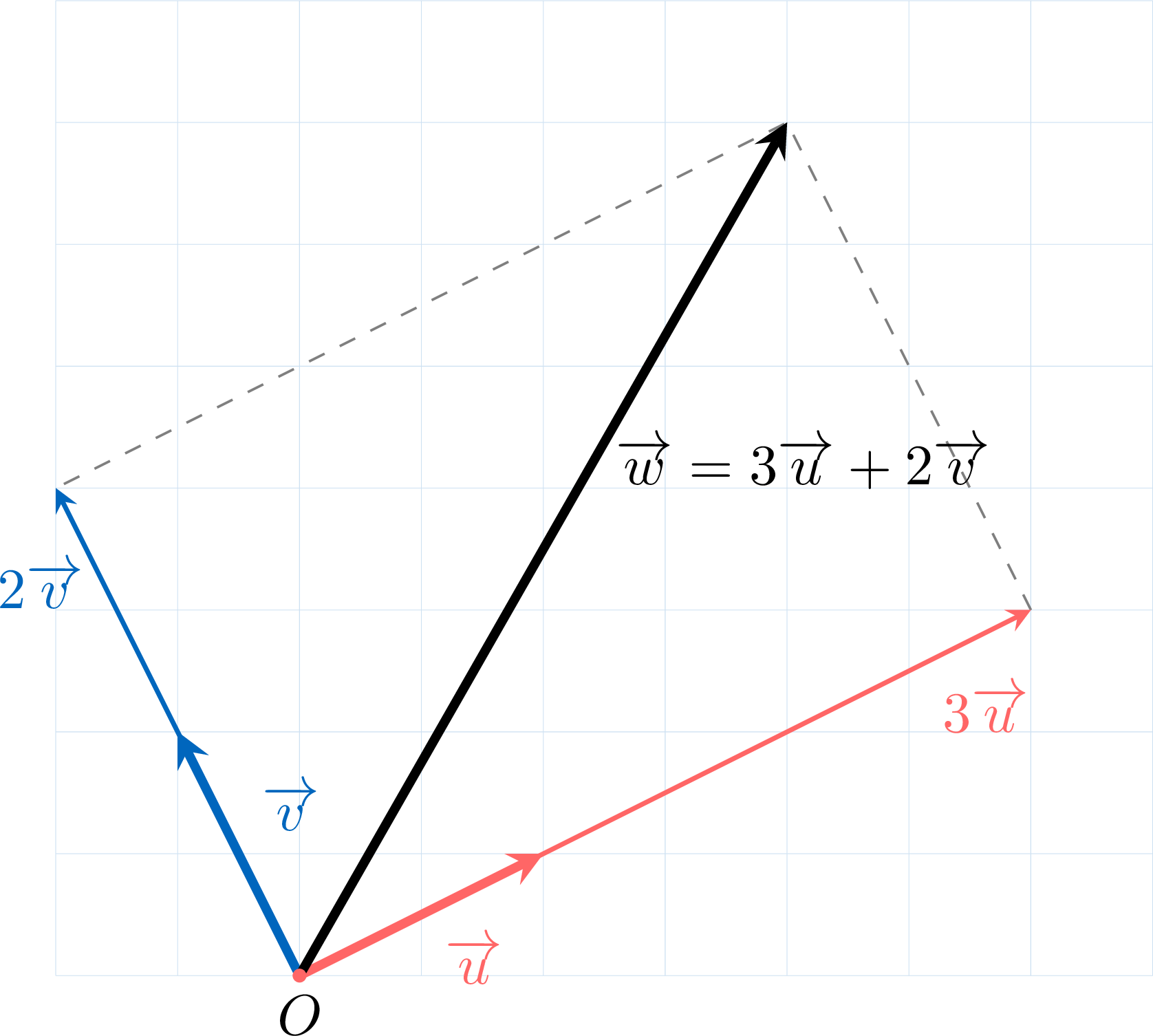
- Existence. Draw representatives from a common point \(O\): \(\Vect{u} = \Vect{OA}\), \(\Vect{v} = \Vect{OB}\) and \(\Vect{w} = \Vect{OM}\). The lines \(\Line{OA}\) and \(\Line{OB}\) intersect at \(O\), since \(\Vect{u}\) and \(\Vect{v}\) do not have the same direction. If \(M\) is on the line \(\Line{OA}\), then \(\Vect{OM}\) is collinear with \(\Vect{OA} \neq \Vect{0}\), so \(\Vect{OM} = a\,\Vect{u}\) for some real \(a\), and \(\Vect{w} = a\,\Vect{u} + 0\,\Vect{v}\); likewise, if \(M\) is on \(\Line{OB}\), then \(\Vect{w} = 0\,\Vect{u} + b\,\Vect{v}\) (and \(\Vect{w} = 0\,\Vect{u} + 0\,\Vect{v}\) when \(M = O\)). Otherwise, the parallel to \(\Line{OB}\) through \(M\) meets \(\Line{OA}\) at a point \(P\), and the parallel to \(\Line{OA}\) through \(M\) meets \(\Line{OB}\) at a point \(Q\): \(OPMQ\) is a parallelogram, so \(\Vect{PM} = \Vect{OQ}\) (parallelogram criterion), and \(\Vect{OM} = \Vect{OP} + \Vect{PM} = \Vect{OP} + \Vect{OQ}\) (Chasles' relation). Now \(P\) is on the line \(\Line{OA}\), so \(\Vect{OP} = a\,\Vect{u}\) for some real \(a\); likewise \(\Vect{OQ} = b\,\Vect{v}\). Hence \(\Vect{w} = a\,\Vect{u} + b\,\Vect{v}\).
- Uniqueness. Suppose \(\Vect{w} = a\,\Vect{u} + b\,\Vect{v} = a'\,\Vect{u} + b'\,\Vect{v}\). Then \((a - a')\,\Vect{u} = (b' - b)\,\Vect{v}\). If \(a \neq a'\), dividing by \(a - a'\) gives \(\Vect{u} = \dfrac{b' - b}{a - a'}\,\Vect{v}\): the vectors \(\Vect{u}\) and \(\Vect{v}\) would be collinear, which is excluded. So \(a = a'\), and then \((b' - b)\,\Vect{v} = \Vect{0}\) with \(\Vect{v} \neq \Vect{0}\) forces \(b' = b\).
Method — Expressing a Vector in Terms of Two Non-Collinear Vectors
In a figure, two non-collinear vectors — typically two sides of a triangle or of a parallelogram from the same vertex — serve as a basis: every vector of the figure is a combination of them, and comparing two such combinations proves that points are collinear or that lines are parallel. - Choose the two reference vectors, for instance \(\Vect{AB}\) and \(\Vect{AD}\) from the vertex \(A\), and check that they are not collinear.
- Walk from the origin to the endpoint of the wanted vector through known points, with Chasles' relation: \(\Vect{AI} = \Vect{AB} + \Vect{BI}\).
- Replace each step by its expression: a side of the parallelogram (\(\Vect{BC} = \Vect{AD}\)), a midpoint (\(\Vect{BI} = \dfrac{1}{2}\Vect{BC}\)), a given multiple (\(\Vect{AE} = \dfrac{2}{3}\Vect{AB}\)), an opposite (\(\Vect{DA} = -\Vect{AD}\)).
- Gather the terms in \(\Vect{AB}\) and in \(\Vect{AD}\): the result is \(a\,\Vect{AB} + b\,\Vect{AD}\), and it is unique.
Example
On the grid, the vectors \(\Vect{u}\), \(\Vect{v}\) and \(\Vect{w}\) are drawn. Write \(\Vect{w}\) as a combination of \(\Vect{u}\) and \(\Vect{v}\), then check with the coordinates. 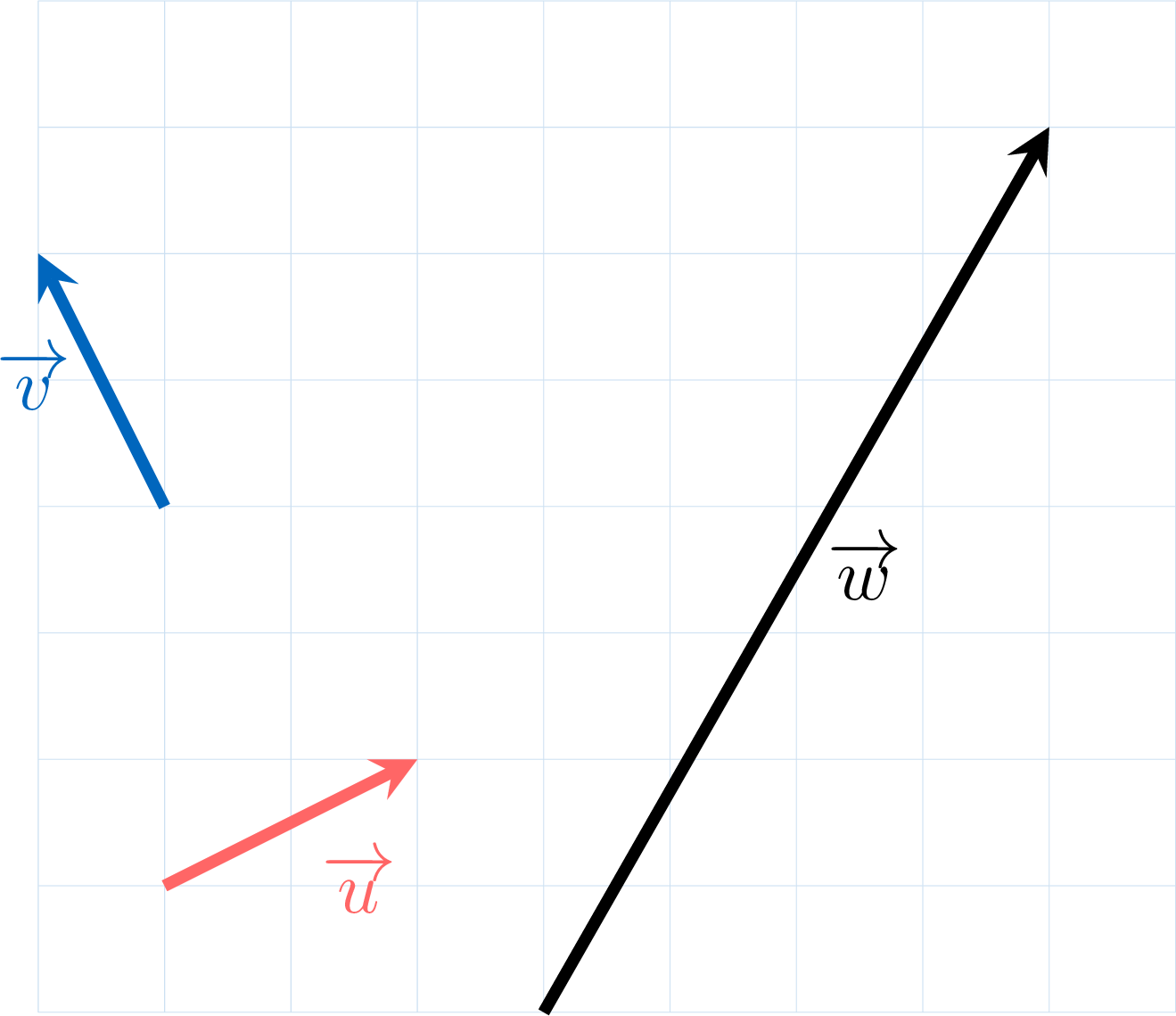
Reading the grid: \(\Vect{u}\begin{pmatrix} 2 \\ 1 \end{pmatrix}\), \(\Vect{v}\begin{pmatrix} -1 \\ 2 \end{pmatrix}\) and \(\Vect{w}\begin{pmatrix} 4 \\ 7 \end{pmatrix}\); \(\Vect{u}\) and \(\Vect{v}\) are not collinear (\(2 \times 2 \neq 1 \times (-1)\)). From the origin of \(\Vect{w}\), walking \(3\) times \(\Vect{u}\) leads \(6\) right and \(3\) up; the remaining move to the endpoint of \(\Vect{w}\) is \(2\) left and \(4\) up, which is \(2\,\Vect{v}\): $$\Vect{w} = 3\,\Vect{u} + 2\,\Vect{v}.$$ 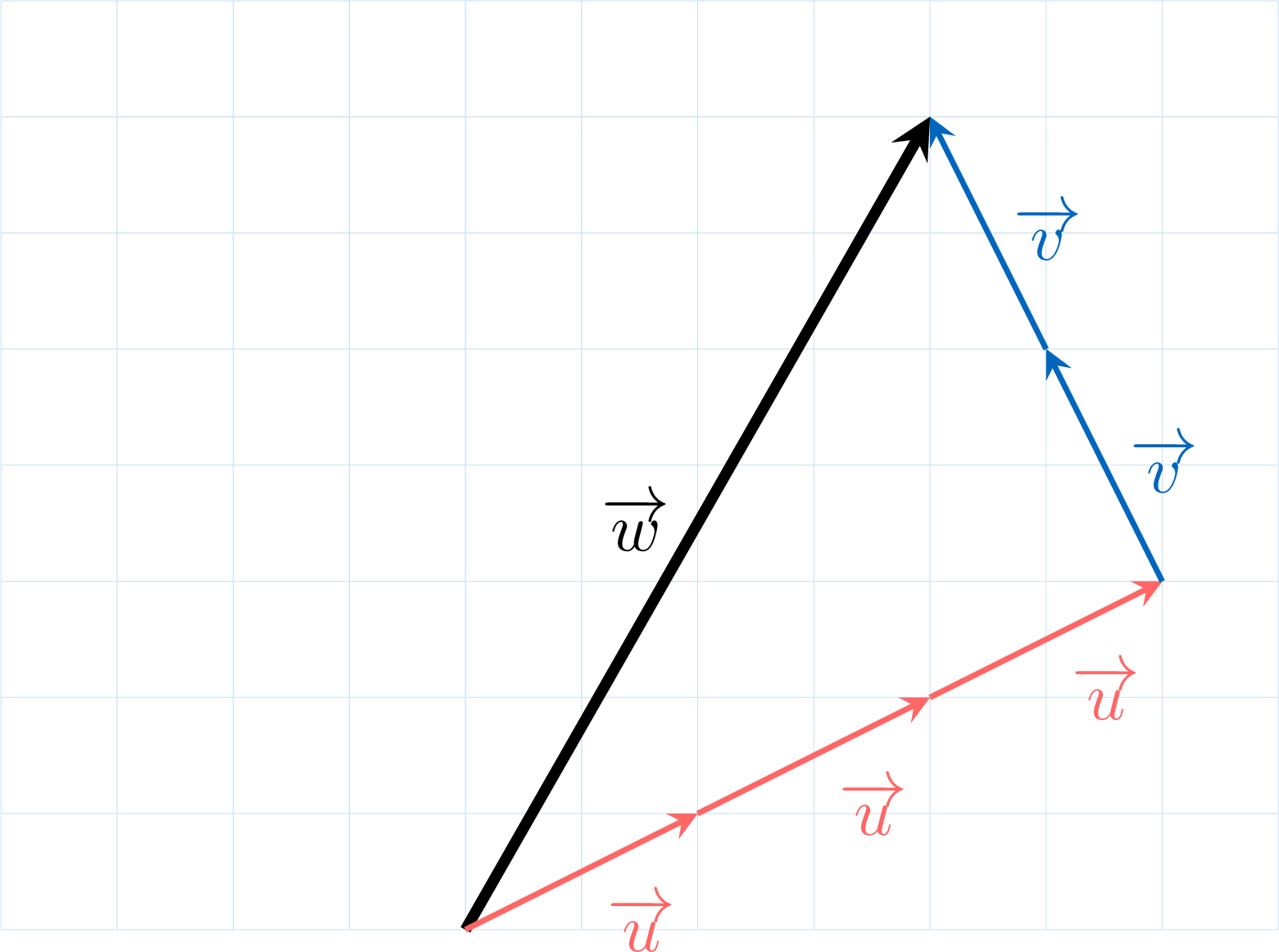
Check with the coordinates: \(3\,\Vect{u} + 2\,\Vect{v} = \begin{pmatrix} 3 \times 2 + 2 \times (-1) \\ 3 \times 1 + 2 \times 2 \end{pmatrix} = \begin{pmatrix} 6 - 2 \\ 3 + 4 \end{pmatrix} = \begin{pmatrix} 4 \\ 7 \end{pmatrix} = \Vect{w}\). The coordinates of \(\Vect{w}\) in the basis \((\Vect{u},\,\Vect{v})\) are \((3, 2)\).
Example
\(ABCD\) is a parallelogram and \(I\) is the midpoint of \(\Segment{BC}\). Express the vectors \(\Vect{AI}\) and \(\Vect{DI}\) in terms of \(\Vect{AB}\) and \(\Vect{AD}\). 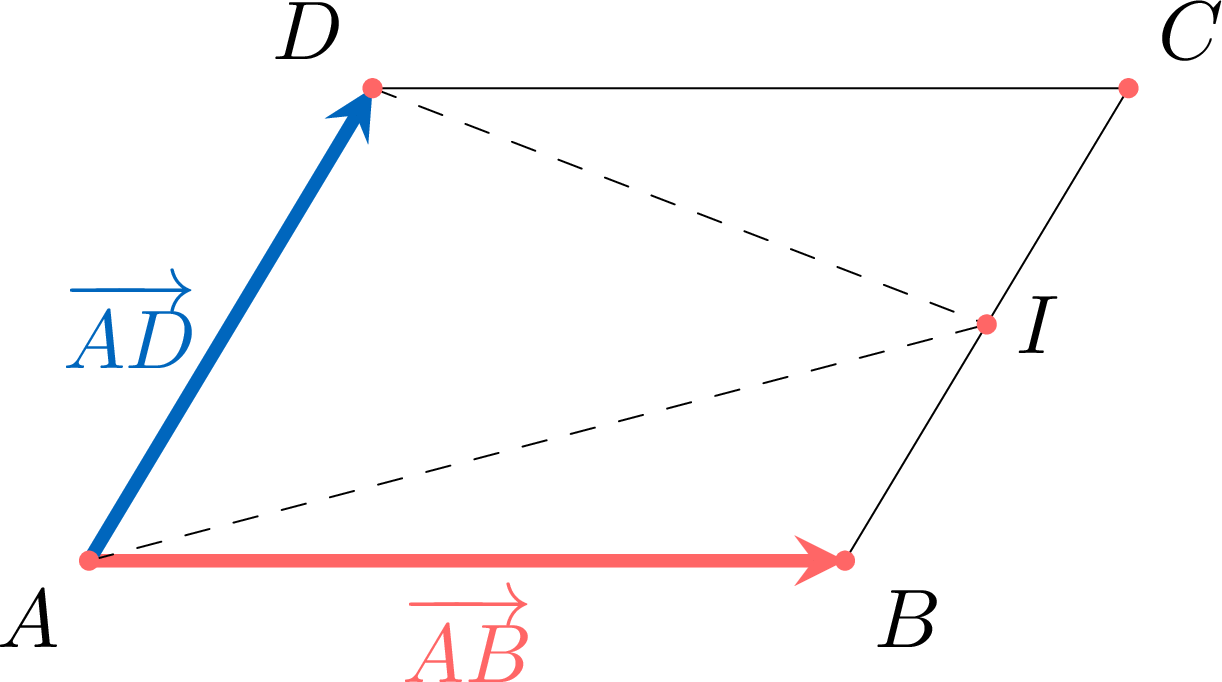
The vectors \(\Vect{AB}\) and \(\Vect{AD}\) are not collinear (the sides of a parallelogram from \(A\) are not on the same line), so they can serve as a basis. Since \(ABCD\) is a parallelogram, \(\Vect{BC} = \Vect{AD}\); since \(I\) is the midpoint of \(\Segment{BC}\), \(\Vect{BI} = \dfrac{1}{2}\Vect{BC}\). $$\begin{aligned} \Vect{AI} &= \Vect{AB} + \Vect{BI} && \text{(Chasles' relation through \(B\))} \\
&= \Vect{AB} + \dfrac{1}{2}\Vect{BC} && \text{(\(I\) midpoint of \(\Segment{BC}\))} \\
&= \Vect{AB} + \dfrac{1}{2}\Vect{AD}. && \text{(\(\Vect{BC} = \Vect{AD}\))} \end{aligned}$$ $$\begin{aligned} \Vect{DI} &= \Vect{DA} + \Vect{AI} && \text{(Chasles' relation through \(A\))} \\
&= -\Vect{AD} + \Vect{AB} + \dfrac{1}{2}\Vect{AD} && \text{(opposite; expression of \(\Vect{AI}\))} \\
&= \Vect{AB} - \dfrac{1}{2}\Vect{AD}. && \text{(gather the terms in \(\Vect{AD}\))} \end{aligned}$$ The coordinates of \(\Vect{AI}\) and \(\Vect{DI}\) in the basis \((\Vect{AB},\,\Vect{AD})\) are \(\left(1,\,\dfrac{1}{2}\right)\) and \(\left(1,\,-\dfrac{1}{2}\right)\).
Skills to practice
- Deciding with a Vector Relation
- Calculating a Determinant
- Finding a Coordinate for Collinearity
- Justifying Collinearity and Parallelism
V
Going further
Skills to practice
- Investigating Patterns with Vectors
- Solving Problems with Velocities and Forces
- Quiz
Jump to section