International Baccalaureate · MYP 5 Extended
Quadratic Equations
I
Completing the Square when \(a \neq 1\)
Proposition — Completing the Square
Any quadratic expression of the form \(x^2 + bx + c\) (leading coefficient \(1\)) can be put into the form \((x + p)^2 + q\) by completing the square: $$x^2 + bx + c = \left(x + \frac{b}{2}\right)^2 - \left(\frac{b}{2}\right)^2 + c.$$ For a general quadratic \(ax^2 + bx + c\) with \(a\neq 0\), we first take out the factor \(a\): $$ax^2 + bx + c = a\left(x^2 + \frac{b}{a}x + \frac{c}{a}\right)$$ and then complete the square inside the brackets. Method — Solving by Completing the Square
Given an equation \(ax^2+bx+c=0\) with \(a\neq 0\): - Step 1: Complete the square to rewrite the left-hand side as \((x + p)^2\) plus or minus a constant, then the equation in the form \((x + p)^2 = q\) (when \(a \neq 1\), first divide both sides by \(a\)).
- Step 2: Conclude from the sign of \(q\). If \(q > 0\): \(x + p = \sqrt{q}\) or \(x + p = -\sqrt{q}\) (or, in the same way, factorise the difference of squares \((x + p)^2 - \left(\sqrt{q}\right)^2 = 0\) and apply the null factor law), so there are two solutions. If \(q = 0\): \(x + p = 0\), so there is one solution, \(x = -p\). If \(q < 0\): there is no solution, since a square is never negative.
- Step 3: Solve the linear equations obtained, and check the solutions in the original equation.
Example
Solve each equation by completing the square. Give the exact solutions. - \(2x^2 - 8x + 6 = 0\)
- \(3x^2 + 6x - 2 = 0\)
The leading coefficient is not \(1\). Since \(a \neq 0\), first divide both sides by \(a\): the equation keeps the same solutions and its leading coefficient becomes \(1\).
- Here \(a = 2\), and \(x^2 - 4x = (x - 2)^2 - 4\): $$\begin{aligned} 2x^2 - 8x + 6 &= 0\\ x^2 - 4x + 3 &= 0 &&\color{gray}\text{(Divide both sides by \(2\))}\\ (x - 2)^2 - 4 + 3 &= 0 &&\color{gray}\text{(Complete the square)}\\ (x - 2)^2 - 1^2 &= 0 &&\color{gray}\text{(Simplify)}\\ (x - 2 - 1)(x - 2 + 1) &= 0 &&\color{gray}\text{(Difference of squares)}\\ (x - 3)(x - 1) &= 0 &&\color{gray}\text{(Simplify)}\\ x - 3 = 0 &\text{ or } x - 1 = 0 &&\color{gray}\text{(Null factor law)}\\ x = 3 &\text{ or } x = 1 &&\color{gray}\text{(Solve)}. \end{aligned}$$ Check: \(2 \times 3^2 - 8 \times 3 + 6 = 18 - 24 + 6 = 0\) and \(2 \times 1^2 - 8 \times 1 + 6 = 2 - 8 + 6 = 0\). The solutions are \(1\) and \(3\).
- Here \(a = 3\), and \(x^2 + 2x = (x + 1)^2 - 1\): $$\begin{aligned} 3x^2 + 6x - 2 &= 0\\ x^2 + 2x - \frac{2}{3} &= 0 &&\color{gray}\text{(Divide both sides by \(3\))}\\ (x + 1)^2 - 1 - \frac{2}{3} &= 0 &&\color{gray}\text{(Complete the square)}\\ (x + 1)^2 &= \frac{5}{3} &&\color{gray}\text{(Add \(\tfrac{5}{3}\) to both sides)}\\ x + 1 = \sqrt{\frac{5}{3}} &\text{ or } x + 1 = -\sqrt{\frac{5}{3}} &&\color{gray}\text{(A square equal to a positive number)}\\ x = -1 + \frac{\sqrt{15}}{3} &\text{ or } x = -1 - \frac{\sqrt{15}}{3} &&\color{gray}\text{(Solve, with \(\sqrt{\tfrac{5}{3}} = \tfrac{\sqrt{5}}{\sqrt{3}} = \tfrac{\sqrt{15}}{3}\))}. \end{aligned}$$ The solutions are \(-1 - \dfrac{\sqrt{15}}{3}\) and \(-1 + \dfrac{\sqrt{15}}{3}\) (about \(-2.29\) and \(0.291\)).
Skills to practice
- Solving by Completing the Square when \(a \neq 1\)
II
Solving with the Quadratic Formula
Applying the method of completing the square to the general equation \(ax^2 + bx + c = 0\) gives a formula that solves any quadratic equation. This is the quadratic formula.
Proposition — Quadratic Formula
For any quadratic equation \(ax^2 + bx + c = 0\), the discriminant, denoted \(\Delta\), is defined as $$\Delta = b^2 - 4ac.$$ Its sign determines the number of real solutions: - If \(\Delta > 0\), there are two real roots:$$x = \frac{-b - \sqrt{\Delta}}{2a}\text{ or }x = \frac{-b + \sqrt{\Delta}}{2a}$$
- If \(\Delta = 0\), there is one real root (a double root):$$x = \frac{-b}{2a}.$$
- If \(\Delta < 0\), there are no real roots.
Suppose \(ax^2 + bx + c = 0\), where \(a \neq 0\). $$\begin{aligned} ax^2 + bx + c &= 0 \\
x^2 + \frac{b}{a}x + \frac{c}{a} &= 0 \quad \color{gray}\text{(Divide each term by \(a\), since \(a \neq 0\))} \\
x^2 + \frac{b}{a}x + \left(\frac{b}{2a}\right)^2 - \left(\frac{b}{2a}\right)^2 + \frac{c}{a} &= 0 \quad \color{gray}\text{(Complete the square)} \\
\left(x + \frac{b}{2a}\right)^2 - \frac{b^2 - 4ac}{4a^2} &= 0 \quad \color{gray}\text{(Simplify)} \\
\left(x + \frac{b}{2a}\right)^2 - \frac{\Delta}{4a^2} &= 0 \quad \color{gray}\text{(Where \(\Delta = b^2 - 4ac\))}. \end{aligned}$$ Now, consider the cases based on the discriminant \(\Delta\):
- Case \(\Delta \geq 0\): Since \(\dfrac{\Delta}{4a^2} \geq 0\), a real square root exists. $$\begin{aligned} \left(x + \frac{b}{2a}\right)^2 &= \frac{\Delta}{4a^2} \\
\left(x + \frac{b}{2a}\right)^2 - \left(\sqrt{\frac{\Delta}{4a^2}}\right)^2 &= 0 \\
\left(x + \frac{b}{2a} - \sqrt{\frac{\Delta}{4a^2}}\right) \left(x + \frac{b}{2a} + \sqrt{\frac{\Delta}{4a^2}}\right) &= 0 \quad \color{gray}\text{(Difference of squares)}. \end{aligned}$$ Applying the Null Factor Law: $$x + \frac{b}{2a} - \sqrt{\frac{\Delta}{4a^2}} = 0 \quad \text{or} \quad x + \frac{b}{2a} + \sqrt{\frac{\Delta}{4a^2}} = 0.$$ Solving these linear equations: $$x = -\frac{b}{2a} + \sqrt{\frac{\Delta}{4a^2}} \quad \text{or} \quad x = -\frac{b}{2a} - \sqrt{\frac{\Delta}{4a^2}}.$$ Since \(\sqrt{\dfrac{\Delta}{4a^2}} = \dfrac{\sqrt{\Delta}}{2|a|}\) and the sign \(\pm\) covers both cases, this can be written $$x = \frac{-b \pm \sqrt{\Delta}}{2a}.$$
- If \(\Delta > 0\), there are two distinct real roots.
- If \(\Delta = 0\), there is one real root (double root): \(x = -\dfrac{b}{2a}\).
- Case \(\Delta < 0\): Then \(\dfrac{\Delta}{4a^2} < 0\), so $$\left(x + \frac{b}{2a}\right)^2 = \frac{\Delta}{4a^2} < 0.$$ Since the square of a real number is non-negative, there are no real solutions.
Example
Consider the quadratic equation \(x^2 + 2x - 3 = 0\). - Find the discriminant.
- Hence, state the nature of the roots of the equation.
- Solve the equation.
\(x^2 + 2x - 3 = 0\) has \(a=1\), \(b=2\), \(c=-3\).
- \(\begin{aligned}[t]\Delta &= b^2 - 4ac \\&= (2)^2 - 4(1)(-3) \\&= 4 + 12 \\&= 16\end{aligned}\)
- As \(\Delta > 0\), there are two distinct real solutions.
- \(\begin{aligned}[t] x &= \frac{-b - \sqrt{\Delta}}{2a} &&\text{ or } && x = \frac{-b + \sqrt{\Delta}}{2a} \\ x &= \frac{-2 - \sqrt{16}}{2 \cdot 1} &&\text{ or } && x = \frac{-2 + \sqrt{16}}{2 \cdot 1} \\ x &= \frac{-2 - 4}{2} &&\text{ or } && x = \frac{-2 + 4}{2} \\ x &= -3 &&\text{ or }&& x = 1 \end{aligned}\)
Skills to practice
- Solving with the Quadratic Formula Step by Step
- Solving Quadratic Equations with the Formula
III
Counting the Roots with the Discriminant
Proposition — Nature of Roots
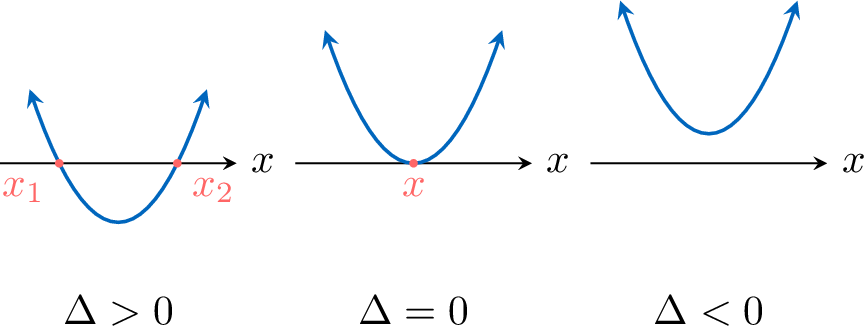
- If \(\boldsymbol{\Delta > 0}\), there are two distinct x-intercepts. The roots are \(x_1 = \frac{-b - \sqrt{\Delta}}{2a}\) and \(x_2 = \frac{-b + \sqrt{\Delta}}{2a}\).
- If \(\boldsymbol{\Delta = 0}\), there is one x-intercept (at the vertex). The root is \(x = \frac{-b}{2a}\).
- If \(\boldsymbol{\Delta < 0}\), there are no x-intercepts.
Method — Solving with the Discriminant
To solve \(ax^2 + bx + c = 0\) (with \(a \neq 0\)): - Identify the coefficients \(a\), \(b\) and \(c\) (write the equation in the form \(ax^2 + bx + c = 0\) first).
- Compute the discriminant \(\Delta = b^2 - 4ac\).
- Conclude from the sign of \(\Delta\): if \(\Delta > 0\), two roots \(x_1 = \dfrac{-b - \sqrt{\Delta}}{2a}\) and \(x_2 = \dfrac{-b + \sqrt{\Delta}}{2a}\); if \(\Delta = 0\), one double root \(x_0 = -\dfrac{b}{2a}\); if \(\Delta < 0\), no real root.
- Write the solution set \(S\), and check one root in the equation.
Proposition — Factorising a Quadratic Function
Let \(f(x) = ax^2 + bx + c\) with \(a \neq 0\) and \(\Delta = b^2 - 4ac\). - If \(\Delta > 0\), \(f\) has two roots, denoted \(x_1\) and \(x_2\), and, for all \(x\), \(f(x) = a(x - x_1)(x - x_2)\).
- If \(\Delta = 0\), \(f\) has one (double) root \(x_0 = -\dfrac{b}{2a}\) and, for all \(x\), \(f(x) = a(x - x_0)^2\).
- If \(\Delta < 0\), \(f\) has no root and cannot be written as a product of two first-degree factors.
By the vertex form, for all \(x\), $$f(x) = a\left[\left(x + \frac{b}{2a}\right)^2 - \frac{\Delta}{4a^2}\right].$$
- If \(\Delta > 0\), then \(\dfrac{\Delta}{4a^2} = \left(\dfrac{\sqrt{\Delta}}{2a}\right)^2\) and the bracket is a difference of two squares: $$f(x) = a\left(x + \frac{b}{2a} - \frac{\sqrt{\Delta}}{2a}\right)\left(x + \frac{b}{2a} + \frac{\sqrt{\Delta}}{2a}\right) = a\,(x - x_1)(x - x_2)$$ with \(x_1 = \dfrac{-b - \sqrt{\Delta}}{2a}\) and \(x_2 = \dfrac{-b + \sqrt{\Delta}}{2a}\), the two roots given by the quadratic formula.
- If \(\Delta = 0\), the bracket is \(\left(x + \dfrac{b}{2a}\right)^2\), so \(f(x) = a(x - x_0)^2\) with \(x_0 = -\dfrac{b}{2a}\).
- If \(\Delta < 0\), then \(-\dfrac{\Delta}{4a^2} > 0\), so the bracket is strictly positive for every \(x\): \(f(x)\) never vanishes. A product \(a(x - p)(x - q)\) vanishes at \(x = p\), so no such writing exists.
Example
Factorise, when possible: \(f(x) = -3x^2 + 6x + 9\), \(g(x) = 4x^2 - 4x + 1\) and \(k(x) = x^2 + x + 1\). - \(f\): \(\Delta = 6^2 - 4 \times (-3) \times 9 = 36 + 108 = 144 > 0\), \(\sqrt{\Delta} = 12\). The roots are \(\dfrac{-6 - 12}{-6} = 3\) and \(\dfrac{-6 + 12}{-6} = -1\), so \(f(x) = -3(x + 1)(x - 3)\).
- \(g\): \(\Delta = (-4)^2 - 4 \times 4 \times 1 = 0\), double root \(x_0 = \dfrac{4}{8} = \dfrac12\), so \(g(x) = 4\left(x - \dfrac12\right)^2 = (2x - 1)^2\).
- \(k\): \(\Delta = 1 - 4 = -3 < 0\): \(k\) has no root and cannot be factorised.
Skills to practice
- Calculating the Discriminant
- Finding the Number of Roots with the Discriminant
IV
Using the Sum and Product of the Roots
The quadratic formula provides the roots of an equation. However, there is a direct relationship between the coefficients of a quadratic equation and the sum and product of its roots. These relationships are known as Vieta's formulas. They are a powerful tool for constructing equations from known roots and for solving problems where the sum or product of roots is involved, without needing to calculate the roots themselves.
Proposition — Sum and Product of Roots
Let \(ax^2 + bx + c = 0\) (with \(a \neq 0\)) be a quadratic equation whose discriminant is \(\Delta \ge 0\), and let \(x_1\) and \(x_2\) be its roots (equal when \(\Delta = 0\)). Then: - Sum of roots: \(x_1 + x_2 = -\dfrac{b}{a}\)
- Product of roots: \(x_1 x_2 = \dfrac{c}{a}\)
Since \(x_1\) and \(x_2\) are the roots of \(ax^2 + bx + c = 0\), the trinomial factorises as \(ax^2 + bx + c = a(x - x_1)(x - x_2)\). Expanding this factored form: $$\begin{aligned} a(x - x_1)(x - x_2) &= a\left[x^2 - (x_1 + x_2)x + x_1 x_2\right] \quad \color{gray}\text{(Expand the two brackets)} \\
&= ax^2 - a(x_1 + x_2)\,x + a\,x_1 x_2 \quad \color{gray}\text{(Multiply through by \(a\))}. \end{aligned}$$ Two polynomials that are equal for every \(x\) have the same coefficients. Identifying with \(ax^2 + bx + c\) term by term: $$b = -a(x_1 + x_2) \quad \text{and} \quad c = a\,x_1 x_2.$$ Since \(a \neq 0\), dividing each by \(a\) gives $$x_1 + x_2 = -\frac{b}{a} \quad \text{and} \quad x_1 x_2 = \frac{c}{a}.$$ Note that no root was ever calculated: the sum and the product are the coefficients of the expanded factored form.
Example
- Without solving the equation, find the sum and the product of the roots of \(2x^2 - 5x - 7 = 0\).
- Check that \(1\) is a root of \(x^2 - 8x + 7 = 0\) and deduce the other root without any further calculation.
- \(a = 2\), \(b = -5\), \(c = -7\) and \(\Delta = 25 + 56 = 81 > 0\), so the equation has two roots, with \(x_1 + x_2 = -\dfrac{b}{a} = \dfrac{5}{2}\) and \(x_1 x_2 = \dfrac{c}{a} = -\dfrac{7}{2}\).
- \(1 - 8 + 7 = 0\), so \(x_1 = 1\) is a root. The product of the roots is \(\dfrac{c}{a} = 7\), hence \(x_2 = 7\) (check: \(1 + 7 = 8 = -\dfrac{b}{a}\)).
Skills to practice
- Finding the Sum and Product of the Roots
- Using the Sum and Product of the Roots
V
Finding Where a Line Meets a Curve
A common problem is to find where the graphs of two functions meet. The intersection points are the points \((x,y)\) that satisfy both equations simultaneously. By setting the function rules equal to each other, we can create a new equation to solve for the x-coordinates of these points.
Method — Finding Intersection Points
To find the points of intersection between the graphs of two functions \(f(x)\) and \(g(x)\): - Set the functions equal to each other: \(\boldsymbol{f(x) = g(x)}\).
- Solve this equation for \(x\). The solutions are the \(x\)-coordinates of the intersection points.
- Substitute each \(x\)-coordinate back into either of the original functions (\(f\) or \(g\)) to find the corresponding y-coordinate.
Example
Find the coordinates of the intersection points of the parabola \(f(x) = x^2 - x - 2\) and the line \(g(x) = x+1\).
We find the intersection points by setting \(f(x) = g(x)\) and solving for \(x\).$$ \begin{aligned}f(x) &= g(x) \\
x^2 - x - 2 &= x+1 \\
x^2 - 2x - 3 &= 0 \\
(x-3)(x+1) &= 0\end{aligned} $$ This gives two solutions for \(x\): \(x=3\) and \(x=-1\).
Now we find the corresponding \(y\)-coordinates by substituting these values into the linear function \(g(x)=x+1\): 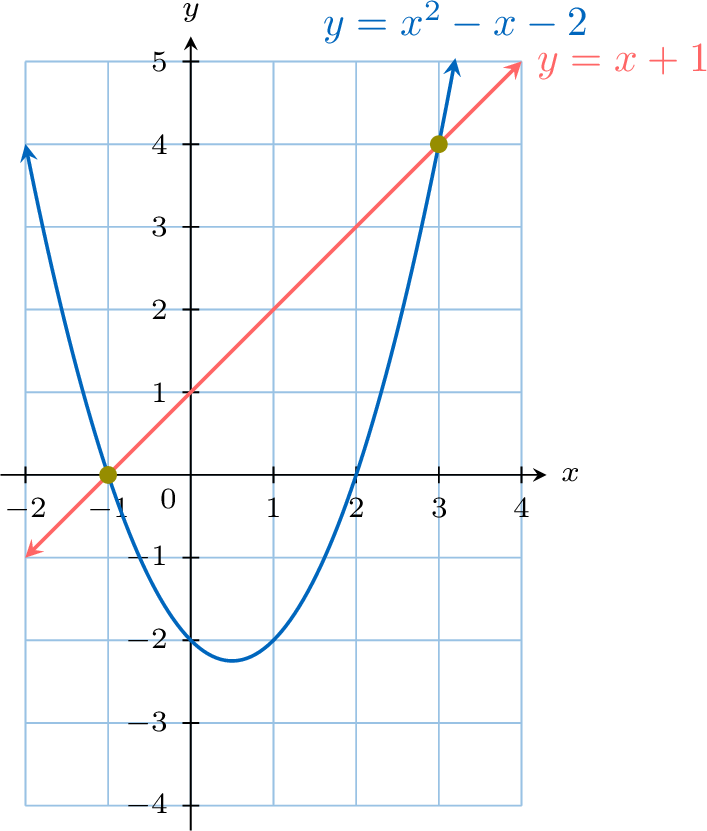
Now we find the corresponding \(y\)-coordinates by substituting these values into the linear function \(g(x)=x+1\):
- If \(x=3\), \(y = 3+1 = 4\).
- If \(x=-1\), \(y = -1+1 = 0\).
Skills to practice
- Finding Intersection Points Algebraically
VI
Going further
Skills to practice
- Choosing a Method and Explaining
- Solving Problems with the Quadratic Formula
- Investigating Patterns with the Quadratic Formula
- Quiz
Jump to section