International Baccalaureate · DP 1: Applications and Interpretation HL
Right-Angled Triangle Trigonometry
I
The Trigonometric Ratios
I.1
Sides of a Right-Angled Triangle
Recappreviously studied — click to reread
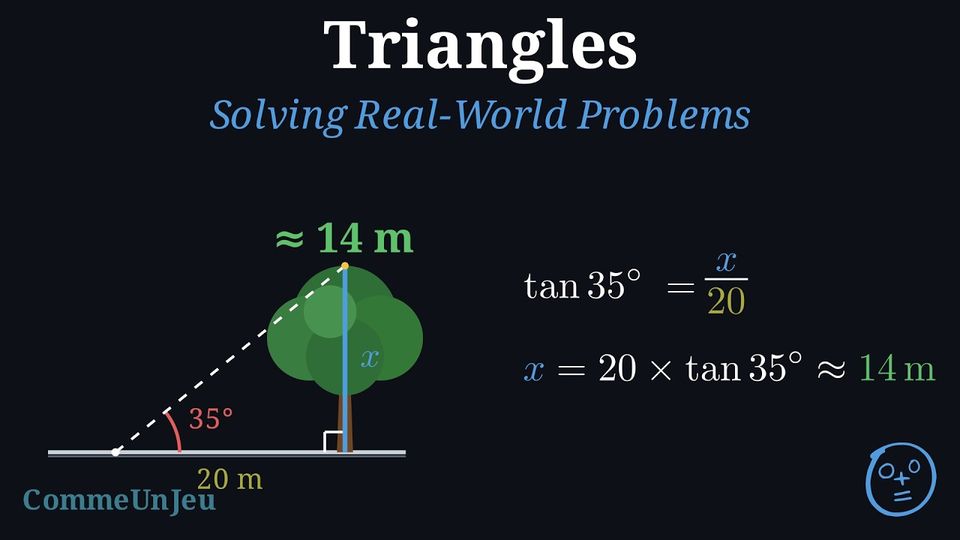
How tall is a tree you cannot climb? Stand \(20\,\text{m}\) from its foot and, from ground level, measure the angle up to its top: \(35^\circ\). You cannot put a tape to the top — but the height is already determined. The tree, the ground and your line of sight form a right-angled triangle, and every right-angled triangle with a \(35^\circ\) angle is a scaled copy of this one (an enlargement or reduction of it), so the ratio \(\dfrac{\text{height}}{\text{distance}}\) is always the same for \(35^\circ\). 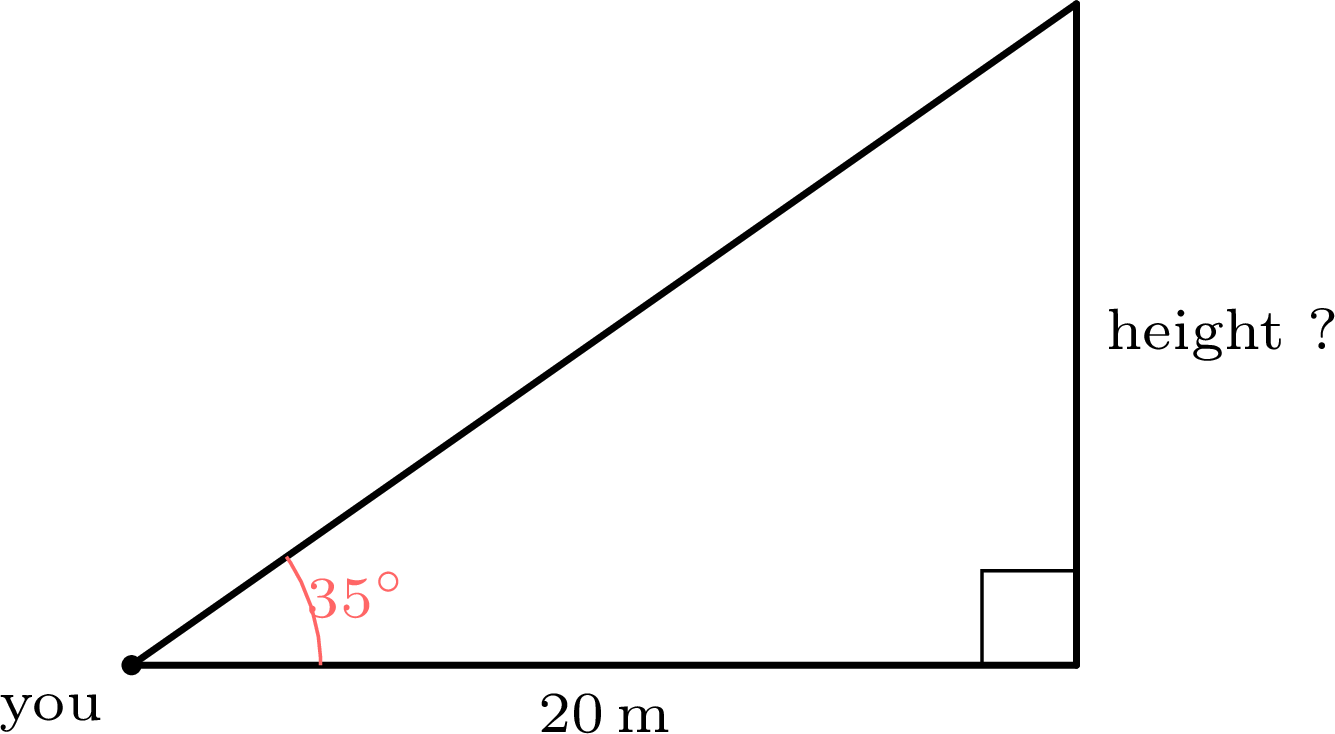
Those fixed ratios have names — sine, cosine, tangent — so that one side and one angle calculate the rest (here height \(=20\tan 35^\circ\)). The ratios work because all such triangles are enlargements or reductions of one another.
Once the trigonometric ratios are defined: the ratio \(\dfrac{\text{height}}{\text{distance}}\) for \(35^\circ\) is the tangent of \(35^\circ\), and the calculator gives \(\tan 35^\circ \approx 0.700\). So $$\text{height} = 20 \times \tan 35^\circ \approx 20 \times 0.700 = 14.0 \text{ m.}$$ With practice, this line becomes routine.
Definition — Right-Angled Triangle Sides
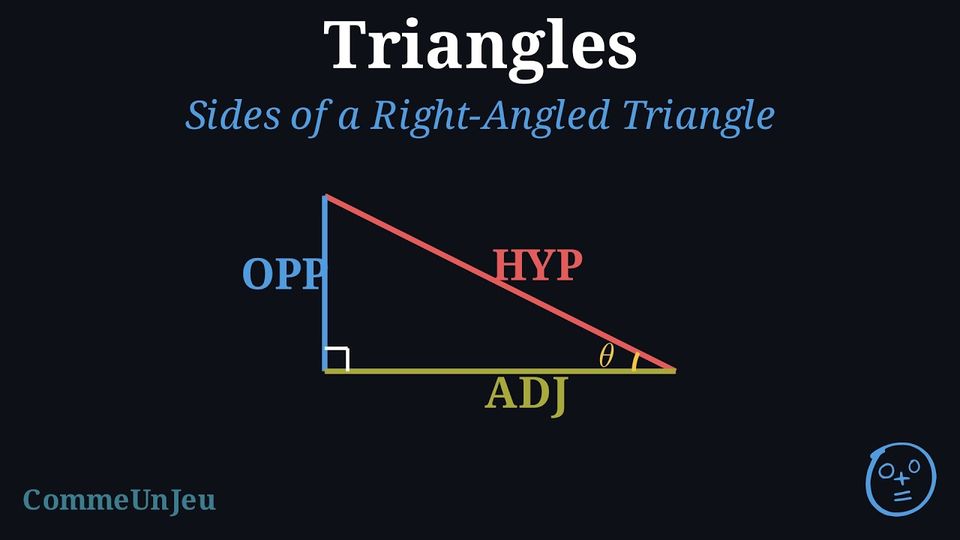
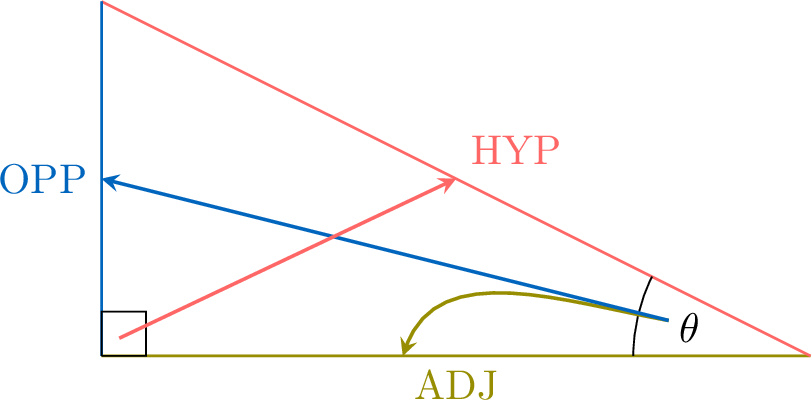
A right-angled triangle has one \(90^\circ\) angle. We name the sides relative to a chosen acute angle \(\theta\) (not the right angle). - The Hypotenuse (HYP) is the longest side, always opposite the right angle. It does not depend on the choice of \(\theta\).
- The Opposite (OPP) side is directly across from the angle \(\theta\); it does not touch \(\theta\).
- The Adjacent (ADJ) side is the leg next to the angle \(\theta\); it touches \(\theta\) but is not the hypotenuse.
Example
In the triangle below, the angle \(\theta\) is at vertex \(B\). Identify the hypotenuse, the adjacent side, and the opposite side relative to angle \(\theta\). 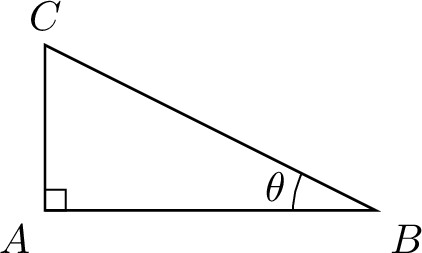
Relative to angle \(\theta\) at \(B\):
- Hypotenuse: \(\Segment{BC}\)
- Adjacent side: \(\Segment{AB}\)
- Opposite side: \(\Segment{AC}\)
Skills to practice
- Identifying Triangle Sides
I.2
The Three Trigonometric Ratios
Recappreviously studied — click to reread
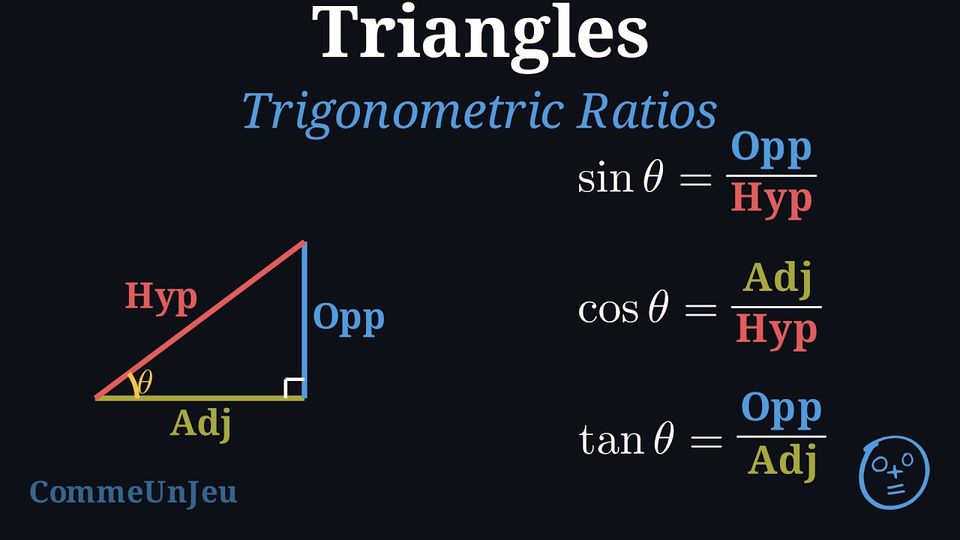
The Foundation of Trigonometric Ratios
Why do trigonometric ratios work? Because two right-angled triangles with the same acute angle are an enlargement or a reduction of one another: all the lengths of one are the lengths of the other multiplied by the same scale factor \(k\).
Consider any two right-angled triangles that share a common acute angle, \(\theta\). 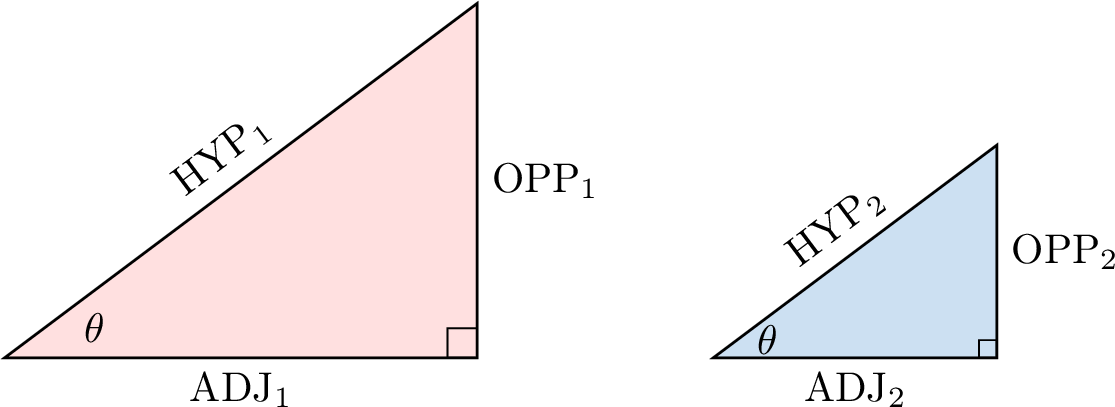
Both triangles have a right angle (\(90^\circ\)) and both share the angle \(\theta\) — so their third angles are equal too (the angles of a triangle add up to \(180^\circ\)). Having the same angles, one triangle is an enlargement or a reduction of the other: every side of the second is the same multiple \(k\) of the matching side of the first. This is exactly what Thales's theorem (the intercept theorem) guarantees: place the two angles \(\theta\) on top of each other — the two opposite sides, both perpendicular to the common adjacent side, are parallel, so the two triangles are nested in a Thales configuration and their sides are proportional. 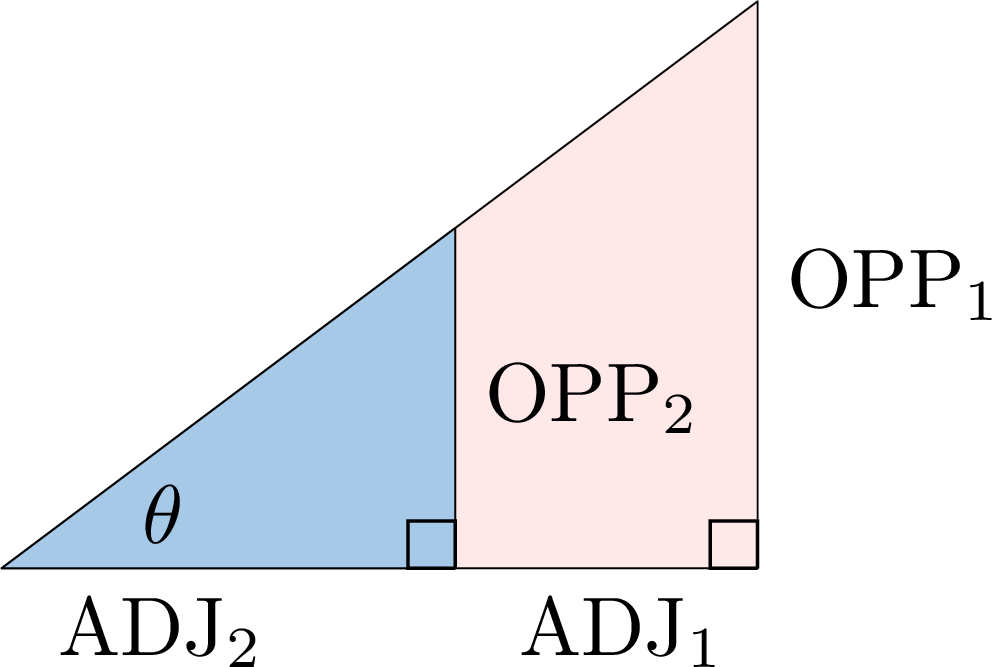
When we divide two sides of the same triangle, this factor \(k\) cancels — the ratio comes out the same in both triangles. This means that for any right-angled triangle with the acute angle \(\theta\): $$ \frac{\text{OPP}_1}{\text{HYP}_1} = \frac{\text{OPP}_2}{\text{HYP}_2}, \quad \frac{\text{ADJ}_1}{\text{HYP}_1} = \frac{\text{ADJ}_2}{\text{HYP}_2}, \quad \frac{\text{OPP}_1}{\text{ADJ}_1} = \frac{\text{OPP}_2}{\text{ADJ}_2}. $$ Since these ratios are constant for any given angle \(\theta\), regardless of the size of the triangle, we can give them special names. These are the trigonometric ratios.
Consider any two right-angled triangles that share a common acute angle, \(\theta\).
Definition — The Three Trigonometric Ratios
For an acute angle \(\theta\) in a right-angled triangle, we define the three main trigonometric ratios: sine, cosine, and tangent. $$ \sin(\theta) = \frac{\text{Opposite}}{\text{Hypotenuse}}, \quad \cos(\theta) = \frac{\text{Adjacent}}{\text{Hypotenuse}}, \quad \tan(\theta) = \frac{\text{Opposite}}{\text{Adjacent}}. $$
A common mnemonic to remember these is SOH-CAH-TOA:
- Sin = Opposite / Hypotenuse
- Cos = Adjacent / Hypotenuse
- Tan = Opposite / Adjacent
Example
In the triangle below, find \(\cos \theta\), \(\sin \theta\), and \(\tan \theta\). 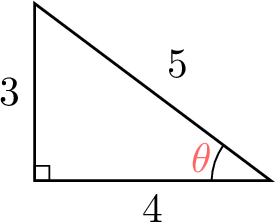
Relative to \(\theta\) at \(B\):
- Hypotenuse: \(BC = 5\)
- Adjacent side: \(AB = 4\)
- Opposite side: \(AC = 3\)
How Do the Ratios Vary?
Take the same ladder (a fixed hypotenuse) and lean it more steeply: the acute angle \(\theta\) at its foot grows, the top climbs higher (the opposite side grows) and the foot comes closer to the wall (the adjacent side shrinks). So, as \(\theta\) grows, \(\sin\theta\) and \(\tan\theta\) increase while \(\cos\theta\) decreases. 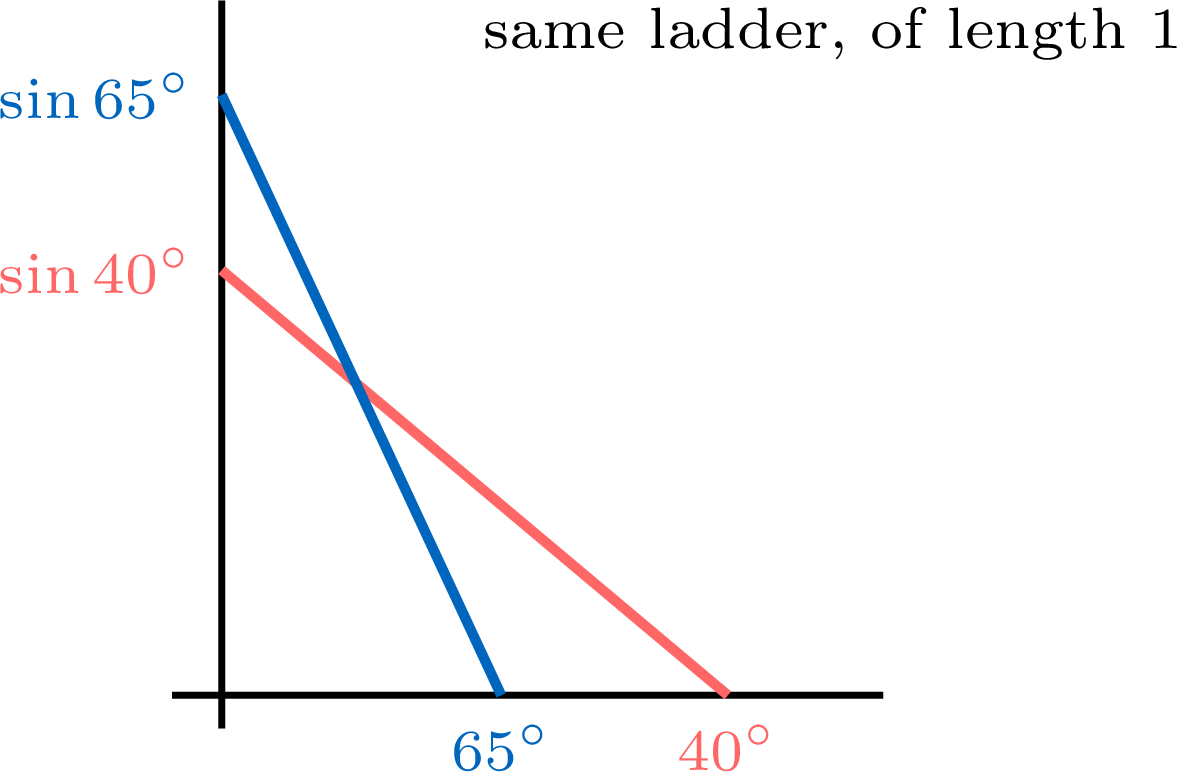
Moreover, the opposite and the adjacent sides are both shorter than the hypotenuse: \(\sin\theta\) and \(\cos\theta\) are always between \(0\) and \(1\). The tangent, a ratio of the two legs, can exceed \(1\).
Proposition — Tangent Formula
For any acute angle \(\theta\) of a right-angled triangle, $$\tan \theta = \frac{\sin \theta}{\cos \theta}$$
$$\begin{aligned} \tan \theta &= \frac{\text{OPP}}{\text{ADJ}}\\
&= \frac{\text{OPP}/\text{HYP}}{\text{ADJ}/\text{HYP}}\\
&= \frac{\sin \theta}{\cos \theta}.\\
\end{aligned}$$
Method — Using a Calculator
Trigonometric ratios for any acute angle can be calculated using a scientific calculator in degree mode. Always check that the calculator is set to “DEG” (degrees) before calculating. Example
In the triangle below, find \(x\), rounded to one decimal place. 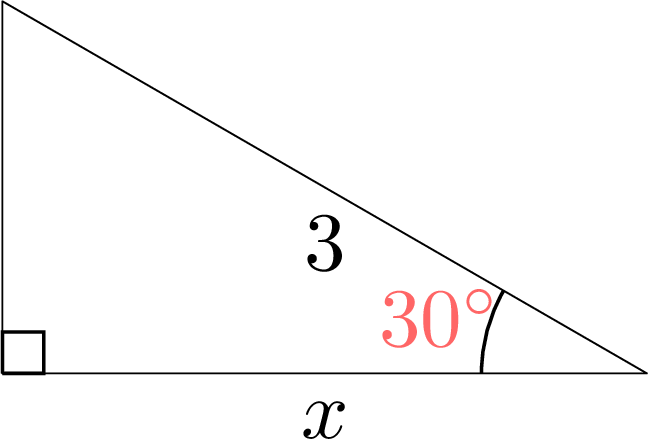
Relative to the angle \(30^\circ\) at \(B\), the side of length \(3\) is the hypotenuse and the side \(x\) is adjacent to the angle. $$\begin{aligned} \cos \theta &= \frac{\text{ADJ}}{\text{HYP}} \\
\cos(30^\circ) &= \frac{x}{3} \\
x &= 3 \times \cos(30^\circ) \\
x &\approx 3 \times 0.866 \\
x &\approx 2.6 \quad \text{(rounded to one decimal place)} \end{aligned}$$
Example
In the triangle below, find \(x\), rounded to one decimal place. 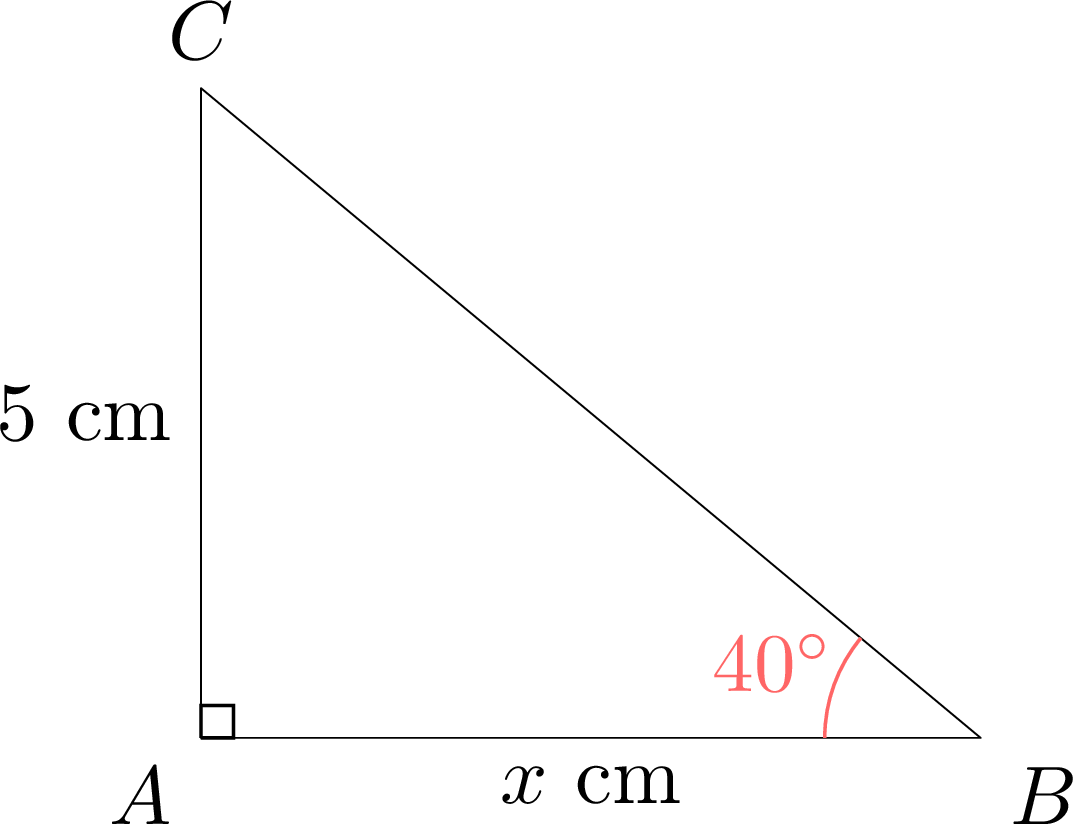
With respect to the \(40^\circ\) angle at \(B\): the side \(AC = 5\) is opposite, the side \(AB = x\) is adjacent. The ratio that links the opposite and the adjacent sides is the tangent: $$\begin{aligned} \tan(40^\circ) &= \frac{5}{x} \\
x \times \tan(40^\circ) &= 5 \\
x &= \frac{5}{\tan(40^\circ)} \\
x &\approx \frac{5}{0.839} \approx 6.0 \text{ cm} \quad \text{(rounded to one decimal place)} \end{aligned}$$ The unknown is in the denominator: multiply both sides by \(x\), then divide by \(\tan(40^\circ)\) — the unknown is never left under the fraction bar.
Skills to practice
- Calculating Trigonometric Ratios
- Calculating Side Lengths
II
Finding Angles
II.1
Finding an Angle from a Ratio
Recappreviously studied — click to reread
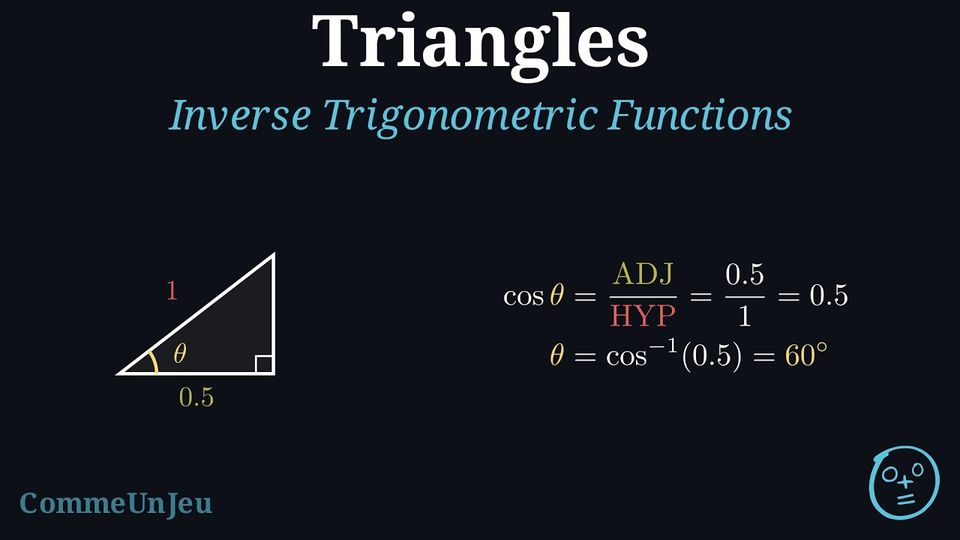
Trigonometric ratios can be used to find unknown angles in right-angled triangles when at least two side lengths are known.
Definition — Inverse Trigonometric Functions
In a right-angled triangle with an acute angle \(\theta\): $$ \theta = \cos^{-1}\left(\frac{\text{ADJ}}{\text{HYP}}\right), \quad \theta = \sin^{-1}\left(\frac{\text{OPP}}{\text{HYP}}\right), \quad \theta = \tan^{-1}\left(\frac{\text{OPP}}{\text{ADJ}}\right). $$ The notation \(\cos^{-1}\) (read “inverse cosine”) is the calculator function that recovers the angle from the ratio — it does not mean \(\frac{1}{\cos\theta}\). Example
In the triangle below, find the angle \(\theta\). 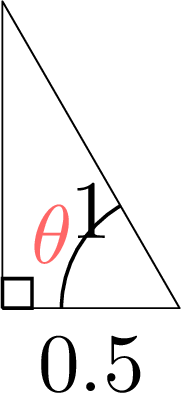
We know the lengths of the adjacent side (\(AB = 0.5\)) and the hypotenuse (\(BC = 1\)) relative to \(\theta\). We can use the inverse cosine function: $$\begin{aligned} \theta &= \cos^{-1}\left(\frac{\text{ADJ}}{\text{HYP}}\right) \\
&= \cos^{-1}\left(\frac{0.5}{1}\right) \\
&= 60^\circ. \end{aligned}$$
Example
A slide is \(4\) m long and its top is \(2.4\) m above the ground. Find the angle the slide makes with the ground, rounded to the nearest degree. 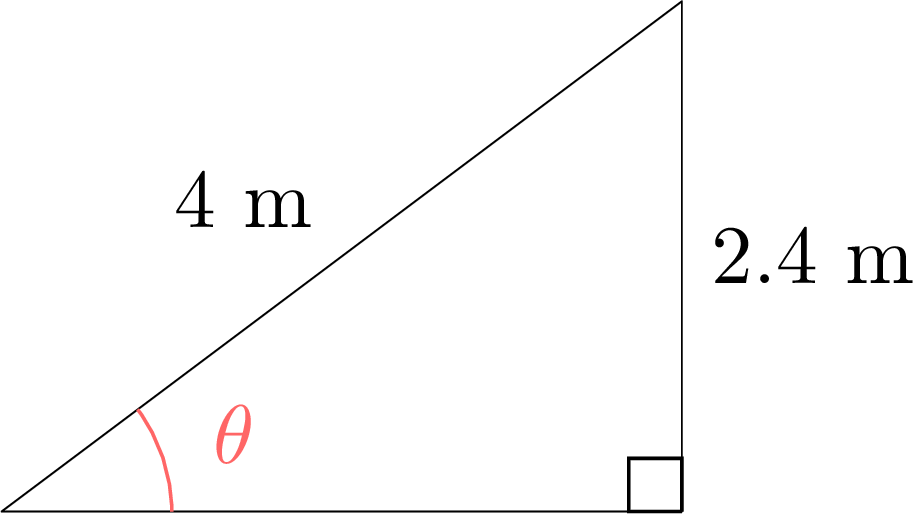
The slide, the ground and the vertical line from the top form a right-angled triangle. With respect to the wanted angle \(\theta\) (at the foot of the slide), we know the opposite side (\(2.4\) m, the height) and the hypotenuse (\(4\) m, the slide): the ratio that links them is the sine, so the inverse function to use is \(\sin^{-1}\). $$\begin{aligned} \sin\theta &= \frac{\text{OPP}}{\text{HYP}} = \frac{2.4}{4} = 0.6 \\
\theta &= \sin^{-1}(0.6) \approx 36.9^\circ \approx 37^\circ. \end{aligned}$$ The choice of the inverse function follows the two known sides: opposite and hypotenuse \(\to \sin^{-1}\); adjacent and hypotenuse \(\to \cos^{-1}\); opposite and adjacent \(\to \tan^{-1}\).
Skills to practice
- Calculating Angles
III
Right Angles in Geometric Figures
III.1
Right Angles in Circles
Recappreviously studied — click to reread
On a building site, Tom must draw a right angle on the ground, but he has no set square — only string and stakes. He plants two stakes \(B\) and \(C\), draws the circle with diameter \(\Segment{BC}\) (string attached to the midpoint \(O\)), and plants a third stake at any point \(A\) of the circle (other than \(B\) and \(C\)). 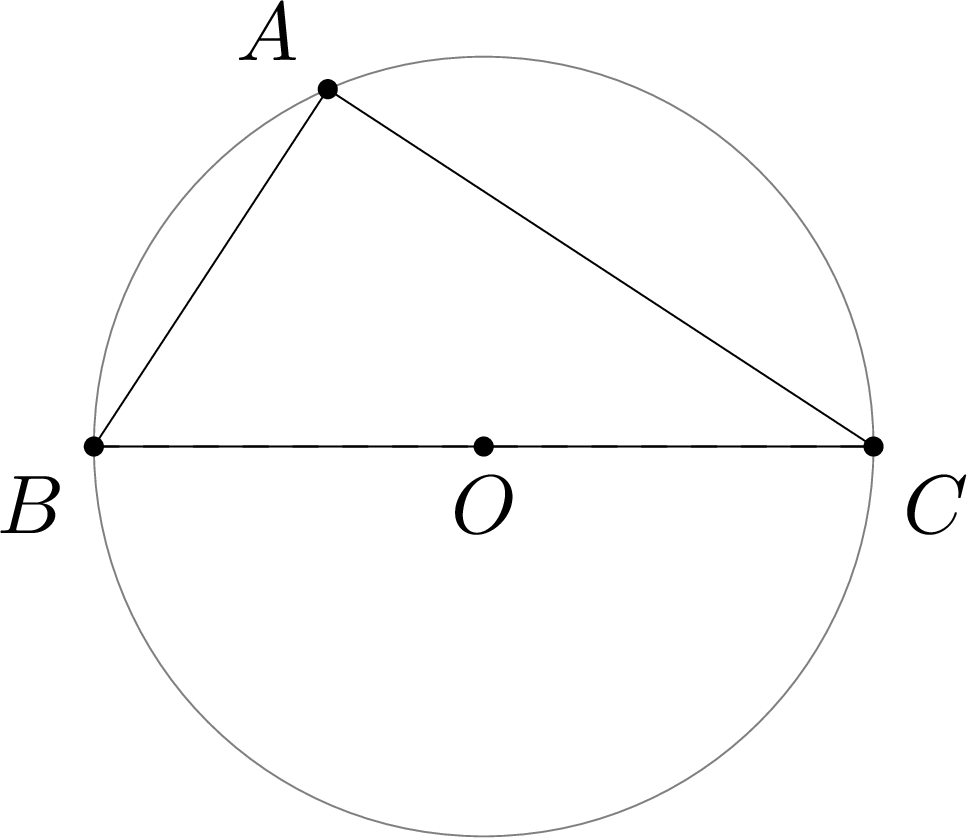
Tom claims the angle at \(A\) is right, wherever \(A\) is on the circle. Is he correct?
Yes: this is the theorem below — any triangle inscribed in a circle with one side as a diameter is right-angled, at the vertex opposite the diameter. Tom's string and stakes draw perfect right angles. This result is often accepted without proof — here it is proved.
Theorem — Angle in a Semicircle
If a triangle is inscribed in a circle and one of its sides is a diameter of the circle, then the triangle is right-angled at the vertex opposite that diameter: the angle in a semicircle is a right angle. This theorem is also called Thales's theorem. 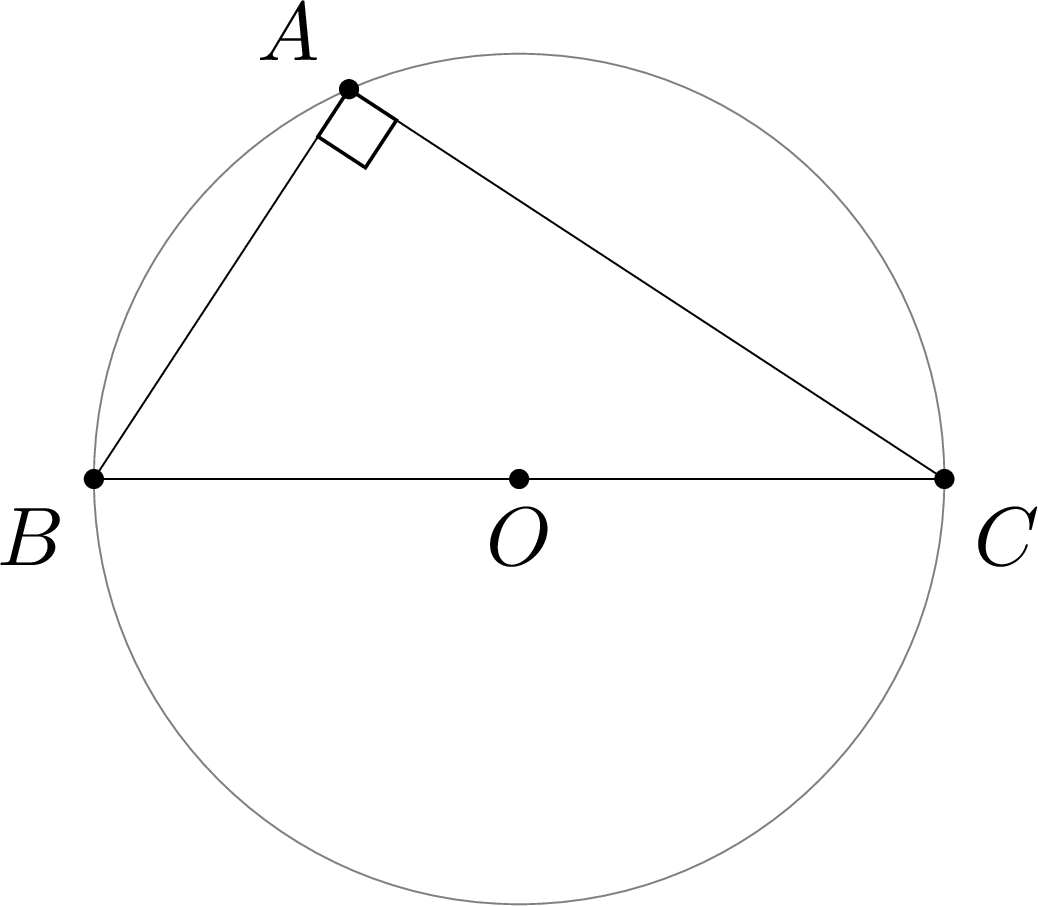
Let \(O\) be the centre of the circle (the midpoint of the diameter \(\Segment{BC}\)). The segments \(\Segment{OA}\), \(\Segment{OB}\) and \(\Segment{OC}\) are all radii: \(OA = OB = OC\). 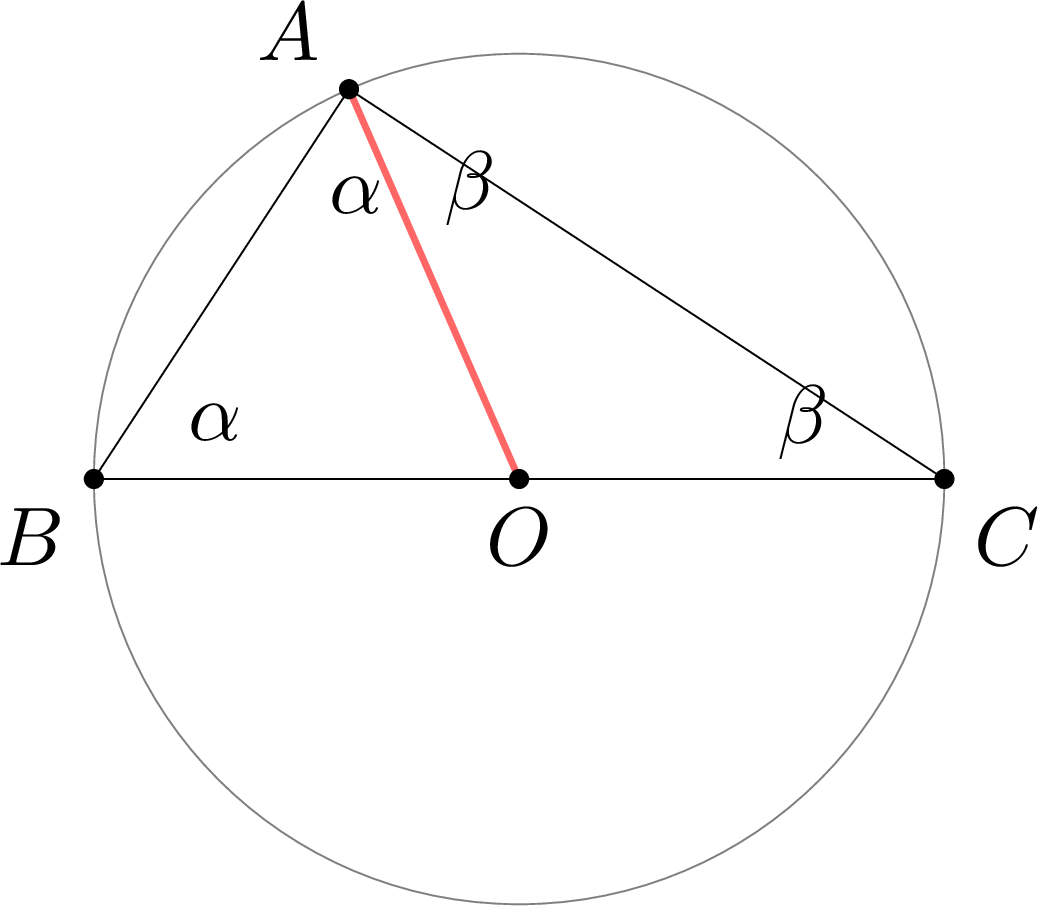
- The triangle \(OAB\) is isosceles at \(O\), so its base angles are equal: \(\Angle{BAO} = \Angle{ABO} = \alpha\).
- The triangle \(OAC\) is isosceles at \(O\), so its base angles are equal: \(\Angle{OAC} = \Angle{OCA} = \beta\).
Theorem — Circumscribed Circle of a Right-Angled Triangle
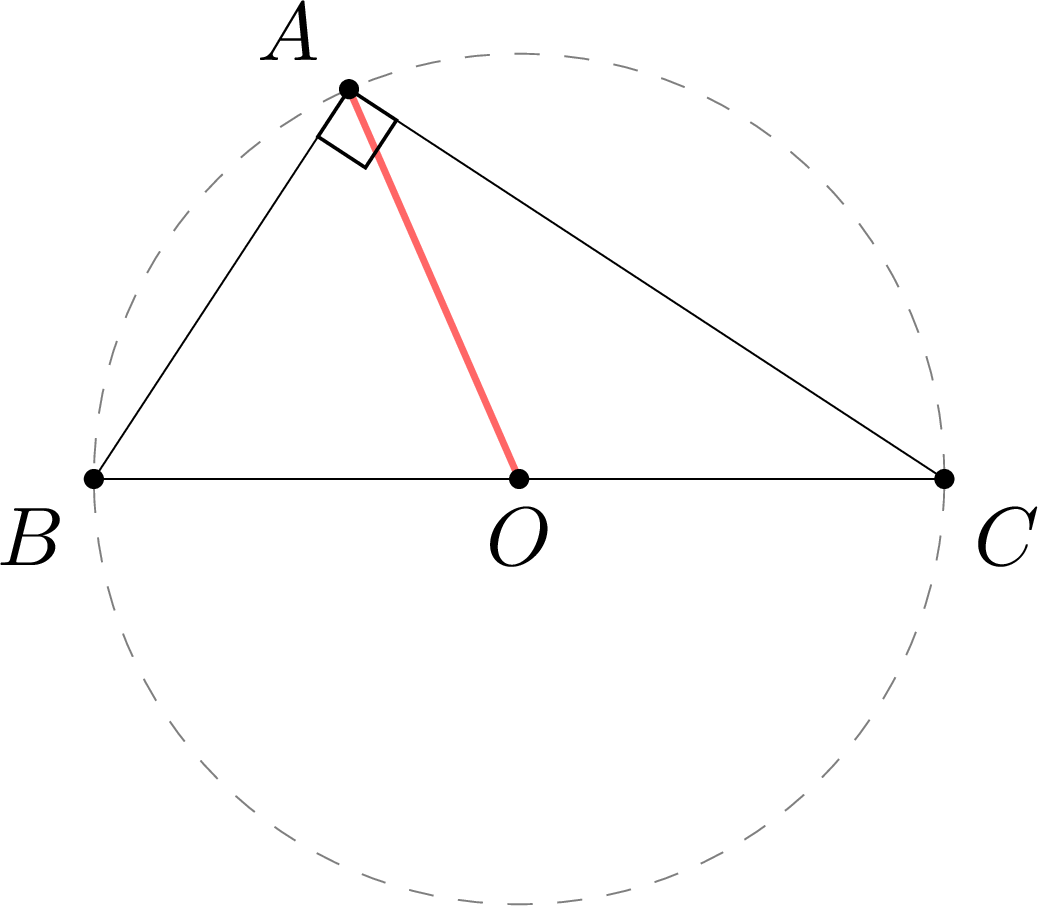
If a triangle is right-angled, then the centre of its circumscribed circle is the midpoint of its hypotenuse (the hypotenuse is a diameter).In particular, the median from the right angle measures half the hypotenuse.
Proposition — Tangent Line and Radius
Let \(\mathcal{C}\) be the circle of centre \(O\) and radius \(r\), and \(A\) a point of \(\mathcal{C}\). The line through \(A\) perpendicular to the radius \(\Segment{OA}\) is tangent to \(\mathcal{C}\) at \(A\), and it is the only line tangent to \(\mathcal{C}\) at \(A\): it is the tangent line to \(\mathcal{C}\) at \(A\). Example
A logo shows an ice-cream cone: the scoop is a disc of centre \(O\) and radius \(3\) cm, and the two straight sides of the cone are the tangent lines to its circle through the tip \(P\), with \(OP = 5\) cm. 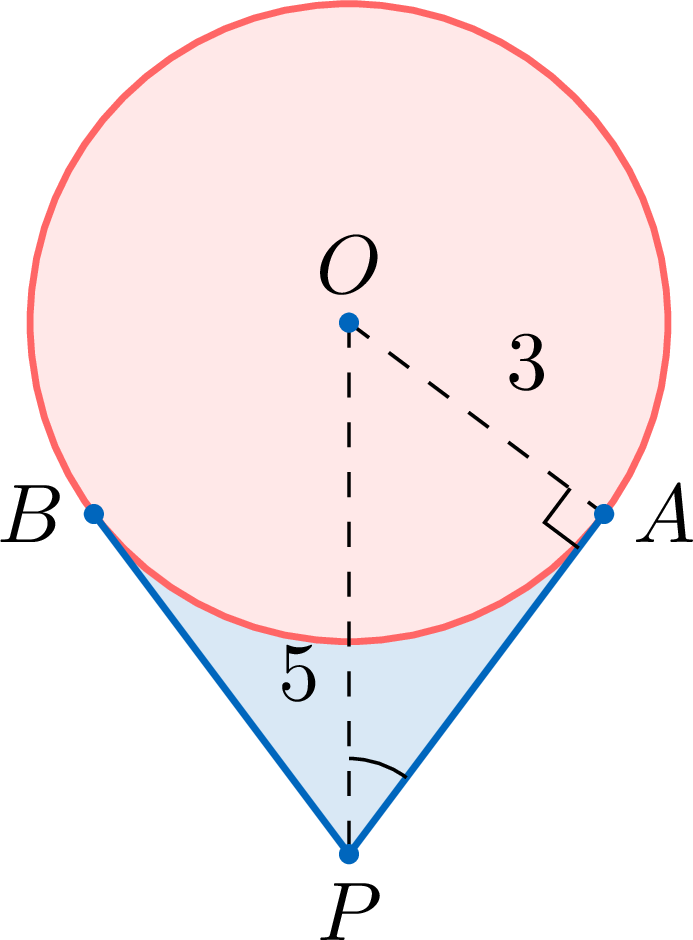
The side \(\Line{PA}\) is tangent at \(A\), so the triangle \(OAP\) is right-angled at \(A\) (tangent line and radius): $$\begin{aligned}[t] PA &= \sqrt{OP^2 - OA^2} && \text{(Pythagoras' theorem in }OAP\text{)}\\
&= \sqrt{5^2 - 3^2}\\
&= \sqrt{16}\\
&= 4 \text{ cm}. \end{aligned}$$ In the same triangle, \(\sin \Angle{APO} = \dfrac{OA}{OP} = \dfrac{3}{5}\), so \(\Angle{APO} \approx 36.87^\circ\). The line \(\Line{OP}\) bisects the angle at the tip: $$\begin{aligned}[t] \Angle{APB} &= 2 \times \Angle{APO} && \text{(line of symmetry }\Line{OP}\text{)}\\
&= 2 \times 36.87^\circ\\
&= 73.74^\circ\\
&\approx 74^\circ \end{aligned}$$
Skills to practice
- Recognising Right Triangles in Circles
- Calculating Lengths with a Right Angle in a Circle
IV
Problem Solving with Trigonometry
IV.1
Real-World Problems
Recappreviously studied — click to reread
Definition — Angle of Elevation and Angle of Depression
When an observer looks at an object, the angle of elevation is the angle between the horizontal and the line of sight when the object is above the observer; the angle of depression is the angle between the horizontal and the line of sight when the object is below the observer. 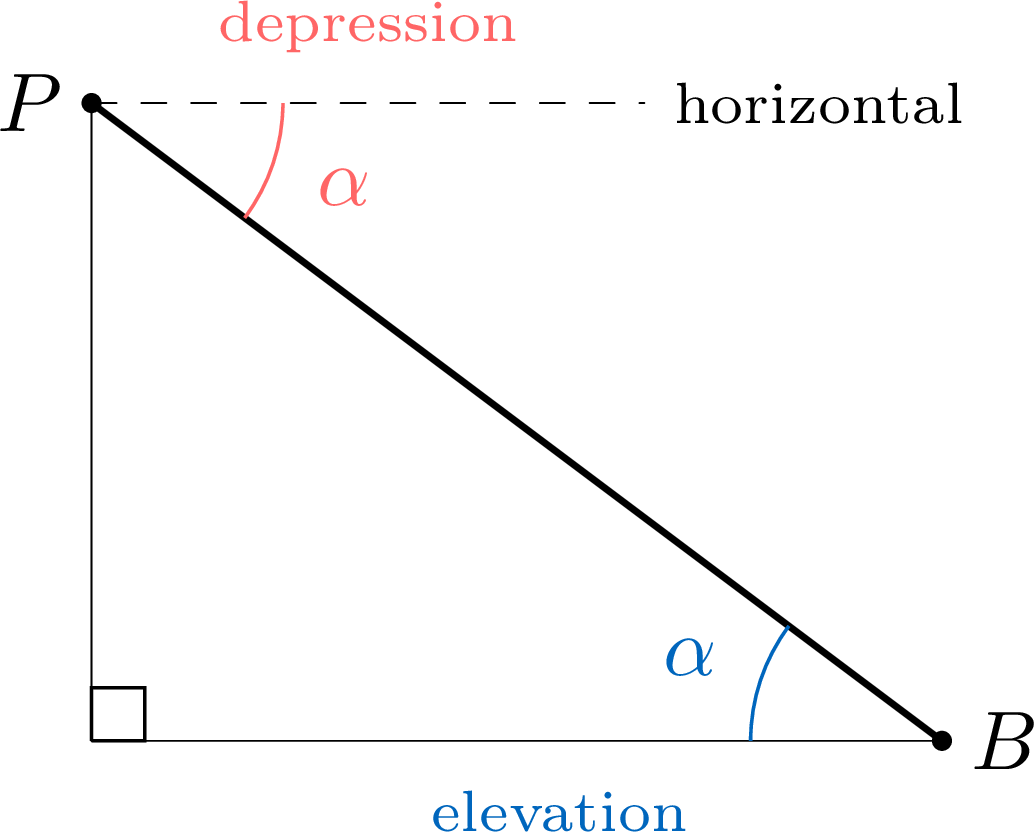
Trigonometric ratios are powerful tools for solving a wide range of problems involving right-angled triangles, especially in real-world contexts. To solve these problems effectively, follow the structured steps below:
Method — Solving Real-World Trigonometry Problems
- Draw a clear diagram representing the situation described in the problem.
- Label the unknown (side or angle) to be found. Use \(x\) for a side and \(\theta\) for an angle if possible.
- Identify a right-angled triangle within the diagram.
- Write an equation relating an angle and two sides of the triangle using the appropriate trigonometric ratio.
- Solve the equation to find the unknown value.
- State the answer clearly, including appropriate units, in a complete sentence.
Example
The string of a kite, taut and straight, is \(50\) m long; its lower end is held at ground level, and the string makes a \(40^\circ\) angle with the horizontal ground. How high is the kite flying? Round to the nearest metre.
We follow the six steps of the method.
- Diagram: the string, the ground and the vertical line through the kite.
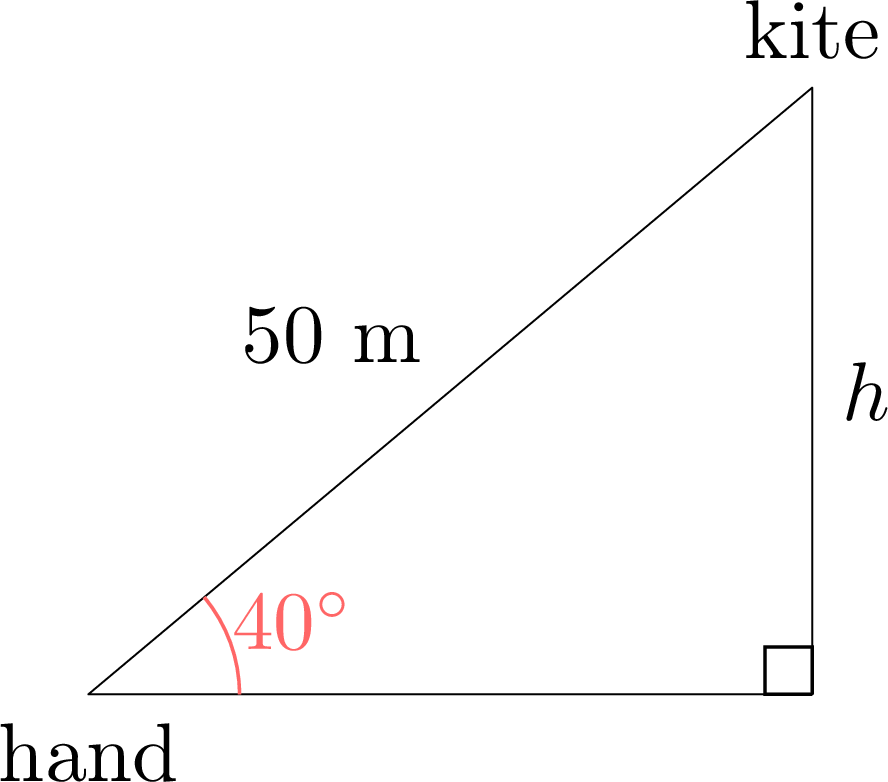
- Unknown: the height \(h\) of the kite.
- Right-angled triangle: the right angle is between the ground and the vertical; the \(40^\circ\) angle is at the hand, on the ground: it is the angle of elevation of the kite.
- Equation: with respect to the \(40^\circ\) angle, \(h\) is the opposite side and the string (\(50\) m) is the hypotenuse, so the sine is the ratio to use: \(\sin(40^\circ) = \dfrac{h}{50}\).
- Solve: \(h = 50 \times \sin(40^\circ) \approx 50 \times 0.643 \approx 32.1\).
- Answer: the kite is flying about \(32\) m above the ground.
Skills to practice
- Solving Real-World Problems
- Writing the Solution
- Solving Multi-Step Problems
V
True Bearings
V.1
Bearings and Back Bearings
Recappreviously studied — click to reread
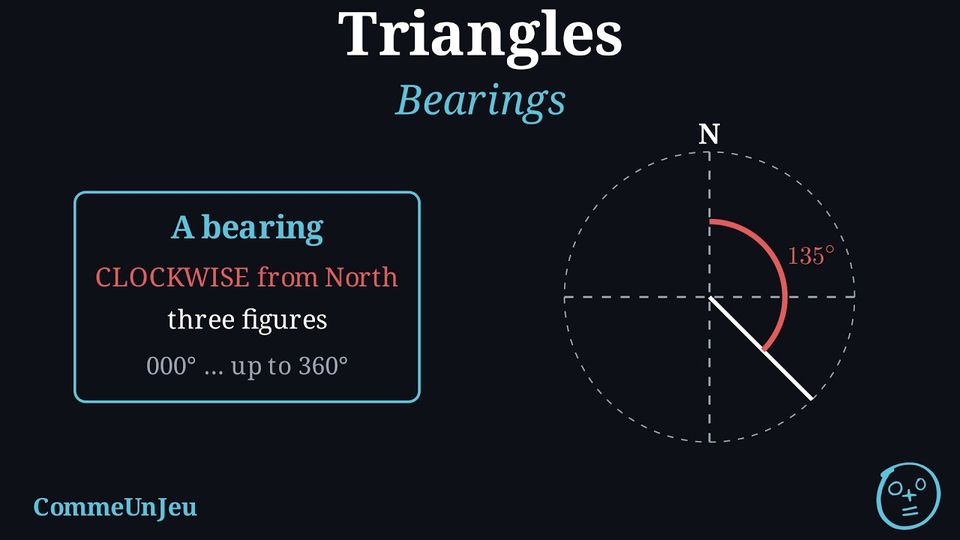
Trigonometry is a powerful tool for navigation and surveying. To describe the direction of travel, we use a standardised system called bearings.
Definition — True Bearings
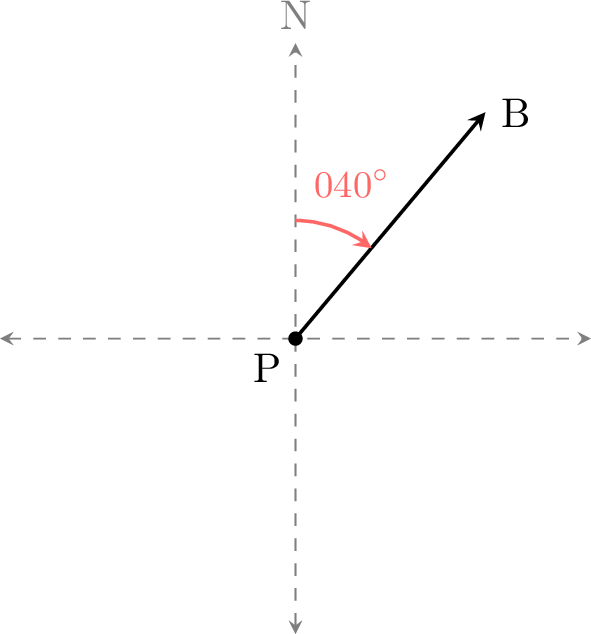
A true bearing is the direction to an object from a point, measured as an angle in a clockwise direction from the North line. The angle is measured in degrees from \(000^\circ\) up to, but not including, \(360^\circ\) (a full turn is written \(000^\circ\)), and bearings are always written using three figures (for example, \(000^\circ\), \(040^\circ\), \(135^\circ\), \(270^\circ\)). Example
- The bearing of A from P is \(135^\circ\).
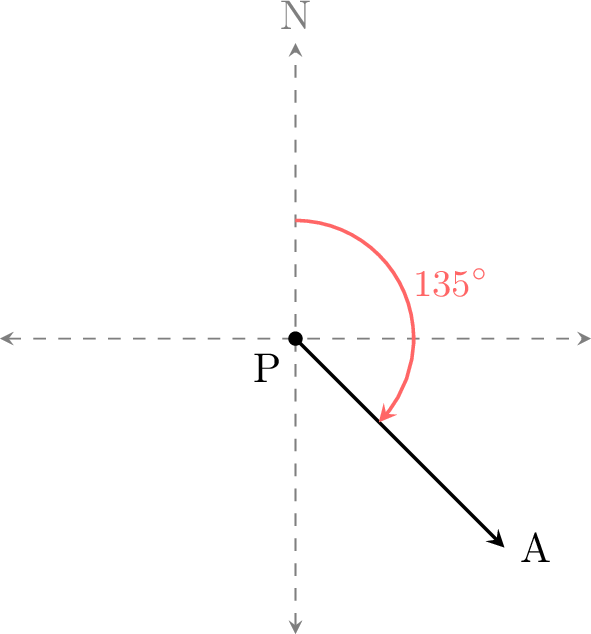
- The bearing of B from P is \(040^\circ\).
Method — Key Geometric Principles for Bearings
Solving bearing problems relies on two key geometric principles that arise from the fact that all North lines on a map or diagram are parallel. - Parallel Line Angles: Because North lines are parallel, angle properties (such as alternate interior or co-interior angles) transfer a direction from one point to another. This is essential for finding the angles of the right-angled triangle formed by the path and the North–South line.
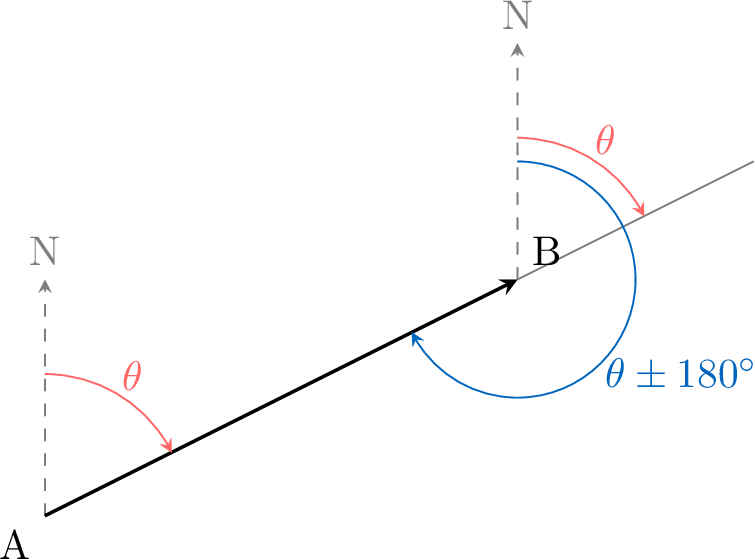
- Back Bearings: The bearing from point A to point B is the forward bearing. The bearing from point B back to point A is the back bearing. A back bearing always differs by \(180^\circ\) from the forward bearing (add or subtract \(180^\circ\) and, if necessary, bring the result back between \(000^\circ\) and \(360^\circ\)).
Skills to practice
- Determining Bearings from a Diagram
- Finding Back Bearings
- Drawing Bearings and Calculating Them from Components
VI
Angles in Solids
VI.1
Angles Between Lines and Planes
Recappreviously studied — click to reread
A vertical mast \(\Segment{FT}\) stands \(6\,\text{m}\) tall; a guy-wire runs from its top \(T\) down to an anchor \(B\) on the ground, \(8\,\text{m}\) from the foot \(F\). What angle does the wire make with the ground? This is no longer an angle inside a flat triangle — it is the angle between a line (the wire) and a plane (the ground). The trick is to find the wire's shadow on the ground, the segment \(\Segment{BF}\): the wire, its shadow, and the mast form a right-angled triangle standing up out of the plane. 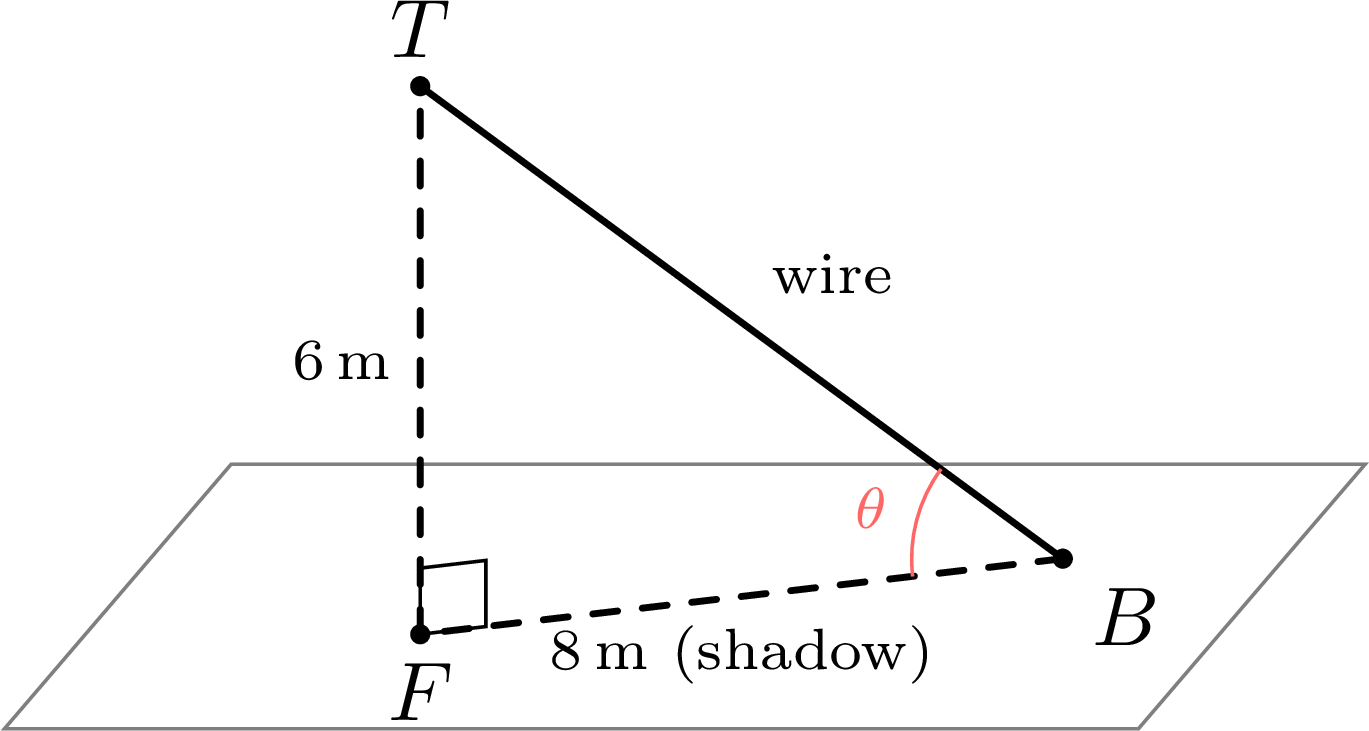
The ratios of the right-angled triangle, used in three dimensions, find the angle between a line and a plane (here \(\tan\theta=\tfrac{6}{8}\)), the key to angles in pyramids, prisms and ramps.
Definition — Angle Between a Line and a Plane
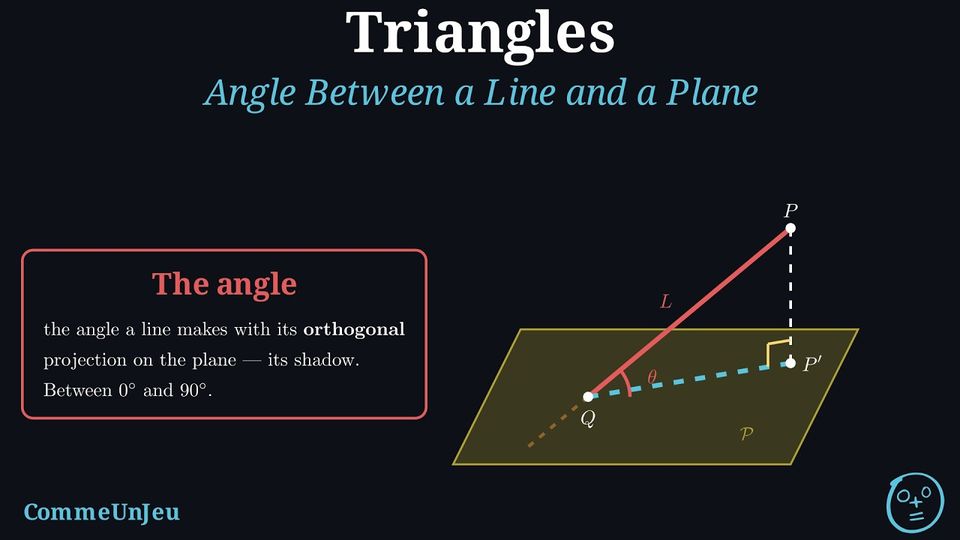
Let \(\mathcal{P}\) be a plane and \(P\) a point outside it. The orthogonal projection of \(P\) on \(\mathcal{P}\) is the point \(P'\) of \(\mathcal{P}\) such that the line \(\Line{PP'}\) is perpendicular to \(\mathcal{P}\): the foot of the perpendicular dropped from \(P\). Let a line \(L\) meet \(\mathcal{P}\) at a point \(Q\), and let \(P'\) be the projection of a point \(P\) of \(L\) outside \(\mathcal{P}\). The angle between the line \(L\) and the plane \(\mathcal{P}\) is the angle \(\theta = \Angle{PQP'}\) between \(L\) and its projection \(\Line{QP'}\). It lies between \(0^\circ\) and \(90^\circ\). When \(L\) is perpendicular to \(\mathcal{P}\), the projection of \(P\) is \(Q\) itself and the angle is taken equal to \(90^\circ\); when \(L\) lies in \(\mathcal{P}\) or is parallel to it, the angle is taken equal to \(0^\circ\). 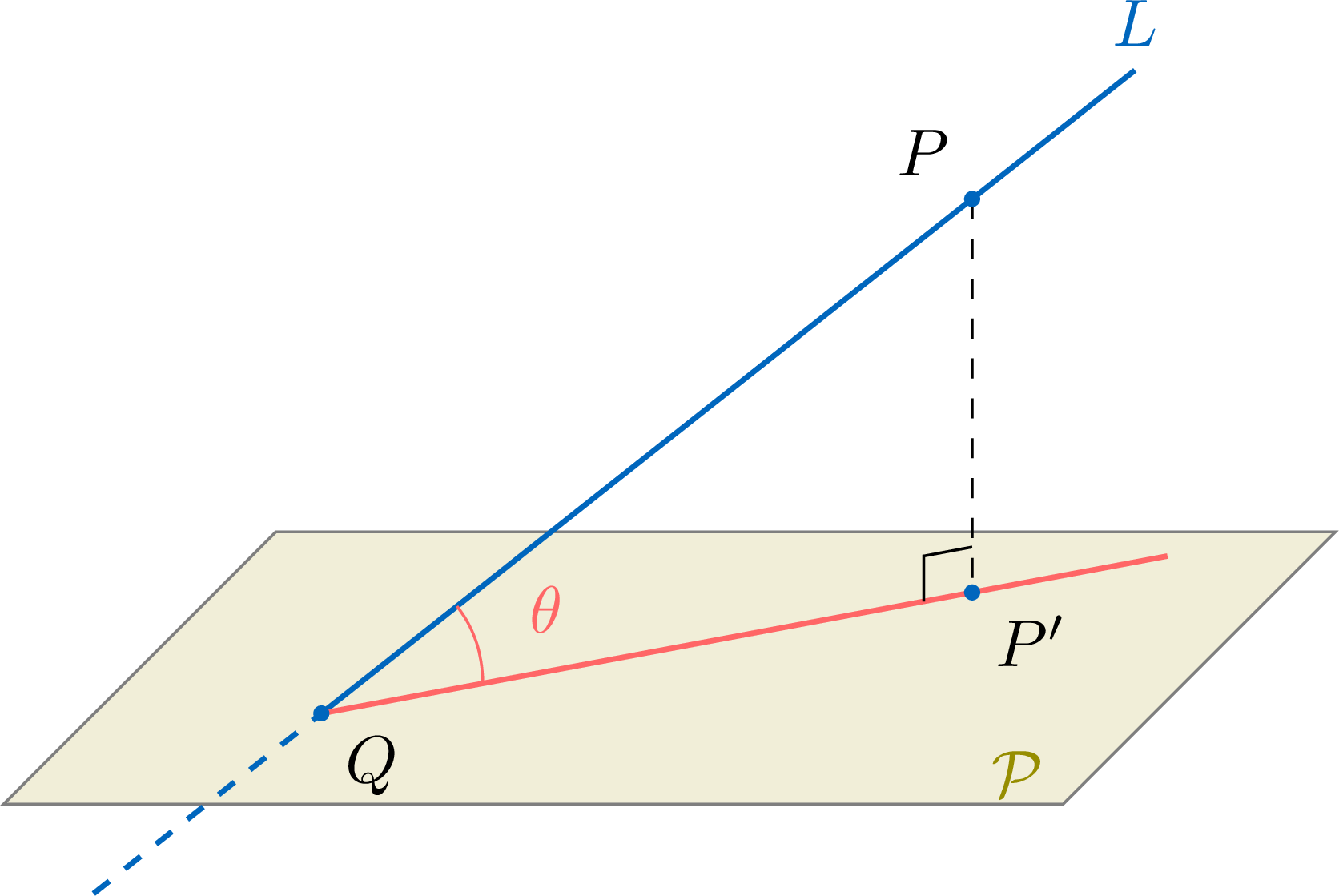
Method — Finding the Angle Between a Line and a Plane
To find the angle \(\theta\) between a line \(\Line{QP}\) and a plane \(\mathcal{P}\) that it meets at \(Q\) — the line being not perpendicular to the plane, otherwise \(\theta = 90^\circ\): - project \(P\) on the plane: choose a point \(P\) of the line outside the plane and drop the perpendicular from \(P\) to the plane; its foot \(P'\) is the projection of \(P\), and the line \(\Line{QP'}\) is the projection of the line on the plane. With coordinates, on the \(xy\)-plane, the projection of \(P(x, y, z)\) is \(P'(x, y, 0)\), right below or right above \(P\); on a plane parallel to a coordinate plane — a face of a cuboid placed along the axes, for instance — the coordinate that is constant on the plane takes its value, the other two are kept;
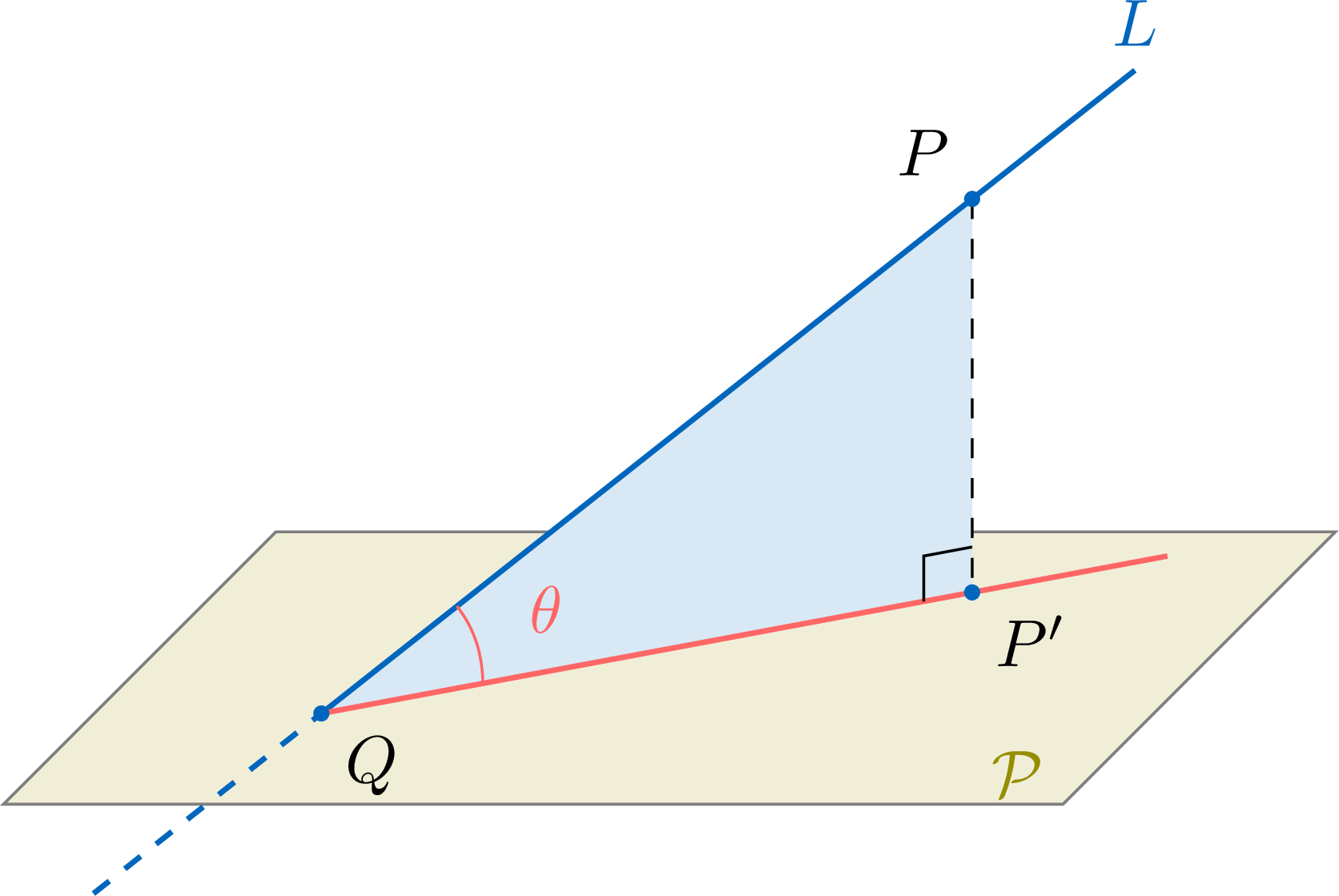
- draw the right-angled triangle \(QP'P\), formed by the segment \(\Segment{QP}\) of the line, its projection \(\Segment{QP'}\) and the perpendicular \(\Segment{PP'}\), right-angled at \(P'\);
- compute two of its sides and use a trigonometric ratio at \(Q\) (SOH-CAH-TOA), for instance \(\tan\theta = \dfrac{PP'}{QP'}\): the result is the acute angle \(\theta\) between the line and its projection.
Example
The pyramid \(SABCD\) has a square base \(ABCD\) in the \(xy\)-plane, with \(A(0, 0, 0)\), \(B(6, 0, 0)\), \(C(6, 6, 0)\) and \(D(0, 6, 0)\), and its apex is \(S(3, 3, 4)\). Calculate the angle between the edge \(\Segment{SC}\) and the base, to the nearest tenth of a degree.
The edge meets the base at \(C\). The projection of \(S(3, 3, 4)\) on the base, the \(xy\)-plane, is \(K(3, 3, 0)\), the centre of the square. The angle sought is \(\theta = \Angle{SCK}\), in the triangle \(CKS\) right-angled at \(K\). 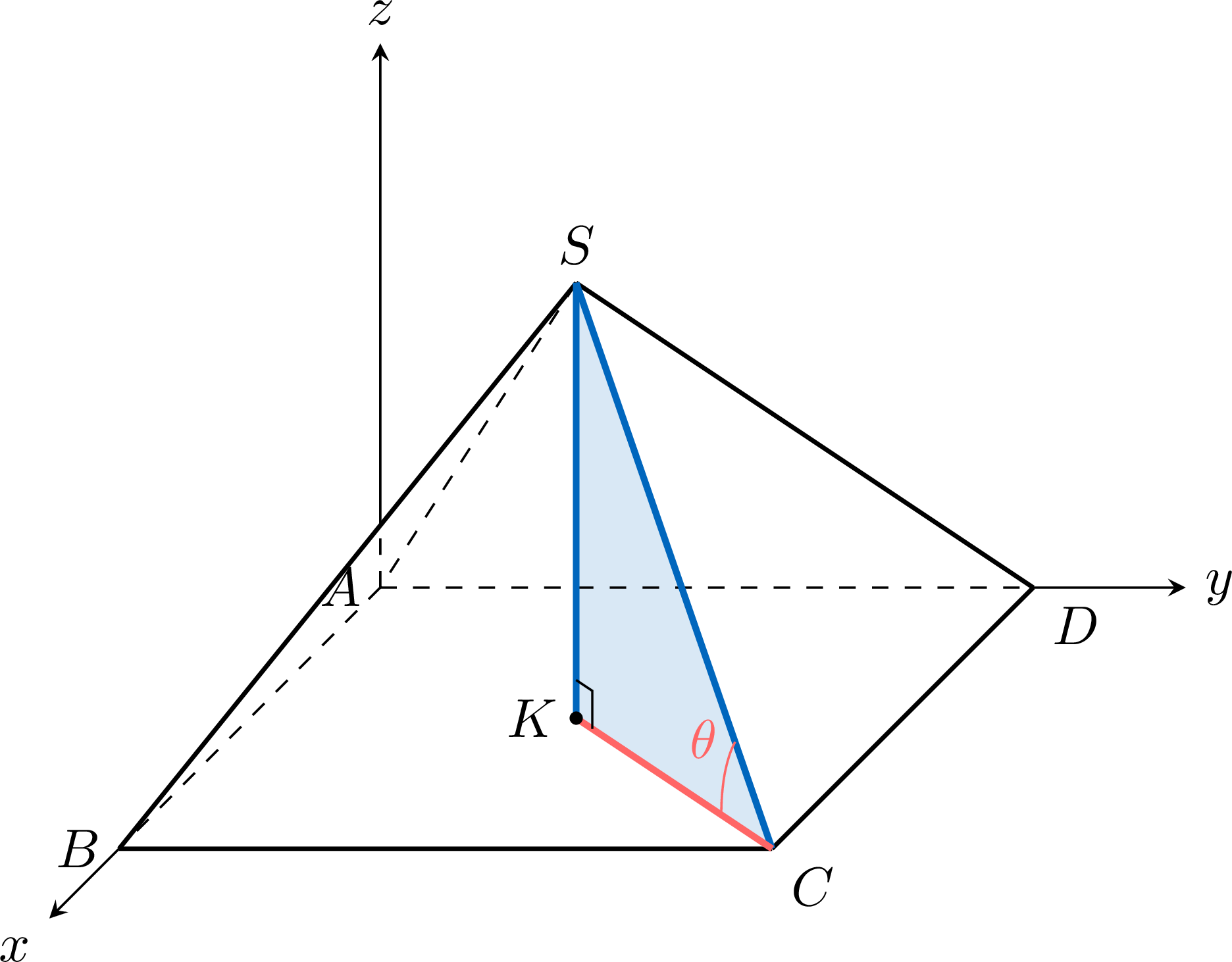
Its sides: \(SK = 4\) and \(CK = \sqrt{(3 - 6)^2 + (3 - 6)^2 + 0^2} = \sqrt{18} = 3\sqrt{2}\). The side \(\Segment{SK}\) is opposite \(\theta\) and \(\Segment{CK}\) adjacent: $$\begin{aligned}[t] \tan\theta &= \frac{SK}{CK} && \text{(opposite over adjacent)}\\
&= \frac{4}{3\sqrt{2}}, \end{aligned}$$ so \(\theta = \tan^{-1}\left(\dfrac{4}{3\sqrt{2}}\right) \approx 43.3^\circ\).
Example
The cuboid \(ABCDEFGH\) has \(A\) at the origin, \(B(4, 0, 0)\), \(D(0, 3, 0)\) and \(E(0, 0, 2)\). Calculate the angle between the space diagonal \(\Segment{AG}\) and the edge \(\Segment{AE}\), to the nearest tenth of a degree.
The vertex opposite \(A\) is \(G(4, 3, 2)\). The angle sought is \(\theta = \Angle{GAE}\), in the triangle \(AEG\). 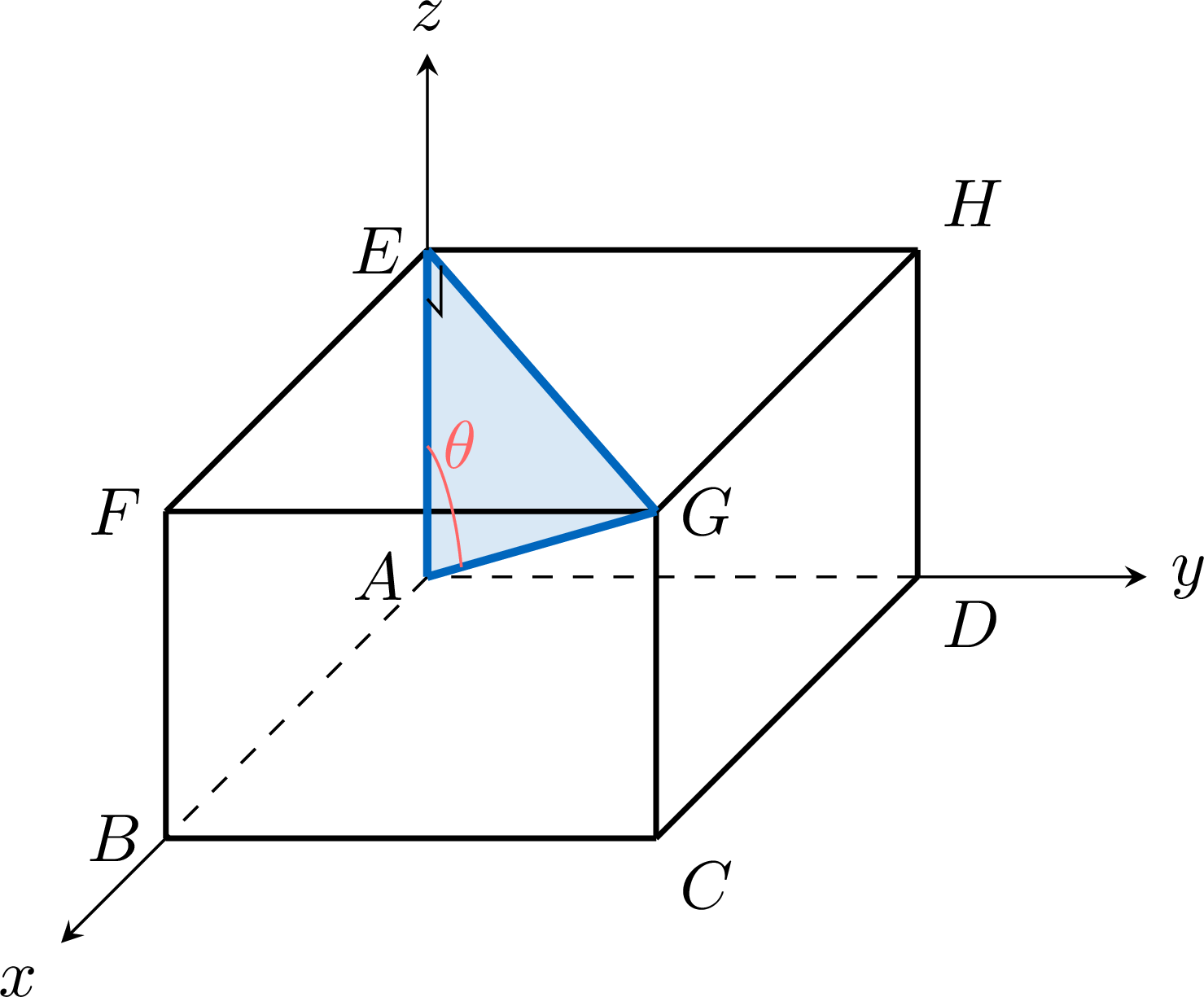
Its sides: \(AE = 2\), \(EG = \sqrt{(4-0)^2 + (3-0)^2 + (2-2)^2} = \sqrt{25} = 5\) and \(AG = \sqrt{4^2 + 3^2 + 2^2} = \sqrt{29}\). Since \(AE^2 + EG^2 = 4 + 25 = 29 = AG^2\), the triangle \(AEG\) is right-angled at \(E\), by the converse of Pythagoras' theorem. The side \(\Segment{AE}\) is adjacent to \(\theta\) and \(\Segment{AG}\) is the hypotenuse: $$\begin{aligned}[t] \cos\theta &= \frac{AE}{AG} && \text{(adjacent over hypotenuse)}\\
&= \frac{2}{\sqrt{29}}, \end{aligned}$$ so \(\theta = \cos^{-1}\left(\dfrac{2}{\sqrt{29}}\right) \approx 68.2^\circ\).
Skills to practice
- Applying Trigonometry in Three Dimensions
VII
Going further
Skills to practice
- Reasoning and Problem-Solving
- Solving Problems and Testing Claims
- Quiz
Jump to section