International Baccalaureate · MYP 5 Extended
Unit Circle and Trigonometric Identities
I
Measuring Angles in Radians
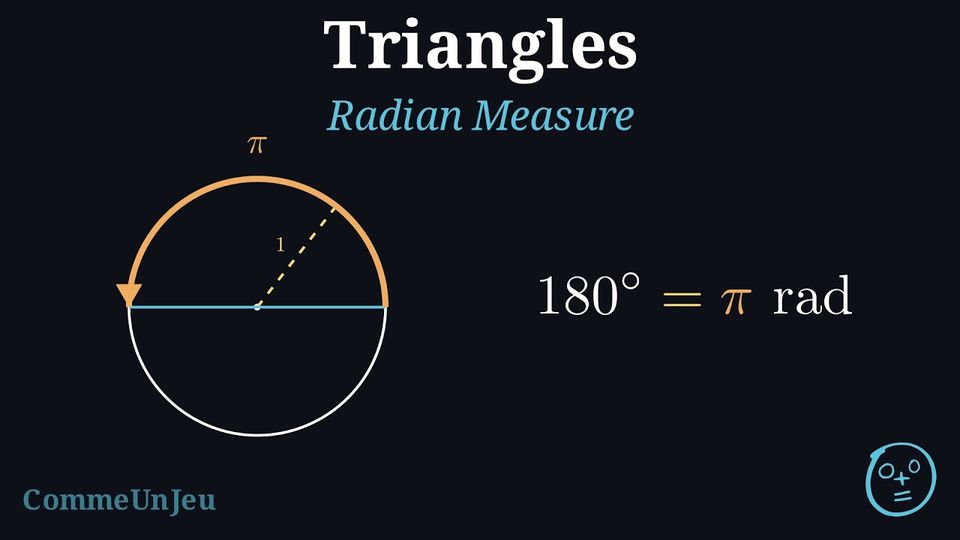
The measure of an angle describes what fraction of a full revolution it represents. While degrees (360° in a circle) are a common unit, they are an arbitrary human invention. A more mathematically natural unit is the radian.
Definition — Radian Measure
The radian measure of an angle \(\theta\) is the length of the arc it subtends on a circle of radius 1 centred at its vertex. When the direction of rotation matters, this measure is signed: positive for an anticlockwise rotation, negative for a clockwise one (see Positive and Negative Angles). 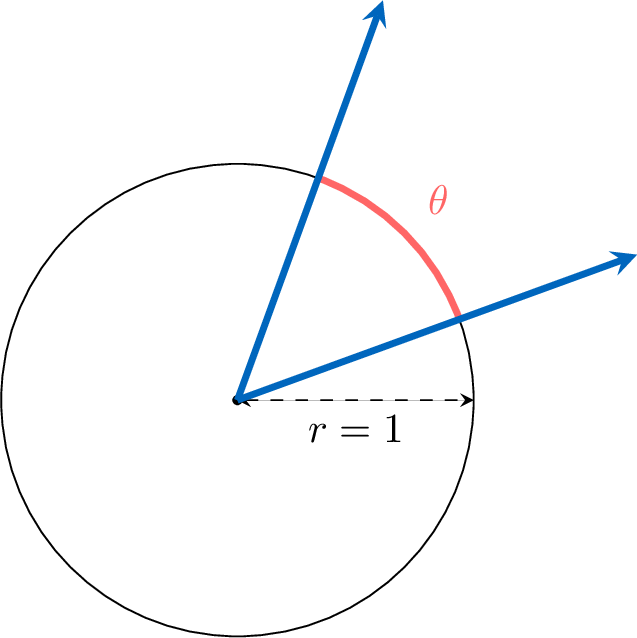
Proposition — Angle of a Full Circle
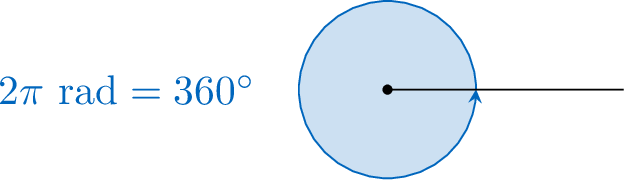
The circumference of a unit circle is \(C = 2\pi(1) = 2\pi\). Therefore, a full circle contains \(2\pi\) radians.This establishes the fundamental conversion: \(360^\circ = 2\pi\) radians, which simplifies to \(180^\circ = \pi\) radians.
Method — Converting Between Degrees and Radians
Based on the relationship \(180^\circ = \pi\) radians: - To convert from degrees to radians, multiply by \(\dfrac{\pi}{180}\).
- To convert from radians to degrees, multiply by \(\dfrac{180}{\pi}\).
Skills to practice
- Measuring Angles in Radians
II
Placing Special Angles on the Circle
Up to now an angle was something one measures. From now on it will be a number. Imagine the number line as a thread, laid tangent to the circle of radius \(1\) at the point with \(x\)-coordinate \(1\), then wound around that circle: \(0\) stays where it is, the positive numbers wind anticlockwise, the negative numbers clockwise. Every real number then lands on a point of the circle. 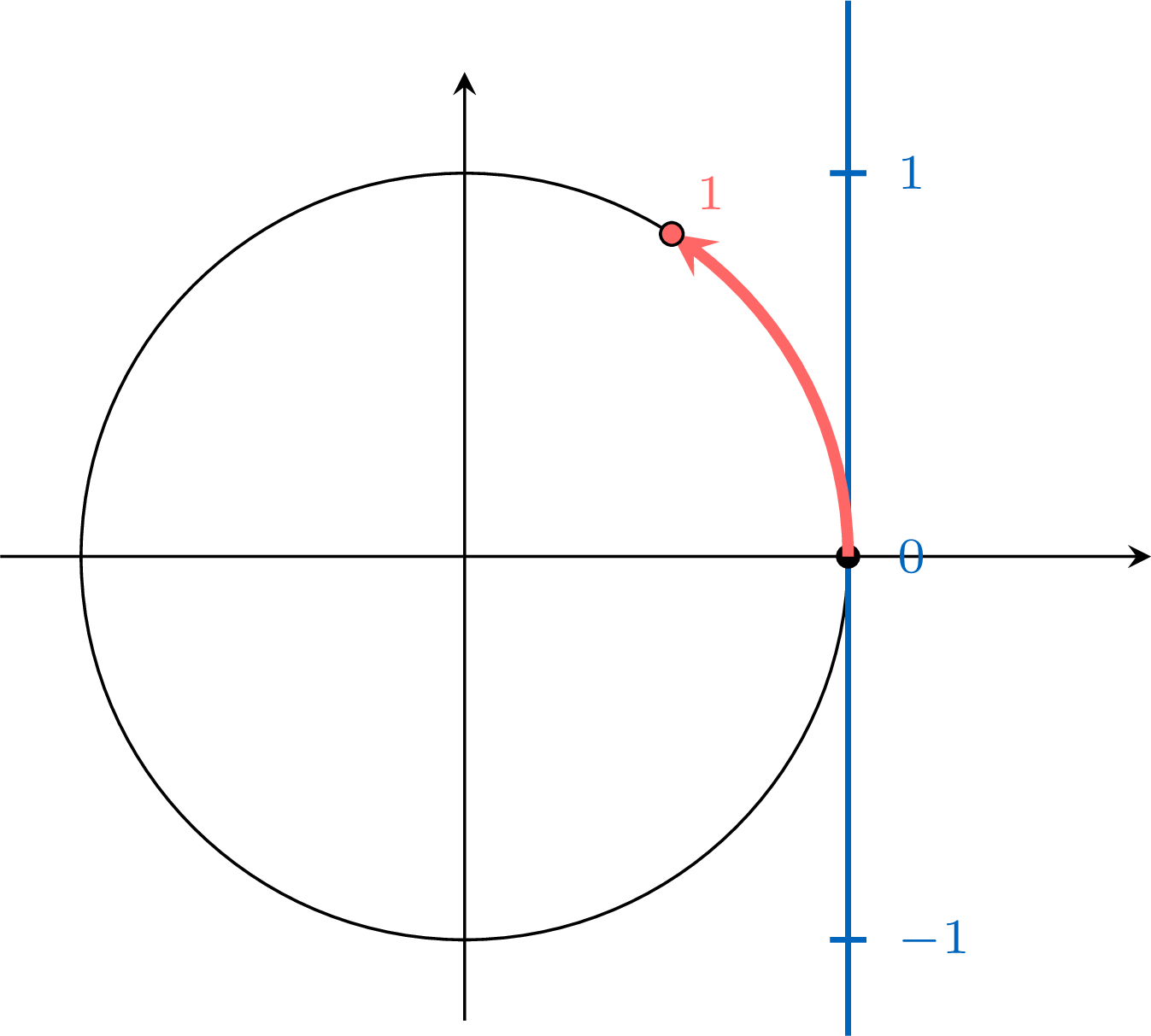
Definition — Image of a Real Number
The unit circle — the circle of radius \(1\) centred at the origin — is travelled anticlockwise: this is the positive direction. Winding the number line around it associates with every real number \(x\) a single point of the circle, called the image of \(x\) and written \(M(x)\): starting from the point of coordinates \((1, 0)\), one travels along the circle a distance \(|x|\), anticlockwise if \(x > 0\), clockwise if \(x < 0\). By the very definition of the radian, \(x\) is then a measure in radians of the signed angle between the positive half of the horizontal axis and the ray \(OM\), where \(M = M(x)\). Proposition — Reals Having the Same Image
For every real number \(x\) and every integer \(k\):$$M(x + 2k\pi) = M(x).$$ Conversely, two real numbers have the same image on the unit circle if and only if their difference is a multiple of \(2\pi\).
The circle has radius \(1\), so one full turn has length \(2\pi\). Travelling an extra \(2\pi\) therefore brings the point back exactly where it was, and \(k\) extra turns bring it back \(k\) times: \(M(x + 2k\pi) = M(x)\). Conversely, suppose \(M(x) = M(y)\) with \(x \leq y\). Going from \(M(x)\) to \(M(y)\) one travels a distance \(y - x\) and comes back to the starting point: that distance is a whole number of turns, so \(y - x = 2k\pi\) for some integer \(k\).
Example
- Locate the image of \(\dfrac{9\pi}{4}\) on the unit circle.
- Locate the image of \(-\dfrac{\pi}{3}\).
- Give three real numbers having the same image as \(\dfrac{\pi}{3}\).
- \(\dfrac{9\pi}{4} = \dfrac{8\pi}{4} + \dfrac{\pi}{4} = 2\pi + \dfrac{\pi}{4}\): one full turn, then an eighth of a turn. So \(M\left(\dfrac{9\pi}{4}\right) = M\left(\dfrac{\pi}{4}\right)\), the point one eighth of a turn from \((1, 0)\).
- \(-\dfrac{\pi}{3}\) is travelled clockwise over a sixth of a turn: the image is in the fourth quadrant, at \(-60^\circ\). It is also the image of \(-\dfrac{\pi}{3} + 2\pi = \dfrac{5\pi}{3}\).
- Adding or subtracting whole turns: \(\dfrac{\pi}{3} + 2\pi = \dfrac{7\pi}{3}\), \(\quad\dfrac{\pi}{3} - 2\pi = -\dfrac{5\pi}{3}\), \(\quad\dfrac{\pi}{3} + 4\pi = \dfrac{13\pi}{3}\).
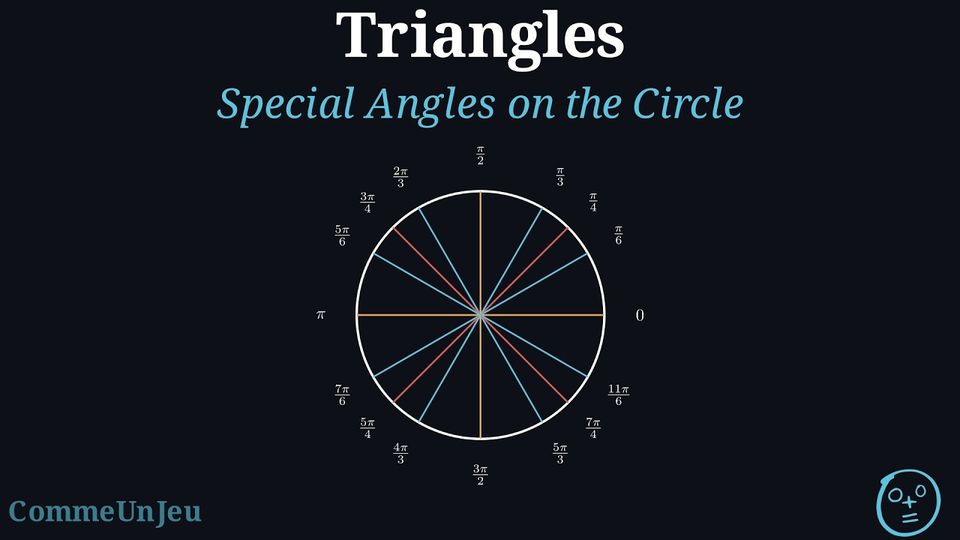
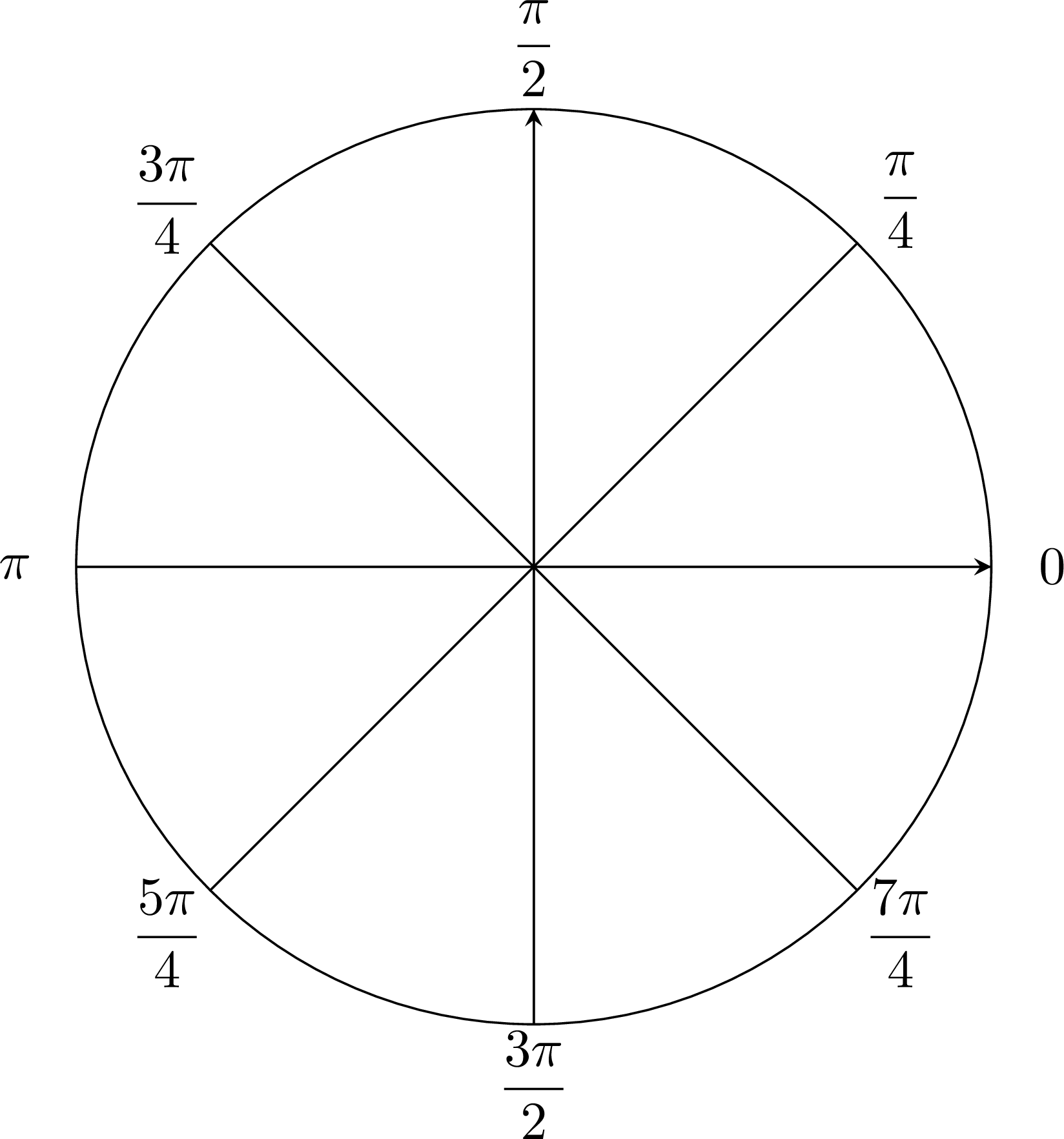
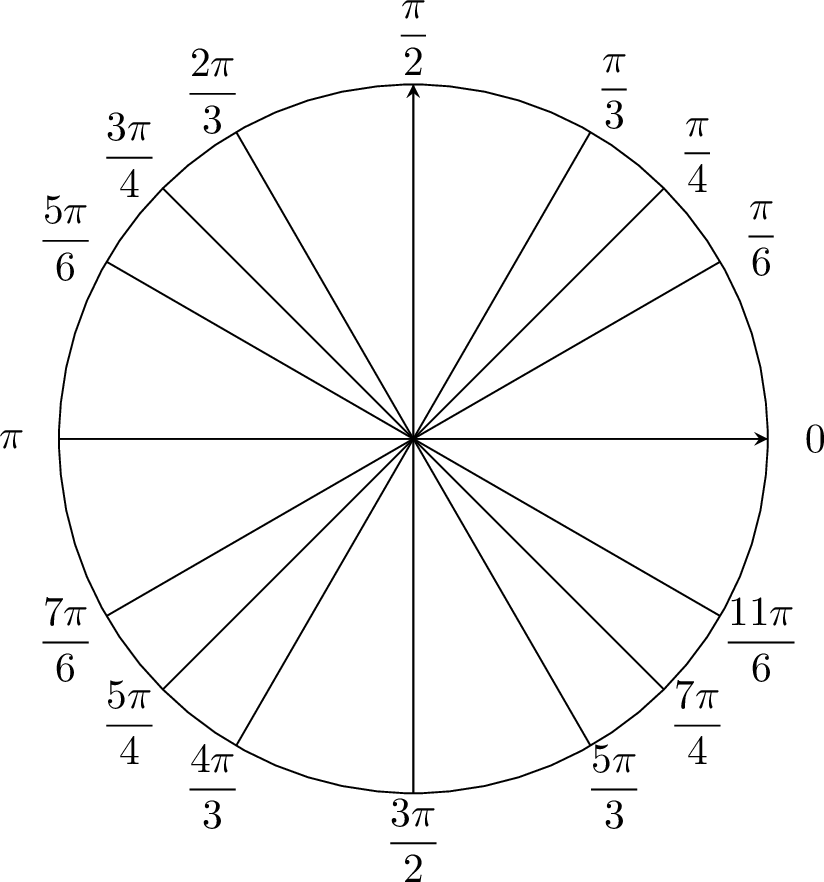
The circle is cut into \(8\) equal arcs by \(4\) diameters. As the full circle measures \(2\pi\), each arc measures $$\frac{2\pi}{8}=\frac{\pi}{4}.$$ 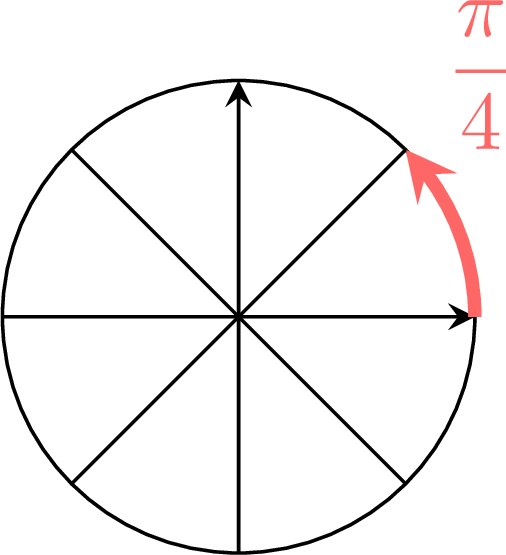
Counting the arcs anticlockwise from the angle \(0\), each arc adds \(\dfrac{\pi}{4}\): after \(k\) arcs, the angle is \(k \times \dfrac{\pi}{4}\).
The count continues in the same way up to \(8\times\dfrac{\pi}{4}=\dfrac{8\pi}{4}=2\pi\), a full turn: the point is back at its starting position.
Four of these eight measures simplify to a fraction with a smaller denominator. The other four, \(\dfrac{\pi}{4}\), \(\dfrac{3\pi}{4}\), \(\dfrac{5\pi}{4}\) and \(\dfrac{7\pi}{4}\), are already in lowest terms.
| Multiple of \(\dfrac{\pi}{4}\) | Angle |
| \(1\times\dfrac{\pi}{4}=\dfrac{\pi}{4}\) | 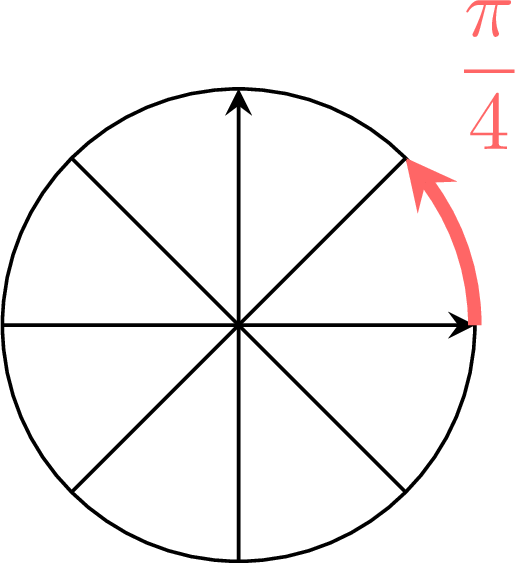 |
| \(2\times\dfrac{\pi}{4}=\dfrac{2\pi}{4}=\dfrac{\pi}{2}\) | 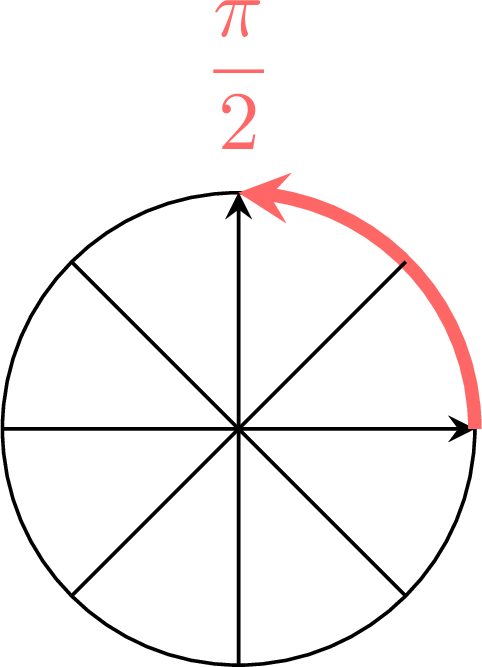 |
| \(3\times\dfrac{\pi}{4}=\dfrac{3\pi}{4}\) | 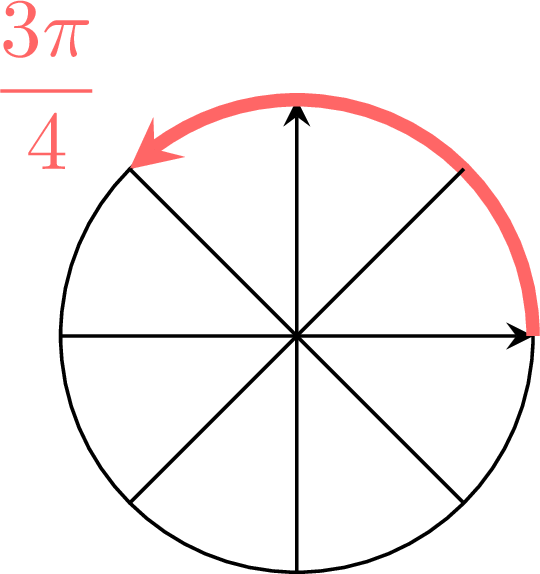 |
| \(4\times\dfrac{\pi}{4}=\dfrac{4\pi}{4}=\pi\) | 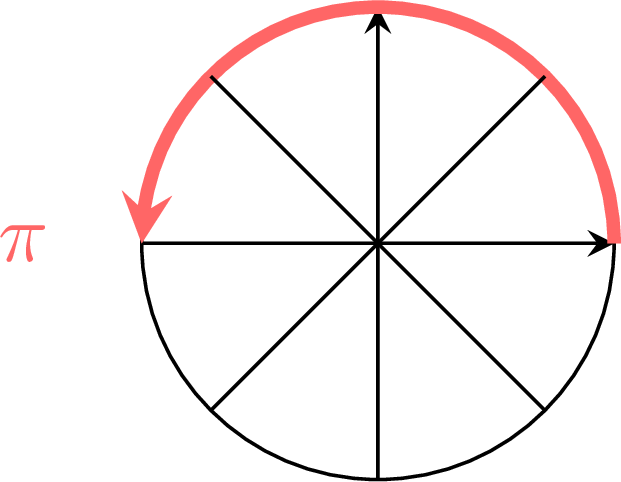 |
Four of these eight measures simplify to a fraction with a smaller denominator. The other four, \(\dfrac{\pi}{4}\), \(\dfrac{3\pi}{4}\), \(\dfrac{5\pi}{4}\) and \(\dfrac{7\pi}{4}\), are already in lowest terms.
Proposition — Locating the Multiples of \(\frac{\pi}{4}\)
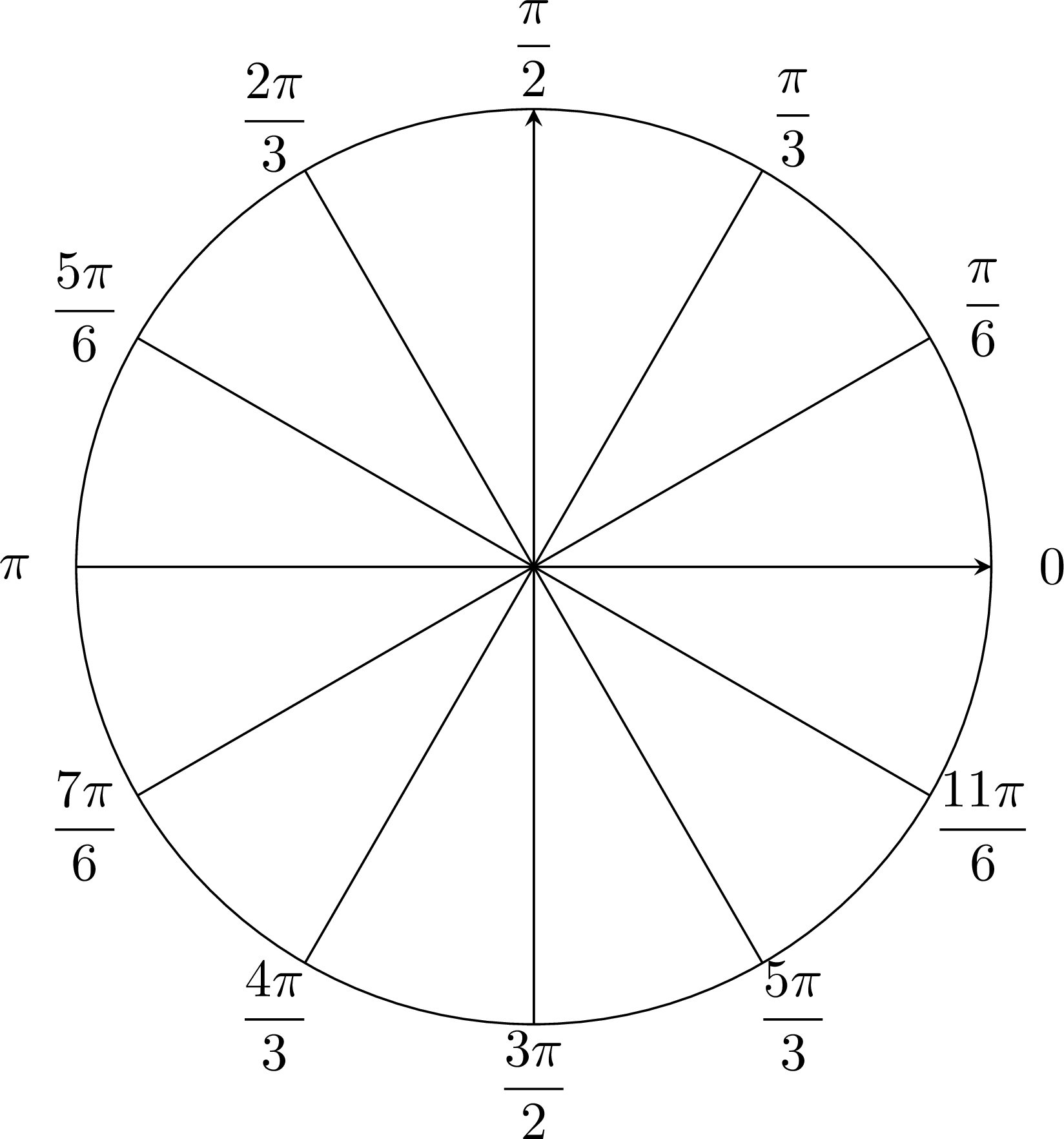
The circle is cut into \(12\) equal arcs by \(6\) diameters. As the full circle measures \(2\pi\), each arc measures $$\frac{2\pi}{12}=\frac{\pi}{6}.$$ 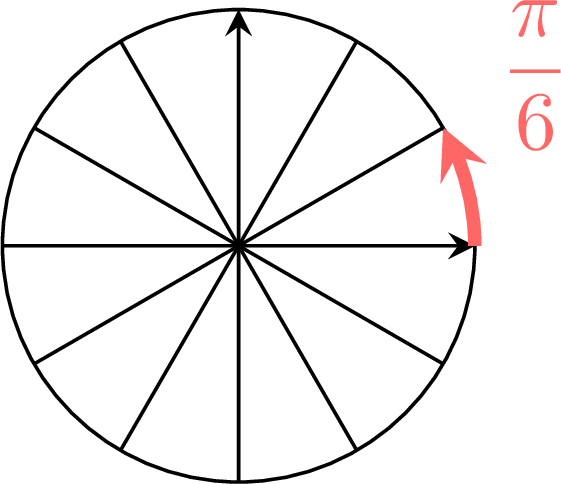
Counting the arcs anticlockwise from the angle \(0\), each arc adds \(\dfrac{\pi}{6}\): after \(k\) arcs, the angle is \(k \times \dfrac{\pi}{6}\).
The count continues in the same way up to \(12\times\dfrac{\pi}{6}=\dfrac{12\pi}{6}=2\pi\), a full turn: the point is back at its starting position.
Eight of these twelve measures simplify to a fraction with a smaller denominator. The other four, \(\dfrac{\pi}{6}\), \(\dfrac{5\pi}{6}\), \(\dfrac{7\pi}{6}\) and \(\dfrac{11\pi}{6}\), are already in lowest terms.
| Multiple of \(\dfrac{\pi}{6}\) | Angle |
| \(1\times\dfrac{\pi}{6}=\dfrac{\pi}{6}\) | 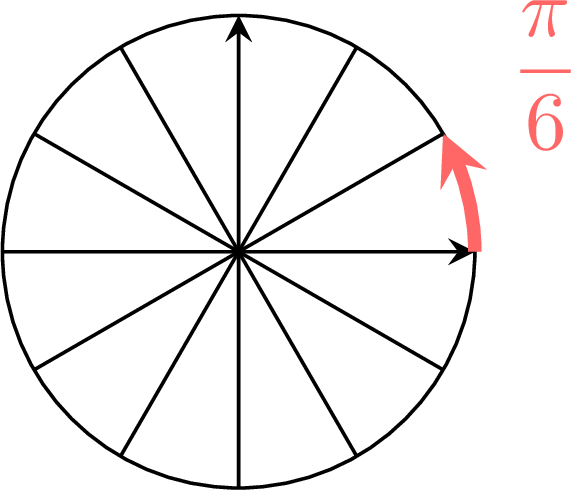 |
| \(2\times\dfrac{\pi}{6}=\dfrac{2\pi}{6}=\dfrac{\pi}{3}\) | 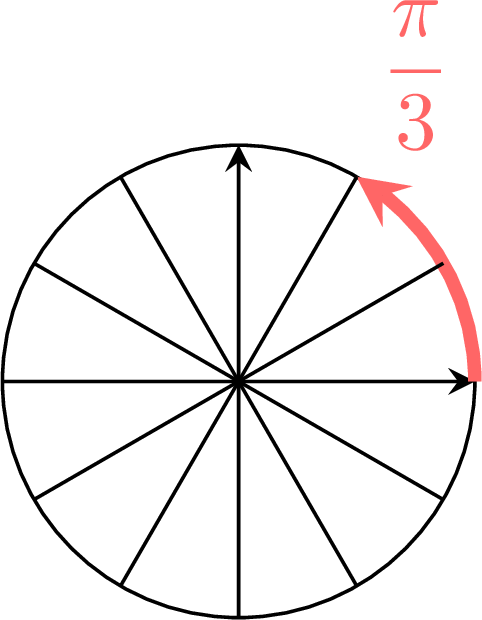 |
| \(3\times\dfrac{\pi}{6}=\dfrac{3\pi}{6}=\dfrac{\pi}{2}\) | 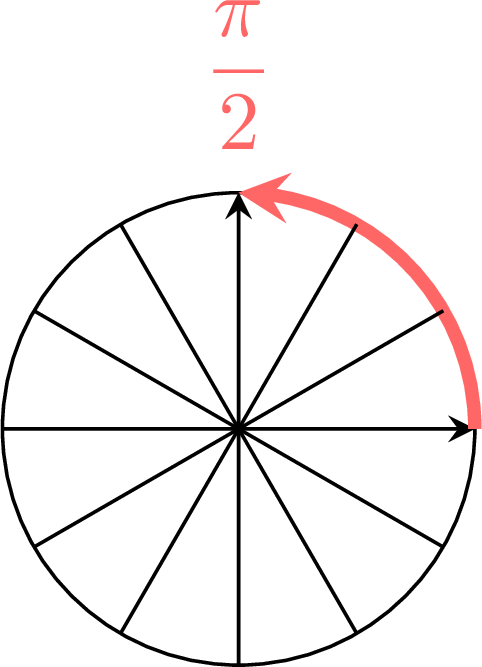 |
| \(4\times\dfrac{\pi}{6}=\dfrac{4\pi}{6}=\dfrac{2\pi}{3}\) | 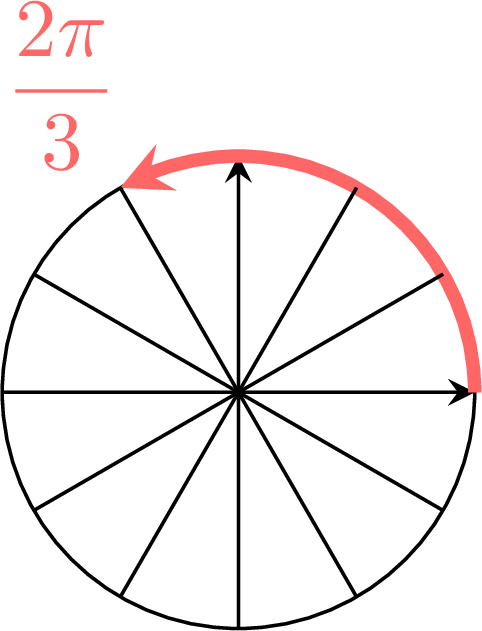 |
| \(5\times\dfrac{\pi}{6}=\dfrac{5\pi}{6}\) | 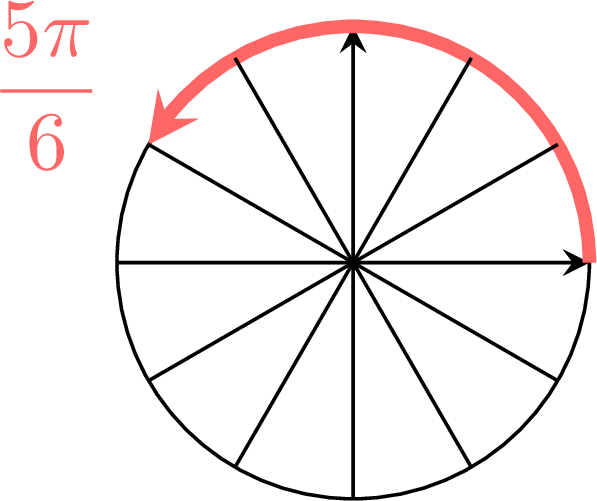 |
| \(6\times\dfrac{\pi}{6}=\dfrac{6\pi}{6}=\pi\) | 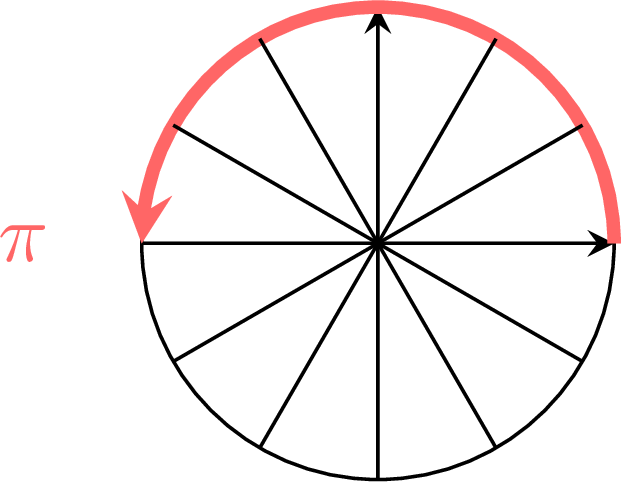 |
Eight of these twelve measures simplify to a fraction with a smaller denominator. The other four, \(\dfrac{\pi}{6}\), \(\dfrac{5\pi}{6}\), \(\dfrac{7\pi}{6}\) and \(\dfrac{11\pi}{6}\), are already in lowest terms.
Proposition — Locating the Multiples of \(\frac{\pi}{6}\)
Proposition — Special Angles on the Unit Circle
Skills to practice
- Writing Angles as Multiples of a Fraction of a Turn
III
Finding the Sine and Cosine of Any Angle
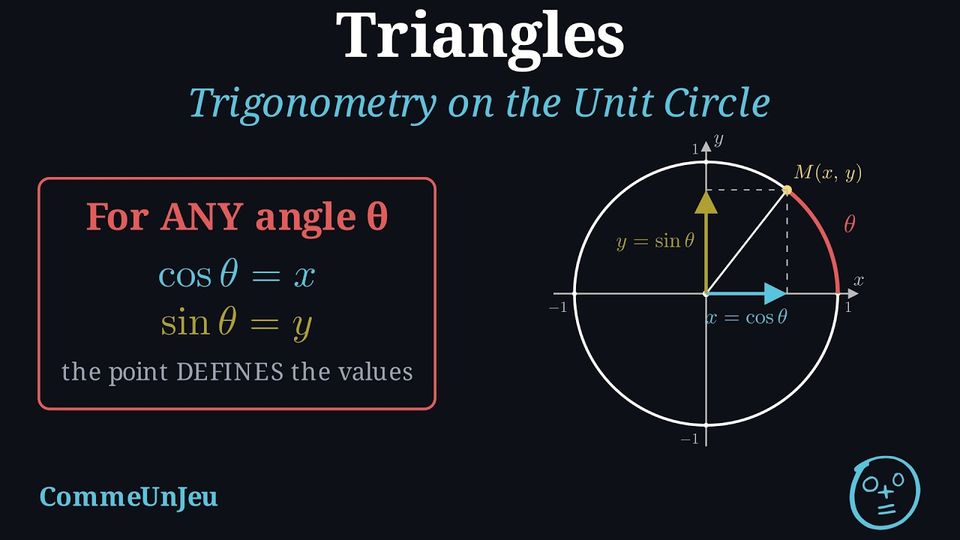
Every real number has a point on the circle. That point has two coordinates — and naming them is defining the cosine and the sine of a number, no longer of a triangle. For an acute angle, the right-angled triangle drawn under the point shows that nothing is lost: these are the very cosine and sine of the right-angled triangle.
Example
Find the values \(\cos \left(\dfrac{\pi}{2}\right)\) and \(\sin \left(\dfrac{\pi}{2}\right)\).
On the unit circle, the point corresponding to the angle \(\dfrac{\pi}{2}\) has coordinates \((0,1)\): 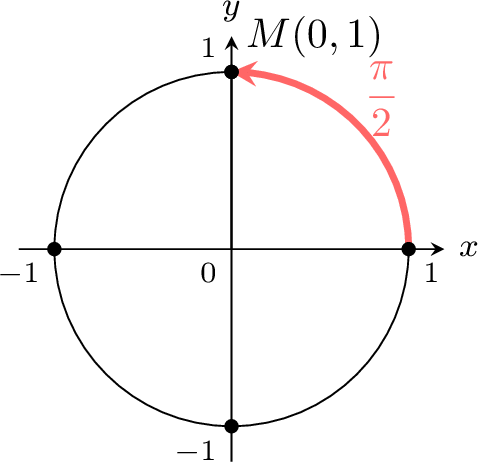
\(\cos \left(\dfrac{\pi}{2}\right)=0 \quad\) \(x\)-coordinate
\(\sin \left(\dfrac{\pi}{2}\right)=1 \quad\) \(y\)-coordinate
\(\sin \left(\dfrac{\pi}{2}\right)=1 \quad\) \(y\)-coordinate
Proposition — Sign of Sine and Cosine
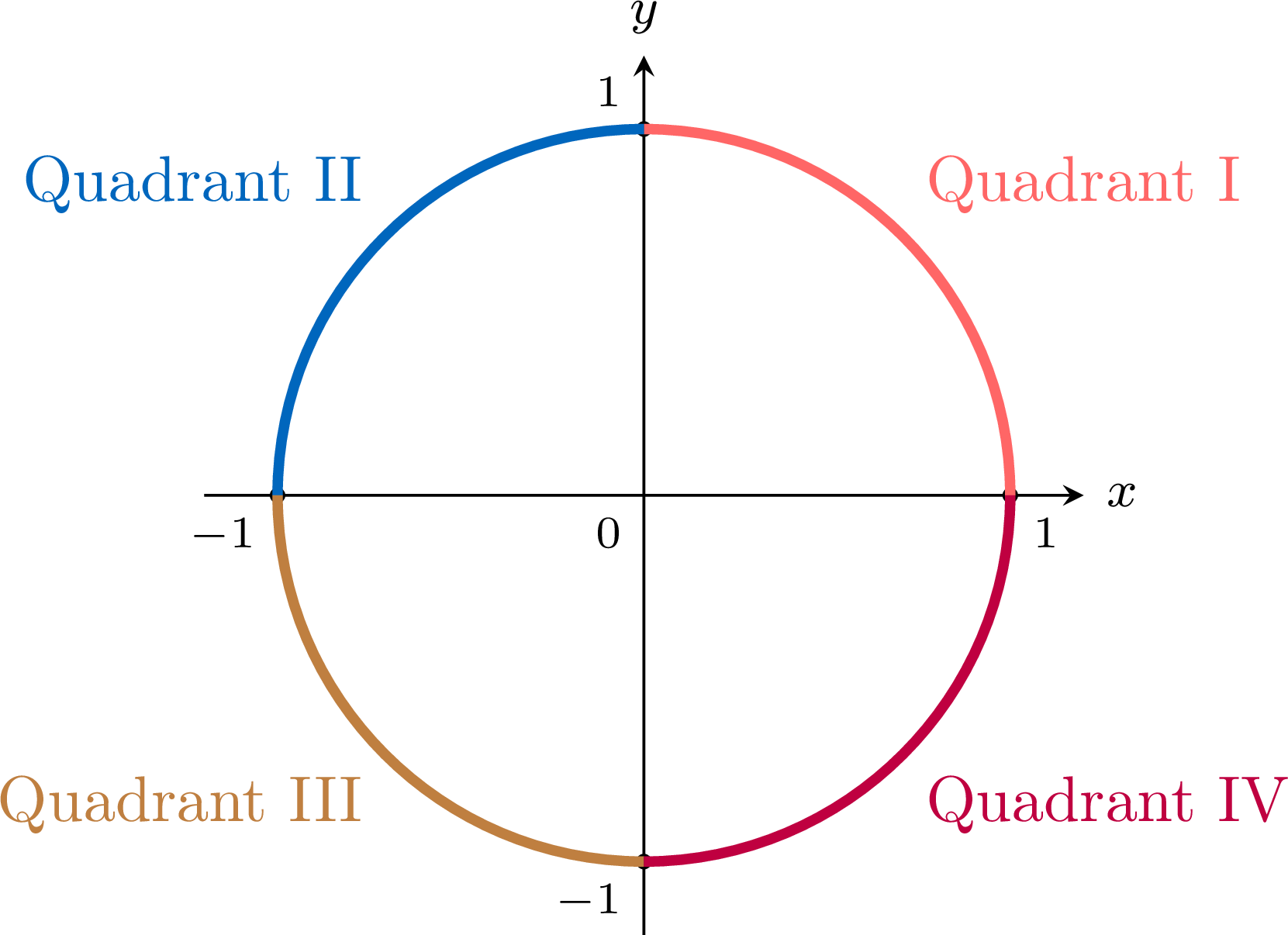
| Quadrant | \(\cos \theta\) | \(\sin \theta\) |
| I | \(+\) | \(+\) |
| II | \(-\) | \(+\) |
| III | \(-\) | \(-\) |
| IV | \(+\) | \(-\) |
Method — Setting the Calculator Mode
A calculator computes cosines and sines in radians or in degrees, and nothing on the screen says which. Before any calculation, check the mode with a known value: \(\cos(1)\) is about \(0{.}54\) in radian mode and about \(0{.}9998\) in degree mode. When angles are measured in radians, the mode must be RAD. Skills to practice
- Reading Cosine and Sine at an Angle in Degrees
- Finding Sine and Cosine Values on the Unit Circle
IV
Using the Identities of the Circle
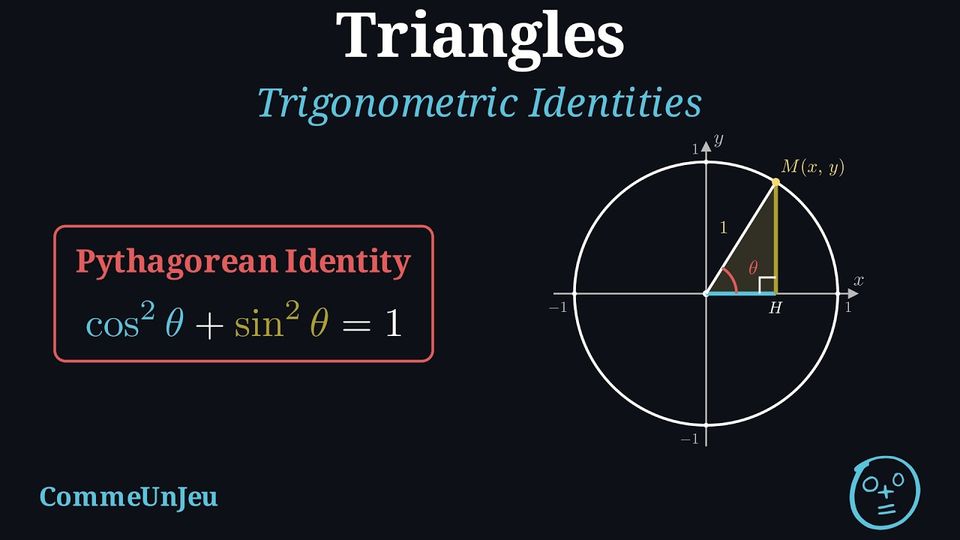
Once one point is placed on the circle, its symmetric points are placed too: a half-turn, a reflection in an axis, a reflection in the diagonal each send \(M(\theta)\) onto another point of the circle. Reading each of these symmetries on the coordinates costs nothing — and turns a handful of exact values into a whole table: that is what the identities below do.
Proposition — The Pythagorean Identity
For every acute angle \(\theta\) of a right-angled triangle,$$\sin^2\theta + \cos^2\theta = 1,$$ where \(\sin^2\theta\) is the usual shorthand for \((\sin\theta)^2\).
In a right-angled triangle with angle \(\theta\), opposite side \(o\), adjacent side \(a\) and hypotenuse \(h\):$$\begin{aligned}[t] \sin^2\theta + \cos^2\theta &= \left(\dfrac{o}{h}\right)^2 + \left(\dfrac{a}{h}\right)^2 && \text{(definitions of sine and cosine)} \\
&= \dfrac{o^2 + a^2}{h^2} && \text{(same denominator)} \\
&= \dfrac{h^2}{h^2} && \text{(Pythagoras' theorem: } o^2 + a^2 = h^2\text{)} \\
&= 1. \end{aligned}$$ 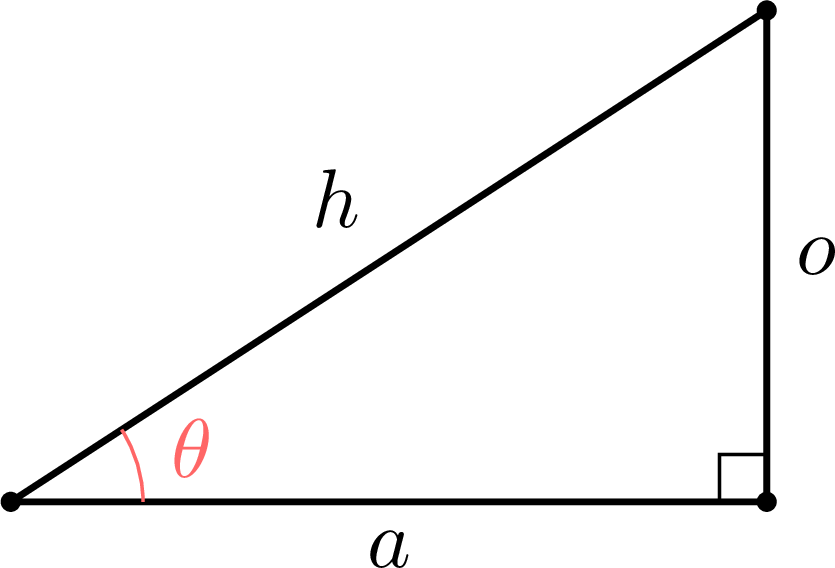
Example
The acute angle \(\theta\) satisfies \(\sin\theta = \dfrac{3}{5}\). Find \(\cos\theta\) without finding the angle \(\theta\).
$$\begin{aligned}[t] \cos^2\theta &= 1 - \sin^2\theta && \text{(Pythagorean identity)} \\
&= 1 - \left(\dfrac{3}{5}\right)^2 && {\scriptstyle(\text{substitute } \sin\theta)} \\
&= 1 - \dfrac{9}{25} = \dfrac{16}{25} \\
\cos\theta &= \dfrac{4}{5} && \text{(\(\theta\) is acute, so \(\cos\theta > 0\))} \end{aligned}$$
Proposition — Pythagorean Identity
For any angle \(\theta\): $$ \cos^2 \theta + \sin^2 \theta = 1 $$
Let \(M(\cos \theta,\sin\theta)\) be the point on the unit circle at the angle \(\theta\), and \(H\) the foot of the perpendicular from \(M\) to the \(x\)-axis. 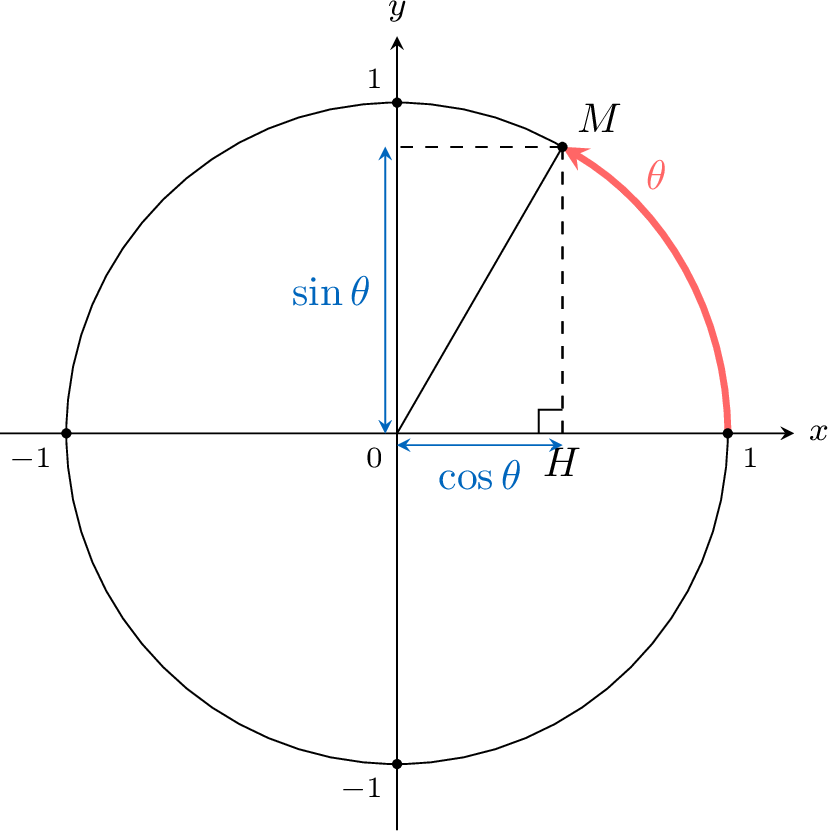
The \(x\)-coordinate of \(H\) is \(\cos\theta\), and the length \(OH\) is its absolute value: \(OH = |\cos\theta|\); in the same way, \(HM = |\sin\theta|\). By Pythagoras' theorem in the triangle \(OHM\), right-angled at \(H\): $$\begin{aligned}[t] OH^2+HM^2&=OM^2 && \text{(Pythagoras' theorem)}\\
|\cos \theta|^2+|\sin \theta|^2&=1^2 && (OM = 1)\\
\cos ^2 \theta+\sin ^2 \theta&=1 && \text{(a square does not depend on the sign)} \end{aligned}$$ When \(M\) lies on an axis, the triangle is flat: one coordinate is \(0\), the other is \(1\) or \(-1\), and the equality still holds. On the figure \(\theta\) is acute, and the two coordinates are the lengths \(OH\) and \(HM\) themselves.
Proposition — Bounds of Cosine and Sine
$$-1 \leq \cos \theta \leq 1\quad\text{ and }\quad-1 \leq \sin \theta \leq 1$$ - Geometric proof:
- Analytical proof (for cosine; the proof for sine is analogous):$$\begin{aligned} 0 &\leq \sin ^2 \theta &&\text{(a square is always non-negative)} \\ \cos ^2 \theta &\leq \cos ^2 \theta +\sin ^2 \theta &&\text{(add } \cos ^2 \theta\text{ to both sides)} \\ \cos ^2 \theta &\leq 1 &&(\cos ^2 \theta+\sin ^2 \theta=1) \\ |\cos \theta| &\leq 1 &&\text{(taking square roots)} \\ -1 &\leq \cos \theta \leq 1 && \end{aligned}$$ The same reasoning applied to \(\sin \theta\) gives \(-1 \leq \sin \theta \leq 1\).
Proposition — Periodicity Identity
For any angle \(\theta\) and any integer \(k\): $$ \cos(\theta + 2k\pi) = \cos\theta \quad \text{and} \quad \sin(\theta + 2k\pi) = \sin\theta $$
Let \(M(\cos \theta,\sin\theta)\) be the point on the unit circle at the angle \(\theta\).
Let \(M'(\cos(\theta+2\pi),\sin(\theta+2\pi))\) be the point on the unit circle at the angle \(\theta+2\pi\). 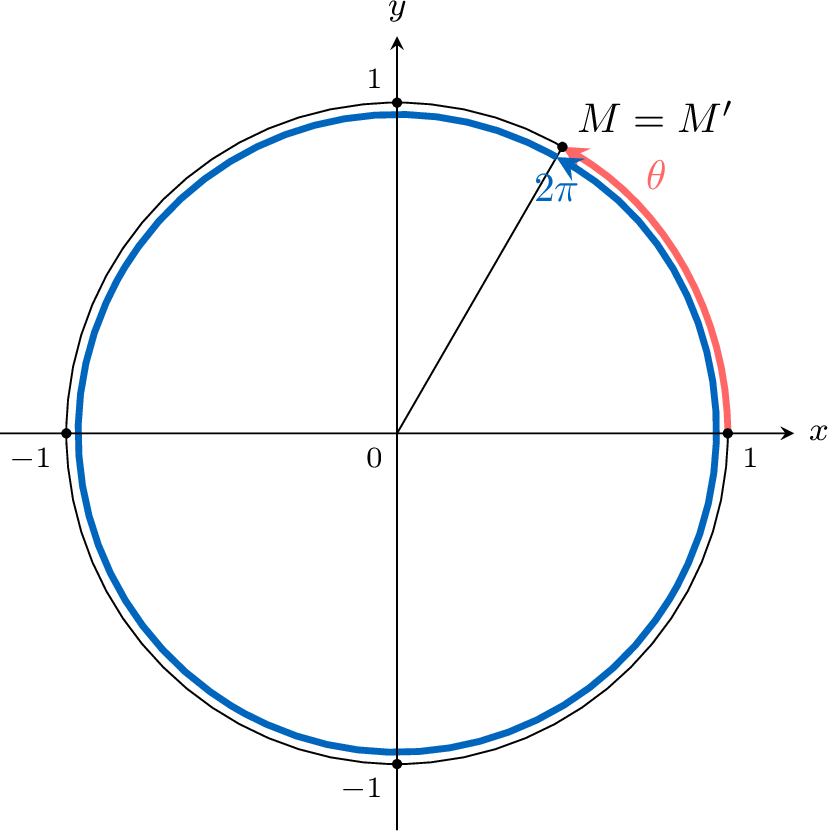
By the proposition on the reals having the same image, \(M(\theta+2\pi)=M(\theta)\): the two points coincide on the circle, \(M'=M\).
Thus, \(\cos (\theta+2 \pi)=\cos \theta\) and \(\sin (\theta+2 \pi)=\sin \theta\).
The same argument holds for any multiple of \(2\pi\), i.e. for any integer \(k\).
Let \(M'(\cos(\theta+2\pi),\sin(\theta+2\pi))\) be the point on the unit circle at the angle \(\theta+2\pi\).
Thus, \(\cos (\theta+2 \pi)=\cos \theta\) and \(\sin (\theta+2 \pi)=\sin \theta\).
The same argument holds for any multiple of \(2\pi\), i.e. for any integer \(k\).
Proposition — Half-Turn: \(\pi + \theta\)
Reflection through the origin: $$\begin{aligned} \sin (\pi+\theta)&=-\sin \theta \\
\cos (\pi+\theta)&=-\cos \theta \end{aligned}$$ 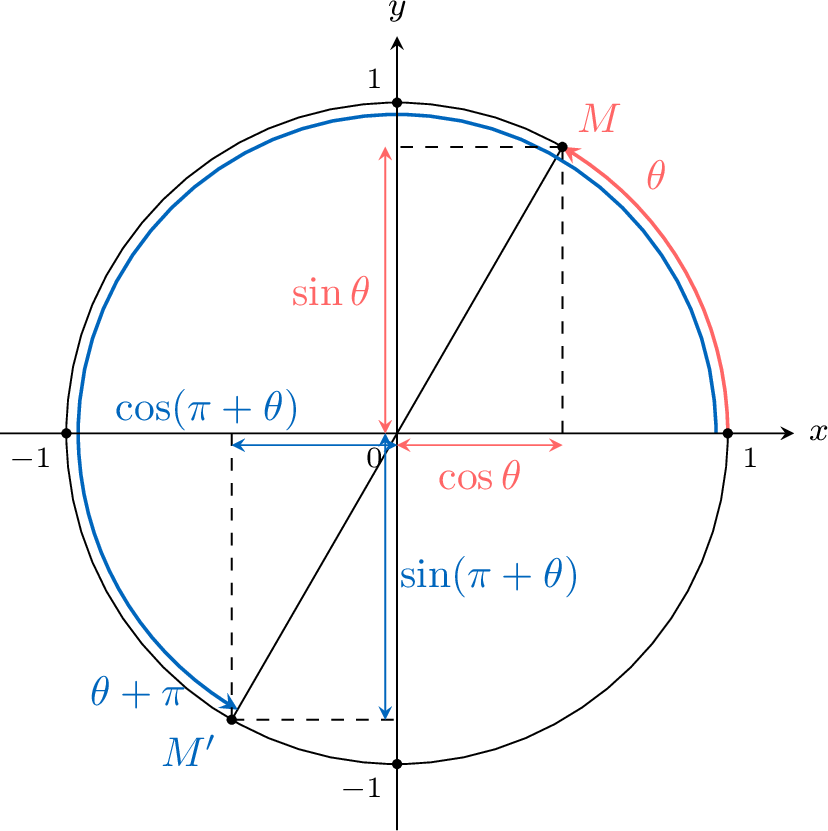
Let \(\theta\) be an angle.
Let \(M(\cos \theta,\sin\theta)\) be the point on the unit circle at the angle \(\theta\).
Let \(M'(\cos(\pi+\theta),\sin(\pi+\theta))\) be the point on the unit circle at the angle \(\pi+\theta\).
A rotation by an angle \(\pi\) is a half-turn about the origin \(O\), which is the same as a point reflection through \(O\). Therefore, the coordinates of \(M'\) are the opposites of the coordinates of \(M\).
So \(\begin{aligned}[t] \sin (\pi+\theta)&=-\sin \theta \\ \cos (\pi+\theta)&=-\cos \theta \end{aligned}\)
Proposition — Symmetry about the Horizontal Axis: \(-\theta\)
Reflection in the \(x\)-axis: $$\begin{aligned} \sin (-\theta)&=-\sin \theta \\
\cos (-\theta)&=\cos \theta \end{aligned}$$ 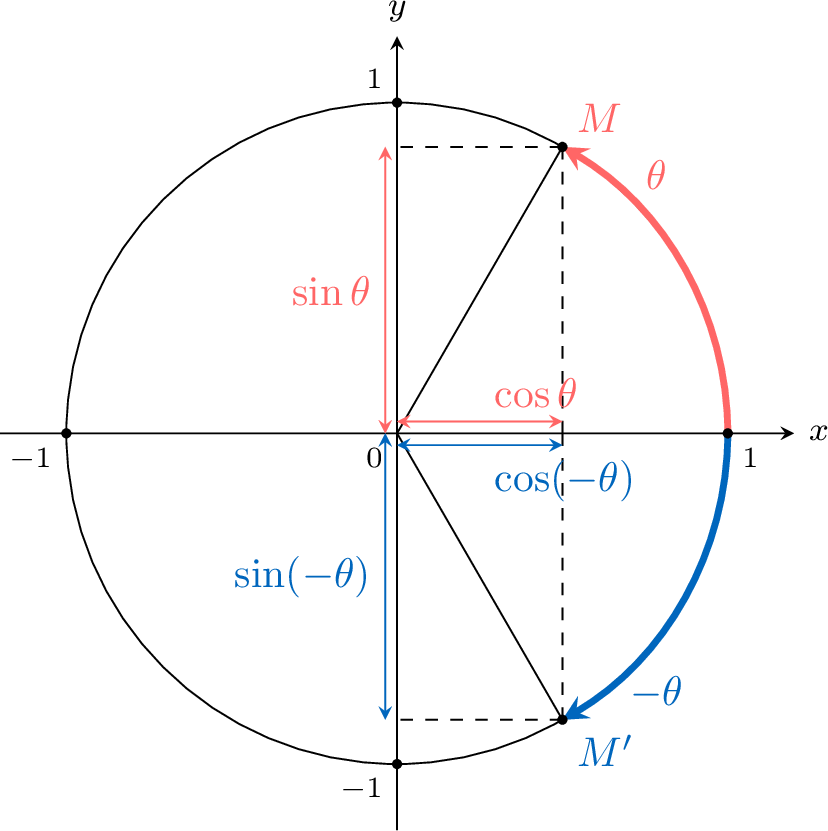
Let \(M(\cos \theta,\sin\theta)\) be the point on the unit circle at the angle \(\theta\).
Let \(M'(\cos(-\theta),\sin(-\theta))\) be the point on the unit circle at the angle \(-\theta\).
The point \(M'\) is the reflection of \(M\) in the \(x\)-axis. Therefore, the \(x\)-coordinate of \(M'\) is the same as that of \(M\), and the \(y\)-coordinate of \(M'\) is the opposite of the \(y\)-coordinate of \(M\).
So \(\begin{aligned}[t] \sin (-\theta)&=-\sin \theta \\ \cos (-\theta)&=\cos \theta \end{aligned}\)
Proposition — Symmetry about the Vertical Axis
For every real number \(\theta\):$$\cos(\pi - \theta) = -\cos\theta, \qquad \sin(\pi - \theta) = \sin\theta.$$ The points of angles \(\theta\) and \(\pi - \theta\) are mirror images of each other in the vertical axis: they share the same \(y\)-coordinate, and their \(x\)-coordinates are opposite. 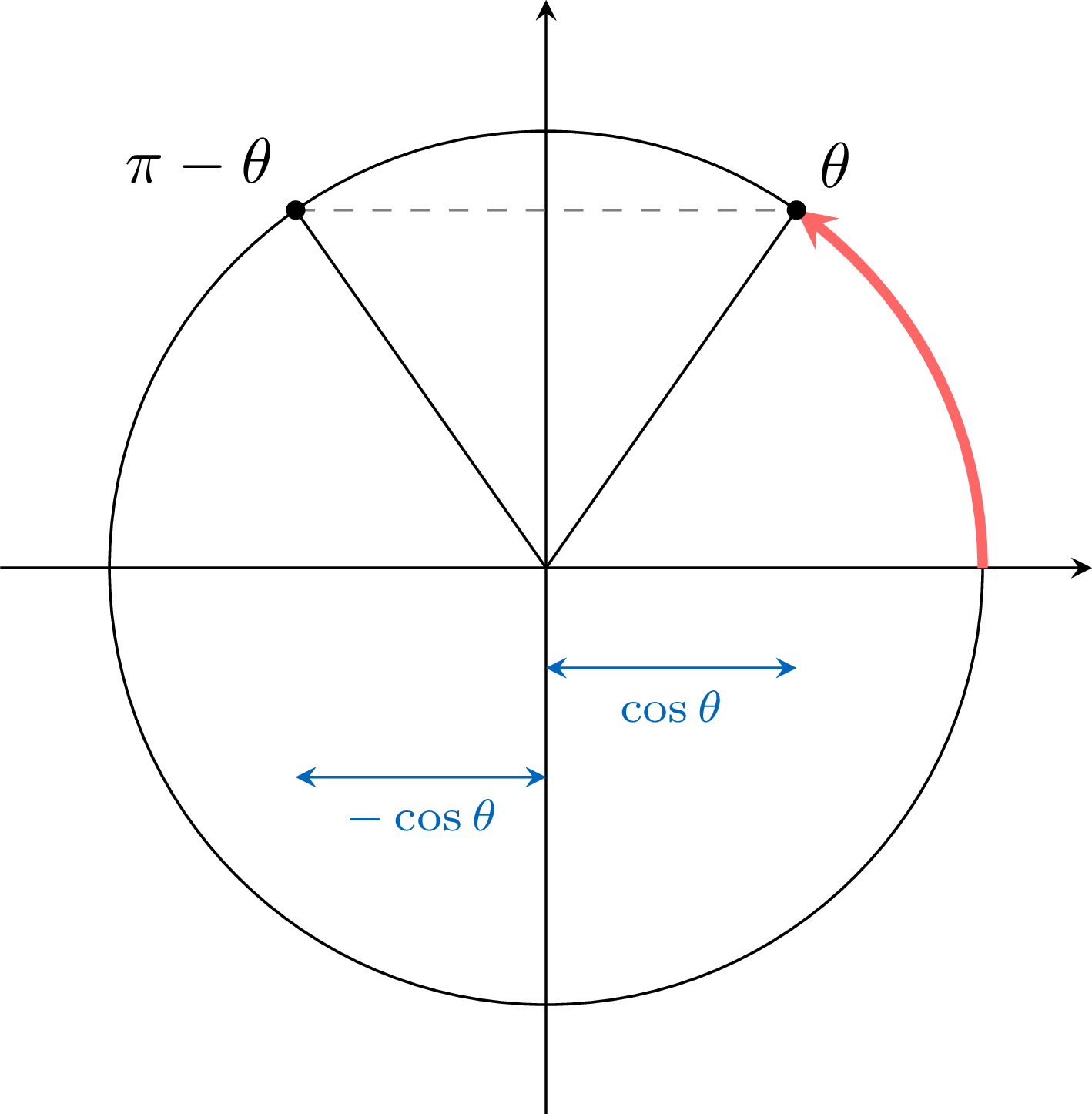
Write \(\pi - \theta = \pi + (-\theta)\) and apply the two preceding propositions, first the one for the opposite, then the one for adding \(\pi\):$$\begin{aligned}[t] \cos(\pi - \theta) &= \cos\big(\pi + (-\theta)\big) \\
&= -\cos(-\theta) && \scriptscriptstyle\text{(adding } \pi \scriptscriptstyle\text{)} \\
&= -\cos\theta && \scriptscriptstyle\text{(cosine of the opposite)} \end{aligned}$$and, in the same way,$$\begin{aligned}[t] \sin(\pi - \theta) &= \sin\big(\pi + (-\theta)\big) \\
&= -\sin(-\theta) && \scriptscriptstyle\text{(adding } \pi \scriptscriptstyle\text{)} \\
&= -(-\sin\theta) = \sin\theta. && \scriptscriptstyle\text{(sine of the opposite)} \end{aligned}$$
Proposition — Identities with \(\frac{\pi}{2} - \theta\)
Reflection in the line \(y=x\): $$\begin{aligned} \cos\left(\frac \pi 2 -\theta\right) &= \sin \theta \\
\sin\left(\frac \pi 2 -\theta\right) &= \cos \theta \\
\end{aligned}$$ 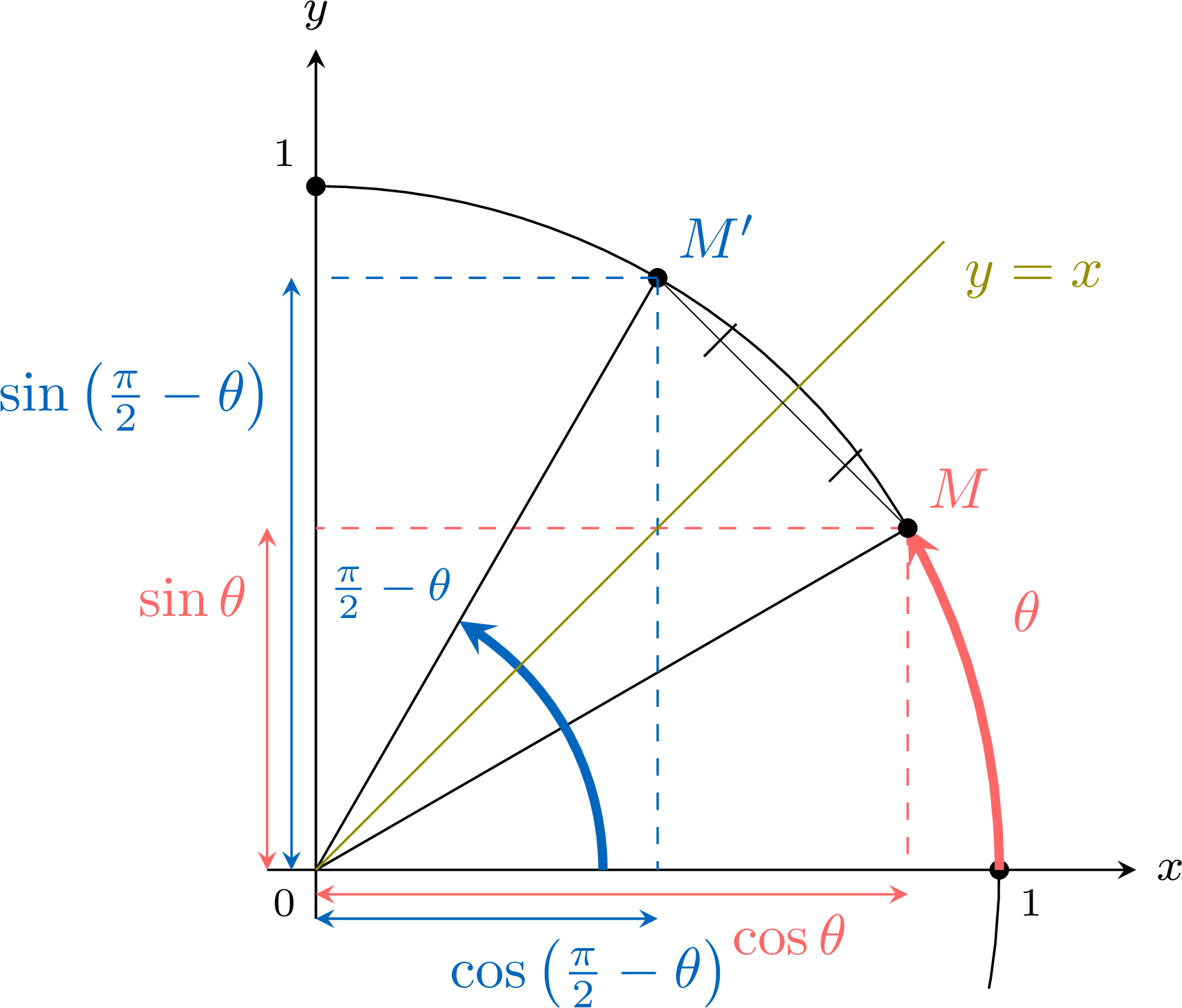
Let \(\theta\) be an angle.
Let \(M(\cos \theta,\sin\theta)\) be the point on the unit circle at the angle \(\theta\).
Let \(M'(\cos(\frac \pi 2 -\theta),\sin(\frac \pi 2 -\theta))\) be the point on the unit circle at the angle \(\frac \pi 2 -\theta\).
The points \(M\) and \(M'\) are symmetric with respect to the line \(y=x\), so the \(x\)-coordinate of \(M\) is the \(y\)-coordinate of \(M'\), and the \(y\)-coordinate of \(M\) is the \(x\)-coordinate of \(M'\).
So \(\begin{aligned}[t] \cos\left(\frac \pi 2 -\theta\right) &= \sin \theta \\ \sin\left(\frac \pi 2 -\theta\right) &= \cos \theta \\ \end{aligned}\)
Example
Using the identities above, write: - \(\cos\dfrac{2\pi}{3}\) in terms of \(\cos\dfrac{\pi}{3}\);
- \(\sin\dfrac{7\pi}{6}\) in terms of \(\sin\dfrac{\pi}{6}\).
- \(\dfrac{2\pi}{3} = \pi - \dfrac{\pi}{3}\): the symmetry about the vertical axis changes the sign of the \(x\)-coordinate, so$$\cos\frac{2\pi}{3} = -\cos\frac{\pi}{3}.$$
- \(\dfrac{7\pi}{6} = \pi + \dfrac{\pi}{6}\): the half-turn about \(O\) changes the sign of both coordinates, so$$\sin\frac{7\pi}{6} = -\sin\frac{\pi}{6}.$$
Proposition — Identities with \(\frac{\pi}{2} + \theta\)
A quarter turn: for every real number \(\theta\), $$\textcolor{colorprop}{\cos\left(\frac{\pi}{2} + \theta\right) = -\sin\theta, \qquad \sin\left(\frac{\pi}{2} + \theta\right) = \cos\theta.}$$ On the unit circle, the point of \(\frac{\pi}{2} + \theta\) is the image of the point \((\cos\theta, \sin\theta)\) of \(\theta\) by the quarter turn about \(O\): it is the point \((-\sin\theta, \cos\theta)\).
Write \(\dfrac{\pi}{2} + \theta = \pi - \left(\dfrac{\pi}{2} - \theta\right)\), and use \(\cos(\pi - x) = -\cos x\), \(\sin(\pi - x) = \sin x\) with \(x = \dfrac{\pi}{2} - \theta\), then the identities with \(\dfrac{\pi}{2} - \theta\): $$\begin{aligned}[t]\cos\left(\frac{\pi}{2} + \theta\right) &= \cos\left(\pi - \left(\frac{\pi}{2} - \theta\right)\right) = -\cos\left(\frac{\pi}{2} - \theta\right) = -\sin\theta,\\
\sin\left(\frac{\pi}{2} + \theta\right) &= \sin\left(\pi - \left(\frac{\pi}{2} - \theta\right)\right) = \sin\left(\frac{\pi}{2} - \theta\right) = \cos\theta.\end{aligned}$$
Example
Using \(\dfrac{2\pi}{3} = \dfrac{\pi}{2} + \dfrac{\pi}{6}\) and \(\dfrac{3\pi}{4} = \dfrac{\pi}{2} + \dfrac{\pi}{4}\), write \(\cos\dfrac{2\pi}{3}\) in terms of \(\sin\dfrac{\pi}{6}\), and \(\sin\dfrac{3\pi}{4}\) in terms of \(\cos\dfrac{\pi}{4}\).
$$\begin{aligned}[t]\cos\frac{2\pi}{3} &= \cos\left(\frac{\pi}{2} + \frac{\pi}{6}\right) = -\sin\frac{\pi}{6}, &&\text{(} \cos\left(\tfrac{\pi}{2} + \theta\right) = -\sin\theta\text{)}\\
\sin\frac{3\pi}{4} &= \sin\left(\frac{\pi}{2} + \frac{\pi}{4}\right) = \cos\frac{\pi}{4}. &&\text{(} \sin\left(\tfrac{\pi}{2} + \theta\right) = \cos\theta\text{)}\end{aligned}$$ As \(\dfrac{\pi}{6} = \dfrac{\pi}{2} - \dfrac{\pi}{3}\), the identities with \(\dfrac{\pi}{2} - \theta\) give \(\sin\dfrac{\pi}{6} = \cos\dfrac{\pi}{3}\), so \(\cos\dfrac{2\pi}{3} = -\cos\dfrac{\pi}{3}\): the result of the previous example, reached by a quarter turn instead of a half-turn.
Skills to practice
- Using the Identities in Degrees
- Using the Pythagorean Identity
- Using the Pythagorean Identity in Radians
- Explaining Trigonometric Equalities
V
Finding Exact Values: Multiples of \(45^\circ\)
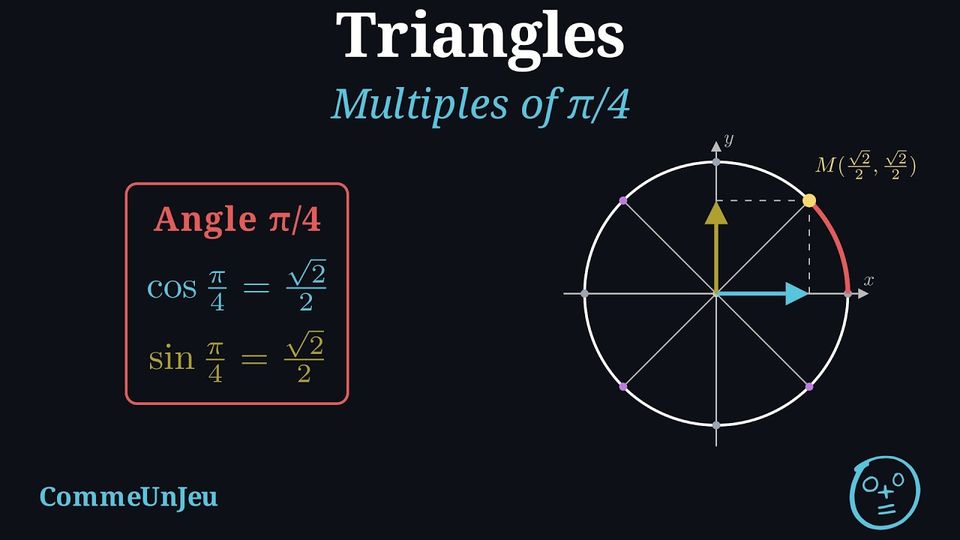
The symmetries of the circle relate the coordinates of many points to those of a single one — but they give nothing until a first value is known. Here is the first: the eighth of a turn, \(\dfrac{\pi}{4}\), that is \(45^\circ\), where the point sits on the diagonal. Its two coordinates are equal, and the right-angled triangle drawn under the point is enough to find them: it is the isosceles right-angled triangle that already gives the exact values of the ratios of \(45^\circ\).
Proposition — Coordinates for Angle \(\frac{\pi}{4}\)
$$\cos \frac{\pi}{4}=\frac{\sqrt{2}}{2} \quad \text { and } \quad \sin \frac{\pi}{4}=\frac{\sqrt{2}}{2}$$ 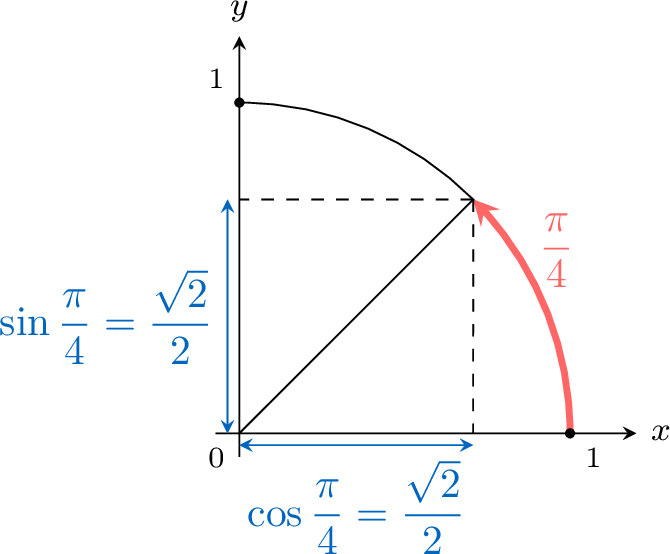
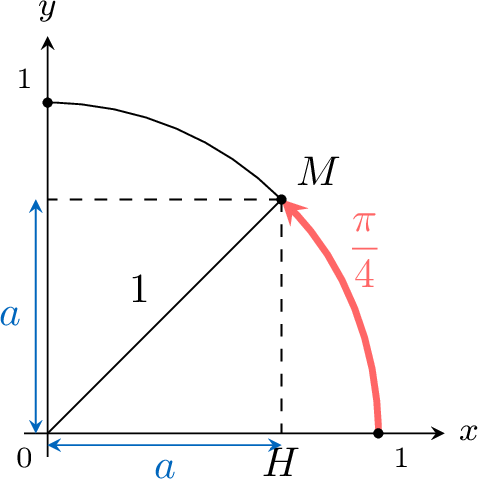
Since \(\angle{OMH}=\angle{MOH}\), the triangle \(OHM\) is isosceles.
Let \(a=OH=HM\). $$\begin{aligned} a^2+a^2 &=1^2 \quad \text { (Pythagoras' theorem in the right-angled triangle } OHM)\\ 2 a^2 &=1 \\ a^2 &=\frac{1}{2} \\ a &=\frac{\sqrt{2}}{2} \quad \text { since } a\geq 0 \end{aligned}$$ So \(M\left(\dfrac{\sqrt{2}}{2},\dfrac{\sqrt{2}}{2}\right)\).
As \(\cos \theta\) is the \(x\)-coordinate of \(M\) and \(\sin \theta\) is the \(y\)-coordinate of \(M\), $$\cos \frac{\pi}{4}=\frac{\sqrt{2}}{2} \quad \text { and } \quad \sin \frac{\pi}{4}=\frac{\sqrt{2}}{2}$$
Proposition — Multiples of \(\frac{\pi}{4}\)
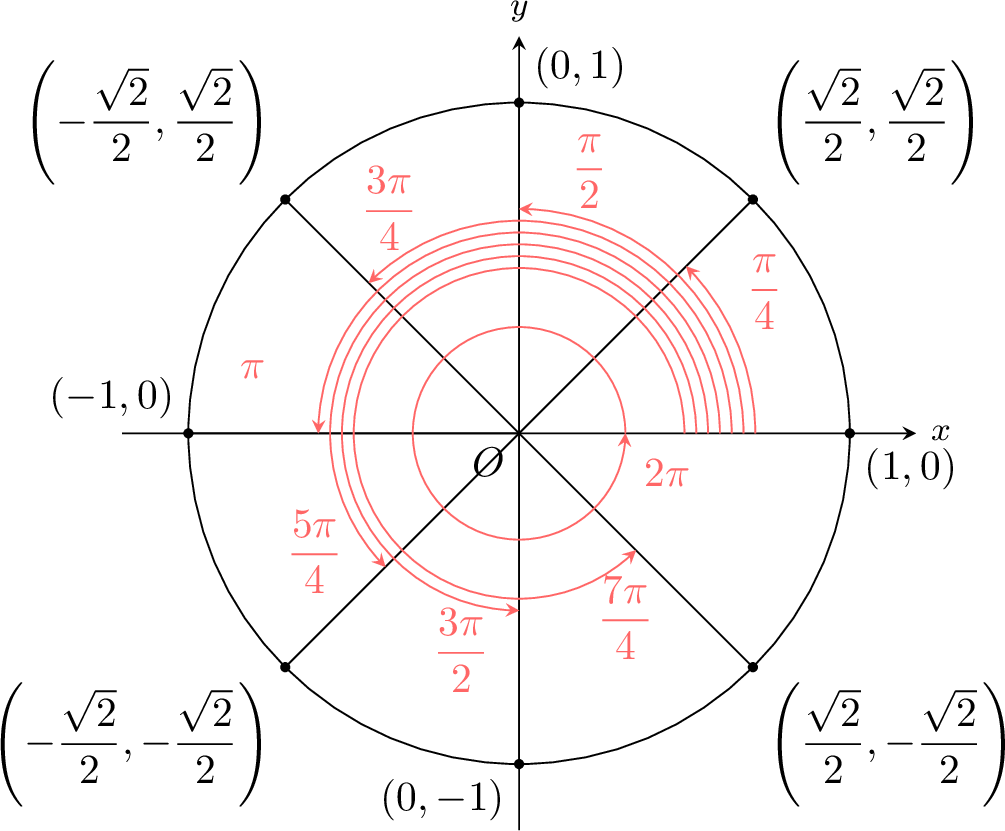
The coordinates of each point are found by using the symmetries about the axes and the half-turn about \(O\).
The signs of the coordinates are determined by the quadrant in which the angle lies.
Skills to practice
- Finding an Exact Value with an Identity
VI
Finding Exact Values: Multiples of \(30^\circ\)
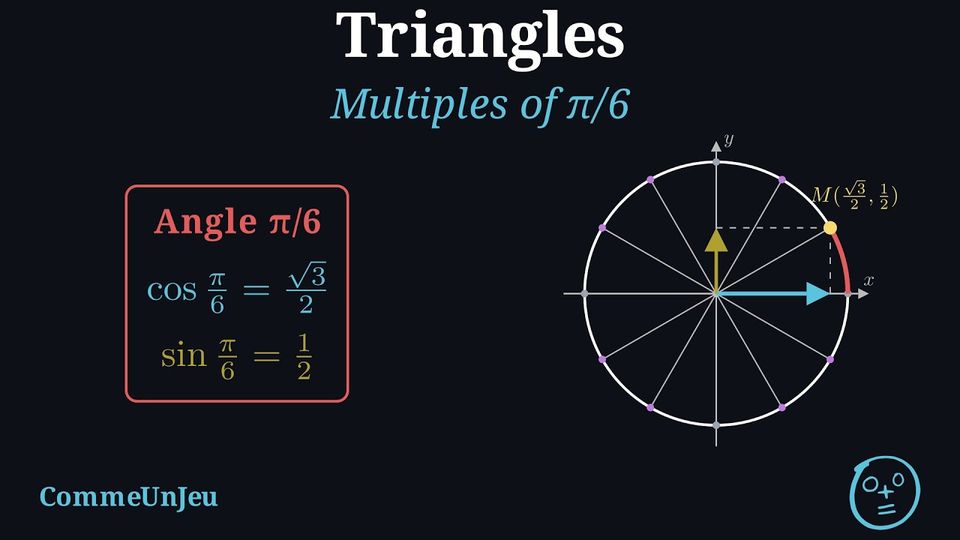
A second family: the twelfth of a turn, \(\dfrac{\pi}{6}\) (\(30^\circ\)), and its companion \(\dfrac{\pi}{3}\) (\(60^\circ\)), the sixth of a turn. This time the triangle to draw is equilateral: its half is the right-angled triangle that already gives the exact values of the ratios of \(30^\circ\) and \(60^\circ\). It gives the two angles at once — they exchange their coordinates.
Proposition — Coordinates of the Angles \(\frac{\pi}{3}\) and \(\frac{\pi}{6}\)
$$\cos \frac{\pi}{3}=\frac{1}{2} \quad \text { and } \quad \sin \frac{\pi}{3}=\frac{\sqrt{3}}{2}, \qquad\qquad \cos \frac{\pi}{6}=\frac{\sqrt{3}}{2} \quad \text { and } \quad \sin \frac{\pi}{6}=\frac{1}{2}.$$ The two angles exchange their coordinates: the point at \(\frac{\pi}{6}\) is the mirror image of the point at \(\frac{\pi}{3}\) in the line \(y = x\). 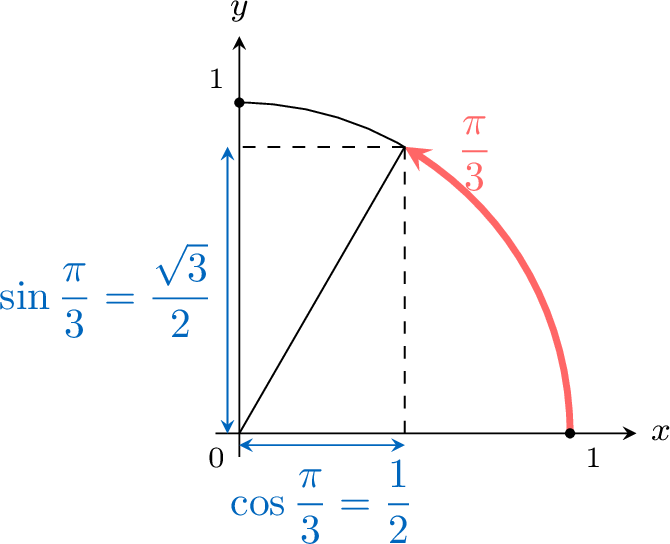
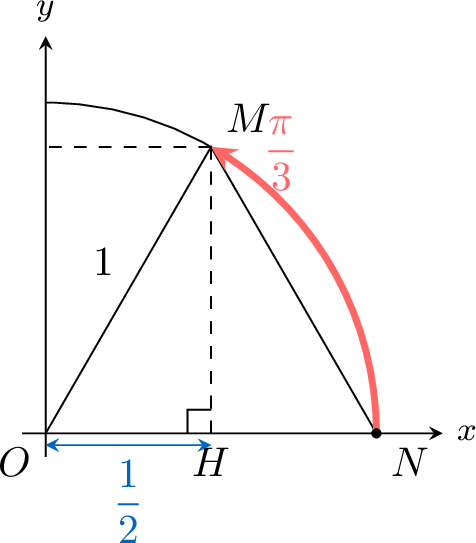
As \(ON=OM=1\), the triangle \(OMN\) is isosceles at \(O\): its base angles are equal, \(\angle{OMN}=\angle{ONM}\).
Since the sum of the angles in a triangle is \(\pi\), \(2\,\angle{OMN}=\pi-\dfrac \pi 3=\dfrac{2\pi}{3}\), so \(\angle{OMN}=\angle{ONM}=\dfrac \pi 3\).
So the triangle \(OMN\) is equilateral.
The altitude \(MH\) bisects the base \(ON\).
Thus \(OH=\dfrac{1}{2}\). $$\begin{aligned} OH^2+HM^2 &=OM^2 \quad \text { (Pythagoras' theorem in the right-angled triangle } OHM)\\ \left(\frac{1}{2}\right)^2 + HM^2 &=1 \\ HM^2 &=\frac{3}{4} \\ HM &=\frac{\sqrt{3}}{2} \quad \text { since } HM\geq 0 \end{aligned}$$ As \(\cos \theta\) is the \(x\)-coordinate of \(M\) and \(\sin \theta\) is the \(y\)-coordinate of \(M\): $$\cos \frac{\pi}{3}=\frac{1}{2} \quad \text { and } \quad \sin \frac{\pi}{3}=\frac{\sqrt{3}}{2}$$ By the symmetry about the line \(y=x\) (the identities with \(\frac{\pi}{2}-\theta\)), the twelfth of a turn, \(\frac{\pi}{6}\), follows at once:$$\cos \frac{\pi}{6}=\sin \frac{\pi}{3}=\frac{\sqrt{3}}{2} \quad \text { and } \quad \sin \frac{\pi}{6}=\cos \frac{\pi}{3}=\frac{1}{2}.$$
Proposition — Multiples of \(\frac{\pi}{6}\)
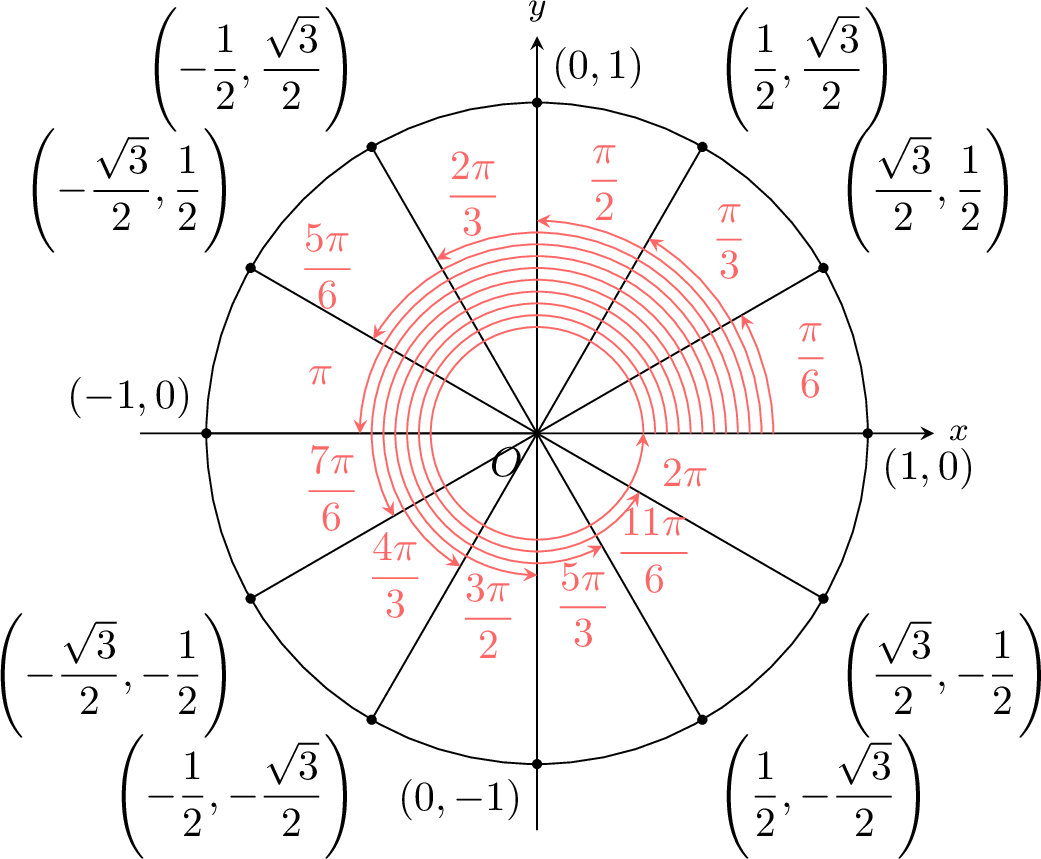
The coordinates of each point are found by applying the symmetries about the axes and the half-turn about \(O\).
Example
Find \(\cos \dfrac{2 \pi}{3}\) and \(\sin \dfrac{2 \pi}{3}\). 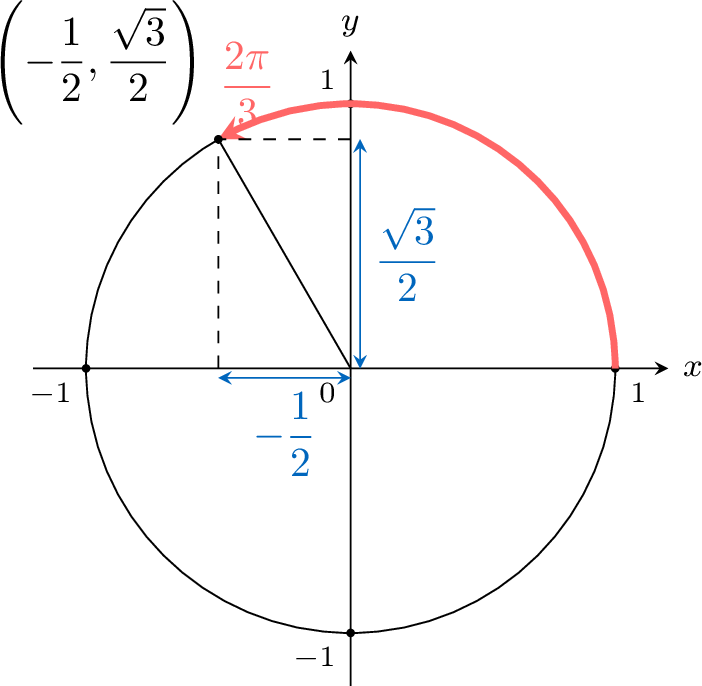
Proposition — Table of Exact Values
| \(\theta\) | \(0\) | \(\dfrac{\pi}{6}\) | \(\dfrac{\pi}{4}\) | \(\dfrac{\pi}{3}\) | \(\dfrac{\pi}{2}\) |
| \(\cos\theta\) | \(1\) | \(\dfrac{\sqrt3}{2}\) | \(\dfrac{\sqrt2}{2}\) | \(\dfrac{1}{2}\) | \(0\) |
| \(\sin\theta\) | \(0\) | \(\dfrac{1}{2}\) | \(\dfrac{\sqrt2}{2}\) | \(\dfrac{\sqrt3}{2}\) | \(1\) |
Example
Without a calculator, give the exact values of \(\sin 150^\circ\), \(\cos 120^\circ\) and \(\cos 135^\circ\).
The unit circle reads angles in degrees too: since \(180^\circ = \pi\), the angles \(30^\circ\), \(45^\circ\) and \(60^\circ\) are \(\dfrac{\pi}{6}\), \(\dfrac{\pi}{4}\) and \(\dfrac{\pi}{3}\), whose values are in the table. Each angle asked is \(180^\circ\) minus one of them. Two angles whose sum is \(180^\circ\) are called supplementary: their points are mirror images of each other in the vertical axis, so they have the same sine and opposite cosines (\(\sin(\pi - \theta) = \sin\theta\), \(\cos(\pi - \theta) = -\cos\theta\)). 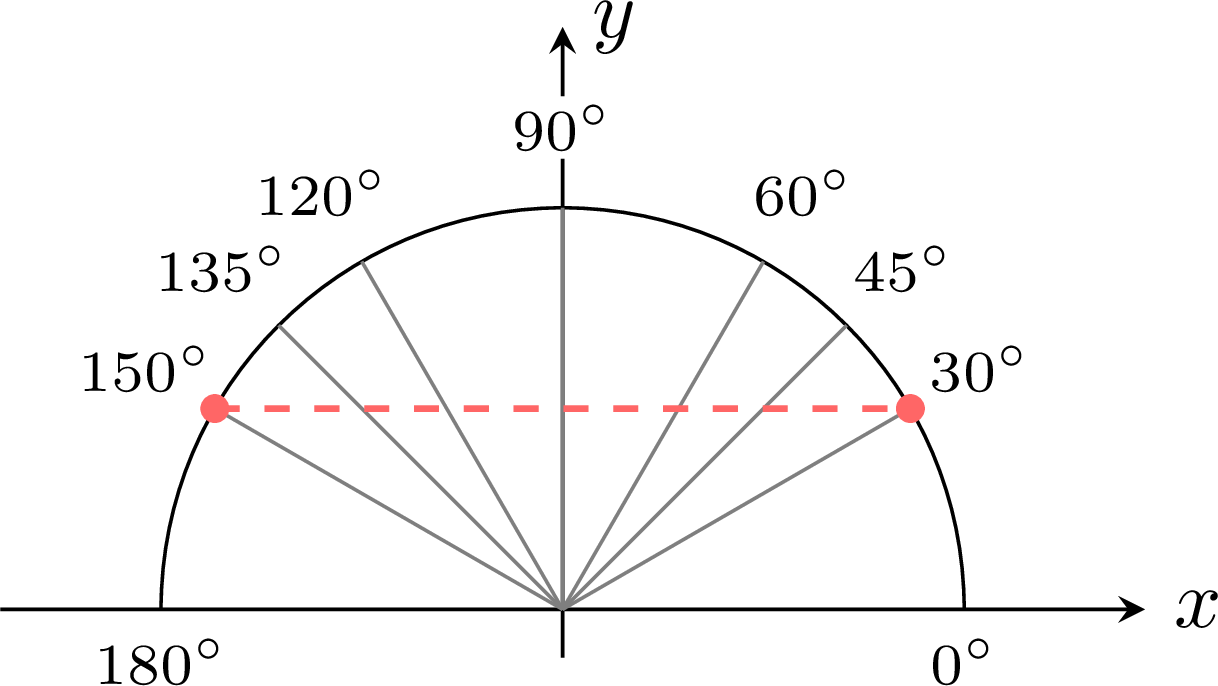
$$\begin{aligned}[t]\sin 150^\circ &= \sin(180^\circ - 30^\circ) && \text{(decomposition)}\\
&= \sin 30^\circ && \text{(same sine)}\\
&= \frac{1}{2},\end{aligned}\qquad \begin{aligned}[t]\cos 120^\circ &= \cos(180^\circ - 60^\circ) && \text{(decomposition)}\\
&= -\cos 60^\circ && \text{(opposite cosine)}\\
&= -\frac{1}{2},\end{aligned}$$ $$\begin{aligned}[t]\cos 135^\circ &= \cos(180^\circ - 45^\circ) && \text{(decomposition)}\\
&= -\cos 45^\circ && \text{(opposite cosine)}\\
&= -\frac{\sqrt{2}}{2}.\end{aligned}$$ Check on the figure: the points for \(120^\circ\), \(135^\circ\) and \(150^\circ\) lie to the left of the \(y\)-axis (negative cosines) and above the \(x\)-axis (positive sines); the dashed segment shows that \(30^\circ\) and \(150^\circ\) are at the same height.
Skills to practice
- Finding Exact Values in Degrees
- Justifying with the Unit Circle in Degrees
- Finding an Exact Value with an Identity
VII
Using the Addition Formulas
Proposition — Cosine of Difference
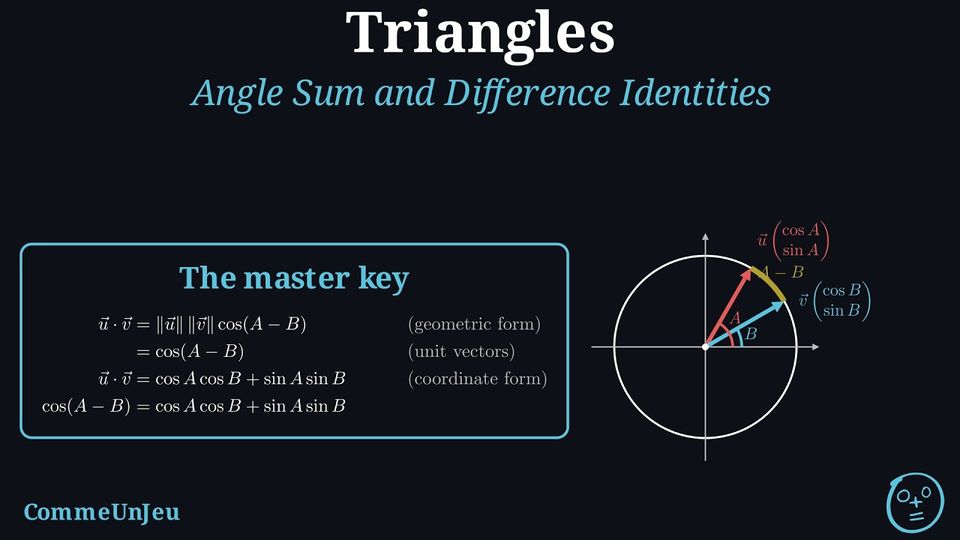
$$\cos (A - B) = \cos A \cos B + \sin A \sin B.$$
Consider the two unit vectors whose tips are the points of the unit circle associated with \(A\) and \(B\): $$\vec{u} = \begin{pmatrix}\cos A \\
\sin A \end{pmatrix} \quad\text{and}\quad \vec{v} = \begin{pmatrix}\cos B \\
\sin B \end{pmatrix}.$$ The geometric angle \(\theta \in [0, \pi]\) between \(\vec{u}\) and \(\vec{v}\) is equal to \(A - B\) or to \(B - A\), up to a multiple of \(2\pi\). Since cosine is even and \(2\pi\)-periodic, \(\cos\theta = \cos(A - B)\).
The scalar product \(\vec{u} \cdot \vec{v}\) can be computed in two ways: 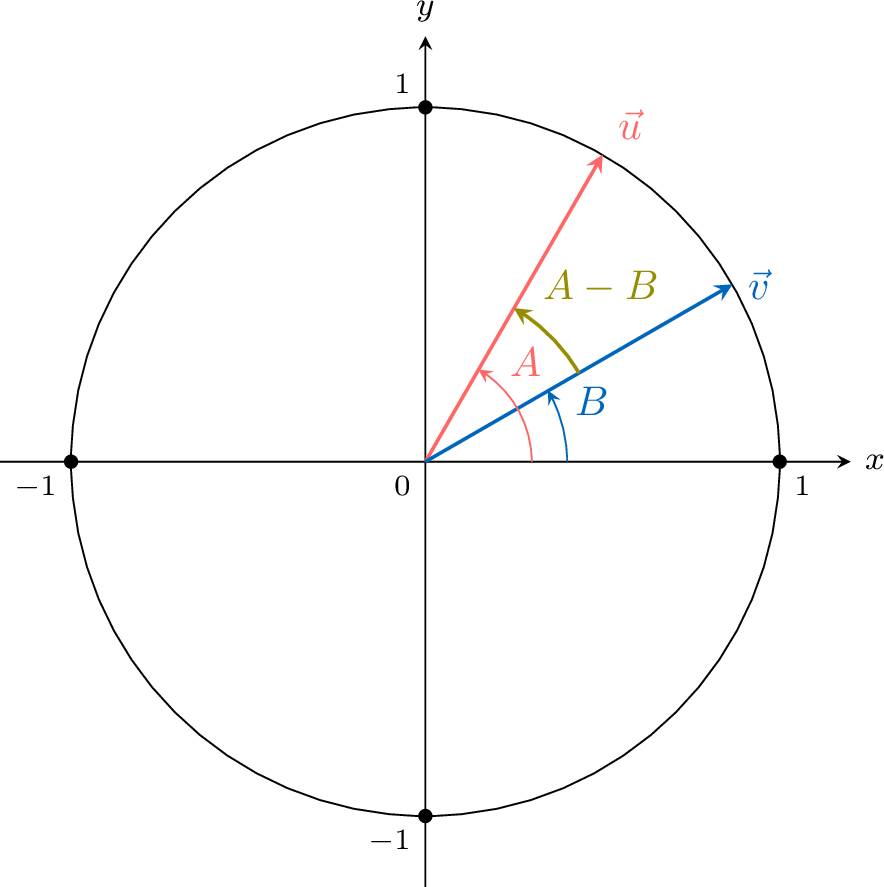
Another proof, with distances. Let \(P\) and \(Q\) be the points of the unit circle associated with \(A\) and \(B\): \(P(\cos A, \sin A)\) and \(Q(\cos B, \sin B)\). Then $$\begin{aligned}[t] PQ^2 &= (\cos A - \cos B)^2 + (\sin A - \sin B)^2 && \text{(distance between two points)}\\
&= \cos^2 A + \sin^2 A + \cos^2 B + \sin^2 B\\
&\quad - 2(\cos A\cos B + \sin A\sin B) && \text{(expanding)}\\
&= 2 - 2(\cos A\cos B + \sin A\sin B). && (\cos^2 + \sin^2 = 1) \end{aligned}$$ The rotation about \(O\) through the angle \(-B\) keeps distances. It sends \(Q\) to the point \(Q'(1, 0)\), of angle \(0\), and \(P\) to the point \(P'\big(\cos(A - B), \sin(A - B)\big)\), of angle \(A - B\). So $$\begin{aligned}[t] PQ^2 = P'Q'^2 &= \big(\cos(A - B) - 1\big)^2 + \sin^2(A - B) && \text{(distance between two points)}\\
&= \cos^2(A - B) + \sin^2(A - B) - 2\cos(A - B) + 1 && \text{(expanding)}\\
&= 2 - 2\cos(A - B). && (\cos^2 + \sin^2 = 1) \end{aligned}$$ The two expressions of \(PQ^2\) are equal: \(2 - 2\cos(A - B) = 2 - 2(\cos A\cos B + \sin A\sin B)\), which gives the identity again, without the scalar product.
The scalar product \(\vec{u} \cdot \vec{v}\) can be computed in two ways:
- From the angle between the vectors: $$\vec{u} \cdot \vec{v} = \|\vec{u}\| \,\|\vec{v}\| \cos\theta = 1 \cdot 1 \cdot \cos(A - B) = \cos(A - B).$$
- From the components: $$\vec{u} \cdot \vec{v} = \begin{pmatrix}\cos A \\ \sin A \end{pmatrix} \cdot \begin{pmatrix}\cos B \\ \sin B \end{pmatrix} = (\cos A)(\cos B) + (\sin A)(\sin B).$$
Proposition — Cosine of Sum
$$\cos (A + B) = \cos A \cos B - \sin A \sin B.$$
Substitute \(B\) by \(-B\) in the cosine difference formula: $$\begin{aligned} \cos(A + B) &= \cos\bigl(A - (-B)\bigr)\\
&= \cos A \cos(-B) + \sin A \sin(-B)\\
&= \cos A \cos B + \sin A (-\sin B)\quad(\text{since } \cos(-\theta) = \cos \theta\text{ and }\sin(-\theta) = -\sin \theta)\\
&= \cos A \cos B - \sin A \sin B. \end{aligned}$$
Proposition — Sine of Sum and Difference
$$\sin (A + B) = \sin A \cos B + \cos A \sin B,$$ $$\sin (A - B) = \sin A \cos B - \cos A \sin B.$$
Using the complementary angle identity \(\sin \theta = \cos\left(\dfrac{\pi}{2} - \theta\right)\): $$\begin{aligned} \sin(A + B) &= \cos\left(\frac{\pi}{2} - (A + B)\right)\\
&= \cos\left( \left(\frac{\pi}{2} - A\right) - B \right)\\
&= \cos\left(\frac{\pi}{2} - A\right) \cos B + \sin\left(\frac{\pi}{2} - A\right) \sin B\\
&= \sin A \cos B + \cos A \sin B. \end{aligned}$$ For the difference, write $$\begin{aligned} \sin(A - B) &= \sin\bigl(A + (-B)\bigr)\\
&= \sin A \cos(-B) + \cos A \sin(-B)\\
&= \sin A \cos B - \cos A \sin B. \end{aligned}$$
Proposition — Tangent of Sum and Difference
For angles \(A\) and \(B\) such that all expressions below are defined, $$\tan (A + B) = \frac{\tan A + \tan B}{1 - \tan A \tan B},$$ $$\tan (A - B) = \frac{\tan A - \tan B}{1 + \tan A \tan B}.$$
Assume \(\cos A \cos B \neq 0\) and \(\cos(A + B) \neq 0\) so that all ratios below are defined: $$\begin{aligned} \tan(A + B) &= \frac{\sin(A + B)}{\cos(A + B)} \\
&= \frac{\sin A \cos B + \cos A \sin B}{\cos A \cos B - \sin A \sin B} \\
&= \frac{\dfrac{\sin A \cos B + \cos A \sin B}{\cos A \cos B}}{\dfrac{\cos A \cos B - \sin A \sin B}{\cos A \cos B}} \quad \text{(divide numerator and denominator by } \cos A \cos B\text{)} \\
&= \frac{\dfrac{\sin A}{\cos A} + \dfrac{\sin B}{\cos B}}{1 - \dfrac{\sin A \sin B}{\cos A \cos B}}\\
&= \frac{\tan A + \tan B}{1 - \tan A \tan B}. \end{aligned}$$ The formula for \(\tan(A-B)\) is obtained by replacing \(B\) with \(-B\) and using \(\tan(-B) = -\tan B\).
Skills to practice
- Simplifying Trigonometric Expressions
- Finding Exact Values with the Addition Formulas in Degrees
VIII
Using the Double-Angle Formulas
Proposition — Double Angle Formulas
For every real number \(A\): $$\cos 2A = \cos^2 A - \sin^2 A = 2\cos^2 A - 1 = 1 - 2\sin^2 A,$$ $$\sin 2A = 2\sin A\cos A.$$ They are obtained by taking \(B = A\) in the formulas for \(\cos(A + B)\) and \(\sin(A + B)\), which gives \(\sin 2A\) and \(\cos^2 A - \sin^2 A\), then using \(\cos^2 A + \sin^2 A = 1\) for the other two forms of \(\cos 2A\). Example
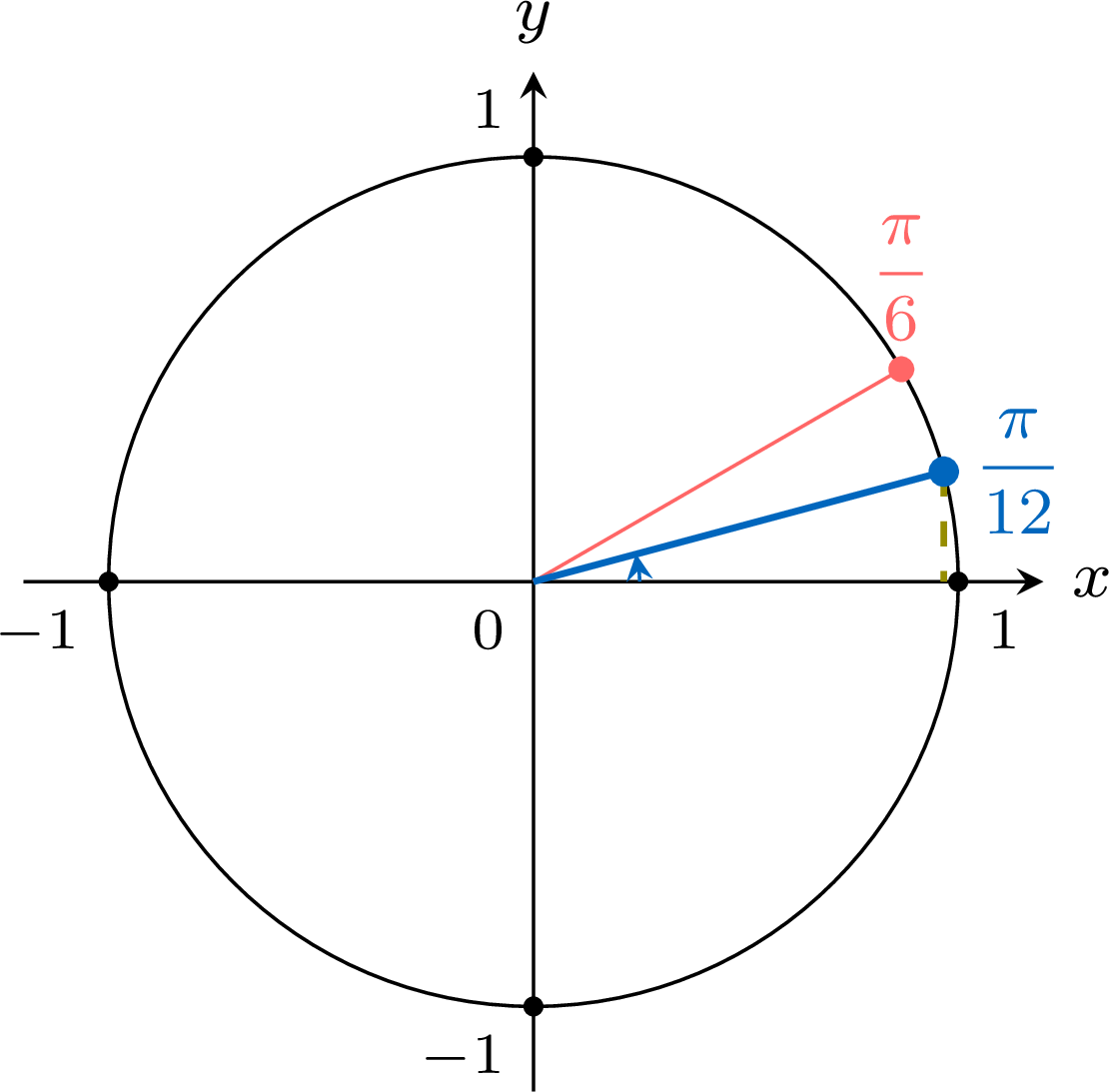
Compute the exact value of \(\cos\dfrac{\pi}{12}\) in two ways: - with an addition formula, writing \(\dfrac{\pi}{12} = \dfrac{\pi}{3} - \dfrac{\pi}{4}\);
- with a double angle formula, since \(2 \times \dfrac{\pi}{12} = \dfrac{\pi}{6}\).
- With the cosine of a difference: $$\begin{aligned}[t] \cos\frac{\pi}{12} &= \cos\left(\frac{\pi}{3} - \frac{\pi}{4}\right) &&\\ &= \cos\frac{\pi}{3}\cos\frac{\pi}{4} + \sin\frac{\pi}{3}\sin\frac{\pi}{4} && \text{(cosine of a difference)}\\ &= \frac{1}{2} \times \frac{\sqrt{2}}{2} + \frac{\sqrt{3}}{2} \times \frac{\sqrt{2}}{2} && \text{(special values)}\\ &= \frac{\sqrt{2} + \sqrt{6}}{4}. \end{aligned}$$
- With \(A = \dfrac{\pi}{12}\), the formula \(\cos 2A = 2\cos^2 A - 1\) gives \(\cos\dfrac{\pi}{6} = 2\cos^2\dfrac{\pi}{12} - 1\), so $$\begin{aligned}[t] \cos^2\frac{\pi}{12} &= \frac{1}{2}\left(1 + \cos\frac{\pi}{6}\right) &&\\ &= \frac{1}{2}\left(1 + \frac{\sqrt{3}}{2}\right) = \frac{2 + \sqrt{3}}{4}. \end{aligned}$$ Since \(\dfrac{\pi}{12} \in \left[0, \dfrac{\pi}{2}\right]\), \(\cos\dfrac{\pi}{12} \ge 0\), hence \(\cos\dfrac{\pi}{12} = \dfrac{\sqrt{2 + \sqrt{3}}}{2}\).
Skills to practice
- Proving and Using the Double-Angle Formulas
- Finding Exact Values in Radians
IX
Going further
Skills to practice
- Investigating Patterns on the Unit Circle
- Quiz
Jump to section