International Baccalaureate · DP 1: Analysis and Approaches SL
Equations
I
Equations of the Form \(x^2 \equal k\)
I.1
Solutions of \(x^2 \equal k\)
Recappreviously studied — click to reread
Proposition — Solutions of \(x^2 \equal a\)
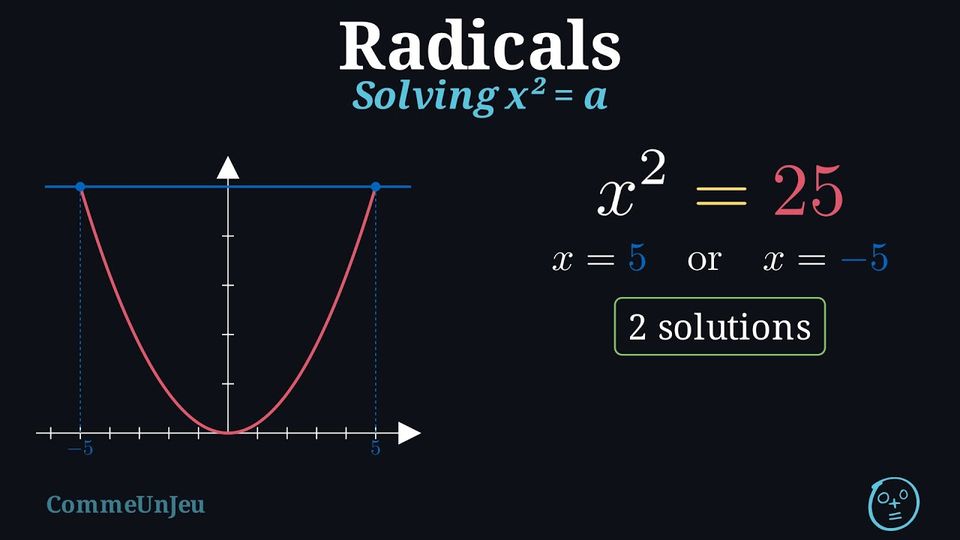
Let \(a\) be a number. The solutions of the equation \(x^2 = a\) depend on the sign of \(a\): - if \(a > 0\), the equation has two solutions: \(x = \sqrt{a}\) and \(x = -\sqrt{a}\);
- if \(a = 0\), the equation has exactly one solution: \(x = 0\);
- if \(a < 0\), the equation has no solution: the square of a number is never negative.
Example
Solve each equation: - \(x^2 = 49\)
- \(x^2 = 7\)
- \(x^2 = -9\)
- \(49 > 0\): two solutions, \(x = \sqrt{49} = 7\) and \(x = -\sqrt{49} = -7\).
- \(7 > 0\): two solutions, \(x = \sqrt{7}\) and \(x = -\sqrt{7}\). These are the exact values; a calculator gives \(\sqrt{7} \approx 2.65\).
- \(-9 < 0\): no solution, because the square of a number is never negative.
Method — Solving \(x^2 \equal a\) Graphically
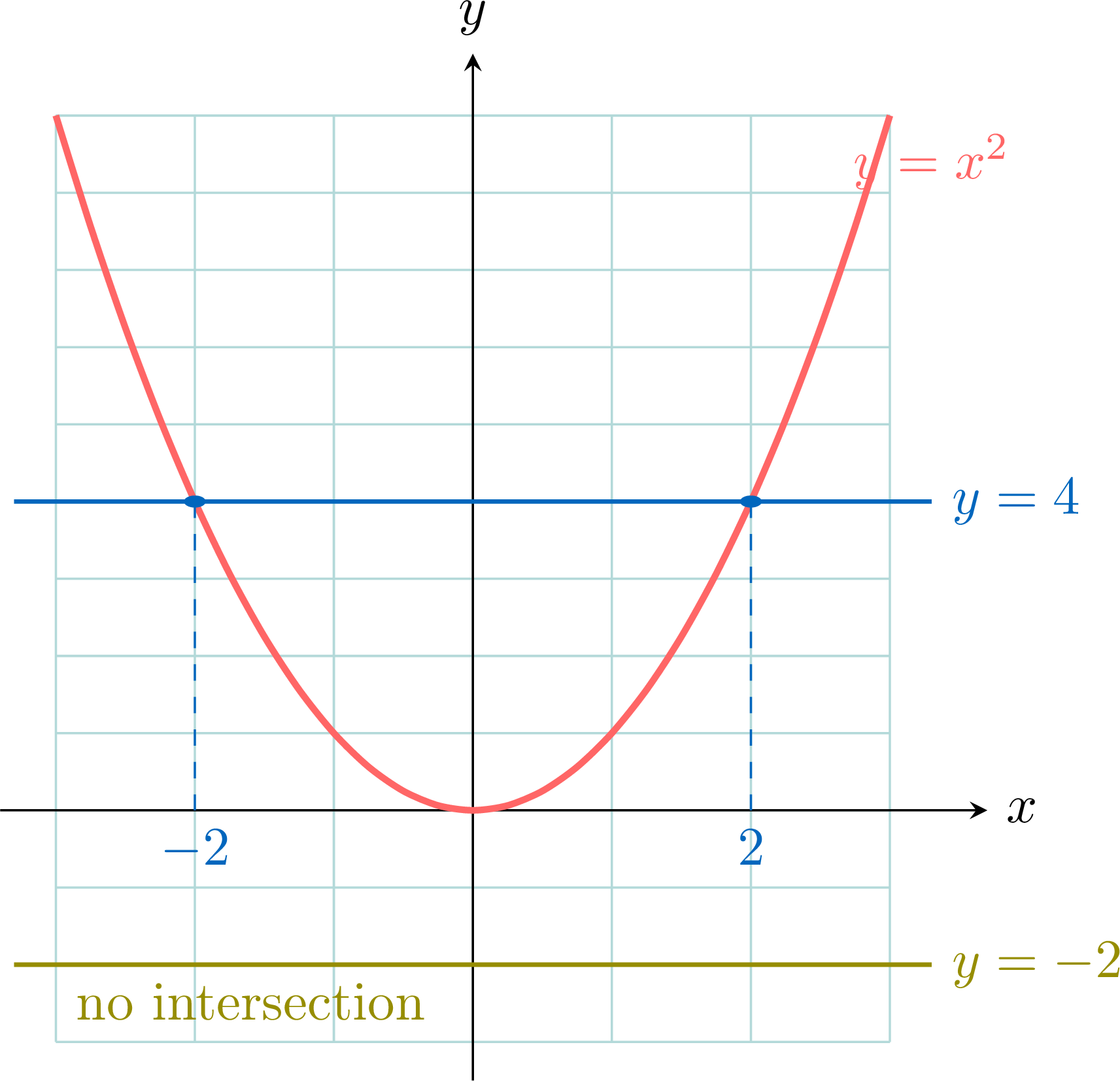
To solve the equation \(x^2 = a\) graphically: - On the given parabola \(y = x^2\), draw the horizontal line \(y = a\).
- Read the \(x\)-coordinates of their intersection points. When they seem to fall on grid lines, check them by calculation: they are then the solutions; otherwise the reading only gives an approximate value — the exact solutions are then \(-\sqrt{a}\) and \(\sqrt{a}\).
Skills to practice
- Solving \(x^2 \equal a\) by Calculation
II
Power Equations
II.1
Solving Power Equations
Definition — Nth Root
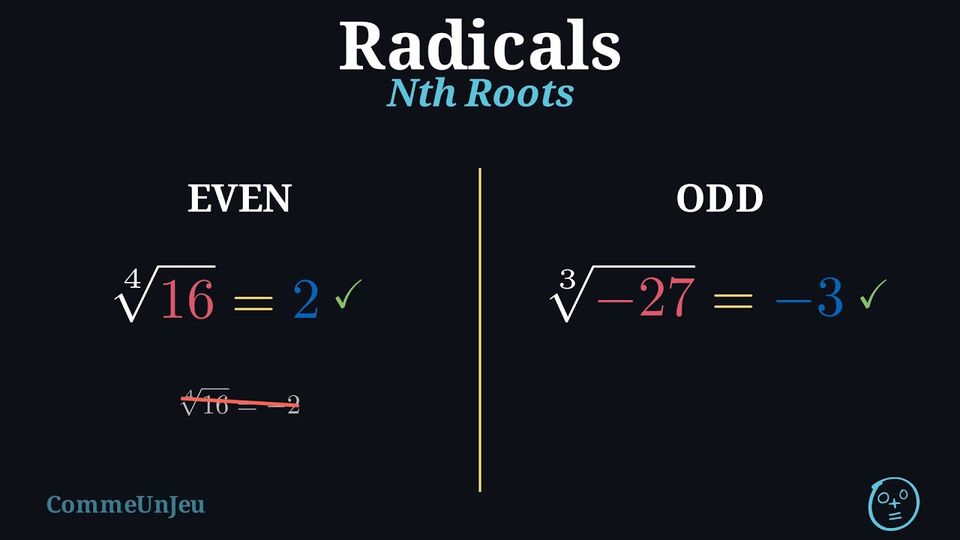
The concept of a root can be generalised. For a positive integer \(n\), the nth root of a real number \(a\), written \(\sqrt[n]{a}\), is a number which, when raised to the power of \(n\), gives \(a\), chosen as follows: for an odd \(n\), it is the only real number whose \(n\)th power is \(a\); for an even \(n\), it exists only when \(a \ge 0\), and it is the non-negative number whose \(n\)th power is \(a\). Whenever it exists, $$\left(\sqrt[n]{a}\right)^n = a.$$ The rules for their domains depend on whether the index \(n\) is even or odd. - Even roots (e.g.\ \(\sqrt[2]{a}, \sqrt[4]{a}, \dots\)): an even root of a negative number is not a real number. For even \(n\), \(\sqrt[n]{a}\) is only defined for \(\boldsymbol{a \ge 0}\), and it denotes the non-negative number whose \(n\)th power is \(a\) (e.g.\ \(\sqrt[4]{16} = 2\), not \(-2\)).
- Odd roots (e.g.\ \(\sqrt[3]{a}, \sqrt[5]{a}, \dots\)): an odd root is defined for all real numbers \(a\).
Definition — Power Equation
A power equation is an equation that can be written in the form \(x^n = k\), where the exponent \(n\) is a nonzero integer and \(k\) is a real number.For example, \(x^3 = 5\), \(2x^4 = 20\) (that is, \(x^4 = 10\)) and \(x^{-2} = 9\) are power equations.
Counting the Solutions on a Graph
When the exponent \(n\) is a positive integer, the solutions of \(x^n = k\) are the \(x\)-coordinates of the points where the curve \(y = x^n\) meets the horizontal line \(y = k\). What decides their number is the parity of the exponent: 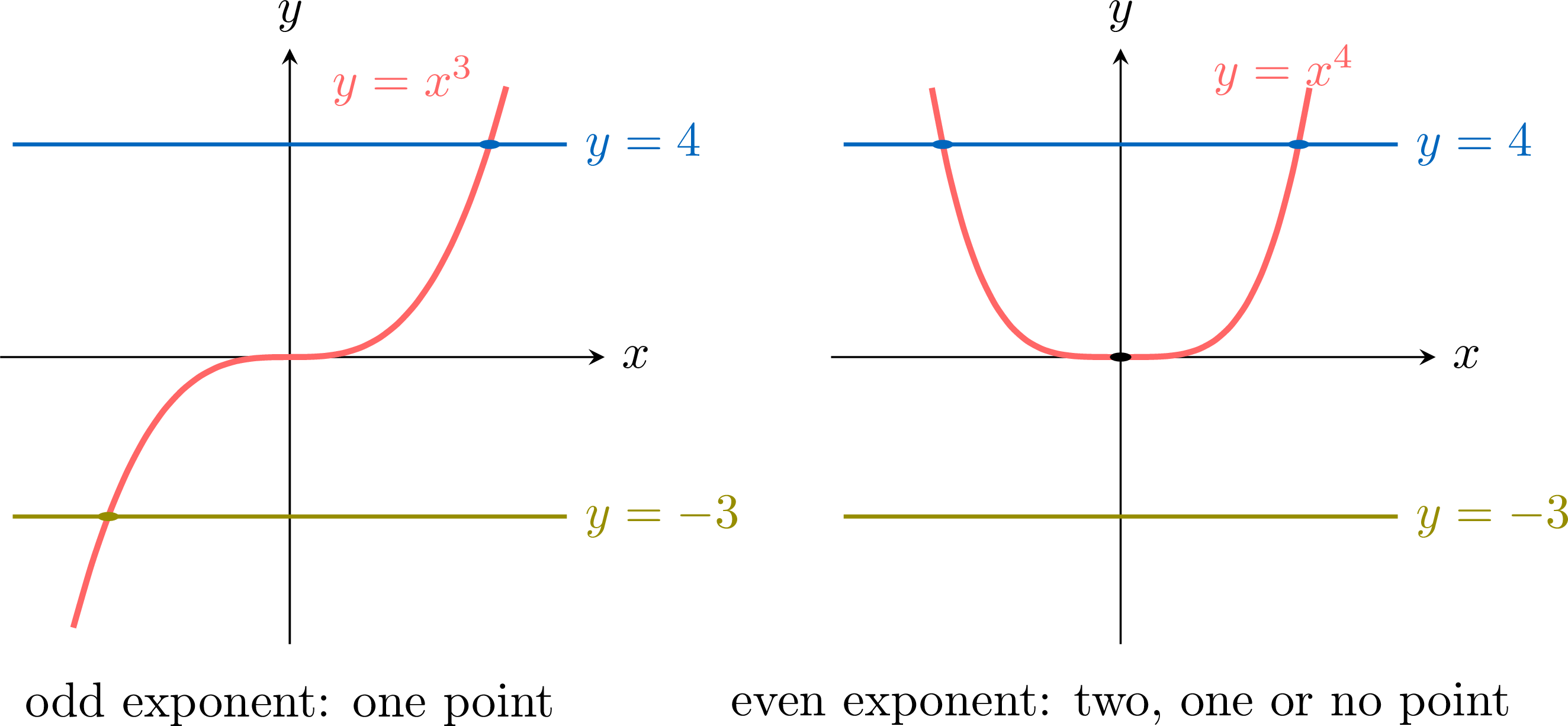
For the exponent \(2\), this is the rule already known for \(x^2 = a\); the Proposition below extends it to every integer exponent \(n \geq 2\), and the Method reduces a negative exponent to a positive one.
- with an odd exponent, the curve rises from left to right through every height: each horizontal line meets it at exactly one point;
- with an even exponent, the curve is symmetric about the \(y\)-axis and never goes below the \(x\)-axis: a line above the axis meets it at two points, the axis itself at one point (the origin), a line below the axis at no point.
Proposition — Solutions of \(x^n \equal k\)
Let \(n \geq 2\) be an integer and \(k\) a real number. - If \(n\) is odd, the equation \(x^n = k\) has exactly one solution, whatever the sign of \(k\): \(x = \sqrt[n]{k}\).
- If \(n\) is even and \(k > 0\), the equation has two solutions: \(x = -\sqrt[n]{k}\) and \(x = \sqrt[n]{k}\).
- If \(n\) is even and \(k = 0\), the equation has exactly one solution: \(x = 0\).
- If \(n\) is even and \(k < 0\), the equation has no solution: an even power of a real number is never negative.
Order. If \(0 \le a < b\), then \(a^n < b^n\): multiplying inequalities between non-negative numbers keeps the order, and each of the \(n\) factors of \(a^n = a \times a \times \dots \times a\) is smaller than the matching factor of \(b^n\). So two different non-negative numbers never have the same \(n\)th power: when \(k \ge 0\), the only non-negative solution of \(x^n = k\) is \(\sqrt[n]{k}\), by the definition of the \(n\)th root.
Even \(n\). An even number of minus signs gives \((-x)^n = x^n\), and one of the numbers \(x\) and \(-x\) is non-negative, so \(x^n \ge 0\) for every real \(x\): there is no solution when \(k < 0\). When \(k \ge 0\), a non-negative solution is \(\sqrt[n]{k}\), and a negative solution \(x\) makes \(-x\) a positive solution, so \(-x = \sqrt[n]{k}\), that is \(x = -\sqrt[n]{k}\). Both numbers are solutions, since \(\left(-\sqrt[n]{k}\right)^n = \left(\sqrt[n]{k}\right)^n = k\): they are two different numbers when \(k > 0\), and both equal \(0\) when \(k = 0\).
Odd \(n\). An odd number of minus signs gives \((-x)^n = -x^n\), so \(x^n\) has the sign of \(x\). If \(k \ge 0\), a solution is non-negative, so it is \(\sqrt[n]{k}\). If \(k < 0\), a solution \(x\) is negative and \(-x\) is a positive solution of \((-x)^n = -k\), so \(-x = \sqrt[n]{-k}\), that is \(x = -\sqrt[n]{-k}\); this number is \(\sqrt[n]{k}\), since \(\left(-\sqrt[n]{-k}\right)^n = -(-k) = k\). In both cases the equation has exactly one solution, \(\sqrt[n]{k}\).
Method — Solving a Power Equation
To solve an equation that can be written \(X^n = k\), where \(X\) is \(x\) or an expression such as \(x - 2\): - Isolate the power: undo the additions, then the multiplications, until the equation reads \(X^n = k\).
- Remove a negative exponent: if \(n = -m\) with \(m > 0\), then \(X \neq 0\) and \(X^{-m} = \dfrac{1}{X^m}\); a quotient \(\dfrac{1}{X^m}\) is never \(0\), so for \(k = 0\) there is no solution, and for \(k \neq 0\) the equation becomes \(X^m = \dfrac{1}{k}\).
- Read the parity of the exponent and the sign of \(k\): the exponent \(1\) gives \(X = k\) directly; an odd exponent \(n \geq 3\) gives \(X = \sqrt[n]{k}\); an even exponent gives \(X = -\sqrt[n]{k}\) or \(X = \sqrt[n]{k}\) if \(k > 0\), \(X = 0\) if \(k = 0\), and no solution if \(k < 0\).
- If \(X\) is an expression, solve each equation \(X = \ldots\) for \(x\).
- Give the exact values; if a decimal value is asked, round only at the end.
Example
Solve each equation: - \(x^3 = -64\)
- \(x^4 = 81\)
- \(x^6 = -5\)
- \(x^4 = 0\)
- \(x^5 = 7\)
- The exponent \(3\) is odd: exactly one solution, \(x = \sqrt[3]{-64} = -4\), since \((-4)^3 = -64\).
- The exponent \(4\) is even and \(81 > 0\): two solutions, \(x = -\sqrt[4]{81} = -3\) and \(x = \sqrt[4]{81} = 3\), since \(3^4 = 81\).
- The exponent \(6\) is even and \(-5 < 0\): no solution, because a sixth power is never negative.
- The exponent \(4\) is even and the right side is \(0\): exactly one solution, \(x = 0\).
- The exponent \(5\) is odd: exactly one solution, \(x = \sqrt[5]{7}\). This is the exact value; a calculator gives \(\sqrt[5]{7} \approx 1.48\).
Example
Solve each equation: - \(2x^3 + 5 = -11\)
- \((x - 1)^4 = 16\)
- \(x^{-2} = \dfrac{1}{25}\)
- \(x^{-3} = -\dfrac{1}{8}\)
- \(x^{-4} = 0\)
- The power is isolated first: $$\begin{aligned}[t] 2x^3 + 5 &= -11\\ 2x^3 &= -16 && \text{(subtract \(5\) from both sides)}\\ x^3 &= -8 && \text{(divide both sides by \(2\))} \end{aligned}$$ The exponent \(3\) is odd: \(x = \sqrt[3]{-8} = -2\). Check: \(2 \times (-2)^3 + 5 = -16 + 5 = -11\).
- Here \(X = x - 1\) and \(X^4 = 16\), with \(4\) even and \(16 > 0\). Since \(\sqrt[4]{16} = 2\): $$x - 1 = -2 \quad \text{or} \quad x - 1 = 2,$$ so \(x = -1\) or \(x = 3\). Check: \((-2)^4 = 2^4 = 16\).
- The negative exponent is removed first: $$\begin{aligned}[t] x^{-2} &= \frac{1}{25}\\ \frac{1}{x^2} &= \frac{1}{25} && \text{(definition of a negative exponent)}\\ x^2 &= 25 && \text{(reciprocals of both sides)} \end{aligned}$$ The exponent \(2\) is even and \(25 > 0\): \(x = -5\) or \(x = 5\).
- The negative exponent is removed first: $$\begin{aligned}[t] x^{-3} &= -\frac{1}{8}\\ \frac{1}{x^3} &= -\frac{1}{8} && \text{(definition of a negative exponent)}\\ x^3 &= -8 && \text{(reciprocals of both sides)} \end{aligned}$$ The exponent \(3\) is odd: exactly one solution, \(x = \sqrt[3]{-8} = -2\). Check: \((-2)^{-3} = \dfrac{1}{(-2)^3} = -\dfrac{1}{8}\).
- \(x^{-4} = \dfrac{1}{x^4}\) with \(x \neq 0\), and a quotient \(\dfrac{1}{x^4}\) is never \(0\): the equation has no solution. With a negative exponent, the right side \(0\) gives no solution, whereas \(x^4 = 0\) gives \(x = 0\).
Skills to practice
- Counting the Solutions of a Power Equation
- Solving \(x^n \equal k\): Level 1
- Solving Power Equations without Technology
- Solving Power Equations with Technology
- Justifying the Solutions of a Power Equation
III
Equations in Factored Form
III.1
The Null Factor Law
Recappreviously studied — click to reread
Definition — Quadratic Equation
A quadratic equation is an equation that can be written in the standard form: $$ax^2 + bx + c = 0$$ where \(a, b,\) and \(c\) are known coefficients, and \(a \neq 0\). The condition \(a \neq 0\) is what makes the equation quadratic.A solution or root of the equation is a value of \(x\) that makes the statement true.
Proposition — Null Factor Law
If the product of two or more factors is equal to zero, then at least one of the factors must be equal to zero. Method — Solving by Factorisation
The primary strategy for solving quadratic equations is to use the Null Factor Law. - Write the equation in standard form, \(ax^2+bx+c=0\).
- Factorise the quadratic expression completely.
- Apply the Null Factor Law: set each factor equal to zero.
- Solve each resulting linear equation.
Example
Solve \((x - 1)(x + 2) = 0\).
$$\begin{aligned}(x-1)(x+2) &= 0\\
x-1 = 0 &\quad \text{or} \quad x+2=0 &&\color{gray}\text{(Null factor law)} \\
x = 1 &\quad \text{or} \quad x = -2 &&\color{gray}\text{(Solve each equation)}\\
\end{aligned}$$
Skills to practice
- Finding Solution Sets of Factored Equations
IV
Quadratic Equations
IV.1
Special Forms of Quadratic Equations
Recappreviously studied — click to reread
Proposition — Common Factor (\(c\equal 0\))
For equations of the form \(ax^2+bx=0\), the common factor is \(x\): $$x(ax+b)=0 \Leftrightarrow x=0 \text{ or } ax+b=0$$ Proposition — Difference of Squares (\(b\equal 0\))
For equations of the form \(x^2-k=0\) (where \(k>0\)): $$x^2 - (\sqrt{k})^2 = 0 \Leftrightarrow (x - \sqrt{k})(x + \sqrt{k})=0$$ Proposition — Perfect Squares
For equations of the form \(x^2 \pm 2kx + k^2=0\): $$ \begin{aligned} x^2 + 2kx + k^2 &= (x + k)^2 = 0 \Leftrightarrow x + k = 0,\\
x^2 - 2kx + k^2 &= (x - k)^2 = 0 \Leftrightarrow x - k = 0. \end{aligned} $$ Skills to practice
- Special Forms of Quadratic Equations
IV.2
Completing the Square
Recappreviously studied — click to reread
Proposition — Completing the Square
Any quadratic expression of the form \(x^2 + bx + c\) (leading coefficient \(1\)) can be put into the form \((x + p)^2 + q\) by completing the square: $$x^2 + bx + c = \left(x + \frac{b}{2}\right)^2 - \left(\frac{b}{2}\right)^2 + c.$$ For a general quadratic \(ax^2 + bx + c\) with \(a\neq 0\), we first take out the factor \(a\): $$ax^2 + bx + c = a\left(x^2 + \frac{b}{a}x + \frac{c}{a}\right)$$ and then complete the square inside the brackets.
We start with the expression \(x^2 + bx + c\). Our goal is to manipulate the first two terms to create a perfect square trinomial of the form \((x+k)^2 = x^2 + 2kx + k^2\). $$ \begin{aligned} x^2 + bx + c = & (x^2 + bx) + c && \color{gray}\text{(Group the \(x\)-terms)} \\
\end{aligned} $$ Comparing \(x^2+bx\) to \(x^2+2kx\), we see that we need \(b=2k\), so \(k=\frac{b}{2}\). The term needed to complete the square is \(k^2 = \left(\frac{b}{2}\right)^2\). We add and subtract this term inside the brackets. $$ \begin{aligned} x^2 + bx + c = & \left(x^2 + bx + \left(\frac{b}{2}\right)^2 - \left(\frac{b}{2}\right)^2\right) + c && \color{gray}\text{(Add and subtract the missing term)} \\
= & \left(x^2 + bx + \left(\frac{b}{2}\right)^2\right) - \left(\frac{b}{2}\right)^2 + c && \color{gray}\text{(Group the perfect square trinomial)} \\
= & \left(x + \frac{b}{2}\right)^2 - \left(\frac{b}{2}\right)^2 + c && \color{gray}\text{(Factorise the trinomial)} \end{aligned} $$ This completes the proof.
Method — Solving by Completing the Square
Given an equation \(ax^2+bx+c=0\) with \(a\neq 0\): - Step 1: Complete the square to rewrite the left-hand side as \((x + p)^2\) plus or minus a constant, then the equation in the form \((x + p)^2 = q\) (when \(a \neq 1\), first divide both sides by \(a\)).
- Step 2: Conclude from the sign of \(q\). If \(q > 0\): \(x + p = \sqrt{q}\) or \(x + p = -\sqrt{q}\) (or, in the same way, factorise the difference of squares \((x + p)^2 - \left(\sqrt{q}\right)^2 = 0\) and apply the Null Factor Law), so there are two solutions. If \(q = 0\): \(x + p = 0\), so there is one solution, \(x = -p\). If \(q < 0\): there is no solution, since a square is never negative.
- Step 3: Solve the linear equations obtained, and check the solutions in the original equation.
Example
Solve \(x^2 + 10x + 24 = 0\).
We know that \((x + 5)^2 = x^2 + 10x + 25\). So $$\begin{aligned} x^2 + 10x + 24 &= 0 \\
x^2 + 10x + 25 -25 +24 &= 0 \\
(x + 5)^2 - 1 &= 0 &&\color{gray}\text{(Complete the square)} \\
(x + 5)^2 - 1^2 &= 0 &&\color{gray}\text{(Difference of squares)}\\
(x + 5 - 1)(x + 5 + 1) &= 0 &&\color{gray}\text{(Factorise)}\\
(x + 4)(x + 6) &= 0 &&\color{gray}\text{(Simplify)}\\
x + 4 = 0 &\text{ or } x + 6 = 0 &&\color{gray}\text{(Null factor law)} \\
x = -4 &\text{ or } x = -6 &&\color{gray}\text{(Solve)}. \end{aligned}$$
Skills to practice
- Finding Solution Sets by Completing the Square
IV.3
The Quadratic Formula
Recappreviously studied — click to reread
Proposition — Quadratic formula
For any quadratic equation \(ax^2 + bx + c = 0\), the discriminant, denoted \(\Delta\), is defined as $$\Delta = b^2 - 4ac.$$ Its sign determines the number of real solutions: - If \(\Delta > 0\), there are two real roots:$$x = \frac{-b - \sqrt{\Delta}}{2a}\text{ or }x = \frac{-b + \sqrt{\Delta}}{2a}$$
- If \(\Delta = 0\), there is one real root (a double root):$$x = \frac{-b}{2a}.$$
- If \(\Delta < 0\), there are no real roots.
Suppose \(ax^2 + bx + c = 0\), where \(a \neq 0\). $$\begin{aligned} ax^2 + bx + c &= 0 \\
x^2 + \frac{b}{a}x + \frac{c}{a} &= 0 \quad \color{gray}\text{(Divide each term by \(a\), since \(a \neq 0\))} \\
x^2 + \frac{b}{a}x + \left(\frac{b}{2a}\right)^2 - \left(\frac{b}{2a}\right)^2 + \frac{c}{a} &= 0 \quad \color{gray}\text{(Complete the square)} \\
\left(x + \frac{b}{2a}\right)^2 - \frac{b^2 - 4ac}{4a^2} &= 0 \quad \color{gray}\text{(Simplify)} \\
\left(x + \frac{b}{2a}\right)^2 - \frac{\Delta}{4a^2} &= 0 \quad \color{gray}\text{(Where \(\Delta = b^2 - 4ac\))}. \end{aligned}$$ Now, consider the cases based on the discriminant \(\Delta\):
- Case \(\Delta \geq 0\): Since \(\dfrac{\Delta}{4a^2} \geq 0\), a real square root exists. $$\begin{aligned} \left(x + \frac{b}{2a}\right)^2 &= \frac{\Delta}{4a^2} \\
\left(x + \frac{b}{2a}\right)^2 - \left(\sqrt{\frac{\Delta}{4a^2}}\right)^2 &= 0 \\
\left(x + \frac{b}{2a} - \sqrt{\frac{\Delta}{4a^2}}\right) \left(x + \frac{b}{2a} + \sqrt{\frac{\Delta}{4a^2}}\right) &= 0 \quad \color{gray}\text{(Difference of squares)}. \end{aligned}$$ Applying the Null Factor Law: $$x + \frac{b}{2a} - \sqrt{\frac{\Delta}{4a^2}} = 0 \quad \text{or} \quad x + \frac{b}{2a} + \sqrt{\frac{\Delta}{4a^2}} = 0.$$ Solving these linear equations: $$x = -\frac{b}{2a} + \sqrt{\frac{\Delta}{4a^2}} \quad \text{or} \quad x = -\frac{b}{2a} - \sqrt{\frac{\Delta}{4a^2}}.$$ Since \(\sqrt{\dfrac{\Delta}{4a^2}} = \dfrac{\sqrt{\Delta}}{2|a|}\) and the sign \(\pm\) covers both cases, this can be written $$x = \frac{-b \pm \sqrt{\Delta}}{2a}.$$
- If \(\Delta > 0\), there are two distinct real roots.
- If \(\Delta = 0\), there is one real root (double root): \(x = -\dfrac{b}{2a}\).
- Case \(\Delta < 0\): Then \(\dfrac{\Delta}{4a^2} < 0\), so $$\left(x + \frac{b}{2a}\right)^2 = \frac{\Delta}{4a^2} < 0.$$ Since the square of a real number is non-negative, there are no real solutions.
Method — Solving with the Discriminant
To solve \(ax^2 + bx + c = 0\) (with \(a \neq 0\)): - Identify the coefficients \(a\), \(b\) and \(c\) (write the equation in the form \(ax^2 + bx + c = 0\) first).
- Compute the discriminant \(\Delta = b^2 - 4ac\).
- Conclude from the sign of \(\Delta\): if \(\Delta > 0\), two roots \(x_1 = \dfrac{-b - \sqrt{\Delta}}{2a}\) and \(x_2 = \dfrac{-b + \sqrt{\Delta}}{2a}\); if \(\Delta = 0\), one double root \(x_0 = -\dfrac{b}{2a}\); if \(\Delta < 0\), no real root.
- Write the solution set \(S\), and check one root in the equation.
Example
Consider the quadratic equation \(x^2 + 2x - 3 = 0\). - Find the discriminant.
- Hence, state the nature of the roots of the equation.
- Solve the equation.
\(x^2 + 2x - 3 = 0\) has \(a=1\), \(b=2\), \(c=-3\).
- \(\begin{aligned}[t]\Delta &= b^2 - 4ac \\&= (2)^2 - 4(1)(-3) \\&= 4 + 12 \\&= 16\end{aligned}\)
- As \(\Delta > 0\), there are two distinct real solutions.
- \(\begin{aligned}[t] x &= \frac{-b - \sqrt{\Delta}}{2a} &&\text{ or } && x = \frac{-b + \sqrt{\Delta}}{2a} \\ x &= \frac{-2 - \sqrt{16}}{2 \cdot 1} &&\text{ or } && x = \frac{-2 + \sqrt{16}}{2 \cdot 1} \\ x &= \frac{-2 - 4}{2} &&\text{ or } && x = \frac{-2 + 4}{2} \\ x &= -3 &&\text{ or }&& x = 1 \end{aligned}\)
Skills to practice
- Using the Discriminant
IV.4
The Factored Form of a Quadratic
Proposition — Factored Form of a Quadratic Trinomial
Let \(a\), \(b\) and \(c\) be real numbers with \(a \neq 0\), and suppose the discriminant satisfies \(\Delta \ge 0\). Let \(x_1\) and \(x_2\) be the roots of \(ax^2 + bx + c = 0\), equal to each other when \(\Delta = 0\). Then, for every real number \(x\), $$ax^2 + bx + c = a(x - x_1)(x - x_2).$$ This is the factored form of the trinomial. It reads in both directions: knowing the roots gives the factorisation, and knowing the factorisation gives the roots by the null factor law. If \(\Delta < 0\), the trinomial has no root and cannot be written as a product of two first-degree factors.
The completed square gives the trinomial its whole shape, and the factorisation follows from it without a single root being substituted. Starting from the identity established by the proposition “Completing the Square”: $$\begin{aligned} ax^2 + bx + c &= a\left[\left(x + \frac{b}{2a}\right)^2 - \frac{\Delta}{4a^2}\right] &&\color{gray}\text{(Completing the square)} \\
&= a\left[\left(x + \frac{b}{2a}\right)^2 - \left(\frac{\sqrt{\Delta}}{2a}\right)^2\right] &&\color{gray}\text{(Legitimate since \(\Delta \ge 0\))} \\
&= a\left(x + \frac{b}{2a} - \frac{\sqrt{\Delta}}{2a}\right)\left(x + \frac{b}{2a} + \frac{\sqrt{\Delta}}{2a}\right) &&\color{gray}\text{(Difference of two squares)} \\
&= a\left(x - \frac{-b + \sqrt{\Delta}}{2a}\right)\left(x - \frac{-b - \sqrt{\Delta}}{2a}\right) &&\color{gray}\text{(Gather each bracket)}. \end{aligned}$$ The two fractions that appear are exactly the roots given by the quadratic formula, so the last line is \(a(x - x_2)(x - x_1)\), that is \(a(x - x_1)(x - x_2)\).
When \(\Delta = 0\) the two roots coincide and the form becomes \(a(x - x_1)^2\); the identity still holds. When \(\Delta < 0\), on the other hand, there is no such form at all: a product of brackets \(x - x_i\) vanishes at each \(x_i\) by the null factor law, so a factored form would give the trinomial a real root, and a trinomial with a negative discriminant has none.
When \(\Delta = 0\) the two roots coincide and the form becomes \(a(x - x_1)^2\); the identity still holds. When \(\Delta < 0\), on the other hand, there is no such form at all: a product of brackets \(x - x_i\) vanishes at each \(x_i\) by the null factor law, so a factored form would give the trinomial a real root, and a trinomial with a negative discriminant has none.
Example
Factorise the trinomial \(2x^2 - 10x + 12\).
Here \(a = 2\), \(b = -10\) and \(c = 12\), so $$\begin{aligned} \Delta &= b^2 - 4ac = (-10)^2 - 4 \times 2 \times 12 &&\color{gray}\text{(Discriminant)} \\
&= 100 - 96 = 4 &&\color{gray}\text{(Positive: two distinct roots)}. \end{aligned}$$ The roots are \(\dfrac{10 - 2}{4} = 2\) and \(\dfrac{10 + 2}{4} = 3\). The factored form therefore gives $$2x^2 - 10x + 12 = 2(x - 2)(x - 3).$$ Check by expanding: \(2(x^2 - 5x + 6) = 2x^2 - 10x + 12\). The factor \(a = 2\) must not be forgotten: \((x-2)(x-3)\) alone would give \(x^2 - 5x + 6\), a different trinomial.
Example
Determine the factored form of \(x^2 + 3x + 2\).
Here \(a = 1\), \(b = 3\) and \(c = 2\), so $$\begin{aligned} \Delta &= b^2 - 4ac = 3^2 - 4 \times 1 \times 2 &&\color{gray}\text{(Discriminant)} \\
&= 9 - 8 = 1 &&\color{gray}\text{(Positive: two distinct roots)}. \end{aligned}$$ The roots are \(\dfrac{-3 - 1}{2} = -2\) and \(\dfrac{-3 + 1}{2} = -1\). The factored form gives $$x^2 + 3x + 2 = 1 \times \bigl(x - (-2)\bigr)\bigl(x - (-1)\bigr) = (x + 2)(x + 1).$$ Two things are worth noticing. The coefficient \(a\) equals \(1\), so no factor stands in front: the form is simply a product of two brackets. And the roots are negative, so each \(x - x_i\) turns into a sum: subtracting \(-2\) is adding \(2\). Check by expanding: \((x+2)(x+1) = x^2 + 3x + 2\).
Skills to practice
- Determining the Factored Form
V
Solving Equations Graphically
V.1
Reading Solutions on Two Curves
Method — Solving Graphically
To solve equations and inequalities using the graphs of \(f\) and \(g\): - For \(f(x) = k\): Draw the horizontal line \(y = k\). The solutions are the x-coordinates of its intersection points with the curve of \(f\) — that is, the antecedents of \(k\) under \(f\).
- For \(f(x) = g(x)\): Locate the intersection points of the two curves. The solutions are the x-coordinates of these points.
- For \(f(x) < g(x)\): Identify the intervals of \(x\) where the curve of \(f\) is below the curve of \(g\).
- For \(f(x) > g(x)\): Identify the intervals of \(x\) where the curve of \(f\) is above the curve of \(g\).
Example
The functions \(f\) and \(g\) are represented below. Solve \(f(x) = g(x)\) and \(f(x) \leq g(x)\). 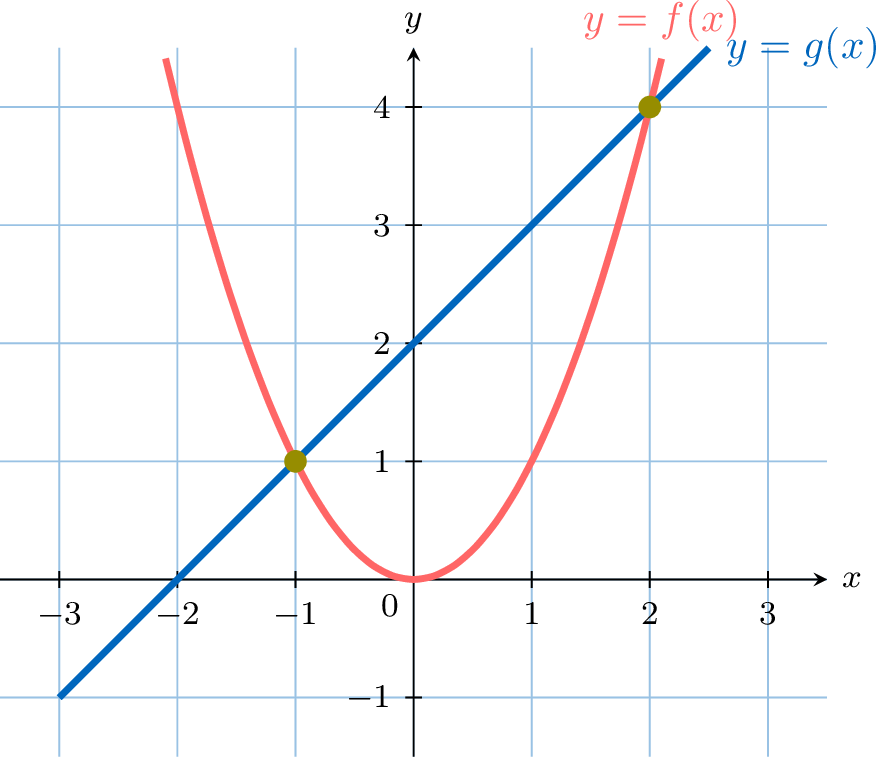
- Equation \(f(x) = g(x)\): The curves intersect at \(x = -1\) and \(x = 2\). The solution set is \(\boldsymbol{S = \{-1 ; 2\}}\).
- Inequality \(f(x) \leq g(x)\): The curve of \(f\) is below or touching the curve of \(g\) between the two intersection points. The solution set is the interval \(\boldsymbol{S = [-1 ; 2]}\).
Skills to practice
- Solving Equations on Two Curves
- Solving Inequalities on Two Curves
VI
Solving Equations with Technology
VI.1
Polynomial and Other Equations with Technology
Factorisation, completing the square and the quadratic formula give the roots of every quadratic equation exactly. Many equations are out of their reach: the equation \(x^3 - 3x + 1 = 0\) has three real solutions, and none of these methods finds them. A graphing calculator, or graphing software, finds such solutions numerically. It draws graphs and locates the points where a graph crosses the \(x\)-axis or another graph, and its solvers return the roots of a polynomial equation and the solution of a system of linear equations. Its answers are in general decimal approximations, displayed with many digits.
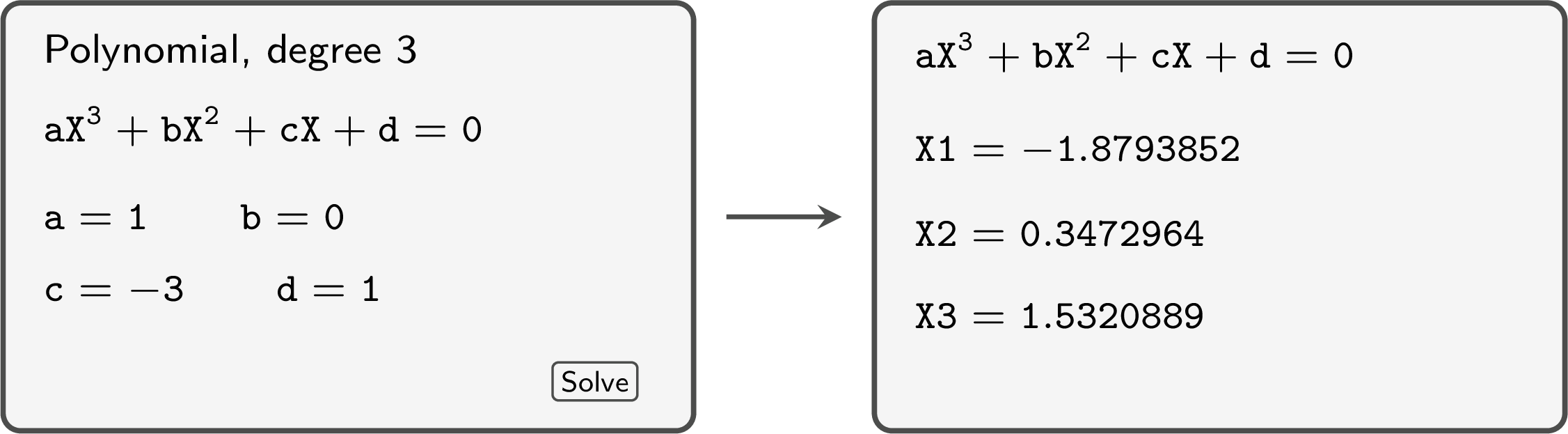
Menu names differ from one model to another: each Method gives its steps in words, with a mock-up of what the screen displays. Unless a question says otherwise, a value that is not exact is given to 3 significant figures, counted from the first non-zero digit: \(2.2573340 \approx 2.26\), \(0.0283416 \approx 0.0283\) and \(31.962 \approx 32.0\).
Menu names differ from one model to another: each Method gives its steps in words, with a mock-up of what the screen displays. Unless a question says otherwise, a value that is not exact is given to 3 significant figures, counted from the first non-zero digit: \(2.2573340 \approx 2.26\), \(0.0283416 \approx 0.0283\) and \(31.962 \approx 32.0\).
Method — Solving a Polynomial Equation with the Polynomial Solver
The polynomial solver, in the equation menu of a graphing calculator, returns the real roots of an equation \(ax^2 + bx + c = 0\) or \(ax^3 + bx^2 + cx + d = 0\), and of higher degrees on most models. - Rearrange the equation so that one side is \(0\), and expand the other side, its terms in decreasing powers of \(x\).
- Open the polynomial solver and choose the degree: the highest power of \(x\).
- Enter the coefficients in order, each with its sign, and \(0\) for a missing power.
- Solve and read the roots. An equation of degree \(n\) has at most \(n\) real roots; a model set to complex mode may also display roots containing \(i\), which are not real solutions.
- Report a root exactly when the screen shows an exact value, such as an integer that substitution confirms; otherwise give it to 3 significant figures.
Example
Use technology to solve: - \(3x^2 = 5x + 4\);
- \(x^2(x + 2) = 5x + 3\).
- One side is brought to \(0\): $$\begin{aligned}[t] 3x^2 &= 5x + 4 \\
3x^2 - 5x - 4 &= 0. &&\text{(subtract } 5x + 4 \text{ from both sides)} \end{aligned}$$ The polynomial solver, degree \(2\), with \(a = 3\), \(b = -5\) and \(c = -4\), displays \(-0.5906673\) and \(2.2573340\). The solutions are \(x \approx -0.591\) and \(x \approx 2.26\).
The equation is quadratic, so the quadratic formula also gives its exact roots, \(x = \dfrac{5 \pm \sqrt{73}}{6}\): the screen shows their decimal approximations. - The left side is expanded, then one side is brought to \(0\): $$\begin{aligned}[t] x^2(x + 2) &= 5x + 3 \\ x^3 + 2x^2 &= 5x + 3 &&\text{(expand)} \\ x^3 + 2x^2 - 5x - 3 &= 0. &&\text{(subtract } 5x + 3 \text{ from both sides)} \end{aligned}$$ The polynomial solver, degree \(3\), with \(a = 1\), \(b = 2\), \(c = -5\) and \(d = -3\), displays \(-3.2534180\), \(-0.5199694\) and \(1.7733874\). The solutions are \(x \approx -3.25\), \(x \approx -0.520\) and \(x \approx 1.77\). In \(-0.520\) the final zero is kept: it is the third significant figure.
Method — Solving an Equation Graphically with Technology
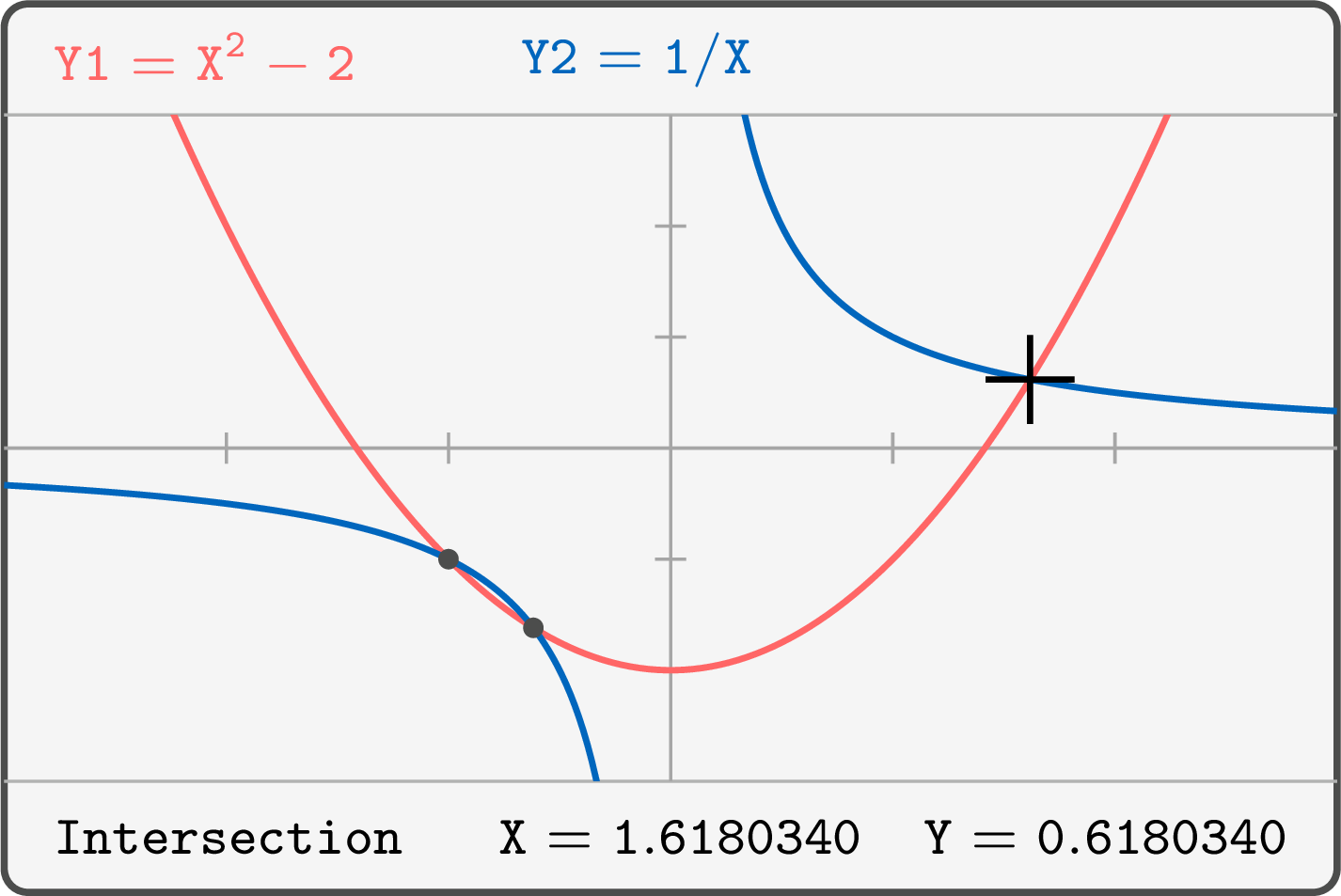
The solutions of an equation \(f(x) = g(x)\) are the \(x\)-coordinates of the points where the graphs of \(f\) and \(g\) meet; the solutions of an equation \(f(x) = 0\) are the \(x\)-intercepts of the graph of \(f\). - Enter each side as a function: \(Y_1 = f(x)\) and \(Y_2 = g(x)\). For an equation \(f(x) = 0\), enter \(f(x)\) alone.
- Choose a window that shows every point of intersection, or every \(x\)-intercept. A table of values of \(f(x) - g(x)\) helps: a change of sign between two consecutive values of \(x\) signals a solution between them, provided the curves have no break between these two values: this holds for polynomials, and for rational functions away from the values that make a denominator zero.
- In the analysis tools of the graph menu, choose intersection (for \(f(x) = 0\): zero), select the curves and give a first guess, or bounds, close to one point. Read the \(x\)-coordinate \(X\) of the point displayed: the \(y\)-coordinate \(Y\) is the common value of the two sides, not a solution.
- Repeat for each point, then report the solutions: exactly when the screen shows an exact value that substitution confirms, otherwise to 3 significant figures.
Example
Use technology to solve \(x^2 - 2 = \dfrac{1}{x}\), for \(x \neq 0\).
The two sides are entered as \(Y_1 = x^2 - 2\) and \(Y_2 = \dfrac{1}{x}\), and graphed in the window \(-3 \le x \le 3\), \(-3 \le y \le 4\). The parabola and the hyperbola meet three times: twice, close together, for negative \(x\), and once for positive \(x\). 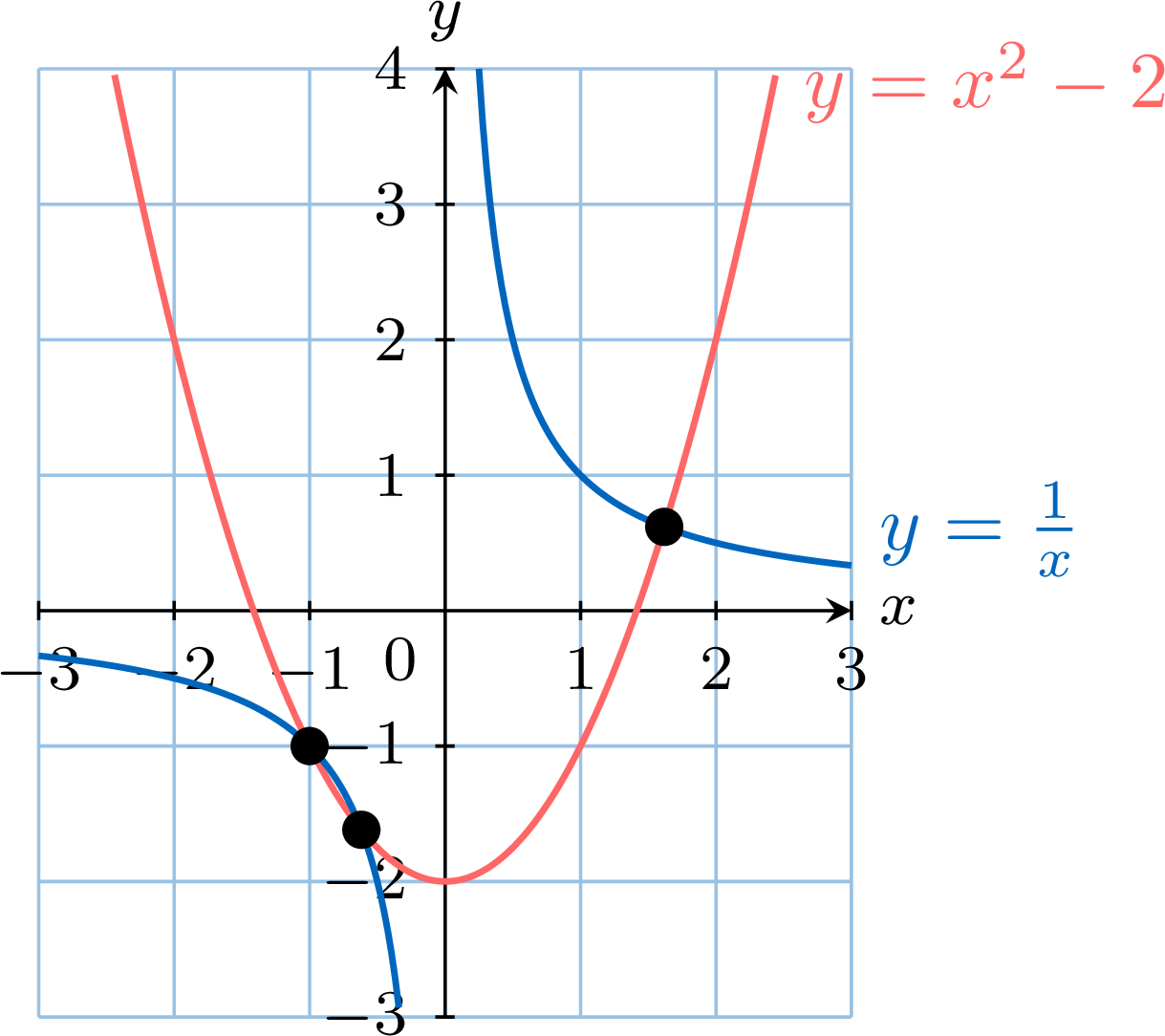
With bounds around each point, the intersection tool displays:
- \(X = -1\) and \(Y = -1\): the value looks exact, and substitution confirms it, since \((-1)^2 - 2 = -1\) and \(\dfrac{1}{-1} = -1\);
- \(X = -0.6180340\), so \(x \approx -0.618\);
- \(X = 1.6180340\), so \(x \approx 1.62\).
Method — Choosing Between Algebra and Technology
- Read what the question asks. The words “exact” or “show that” call for an algebraic solution; “use technology”, a required accuracy such as “to 3 significant figures”, or measured data call for technology.
- Recognise the type of equation. A linear or quadratic equation, or a product of factors equal to zero, is solved exactly by algebra: the quadratic formula always gives the exact roots. A polynomial equation of degree \(3\) or more with no visible factor, or an equation mixing powers of \(x\) with fractions such as \(\dfrac{1}{x}\), is in general solved with technology.
- Use technology to check an algebraic answer: the decimal values of the exact roots must match the values on the screen.
- Report exact values exactly; otherwise give 3 significant figures unless told otherwise, and round only the final answer, never an intermediate value.
- Answer the question asked: keep only the solutions that the domain or the context allows (a length is positive, a number of objects is a whole number), and give the units.
Example
For each equation, decide whether technology is needed, then solve the equation. - \(x^2 - 6x + 7 = 0\), giving exact solutions.
- \(x^3 + x = 5\).
- \((x - 3)(2x + 1) = 0\).
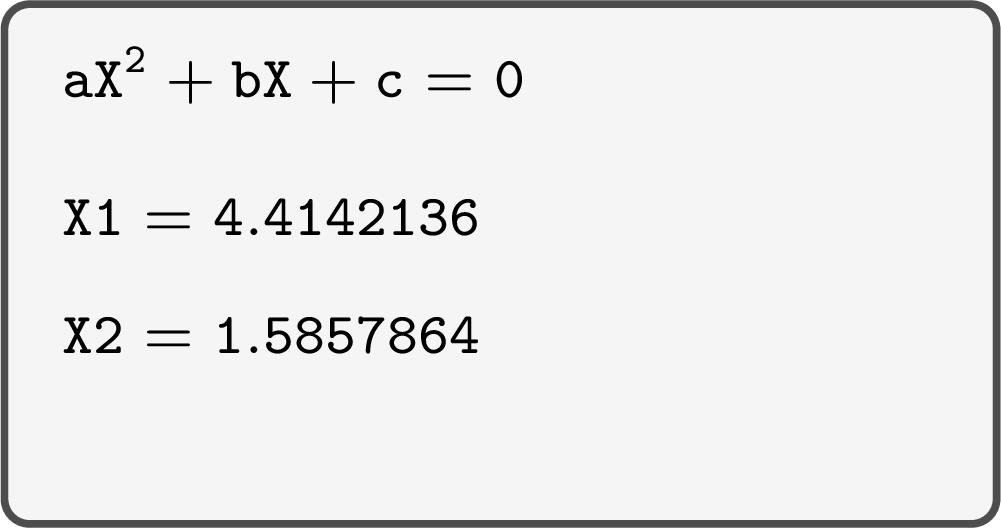
- The equation is quadratic and exact solutions are required: algebra, with the quadratic formula (\(a = 1\), \(b = -6\), \(c = 7\)). $$\begin{aligned}[t] \Delta &= (-6)^2 - 4 \times 1 \times 7 &&\text{(discriminant)} \\ &= 36 - 28 = 8. \end{aligned}$$ Since \(\Delta > 0\), there are two roots: $$\begin{aligned}[t] x &= \frac{6 \pm \sqrt{8}}{2} &&\text{(quadratic formula)} \\ &= \frac{6 \pm 2\sqrt{2}}{2} &&(\sqrt{8} = 2\sqrt{2}) \\ &= 3 \pm \sqrt{2}. \end{aligned}$$ The solutions are \(3 - \sqrt{2}\) and \(3 + \sqrt{2}\). Technology only checks them: the polynomial solver displays \(1.5857864\) and \(4.4142136\), the decimal values of \(3 - \sqrt{2}\) and \(3 + \sqrt{2}\).
- Rearranged, the equation reads \(x^3 + x - 5 = 0\): degree \(3\), with no visible factor, so neither factorisation nor the quadratic formula applies; technology gives its root numerically. The polynomial solver, degree \(3\), with \(a = 1\), \(b = 0\), \(c = 1\) and \(d = -5\), displays a single real root, \(1.5159802\). The solution is \(x \approx 1.52\).
- A product of factors equals zero: the null factor law gives \(x - 3 = 0\) or \(2x + 1 = 0\), that is \(x = 3\) or \(x = -\dfrac{1}{2}\), both exact. Technology is not needed.
Skills to practice
- Interpreting a Calculator Screen
- Solving Polynomial Equations with the Solver
- Solving Equations Graphically with Technology
VII
Deductive Proof
VII.1
Identities
Recappreviously studied — click to reread
Definition — Identity
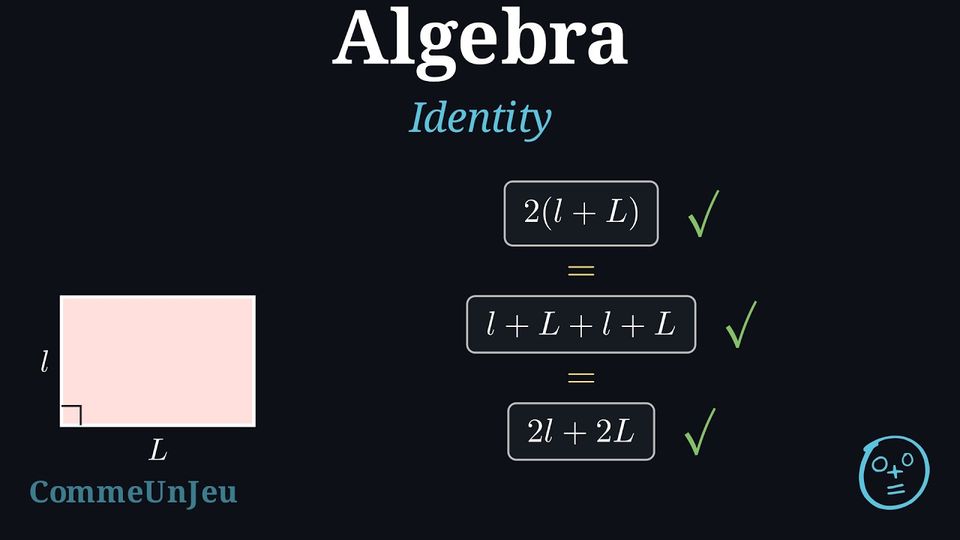
An identity is an equality between two expressions such that their evaluations produce the same value for all values of the variables. Skills to practice
- Identities
VII.2
Writing a Proof from One Side to the Other
Equality and Identity: the Sign \(\equiv\)
An equation such as \(2x + 1 = 7\) asks for which values of \(x\) the equality is true (here only for \(x = 3\)); an identity is an equality true for every value of its variables for which both sides are defined. To mark an identity, one may write the sign \(\equiv\), read “is identically equal to”: $$(x - 4)^2 + 3 \equiv x^2 - 8x + 19$$ means that \((x - 4)^2 + 3 = x^2 - 8x + 19\) for every real number \(x\).
A proof that an equality holds (“show that…”) is laid out from one side to the other: start from one side, usually the more complicated one, transform it through a chain of equalities, each justified by a rule already established, and stop when the other side appears.
Do not start from the equality to be proved and transform both sides at once: unless every step is an equivalence, this only shows that the equality implies a true statement, which proves nothing. For instance, squaring both sides of the false equality \(-1 = 1\) gives the true equality \(1 = 1\).
Example
Show that: - \(\left(2 + \sqrt{3}\right)^2 = 7 + 4\sqrt{3}\);
- \((x - 4)^2 + 3 \equiv x^2 - 8x + 19\).
- Starting from the left side: $$\begin{aligned}[t] \left(2 + \sqrt{3}\right)^2 &= 2^2 + 2 \times 2 \times \sqrt{3} + \left(\sqrt{3}\right)^2 && \text{(square of a sum)}\\ &= 4 + 4\sqrt{3} + 3 && \text{(\(\left(\sqrt{3}\right)^2 = 3\))}\\ &= 7 + 4\sqrt{3}, \end{aligned}$$ which is the right side.
- Let \(x\) be a real number. Starting from the left side: $$\begin{aligned}[t] (x - 4)^2 + 3 &= x^2 - 8x + 16 + 3 && \text{(square of a difference)}\\ &= x^2 - 8x + 19, \end{aligned}$$ which is the right side. This holds for every real \(x\), so \((x - 4)^2 + 3 \equiv x^2 - 8x + 19\).
Skills to practice
- Proving an Equality from One Side to the Other
VII.3
Direct Proof
Method — Structure for Written Proofs
A clear, well-structured proof generally follows these steps: - Statement: Clearly state the proposition you intend to prove and, if relevant, the method you will use.
- Assumptions: Explicitly state your initial hypotheses. For direct proofs, this means assuming the premise \(p\) of the implication \(p \Rightarrow q\).
- Logical Steps: Present a sequence of clear, logical deductions, justifying each step with definitions, axioms, or previously proven theorems.
- Conclusion: State the final conclusion, explicitly linking it back to the original proposition.
Method — Direct Proof
To prove \(p \Rightarrow q\), a direct proof assumes \(p\) is true and uses a sequence of logical deductions to show that \(q\) must also be true. $$ \begin{aligned} &\text{Assume } p \text{ is true.} && (\text{Hypothesis})\\
&\quad\vdots\quad && (\text{Logical steps})\\
&\text{So, } q \text{ is true.}&& (\text{Conclusion}). \end{aligned} $$ Example
Direct proof: the sum of two even integers is even. - Claim:
We prove by direct proof: if \(a,b\) are even integers, then \(a+b\) is even. - Assumptions:
Let \(a,b\) be two even integers. By definition of even numbers, there exist \(k,\ell\in\Z\) such that $$ a=2k \quad\text{and}\quad b=2\ell. $$ - Logical Steps:
$$ \begin{aligned} a+b &= 2k + 2\ell \\ &= 2(k+\ell). \end{aligned} $$ Since \(k+\ell\in\Z\), the sum \(a+b\) is a multiple of \(2\). - Conclusion:
By definition of even numbers, \(a+b\) is even.
Method — Proving by Expanding and Factorising
Testing examples can only make a claim plausible; to prove it for all numbers: - Write the numbers in algebraic form: \(2n\) for an even number, \(2n+1\) for an odd number, \(n\) and \(n+1\) for consecutive numbers… Use different letters, such as \(n\) and \(m\), for numbers chosen independently.
- Compute with the letters (expand, simplify, factorise).
- Read the form of the result — \(2(\ldots)\) is twice a whole number, \(3(\ldots)\) a multiple of \(3\)… — and connect it to the claim: this form proves the property for every whole number.
Method — Introduce a Variable
Let \(x\in E\).\(\vdots\quad\quad \quad\quad\) (reason about \(x\))
Therefore, the statement holds for all \(x\in E\).
Example
Prove that if an integer \(a\) divides both integers \(b\) and \(c\), then \(a\) divides their sum \(b+c\).
Let \(a, b,\) and \(c\) be integers.
Suppose that \(a\) divides \(b\) and \(a\) divides \(c\).
By the definition of divisibility, there exist integers \(k\) and \(m\) such that $$ b = ak \quad \text{and} \quad c = am. $$ Now, consider the sum \(b+c\): $$ \begin{aligned} b + c &= ak + am \\ &= a(k+m). \end{aligned} $$ By definition, this means that \(a\) divides \(b+c\).
Method — Advice for Writing Proofs
- Write down the hypotheses and the desired conclusion first; they guide your route. It can help to work backward from the conclusion on scratch paper.

Proof in progress: the left “hand” is the hypothesis, the right “hand” the conclusion—meet in the middle. - Use a draft. Explore freely on scratch paper before composing the final, clean argument.

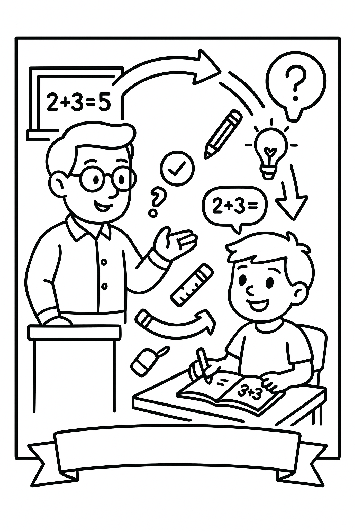
The great mathematician Maryam Mirzakhani working intently on a draft. - Iterate. Get feedback, revise, and don’t expect a perfect proof on the first try.
Feedback loop with Dr. Tariel and a CommeUnJeu Academy student.
Skills to practice
- Correcting a Proof
- Writing Direct Proofs in Arithmetic
- Constructing Direct Proofs in Various Contexts
VIII
Going further
Skills to practice
- Reasoning about Equations
- Solving Problems with Technology
- Solving Quadratic Problems
- Quiz
Jump to section