International Baccalaureate · MYP 5 Extended
Series
I
Series
I.1
Series and Sigma Notation
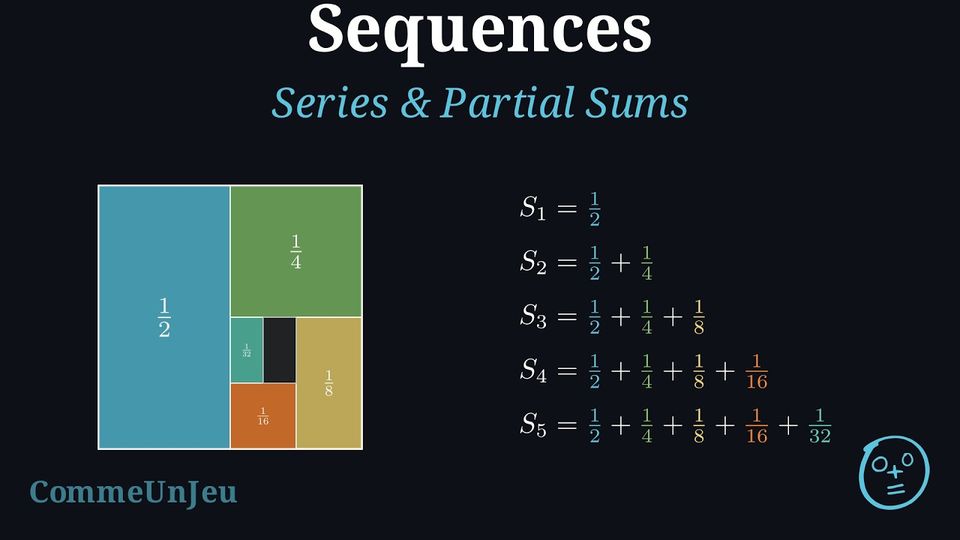
While a sequence is a list of numbers, a series is obtained by adding those numbers together. Every sequence has a corresponding series. We are often interested in the partial sum of a sequence, which is the sum of a specific number of its terms, starting from the beginning.
To see terms being added, consider a square of area \(1\). Its left half is painted, then half of what remains, then half of what remains again, and so on: the painted pieces have areas \(\frac{1}{2}, \frac{1}{4}, \frac{1}{8}, \ldots\) — and each new piece adds one more term to the sum of the painted area:
Each new piece adds one more term to the sum, and the pieces wind, like a snail shell, towards a single point of the square, while the empty rectangle keeps coiling inward, smaller and smaller. The more terms we add, the closer the painted area gets to the area of the whole square: $$\frac{1}{2} + \frac{1}{4} + \frac{1}{8} + \frac{1}{16} + \frac{1}{32} + \cdots \; \longrightarrow \; 1.$$ Whether a never-ending sum can truly make sense — and reach \(1\) — is another question; here, every sum stops somewhere.
To see terms being added, consider a square of area \(1\). Its left half is painted, then half of what remains, then half of what remains again, and so on: the painted pieces have areas \(\frac{1}{2}, \frac{1}{4}, \frac{1}{8}, \ldots\) — and each new piece adds one more term to the sum of the painted area:
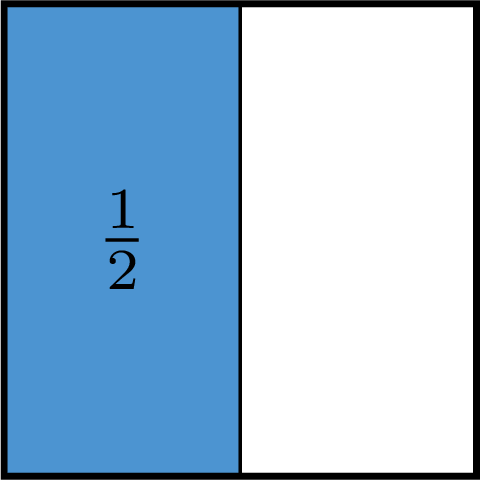 | 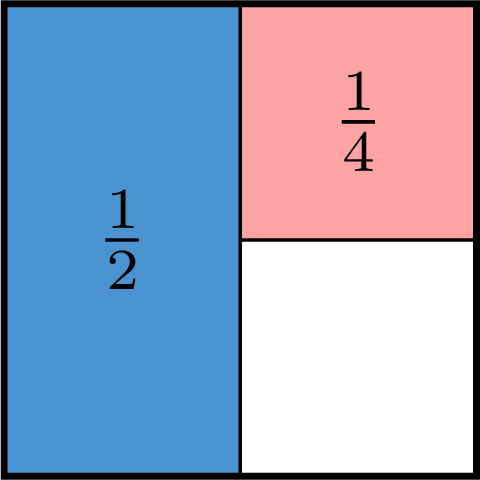 | 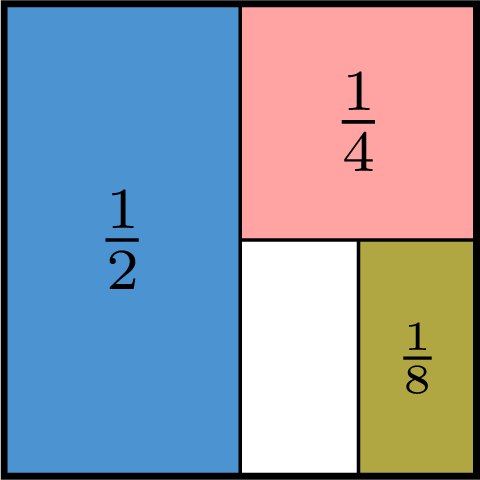 | 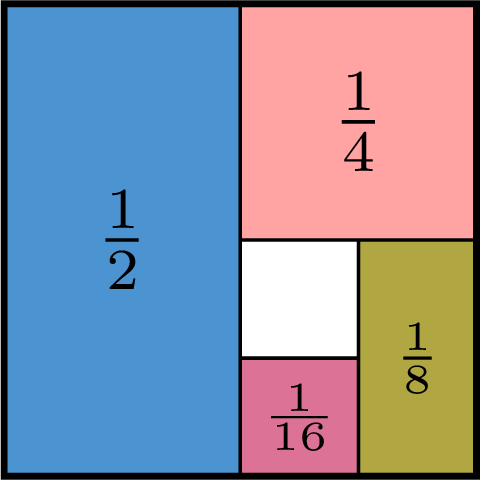 | 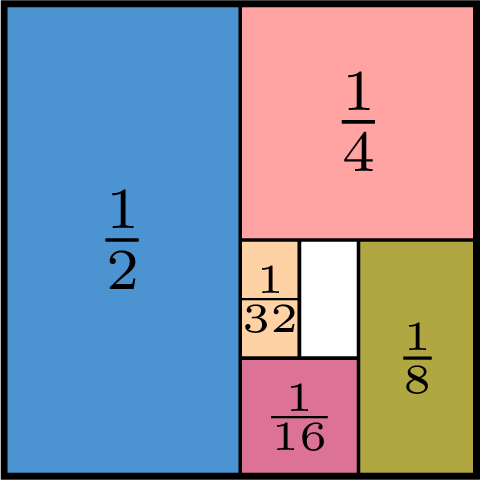 |
| \(S_1 = \textcolor{colorprop}{\frac{1}{2}}\) | \(S_2 = \textcolor{colorprop}{\frac{1}{2}} + \textcolor{colordef}{\frac{1}{4}}\) | \(S_3 = \textcolor{colorprop}{\frac{1}{2}} + \textcolor{colordef}{\frac{1}{4}} + \textcolor{olive!80!black}{\frac{1}{8}}\) | \(S_4 = \textcolor{colorprop}{\frac{1}{2}} + \textcolor{colordef}{\frac{1}{4}} + \textcolor{olive!80!black}{\frac{1}{8}} + \textcolor{purple}{\frac{1}{16}}\) | \(S_5 = \textcolor{colorprop}{\frac{1}{2}} + \textcolor{colordef}{\frac{1}{4}} + \textcolor{olive!80!black}{\frac{1}{8}} + \textcolor{purple}{\frac{1}{16}} + \textcolor{orange}{\frac{1}{32}}\) |
Definition — Series and Partial Sum
A series is the sum of the terms in a sequence. The partial sum, denoted \(\boldsymbol{S_n}\), is the sum of the terms of a sequence up to a specific index \(n\). - If a sequence starts at \(u_0\), the partial sum \(S_n\) is the sum of the first \(\textcolor{colordef}{(n+1)}\) terms: $$S_n = u_0 + u_1 + u_2 + \ldots + u_n = \sum_{i=0}^n u_i$$
- If a sequence starts at \(u_1\), the partial sum \(S_n\) is the sum of the first \(\textcolor{colordef}{n}\) terms: $$S_n = u_1 + u_2 + u_3 + \ldots + u_n = \sum_{i=1}^n u_i$$
Two Conventions
Two conventions for \(S_n\) are in use, and they do not count the same number of terms.
- From \(u_1\): \(S_n = u_1 + u_2 + \cdots + u_n\) is the sum of the first \(n\) terms. This is the convention of many formula sheets.
- From \(u_0\): \(S_n = u_0 + u_1 + \cdots + u_n\) has \(n + 1\) terms.
Example
Consider the sequence defined by \(u_n = 2n + 1\) for \(n \ge 0\). - Write out the terms \(u_0\), \(u_1\), \(u_2\) and \(u_3\).
- Compute the partial sum \(S_3 = \displaystyle\sum_{i=0}^{3} u_i\).
- \(u_0 = 1\), \(u_1 = 3\), \(u_2 = 5\) and \(u_3 = 7\).
- The sequence starts at \(u_0\), so \(S_3\) is the sum of the first four terms: $$\begin{aligned}[t] S_3 &= u_0 + u_1 + u_2 + u_3 && \text{(definition of } S_3\text{, start at } u_0\text{)} \\ &= 1 + 3 + 5 + 7 && \text{(terms from part 1)} \\ &= 16. \end{aligned}$$
Method — From a Sigma Sum to an Algorithm
A sum written with the symbol \(\Sigma\) is computed by a loop. To compute \(S = \displaystyle\sum_{k=a}^{b} f(k)\), for whole numbers \(a \leqslant b\): - Initialisation: before the loop, a variable \(s\), the accumulator, receives \(0\), the sum of no term at all.
- Counter: a bounded loop makes the counter \(k\) take the values \(a\), \(a + 1\), …, \(b\): the bounds of the loop are the bounds written under and above \(\Sigma\).
- Accumulator: at each turn, the term \(f(k)\) written after \(\Sigma\) is added to \(s\).
- Loop exit: after the turn \(k = b\), the loop stops and \(s\) is read: it holds \(S\).
s ← 0
For k from a to b
    s ← s + f(k)
End For
Display s
Example
Write an algorithm that computes \(S = \displaystyle\sum_{k=1}^{4} k^3\), execute it by hand and give \(S\).
The bounds are \(1\) and \(4\) and the term is \(k^3\):
The loop stops after the turn \(k = 4\), the upper bound of the sum: \(S = 1^3 + 2^3 + 3^3 + 4^3 = 100\). After each turn \(k\), the accumulator holds the sum of the cubes from \(1\) to \(k\).
s ← 0
For k from 1 to 4
    s ← s + k^3
End For
Display s| Step | \(k\) | \(s\) |
| before the loop | \(0\) | |
| turn \(k = 1\) | \(1\) | \(0 + 1 = 1\) |
| turn \(k = 2\) | \(2\) | \(1 + 8 = 9\) |
| turn \(k = 3\) | \(3\) | \(9 + 27 = 36\) |
| turn \(k = 4\) | \(4\) | \(36 + 64 = 100\) |
Skills to practice
- Calculating Terms and Partial Sums
- Evaluating Sums in Sigma Notation
- Calculating Partial Sums from an Explicit Formula
- Running a Summation Algorithm
II
Sums of Arithmetic and Geometric Sequences
II.1
Sum of an Arithmetic Sequence
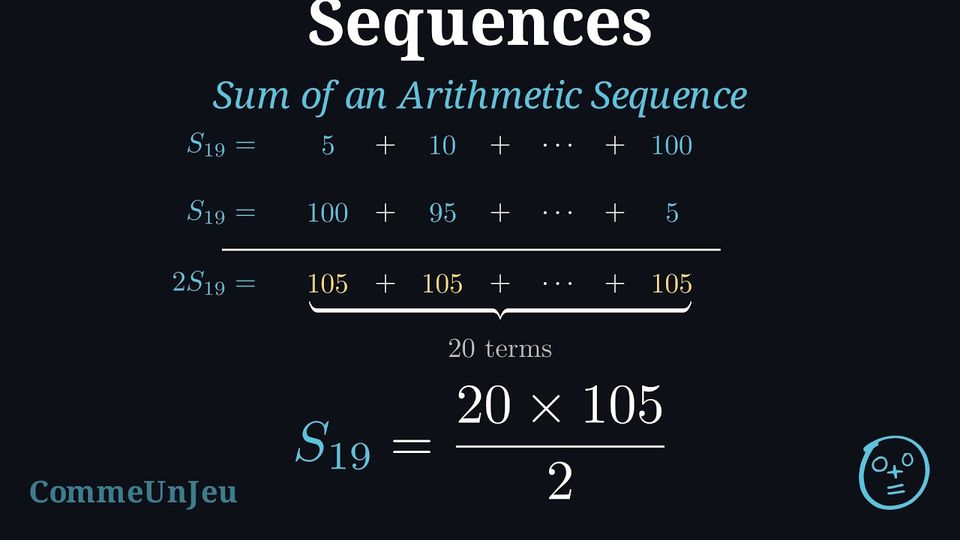
How can we efficiently calculate the sum of the first 20 terms of an arithmetic sequence starting with \(u_0 = 5\) and a common difference of \(d=5\)?$$S_{19} = \overbrace{5 + 10 + 15 + \ldots + 90 + 95 + 100}^{\text{20 terms}}$$ The method is to write the sum twice, once in forward order and once in reverse order, and then to add the two lines together term by term.$$\begin{array}{l r c c c c c c c}S_{19} & = & 5 & + & 10 & + & \ldots & + & 100 \\
S_{19} & = & 100 & + & 95 & + & \ldots & + & 5 \\
\hline2S_{19} & = & 105 & + & 105 & + & \ldots & + & 105 \\
\end{array}$$ Each pair of terms adds up to the same value (\(5+100=105\), \(10+95=105\), etc.). There are 20 identical sums in \(2S_{19}\). $$2S_{19} = 20 \times (5+100)$$ Therefore, the sum is:$$S_{19} = 20 \times\frac{5+100}{2} = 1050$$ This method reveals the general formula:$$S_n = \frac{\text{Number of terms}}{2} \times (\text{First term} + \text{Last term})$$
Proposition — Sum of an Arithmetic Sequence
The sum of the first terms of an arithmetic sequence is given by the formula:$$S_n = \text{Number of terms} \times \frac{(\text{First term} + \text{Last term})}{2}$$ - If a sequence starts at \(u_0\) and ends at \(u_n\), there are \(\boldsymbol{n+1}\) terms. The formula is:$$S_n = \frac{n+1}{2}(u_0 + u_n)$$
- If a sequence starts at \(u_1\) and ends at \(u_n\), there are \(\boldsymbol{n}\) terms. The formula is:$$S_n = \frac{n}{2}(u_1 + u_n)$$
Write the sum forwards and then backwards, and add the two lines term by term:$$\begin{array}{rccccccc} S &=& u_0 &+& u_1 &+ \cdots +& u_{n-1} &+ u_n \\
S &=& u_n &+& u_{n-1} &+ \cdots +& u_1 &+ u_0 \\
\hline 2S &=& (u_0+u_n) &+& (u_0+u_n) &+ \cdots +& (u_0+u_n) &+ (u_0+u_n) \end{array}$$ Each of the \(n+1\) columns has the same sum. Indeed, the sequence is arithmetic, so \(u_k = u_0 + kd\); the column of index \(k\) (for \(0 \le k \le n\)) therefore totals$$u_k + u_{n-k} = (u_0 + kd) + \big(u_0 + (n-k)d\big) = 2u_0 + nd = u_0 + u_n,$$ a value independent of \(k\) (as \(k\) increases by \(1\) the top term rises by \(d\) and the bottom term falls by \(d\)). Summing these \(n+1\) equal columns gives \(2S = (n+1)(u_0 + u_n)\), that is$$S = \frac{(n+1)(u_0 + u_n)}{2} = \frac{\text{number of terms}}{2}\,(\text{first} + \text{last}).$$
Example
Compute the sum \(1 + 2 + 3 + \cdots + 100\).
The terms \(1, 2, 3, \ldots, 100\) form an arithmetic sequence starting at \(u_1 = 1\) and ending at \(u_{100} = 100\), so there are \(100\) terms: $$\begin{aligned}[t] 1 + 2 + \cdots + 100 &= \frac{100}{2}\,(1 + 100) && \text{(} S_n = \tfrac{n}{2}(u_1 + u_n)\text{)} \\
&= 50 \times 101 && \text{(simplify } \tfrac{100}{2}\text{)} \\
&= 5\,050. \end{aligned}$$
Example
The sequence \((u_n)\) is arithmetic with first term \(u_0 = 7\) and common difference \(d = 3\). Compute the sum of its first \(15\) terms.
The sum of the first \(15\) terms is \(S_{14} = u_0 + u_1 + \cdots + u_{14}\). First, the last term: $$\begin{aligned}[t] u_{14} &= u_0 + 14\,d && \text{(explicit formula)} \\
&= 7 + 14 \times 3 && \text{(} u_0 = 7,\ d = 3\text{)} \\
&= 49. \end{aligned}$$ Then the formula for a sequence starting at \(u_0\) gives: $$\begin{aligned}[t] S_{14} &= \frac{14+1}{2}\,(u_0 + u_{14}) && \text{(} S_n = \tfrac{n+1}{2}(u_0 + u_n)\text{)} \\
&= \frac{15}{2} \times (7 + 49) && \\
&= \frac{15 \times 56}{2} && \\
&= 15 \times 28 && \text{(divide } 56 \text{ by } 2\text{)} \\
&= 420. \end{aligned}$$
Proposition — Sum from the First Term and the Common Difference
Let \((u_n)\) be an arithmetic sequence with common difference \(d\). The sum of its first terms can also be written with the first term and the common difference only, without computing the last term: - If the sequence starts at \(u_1\), the sum of its first \(\boldsymbol{n}\) terms is:$$S_n = \frac{n}{2}\big(2u_1 + (n-1)d\big)$$
- If the sequence starts at \(u_0\), the sum of its first \(\boldsymbol{n+1}\) terms is:$$S_n = \frac{n+1}{2}\big(2u_0 + nd\big)$$
We start from the formula “number of terms \(\times\) (first \(+\) last)\(/2\)” and replace the last term by its explicit formula.
If the sequence starts at \(u_1\), there are \(n\) terms and the last one is \(u_n = u_1 + (n-1)d\): $$\begin{aligned}[t] S_n &= \frac{n}{2}\,(u_1 + u_n) && \text{(sum of an arithmetic sequence)} \\ &= \frac{n}{2}\big(u_1 + u_1 + (n-1)d\big) && \text{(explicit formula } u_n = u_1 + (n-1)d\text{)} \\ &= \frac{n}{2}\big(2u_1 + (n-1)d\big). \end{aligned}$$ If the sequence starts at \(u_0\), there are \(n+1\) terms and the last one is \(u_n = u_0 + nd\): $$\begin{aligned}[t] S_n &= \frac{n+1}{2}\,(u_0 + u_n) && \text{(sum of an arithmetic sequence)} \\ &= \frac{n+1}{2}\big(u_0 + u_0 + nd\big) && \text{(explicit formula } u_n = u_0 + nd\text{)} \\ &= \frac{n+1}{2}\big(2u_0 + nd\big). \end{aligned}$$
If the sequence starts at \(u_1\), there are \(n\) terms and the last one is \(u_n = u_1 + (n-1)d\): $$\begin{aligned}[t] S_n &= \frac{n}{2}\,(u_1 + u_n) && \text{(sum of an arithmetic sequence)} \\ &= \frac{n}{2}\big(u_1 + u_1 + (n-1)d\big) && \text{(explicit formula } u_n = u_1 + (n-1)d\text{)} \\ &= \frac{n}{2}\big(2u_1 + (n-1)d\big). \end{aligned}$$ If the sequence starts at \(u_0\), there are \(n+1\) terms and the last one is \(u_n = u_0 + nd\): $$\begin{aligned}[t] S_n &= \frac{n+1}{2}\,(u_0 + u_n) && \text{(sum of an arithmetic sequence)} \\ &= \frac{n+1}{2}\big(u_0 + u_0 + nd\big) && \text{(explicit formula } u_n = u_0 + nd\text{)} \\ &= \frac{n+1}{2}\big(2u_0 + nd\big). \end{aligned}$$
Example
An arithmetic sequence has first term \(u_1 = 3\) and common difference \(d = 4\). - Compute the sum \(S_{12}\) of its first \(12\) terms.
- How many terms, starting from \(u_1\), must be added for the sum to equal \(210\)?
- The last term is not needed. With \(u_1 = 3\), \(d = 4\) and \(n = 12\): $$\begin{aligned}[t] S_{12} &= \frac{12}{2}\big(2u_1 + 11d\big) && \text{(} S_n = \tfrac{n}{2}(2u_1 + (n-1)d)\text{)} \\ &= 6 \times (2 \times 3 + 11 \times 4) \\ &= 6 \times 50 \\ &= 300. \end{aligned}$$
- Here the number of terms \(n\) is the unknown. First, \(S_n\) in terms of \(n\): $$\begin{aligned}[t] S_n &= \frac{n}{2}\big(2 \times 3 + (n-1) \times 4\big) && \text{(} S_n = \tfrac{n}{2}(2u_1 + (n-1)d)\text{)} \\
&= \frac{n}{2}\,(4n + 2) && \text{(expand)} \\
&= 2n^2 + n. \end{aligned}$$ So we look for the number of terms \(n\) such that \(2n^2 + n = 210\). The terms \(3, 7, 11, \ldots\) are positive, so each added term makes the sum larger: \(S_n\) increases with \(n\). A table of values gives
\(n\) \(8\) \(9\) \(10\) \(11\) \(S_n = 2n^2 + n\) \(136\) \(171\) \(210\) \(253\)
Check: \(S_{10} = \frac{10}{2}(2 \times 3 + 9 \times 4) = 5 \times 42 = 210\).
Skills to practice
- Calculating the Sum of an Arithmetic Series
- Calculating Longer Arithmetic Sums
- Calculating Arithmetic Sums in Sigma Notation
II.2
Sum of a Geometric Sequence
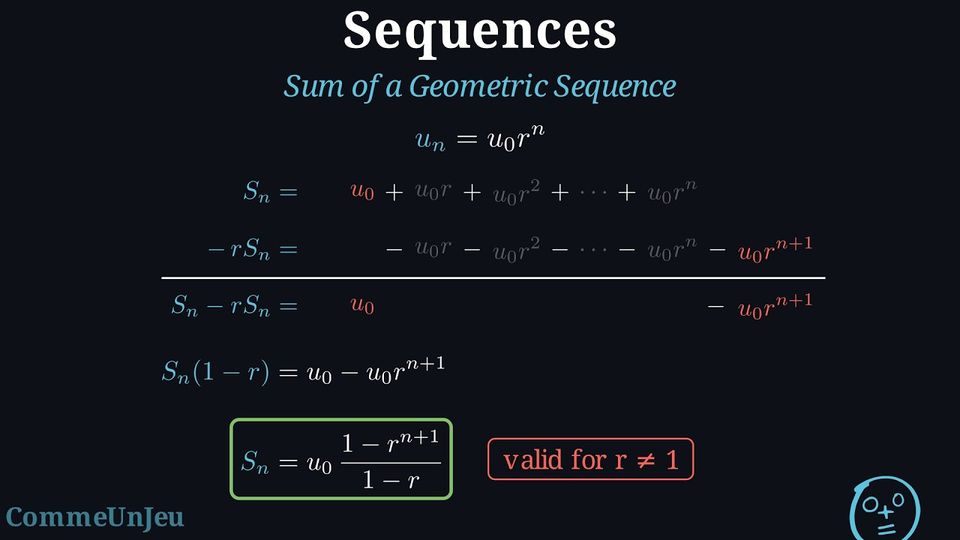
How can we efficiently calculate the sum of the first 10 terms of a geometric sequence starting with \(u_0 = 3\) and a common ratio of \(r=2\)?$$S_9 = 3 + 6 + 12 + 24 + \ldots + 768 + 1536$$ The trick is to multiply the entire sum by the common ratio, \(r=2\), and then subtract the original sum from this new one.
We write the original sum:$$S_9 = 3 + 6 + 12 + \ldots + 768 + 1536$$ Then we multiply every term by the common ratio, 2:$$2S_9 = 6 + 12 + 24 + \ldots + 1536 + 3072$$ Most of the terms in \(S_9\) and \(2S_9\) are identical. When the first equation is subtracted from the second, these terms cancel out:$$\begin{array}{lrccccccccc} 2S_9 & = & & & 6 & + & 12 & + \ldots + & 1536 & + & 3072 \\ -\, S_9 & = & -(3 & + & 6 & +&12 & + \ldots + & 1536) \\ \hline(2-1)S_9 & = & -3 & + & 0 & + &0&+\ldots + & 0 & + & 3072 \\ \end{array}$$ This leaves us with a much simpler equation:$$S_9 = 3072 - 3 = 3069$$ This method gives the general formula for the sum of the terms of a geometric sequence with ratio \(r \neq 1\) (so that we can divide by \(1 - r\)):$$\begin{aligned}S_n - rS_n &= u_0 - u_0 \times r^{n+1}\\ S_n(1-r) &= u_0(1-r^{n+1})\\ S_n &= u_0 \left( \frac{1 - r^{n+1}}{1 - r}\right)\\ \end{aligned}$$
We write the original sum:$$S_9 = 3 + 6 + 12 + \ldots + 768 + 1536$$ Then we multiply every term by the common ratio, 2:$$2S_9 = 6 + 12 + 24 + \ldots + 1536 + 3072$$ Most of the terms in \(S_9\) and \(2S_9\) are identical. When the first equation is subtracted from the second, these terms cancel out:$$\begin{array}{lrccccccccc} 2S_9 & = & & & 6 & + & 12 & + \ldots + & 1536 & + & 3072 \\ -\, S_9 & = & -(3 & + & 6 & +&12 & + \ldots + & 1536) \\ \hline(2-1)S_9 & = & -3 & + & 0 & + &0&+\ldots + & 0 & + & 3072 \\ \end{array}$$ This leaves us with a much simpler equation:$$S_9 = 3072 - 3 = 3069$$ This method gives the general formula for the sum of the terms of a geometric sequence with ratio \(r \neq 1\) (so that we can divide by \(1 - r\)):$$\begin{aligned}S_n - rS_n &= u_0 - u_0 \times r^{n+1}\\ S_n(1-r) &= u_0(1-r^{n+1})\\ S_n &= u_0 \left( \frac{1 - r^{n+1}}{1 - r}\right)\\ \end{aligned}$$
Proposition — Sum of a Geometric Sequence
The sum of the first terms of a geometric sequence is given by the formula:$$S_n = \text{First term} \times \frac{1 - (\text{common ratio})^{\text{Number of terms}}}{1 - \text{common ratio}}$$ - If a sequence starts at \(u_0\) and has a common ratio \(r\), the sum of the first \(\boldsymbol{n+1}\) terms is:$$S_n = u_0 \left( \frac{1 - r^{n+1}}{1 - r} \right)$$
- If a sequence starts at \(u_1\) and has a common ratio \(r\), the sum of the first \(\boldsymbol{n}\) terms is:$$S_n = u_1 \left( \frac{1 - r^{n}}{1 - r} \right)$$
Assume \(r \neq 1\). Multiply the sum \(S = u_0 + u_0 r + \cdots + u_0 r^{n}\) by \(r\) and subtract:$$\begin{aligned}[t] S &= u_0 + u_0 r + u_0 r^2 + \cdots + u_0 r^{n} \\
rS &= \phantom{u_0 + {}} u_0 r + u_0 r^2 + \cdots + u_0 r^{n} + u_0 r^{n+1} \\
S - rS &= u_0 - u_0 r^{n+1} && {\scriptstyle(\text{all middle terms cancel})} \\
S(1 - r) &= u_0\left(1 - r^{n+1}\right) \\
S &= u_0\,\frac{1 - r^{n+1}}{1 - r} && {\scriptstyle(r \neq 1)}. \end{aligned}$$
The case \(r \equal 1\)
If \(r = 1\), every term equals \(u_0\), so the formula above (which divides by \(1-r\)) does not apply. The sum is then simply$$S = \underbrace{u_0 + u_0 + \cdots + u_0}_{n+1 \text{ terms}} = (n+1)\,u_0.$$
Example
The sequence \((u_n)\) is geometric with first term \(u_0 = 5\) and common ratio \(r = 3\). Compute the sum of its first \(6\) terms.
The sequence starts at \(u_0\), so the sum of the first \(6\) terms is \(S_5\), and \(r = 3 \neq 1\): $$\begin{aligned}[t] S_5 &= u_0\left(\frac{1 - r^{5+1}}{1 - r}\right) && \text{(} S_n = u_0\,\tfrac{1-r^{n+1}}{1-r}\text{)} \\
&= 5 \times \frac{1 - 3^6}{1 - 3} && \\
&= 5 \times \frac{1 - 729}{-2} && \text{(} 3^6 = 729\text{)} \\
&= 5 \times \frac{-728}{-2} && \\
&= 5 \times 364 && \\
&= 1\,820. \end{aligned}$$
Another Form of the Geometric Sum
When \(r > 1\) and \(n \ge 1\), the numerator and the denominator of \(\dfrac{1 - r^n}{1 - r}\) are both negative. Multiplying both by \(-1\) does not change the fraction, and gives an equivalent form of the sum, for \(r \neq 1\):
- starting at \(u_1\), the sum of the first \(n\) terms is \(S_n = u_1 \left( \dfrac{r^{n} - 1}{r - 1} \right)\);
- starting at \(u_0\), the sum of the first \(n+1\) terms is \(S_n = u_0 \left( \dfrac{r^{n+1} - 1}{r - 1} \right)\).
Definition — Accumulated Value
A savings account earns compound interest at a fixed rate of \(t\pourcent\) per period, with \(t \gt 0\): at the end of each period its balance is multiplied by \(r = 1 + \dfrac{t}{100}\) (a rate of \(3\pourcent\) gives \(t = 3\) and \(r = 1.03\)). When the same amount \(D\) is deposited at the start of every period, the balance of the account just after the \(n\)th deposit is called the accumulated value (or future value) of the \(n\) deposits, written \(V_n\). Proposition — Accumulated Value of Regular Deposits
With deposits of \(D\) at the start of every period and a rate of \(t\pourcent\) per period (\(t \gt 0\)), the accumulated value just after the \(n\)th deposit is the sum of the first \(n\) terms of the geometric sequence with first term \(D\) and common ratio \(r = 1 + \frac{t}{100}\): $$V_n = D + Dr + Dr^2 + \cdots + Dr^{n-1} = D\,\frac{r^n - 1}{r - 1}.$$
Each period multiplies what is in the account by \(r = 1 + \frac{t}{100}\), so a deposit that has stayed \(j\) periods in the account is worth \(Dr^j\). Just after the \(n\)th deposit, the deposits have stayed \(n - 1\), \(n - 2\), …, \(1\) and \(0\) periods; listing them from the last deposit to the first gives $$V_n = D + Dr + Dr^2 + \cdots + Dr^{n-1},$$ the sum of the first \(n\) terms of the geometric sequence with first term \(D\) and common ratio \(r\). Since \(t \gt 0\), the common ratio \(r = 1 + \frac{t}{100}\) is not \(1\), and the formula for the sum of the first \(n\) terms of a geometric sequence gives $$V_n = D\,\frac{r^n - 1}{r - 1}.$$
Example
A saver deposits \(\dollar 1\,000\) on 1 January of every year in an account that pays \(3\pourcent\) interest per year, compounded yearly. Determine the accumulated value of the account just after the \(10\)th deposit, to the cent, and the part of it that is interest.
Adding \(3\pourcent\) multiplies by \(1.03\). Just after the \(10\)th deposit, the last deposit is worth \(1\,000\), the one before \(1\,000 \times 1.03\), and so on up to the first one, which has stayed \(9\) years: \(1\,000 \times 1.03^9\). The accumulated value is the sum of the first \(10\) terms of the geometric sequence with first term \(1\,000\) and common ratio \(1.03\): $$\begin{aligned}[t] V_{10} &= 1\,000 + 1\,000 \times 1.03 + \cdots + 1\,000 \times 1.03^9 && \text{(one term per deposit)} \\
&= 1\,000 \times \frac{1.03^{10} - 1}{1.03 - 1} && \text{(sum of a geometric sequence, } 10 \text{ terms)} \\
&\approx \dollar 11\,463.88. \end{aligned}$$ The saver has deposited \(10 \times \dollar 1\,000 = \dollar 10\,000\), so the interest amounts to about \(\dollar 11\,463.88 - \dollar 10\,000 = \dollar 1\,463.88\).
Skills to practice
- Calculating the Sum of a Geometric Series
- Calculating Longer Geometric Sums and Savings Plans
III
Going further
Skills to practice
- Explaining and Justifying Sums
- Solving Problems with Sums
- Investigating Patterns in Sums
- Quiz
Jump to section