International Baccalaureate · MYP 5
Expansion and Factorisation
I
Expanding the Cube of a Sum and of a Difference
Proposition — Perfect Squares Expansion
The square of a sum and the square of a difference can be written as: $$(a+b)^2=a^2+2ab+b^2 \quad\text{and}\quad (a-b)^2=a^2-2ab+b^2.$$ 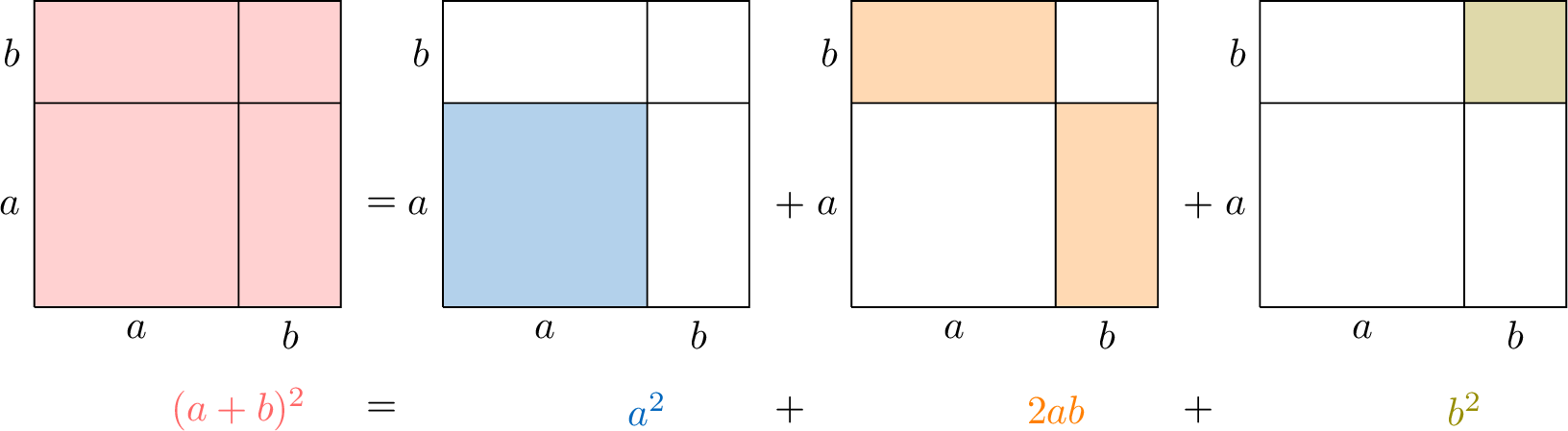
Proposition — Cube of a Sum and of a Difference
For all numbers \(a\) and \(b\), the cube of a sum is $$(a+b)^3=a^3+3a^2b+3ab^2+b^3.$$ Replacing \(b\) by \(-b\) gives the cube of a difference: $$(a-b)^3=a^3-3a^2b+3ab^2-b^3.$$ 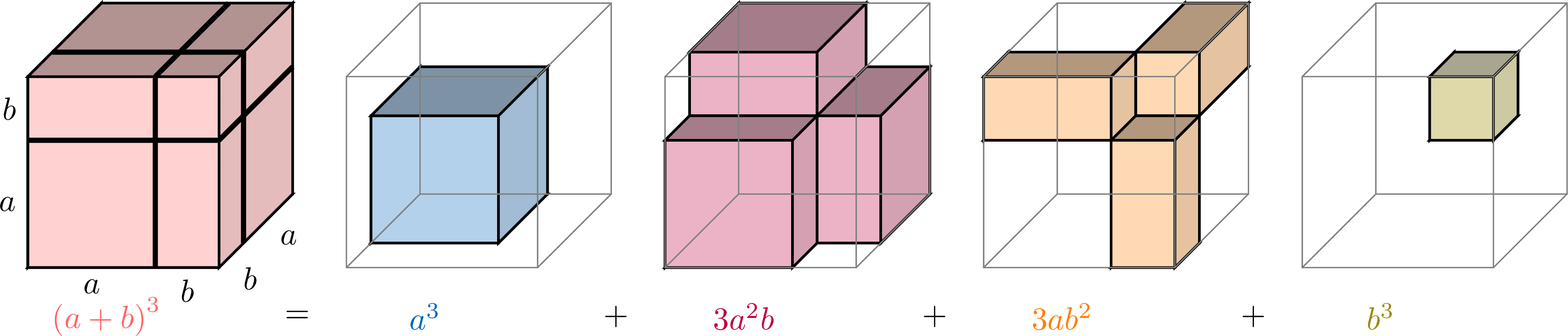
$$\begin{aligned} (a+b)^3 &= (a+b)(a+b)(a+b) &&\text {(cube definition)} \\
&= (a^2+2ab+b^2)(a+b) &&\text {(using the square expansion)} \\
&= (a^2+2ab+b^2)a + (a^2+2ab+b^2)b &&\text {(expanding)} \\
&= a^3+2a^2b+ab^2 + a^2b+2ab^2+b^3 &&\text {(distributive law)} \\
&= a^3+3a^2b+3ab^2+b^3 &&\text {(combining)}\\
\end{aligned}$$
Example
Expand and simplify \((x+2)^3\)
In the identity for the cube of a sum, we substitute \(a=x\) and \(b=2\):$$\begin{aligned}(\textcolor{colordef}{x}+\textcolor{colorprop}{2})^{3}&= \textcolor{colordef}{x}^{3} + 3 \times \textcolor{colordef}{x}^2 \times \textcolor{colorprop}{2} + 3 \times \textcolor{colordef}{x} \times \textcolor{colorprop}{2}^2 + \textcolor{colorprop}{2}^{3} \\
&= x^{3} + 6x^2 + 12x + 8\end{aligned}$$
Example
Expand and simplify \((x-3)^3\).
In the identity for the cube of a difference, we substitute \(a=x\) and \(b=3\):$$\begin{aligned}(\textcolor{colordef}{x}-\textcolor{colorprop}{3})^{3}&= \textcolor{colordef}{x}^{3} - 3 \times \textcolor{colordef}{x}^2 \times \textcolor{colorprop}{3} + 3 \times \textcolor{colordef}{x} \times \textcolor{colorprop}{3}^2 - \textcolor{colorprop}{3}^{3} \\
&= x^{3} - 9x^2 + 27x - 27.\end{aligned}$$ So \((x-3)^3 = x^3 - 9x^2 + 27x - 27\).
Skills to practice
- Expanding the Cube of a Sum
- Expanding the Cube of a Difference
II
Expanding Three Terms and Three Factors
Proposition — Square of a Trinomial
For all numbers \(a\), \(b\) and \(c\):$$(a+b+c)^2 = a^2 + b^2 + c^2 + 2ab + 2ac + 2bc$$ — the three squares, plus twice each of the three possible products of two different terms.
Group the first two terms and apply the perfect-square identity twice: $$\begin{aligned}[t] (a+b+c)^2 &= \big((a+b) + c\big)^2 \\
&= (a+b)^2 + 2(a+b)c + c^2 && {\scriptstyle\text{(square of a sum, with } a+b \text{ as one block)}} \\
&= a^2 + 2ab + b^2 + 2ac + 2bc + c^2 && {\scriptstyle\text{(expand the block and distribute } 2c)} \\
&= a^2 + b^2 + c^2 + 2ab + 2ac + 2bc. \end{aligned}$$
Example
Expand \((x + y + 2)^2\). $$\begin{aligned}[t] (x+y+2)^2 &= x^2 + y^2 + 2^2 + 2xy + 2 \cdot x \cdot 2 + 2 \cdot y \cdot 2 && {\scriptstyle\text{(the trinomial identity)}} \\
&= x^2 + y^2 + 4 + 2xy + 4x + 4y. \end{aligned}$$ Method — Expanding a Product of Three Factors
To expand \((A)(B)(C)\): - Expand the product of the first two factors.
- Multiply the result by the third factor, distributing every term.
- Collect like terms.
Example
Expand \((x+1)(x+2)(x+3)\). $$\begin{aligned}[t] (x+1)(x+2)(x+3) &= \big(x^2 + 3x + 2\big)(x+3) && {\scriptstyle\text{(first two factors)}} \\
&= x^3 + 3x^2 + 3x^2 + 9x + 2x + 6 && {\scriptstyle\text{(distribute each term)}} \\
&= x^3 + 6x^2 + 11x + 6. && {\scriptstyle\text{(collect)}} \end{aligned}$$ Quick check at \(x = 1\): left side \(2 \cdot 3 \cdot 4 = 24\); right side \(1 + 6 + 11 + 6 = 24\). Skills to practice
- Expanding Further
- Justifying an Expansion
III
Choosing the Most Suitable Form
Proposition — Difference of Squares
Method — Choosing the Most Suitable Form
The same expression can be written in several forms. Before computing, ask what the question needs: - the factorised form reveals the zeros: it serves to solve \(E(x) = 0\) (null factor law) and to find its sign;
- the expanded and simplified form serves to compute \(E(0)\), to compare two expressions, or to combine them.
Example
Let \(E(x) = (x+3)^2 - 25\). - Expand and simplify \(E(x)\).
- Factorise \(E(x)\).
- Choose the suitable form to: solve \(E(x) = 0\); compute \(E(0)\).
- $$\begin{aligned}[t] E(x) &= (x+3)^2 - 25 \\ &= x^2 + 6x + 9 - 25 && \text{(square of a sum)}\\ &= x^2 + 6x - 16. \end{aligned}$$
- $$\begin{aligned}[t] E(x) &= (x+3)^2 - 5^2 \\ &= (x+3-5)(x+3+5) && \text{(difference of two squares)}\\ &= (x-2)(x+8). \end{aligned}$$
- To solve \(E(x) = 0\): the factorised form gives \((x-2)(x+8) = 0\), so \(x = 2\) or \(x = -8\) (null factor law). To compute \(E(0)\): the expanded form gives \(E(0) = -16\) at a glance.
Skills to practice
- Choosing the Right Form
IV
Going further
Skills to practice
- Reasoning and Problem-Solving
- Solving Problems with Identities
- Investigating Patterns
- Modelling with Expansions
- Quiz
Jump to section