International Baccalaureate · MYP 1
Probability
I
Outcomes and Events
I.1
Outcomes
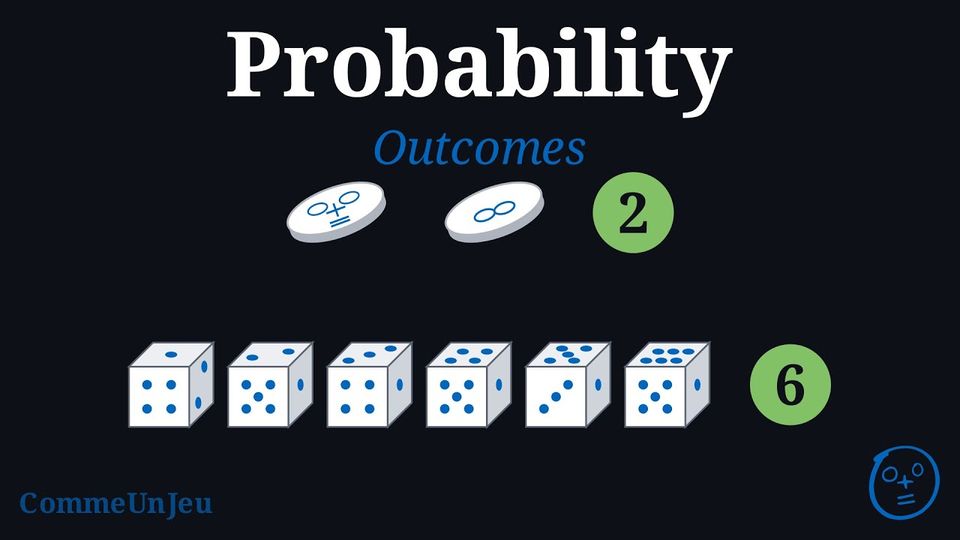
Some actions have a result we cannot predict — flipping a coin, rolling a die, or playing a game. We call such an action a random experiment: it can be repeated under the same conditions, all its possible results are known in advance, but nobody can tell with certainty which one will happen. Probability is a mathematical way to measure how likely an event of the experiment is, such as “rolling a 6” when a die is rolled.
Definition — Outcome
An outcome is one possible result of a random experiment. Definition — All Possible Outcomes
All possible outcomes are the complete list of all the outcomes that can happen in a random experiment. Example
What are all the possible outcomes when you flip a coin? 
All possible outcomes are Heads (H)= and Tails (T)=
 .
and Tails (T)=. Example
What are all the possible outcomes when you roll a six-sided die?
All possible outcomes are 1= , 2=
 , 3=
 , 4=
 , 5=
 , and 6=
 .
, 2=, 3=, 4=, 5=, and 6=. Skills to practice
- Listing All the Possible Outcomes
I.2
Events
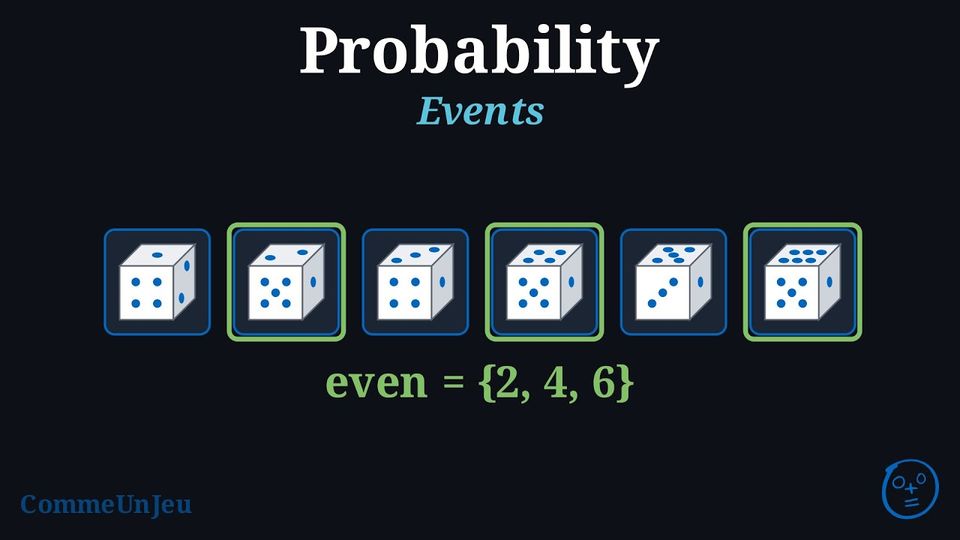
Once we know all the possible outcomes of an experiment (the sample space), we can focus on specific results we are interested in. These specific results are called events: an event can contain several outcomes, a single outcome, or even none (the impossible event).
Definition — Event
An event is a set of outcomes from the set of all possible outcomes. Example
In the experiment of rolling a die, find the outcomes that correspond to rolling an even number.
The outcomes for “rolling an even number” are 2=, 4=, and 6=.
, 4=, and 6=. Method — Certain, Possible or Impossible: Look at the Outcomes
To decide whether an event is certain, possible or impossible, list all the possible outcomes of the experiment, then the outcomes that make the event happen, and compare: if all the outcomes make it happen, the event is certain; if no outcome makes it happen, it is impossible; if some do and others do not, it is possible. For one roll of a die, “getting a number from 1 to 6” is certain (all six outcomes), “getting a 7” is impossible (no outcome), “getting an even number” is possible (the outcomes 2, 4 and 6 only). Skills to practice
- Finding the Outcomes of an Event
II
Describing Probability
II.1
Probability in Words
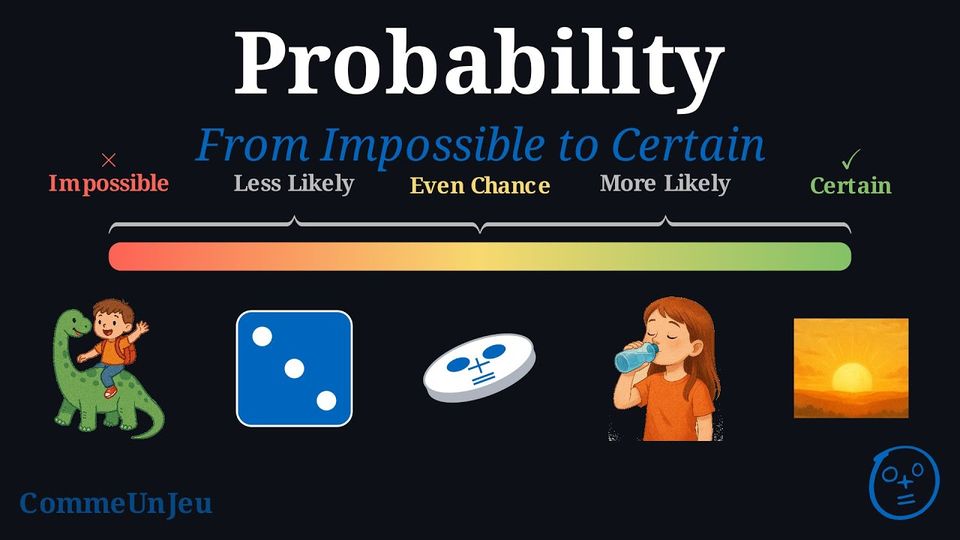
We use special words to describe the chance of an event happening. We can place these words on a line from least likely to most likely.
Definition — Probability Line

- Impossible: It can’t happen.
Example: Riding a dinosaur. - Less likely: It probably won’t happen.
Example: Rolling a die and getting a 3. - Even chance: It has the same chance to happen or not to happen.
Example: Tossing a coin and getting heads. - More likely: It will probably happen.
Example: Drinking water at school today. - Certain: It will happen.
Example: The sun will rise tomorrow.
Riding a dinosaur, drinking water at school and the sunrise are everyday happenings, not events of an experiment whose outcomes are listed. In an experiment, an event is impossible when no outcome makes it happen, and certain when every outcome makes it happen: with a die, “getting a 7” is impossible and “getting a number from 1 to 6” is certain.
Skills to practice
- Describing Probabilities in Words
II.2
Probability as a Number from 0 to 1
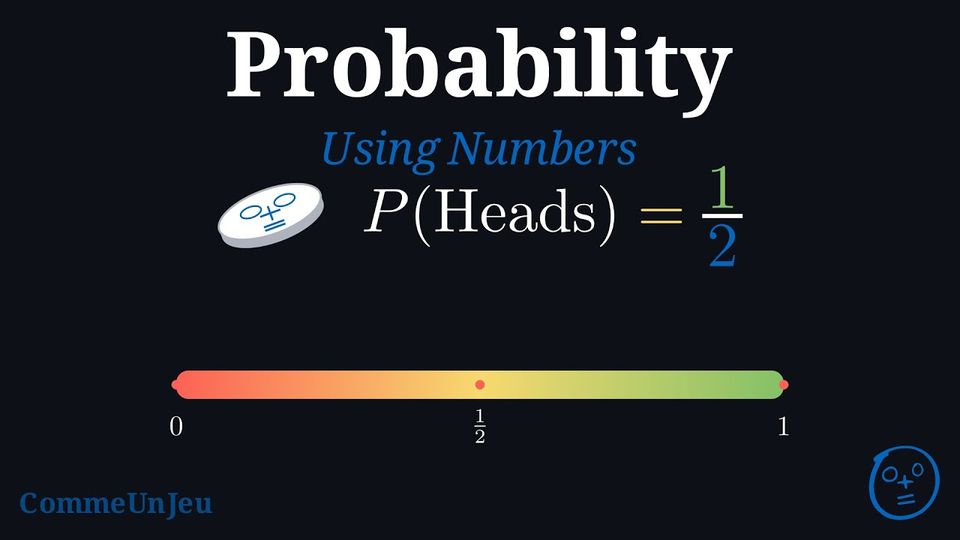
When you flip a fair coin, there are two possible outcomes: heads or tails. The chance of getting heads is 1 out of 2. We can write this as a fraction: 
Definition — Probability
The probability of an event, written \(P(\text{event})\), is a number from 0 (impossible) to 1 (certain). 
Skills to practice
- Describing a Probability Given as a Number
III
Calculating Probabilities
III.1
Equally Likely Outcomes
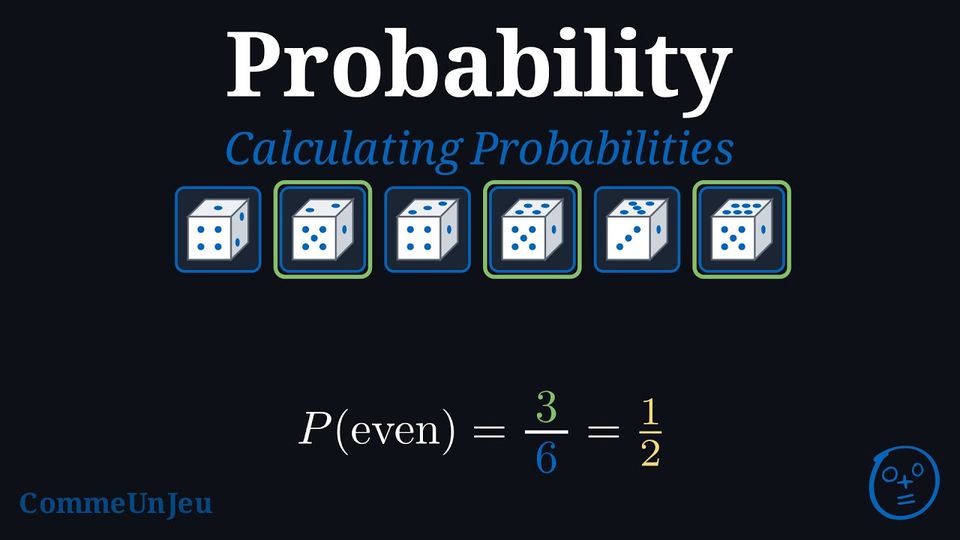
In many experiments, each outcome has the same chance of happening. For example, a fair coin is just as likely to land on heads as it is on tails. When we roll a fair die, each number from 1 to 6 has the same chance of appearing. We call these equally likely outcomes.
Definition — Calculating Probability with Equally Likely Outcomes
When all outcomes of an experiment are equally likely, we can calculate the probability of an event using a simple formula: $$P(\text{event}) = \frac{\text{Number of favourable outcomes}}{\text{Total number of possible outcomes}}$$ “Favourable outcomes” are the outcomes that match the event we are interested in. Example
A fair six-sided die is rolled. Calculate the probability of rolling an even number. - Total number of possible outcomes: A die has 6 faces, so there are 6 possible outcomes: \(1\), \(2\), \(3\), \(4\), \(5\) and \(6\).
- Number of favourable outcomes: The event is “rolling an even number”. The outcomes that are even are \(2\), \(4\) and \(6\). There are 3 favourable outcomes.
- Calculate the probability: $$\begin{aligned} P(\text{rolling an even number}) &= \frac{\text{Number of favourable outcomes}}{\text{Total number of possible outcomes}} \\ &= \frac{3}{6} \\ &= \frac{1}{2} \end{aligned}$$
Skills to practice
- Calculating a Probability as a Fraction
III.2
Three Ways to Write a Probability
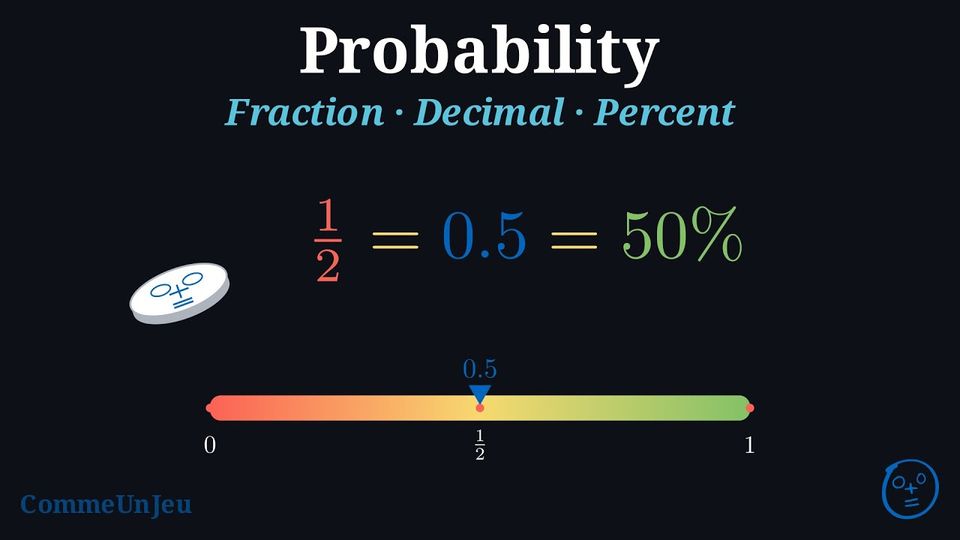
Method — Expressing Probabilities in Different Forms
We can write probabilities in three different ways: as fractions, decimals, or percentages. These three forms represent the same probability, but look different. Example
A fair spinner has 4 equal parts, 1 of them red: \(P(\text{red}) = \frac{1}{4}\). Represent this probability as a decimal and a percentage. - Fraction: \( \frac{1}{4} \)
- Decimal: To convert a fraction to a decimal, divide the numerator by the denominator: $$ 1 \div 4 = 0.25 $$
- Percentage: To convert a decimal to a percentage, multiply by 100 and add the percent sign: $$ 0.25 = 0.25 \times 100\pourcent = 25\pourcent $$
Method — When the Division Does Not Stop
The fraction is the exact form of a probability. To write it as a decimal, divide the numerator by the denominator. - Sometimes the division stops: \(1 \div 4 = 0.25\). The decimal is exact, and we write \(\frac{1}{4} = 0.25 = 25\pourcent\).
- Sometimes it never stops: \(1 \div 3 = 0.333\ldots\) The digits go on for ever. Then the decimal we write down is only an approximate value: we round it, to the nearest hundredth for instance, and we write \(\approx\) instead of \(=\). So \(\frac{1}{3} \approx 0.33\), and \(\frac{1}{3} \approx 33\pourcent\).
Example
Which is more likely: an event with probability \(\dfrac{2}{5}\), or an event with probability \(35\pourcent\)?
We write both probabilities in the same form, for example as percentages: $$\begin{aligned}[t] \frac{2}{5} &= \frac{40}{100} && \text{(multiply numerator and denominator by 20)}\\
&= 40\pourcent. \end{aligned}$$ Since \(40\pourcent > 35\pourcent\), the first event is more likely.
Example
A fair die is rolled. Write the probability of getting a multiple of \(3\) as a fraction, then as a decimal rounded to the nearest hundredth, then as a percentage. Then say which is more likely: getting a multiple of \(3\), or an event with probability \(0.3\).
The multiples of \(3\) on a die are \(3\) and \(6\): two favourable outcomes out of six. $$\begin{aligned}[t] P(\text{multiple of } 3) &= \frac{2}{6} = \frac{1}{3} && {\scriptstyle\text{(exact form)}}\\
1 \div 3 &= 0.333\ldots && {\scriptstyle\text{(the division never stops)}}\\
\frac{1}{3} &\approx 0.33 \approx 33\pourcent. && {\scriptstyle\text{(rounded to the nearest hundredth)}} \end{aligned}$$ To compare with \(0.3\): \(\frac{1}{3} = 0.333\ldots\) and \(0.333\ldots > 0.3\). Getting a multiple of \(3\) is the more likely event — even though \(0.33\) and \(0.3\) look close, the hundredths digit decides: \(0.333\ldots\) against \(0.300\).
Skills to practice
- Estimating a Probability as a Percentage
- Writing and Comparing Probabilities in Different Forms
III.3
The Probabilities Add Up to 1
A game wheel is divided into four sectors: red, blue, green and yellow — but the sectors do not have the same size. The red sector covers half of the wheel; blue covers a quarter; green and yellow share the rest equally. 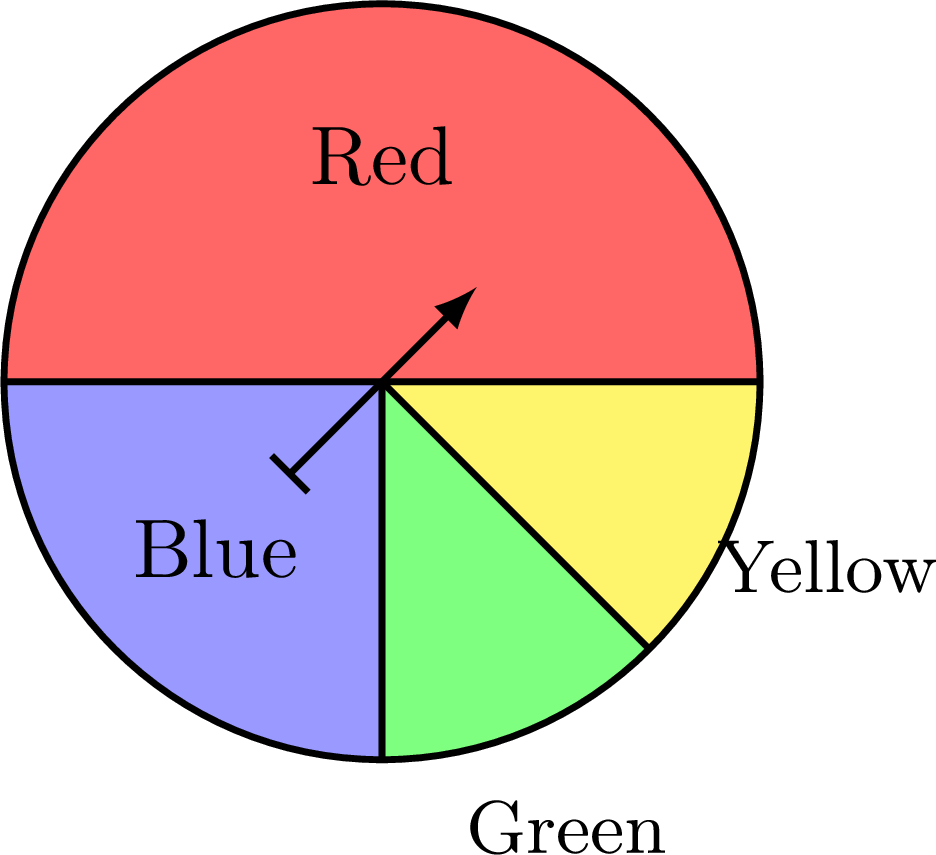
- Lina says: “There are four colours, so each colour has a probability of \(\frac{1}{4}\).” Do you agree with Lina?
- The wheel is spun many times. Which colour do you expect to come up most often? About how often?
- The four outcomes are the same as on a fair four-colour wheel: red, blue, green, yellow. What has changed, if it is not the list of outcomes?
Until now, every outcome had the same chance: a fair coin, a fair die, balls that are all identical. The formula “number of favourable outcomes divided by total number of possible outcomes” works only in that situation. But many experiments are not like that: a wheel with sectors of different sizes, a thumbtack that can land point up or point down, tomorrow's weather. The list of outcomes is the same kind of object as before — what changes is the chance attached to each outcome.
An event can contain a single outcome: for the die, “rolling a 3” is the event whose only outcome is 3. Every outcome defines an event in this way — the event containing just that outcome. Speaking of the chance of an outcome is therefore speaking of the chance of an event.
Proposition — Sum of the Probabilities
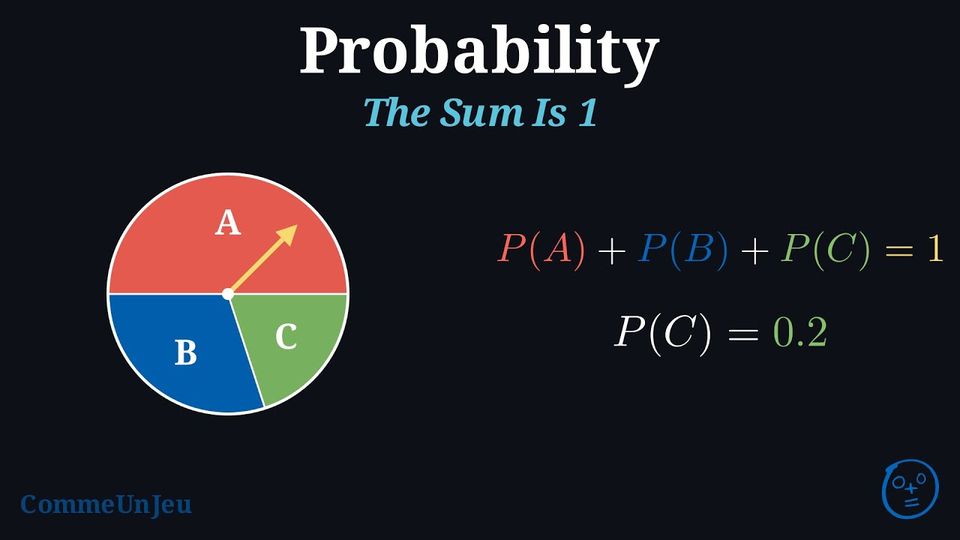
In a random experiment, the probabilities of all the outcomes add up to \(1\): $$\textcolor{colorprop}{P(\text{outcome}_1) + P(\text{outcome}_2) + \dots + P(\text{outcome}_n) = 1}$$ Method — Finding a Missing Probability
When the probabilities of all the outcomes but one are known, the missing one is found by subtracting from \(1\): $$P(\text{missing outcome}) = 1 - (\text{sum of the known probabilities}).$$ Example
A spinner has three outcomes, A, B and C, with \(P(A) = 0.5\) and \(P(B) = 0.3\). 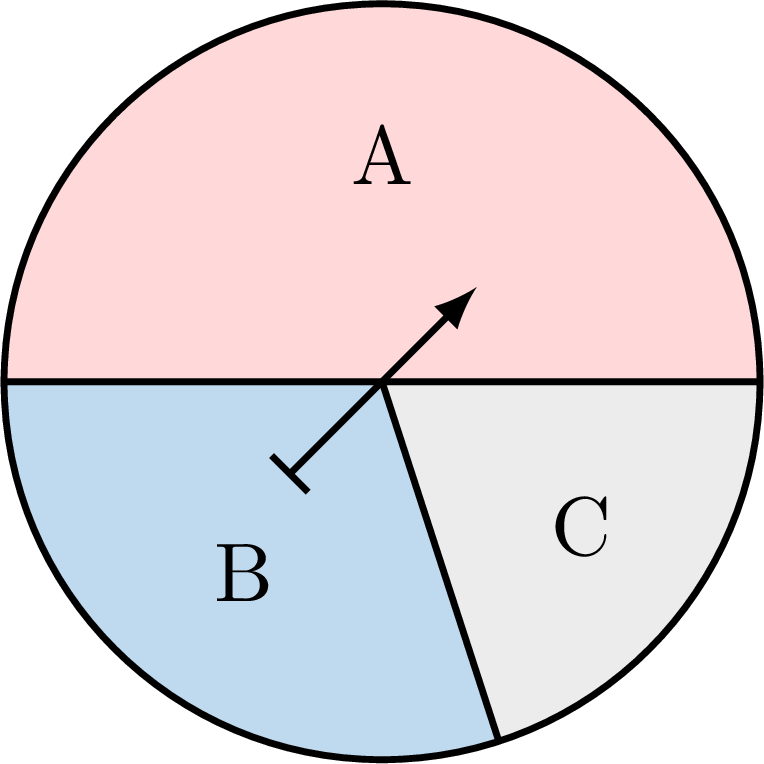
$$\begin{aligned}[t] P(C) &= 1 - (0.5 + 0.3) && \text{(the probabilities add up to 1)}\\
&= 1 - 0.8 && \text{(\(0.5 + 0.3 = 0.8\))}\\
&= 0.2. \end{aligned}$$
Example
A game wheel is divided into four sectors of different sizes: red covers half of the wheel, blue a quarter, and green and yellow share the rest equally. The arrow is spun, and it has the same chance of stopping in any direction. 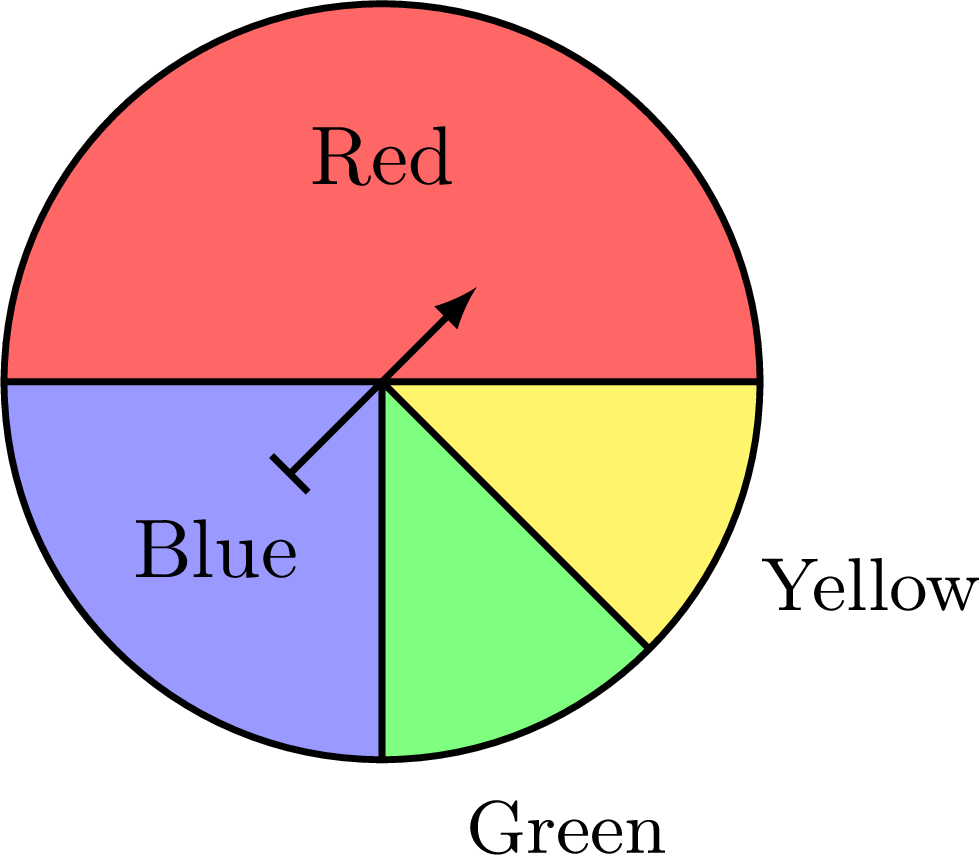
The wheel is cut into \(8\) equal sectors, numbered from \(1\) to \(8\): red covers \(4\) of them, blue \(2\), green \(1\) and yellow \(1\). 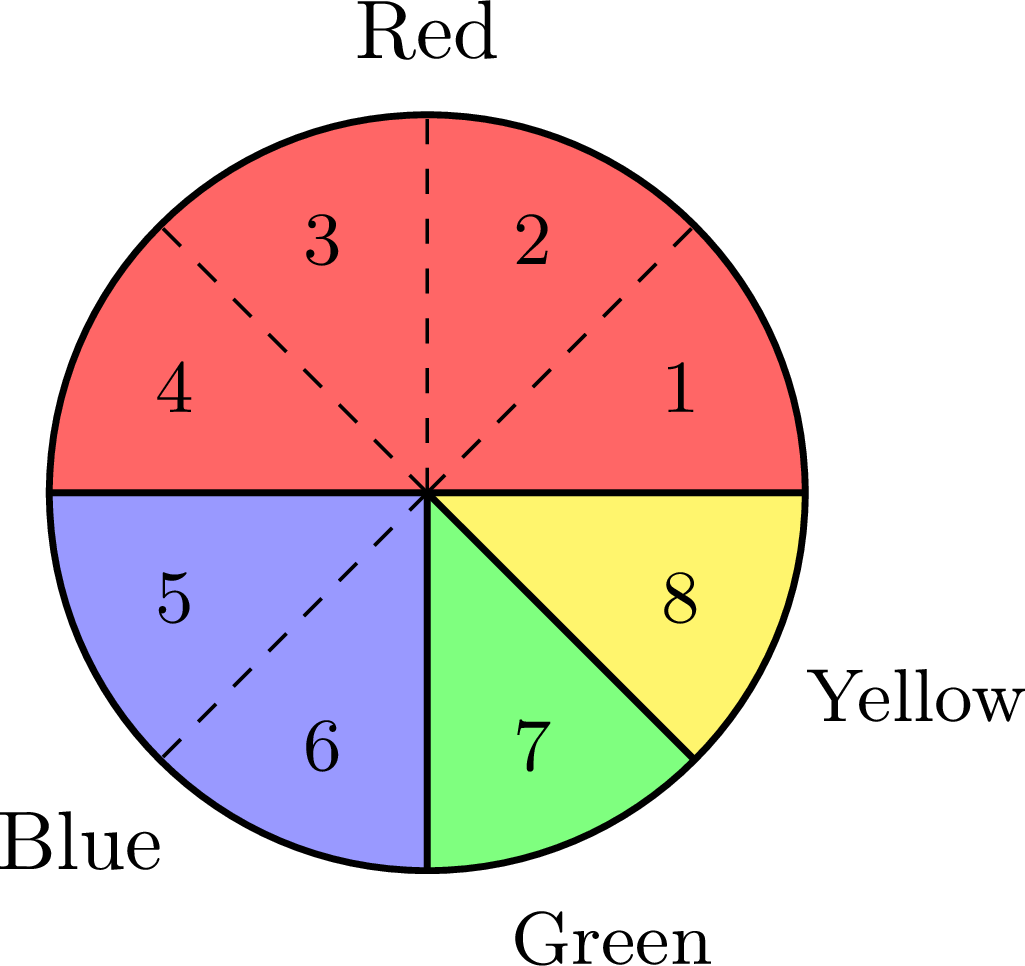
The arrow has the same chance of stopping in any direction, so the \(8\) equal sectors have the same chance: they are \(8\) equally likely outcomes. Each colour is an event made of some of these sectors: the event “red” is made of the sectors \(1\), \(2\), \(3\) and \(4\), “blue” of the sectors \(5\) and \(6\), “green” of the sector \(7\) and “yellow” of the sector \(8\). So $$\begin{aligned}[t] P(\text{red}) &= \frac{\text{number of favourable outcomes}}{\text{total number of possible outcomes}} && \text{(equally likely outcomes)}\\
&= \frac{4}{8} && \text{(red: \(4\) of the \(8\) sectors)}\\
&= \frac{1}{2}. \end{aligned}$$ In the same way, \(P(\text{blue}) = \frac{2}{8} = \frac{1}{4}\), \(P(\text{green}) = \frac{1}{8}\) and \(P(\text{yellow}) = \frac{1}{8}\). Every sector has exactly one colour, so the four probabilities add up to \(1\): $$\frac{1}{2} + \frac{1}{4} + \frac{1}{8} + \frac{1}{8} = \frac{4}{8} + \frac{2}{8} + \frac{1}{8} + \frac{1}{8} = \frac{8}{8} = 1.$$ Lina is not correct: she treated the four colours as if they were equally likely, and they are not — red covers four sectors, green only one. The list of colours is the same as on a fair four-colour wheel; what changes is the chance attached to each colour.
Skills to practice
- Finding a Missing Probability
IV
Going further
Skills to practice
- Solving Probability Problems
- Investigating Patterns in Probabilities
- Quiz
Jump to section