International Baccalaureate · DP 1: Analysis and Approaches HL
Straight Lines
I
Lines and Systems
I.1
Writing the Equation of a Line in General Form
Definition — Gradient-Intercept Form
The gradient-intercept form (also called the slope-intercept form) of a non-vertical line's equation is:$$y = mx + c$$ where \(m\) is the gradient (also called the slope) and \(c\) is the \(y\)-intercept. - The gradient \(m\) tells us how much \(y\) changes when \(x\) increases by \(1\).
- The \(y\)-intercept \(c\) is the value of \(y\) when \(x = 0\): the line crosses the \(y\)-axis at the point \((0, c)\).
Definition — General Form of Equation of a Line
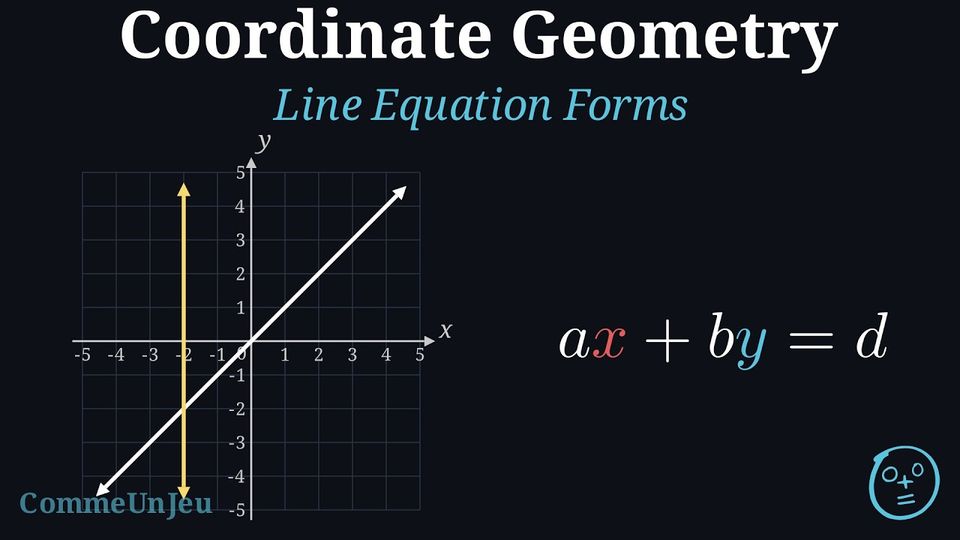
The general form of the equation of a line is:$$ax + by = d$$ where \(a\), \(b\), and \(d\) are constants, and \(a\) and \(b\) are not both zero. - If \(b \neq 0\), solving for \(y\) gives \(y = -\dfrac{a}{b}x + \dfrac{d}{b}\): the line is not vertical, and its gradient is \(-\dfrac{a}{b}\).
- If \(b = 0\), then \(a \neq 0\) and the equation becomes \(x = \dfrac{d}{a}\): the line is vertical.
The General Form \(ax + by + d = 0\)
The general form is also written with every term on one side: $$ax + by + d = 0,$$ where \(a\), \(b\) and \(d\) are integers, with \(a\) and \(b\) not both zero. It is the form \(ax + by = d\) with the constant brought to the left-hand side, so the constant changes sign: \(2x + 3y = 6\) becomes \(2x + 3y - 6 = 0\).
- To write the gradient-intercept form \(y = mx + c\) or the point-gradient form \(y - y_1 = m(x - x_1)\) in general form, bring every term to one side, then multiply both sides by the lowest common denominator of the fractions, so that every coefficient is an integer.
- Conversely, when \(b \neq 0\), solving \(ax + by + d = 0\) for \(y\) gives \(y = -\dfrac{a}{b}x - \dfrac{d}{b}\): the gradient is \(m = -\dfrac{a}{b}\) and the \(y\)-intercept is \(c = -\dfrac{d}{b}\).
Example
Write each equation in the form \(ax + by + d = 0\), where \(a\), \(b\) and \(d\) are integers. - The line \(y = \dfrac{2}{3}x - \dfrac{1}{2}\).
- The line with gradient \(-\dfrac{3}{5}\) passing through \(A(-1, 2)\).
- The denominators are \(3\) and \(2\); their lowest common denominator is \(6\). $$\begin{aligned}[t] y &= \frac{2}{3}x - \frac{1}{2} \\ 6y &= 4x - 3 && \text{(multiply both sides by } 6\text{)} \\ -4x + 6y + 3 &= 0 && \text{(subtract } 4x \text{ and add } 3 \text{ on both sides)} \\ 4x - 6y - 3 &= 0 && \text{(multiply both sides by } -1 \text{, so that } a > 0\text{)} \end{aligned}$$ Check with the point \(\left(0, -\frac{1}{2}\right)\) of the line: \(4 \times 0 - 6 \times \left(-\frac{1}{2}\right) - 3 = 3 - 3 = 0\).
- $$\begin{aligned}[t] y - 2 &= -\frac{3}{5}(x + 1) && \text{(point-gradient form)} \\ 5y - 10 &= -3(x + 1) && \text{(multiply both sides by } 5\text{)} \\ 5y - 10 &= -3x - 3 && \text{(expand)} \\ 3x + 5y - 7 &= 0 && \text{(add } 3x + 3 \text{ to both sides)} \end{aligned}$$ Check: \(A(-1, 2)\) gives \(3 \times (-1) + 5 \times 2 - 7 = 0\), and the gradient is \(-\dfrac{a}{b} = -\dfrac{3}{5}\).
Skills to practice
- Writing the Equation of a Line in General Form
I.2
Solving Simultaneous Equations with Technology
Proposition — Graphical Meaning of a System
Consider a system whose two equations can be rearranged in the forms \(y = m_1x + c_1\) and \(y = m_2x + c_2\). In a coordinate plane, each of them is the equation of a line. A pair \((x, y)\) is a solution of the system if and only if the point with coordinates \((x, y)\) lies on both lines: the solutions of the system are the coordinates of the intersection points of the two lines. 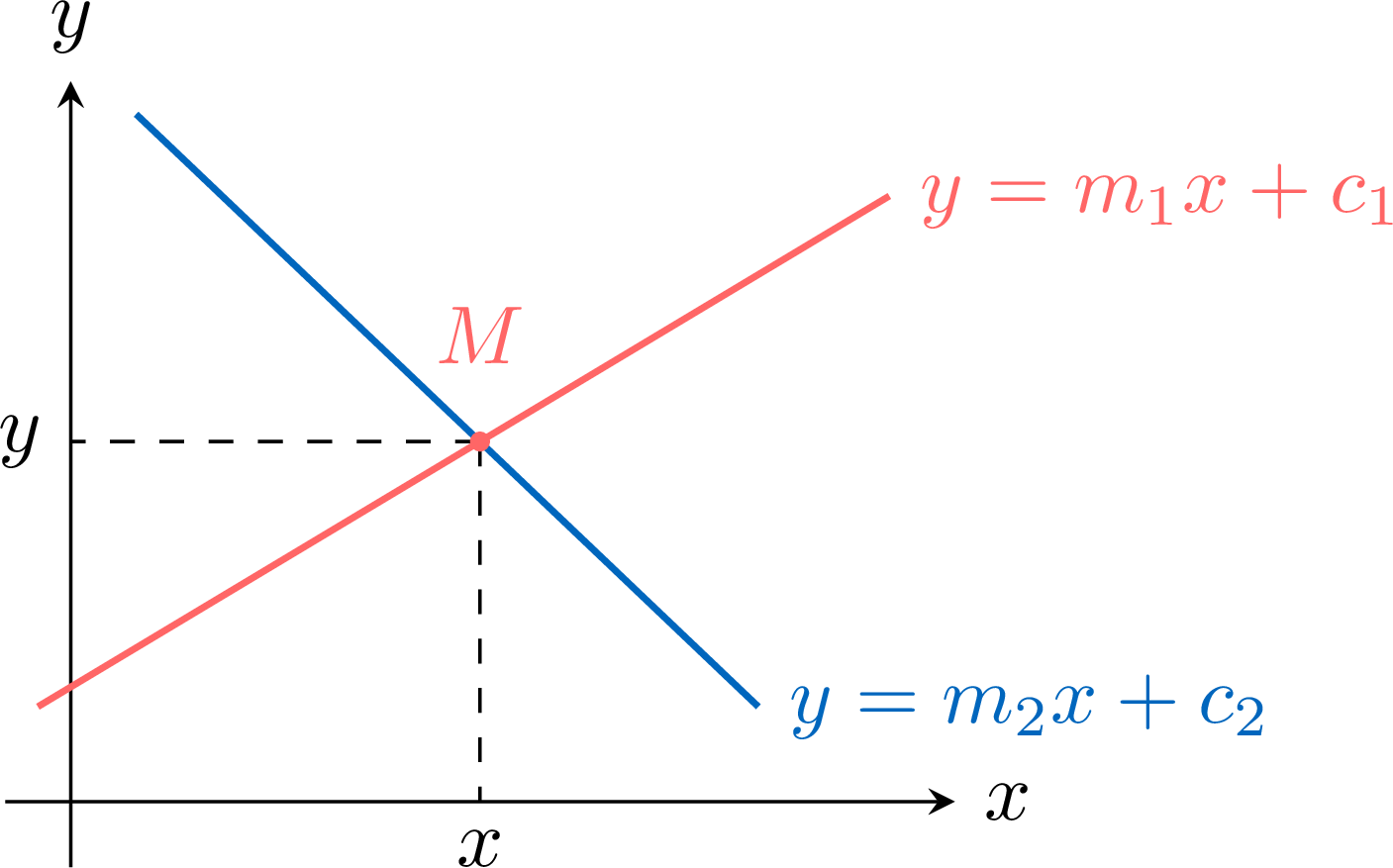
Rearranging an equation with balance moves does not change its solutions, so the system has the same solutions as \(\begin{cases} y = m_1x + c_1 \\ y = m_2x + c_2 \end{cases}\). Let \(M\) be the point with coordinates \((x, y)\). By the definition of the equation of a line, \(M\) lies on the first line if and only if \(y = m_1x + c_1\) is true, and \(M\) lies on the second line if and only if \(y = m_2x + c_2\) is true. Hence \(M\) lies on both lines if and only if \((x, y)\) satisfies both equations, that is, if and only if \((x, y)\) is a solution of the system.
Proposition — Number of Solutions of a System
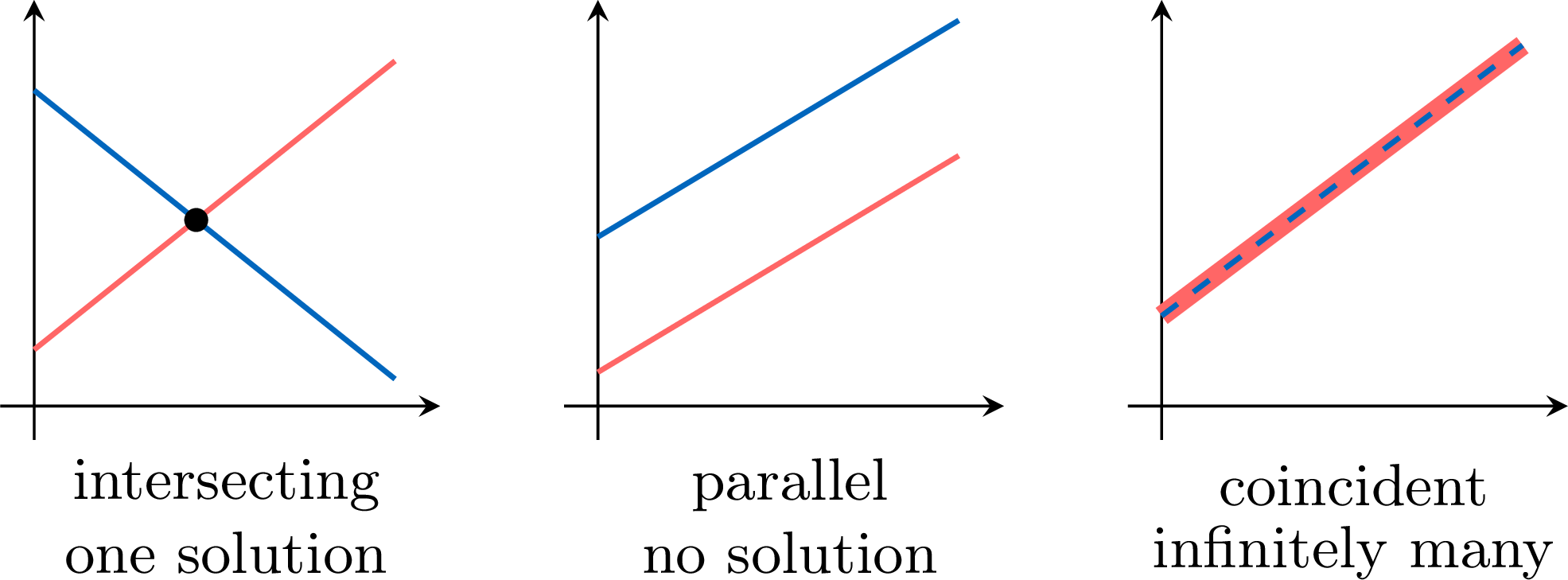
Consider a system whose equations can be rearranged as \(y = m_1x + c_1\) and \(y = m_2x + c_2\), where \(m_1\) and \(m_2\) are the gradients (also called slopes) of the two lines. - If \(m_1 \neq m_2\), the lines are intersecting: the system has exactly one solution.
- If \(m_1 = m_2\) and \(c_1 \neq c_2\), the lines are parallel and distinct: the system has no solution.
- If \(m_1 = m_2\) and \(c_1 = c_2\), the lines are coincident (they are the same line): the system has infinitely many solutions, all the pairs \((x, m_1x + c_1)\).
A solution \((x, y)\) satisfies \(y = m_1x + c_1\) and \(y = m_2x + c_2\), so the two expressions of \(y\) are equal: $$\begin{aligned}[t] m_1x + c_1 &= m_2x + c_2 && \text{(both are equal to } y\text{)} \\
m_1x - m_2x + c_1 &= c_2 && \text{(subtract } m_2x \text{ from both sides)} \\
m_1x - m_2x &= c_2 - c_1 && \text{(subtract } c_1 \text{ from both sides)} \\
(m_1 - m_2)x &= c_2 - c_1 && \text{(factorise by } x\text{)} \end{aligned}$$
- If \(m_1 \neq m_2\), then \(m_1 - m_2 \neq 0\), and dividing by it gives the single value \(x = \dfrac{c_2 - c_1}{m_1 - m_2}\), then the single value \(y = m_1x + c_1\). For this \(x\) the two expressions of \(y\) are equal, so this pair satisfies both equations: exactly one solution.
- If \(m_1 = m_2\), the last equation reads \(0 \times x = c_2 - c_1\). When \(c_1 \neq c_2\), it is false for every \(x\): no solution. When \(c_1 = c_2\), the two equations are the same equation, and every pair \((x, m_1x + c_1)\) satisfies both: infinitely many solutions.
A graphing calculator, or graphing software, draws graphs and locates the points where a graph crosses the \(x\)-axis or another graph; its solvers return the roots of a polynomial equation and the solution of a system of linear equations. Its answers are in general decimal approximations, displayed with many digits.
Menu names differ from one model to another: each Method gives its steps in words, with a mock-up of what the screen displays. Unless a question says otherwise, a value that is not exact is given to 3 significant figures, counted from the first non-zero digit: \(2.2573340 \approx 2.26\), \(0.0283416 \approx 0.0283\) and \(31.962 \approx 32.0\).
Menu names differ from one model to another: each Method gives its steps in words, with a mock-up of what the screen displays. Unless a question says otherwise, a value that is not exact is given to 3 significant figures, counted from the first non-zero digit: \(2.2573340 \approx 2.26\), \(0.0283416 \approx 0.0283\) and \(31.962 \approx 32.0\).
Method — Solving an Equation Graphically with Technology
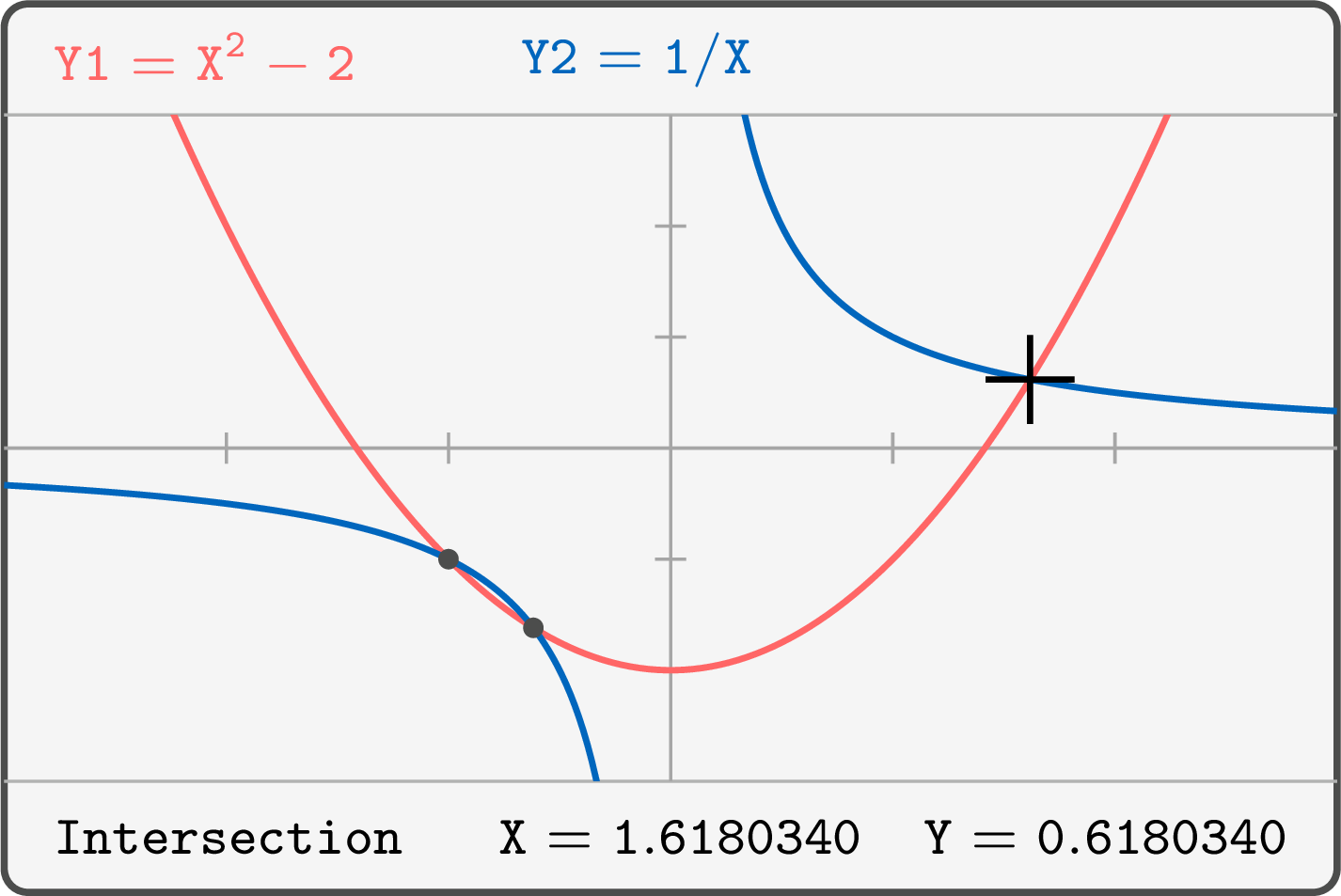
The solutions of an equation \(f(x) = g(x)\) are the \(x\)-coordinates of the points where the graphs of \(f\) and \(g\) meet; the solutions of an equation \(f(x) = 0\) are the \(x\)-intercepts of the graph of \(f\). - Enter each side as a function: \(Y_1 = f(x)\) and \(Y_2 = g(x)\). For an equation \(f(x) = 0\), enter \(f(x)\) alone.
- Choose a window that shows every point of intersection, or every \(x\)-intercept. A table of values of \(f(x) - g(x)\) helps: a change of sign between two consecutive values of \(x\) signals a solution between them, provided the curves have no break between these two values: this holds for polynomials, and for rational functions away from the values that make a denominator zero. Where the two curves touch without crossing, \(f(x) - g(x)\) does not change sign: such a solution is seen only on the graph.
- In the analysis tools of the graph menu, choose intersection (for \(f(x) = 0\): zero), select the curves and give a first guess, or bounds, close to one point. Read the \(x\)-coordinate \(X\) of the point displayed: the \(y\)-coordinate \(Y\) is the common value of the two sides, not a solution.
- Repeat for each point, then report the solutions: exactly when the screen shows an exact value that substitution confirms, otherwise to 3 significant figures.
Example
Use technology to find the point of intersection of the lines with equations \(y = 0.4x + 1.3\) and \(y = -1.7x + 5.2\).
The gradients, \(0.4\) and \(-1.7\), are different: the lines meet at exactly one point. The two equations are entered as \(Y_1 = 0.4x + 1.3\) and \(Y_2 = -1.7x + 5.2\), and graphed in the window \(-2 \le x \le 5\), \(-2 \le y \le 6\). The intersection tool displays \(X = 1.8571429\) and \(Y = 2.0428571\). 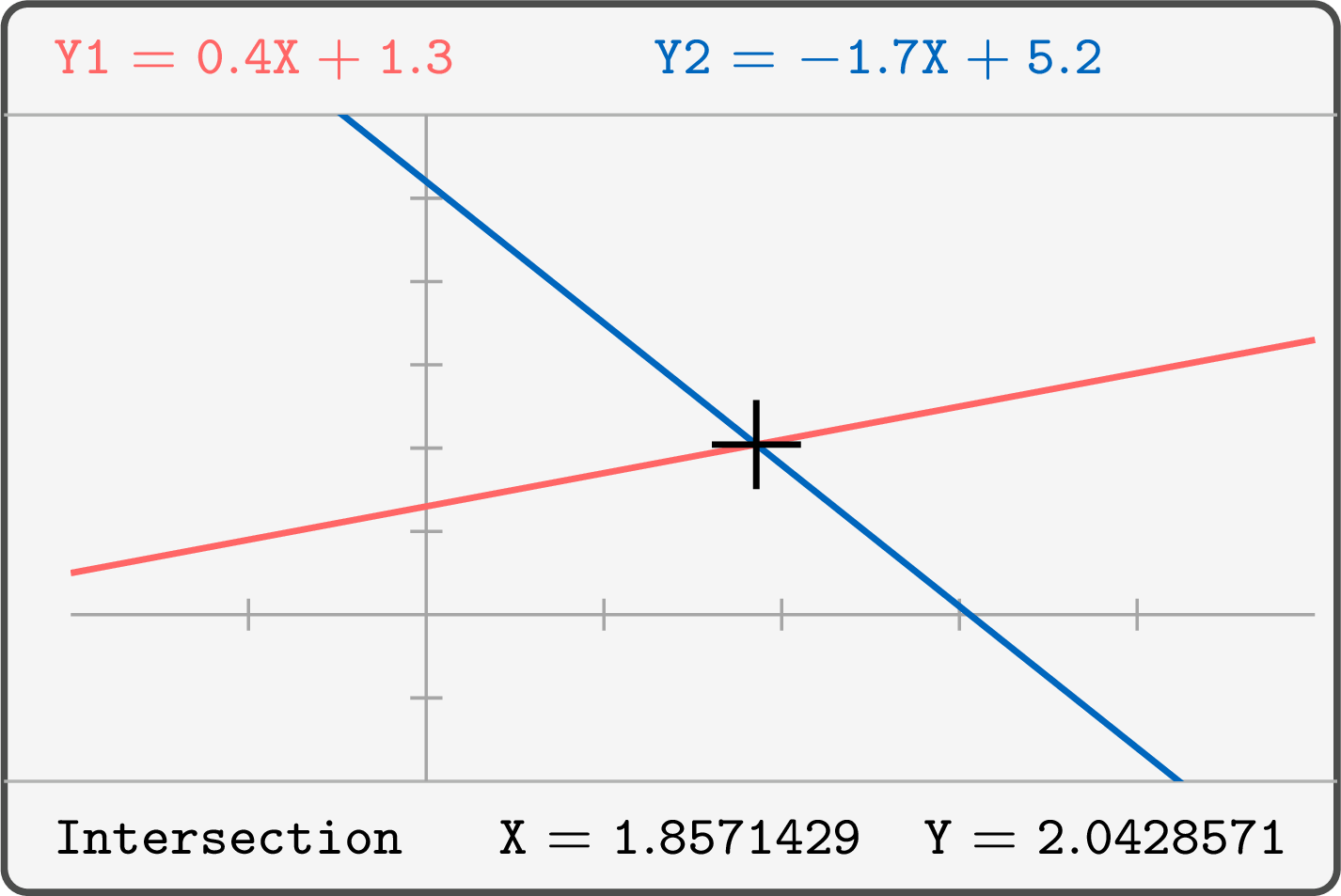
The question asks for a point, so both coordinates are part of the answer: \(Y\) is the \(y\)-coordinate of the point of intersection. (When the question is an equation \(f(x) = g(x)\), only \(X\) is a solution.) To 3 significant figures, the point of intersection is \((1.86, 2.04)\).
Check with the displayed values, which are rounded: \(0.4 \times 1.8571429 + 1.3 \approx 2.04\) and \(-1.7 \times 1.8571429 + 5.2 \approx 2.04\). Equating the two expressions of \(y\) gives \(2.1x = 3.9\): the exact coordinates are \(x = \dfrac{13}{7}\) and \(y = \dfrac{143}{70}\), whose decimal approximations are on the screen.
Check with the displayed values, which are rounded: \(0.4 \times 1.8571429 + 1.3 \approx 2.04\) and \(-1.7 \times 1.8571429 + 5.2 \approx 2.04\). Equating the two expressions of \(y\) gives \(2.1x = 3.9\): the exact coordinates are \(x = \dfrac{13}{7}\) and \(y = \dfrac{143}{70}\), whose decimal approximations are on the screen.
Method — Solving a Linear System with the Equation Solver
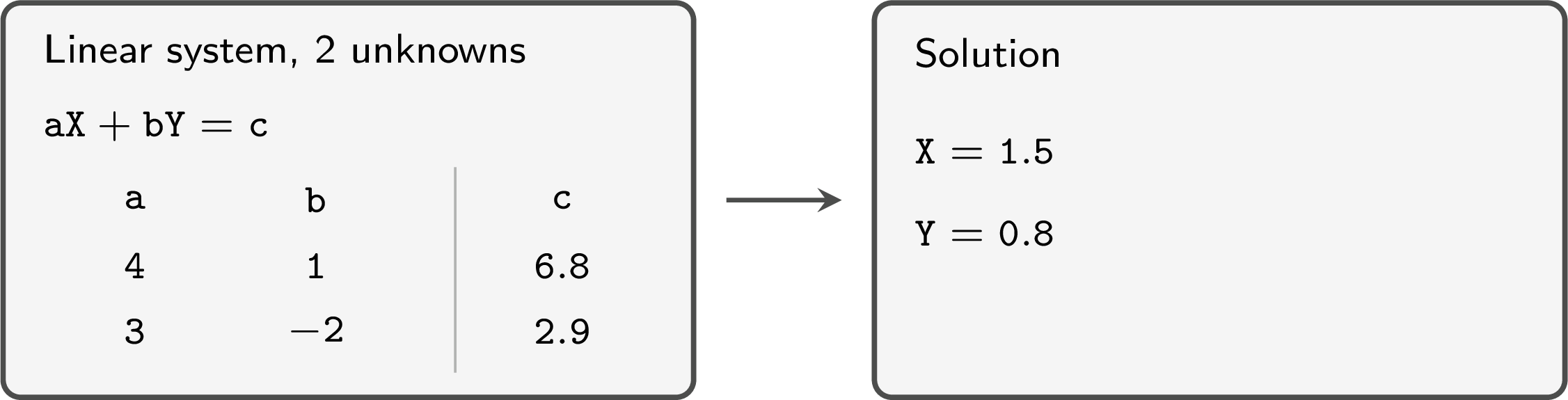
The linear system solver, in the equation menu of a graphing calculator, solves a system of two linear equations in two unknowns, or of three linear equations in three unknowns. - Write each equation in the form \(ax + by = c\) (two unknowns) or \(ax + by + cz = d\) (three unknowns): the unknowns on the left, in the same order in every equation, and the constant on the right.
- Open the linear system solver and choose the number of unknowns.
- Enter the coefficients row by row, one row per equation, each with its sign, and \(0\) for a missing unknown.
- Solve and read the value of each unknown. If the solver reports no solution, or infinitely many, the system has no unique solution.
- Check the solution by substituting it in each original equation, then report each value exactly when the checks hold exactly, otherwise to 3 significant figures.
Example
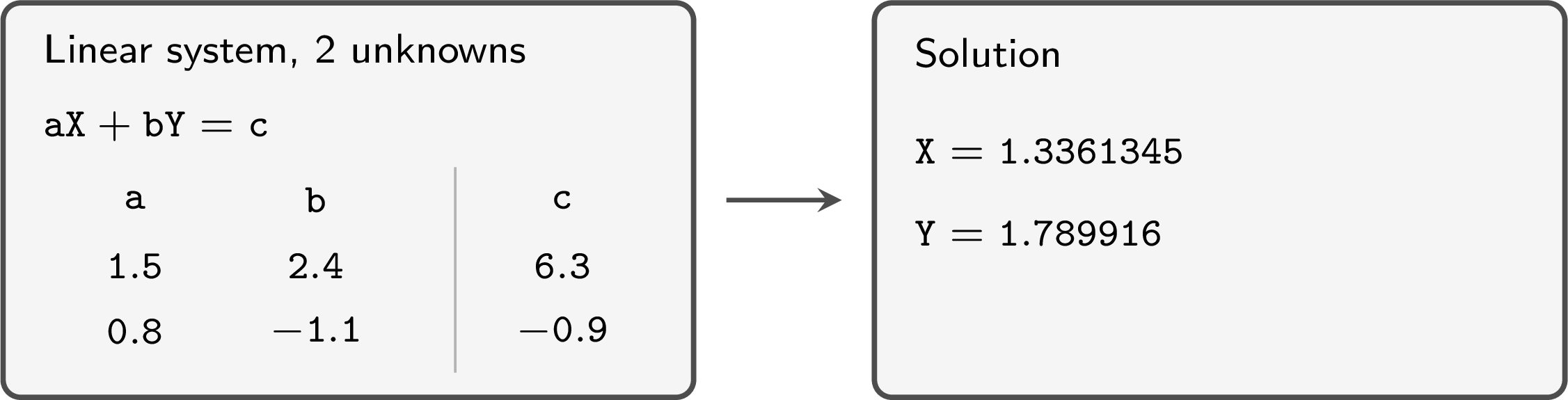
Use technology to answer. - Solve the system \(\begin{cases} 1.5x + 2.4y = 6.3 \\ 0.8x - 1.1y = -0.9 \end{cases}\), and interpret the solution with the two lines.
- For the system \(\begin{cases} 2x - 3y = 4 \\ -4x + 6y = 5 \end{cases}\), the linear system solver reports that there is no solution. Explain this message with the gradients of the two lines.
- Both equations already have the form \(ax + by = c\). The linear system solver, with two unknowns, the coefficients \(1.5\), \(2.4\), \(6.3\) in the first row and \(0.8\), \(-1.1\), \(-0.9\) in the second, displays \(x = 1.3361345\) and \(y = 1.789916\).
- Rearranged in the form \(y = mx + c\), the equations read \(y = \dfrac{2}{3}x - \dfrac{4}{3}\) and \(y = \dfrac{2}{3}x + \dfrac{5}{6}\). The two lines have the same gradient \(\dfrac{2}{3}\) and different \(y\)-intercepts: they are parallel and distinct, so they never meet, and the system has no solution. This is what the solver reports. The left-hand side of the second equation is \(-2\) times that of the first one, while \(5 \neq -2 \times 4\).
Skills to practice
- Intersecting Two Lines with Technology
II
Going further
Skills to practice
- Solving Exam-Style Problems on Lines
- Quiz
Jump to section