International Baccalaureate · MYP 5 Extended
Scalar Product
I
Definition and Properties
I.1
The Scalar Product
The scalar product, also known as the dot product, is a fundamental operation in vector algebra. It is used in various fields such as physics (for example, when computing work or projections) and in mathematics (for finding angles between vectors and testing orthogonality).
Two vectors, one number. A wagon is pushed along a rail while its rope is pulled sideways: what moves the wagon is not the whole pull, only its shadow on the rail. Drawing the pull \(\Vect{F}\) and dropping the perpendicular from its tip onto the rail gives a point \(H\). The length \(OH\), counted with a sign, is the part of the pull that really works. Multiplying it by the length of the displacement \(\Vect{d}\) gives a single number: large when the two vectors point the same way, zero when they are perpendicular, negative when they fight each other. This number is the scalar product. It can be read on a projection, computed from the angle, obtained from coordinates, or recovered from lengths alone. Four faces of one idea. 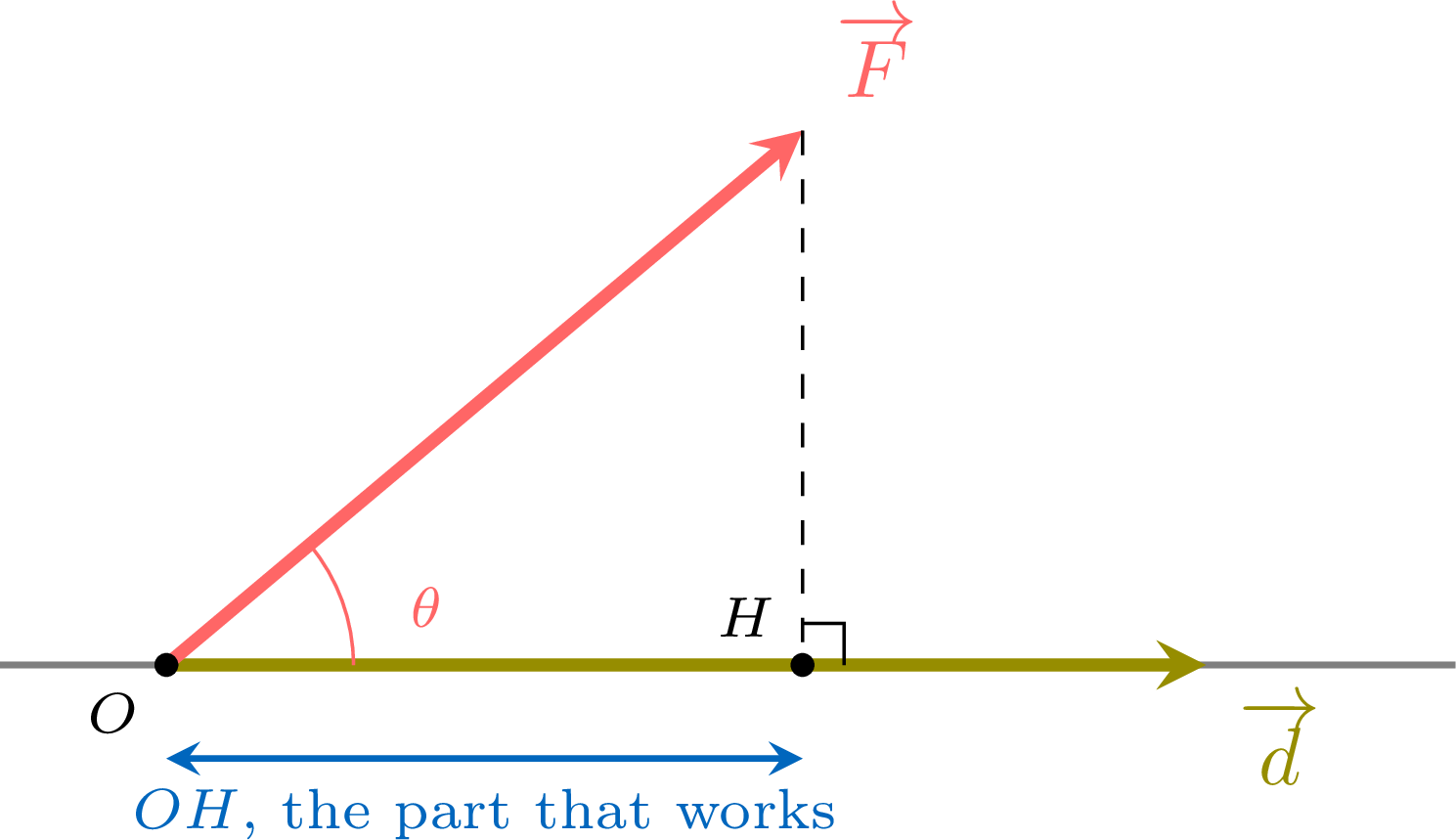
Definition — Geometric Scalar Product
The scalar product of two non-zero vectors \(\Vect{u}\) and \(\Vect{v}\) is defined as:$$\Vect{u} \cdot \Vect{v} = \|\Vect{u}\| \|\Vect{v}\| \cos \theta$$ where \(\|\Vect{u}\|\) is the magnitude of \(\Vect{u}\) (also called its norm), \(\|\Vect{v}\|\) is the magnitude of \(\Vect{v}\), and \(\theta\) is the angle between the vectors. If one of the two vectors is the zero vector, the scalar product is \(0\). 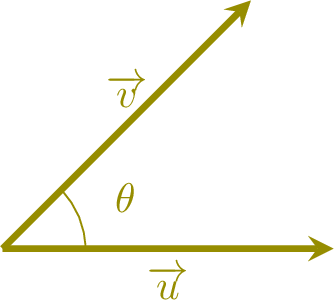
\(\Vect{u} \cdot \Vect{v}\) is read as “\(\Vect{u}\) dot \(\Vect{v}\)”.
The scalar product is a real number (a scalar), not a vector. It is: 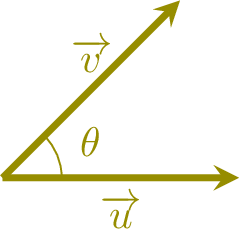 \(\quad\)
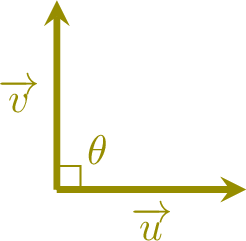 \(\quad\)
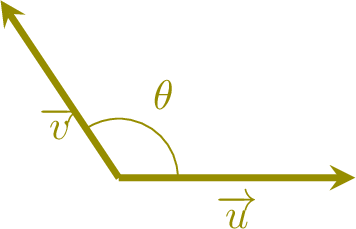
The scalar product is a real number (a scalar), not a vector. It is:
- positive if \(0^\circ \leq \theta < 90^\circ\), in radians \(0 \leq \theta < \frac{\pi}{2}\) (zero or acute angle);
- zero if \(\theta = 90^\circ\), in radians \(\theta = \frac{\pi}{2}\) (orthogonal vectors), or if at least one of the vectors is the zero vector;
- negative if \(90^\circ < \theta \leq 180^\circ\), in radians \(\frac{\pi}{2}<\theta \leq \pi\) (obtuse or straight angle).
\(\quad\)\(\quad\)Definition — Scalar Product with Point Notation
For three points \(A\), \(B\), \(C\) with \(A \neq B\) and \(A \neq C\), the scalar product of \(\Vect{AB}\) and \(\Vect{AC}\) is given by:$$\Vect{AB} \cdot \Vect{AC} = AB \times AC \times \cos(\Angle{BAC}),$$ where \(AB\) and \(AC\) denote the lengths of the segments \([AB]\) and \([AC]\). 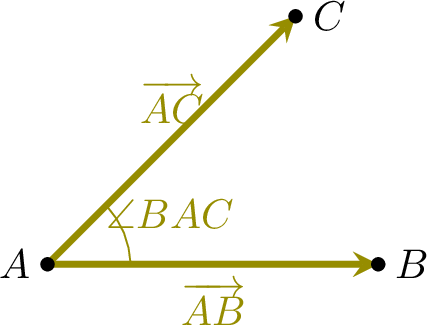
On a figure, the two vectors of a scalar product do not always share an origin, and they are not always the two vectors of the marked angle. Two facts settle every case. Sliding a vector changes neither its length nor its direction, so it changes no scalar product: one may always bring the two vectors to a common origin. Reversing one of them replaces the angle \(\theta\) by \(180^\circ - \theta\), and since \(\cos(180^\circ - \theta) = -\cos\theta\), the scalar product changes sign: $$\Vect{u} \cdot (-\Vect{v}) = -\,\Vect{u} \cdot \Vect{v}.$$ Reversing both brings the angle, and the sign, back. 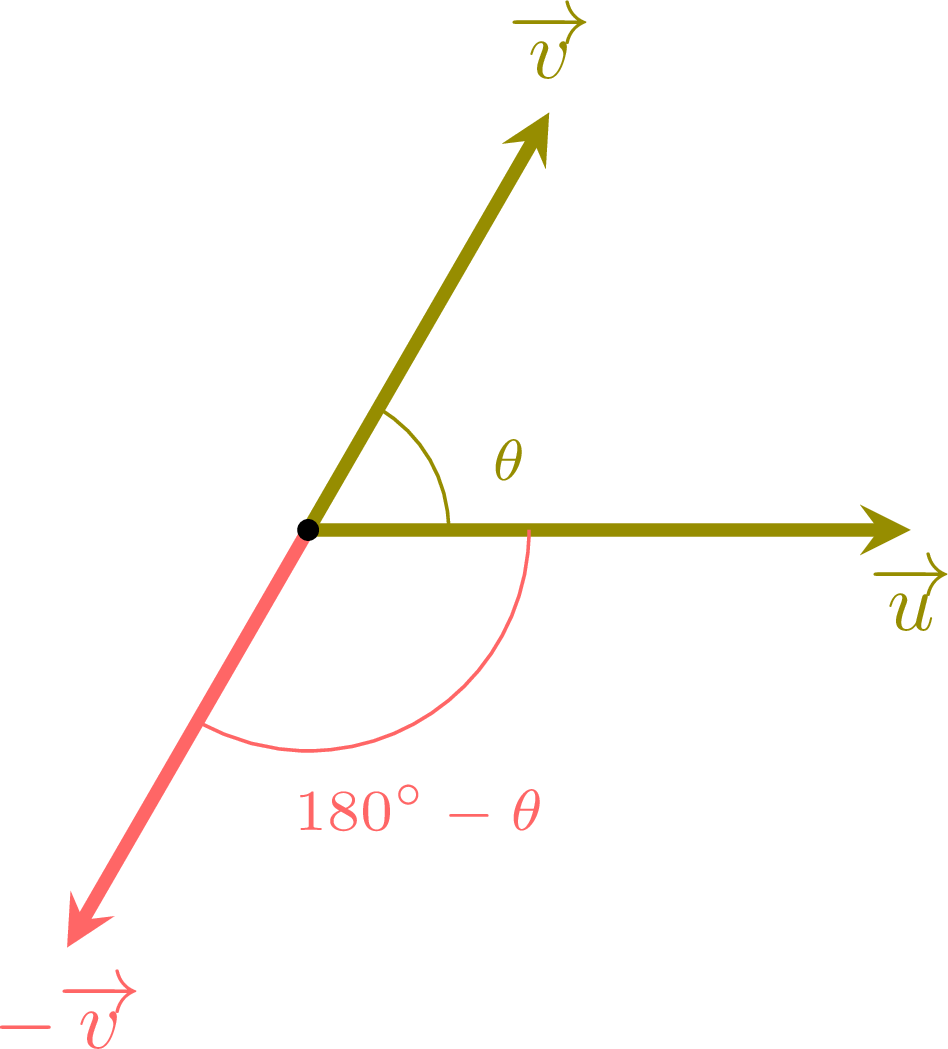
Example
Given \(AB = 2\), \(AC = 5\), and \(\Angle{BAC} = 45^\circ\) (\(\frac{\pi}{4}\) in radians), calculate \(\Vect{AB} \cdot \Vect{AC}\).
$$\begin{aligned}\Vect{AB} \cdot \Vect{AC} &= AB \times AC \times \cos(\Angle{BAC}) \\
&= 2 \times 5 \times \cos(45^\circ)\\
&= 10 \times \frac{\sqrt{2}}{2}\\
&= 5 \sqrt{2}\\
\end{aligned}$$
Skills to practice
- Calculating a Scalar Product from Magnitudes and an Angle
- Calculating a Scalar Product from a Figure
- Identifying the Angle between Two Vectors
I.2
Properties of the Scalar Product
Proposition — Square of a vector
$$\Vect{u} \cdot \Vect{u} = \|\Vect{u}\|^2$$
If \(\Vect{u} = \Vect{0}\) both sides are \(0\). Otherwise the angle between \(\Vect{u}\) and itself is \(0\), so by the geometric definition$$\Vect{u} \cdot \Vect{u} = \|\Vect{u}\|\,\|\Vect{u}\| \cos 0 = \|\Vect{u}\|^2.$$
Proposition — Symmetry
The scalar product is commutative:$$\Vect{u} \cdot \Vect{v} = \Vect{v} \cdot \Vect{u}.$$
If one of the vectors is \(\Vect{0}\) both sides are \(0\). Otherwise the angle \(\theta\) between \(\Vect{u}\) and \(\Vect{v}\) is also the angle between \(\Vect{v}\) and \(\Vect{u}\), so by the geometric definition$$\Vect{u} \cdot \Vect{v} = \|\Vect{u}\|\,\|\Vect{v}\| \cos \theta = \|\Vect{v}\|\,\|\Vect{u}\| \cos \theta = \Vect{v} \cdot \Vect{u}.$$
Proposition — Bilinearity
The scalar product is linear with respect to each of its vector arguments (property accepted without proof here): - \(\Vect{u} \cdot (\Vect{v} + \Vect{w}) = \Vect{u} \cdot \Vect{v} + \Vect{u} \cdot \Vect{w}\) (distributivity in the second argument);
- \((\Vect{u} + \Vect{v}) \cdot \Vect{w} = \Vect{u} \cdot \Vect{w} + \Vect{v} \cdot \Vect{w}\) (distributivity in the first argument);
- \(\Vect{u} \cdot (k\Vect{v}) = k(\Vect{u} \cdot \Vect{v})\) and \((k\Vect{u})\cdot\Vect{v} = k(\Vect{u}\cdot\Vect{v})\), where \(k\) is a real number.
Proposition — Algebraic Identities
- \(\|\Vect{u} + \Vect{v}\|^2 = \|\Vect{u}\|^2 + 2\Vect{u} \cdot \Vect{v} + \|\Vect{v}\|^2\).
- \(\|\Vect{u} - \Vect{v}\|^2 = \|\Vect{u}\|^2 - 2\Vect{u} \cdot \Vect{v} + \|\Vect{v}\|^2\).
- \((\Vect{u} + \Vect{v}) \cdot (\Vect{u} - \Vect{v}) = \|\Vect{u}\|^2 - \|\Vect{v}\|^2\).
- $$\begin{aligned}[t]\|\Vect{u} + \Vect{v}\|^2 &= (\Vect{u} + \Vect{v}) \cdot (\Vect{u} + \Vect{v})\\ &= \Vect{u}\cdot\Vect{u} + \Vect{u}\cdot\Vect{v} + \Vect{v}\cdot\Vect{u} + \Vect{v}\cdot\Vect{v} && \text{(distributivity)} \\ &= \|\Vect{u}\|^2 + 2(\Vect{u} \cdot \Vect{v}) + \|\Vect{v}\|^2 && \text{(symmetry and \(\Vect{u}\cdot\Vect{u}=\|\Vect{u}\|^2\))}\end{aligned}$$
- $$\begin{aligned}\|\Vect{u} - \Vect{v}\|^2 &= (\Vect{u} - \Vect{v}) \cdot (\Vect{u} - \Vect{v})\\ &= \Vect{u}\cdot\Vect{u} - \Vect{u}\cdot\Vect{v} - \Vect{v}\cdot\Vect{u} + \Vect{v}\cdot\Vect{v} \\ &= \|\Vect{u}\|^2 - 2(\Vect{u} \cdot \Vect{v}) + \|\Vect{v}\|^2\end{aligned}$$
- $$\begin{aligned}(\Vect{u} + \Vect{v}) \cdot (\Vect{u} - \Vect{v}) &= \Vect{u}\cdot\Vect{u} - \Vect{u}\cdot\Vect{v} + \Vect{v}\cdot\Vect{u} - \Vect{v}\cdot\Vect{v} \\ &= \|\Vect{u}\|^2 - \Vect{u}\cdot\Vect{v} + \Vect{u}\cdot\Vect{v} - \|\Vect{v}\|^2 && \text{(symmetry)} \\ &= \|\Vect{u}\|^2 - \|\Vect{v}\|^2\end{aligned}$$
Example
Let \(\Vect{u}\) and \(\Vect{v}\) be two vectors such that \(\|\Vect{u}\| = 3\), \(\|\Vect{v}\| = 2\) and \(\Vect{u} \cdot \Vect{v} = -1\). Calculate \(\|2\Vect{u} + \Vect{v}\|^2\).
$$\begin{aligned}[t] \|2\Vect{u} + \Vect{v}\|^2 &= (2\Vect{u} + \Vect{v}) \cdot (2\Vect{u} + \Vect{v}) && \scriptscriptstyle\text{(square of a vector)} \\
&= 4\,\Vect{u} \cdot \Vect{u} + 4\,\Vect{u} \cdot \Vect{v} + \Vect{v} \cdot \Vect{v} && \scriptscriptstyle\text{(bilinearity and symmetry)} \\
&= 4\|\Vect{u}\|^2 + 4\,\Vect{u} \cdot \Vect{v} + \|\Vect{v}\|^2 \\
&= 4 \times 9 + 4 \times (-1) + 4 = 36 \end{aligned}$$ So \(\|2\Vect{u} + \Vect{v}\| = 6\).
Proposition — Law of Cosines (also called Al-Kashi's theorem)
In any triangle \(ABC\), with \(a = BC\), \(b = CA\) and \(c = AB\): $$c^2 = a^2 + b^2 - 2ab\cos \Angle{C},$$ and likewise at each vertex: \(a^2 = b^2 + c^2 - 2bc\cos \Angle{A}\) and \(b^2 = a^2 + c^2 - 2ac\cos \Angle{B}\). When the angle is a right angle its cosine is \(0\) and the formula is Pythagoras' theorem. 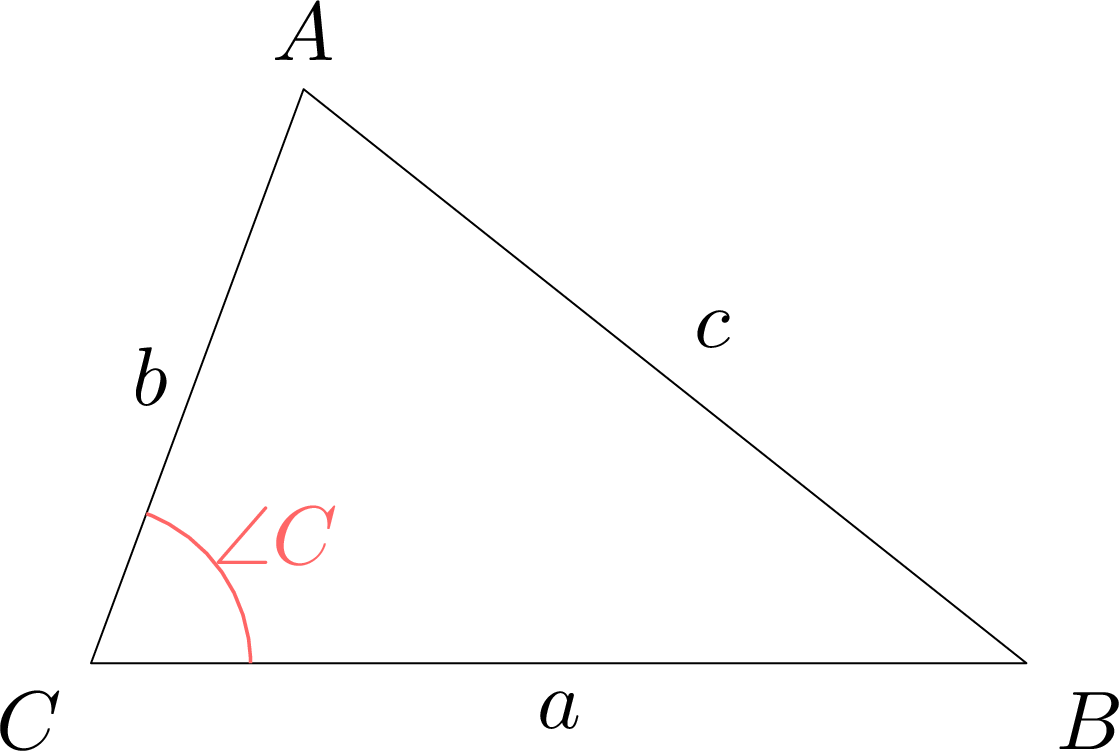
The side \(c = AB\) faces the angle at \(C\), so we express it with the two vectors from \(C\) and square its norm. With \(a = CB\) and \(b = CA\): $$\begin{aligned}[t] c^2 &= \|\Vect{AB}\|^2 \\
&= \|\Vect{CB} - \Vect{CA}\|^2 && \scriptscriptstyle\text{(Chasles: } \Vect{AB} = \Vect{AC} + \Vect{CB} = \Vect{CB} - \Vect{CA}) \\
&= \|\Vect{CB}\|^2 - 2\,\Vect{CB} \cdot \Vect{CA} + \|\Vect{CA}\|^2 && \scriptscriptstyle\text{(square of a difference)} \\
&= a^2 + b^2 - 2\,\Vect{CB} \cdot \Vect{CA} \\
&= a^2 + b^2 - 2ab\cos \Angle{C} && \scriptscriptstyle\text{(geometric definition, the angle of } \Vect{CB}, \Vect{CA} \text{ is } \Angle{C}) \end{aligned}$$ Check: when \(\Angle{C}\) is a right angle, \(\cos \Angle{C} = 0\) and the formula is Pythagoras' theorem. 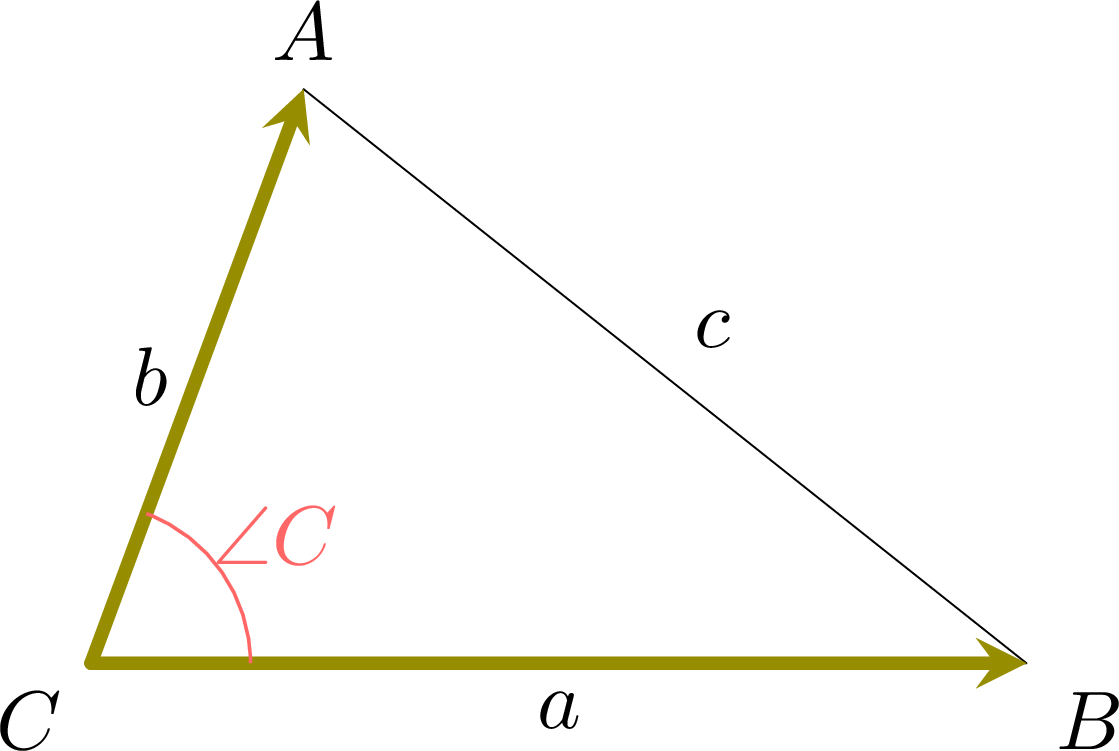
Proposition — Polarisation Identity
$$\Vect{u} \cdot \Vect{v}=\frac{1}{2}\left( \|\Vect{u} + \Vect{v}\|^2 - \|\Vect{u}\|^2 - \|\Vect{v}\|^2 \right).$$
This identity is derived directly from the algebraic identities. Starting from the expansion of \(\|\Vect{u} + \Vect{v}\|^2\):$$ \|\Vect{u} + \Vect{v}\|^2 = \|\Vect{u}\|^2 + 2(\Vect{u} \cdot \Vect{v}) + \|\Vect{v}\|^2.$$ We can rearrange the equation to solve for \(\Vect{u} \cdot \Vect{v}\):$$ 2(\Vect{u} \cdot \Vect{v}) = \|\Vect{u} + \Vect{v}\|^2 - \|\Vect{u}\|^2 - \|\Vect{v}\|^2.$$ Dividing by 2 gives the identity:$$ \Vect{u} \cdot \Vect{v} = \frac{1}{2} \left( \|\Vect{u} + \Vect{v}\|^2 - \|\Vect{u}\|^2 - \|\Vect{v}\|^2 \right). $$ Equivalently, using \(\|\Vect{u} - \Vect{v}\|^2\), one can also show that$$ \Vect{u} \cdot \Vect{v} = \frac{1}{2} \left( \|\Vect{u}\|^2 + \|\Vect{v}\|^2 - \|\Vect{u} - \Vect{v}\|^2 \right). $$
Proposition — Parallelogram Identity
For all vectors \(\Vect{u}\) and \(\Vect{v}\): $$\textcolor{colorprop}{\|\Vect{u} + \Vect{v}\|^2 + \|\Vect{u} - \Vect{v}\|^2 = 2\left(\|\Vect{u}\|^2 + \|\Vect{v}\|^2\right).}$$ In a parallelogram \(ABCD\), with \(\Vect{u} = \Vect{AB}\) and \(\Vect{v} = \Vect{AD}\), the diagonals are \(\Vect{AC} = \Vect{u} + \Vect{v}\) and \(\Vect{DB} = \Vect{u} - \Vect{v}\): the sum of the squares of the two diagonals equals the sum of the squares of the four sides, \(AC^2 + BD^2 = AB^2 + BC^2 + CD^2 + DA^2 = 2\left(AB^2 + AD^2\right)\). 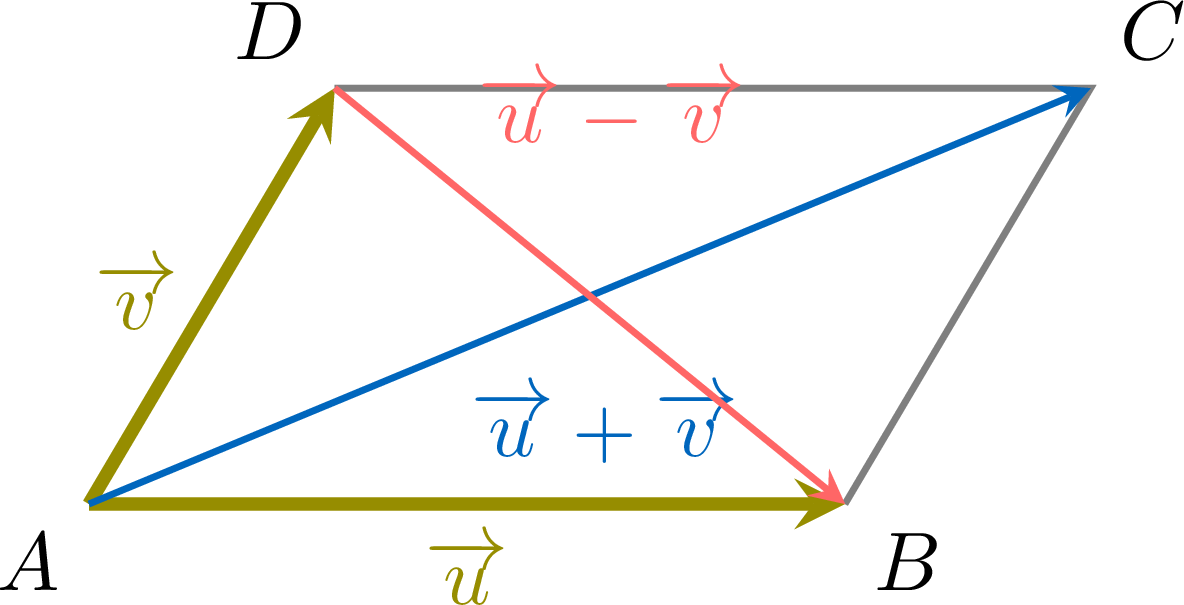
$$\begin{aligned}[t]\|\Vect{u} + \Vect{v}\|^2 + \|\Vect{u} - \Vect{v}\|^2 &= \left(\|\Vect{u}\|^2 + 2\,\Vect{u}\cdot\Vect{v} + \|\Vect{v}\|^2\right) + \left(\|\Vect{u}\|^2 - 2\,\Vect{u}\cdot\Vect{v} + \|\Vect{v}\|^2\right) && \scriptscriptstyle\text{(square of a sum, square of a difference)}\\
&= 2\|\Vect{u}\|^2 + 2\|\Vect{v}\|^2 && \scriptscriptstyle\text{(the terms } 2\,\Vect{u}\cdot\Vect{v} \text{ cancel)}\\
&= 2\left(\|\Vect{u}\|^2 + \|\Vect{v}\|^2\right).\end{aligned}$$ In the parallelogram \(ABCD\), \(\Vect{AC} = \Vect{AB} + \Vect{BC} = \Vect{AB} + \Vect{AD}\) (as \(\Vect{BC} = \Vect{AD}\)) and \(\Vect{DB} = \Vect{DA} + \Vect{AB} = \Vect{AB} - \Vect{AD}\) (Chasles); since \(BC = AD\) and \(CD = AB\), \(2\left(AB^2 + AD^2\right) = AB^2 + BC^2 + CD^2 + DA^2\).
Example
A parallelogram \(ABCD\) has sides \(AB = 5\) and \(AD = 3\), and its diagonal \(AC\) measures \(7\). Calculate the length of the other diagonal \(BD\).
$$\begin{aligned}[t] AC^2 + BD^2 &= 2\left(AB^2 + AD^2\right) && \scriptscriptstyle\text{(parallelogram identity)}\\
49 + BD^2 &= 2(25 + 9) = 68\\
BD^2 &= 68 - 49 = 19\end{aligned}$$ so \(BD = \sqrt{19} \approx 4.36\). Check with the law of cosines: in the triangle \(ABC\), where \(BC = AD = 3\), \(\cos \Angle{ABC} = \dfrac{25 + 9 - 49}{2 \times 5 \times 3} = -\dfrac{1}{2}\), so \(\Angle{ABC} = 120^\circ\) and the consecutive angle \(\Angle{DAB}\) is \(60^\circ\); in the triangle \(ABD\), \(BD^2 = 25 + 9 - 2 \times 5 \times 3 \times \cos 60^\circ = 34 - 15 = 19\).
Skills to practice
- Calculating with the Properties of the Scalar Product
- Calculating a Scalar Product from Magnitudes
II
Coordinates and Geometric Meaning
II.1
The Scalar Product in an Orthonormal Basis
Proposition — Analytical Expressions
In an orthonormal basis, for vectors \(\Vect{u} \begin{pmatrix} x \\ y \end{pmatrix}\) and \(\Vect{v} \begin{pmatrix} x' \\ y' \end{pmatrix}\): - Scalar Product: \(\Vect{u} \cdot \Vect{v} = xx' + yy'\).
- Norm: \(\|\Vect{u}\| = \sqrt{x^2 + y^2}\).
- Distance (in an orthonormal frame): \(AB = \sqrt{(x_B-x_A)^2 + (y_B-y_A)^2}\).
In the orthonormal basis \((\Vect{i}, \Vect{j})\) the four scalar products of the basis vectors are known: the vectors are unit, so \(\Vect{i} \cdot \Vect{i} = \|\Vect{i}\|^2 = 1\) and \(\Vect{j} \cdot \Vect{j} = 1\), and they are orthogonal, so \(\Vect{i} \cdot \Vect{j} = \Vect{j} \cdot \Vect{i} = 0\).
Write \(\Vect{u} = x\Vect{i} + y\Vect{j}\) and \(\Vect{v} = x'\Vect{i} + y'\Vect{j}\) and expand, bilinearity allowing us to multiply out exactly as with numbers: $$\begin{aligned}[t] \Vect{u} \cdot \Vect{v} &= (x\Vect{i} + y\Vect{j}) \cdot (x'\Vect{i} + y'\Vect{j}) \\
&= xx'\,(\Vect{i} \cdot \Vect{i}) + xy'\,(\Vect{i} \cdot \Vect{j}) + yx'\,(\Vect{j} \cdot \Vect{i}) + yy'\,(\Vect{j} \cdot \Vect{j}) && \scriptscriptstyle\text{(bilinearity)} \\
&= xx' + yy' && \scriptscriptstyle\text{(table above)} \end{aligned}$$ For the norm, take \(\Vect{v} = \Vect{u}\): \(\|\Vect{u}\|^2 = \Vect{u} \cdot \Vect{u} = x^2 + y^2\), so \(\|\Vect{u}\| = \sqrt{x^2 + y^2}\). For the distance, apply this to \(\Vect{AB}\begin{pmatrix} x_B - x_A \\ y_B - y_A \end{pmatrix}\).
| \(\cdot\) | \(\Vect{i}\) | \(\Vect{j}\) |
| \(\Vect{i}\) | \(1\) | \(0\) |
| \(\Vect{j}\) | \(0\) | \(1\) |
Convention. Whenever coordinates are given without further comment, they are given in an orthonormal basis or frame. Important: If the basis is not orthonormal, the coordinate-based formula \(xx' + yy'\) cannot be used to calculate the scalar product. In such cases, one must use the geometric definition or the polarisation identities.
Proposition — Coordinates and Scalar Products
Let \((\Vect{i}, \Vect{j})\) be an orthonormal basis of the plane. For any vector \(\Vect{u} \begin{pmatrix} x \\ y \end{pmatrix}\), $$\textcolor{colorprop}{x = \Vect{u} \cdot \Vect{i} \qquad \text{and} \qquad y = \Vect{u} \cdot \Vect{j}},$$ so that \(\Vect{u} = (\Vect{u} \cdot \Vect{i})\,\Vect{i} + (\Vect{u} \cdot \Vect{j})\,\Vect{j}\). Each coordinate of a vector is its scalar product with the corresponding basis vector.
By definition of the coordinates, \(\Vect{u} = x\,\Vect{i} + y\,\Vect{j}\). By bilinearity of the scalar product, $$\Vect{u} \cdot \Vect{i} = x\,(\Vect{i} \cdot \Vect{i}) + y\,(\Vect{j} \cdot \Vect{i}) = x \times 1 + y \times 0 = x,$$ since the basis is orthonormal: \(\Vect{i} \cdot \Vect{i} = \|\Vect{i}\|^2 = 1\) and \(\Vect{j} \cdot \Vect{i} = 0\). In the same way, \(\Vect{u} \cdot \Vect{j} = x\,(\Vect{i} \cdot \Vect{j}) + y\,(\Vect{j} \cdot \Vect{j}) = 0 + y = y\).
Geometric reading. For a non-zero vector \(\Vect{u}\) (the zero vector has both coordinates equal to \(0\)), since \(\|\Vect{i}\| = 1\), the scalar product \(\Vect{u} \cdot \Vect{i} = \|\Vect{u}\| \cos\theta\), where \(\theta\) is the angle between \(\Vect{i}\) and \(\Vect{u}\), is the signed length of the orthogonal projection of \(\Vect{u}\) onto the axis along \(\Vect{i}\): the coordinates of a vector are the signed lengths of its orthogonal projections onto the two axes. This is what makes an orthonormal basis so convenient — in a basis that is not orthonormal, projecting no longer gives the coordinates. 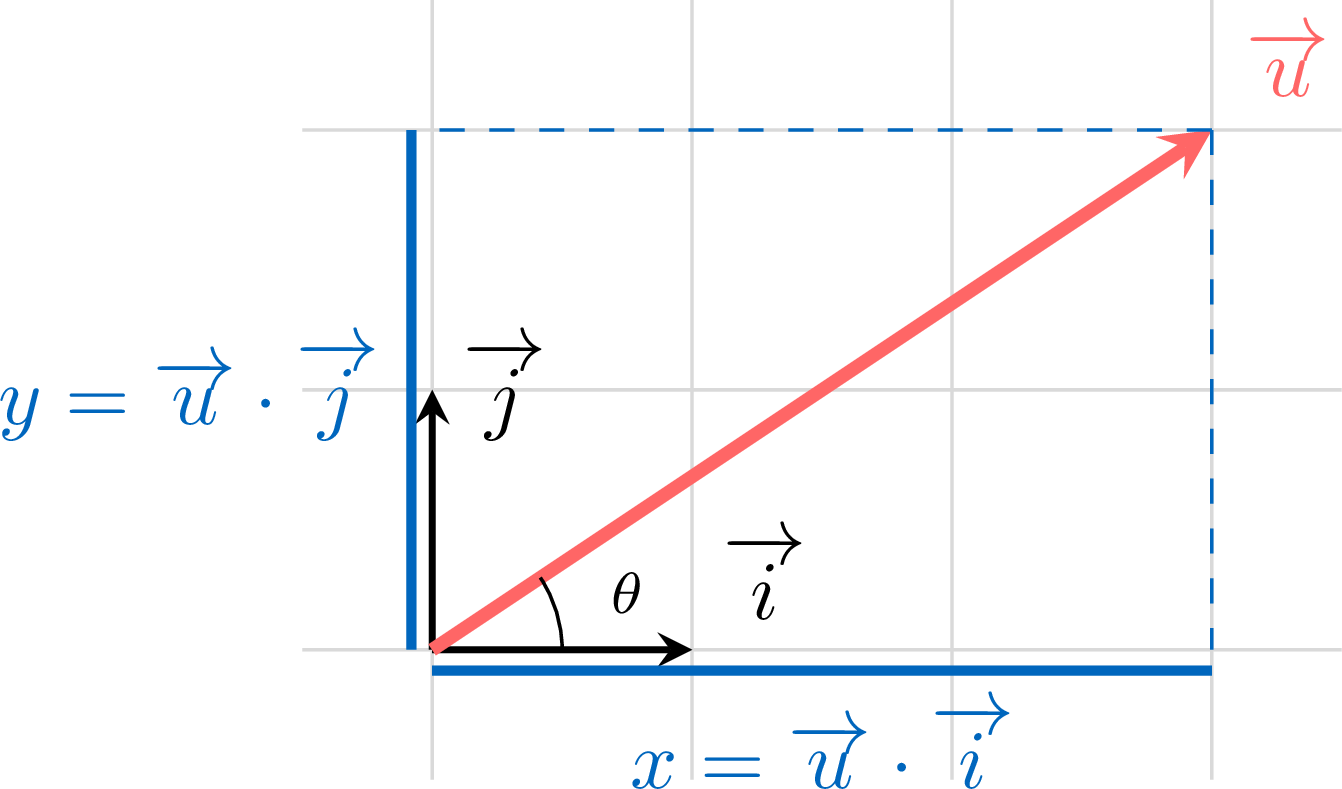
Example
The plane is equipped with an orthonormal basis \((\Vect{i}, \Vect{j})\). - A vector \(\Vect{u}\) satisfies \(\Vect{u} \cdot \Vect{i} = 3\) and \(\Vect{u} \cdot \Vect{j} = -2\). Give its coordinates, then check the first product with the analytical expression.
- A vector \(\Vect{v}\) has norm \(4\) and makes an angle of \(60^\circ\) with \(\Vect{i}\), on the side of \(\Vect{j}\). Compute its coordinates using scalar products.
- The coordinates are the two scalar products: \(\Vect{u} \begin{pmatrix} 3 \\ -2 \end{pmatrix}\). Check: \(\Vect{i} \begin{pmatrix} 1 \\ 0 \end{pmatrix}\), so \(\Vect{u} \cdot \Vect{i} = 3 \times 1 + (-2) \times 0 = 3\).
- \(x = \Vect{v} \cdot \Vect{i} = \|\Vect{v}\| \times \|\Vect{i}\| \times \cos 60^\circ = 4 \times 1 \times \dfrac{1}{2} = 2\). The angle between \(\Vect{v}\) and \(\Vect{j}\) is \(90^\circ - 60^\circ = 30^\circ\), so \(y = \Vect{v} \cdot \Vect{j} = 4 \cos 30^\circ = 4 \times \dfrac{\sqrt{3}}{2} = 2\sqrt{3}\). Hence \(\Vect{v} \begin{pmatrix} 2 \\ 2\sqrt{3} \end{pmatrix}\); check with the norm: \(\sqrt{2^2 + (2\sqrt{3})^2} = \sqrt{4 + 12} = 4\).
Proposition — Calculating an Angle from Coordinates
In an orthonormal basis, for two non-zero vectors \(\Vect{u}\begin{pmatrix} x \\ y \end{pmatrix}\) and \(\Vect{v}\begin{pmatrix} x' \\ y' \end{pmatrix}\), the angle \(\theta\) between them satisfies $$\cos\theta = \frac{\Vect{u} \cdot \Vect{v}}{\|\Vect{u}\|\,\|\Vect{v}\|} = \frac{xx' + yy'}{\sqrt{x^2 + y^2}\,\sqrt{x'^2 + y'^2}},$$ and \(\theta\) is the unique angle of \([0^\circ, 180^\circ]\) with this cosine: \(\theta = \cos^{-1}\left(\dfrac{\Vect{u} \cdot \Vect{v}}{\|\Vect{u}\|\,\|\Vect{v}\|}\right)\). Example
In an orthonormal basis, \(\Vect{u}\begin{pmatrix} 3 \\ -1 \end{pmatrix}\) and \(\Vect{v}\begin{pmatrix} 2 \\ 5 \end{pmatrix}\). Calculate \(\Vect{u} \cdot \Vect{v}\), the two norms, and the angle between the vectors, correct to one decimal place.
$$\begin{aligned}[t] \Vect{u} \cdot \Vect{v} &= 3 \times 2 + (-1) \times 5 = 1 && \scriptscriptstyle\text{(orthonormal basis)} \\
\|\Vect{u}\| &= \sqrt{3^2 + (-1)^2} = \sqrt{10}, \qquad \|\Vect{v}\| = \sqrt{2^2 + 5^2} = \sqrt{29} \\
\cos\theta &= \frac{1}{\sqrt{10}\,\sqrt{29}} = \frac{1}{\sqrt{290}} \approx 0{.}059 && \scriptscriptstyle\text{(angle from coordinates)} \end{aligned}$$ so \(\theta \approx 86{.}6^\circ\). The cosine is small and positive: the vectors are almost perpendicular, and the angle is indeed just short of \(90^\circ\). It is the cosine, and not the scalar product alone, that measures this: the same scalar product \(1\) between two much shorter vectors would give a much larger cosine.
Skills to practice
- Calculating Scalar Products from Coordinates: Level 1
- Calculating Scalar Products from Coordinates: Level 2
- Finding Coordinates from Scalar Products
- Calculating an Angle from Coordinates
- Calculating Angles in Figures
II.2
Orthogonality, Projection and Work
Proposition — Scalar Product of Collinear Vectors
Let \(\Vect{u}\) and \(\Vect{v}\) be two non-zero vectors. - If \(\Vect{u}\) and \(\Vect{v}\) are collinear and point in the same direction, then \(\Vect{u} \cdot \Vect{v} = \|\Vect{u}\|\|\Vect{v}\|\).
- If \(\Vect{u}\) and \(\Vect{v}\) are collinear and point in opposite directions, then \(\Vect{u} \cdot \Vect{v} = -\|\Vect{u}\|\|\Vect{v}\|\).
This follows directly from the geometric definition \(\Vect{u} \cdot \Vect{v} = \|\Vect{u}\|\|\Vect{v}\|\cos\theta\).
- If the vectors are collinear and have the same direction, the angle \(\theta\) between them is \(0^\circ\) (\(0\) in radians). Since \(\cos(0^\circ) = 1\), the result is \(\Vect{u} \cdot \Vect{v} = \|\Vect{u}\|\|\Vect{v}\|\).
- If they are collinear and have opposite directions, the angle \(\theta\) is \(180^\circ\) (\(\pi\) in radians). Since \(\cos(180^\circ) = -1\), the result is \(\Vect{u} \cdot \Vect{v} = -\|\Vect{u}\|\|\Vect{v}\|\).
Definition — Orthogonal Vectors
Two vectors \(\Vect{u}\) and \(\Vect{v}\) are said to be orthogonal if their scalar product is zero:$$\Vect{u} \perp \Vect{v} \iff \Vect{u} \cdot \Vect{v} = 0.$$ Proposition — Perpendicular Lines
Let \(A \neq B\) and \(C \neq D\). The lines \((AB)\) and \((CD)\) are perpendicular if and only if the scalar product of their direction vectors is zero:$$(AB) \perp (CD) \iff \Vect{AB} \cdot \Vect{CD} = 0.$$
A direction vector of \((AB)\) is a vector \(k\,\Vect{AB}\) with \(k \neq 0\), and a direction vector of \((CD)\) is \(k'\,\Vect{CD}\) with \(k' \neq 0\). By bilinearity, \((k\,\Vect{AB}) \cdot (k'\,\Vect{CD}) = kk'\,(\Vect{AB} \cdot \Vect{CD})\), which is zero exactly when \(\Vect{AB} \cdot \Vect{CD} = 0\): the condition does not depend on the direction vectors chosen. Finally, two lines are perpendicular exactly when their direction vectors are orthogonal, and by the definition of orthogonal vectors this means that their scalar product is zero.
Example
In an orthonormal frame, \(A(1, 2)\), \(B(4, 3)\), \(C(2, 5)\) and \(D(3, 2)\). Show that the lines \((AB)\) and \((CD)\) are perpendicular.
\(\Vect{AB}\begin{pmatrix} 4 - 1 \\ 3 - 2 \end{pmatrix} = \begin{pmatrix} 3 \\ 1 \end{pmatrix}\) and \(\Vect{CD}\begin{pmatrix} 3 - 2 \\ 2 - 5 \end{pmatrix} = \begin{pmatrix} 1 \\ -3 \end{pmatrix}\), so $$\begin{aligned}[t] \Vect{AB} \cdot \Vect{CD} &= 3 \times 1 + 1 \times (-3) && \scriptscriptstyle\text{(orthonormal basis)} \\
&= 0 \end{aligned}$$ The direction vectors are orthogonal, hence \((AB) \perp (CD)\).
Proposition — Orthogonality Criterion in an Orthonormal Basis
In an orthonormal basis, two vectors \(\Vect{u}\begin{pmatrix} x \\ y \end{pmatrix}\) and \(\Vect{v}\begin{pmatrix} x' \\ y' \end{pmatrix}\) are orthogonal if and only if $$xx' + yy' = 0.$$
By definition, \(\Vect{u}\) and \(\Vect{v}\) are orthogonal when \(\Vect{u} \cdot \Vect{v} = 0\); in an orthonormal basis this scalar product is \(xx' + yy'\). The two statements are one and the same.
Proposition — Orthogonal Projection
Let \(A\), \(B\) and \(C\) be three points with \(A \neq B\). Let \(H\) be the orthogonal projection of point \(C\) onto the line \(\Line{AB}\). Then:$$\Vect{AB} \cdot \Vect{AC} = \Vect{AB} \cdot \Vect{AH}.$$ 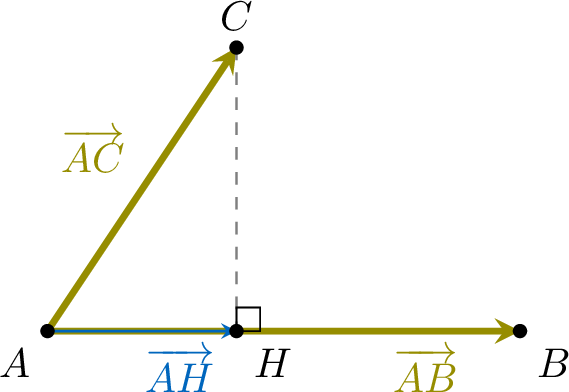
- If \(\Vect{AB}\) and \(\Vect{AH}\) have the same direction, \(\Vect{AB} \cdot \Vect{AC} = AB \times AH\).
- If \(\Vect{AB}\) and \(\Vect{AH}\) have opposite directions, \(\Vect{AB} \cdot \Vect{AC} = -AB \times AH\);
- If \(H = A\), then \(\Vect{AB} \cdot \Vect{AC} = 0\).
Using Chasles' relation, we can write \(\Vect{AC} = \Vect{AH} + \Vect{HC}\):$$\begin{aligned}\Vect{AB} \cdot \Vect{AC} &= \Vect{AB} \cdot (\Vect{AH} + \Vect{HC}) \\
&= \Vect{AB} \cdot \Vect{AH} + \Vect{AB} \cdot \Vect{HC}.\end{aligned}$$ Since \(H\) is the orthogonal projection of \(C\) on \((AB)\), the vectors \(\Vect{AB}\) and \(\Vect{HC}\) are orthogonal. Therefore, their scalar product is zero: \(\Vect{AB} \cdot \Vect{HC} = 0\). This leaves us with$$\Vect{AB} \cdot \Vect{AC} = \Vect{AB} \cdot \Vect{AH}.$$ The second part of the proposition follows from the collinearity condition applied to \(\Vect{AB}\) and \(\Vect{AH}\).
The Work of a Force
In physics, when a constant force \(\Vect{F}\) acts on an object that moves in a straight line from \(A\) to \(B\), the work of the force is the scalar product $$W = \Vect{F} \cdot \Vect{AB} = F \times AB \times \cos\theta,$$ where \(\theta\) is the angle between \(\Vect{F}\) and \(\Vect{AB}\); with \(F\) in newtons (N) and \(AB\) in metres, \(W\) is in joules (J). The orthogonal projection \(H\) of the tip of the force onto the line \(\Line{AB}\) shows what the work measures: only the part of the force along the displacement, \(F\cos\theta\), counts. For a non-zero force and a non-zero displacement: 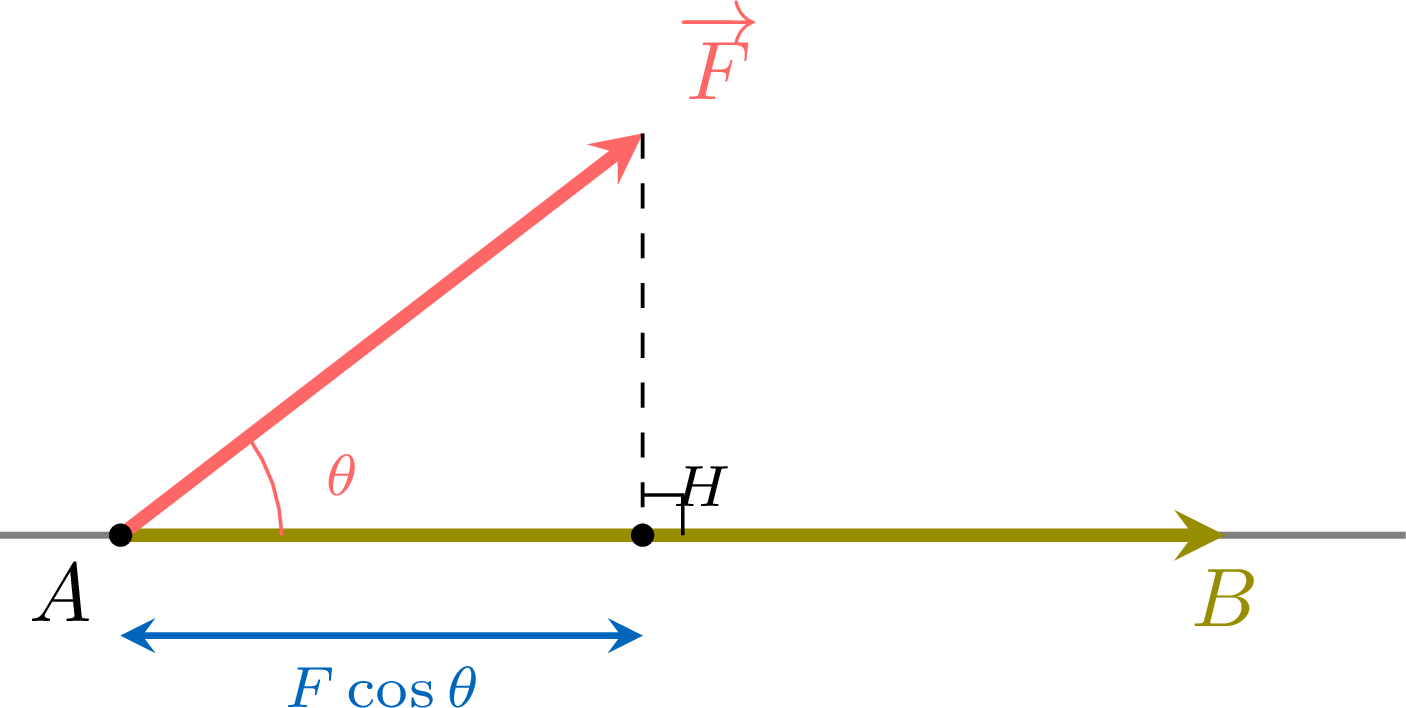
- \(0^\circ \leq \theta \lt 90^\circ\): \(W \gt 0\), the force helps the motion (it does positive work);
- \(\theta = 90^\circ\): \(W = 0\);
- \(90^\circ \lt \theta \leq 180^\circ\): \(W \lt 0\), the force opposes the motion (it does negative work).
Proposition — Work of a Perpendicular Force and of the Resultant
For a straight displacement from \(A\) to \(B\): - a force perpendicular to the displacement does no work: if \(\Vect{F}\) and \(\Vect{AB}\) are orthogonal, then \(\Vect{F} \cdot \Vect{AB} = 0\);
- the work of the resultant \(\Vect{F} = \Vect{F_1} + \Vect{F_2} + \cdots + \Vect{F_n}\) of several constant forces is the sum of their works: $$\Vect{F} \cdot \Vect{AB} = \Vect{F_1} \cdot \Vect{AB} + \Vect{F_2} \cdot \Vect{AB} + \cdots + \Vect{F_n} \cdot \Vect{AB}.$$
- If \(\Vect{F}\) and \(\Vect{AB}\) are orthogonal, the angle between them is \(90^\circ\), and \(W = F \times AB \times \cos 90^\circ = F \times AB \times 0 = 0\).
- $$\begin{aligned}[t]\left(\Vect{F_1} + \Vect{F_2} + \cdots + \Vect{F_n}\right) \cdot \Vect{AB} &= \Vect{F_1} \cdot \Vect{AB} + \left(\Vect{F_2} + \cdots + \Vect{F_n}\right) \cdot \Vect{AB} && \scriptscriptstyle\text{(distributivity in the first argument)}\\ &= \Vect{F_1} \cdot \Vect{AB} + \Vect{F_2} \cdot \Vect{AB} + \cdots + \Vect{F_n} \cdot \Vect{AB} && \scriptscriptstyle\text{(the same rule, repeated)}\end{aligned}$$ The additivity of works comes from the bilinearity of the scalar product.
Example
A sledge is pulled over \(15\) m in a straight line, from \(A\) to \(B\), on horizontal ground. The rope makes an angle of \(60^\circ\) with the ground and its tension is \(T = 40\) N. The weight \(\Vect{P}\) of the sledge and the normal reaction \(\Vect{R}\) of the ground are vertical; the friction of the snow is horizontal, opposite to the motion, with \(f = 12\) N. Calculate the work of each force, then the work of their resultant. - Tension: $$\begin{aligned}[t] W_T &= T \times AB \times \cos 60^\circ && \scriptscriptstyle\text{(work of a force)}\\ &= 40 \times 15 \times \frac{1}{2} && \scriptscriptstyle(\cos 60^\circ = \frac{1}{2})\\ &= 300 \text{ J.}\end{aligned}$$ Only the part of the tension along the ground, \(40\cos 60^\circ = 20\) N, pulls the sledge: \(20 \times 15 = 300\).
- Weight and reaction: both are perpendicular to the horizontal displacement, so \(W_P = W_R = 0\) J.
- Friction: the angle with \(\Vect{AB}\) is \(180^\circ\), so \(W_f = 12 \times 15 \times \cos 180^\circ = -180\) J (negative work).
- Resultant: the work of the resultant is the sum of the works, \(W = 300 + 0 + 0 - 180 = 120\) J.
Skills to practice
- Interpreting a Scalar Product
- Calculating a Scalar Product by Orthogonal Projection
- Proving Orthogonality
- Finding an Unknown for Orthogonality
III
Going further
Skills to practice
- Reasoning with the Scalar Product
- Investigating Patterns with the Scalar Product
- Solving Problems in Context
- Quiz
Jump to section