International Baccalaureate · MYP 5 Extended
Trigonometric Functions and Equations
I
Drawing the Sine and Cosine Curves in Degrees
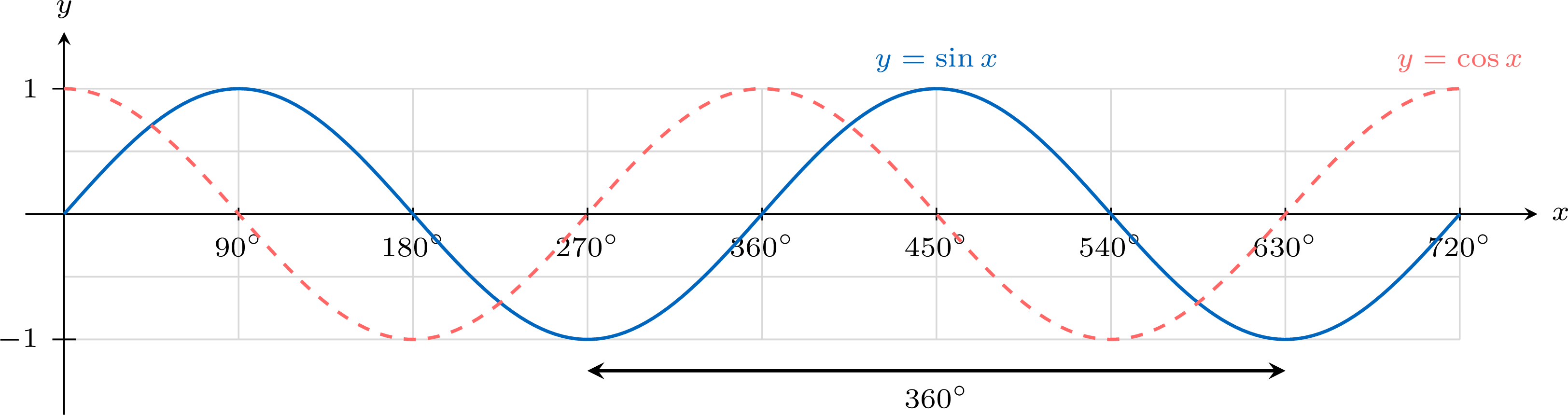
Angles are often measured in degrees: on a compass, in a triangle, on a turning wheel. The unit circle gives the cosine and the sine of every angle, whatever its unit: the point of the circle for the angle \(x\) has coordinates \((\cos x, \sin x)\). Let the angle \(x\) run through the degrees, from \(0^\circ\) to \(360^\circ\) and beyond, and follow each coordinate on its own: this draws the curves of \(y = \sin x\) and \(y = \cos x\) above a horizontal axis graduated in degrees.
Definition — Periodic Function
A function \(f\) defined on \(\mathbb{R}\) is periodic if there exists a constant \(P>0\) such that$$f(x+P) = f(x), \forall x \in \mathbb{R}$$When there is a smallest such constant \(P\), it is called the period of \(f\). Proposition — The Sine and Cosine Functions in Degrees
For an angle \(x\) measured in degrees: - \(\sin x\) and \(\cos x\) are defined for every angle \(x\), and \(-1 \le \sin x \le 1\), \(-1 \le \cos x \le 1\): the range of each function is the interval from \(-1\) to \(1\);
- the two functions are periodic with period \(360^\circ\): for every angle \(x\) and every integer \(k\), $$\sin(x + 360^\circ k) = \sin x \qquad \text{and} \qquad \cos(x + 360^\circ k) = \cos x;$$
- for \(0^\circ \le x \le 360^\circ\), \(y = \sin x\) starts at \(0\), reaches its maximum \(1\) at \(90^\circ\), returns to \(0\) at \(180^\circ\), reaches its minimum \(-1\) at \(270^\circ\) and returns to \(0\) at \(360^\circ\); \(y = \cos x\) starts at its maximum \(1\) at \(0^\circ\), is \(0\) at \(90^\circ\), reaches its minimum \(-1\) at \(180^\circ\), is \(0\) at \(270^\circ\) and returns to \(1\) at \(360^\circ\).
The point \(M\) of the unit circle for the angle \(x\) has coordinates \((\cos x, \sin x)\) (Relationship between Angle and Coordinates).
- \(M\) lies on the circle of centre \(O\) and radius \(1\), so each of its coordinates lies between \(-1\) and \(1\). Every value \(c\) from \(-1\) to \(1\) is reached: the horizontal line \(y = c\) meets the circle, and the angle of a meeting point has sine \(c\); in the same way the vertical line \(x = c\) gives an angle with cosine \(c\).
- Adding \(360^\circ\) to the angle adds a full turn, which brings \(M\) back to the same point: the angles \(x\) and \(x + 360^\circ\) have the same coordinates. Repeating this \(k\) times (turning the other way when \(k\) is negative) gives \(x + 360^\circ k\). No smaller positive angle \(P\) works for every \(x\): the only angles of sine \(1\) are \(90^\circ + 360^\circ k\) (the point \((0, 1)\)), so \(\sin(90^\circ + P) = 1\) forces \(P\) to be a multiple of \(360^\circ\); in the same way \(\cos(0^\circ + P) = 1\) forces it for the cosine.
- The points for \(0^\circ\), \(90^\circ\), \(180^\circ\), \(270^\circ\) and \(360^\circ\) are \((1, 0)\), \((0, 1)\), \((-1, 0)\), \((0, -1)\) and \((1, 0)\): their \(y\)-coordinates give the values of the sine, their \(x\)-coordinates those of the cosine.
Example
Complete the table of values of \(y = \sin x\), giving each value that is not exact to \(2\) decimal places, then draw the graph of \(y = \sin x\) for \(0^\circ \le x \le 360^\circ\). | \(x\) | \(0^\circ\) | \(30^\circ\) | \(60^\circ\) | \(90^\circ\) | \(120^\circ\) | \(150^\circ\) | \(180^\circ\) |
| \(\sin x\) |
| \(x\) | \(210^\circ\) | \(240^\circ\) | \(270^\circ\) | \(300^\circ\) | \(330^\circ\) | \(360^\circ\) |
| \(\sin x\) |
From \(0^\circ\) to \(90^\circ\) the values are the exact values: \(\sin 0^\circ = 0\), \(\sin 30^\circ = \dfrac{1}{2}\), \(\sin 60^\circ = \dfrac{\sqrt{3}}{2} \approx 0.87\), \(\sin 90^\circ = 1\). The other angles are read on the unit circle, where the points for \(30^\circ\), \(150^\circ\), \(210^\circ\) and \(330^\circ\) are placed symmetrically: 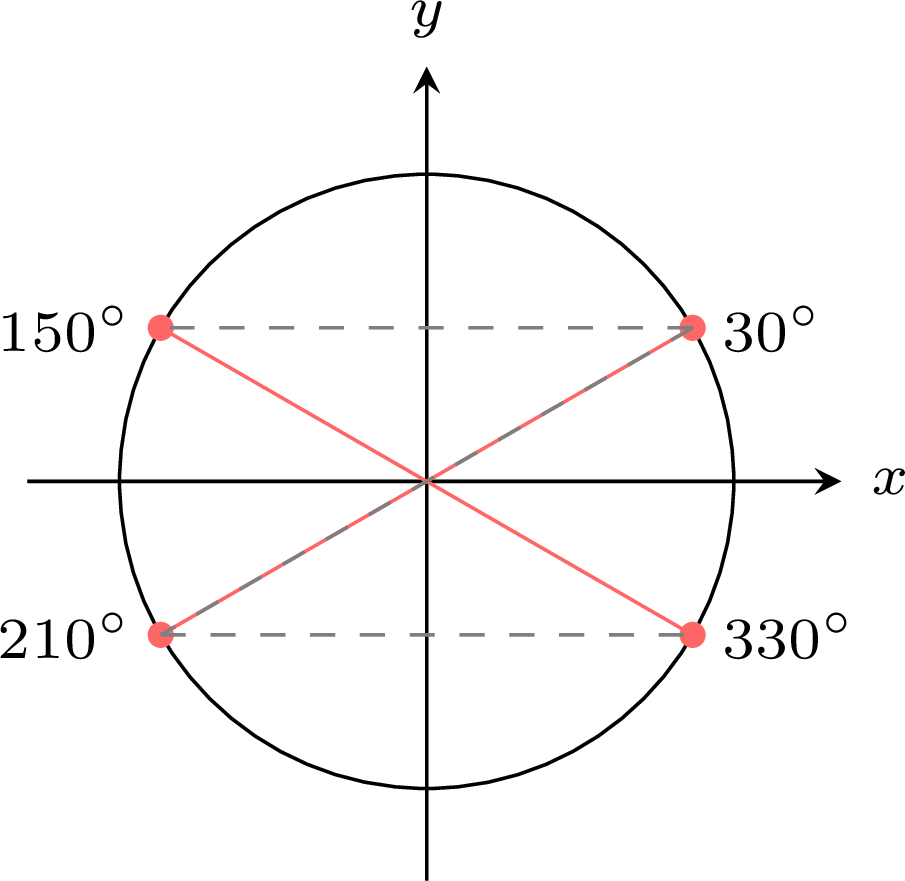
A calculator set to degree mode gives the same values. Plotting the points and joining them with a smooth curve: 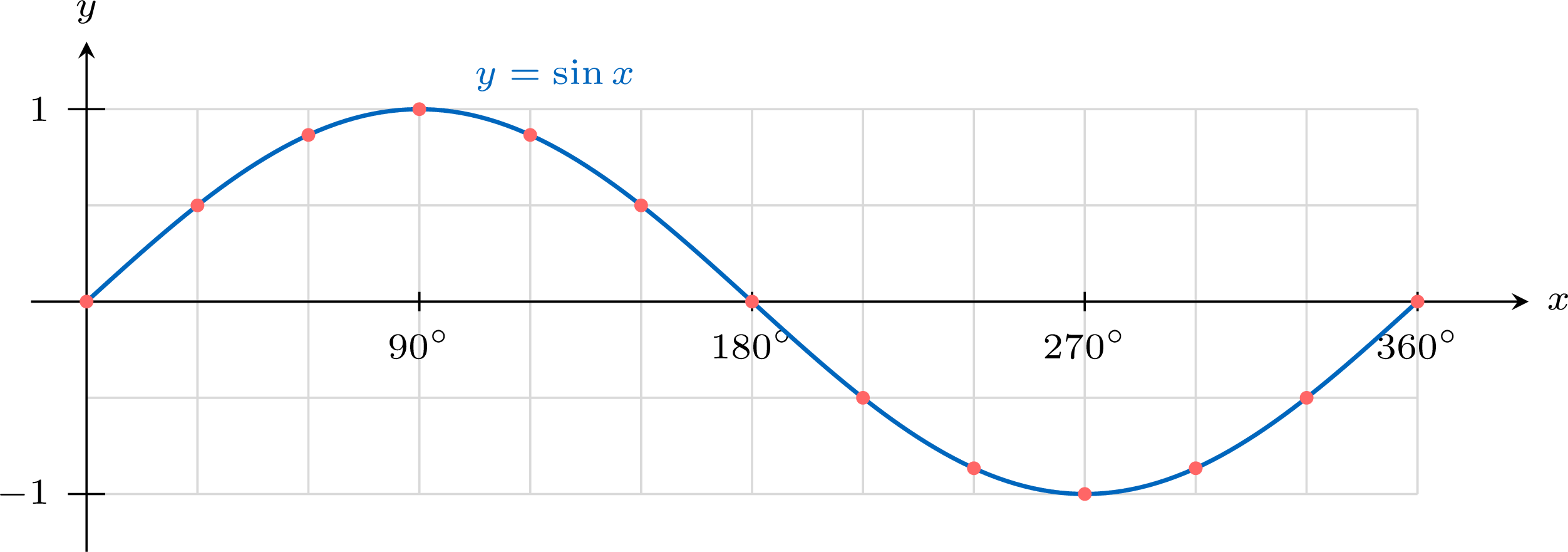
- the point for \(180^\circ - x\) is the reflection of the point for \(x\) in the vertical axis: same \(y\)-coordinate, so \(\sin 150^\circ = \sin 30^\circ\) and \(\sin 120^\circ = \sin 60^\circ\);
- the point for \(180^\circ + x\) is the image of the point for \(x\) by the half-turn about \(O\): opposite \(y\)-coordinate, so \(\sin 210^\circ = -\sin 30^\circ\) and \(\sin 240^\circ = -\sin 60^\circ\);
- the point for \(360^\circ - x\) is the reflection of the point for \(x\) in the horizontal axis: opposite \(y\)-coordinate, so \(\sin 330^\circ = -\sin 30^\circ\) and \(\sin 300^\circ = -\sin 60^\circ\).
| \(x\) | \(0^\circ\) | \(30^\circ\) | \(60^\circ\) | \(90^\circ\) | \(120^\circ\) | \(150^\circ\) | \(180^\circ\) |
| \(\sin x\) | \(0\) | \(0.5\) | \(0.87\) | \(1\) | \(0.87\) | \(0.5\) | \(0\) |
| \(x\) | \(210^\circ\) | \(240^\circ\) | \(270^\circ\) | \(300^\circ\) | \(330^\circ\) | \(360^\circ\) |
| \(\sin x\) | \(-0.5\) | \(-0.87\) | \(-1\) | \(-0.87\) | \(-0.5\) | \(0\) |
Example
- Using the period, find the exact values of \(\cos 420^\circ\), \(\cos(-60^\circ)\) and \(\sin 750^\circ\).
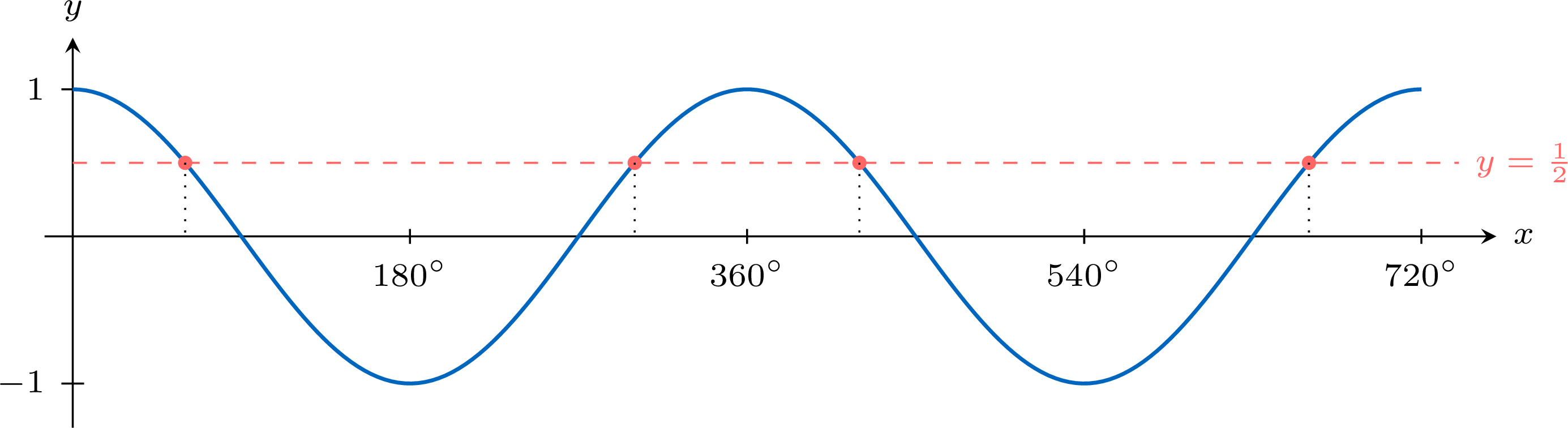
- Find every angle \(x\) with \(0^\circ \le x \le 720^\circ\) such that \(\cos x = \dfrac{1}{2}\).
- Each angle is brought back between \(0^\circ\) and \(360^\circ\) by whole turns, which do not change the cosine or the sine: $$\begin{aligned}[t] \cos 420^\circ &= \cos(60^\circ + 360^\circ) &&\text{(}420 = 60 + 360\text{)}\\ &= \cos 60^\circ &&\text{(period } 360^\circ\text{)}\\ &= \frac{1}{2}, \end{aligned} \qquad \begin{aligned}[t] \sin 750^\circ &= \sin(30^\circ + 2 \times 360^\circ) &&\text{(}750 = 30 + 720\text{)}\\ &= \sin 30^\circ &&\text{(period } 360^\circ\text{)}\\ &= \frac{1}{2}. \end{aligned}$$ For \(\cos(-60^\circ)\), adding one turn gives \(\cos(-60^\circ) = \cos 300^\circ\). The point for \(300^\circ = 360^\circ - 60^\circ\) is the reflection of the point for \(60^\circ\) in the horizontal axis: same \(x\)-coordinate, so \(\cos(-60^\circ) = \cos 60^\circ = \dfrac{1}{2}\).
- Between \(0^\circ\) and \(360^\circ\), the vertical line \(x = \dfrac{1}{2}\) meets the unit circle at two points: the point for \(60^\circ\) (as \(\cos 60^\circ = \dfrac{1}{2}\)) and its reflection in the horizontal axis, the point for \(360^\circ - 60^\circ = 300^\circ\). Adding one turn to each gives the solutions between \(360^\circ\) and \(720^\circ\): \(60^\circ + 360^\circ = 420^\circ\) and \(300^\circ + 360^\circ = 660^\circ\). The solutions are $$x = 60^\circ, \quad x = 300^\circ, \quad x = 420^\circ, \quad x = 660^\circ.$$ On the graph, they are the four points where the curve of \(y = \cos x\) meets the line \(y = \dfrac{1}{2}\):
Skills to practice
- Reading the Curves in Degrees
- Identifying Periodic Behaviour from a Graph
- Using the Period in Degrees
II
Finding the Amplitude, Period and Principal Axis
Definition — Principal Axis and Amplitude
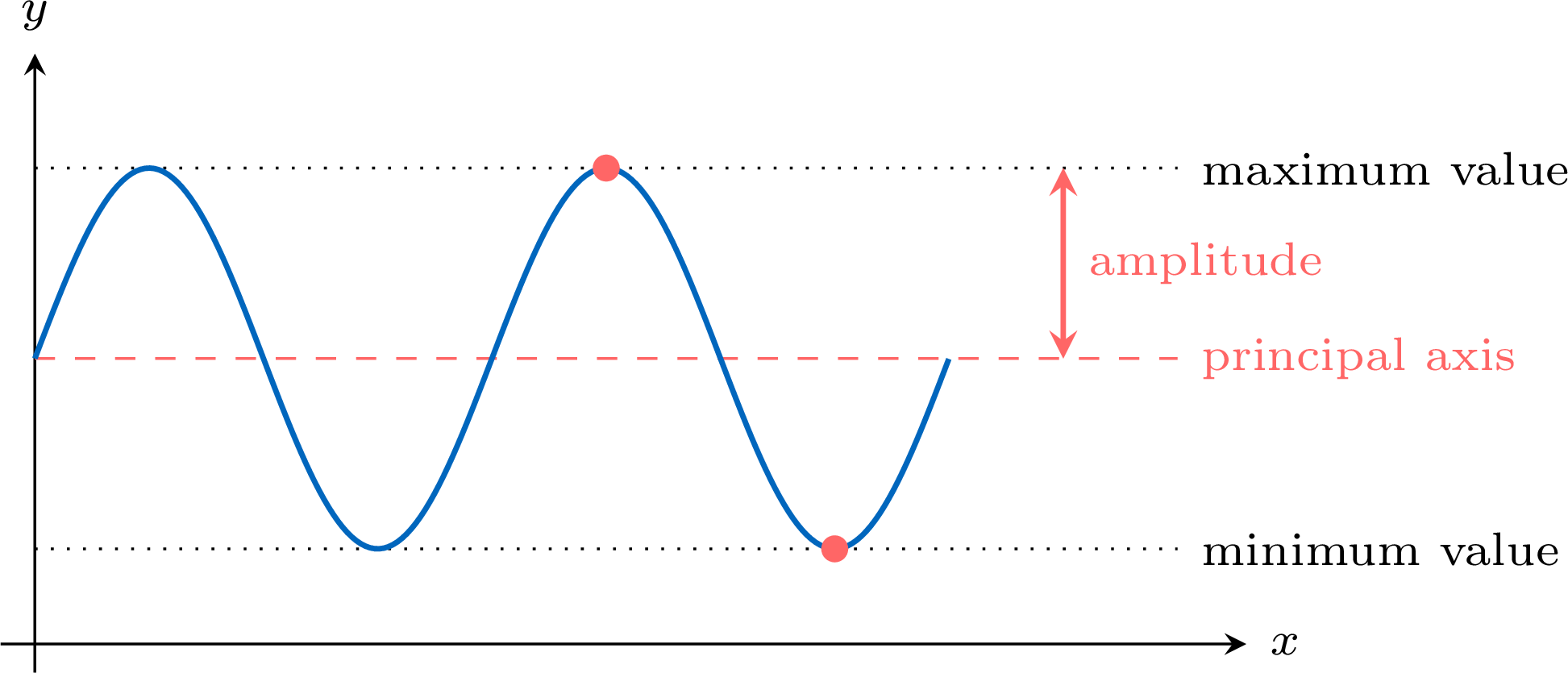
Let \(f\) be a periodic function that has a maximum value and a minimum value. Its curve oscillates between the horizontal lines \(y = \text{maximum value}\) and \(y = \text{minimum value}\). - The principal axis is the horizontal line halfway between them: $$y = \frac{\text{maximum value} + \text{minimum value}}{2}.$$
- The amplitude is the distance from the principal axis to a maximum point (or to a minimum point): $$\text{amplitude} = \frac{\text{maximum value} - \text{minimum value}}{2}.$$
Proposition — Transformations of Trigonometric Functions
For real parameters \(a,b,c,d\) with \(b\neq 0\), the graph of \(y = a\sin\!\big(b(x-c)\big) + d\) is obtained from the graph of \(y=\sin x\) by: - a vertical stretch with scale factor \(|a|\); if \(a<0\), there is also a reflection in the \(x\)-axis,
- a horizontal stretch with scale factor \(\dfrac{1}{|b|}\); if \(b<0\), there is also a reflection in the \(y\)-axis,
- a horizontal translation by \(c\) units (to the right if \(c>0\), left if \(c<0\)) and a vertical translation by \(d\) units (up if \(d>0\), down if \(d<0\)).
Proposition — General Sine and Cosine Functions in Degrees
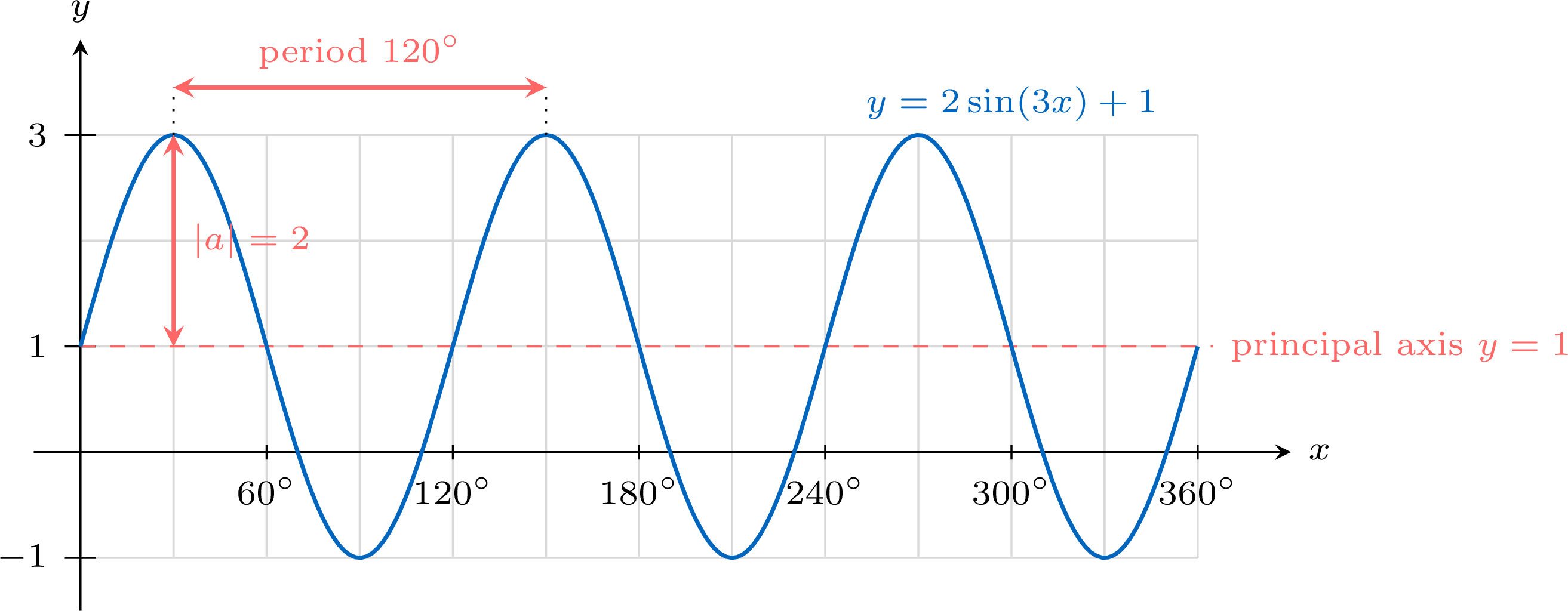
Let \(a\), \(b\) and \(d\) be real numbers with \(a \neq 0\) and \(b \neq 0\). When \(x\) is measured in degrees, the functions $$y = a\sin(bx) + d \qquad \text{and} \qquad y = a\cos(bx) + d$$ have - amplitude \(|a|\);
- period \(\dfrac{360^\circ}{|b|}\);
- principal axis the line \(y = d\);
- maximum value \(d + |a|\) and minimum value \(d - |a|\).
We write the proof for \(f(x) = a\sin(bx) + d\); replacing \(\sin\) by \(\cos\) changes nothing below.
- Values. As \(x\) runs through all the angles, so does \(bx\) (as \(b \neq 0\)), and \(\sin(bx)\) takes every value from \(-1\) to \(1\), and only those. Multiplying by \(a\) gives every value from \(-|a|\) to \(|a|\) (in the reverse order when \(a < 0\)); adding \(d\) gives every value from \(d - |a|\) to \(d + |a|\). So the maximum value is \(d + |a|\) and the minimum value \(d - |a|\). By the definitions of the principal axis and of the amplitude, the principal axis is \(y = \dfrac{(d + |a|) + (d - |a|)}{2} = d\) and the amplitude is \(\dfrac{(d + |a|) - (d - |a|)}{2} = |a|\).
- Period. Let \(P = \dfrac{360^\circ}{|b|}\). Then \(bP = \pm 360^\circ\), and since the sine has period \(360^\circ\), $$\begin{aligned}[t] f(x + P) &= a\sin(bx + bP) + d \\ &= a\sin(bx \pm 360^\circ) + d \\ &= a\sin(bx) + d && \text{(period } 360^\circ \text{ of the sine)}\\ &= f(x). \end{aligned}$$ No smaller positive number works: if \(f(x + Q) = f(x)\) for every \(x\), with \(Q > 0\), then \(\sin(bx + bQ) = \sin(bx)\) for every \(x\) (divide by \(a \neq 0\)), that is \(\sin(u + |b|Q) = \sin u\) for every angle \(u\); so \(|b|Q\) is at least the period \(360^\circ\) of the sine, and \(Q \ge \dfrac{360^\circ}{|b|} = P\).
Example
Consider the function \(y = 3\sin(2x) + 1\), with \(x\) in degrees. - State its amplitude, its period and its principal axis.
- State its maximum and minimum values, and the values of \(x\) with \(0^\circ \le x \le 360^\circ\) at which they are reached.
- Sketch its graph for \(0^\circ \le x \le 360^\circ\).
Here \(a = 3\), \(b = 2\) and \(d = 1\).
- Amplitude \(|a| = 3\); period \(\dfrac{360^\circ}{|b|} = \dfrac{360^\circ}{2} = 180^\circ\); principal axis \(y = 1\).
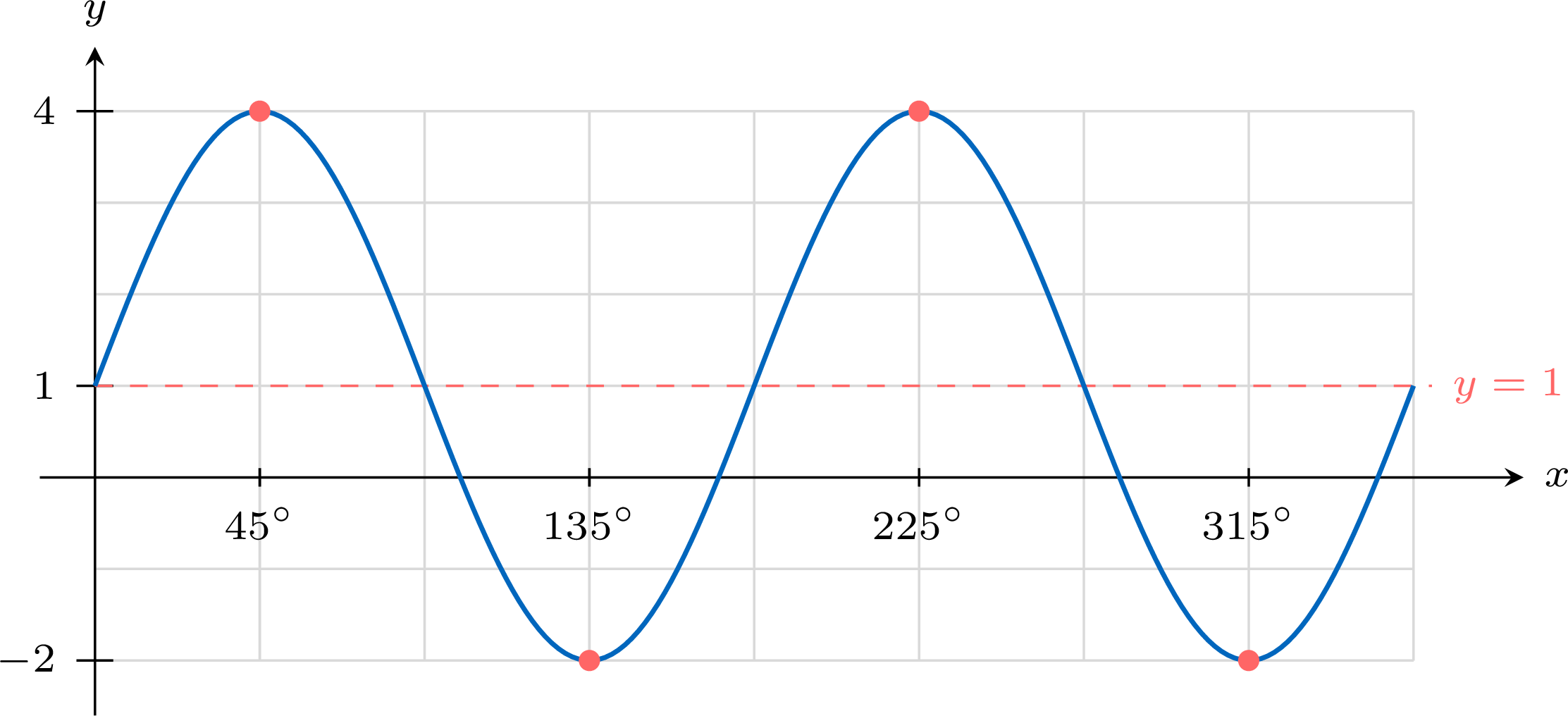
- Maximum value \(d + |a| = 1 + 3 = 4\), minimum value \(d - |a| = 1 - 3 = -2\). At \(x = 0^\circ\) the curve is on its principal axis, rising, as \(y = 3\sin 0^\circ + 1 = 1\); it reaches its maximum a quarter of a period later and its minimum three quarters of a period later: $$\begin{aligned}[t] x &= \tfrac{1}{4} \times 180^\circ = 45^\circ && \text{(first maximum)}\\ x &= \tfrac{3}{4} \times 180^\circ = 135^\circ && \text{(first minimum)} \end{aligned}$$ Adding the period \(180^\circ\) gives the others: the maximum is reached at \(x = 45^\circ\) and \(x = 225^\circ\), the minimum at \(x = 135^\circ\) and \(x = 315^\circ\); one more period goes beyond \(360^\circ\). Check: \(3\sin 90^\circ + 1 = 4\) and \(3\sin 270^\circ + 1 = -2\).
- The curve starts on its principal axis at \((0^\circ, 1)\), rising, and repeats every \(180^\circ\):
Example
The curve below has equation \(y = a\cos(bx) + d\), with \(a > 0\), \(b > 0\) and \(x\) in degrees. It has a maximum point at \((0^\circ, 5)\), and its next minimum point is \((60^\circ, -1)\). Find \(a\), \(b\) and \(d\). 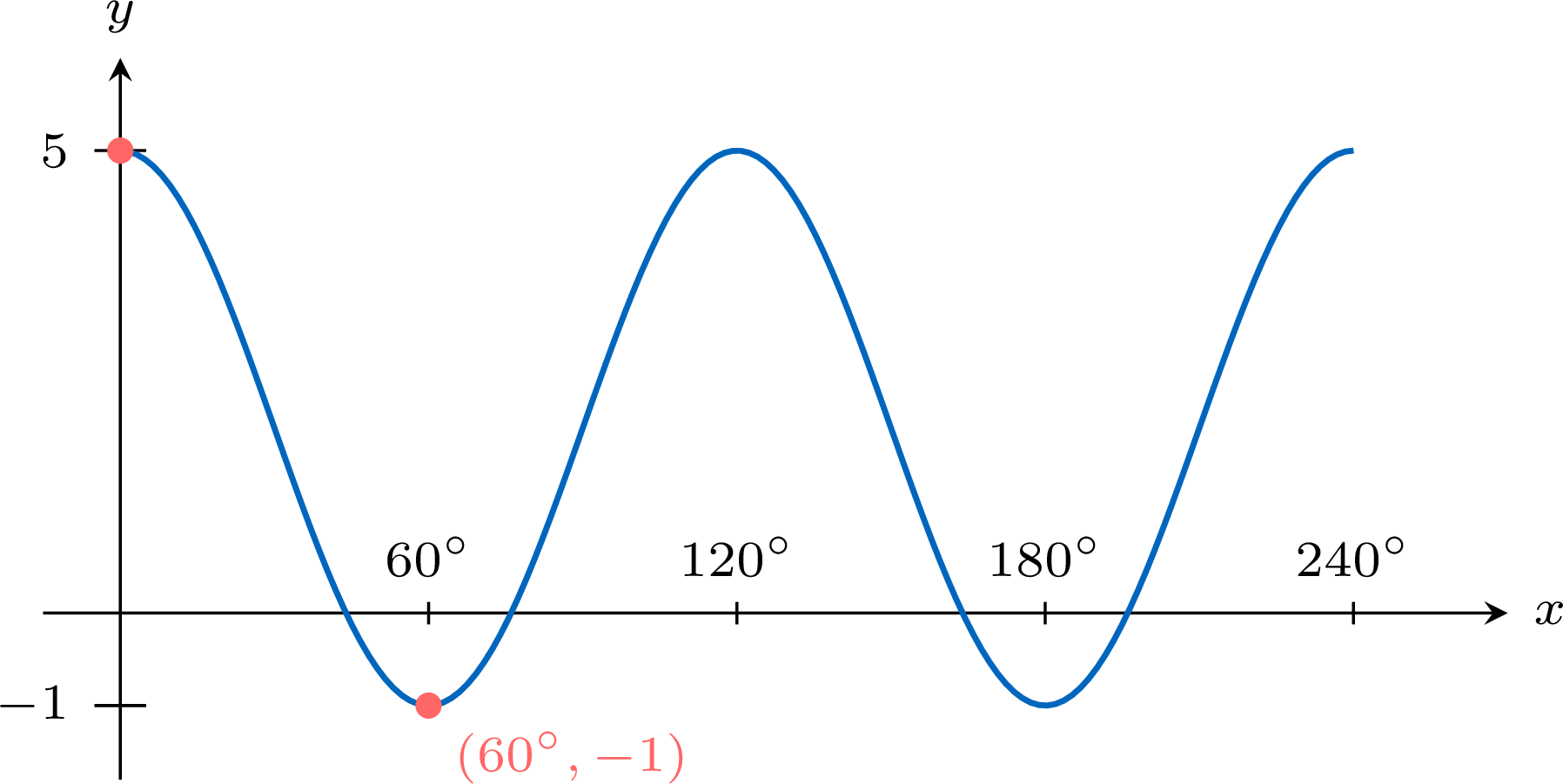
The maximum value is \(5\) and the minimum value is \(-1\).
- Principal axis: \(d = \dfrac{5 + (-1)}{2} = 2\).
- Amplitude: \(|a| = \dfrac{5 - (-1)}{2} = 3\), and \(a > 0\), so \(a = 3\).
- From a maximum to the next minimum is half a period: the period is \(2 \times 60^\circ = 120^\circ\). As \(b > 0\), \(\dfrac{360^\circ}{b} = 120^\circ\), so \(b = \dfrac{360}{120} = 3\).
Skills to practice
- Reading the Amplitude, the Period and the Principal Axis
- Finding a Sinusoid from its Graph in Degrees
III
Solving Trigonometric Equations
Method — Solving a Trigonometric Equation
- Use identities to simplify the equation into a form involving a single trigonometric function, e.g., \(\sin(X)=k\).
- Check that the equation has solutions: \(\sin X = k\) and \(\cos X = k\) have none when \(k < -1\) or \(k > 1\). Then find one solution \(X_0\): read it on the unit circle when \(k\) is the exact value of a special angle, or take the value given by the calculator's \(\sin^{-1}\) key for \(\sin X = k\). This value lies between \(-\frac{\pi}{2}\) and \(\frac{\pi}{2}\) (between \(-90^\circ\) and \(90^\circ\)), so it is negative when \(k < 0\): for example \(\sin^{-1}\left(-\frac{1}{2}\right) = -\frac{\pi}{6}\), which is not in \([0, 2\pi)\).
- Use the symmetry and periodicity of the function to find all solutions within one period.
- Add whole multiples of the period — \(2n\pi\) (that is \(n \times 360^\circ\)) for the sine and the cosine, \(n\pi\) (that is \(n \times 180^\circ\)) for the tangent, \(n\) an integer — to find the general solution or all the solutions in a given interval. A negative value gives a solution in \([0, 2\pi)\) once \(2\pi\) is added: \(-\frac{\pi}{6} + 2\pi = \frac{11\pi}{6}\).
Example
Solve the equation \(2\sin x = 1\) for \(0^\circ \le x \le 720^\circ\).
The steps of the Method, with \(x\) in degrees. 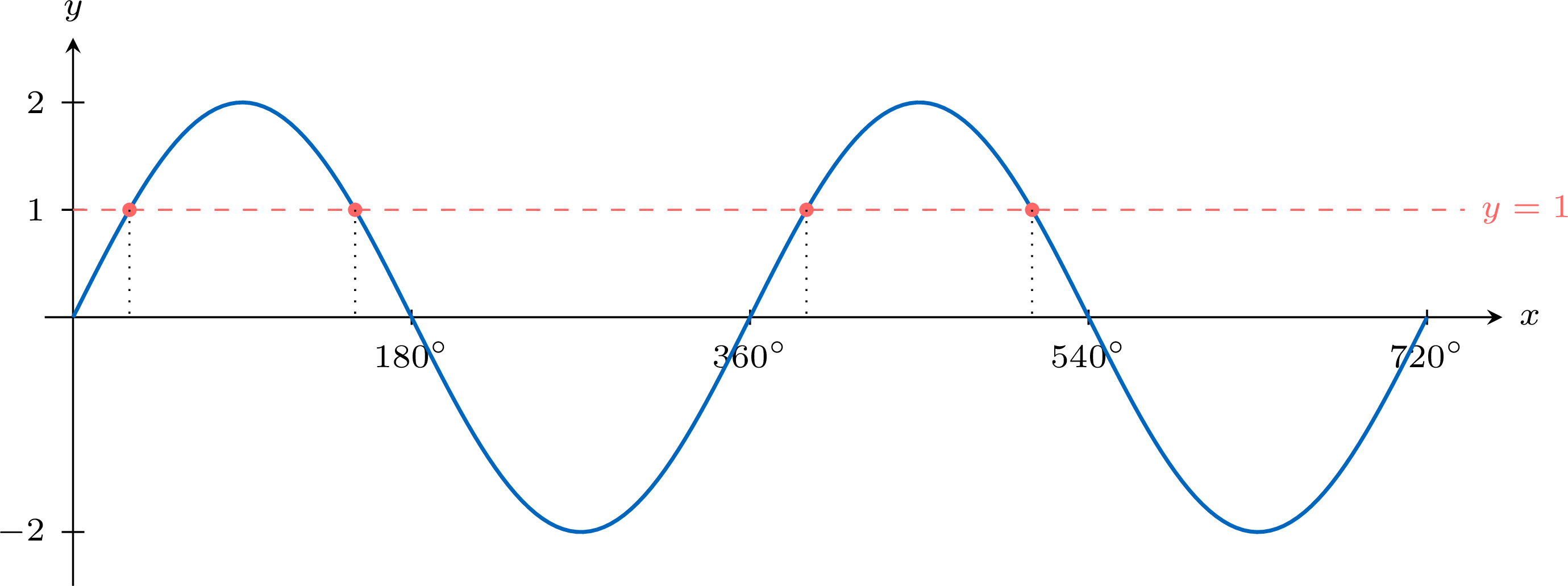
- One trigonometric function. $$\begin{aligned}[t] 2\sin x = 1 &\iff \sin x = \frac{1}{2} && \text{(divide both sides by } 2\text{)} \end{aligned}$$
- One solution. \(\sin 30^\circ = \dfrac{1}{2}\), so \(x = 30^\circ\) is a solution (it is the value \(\sin^{-1}\left(\dfrac{1}{2}\right) = 30^\circ\) given by the calculator).
- All the solutions in one period. The point of the unit circle for \(180^\circ - 30^\circ = 150^\circ\) is the reflection of the point for \(30^\circ\) in the vertical axis: it has the same \(y\)-coordinate, so \(\sin 150^\circ = \dfrac{1}{2}\). Between \(0^\circ\) and \(360^\circ\), the solutions are \(x = 30^\circ\) and \(x = 150^\circ\).
- The solutions in the interval. The sine has period \(360^\circ\): adding one turn gives \(30^\circ + 360^\circ = 390^\circ\) and \(150^\circ + 360^\circ = 510^\circ\), both at most \(720^\circ\); adding a second turn gives \(750^\circ\) and \(870^\circ\), beyond \(720^\circ\).
Skills to practice
- Solving Basic Trigonometric Equations in Degrees
IV
Defining the Sine and Cosine Functions in Radians
Going furtherbeyond the syllabus — click to explore
Every real number \(x\) has a point of the circle, and that point has two coordinates. Let \(x\) now run along the whole number line and follow each coordinate on its own: two functions are born, \(x \mapsto \cos x\) and \(x \mapsto \sin x\). As the circle unrolls, it draws their curves.
Let \(M(\cos x, \sin x)\) be the point on the unit circle corresponding to an angle \(x\) (in radians). 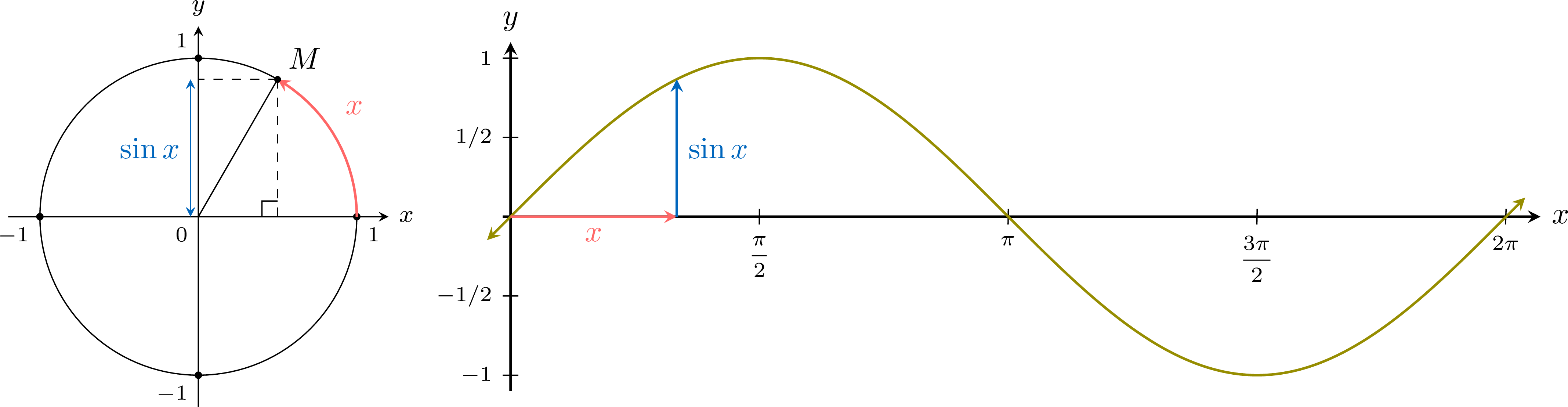
- The angle \(x\) on the unit circle corresponds to the input for the sine function.
- The \(y\)-coordinate of point \(M\) on the unit circle, \(\sin x\), gives the output of the sine function.
Definition — Sine Function
The sine function, denoted \(\sin\), is the function defined on \(\mathbb{R}\) which maps every real number \(x\) to the \(y\)-coordinate of the point \(M\) of the unit circle associated with \(x\): \(x\mapsto \sin(x)\). Example
Complete the following table with the values of the sine function at key angles: | \(x\) | 0 | \(\dfrac{\pi}{6}\) | \(\dfrac{\pi}{4}\) | \(\dfrac{\pi}{3}\) | \(\dfrac{\pi}{2}\) | \(\dfrac{2 \pi}{3}\) | \(\dfrac{3 \pi}{4}\) | \(\dfrac{5 \pi}{6}\) | \(\pi\) |
| \(\sin (x)\) |
| \(x\) | 0 | \(\dfrac{\pi}{6}\) | \(\dfrac{\pi}{4}\) | \(\dfrac{\pi}{3}\) | \(\dfrac{\pi}{2}\) | \(\dfrac{2 \pi}{3}\) | \(\dfrac{3 \pi}{4}\) | \(\dfrac{5 \pi}{6}\) | \(\pi\) |
| \(\sin (x)\) | 0 | \(\dfrac{1}{2}\) | \(\dfrac{\sqrt{2}}{2}\) | \(\dfrac{\sqrt{3}}{2}\) | 1 | \(\dfrac{\sqrt{3}}{2}\) | \(\dfrac{\sqrt{2}}{2}\) | \(\dfrac{1}{2}\) | \(0\) |
If we instead project the values of \(\cos x\) from the unit circle onto a graph, we obtain the graph of the cosine function \(x \mapsto \cos x\). 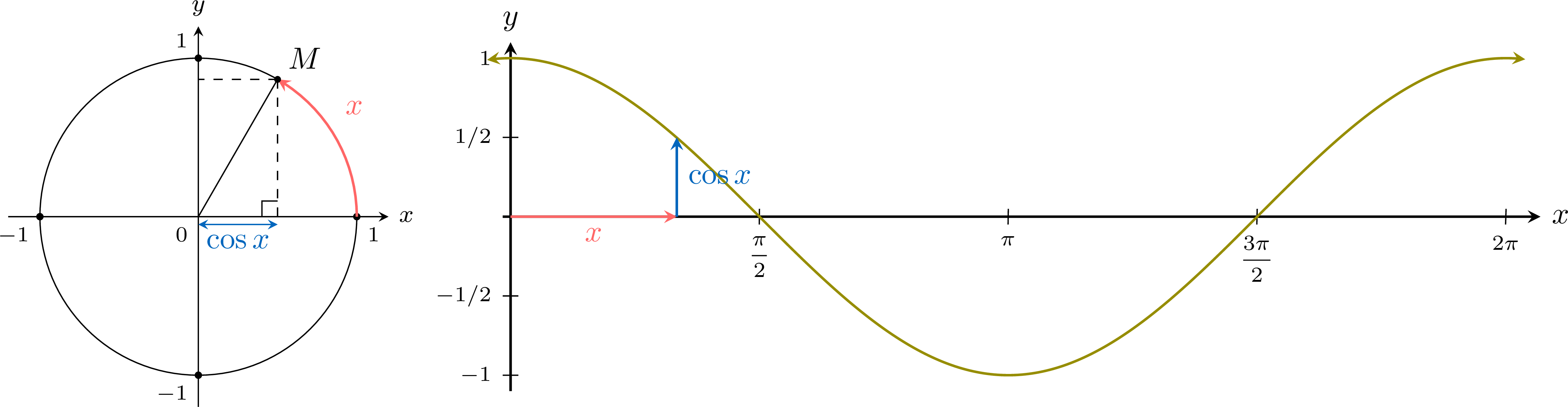
Definition — Cosine Function
The cosine function, denoted \(\cos\), is the function defined on \(\mathbb{R}\) which maps every real number \(x\) to the \(x\)-coordinate of the point \(M\) of the unit circle associated with \(x\): \(x\mapsto\cos(x)\). Example
Complete the following table with the values of the cosine function at key angles: | \(x\) | 0 | \(\dfrac{\pi}{6}\) | \(\dfrac{\pi}{4}\) | \(\dfrac{\pi}{3}\) | \(\dfrac{\pi}{2}\) | \(\dfrac{2 \pi}{3}\) | \(\dfrac{3 \pi}{4}\) | \(\dfrac{5 \pi}{6}\) | \(\pi\) |
| \(\cos (x)\) |
| \(x\) | \(0\) | \(\dfrac{\pi}{6}\) | \(\dfrac{\pi}{4}\) | \(\dfrac{\pi}{3}\) | \(\dfrac{\pi}{2}\) | \(\dfrac{2 \pi}{3}\) | \(\dfrac{3 \pi}{4}\) | \(\dfrac{5 \pi}{6}\) | \(\pi\) |
| \(\cos (x)\) | \(1\) | \(\dfrac{\sqrt{3}}{2}\) | \(\dfrac{\sqrt{2}}{2}\) | \(\dfrac{1}{2}\) | \(0\) | \(-\dfrac{1}{2}\) | \(-\dfrac{\sqrt{2}}{2} \) | \(-\dfrac{\sqrt{3}}{2}\) | \(-1\) |
Proposition — Parity of the Cosine and Sine Functions
Recall that a function \(f\) is even when \(f(-x) = f(x)\) for every \(x\), and odd when \(f(-x) = -f(x)\) for every \(x\). The cosine function is even: for every real \(x\), \(\cos(-x) = \cos x\). Its curve is symmetric about the vertical axis. The sine function is odd: for every real \(x\), \(\sin(-x) = -\sin x\). Its curve is symmetric about the origin \(O\). 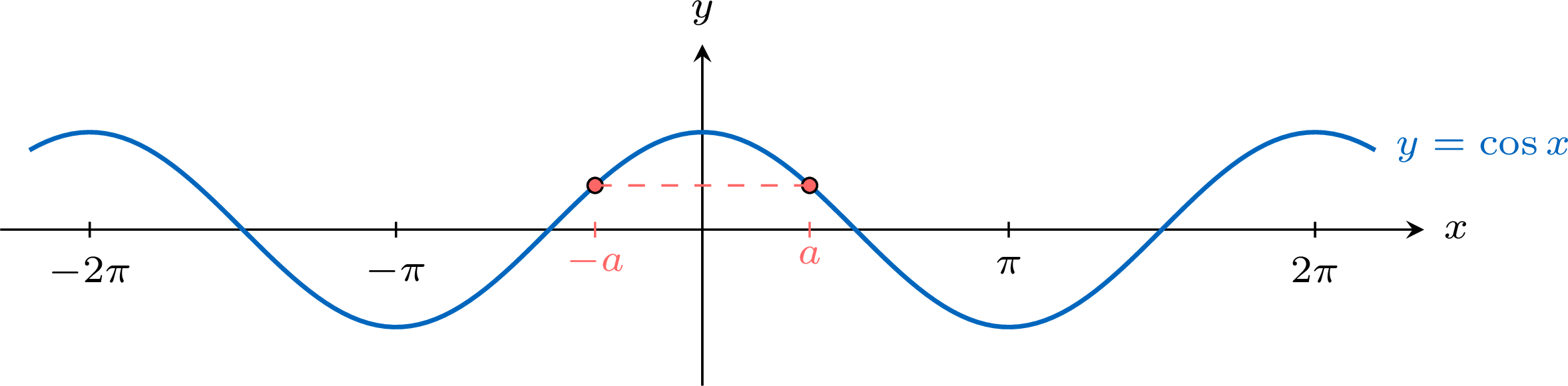
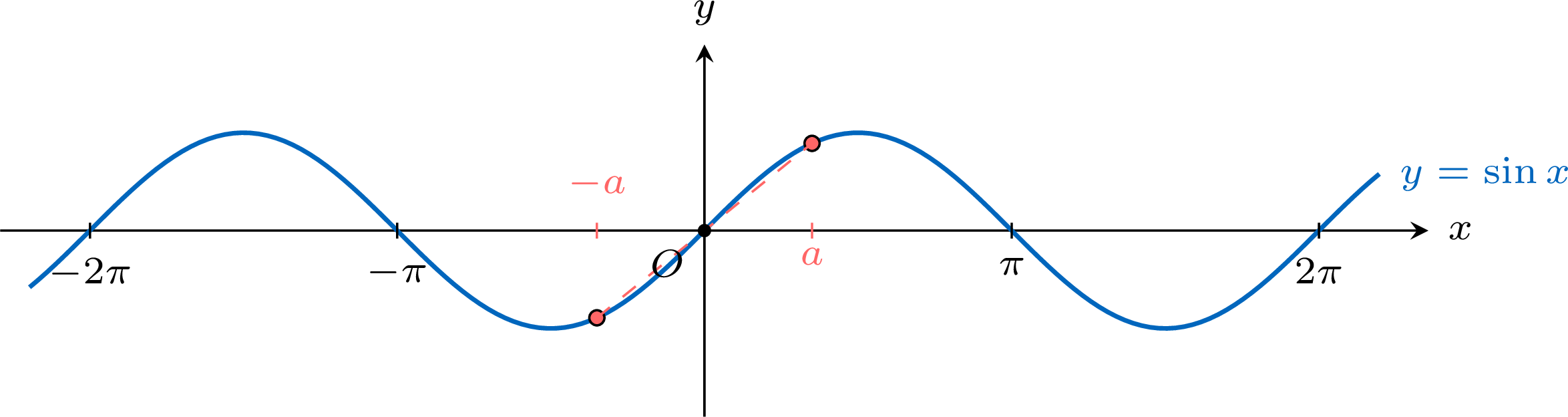
On the unit circle, the points of angles \(x\) and \(-x\) are reflections of each other in the horizontal axis: same \(x\)-coordinate, opposite \(y\)-coordinates. That is \(\cos(-x) = \cos x\) and \(\sin(-x) = -\sin x\); on the curves, these are the two symmetries stated.
Proposition — Domain and Range of the Sine and Cosine Functions
The sine and cosine functions are defined on \(\mathbb{R}\). For every real \(x\), \(-1 \le \sin x \le 1\) and \(-1 \le \cos x \le 1\), and, the point associated with \(x\) running over the whole unit circle, its \(x\)-coordinate and its \(y\)-coordinate take every value between \(-1\) and \(1\): the range of each function is \([-1, 1]\). Skills to practice
- Reading Values of the Sine and Cosine Functions
- Plotting Graphs
V
Studying Periodicity in Radians
Going furtherbeyond the syllabus — click to explore
Proposition — Periodicity of the Cosine and Sine Functions
The cosine and sine functions are periodic with period \(2\pi\): for every real \(x\),$$\cos(x + 2\pi) = \cos x \qquad \text{and} \qquad \sin(x + 2\pi) = \sin x.$$ Their curves are unchanged by the translation of length \(2\pi\) along the horizontal axis: it is enough to draw them on an interval of length \(2\pi\), such as \([-\pi, \pi]\), and to repeat the pattern. 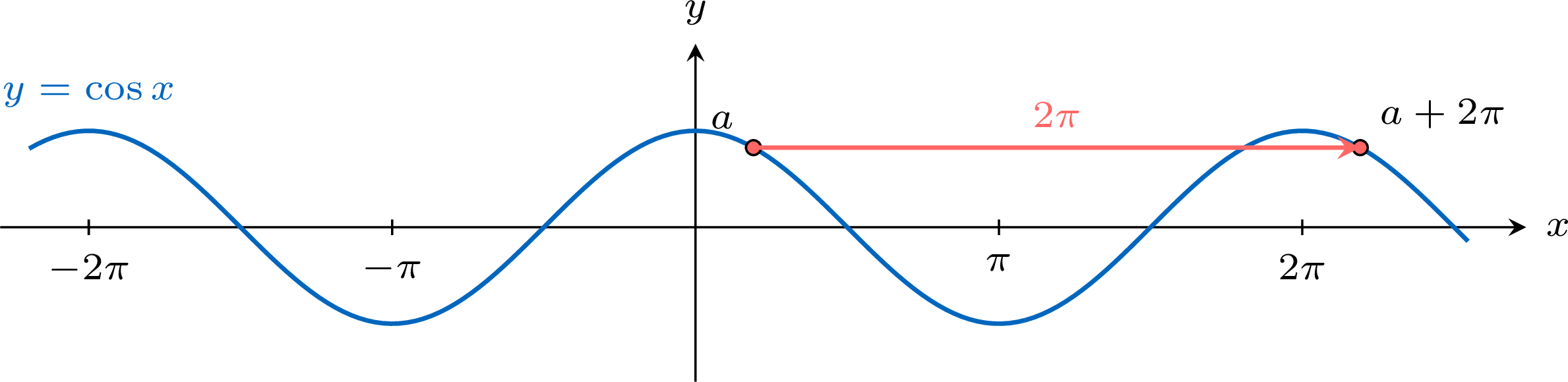
On the unit circle, the points of angles \(x\) and \(x + 2\pi\) coincide: one full turn brings the point back. So they have the same coordinates — \(\cos(x + 2\pi) = \cos x\) and \(\sin(x + 2\pi) = \sin x\). On the curves, this is the translation: the portion of the curve above \([a, a + 2\pi]\) is carried, by the translation of length \(2\pi\), onto the portion above \([a + 2\pi, a + 4\pi]\), whatever \(a\). No smaller positive number \(P\) works for every \(x\): the only real numbers whose sine is \(1\) are the numbers \(\dfrac{\pi}{2} + 2k\pi\), \(k\) an integer (the point \((0, 1)\)), so \(\sin\left(\dfrac{\pi}{2} + P\right) = 1\) forces \(P\) to be a multiple of \(2\pi\); in the same way, \(\cos(0 + P) = 1\) forces it for the cosine. So \(2\pi\) is the period of both functions.
Skills to practice
- Reading Periodicity on the Curve
VI
Studying the Variations and Symmetries in Radians
Going furtherbeyond the syllabus — click to explore
Periodicity says that the curves of cosine and sine repeat a pattern of length \(2\pi\). The unit circle tells more about this pattern: where it rises, where it falls, and which symmetries it has.
Proposition — Variations of the Cosine and Sine Functions
On \(\left[-\pi, \pi\right]\): - the cosine function is increasing on \(\left[-\pi, 0\right]\) and decreasing on \(\left[0, \pi\right]\);
- the sine function is increasing on \(\left[-\dfrac{\pi}{2}, \dfrac{\pi}{2}\right]\), and decreasing on \(\left[-\pi, -\dfrac{\pi}{2}\right]\) and on \(\left[\dfrac{\pi}{2}, \pi\right]\).
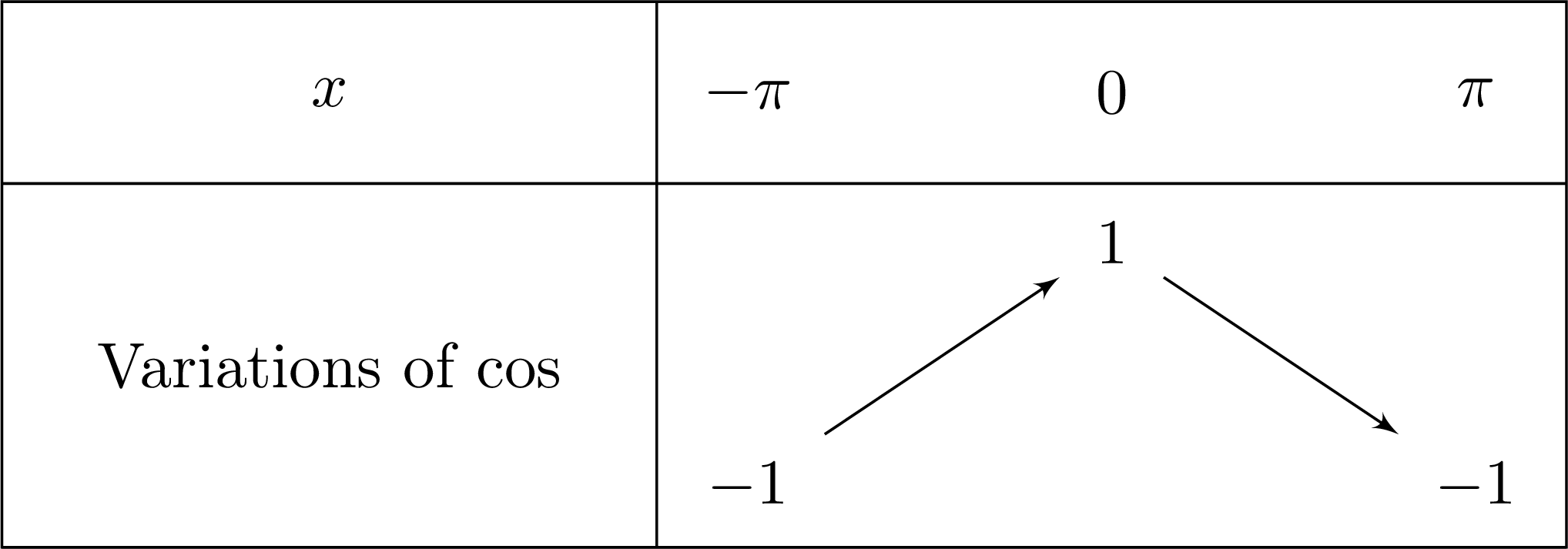
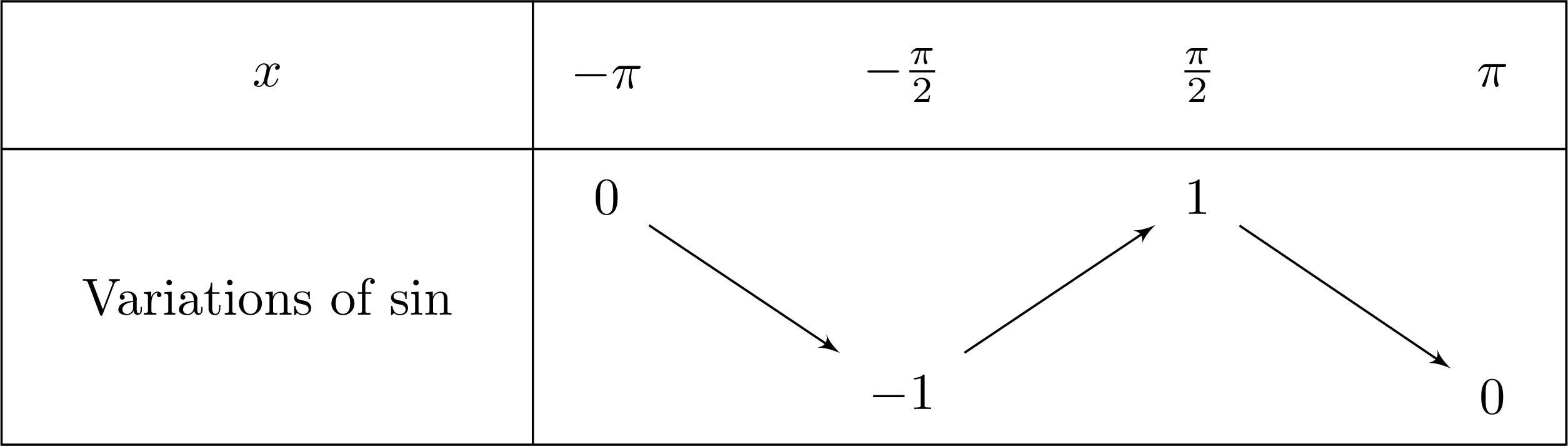
Read on the unit circle, where the point \(M(x)\) associated with \(x\) has coordinates \((\cos x, \sin x)\).
- When \(x\) goes from \(0\) to \(\pi\), \(M(x)\) travels the upper half-circle from \((1, 0)\) to \((-1, 0)\): its \(x\)-coordinate \(\cos x\) goes down from \(1\) to \(-1\). When \(x\) goes from \(-\pi\) to \(0\), \(M(x)\) travels the lower half-circle from \((-1, 0)\) to \((1, 0)\): \(\cos x\) goes up from \(-1\) to \(1\).
- When \(x\) goes from \(-\dfrac{\pi}{2}\) to \(\dfrac{\pi}{2}\), \(M(x)\) travels the right half-circle from \((0, -1)\) to \((0, 1)\): its \(y\)-coordinate \(\sin x\) goes up from \(-1\) to \(1\). From \(\dfrac{\pi}{2}\) to \(\pi\), \(M(x)\) goes from \((0, 1)\) to \((-1, 0)\) and \(\sin x\) goes down from \(1\) to \(0\); from \(-\pi\) to \(-\dfrac{\pi}{2}\), it goes from \((-1, 0)\) to \((0, -1)\) and \(\sin x\) goes down from \(0\) to \(-1\).
Proposition — Symmetries of the Cosine and Sine Curves
For every real number \(x\), the associated angles give: - \(\sin(\pi - x) = \sin x\): the sine curve is symmetric about the vertical line \(x = \dfrac{\pi}{2}\);
- \(\sin(\pi + x) = -\sin x\) and \(\sin(\pi - x) = \sin x\): the sine curve is symmetric about the point \((\pi, 0)\);
- \(\cos(\pi - x) = -\cos x\): the cosine curve is symmetric about the point \(\left(\dfrac{\pi}{2}, 0\right)\);
- \(\cos\left(x - \dfrac{\pi}{2}\right) = \sin x\): the sine curve is the cosine curve translated by \(\dfrac{\pi}{2}\) to the right.
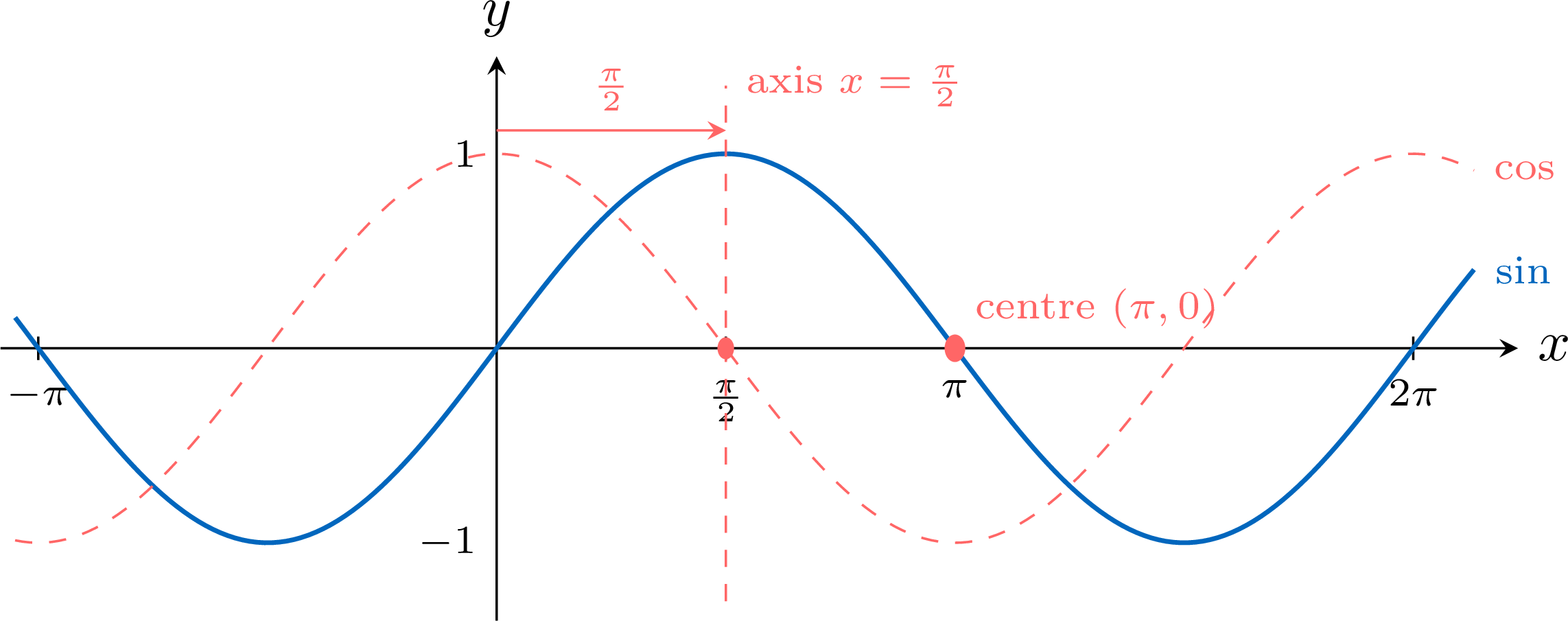
The relations come from the unit circle: the points associated with \(x\) and \(\pi - x\) are symmetric about the vertical axis (same \(y\)-coordinate, opposite \(x\)-coordinates), so \(\sin(\pi - x) = \sin x\) and \(\cos(\pi - x) = -\cos x\); the points associated with \(x\) and \(\pi + x\) are symmetric about the centre (half-turn), so \(\sin(\pi + x) = -\sin x\); the points associated with \(x\) and \(\dfrac{\pi}{2} - x\) are symmetric about the line \(y = x\), which swaps the two coordinates, so \(\cos\left(\dfrac{\pi}{2} - x\right) = \sin x\). Two points \((a, b)\) and \((a', b')\) are symmetric about the vertical line \(x = m\) when \(b' = b\) and \(\dfrac{a + a'}{2} = m\), and about the point \((m, 0)\) when \(b' = -b\) and \(\dfrac{a + a'}{2} = m\).
- The points \((x, \sin x)\) and \((\pi - x, \sin(\pi - x)) = (\pi - x, \sin x)\) of the sine curve have the same \(y\)-coordinate, and \(\dfrac{x + (\pi - x)}{2} = \dfrac{\pi}{2}\).
- The points \((\pi - x, \sin(\pi - x)) = (\pi - x, \sin x)\) and \((\pi + x, \sin(\pi + x)) = (\pi + x, -\sin x)\) have opposite \(y\)-coordinates, and \(\dfrac{(\pi - x) + (\pi + x)}{2} = \pi\).
- The points \((x, \cos x)\) and \((\pi - x, \cos(\pi - x)) = (\pi - x, -\cos x)\) have opposite \(y\)-coordinates, and \(\dfrac{x + (\pi - x)}{2} = \dfrac{\pi}{2}\).
- The point \((x, \sin x) = \left(x, \cos\left(x - \frac{\pi}{2}\right)\right)\) of the sine curve is the point \(\left(x - \frac{\pi}{2}, \cos\left(x - \frac{\pi}{2}\right)\right)\) of the cosine curve moved \(\dfrac{\pi}{2}\) to the right; and \(\cos\left(x - \frac{\pi}{2}\right) = \cos\left(\frac{\pi}{2} - x\right) = \sin x\), since \(\cos(-u) = \cos u\).
Example
Without a calculator, compare: - \(\cos 1\) and \(\cos 2\);
- \(\sin 0.5\) and \(\sin 1\);
- \(\sin 1\) and \(\sin 2\).
- \(1\) and \(2\) lie in \(\left[0, \pi\right]\), where cosine is decreasing, and \(1 \lt 2\): so \(\cos 1 \gt \cos 2\).
- \(0.5\) and \(1\) lie in \(\left[-\frac{\pi}{2}, \frac{\pi}{2}\right]\) (as \(\frac{\pi}{2} \approx 1.57\)), where sine is increasing, and \(0.5 \lt 1\): so \(\sin 0.5 \lt \sin 1\).
- \(2 \gt \frac{\pi}{2}\), so \(1\) and \(2\) are not in the same interval of variation. The symmetry about \(x = \frac{\pi}{2}\) brings \(2\) back: \(\sin 2 = \sin(\pi - 2)\), with \(\pi - 2 \gt 1\) since \(\pi \gt 3\), and \(\pi - 2 \lt \frac{\pi}{2}\) since \(\pi \lt 4\). Now \(1\) and \(\pi - 2\) lie in \(\left[-\frac{\pi}{2}, \frac{\pi}{2}\right]\) and \(1 \lt \pi - 2\): so \(\sin 1 \lt \sin(\pi - 2) = \sin 2\).
Skills to practice
- Reading Variations and Symmetries
- Justifying with Variations and Symmetries
VII
Describing Sinusoids and Signals in Radians
Going furtherbeyond the syllabus — click to explore
Now that we are familiar with the graphs of \(y = \sin x\) and \(y = \cos x\), we can use transformations to graph more complicated trigonometric functions.
Definition — General Sine and Cosine Function
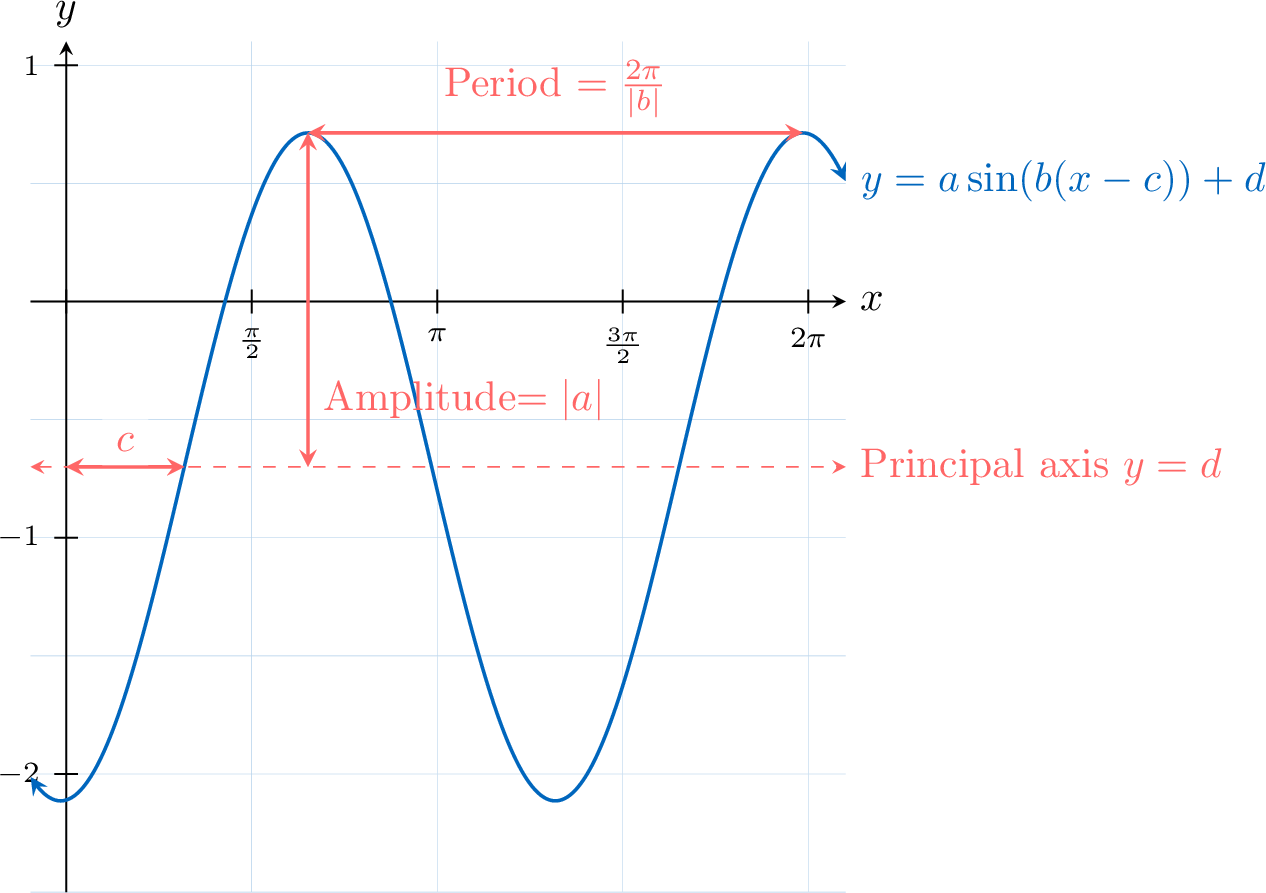
For functions of the form \(y = a\sin(b(x-c)) + d\) and \(y = a\cos(b(x-c)) + d\), with \(a \neq 0\) and \(b \neq 0\): - \(|a|\) is the amplitude.
- \(\frac{2\pi}{|b|}\) is the period (\(x\) in radians; with \(x\) in degrees, the period is \(\frac{360^\circ}{|b|}\)).
- \(c\) is the phase shift (horizontal translation).
- \(d\) is the vertical shift (the principal axis is \(y=d\)).
Example
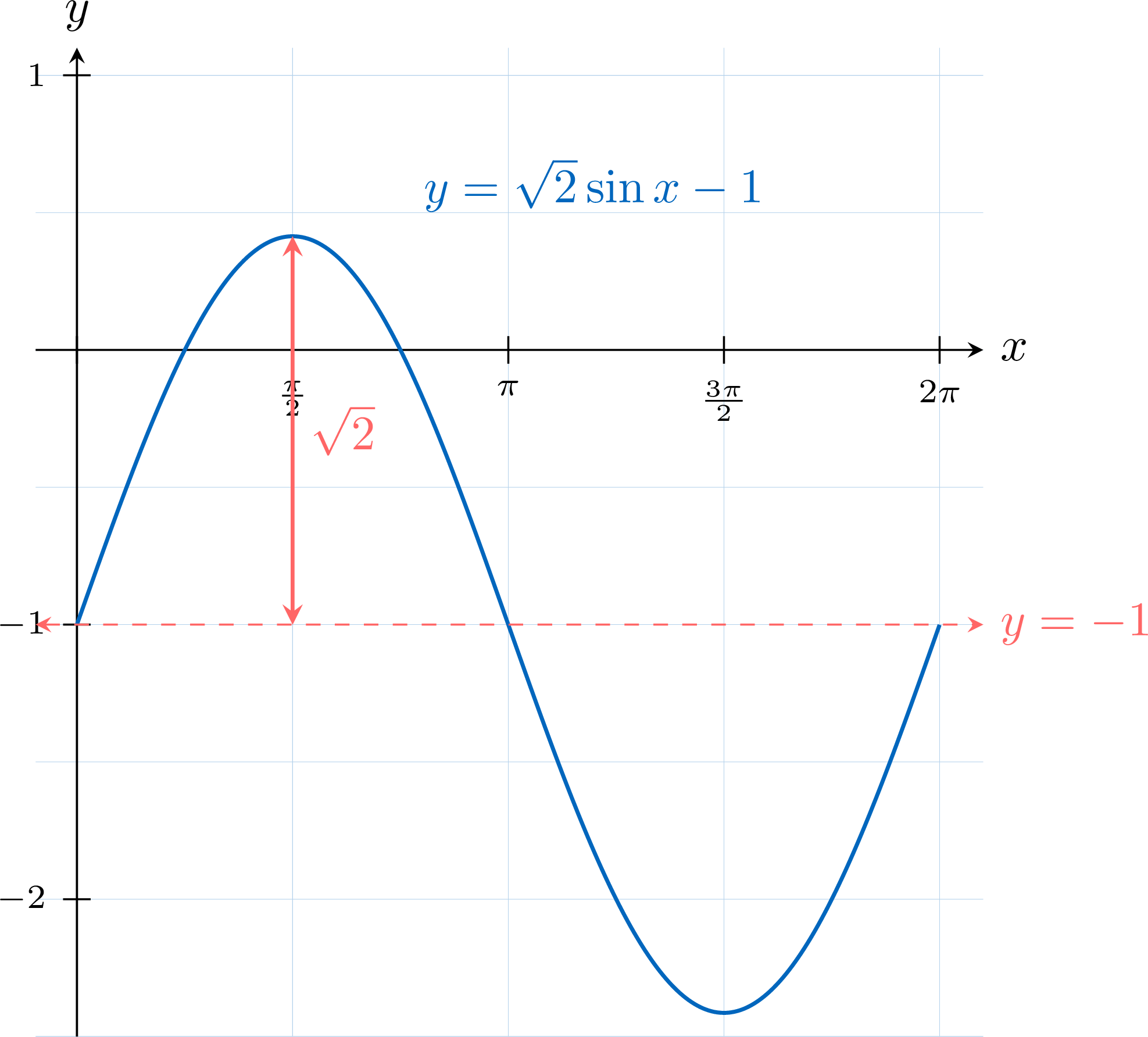
Sketch the graph of \(y=\sqrt{2} \sin x-1\) for \(0 \leq x \leq 2 \pi\). - The graph of \(y=\sqrt{2} \sin x\) is the vertical stretch of the graph of \(y=\sin x\) with scale factor \(\sqrt{2}\).
- The graph of \(y=\sqrt{2} \sin x-1\) is the vertical translation of the graph of \(y=\sqrt{2}\sin x\) by \(-1\).
Sinusoidal Signals
A quantity that oscillates regularly over time — the voltage of the mains, the height of a point of a vibrating rope, the position of a mass hanging on a spring, each measured from its equilibrium position — is often modelled by a function of the time \(t\) of the form \(t \mapsto A\cos(\omega t + \varphi)\) or \(t \mapsto A\sin(\omega t + \varphi)\). Physics gives each of the three numbers \(A\), \(\omega\) and \(\varphi\) a name.
Definition — Sinusoidal Signal
Let \(A \gt 0\), \(\omega \gt 0\) and \(\varphi\) be real numbers. The functions \(t \mapsto A\cos(\omega t + \varphi)\) and \(t \mapsto A\sin(\omega t + \varphi)\) of the time \(t\) are sinusoidal signals: - \(A\) is the amplitude: the signal oscillates between \(-A\) and \(A\);
- \(\omega\) is the angular frequency, in radians per second;
- \(\omega t + \varphi\) is the instantaneous phase, and its value \(\varphi\) at \(t = 0\) is the initial phase.
Proposition — Period and Frequency of a Sinusoidal Signal
A sinusoidal signal of angular frequency \(\omega\) is periodic, of period \(T = \dfrac{2\pi}{\omega}\): it takes the same values again every \(T\) seconds. Its frequency is the number of periods per second: $$\textcolor{colorprop}{f = \frac{1}{T} = \frac{\omega}{2\pi}}, \quad \text{in hertz (Hz)}.$$
The cosine function is periodic of period \(2\pi\): \(\cos(x + 2\pi) = \cos x\) for every real \(x\). For every real \(t\), $$\begin{aligned}[t] A\cos\left(\omega\left(t + \frac{2\pi}{\omega}\right) + \varphi\right) &= A\cos(\omega t + \varphi + 2\pi) &&\text{(expand)}\\
&= A\cos(\omega t + \varphi). &&\text{(period } 2\pi\text{)}\end{aligned}$$ Adding \(T = \dfrac{2\pi}{\omega}\) to the time adds \(2\pi\) to the instantaneous phase, that is one full turn; as \(2\pi\) is the smallest period of the cosine, no smaller positive time brings the signal back to the same values for every \(t\). The same holds for \(A\sin(\omega t + \varphi)\).
Initial Phase and Horizontal Shift
A sinusoidal signal is a function \(y = a\cos\big(b(x - c)\big)\) written with the time \(t\): $$A\cos(\omega t + \varphi) = A\cos\left(\omega\left(t + \frac{\varphi}{\omega}\right)\right),$$ so \(a = A\), \(b = \omega\) and the horizontal shift (a duration, which the general form of the sine and cosine functions calls the phase shift) is \(c = -\dfrac{\varphi}{\omega}\). The curve of \(t \mapsto A\cos(\omega t + \varphi)\) is the curve of \(t \mapsto A\cos(\omega t)\) shifted to the left by \(\dfrac{\varphi}{\omega}\) when \(\varphi \gt 0\), to the right by \(-\dfrac{\varphi}{\omega}\) when \(\varphi \lt 0\).
Method — Reading a Sinusoidal Signal on its Curve
To find \(A\), \(\omega\) and \(\varphi\) from the curve of \(u(t) = A\cos(\omega t + \varphi)\): - Amplitude: \(A\) is the maximum value of the signal.
- Period: \(T\) is the time between two consecutive maxima; then \(\omega = \dfrac{2\pi}{T}\).
- Initial phase: if the signal reaches its maximum at the time \(t_0\), then \(\cos(\omega t_0 + \varphi) = 1\), so \(\omega t_0 + \varphi\) is a multiple of \(2\pi\): \(\varphi = -\omega t_0 + 2k\pi\), \(k\) an integer. Take the value that lies in \(\left(-\pi, \pi\right]\); when \(0 \leq t_0 \lt \dfrac{T}{2}\), it is \(\varphi = -\omega t_0\).
- Check: \(u(0) = A\cos\varphi\) must be the value read on the curve at \(t = 0\).
Example
The voltage of the mains, in volts, is \(u(t) = 325\cos(100\pi t)\), with \(t\) in seconds. Give its amplitude, its angular frequency, its period, its frequency and its initial phase.
Here \(A = 325\) V and \(\omega = 100\pi\) rad/s, and \(\varphi = 0\) (nothing is added to \(100\pi t\)). $$\begin{aligned}[t] T &= \frac{2\pi}{\omega} = \frac{2\pi}{100\pi} = \frac{1}{50} = 0.02 \text{ s}\\
f &= \frac{1}{T} = 50 \text{ Hz.}\end{aligned}$$ The voltage takes the same values again fifty times per second.
Example
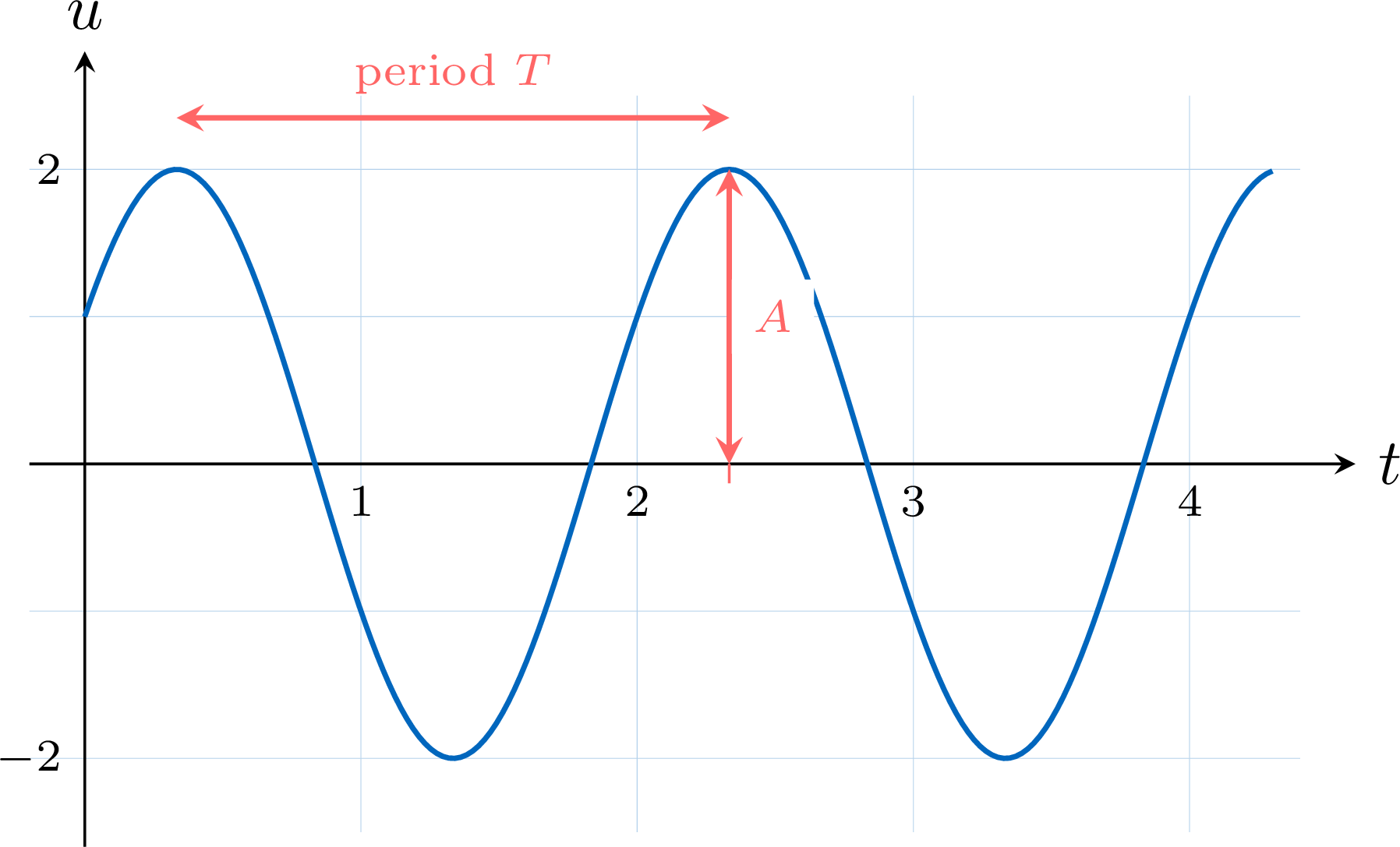
The curve below is that of a signal \(u(t) = A\cos(\omega t + \varphi)\), with \(t\) in seconds. Read \(A\) and \(T\), deduce \(\omega\), then find \(\varphi\) in \(\left(-\pi, \pi\right]\). 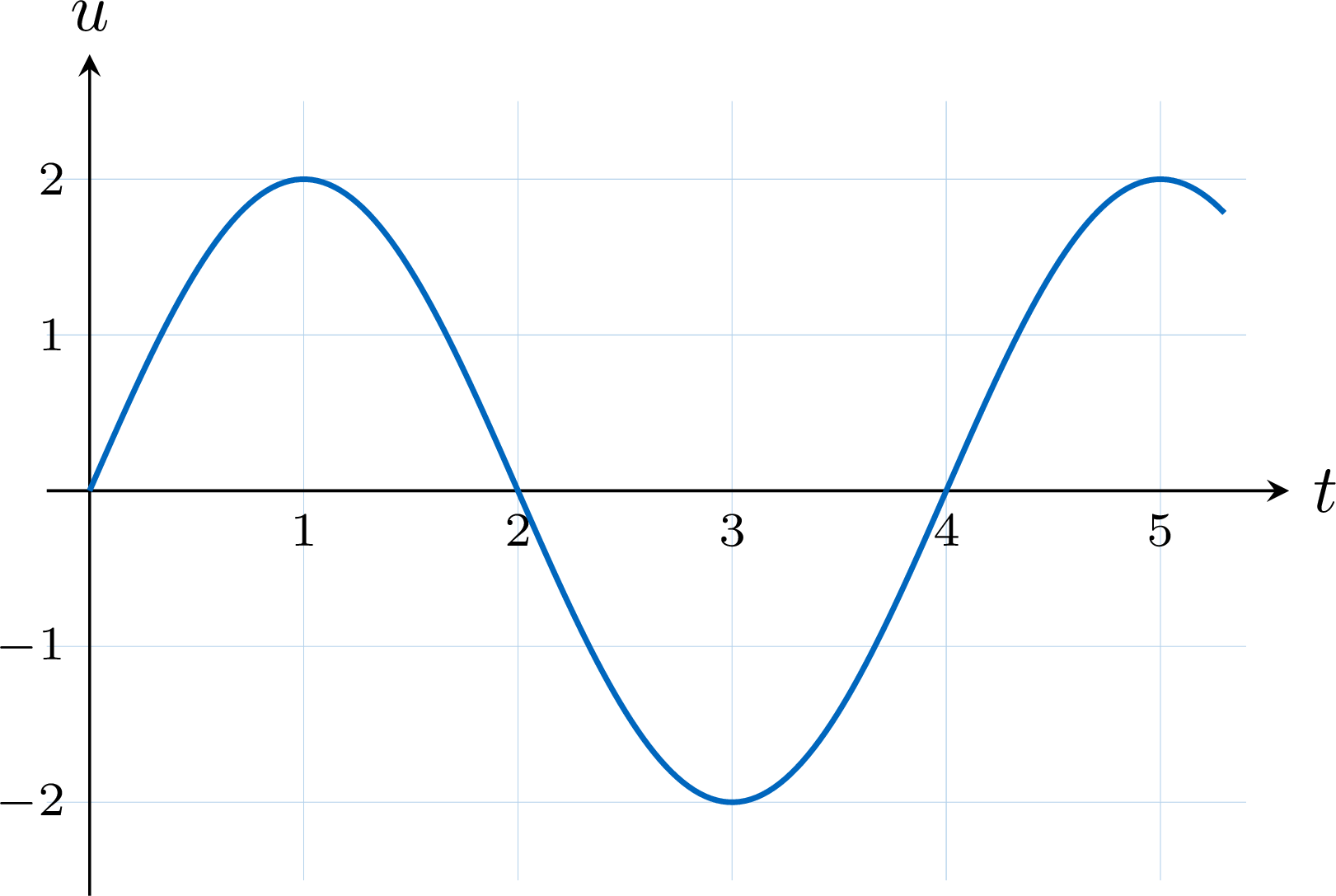
- The maximum value is \(2\): \(A = 2\).
- Two consecutive maxima are at \(t = 1\) and \(t = 5\): \(T = 4\) s, so \(\omega = \dfrac{2\pi}{4} = \dfrac{\pi}{2}\) rad/s.
- The maximum at \(t_0 = 1\) gives \(\varphi = -\dfrac{\pi}{2} \times 1 + 2k\pi\); the value in \(\left(-\pi, \pi\right]\) is \(\varphi = -\dfrac{\pi}{2}\). Check: \(u(0) = 2\cos\left(-\dfrac{\pi}{2}\right) = 0\), as on the curve. So \(u(t) = 2\cos\left(\dfrac{\pi}{2}t - \dfrac{\pi}{2}\right)\): this curve is also that of \(t \mapsto 2\sin\left(\dfrac{\pi}{2}t\right)\).
Skills to practice
- Finding the Equation from a Graph
- Identifying Properties from an Equation
- Sketching and Describing Sinusoids
VIII
Solving Trigonometric Equations in Radians
Going furtherbeyond the syllabus — click to explore
Example
Find the general solution to the equation \(2\sin(3x) = \sqrt{3}\), and hence find all solutions in the interval \(0 \le x \le \pi\). - Simplify the equation: We first isolate the trigonometric function. $$ \sin(3x) = \frac{\sqrt{3}}{2} $$ Let \(u = 3x\). We are now solving \(\sin(u) = \frac{\sqrt{3}}{2}\).
- Find one solution: The unit circle, or the calculator's \(\sin^{-1}\) key, gives one solution for \(u\): $$ u = \sin^{-1}\left(\frac{\sqrt{3}}{2}\right) = \frac{\pi}{3} $$
- Find all solutions for \(u\) in one period: For the sine function, a second solution exists at \(\pi - u\). $$ \text{Second solution: } u = \pi - \frac{\pi}{3} = \frac{2\pi}{3} $$
- Find the general solution for \(u\): Since the period of sine is \(2\pi\), we add multiples of \(2\pi\) to our initial solutions. Let \(k\) be any integer (\(k \in \mathbb{Z}\)). $$ u = \frac{\pi}{3} + 2k\pi \quad \text{or} \quad u = \frac{2\pi}{3} + 2k\pi $$
- Solve for \(x\): Now we substitute back \(u=3x\) to find the general solution for \(x\). $$ 3x = \frac{\pi}{3} + 2k\pi \implies \boldsymbol{x = \frac{\pi}{9} + \frac{2k\pi}{3}} $$ $$ 3x = \frac{2\pi}{3} + 2k\pi \implies \boldsymbol{x = \frac{2\pi}{9} + \frac{2k\pi}{3}} $$
- Find solutions in the given interval \(0 \le x \le \pi\): We test integer values for \(k\).
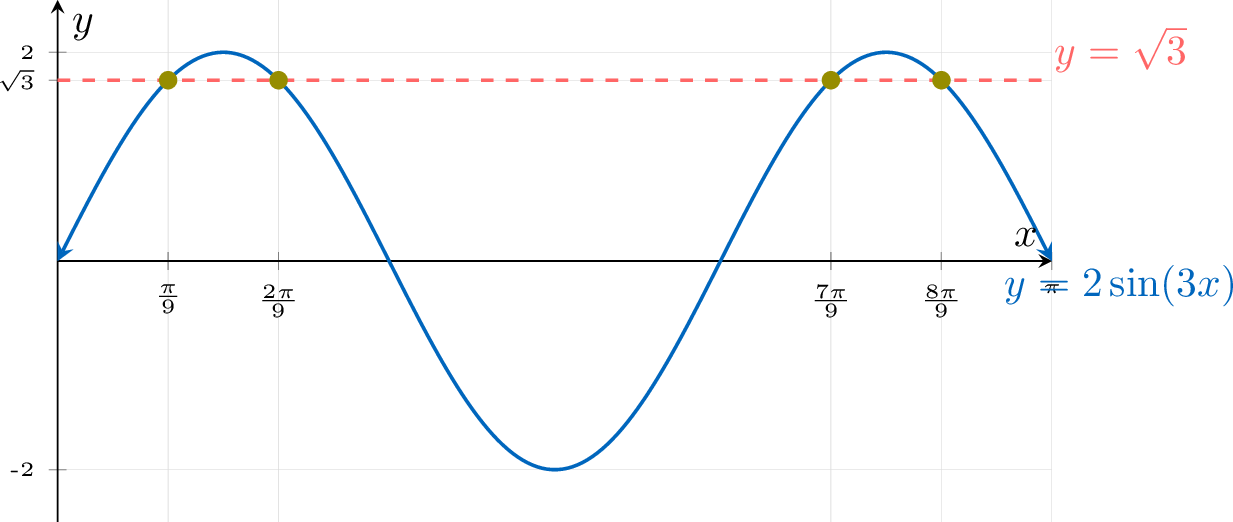
- For \(k=0\): \(x = \frac{\pi}{9}\) and \(x = \frac{2\pi}{9}\). (Both are in the interval.)
- For \(k=1\): \(x = \frac{\pi}{9} + \frac{2\pi}{3} = \frac{7\pi}{9}\) and \(x = \frac{2\pi}{9} + \frac{2\pi}{3} = \frac{8\pi}{9}\). (Both are in the interval.)
- For \(k=2\): \(x = \frac{\pi}{9} + \frac{4\pi}{3} = \frac{13\pi}{9}\). (This is outside the interval, since it is greater than \(\pi\).)
- The solutions can be checked by plotting the graphs of \(y=2\sin(3x)\) and \(y=\sqrt{3}\) on the same set of axes on the interval \(0 \le x \le \pi\). The x-coordinates of the intersection points correspond to the solutions of the equation.
Skills to practice
- Solving Basic Trigonometric Equations in Radians
- Solving Equations with Transformed Arguments
IX
Going further
Skills to practice
- Reasoning and Problem-Solving
- Investigating Patterns in Sinusoids
- Reasoning in Radians
- Quiz
Jump to section