International Baccalaureate · MYP 5 Extended
Logarithms
I
Logarithms in Base 10
I.1
The Logarithm of a Number
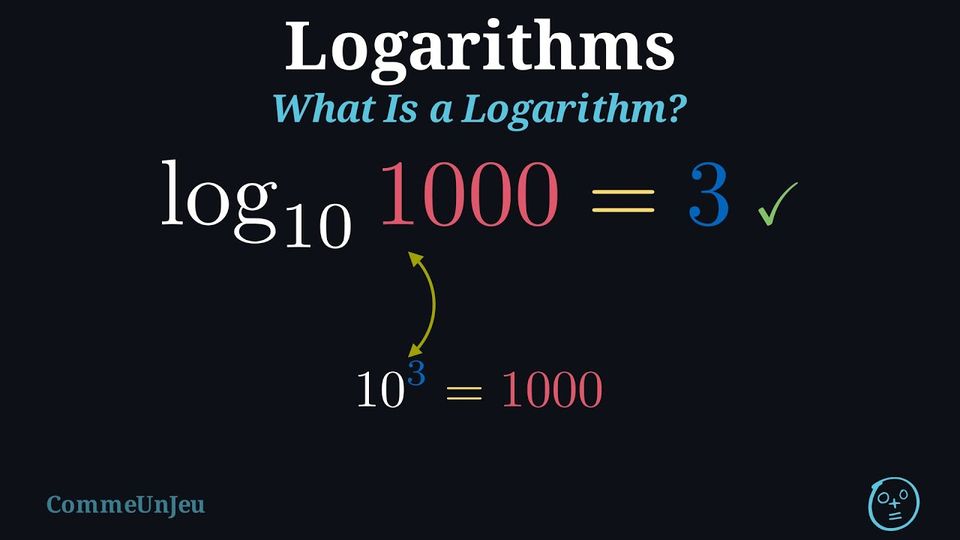
Exponentiation answers the question of what we get when we multiply a number by itself a certain number of times (for example, \(10^3 = 10 \times 10 \times 10 = 1000\)).
Now we ask the inverse question: To what exponent must 10 be raised to get 1000?
This question leads us to the concept of the logarithm. A logarithm is the inverse operation of exponentiation: it is the tool we use to find an unknown exponent.
Before the invention of calculators, logarithms were a revolutionary tool for scientists, turning complex multiplications into simpler additions. Today, they remain essential for solving exponential equations and are used to describe phenomena in science, such as the pH scale in chemistry or the Richter scale for earthquakes.
The aim is to:
- define logarithms (in base 10),
- explore their main properties (the laws of logarithms),
- find with them the order of magnitude of a number and the number of digits of a whole number,
- and use them to solve exponential equations and real-world problems.
Definition — Logarithm
The (base 10) logarithm of a number \(y\) (where \(y > 0\)) is the exponent to which 10 must be raised to obtain \(y\). It is denoted \(\log_{10} y\) and defined by the equivalence: $$\log_{10} y = x \quad \Leftrightarrow \quad 10^x = y$$ As on most calculators and in exams, \(\log_{10} y\) is abbreviated \(\log y\); so \(\log y = \log_{10} y\). In other words, \(\log y\) is the exponent \(x\) such that \(10^x = y\).
For a power of 10, the logarithm is simply the exponent read off the power. The table below shows this two-way reading:
For example, \(10^{-2} = 0.01\), so \(\log 0.01 = -2\); and \(10^{3} = 1000\), so \(\log 1000 = 3\).
The two operations travel in opposite directions between a number \(y\) and its exponent \(x\): the logarithm extracts the exponent, and raising 10 to a power rebuilds the number. 
| \(y\) | \(0.01\) | \(0.1\) | \(1\) | \(10\) | \(100\) | \(1000\) |
| \(y\) as a power of \(10\) | \(10^{-2}\) | \(10^{-1}\) | \(10^{0}\) | \(10^{1}\) | \(10^{2}\) | \(10^{3}\) |
| \(\log y\) | \(-2\) | \(-1\) | \(0\) | \(1\) | \(2\) | \(3\) |
The two operations travel in opposite directions between a number \(y\) and its exponent \(x\): the logarithm extracts the exponent, and raising 10 to a power rebuilds the number.
Why \(\log 0\) and \(\log(-5)\) are undefined
The logarithm \(\log y\) is defined only for \(y > 0\). Indeed, a power of 10 is always strictly positive: \(10^x > 0\) for every real \(x\). Since no power of 10 equals \(0\) or a negative number, expressions such as \(\log 0\) and \(\log(-5)\) have no value.
Proposition — Inverse Properties of Logarithms
For real numbers: - \(10^{\log x} = x\) for any \(x > 0\),
- \(\log (10^x) = x\) for any real \(x\).
These properties reflect that the exponential function \(10^x\) and the logarithm function \(\log x\) (base 10) are inverses of each other.
Example
Evaluate \(\log 100\).
\(\begin{aligned}[t]\log(100) &= \log\left(10^{2}\right) &&(100 = 10^2) \\&=2\\\end{aligned}\)
Since \(10^2 = 100\), the logarithm of \(100\) (base 10) is \(2\).
Since \(10^2 = 100\), the logarithm of \(100\) (base 10) is \(2\).
Skills to practice
- Evaluating Logarithms
- Finding the Number from Its Logarithm
- Evaluating Logarithms with a Calculator
- Finding an Unknown Exponent
I.2
Laws of Logarithms
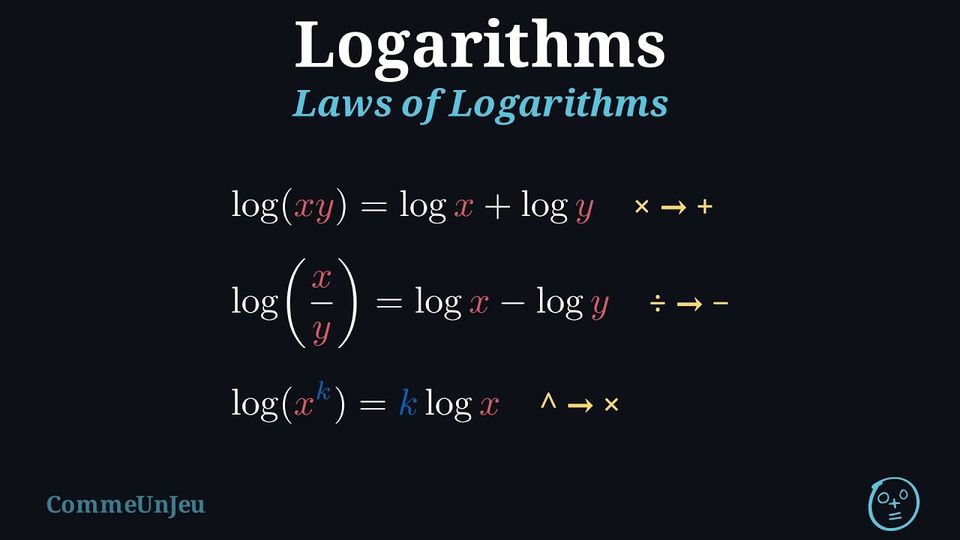
Proposition — Laws of Logarithms
For \(x>0\) and \(y>0\), and for any real number \(k\): - Product Rule: \(\log (xy) = \log x + \log y\)
- Quotient Rule: \(\log \left(\dfrac{x}{y}\right) = \log x - \log y\)
- Power Rule: \(\log (x^k) = k \log x\)
Assume \(x>0\) and \(y>0\). We use the fact that \(x = 10^{\log x}\) and \(y = 10^{\log y}\). $$\begin{aligned} \log(xy) &= \log(10^{\log x} \times 10^{\log y}) &&(x = 10^{\log x})\\
&= \log\bigl(10^{\log x + \log y}\bigr) &&\text{(exponent product law)}\\
&= \log x+ \log y &&(\log(10^u) = u)\\
\\
\log\left(\frac{x}{y}\right) &= \log\left(\frac{10^{\log x}}{10^{\log y}}\right) &&(x = 10^{\log x})\\
&= \log\bigl(10^{\log x - \log y}\bigr) &&\text{(exponent quotient law)}\\
&= \log x - \log y &&(\log(10^u) = u)\\
\\
\log(x^k) &= \log\left(\bigl(10^{\log x}\bigr)^k\right) &&(x = 10^{\log x})\\
&= \log\bigl(10^{k \log x}\bigr) &&\text{(power of a power)}\\
&= k \log x\\
\end{aligned}$$
Example
Write as a single logarithm: \(\log (5)+\log (3)\).
\(\begin{aligned}[t]\log (5)+\log (3) &= \log (5\times 3) &&\text{(product rule)} \\&= \log 15\\\end{aligned}\)
Example
For \(a>0\) and \(b>0\), write \(\log\left(\dfrac{a^2 b}{10}\right)\) in terms of \(\log a\) and \(\log b\).
$$\begin{aligned}[t] \log\left(\dfrac{a^2 b}{10}\right) &= \log(a^2 b) - \log 10 &&\text{(quotient rule)}\\
&= \log(a^2) + \log b - \log 10 &&\text{(product rule)}\\
&= 2\log a + \log b - \log 10 &&\text{(power rule)}\\
&= 2\log a + \log b - 1 \end{aligned}$$ The laws also work in this direction: they break a single logarithm into a combination of simpler logarithms.
Example
Given \(\log 2 \approx 0.301\), evaluate \(\log 5\) without a calculator.
$$\begin{aligned}[t] \log 5 &= \log\left(\dfrac{10}{2}\right) &&\left(5 = \dfrac{10}{2}\right)\\
&= \log 10 - \log 2 &&\text{(quotient rule)}\\
&= 1 - \log 2 &&(\log 10 = 1)\\
&\approx 1 - 0.301 \\
&\approx 0.699 \end{aligned}$$
Skills to practice
- Writing as a Single Logarithm: Level 1
- Writing as a Single Logarithm: Level 2
- Writing as a Single Logarithm: Level 3
- Expanding a Logarithm
- Evaluating with Given Values
II
Using Logarithms
II.1
Solving Exponential Equations
Method — Solving Exponential Equations Using Logarithms
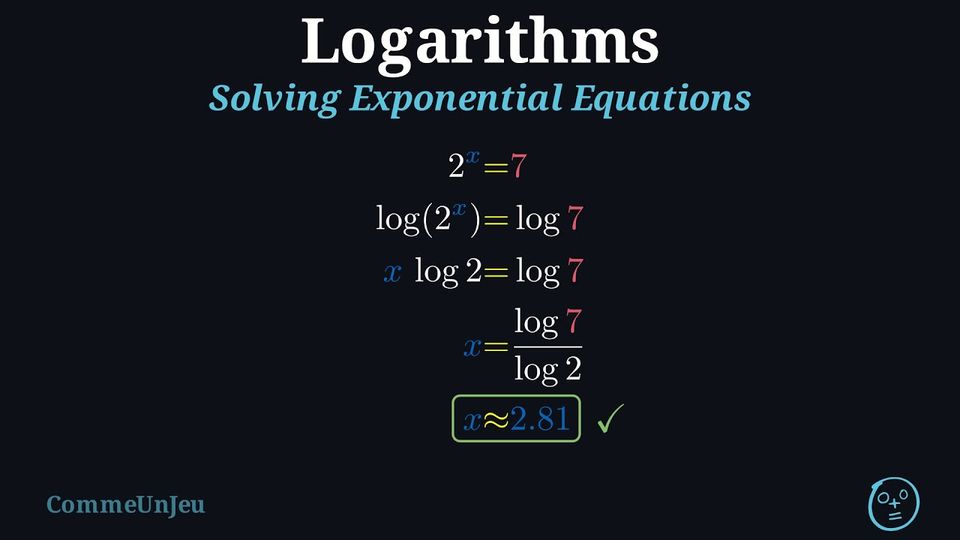
To solve an exponential equation of the form \(a^x = b\) (where \(a > 0\), \(a \neq 1\), \(b > 0\)): - Take the logarithm (base 10) of both sides: \(\log(a^x) = \log b\)
- Apply the power rule: \(x \log a = \log b\)
- Solve for \(x\): \(x = \dfrac{\log b}{\log a}\)
Example
Solve \(2^x = 7\).
$$\begin{aligned} 2^x &= 7 \\
\log(2^x) &= \log 7 &&\text{(taking the logarithm of both sides)}\\
x \log 2 &= \log 7 &&\text{(power rule)}\\
x &= \frac{\log 7}{\log 2} &&\text{(dividing both sides by } \log 2\text{)}\\
x &\approx 2.807 &&\text{(using a calculator)}\\
\end{aligned}$$
Skills to practice
- Solving Exponential Equations: Level 1
- Solving Exponential Equations: Level 2
II.2
Applications of Logarithms
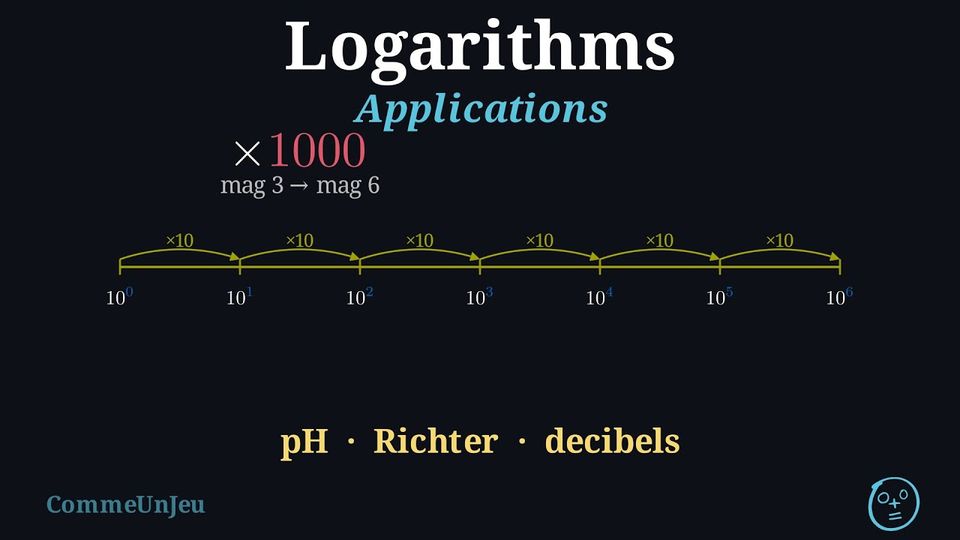
Logarithms are used to describe quantities that vary over many orders of magnitude. In the scientific formulas below, the base-10 logarithm is written in full as \(\log_{10}\). Some important examples in science include:
- pH scale in chemistry: \(\text{pH} = -\log_{10} [H^+]\)
(where \([H^+]\) is the numerical value of the hydrogen ion concentration in moles per litre) - Richter scale for earthquakes (simplified model): \(\text{Magnitude} = \log_{10}\left(\dfrac{I}{I_0}\right)\)
(where \(I\) is the intensity of the earthquake, \(I_0\) is a reference intensity) - Decibel (dB) scale for sound: \(L = 10 \log_{10}\left(\dfrac{P}{P_0}\right)\)
(where \(P\) is the power/intensity measured, \(P_0\) is a reference level)
Example
The pH of a solution is \(3.2\). Find the hydrogen ion concentration \([H^+]\).
We know: $$\begin{aligned} \text{pH} &= -\log_{10}[H^+] \\
3.2 &= -\log_{10}[H^+] &&\text{(substituting the value)}\\
-3.2 &= \log_{10}[H^+] &&\text{(multiplying both sides by \(-1\))}\\
10^{-3.2} &= 10^{\log_{10}[H^+]} &&\text{(exponentiating both sides, base 10)}\\
[H^+] &= 10^{-3.2} \\
[H^+] &\approx 6.31 \times 10^{-4}\ \text{mol/L} &&\text{(using a calculator)} \end{aligned}$$
These scales compress orders of magnitude: a pH of \(3\) against a pH of \(4\) is a concentration ten times larger. The logarithm gives this order of magnitude directly — and with it, the number of digits of an integer.
Proposition — Order of Magnitude and Number of Digits
Let \(N\) be a positive number. - Order of magnitude: for every integer \(k\), \(10^{k} \leq N \lt 10^{k+1}\) if and only if \(k \leq \log N \lt k + 1\). The order of magnitude of \(N\) is this power \(10^k\), the greatest power of \(10\) that does not exceed \(N\); for \(N \geq 1\), \(k\) is the integer part of \(\log N\).
- Number of digits: an integer \(N \geq 1\) has exactly \(k\) digits (\(k \geq 1\)) if and only if \(k - 1 \leq \log N \lt k\). The number of digits of \(N\) is the integer part of \(\log N\), plus \(1\).
By definition of the logarithm, \(N = 10^{\log N}\). The powers of \(10\) increase with their exponent, so \(10^{k} \leq 10^{\log N} \lt 10^{k+1}\) holds exactly when \(k \leq \log N \lt k + 1\). An integer with \(k\) digits is at least \(10^{k-1}\) (the smallest \(k\)-digit integer, a \(1\) followed by \(k-1\) zeros) and less than \(10^k\) (the smallest \((k+1)\)-digit integer): this is the first statement, applied to the exponent \(k - 1\).
Example
- The number of particles in a mole is about \(6.02 \times 10^{23}\). Find its order of magnitude with a logarithm.
- How many digits does \(3^{100}\) have?
- A bacterium population doubles every hour; after \(n\) hours there are \(2^n\) bacteria. After how many hours does the count reach \(10\) digits?
- Let \(N = 6.02 \times 10^{23}\). Then \(\log N = \log 6.02 + \log\left(10^{23}\right) = \log 6.02 + 23 \approx 0.78 + 23 = 23.78\) (product rule). So \(23 \leq \log N \lt 24\): the order of magnitude is \(10^{23}\).
- \(\begin{aligned}[t]\log(3^{100}) &= 100 \log 3 &&\text{(logarithm of a power)}\\ &\approx 100 \times 0.4771 \\ &\approx 47.71\end{aligned}\)
Since \(47 \leq 47.71 \lt 48\), the number \(3^{100}\) has \(48\) digits. - \(2^n\) has \(10\) digits when \(9 \leq n \log 2 \lt 10\), that is \(\dfrac{9}{\log 2} \leq n \lt \dfrac{10}{\log 2}\), about \(29.9 \leq n \lt 33.2\). The count reaches \(10\) digits after \(30\) hours (\(2^{30} = 1\,073\,741\,824\)).
Skills to practice
- Applying Logarithms in Science
- Counting Digits
III
Logarithms in Other Bases
III.1
Logarithms in Base \(a\)
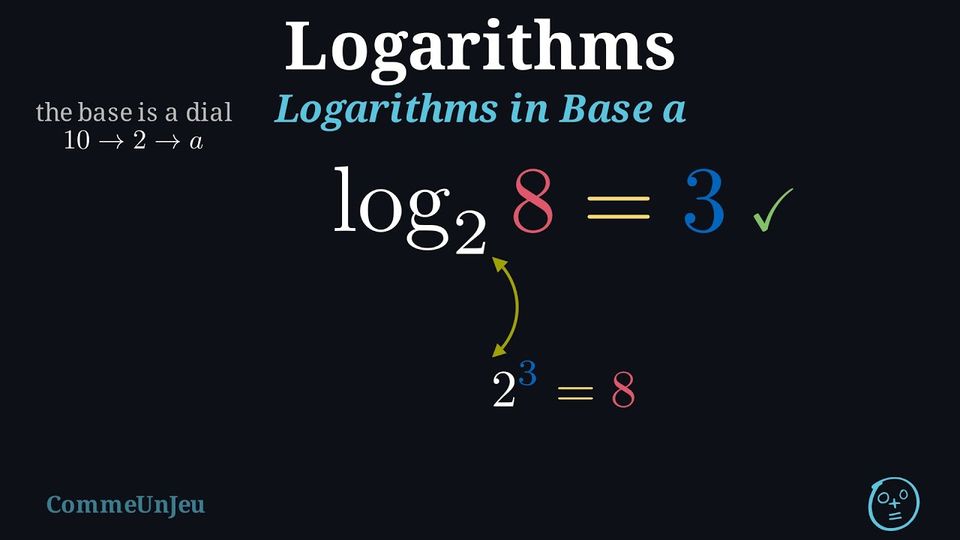
The logarithm in base \(10\) of a number is the exponent to which \(10\) must be raised in order to obtain that number.
We can use the same principle to define logarithms in other bases:
We can use the same principle to define logarithms in other bases:
Definition — Logarithm in Base a
For a positive number \(a \neq 1\), the logarithm base \(a\) of a number \(y\) (where \(y > 0\)) is the exponent to which \(a\) must be raised to obtain \(y\). It is denoted as:$$\log_a y = x \quad \Leftrightarrow \quad a^x = y.$$ Proposition — Inverse Properties of Logarithms in Base a
Let \(a>0\) with \(a\neq 1\). - \(a^{\log_a x} = x\) for any \(x > 0\),
- \(\log_a (a^x) = x\) for any real \(x\).
These properties show that the exponential function \(a^x\) and the logarithm function \(\log_a x\) are inverses of each other.
Example
Evaluate \(\log_2 8\).
\(\begin{aligned}[t]\log_2 8 &= \log_2 (2^3) &&(8 = 2^3)\\&=3\\\end{aligned}\)
The three laws of logarithms (product, quotient, power) hold in any base \(a\).
Method — Solving Exponential Equations with Base a
To solve \(a^x = b\) (where \(a > 0\), \(a \neq 1\), \(b > 0\)): - Take the logarithm base \(a\) of both sides: \(\log_a (a^x) = \log_a b\)
- Simplify: \(x = \log_a b\)
Example
Solve \(3^x = 81\).
$$\begin{aligned}3^x &= 81 \\
\log_3 (3^x) &= \log_3 (81) &&\text{(applying \(\log_3\) to both sides)}\\
x &= \log_3 (3^4) &&(\log_3(3^x) = x,\ 81 = 3^4)\\
x &= 4\end{aligned}$$
Skills to practice
- Evaluating Logarithms in Base \(a\)
- Finding \(x\) When \(\log_a x\) Is Given
- Using the Laws in Base \(a\)
III.2
Change of Base Rule
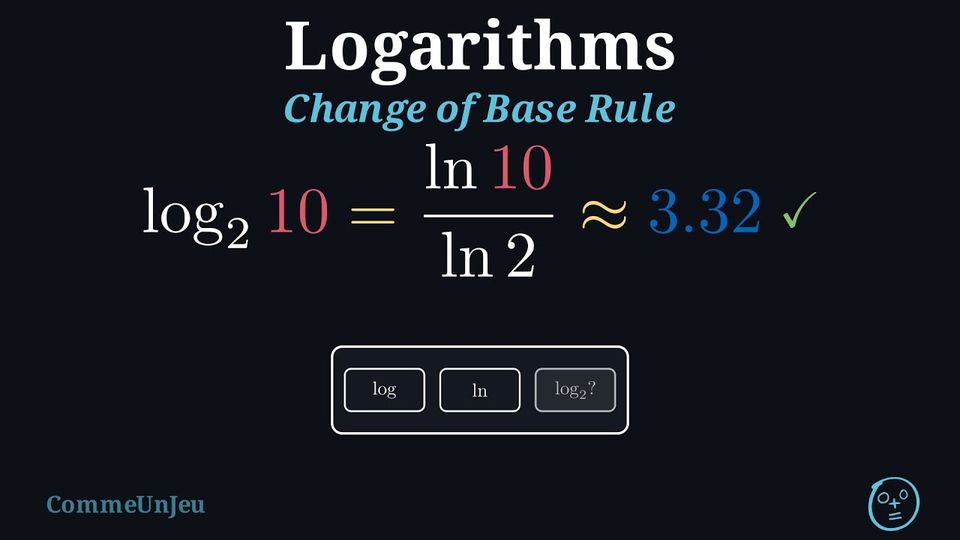
Proposition — Change of Base Rule
For any \(a>0\), \(a \neq 1\), \(b>0\), \(b \neq 1\), and \(x > 0\):$$\log_a x = \frac{\log_b x}{\log_b a}.$$
Let \(y = \log_a x\).$$\begin{aligned}a^y &= a^{\log_a x} &&\text{(applying \(a^{(\cdot)}\) to both sides)}\\
a^y &= x &&(a^{\log_a x} = x)\\
\log_b\left(a^y\right) &= \log_b x &&\text{(applying \(\log_b\) to both sides)}\\
y \log_b a &= \log_b x &&\text{(power rule)}\\
y &= \frac{\log_b x}{\log_b a} &&\text{(dividing by \(\log_b a\), not zero since \(a \neq 1\))}\\
\log_a x &= \frac{\log_b x}{\log_b a} &&(y = \log_a x) \end{aligned}$$
With \(b = 10\), the rule reads \(\log_a x = \dfrac{\log x}{\log a}\): every logarithm can be computed with the \(\log\) key of a calculator. The two ways of solving \(a^x = c\) (with \(c > 0\)) therefore agree: taking the base-10 logarithm of both sides gives \(x = \dfrac{\log c}{\log a}\), taking the base-\(a\) logarithm gives \(x = \log_a c\), and these are the same number.
Example
Evaluate \(\log_3 20\) with base-10 logarithms (round to 3 decimal places).
$$\begin{aligned}\log_3 20 &= \frac{\log 20}{\log 3} &&\text{(change of base, \(b = 10\))}\\
&\approx \frac{1.30103}{0.47712} &&\text{(using a calculator)}\\
&\approx 2.727\end{aligned}$$ Check: \(3^2 = 9 < 20 < 27 = 3^3\), so \(\log_3 20\) lies between \(2\) and \(3\).
Skills to practice
- Evaluating Logarithms with the Change of Base Rule
IV
The Logarithmic Function
IV.1
The Function \(x \mapsto \log x\)
The logarithm is the inverse operation of exponentiation. Just as these two operations are algebraically linked, their graphs are also deeply connected.
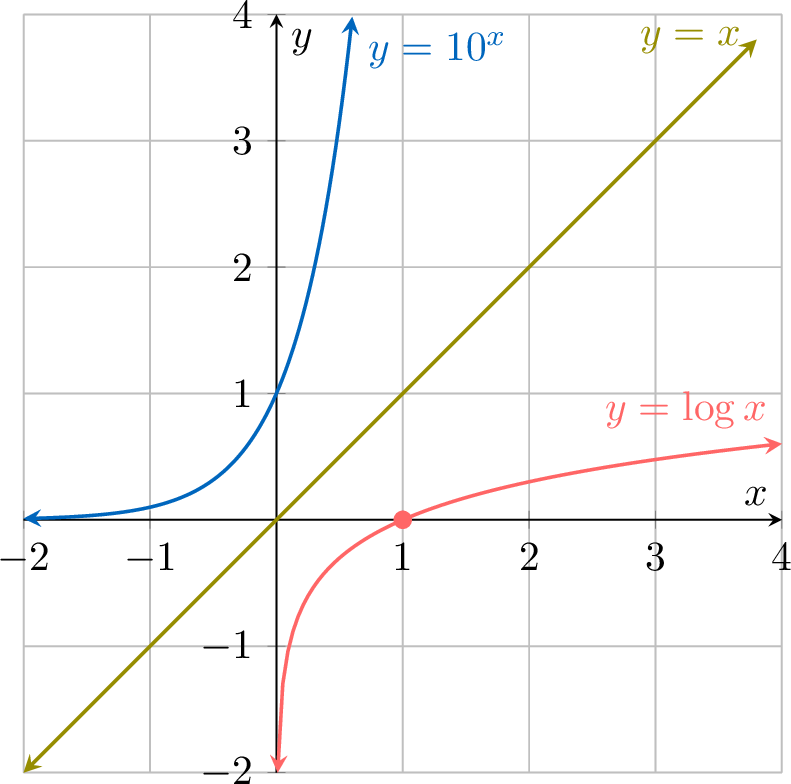
Logarithmic functions are read on their graphs. The graph of a logarithmic function, such as \(y = \log(x)\), is the reflection of the graph of the corresponding exponential function, \(y = 10^x\), in the line \(y=x\).
This chapter studies the key features of these graphs: their domain and range, their vertical asymptotes and their intercepts.
Definition — Logarithmic Function
The logarithmic function is \(f(x) = \log(x)\). It is the inverse of the exponential function \(g(x)=10^x\). - Domain: \((0, +\infty)\)
- Range: \((-\infty, +\infty)\)
Proposition — Graph of the Logarithmic Function
The graph of \(\textcolor{colordef}{y = \log(x)}\) is the reflection of the graph of \(\textcolor{colorprop}{y = 10^x}\) in the line \(\textcolor{olive}{y = x}\). Key features of the graph of \(y=\log(x)\): - It has a vertical asymptote at the y-axis (\(x=0\)).
- It passes through the point (1, 0).
- It is an increasing function.
Example
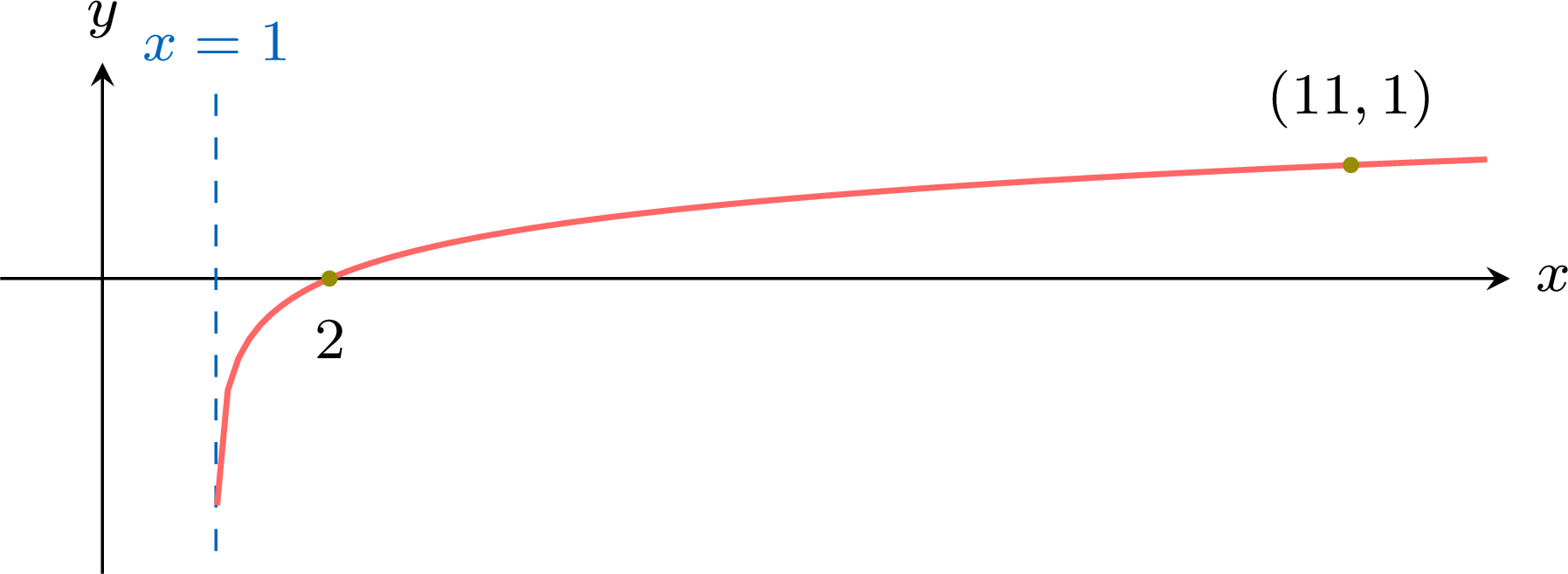
Study the function \(f(x) = \log(x - 1)\): domain, asymptote, intercept, and sketch. - Domain: the logarithm needs a positive input: \(x - 1 > 0\), so the domain is \((1, +\infty)\).
- Vertical asymptote: at the edge of the domain, \(x = 1\) (the whole curve of \(\log\) is shifted \(1\) unit right, and its asymptote moves with it).
- \(x\)-intercept: \(f(x) = 0\) when \(\log(x-1) = 0\), i.e. \(x - 1 = 1\) (since \(\log 1 = 0\)): the point \((2, 0)\).
- One exact point: \(f(11) = \log(10) = 1\) (ten to the power \(1\)): the point \((11, 1)\).
Skills to practice
- Finding Domains
- Calculating Values and Finding Asymptotes
V
Going further
Skills to practice
- Explaining and Reasoning with the Laws
- Modelling with Logarithms
- Investigating Patterns with Logarithms
- Quiz
Jump to section