International Baccalaureate · MYP 5 Extended
Introduction to Calculus (Optional)
I
Finding a Rate of Change
Going furtherbeyond the syllabus — click to explore
Take two points \(A\) and \(B\) on the curve of a function \(f\). The line \((AB)\) is called a secant line of the curve. Its slope measures how much \(f\) changes, on average, between the \(x\)-coordinates of \(A\) and \(B\): this is the rate of change of \(f\).
Definition — Rate of Change
The rate of change of a function \(f\) between two points \(A(a, f(a))\) and \(B(b, f(b))\) (with \(a \neq b\)) is the gradient of the secant line \((AB)\).$$ \textcolor{colordef}{\text{Rate of change} = \dfrac{f(b)-f(a)}{b-a}} $$ 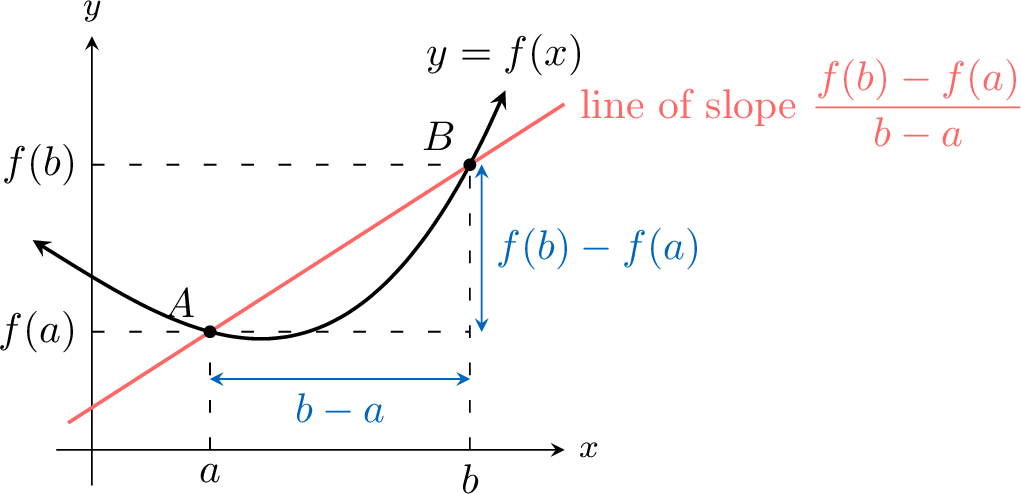
Example
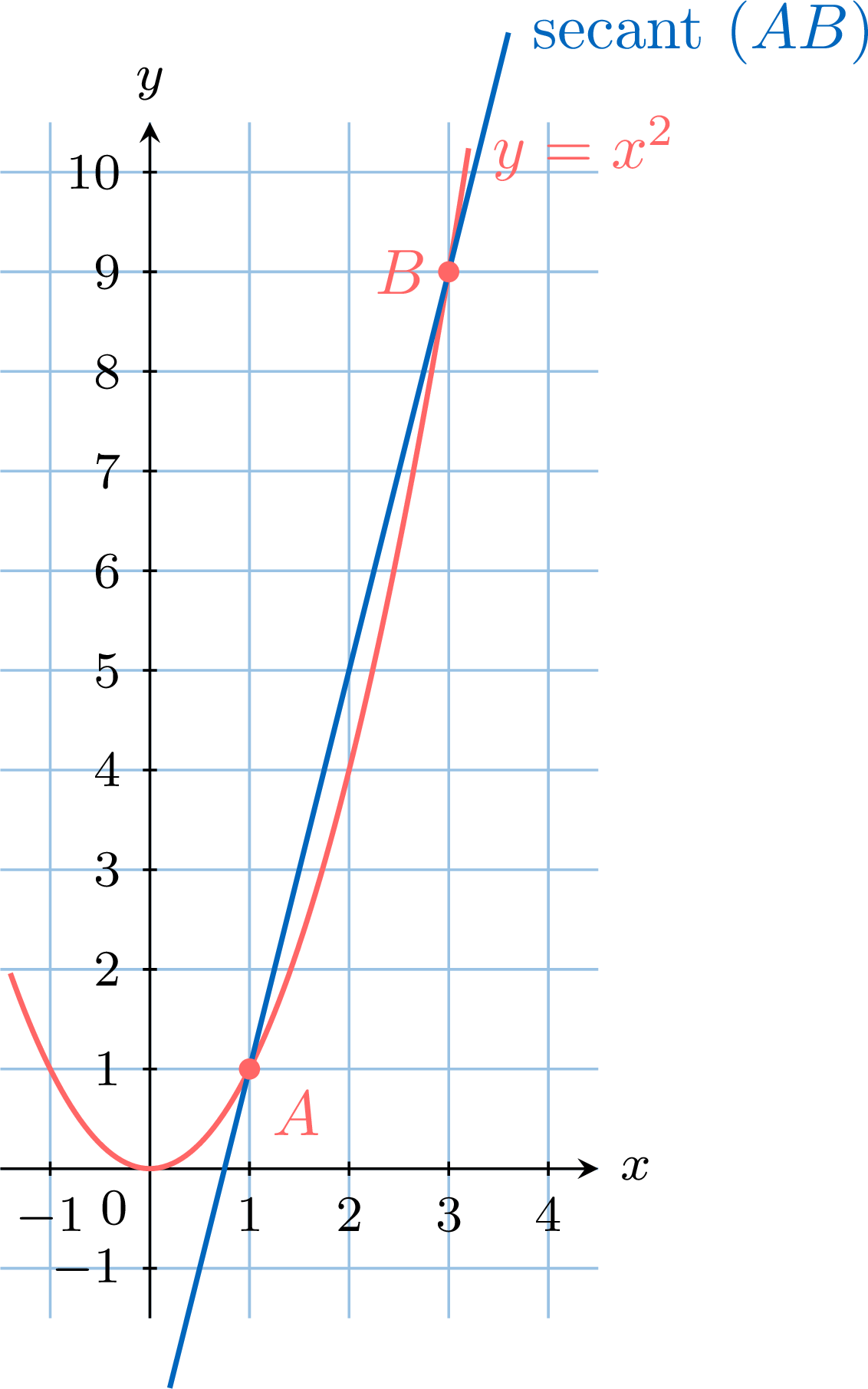
Let \(f(x) = x^2\). - Compute the rate of change of \(f\) between \(1\) and \(3\), and interpret it with the secant line.
- Compute the rate of change of \(f\) between \(-1\) and \(2\).
- \(f(1) = 1\) and \(f(3) = 9\), so $$ \dfrac{f(3)-f(1)}{3-1} = \dfrac{9-1}{2} = 4. $$ The secant line through \(A(1, 1)\) and \(B(3, 9)\) has slope \(4\): between \(x = 1\) and \(x = 3\), \(f(x)\) increases on average by \(4\) when \(x\) increases by \(1\).
- \(f(-1) = 1\) and \(f(2) = 4\), so $$ \dfrac{f(2)-f(-1)}{2-(-1)} = \dfrac{4-1}{3} = 1. $$
Definition — Increasing and Decreasing Functions
Let \(I\) be an interval contained in the domain of a function \(f\). - \(f\) is increasing on \(I\) if for all \(x_1, x_2 \in I\) such that \(x_1 < x_2\), we have \(f(x_1) \leq f(x_2)\); it is strictly increasing if \(f(x_1) < f(x_2)\).
- \(f\) is decreasing on \(I\) if for all \(x_1, x_2 \in I\) such that \(x_1 < x_2\), we have \(f(x_1) \geq f(x_2)\); it is strictly decreasing if \(f(x_1) > f(x_2)\).
Definition — Monotonic Function
A function \(f\) is monotonic on an interval \(I\) if it is increasing on \(I\) or decreasing on \(I\): on \(I\), it never changes direction. Proposition — Monotonic Functions and the Sign of the Rate of Change
Let \(f\) be a function defined on an interval \(I\). - \(f\) is increasing on \(I\) if and only if, for all distinct numbers \(a\) and \(b\) of \(I\), \(\dfrac{f(b)-f(a)}{b-a} \geq 0\).
- \(f\) is decreasing on \(I\) if and only if, for all distinct numbers \(a\) and \(b\) of \(I\), \(\dfrac{f(b)-f(a)}{b-a} \leq 0\).
Exchanging \(a\) and \(b\) changes the sign of both \(f(b)-f(a)\) and \(b-a\), so it does not change the rate of change: it is enough to take \(a \lt b\). Then \(b - a \gt 0\), so the rate of change \(\dfrac{f(b)-f(a)}{b-a}\) has the sign of \(f(b)-f(a)\). Hence all the rates of change on \(I\) are positive or zero if and only if \(f(a) \leq f(b)\) whenever \(a \lt b\) in \(I\), that is, if and only if \(f\) is increasing on \(I\). The decreasing case is identical, with \(f(a) \geq f(b)\).
Example
Let \(f(x) = x^2\). - Show that, for all distinct numbers \(a\) and \(b\), the rate of change of \(f\) between \(a\) and \(b\) is \(a + b\).
- Deduce that \(f\) is increasing on \([0, \infty)\) and decreasing on \((-\infty, 0]\).
- The rate of change of \(f\) between \(-1\) and \(3\) is positive. Is \(f\) monotonic on \([-1, 3]\)?
- \(\begin{aligned}[t]\dfrac{f(b)-f(a)}{b-a} &= \dfrac{b^2-a^2}{b-a} \\ &= \dfrac{(b-a)(b+a)}{b-a} \\ &= a+b\end{aligned}\)
- If \(a\) and \(b\) are distinct numbers of \([0, \infty)\), then \(a + b \gt 0\): all the rates of change are positive, so \(f\) is increasing on \([0, \infty)\). If \(a\) and \(b\) are distinct numbers of \((-\infty, 0]\), then \(a + b \lt 0\): all the rates of change are negative, so \(f\) is decreasing on \((-\infty, 0]\).
- Between \(-1\) and \(3\) the rate of change is \(-1 + 3 = 2\), but between \(-1\) and \(0\) it is \(-1 + 0 = -1\). The rates of change on \([-1, 3]\) do not all have the same sign: \(f\) is not monotonic on \([-1, 3]\). One positive rate of change does not prove that \(f\) is increasing: the property asks for all of them.
Skills to practice
- Linking Monotonicity and the Sign of the Rate of Change
- Finding Rates of Change
II
Defining the Derivative at a Point
Going furtherbeyond the syllabus — click to explore
To find the rate of change at a single point \(A\), we can examine the average rate of change over a very small interval. Let the second point be \(B(a+h, f(a+h))\), where \(h\) is a small change in \(x\). The gradient of the secant line \((AB)\) is given by:$$ \dfrac{f(a+h) - f(a)}{(a+h)-a} = \dfrac{f(a+h) - f(a)}{h} $$ As we let \(B\) get closer to \(A\), the value of \(h\) approaches 0. The secant line approaches the tangent line at point A. The limit of the secant slopes is the slope of the tangent, which we define as the instantaneous rate of change. 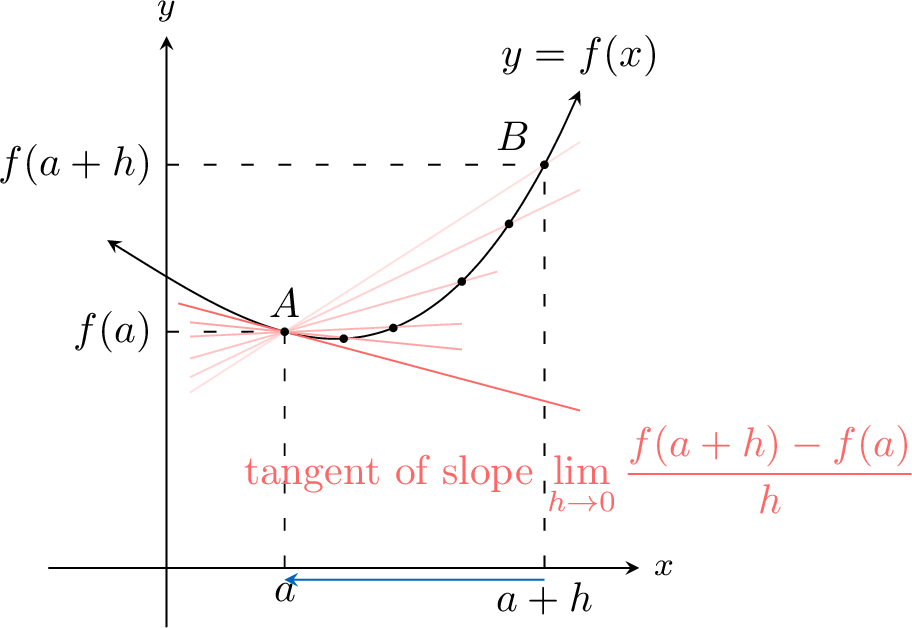
Definition — The Derivative at a Point
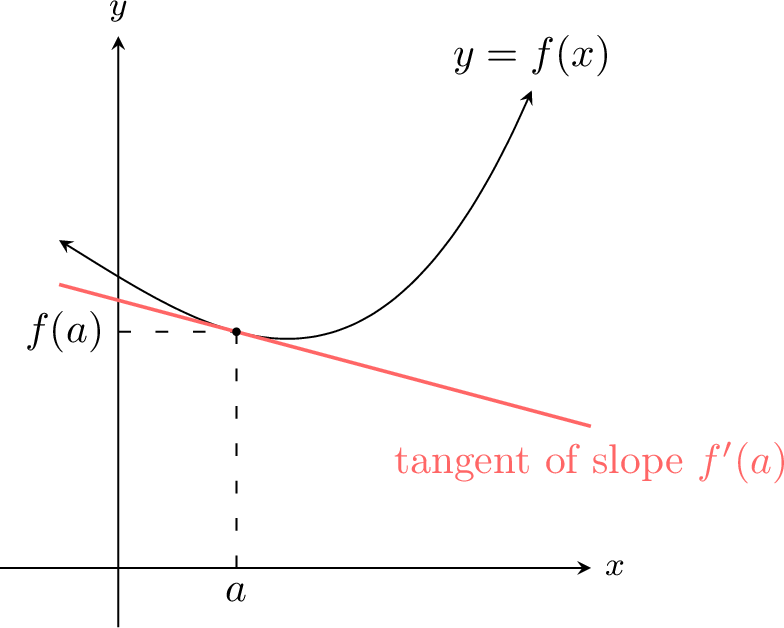
Let \(f\) be a function defined on an interval containing \(a\). When the limit of the rate of change below exists and is a real number, \(f\) is said to be differentiable at \(a\), and that limit is called the derivative of \(f\) at \(a\), written \(f'(a)\):$$ \textcolor{colordef}{f'(a) = \lim_{h \to 0} \dfrac{f(a+h)-f(a)}{h}} $$ Geometrically, \(f'(a)\) is the slope of the tangent line to the graph of \(f\) at the point \((a, f(a))\). It is also the instantaneous rate of change of \(f\) at \(a\).When this limit does not exist, or is infinite, \(f\) is not differentiable at \(a\): the curve has no tangent of finite slope at that point.
Example
Use first principles to find the derivative of \(f(x)=x^2\) at the point \(x=1\).
We evaluate the limit of the rate of change as \(h \to 0\).$$\begin{aligned}\dfrac{f(1+h)-f(1)}{h} &= \dfrac{(1+h)^2 - 1^2}{h} \\
&= \dfrac{(1+2h+h^2) - 1}{h} \\
&= \dfrac{2h+h^2}{h} \\
&= \dfrac{h(2+h)}{h} \\
&= 2+h \quad (\text{for } h \neq 0)\end{aligned}$$ Now, we take the limit:$$ f'(1) = \lim_{h \to 0} (2+h) = 2 $$ The derivative at \(x=1\) is 2. This means the slope of the tangent line to the graph of \(f(x)=x^2\) at the point \((1,1)\) is 2. The diagram below shows how the slope of the secant line from \((1,1)\) to \((1+h, f(1+h))\) approaches the slope of the tangent as \(h\) gets smaller. 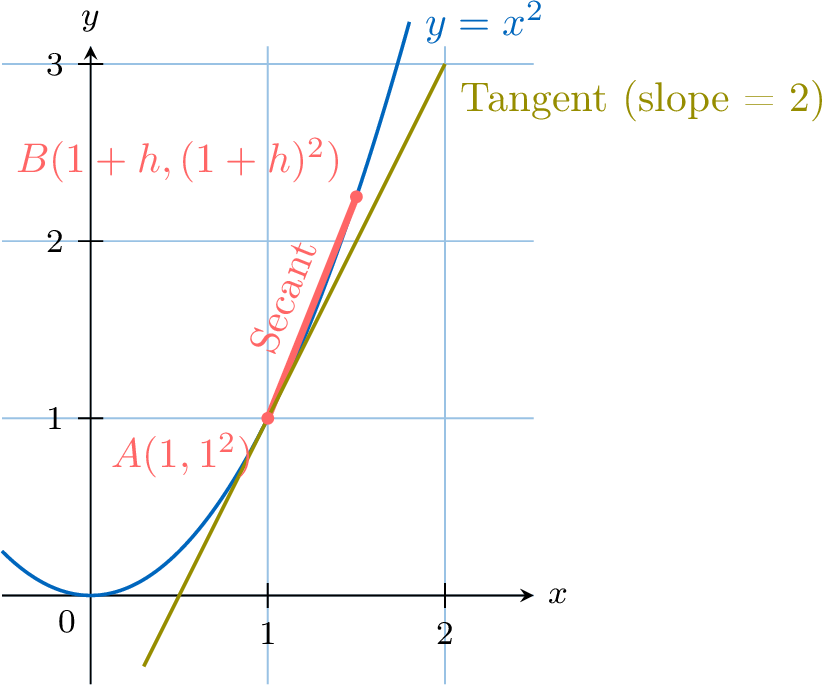
Example
A ball is dropped from a tower. The distance it has fallen after \(t\) seconds is \(d(t) = 5t^2\) (in metres). - Compute the average speed of the ball between \(t = 2\) and \(t = 3\).
- Using the definition of the derivative, compute \(d'(2)\) and interpret this number.
- The average speed is the rate of change of \(d\) between \(2\) and \(3\): $$ \dfrac{d(3)-d(2)}{3-2} = \dfrac{45 - 20}{1} = 25\ \text{m/s}. $$
- For \(h \neq 0\), $$\begin{aligned} \dfrac{d(2+h)-d(2)}{h} &= \dfrac{5(2+h)^2 - 20}{h} \\ &= \dfrac{20 + 20h + 5h^2 - 20}{h} \\ &= \dfrac{h(20 + 5h)}{h} \\ &= 20 + 5h \xrightarrow[h \to 0]{} 20. \end{aligned}$$ So \(d'(2) = 20\): at the instant \(t = 2\), the ball falls at the instantaneous speed of \(20\ \text{m/s}\). It is smaller than the average speed on \([2, 3]\) because the ball keeps accelerating.
Skills to practice
- Finding the Derivative Graphically
- Finding and Interpreting the Derivative at a Point
III
Finding the Derivative Function
Going furtherbeyond the syllabus — click to explore
By finding the derivative at a general point \(x\) instead of a specific point \(a\), we can construct a new function, \(f'(x)\), whose value at any \(x\) is the slope of the tangent to the original function \(f(x)\) at that point.
The process of finding the derivative using this limit is called differentiation from first principles.
The process of finding the derivative using this limit is called differentiation from first principles.
Definition — The Derivative Function
The derivative function of \(f\), denoted \(f'\), is the function defined by:$$ f'(x) = \lim_{h \to 0} \dfrac{f(x+h)-f(x)}{h} $$ Example
For \(f(x)=x^2\), find \(f'(x)\).
We evaluate the limit of the rate of change.$$\begin{aligned}\dfrac{f(x+h)-f(x)}{h} &= \dfrac{(x+h)^2 - x^2}{h} \\
&= \dfrac{x^2+2xh+h^2-x^2}{h} \\
&= \dfrac{2xh+h^2}{h}\\
&= \dfrac{h(2x+h)}{h}\\
& = 2x+h \quad (\text{for } h \neq 0)\\
&\xrightarrow[h \to 0]{ } 2x.\end{aligned}$$ So$$ f'(x) = \lim_{h \to 0} \dfrac{f(x+h)-f(x)}{h} = 2x $$
Definition — Leibniz Notation
Let \(y\) be a function of \(x\), i.e., \(y=f(x)\).The derivative function can be written as:$$ \dfrac{\mathrm{d}y}{\mathrm{d}x}=f'(x)$$ This is read as “dee y by dee x” and represents the derivative of \(y\) with respect to the variable \(x\).
Example
For \(y=x^2\), find \(\dfrac{\mathrm{d}y}{\mathrm{d}x}\).
The derivative of \(x^2\) is \(2x\). In Leibniz notation, we write:$$ \dfrac{\mathrm{d}y}{\mathrm{d}x} = 2x $$
Skills to practice
- Using the Definition of the Derivative
IV
Differentiating with the Rules
Going furtherbeyond the syllabus — click to explore
Proposition — Derivatives of the Reference Functions
| Function \(f\) | \(f\) is differentiable for | Derivative \(f'\) |
| \(f(x) = k\) (constant) | all \(x \in \mathbb{R}\) | \(f'(x) = 0\) |
| \(f(x) = x\) | all \(x \in \mathbb{R}\) | \(f'(x) = 1\) |
| \(f(x) = x^2\) | all \(x \in \mathbb{R}\) | \(f'(x) = 2x\) |
| \(f(x) = x^3\) | all \(x \in \mathbb{R}\) | \(f'(x) = 3x^2\) |
| \(f(x) = x^n\) with \(n \in \mathbb{Z}\), \(n \geq 1\) | all \(x \in \mathbb{R}\) | \(f'(x) = nx^{n-1}\) |
| \(f(x) = \dfrac{1}{x}\) | \(x \neq 0\) | \(f'(x) = -\dfrac{1}{x^2}\) |
| \(f(x) = x^n\) with \(n \in \mathbb{Z}\), \(n \leq -1\) | \(x \neq 0\) | \(f'(x) = nx^{n-1}\) |
| \(f(x) = \sqrt{x}\) | \(x > 0\) | \(f'(x) = \dfrac{1}{2\sqrt{x}}\) |
Constant, \(x\) and \(x^2\). For \(f(x) = k\), the rate of change is \(\dfrac{k - k}{h} = 0\); for \(f(x) = x\), it is \(\dfrac{(x+h) - x}{h} = 1\). For \(f(x) = x^2\): $$ \dfrac{(x+h)^2 - x^2}{h} = \dfrac{2xh + h^2}{h} = 2x + h \xrightarrow[h \to 0]{} 2x. $$ Inverse. For \(x \neq 0\) and \(h\) small enough that \(x + h \neq 0\), $$ \dfrac{\frac{1}{x+h} - \frac{1}{x}}{h} = \dfrac{\frac{x - (x+h)}{x(x+h)}}{h} = \dfrac{-h}{h\,x(x+h)} = -\dfrac{1}{x(x+h)} \xrightarrow[h \to 0]{} -\dfrac{1}{x \times x} = -\dfrac{1}{x^2}. $$ Square root. For \(x > 0\), we multiply the numerator and the denominator by \(\sqrt{x+h} + \sqrt{x}\) (the conjugate expression): $$ \dfrac{\sqrt{x+h}-\sqrt{x}}{h} = \dfrac{\left(\sqrt{x+h}-\sqrt{x}\right)\left(\sqrt{x+h}+\sqrt{x}\right)}{h\left(\sqrt{x+h}+\sqrt{x}\right)} = \dfrac{(x+h) - x}{h\left(\sqrt{x+h}+\sqrt{x}\right)} = \dfrac{1}{\sqrt{x+h}+\sqrt{x}} \xrightarrow[h \to 0]{} \dfrac{1}{2\sqrt{x}}. $$ Powers. For \(f(x) = x^3\), since \((x+h)^3 = x^3 + 3x^2h + 3xh^2 + h^3\), $$ \dfrac{(x+h)^3 - x^3}{h} = \dfrac{h(3x^2 + 3xh + h^2)}{h} = 3x^2 + 3xh + h^2 \xrightarrow[h \to 0]{} 3x^2. $$ The general formula \((x^n)' = nx^{n-1}\) for \(n \in \mathbb{Z}\) is admitted: for \(n \geq 1\) the computation follows the same pattern, and for \(n \leq -1\) it follows from the case \(n \geq 1\) and the derivative of the reciprocal of a function.
Proposition — Basic Derivative Rules
- Constant Rule: If \(f(x)=c\), then \(f'(x)=0\).
- Power Rule: If \(f(x)=x^n\), then \(f'(x)=nx^{n-1}\) for any integer \(n\) — at every \(x \neq 0\) when \(n < 0\); for \(n = 0\), \(f\) is constant and \(f' = 0\) (and, admitted, for any real \(n\) when \(x > 0\)).
- Constant Multiple Rule: If \(f(x)=c \cdot u(x)\) with \(u\) differentiable, then \(f'(x)=c \cdot u'(x)\).
- Sum Rule: If \(f(x)=u(x) + v(x)\) with \(u\) and \(v\) differentiable, then \(f'(x)=u'(x) + v'(x)\).
Proof for if \(f(x)=u(x)+v(x)\), then \(f'(x)=u'(x)+v'(x)\):
We evaluate the limit of the rate of change.$$\begin{aligned}\dfrac{f(x+h)-f(x)}{h} &= \dfrac{\left[u(x+h)+v(x+h)\right] - \left[u(x)+v(x)\right]}{h} \\ &= \dfrac{\left[u(x+h)-u(x)\right] + \left[v(x+h)-v(x)\right]}{h} \\ &= \dfrac{u(x+h)-u(x)}{h} + \dfrac{v(x+h)-v(x)}{h} \\ &\xrightarrow[h \to 0]{ } u'(x) + v'(x)\quad \text{(sum of limits)}.\end{aligned}$$ So \( f'(x) = u'(x)+v'(x) \).
The other proofs are done in the exercises.
One Formula for the Powers
The lines of the table from the constant to \(\dfrac{1}{x}\) are one and the same formula, \((x^n)' = nx^{n-1}\), applied with an integer \(n \geq -1\) (at \(x \neq 0\) when \(n \leq 0\)): \renewcommand{\arraystretch}{1.5}
Remembering this single formula is enough to rebuild these lines: writing \(\dfrac{1}{x}\) as \(x^{-1}\) and a constant \(k\) as \(k\,x^0\) lets it be applied term by term. (A constant function also has derivative \(0\) at \(x = 0\), as the table says: the restriction \(x \neq 0\) only comes from the power \(x^{-1}\) in \(0 \times x^{-1}\).)
| \(n\) | \(x^n\) | \(nx^{n-1}\) | line of the table |
| \(-1\) | \(x^{-1} = \dfrac{1}{x}\) | \((-1)\,x^{-2}\) | \(-\dfrac{1}{x^2}\) |
| \(0\) | \(x^0 = 1\) | \(0 \times x^{-1} = 0\) | constant: \(0\) |
| \(1\) | \(x^1 = x\) | \(1 \times x^0 = 1\) | \(1\) |
| \(2\) | \(x^2\) | \(2x^1\) | \(2x\) |
| \(3\) | \(x^3\) | \(3x^2\) | \(3x^2\) |
Proposition — Derivative of a Polynomial of Degree at Most 3
The following functions are differentiable on \(\mathbb{R}\): | \(f(x)\) | \(k\) (constant) | \(x\) | \(x^2\) | \(x^3\) |
| \(f'(x)\) | \(0\) | \(1\) | \(2x\) | \(3x^2\) |
- Sum: \((u + v)' = u' + v'\);
- Constant multiple: \((k\,u)' = k\,u'\).
Example
Find the derivative of \(f(x) = 4x^3 - 5x^2 + 7x - 2\).
We apply the rules to each term:$$\begin{aligned}f'(x) &= \dfrac{\mathrm{d}}{\mathrm{d}x}(4x^3) - \dfrac{\mathrm{d}}{\mathrm{d}x}(5x^2) + \dfrac{\mathrm{d}}{\mathrm{d}x}(7x) - \dfrac{\mathrm{d}}{\mathrm{d}x}(2) \\
&= 4(3x^2) - 5(2x) + 7(1) - 0 \\
&= 12x^2 - 10x + 7\end{aligned}$$
Example
Let \(f(x) = x^3 - 3x^2 + 2\). - Compute \(f'(x)\).
- Give the slope of the tangent to the curve of \(f\) at the points with \(x\)-coordinates \(0\), \(1\) and \(2\).
- Check that \(f'(x) = 3x(x - 2)\), then give the points of the curve where the tangent is horizontal.
- \(\begin{aligned}[t]f'(x) &= 3x^2 - 3 \times 2x + 0 &&\text{(sum and constant multiple)}\\ &= 3x^2 - 6x\end{aligned}\)
- The slope of the tangent at the point with \(x\)-coordinate \(a\) is \(f'(a)\): \(f'(0) = 0\), \(f'(1) = 3 - 6 = -3\) and \(f'(2) = 12 - 12 = 0\).
- \(3x(x - 2) = 3x^2 - 6x = f'(x)\). The tangent is horizontal when \(f'(x) = 0\), that is \(3x(x - 2) = 0\), so \(x = 0\) or \(x = 2\). Since \(f(0) = 2\) and \(f(2) = 8 - 12 + 2 = -2\), the tangent is horizontal at the points \((0, 2)\) and \((2, -2)\).
Skills to practice
- Recognising the Derivative of a Polynomial
- Applying the Power Rule
- Differentiating a Polynomial of Degree at Most 3
- Differentiating Functions with Fractional and Negative Exponents
- Proving Basic Rules and Power Functions
V
Writing the Equation of a Tangent
Going furtherbeyond the syllabus — click to explore
The most direct geometric interpretation of the derivative is that it gives the slope of the tangent line. Finding the equation of this line is a fundamental application of differentiation.
Proposition — Equation of the Tangent
Assume \(f\) is differentiable at \(x=a\) and that the tangent is not vertical. Then the equation of the tangent to the curve \(y=f(x)\) at the point \((a, f(a))\) is:$$\textcolor{colorprop}{y = f^{\prime}(a)(x-a) +f(a)}$$ 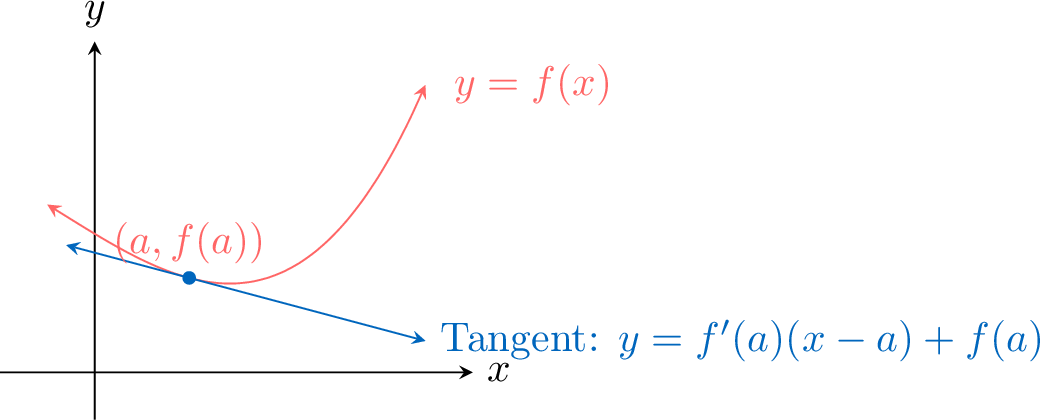
Let \(B(x,y)\) be any point on the tangent line. The point of tangency is \(A(a,f(a))\), which also belongs to the tangent line.
The gradient (also called slope) of a line is given by the formula \(m = \dfrac{\Delta y}{\Delta x}\). Using points \(A\) and \(B\), the slope of the tangent line is:$$ m = \dfrac{y-f(a)}{x-a}\quad \text{for }x\neq a. $$ By definition, the slope of the tangent to the curve \(y=f(x)\) at the point \(x=a\) is the value of the derivative at that point, so:$$ m = f'(a). $$ Equating the two expressions for the slope, we get:$$ f'(a) = \dfrac{y-f(a)}{x-a}. $$ Multiplying both sides by \((x-a)\) gives the point-gradient form (also called point-slope form) of the equation:$$ y - f(a) = f'(a)(x-a). $$ Making \(y\) the subject gives:$$ y = f'(a)(x-a) + f(a). $$
The gradient (also called slope) of a line is given by the formula \(m = \dfrac{\Delta y}{\Delta x}\). Using points \(A\) and \(B\), the slope of the tangent line is:$$ m = \dfrac{y-f(a)}{x-a}\quad \text{for }x\neq a. $$ By definition, the slope of the tangent to the curve \(y=f(x)\) at the point \(x=a\) is the value of the derivative at that point, so:$$ m = f'(a). $$ Equating the two expressions for the slope, we get:$$ f'(a) = \dfrac{y-f(a)}{x-a}. $$ Multiplying both sides by \((x-a)\) gives the point-gradient form (also called point-slope form) of the equation:$$ y - f(a) = f'(a)(x-a). $$ Making \(y\) the subject gives:$$ y = f'(a)(x-a) + f(a). $$
Example
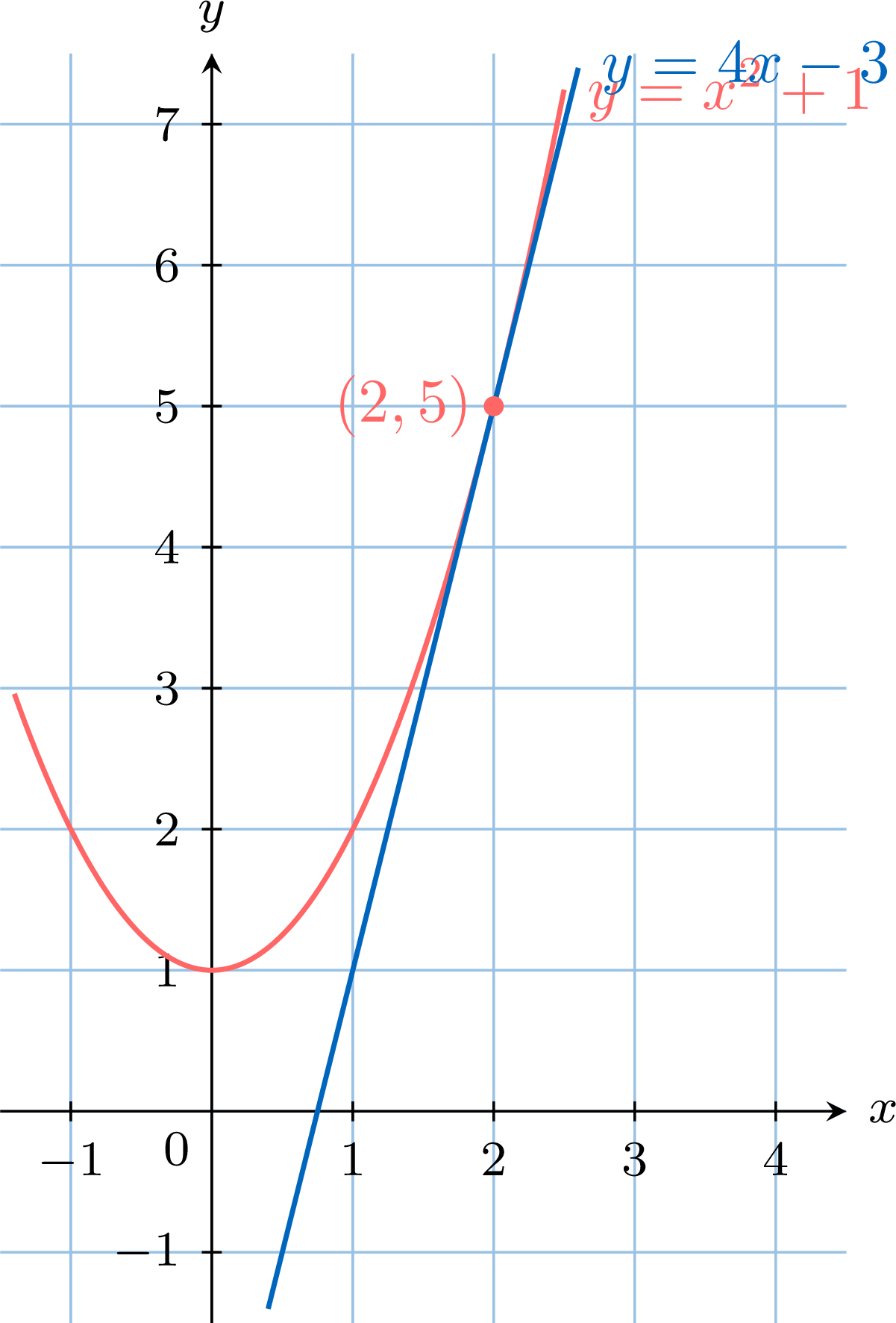
Let \(f(x) = x^2 + 1\). - Using the definition of the derivative, compute \(f'(2)\).
- Deduce the equation of the tangent to the curve of \(f\) at the point with \(x\)-coordinate \(2\).
- \(f(2) = 5\) and \(f(2+h) = (2+h)^2 + 1 = 5 + 4h + h^2\). For \(h \neq 0\), $$ \dfrac{f(2+h)-f(2)}{h} = \dfrac{4h + h^2}{h} = 4 + h \xrightarrow[h \to 0]{} 4. $$ So \(f'(2) = 4\).
- The tangent passes through the point \((2, f(2)) = (2, 5)\) with slope \(f'(2) = 4\): $$ y = f'(2)(x - 2) + f(2) = 4(x-2) + 5 = 4x - 3. $$
Method — Constructing a Tangent from the Derivative
To draw the tangent to the curve of \(f\) at the point \(A(a, f(a))\) when the number \(f'(a)\) is known: - Place the point \(A\) on the curve.
- Use the slope \(f'(a)\) to find a second point: from \(A\), move \(1\) unit to the right and \(f'(a)\) units up (down if \(f'(a) < 0\)). If \(f'(a) = \dfrac{p}{q}\) is a fraction, move \(q\) units to the right and \(p\) units up instead.
- Draw the line through \(A\) and this second point: it is the tangent.
Example
The curve of a function \(f\) is drawn below. We know that \(f(1) = 2\) and \(f'(1) = -\dfrac{1}{2}\). Construct the tangent to the curve at the point with \(x\)-coordinate \(1\). 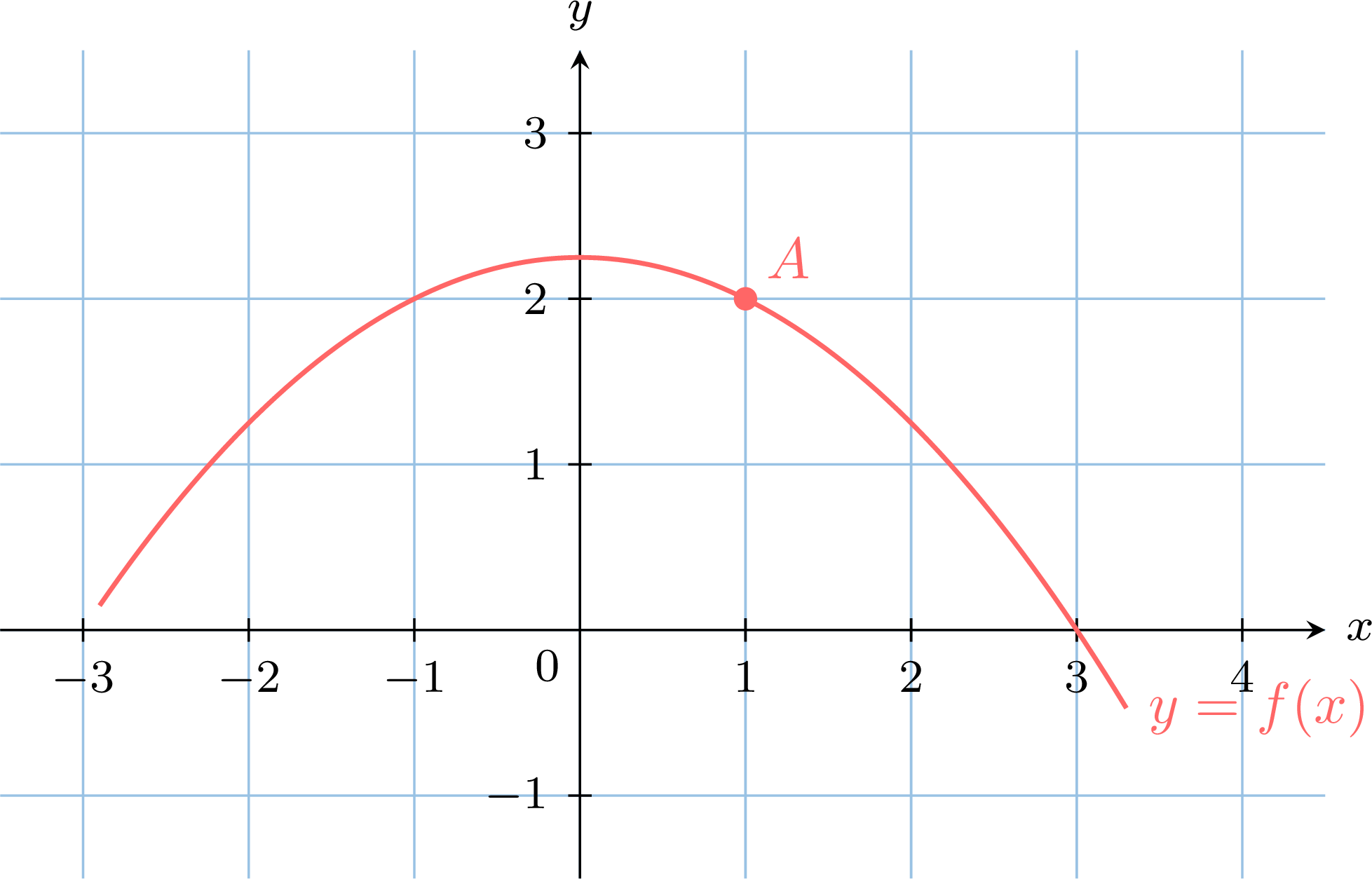
The tangent passes through \(A(1, 2)\) with slope \(f'(1) = -\dfrac{1}{2}\): from \(A\), we move \(2\) units to the right and \(1\) unit down, which gives the second point \(B(3, 1)\). The tangent is the line \((AB)\). 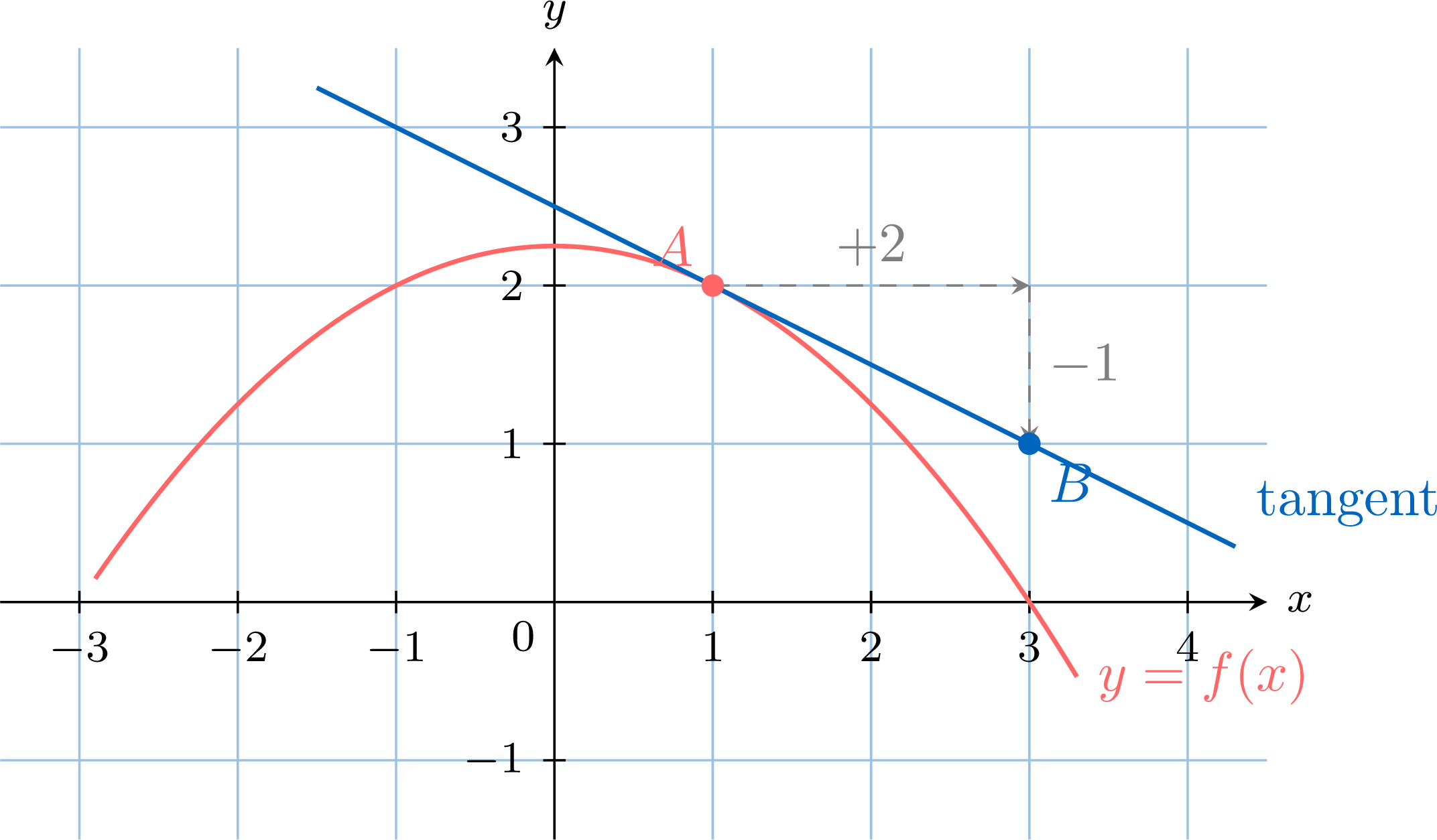
Check: the line \((AB)\) has equation \(y = -\dfrac{1}{2}(x-1) + 2 = -\dfrac{1}{2}x + \dfrac{5}{2}\), which is indeed \(y = f'(1)(x-1) + f(1)\).
Proposition — Where a Tangent Crosses the \(x\)-Axis
Let \(f\) be differentiable at \(a\), with \(f'(a) \neq 0\). The tangent to the curve of \(f\) at the point with \(x\)-coordinate \(a\) crosses the \(x\)-axis at the point with \(x\)-coordinate $$a - \dfrac{f(a)}{f'(a)}.$$
The tangent has equation \(y = f'(a)(x - a) + f(a)\). A point of this line lies on the \(x\)-axis when \(y = 0\): \begin{align*} f'(a)(x - a) + f(a) = 0 &\iff f'(a)(x - a) = -f(a)
&\iff x - a = -\dfrac{f(a)}{f'(a)} && \text{(division by } f'(a) \neq 0\text{)}
&\iff x = a - \dfrac{f(a)}{f'(a)}. \end{align*} When \(f'(a) = 0\), the division cannot be made: the tangent is horizontal (it is the \(x\)-axis itself when \(f(a) = 0\)).
&\iff x - a = -\dfrac{f(a)}{f'(a)} && \text{(division by } f'(a) \neq 0\text{)}
&\iff x = a - \dfrac{f(a)}{f'(a)}. \end{align*} When \(f'(a) = 0\), the division cannot be made: the tangent is horizontal (it is the \(x\)-axis itself when \(f(a) = 0\)).
Definition — Tangent Line Function
Let \(f\) be a function differentiable at \(a\). The tangent line function of \(f\) at \(a\) is the linear function $$t : x \longmapsto f(a) + f'(a)\,(x - a),$$ whose graph is the tangent to the curve of \(f\) at the point with \(x\)-coordinate \(a\). It takes the same value as \(f\) at \(a\), \(t(a) = f(a)\), and it has the same slope as the curve there, \(t'(a) = f'(a)\). Proposition — Linear Approximation
Let \(f\) be a function differentiable at \(a\). For \(h\) close to \(0\), $$\textcolor{colorprop}{f(a + h) \approx f(a) + f'(a)\,h}.$$ More precisely, \(f(a + h) = f(a) + f'(a)\,h + h\,\varepsilon(h)\) where \(\varepsilon(h)\) tends to \(0\) as \(h\) tends to \(0\): the error of the approximation is small compared with \(h\), and it shrinks faster than \(h\) does. 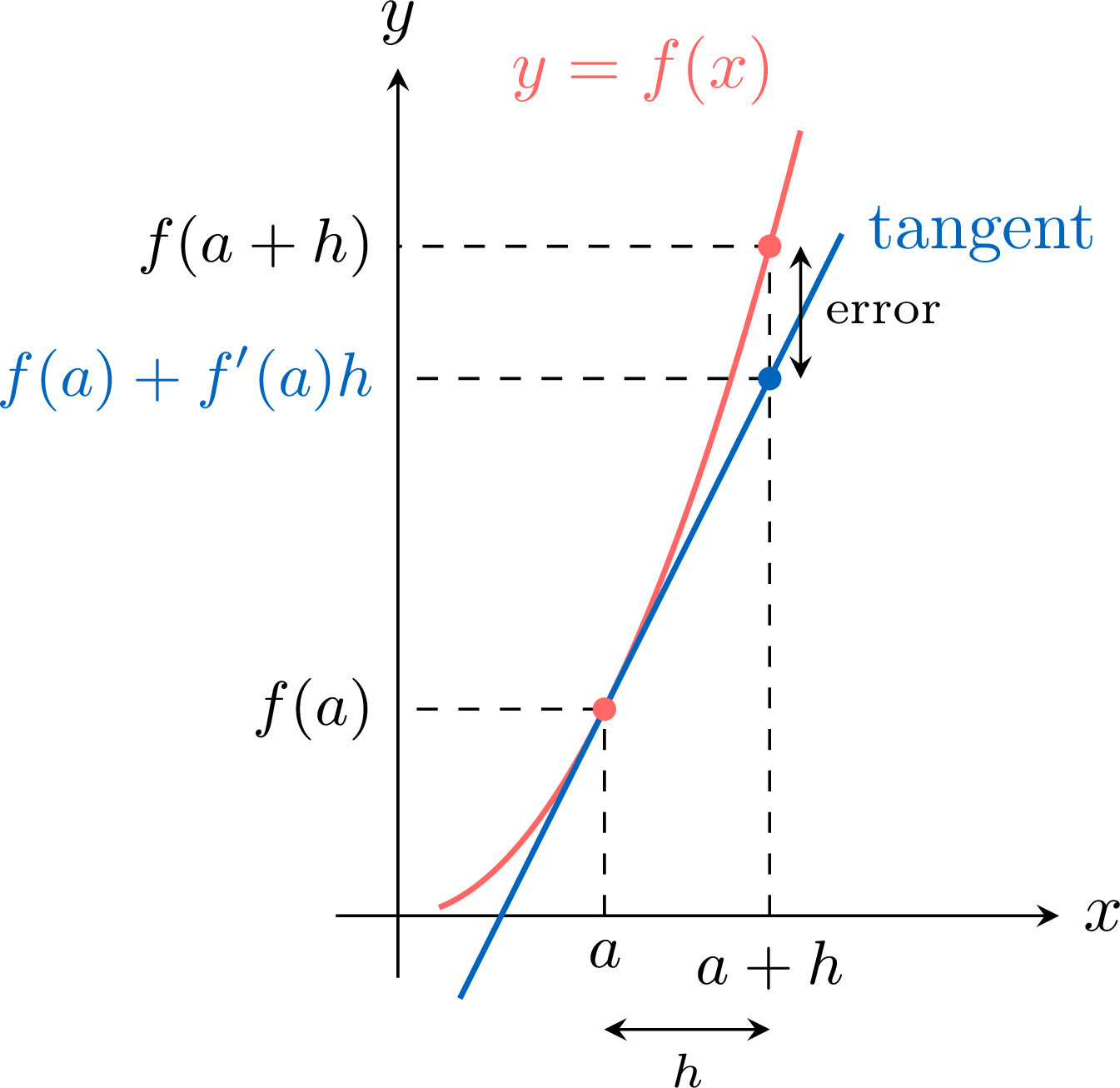
By definition of the derivative at \(a\), the rate of change \(\dfrac{f(a+h) - f(a)}{h}\) tends to \(f'(a)\) as \(h\) tends to \(0\). Set, for \(h \neq 0\), $$\varepsilon(h) = \dfrac{f(a+h) - f(a)}{h} - f'(a).$$ Then \(\varepsilon(h)\) tends to \(0\), and multiplying by \(h\) gives \(f(a+h) - f(a) - f'(a)\,h = h\,\varepsilon(h)\), that is \(f(a+h) = f(a) + f'(a)\,h + h\,\varepsilon(h)\). The error \(h\,\varepsilon(h)\) is the product of two quantities that both tend to \(0\): it is negligible compared with \(h\).
Skills to practice
- Finding the Equation of a Tangent
- Using the Linear Approximation
VI
Studying Variations with the Derivative
Going furtherbeyond the syllabus — click to explore
When we draw the graph of a function, we may notice that the function is increasing or decreasing over particular intervals.
Proposition — From the Variations to the Sign of the Derivative
Let \(f\) be a function differentiable on an interval \(I\). - If \(f\) is increasing on \(I\), then \(f'(x) \geq 0\) for all \(x \in I\).
- If \(f\) is decreasing on \(I\), then \(f'(x) \leq 0\) for all \(x \in I\).
- If \(f\) is constant on \(I\), then \(f'(x) = 0\) for all \(x \in I\).
Let \(a \in I\) and suppose that \(f\) is increasing on \(I\). For \(x \in I\) with \(x \neq a\), consider the rate of change \(\dfrac{f(x)-f(a)}{x-a}\).
If \(f\) is decreasing, the same reasoning gives a quotient less than or equal to \(0\), hence \(f'(a) \leq 0\). If \(f\) is constant, \(f(x) - f(a) = 0\): the rate of change is \(0\) and so is \(f'(a)\).
- If \(x < a\): since \(f\) is increasing, \(f(x) \leq f(a)\), so \(f(x) - f(a) \leq 0\) and \(x - a < 0\). The quotient of two numbers of the same sign is positive or zero.
- If \(x > a\): \(f(x) \geq f(a)\), so \(f(x) - f(a) \geq 0\) and \(x - a > 0\). Again the quotient is positive or zero.
If \(f\) is decreasing, the same reasoning gives a quotient less than or equal to \(0\), hence \(f'(a) \leq 0\). If \(f\) is constant, \(f(x) - f(a) = 0\): the rate of change is \(0\) and so is \(f'(a)\).
Proposition — Strict Sign of the Derivative and Monotonicity
For a function \(f\) that is differentiable on an interval \(I\): - If \(f'(x) > 0\) for all \(x \in I\), then \(f\) is strictly increasing on \(I\).
- If \(f'(x) < 0\) for all \(x \in I\), then \(f\) is strictly decreasing on \(I\).
Proposition — Sign of the Derivative and Direction of Variation
The derivative may vanish at isolated points without changing the variations: if \(f'(x) \geq 0\) on \(I\), then \(f\) is increasing on \(I\), and if moreover \(f'\) vanishes only at a finite number of points, \(f\) is even strictly increasing. For instance \(f(x) = x^3\) has \(f'(x) = 3x^2 \geq 0\), which is zero only at \(x = 0\), and \(x^3\) is increasing on \(\mathbb{R}\). Together with the proposition “From the Variations to the Sign of the Derivative”: on an interval, \(f\) is increasing if and only if \(f' \geq 0\), and decreasing if and only if \(f' \leq 0\). Method — Sign Diagram and Table of Variations
A sign diagram for the derivative, \(f'\), shows where the function is increasing or decreasing. This information is organised in a table of variations. Example
Find the variations of the function \(f(x)=x^2\).
The derivative of the function \(f(x)=x^2\) is \(f'(x)=2x\). 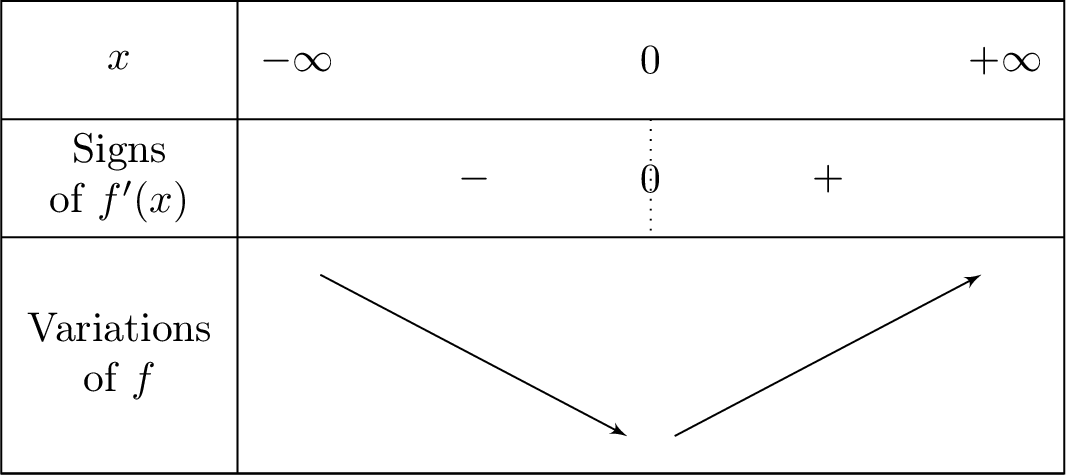
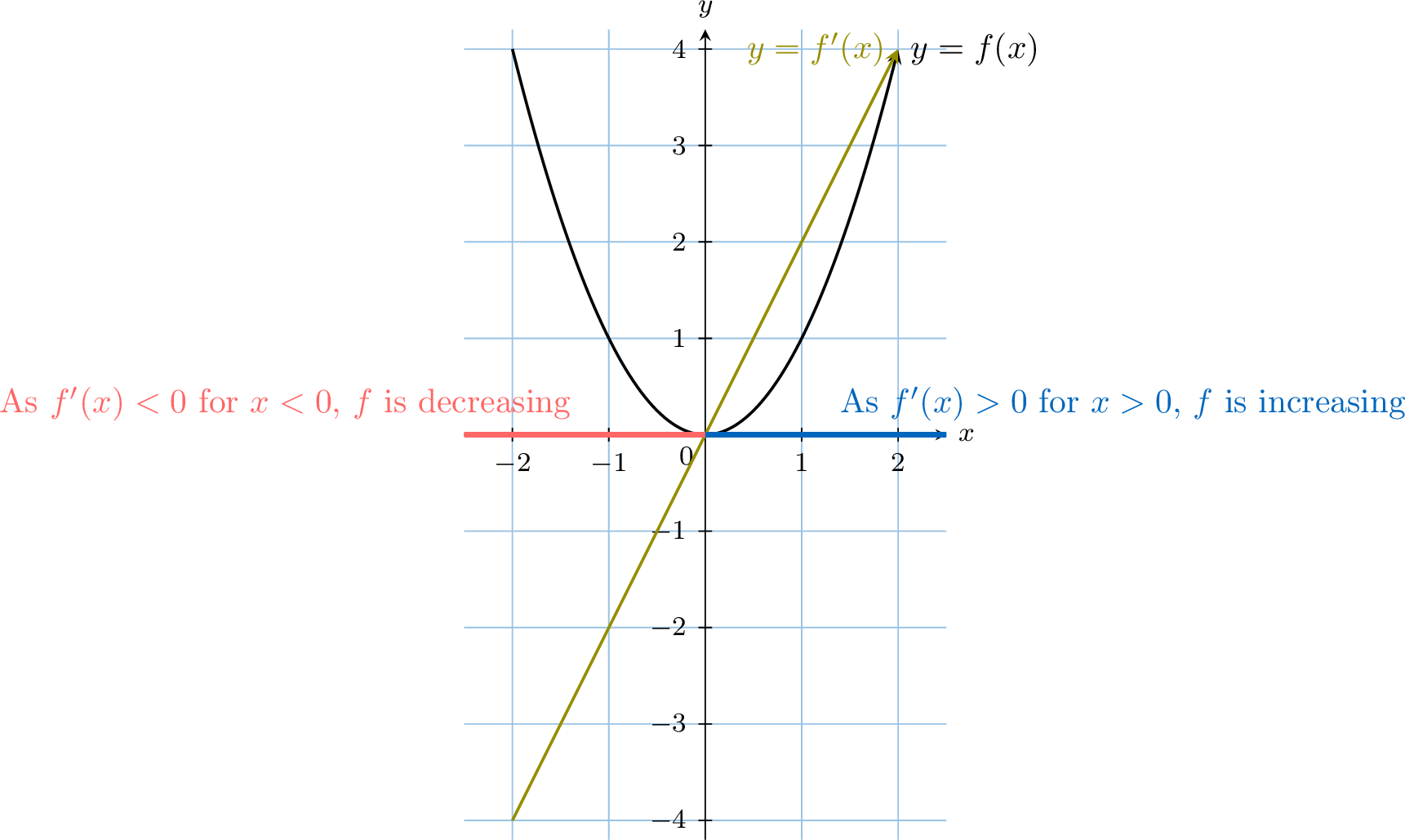
- The derivative \(f'(x)\) is negative on \((-\infty, 0)\), so the function \(f(x)\) is decreasing on \((-\infty, 0]\).
- The derivative \(f'(x)\) is positive on \((0,+\infty)\), so the function \(f(x)\) is increasing on \([0,+\infty)\).
Skills to practice
- Linking the Sign of the Derivative and the Variations
- Studying Variations with the Derivative
VII
Finding and Classifying Stationary Points
Going furtherbeyond the syllabus — click to explore
Definition — Global Extrema
Let \(f\) be a function with domain \(D\). - \(f\) has a global maximum at \(x=c\) if \(f(c) \ge f(x)\) for all \(x\) in \(D\). The value \(f(c)\) is the maximum value of \(f\).
- \(f\) has a global minimum at \(x=c\) if \(f(c) \le f(x)\) for all \(x\) in \(D\). The value \(f(c)\) is the minimum value of \(f\).
Example
For \(f(x)=(x-1)^2-1\), the point \((1,-1)\) is a global minimum, since \(f(x) \ge f(1)\) for all \(x \in \mathbb{R}\). 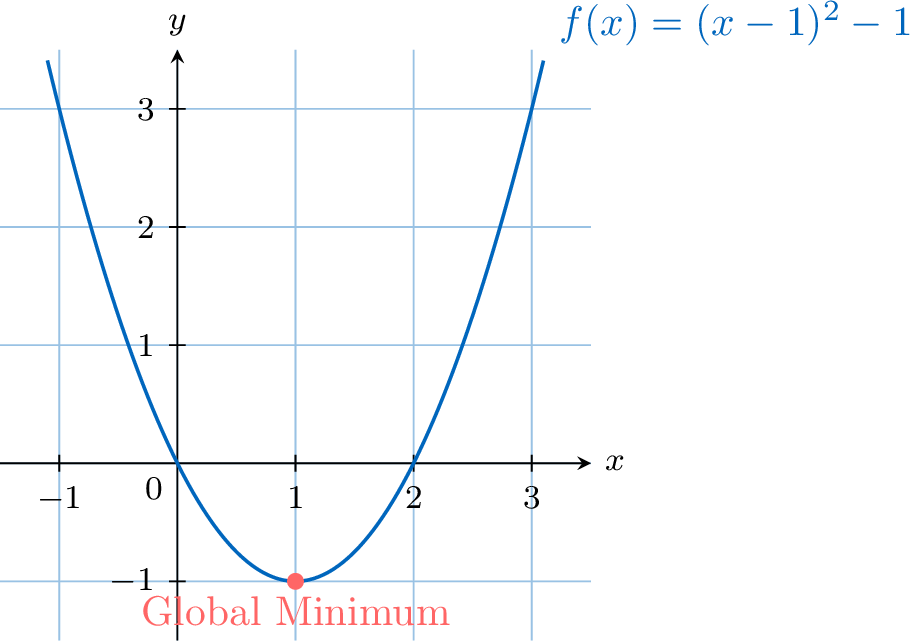
Definition — Local Extrema
Let \(f\) be a function. - \(f\) has a local maximum at \(x=c\) if there is an open interval \(I\) containing \(c\) such that \(f(c) \ge f(x)\) for all \(x\) in \(I\).
- \(f\) has a local minimum at \(x=c\) if there is an open interval \(I\) containing \(c\) such that \(f(c) \le f(x)\) for all \(x\) in \(I\).
Example
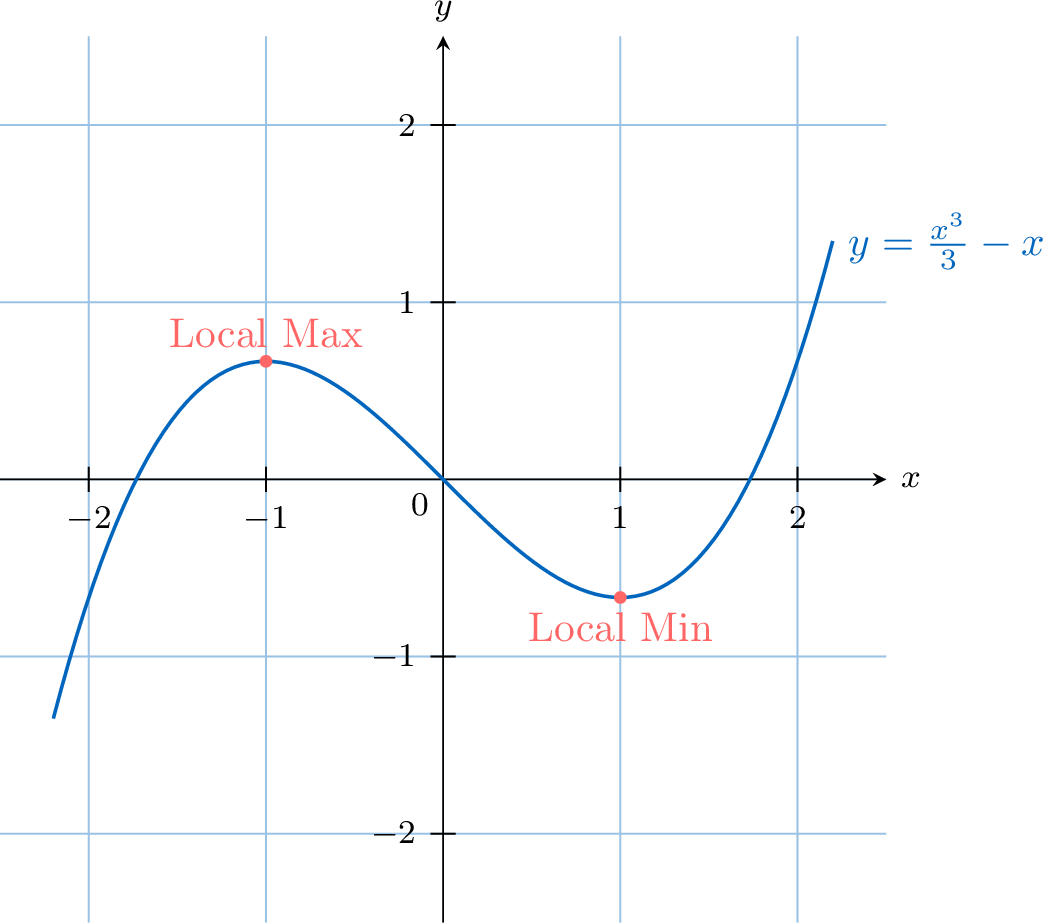
The function \(f(x) = \frac{x^3}{3} - x\) has a local maximum at \(x=-1\) and a local minimum at \(x=1\). 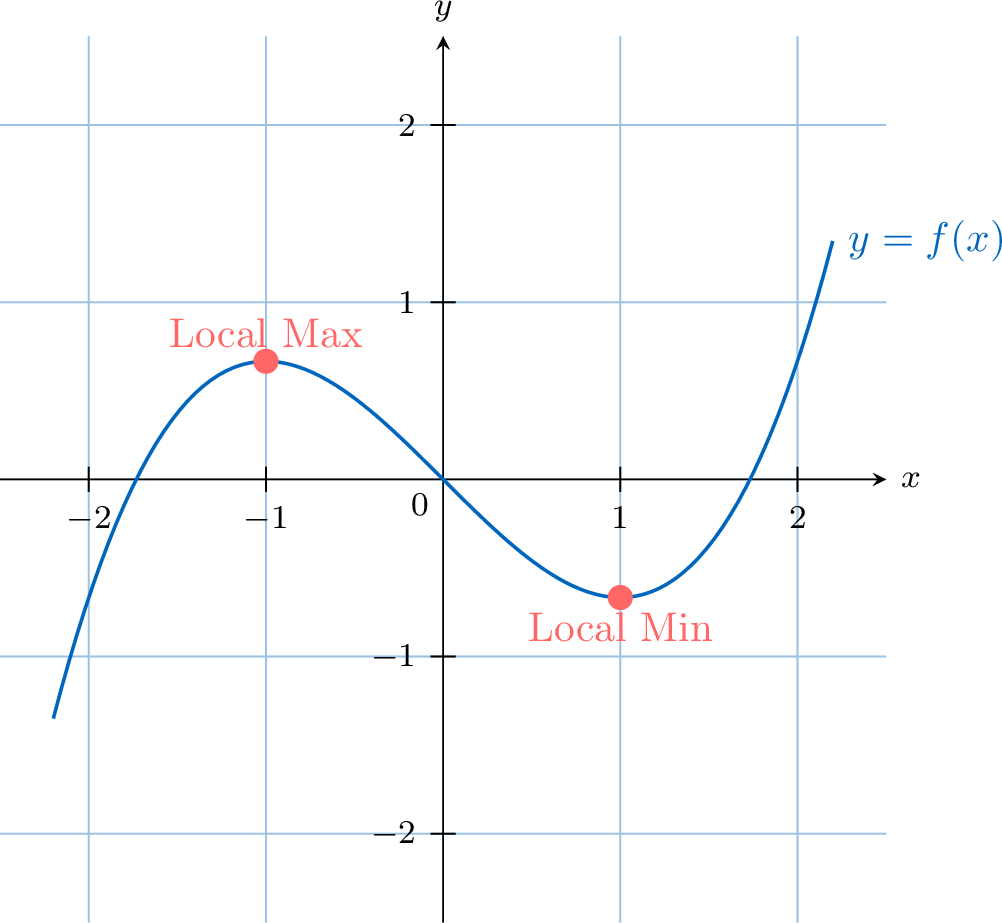
Definition — Stationary Point
A stationary point of a function \(f\) is a point \((c, f(c))\) on the curve where the tangent is horizontal, which means \(f^{\prime}(c)=0\). Proposition — Local Extrema and Stationary Points
Let \(f\) be a function defined on an open interval \(I\), and let \(c\in I\).If \(f\) has a local maximum or a local minimum at \(x=c\) and if \(f\) is differentiable at \(c\), then$$ f'(c)=0. $$
Proposition — First Derivative Test for Local Extrema
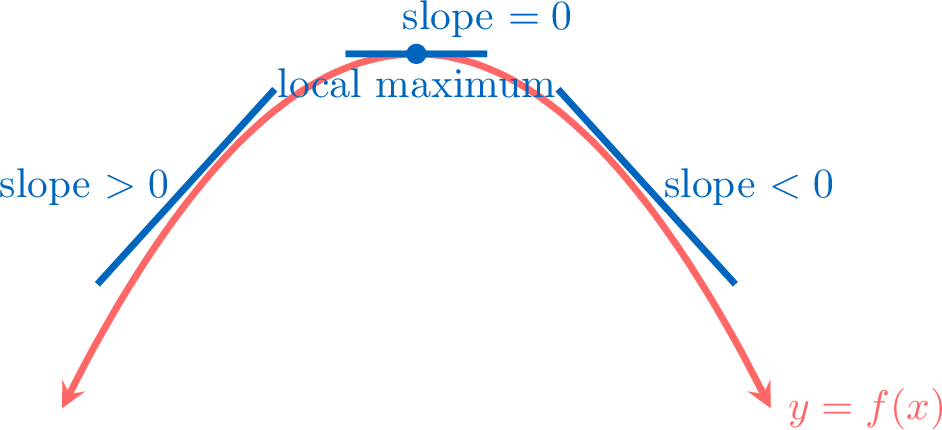
Let \(c\) be a number such that \(f'(c) = 0\). - If \(f^{\prime}(x)\) changes sign from positive to negative at \(x=c\), then \(f\) has a local maximum at \(c\).
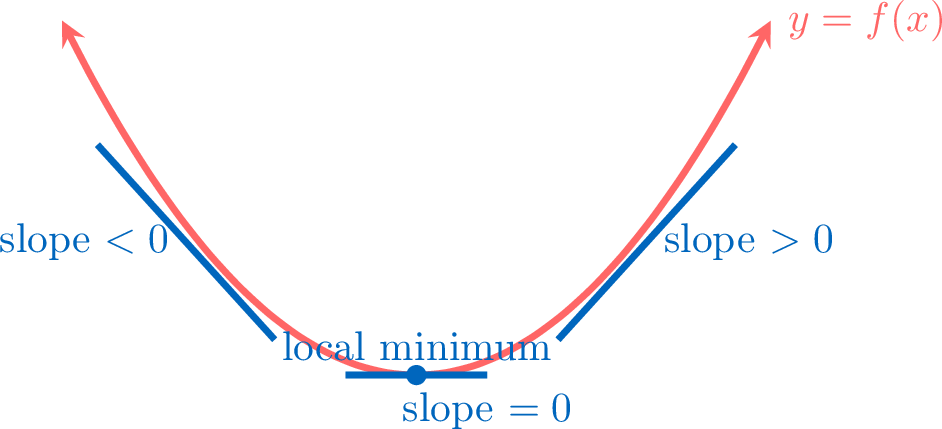
- If \(f^{\prime}(x)\) changes sign from negative to positive at \(x=c\), then \(f\) has a local minimum at \(c\).
Example
Find and classify the stationary points of \(f(x) = \frac{1}{3}x^3 - x\). - Find the derivative:$$ f'(x) = x^2 - 1. $$
- Find stationary points by solving \(f'(x)=0\):$$ \begin{aligned} x^2 - 1 &= 0 \\ (x-1)(x+1) &= 0.\end{aligned}$$ The stationary points are at \(x=-1\) and \(x=1\).
- Create the sign diagram for \(f'(x)\):
The derivative \(f'(x)=x^2-1\) is an upward-opening parabola with roots at \(-1\) and \(1\). It is positive outside the roots and negative between them. - Draw the table of variations and classify points:
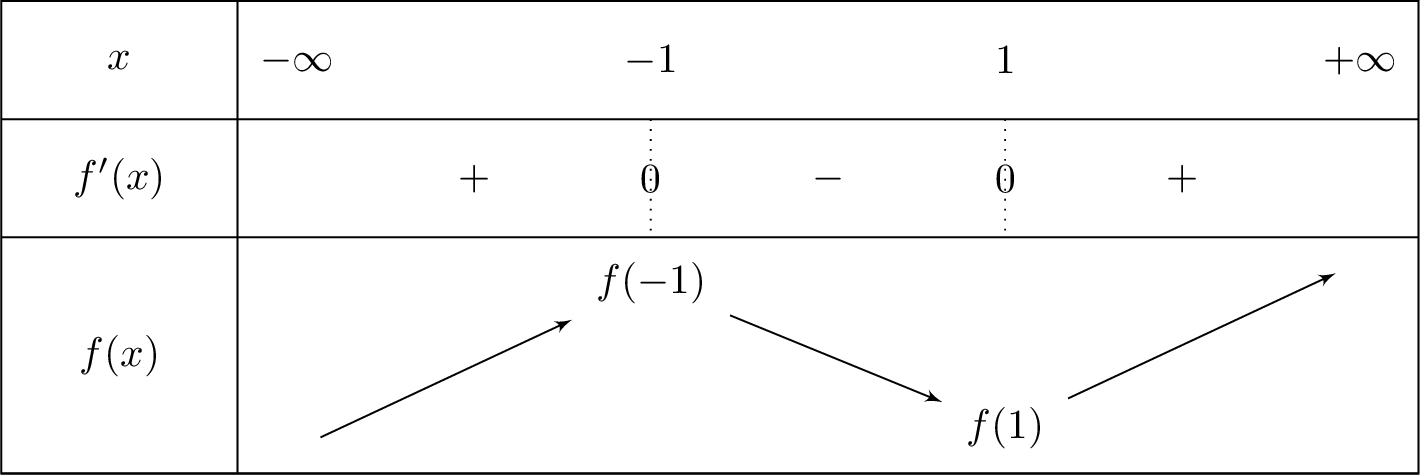
- At \(x=-1\), the sign of \(f'(x)\) changes from \(+\) to \(-\). Thus, there is a local maximum at \(x=-1\).$$f(-1) = \frac{1}{3}(-1)^3 - (-1) = \frac{2}{3}.$$
- At \(x=1\), the sign of \(f'(x)\) changes from \(-\) to \(+\). Thus, there is a local minimum at \(x=1\).$$f(1) = \frac{1}{3}(1)^3 - 1 = -\frac{2}{3}.$$
Proposition — The Quadratic Function Revisited
Let \(f(x) = ax^2 + bx + c\) with \(a \neq 0\). Then \(f\) is differentiable on \(\mathbb{R}\), \(f'(x) = 2ax + b\), and \(f'\) vanishes at \(x_0 = -\dfrac{b}{2a}\) while changing sign. - If \(a > 0\): \(f\) is decreasing on \((-\infty, x_0]\) and increasing on \([x_0, \infty)\); it has a minimum, equal to \(f(x_0)\), at \(x_0\).
- If \(a < 0\): \(f\) is increasing on \((-\infty, x_0]\) and decreasing on \([x_0, \infty)\); it has a maximum, equal to \(f(x_0)\), at \(x_0\).
\(f'(x) = 2ax + b\) is a linear function with gradient \(2a\); it vanishes at \(x_0 = -\dfrac{b}{2a}\). If \(a > 0\), then \(2a > 0\), so \(f'(x) < 0\) for \(x < x_0\) and \(f'(x) > 0\) for \(x > x_0\): \(f\) is decreasing then increasing, and \(f'\) vanishes at \(x_0\) while changing sign from \(-\) to \(+\), so \(f\) has a minimum at \(x_0\). If \(a < 0\), all the signs are reversed: \(f\) is increasing then decreasing, with a maximum at \(x_0\).
Skills to practice
- Finding and Classifying Stationary Points
VIII
Finding an Area with a Definite Integral
Going furtherbeyond the syllabus — click to explore
Method — Approximating Area with Riemann Sums
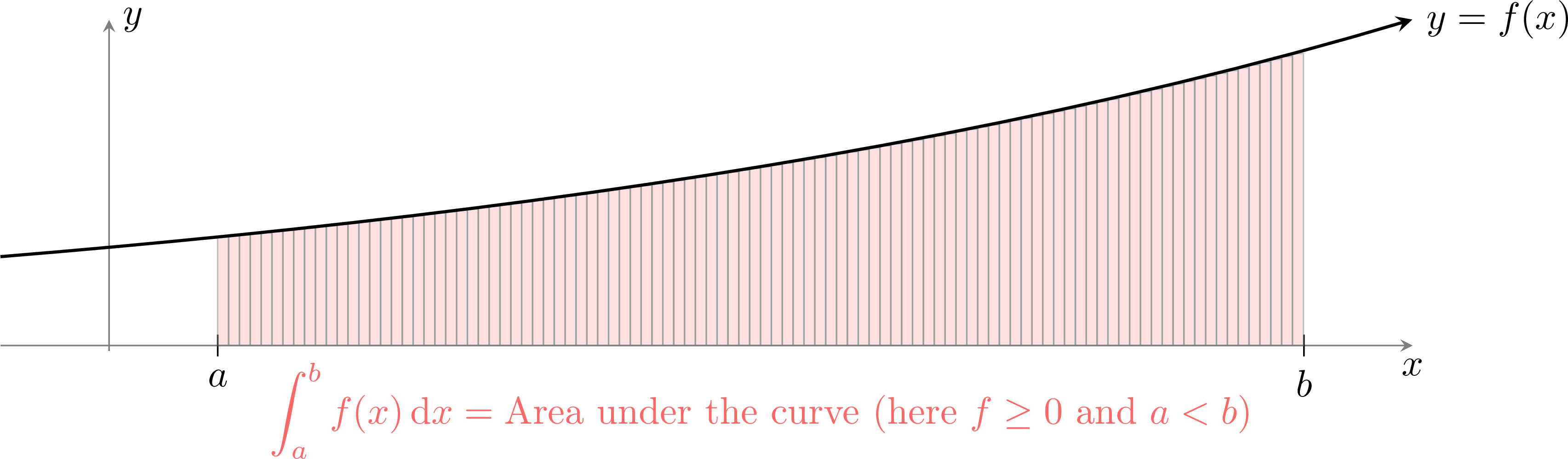
We aim to measure the shaded area, denoted \(\displaystyle\int_a^b f(x)\,\mathrm{d}x\), under the curve of a continuous non-negative function \(y=f(x)\). 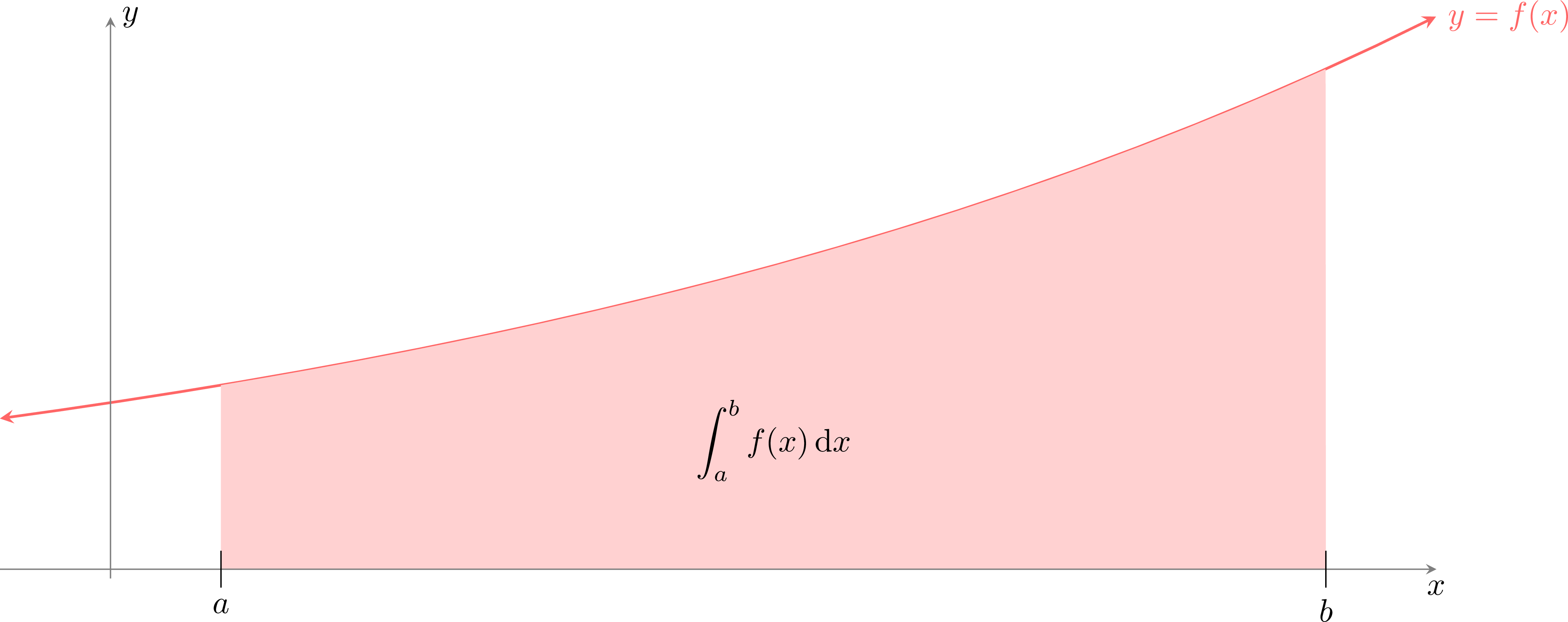
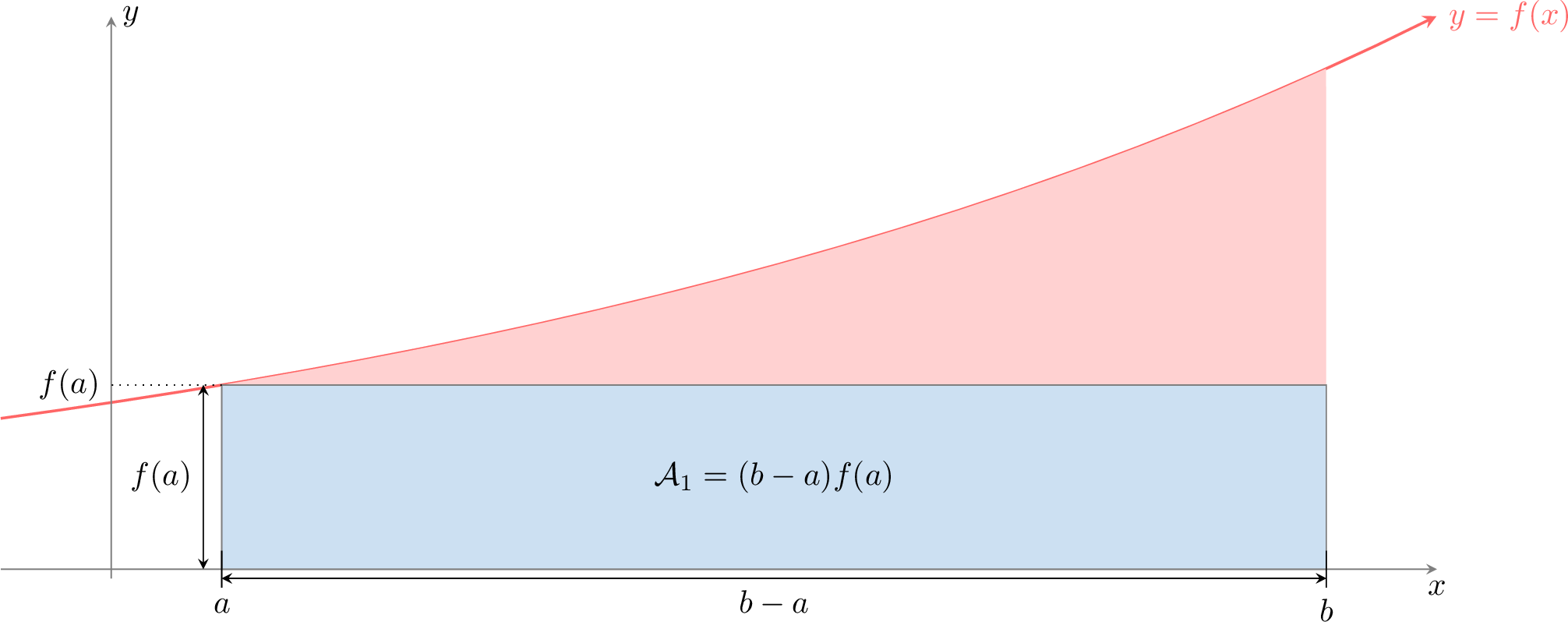
- Approximation with 1 rectangle: We can make a first, rough approximation by filling the area with a single rectangle of width \((b-a)\) and height \(f(a)\) (the value of the function at the left endpoint).
- Approximation with 4 rectangles: To improve the approximation, we divide the interval \([a,b]\) into 4 equal subintervals, each of width \(\frac{b-a}{4}\). We construct a rectangle on each subinterval, using the function's value at the left endpoint for the height.
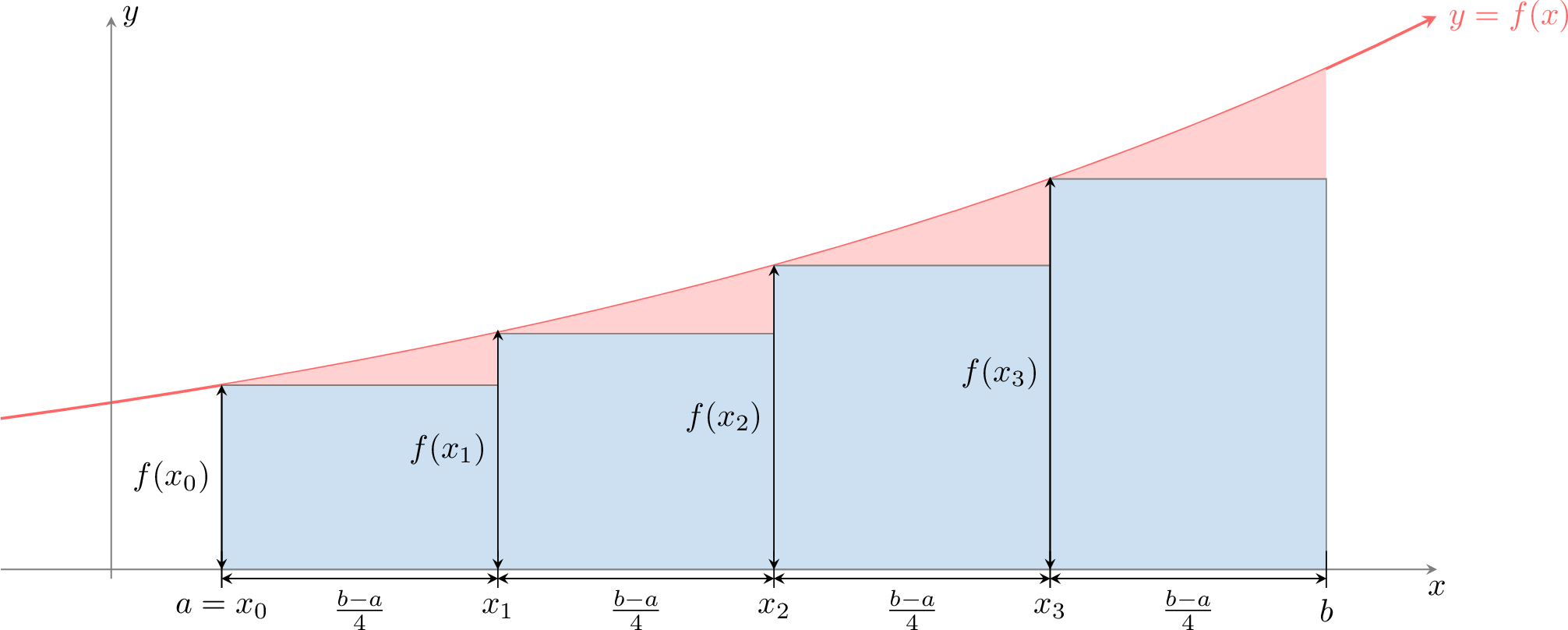
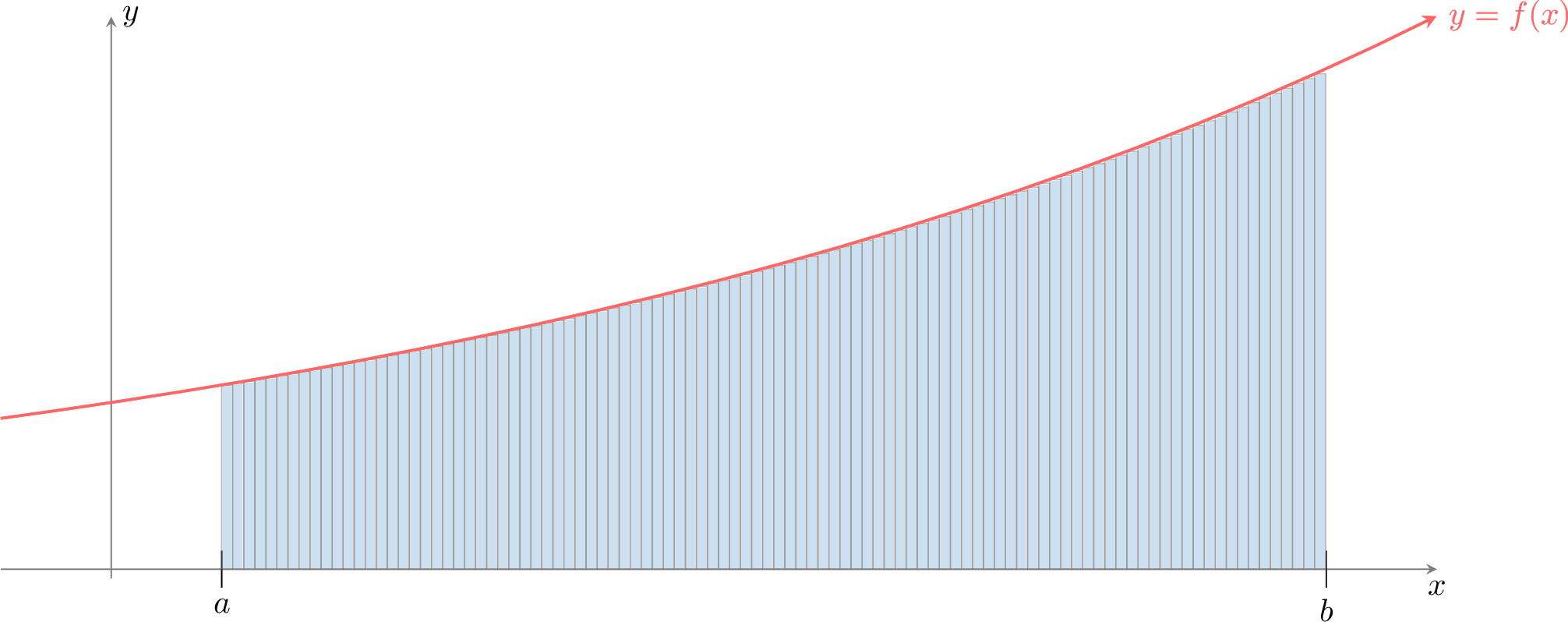
- Approximation with \(n\) rectangles: We can generalise this by dividing the interval into \(n\) equal subintervals, each of width \(\Delta x = \frac{b-a}{n}\). Let \(x_i=a+i\Delta x\) for \(i=0,1,\dots,n-1\). The sum of the areas of the \(n\) rectangles is: $$ S_n = \sum_{i=0}^{n-1} f(x_i) \Delta x. $$ As we increase the number of rectangles (\(n \to \infty\)), the width of each rectangle becomes infinitesimally small, and the sum of their areas becomes a perfect match for the area under the curve: $$\displaystyle\int_a^b f(x)\,\mathrm{d}x = \lim_{n\to\infty} S_n.$$
Definition — Definite Integral
The definite integral of a continuous function \(f\) from \(a\) to \(b\) is the limit of the Riemann sum as the number of subintervals approaches infinity. It is denoted by: $$ \int_a^b f(x)\,\mathrm{d}x = \lim_{n \to \infty} \sum_{i=0}^{n-1} f(x_i) \Delta x $$ where the interval \([a,b]\) is divided into \(n\) subintervals of equal width \(\Delta x = \dfrac{b-a}{n}\) and \(x_i = a + i\Delta x\). - \(a\) and \(b\) are the limits of integration.
- \(f(x)\) is the integrand.
Definition — Signed Area
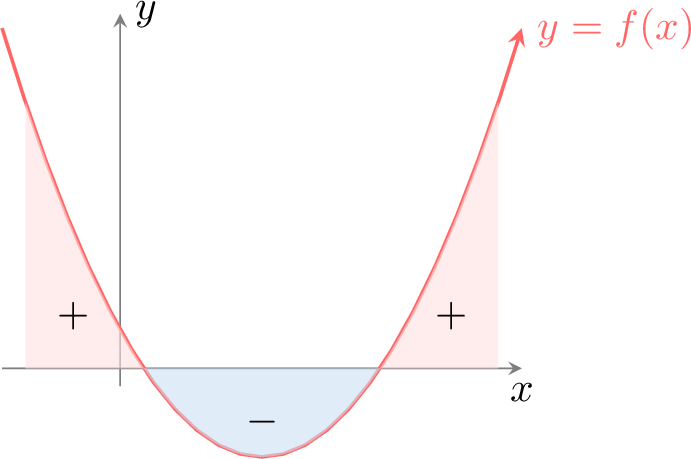
The definite integral calculates the signed area. - Area above the x-axis is counted as positive.
- Area below the x-axis is counted as negative.
Example
Determine the integral \(\displaystyle\int_{-1}^{2} 1\,\mathrm{d}x\) by interpreting it as an area.
The integral represents the area under the constant function \(f(x)=1\) from \(x=-1\) to \(x=2\). This forms a rectangle with width \(2 - (-1) = 3\) and height \(1\). 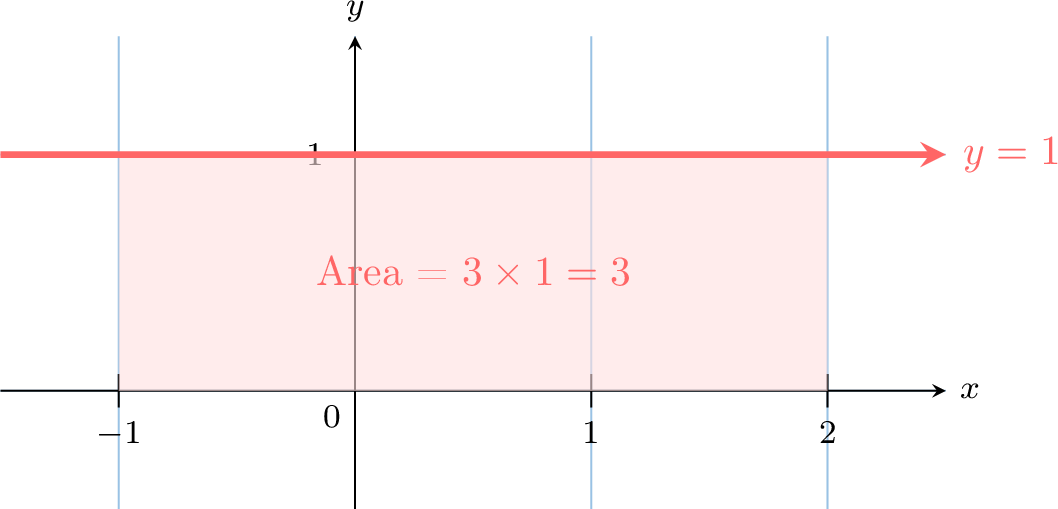
Therefore, \(\displaystyle\int_{-1}^{2}1\,\mathrm{d}x= 3.\)
Proposition — Properties of Integration
Let \(f\) and \(g\) be continuous on an interval \(I\), \(a\), \(b\), \(c\) three real numbers in \(I\), and \(k\) a constant. - Zero-Width Interval: $$\displaystyle\int_a^a f(x) \;\mathrm{d}x= 0.$$
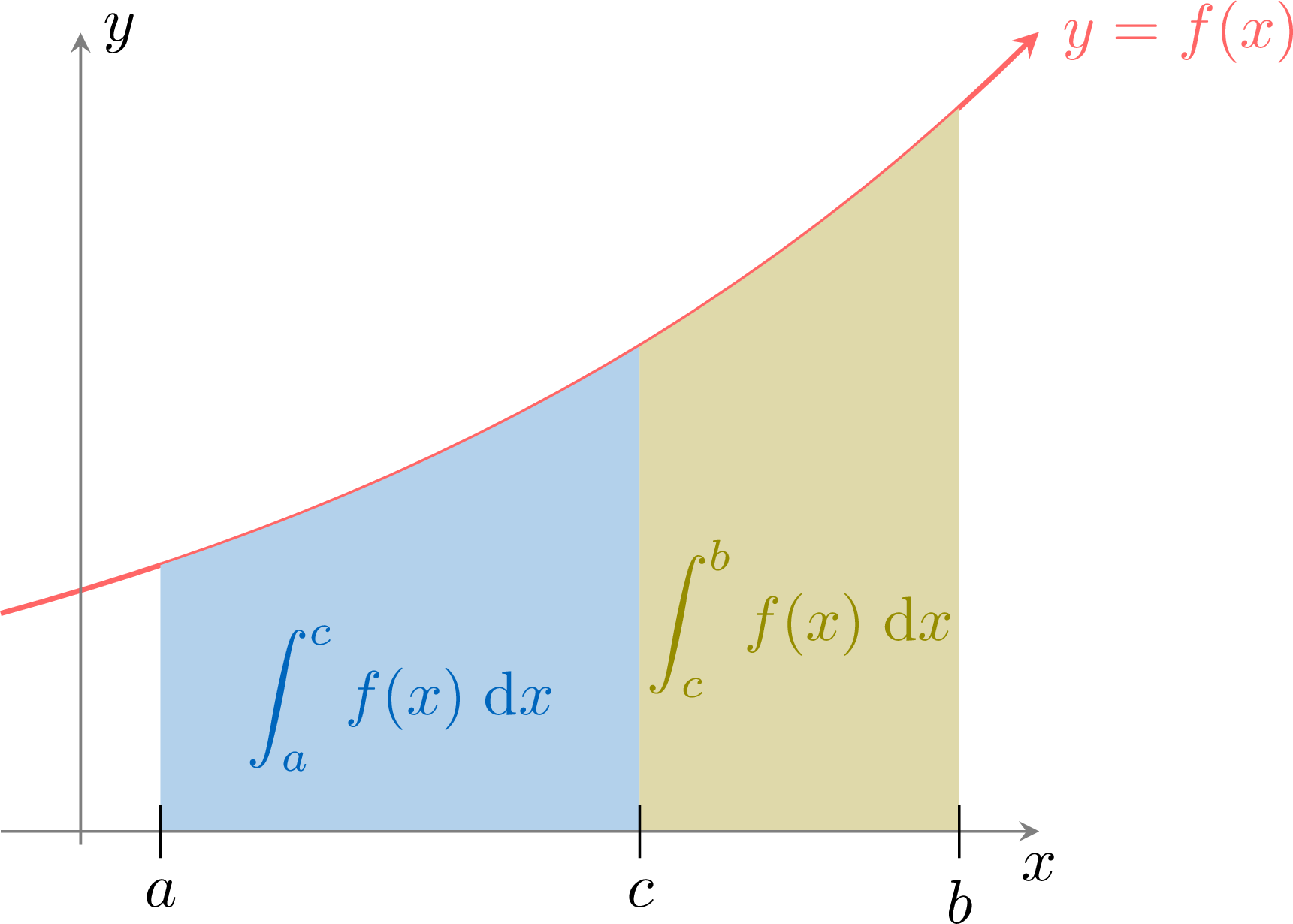
- Additivity of Intervals: For any \(c\) between \(a\) and \(b\): $$\displaystyle\int_a^b f(x)\;\mathrm{d}x = \int_a^c f(x) \; \mathrm{d}x + \int_c^b f(x)\;\mathrm{d}x$$
- Linearity: $$\displaystyle\int_a^b (f(x)+g(x)) \; \mathrm{d}x= \int_a^b f(x) \; \mathrm{d}x+ \int_a^b g(x) \; \mathrm{d}x$$ $$\displaystyle\int_a^b k f(x) \; \mathrm{d}x= k \int_a^b f(x) \; \mathrm{d}x.$$
Skills to practice
- Identifying the Definite Integral for a Given Area
- Evaluating Integrals using Geometric Formulas
- Applying the Properties of Definite Integrals
Jump to section