International Baccalaureate · DP 2: Applications and Interpretation SL
Exponentials and Logarithms
I
Exponential Expressions and Equations
I.1
Exponential Expressions
Recappreviously studied — click to reread
Definition — Exponential Expression
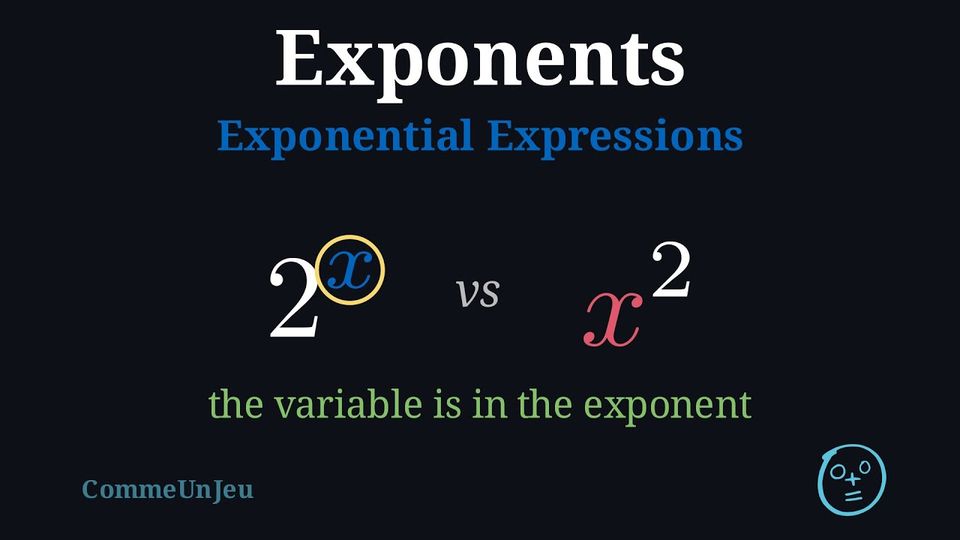
An exponential expression is a mathematical expression where a variable appears in the exponent. The base is usually a positive constant different from \(1\). Example
\(2^x\) and \(5^{x+1}\) are exponential expressions. This is different from a polynomial expression like \(x^2\), where the variable is in the base, not in the exponent. Method — Manipulating Exponential Expressions
Using the laws of exponents (index laws), we can simplify, expand, and factorise expressions where the variable is in the exponent. These skills are fundamental for solving exponential equations. Example
Simplify \(\displaystyle\frac{2^{x+1}+2^x}{2^x}\).
$$\begin{aligned}[t] \frac{2^{x+1}+2^x}{2^x} &= \frac{2^x \cdot 2^1 + 2^x}{2^x} && \text{(using the law }a^{x+1}=a^x\cdot a^1\text{)} \\
&= \frac{2^x(2+1)}{2^x} && \text{(factorise by the common factor } 2^x\text{)} \\
&= 3 && \text{(simplify by } 2^x\text{)} \end{aligned}$$
Skills to practice
- Exponential Expressions
I.2
Exponential Equations
Recappreviously studied — click to reread
Definition — Exponential Equation
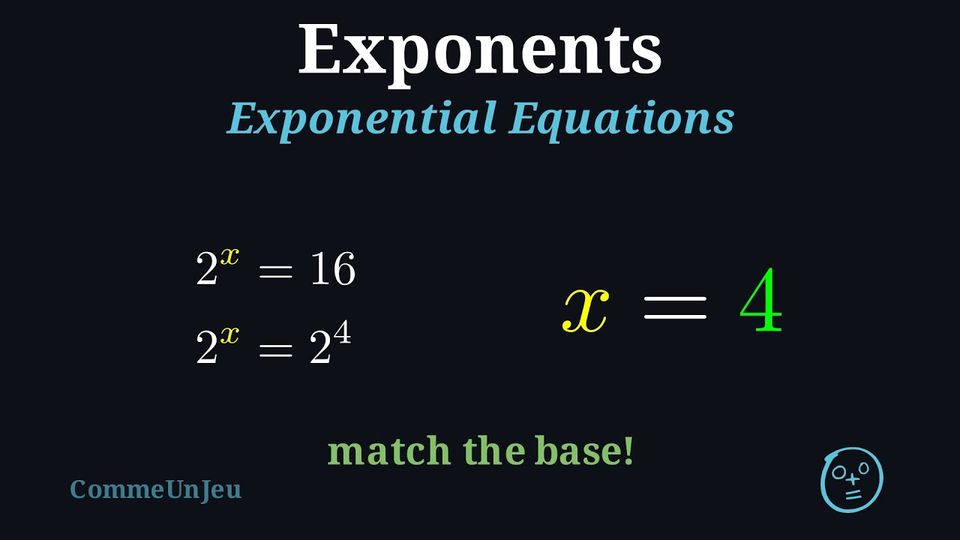
An exponential equation is an equation in which the unknown occurs in the exponent. Example
\(2^x = 8\) and \(30 \times 3^x = 7\) are both exponential equations.
There are several methods we can use to solve exponential equations. These include solving by graphing, using technology (such as a calculator or graphing software), and using logarithms. We focus on equations that can be solved algebraically by rewriting both sides with the same base and then equating the exponents.
Method — Solving by Equating Exponents
For \(a>0\), \(a\neq 1\), we have \(a^x = a^y\) if and only if \(x = y\). So, when both sides of an equation can be written with the same base \(a\), we can equate the exponents. Example
Solve for \(x\):
$$\begin{aligned}[t] && 2^x &= 16 \\
\Leftrightarrow && 2^x &= 2^4 && \text{(Write \(16\) as a power of \(2\))} \\
\Leftrightarrow && x &= 4 && \text{(Equate the exponents)} \end{aligned}$$
Skills to practice
- Solving by Equating Indices
I.3
The Number \(e\)
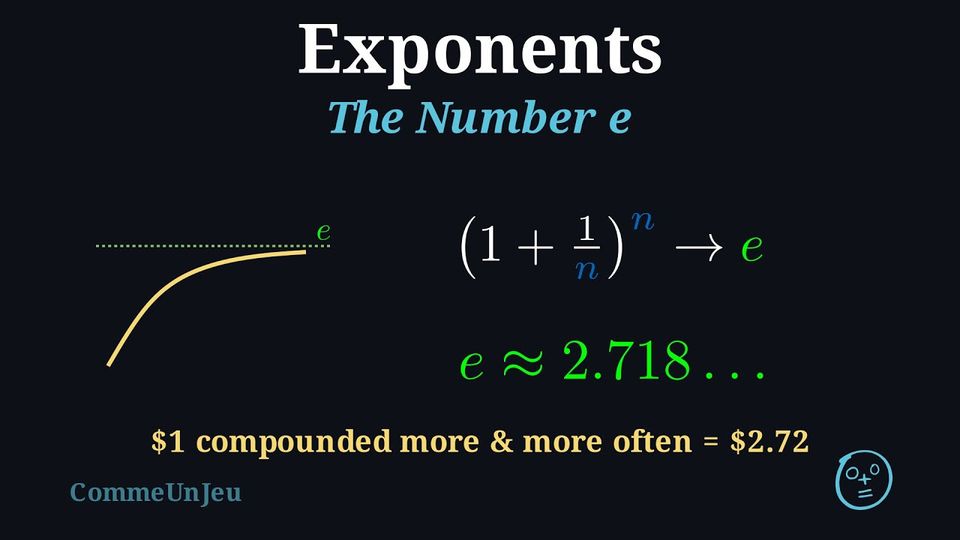
Let’s explore an idea from finance: compound interest.
Imagine you invest \(\dollar 1\) in a special bank account that offers a \(100\pourcent\) annual interest rate. We will see how much money you have after one year, depending on how often the interest is calculated (compounded) and added to your account.
As you can see, the final amount increases, but it does not grow without bound. It seems to approach a specific number. This special irrational number is denoted by \(e\), also known as Euler’s number. It represents the limiting value of this process of increasingly frequent compounding.
Imagine you invest \(\dollar 1\) in a special bank account that offers a \(100\pourcent\) annual interest rate. We will see how much money you have after one year, depending on how often the interest is calculated (compounded) and added to your account.
- Case 1: Compounded annually
The interest is paid once at the end of the year. The value is: $$ 1 \times (1 + 100\pourcent) = 1 \times (1+1) = \dollar 2. $$ So $$ \text{Value} = (1 + 1)^1. $$ - Case 2: Compounded semi-annually
The interest is paid twice a year. The bank gives you half the annual rate (\(50\pourcent\)) each time.- After 6 months: \(1 \times \left(1 + \dfrac{1}{2}\right) = \dollar 1.50\)
- At the end of the year: \(1.50 \times \left(1 + \dfrac{1}{2}\right) = \dollar 2.25\)
- Case \(n\): Compounded \(n\) times per year
If we compound \(n\) times per year, the interest rate per period is \(\dfrac{1}{n}\) (since the total annual rate is \(100\pourcent\)), and it is applied \(n\) times. The value after one year is $$ \text{Value} = \left(1 + \frac{1}{n}\right)^n. $$
| Compounding Frequency | \(n\) | Value \(\left(1 + \dfrac{1}{n}\right)^n\) |
| Annually | 1 | \((1 + 1/1)^1 = 2.00000\) |
| Semi-annually | 2 | \((1 + 1/2)^2 = 2.25000\) |
| Quarterly | 4 | \((1 + 1/4)^4 \approx 2.44141\) |
| Monthly | 12 | \((1 + 1/12)^{12} \approx 2.61304\) |
| Daily | 365 | \((1 + 1/365)^{365} \approx 2.71457\) |
| Hourly | 8,760 | \((1 + 1/8760)^{8760} \approx 2.71813\) |
Definition — The Exponential Number \(e\)
The number e is defined as $$ e = \lim_{n\to\infty} \left(1 + \frac{1}{n}\right)^n. $$
Correct to five decimal places, $$ e \approx 2.71828\ldots $$ It is an irrational number, which means its decimal representation never terminates and never repeats.
Skills to practice
- Simplifying Powers of \(e\)
II
Exponential Functions
II.1
The Exponential Function \(x \mapsto a^x\)
Recappreviously studied — click to reread
Expressions like \(a^n\) make sense when the exponent \(n\) is an integer (roots give fractional exponents). The exponential function, written \(f(x) = a^x\), extends that concept to any real exponent \(x\).
This chapter presents the key features and graphs of these functions, and how they model real-world phenomena involving rapid growth or decay, such as population dynamics and compound interest.
This chapter presents the key features and graphs of these functions, and how they model real-world phenomena involving rapid growth or decay, such as population dynamics and compound interest.
Definition — Exponential Function
The exponential function has the form \(f(x)=a^x\), where the base \(a\) is a positive constant and \(a \neq 1\). Proposition — Key Features of the Graph of \(y\equal a^x\)
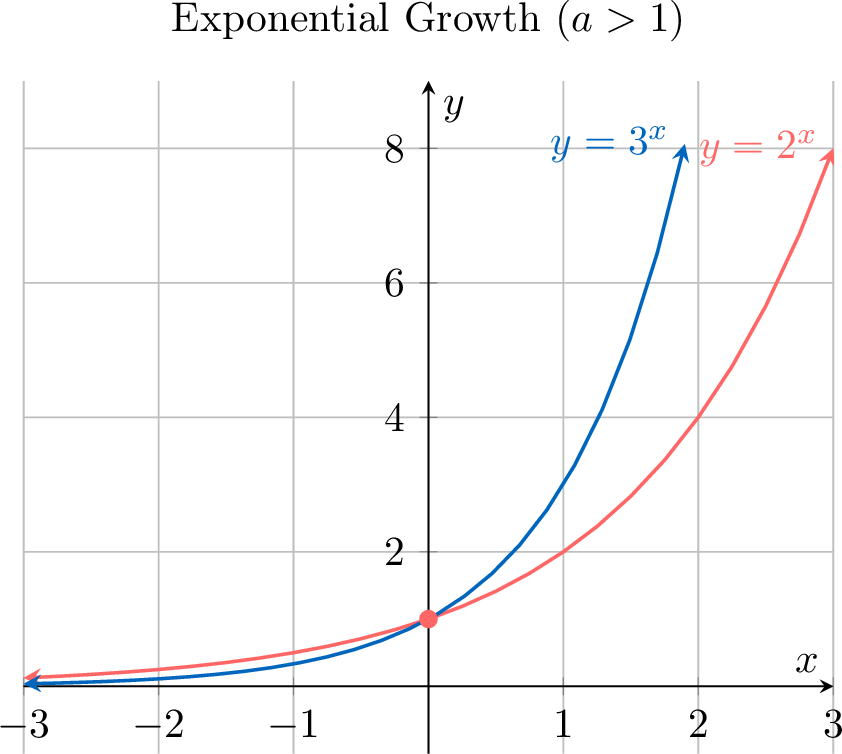
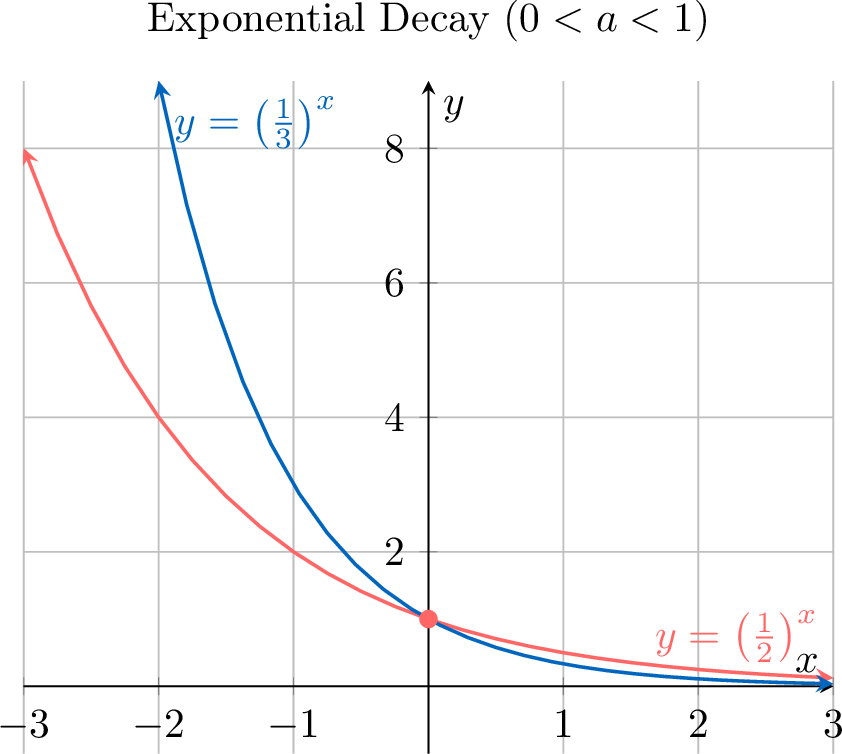
All exponential functions of the form \(f(x) = a^x\) share several key graphical features: - Domain: The domain is all real numbers, \((-\infty, \infty)\).
- Range: The range is all positive real numbers, \((0, \infty)\).
- Horizontal Asymptote: The graph has a horizontal asymptote at the x-axis (\(y=0\)). The function approaches this line but never touches it.
- y-intercept: The graph always passes through the point \((0, 1)\), because \(a^0 = 1\) for any valid base \(a\).
- General Shape: The shape of the graph is determined by the value of the base, \(a\):
- If \(a > 1\), the function shows exponential growth and is increasing.
- If \(0 < a < 1\), the function shows exponential decay and is decreasing.
 \(\quad\)
Proposition — Variations of \(x \mapsto k \times a^x\)
Let \(a \gt 0\) with \(a \neq 1\), and let \(k \neq 0\). The function \(f\) defined for every real \(x\) by \(f(x) = k \times a^x\) satisfies \(f(0) = k\) and has the sign of \(k\). - If \(\textcolor{colorprop}{k \gt 0}\), \(f\) has the same variations as \(x \mapsto a^x\): increasing if \(a \gt 1\), decreasing if \(0 \lt a \lt 1\).
- If \(\textcolor{colorprop}{k \lt 0}\), \(f\) has the opposite variations: decreasing if \(a \gt 1\), increasing if \(0 \lt a \lt 1\).
Example
Give the variations of each function on the set of real numbers. - \(f(x) = 3 \times 1.2^{x}\)
- \(g(x) = -2 \times 1.5^{x}\)
- \(h(x) = 5 \times 0.8^{x}\)
- \(m(x) = -0.5 \times 0.9^{x}\)
- \(k = 3 \gt 0\) and \(a = 1.2 \gt 1\): \(f\) is increasing.
- \(k = -2 \lt 0\) and \(a = 1.5 \gt 1\): \(g\) is decreasing.
- \(k = 5 \gt 0\) and \(0 \lt a = 0.8 \lt 1\): \(h\) is decreasing.
- \(k = -0.5 \lt 0\) and \(0 \lt a = 0.9 \lt 1\): \(m\) is increasing — two reversals cancel out.
Skills to practice
- Deciding the Variations of \(x \mapsto k \times a^x\)
- Studying Exponential Functions
II.2
The Natural Exponential Function
Definition — Natural Exponential Function
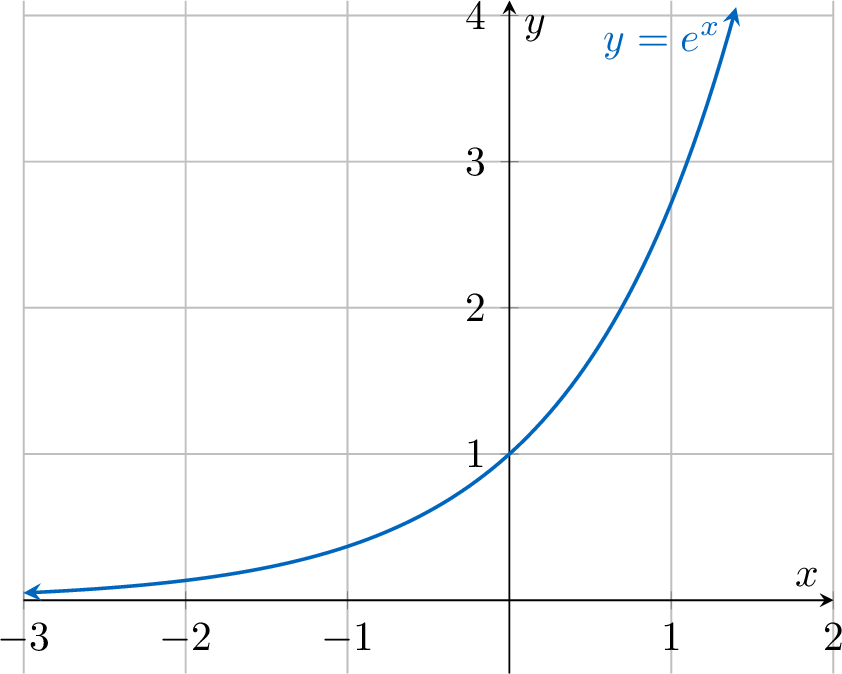
The natural exponential function is \(x\mapsto e^x\). - Domain: \((-\infty, +\infty)\)
- Range: \((0, +\infty)\)
Proposition — Graph and Properties of \(y\equal e^x\)
- Horizontal Asymptote: The graph has a horizontal asymptote at the x-axis (\(y=0\)) as \(x \to -\infty\).
- y-intercept: The graph passes through the point \((0, 1)\), since \(e^0 = 1\).
- It is a strictly increasing function.
Skills to practice
- Calculating with and Graphing \(e^x\)
II.3
Transformations of Exponential Functions
Recappreviously studied — click to reread
Proposition — Transformations of Exponential Functions
The graph of the general exponential function \(f(x) = k \cdot a^{m(x-h)} + v\), with \(a > 0\), \(a \neq 1\), \(k \neq 0\) and \(m \neq 0\), can be obtained by applying transformations to the basic graph of \(y=a^x\). - Vertical Translation (\(v\)): The graph is shifted vertically by \(|v|\) units: up if \(v > 0\), down if \(v < 0\). The horizontal asymptote becomes \(y=v\).
- Horizontal Translation (\(h\)): The graph is shifted horizontally by \(|h|\) units: to the right if \(h > 0\), to the left if \(h < 0\).
- Vertical Stretch/Reflection (\(k\)): The graph is stretched vertically by a factor of \(|k|\). If \(k<0\), the graph is reflected in the horizontal asymptote.
- Horizontal Stretch/Reflection (\(m\)): The graph is stretched horizontally by a factor of \(1/|m|\) about the line \(x=h\). If \(m<0\), it is reflected in the vertical line \(x=h\) (in the \(y\)-axis only when \(h=0\)).
Example
Sketch the graph of \(f(x) = 2e^{-x} + 3\). State the domain, range, and equation of the asymptote.
The graph is a transformation of \(y=e^x\): 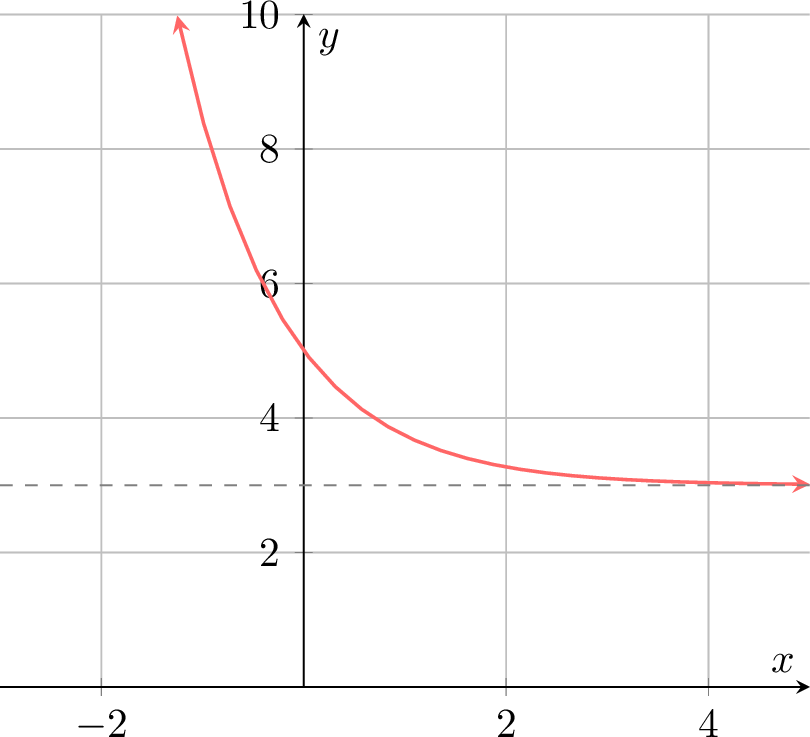
- Reflection in the y-axis (due to the negative in front of \(x\)).
- Vertical stretch by a factor of 2.
- Vertical shift 3 units up.
- The horizontal asymptote is \(\boldsymbol{y=3}\).
- The domain is \(\boldsymbol{\mathbb{R}}\).
- The range is \(\boldsymbol{(3, \infty)}\).
Skills to practice
- Transformations of Exponential Functions
III
The Logarithm of a Number
III.1
Logarithms in Base 10
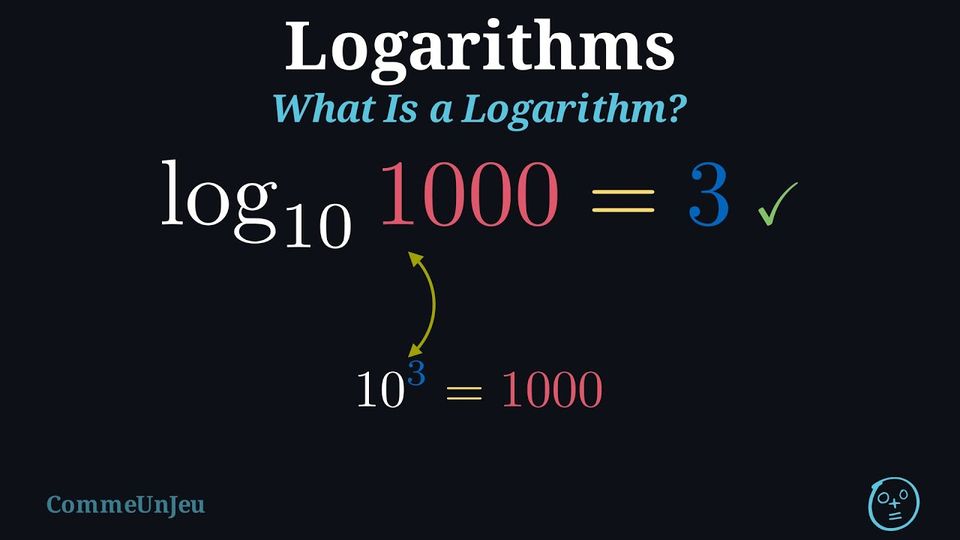
For a power of 10, the logarithm is simply the exponent read off the power. The table below shows this two-way reading:
For example, \(10^{-2} = 0.01\), so \(\log 0.01 = -2\); and \(10^{3} = 1000\), so \(\log 1000 = 3\).
The two operations travel in opposite directions between a number \(y\) and its exponent \(x\): the logarithm extracts the exponent, and raising 10 to a power rebuilds the number. 
| \(y\) | \(0.01\) | \(0.1\) | \(1\) | \(10\) | \(100\) | \(1000\) |
| \(y\) as a power of \(10\) | \(10^{-2}\) | \(10^{-1}\) | \(10^{0}\) | \(10^{1}\) | \(10^{2}\) | \(10^{3}\) |
| \(\log y\) | \(-2\) | \(-1\) | \(0\) | \(1\) | \(2\) | \(3\) |
The two operations travel in opposite directions between a number \(y\) and its exponent \(x\): the logarithm extracts the exponent, and raising 10 to a power rebuilds the number.
Definition — Logarithm
The (base 10) logarithm of a number \(y\) (where \(y > 0\)) is the exponent to which 10 must be raised to obtain \(y\). It is denoted \(\log_{10} y\) and defined by the equivalence: $$\log_{10} y = x \quad \Leftrightarrow \quad 10^x = y$$ As on most calculators and in exams, \(\log_{10} y\) is abbreviated \(\log y\); so \(\log y = \log_{10} y\). In other words, \(\log y\) is the exponent \(x\) such that \(10^x = y\).
Why \(\log 0\) and \(\log(-5)\) are undefined
The logarithm \(\log y\) is defined only for \(y > 0\). Indeed, a power of 10 is always strictly positive: \(10^x > 0\) for every real \(x\). Since no power of 10 equals \(0\) or a negative number, expressions such as \(\log 0\) and \(\log(-5)\) have no value.
Proposition — Inverse Properties of Logarithms
For real numbers: - \(10^{\log x} = x\) for any \(x > 0\),
- \(\log (10^x) = x\) for any real \(x\).
Example
Evaluate \(\log 100\).
\(\begin{aligned}[t]\log(100) &= \log\left(10^{2}\right) &&(100 = 10^2) \\&=2\\\end{aligned}\)
Since \(10^2 = 100\), the logarithm of \(100\) (base 10) is \(2\).
Since \(10^2 = 100\), the logarithm of \(100\) (base 10) is \(2\).
Skills to practice
- Evaluating Logarithms without a Calculator
- Evaluating Logarithms with a Calculator
- Finding an Unknown Exponent
- Finding the Number from Its Logarithm
III.2
The Logarithm in Base \(a\)
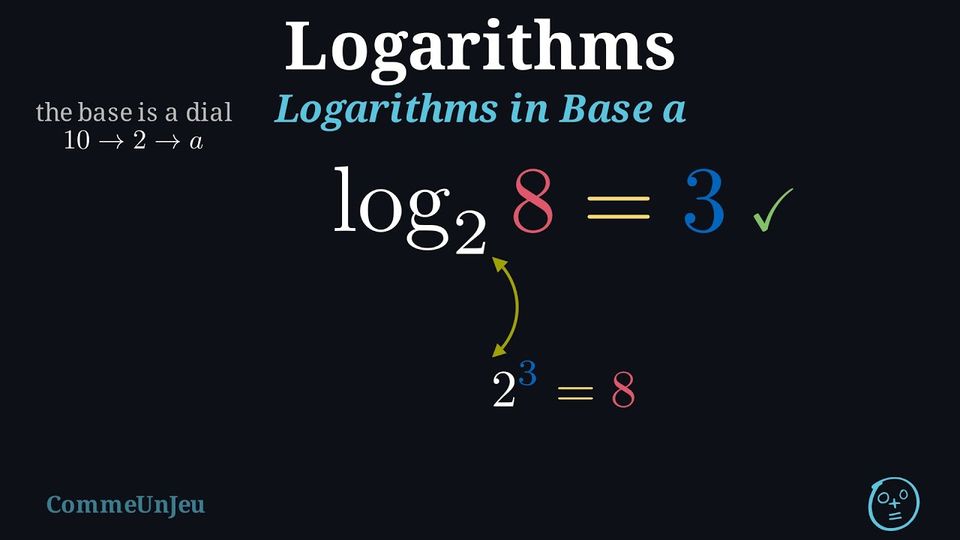
The logarithm in base \(10\) of a number is the exponent to which \(10\) must be raised in order to obtain that number.
We can use the same principle to define logarithms in other bases:
We can use the same principle to define logarithms in other bases:
Definition — Logarithm in Base a
For a positive number \(a \neq 1\), the logarithm base \(a\) of a number \(y\) (where \(y > 0\)) is the exponent to which \(a\) must be raised to obtain \(y\). It is denoted as:$$\log_a y = x \quad \Leftrightarrow \quad a^x = y.$$ Skills to practice
- Evaluating Logarithms in Base \(a\)
III.3
The Natural Logarithm
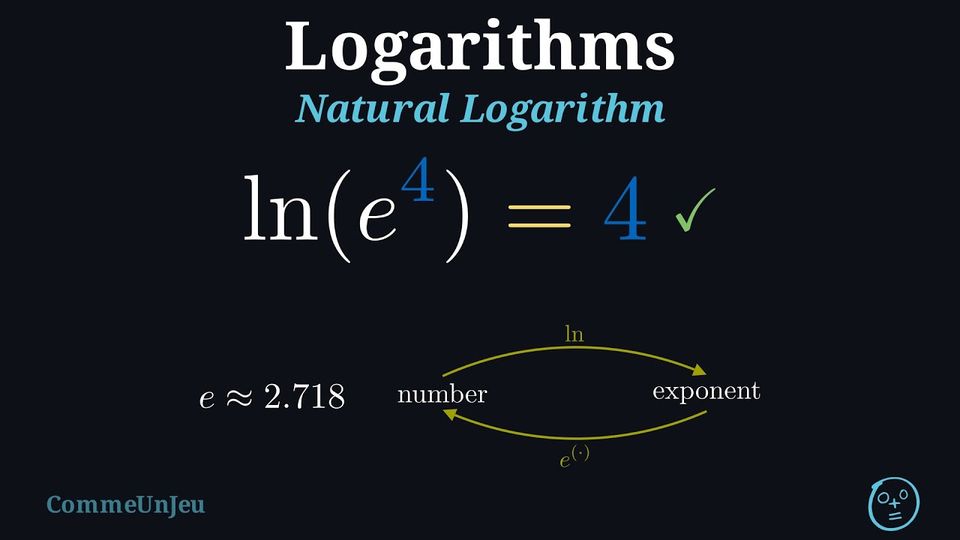
The natural logarithm, often denoted \(\ln x\), is the logarithm with base \(e\) (where \(e \approx 2.71828\) is the base of the natural exponential function). It is the inverse of the exponential function \(e^x\) and plays a central role in calculus, growth models, and many scientific applications.
Definition — Natural Logarithm
The natural logarithm, denoted \(\ln x\), is the logarithm base \(e\), defined for \(x>0\):$$\ln x = \log_e(x).$$ Proposition — Inverse Properties of Natural Logarithms
- \(e^{\ln x} = x\) for \(x > 0\),
- \(\ln (e^x) = x\) for any real \(x\).
Notation. A logarithm always has a base. Three forms are in use:
- \(\log_a x\) — the logarithm in base \(a\) (the base is written explicitly);
- \(\log x = \log_{10} x\) — the base-10 logarithm; as on calculators and in exams, the base 10 is omitted;
- \(\ln x = \log_e x\) — the natural logarithm (base \(e\)).
Skills to practice
- Evaluating Natural Logarithms
- Solving Equations with \(e^x\)
IV
Growth and Decay
IV.1
Exponential Models
Recappreviously studied — click to reread
Exponential functions are used to model quantities that change by a constant multiplicative factor over equal intervals of time. This core principle distinguishes them from linear functions, which change by a constant difference (addition or subtraction).
There are two main types of exponential models:
There are two main types of exponential models:
- Exponential Growth: The quantity increases by a constant factor greater than 1. This is seen in phenomena like population growth and compound interest.
- Exponential Decay: The quantity decreases by a constant factor between 0 and 1. This is seen in phenomena like radioactive decay and asset depreciation.
Definition — General Model for Exponential Growth and Decay
An exponential relationship is described by the function:$$ A(t) = A_0 \times R^t $$ where: - \(A(t)\) is the amount at time \(t\).
- \(A_0\) is the initial amount (the amount at \(t=0\)).
- \(R\) is the constant growth or decay factor per unit of time, with \(R > 0\): \(R = 1 + r\) for a growth at the rate \(r\), \(R = 1 - r\) for a decay at the rate \(r\).
- \(t\) is the time elapsed.
Example
The population of foxes, \(P\), in a specified area, \(t\) years after observation began, is modelled by the equation: \(P(t)=300(1.25)^t\). - How many foxes are there initially?
- What is the annual percentage growth rate?
- How many foxes are there after 5 years?
- The initial population corresponds to \(t=0\). $$P(0) = 300(1.25)^0 = 300 \times 1 = \boldsymbol{300} \text{ foxes}$$
- The growth factor is \(R=1.25\). Since \(R = 1+r\), we have \(1.25 = 1+r\), which gives \(r=0.25\).
The annual growth rate is \(\boldsymbol{25\pourcent}\). - Substitute \(t=5\) into the equation. Since the population must be a whole number, we round to the nearest fox. $$P(5) = 300(1.25)^5 \approx 915.52... \approx \boldsymbol{916} \text{ foxes}$$
Example
An amount of \(\dollar 5\,000\) is invested at \(6\pourcent\) p.a. compounded annually. - Find a model for the amount, \(A\), after \(t\) years.
- Find the amount after 4 years.
- The initial amount is \(A_0 = 5\,000\). The annual interest rate is \(r = 0.06\).
The growth factor is \(R = 1+r = 1+0.06 = 1.06\).
The model is \(\boldsymbol{A(t) = 5\,000(1.06)^t}\).
- After 4 years, the amount is: $$A(4) = 5\,000(1.06)^4 \approx 6\,312.38...$$ The amount is \(\boldsymbol{\dollar 6\,312.38}\).
Skills to practice
- Modelling Growth and Decay
IV.2
Solving Exponential Equations with Technology
Equating exponents solves \(2^x = 16\), because both sides are powers of \(2\). The equation \(3^x = 7\) cannot be solved this way: \(7\) is not a power of \(3\) with a whole-number exponent. Comparing with the powers of \(3\) still locates its solution: $$3^1 = 3 < 7 < 9 = 3^2,$$ so the solution lies between \(1\) and \(2\). Its value is read on the graphs of \(y = 3^x\) and \(y = 7\), with technology. Two questions come first: is there always a solution, and can there be more than one?
Proposition — Number of Solutions of an Exponential Equation
Let \(a > 0\) with \(a \neq 1\), and let \(k\) be a real number. The equation \(a^x = k\) has - exactly one solution if \(k > 0\);
- no solution if \(k \leq 0\).
The key features of the graph of \(y = a^x\), stated with the exponential functions (domain: all real numbers; range: the positive numbers; increasing if \(a > 1\), decreasing if \(0 < a < 1\)), give the two cases.
- If \(k \leq 0\): the range of \(x \mapsto a^x\) is the set of positive numbers, so \(a^x > 0 \geq k\) for every \(x\), and the equation has no solution.
- If \(k > 0\): \(k\) belongs to the range, so at least one number \(x\) satisfies \(a^x = k\). There is only one: if \(a^x = k\) and \(a^y = k\), then \(a^x = a^y\), hence \(x = y\) by the method of equating exponents. Graphically, the horizontal line \(y = k\) meets the graph once, since the graph is increasing when \(a > 1\) and decreasing when \(0 < a < 1\).
Method — Solving an Exponential Equation with Technology
To solve an equation such as \(a^x = k\), or \(c \times a^x = k\) with \(c \neq 0\): - Count the solutions: isolate the power, \(a^x = \dfrac{k}{c}\), and apply the proposition “Number of Solutions of an Exponential Equation”. If the right side is not positive, there is no solution and nothing to graph.
- Locate the solution between two consecutive integers by comparing with the powers of \(a\) (a table of values does it). If the right side is itself a power of \(a\) with an integer exponent, that integer is the exact solution, found by equating exponents. The two integers give the \(x\)-range of the window; its \(y\)-range must contain the right side.
- Enter each side as a function, \(Y_1\) = left side and \(Y_2\) = right side, graph them, and choose intersection in the analysis tools of the graph menu. The solution is the \(x\)-coordinate \(X\) of the point displayed; its \(y\)-coordinate is the common value of the two sides.
- Round as the question asks (to 3 significant figures if it says nothing), then check: the left side, evaluated at the rounded value, is close to the right side.
Example
Solve each equation, with technology where it is needed. Give each solution to 3 significant figures. - \(2^x = 12\);
- \(4 \times 0.8^x = 1.5\);
- \(5 \times 2^x = -10\).
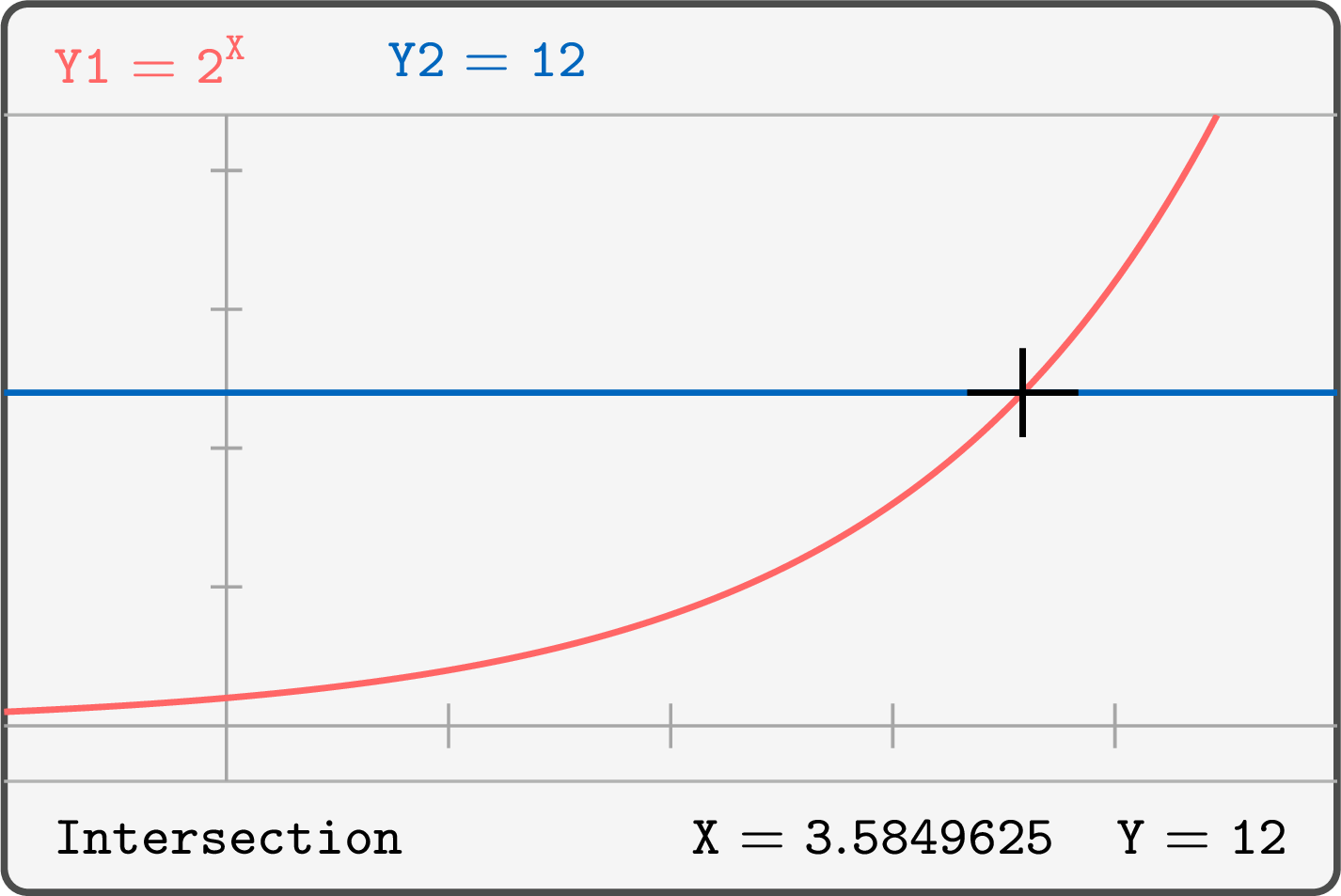
- Since \(12 > 0\), the equation has exactly one solution, and \(2^3 = 8 < 12 < 16 = 2^4\) places it between \(3\) and \(4\). The two sides are entered as \(Y_1 = 2^x\) and \(Y_2 = 12\), and graphed in the window \(-1 \le x \le 5\), \(-2 \le y \le 22\). The intersection tool displays \(X = 3.5849625\) and \(Y = 12\).
- First the power is isolated: $$\begin{aligned}[t] 4 \times 0.8^x &= 1.5 \\ 0.8^x &= 0.375. && \text{(divide both sides by } 4\text{)} \end{aligned}$$ Since \(0.375 > 0\), there is exactly one solution. The base \(0.8\) is less than \(1\), so the powers decrease: \(0.8^4 = 0.4096 > 0.375 > 0.32768 = 0.8^5\), and the solution lies between \(4\) and \(5\). With \(Y_1 = 4 \times 0.8^x\) and \(Y_2 = 1.5\), in the window \(0 \le x \le 8\), \(0 \le y \le 5\), the intersection tool displays \(X = 4.3955079\). The solution is \(x \approx 4.40\), the final zero being the third significant figure. Check: \(4 \times 0.8^{4.40} \approx 1.498\), close to \(1.5\).
- The power is isolated first: $$\begin{aligned}[t] 5 \times 2^x &= -10 \\ 2^x &= -2. && \text{(divide both sides by } 5\text{)} \end{aligned}$$ The right side is negative, and \(2^x > 0\) for every \(x\): the equation has no solution, and there is nothing to graph.
Definition — Half-Life
For a quantity that decreases according to \(A(t) = A_0 \times b^t\), with \(A_0 > 0\) and \(0 < b < 1\), the half-life is the time \(T\) after which the quantity is halved: $$A(T) = \dfrac{A_0}{2}, \quad \text{that is} \quad b^T = \dfrac{1}{2}.$$ Example
A patient is given \(400\) mg of a medicine. The amount left in the body \(t\) hours later is modelled by \(A(t) = 400 \times 0.82^t\) mg. - Find the half-life of the medicine, to 3 significant figures.
- The medicine no longer acts below \(50\) mg. After how many whole hours is the amount first below \(50\) mg?
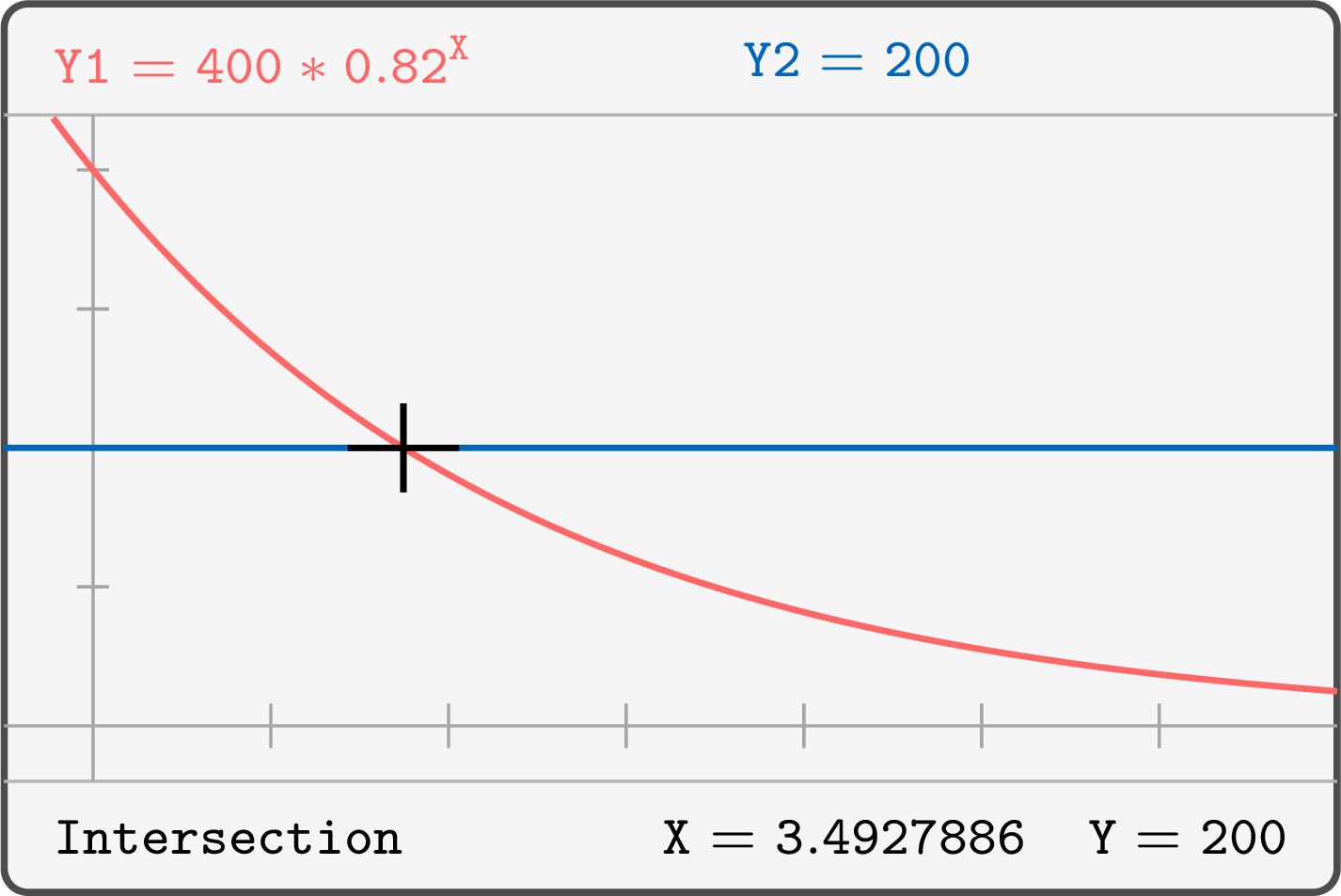
- The half-life \(T\) satisfies \(A(T) = 200\): $$\begin{aligned}[t] 400 \times 0.82^T &= 200 \\
0.82^T &= 0.5. && \text{(divide both sides by } 400\text{)} \end{aligned}$$ Since \(0.5 > 0\), there is exactly one solution. With \(Y_1 = 400 \times 0.82^x\) and \(Y_2 = 200\), in the window \(-1 \le x \le 14\), \(-40 \le y \le 440\), the intersection tool displays \(X = 3.4927886\).
- The base \(0.82\) is less than \(1\), so the amount decreases, and it is enough to find the first whole hour at which it is below \(50\) mg. A table of values of \(Y_1\) at whole numbers gives:
\(t\) (h) \(9\) \(10\) \(11\) \(12\) \(A(t)\) (mg) \(67.05\) \(54.98\) \(45.08\) \(36.97\)
Check with the half-life: \(50 = \dfrac{400}{8}\), three halvings, so the amount reaches \(50\) mg after \(3 \times 3.49 \approx 10.5\) hours, between \(10\) and \(11\).
Skills to practice
- Counting and Locating Solutions
- Solving Equations with the Intersection Tool
- Finding When a Model Reaches a Value
- Writing Up a Solution Found with Technology
IV.3
Modelling with Exponential Functions
Common real-world examples of exponential models include:
- Population growth (growth)
- Radioactive decay (decay)
- Compound interest (growth)
- Cooling of an object (decay)
- Drug concentration in bloodstream (decay)
Definition — Exponential Model
An exponential model is a function of the form - \( f(x) = ka^x + c \), with \( a>0 \) and \( a\neq 1 \)
- \( f(x) = ke^{rx} + c \)
Proposition — Properties
- Assume \(k>0\). Exponential growth is represented by:
- \( a^x \) where \( a > 1 \)
- \( e^{rx} \) where \( r > 0 \)
- Assume \(k>0\). Exponential decay is represented by:
- \( a^x \) where \( 0 < a < 1 \)
- \( e^{rx} \) where \( r < 0 \)
- The constant \(c\) translates the graph vertically. When \(r<0\) (or \(0
Example
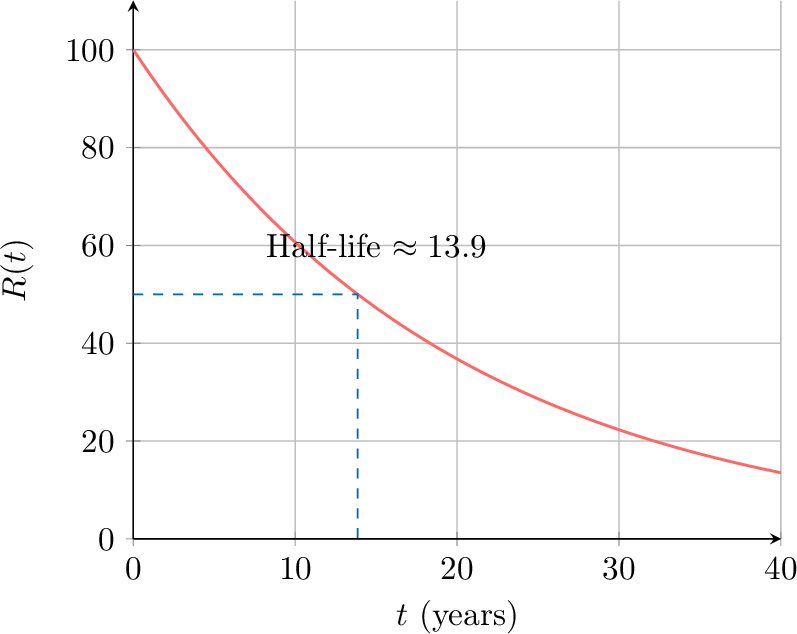
A radioactive element decays according to the formula \(R(t) = 100 e^{-0.05t}\), where \(R\) is the radiation in counts per minute and \(t\) is time in years. - State the initial radiation.
- Find the half-life (time taken for radiation to halve).
- Initial radiation: At \(t=0\), $$ R(0) = 100 e^0 = 100 \text{ cpm}. $$
- Half-life: We find \(t\) such that \(R(t) = 50\). $$ 50 = 100 e^{-0.05t} \implies 0.5 = e^{-0.05t}. $$ Taking \(\ln\) of both sides: $$ \ln(0.5) = -0.05t \implies t = \frac{\ln(0.5)}{-0.05} \approx 13.86 \text{ years}. $$
Example
A metal bar is taken out of an oven and left in a workshop. Its temperature \(t\) minutes later is modelled by $$T(t) = 25 + 175 \times 0.85^{t} \quad \text{degrees Celsius}.$$ - Find the temperature of the bar when it leaves the oven.
- State the horizontal asymptote of the model and what it means.
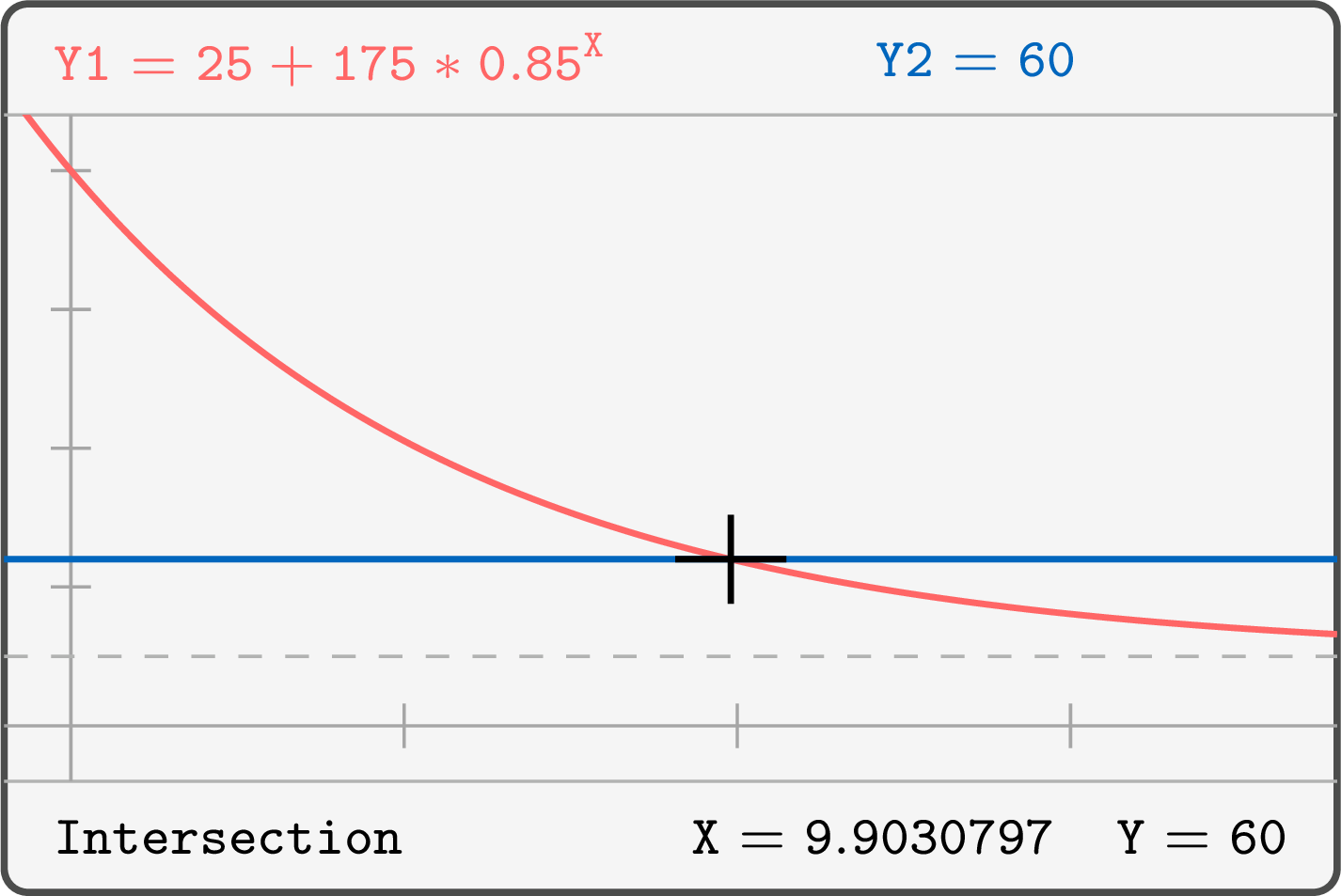
- Use technology to find when the bar has cooled to \(60^\circ\)C. Give the answer to 3 significant figures.
- At \(t = 0\): $$\begin{aligned}[t] T(0) &= 25 + 175 \times 0.85^{0} \\ &= 25 + 175 \\ &= 200. \end{aligned}$$ The bar leaves the oven at \(200^\circ\)C.
- The model has the form \(k a^{t} + c\) with \(k = 175\), \(a = 0.85\) and \(c = 25\). Since \(0 < 0.85 < 1\), the term \(175 \times 0.85^{t}\) decreases towards \(0\): the horizontal asymptote is \(y = 25\). The bar cools towards the temperature of the workshop, \(25^\circ\)C, and stays above it.
- The power is isolated first: $$\begin{aligned}[t] 25 + 175 \times 0.85^{t} &= 60 \\
175 \times 0.85^{t} &= 35 && \text{(subtract } 25\text{)} \\
0.85^{t} &= 0.2. && \text{(divide both sides by } 175\text{)} \end{aligned}$$ The base \(0.85\) is positive and different from \(1\), and \(0.2 > 0\): the equation has exactly one solution. With \(Y_1 = 25 + 175 \times 0.85^{x}\) and \(Y_2 = 60\), in the window \(-1 \le x \le 19\), \(-20 \le y \le 220\), the intersection tool displays \(X = 9.9030797\).
Skills to practice
- Using Exponential Models
V
Going further
Skills to practice
- Solving Problems with Exponential Models
- Quiz
Jump to section