International Baccalaureate · DP 1: Applications and Interpretation SL
Sequences and Series
I
Number Sequences
I.1
Numerical Sequences and Their Graphs
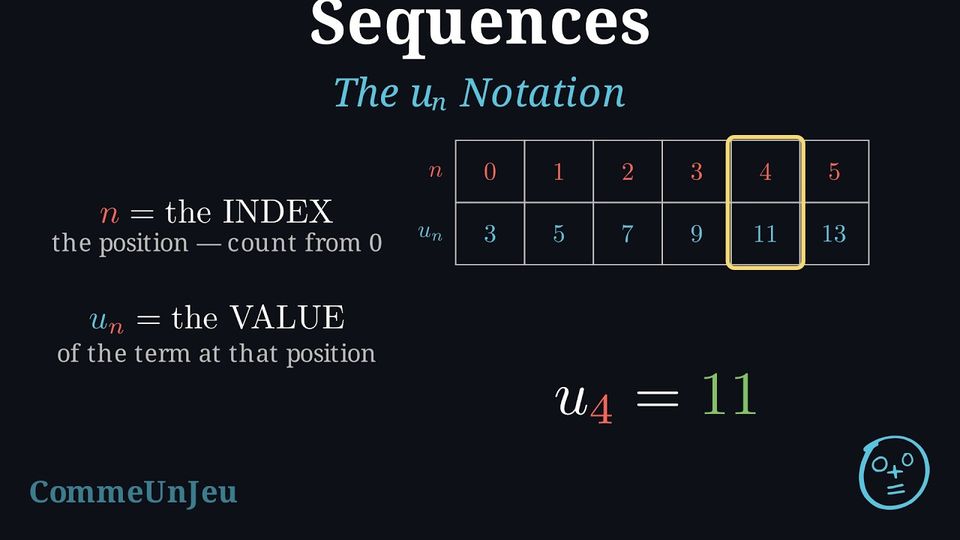
In mathematics, a sequence is more than just a pattern; it is an ordered list of numbers where each number has a specific position (its place in the list). To work with sequences effectively, we use a special notation to distinguish a term's position from its value.
Definition — Numerical Sequence
A numerical sequence is an ordered list of numbers, called terms. We use the notation \(u_n\) to describe a term in the sequence. - The subscript \(n\) is the index, which tells us the position of the term (often starting from \(n=0\)). The index \(n\) usually takes integer values: \(0,1,2,\dots\)
- \(u_n\) represents the value of the term at that specific position.
| Index (\(n\)) | 0 | 1 | 2 | \(\dots\) |
| Term (\(u_n\)) | \(u_0\) | \(u_1\) | \(u_2\) | \(\dots\) |
Example
Given the sequence defined by the table below, find the value of the term \(u_4\). | \(n\) | 0 | 1 | 2 | 3 | 4 | 5 | \(\dots\) |
| \(u_n\) | 3 | 5 | 7 | 9 | 11 | 13 | \(\dots\) |
To find \(u_4\), we look in the table for the column where the index is \(n=4\). The value in the row below it is \(11\).
Therefore, \(u_4 = 11\).
This sequence starts at \(u_0\), so \(u_4\) is its fifth term. A sequence may also start at \(u_1\): its first term is then \(u_1\), and \(u_4\) is its fourth term.
Therefore, \(u_4 = 11\).
This sequence starts at \(u_0\), so \(u_4\) is its fifth term. A sequence may also start at \(u_1\): its first term is then \(u_1\), and \(u_4\) is its fourth term.
Graphical Representation of a Sequence
A sequence associates to each integer \(n\) (from its starting index) a real number \(u_n\): it is a function defined on \(\mathbb{N}\) (or on the integers \(n \ge n_0\)). Like a function, a sequence can be pictured, in two ways.
- On a number line: the terms \(u_0\), \(u_1\), \(u_2\), …\ are placed as points on a graduated line.
- In a coordinate system: the sequence is represented by the points of coordinates \((n, u_n)\), that is the point of abscissa \(0\) and ordinate \(u_0\), the point of abscissa \(1\) and ordinate \(u_1\), and so on.
Example
Let \((u_n)\) be the sequence defined for all \(n \in \mathbb{N}\) by \(u_n = 2n - 1\).Represent the first five terms of \((u_n)\) on a number line, then in a coordinate system.
The first five terms are \(u_0 = -1\), \(u_1 = 1\), \(u_2 = 3\), \(u_3 = 5\) and \(u_4 = 7\). 
In a coordinate system, we plot the points \((0, -1)\), \((1, 1)\), \((2, 3)\), \((3, 5)\) and \((4, 7)\), without joining them. 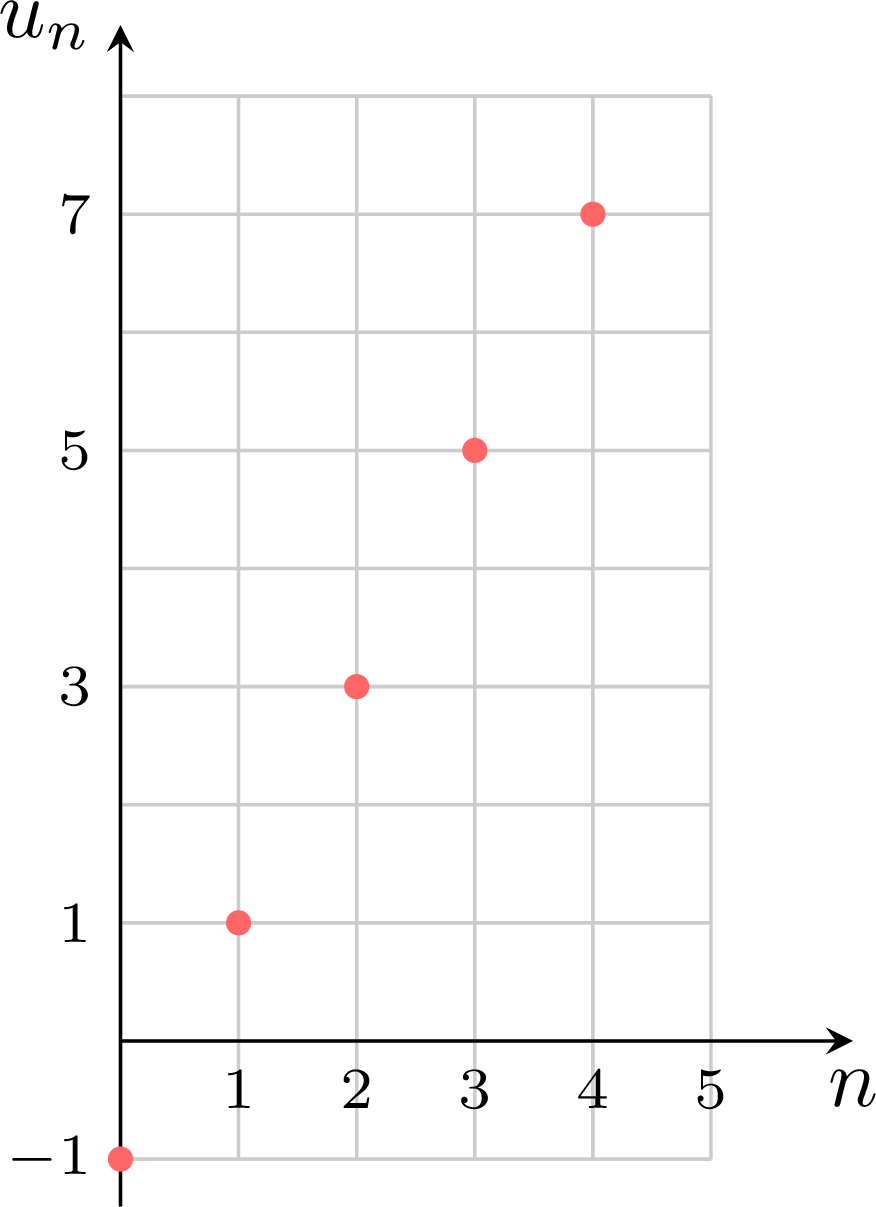
Skills to practice
- Writing Terms and Indices
I.2
Recursive Definition
Recappreviously studied — click to reread
Consider a sequence where the first term is \(2\), and each term is obtained by adding \(3\) to the previous term. The terms are: 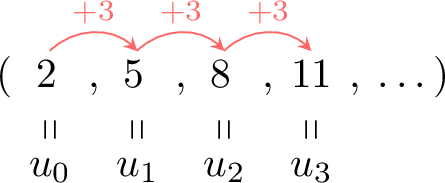
Here the sequence is indexed starting from \(n=0\): \(u_0 = 2\), \(u_1 = 5\), \(u_2 = 8\), \(u_3 = 11\), etc. We can describe the relationship between the terms using formal notation: 
- \(5 = 2\textcolor{colordef}{+3} \longrightarrow u_1 = u_0\textcolor{colordef}{+3} \longrightarrow u_{0+1} = u_0+3\)
- \(8 = 5\textcolor{colordef}{+3} \longrightarrow u_2 = u_1\textcolor{colordef}{+3} \longrightarrow u_{1+1} = u_1+3\)
- \(11 = 8\textcolor{colordef}{+3} \longrightarrow u_3 = u_2\textcolor{colordef}{+3} \longrightarrow u_{2+1} = u_2+3\)
Definition — Recursive Definition
A recursive definition of a sequence includes two parts: - The first term (or initial term), denoted for example by \(u_0\) or \(u_1\). This is the starting point.
- The recursive rule (or recurrence relation), which is a formula that connects the next term, \(u_{n+1}\), to the current term, \(u_n\), for all appropriate integers \(n\) (such as \(n \ge 0\) or \(n \ge 1\)).
Example
A sequence is defined recursively by: - \(u_1 = 5\) (The first term is \(5\)).
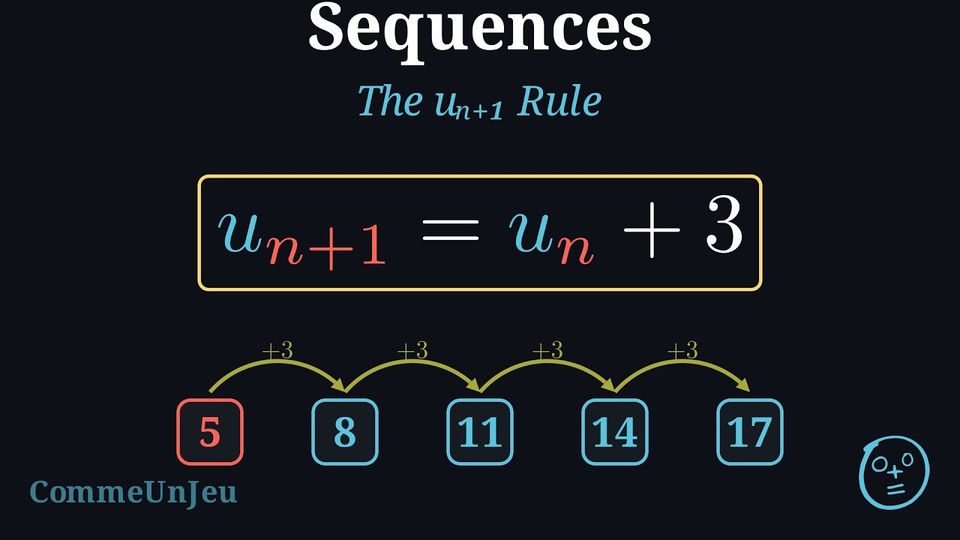
- \(u_{n+1} = u_n + 3\) (The rule is to add \(3\) to the previous term, for all integers \(n \ge 1\)).
We build the sequence step by step using the recursive definition. $$5 \textcolor{olive}{\xrightarrow{\;+3\;}} 8 \textcolor{olive}{\xrightarrow{\;+3\;}} 11 \textcolor{olive}{\xrightarrow{\;+3\;}} 14 \textcolor{olive}{\xrightarrow{\,+3\,}} 17$$ The first five terms are: \(5, 8, 11, 14, 17\).
- 1\(^{\text{st}}\) term: The starting term is given: \(\boldsymbol{u_1 = 5}\).
- 2\(^{\text{nd}}\) term: Use the rule with \(n=1\). \(\boldsymbol{u_2} = u_1 + 3 = 5 + 3 = \textbf{8}\).
- 3\(^{\text{rd}}\) term: Use the rule with \(n=2\). \(\boldsymbol{u_3} = u_2 + 3 = 8 + 3 = \textbf{11}\).
- 4\(^{\text{th}}\) term: Use the rule with \(n=3\). \(\boldsymbol{u_4} = u_3 + 3 = 11 + 3 = \textbf{14}\).
- 5\(^{\text{th}}\) term: Use the rule with \(n=4\). \(\boldsymbol{u_5} = u_4 + 3 = 14 + 3 = \textbf{17}\).
Skills to practice
- Recursive Definition
I.3
Explicit Definition
Recappreviously studied — click to reread
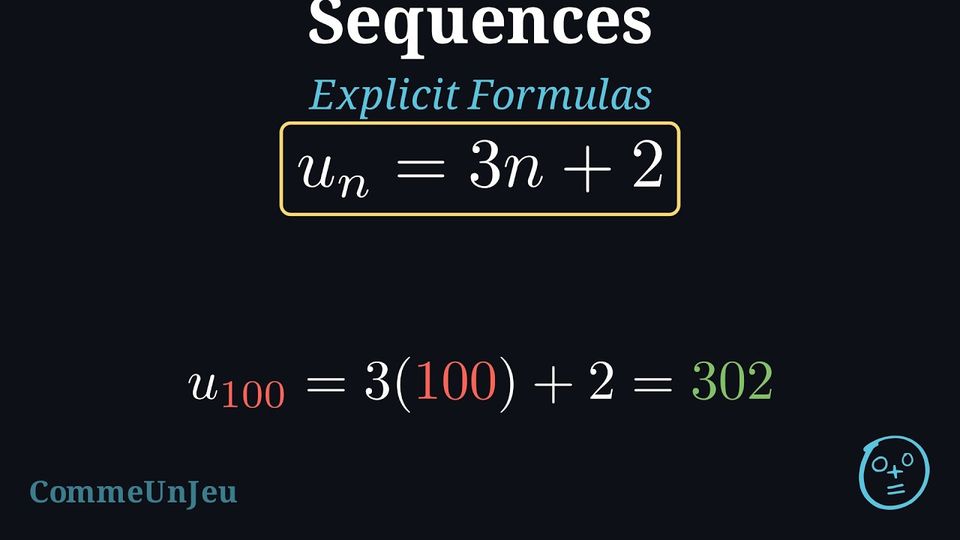
While a recursive rule tells how to get from one term to the next, it is not very efficient for finding a term far into the sequence (like the \(100^{\text{th}}\) term), because all the terms before it would have to be calculated.
An alternative and often more powerful way to define a sequence is with an explicit rule. An explicit rule is a formula that gives the value of \(u_n\) directly from the position \(n\) in the sequence. A value of \(n\) is chosen, and the rule gives \(u_n\) immediately.
An alternative and often more powerful way to define a sequence is with an explicit rule. An explicit rule is a formula that gives the value of \(u_n\) directly from the position \(n\) in the sequence. A value of \(n\) is chosen, and the rule gives \(u_n\) immediately.
Definition — Explicit Rule
An explicit rule (or explicit formula) defines the \(n\)th term of a sequence, \(u_n\), directly as a function of its position \(n\).$$u_n = f(n)$$ Example
Consider the sequence defined by the explicit formula: $$u_n = 3n + 2$$ Calculate \(u_{100}\).
To find the value of \(u_{100}\), we substitute \(n = 100\) into the explicit formula: $$\begin{aligned}[t] u_{100} &= 3(100) + 2 \\
&= 300 + 2 \\
&= \boldsymbol{302} \end{aligned}$$ We did not need to know any of the previous terms in the sequence.
Skills to practice
- Calculating with an Explicit Formula
II
Arithmetic and Geometric Sequences
II.1
Arithmetic Sequences
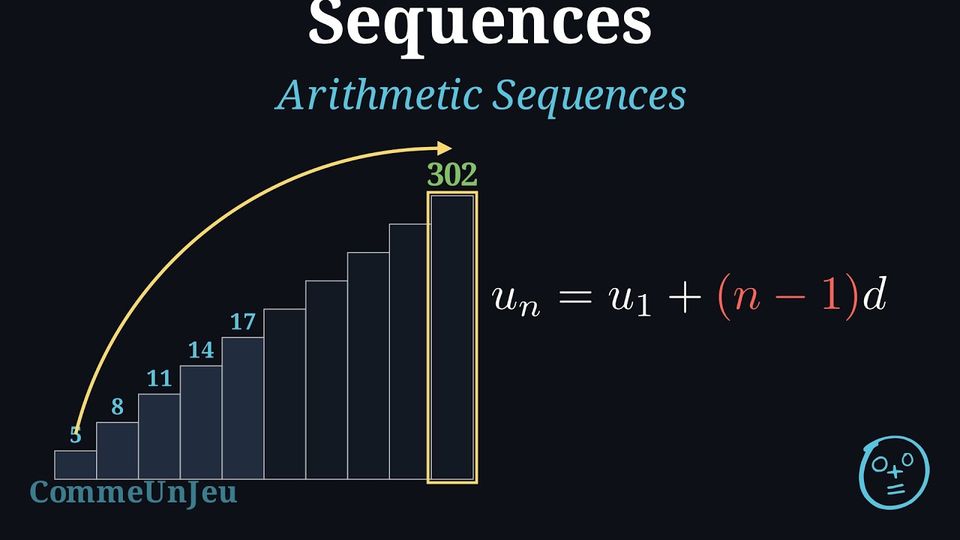
An arithmetic sequence is a fundamental type of sequence that follows a recursive rule. It is defined by a starting term and a constant change between consecutive terms.
Consider an arithmetic sequence with a first term \(u_1 = 5\) and a common difference \(d = 3\).
We can write out the first few terms by repeatedly adding 3:
We can write out the first few terms by repeatedly adding 3:
- \(u_1 = 5\)
- \(u_2 = 5 + 3\)
- \(u_3 = 5 + 3 + 3\)
- \(u_4 = 5 + 3 + 3 + 3\)
- \(u_1 = 5 + \textcolor{colordef}{0} \times 3\)
- \(u_2 = 5 + \textcolor{colordef}{1} \times 3\)
- \(u_3 = 5 + \textcolor{colordef}{2} \times 3\)
- \(u_4 = 5 + \textcolor{colordef}{3} \times 3\)
Definition — Arithmetic Sequence
An arithmetic sequence is a sequence where each term after the first is found by adding a constant value to the previous term. This constant is called the common difference, denoted by \(d\). - Recursive Definition: The rule for finding the next term from the previous one is:$$u_{n+1} = u_n + d$$
- Explicit Formula: We can also find any term directly using its position, \(n\).
- If the sequence starts with \(u_1\): $$u_n = u_1 + (n-1)d$$
- If the sequence starts with \(u_0\): $$u_n = u_0 + nd$$
Proposition — General Term of an Arithmetic Sequence
Let \((u_n)\) be an arithmetic sequence with common difference \(d\). - For every natural number \(n\): \(u_n = u_0 + nd\).
- If the sequence starts at \(u_1\): \(u_n = u_1 + (n-1)d\).
- More generally, for all natural numbers \(n\) and \(p\): \(u_n = u_p + (n-p)d\).
By definition, each term is obtained from the previous one by adding \(d\): $$\begin{aligned} u_1 &= u_0 + d \\
u_2 &= u_1 + d = u_0 + 2d \\
u_3 &= u_2 + d = u_0 + 3d \end{aligned}$$ To go from \(u_0\) to \(u_n\), we add \(d\) exactly \(n\) times: \(u_n = u_0 + nd\).
Starting from \(u_p\) instead of \(u_0\), we add \(d\) exactly \(n - p\) times when \(n \geq p\): \(u_n = u_p + (n-p)d\). When \(n \lt p\), going back from \(u_p\) to \(u_n\) means subtracting \(d\) exactly \(p - n\) times, which gives the same formula. The case \(p = 1\) gives \(u_n = u_1 + (n-1)d\).
(The sentence « we add \(d\) exactly \(n\) times » is made fully rigorous by a proof by induction (Terminale).)
Example
Let \((u_n)\) be the arithmetic sequence with \(u_0 = 5\) and common difference \(d = 3\). - Compute \(u_{20}\).
- Another arithmetic sequence \((v_n)\) has common difference \(3\) and \(v_5 = 17\). Compute \(v_{12}\).
- By the proposition, \(u_{20} = u_0 + 20d = 5 + 20 \times 3 = 65\).
- Starting from \(v_5\): \(v_{12} = v_5 + (12 - 5) \times 3 = 17 + 21 = 38\).
Skills to practice
- Showing that a Sequence Is Arithmetic and Using its General Term
II.2
Geometric Sequences
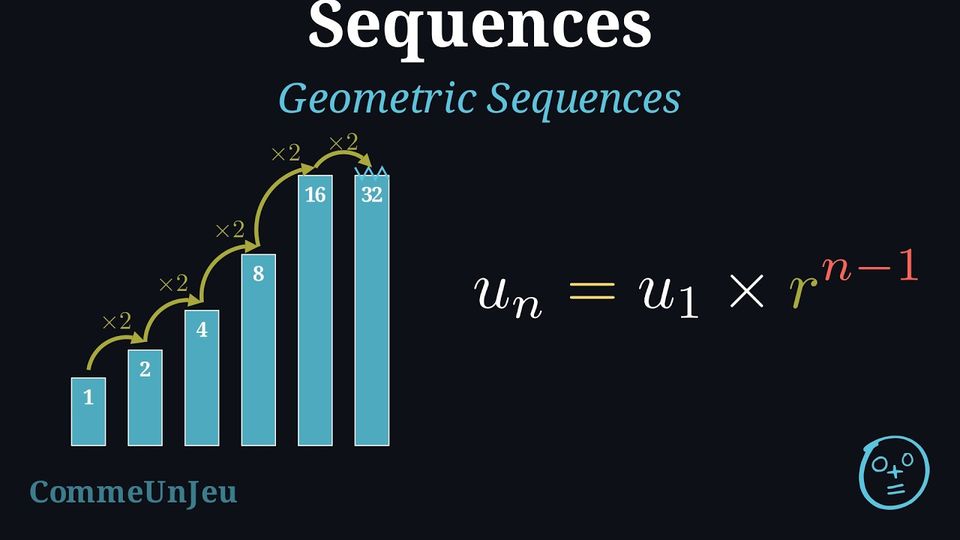
A geometric sequence is another fundamental type of sequence that follows a recursive rule. It is defined by a starting term and a constant multiplicative factor: to get from one term to the next, the term is always multiplied by the same number.
Consider a geometric sequence with a first term \(u_1 = 2\) and a common ratio \(r = 3\).
We can write out the first few terms by repeatedly multiplying by 3:
We can write out the first few terms by repeatedly multiplying by 3:
- \(u_1 = 2\)
- \(u_2 = 2 \times 3\)
- \(u_3 = 2 \times 3 \times 3\)
- \(u_4 = 2 \times 3 \times 3 \times 3\)
- \(u_1 = 2 \times 3^{\textcolor{colordef}{0}}\)
- \(u_2 = 2 \times 3^{\textcolor{colordef}{1}}\)
- \(u_3 = 2 \times 3^{\textcolor{colordef}{2}}\)
- \(u_4 = 2 \times 3^{\textcolor{colordef}{3}}\)
Definition — Geometric Sequence
A geometric sequence is a sequence where each term after the first is found by multiplying the previous term by a constant non-zero value. This constant is called the common ratio, denoted by \(r\). - Recursive Definition: The rule for finding the next term from the previous one is:$$u_{n+1} = r \times u_n $$
- Explicit Formula: We can also find any term directly using its position, \(n\).
- If the sequence starts with \(u_1\): $$u_n = u_1 \times r^{n-1}$$
- If the sequence starts with \(u_0\): $$u_n = u_0 \times r^n$$
Proposition — General Term of a Geometric Sequence
Let \((u_n)\) be a geometric sequence with common ratio \(r\). - For every natural number \(n\): \(u_n = u_0 \times r^n\).
- If the sequence starts at \(u_1\): \(u_n = u_1 \times r^{n-1}\).
- More generally, for all natural numbers \(n\) and \(p\) with \(n \geq p\): \(u_n = u_p \times r^{n-p}\).
By definition, each term is obtained from the previous one by multiplying by \(r\): $$\begin{aligned} u_1 &= u_0 \times r \\
u_2 &= u_1 \times r = u_0 \times r^2 \\
u_3 &= u_2 \times r = u_0 \times r^3 \end{aligned}$$ To go from \(u_0\) to \(u_n\), we multiply by \(r\) exactly \(n\) times: \(u_n = u_0 \times r^n\).
Starting from \(u_p\), we multiply by \(r\) exactly \(n - p\) times: \(u_n = u_p \times r^{n-p}\); the case \(p = 1\) gives \(u_n = u_1 \times r^{n-1}\).
(As for arithmetic sequences, « exactly \(n\) times » is made rigorous by a proof by induction (Terminale).)
Starting from \(u_p\), we multiply by \(r\) exactly \(n - p\) times: \(u_n = u_p \times r^{n-p}\); the case \(p = 1\) gives \(u_n = u_1 \times r^{n-1}\).
(As for arithmetic sequences, « exactly \(n\) times » is made rigorous by a proof by induction (Terminale).)
Example
Let \((u_n)\) be the geometric sequence with \(u_0 = 3\) and common ratio \(r = 2\). - Compute \(u_{10}\).
- Another geometric sequence \((v_n)\) has common ratio \(2\) and \(v_4 = 24\). Compute \(v_7\).
- By the proposition, \(u_{10} = u_0 \times r^{10} = 3 \times 2^{10} = 3 \times 1024 = 3072\).
- Starting from \(v_4\): \(v_7 = v_4 \times 2^{7-4} = 24 \times 8 = 192\).
Skills to practice
- Showing that a Sequence Is Geometric and Using its General Term
III
Percentage Change and Financial Mathematics
III.1
Growth and Decay
Recappreviously studied — click to reread
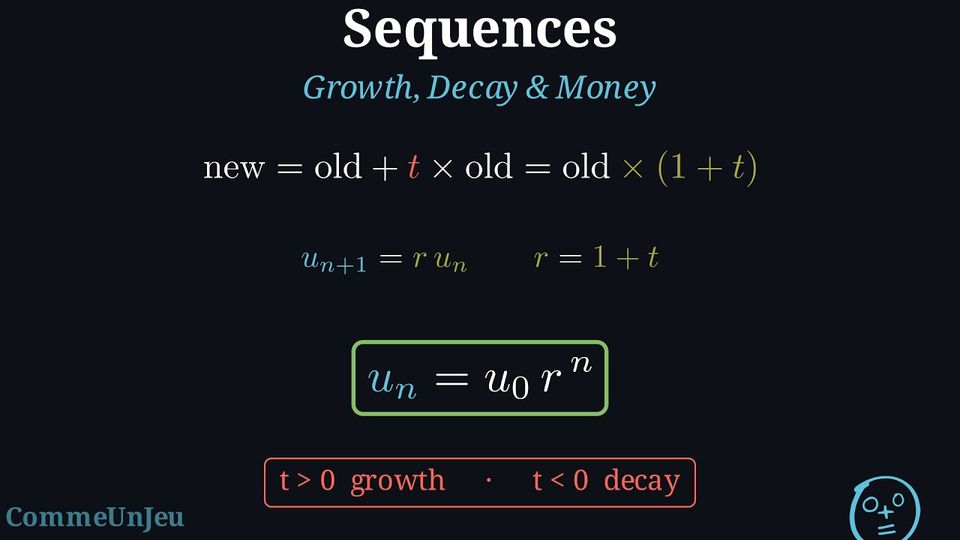
A sum of money is invested at a fixed rate of \(3\pourcent\) a year: each year the interest is added to the account, and then itself earns interest the next year (compound interest). Why is such a situation modelled by a geometric sequence? Each year the amount is not increased by a fixed sum, but by a fixed fraction of itself:$$\text{new amount} = \text{old amount} + \frac{3}{100} \times \text{old amount} = \text{old amount} \times 1.03.$$ So from one year to the next we multiply by the same factor \(1.03\). That is exactly the recurrence of a geometric sequence, \(u_{n+1} = 1.03\,u_n\), whose explicit form is \(u_n = u_0 \times 1.03^n\). The same reasoning covers any constant percentage change of \(t\pourcent\) per period, whose factor is \(1 + \dfrac{t}{100}\) — a population growing at a steady rate, a car losing value each year.
Method — Modelling a Constant Percentage Change
For a quantity changing by a fixed rate of \(t\pourcent\) each period, starting from \(u_0\): - The rate \(t\) is signed: \(t > 0\) for a growth, \(-100 < t < 0\) for a decay (a decrease by \(100\pourcent\) or more is not a percentage change of a positive quantity).
- In every case the common ratio is the multiplier \(\;r = 1 + \dfrac{t}{100}\): \(+5\pourcent\) gives \(t = 5\) and \(r = 1.05\); \(-15\pourcent\) gives \(t = -15\) and \(r = 1 + \dfrac{-15}{100} = 0.85\).
- After \(n\) periods: \(\;u_n = u_0\, r^n\).
Example — Compound interest
An amount of \(\dollar 1000\) is invested at a fixed annual interest rate of \(5\pourcent\). What is its value after \(3\) years?
Each year the balance is multiplied by \(1 + 0.05 = 1.05\), so the yearly amounts form a geometric sequence:$$\begin{aligned}[t] u_1 &= 1000 \times 1.05 \\
u_2 &= (1000 \times 1.05) \times 1.05 = 1000 \times 1.05^2 \\
u_3 &= 1000 \times 1.05^3. \end{aligned}$$ Hence \(u_n = u_0\, r^n\) with \(u_0 = 1000\) and \(r = 1.05\), and$$u_3 = 1000 \times 1.05^3 = 1000 \times 1.157625 \approx \dollar 1157.63.$$
Example — Depreciation
A car bought for \(\dollar 20\,000\) loses \(15\pourcent\) of its value each year. What is its value after \(4\) years?
The value decays by \(15\pourcent\) each year, so \(t = -15\) and the multiplier is \(r = 1 + \dfrac{t}{100} = 1 + \dfrac{-15}{100} = 0.85\), giving \(u_n = 20\,000 \times 0.85^n\).$$u_4 = 20\,000 \times 0.85^4 = 20\,000 \times 0.52200625 \approx \dollar 10\,440.13.$$
Skills to practice
- Modelling a Constant Percentage Change
III.2
Compound Interest per Period
Recappreviously studied — click to reread
Compound interest can be calculated more frequently than once a year, such as monthly or quarterly. In such cases:
- the annual interest rate is divided by the number of compounding periods per year;
- the exponent (time) is multiplied by the number of compounding periods.
Proposition — Compound Interest Formula per Period
The final amount \(A\) after \(t\) years with interest compounded \(c_y\) times per year is: $$A = P \left(1 + \frac{r}{c_y}\right)^{c_y t}$$ where: - \(P\) is the principal,
- \(r\) is the annual interest rate (as a decimal),
- \(c_y\) is the number of compounding periods per year,
- \(t\) is the time in years.
With \(c_y = 1\) this is \(A = P(1 + r)^t\): the amounts from one year to the next form a geometric sequence whose common ratio is the multiplier \(1 + r\) (here \(r\) is the rate as a decimal, and \(t\) the number of years).
Example
Calculate the final amount on a principal of \(\dollar 1\,000\) at an annual rate of \(5\pourcent\) compounded quarterly over \(2\) years.
$$\begin{aligned}[t] A &= 1\,000 \left(1 + \frac{0.05}{4}\right)^{4 \times 2} \\
&= 1\,000 \left(1 + 0.0125\right)^{8} \\
&= 1\,000 \times (1.0125)^8 \\
&\approx \dollar 1\,104.49 \end{aligned}$$ The final amount is approximately \(\dollar 1\,104.49\).
Skills to practice
- Calculating Compound Interest per Period
III.3
Using the Finance Solver
Recappreviously studied — click to reread
Method — Finding Any Value Using a TVM Solver
The TVM Solver (Time Value of Money) can be used to find any unknown variable if all the other variables are given. - \(PV\) is the principal (present value), considered as an outgoing cash flow, and is entered as a negative value (\(PV = -P\)).
- \(FV\) represents the final amount (\(FV = A\)).
- \(I\pourcent\) is the annual interest rate \(r\) expressed as a percentage (for a rate of \(5\pourcent\), \(I\pourcent = 5\)).
- \(C/Y\) is the number of compounding periods per year (\(C/Y = c_y\)).
- \(N\) is the total number of compounding periods, not the number of years (\(N = c_y \times t\)).
- \(PMT\) and \(P/Y\) are not used in this case. We set \(PMT = 0\) and \(P/Y = C/Y\).
Example
Find the final amount on a principal of \(\dollar 23\,000\) at a rate of \(3.45\pourcent\) per year over \(6\) years compounded quarterly.
Using the TVM Solver with: $$N = 6 \times 4 = 24,\quad I\pourcent = 3.45,\quad PV = -23\,000,\quad C/Y = 4,\quad (PMT = 0,\ P/Y = 4)$$ we find the final amount: $$FV \approx \dollar 28\,264.50$$
Skills to practice
- Finding a Final Amount or a Deposit with the Solver
III.4
Inflation and Real Value
Inflation is the rate at which the general level of prices for goods and services is rising, and, as a result, purchasing power is falling. Central banks attempt to limit inflation — and avoid deflation — in order to keep the economy running smoothly.
Definition — Inflation Rate
The inflation rate is the percentage increase in the general price level from one period to another, typically measured annually.
The future price of a good or service, accounting for inflation, can be calculated using a formula similar to that of compound interest. This reflects how prices grow over time when subjected to a constant inflation rate.
Proposition — Effect of Inflation on Prices
The price of goods increases over time due to inflation: $$FV = P \left(1 + r\right)^t$$ where: - \(P\) is the present price,
- \(r\) is the inflation rate per period (often per year),
- \(t\) is the time in periods (typically years).
Example
If the inflation rate is \(2\pourcent\) per year, what will be the price of a \(\dollar 100\) item after \(5\) years?
$$\begin{aligned}[t] FV &= 100 \left(1 + 0.02\right)^5 \\
&= 100 \times (1.02)^5 \\
&\approx \dollar 110.41 \end{aligned}$$ The price will be approximately \(\dollar 110.41\) after \(5\) years.
Definition — Real Value of an Investment
The real value of an investment is its final (nominal) amount adjusted for inflation to express it in terms of today's purchasing power. In other words, it tells us what the future sum is truly worth in present-day terms.
To find the real value, we reverse the inflation formula: instead of projecting a present value into the future, we discount a future value back to present-day purchasing power.
Proposition — Formula for Real Value of an Investment
The real value \(RV\) of a final amount \(A\) after \(t\) years at an inflation rate \(r\) per year is: $$RV = \frac{A}{(1 + r)^t}$$ Example
An investment grows to \(\dollar 10\,000\) after \(5\) years. If the inflation rate is \(2\pourcent\) per year, find the real value of the investment in today's dollars.
$$\begin{aligned}[t] RV &= \frac{10\,000}{(1 + 0.02)^5} \\
&= \frac{10\,000}{(1.02)^5} \\
&\approx \dollar 9\,057.31 \end{aligned}$$ The real value is approximately \(\dollar 9\,057\).
Skills to practice
- Calculating Prices and Real Values under Inflation
- Interpreting Prices and Real Values
IV
Series
IV.1
Series and Sigma Notation
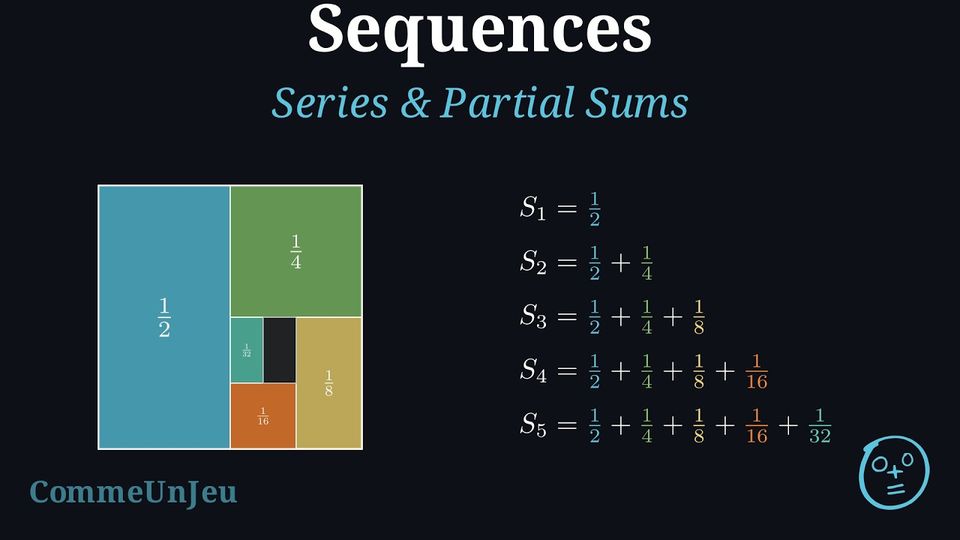
While a sequence is a list of numbers, a series is obtained by adding those numbers together. Every sequence has a corresponding series. We are often interested in the partial sum of a sequence, which is the sum of a specific number of its terms, starting from the beginning.
To see terms being added, consider a square of area \(1\). Its left half is painted, then half of what remains, then half of what remains again, and so on: the painted pieces have areas \(\frac{1}{2}, \frac{1}{4}, \frac{1}{8}, \ldots\) — and each new piece adds one more term to the sum of the painted area:
Each new piece adds one more term to the sum, and the pieces wind, like a snail shell, towards a single point of the square, while the empty rectangle keeps coiling inward, smaller and smaller. The more terms we add, the closer the painted area gets to the area of the whole square: $$\frac{1}{2} + \frac{1}{4} + \frac{1}{8} + \frac{1}{16} + \frac{1}{32} + \cdots \; \longrightarrow \; 1.$$ Whether a never-ending sum can truly make sense — and reach \(1\) — is another question; here, every sum stops somewhere.
To see terms being added, consider a square of area \(1\). Its left half is painted, then half of what remains, then half of what remains again, and so on: the painted pieces have areas \(\frac{1}{2}, \frac{1}{4}, \frac{1}{8}, \ldots\) — and each new piece adds one more term to the sum of the painted area:
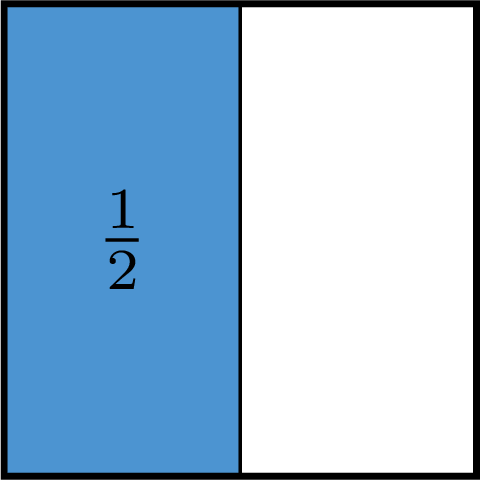 | 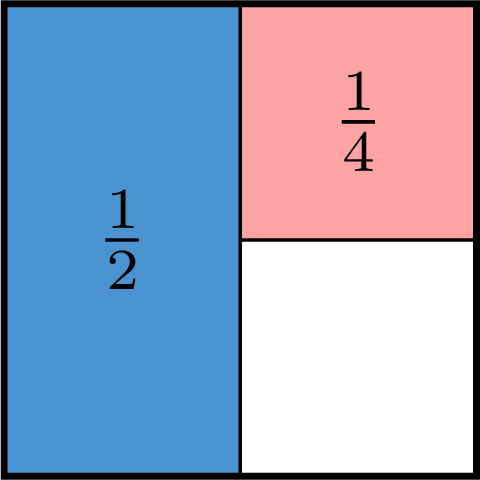 | 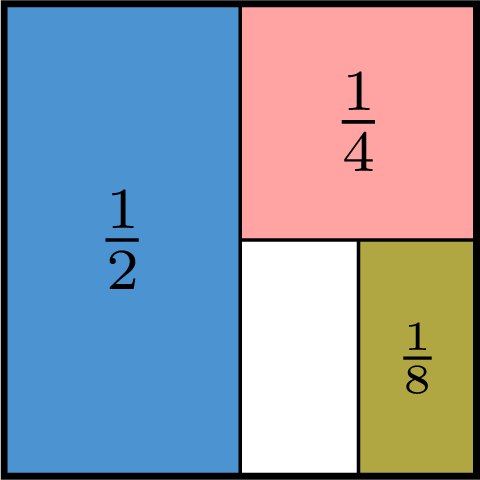 | 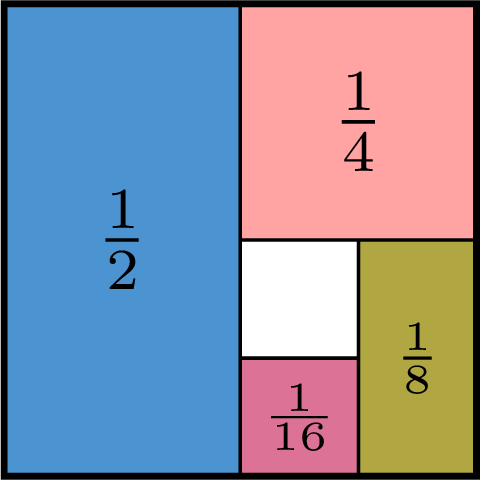 | 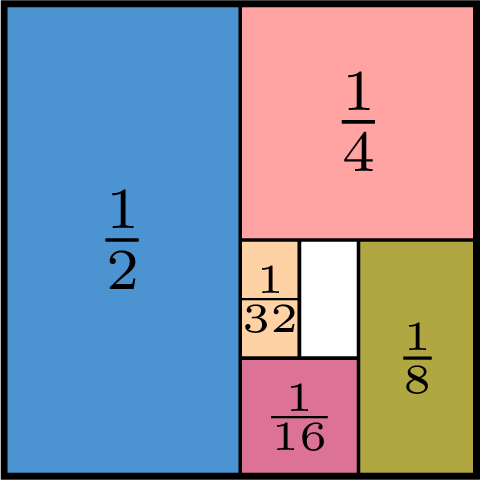 |
| \(S_1 = \textcolor{colorprop}{\frac{1}{2}}\) | \(S_2 = \textcolor{colorprop}{\frac{1}{2}} + \textcolor{colordef}{\frac{1}{4}}\) | \(S_3 = \textcolor{colorprop}{\frac{1}{2}} + \textcolor{colordef}{\frac{1}{4}} + \textcolor{olive!80!black}{\frac{1}{8}}\) | \(S_4 = \textcolor{colorprop}{\frac{1}{2}} + \textcolor{colordef}{\frac{1}{4}} + \textcolor{olive!80!black}{\frac{1}{8}} + \textcolor{purple}{\frac{1}{16}}\) | \(S_5 = \textcolor{colorprop}{\frac{1}{2}} + \textcolor{colordef}{\frac{1}{4}} + \textcolor{olive!80!black}{\frac{1}{8}} + \textcolor{purple}{\frac{1}{16}} + \textcolor{orange}{\frac{1}{32}}\) |
Definition — Series and Partial Sum
A series is the sum of the terms in a sequence. The partial sum, denoted \(\boldsymbol{S_n}\), is the sum of the terms of a sequence up to a specific index \(n\). - If a sequence starts at \(u_0\), the partial sum \(S_n\) is the sum of the first \(\textcolor{colordef}{(n+1)}\) terms: $$S_n = u_0 + u_1 + u_2 + \ldots + u_n = \sum_{i=0}^n u_i$$
- If a sequence starts at \(u_1\), the partial sum \(S_n\) is the sum of the first \(\textcolor{colordef}{n}\) terms: $$S_n = u_1 + u_2 + u_3 + \ldots + u_n = \sum_{i=1}^n u_i$$
Example
Consider the sequence defined by \(u_n = 2n + 1\) for \(n \ge 0\). - Write out the terms \(u_0\), \(u_1\), \(u_2\) and \(u_3\).
- Compute the partial sum \(S_3 = \displaystyle\sum_{i=0}^{3} u_i\).
- \(u_0 = 1\), \(u_1 = 3\), \(u_2 = 5\) and \(u_3 = 7\).
- The sequence starts at \(u_0\), so \(S_3\) is the sum of the first four terms: $$\begin{aligned}[t] S_3 &= u_0 + u_1 + u_2 + u_3 && \text{(definition of } S_3\text{, start at } u_0\text{)} \\ &= 1 + 3 + 5 + 7 && \text{(terms from part 1)} \\ &= 16. \end{aligned}$$
Skills to practice
- Evaluating Sums in Sigma Notation
IV.2
Arithmetic Series
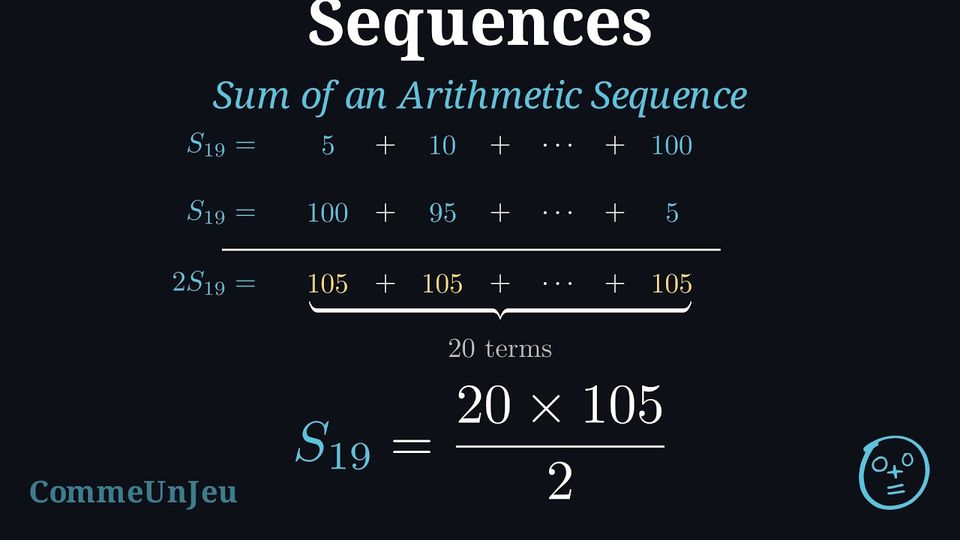
How can we efficiently calculate the sum of the first 20 terms of an arithmetic sequence starting with \(u_0 = 5\) and a common difference of \(d=5\)?$$S_{19} = \overbrace{5 + 10 + 15 + \ldots + 90 + 95 + 100}^{\text{20 terms}}$$ The method is to write the sum twice, once in forward order and once in reverse order, and then to add the two lines together term by term.$$\begin{array}{l r c c c c c c c}S_{19} & = & 5 & + & 10 & + & \ldots & + & 100 \\
S_{19} & = & 100 & + & 95 & + & \ldots & + & 5 \\
\hline2S_{19} & = & 105 & + & 105 & + & \ldots & + & 105 \\
\end{array}$$ Each pair of terms adds up to the same value (\(5+100=105\), \(10+95=105\), etc.). There are 20 identical sums in \(2S_{19}\). $$2S_{19} = 20 \times (5+100)$$ Therefore, the sum is:$$S_{19} = 20 \times\frac{5+100}{2} = 1050$$ This method reveals the general formula:$$S_n = \frac{\text{Number of terms}}{2} \times (\text{First term} + \text{Last term})$$
Proposition — Sum of an Arithmetic Sequence
The sum of the first terms of an arithmetic sequence is given by the formula:$$S_n = \text{Number of terms} \times \frac{(\text{First term} + \text{Last term})}{2}$$ - If a sequence starts at \(u_0\) and ends at \(u_n\), there are \(\boldsymbol{n+1}\) terms. The formula is:$$S_n = \frac{n+1}{2}(u_0 + u_n)$$
- If a sequence starts at \(u_1\) and ends at \(u_n\), there are \(\boldsymbol{n}\) terms. The formula is:$$S_n = \frac{n}{2}(u_1 + u_n)$$
Write the sum forwards and then backwards, and add the two lines term by term:$$\begin{array}{rccccccc} S &=& u_0 &+& u_1 &+ \cdots +& u_{n-1} &+ u_n \\
S &=& u_n &+& u_{n-1} &+ \cdots +& u_1 &+ u_0 \\
\hline 2S &=& (u_0+u_n) &+& (u_0+u_n) &+ \cdots +& (u_0+u_n) &+ (u_0+u_n) \end{array}$$ Each of the \(n+1\) columns has the same sum. Indeed, the sequence is arithmetic, so \(u_k = u_0 + kd\); the column of index \(k\) (for \(0 \le k \le n\)) therefore totals$$u_k + u_{n-k} = (u_0 + kd) + \big(u_0 + (n-k)d\big) = 2u_0 + nd = u_0 + u_n,$$ a value independent of \(k\) (as \(k\) increases by \(1\) the top term rises by \(d\) and the bottom term falls by \(d\)). Summing these \(n+1\) equal columns gives \(2S = (n+1)(u_0 + u_n)\), that is$$S = \frac{(n+1)(u_0 + u_n)}{2} = \frac{\text{number of terms}}{2}\,(\text{first} + \text{last}).$$
Example
Compute the sum \(1 + 2 + 3 + \cdots + 100\).
The terms \(1, 2, 3, \ldots, 100\) form an arithmetic sequence starting at \(u_1 = 1\) and ending at \(u_{100} = 100\), so there are \(100\) terms: $$\begin{aligned}[t] 1 + 2 + \cdots + 100 &= \frac{100}{2}\,(1 + 100) && \text{(} S_n = \tfrac{n}{2}(u_1 + u_n)\text{)} \\
&= 50 \times 101 && \text{(simplify } \tfrac{100}{2}\text{)} \\
&= 5\,050. \end{aligned}$$
Proposition — Sum from the First Term and the Common Difference
Let \((u_n)\) be an arithmetic sequence with common difference \(d\). The sum of its first terms can also be written with the first term and the common difference only, without computing the last term: - If the sequence starts at \(u_1\), the sum of its first \(\boldsymbol{n}\) terms is:$$S_n = \frac{n}{2}\big(2u_1 + (n-1)d\big)$$
- If the sequence starts at \(u_0\), the sum of its first \(\boldsymbol{n+1}\) terms is:$$S_n = \frac{n+1}{2}\big(2u_0 + nd\big)$$
We start from the formula “number of terms \(\times\) (first \(+\) last)\(/2\)” and replace the last term by its explicit formula.
If the sequence starts at \(u_1\), there are \(n\) terms and the last one is \(u_n = u_1 + (n-1)d\): $$\begin{aligned}[t] S_n &= \frac{n}{2}\,(u_1 + u_n) && \text{(sum of an arithmetic sequence)} \\ &= \frac{n}{2}\big(u_1 + u_1 + (n-1)d\big) && \text{(explicit formula } u_n = u_1 + (n-1)d\text{)} \\ &= \frac{n}{2}\big(2u_1 + (n-1)d\big). \end{aligned}$$ If the sequence starts at \(u_0\), there are \(n+1\) terms and the last one is \(u_n = u_0 + nd\): $$\begin{aligned}[t] S_n &= \frac{n+1}{2}\,(u_0 + u_n) && \text{(sum of an arithmetic sequence)} \\ &= \frac{n+1}{2}\big(u_0 + u_0 + nd\big) && \text{(explicit formula } u_n = u_0 + nd\text{)} \\ &= \frac{n+1}{2}\big(2u_0 + nd\big). \end{aligned}$$
If the sequence starts at \(u_1\), there are \(n\) terms and the last one is \(u_n = u_1 + (n-1)d\): $$\begin{aligned}[t] S_n &= \frac{n}{2}\,(u_1 + u_n) && \text{(sum of an arithmetic sequence)} \\ &= \frac{n}{2}\big(u_1 + u_1 + (n-1)d\big) && \text{(explicit formula } u_n = u_1 + (n-1)d\text{)} \\ &= \frac{n}{2}\big(2u_1 + (n-1)d\big). \end{aligned}$$ If the sequence starts at \(u_0\), there are \(n+1\) terms and the last one is \(u_n = u_0 + nd\): $$\begin{aligned}[t] S_n &= \frac{n+1}{2}\,(u_0 + u_n) && \text{(sum of an arithmetic sequence)} \\ &= \frac{n+1}{2}\big(u_0 + u_0 + nd\big) && \text{(explicit formula } u_n = u_0 + nd\text{)} \\ &= \frac{n+1}{2}\big(2u_0 + nd\big). \end{aligned}$$
Example
An arithmetic sequence has first term \(u_1 = 3\) and common difference \(d = 4\). - Compute the sum \(S_{12}\) of its first \(12\) terms.
- How many terms, starting from \(u_1\), must be added for the sum to equal \(210\)?
- The last term is not needed. With \(u_1 = 3\), \(d = 4\) and \(n = 12\): $$\begin{aligned}[t] S_{12} &= \frac{12}{2}\big(2u_1 + 11d\big) && \text{(} S_n = \tfrac{n}{2}(2u_1 + (n-1)d)\text{)} \\ &= 6 \times (2 \times 3 + 11 \times 4) \\ &= 6 \times 50 \\ &= 300. \end{aligned}$$
- Here the number of terms \(n\) is the unknown. First, \(S_n\) in terms of \(n\): $$\begin{aligned}[t] S_n &= \frac{n}{2}\big(2 \times 3 + (n-1) \times 4\big) && \text{(} S_n = \tfrac{n}{2}(2u_1 + (n-1)d)\text{)} \\
&= \frac{n}{2}\,(4n + 2) && \text{(expand)} \\
&= 2n^2 + n. \end{aligned}$$ So we look for the number of terms \(n\) such that \(2n^2 + n = 210\). The terms \(3, 7, 11, \ldots\) are positive, so each added term makes the sum larger: \(S_n\) increases with \(n\). A table of values gives
\(n\) \(8\) \(9\) \(10\) \(11\) \(S_n = 2n^2 + n\) \(136\) \(171\) \(210\) \(253\)
Check: \(S_{10} = \frac{10}{2}(2 \times 3 + 9 \times 4) = 5 \times 42 = 210\).
Skills to practice
- Using the Sum Formula with the First Term and the Common Difference
- Proving Sum Formulas
- Writing Out Arithmetic Sums
IV.3
Finite Geometric Series
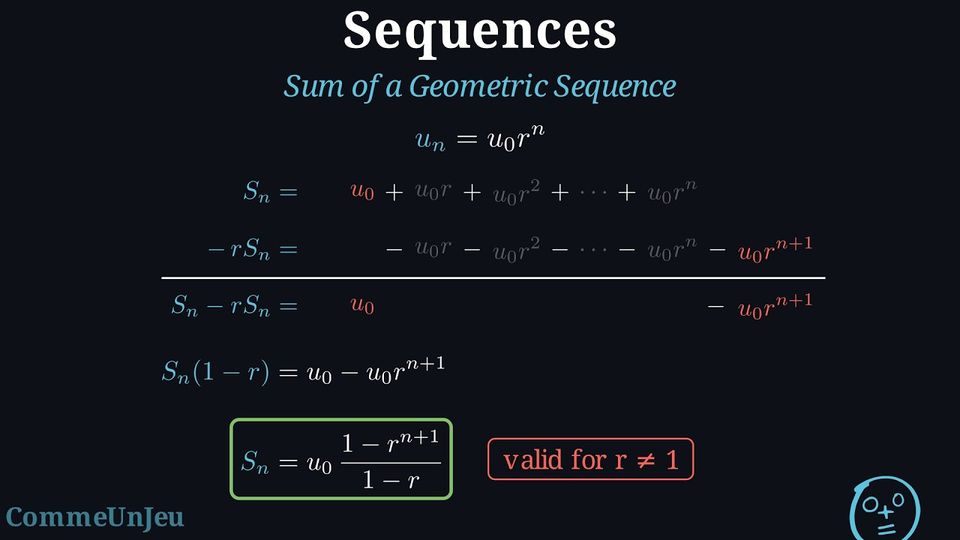
How can we efficiently calculate the sum of the first 10 terms of a geometric sequence starting with \(u_0 = 3\) and a common ratio of \(r=2\)?$$S_9 = 3 + 6 + 12 + 24 + \ldots + 768 + 1536$$ The trick is to multiply the entire sum by the common ratio, \(r=2\), and then subtract the original sum from this new one.
We write the original sum:$$S_9 = 3 + 6 + 12 + \ldots + 768 + 1536$$ Then we multiply every term by the common ratio, 2:$$2S_9 = 6 + 12 + 24 + \ldots + 1536 + 3072$$ Most of the terms in \(S_9\) and \(2S_9\) are identical. When the first equation is subtracted from the second, these terms cancel out:$$\begin{array}{lrccccccccc} 2S_9 & = & & & 6 & + & 12 & + \ldots + & 1536 & + & 3072 \\ -\, S_9 & = & -(3 & + & 6 & +&12 & + \ldots + & 1536) \\ \hline(2-1)S_9 & = & -3 & + & 0 & + &0&+\ldots + & 0 & + & 3072 \\ \end{array}$$ This leaves us with a much simpler equation:$$S_9 = 3072 - 3 = 3069$$ This method gives the general formula for the sum of the terms of a geometric sequence with ratio \(r \neq 1\) (so that we can divide by \(1 - r\)):$$\begin{aligned}S_n - rS_n &= u_0 - u_0 \times r^{n+1}\\ S_n(1-r) &= u_0(1-r^{n+1})\\ S_n &= u_0 \left( \frac{1 - r^{n+1}}{1 - r}\right)\\ \end{aligned}$$
We write the original sum:$$S_9 = 3 + 6 + 12 + \ldots + 768 + 1536$$ Then we multiply every term by the common ratio, 2:$$2S_9 = 6 + 12 + 24 + \ldots + 1536 + 3072$$ Most of the terms in \(S_9\) and \(2S_9\) are identical. When the first equation is subtracted from the second, these terms cancel out:$$\begin{array}{lrccccccccc} 2S_9 & = & & & 6 & + & 12 & + \ldots + & 1536 & + & 3072 \\ -\, S_9 & = & -(3 & + & 6 & +&12 & + \ldots + & 1536) \\ \hline(2-1)S_9 & = & -3 & + & 0 & + &0&+\ldots + & 0 & + & 3072 \\ \end{array}$$ This leaves us with a much simpler equation:$$S_9 = 3072 - 3 = 3069$$ This method gives the general formula for the sum of the terms of a geometric sequence with ratio \(r \neq 1\) (so that we can divide by \(1 - r\)):$$\begin{aligned}S_n - rS_n &= u_0 - u_0 \times r^{n+1}\\ S_n(1-r) &= u_0(1-r^{n+1})\\ S_n &= u_0 \left( \frac{1 - r^{n+1}}{1 - r}\right)\\ \end{aligned}$$
Proposition — Sum of a Geometric Sequence
The sum of the first terms of a geometric sequence is given by the formula:$$S_n = \text{First term} \times \frac{1 - (\text{common ratio})^{\text{Number of terms}}}{1 - \text{common ratio}}$$ - If a sequence starts at \(u_0\) and has a common ratio \(r\), the sum of the first \(\boldsymbol{n+1}\) terms is:$$S_n = u_0 \left( \frac{1 - r^{n+1}}{1 - r} \right)$$
- If a sequence starts at \(u_1\) and has a common ratio \(r\), the sum of the first \(\boldsymbol{n}\) terms is:$$S_n = u_1 \left( \frac{1 - r^{n}}{1 - r} \right)$$
Assume \(r \neq 1\). Multiply the sum \(S = u_0 + u_0 r + \cdots + u_0 r^{n}\) by \(r\) and subtract:$$\begin{aligned}[t] S &= u_0 + u_0 r + u_0 r^2 + \cdots + u_0 r^{n} \\
rS &= \phantom{u_0 + {}} u_0 r + u_0 r^2 + \cdots + u_0 r^{n} + u_0 r^{n+1} \\
S - rS &= u_0 - u_0 r^{n+1} && {\scriptstyle(\text{all middle terms cancel})} \\
S(1 - r) &= u_0\left(1 - r^{n+1}\right) \\
S &= u_0\,\frac{1 - r^{n+1}}{1 - r} && {\scriptstyle(r \neq 1)}. \end{aligned}$$
The case \(r \equal 1\)
If \(r = 1\), every term equals \(u_0\), so the formula above (which divides by \(1-r\)) does not apply. The sum is then simply$$S = \underbrace{u_0 + u_0 + \cdots + u_0}_{n+1 \text{ terms}} = (n+1)\,u_0.$$
Example
The sequence \((u_n)\) is geometric with first term \(u_0 = 5\) and common ratio \(r = 3\). Compute the sum of its first \(6\) terms.
The sequence starts at \(u_0\), so the sum of the first \(6\) terms is \(S_5\), and \(r = 3 \neq 1\): $$\begin{aligned}[t] S_5 &= u_0\left(\frac{1 - r^{5+1}}{1 - r}\right) && \text{(} S_n = u_0\,\tfrac{1-r^{n+1}}{1-r}\text{)} \\
&= 5 \times \frac{1 - 3^6}{1 - 3} && \\
&= 5 \times \frac{1 - 729}{-2} && \text{(} 3^6 = 729\text{)} \\
&= 5 \times \frac{-728}{-2} && \\
&= 5 \times 364 && \\
&= 1\,820. \end{aligned}$$
Another Form of the Geometric Sum
When \(r > 1\) and \(n \ge 1\), the numerator and the denominator of \(\dfrac{1 - r^n}{1 - r}\) are both negative. Multiplying both by \(-1\) does not change the fraction, and gives an equivalent form of the sum, for \(r \neq 1\):
- starting at \(u_1\), the sum of the first \(n\) terms is \(S_n = u_1 \left( \dfrac{r^{n} - 1}{r - 1} \right)\);
- starting at \(u_0\), the sum of the first \(n+1\) terms is \(S_n = u_0 \left( \dfrac{r^{n+1} - 1}{r - 1} \right)\).
Skills to practice
- Evaluating Geometric Sums
- Writing Out Geometric Sums
V
Going further
Skills to practice
- Solving Problems on Sequences and Series
- Solving Growth and Decay Problems
- Diagnosing and Correcting Errors
- Solving Problems in Context
- Quiz
Jump to section