International Baccalaureate · DP 2: Applications and Interpretation SL
Trigonometric Functions
I
Periodic Behaviour
I.1
Periodic Functions
A function \(f\) is periodic if it repeats itself in regular intervals.
Definition — Periodic Function
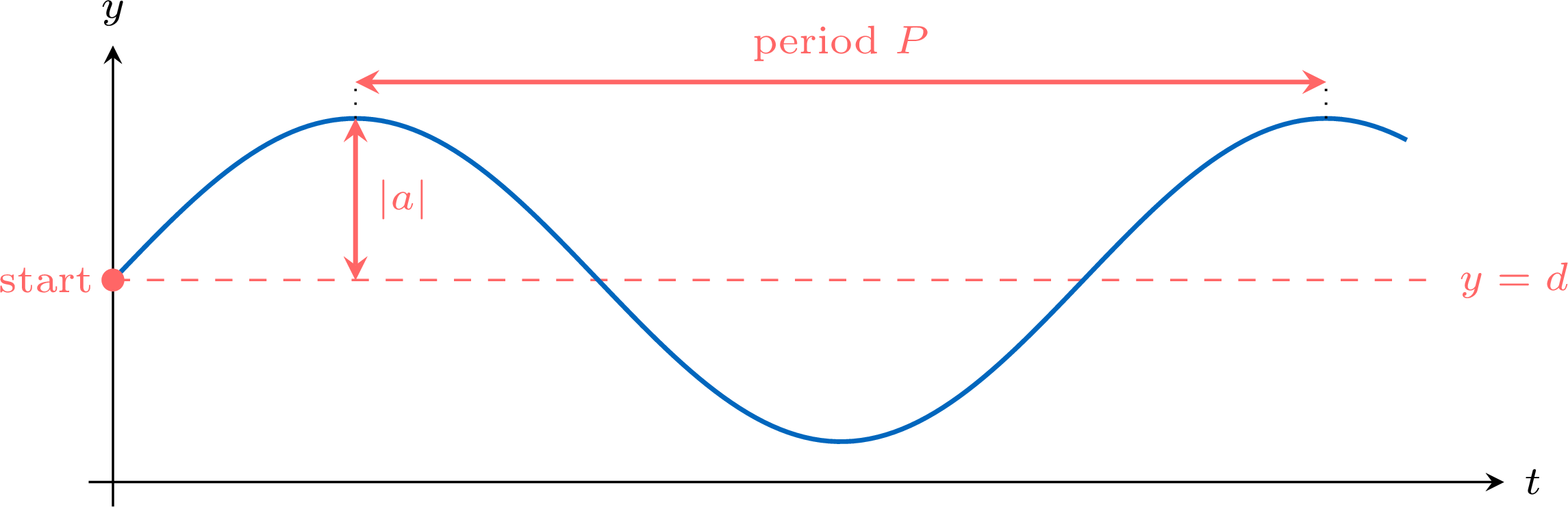
A function \(f\) is periodic if there exists a constant \(P>0\) such that$$f(x+P) = f(x), \forall x$$ - For a periodic function that has a smallest such constant, the period is this smallest value of \(P\): the length of one full repetition, or cycle.
- For a periodic function that has a maximum value and a minimum value, the principal axis is the horizontal line about which the curve oscillates, given by $$y = \frac{\text{maximum value} + \text{minimum value}}{2}$$
- For such a function, the amplitude is the distance from the principal axis to a maximum or minimum point, given by $$\frac{\text{maximum value} - \text{minimum value}}{2}$$
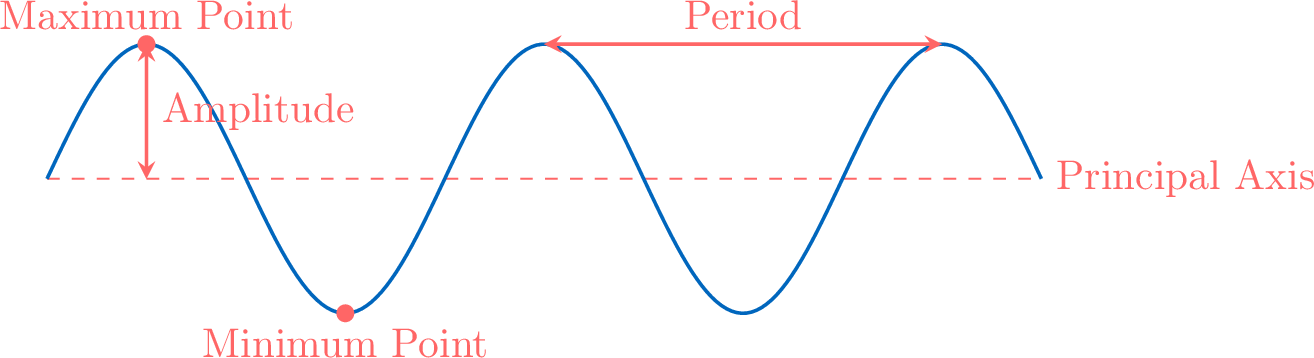
Among the many types of periodic functions, some exhibit a smooth, wave-like pattern. These sinusoidal functions are modelled with the sine and cosine trigonometric functions.
Skills to practice
- Recognising Periodic Behaviour
II
The Unit Circle
II.1
Cosine and Sine of Any Angle
Recappreviously studied — click to reread
Definition — Unit circle
The unit circle is the circle with a radius of 1 centred at the origin: it is the circle used to measure angles, travelled anticlockwise. 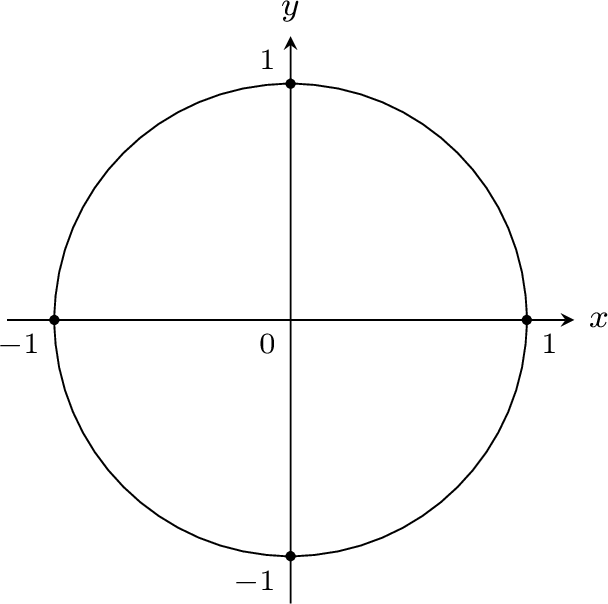
Proposition — Relationship between Angle and Coordinates
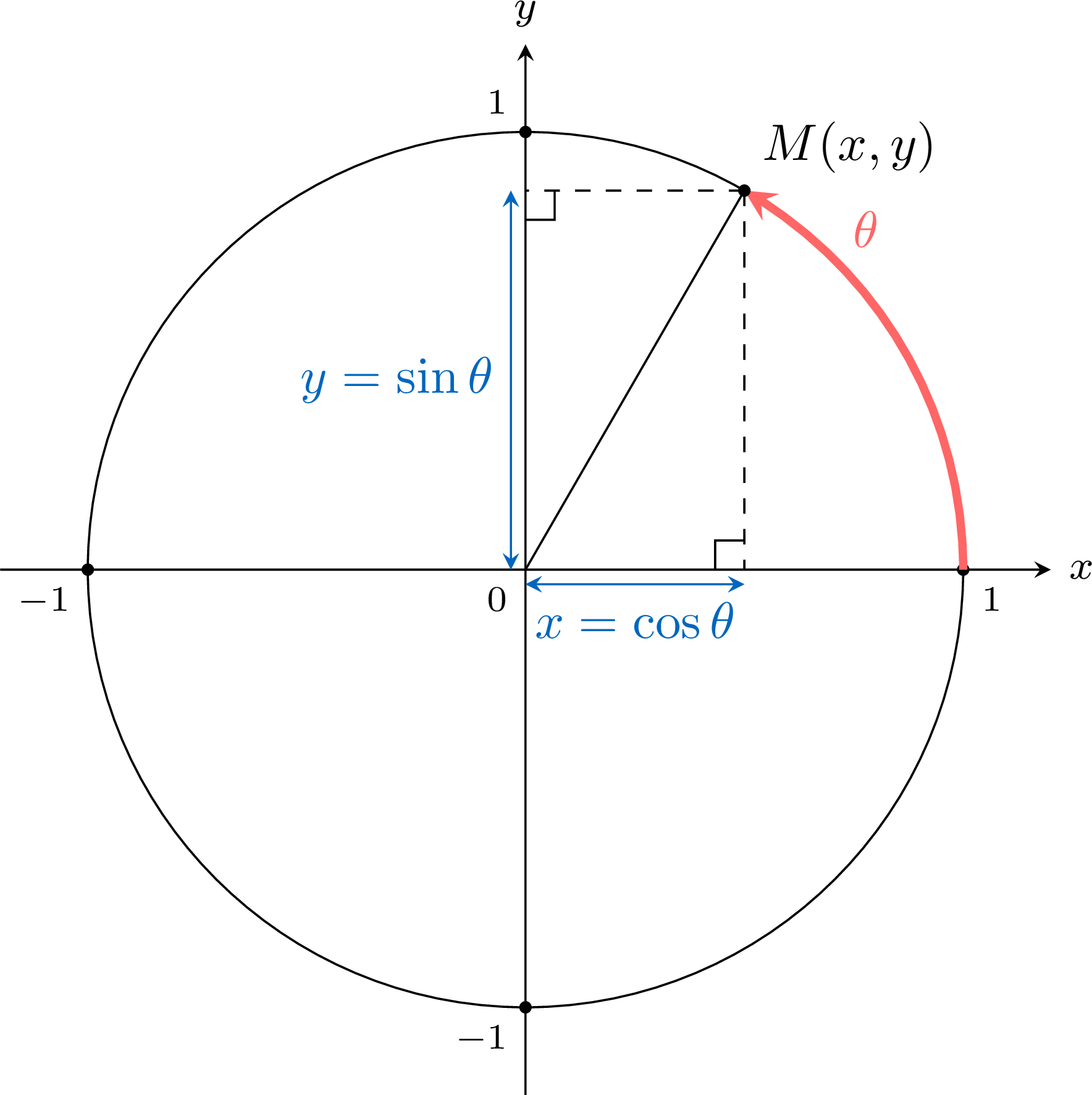
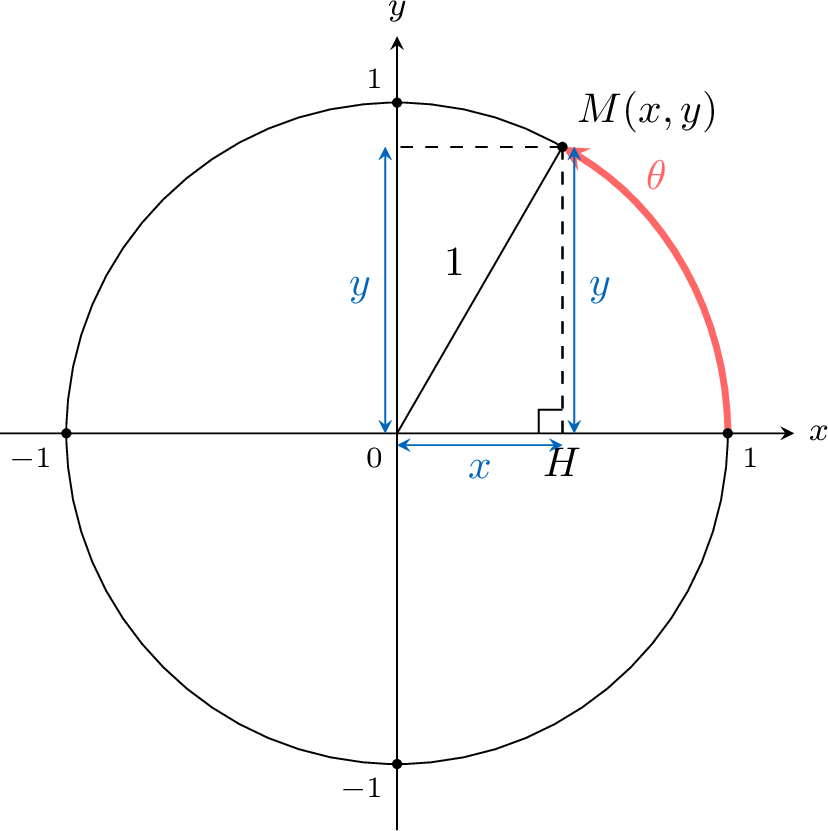
For an angle \(\theta\), measured anticlockwise from the positive \(x\)-axis, \(M(x,y)\) is the corresponding point on the unit circle. - The \(x\)-coordinate is the cosine of the angle: \(\cos \theta = x\)
- The \(y\)-coordinate is the sine of the angle: \(\sin \theta = y\)
Skills to practice
- Cosine and Sine of Any Angle
III
The Sine and Cosine Functions in Degrees
III.1
The Curves of \(y \equal \sin x\) and \(y \equal \cos x\)
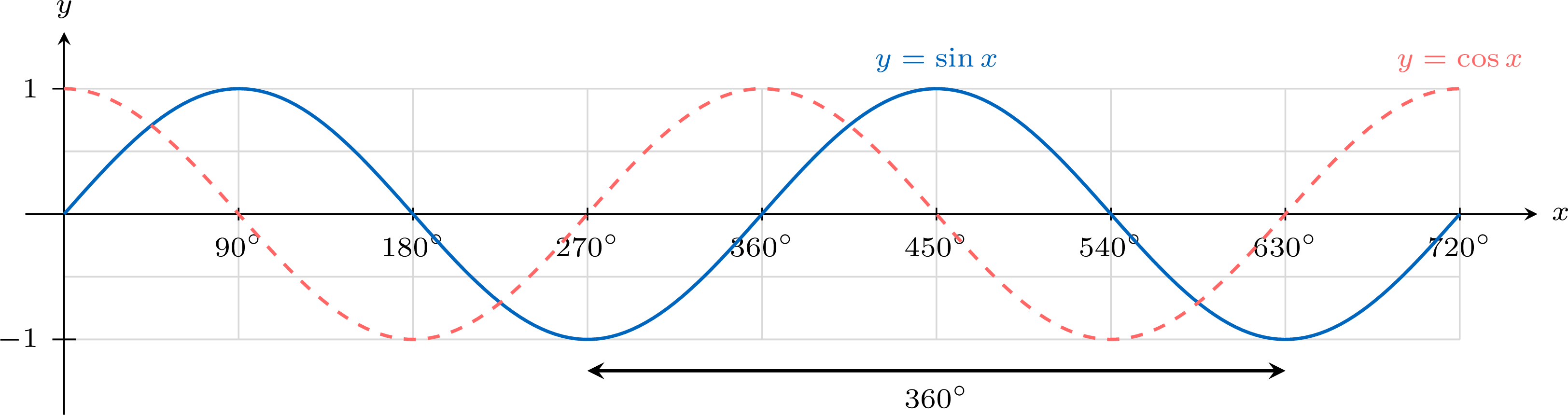
Angles are often measured in degrees: on a compass, in a triangle, on a turning wheel. The unit circle gives the cosine and the sine of every angle, whatever its unit: the point of the circle for the angle \(x\) has coordinates \((\cos x, \sin x)\). Let the angle \(x\) run through the degrees, from \(0^\circ\) to \(360^\circ\) and beyond, and follow each coordinate on its own: this draws the curves of \(y = \sin x\) and \(y = \cos x\) above a horizontal axis graduated in degrees.
Proposition — The Sine and Cosine Functions in Degrees
For an angle \(x\) measured in degrees: - \(\sin x\) and \(\cos x\) are defined for every angle \(x\), and \(-1 \le \sin x \le 1\), \(-1 \le \cos x \le 1\): the range of each function is the interval from \(-1\) to \(1\);
- the two functions are periodic with period \(360^\circ\): for every angle \(x\) and every integer \(k\), $$\sin(x + 360^\circ k) = \sin x \qquad \text{and} \qquad \cos(x + 360^\circ k) = \cos x;$$
- for \(0^\circ \le x \le 360^\circ\), \(y = \sin x\) starts at \(0\), reaches its maximum \(1\) at \(90^\circ\), returns to \(0\) at \(180^\circ\), reaches its minimum \(-1\) at \(270^\circ\) and returns to \(0\) at \(360^\circ\); \(y = \cos x\) starts at its maximum \(1\) at \(0^\circ\), is \(0\) at \(90^\circ\), reaches its minimum \(-1\) at \(180^\circ\), is \(0\) at \(270^\circ\) and returns to \(1\) at \(360^\circ\).
The point \(M\) of the unit circle for the angle \(x\) has coordinates \((\cos x, \sin x)\) (Relationship between Angle and Coordinates).
- \(M\) lies on the circle of centre \(O\) and radius \(1\), so each of its coordinates lies between \(-1\) and \(1\). Every value \(c\) from \(-1\) to \(1\) is reached: the horizontal line \(y = c\) meets the circle, and the angle of a meeting point has sine \(c\); in the same way the vertical line \(x = c\) gives an angle with cosine \(c\).
- Adding \(360^\circ\) to the angle adds a full turn, which brings \(M\) back to the same point: the angles \(x\) and \(x + 360^\circ\) have the same coordinates. Repeating this \(k\) times (turning the other way when \(k\) is negative) gives \(x + 360^\circ k\). No smaller positive angle \(P\) works for every \(x\): the only angles of sine \(1\) are \(90^\circ + 360^\circ k\) (the point \((0, 1)\)), so \(\sin(90^\circ + P) = 1\) forces \(P\) to be a multiple of \(360^\circ\); in the same way \(\cos(0^\circ + P) = 1\) forces it for the cosine.
- The points for \(0^\circ\), \(90^\circ\), \(180^\circ\), \(270^\circ\) and \(360^\circ\) are \((1, 0)\), \((0, 1)\), \((-1, 0)\), \((0, -1)\) and \((1, 0)\): their \(y\)-coordinates give the values of the sine, their \(x\)-coordinates those of the cosine.
Example
Complete the table of values of \(y = \sin x\), giving each value that is not exact to \(2\) decimal places, then draw the graph of \(y = \sin x\) for \(0^\circ \le x \le 360^\circ\). | \(x\) | \(0^\circ\) | \(30^\circ\) | \(60^\circ\) | \(90^\circ\) | \(120^\circ\) | \(150^\circ\) | \(180^\circ\) |
| \(\sin x\) |
| \(x\) | \(210^\circ\) | \(240^\circ\) | \(270^\circ\) | \(300^\circ\) | \(330^\circ\) | \(360^\circ\) |
| \(\sin x\) |
From \(0^\circ\) to \(90^\circ\) the values are the exact values: \(\sin 0^\circ = 0\), \(\sin 30^\circ = \dfrac{1}{2}\), \(\sin 60^\circ = \dfrac{\sqrt{3}}{2} \approx 0.87\), \(\sin 90^\circ = 1\). The other angles are read on the unit circle, where the points for \(30^\circ\), \(150^\circ\), \(210^\circ\) and \(330^\circ\) are placed symmetrically: 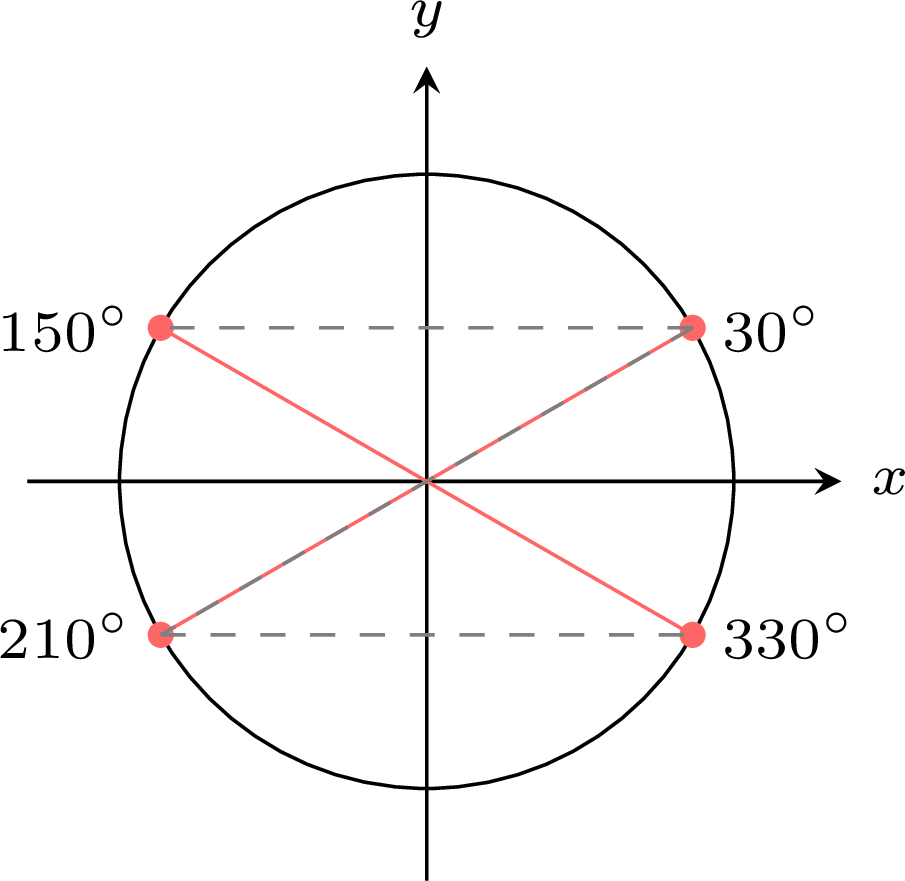
A calculator set to degree mode gives the same values. Plotting the points and joining them with a smooth curve: 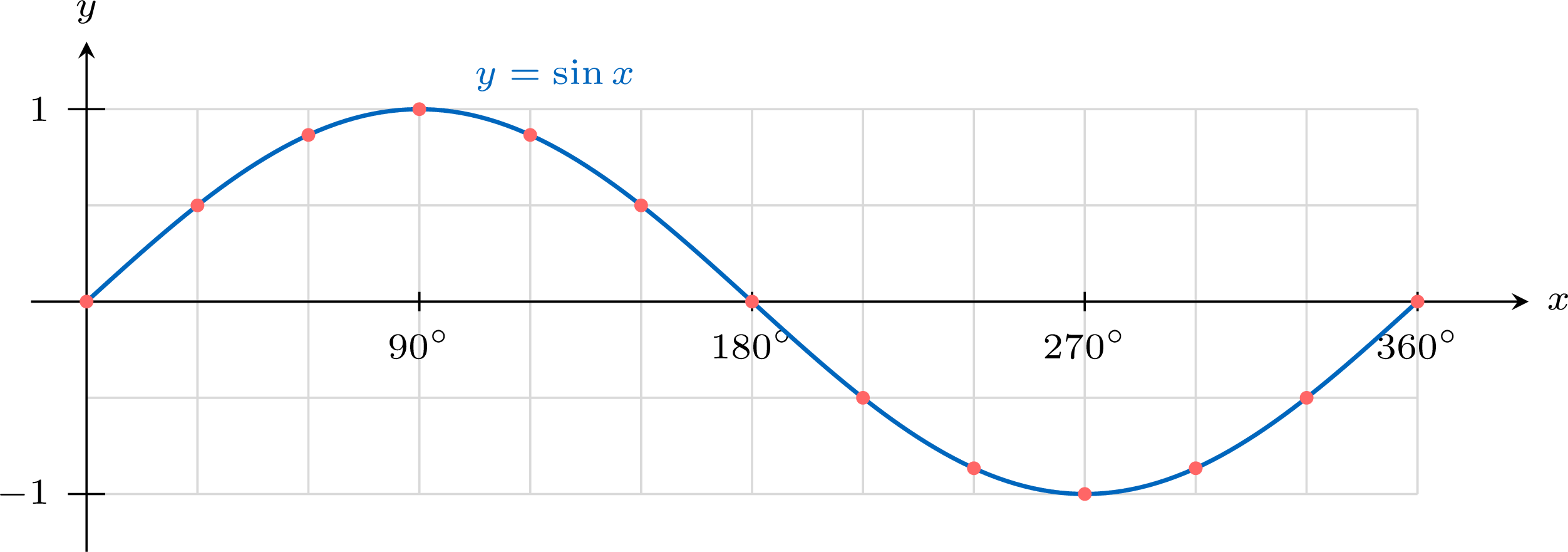
- the point for \(180^\circ - x\) is the reflection of the point for \(x\) in the vertical axis: same \(y\)-coordinate, so \(\sin 150^\circ = \sin 30^\circ\) and \(\sin 120^\circ = \sin 60^\circ\);
- the point for \(180^\circ + x\) is the image of the point for \(x\) by the half-turn about \(O\): opposite \(y\)-coordinate, so \(\sin 210^\circ = -\sin 30^\circ\) and \(\sin 240^\circ = -\sin 60^\circ\);
- the point for \(360^\circ - x\) is the reflection of the point for \(x\) in the horizontal axis: opposite \(y\)-coordinate, so \(\sin 330^\circ = -\sin 30^\circ\) and \(\sin 300^\circ = -\sin 60^\circ\).
| \(x\) | \(0^\circ\) | \(30^\circ\) | \(60^\circ\) | \(90^\circ\) | \(120^\circ\) | \(150^\circ\) | \(180^\circ\) |
| \(\sin x\) | \(0\) | \(0.5\) | \(0.87\) | \(1\) | \(0.87\) | \(0.5\) | \(0\) |
| \(x\) | \(210^\circ\) | \(240^\circ\) | \(270^\circ\) | \(300^\circ\) | \(330^\circ\) | \(360^\circ\) |
| \(\sin x\) | \(-0.5\) | \(-0.87\) | \(-1\) | \(-0.87\) | \(-0.5\) | \(0\) |
Example
- Using the period, find the exact values of \(\cos 420^\circ\), \(\cos(-60^\circ)\) and \(\sin 750^\circ\).
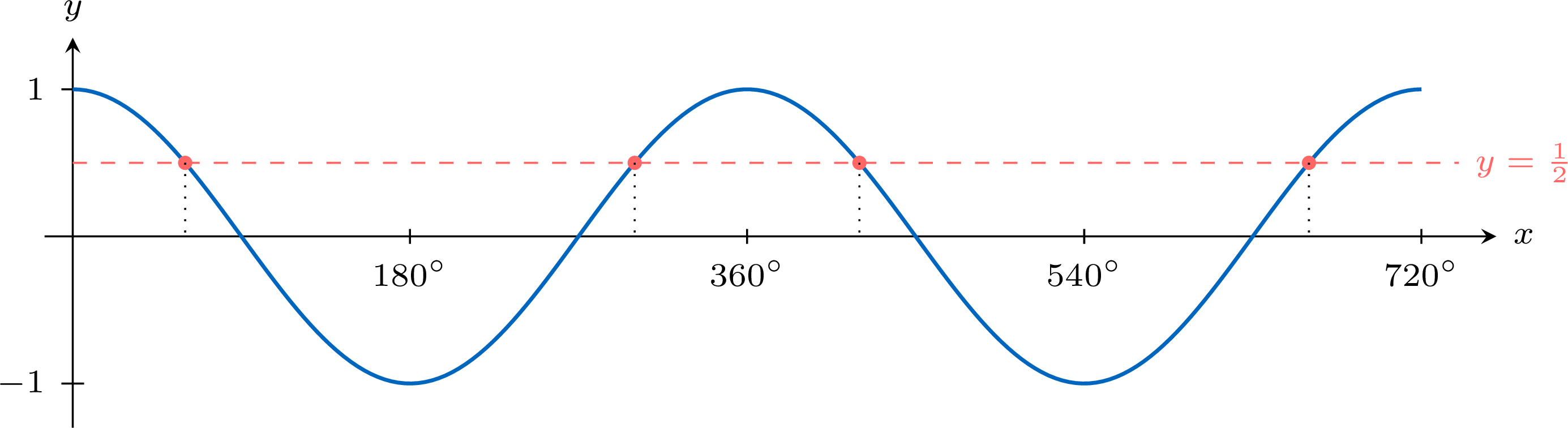
- Find every angle \(x\) with \(0^\circ \le x \le 720^\circ\) such that \(\cos x = \dfrac{1}{2}\).
- Each angle is brought back between \(0^\circ\) and \(360^\circ\) by whole turns, which do not change the cosine or the sine: $$\begin{aligned}[t] \cos 420^\circ &= \cos(60^\circ + 360^\circ) &&\text{(}420 = 60 + 360\text{)}\\ &= \cos 60^\circ &&\text{(period } 360^\circ\text{)}\\ &= \frac{1}{2}, \end{aligned} \qquad \begin{aligned}[t] \sin 750^\circ &= \sin(30^\circ + 2 \times 360^\circ) &&\text{(}750 = 30 + 720\text{)}\\ &= \sin 30^\circ &&\text{(period } 360^\circ\text{)}\\ &= \frac{1}{2}. \end{aligned}$$ For \(\cos(-60^\circ)\), adding one turn gives \(\cos(-60^\circ) = \cos 300^\circ\). The point for \(300^\circ = 360^\circ - 60^\circ\) is the reflection of the point for \(60^\circ\) in the horizontal axis: same \(x\)-coordinate, so \(\cos(-60^\circ) = \cos 60^\circ = \dfrac{1}{2}\).
- Between \(0^\circ\) and \(360^\circ\), the vertical line \(x = \dfrac{1}{2}\) meets the unit circle at two points: the point for \(60^\circ\) (as \(\cos 60^\circ = \dfrac{1}{2}\)) and its reflection in the horizontal axis, the point for \(360^\circ - 60^\circ = 300^\circ\). Adding one turn to each gives the solutions between \(360^\circ\) and \(720^\circ\): \(60^\circ + 360^\circ = 420^\circ\) and \(300^\circ + 360^\circ = 660^\circ\). The solutions are $$x = 60^\circ, \quad x = 300^\circ, \quad x = 420^\circ, \quad x = 660^\circ.$$ On the graph, they are the four points where the curve of \(y = \cos x\) meets the line \(y = \dfrac{1}{2}\):
Skills to practice
- Reading the Curves in Degrees
- Using the Period in Degrees
- Finding Exact Values beyond \(180^\circ\)
IV
General Sine and Cosine Functions
IV.1
Amplitude, Period and Principal Axis
Proposition — General Sine and Cosine Functions in Degrees
Let \(a\), \(b\) and \(d\) be real numbers with \(a \neq 0\) and \(b \neq 0\). When \(x\) is measured in degrees, the functions $$y = a\sin(bx) + d \qquad \text{and} \qquad y = a\cos(bx) + d$$ have - amplitude \(|a|\);
- period \(\dfrac{360^\circ}{|b|}\);
- principal axis the line \(y = d\);
- maximum value \(d + |a|\) and minimum value \(d - |a|\).
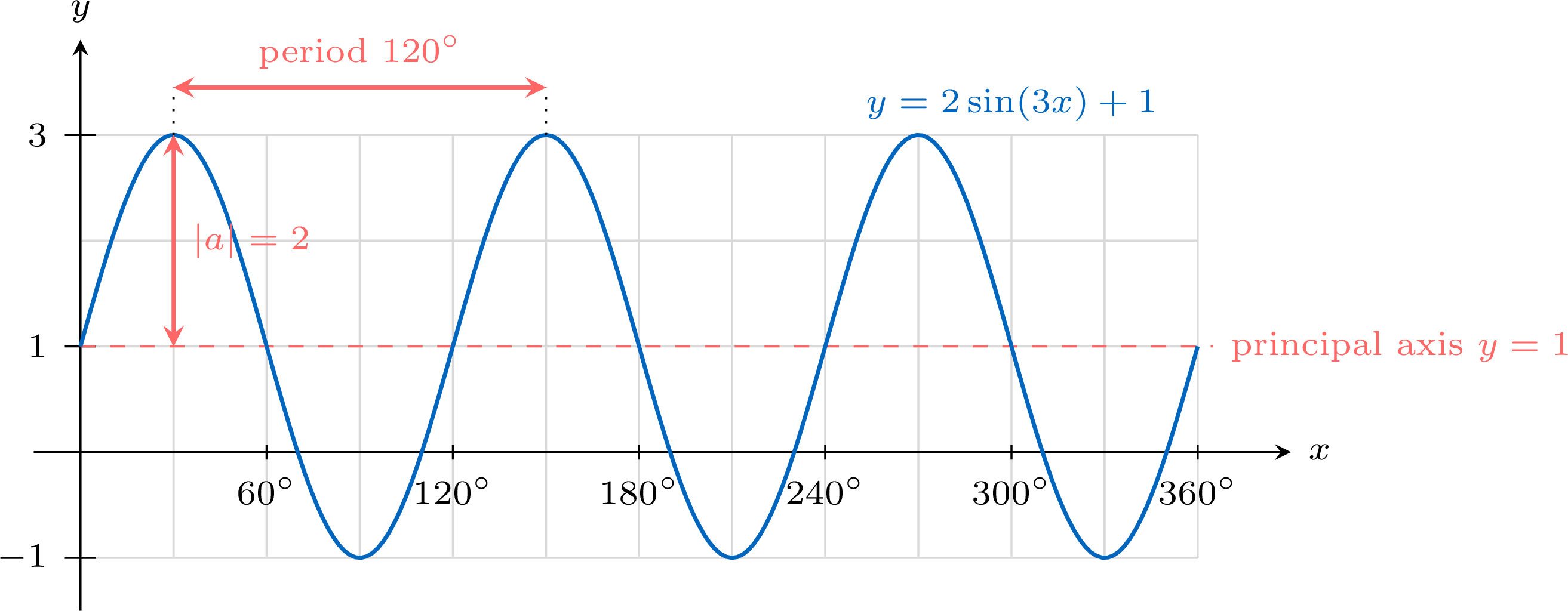
We write the proof for \(f(x) = a\sin(bx) + d\); replacing \(\sin\) by \(\cos\) changes nothing below.
- Values. As \(x\) runs through all the angles, so does \(bx\) (as \(b \neq 0\)), and \(\sin(bx)\) takes every value from \(-1\) to \(1\), and only those. Multiplying by \(a\) gives every value from \(-|a|\) to \(|a|\) (in the reverse order when \(a < 0\)); adding \(d\) gives every value from \(d - |a|\) to \(d + |a|\). So the maximum value is \(d + |a|\) and the minimum value \(d - |a|\). By the definitions of the principal axis and of the amplitude, the principal axis is \(y = \dfrac{(d + |a|) + (d - |a|)}{2} = d\) and the amplitude is \(\dfrac{(d + |a|) - (d - |a|)}{2} = |a|\).
- Period. Let \(P = \dfrac{360^\circ}{|b|}\). Then \(bP = \pm 360^\circ\), and since the sine has period \(360^\circ\), $$\begin{aligned}[t] f(x + P) &= a\sin(bx + bP) + d \\ &= a\sin(bx \pm 360^\circ) + d \\ &= a\sin(bx) + d && \text{(period } 360^\circ \text{ of the sine)}\\ &= f(x). \end{aligned}$$ No smaller positive number works: if \(f(x + Q) = f(x)\) for every \(x\), with \(Q > 0\), then \(\sin(bx + bQ) = \sin(bx)\) for every \(x\) (divide by \(a \neq 0\)), that is \(\sin(u + |b|Q) = \sin u\) for every angle \(u\); so \(|b|Q\) is at least the period \(360^\circ\) of the sine, and \(Q \ge \dfrac{360^\circ}{|b|} = P\).
Example
Consider the function \(y = 3\sin(2x) + 1\), with \(x\) in degrees. - State its amplitude, its period and its principal axis.
- State its maximum and minimum values, and the values of \(x\) with \(0^\circ \le x \le 360^\circ\) at which they are reached.
- Sketch its graph for \(0^\circ \le x \le 360^\circ\).
Here \(a = 3\), \(b = 2\) and \(d = 1\).
- Amplitude \(|a| = 3\); period \(\dfrac{360^\circ}{|b|} = \dfrac{360^\circ}{2} = 180^\circ\); principal axis \(y = 1\).
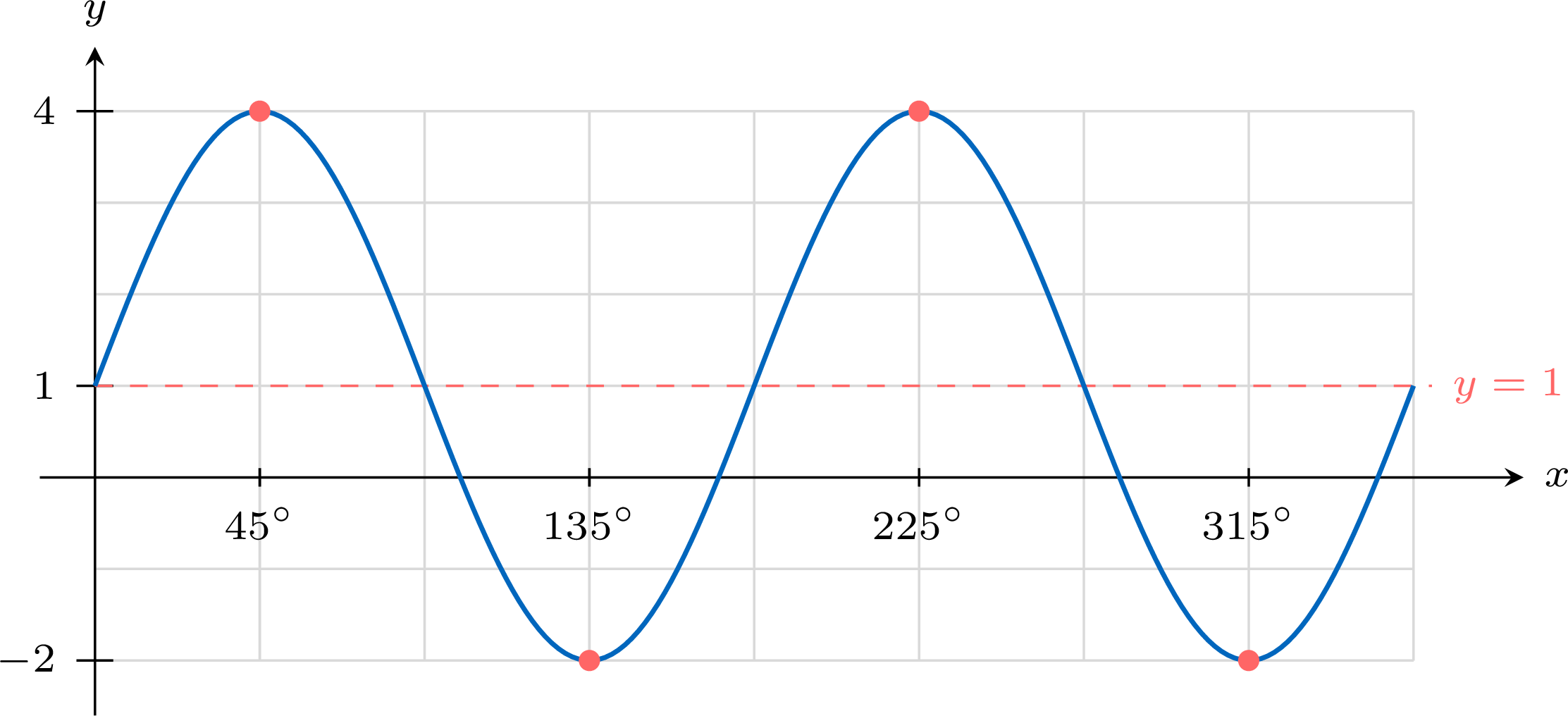
- Maximum value \(d + |a| = 1 + 3 = 4\), minimum value \(d - |a| = 1 - 3 = -2\). At \(x = 0^\circ\) the curve is on its principal axis, rising, as \(y = 3\sin 0^\circ + 1 = 1\); it reaches its maximum a quarter of a period later and its minimum three quarters of a period later: $$\begin{aligned}[t] x &= \tfrac{1}{4} \times 180^\circ = 45^\circ && \text{(first maximum)}\\ x &= \tfrac{3}{4} \times 180^\circ = 135^\circ && \text{(first minimum)} \end{aligned}$$ Adding the period \(180^\circ\) gives the others: the maximum is reached at \(x = 45^\circ\) and \(x = 225^\circ\), the minimum at \(x = 135^\circ\) and \(x = 315^\circ\); one more period goes beyond \(360^\circ\). Check: \(3\sin 90^\circ + 1 = 4\) and \(3\sin 270^\circ + 1 = -2\).
- The curve starts on its principal axis at \((0^\circ, 1)\), rising, and repeats every \(180^\circ\):
Example
The curve below has equation \(y = a\cos(bx) + d\), with \(a > 0\), \(b > 0\) and \(x\) in degrees. It has a maximum point at \((0^\circ, 5)\), and its next minimum point is \((60^\circ, -1)\). Find \(a\), \(b\) and \(d\). 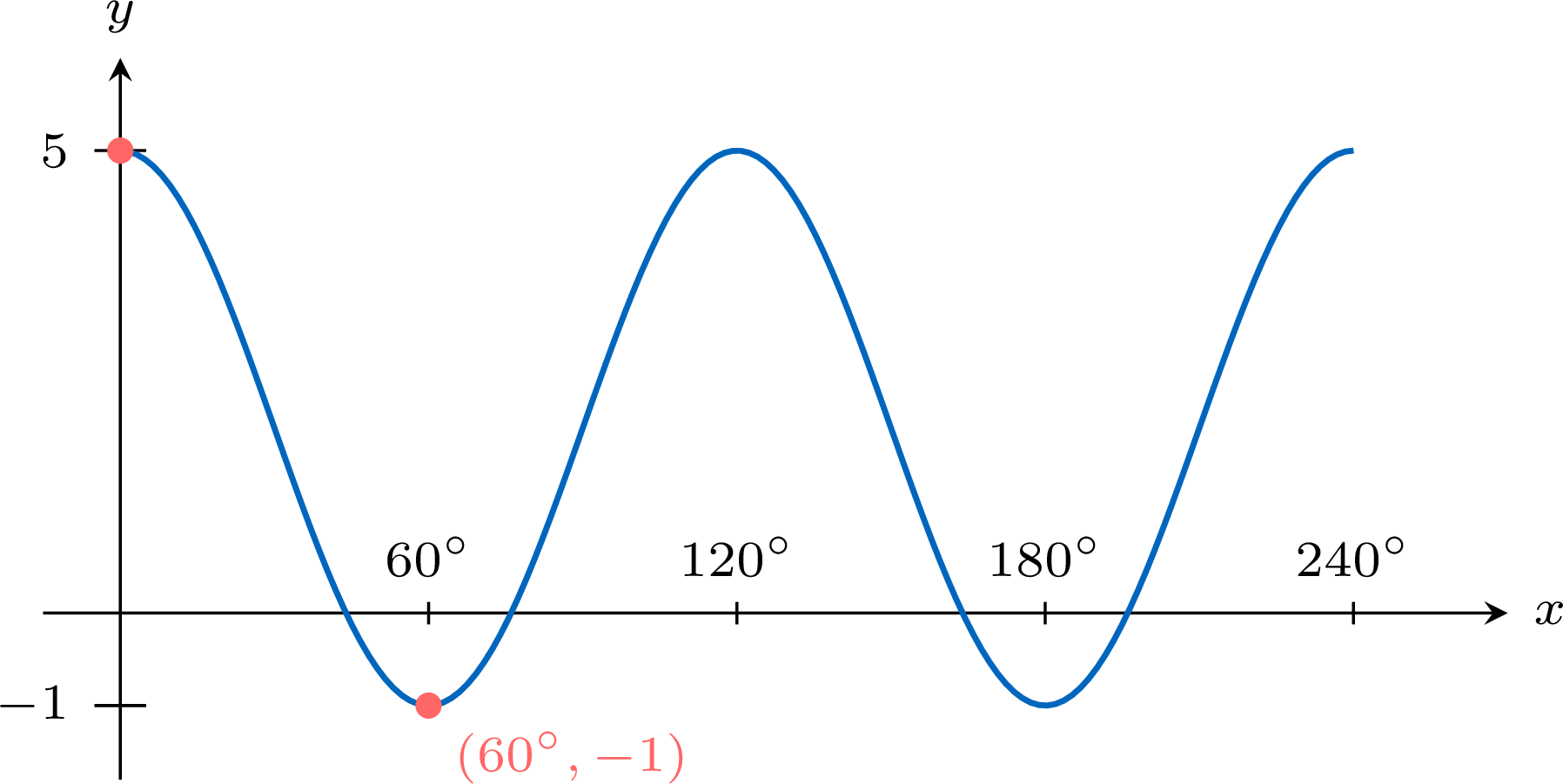
The maximum value is \(5\) and the minimum value is \(-1\).
- Principal axis: \(d = \dfrac{5 + (-1)}{2} = 2\).
- Amplitude: \(|a| = \dfrac{5 - (-1)}{2} = 3\), and \(a > 0\), so \(a = 3\).
- From a maximum to the next minimum is half a period: the period is \(2 \times 60^\circ = 120^\circ\). As \(b > 0\), \(\dfrac{360^\circ}{b} = 120^\circ\), so \(b = \dfrac{360}{120} = 3\).
Skills to practice
- Reading Period, Principal Axis and Amplitude
- Finding a Sinusoid from its Graph in Degrees
V
Modelling Periodic Behaviour
V.1
Solving Equations with Technology
Recappreviously studied — click to reread
Method — Solving an Equation Graphically with Technology
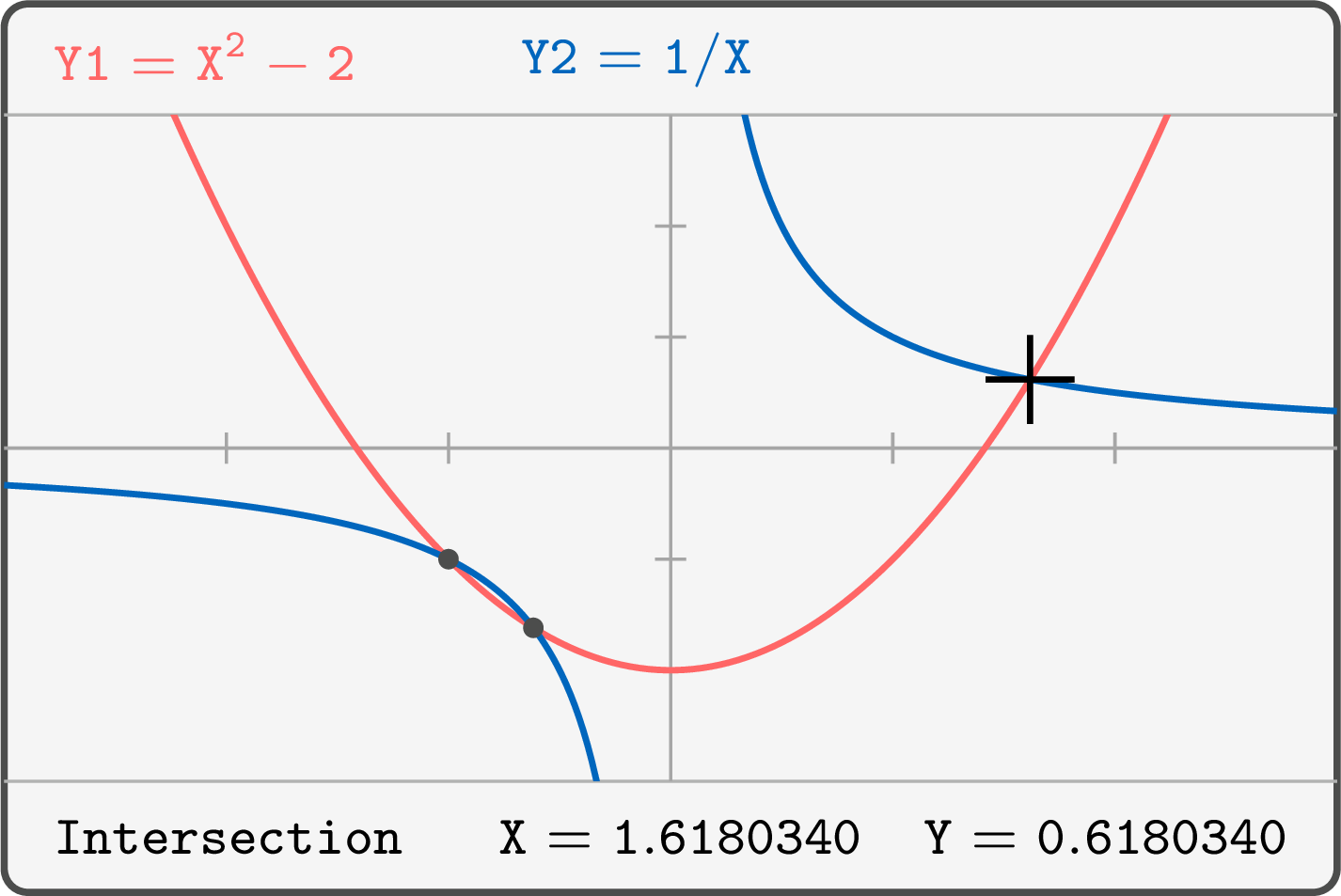
The solutions of an equation \(f(x) = g(x)\) are the \(x\)-coordinates of the points where the graphs of \(f\) and \(g\) meet; the solutions of an equation \(f(x) = 0\) are the \(x\)-intercepts of the graph of \(f\). - Enter each side as a function: \(Y_1 = f(x)\) and \(Y_2 = g(x)\). For an equation \(f(x) = 0\), enter \(f(x)\) alone.
- Choose a window that shows every point of intersection, or every \(x\)-intercept. A table of values of \(f(x) - g(x)\) helps: a change of sign between two consecutive values of \(x\) signals a solution between them, provided the curves have no break between these two values: this holds for polynomials, and for rational functions away from the values that make a denominator zero. Where the two curves touch without crossing, \(f(x) - g(x)\) does not change sign: such a solution is seen only on the graph.
- In the analysis tools of the graph menu, choose intersection (for \(f(x) = 0\): zero), select the curves and give a first guess, or bounds, close to one point. Read the \(x\)-coordinate \(X\) of the point displayed: the \(y\)-coordinate \(Y\) is the common value of the two sides, not a solution.
- Repeat for each point, then report the solutions: exactly when the screen shows an exact value that substitution confirms, otherwise to 3 significant figures.
Skills to practice
- Solving Equations with Technology
V.2
Sinusoidal Models in Degrees
Common real-world examples of sinusoidal models include phenomena that oscillate (fluctuate periodically):
- \(D(t)\) is the depth of water at a shore \(t\) hours after midnight
- \(T(n)\) is the temperature of a city \(n\) days after January 1st
- \(H(t)\) is the vertical height above ground of a person \(t\) seconds after entering a Ferris wheel
Method — Modelling Periodic Data in Degrees
A quantity that repeats itself every \(P\) units of time in a smooth wave, rising and falling symmetrically about a middle value, can be modelled by \(y = a\sin(bt) + d\) or \(y = a\cos(bt) + d\), where the angle \(bt\) is measured in degrees. - Principal axis: \(d = \dfrac{\text{maximum} + \text{minimum}}{2}\).
- Amplitude: \(|a| = \dfrac{\text{maximum} - \text{minimum}}{2}\).
- Period: one period is one full turn of \(360^\circ\), so \(b = \dfrac{360}{P}\), in degrees per unit of time (\(b > 0\)).
- Form and sign, read on the start of the data, at \(t = 0\):
- on the principal axis and rising: \(y = a\sin(bt) + d\) with \(a > 0\);
- on the principal axis and falling: \(y = a\sin(bt) + d\) with \(a < 0\);
- at a maximum: \(y = a\cos(bt) + d\) with \(a > 0\);
- at a minimum: \(y = a\cos(bt) + d\) with \(a < 0\).
- Check the model on a data point, and set the calculator to degree mode before using it.
Example
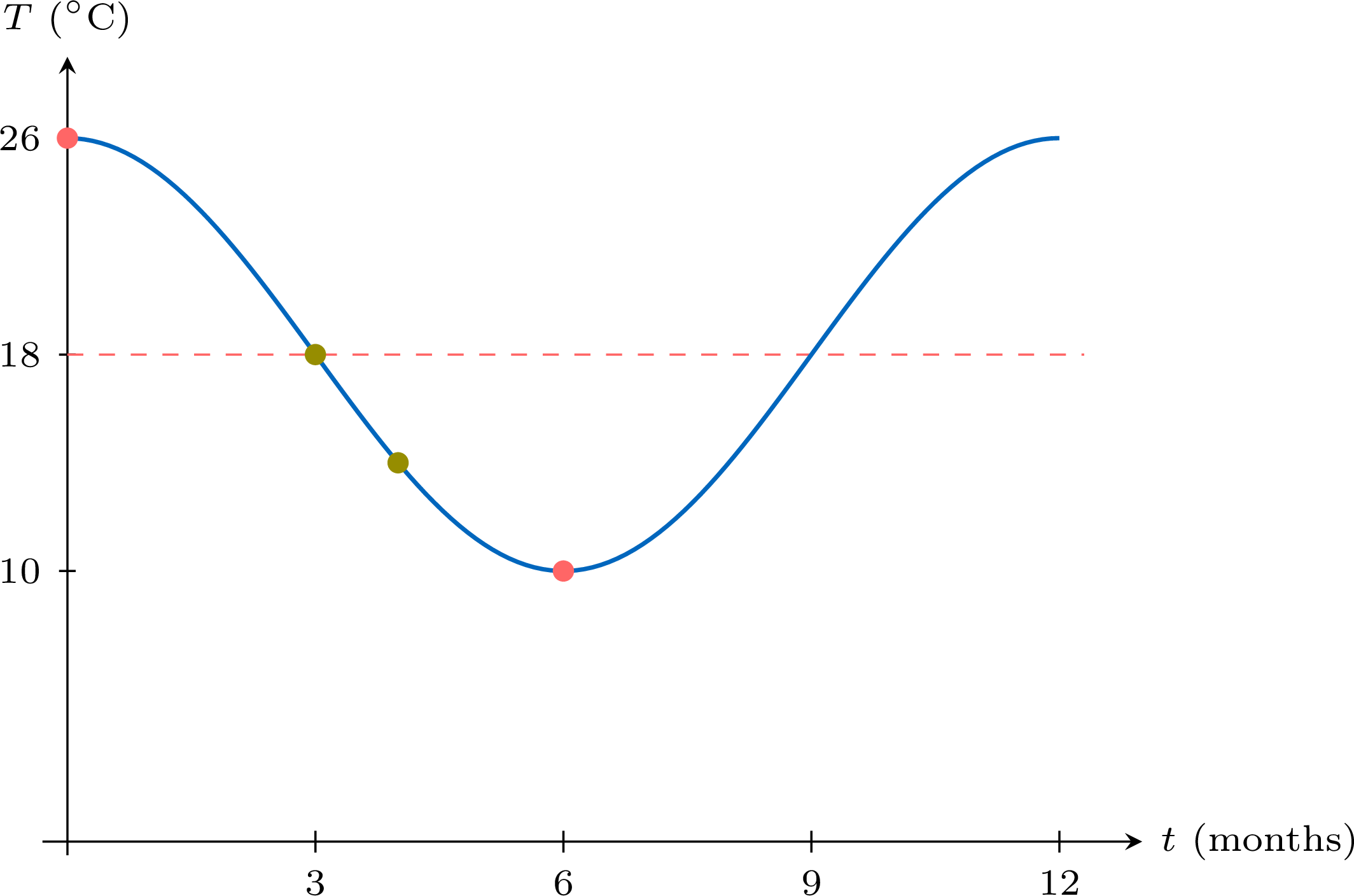
In a city of the southern hemisphere, the mean monthly temperature is highest in January, \(26^\circ\)C, and lowest in July, \(10^\circ\)C, and the pattern repeats every year. Let \(t\) be the time in months, with \(t = 0\) in January and \(t = 6\) in July. - Find a model \(T(t) = a\cos(bt) + d\) for the mean monthly temperature, the angle \(bt\) being in degrees.
- Use the model to estimate the mean temperature in April (\(t = 3\)) and in May (\(t = 4\)).
- Following the Method:
- principal axis: \(d = \dfrac{26 + 10}{2} = 18\);
- amplitude: \(|a| = \dfrac{26 - 10}{2} = 8\);
- the period is \(12\) months, so \(b = \dfrac{360}{12} = 30\) (degrees per month);
- at \(t = 0\) the temperature is at its maximum: the form \(a\cos(bt) + d\) with \(a > 0\), so \(a = 8\).
- $$\begin{aligned}[t] T(3) &= 8\cos 90^\circ + 18 = 8 \times 0 + 18 = 18,\\ T(4) &= 8\cos 120^\circ + 18 = 8 \times \left(-\frac{1}{2}\right) + 18 = 14. \end{aligned}$$ The model estimates about \(18^\circ\)C in April and \(14^\circ\)C in May.
Example
A Ferris wheel has a diameter of \(40\) m and its axle is \(22\) m above the ground. It turns at a constant rate, once every \(12\) minutes. A passenger boards at the lowest point of the wheel at \(t = 0\), \(t\) in minutes. - Find a model \(h(t) = a\cos(bt) + d\) for the height of the passenger above the ground, in metres, the angle \(bt\) being in degrees.
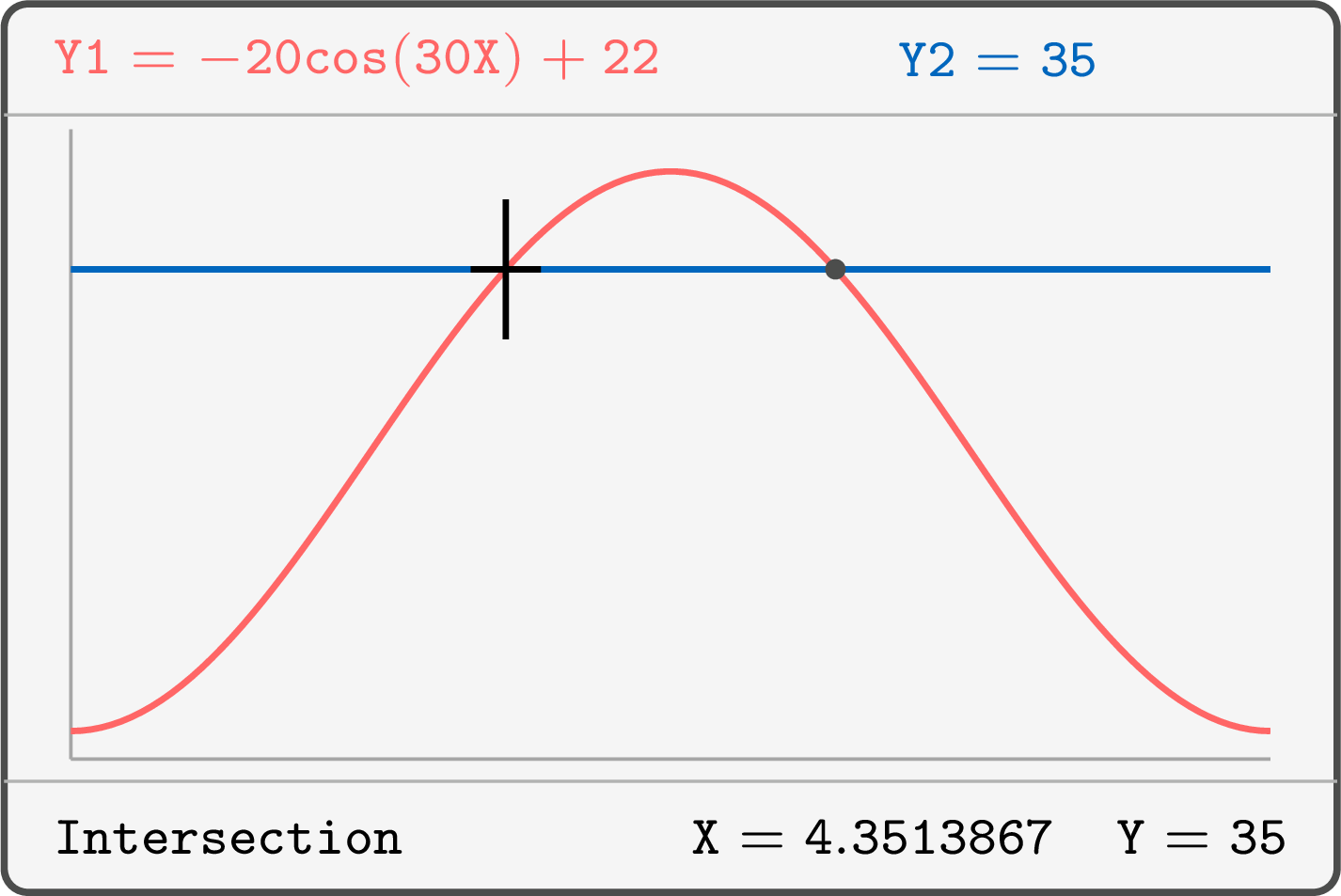
- Using a graphing calculator, find when the passenger first reaches \(35\) m above the ground, and for how long, during each turn, the passenger is higher than \(35\) m.
- The lowest point is \(22 - 20 = 2\) m above the ground and the highest \(22 + 20 = 42\) m.
- principal axis: \(d = \dfrac{42 + 2}{2} = 22\), the height of the axle;
- amplitude: \(|a| = \dfrac{42 - 2}{2} = 20\), the radius;
- period \(12\) minutes: \(b = \dfrac{360}{12} = 30\) (degrees per minute);
- at \(t = 0\) the passenger is at the lowest point, a minimum: the form \(a\cos(bt) + d\) with \(a < 0\), so \(a = -20\).
- In degree mode, enter \(Y_1 = -20\cos(30X) + 22\) and \(Y_2 = 35\), with the window \(0 \le X \le 12\), \(0 \le Y \le 45\): one turn. The line meets the curve twice (Method Solving an Equation Graphically with Technology):
Skills to practice
- Building a Sinusoidal Model in Degrees
- Solving Equations in Degree Mode with Technology
VI
Going further
Skills to practice
- Solving Problems with Sinusoidal Models
- Quiz
Jump to section