International Baccalaureate · DP 2: Analysis and Approaches HL
Complex Numbers: Polar and Euler Forms
I
The Complex Plane
I.1
The Complex Plane
The algebraic chapter computed with complex numbers; this one represents them in the plane. Represent each complex number \(a+bi\) by the point with coordinates \((a, b)\).
- Place the points representing \(z_0 = 1\), then \(z_1 = i \times z_0\), then \(z_2 = i \times z_1\), then \(z_3 = i \times z_2\), then \(z_4 = i \times z_3\). What do you observe?
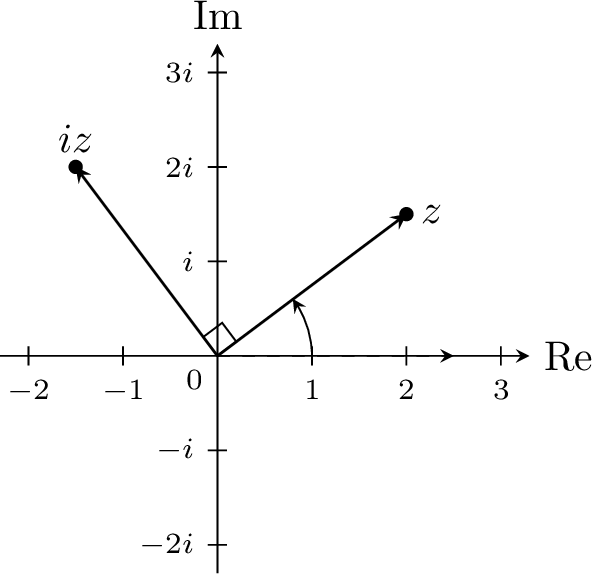
- Now start from \(w_0 = 2+i\) and repeat: place \(w_0\), \(iw_0\), \(i^2w_0\), \(i^3w_0\). What geometric transformation does “multiplying by \(i\)” appear to perform?
- Knowing that \(i^2 = -1\), explain why this transformation, applied twice, must send every point to its reflection through the origin.
We have seen that a complex number can be written in Cartesian (algebraic) form as \(z = a+bi\) where \(a = \Re(z)\) and \(b = \Im(z)\) are both real numbers.
There is a one-to-one correspondence between any complex number \(a+bi\) and the point \((a, b)\).
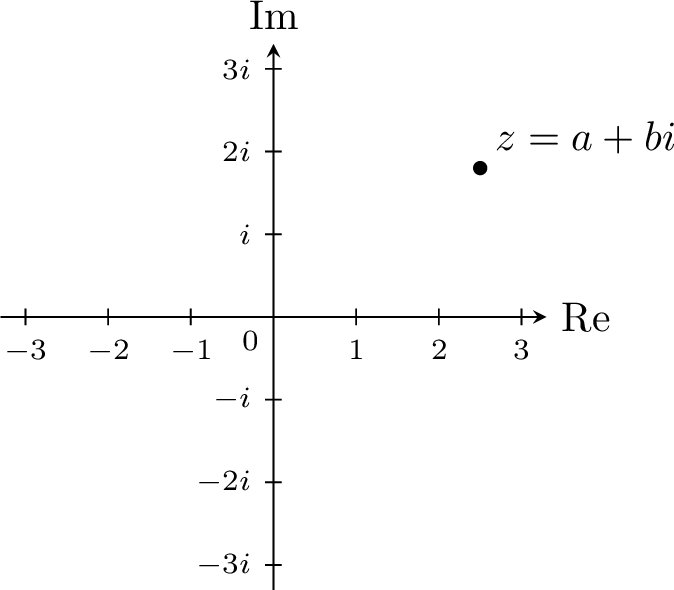
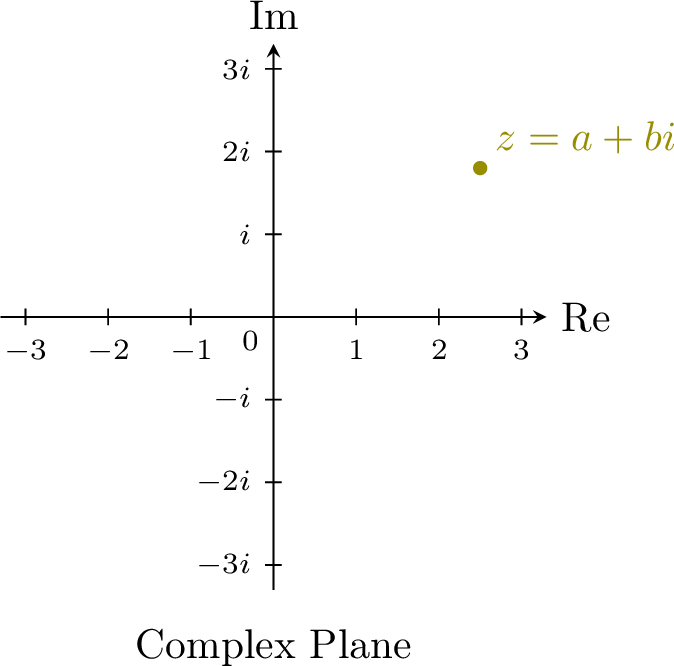
We can therefore plot any complex number on a plane by associating it with a unique point, giving a geometric representation to what was previously an algebraic object. We refer to this plane as the complex plane.
Definition — Complex Plane
The complex plane is the plane formed by the complex numbers, endowed with an orthonormal Cartesian coordinate system such that: - the horizontal \(x\)-axis, called the real axis, consists of the real numbers
- the vertical \(y\)-axis, called the imaginary axis, consists of the purely imaginary numbers.
Definition — Relationship between Cartesian and Complex Representations
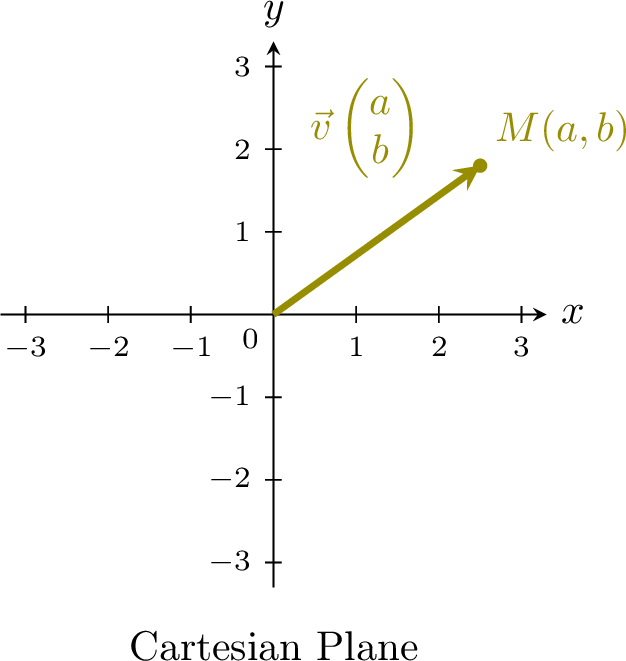
- The point \(M(a, b)\) is the point corresponding to the complex number \(z=a+bi\).
- The vector \(\vec{v} = \begin{pmatrix} a \\ b \end{pmatrix}\) is the position vector representing the complex number \(z=a+bi\).
- The complex number \(z=a+bi\) is the affix of the point \(M(a, b)\) and of the vector \(\vec{v} = \begin{pmatrix} a \\ b \end{pmatrix}\).
Skills to practice
- Reading the Affix of a Point
I.2
Modulus and Argument
Geometrically, a complex number has two key characteristics: its distance from the origin and, when it is non-zero, its direction relative to the positive real axis.
Definition — Modulus
The modulus of a complex number \(z = x+yi\), denoted \(|z|\), is the distance from the origin to its corresponding point in the complex plane. By the Pythagorean theorem, it is defined as: $$|z| = \sqrt{x^2 + y^2}.$$ The modulus is a non-negative real number. 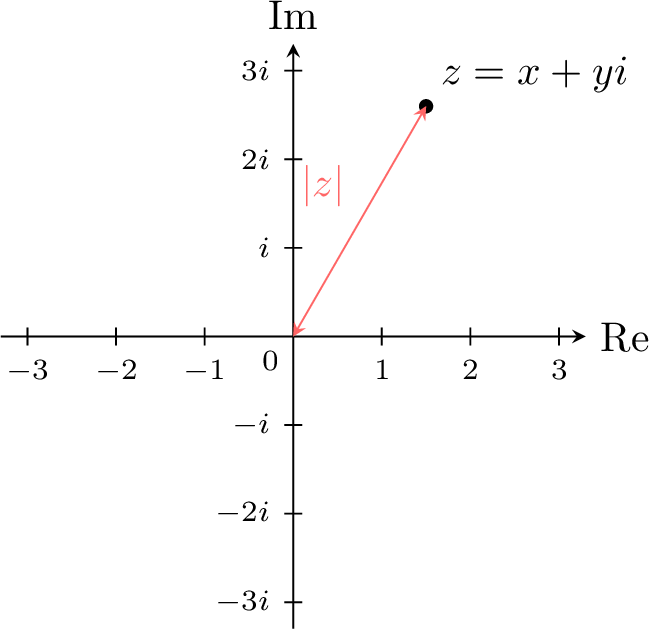
Definition — Oriented Angle of Two Vectors
Let \(\vec{w_1}\) and \(\vec{w_2}\) be two non-zero vectors, and \(M\) and \(N\) the points such that \(\vec{w_1} = \Vect{OM}\) and \(\vec{w_2} = \Vect{ON}\), where \(O\) is the origin. The ray \([OM)\) meets the trigonometric circle at a point \(M'\), and the ray \([ON)\) meets it at a point \(N'\). If \(M'\) is the image of a real number \(x\) on the trigonometric circle (the point reached from the point with affix \(1\) by travelling a distance \(|x|\) along the circle, counterclockwise if \(x \ge 0\) and clockwise if \(x < 0\)), and \(N'\) the image of a real number \(y\), then the real number \(y - x\) is a measure of the oriented angle \((\vec{w_1}, \vec{w_2})\).The measures of \((\vec{w_1}, \vec{w_2})\) are the real numbers \(y - x + 2k\pi\), \(k \in \mathbb{Z}\): an oriented angle is defined modulo \(2\pi\), and we write \((\vec{w_1}, \vec{w_2}) \equiv y - x \pmod{2\pi}\).
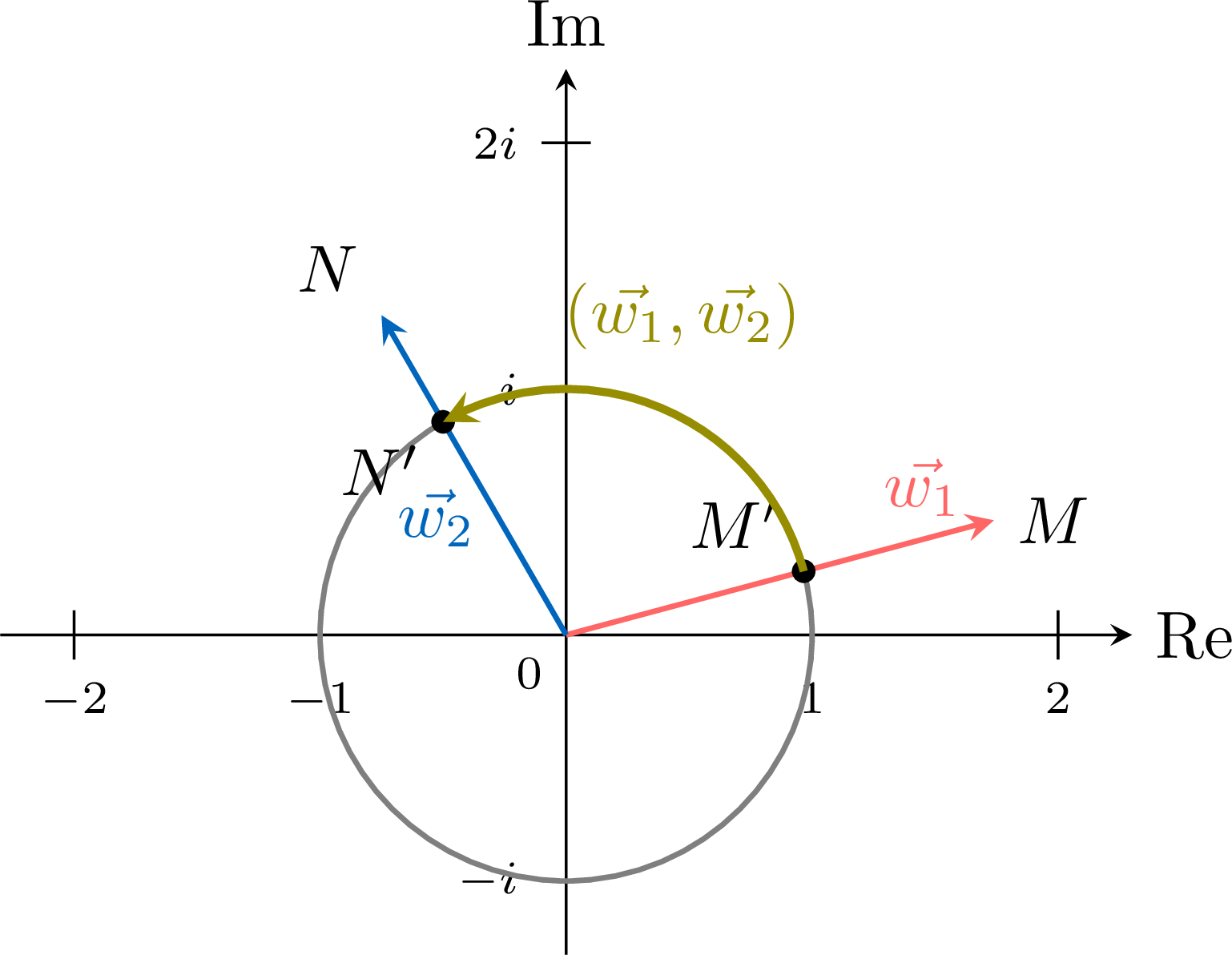
Reading an Oriented Angle
The definition, together with the symmetries of the trigonometric circle, gives the following properties, for non-zero vectors \(\vec{w_1}\), \(\vec{w_2}\), \(\vec{w_3}\) whose rays meet the trigonometric circle at the images of \(x_1\), \(x_2\), \(x_3\).
- Chasles' relation: \((x_2 - x_1) + (x_3 - x_2) = x_3 - x_1\), so \((\vec{w_1}, \vec{w_2}) + (\vec{w_2}, \vec{w_3}) \equiv (\vec{w_1}, \vec{w_3}) \pmod{2\pi}\).
- Reversing the order: \(x_1 - x_2 = -(x_2 - x_1)\), so \((\vec{w_2}, \vec{w_1}) \equiv -(\vec{w_1}, \vec{w_2}) \pmod{2\pi}\).
- Collinear vectors: \(\vec{w_1}\) and \(\vec{w_2}\) are collinear when the two points of the circle coincide or are diametrically opposite (the image of \(x + \pi\) is diametrically opposite to the image of \(x\)), that is when \((\vec{w_1}, \vec{w_2}) \equiv 0 \pmod{\pi}\): a measure \(0\) for the same direction, \(\pi\) for opposite directions.
- Orthogonal vectors: \(\vec{w_1}\) and \(\vec{w_2}\) are orthogonal when one point is obtained from the other by a quarter turn (it is the image of \(x + \dfrac{\pi}{2}\) or of \(x - \dfrac{\pi}{2}\) when the other is the image of \(x\)), that is when \((\vec{w_1}, \vec{w_2}) \equiv \dfrac{\pi}{2} \pmod{\pi}\).
Definition — Argument
The argument of a non-zero complex number \(z\), denoted \(\arg(z)\), is any measure \(\theta\) of the oriented angle between the positive real axis and the vector representing \(z\). 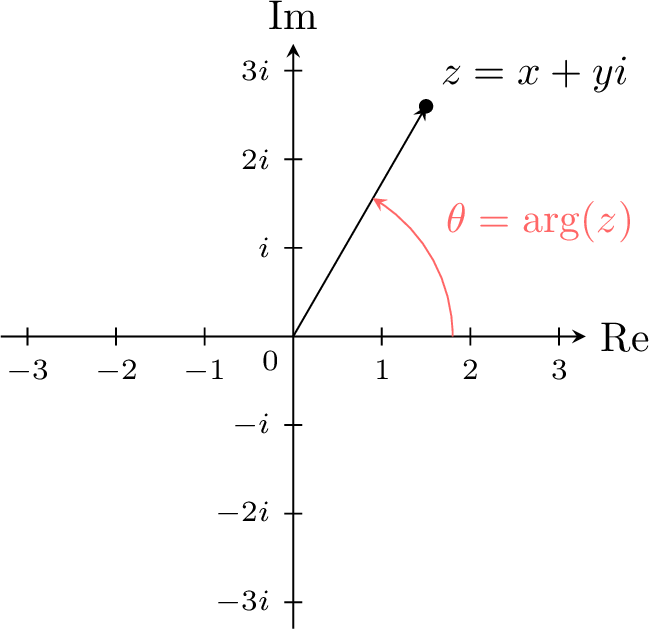
Note
An argument of a complex number is not unique, as any multiple of \(2\pi\) can be added to the angle. To make it unique, we define the principal value of the argument, also called the principal argument, as the unique argument \(\theta\) in the interval \((-\pi, \pi]\).
The argument of \(0\) is undefined.
The argument of \(0\) is undefined.
Method — Calculating the Argument
To find an argument \(\theta\) of a non-zero complex number \(z=a+bi\): - Calculate the modulus \(|z| = \sqrt{a^2+b^2}\).
- Factor out the modulus to identify the coordinates of the corresponding point on the unit circle: $$ z = |z| \left( \frac{a}{|z|} + i \frac{b}{|z|} \right). $$
- Identify the angle. Find an angle \(\theta\) that satisfies the system of equations: $$ \begin{cases} \cos(\theta) = \dfrac{a}{|z|} \\ \sin(\theta) = \dfrac{b}{|z|} \end{cases} $$ This value of \(\theta\) is an argument of \(z\).
Example
Find an argument of the complex number \(z = -1+i\sqrt{3}\). - We first calculate the modulus of \(z\): $$|z| = \sqrt{(-1)^2 + (\sqrt{3})^2} = \sqrt{1+3} = 2.$$ We can then factor out the modulus: $$ z = 2 \times \left(-\frac{1}{2} + i\frac{\sqrt{3}}{2}\right). $$
- We are looking for a real number \(\theta\) such that: $$ \begin{cases} \cos(\theta) = -\dfrac{1}{2} \\
\sin(\theta) = \dfrac{\sqrt{3}}{2} \end{cases} $$ The angle \(\theta = \dfrac{2\pi}{3}\) satisfies both equations.
Therefore, an argument of \(z\) is \(\dfrac{2\pi}{3}\).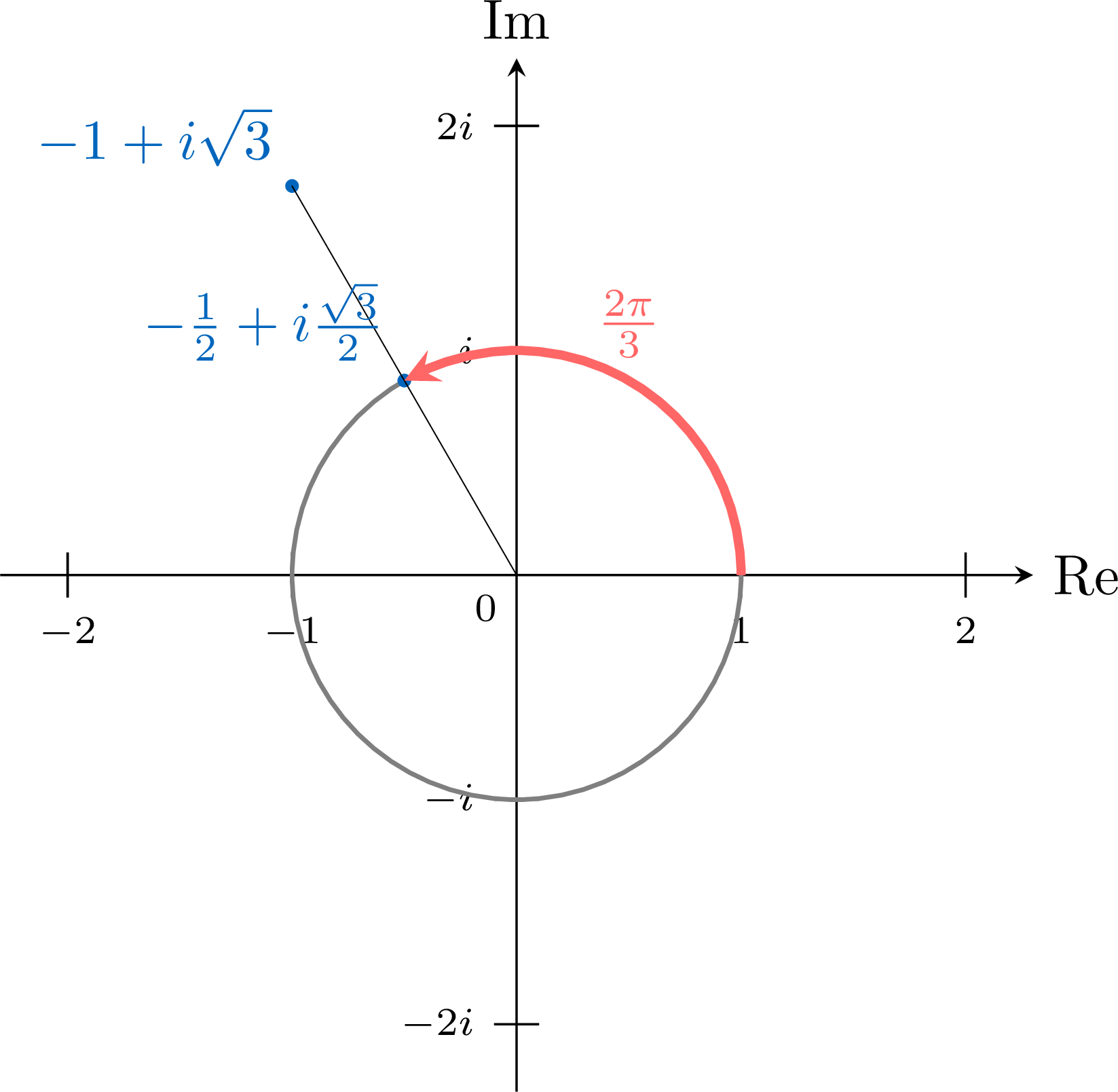
Skills to practice
- Understanding Modulus and Argument
- Calculating the Modulus and the Argument
II
Polar and Euler Forms
II.1
Unit Modulus Numbers and the Imaginary Exponential
Definition — Unit Circle in the Complex Plane
We denote by \(\mathbb{U}\) the set of all complex numbers with modulus \(1\): $$\mathbb{U}=\{z \in \mathbb{C} \mid |z |=1\}.$$ The points corresponding to the elements of \(\mathbb{U}\) form the unit circle, the circle of radius \(1\) centred at the origin; travelled counterclockwise, it is the trigonometric circle. 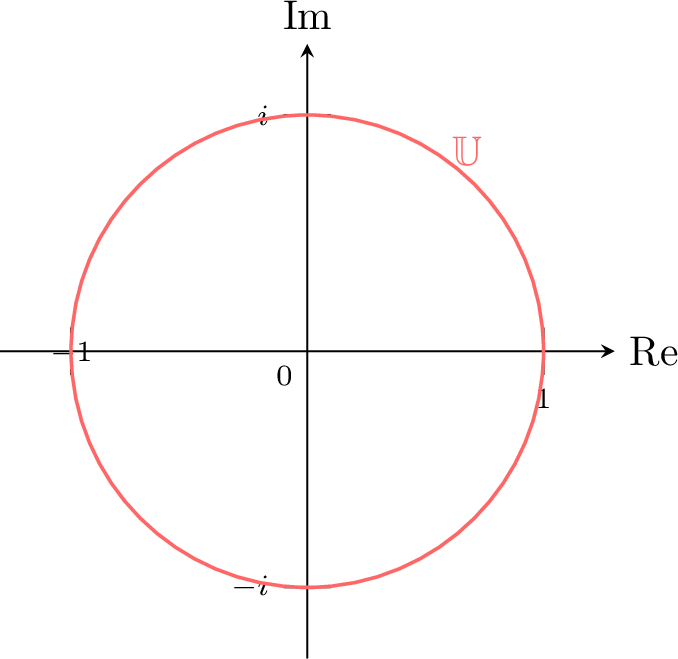
Proposition — Trigonometric Form of Unit Modulus Numbers
If \(z \in \mathbb{U}\), then there exists a real number \(\theta\) such that $$z=\cos\theta+i\sin\theta.$$ Here, \(\theta\) is an argument of \(z\). 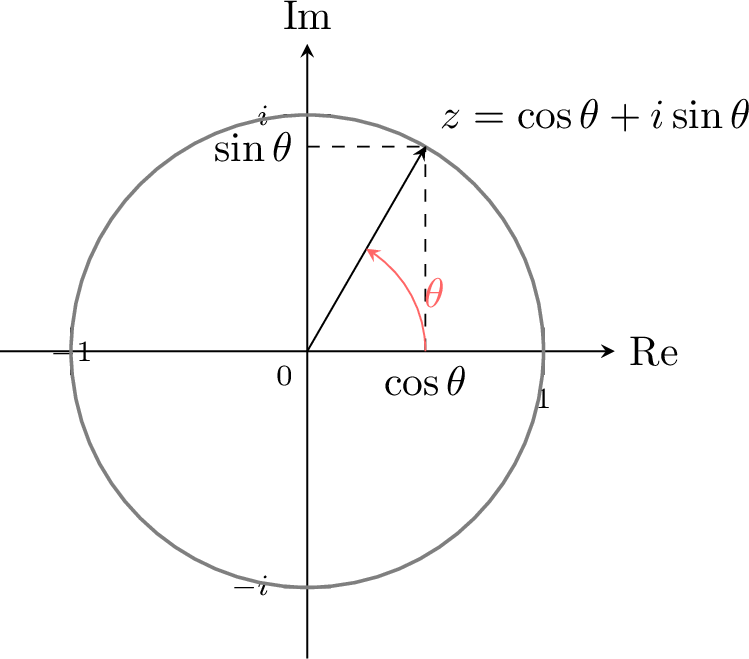
Multiplying Two Numbers of Modulus 1
Two complex numbers of modulus \(1\) can be written \(\cos\theta + i\sin\theta\) and \(\cos\theta' + i\sin\theta'\). Expanding their product with \(i^2 = -1\): $$\begin{aligned}[t] (\cos\theta + i\sin\theta)(\cos\theta' + i\sin\theta') &= \cos\theta\cos\theta' - \sin\theta\sin\theta' \\
&\quad + i\,(\sin\theta\cos\theta' + \cos\theta\sin\theta'). \end{aligned}$$ The product also has modulus \(1\), so it can be written \(\cos\varphi + i\sin\varphi\) for a real number \(\varphi\). Which one? The addition formulas of trigonometry answer this question: they recognise \(\cos(\theta + \theta')\) in the real part and \(\sin(\theta + \theta')\) in the imaginary part. Multiplying numbers of modulus \(1\) adds their angles.
Motivation for Euler's Notation
Let \(f\) be the function defined on \(\mathbb{R}\) by $$f(\theta) = \cos(\theta) + i \sin(\theta).$$ Using the angle addition formulas, one can show that, for all real numbers \(\theta_1\) and \(\theta_2\), $$ f(\theta_1 + \theta_2) = f(\theta_1)\, f(\theta_2). $$ This is the same fundamental property as the real exponential function (\(e^{x+y}=e^x e^y\)). This strong analogy motivates the notation $$f(\theta) = e^{i\theta}.$$
Definition — Imaginary Exponential
For any real number \(\theta\), we define the imaginary exponential, denoted \(e^{i\theta}\), as the complex number $$e^{i\theta} = \cos \theta + i \sin \theta.$$ Proposition — Properties of the Imaginary Exponential
For any real numbers \(\theta\) and \(\theta'\), and for any integer \(n\), the imaginary exponential has the following properties: - Modulus: \(|e^{i\theta}| = 1\)
- Argument: \(\arg(e^{i\theta}) \equiv \theta \pmod{2\pi}\)
- Conjugate: \(\conjugate{e^{i\theta}} = e^{-i\theta}\)
- Product Rule: \(e^{i(\theta+\theta')} = e^{i\theta}\, e^{i\theta'}\)
- Quotient Rule: \(\dfrac{e^{i\theta}}{e^{i\theta'}} = e^{i(\theta-\theta')}\)
- Power Rule: \((e^{i\theta})^n = e^{in\theta}\)
Let \(\theta\) and \(\theta'\) be real numbers.
- Modulus. \(|e^{i\theta}| = \sqrt{\cos^2\theta + \sin^2\theta} = \sqrt{1} = 1\).
- Argument. The point with affix \(e^{i\theta} = \cos\theta + i\sin\theta\) is the image of \(\theta\) on the trigonometric circle. By the definition of an oriented angle, \(\theta\) is a measure of the angle from the positive real axis to its vector: \(\arg(e^{i\theta}) \equiv \theta \pmod{2\pi}\).
- Conjugate. Since cosine is even and sine is odd: $$\conjugate{e^{i\theta}} = \cos\theta - i\sin\theta = \cos(-\theta) + i\sin(-\theta) = e^{-i\theta}.$$
- Product. Expanding with \(i^2 = -1\), then applying the addition formulas: $$\begin{aligned}[t] e^{i\theta}\,e^{i\theta'} &= (\cos\theta + i\sin\theta)(\cos\theta' + i\sin\theta')\\ &= \cos\theta\cos\theta' - \sin\theta\sin\theta' + i\,(\sin\theta\cos\theta' + \cos\theta\sin\theta')\\ &= \cos(\theta + \theta') + i\sin(\theta + \theta') && \text{(addition formulas)}\\ &= e^{i(\theta + \theta')}. \end{aligned}$$
- Power, for \(n \in \mathbb{N}\). By induction on \(n\). Base case: \((e^{i\theta})^0 = 1 = \cos 0 + i \sin 0 = e^{i \times 0}\). Inductive step: if \((e^{i\theta})^n = e^{in\theta}\), then, by the product rule, \((e^{i\theta})^{n+1} = e^{in\theta}\,e^{i\theta} = e^{i(n+1)\theta}\).
- Power, for \(n < 0\). By the product rule, \(e^{i\varphi}\,e^{-i\varphi} = e^{i \times 0} = 1\) for every real number \(\varphi\), so \(e^{i\varphi} \neq 0\) and \(\dfrac{1}{e^{i\varphi}} = e^{-i\varphi}\). For \(n < 0\), the integer \(-n\) is a natural number, hence $$(e^{i\theta})^n = \frac{1}{(e^{i\theta})^{-n}} = \frac{1}{e^{-in\theta}} = e^{in\theta}.$$
- Quotient. As shown for the negative powers, \(e^{i\varphi} \neq 0\) and \(\dfrac{1}{e^{i\varphi}} = e^{-i\varphi}\) for every real number \(\varphi\). Hence, by the product rule, \(\dfrac{e^{i\theta}}{e^{i\theta'}} = e^{i\theta}\,e^{-i\theta'} = e^{i(\theta - \theta')}\).
Recovering the Addition Formulas
Read backwards, the product computation in the proof above gives a quick way to recover the addition formulas. For all real numbers \(\theta\) and \(\theta'\), the rule \(e^{i(\theta + \theta')} = e^{i\theta}\,e^{i\theta'}\) reads $$\begin{aligned}[t] \cos(\theta + \theta') + i\sin(\theta + \theta') &= (\cos\theta + i\sin\theta)(\cos\theta' + i\sin\theta')\\
&= \cos\theta\cos\theta' - \sin\theta\sin\theta' + i\,(\sin\theta\cos\theta' + \cos\theta\sin\theta'). \end{aligned}$$ Two complex numbers are equal if and only if they have the same real part and the same imaginary part, so $$\cos(\theta + \theta') = \cos\theta\cos\theta' - \sin\theta\sin\theta' \qquad\text{and}\qquad \sin(\theta + \theta') = \sin\theta\cos\theta' + \cos\theta\sin\theta'.$$ Replacing \(\theta'\) by \(-\theta'\) (cosine is even, sine is odd) gives \(\cos(\theta - \theta')\) and \(\sin(\theta - \theta')\), and taking \(\theta' = \theta\) gives the double angle formulas.
This is a memory aid, not a proof: the rule \(e^{i\theta}\,e^{i\theta'} = e^{i(\theta + \theta')}\) was itself proved from the addition formulas.
This is a memory aid, not a proof: the rule \(e^{i\theta}\,e^{i\theta'} = e^{i(\theta + \theta')}\) was itself proved from the addition formulas.
Skills to practice
- Applying the Properties of the Imaginary Exponential
II.2
Polar and Euler's Forms
Any non-zero complex number can be represented by starting with a number on the unit circle and scaling it by its modulus.
Definition — Polar Form
A non-zero complex number \(z\) with modulus \(r = |z|\) and argument \(\theta\) can be written in polar form as $$ z = r(\cos\theta + i\sin\theta). $$ 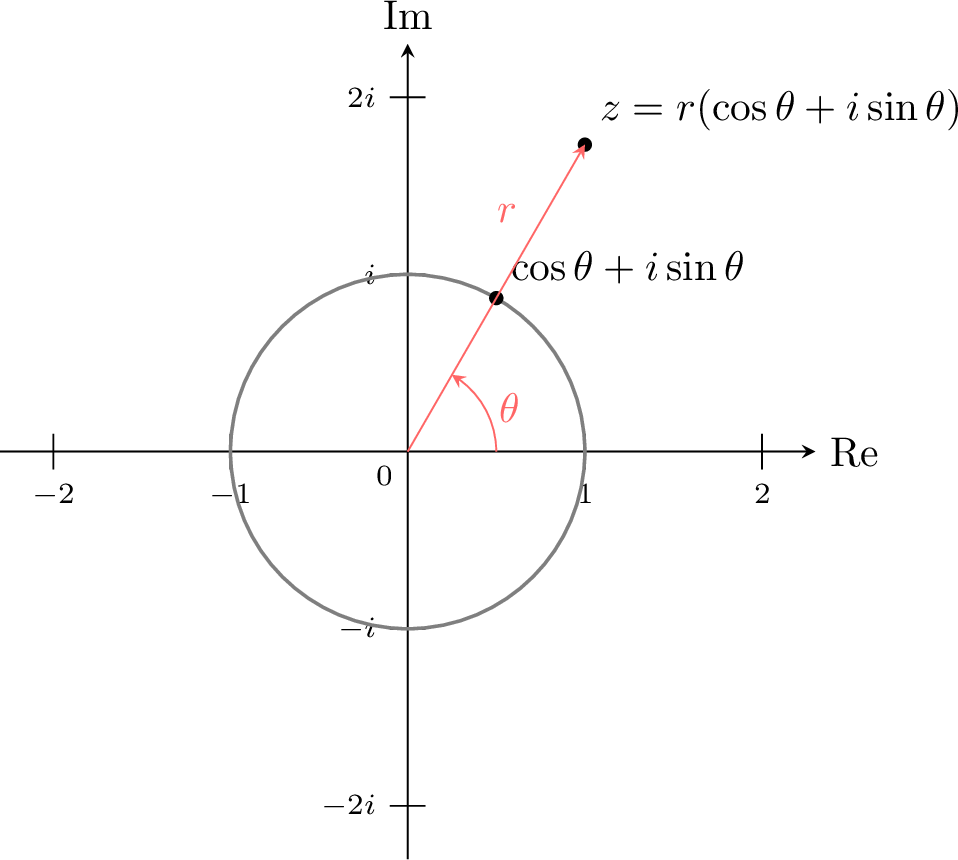
Proposition — Equality in Polar Form
Let \(r > 0\) and \(r' > 0\), and let \(\theta\) and \(\theta'\) be real numbers. Then $$\textcolor{colorprop}{r(\cos\theta + i\sin\theta) = r'(\cos\theta' + i\sin\theta') \iff r = r' \text{ and } \theta \equiv \theta' \pmod{2\pi}.}$$ In particular, if \(z = r(\cos\theta + i\sin\theta)\) with \(r > 0\), then \(r = |z|\) and \(\theta\) is an argument of \(z\).
For every real number \(\theta\) and every \(r > 0\), $$|r(\cos\theta + i\sin\theta)| = \sqrt{r^2\cos^2\theta + r^2\sin^2\theta} = r\sqrt{\cos^2\theta + \sin^2\theta} = r.$$
- If \(r = r'\) and \(\theta' = \theta + 2k\pi\) with \(k \in \mathbb{Z}\), then \(\cos\theta' = \cos\theta\) and \(\sin\theta' = \sin\theta\) (cosine and sine are \(2\pi\)-periodic), so the two numbers are equal.
- Conversely, if the two numbers are equal, they have the same modulus: \(r = r'\). Dividing by \(r > 0\) gives \(\cos\theta + i\sin\theta = \cos\theta' + i\sin\theta'\), and identifying real and imaginary parts, \(\cos\theta = \cos\theta'\) and \(\sin\theta = \sin\theta'\). The images of \(\theta\) and \(\theta'\) on the trigonometric circle are therefore the same point, so \(\theta' - \theta\) is a multiple of \(2\pi\).
Definition — Euler's Form
Using the imaginary exponential, a non-zero complex number \(z\) with modulus \(r = |z|\) and argument \(\theta\) can be written in Euler's form as $$ z = re^{i\theta}. $$ 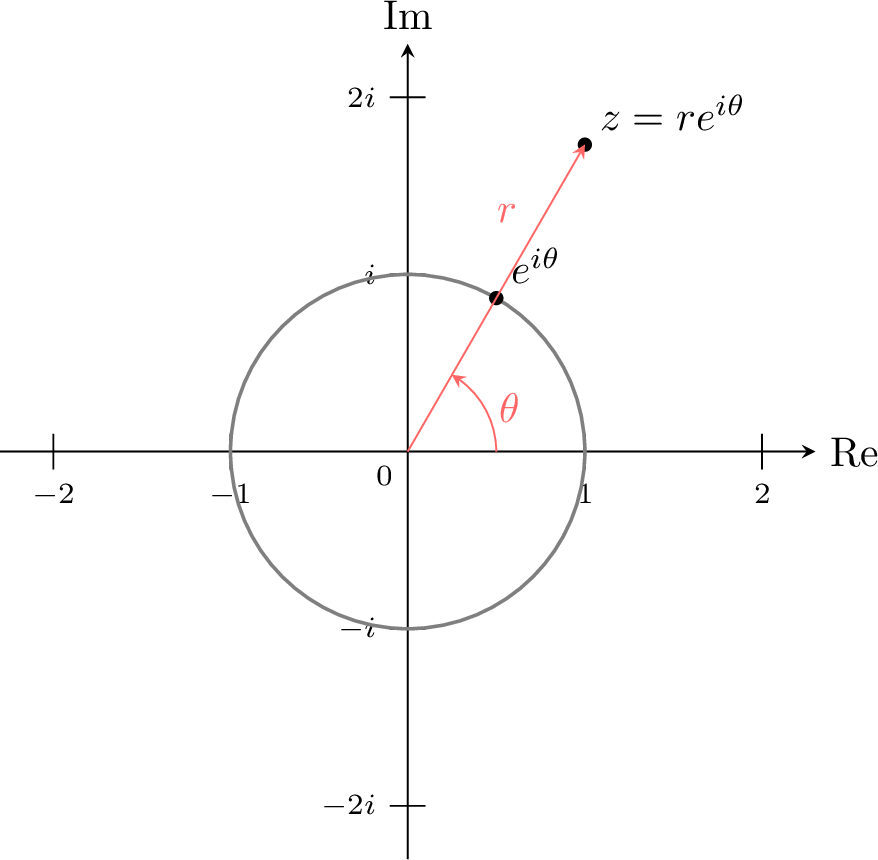
Note
This form makes the geometric rules of multiplication intuitive: $$(r_1 e^{i\theta_1})(r_2 e^{i\theta_2}) = (r_1r_2)e^{i(\theta_1+\theta_2)}.$$ Multiplying complex numbers corresponds to multiplying their moduli and adding their arguments.
Other Names and Notations
Several names and notations are in common use for the objects of this chapter.
- The complex plane is also called the Argand diagram.
- The polar form \(r(\cos\theta + i\sin\theta)\) is also called the modulus-argument form. It is abbreviated \(r\operatorname{cis}\theta\), where \(\operatorname{cis}\theta = \cos\theta + i\sin\theta\), so that \(\operatorname{cis}\theta = e^{i\theta}\).
- Euler's form \(re^{i\theta}\) is also called the exponential form.
Method — Converting Between Forms with Technology
A graphing calculator, or a scientific calculator with a complex mode, converts between the algebraic form \(a + bi\), the polar form \(r(\cos\theta + i\sin\theta)\) and Euler's form \(re^{i\theta}\). - Set the angle unit to radians and the mode to complex numbers.
- From \(a + bi\) to the modulus and an argument, for \(z \neq 0\) (the number \(0\) has no argument): the functions \(\mathrm{abs}\) and \(\arg\) (sometimes named \(\mathrm{angle}\)), or the conversion to the display \(r\angle\theta\), give \(|z|\) and an argument; most calculators return the principal argument, the argument in \((-\pi, \pi]\) (check the convention of the device once on \(z = -1\), whose principal argument is \(\pi\)).
- From \(re^{i\theta}\) to \(a + bi\): enter \(re^{i\theta}\) with the keys \(e^{\square}\) and \(i\) (or \(r\angle\theta\)), then convert to the display \(a + bi\).
- Products, quotients and powers are entered directly. The screen shows the argument of the result in its own convention: an argument obtained by adding the arguments of two Euler forms may differ from it by a multiple of \(2\pi\).
- Report each value to 3 significant figures unless it is exact, and check the quadrant: the signs of \(a\) and \(b\) must agree with the argument.
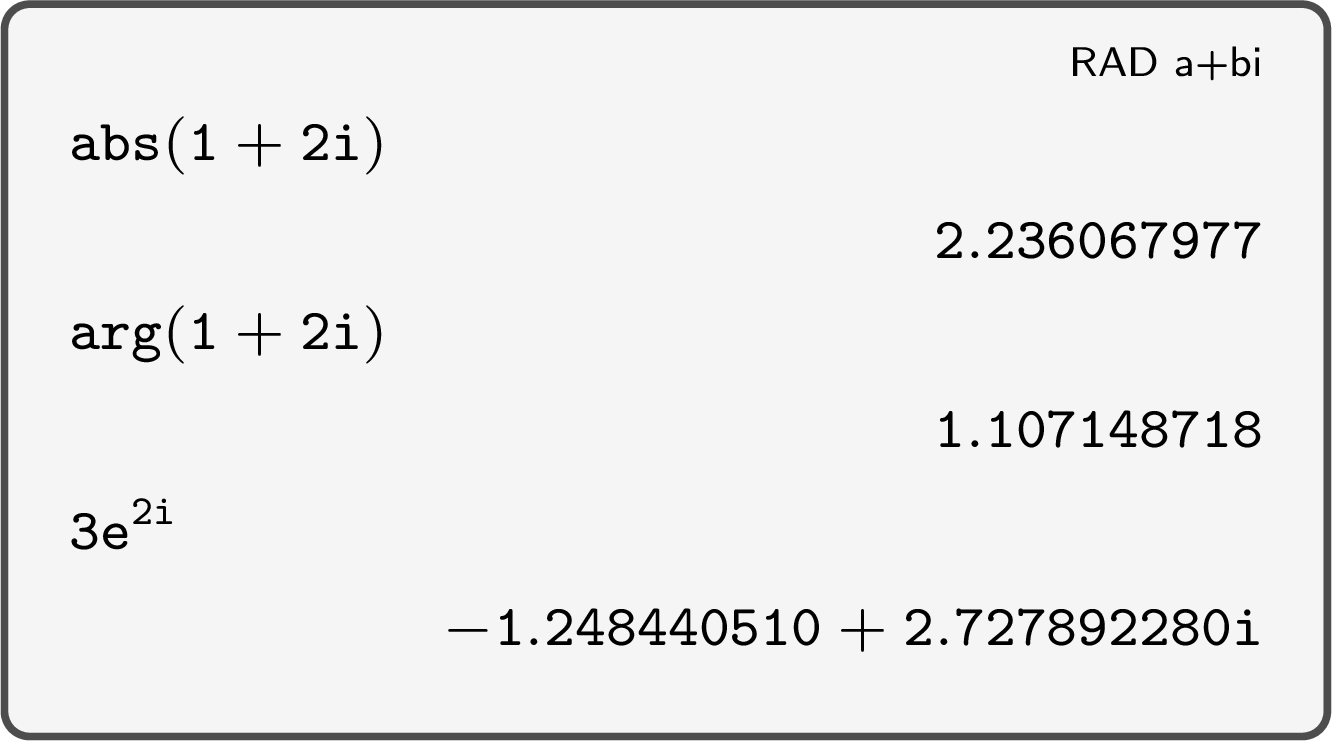
Example
Use technology to answer each question, to 3 significant figures. - Write \(z = -4 - 3i\) in polar form and in Euler's form.
- Write \(w = 2.5e^{2.8i}\) in the form \(a + bi\).
- Deduce the modulus and the principal argument of \(zw\) from parts 1 and 2, then check them on the screen.
- The screen gives \(\mathrm{abs}(-4 - 3i) = 5\) and \(\arg(-4 - 3i) = -2.498091545\), so $$z \approx 5\left(\cos(-2.50) + i\sin(-2.50)\right) = 5e^{-2.50i}.$$ Check: \(a < 0\) and \(b < 0\) place \(z\) in the third quadrant, and indeed \(-\pi < -2.50 < -\dfrac{\pi}{2}\).
- The input \(2.5e^{2.8i}\) displays \(-2.355555852 + 0.837470375i\), so \(w \approx -2.36 + 0.837i\). Check: \(\dfrac{\pi}{2} < 2.8 < \pi\), a second-quadrant argument, and indeed \(a < 0 < b\).
- Write \(\alpha = \arg z \approx -2.498091545\), kept unrounded until the end. With the Euler forms: $$\begin{aligned}[t] zw &= 5e^{i\alpha} \times 2.5e^{2.8i} &&\\ &= 12.5\,e^{i(\alpha + 2.8)}. && \text{(}e^{i\theta}e^{i\theta'} = e^{i(\theta + \theta')}\text{)} \end{aligned}$$ So \(|zw| = 12.5\), and \(\alpha + 2.8 \approx 0.301908455\) is an argument of \(zw\); it lies in \((-\pi, \pi]\), so it is the principal argument: \(\arg(zw) \approx 0.302\). The input \((-4 - 3i) \times 2.5e^{2.8i}\) displays \(11.934634533 + 3.716786053i\), whose modulus is \(12.5\) and argument \(0.301908455\): the screen agrees.
Skills to practice
- Recognising Polar and Euler's Forms
- Converting from Polar to Cartesian Form
- Converting to Polar and Euler's Forms
- Converting Between Forms with Technology
II.3
Products and Quotients: Modulus and Argument
Proposition — Properties of the Modulus
- \(|\conjugate{z}| = |z|\)
- \(|z|^2 = z\conjugate{z}\)
- \(|z_1 z_2| = |z_1|\, |z_2|\)
- \(\left| \dfrac{z_1}{z_2} \right| = \dfrac{|z_1|}{|z_2|}\) provided \(z_2 \neq 0\)
- \(|z^n| = |z|^n\) for any integer \(n\) (with \(z \neq 0\) when \(n < 0\)).
We prove the two central properties; the others are proved with the same tools (and in the exercises). Let \(z = a+bi\), \(z_1\) and \(z_2\) be complex numbers.
- \(|z|^2 = z\conjugate{z}\): $$\begin{aligned}[t] z\conjugate{z} &= (a+bi)(a-bi) && \\ &= a^2 - (bi)^2 && \text{(\((x+y)(x-y) = x^2 - y^2\))}\\ &= a^2 + b^2 = |z|^2. && \text{(\(i^2 = -1\))} \end{aligned}$$
- \(|z_1 z_2| = |z_1|\,|z_2|\): both sides are non-negative, so it suffices to compare their squares. $$\begin{aligned}[t] |z_1 z_2|^2 &= (z_1 z_2)\conjugate{(z_1 z_2)} && \text{(\(|z|^2 = z\conjugate{z}\))}\\ &= z_1 \conjugate{z_1}\, z_2 \conjugate{z_2} && \text{(\(\conjugate{z_1 z_2} = \conjugate{z_1}\,\conjugate{z_2}\))}\\ &= |z_1|^2\, |z_2|^2 = \left(|z_1|\,|z_2|\right)^2. && \end{aligned}$$ Since \(|z_1z_2| \ge 0\) and \(|z_1|\,|z_2| \ge 0\), taking square roots gives \(|z_1 z_2| = |z_1|\,|z_2|\).
We now prove the power, inverse and quotient properties, which follow from the modulus of a product; the property \(|\conjugate{z}| = |z|\) is proved in the exercises.
- Power, for \(n \in \mathbb{N}\). Let \(z\) be a complex number, with the convention \(z^0 = 1\) (also for \(z = 0\)). Let \(P(n)\) be the statement “\(|z^n| = |z|^n\)”.
- Base case: \(|z^0| = |1| = 1 = |z|^0\), so \(P(0)\) is true.
- Inductive step: assume \(P(n)\) for some natural number \(n\). Then $$\begin{aligned}[t] |z^{n+1}| &= |z^n \times z| &&\\ &= |z^n|\,|z| && \text{(modulus of a product)}\\ &= |z|^n\,|z| = |z|^{n+1}, && \text{(induction hypothesis)} \end{aligned}$$ so \(P(n+1)\) is true.
- Conclusion: \(|z^n| = |z|^n\) for every natural number \(n\).
- Inverse. Let \(z \neq 0\). Since \(z \times \dfrac{1}{z} = 1\), the modulus of a product gives \(|z| \times \left|\dfrac{1}{z}\right| = |1| = 1\). As \(|z| \neq 0\), \(\left|\dfrac{1}{z}\right| = \dfrac{1}{|z|}\).
- Quotient. Let \(z_2 \neq 0\). Then \(\left|\dfrac{z_1}{z_2}\right| = \left|z_1 \times \dfrac{1}{z_2}\right| = |z_1| \times \dfrac{1}{|z_2|} = \dfrac{|z_1|}{|z_2|}\).
- Power, for \(n < 0\). Let \(z \neq 0\) and \(n < 0\). The integer \(-n\) is a natural number and \(z^n = \dfrac{1}{z^{-n}}\), so $$|z^n| = \frac{1}{|z^{-n}|} = \frac{1}{|z|^{-n}} = |z|^n.$$
Proposition — Products and Inverses of Unit Modulus Numbers
For all complex numbers \(z\) and \(z'\) in \(\mathbb{U}\): - the product \(zz'\) belongs to \(\mathbb{U}\);
- \(z \neq 0\), and its inverse is its conjugate: \(\dfrac{1}{z} = \conjugate{z}\), which belongs to \(\mathbb{U}\);
- every power \(z^n\), \(n \in \mathbb{Z}\), belongs to \(\mathbb{U}\).
Let \(z, z' \in \mathbb{U}\), so \(|z| = |z'| = 1\).
- \(|zz'| = |z|\,|z'| = 1 \times 1 = 1\), so \(zz' \in \mathbb{U}\).
- \(|z| = 1 \neq 0\), so \(z \neq 0\). Moreover \(z\conjugate{z} = |z|^2 = 1\), so \(\dfrac{1}{z} = \conjugate{z}\), and \(|\conjugate{z}| = |z| = 1\).
- For every integer \(n\), \(|z^n| = |z|^n = 1^n = 1\) (modulus of a power, valid for \(n < 0\) since \(z \neq 0\)).
Proposition — Properties of Arguments
For any non-zero complex numbers \(z_1\) and \(z_2\) and any integer \(n\): - for any non-zero complex number \(z\), \(\arg(\conjugate{z}) \equiv -\arg(z) \pmod{2\pi}\)
- \(\arg(z_1 z_2) \equiv \arg(z_1) + \arg(z_2) \pmod{2\pi}\)
- \(\arg\left(\dfrac{z_1}{z_2}\right) \equiv \arg(z_1) - \arg(z_2) \pmod{2\pi}\)
- \(\arg(z^n) \equiv n \arg(z) \pmod{2\pi}\) for any non-zero complex number \(z\).
We prove the product property, then deduce from it the quotient and power properties; the conjugate property is proved in the exercises. Write \(z_1 = r_1 e^{i\theta_1}\) and \(z_2 = r_2 e^{i\theta_2}\) in Euler form, with \(r_1, r_2 > 0\). $$\begin{aligned}[t] z_1 z_2 &= r_1 e^{i\theta_1} \, r_2 e^{i\theta_2} && \\
&= r_1 r_2 \, e^{i(\theta_1+\theta_2)}. && \text{(\(e^{i\alpha}e^{i\beta} = e^{i(\alpha+\beta)}\))} \end{aligned}$$ This is an Euler form of \(z_1z_2\) with positive modulus \(r_1r_2\), so \(\theta_1 + \theta_2\) is an argument of \(z_1 z_2\): $$\arg(z_1 z_2) \equiv \arg(z_1) + \arg(z_2) \pmod{2\pi}.$$ Quotient. Let \(z_1\) and \(z_2\) be non-zero complex numbers. The number \(\dfrac{z_1}{z_2}\) is non-zero and \(z_1 = \dfrac{z_1}{z_2} \times z_2\), so, by the product property, \(\arg(z_1) \equiv \arg\left(\dfrac{z_1}{z_2}\right) + \arg(z_2) \pmod{2\pi}\), that is $$\arg\left(\frac{z_1}{z_2}\right) \equiv \arg(z_1) - \arg(z_2) \pmod{2\pi}.$$ Power, for \(n \in \mathbb{N}\). Let \(z\) be a non-zero complex number, and let \(P(n)\) be the statement “\(\arg(z^n) \equiv n\arg(z) \pmod{2\pi}\)”.
- Base case: \(z^0 = 1\) and \(0\) is an argument of \(1\), so \(\arg(z^0) \equiv 0 = 0 \times \arg(z) \pmod{2\pi}\): \(P(0)\) is true.
- Inductive step: assume \(P(n)\) for some natural number \(n\). Then $$\begin{aligned}[t] \arg(z^{n+1}) &= \arg(z^n \times z) &&\\ &\equiv \arg(z^n) + \arg(z) && \text{(product property)}\\ &\equiv n\arg(z) + \arg(z) && \text{(induction hypothesis)}\\ &= (n+1)\arg(z) \pmod{2\pi}, \end{aligned}$$ so \(P(n+1)\) is true.
- Conclusion: since \(P(0)\) is true and \(P(n) \Rightarrow P(n+1)\), by the principle of mathematical induction, \(\arg(z^n) \equiv n\arg(z) \pmod{2\pi}\) for every natural number \(n\).
Skills to practice
- Proving the Properties of the Modulus and the Argument
III
Geometry in the Complex Plane
III.1
Sums, Quotients and Products as Geometry
Proposition — Addition and Subtraction
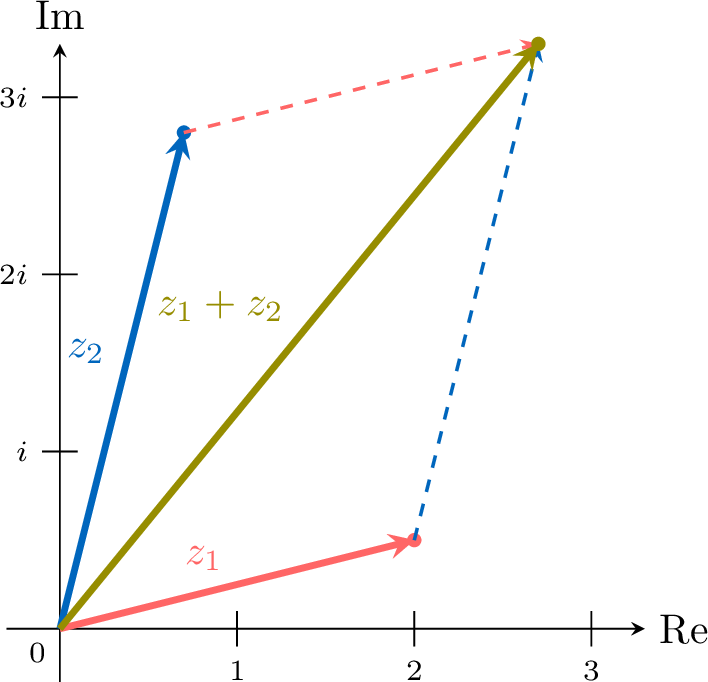
Adding or subtracting complex numbers is equivalent to the vector addition or subtraction of their corresponding position vectors, following the parallelogram law. - Addition (\(z_1+z_2\)): The vector for the sum is the main diagonal of the parallelogram formed by the vectors for \(z_1\) and \(z_2\).
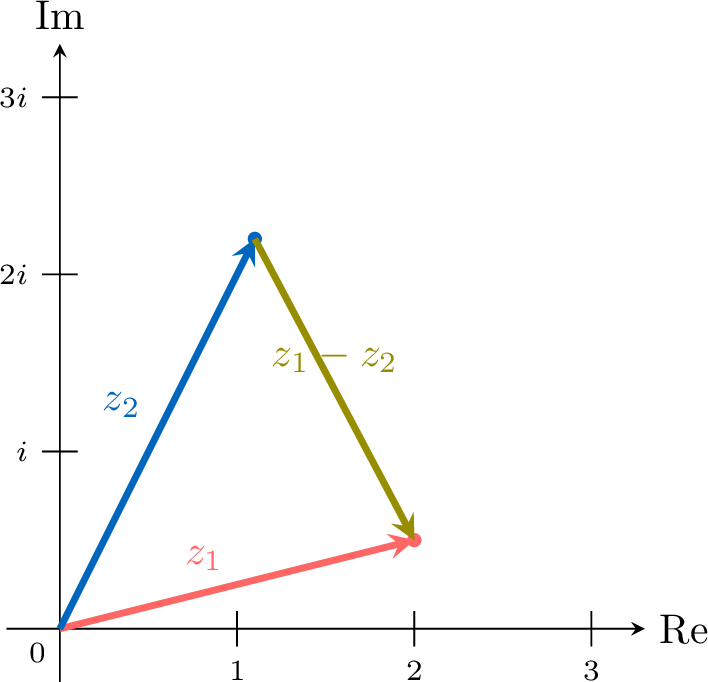
- Subtraction (\(z_1-z_2\)): The vector for the difference is the vector from the point representing \(z_2\) to the point representing \(z_1\).
Proposition — Affix of a Vector and Distance between Points
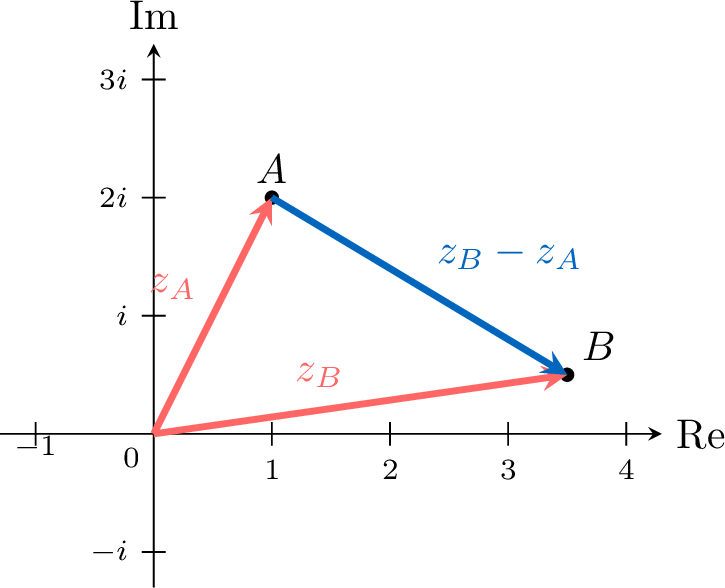
Let \(A\) and \(B\) be two points in the complex plane with respective affixes \(z_A\) and \(z_B\). - The vector \(\Vect{AB}\) has the affix \(z_{\Vect{AB}} = z_B - z_A\).
- The distance between points \(A\) and \(B\) is the modulus of this affix: $$ AB = |z_B - z_A|. $$
Proposition — Affix of a Midpoint
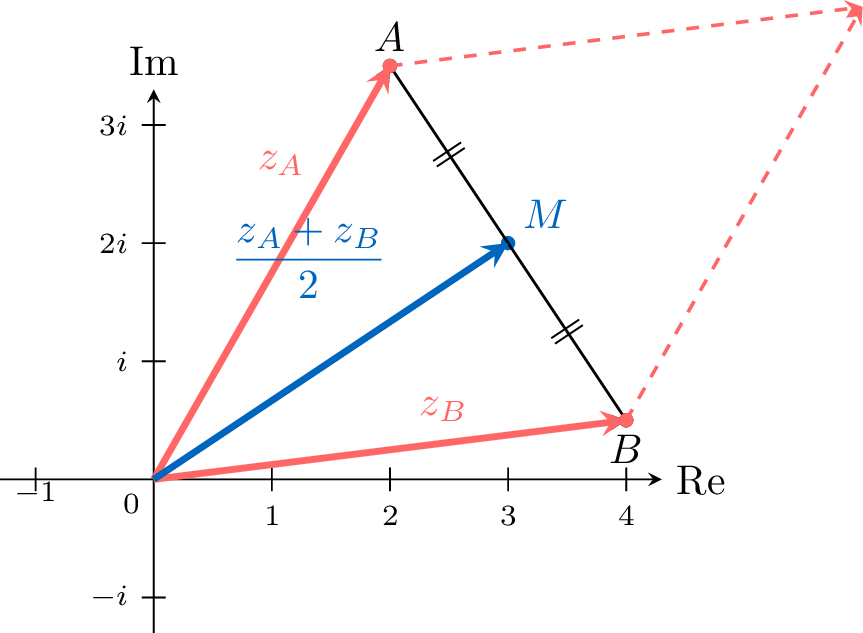
Let \(A\) and \(B\) be two points in the complex plane with affixes \(z_A\) and \(z_B\).The midpoint \(M\) of the segment \(\SegmentFr{AB}\) has the affix $$ z_M = \frac{z_A + z_B}{2}. $$
Proposition — Angle
Let \(A\), \(B\), and \(C\) be three distinct points in the complex plane with respective affixes \(z_A\), \(z_B\), and \(z_C\). The oriented angle \(\left(\Vect{AB}, \Vect{AC}\right)\) is given by $$ \left(\Vect{AB}, \Vect{AC}\right) \equiv \arg\left(\frac{z_C-z_A}{z_B-z_A}\right) \pmod{2\pi}. $$ 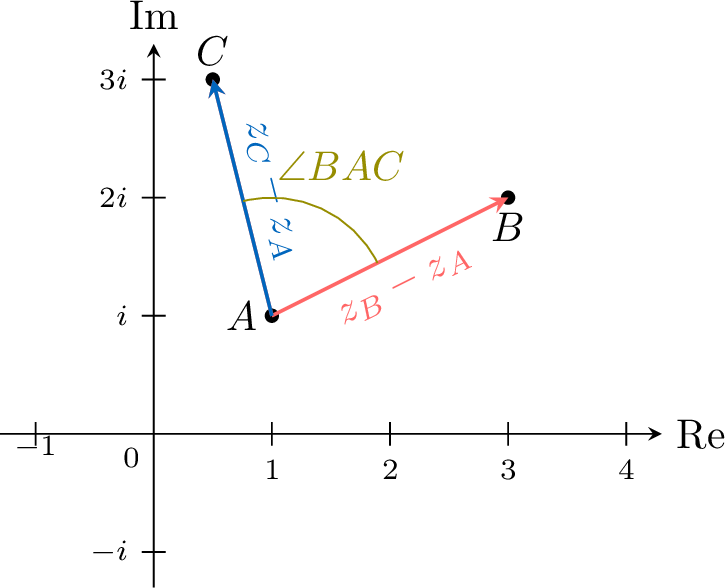
Let \(\vec{u}\) be the vector with affix \(1\), which directs the positive real axis. By Chasles' relation, \(\left(\Vect{AB}, \Vect{AC}\right) \equiv \left(\Vect{AB}, \vec{u}\right) + \left(\vec{u}, \Vect{AC}\right) \equiv \left(\vec{u}, \Vect{AC}\right) - \left(\vec{u}, \Vect{AB}\right) \pmod{2\pi}\): the oriented angle is the difference between the angles of the vectors \(\Vect{AC}\) and \(\Vect{AB}\), both measured from the positive real axis. 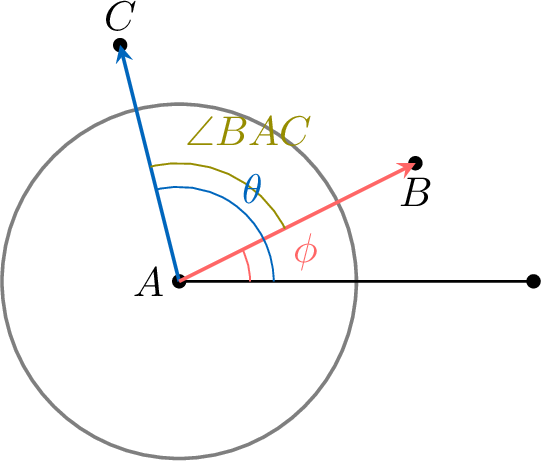
Let \(\theta\) be a measure of \(\left(\vec{u}, \Vect{AC}\right)\) and \(\phi\) a measure of \(\left(\vec{u}, \Vect{AB}\right)\). From the definition of the argument of the affix of a vector, we have:
- The affix of \(\Vect{AC}\) is \(z_C-z_A\), so \(\theta = \arg(z_C-z_A)\).
- The affix of \(\Vect{AB}\) is \(z_B-z_A\), so \(\phi = \arg(z_B-z_A)\).
Proposition — Alignment and Orthogonality Criteria
Let \(A\), \(B\), \(C\) be three distinct points with affixes \(a\), \(b\), \(c\). - \(A\), \(B\), \(C\) are aligned if and only if \(\dfrac{c-a}{b-a}\) is a real number.
- The lines \((AB)\) and \((AC)\) are perpendicular if and only if \(\dfrac{c-a}{b-a}\) is a purely imaginary number.
The oriented angle \(\left(\Vect{AB}, \Vect{AC}\right)\) is an argument of \(\dfrac{c-a}{b-a}\), and this quotient is non-zero (the points are distinct).
- The points are aligned exactly when this angle is \(0\) or \(\pi\) modulo \(2\pi\) — that is, when the argument of the quotient is \(0 \pmod{\pi}\): the non-zero complex numbers with such an argument are exactly the real ones.
- The lines are perpendicular exactly when the angle is \(\pm\dfrac{\pi}{2}\) modulo \(2\pi\) — the non-zero complex numbers with argument \(\dfrac{\pi}{2} \pmod{\pi}\) are exactly the purely imaginary ones.
Example
Let \(A\), \(B\), \(C\) be the points with affixes \(a = 1+2i\), \(b = 3+3i\), \(c = 7+5i\). Show that \(A\), \(B\), \(C\) are aligned.
$$\begin{aligned}[t] \frac{c-a}{b-a} &= \frac{6+3i}{2+i} && \\
&= \frac{3(2+i)}{2+i} && \text{(factor out 3)}\\
&= 3. \end{aligned}$$ The quotient is a real number, so \(A\), \(B\), \(C\) are aligned (and \(\Vect{AC} = 3\,\Vect{AB}\)).
Method — Studying a Configuration with Affixes
Let \(A\), \(B\), \(C\) be points with affixes \(a\), \(b\), \(c\), with \(B \neq A\) and \(C \neq A\). To study the configuration at the vertex \(A\), compute the quotient \(q = \dfrac{c-a}{b-a}\) in algebraic form, then read it: - lengths: \(|q| = \dfrac{|c-a|}{|b-a|} = \dfrac{AC}{AB}\); in particular, \(|q| = 1\) means \(AC = AB\) (if moreover \(A\), \(B\), \(C\) are not aligned, triangle \(ABC\) is isosceles at \(A\));
- angle: an argument of \(q\) is a measure of the oriented angle \(\left(\Vect{AB}, \Vect{AC}\right)\);
- alignment: \(q\) is a real number exactly when \(A\), \(B\), \(C\) are aligned;
- orthogonality: \(q\) is purely imaginary exactly when \((AB) \perp (AC)\), that is when triangle \(ABC\) is right-angled at \(A\).
Example
Let \(A\), \(B\), \(C\) be the points with affixes \(a = 2+2i\), \(b = 4+i\) and \(c = 4+6i\). Determine the nature of triangle \(ABC\).
We compute the quotient at the vertex \(A\), multiplying by the conjugate of the denominator: $$\begin{aligned}[t] \frac{c-a}{b-a} &= \frac{2+4i}{2-i} &&\\
&= \frac{(2+4i)(2+i)}{(2-i)(2+i)} && \text{(conjugate of the denominator)}\\
&= \frac{4 + 2i + 8i + 4i^2}{4+1} && \text{(\(i^2 = -1\))}\\
&= \frac{10i}{5} = 2i. \end{aligned}$$ 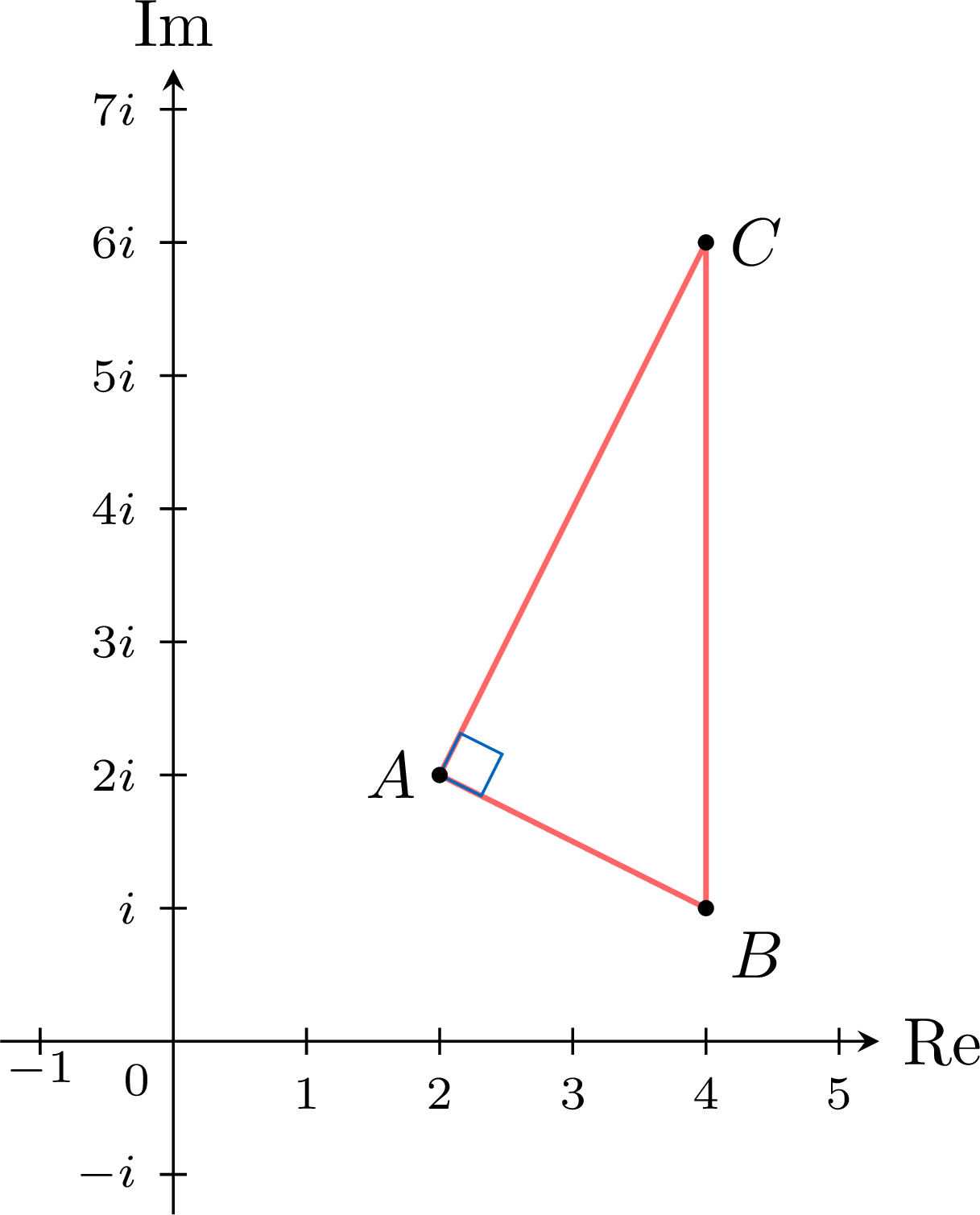
- \(|2i| = 2\), so \(AC = 2\,AB\): the triangle is not isosceles at \(A\).
- \(2i\) is purely imaginary, with argument \(\dfrac{\pi}{2}\): \(\left(\Vect{AB}, \Vect{AC}\right) \equiv \dfrac{\pi}{2} \pmod{2\pi}\).
Proposition — Multiplication and Division
Let \(z_1\) and \(z_2\) be non-zero complex numbers. Multiplying or dividing them acts on their moduli and on their arguments: - Multiplication (\(z_1 z_2\)): Multiply the moduli and add the arguments.
- Division (\(\dfrac{z_1}{z_2}\)): Divide the moduli and subtract the arguments.
Proposition — Fundamental Geometric Transformations
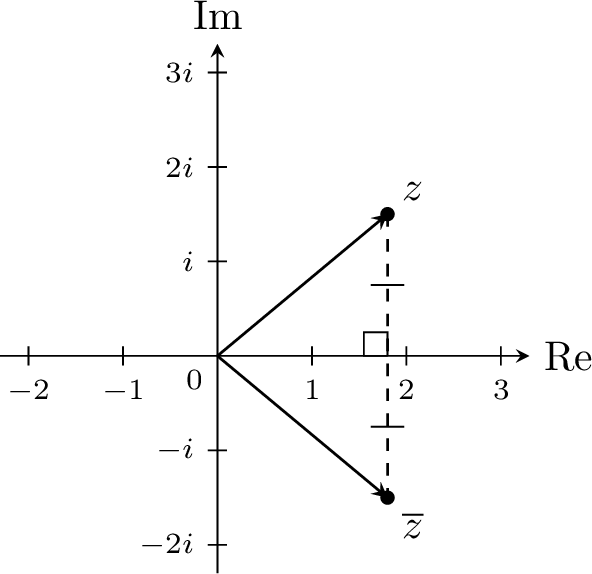
- Conjugate (\(z \to \conjugate{z}\)): a reflection across the real axis.
- Negation (\(z \to -z\)): a rotation of \(180^\circ\) (or \(\pi\) radians) about the origin.
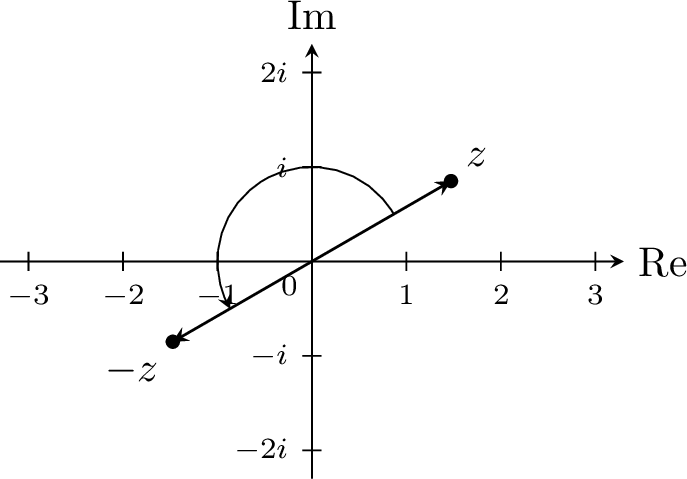
- Multiplication by \(i\) (\(z \to iz\)): a rotation of \(90^\circ\) (or \(\pi/2\) radians) anti-clockwise about the origin.
- Adding \(b\) (\(z \to z + b\)): the translation by the vector of affix \(b\).
- Multiplying by a non-zero real \(k\) (\(z \to kz\)): the homothety of centre \(O\) and ratio \(k\).
Skills to practice
- Visualising Fundamental Transformations
- Calculating Distances, Midpoints and Angles
- Proving an Alignment, an Orthogonality or the Nature of a Figure
IV
Powers and Roots
IV.1
De Moivre's Theorem
Proposition — De Moivre's Theorem
For any non-zero complex number \(z = r(\cos\theta + i\sin\theta)\) (with \(r > 0\)) and for any integer \(n\): $$ [r(\cos\theta + i\sin\theta)]^n = r^n(\cos(n\theta) + i\sin(n\theta)). $$ In Euler's form, this is expressed concisely as: $$ (re^{i\theta})^n = r^n e^{in\theta}. $$
The most direct proof uses Euler's form, which extends the familiar laws of exponents to complex numbers.
Let \(z = re^{i\theta}\). Raising this to the power \(n\) gives $$\begin{aligned} z^n &= (re^{i\theta})^n \\ &= r^n \left(e^{i\theta}\right)^n &&\text{(power of a product rule)} \\ &= r^n e^{i(n\theta)} &&\text{(power rule of the imaginary exponential)}. \end{aligned}$$ Converting this result back to polar (trigonometric) form gives: $$ z^n = r^n (\cos(n\theta) + i\sin(n\theta)). $$ Since \(z \neq 0\), these exponent laws hold for negative integers \(n\) as well: the theorem is proved for any integer \(n\).
Let \(z = re^{i\theta}\). Raising this to the power \(n\) gives $$\begin{aligned} z^n &= (re^{i\theta})^n \\ &= r^n \left(e^{i\theta}\right)^n &&\text{(power of a product rule)} \\ &= r^n e^{i(n\theta)} &&\text{(power rule of the imaginary exponential)}. \end{aligned}$$ Converting this result back to polar (trigonometric) form gives: $$ z^n = r^n (\cos(n\theta) + i\sin(n\theta)). $$ Since \(z \neq 0\), these exponent laws hold for negative integers \(n\) as well: the theorem is proved for any integer \(n\).
Example — Calculating a Power using Euler's Form
Calculate \((1+i\sqrt{3})^5\). - Step 1: Convert to Euler's form.
\(\begin{aligned}[t] r &= |1+i\sqrt{3}| \\ &= \sqrt{1^2 + (\sqrt{3})^2} \\ &= \sqrt{4} \\ &= 2 \end{aligned} \qquad\text{and}\qquad \begin{aligned}[t] \cos\theta &= \frac{1}{2},\quad \sin\theta = \frac{\sqrt{3}}{2} \\ \theta &= \frac{\pi}{3}. \end{aligned}\)
So, \(1+i\sqrt{3} = 2e^{i\frac{\pi}{3}}\). - Step 2: Apply De Moivre's Theorem and convert back.
Using De Moivre's theorem and the identity \(e^{i\varphi} = \cos\varphi+i\sin\varphi\): $$\begin{aligned} (1+i\sqrt{3})^5 &= \left(2e^{i\frac{\pi}{3}}\right)^5 \\ &= 2^5 e^{i\frac{5\pi}{3}} \\ &= 32\left(\cos\left(\frac{5\pi}{3}\right) + i\sin\left(\frac{5\pi}{3}\right)\right) \\ &= 32\left(\frac{1}{2} - i\frac{\sqrt{3}}{2}\right) \\ &= 16 - 16i\sqrt{3}. \end{aligned}$$
Skills to practice
- Applying De Moivre's Theorem
- Proving De Moivre's Theorem
IV.2
Multiple Angles and Powers of Sine and Cosine
Proposition — Euler's Formulas
For any real number \(\theta\): $$\textcolor{colorprop}{\cos\theta = \frac{e^{i\theta} + e^{-i\theta}}{2}, \qquad \sin\theta = \frac{e^{i\theta} - e^{-i\theta}}{2i}.}$$
By definition, \(e^{i\theta} = \cos\theta + i\sin\theta\), and replacing \(\theta\) by \(-\theta\): \(e^{-i\theta} = \cos\theta - i\sin\theta\) (cosine is even, sine is odd). $$\begin{aligned}[t] e^{i\theta} + e^{-i\theta} &= 2\cos\theta && \text{(the \(i\sin\theta\) terms cancel)}\\
e^{i\theta} - e^{-i\theta} &= 2i\sin\theta. \end{aligned}$$ Dividing by \(2\) and by \(2i\) gives the two formulas.
Method — Linearizing a Power of Cosine or Sine
To write \(\cos^n\theta\) (or \(\sin^n\theta\)), for a natural number \(n\), as a sum of terms \(\cos(k\theta)\) and \(\sin(k\theta)\) — to linearize it: - replace \(\cos\theta\) by \(\dfrac{e^{i\theta}+e^{-i\theta}}{2}\) (or \(\sin\theta\) by \(\dfrac{e^{i\theta}-e^{-i\theta}}{2i}\) — Euler's formulas);
- expand the power with the binomial theorem;
- group the conjugate exponentials, using \(e^{ik\theta} + e^{-ik\theta} = 2\cos(k\theta)\) and \(e^{ik\theta} - e^{-ik\theta} = 2i\sin(k\theta)\).
Example
Linearize \(\cos^3\theta\).
$$\begin{aligned}[t] \cos^3\theta &= \left(\frac{e^{i\theta}+e^{-i\theta}}{2}\right)^3 && \text{(Euler's formula)}\\
&= \frac{e^{3i\theta} + 3e^{i\theta} + 3e^{-i\theta} + e^{-3i\theta}}{8} && \text{(\((x+y)^3 = x^3+3x^2y+3xy^2+y^3\))}\\
&= \frac{\left(e^{3i\theta} + e^{-3i\theta}\right) + 3\left(e^{i\theta} + e^{-i\theta}\right)}{8} && \text{(group conjugate terms)}\\
&= \frac{2\cos(3\theta) + 6\cos\theta}{8} && \text{(\(e^{ik\theta}+e^{-ik\theta} = 2\cos(k\theta)\))}\\
&= \frac{1}{4}\cos(3\theta) + \frac{3}{4}\cos\theta. \end{aligned}$$
Method — Expressing \(\cos(n\theta)\) as a Polynomial in \(\cos\theta\)
This is the converse direction of linearization, for a natural number \(n\): - write \(\cos(n\theta) + i\sin(n\theta) = \left(\cos\theta + i\sin\theta\right)^n\) (De Moivre's theorem);
- expand the right side with the binomial theorem;
- identify the real parts (and use \(\sin^2\theta = 1 - \cos^2\theta\)).
Example
Express \(\cos(3\theta)\) as a polynomial in \(\cos\theta\).
Write \(c = \cos\theta\) and \(s = \sin\theta\). By De Moivre's theorem, $$\begin{aligned}[t] \cos(3\theta) + i\sin(3\theta) &= (c + is)^3 && \text{(De Moivre)}\\
&= c^3 + 3ic^2s + 3i^2cs^2 + i^3s^3 && \text{(\((x+y)^3 = x^3+3x^2y+3xy^2+y^3\))}\\
&= \left(c^3 - 3cs^2\right) + i\left(3c^2s - s^3\right). && \text{(\(i^2=-1\), \(i^3=-i\))} \end{aligned}$$ Identifying the real parts: $$\begin{aligned}[t] \cos(3\theta) &= c^3 - 3cs^2 && \\
&= c^3 - 3c\left(1 - c^2\right) && \text{(\(s^2 = 1 - c^2\))}\\
&= 4\cos^3\theta - 3\cos\theta. \end{aligned}$$
Skills to practice
- Linearising Powers of Cosine and Sine
- Expressing \(\cos(n\theta)\) and \(\sin(n\theta)\)
IV.3
Roots of Complex Numbers
Just as De Moivre's theorem provides a powerful method for raising complex numbers to a power, it also gives us a systematic way to find the \(n\)-th roots of any complex number. We begin with the special case of finding the roots of \(1\).
Definition — Roots of Unity
For any integer \(n \ge 1\), an \(n\)-th root of unity is any complex number \(z\) such that \(z^n = 1\). The set of all \(n\)-th roots of unity is denoted by \(\mathbb{U}_n\). Proposition — Structure of the Set of Roots of Unity
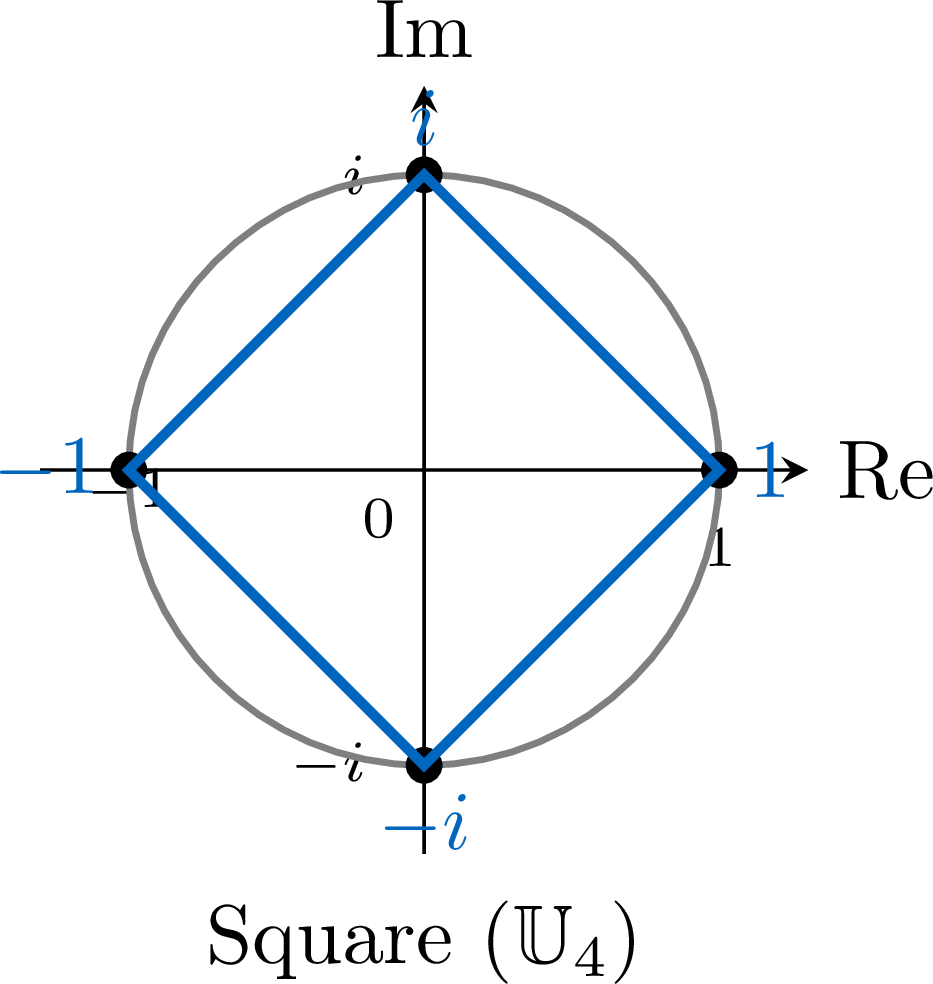
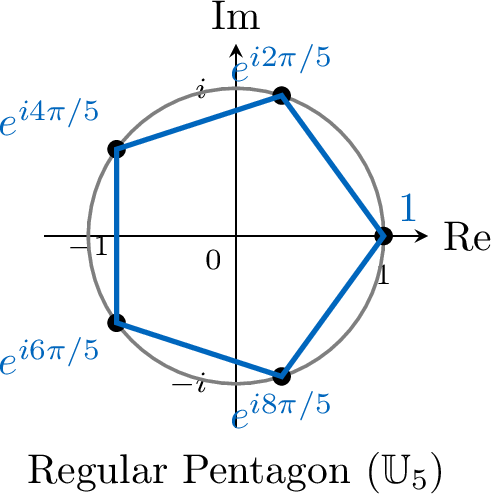
For any integer \(n \ge 1\), the set of the \(n\)-th roots of unity is $$\mathbb{U}_n = \left\{ e^{i\frac{2k\pi}{n}} \;|\; k=0, 1, 2, \dots, n-1 \right\}.$$ Geometrically, for \(n \ge 3\), the points representing the \(n\)-th roots of unity form the vertices of a regular \(n\)-sided polygon inscribed in the unit circle, with one vertex at the point \(1\). 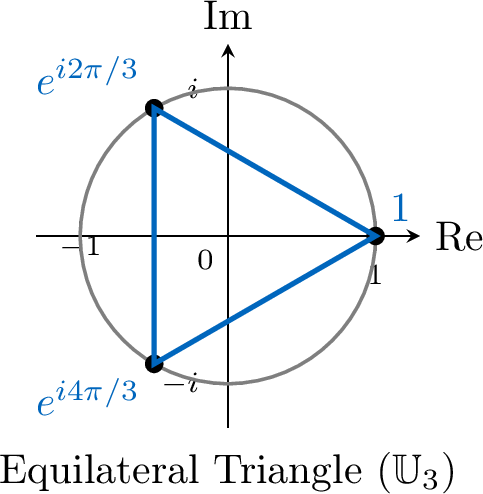
Let \(n \ge 1\) be an integer.
- An \(n\)-th root of unity has modulus \(1\). If \(z^n = 1\), then \(|z|^n = |z^n| = 1\) (modulus of a power). The real number \(|z| \ge 0\) therefore satisfies \(|z|^n = 1\). If \(0 \le |z| < 1\), then \(|z|^n < 1\); if \(|z| > 1\), then \(|z|^n > 1\). Hence \(|z| = 1\).
- Solving on the unit circle. So \(z \in \mathbb{U}\), and \(z = e^{i\theta}\) for a real number \(\theta\). Then \(z^n = e^{in\theta}\), and \(1 = e^{i \times 0}\). By equality in polar form (both moduli equal \(1\)): $$z^n = 1 \iff n\theta \equiv 0 \pmod{2\pi} \iff \theta = \frac{2k\pi}{n} \text{ for an integer } k.$$ Conversely, for every integer \(k\), \(\left(e^{i\frac{2k\pi}{n}}\right)^n = e^{i2k\pi} = 1\). Therefore \(\mathbb{U}_n = \left\{e^{i\frac{2k\pi}{n}} \;|\; k \in \mathbb{Z}\right\}\).
- Exactly \(n\) distinct roots. For \(0 \le k' < k \le n-1\), the difference \(\dfrac{2k\pi}{n} - \dfrac{2k'\pi}{n} = \dfrac{2(k-k')\pi}{n}\) lies strictly between \(0\) and \(2\pi\), so it is not a multiple of \(2\pi\): the numbers \(e^{i\frac{2k\pi}{n}}\), \(k = 0, \dots, n-1\), are distinct. Any other integer \(k\) is written \(k = qn + j\) with \(q \in \mathbb{Z}\) and \(0 \le j \le n-1\) (Euclidean division), and $$e^{i\frac{2k\pi}{n}} = e^{i\left(\frac{2j\pi}{n} + 2q\pi\right)} = e^{i\frac{2j\pi}{n}},$$ which is one of these \(n\) numbers.
- The regular polygon. With \(\omega = e^{i\frac{2\pi}{n}}\), the roots are \(1, \omega, \dots, \omega^{n-1}\), and \(\omega^n = 1\). Multiplying by a complex number of modulus \(r\) and argument \(\varphi\) scales by \(r\) and rotates by \(\varphi\); so multiplying by \(\omega\), of modulus \(1\) and argument \(\dfrac{2\pi}{n}\), is the rotation of centre \(O\) and angle \(\dfrac{2\pi}{n}\). It sends each root \(\omega^k\) to the next one \(\omega^{k+1}\), and \(\omega^{n-1}\) to \(\omega^n = 1\). For \(n \ge 3\), this rotation therefore maps the polygon with consecutive vertices \(1, \omega, \dots, \omega^{n-1}\) onto itself, each side onto the next side and each angle onto the next angle: all its sides are equal, with length \(|\omega - 1|\), and all its angles are equal. The polygon is regular.
Proposition — Sum of the Roots of Unity
For any integer \(n \ge 2\), the sum of the \(n\)-th roots of unity is zero: $$\textcolor{colorprop}{1 + \omega + \omega^2 + \dots + \omega^{n-1} = 0, \qquad \text{where } \omega = e^{i\frac{2\pi}{n}}.}$$
Let \(S = 1 + \omega + \omega^2 + \dots + \omega^{n-1}\). Multiplying by \(\omega\) shifts every term one step: $$\begin{aligned}[t] \omega S &= \omega + \omega^2 + \dots + \omega^{n-1} + \omega^n && \\
&= \omega + \omega^2 + \dots + \omega^{n-1} + 1 && \text{(\(\omega^n = 1\))}\\
&= S. \end{aligned}$$ So \((\omega - 1)S = 0\). Since \(n \ge 2\), \(\omega = e^{i2\pi/n} \neq 1\), hence \(S = 0\). Geometrically: the centre of gravity of the \(n\) roots, which are the vertices of a regular polygon when \(n \ge 3\), is the origin.
Method — Studying a Regular Polygon with Roots of Unity
To study a regular polygon with \(n\) sides (\(n \ge 3\)) inscribed in the unit circle, with a vertex at the point \(1\): - Place the vertices at the \(n\)-th roots of unity \(1, \omega, \omega^2, \dots, \omega^{n-1}\), where \(\omega = e^{i\frac{2\pi}{n}}\).
- Compute a side as a modulus: \(\omega^{k+1} - \omega^k = \omega^k(\omega - 1)\) and \(|\omega^k| = 1\), so every side has length \(|\omega - 1|\).
- Compute \(|\omega - 1|\) from the algebraic form, with \(\alpha = \dfrac{2\pi}{n}\): $$\begin{aligned}[t] |e^{i\alpha} - 1|^2 &= (\cos\alpha - 1)^2 + \sin^2\alpha &&\\ &= 2 - 2\cos\alpha && \text{(\(\cos^2\alpha + \sin^2\alpha = 1\))}\\ &= 4\sin^2\frac{\alpha}{2}, && \text{(double angle formula)} \end{aligned}$$ so the side is \(2\sin\dfrac{\pi}{n}\), since \(\sin\dfrac{\pi}{n} > 0\).
- For a regular polygon inscribed in the circle of radius \(R\) centred at the origin, with a vertex at the point \(R\), the vertices are \(R\,\omega^k\): every length is multiplied by \(R\).
Example
A regular octagon is inscribed in the unit circle, with a vertex at the point \(1\). Give the affixes of its vertices in algebraic form, then the exact length of its side.
The vertices are the 8th roots of unity \(\omega^k = e^{i\frac{k\pi}{4}}\), \(k = 0, \dots, 7\), with \(\omega = e^{i\frac{\pi}{4}} = \dfrac{\sqrt{2}}{2} + i\dfrac{\sqrt{2}}{2}\): $$1,\quad \frac{\sqrt{2}}{2} + i\frac{\sqrt{2}}{2},\quad i,\quad -\frac{\sqrt{2}}{2} + i\frac{\sqrt{2}}{2},\quad -1,\quad -\frac{\sqrt{2}}{2} - i\frac{\sqrt{2}}{2},\quad -i,\quad \frac{\sqrt{2}}{2} - i\frac{\sqrt{2}}{2}.$$ Every side has length \(|\omega - 1|\): $$\begin{aligned}[t] |\omega - 1|^2 &= \left(\frac{\sqrt{2}}{2} - 1\right)^2 + \left(\frac{\sqrt{2}}{2}\right)^2 &&\\
&= \frac{1}{2} - \sqrt{2} + 1 + \frac{1}{2} && \text{(\((x-y)^2 = x^2 - 2xy + y^2\))}\\
&= 2 - \sqrt{2}. \end{aligned}$$ The side is \(\sqrt{2 - \sqrt{2}}\), that is \(2\sin\dfrac{\pi}{8}\) by the method (about \(0.77\), and the perimeter \(8\sqrt{2-\sqrt{2}}\) is about \(6.12\), a little less than the circumference \(2\pi\)). 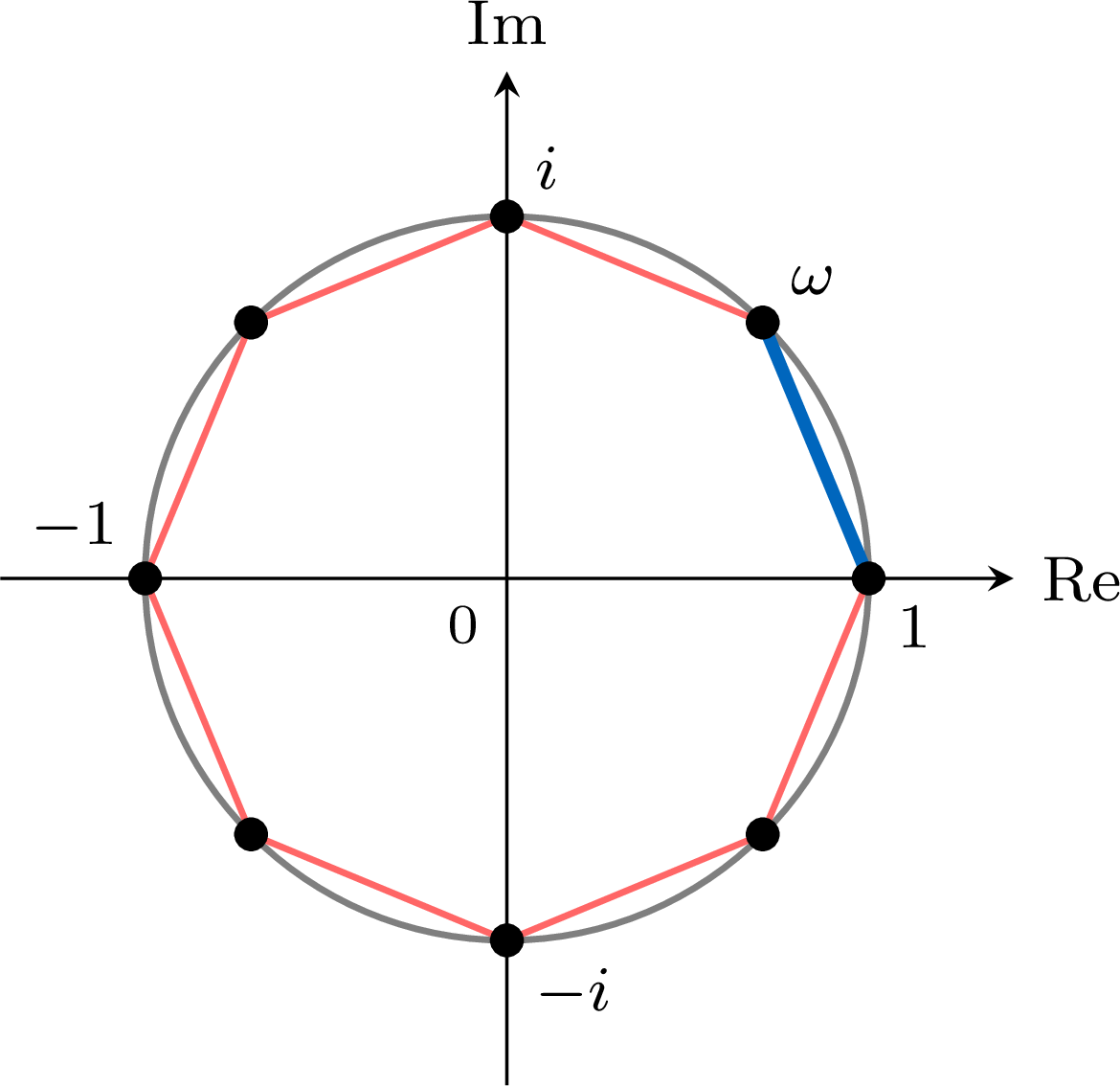
Proposition — Finding n-th Roots
Let \(n \ge 1\) be an integer. A non-zero complex number \(c = \rho e^{i\alpha}\), with \(\rho > 0\), has exactly \(n\) distinct \(n\)-th roots. The roots are the solutions to the equation \(z^n = c\), given by the formula $$ z_k = r e^{i\left(\frac{\alpha + 2k\pi}{n}\right)} \quad \text{for } k = 0, 1, 2, \dots, n-1, $$ where \(r\) is the unique positive real number such that \(r^n = \rho\). Geometrically, for \(n \ge 3\), the roots form the vertices of a regular \(n\)-sided polygon inscribed in a circle of radius \(r\).
We want to solve \(z^n = c\) for \(z\). Let \(z = re^{i\theta}\) and \(c=\rho e^{i\alpha}\): $$\begin{aligned} (re^{i\theta})^n &= \rho e^{i\alpha} \\
r^n e^{in\theta} &= \rho e^{i\alpha}. \end{aligned}$$ For two complex numbers to be equal, their moduli must be equal and their arguments must be coterminal (that is, differ by a multiple of \(2\pi\)).
- Equating moduli: \(r^n = \rho\) with \(r > 0\), so \(r\) is the unique positive real number such that \(r^n = \rho\).
- Equating arguments: \(n\theta = \alpha + 2k\pi \implies \theta = \dfrac{\alpha + 2k\pi}{n}\) for \(k \in \mathbb{Z}\).
Example
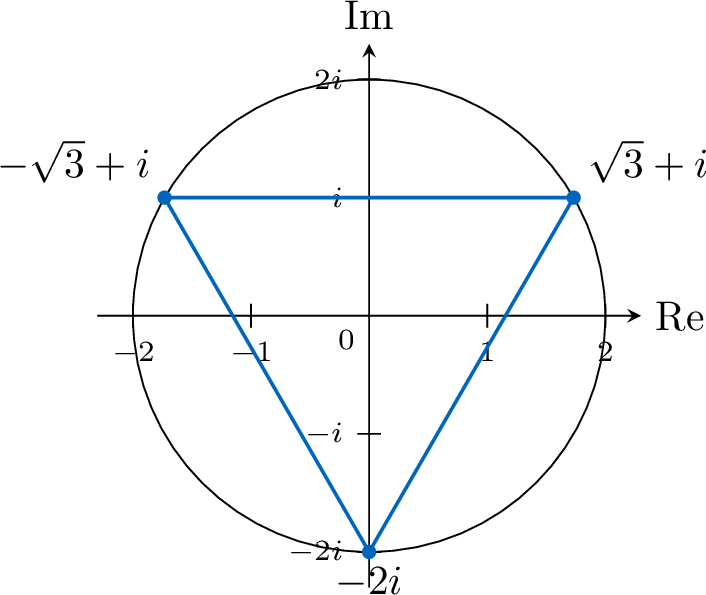
Find the three cube roots of \(c = 8i\). - Step 1: Convert to Euler form.
\(\rho = |8i| = 8\). \(\alpha = \arg(8i) = \frac{\pi}{2}\). So, \(c = 8e^{i\frac{\pi}{2}}\). - Step 2: Apply the root formula.
The modulus of the roots is the real number \(r > 0\) such that \(r^3 = 8\), that is \(r = 2\).
The arguments are \(\phi_k = \frac{\pi/2 + 2k\pi}{3}\) for \(k=0,1,2\). - Step 3: Calculate each root.
\(k=0: z_0 = 2e^{i\frac{\pi}{6}} = \sqrt{3}+i\).
\(k=1: z_1 = 2e^{i\frac{5\pi}{6}} = -\sqrt{3}+i\).
\(k=2: z_2 = 2e^{i\frac{3\pi}{2}} = -2i\).
Skills to practice
- Studying a Regular Polygon with Roots of Unity
- Finding the n-th Roots of a Complex Number
V
Going further
Skills to practice
- Solving Problems without Technology
- Solving Problems with Technology
- Quiz
Jump to section