International Baccalaureate · DP 2: Analysis and Approaches HL
Lines and Planes in Space
I
Equations of Lines
I.1
Vector Equation of a Line
The position of any point on a line can be described by a starting point and a direction of travel. In vector terms, this means that the position vector of any point on the line can be reached by starting with the position vector of a known point and adding a scalar multiple of the line's direction vector. This principle allows us to define a line in both two and three dimensions.
Definition — Vector Equation of a Line
The vector equation of the line is:$$ \textcolor{olive}{\Vect{r}} = \textcolor{colordef}{\Vect{a}} + \textcolor{colorprop}{\lambda\Vect{b}}, \quad \lambda \in \R $$ where \(\Vect{a}\) is the position vector of a point of the line and \(\Vect{b}\) is a direction vector of the line; \(\Vect{r}\) is the position vector of a point of the line, obtained for each value of the parameter \(\lambda\). 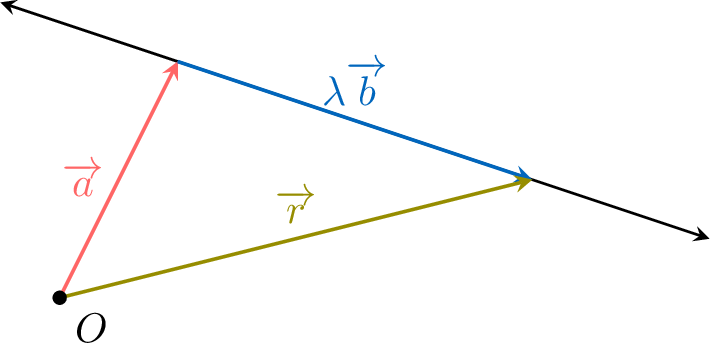
Example
Find the vector equation of the line passing through the point \(A(2, -1)\) with direction vector \(\Vect{b} = \begin{pmatrix} 3 \\ 4 \end{pmatrix}\).
The vector equation is given by \(\Vect{r} = \Vect{a} + \lambda\Vect{b}\). Substituting the point and direction:$$ \Vect{r} = \begin{pmatrix} 2 \\
-1 \end{pmatrix} + \lambda \begin{pmatrix} 3 \\
4 \end{pmatrix}, \quad \lambda \in \R $$ 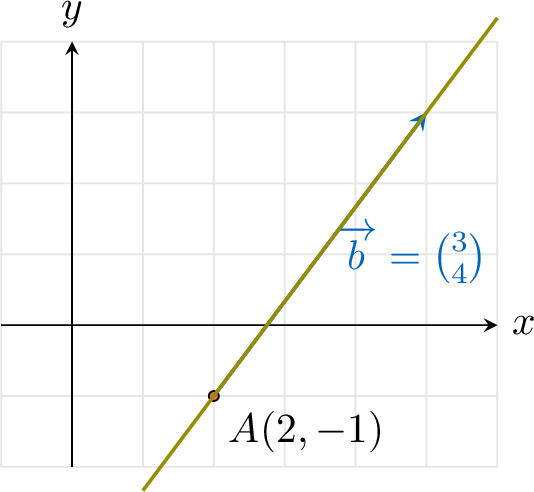
Skills to practice
- Vector Equation of a Line
I.2
Parametric Equations
Definition — Parametric Equations of a Line
The parametric equations of a line passing through a point \(A(a_1, a_2, a_3)\) with direction vector \(\Vect{b} = \begin{pmatrix} b_1 \\ b_2 \\ b_3 \end{pmatrix}\) are given by the system:$$ \begin{cases} x = a_1 + \lambda b_1 \\
y = a_2 + \lambda b_2 \\
z = a_3 + \lambda b_3 \end{cases} $$ where the variable \(\lambda \in \mathbb{R}\) is the parameter. Example
Determine the parametric equations of the line passing through \(A(1, -2, 5)\) and \(B(3, 4, -1)\).
First, calculate the direction vector \(\Vect{AB} = \begin{pmatrix} 3-1 \\ 4-(-2) \\ -1-5 \end{pmatrix} = \begin{pmatrix} 2 \\ 6 \\ -6 \end{pmatrix}\).
Using point \(A(1, -2, 5)\) and the direction vector, the equations are:$$ \begin{cases} x = 1 + 2\lambda \\ y = -2 + 6\lambda \\ z = 5 - 6\lambda \end{cases} $$ 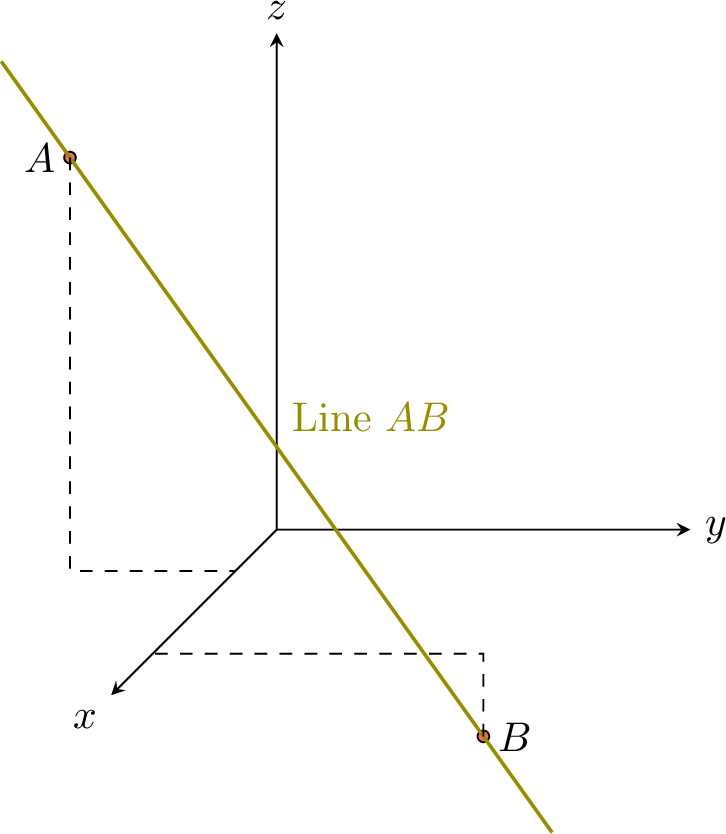
Using point \(A(1, -2, 5)\) and the direction vector, the equations are:$$ \begin{cases} x = 1 + 2\lambda \\ y = -2 + 6\lambda \\ z = 5 - 6\lambda \end{cases} $$
Skills to practice
- Reading Vector and Parametric Equations
- Writing Equations of Lines
I.3
Cartesian Equations of a Line
In two dimensions, a line can also be defined by a normal vector. Let \(\Vect{n}\) be a normal vector to the line's direction, so that \(\Vect{b} \cdot \Vect{n} = 0\). Starting from the vector equation \(\Vect{r} = \Vect{a} + \lambda\Vect{b}\), we take the scalar product of both sides with the normal vector \(\Vect{n}\):$$ \begin{aligned} \Vect{r}\cdot \Vect{n} &= (\lambda\Vect{b}+\Vect{a} ) \cdot \Vect{n} \\
\Vect{r}\cdot \Vect{n} &= \lambda\Vect{b}\cdot \Vect{n}+\Vect{a} \cdot \Vect{n}&&\text{(distributivity)} \\
\Vect{r}\cdot \Vect{n} &= \Vect{a} \cdot \Vect{n}&&(\Vect{b} \cdot \Vect{n} = 0) \\
\end{aligned} $$ If we let \(\Vect{r} = \begin{pmatrix} x \\ y \end{pmatrix}\) and the normal vector \(\Vect{n} = \begin{pmatrix} a \\ b \end{pmatrix}\), the expression \(\Vect{r} \cdot \Vect{n}\) becomes \(ax+by\). The term \(\Vect{a} \cdot \Vect{n}\) is a constant, which we can call \(C\). This leads to the familiar Cartesian form.
Definition — Cartesian Equation of a Line in 2D
The Cartesian equation of a line in 2D with normal vector \(\Vect{n} = \begin{pmatrix} a \\ b \end{pmatrix} \neq \Vect{0}\) is given by:$$ ax + by = C $$ where \(C\) is a constant. Moving the constant to the left-hand side gives the equivalent form \(ax + by + c = 0\), with \(c = -C\). 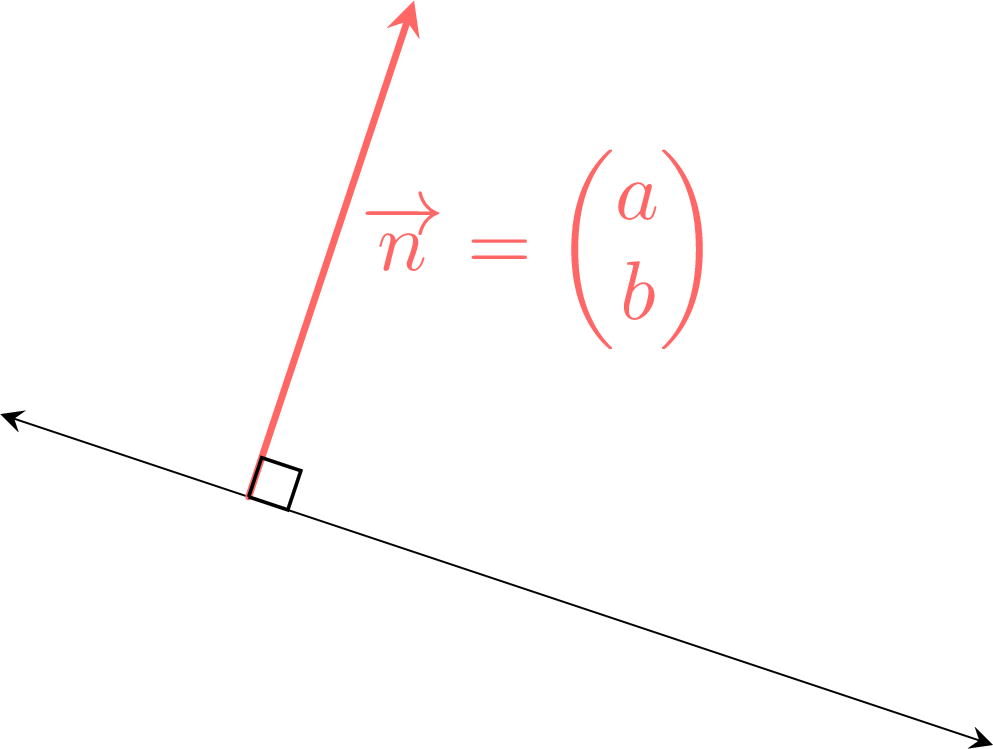
Example
Find the Cartesian equation of the line passing through point \(P(1, 4)\) with normal vector \(\Vect{n} = \begin{pmatrix} 2 \\ -5 \end{pmatrix}\).
The equation is of the form \(2x - 5y = C\). Using point \(P(1,4)\) to find \(C\):$$ 2(1) - 5(4) = C \implies 2 - 20 = C \implies C = -18 $$ The Cartesian equation is \(2x - 5y = -18\). 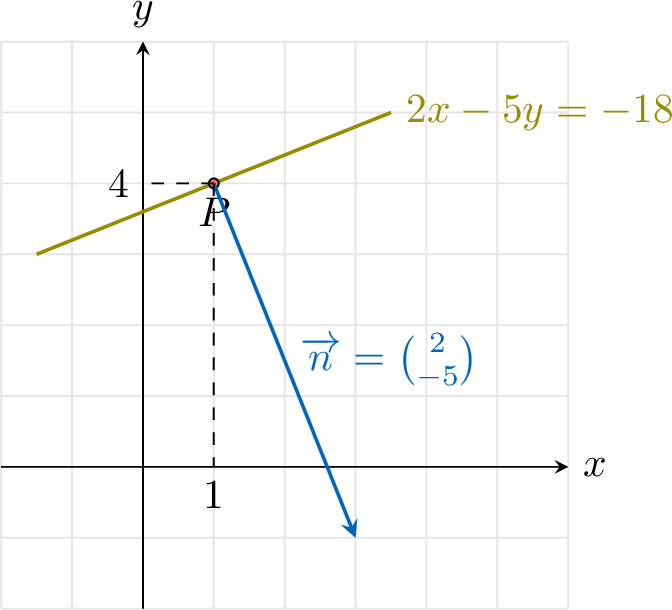
One Equation Is Not Enough
In the plane, a line has one Cartesian equation \(ax + by = C\). In space, a line is still a point and a direction, but one first-degree equation in \(x\), \(y\) and \(z\) is not enough to describe it: the line needs two equations. They come from the parametric equations $$\begin{cases} x = x_0 + \lambda l \\
y = y_0 + \lambda m \\
z = z_0 + \lambda n \end{cases}, \quad \lambda \in \mathbb{R},$$ by eliminating the parameter. When \(l\), \(m\) and \(n\) are all non-zero, each equation gives the value of \(\lambda\): $$\lambda = \frac{x - x_0}{l}, \qquad \lambda = \frac{y - y_0}{m}, \qquad \lambda = \frac{z - z_0}{n}.$$ A point \((x, y, z)\) lies on the line exactly when one and the same \(\lambda\) gives its three coordinates, that is when the three quotients are equal.
Definition — Cartesian Equations of a Line in Space
Let \(d\) be the line through \(A(x_0, y_0, z_0)\) with direction vector \(\Vect{b} = \begin{pmatrix} l \\ m \\ n \end{pmatrix}\), where \(l\), \(m\) and \(n\) are non-zero. The double equality $$\frac{x - x_0}{l} = \frac{y - y_0}{m} = \frac{z - z_0}{n}$$ gives the Cartesian equations of \(d\): a point \(M(x, y, z)\) lies on \(d\) exactly when its coordinates satisfy both equalities.When a component of \(\Vect{b}\) is zero, the matching coordinate is constant on the line, and it is written as a separate equation instead of a quotient:
- if \(m = 0\) (and \(l, n \neq 0\)): \(\dfrac{x - x_0}{l} = \dfrac{z - z_0}{n}\) and \(y = y_0\);
- if \(l = m = 0\) (and \(n \neq 0\)): \(x = x_0\) and \(y = y_0\), the coordinate \(z\) being free.
Method — Reading and Writing Cartesian Equations
- Put each quotient in the form \(\dfrac{x - x_0}{l}\): the coefficient of \(x\), \(y\) or \(z\) in the numerator must be \(1\). Multiply the numerator and the denominator by \(-1\), or divide them by the same number: \(\dfrac{3 - y}{2} = \dfrac{y - 3}{-2}\) and \(\dfrac{2z + 1}{4} = \dfrac{z + \frac{1}{2}}{2}\).
- Read a point: \((x_0, y_0, z_0)\) are the numbers subtracted from \(x\), \(y\) and \(z\); so \(x + 1 = x - (-1)\) gives \(x_0 = -1\).
- Read a direction vector: the denominators \((l, m, n)\); a coordinate given by a separate equation such as \(y = y_0\) has direction component \(0\).
- Conversely, from a point and a direction vector, write the quotients directly; from parametric equations, solve each one for the parameter — an equation that does not contain the parameter is a constant coordinate, written apart.
Example
Find Cartesian equations of the line through the points \(A(2, -1, 3)\) and \(B(5, 1, -1)\).
A direction vector of the line is $$\begin{aligned}[t] \Vect{AB} &= \begin{pmatrix} 5 - 2 \\
1 - (-1) \\
-1 - 3 \end{pmatrix} && \text{(coordinates of a vector from two points)}\\
&= \begin{pmatrix} 3 \\
2 \\
-4 \end{pmatrix}. \end{aligned}$$ No component is zero. With the point \(A(2, -1, 3)\), the Cartesian equations are $$\frac{x - 2}{3} = \frac{y + 1}{2} = \frac{z - 3}{-4}.$$ Check with \(B\): \(\frac{5 - 2}{3} = 1\), \(\frac{1 + 1}{2} = 1\) and \(\frac{-1 - 3}{-4} = 1\): the three quotients are equal, so \(B\) lies on the line (it is the point of parameter \(\lambda = 1\)).
Example
The line \(d\) has Cartesian equations $$\frac{x + 1}{2} = \frac{3 - y}{4} = \frac{2z - 4}{6}.$$ Find a point and a direction vector of \(d\), write a vector equation of \(d\), and decide whether the point \(P(3, -5, 8)\) lies on \(d\).
The second and third quotients do not have the form \(\frac{y - y_0}{m}\) and \(\frac{z - z_0}{n}\) yet: $$\frac{3 - y}{4} = \frac{y - 3}{-4} \quad \text{(both terms multiplied by } -1\text{)}, \qquad \frac{2z - 4}{6} = \frac{z - 2}{3} \quad \text{(both terms divided by } 2\text{)}.$$ So \(d\) has the equations \(\dfrac{x - (-1)}{2} = \dfrac{y - 3}{-4} = \dfrac{z - 2}{3}\): it passes through \(\mathbf{(-1, 3, 2)}\) with direction vector \(\begin{pmatrix} 2 \\ -4 \\ 3 \end{pmatrix}\), and a vector equation is $$\Vect{r} = \begin{pmatrix} -1 \\
3 \\
2 \end{pmatrix} + \lambda \begin{pmatrix} 2 \\
-4 \\
3 \end{pmatrix}, \quad \lambda \in \mathbb{R}.$$ Reading the numbers as they appear would give the wrong point \((1, -3, 4)\) and the wrong direction \((2, 4, 6)\).
For \(P(3, -5, 8)\): \(\frac{3 + 1}{2} = 2\), \(\frac{3 - (-5)}{4} = 2\) and \(\frac{2 \times 8 - 4}{6} = 2\). The three quotients are equal, so \(P\) lies on \(d\); it is the point of parameter \(\lambda = 2\), since \((-1 + 4, 3 - 8, 2 + 6) = (3, -5, 8)\).
For \(P(3, -5, 8)\): \(\frac{3 + 1}{2} = 2\), \(\frac{3 - (-5)}{4} = 2\) and \(\frac{2 \times 8 - 4}{6} = 2\). The three quotients are equal, so \(P\) lies on \(d\); it is the point of parameter \(\lambda = 2\), since \((-1 + 4, 3 - 8, 2 + 6) = (3, -5, 8)\).
Example
Write Cartesian equations of the line \(d: \Vect{r} = \begin{pmatrix} 4 \\ -2 \\ 1 \end{pmatrix} + \lambda \begin{pmatrix} 3 \\ 0 \\ -2 \end{pmatrix}\).
The parametric equations are \(x = 4 + 3\lambda\), \(y = -2\), \(z = 1 - 2\lambda\). The second component of the direction vector is \(0\): the coordinate \(y\) does not depend on \(\lambda\), it is constant, \(y = -2\). The other two equations give \(\lambda = \frac{x - 4}{3}\) and \(\lambda = \frac{z - 1}{-2}\). The Cartesian equations of \(d\) are $$\frac{x - 4}{3} = \frac{z - 1}{-2} \qquad \text{and} \qquad y = -2.$$ Writing \(\frac{y + 2}{0}\) would divide by zero: the constant coordinate always gets its own equation.
Skills to practice
- Reading Cartesian Equations of a Line
- Writing Cartesian Equations of a Line
II
Distances, Intersections and Angles Between Lines
II.1
Shortest Distance from a Point to a Line
When calculating the shortest distance from a point \(P\) to a line, we are looking for the perpendicular distance.
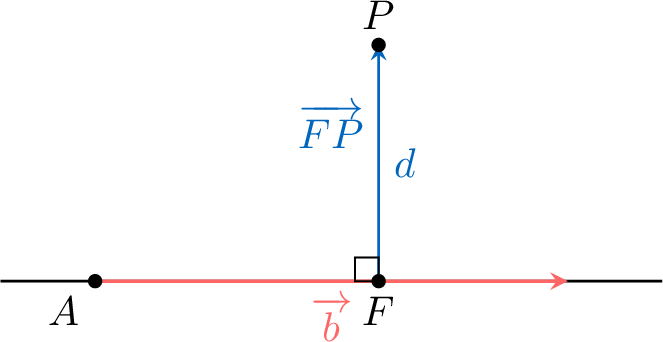
- In 2D, we can find the foot of the perpendicular \(F\) on the line such that \(\Vect{PF} \cdot \Vect{b} = 0\), where \(\Vect{b}\) is the direction vector of the line. The distance is then the magnitude \(\lVert \Vect{PF} \rVert\).
- In 3D, vector methods involving the cross product are most efficient.
Method — Distance from a Point to a Line in 2D
To find the shortest distance from a point \(P\) to a line passing through \(A\) with direction vector \(\Vect{b}\): - Let \(F\) be a generic point on the line: \(\Vect{f} = \Vect{a} + \lambda \Vect{b}\).
- The vector \(\Vect{PF}\) is perpendicular to the line, so \(\Vect{PF} \cdot \Vect{b} = 0\).
- Solve for \(\lambda\) to find the coordinates of \(F\).
- The shortest distance is \(d = \lVert \Vect{PF} \rVert\).
Example
Find the shortest distance from \(P(1, 4)\) to the line \(\Vect{r} = \begin{pmatrix} 0 \\ -1 \end{pmatrix} + \lambda \begin{pmatrix} 1 \\ 1 \end{pmatrix}\).
Let \(F\) be the foot of the perpendicular on the line. 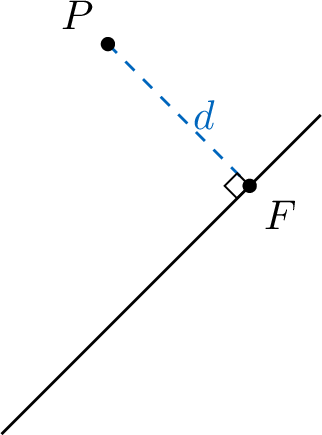
- The coordinates of \(F\) are \((\lambda, -1+\lambda)\).
- The vector \(\Vect{PF} = \begin{pmatrix} \lambda - 1 \\ (-1+\lambda) - 4 \end{pmatrix} = \begin{pmatrix} \lambda - 1 \\ \lambda - 5 \end{pmatrix}\).
- Since \(\Vect{PF} \perp \Vect{b}\), the scalar product is zero: $$ \begin{pmatrix} \lambda - 1 \\ \lambda - 5 \end{pmatrix} \cdot \begin{pmatrix} 1 \\ 1 \end{pmatrix} = 0 $$ $$ (\lambda - 1)(1) + (\lambda - 5)(1) = 0 \implies 2\lambda - 6 = 0 \implies \lambda = 3 $$
- Substitute \(\lambda = 3\) back into \(\Vect{PF}\): \(\Vect{PF} = \begin{pmatrix} 3-1 \\ 3-5 \end{pmatrix} = \begin{pmatrix} 2 \\ -2 \end{pmatrix}\).
- The distance is \(d = \sqrt{2^2 + (-2)^2} = \sqrt{8} = 2\sqrt{2}\).
Proposition — Distance from a Point to a Line in 3D
The shortest distance \(d\) from a point \(P\) to a line passing through point \(A\) with direction vector \(\Vect{b}\) is given by:$$ d = \frac{\left\lVert \Vect{AP} \times \Vect{b} \right\rVert}{\left\lVert \Vect{b} \right\rVert} $$
If \(P\) lies on the line, \(\Vect{AP}\) and \(\Vect{b}\) are parallel, so \(\Vect{AP} \times \Vect{b} = \Vect{0}\) and the formula gives \(d = 0\). Otherwise, let \(B\) be the point such that \(\Vect{AB} = \Vect{b}\) (it lies on the line, and \(B \neq A\) since \(\Vect{b} \neq \Vect{0}\)), and consider the parallelogram built on \(\Vect{AB}\) and \(\Vect{AP}\).
- Its area is \(\left\lVert \Vect{AP} \times \Vect{b} \right\rVert\), the magnitude of the vector product of two of its sides.
- Take its side \([AB]\), of length \(\left\lVert \Vect{b} \right\rVert\), as base. The opposite side passes through \(P\) and is parallel to the line \((AB)\), so the height relative to this base is the distance from \(P\) to the line, that is \(d\).
Example
Find the distance from the point \(P(3, 1, 1)\) to the line passing through \(A(1, 2, 3)\) with direction vector \(\Vect{b} = \begin{pmatrix} 1 \\ 0 \\ -1 \end{pmatrix}\). - First, find \(\Vect{AP} = \begin{pmatrix} 3-1 \\ 1-2 \\ 1-3 \end{pmatrix} = \begin{pmatrix} 2 \\ -1 \\ -2 \end{pmatrix}\).
- Calculate the cross product \(\Vect{AP} \times \Vect{b} = \begin{pmatrix} 2 \\ -1 \\ -2 \end{pmatrix} \times \begin{pmatrix} 1 \\ 0 \\ -1 \end{pmatrix} = \begin{pmatrix} (-1)\cdot (-1)-(-2)\cdot (0) \\ (-2)\cdot (1)-(2)\cdot (-1) \\ (2)\cdot (0)-(-1)\cdot (1) \end{pmatrix} = \begin{pmatrix} 1 \\ 0 \\ 1 \end{pmatrix}\).
- Calculate the magnitude \(\lVert \Vect{AP} \times \Vect{b} \rVert = \sqrt{1^2 + 0^2 + 1^2} = \sqrt{2}\).
- Calculate \(\lVert \Vect{b} \rVert = \sqrt{1^2 + 0^2 + (-1)^2} = \sqrt{2}\).
- The distance is \(d = \frac{\sqrt{2}}{\sqrt{2}} = 1\).
Skills to practice
- Calculating the Shortest Distance from a Point to a Line
II.2
Intersecting Lines
Two Lines and Their Positions
In the plane, two lines are either intersecting (one common point), parallel and distinct (no common point) or coincident (the same line). Space adds a fourth case: two lines that are not parallel and have no common point. No plane contains both of them; they are called skew lines. In the cube below, the edges \(\Segment{AB}\) and \(\Segment{CG}\) are carried by skew lines: they never meet, and they do not have the same direction. 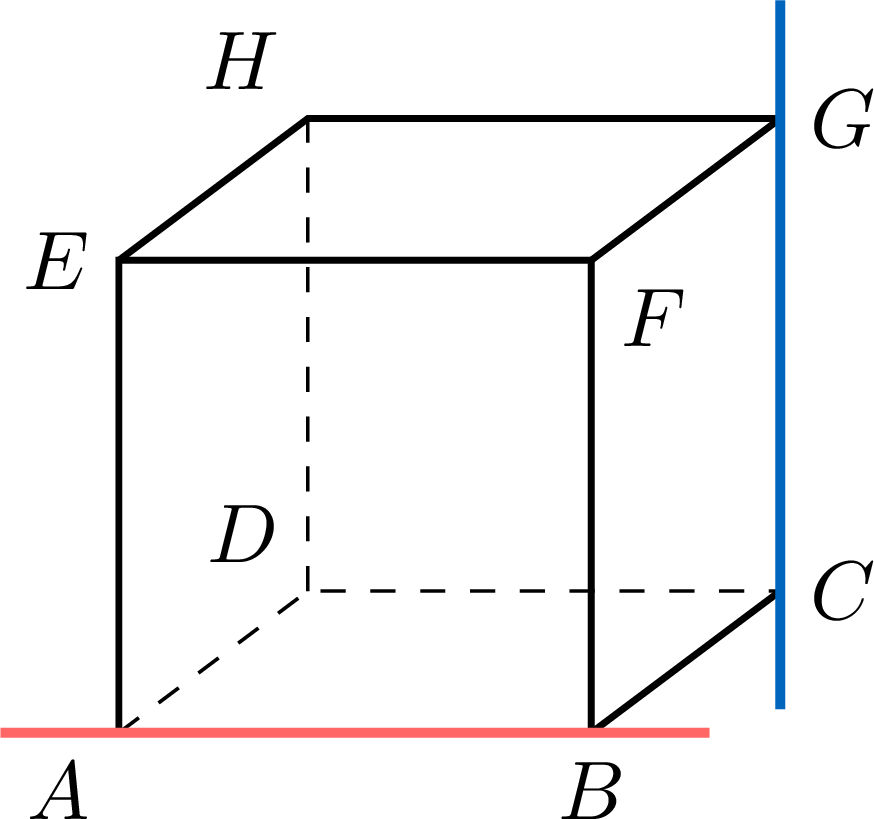
With vector equations, the question “do the lines meet?” becomes a system of equations in the two parameters.
Method — Deciding Whether Two Lines Meet
Let \(d_1: \Vect{r} = \Vect{a}_1 + \lambda\Vect{b}_1\) and \(d_2: \Vect{r} = \Vect{a}_2 + \mu\Vect{b}_2\), with two different parameters: the two points need not be reached for the same value. - Compare the directions. If \(\Vect{b}_2\) is a multiple of \(\Vect{b}_1\), the lines are parallel: they are coincident if the point \(A_2\) lies on \(d_1\), parallel and distinct otherwise.
- Otherwise, equate the coordinates of the two points: \(\Vect{a}_1 + \lambda\Vect{b}_1 = \Vect{a}_2 + \mu\Vect{b}_2\) gives one equation per coordinate, with the two unknowns \(\lambda\) and \(\mu\). Solve two of them that determine \(\lambda\) and \(\mu\) (if a pair gives no single solution, take another pair), by elimination or with the equation solver of a calculator.
- In space, test the third equation with these values. If it holds, the lines meet: the common point is given by \(\lambda\) on \(d_1\), and \(\mu\) on \(d_2\) gives the same point (a check). If it fails, the lines have no common point: they are skew.
Example
Find the point where the lines \(d_1: \Vect{r} = \begin{pmatrix} 1 \\ 5 \end{pmatrix} + \lambda \begin{pmatrix} 1 \\ -2 \end{pmatrix}\) and \(d_2: \Vect{r} = \begin{pmatrix} 1 \\ -2 \end{pmatrix} + \mu \begin{pmatrix} 2 \\ 3 \end{pmatrix}\) meet.
The direction vectors \(\begin{pmatrix} 1 \\ -2 \end{pmatrix}\) and \(\begin{pmatrix} 2 \\ 3 \end{pmatrix}\) are not multiples of each other (the first components would need the factor \(2\), the second ones the factor \(-\frac{3}{2}\)): the lines are not parallel, so they meet. A common point satisfies $$\begin{cases} 1 + \lambda = 1 + 2\mu & (1) \\
5 - 2\lambda = -2 + 3\mu & (2) \end{cases}$$ Equation (1) gives \(\lambda = 2\mu\). Substituting in (2): $$\begin{aligned}[t] 5 - 4\mu &= -2 + 3\mu && \text{(substitution of } \lambda = 2\mu\text{)}\\
7 &= 7\mu, \end{aligned}$$ so \(\mu = 1\) and \(\lambda = 2\). On \(d_1\), \(\lambda = 2\) gives the point \((1 + 2, 5 - 4) = \mathbf{(3, 1)}\). Check on \(d_2\) with \(\mu = 1\): \((1 + 2, -2 + 3) = (3, 1)\).
Example
Show that the lines \(d_1: \Vect{r} = \begin{pmatrix} 1 \\ 0 \\ 1 \end{pmatrix} + \lambda \begin{pmatrix} 2 \\ -1 \\ 3 \end{pmatrix}\) and \(d_2: \Vect{r} = \begin{pmatrix} 5 \\ 3 \\ 2 \end{pmatrix} + \mu \begin{pmatrix} 1 \\ 2 \\ -1 \end{pmatrix}\) meet, and find their common point.
The direction vectors are not multiples of each other (\(2 = 2 \times 1\) but \(-1 \neq 2 \times 2\)): the lines are not parallel. A common point satisfies $$\begin{cases} 1 + 2\lambda = 5 + \mu & (1) \\
-\lambda = 3 + 2\mu & (2) \\
1 + 3\lambda = 2 - \mu & (3) \end{cases}$$ Equation (1) gives \(\mu = 2\lambda - 4\). Substituting in (2): $$\begin{aligned}[t] -\lambda &= 3 + 2(2\lambda - 4) && \text{(substitution)}\\
-\lambda &= 4\lambda - 5\\
\lambda &= 1, \end{aligned}$$ and then \(\mu = 2 - 4 = -2\). Equation (3) with these values: \(1 + 3 \times 1 = 4\) and \(2 - (-2) = 4\). It holds, so the lines meet. On \(d_1\), \(\lambda = 1\) gives the point \((1 + 2, 0 - 1, 1 + 3) = \mathbf{(3, -1, 4)}\). Check on \(d_2\) with \(\mu = -2\): \((5 - 2, 3 - 4, 2 + 2) = (3, -1, 4)\).
Example
Show that the lines \(d_1: \Vect{r} = \begin{pmatrix} 1 \\ 0 \\ -2 \end{pmatrix} + \lambda \begin{pmatrix} 1 \\ 1 \\ 2 \end{pmatrix}\) and \(d_2: \Vect{r} = \begin{pmatrix} -1 \\ 2 \\ 3 \end{pmatrix} + \mu \begin{pmatrix} 3 \\ -1 \\ 1 \end{pmatrix}\) are skew.
Two conditions are needed: the lines are not parallel, and they have no common point.
- The direction vectors are not multiples of each other: the first components would need the factor \(3\), the second ones the factor \(-1\). The lines are not parallel.
- A common point would satisfy $$\begin{cases} 1 + \lambda = -1 + 3\mu & (1) \\ \lambda = 2 - \mu & (2) \\ -2 + 2\lambda = 3 + \mu & (3) \end{cases}$$ Substituting (2) in (1): \(3 - \mu = -1 + 3\mu\), so \(\mu = 1\) and \(\lambda = 1\). Equation (3) with these values: \(-2 + 2 = 0\) but \(3 + 1 = 4\), and \(0 \neq 4\). The system has no solution: the lines have no common point.
Skills to practice
- Recognising the Relative Position of Two Lines
- Deciding Whether Two Lines Meet
II.3
Angle Between Two Lines
Two intersecting lines form four angles: two equal acute angles and two equal obtuse angles, or four right angles. The angle between the two lines is the acute or right one, a measure \(\theta\) with \(0^\circ \le \theta \le 90^\circ\); two parallel lines make an angle of \(0^\circ\). Two lines of space that do not meet and are not parallel (skew lines) also have an angle: only their directions count, so it is the angle between two intersecting lines parallel to them.
With direction vectors \(\Vect{b}_1\) and \(\Vect{b}_2\), the angle \(\varphi\) between the vectors lies between \(0^\circ\) and \(180^\circ\) and depends on the direction chosen on each line: replacing \(\Vect{b}_2\) by \(-\Vect{b}_2\) describes the same line but changes \(\varphi\) into \(180^\circ - \varphi\). The angle between the lines is the one of \(\varphi\) and \(180^\circ - \varphi\) that is at most \(90^\circ\). 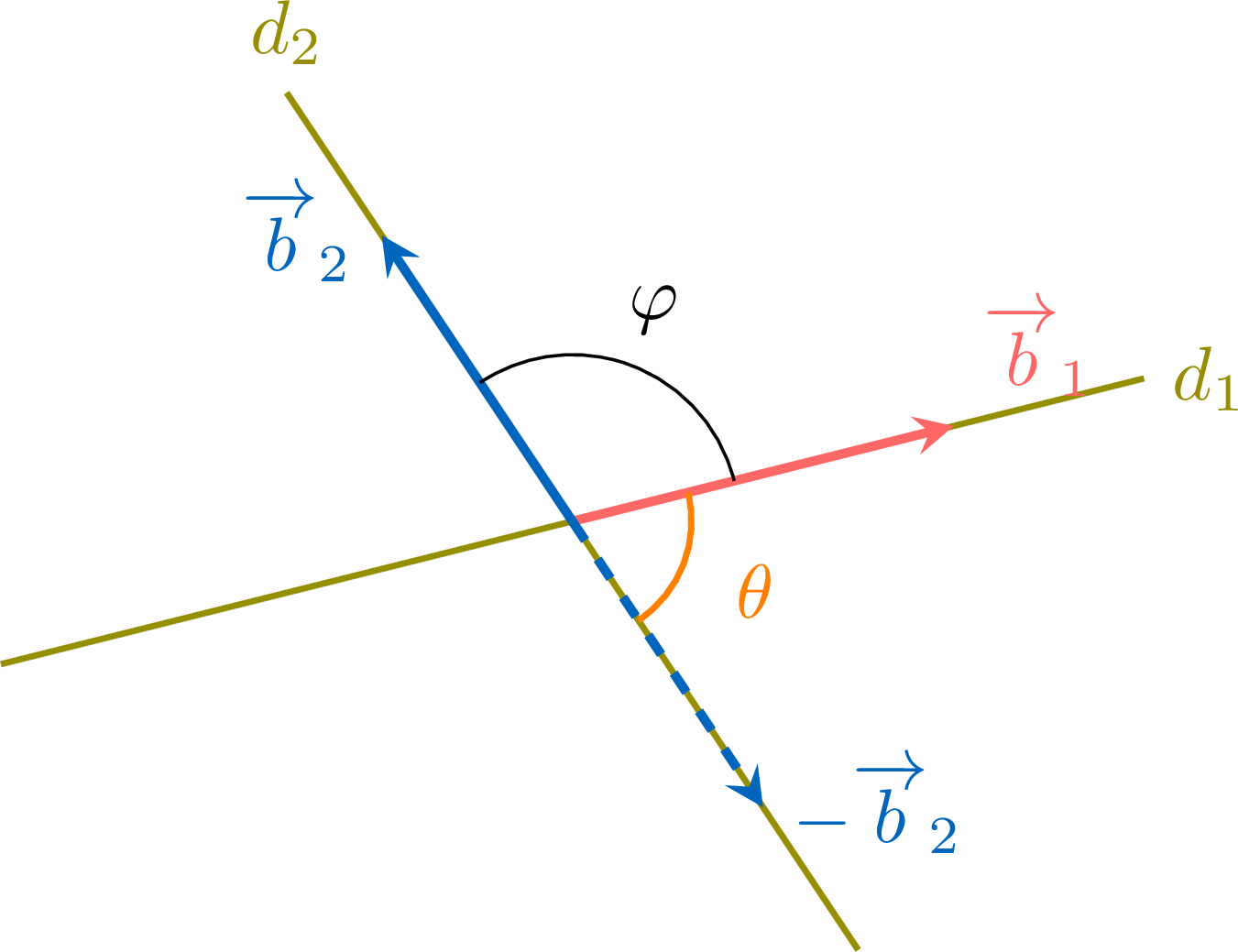
With direction vectors \(\Vect{b}_1\) and \(\Vect{b}_2\), the angle \(\varphi\) between the vectors lies between \(0^\circ\) and \(180^\circ\) and depends on the direction chosen on each line: replacing \(\Vect{b}_2\) by \(-\Vect{b}_2\) describes the same line but changes \(\varphi\) into \(180^\circ - \varphi\). The angle between the lines is the one of \(\varphi\) and \(180^\circ - \varphi\) that is at most \(90^\circ\).
Proposition — Angle Between Two Lines
Let \(d_1\) and \(d_2\) be two lines of the plane or of space, with direction vectors \(\Vect{b}_1\) and \(\Vect{b}_2\) (non-zero, as every direction vector). The angle \(\theta\) between \(d_1\) and \(d_2\), with \(0^\circ \le \theta \le 90^\circ\), is given by $$\cos\theta = \frac{\left|\Vect{b}_1 \cdot \Vect{b}_2\right|}{\left\lVert \Vect{b}_1 \right\rVert \left\lVert \Vect{b}_2 \right\rVert}.$$ In particular, the lines are perpendicular (in space, orthogonal when they do not meet) exactly when \(\Vect{b}_1 \cdot \Vect{b}_2 = 0\).
Let \(\varphi\) be the angle between the vectors \(\Vect{b}_1\) and \(\Vect{b}_2\), with \(0^\circ \le \varphi \le 180^\circ\). By the scalar product, \(\Vect{b}_1 \cdot \Vect{b}_2 = \left\lVert \Vect{b}_1 \right\rVert \left\lVert \Vect{b}_2 \right\rVert \cos\varphi\), and the norms are positive, so $$\cos\varphi = \frac{\Vect{b}_1 \cdot \Vect{b}_2}{\left\lVert \Vect{b}_1 \right\rVert \left\lVert \Vect{b}_2 \right\rVert}.$$ Two cases cover all the possibilities.
- Case 1: \(0^\circ \le \varphi \le 90^\circ\). The angle between the lines is \(\theta = \varphi\), and \(\cos\varphi \ge 0\), so \(\cos\theta = \cos\varphi = |\cos\varphi|\).
- Case 2: \(90^\circ < \varphi \le 180^\circ\). The angle between the lines is \(\theta = 180^\circ - \varphi\), and \(\cos\varphi < 0\), so $$\begin{aligned}[t] \cos\theta &= \cos(180^\circ - \varphi) \\ &= -\cos\varphi && \text{(supplementary angles)}\\ &= |\cos\varphi|. && (\cos\varphi < 0) \end{aligned}$$
Example
Find the angle between the lines \(d_1: \Vect{r} = \begin{pmatrix} 1 \\ 2 \end{pmatrix} + \lambda \begin{pmatrix} 3 \\ 4 \end{pmatrix}\) and \(d_2: \Vect{r} = \begin{pmatrix} 0 \\ 5 \end{pmatrix} + \mu \begin{pmatrix} 5 \\ -12 \end{pmatrix}\), to the nearest \(0.1^\circ\).
The direction vectors are \(\Vect{b}_1 = \begin{pmatrix} 3 \\ 4 \end{pmatrix}\) and \(\Vect{b}_2 = \begin{pmatrix} 5 \\ -12 \end{pmatrix}\), with \(\left\lVert \Vect{b}_1 \right\rVert = \sqrt{3^2 + 4^2} = 5\) and \(\left\lVert \Vect{b}_2 \right\rVert = \sqrt{5^2 + (-12)^2} = 13\). $$\begin{aligned}[t] \Vect{b}_1 \cdot \Vect{b}_2 &= 3 \times 5 + 4 \times (-12) && \text{(scalar product)}\\
&= -33,\\
\cos\theta &= \frac{|-33|}{5 \times 13} && \text{(angle between two lines)}\\
&= \frac{33}{65}, \end{aligned}$$ so \(\theta = \arccos\left(\frac{33}{65}\right) \approx 59.5^\circ\).
The scalar product is negative: the chosen direction vectors make the obtuse angle \(\arccos\left(-\frac{33}{65}\right) \approx 120.5^\circ\), and the absolute value selects its supplement, the angle between the lines.
The scalar product is negative: the chosen direction vectors make the obtuse angle \(\arccos\left(-\frac{33}{65}\right) \approx 120.5^\circ\), and the absolute value selects its supplement, the angle between the lines.
Example
Find the angle between the lines of space $$d_1: \begin{cases} x = 1 + 2t \\
y = -1 + 3t \\
z = 4 + 6t \end{cases} \quad (t \in \mathbb{R}) \qquad\text{and}\qquad d_2: \begin{cases} x = 3 + s \\
y = -2s \\
z = 1 + 2s \end{cases} \quad (s \in \mathbb{R}),$$ to the nearest \(0.1^\circ\).
The coefficients of the parameters give the direction vectors \(\Vect{b}_1 = \begin{pmatrix} 2 \\ 3 \\ 6 \end{pmatrix}\) and \(\Vect{b}_2 = \begin{pmatrix} 1 \\ -2 \\ 2 \end{pmatrix}\), with \(\left\lVert \Vect{b}_1 \right\rVert = \sqrt{4 + 9 + 36} = 7\) and \(\left\lVert \Vect{b}_2 \right\rVert = \sqrt{1 + 4 + 4} = 3\). $$\begin{aligned}[t] \Vect{b}_1 \cdot \Vect{b}_2 &= 2 \times 1 + 3 \times (-2) + 6 \times 2 && \text{(scalar product)}\\
&= 8,\\
\cos\theta &= \frac{|8|}{7 \times 3} && \text{(angle between two lines)}\\
&= \frac{8}{21}, \end{aligned}$$ so \(\theta = \arccos\left(\frac{8}{21}\right) \approx 67.6^\circ\). Here the scalar product is positive: the direction vectors already make an acute angle, and the absolute value changes nothing.
Skills to practice
- Calculating the Angle Between Two Lines
- Solving Problems with the Angle Between Two Lines
III
Planes
III.1
Vector Equation and Normal Vectors of a Plane
Two Directions or One Normal
A plane is fixed by a point and two directions that are not parallel, or by a point and a normal vector. The first description gives every point of the plane, one for each pair of real numbers; the second gives a single equation that every point satisfies. The vector product turns the first description into the second: \(\Vect{b} \times \Vect{c}\) is perpendicular to both \(\Vect{b}\) and \(\Vect{c}\), so it is perpendicular to the plane they span.
Definition — Vector Equation of a Plane
Let \(\mathscr{P}\) be the plane through the point \(A\), with position vector \(\Vect{a}\), containing the directions of two vectors \(\Vect{b}\) and \(\Vect{c}\) that are not parallel. A point \(R\) with position vector \(\Vect{r}\) lies on \(\mathscr{P}\) exactly when $$\Vect{r} = \Vect{a} + \lambda\Vect{b} + \mu\Vect{c} \qquad \text{for some real numbers } \lambda \text{ and } \mu.$$ This is the vector equation of the plane. This plane is also written \(\mathscr{P}(A, \Vect{b}, \Vect{c})\): a point and two directions that are not parallel. With \(\Vect{a} =\begin{pmatrix} a_1 \\ a_2 \\ a_3 \end{pmatrix}\), \(\Vect{b} = \begin{pmatrix} b_1 \\ b_2 \\ b_3 \end{pmatrix}\) and \(\Vect{c} = \begin{pmatrix} c_1 \\ c_2 \\ c_3 \end{pmatrix}\), it gives the parametric equations of the plane $$\begin{cases} x = a_1 + \lambda b_1 + \mu c_1 \\
y = a_2 + \lambda b_2 + \mu c_2 \\
z = a_3 + \lambda b_3 + \mu c_3 \end{cases}, \qquad \lambda, \mu \in \mathbb{R}.$$ Definition — Normal Vector
Given a plane \(\mathscr{P}\) defined by a point \(A\) and two non-collinear direction vectors \(\Vect{u}\) and \(\Vect{v}\), a non-zero vector \(\Vect{n}\) is said to be normal to the plane if it is orthogonal to both \(\Vect{u}\) and \(\Vect{v}\). 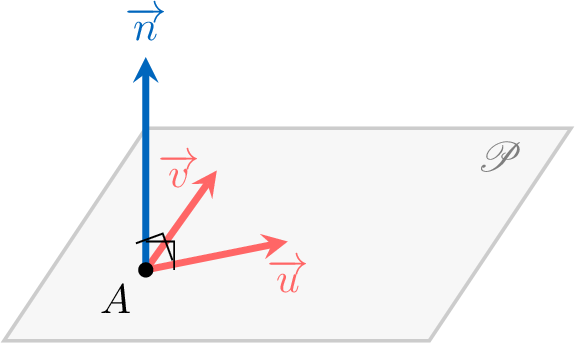
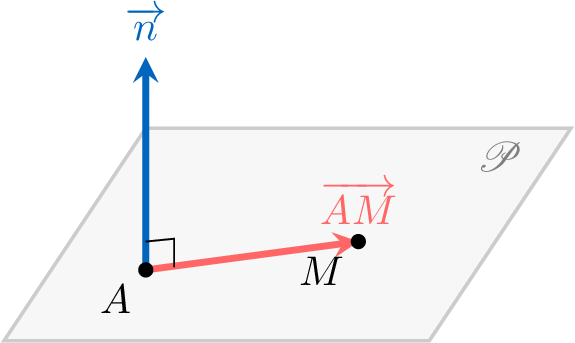
Proposition — The Plane Through a Point Normal to a Vector
Let \(A\) be a point and \(\Vect{n}\) a non-zero vector. The set of the points \(M\) such that \(\Vect{AM} \cdot \Vect{n} = 0\) is a plane: the plane passing through \(A\) with normal vector \(\Vect{n}\). It is the only plane through \(A\) normal to \(\Vect{n}\).
In an orthonormal basis, \(\Vect{n}(a, b, c)\) with, say, \(a \neq 0\) — one coordinate at least is not zero, and the axes can be renamed so that it is the first. For a point \(M\), write \(\Vect{AM}(X, Y, Z)\). The condition \(\Vect{AM} \cdot \Vect{n} = 0\) reads \(aX + bY + cZ = 0\), that is \(X = -\dfrac{b}{a}Y - \dfrac{c}{a}Z\). Setting \(Y = as\) and \(Z = at\), the solutions are exactly the vectors $$\Vect{AM} = s\,(-b, a, 0) + t\,(-c, 0, a) = s\Vect{u} + t\Vect{v}, \qquad s, t \in \mathbb{R},$$ with \(\Vect{u}(-b, a, 0)\) and \(\Vect{v}(-c, 0, a)\), which are not collinear since \(a \neq 0\). So the set is the plane \(\mathscr{P}(A, \Vect{u}, \Vect{v})\); and \(\Vect{n}\) is normal to it, since \(\Vect{n} \cdot \Vect{u} = -ab + ab = 0\) and \(\Vect{n} \cdot \Vect{v} = -ac + ac = 0\). Conversely, every point \(M\) of a plane through \(A\) with normal vector \(\Vect{n}\) satisfies \(\Vect{AM} \cdot \Vect{n} = 0\): such a plane is contained in \(\mathscr{P}(A, \Vect{u}, \Vect{v})\), and a plane contained in a plane is equal to it. The plane is unique.
Example
In an orthonormal basis, \(\Vect{u}(1, 0, 1)\) and \(\Vect{v}(0, 1, -1)\). Determine a normal vector to the plane \(\mathscr{P}(A, \Vect{u}, \Vect{v})\).
The vectors \(\Vect{u}\) and \(\Vect{v}\) are not collinear. A non-zero vector \(\Vect{n}(a, b, c)\) is normal to \(\mathscr{P}\) if and only if $$\begin{aligned}\Vect{n} \cdot \Vect{u} = a + c &= 0 &&\text{(coordinates)}\\
\Vect{n} \cdot \Vect{v} = b - c &= 0 &&\text{(coordinates)}\end{aligned}$$ so \(a = -c\) and \(b = c\): the normal vectors are the \(\Vect{n}(-c, c, c)\) with \(c \neq 0\). Taking \(c = 1\), \(\Vect{n}(-1, 1, 1)\) is a normal vector to \(\mathscr{P}\).
Skills to practice
- Determining a Normal Vector to a Plane
III.2
Cartesian Equation of a Plane
Proposition — Cartesian Equation
In an orthonormal coordinate system, the plane passing through point \(A(x_A, y_A, z_A)\) with a normal vector \(\Vect{n}(a, b, c)\) has a Cartesian equation of the form:$$ax + by + cz + d = 0$$ where \((a, b, c) \neq (0, 0, 0)\) and \(d\) is a real constant. 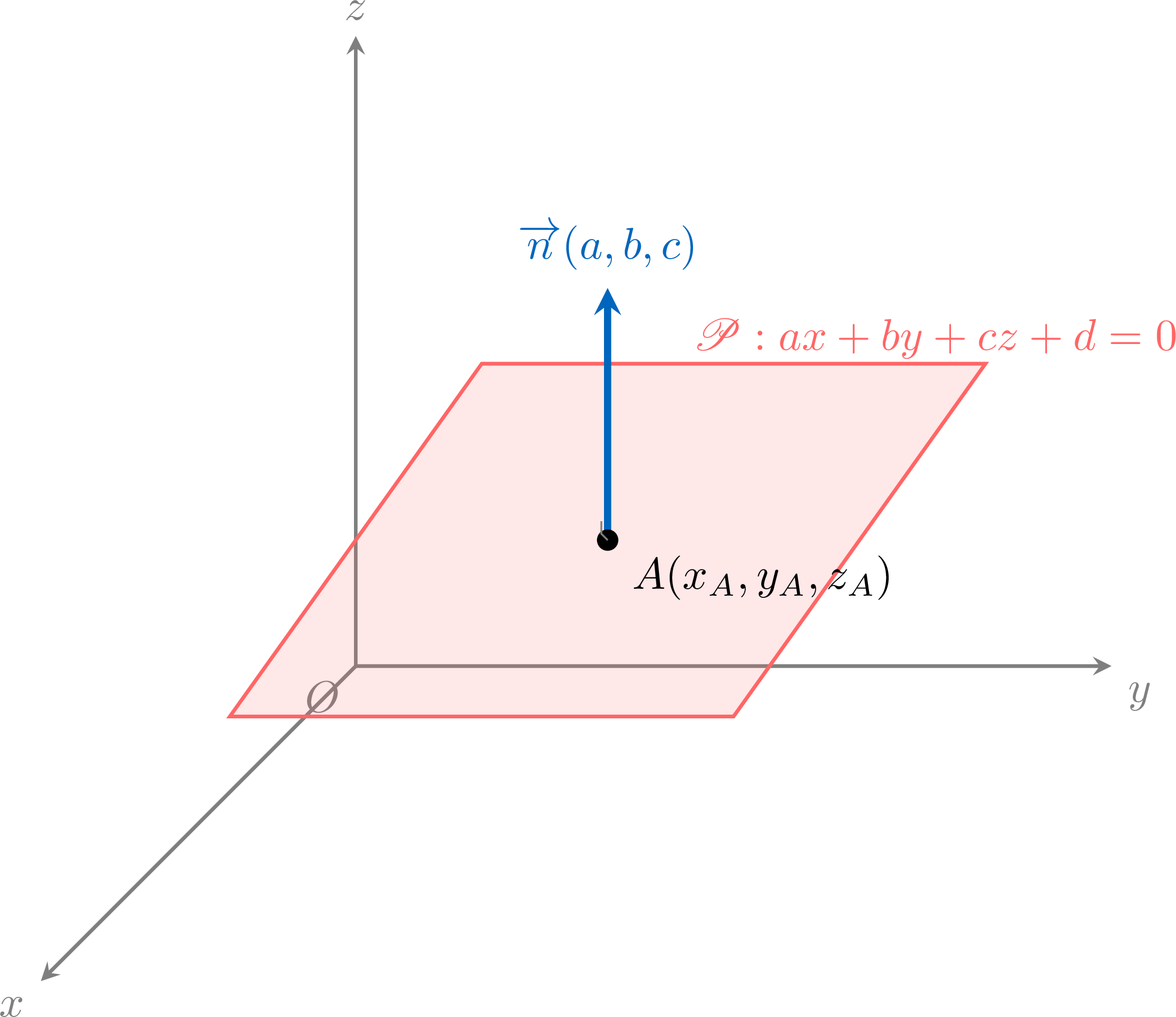
A point \(M(x, y, z)\) belongs to the plane if and only if \(\Vect{AM} \cdot \Vect{n} = 0\).$$ \begin{aligned}\Vect{AM} \cdot \Vect{n} = 0 &\iff a(x - x_A) + b(y - y_A) + c(z - z_A) = 0 \\
&\iff ax + by + cz - (ax_A + by_A + cz_A) = 0\end{aligned} $$ By setting \(d = -(ax_A + by_A + cz_A)\), we obtain the form \(ax + by + cz + d = 0\).
Example
In an orthonormal coordinate system, determine a Cartesian equation of the plane \(\mathscr{P}\) passing through \(A(3, 1, -2)\) with normal vector \(\Vect{n}(1, -2, 2)\), in two ways. - With the form of the equation. The coordinates of \(\Vect{n}\) give the form \(x - 2y + 2z + d = 0\). Since \(A \in \mathscr{P}\): \(3 - 2 - 4 + d = 0\), so \(d = 3\), and \(\mathscr{P} : x - 2y + 2z + 3 = 0\).
- With the scalar product. \(M(x, y, z) \in \mathscr{P} \iff \Vect{AM} \cdot \Vect{n} = 0 \iff (x - 3) - 2(y - 1) + 2(z + 2) = 0 \iff x - 2y + 2z + 3 = 0\).
Proposition — Reading a Cartesian Equation
Let \(a\), \(b\), \(c\), \(d\) be real numbers with \((a, b, c) \neq (0, 0, 0)\). In an orthonormal coordinate system, the set of the points \(M(x, y, z)\) such that \(ax + by + cz + d = 0\) is a plane, and \(\Vect{n}(a, b, c)\) is a normal vector of it. Conversely, every plane has such an equation, and two equations of the same plane are proportional.
One of \(a\), \(b\), \(c\) is not zero, say \(a\): the point \(A\left(-\tfrac{d}{a}, 0, 0\right)\) satisfies the equation, and for every point \(M\), \(ax + by + cz + d = a\left(x + \tfrac{d}{a}\right) + by + cz = \Vect{AM} \cdot \Vect{n}\). The set is therefore \(\{M : \Vect{AM} \cdot \Vect{n} = 0\}\), the plane through \(A\) normal to \(\Vect{n}\). Conversely, a plane has a normal vector \(\Vect{n}(a, b, c)\) and a point \(A\), and the previous proposition gives its equation. Two equations of the same plane have collinear normal vectors, \((a', b', c') = k(a, b, c)\), and the constants then agree: \(d' = kd\), both being computed at a point \(A\) of the plane.
Method — A Line and a Plane Given by Equations
The line \(d\) is given by parametric equations, with direction vector \(\Vect{u}\), and the plane \(\mathscr{P}\) by a Cartesian equation, with normal vector \(\Vect{n}\). - If \(\Vect{u} \cdot \Vect{n} \neq 0\), the line and the plane are intersecting. To find the intersection point, substitute \(x\), \(y\), \(z\) from the parametric equations into the equation of \(\mathscr{P}\): a first-degree equation in the parameter, whose solution gives the point.
- If \(\Vect{u} \cdot \Vect{n} = 0\), the line is parallel to the plane: contained in it if one of its points satisfies the equation, strictly parallel otherwise.
Example
In an orthonormal coordinate system, \(d\) has parametric equations \(x = 2 + t\), \(y = 1 - t\), \(z = 3t\) (\(t \in \mathbb{R}\)) and \(\mathscr{P}\) has equation \(x + y - 2z + 3 = 0\). Show that \(d\) and \(\mathscr{P}\) intersect and determine their intersection point.
A direction vector of \(d\) is \(\Vect{u}(1, -1, 3)\) and a normal vector of \(\mathscr{P}\) is \(\Vect{n}(1, 1, -2)\): \(\Vect{u} \cdot \Vect{n} = 1 - 1 - 6 = -6 \neq 0\), so \(d\) is not parallel to \(\mathscr{P}\): they intersect. Substituting, $$\begin{aligned}(2 + t) + (1 - t) - 2(3t) + 3 &= 0 &&\text{(the point of parameter \(t\) in \(\mathscr{P}\))}\\
6 - 6t &= 0 \quad\text{so}\quad t = 1.\end{aligned}$$ The intersection point is the point of parameter \(1\): \((3, 0, 3)\). Check: \(3 + 0 - 6 + 3 = 0\).
Method — Two Planes Given by Equations
The planes \(\mathscr{P}\) and \(\mathscr{P}'\) have Cartesian equations with normal vectors \(\Vect{n}\) and \(\Vect{n'}\). - If \(\Vect{n}\) and \(\Vect{n'}\) are collinear, the planes are parallel: the same plane if the equations are proportional (equivalently, if a point of one satisfies the equation of the other), strictly parallel otherwise.
- If \(\Vect{n}\) and \(\Vect{n'}\) are not collinear, the planes are intersecting along a line. To describe it, choose one of the unknowns as a parameter — one whose elimination leaves a system in the other two that has a unique solution; for instance, for the planes \(x = 0\) and \(y = 0\), the parameter must be \(z\) — and express the other two from the system of the two equations: this gives parametric equations of the line.
Skills to practice
- Reading a Cartesian Equation of a Plane
- Intersecting a Line and a Plane
III.3
Planes in Vector Form
Proposition — A Normal Vector from the Vector Product
Let \(\mathscr{P}\) be the plane \(\Vect{r} = \Vect{a} + \lambda\Vect{b} + \mu\Vect{c}\), with \(\Vect{b}\) and \(\Vect{c}\) not parallel. Then \(\Vect{n} = \Vect{b} \times \Vect{c}\) is a normal vector of \(\mathscr{P}\), and \(\mathscr{P}\) has the equation $$\Vect{r} \cdot \Vect{n} = \Vect{a} \cdot \Vect{n}.$$ With \(\Vect{n} = \begin{pmatrix} n_1 \\ n_2 \\ n_3 \end{pmatrix}\) and \(\Vect{r} = \begin{pmatrix} x \\ y \\ z \end{pmatrix}\), this is the Cartesian equation \(n_1x + n_2y + n_3z = d\), where \(d = \Vect{a} \cdot \Vect{n}\). Moving the constant to the left-hand side gives \(n_1x + n_2y + n_3z - d = 0\): this is the other usual form \(ax + by + cz + d' = 0\) of a Cartesian equation, whose constant \(d' = -d\) has the opposite sign.
The vector \(\Vect{b} \times \Vect{c}\) is orthogonal to \(\Vect{b}\) and to \(\Vect{c}\), and it is not the zero vector, since \(\Vect{b}\) and \(\Vect{c}\) are not parallel (properties of the vector product). Being orthogonal to two non-parallel vectors of the plane, it is a normal vector of \(\mathscr{P}\).
The plane through \(A\) normal to \(\Vect{n}\) is the set of the points \(R\) such that \(\Vect{AR} \cdot \Vect{n} = 0\). With \(\Vect{AR} = \Vect{r} - \Vect{a}\): $$\begin{aligned}[t] \Vect{AR} \cdot \Vect{n} = 0 &\iff (\Vect{r} - \Vect{a}) \cdot \Vect{n} = 0\\ &\iff \Vect{r} \cdot \Vect{n} - \Vect{a} \cdot \Vect{n} = 0 && \text{(distributivity)}\\ &\iff \Vect{r} \cdot \Vect{n} = \Vect{a} \cdot \Vect{n}. \end{aligned}$$ In coordinates, \(\Vect{r} \cdot \Vect{n} = n_1x + n_2y + n_3z\), which gives the Cartesian equation.
The plane through \(A\) normal to \(\Vect{n}\) is the set of the points \(R\) such that \(\Vect{AR} \cdot \Vect{n} = 0\). With \(\Vect{AR} = \Vect{r} - \Vect{a}\): $$\begin{aligned}[t] \Vect{AR} \cdot \Vect{n} = 0 &\iff (\Vect{r} - \Vect{a}) \cdot \Vect{n} = 0\\ &\iff \Vect{r} \cdot \Vect{n} - \Vect{a} \cdot \Vect{n} = 0 && \text{(distributivity)}\\ &\iff \Vect{r} \cdot \Vect{n} = \Vect{a} \cdot \Vect{n}. \end{aligned}$$ In coordinates, \(\Vect{r} \cdot \Vect{n} = n_1x + n_2y + n_3z\), which gives the Cartesian equation.
Method — The Equations of a Plane Through Three Points
Let \(A\), \(B\) and \(C\) be three points that are not collinear. - Two directions: \(\Vect{b} = \Vect{AB}\) and \(\Vect{c} = \Vect{AC}\), which are not parallel; the vector equation is \(\Vect{r} = \Vect{a} + \lambda\Vect{b} + \mu\Vect{c}\).
- A normal vector: \(\Vect{n} = \Vect{b} \times \Vect{c}\); check \(\Vect{n} \cdot \Vect{b} = 0\) and \(\Vect{n} \cdot \Vect{c} = 0\). A non-zero multiple of \(\Vect{n}\) may replace it.
- The constant: \(d = \Vect{a} \cdot \Vect{n}\), and the Cartesian equation is \(n_1x + n_2y + n_3z = d\).
- Check the equation with \(B\) and \(C\).
Example
Find a vector equation and a Cartesian equation of the plane through the points \(A(1, 0, 2)\), \(B(3, 1, 1)\) and \(C(0, 2, 4)\).
The directions are \(\Vect{b} = \Vect{AB} = \begin{pmatrix} 2 \\ 1 \\ -1 \end{pmatrix}\) and \(\Vect{c} = \Vect{AC} = \begin{pmatrix} -1 \\ 2 \\ 2 \end{pmatrix}\), not parallel (the factor would be \(-2\) for the first components and \(\frac{1}{2}\) for the second ones). A vector equation is $$\Vect{r} = \begin{pmatrix} 1 \\
0 \\
2 \end{pmatrix} + \lambda\begin{pmatrix} 2 \\
1 \\
-1 \end{pmatrix} + \mu\begin{pmatrix} -1 \\
2 \\
2 \end{pmatrix}, \quad \lambda, \mu \in \mathbb{R}.$$ A normal vector is $$\begin{aligned}[t] \Vect{n} = \Vect{b} \times \Vect{c} &= \begin{pmatrix} 1 \times 2 - (-1) \times 2 \\
(-1) \times (-1) - 2 \times 2 \\
2 \times 2 - 1 \times (-1) \end{pmatrix} && \text{(vector product)}\\
&= \begin{pmatrix} 4 \\
-3 \\
5 \end{pmatrix}, \end{aligned}$$ with \(\Vect{n} \cdot \Vect{b} = 8 - 3 - 5 = 0\) and \(\Vect{n} \cdot \Vect{c} = -4 - 6 + 10 = 0\). Then \(d = \Vect{a} \cdot \Vect{n} = 4 + 0 + 10 = 14\), and the Cartesian equation is $$4x - 3y + 5z = 14.$$ Check: \(B\) gives \(12 - 3 + 5 = 14\) and \(C\) gives \(0 - 6 + 20 = 14\).
Proposition — The Line Where Two Planes Meet
Let \(\mathscr{P}_1\) and \(\mathscr{P}_2\) be two planes that are not parallel, with normal vectors \(\Vect{n}_1\) and \(\Vect{n}_2\). They meet along a line with direction vector \(\Vect{n}_1 \times \Vect{n}_2\).
The planes are not parallel, so they meet along a line \(\Delta\), and \(\Vect{n}_1\), \(\Vect{n}_2\) are not parallel. Let \(\Vect{w}\) be a direction vector of \(\Delta\). The line lies in \(\mathscr{P}_1\), so \(\Vect{w} \cdot \Vect{n}_1 = 0\); it lies in \(\mathscr{P}_2\), so \(\Vect{w} \cdot \Vect{n}_2 = 0\). So \(\Vect{w}\) is a normal vector of the plane through the origin with directions \(\Vect{n}_1\) and \(\Vect{n}_2\); by the previous proposition, so is \(\Vect{n}_1 \times \Vect{n}_2\), and two normal vectors of a plane are collinear. Hence \(\Vect{n}_1 \times \Vect{n}_2\), which is not the zero vector, is a direction vector of \(\Delta\).
Example
Find a vector equation of the line where the planes \(\mathscr{P}_1: x + y + z = 6\) and \(\mathscr{P}_2: 2x - y + z = 3\) meet.
The normal vectors \(\Vect{n}_1 = \begin{pmatrix} 1 \\ 1 \\ 1 \end{pmatrix}\) and \(\Vect{n}_2 = \begin{pmatrix} 2 \\ -1 \\ 1 \end{pmatrix}\) are not parallel, so the planes meet along a line, with direction vector $$\Vect{n}_1 \times \Vect{n}_2 = \begin{pmatrix} 1 \times 1 - 1 \times (-1) \\
1 \times 2 - 1 \times 1 \\
1 \times (-1) - 1 \times 2 \end{pmatrix} = \begin{pmatrix} 2 \\
1 \\
-3 \end{pmatrix}.$$ A common point: with \(z = 0\), the equations become \(x + y = 6\) and \(2x - y = 3\); adding them, \(3x = 9\), so \(x = 3\) and \(y = 3\). The point \((3, 3, 0)\) lies on both planes, and the line is $$\Vect{r} = \begin{pmatrix} 3 \\
3 \\
0 \end{pmatrix} + t\begin{pmatrix} 2 \\
1 \\
-3 \end{pmatrix}, \quad t \in \mathbb{R}.$$ Check: \((3 + 2t) + (3 + t) - 3t = 6\) and \(2(3 + 2t) - (3 + t) - 3t = 3\) for every \(t\).
Three Planes
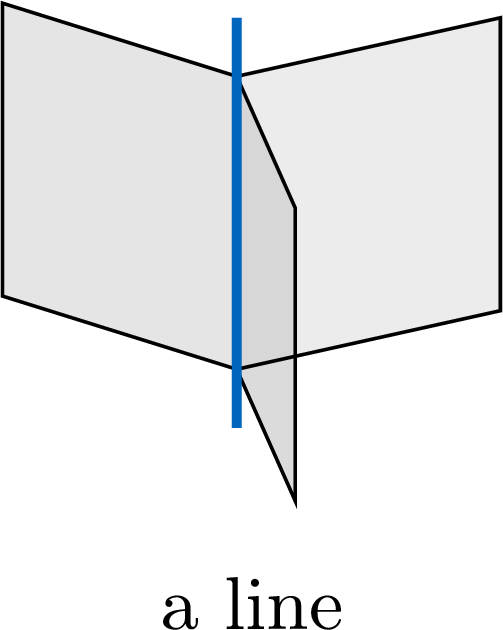
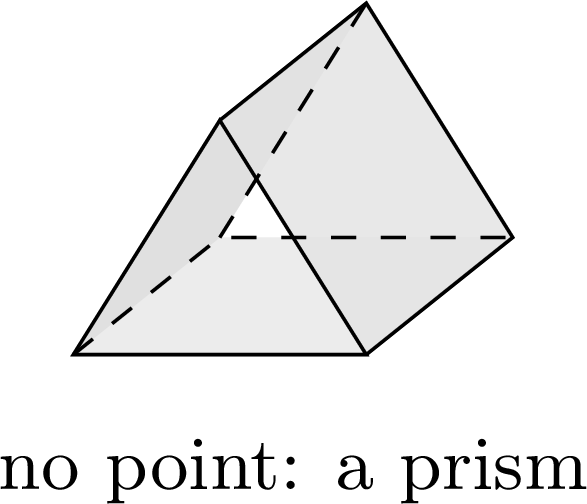
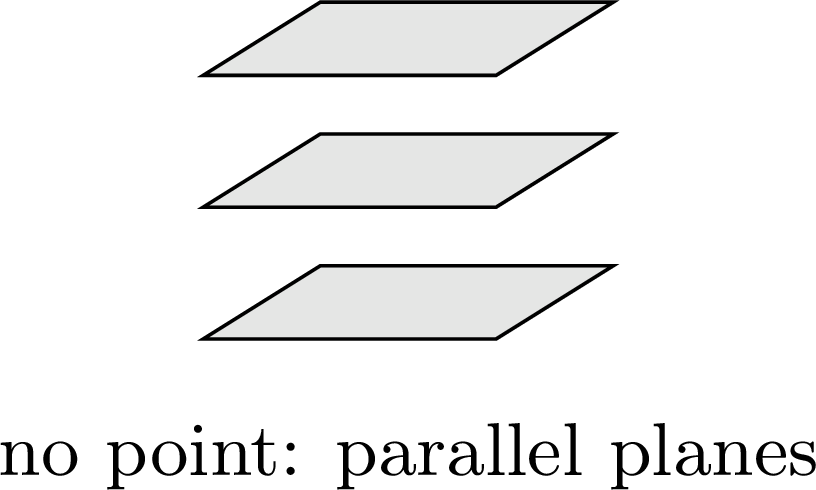
The common points of three planes are the solutions of the system of their three equations. Four configurations occur. 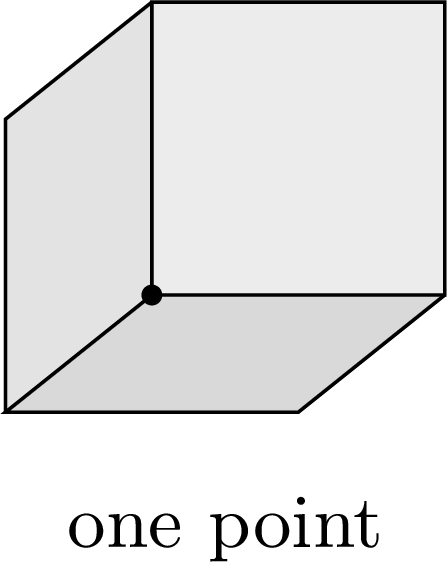
- A single point: the system has a unique solution, as the three faces of a room meet at a corner.
- A line: the system has infinitely many solutions with one parameter; the three planes contain a common line, like the pages of an open book (or two of them coincide and the third cuts them).
- No common point: the system has no solution. Either two of the planes are parallel and distinct, or each pair of planes meets along a line and the three lines are parallel, like the faces of a triangular prism.
- A plane: the three equations describe the same plane.
Method — Intersecting Three Planes
- Solve the system of the three Cartesian equations, by elimination or with the equation solver of a calculator.
- Read the solutions: a unique solution is the single common point; solutions with one parameter give the common line (write it as a vector equation); solutions with two parameters mean that the three equations describe one plane; a contradiction such as \(0 = 4\) means no common point.
- Without a common point, read the normal vectors: two parallel normal vectors mean parallel planes; three normal vectors with no two parallel mean a prism.
Example
Find the common points of the planes \(\mathscr{P}_1: x + y + z = 6\), \(\mathscr{P}_2: 2x - y + z = 3\) and \(\mathscr{P}_3: x + 2y - z = 2\).
Eliminate \(z\) twice: $$\begin{aligned}[t] \mathscr{P}_1 + \mathscr{P}_3:&\quad 2x + 3y = 8,\\
\mathscr{P}_2 + \mathscr{P}_3:&\quad 3x + y = 5. \end{aligned}$$ From the second, \(y = 5 - 3x\); in the first, \(2x + 15 - 9x = 8\), so \(x = 1\) and \(y = 2\); then \(\mathscr{P}_1\) gives \(z = 6 - 1 - 2 = 3\). The system has the unique solution \((1, 2, 3)\): the three planes meet at the single point \(\mathbf{(1, 2, 3)}\). Check in \(\mathscr{P}_2\): \(2 - 2 + 3 = 3\); in \(\mathscr{P}_3\): \(1 + 4 - 3 = 2\).
Example
The planes \(\mathscr{P}_1: x + y + z = 6\) and \(\mathscr{P}_2: 2x - y + z = 3\) are cut by a third plane. Find their common points and describe the configuration when the third plane is - \(\mathscr{P}_3: 3x + 2z = 9\);
- \(\mathscr{Q}_3: 3x + 2z = 5\).
Adding the equations of \(\mathscr{P}_1\) and \(\mathscr{P}_2\) gives \(3x + 2z = 9\): every common point of \(\mathscr{P}_1\) and \(\mathscr{P}_2\) satisfies it.
- The equation of \(\mathscr{P}_3\) is this sum, so it adds no condition: the common points are those of \(\mathscr{P}_1\) and \(\mathscr{P}_2\), the line $$\Vect{r} = \begin{pmatrix} 3 \\ 3 \\ 0 \end{pmatrix} + t\begin{pmatrix} 2 \\ 1 \\ -3 \end{pmatrix}, \quad t \in \mathbb{R}$$ (the intersection of two planes found before). The three planes contain a common line. Check in \(\mathscr{P}_3\): \(3(3 + 2t) + 2(-3t) = 9\).
- A common point would satisfy both \(3x + 2z = 9\) and \(3x + 2z = 5\), that is \(9 = 5\): no common point. The normal vectors \(\begin{pmatrix} 1 \\ 1 \\ 1 \end{pmatrix}\), \(\begin{pmatrix} 2 \\ -1 \\ 1 \end{pmatrix}\) and \(\begin{pmatrix} 3 \\ 0 \\ 2 \end{pmatrix}\) are pairwise not parallel, so each pair of planes meets along a line, with direction \(\Vect{n}_i \times \Vect{n}_j\): here \(\begin{pmatrix} 2 \\ 1 \\ -3 \end{pmatrix}\), \(\begin{pmatrix} 2 \\ 1 \\ -3 \end{pmatrix}\) and \(\begin{pmatrix} -2 \\ -1 \\ 3 \end{pmatrix}\). The three lines are parallel, and distinct since no point is common to the three planes: the planes form a prism.
Skills to practice
- Finding the Equations of a Plane
- Intersecting Two or Three Planes
III.4
Angles in Space
Directions and Normals
The angle between two lines is read on their direction vectors. A plane has many directions, but only one normal direction: angles in which a plane takes part are read on a normal vector.
Recall that the angle \(\theta\) between a line and a plane that it meets at \(Q\) is the angle between the line and its orthogonal projection on the plane, with \(0^\circ \le \theta \le 90^\circ\): it is \(90^\circ\) for a line perpendicular to the plane, and \(0^\circ\) for a line parallel to it or contained in it. In the figure, the line meets the plane at \(Q\) without being perpendicular to it, and \(P'\) is the projection of a point \(P\) of the line other than \(Q\). The segment \(\Segment{PP'}\) has the direction of the normal vector \(\Vect{n}\), and in the right-angled triangle \(QP'P\) the angle at \(P\) is \(90^\circ - \theta\): the line makes the angle \(90^\circ - \theta\) with the normal. This is why the sine of \(\theta\) will appear where the angle between two lines had a cosine. 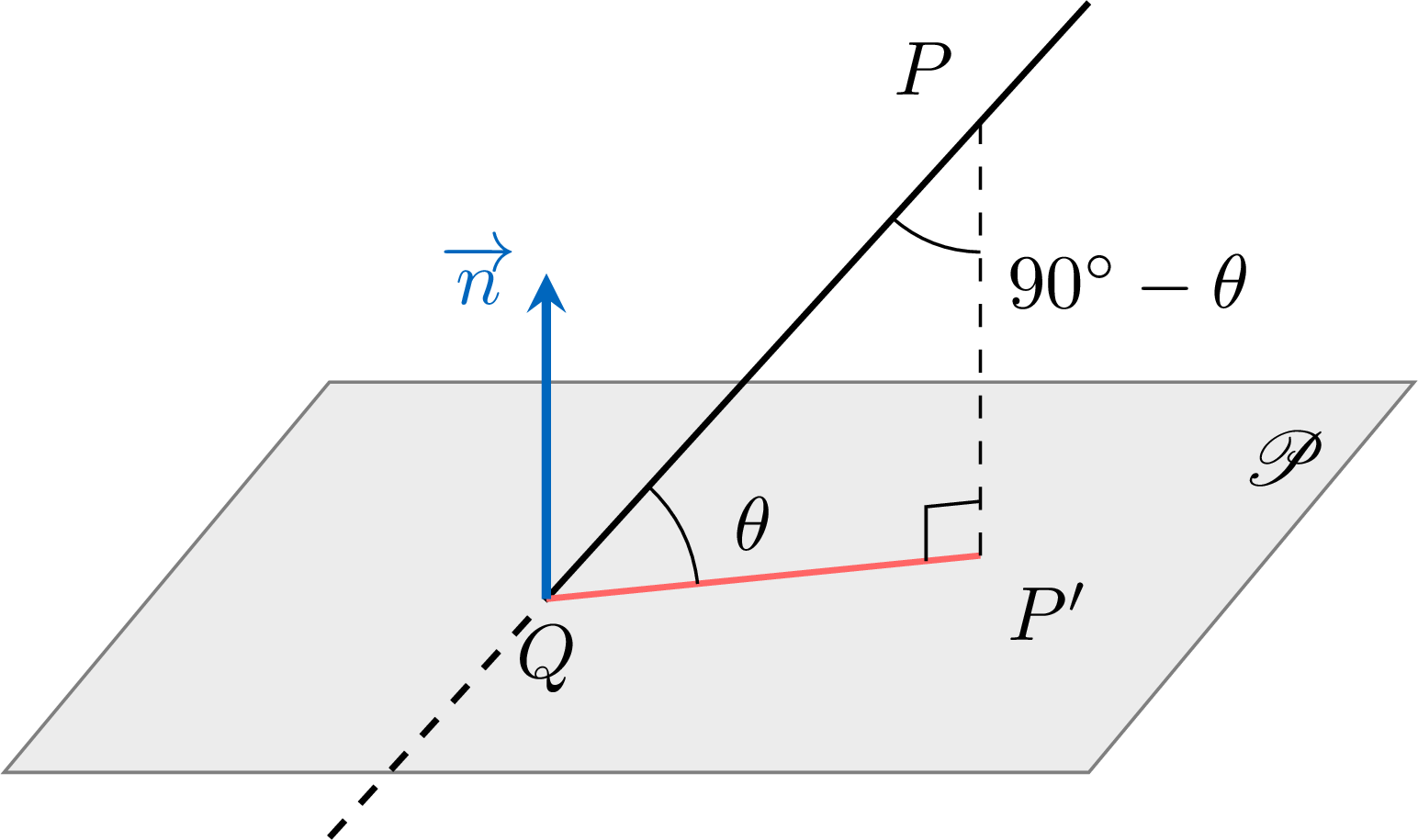
Recall that the angle \(\theta\) between a line and a plane that it meets at \(Q\) is the angle between the line and its orthogonal projection on the plane, with \(0^\circ \le \theta \le 90^\circ\): it is \(90^\circ\) for a line perpendicular to the plane, and \(0^\circ\) for a line parallel to it or contained in it. In the figure, the line meets the plane at \(Q\) without being perpendicular to it, and \(P'\) is the projection of a point \(P\) of the line other than \(Q\). The segment \(\Segment{PP'}\) has the direction of the normal vector \(\Vect{n}\), and in the right-angled triangle \(QP'P\) the angle at \(P\) is \(90^\circ - \theta\): the line makes the angle \(90^\circ - \theta\) with the normal. This is why the sine of \(\theta\) will appear where the angle between two lines had a cosine.
Proposition — Angle Between a Line and a Plane
Let \(d\) be a line with direction vector \(\Vect{b}\) and \(\mathscr{P}\) a plane with normal vector \(\Vect{n}\), in an orthonormal coordinate system. The angle \(\theta\) between \(d\) and \(\mathscr{P}\), with \(0^\circ \le \theta \le 90^\circ\), is given by $$\sin\theta = \frac{|\Vect{b} \cdot \Vect{n}|}{\|\Vect{b}\|\,\|\Vect{n}\|}.$$ In particular, \(\theta = 0^\circ\) exactly when \(\Vect{b} \cdot \Vect{n} = 0\): the line is then parallel to the plane or contained in it.
Three cases cover all the positions of \(d\).
- \(d\) is parallel to \(\mathscr{P}\) or contained in it. Then \(\theta = 0^\circ\) by definition, and \(\Vect{b}\) is a vector of the direction of \(\mathscr{P}\), so it is orthogonal to the normal vector: \(\Vect{b} \cdot \Vect{n} = 0\), and both sides of the formula are \(0\). Conversely, when \(\Vect{b} \cdot \Vect{n} = 0\), the line is parallel to \(\mathscr{P}\) or contained in it (a line and a plane given by equations), so \(\theta = 0^\circ\).
- \(d\) is perpendicular to \(\mathscr{P}\). Then \(\theta = 90^\circ\) by definition, and \(\Vect{b}\) has the direction of the normal: \(\Vect{b} = k\Vect{n}\) with \(k \neq 0\). So \(|\Vect{b} \cdot \Vect{n}| = |k|\,\|\Vect{n}\|^2 = \|\Vect{b}\|\,\|\Vect{n}\|\), the quotient is \(1 = \sin 90^\circ\).
- Otherwise, \(d\) meets \(\mathscr{P}\) at one point \(Q\) and is not perpendicular to it. Let \(P\) be a point of \(d\) other than \(Q\), so \(P\) is not in \(\mathscr{P}\), and let \(P'\) be its orthogonal projection on \(\mathscr{P}\); \(P' \neq Q\), since \(d\) is not perpendicular to \(\mathscr{P}\). The triangle \(QP'P\) is right-angled at \(P'\), and its angle at \(Q\) is \(\theta\), by definition. Its angle at \(P\) is therefore \(\varphi = 90^\circ - \theta\) (angle sum of a triangle), an acute angle. It is the angle at \(P\) between the lines \(d = \Line{PQ}\) and \(\Line{PP'}\), and the line \(\Line{PP'}\), perpendicular to \(\mathscr{P}\), has direction vector \(\Vect{n}\). By the angle between two lines, $$\cos\varphi = \frac{|\Vect{b} \cdot \Vect{n}|}{\|\Vect{b}\|\,\|\Vect{n}\|}, \qquad\text{and}\qquad \sin\theta = \sin(90^\circ - \varphi) = \cos\varphi.$$
Definition — Angle Between Two Planes
Let \(\mathscr{P}_1\) and \(\mathscr{P}_2\) be two planes that meet along a line \(\Delta\), and \(A\) a point of \(\Delta\). In each plane, draw the line through \(A\) perpendicular to \(\Delta\): \(\ell_1\) in \(\mathscr{P}_1\) and \(\ell_2\) in \(\mathscr{P}_2\). The angle between the planes \(\mathscr{P}_1\) and \(\mathscr{P}_2\) is the angle \(\theta\) between the lines \(\ell_1\) and \(\ell_2\), with \(0^\circ \le \theta \le 90^\circ\); it does not depend on the point \(A\) chosen on \(\Delta\). Two parallel planes, distinct or coincident, make an angle of \(0^\circ\). 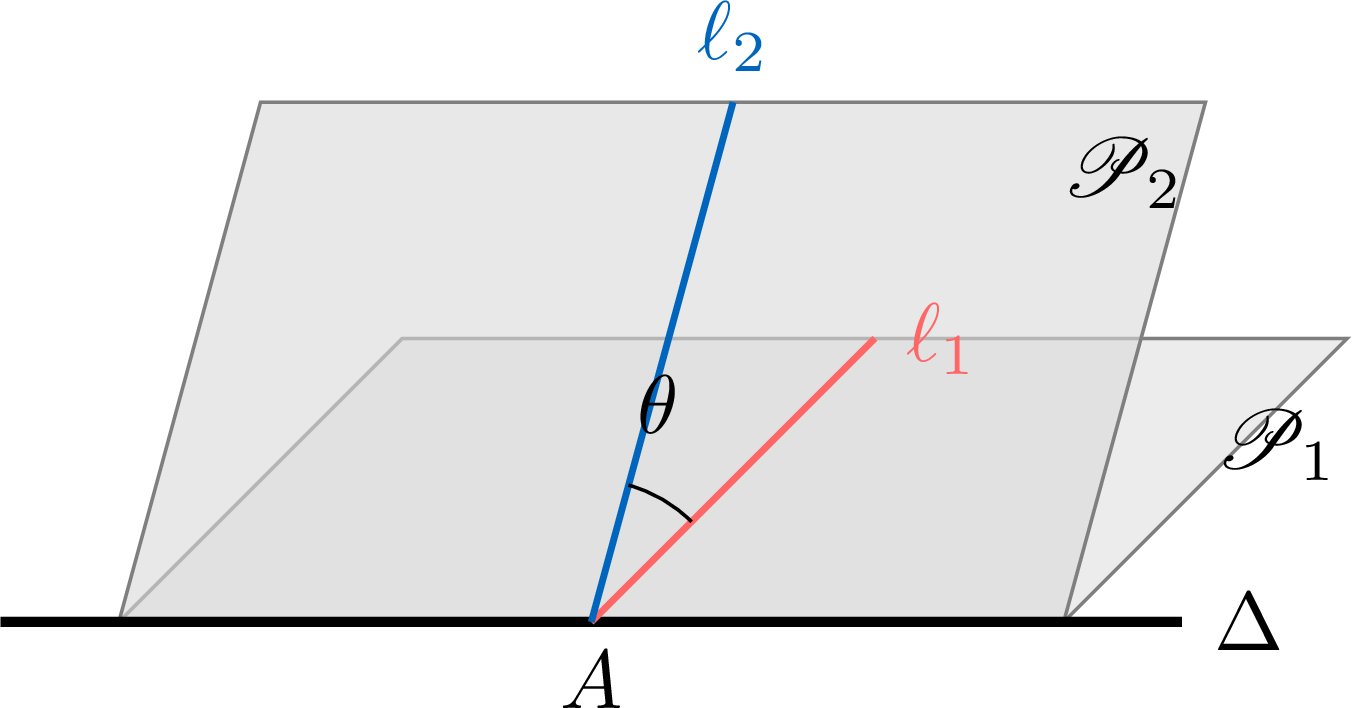
Proposition — Angle Between Two Planes from Their Normals
Let \(\mathscr{P}_1\) and \(\mathscr{P}_2\) be two planes with normal vectors \(\Vect{n}_1\) and \(\Vect{n}_2\), in an orthonormal coordinate system. The angle \(\theta\) between \(\mathscr{P}_1\) and \(\mathscr{P}_2\), with \(0^\circ \le \theta \le 90^\circ\), is the angle between the lines that carry \(\Vect{n}_1\) and \(\Vect{n}_2\): $$\cos\theta = \frac{|\Vect{n}_1 \cdot \Vect{n}_2|}{\|\Vect{n}_1\|\,\|\Vect{n}_2\|}.$$ In particular, the planes are perpendicular, \(\theta = 90^\circ\), exactly when \(\Vect{n}_1 \cdot \Vect{n}_2 = 0\).
If the planes are parallel, they have the same normal direction: \(\Vect{n}_2 = k\Vect{n}_1\) with \(k \neq 0\), so \(|\Vect{n}_1 \cdot \Vect{n}_2| = |k|\,\|\Vect{n}_1\|^2 = \|\Vect{n}_1\|\,\|\Vect{n}_2\|\), the quotient is \(1\) and \(\theta = 0^\circ\), as the definition says.
Otherwise the planes meet along a line \(\Delta\), with a direction vector \(\Vect{w}\). Let \(A\) be a point of \(\Delta\), \(\ell_1\) and \(\ell_2\) the lines of the definition, and \(\mathscr{Q}\) the plane through \(A\) normal to \(\Vect{w}\).
Otherwise the planes meet along a line \(\Delta\), with a direction vector \(\Vect{w}\). Let \(A\) be a point of \(\Delta\), \(\ell_1\) and \(\ell_2\) the lines of the definition, and \(\mathscr{Q}\) the plane through \(A\) normal to \(\Vect{w}\).
- The line \(\ell_1\) passes through \(A\) and is perpendicular to \(\Vect{w}\), so it lies in \(\mathscr{Q}\); so does \(\ell_2\).
- The vector \(\Vect{n}_1\) is orthogonal to every vector of \(\mathscr{P}_1\), in particular to \(\Vect{w}\): the line \(N_1\) through \(A\) with direction vector \(\Vect{n}_1\) lies in \(\mathscr{Q}\) too, and so does the line \(N_2\) through \(A\) with direction vector \(\Vect{n}_2\).
- In the plane \(\mathscr{Q}\), \(N_1\) is perpendicular to \(\ell_1\), because \(\Vect{n}_1\) is orthogonal to the direction of \(\ell_1\), a vector of \(\mathscr{P}_1\); likewise \(N_2\) is perpendicular to \(\ell_2\).
Method — Finding an Angle in Space
- Read the vectors: a direction vector for each line, from its vector, parametric or Cartesian equations; a normal vector for each plane, the coefficients \((a, b, c)\) of a Cartesian equation \(ax + by + cz = d\).
- Choose the formula, with the absolute value of the scalar product:
- two lines: \(\cos\theta = \dfrac{|\Vect{b}_1 \cdot \Vect{b}_2|}{\|\Vect{b}_1\|\,\|\Vect{b}_2\|}\);
- a line and a plane: \(\sin\theta = \dfrac{|\Vect{b} \cdot \Vect{n}|}{\|\Vect{b}\|\,\|\Vect{n}\|}\), the sine, because the normal makes the angle \(90^\circ - \theta\) with the line;
- two planes: \(\cos\theta = \dfrac{|\Vect{n}_1 \cdot \Vect{n}_2|}{\|\Vect{n}_1\|\,\|\Vect{n}_2\|}\).
- Compute the scalar product and the norms, then \(\theta\) with the inverse cosine or inverse sine of a calculator in degree mode: the result lies between \(0^\circ\) and \(90^\circ\).
Example
Find the angle between the line \(d: x = 1 + 2t\), \(y = -1 + t\), \(z = 3 - 2t\) (\(t \in \mathbb{R}\)) and the plane \(\mathscr{P}: 3x - 4y + 12z = 7\), to the nearest \(0.1^\circ\).
A direction vector of \(d\) is \(\Vect{b}(2, 1, -2)\), with \(\|\Vect{b}\| = \sqrt{4 + 1 + 4} = 3\), and a normal vector of \(\mathscr{P}\) is \(\Vect{n}(3, -4, 12)\), with \(\|\Vect{n}\| = \sqrt{9 + 16 + 144} = 13\). $$\begin{aligned}[t] \Vect{b} \cdot \Vect{n} &= 2 \times 3 + 1 \times (-4) + (-2) \times 12 && \text{(scalar product)}\\
&= -22,\\
\sin\theta &= \frac{|-22|}{3 \times 13} && \text{(angle between a line and a plane)}\\
&= \frac{22}{39}, \end{aligned}$$ so \(\theta = \arcsin\left(\frac{22}{39}\right) \approx 34.3^\circ\). The inverse cosine of \(\frac{22}{39}\), about \(55.7^\circ\), would be the angle between the line and the normal, not the plane: \(34.3^\circ + 55.7^\circ = 90^\circ\).
Example
Find the angle between the planes \(\mathscr{P}_1: x + 2y - 2z = 5\) and \(\mathscr{P}_2: 2x - y + 2z = 1\), to the nearest \(0.1^\circ\).
The normal vectors are \(\Vect{n}_1(1, 2, -2)\) and \(\Vect{n}_2(2, -1, 2)\), both of norm \(\sqrt{1 + 4 + 4} = 3\). $$\begin{aligned}[t] \Vect{n}_1 \cdot \Vect{n}_2 &= 1 \times 2 + 2 \times (-1) + (-2) \times 2 && \text{(scalar product)}\\
&= -4,\\
\cos\theta &= \frac{|-4|}{3 \times 3} && \text{(angle between two planes)}\\
&= \frac{4}{9}, \end{aligned}$$ so \(\theta = \arccos\left(\frac{4}{9}\right) \approx 63.6^\circ\). The normal vectors themselves make the obtuse angle \(180^\circ - 63.6^\circ = 116.4^\circ\); the absolute value keeps the angle between the planes between \(0^\circ\) and \(90^\circ\).
Example
\(ABCDEFGH\) is a cube of side \(1\) in which \(\Segment{AE}\), \(\Segment{BF}\), \(\Segment{CG}\) and \(\Segment{DH}\) are edges; in an orthonormal coordinate system, \(A(0, 0, 0)\), \(B(1, 0, 0)\), \(D(0, 1, 0)\) and \(E(0, 0, 1)\). Find the angle between the diagonal \(\Line{AG}\) and the face \(ABCD\) in two ways: with a normal vector of the face, then with the projection of \(G\) on the face.
The vertex \(G\) is \((1, 1, 1)\) and \(C\) is \((1, 1, 0)\). The face \(ABCD\) lies in the plane \(z = 0\), with normal vector \(\Vect{k}(0, 0, 1)\).
- With the normal vector: \(\Vect{AG}(1, 1, 1)\), \(\|\Vect{AG}\| = \sqrt{3}\), \(\Vect{AG} \cdot \Vect{k} = 1\), so $$\sin\theta = \frac{|1|}{\sqrt{3} \times 1} = \frac{1}{\sqrt{3}}, \qquad \theta \approx 35.3^\circ.$$
- With the projection: the projection of \(G\) on the face is \(C\), so the angle is \(\Angle{GAC}\) in the triangle \(ACG\), right-angled at \(C\), with \(CG = 1\) and \(AC = \sqrt{2}\) (a diagonal of a square face): $$\tan\theta = \frac{CG}{AC} = \frac{1}{\sqrt{2}}, \qquad \theta \approx 35.3^\circ.$$
Skills to practice
- Choosing the Formula for an Angle in Space
- Calculating the Angle Between a Line and a Plane
- Calculating the Angle Between Two Planes
- Justifying Results on Angles in Space
IV
Lines and Motion
IV.1
Motion with Constant Velocity
Proposition — Equation of Motion with Zero Net Force
If the net force on an object is zero, its velocity remains constant. The object's position vector, \(\Vect{r}(t)\), at any time \(t\) is given by the equation:$$ \Vect{r}(t) = \Vect{r_0} + t\Vect{v_0} $$ where \(\Vect{r_0}\) is the initial position vector at \(t=0\) and \(\Vect{v_0}\) is the constant velocity vector. This is a vector equation of a line, \(\Vect{r} = \Vect{a} + \lambda\Vect{b}\), in which the parameter \(\lambda\) is the time \(t\), the position vector \(\Vect{a}\) of a point is the initial position \(\Vect{r_0}\), and the direction vector \(\Vect{b}\) is the velocity \(\Vect{v_0}\): the object moves along this line. Example
A helicopter is at position \((6, 9, 3)\) and moves with a constant velocity. Ten minutes later, it is at \((3, 10, 2.5)\). Distances are in kilometres. Find the velocity vector and the speed of the helicopter in km/h.
The time taken is 10 minutes, which is \(t=\frac{10}{60} = \frac{1}{6}\) hours. From the equation of motion with constant velocity, \(\Vect{r}(t) = \Vect{r_0} + t\Vect{v_0}\), we have:$$\begin{aligned}[t]\Vect{r}(t) &= \Vect{r_0} + t\Vect{v_0} \\
t\Vect{v_0} &= \Vect{r}(t) - \Vect{r_0} \\
\Vect{v_0} &= \frac{\Vect{r}(t) - \Vect{r_0}}{t} \\
&= \frac{1}{1/6} \begin{pmatrix} 3-6 \\
10-9 \\
2.5-3 \end{pmatrix} \\
&= 6 \begin{pmatrix} -3 \\
1 \\
-0.5 \end{pmatrix} \\
&= \begin{pmatrix} -18 \\
6 \\
-3 \end{pmatrix} \text{ km/h}\end{aligned}$$ The speed is the magnitude of the velocity vector:$$\begin{aligned}[t]\text{Speed} &= \|\Vect{v_0}\|\\
&= \sqrt{(-18)^2 + 6^2 + (-3)^2} \\
&= \sqrt{324 + 36 + 9} \\
&= \sqrt{369} \\
&\approx 19.2 \text{ km/h}\end{aligned}$$
Example
A boat leaves the point \((2, -1)\) and sails in a straight line at a constant speed of \(15\) km/h, in the direction of the vector \(\begin{pmatrix} 3 \\ 4 \end{pmatrix}\). Distances are in kilometres and time in hours. Find the velocity vector of the boat, its position vector after \(t\) hours, and its position after \(20\) minutes.
The velocity has the direction of the vector \(\begin{pmatrix} 3 \\ 4 \end{pmatrix}\), whose magnitude is \(\sqrt{9 + 16} = 5\), and the velocity itself has magnitude \(15\), the speed: $$\begin{aligned}[t] \Vect{v} &= 15 \times \frac{1}{5}\begin{pmatrix} 3 \\
4 \end{pmatrix} && \text{(speed times the unit vector)}\\
&= \begin{pmatrix} 9 \\
12 \end{pmatrix}. \end{aligned}$$ By the equation of motion with constant velocity, \(\Vect{r}(t) = \begin{pmatrix} 2 \\ -1 \end{pmatrix} + t\begin{pmatrix} 9 \\ 12 \end{pmatrix}\). After \(20\) minutes, \(t = \frac{1}{3}\) and \(\Vect{r}\left(\frac{1}{3}\right) = \begin{pmatrix} 2 + 3 \\ -1 + 4 \end{pmatrix} = \begin{pmatrix} 5 \\ 3 \end{pmatrix}\): the boat is at \((5, 3)\), \(5\) km from its start, as \(15 \times \frac{1}{3} = 5\) confirms.
Skills to practice
- Calculating Velocity and Speed from Displacement
V
Going further
Skills to practice
- Solving Exam-Style Problems on Lines and Planes
- Quiz
Jump to section