International Baccalaureate · DP 2: Analysis and Approaches HL
Vectors
I
Vectors in the Plane and in Space
I.1
Vectors and Their Operations
Recappreviously studied — click to reread
Definition — Vector
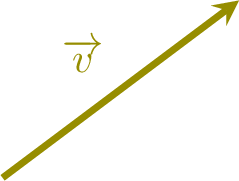
A vector is defined by: - Geometrically, as a directed line segment, characterized by a magnitude (length) and a direction (including its sense).
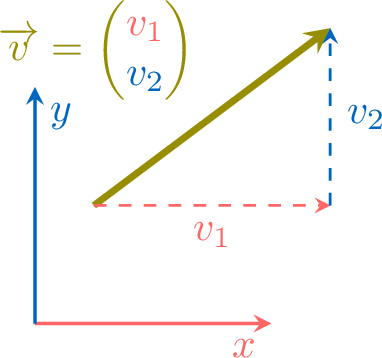
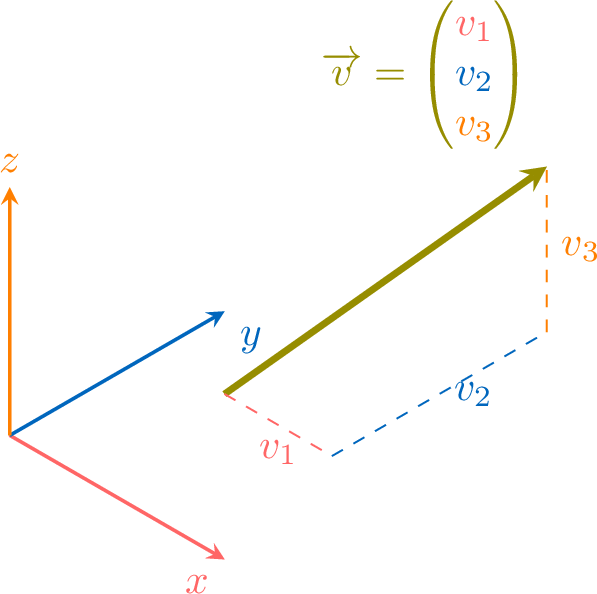
- Algebraically, as an ordered set of components. In a Cartesian coordinate system, a vector in 2D is \(\Vect{v} = \begin{pmatrix} v_1 \\ v_2 \end{pmatrix}\) and in 3D is \(\Vect{v} = \begin{pmatrix} v_1 \\ v_2 \\ v_3 \end{pmatrix}\).
Definition — Two Point Notation
The vector from a starting point \(A\) to an endpoint \(B\) is denoted by \(\Vect{AB}\). 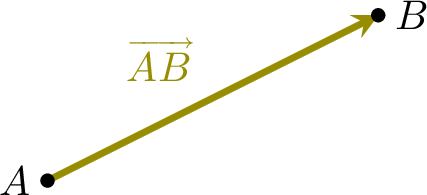
Proposition — Components of \(\Vect{AB}\)
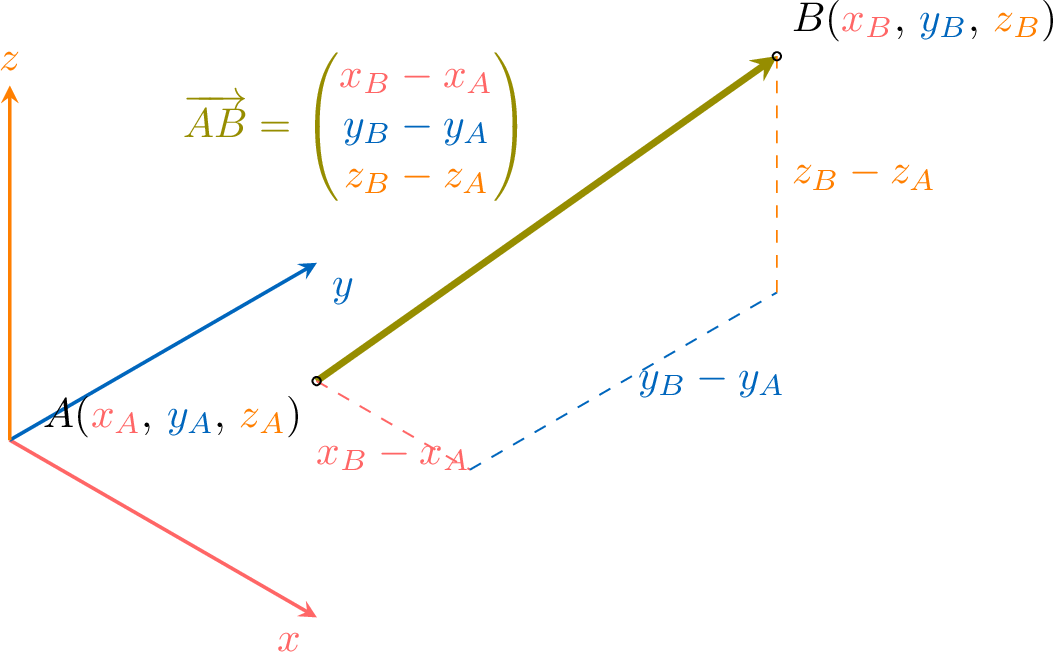
The components of the vector \(\Vect{AB}\) are found by subtracting the coordinates of the starting point from the coordinates of the endpoint. - In 2D, for points \(A(x_A, y_A)\) and \(B(x_B, y_B)\): $$\Vect{AB} = \begin{pmatrix}x_B - x_A \\
y_B - y_A\end{pmatrix}$$
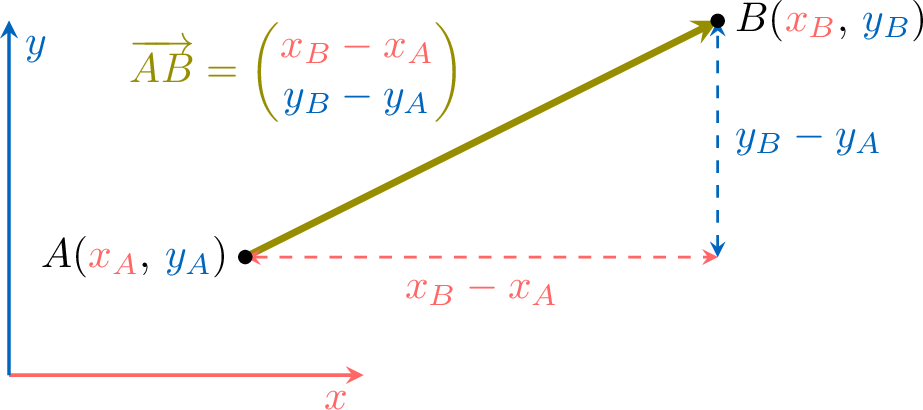
- In 3D, for points \(A(x_A, y_A, z_A)\) and \(B(x_B, y_B, z_B)\): $$\Vect{AB} = \begin{pmatrix}x_B - x_A \\
y_B - y_A \\
z_B - z_A \end{pmatrix}$$
Definition — Algebraic Equality of Vectors
Two vectors are equal if their corresponding components are equal. - In 2D: \(\begin{pmatrix}x\\y\end{pmatrix} = \begin{pmatrix}x'\\y'\end{pmatrix} \iff x = x' \text{ and } y = y'\).
- In 3D: \(\begin{pmatrix}x\\y\\z\end{pmatrix} = \begin{pmatrix}x'\\y'\\z'\end{pmatrix} \iff x = x',\; y = y', \text{ and } z = z'\).
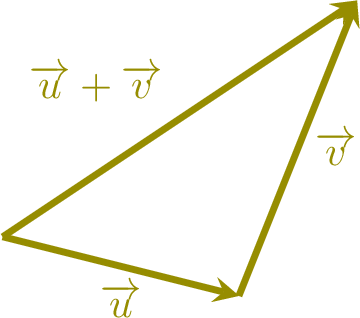
Definition — Vector Addition
The sum of two vectors is found by adding their corresponding components. - In 2D: \(\begin{pmatrix}u_1\\ u_2\end{pmatrix}+\begin{pmatrix}v_1\\ v_2\end{pmatrix}=\begin{pmatrix}u_1+v_1\\ u_2+v_2 \end{pmatrix}\)
- In 3D: \(\begin{pmatrix}u_1\\ u_2 \\ u_3\end{pmatrix}+\begin{pmatrix}v_1\\ v_2 \\ v_3\end{pmatrix}=\begin{pmatrix}u_1+v_1\\ u_2+v_2 \\ u_3+v_3 \end{pmatrix}\)
Proposition — Chasles' Relation
For any three points \(A\), \(B\), and \(C\), the vector from \(A\) to \(C\) is the sum of the vector from \(A\) to \(B\) and the vector from \(B\) to \(C\): $$\Vect{AB} + \Vect{BC} = \Vect{AC}.$$ 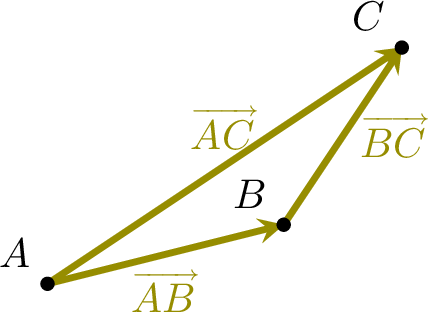
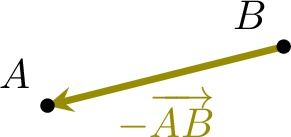
Definition — Opposite Vector
For every vector \(\Vect{v}\), there exists an opposite vector, denoted \(-\Vect{v}\), such that their sum is the null vector: $$ \Vect{v} + (-\Vect{v}) = \Vect{0}. $$ Geometrically, \(-\Vect{v}\) has the same magnitude and direction as \(\Vect{v}\) but the opposite sense. Algebraically, its components are the negatives of the components of \(\Vect{v}\). - In 2D: \( -\begin{pmatrix}v_1\\ v_2 \\ \end{pmatrix}=\begin{pmatrix}-v_1\\ -v_2 \\ \end{pmatrix} \)
- In 3D: \( -\begin{pmatrix}v_1\\ v_2 \\ v_3\end{pmatrix}=\begin{pmatrix}-v_1\\ -v_2 \\ -v_3 \end{pmatrix} \)
Definition — Vector Subtraction
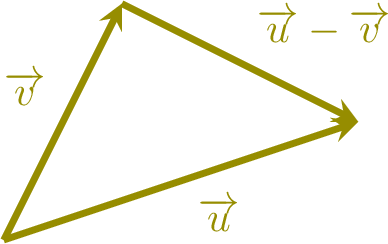
The subtraction of vector \(\Vect{v}\) from vector \(\Vect{u}\) is defined as the addition of the opposite of \(\Vect{v}\): $$\Vect{u}-\Vect{v} = \Vect{u} + (-\Vect{v}).$$ The components are found by subtracting the corresponding components. - In 2D: \(\begin{pmatrix}u_1\\ u_2\end{pmatrix}-\begin{pmatrix}v_1\\ v_2\end{pmatrix}=\begin{pmatrix}u_1-v_1\\ u_2-v_2 \end{pmatrix}\)
- In 3D: \(\begin{pmatrix}u_1\\ u_2 \\ u_3\end{pmatrix}-\begin{pmatrix}v_1\\ v_2 \\ v_3\end{pmatrix}=\begin{pmatrix}u_1-v_1\\ u_2-v_2 \\ u_3-v_3 \end{pmatrix}\)
Definition — Scalar Multiplication
The product of a scalar \(k \in \mathbb{R}\) and a vector \(\Vect{v}\) is the vector \(k\Vect{v}\), obtained by multiplying each component of \(\Vect{v}\) by \(k\). - In 2D: \(k\Vect{v} = k\begin{pmatrix} v_1 \\ v_2 \end{pmatrix} = \begin{pmatrix} kv_1 \\ kv_2 \end{pmatrix}\)
- In 3D: \(k\Vect{v} = k\begin{pmatrix} v_1 \\ v_2 \\ v_3 \end{pmatrix} = \begin{pmatrix} kv_1 \\ kv_2 \\ kv_3 \end{pmatrix}\)
Proposition — Geometric Effect of Scalar Multiplication
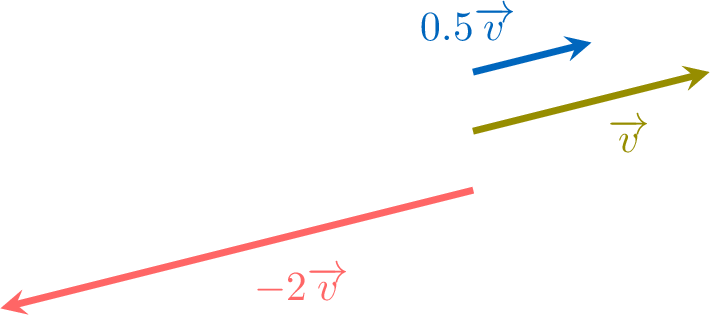
Multiplying a vector \(\Vect{v}\) by a scalar \(k\) results in a new vector \(k\Vect{v}\) that is parallel to \(\Vect{v}\). - If \(k > 0\), \(k\Vect{v}\) has the same sense as \(\Vect{v}\).
- If \(k < 0\), \(k\Vect{v}\) has the opposite sense to \(\Vect{v}\).
- If \(k = 0\), the result is the null vector: \(0\Vect{v} = \Vect{0}\).
Definition — Parallel (Collinear) Vectors
Two vectors \(\Vect{u}\) and \(\Vect{v}\) are parallel (or collinear) if one is a scalar multiple of the other. That is, if there exists a real number \(k\) such that: $$\Vect{u} = k \Vect{v}.$$ 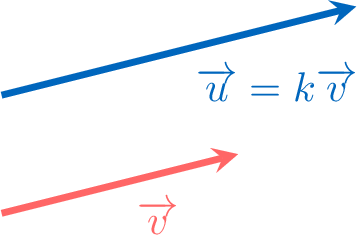
Proposition — Geometric Applications
- Two lines \(\Line{AB}\) and \(\Line{CD}\) are parallel if and only if their direction vectors \(\Vect{AB}\) and \(\Vect{CD}\) are parallel.
- Three points \(A\), \(B\), and \(C\) are collinear (lie on the same straight line) if and only if the vectors \(\Vect{AB}\) and \(\Vect{AC}\) are parallel.
Skills to practice
- Vectors and Their Operations
I.2
Vectors in Space
From the Plane to Space
In the plane, a vector records a translation: a direction, a sense and a length. Nothing in that idea belongs to the plane, and it carries over to space word for word. Consider a cube \(ABCDEFGH\), in which \([AE]\), \([BF]\), \([CG]\) and \([DH]\) are edges, and represent from the same vertex \(A\) the three vectors \(\Vect{u} = \Vect{AB}\), \(\Vect{v} = \Vect{AD}\) and \(\Vect{w} = \Vect{AE}\). No face of the cube contains all three. Where does \(\Vect{u} + \Vect{v}\) lead, and where does \(\Vect{u} + \Vect{v} + \Vect{w}\) lead? 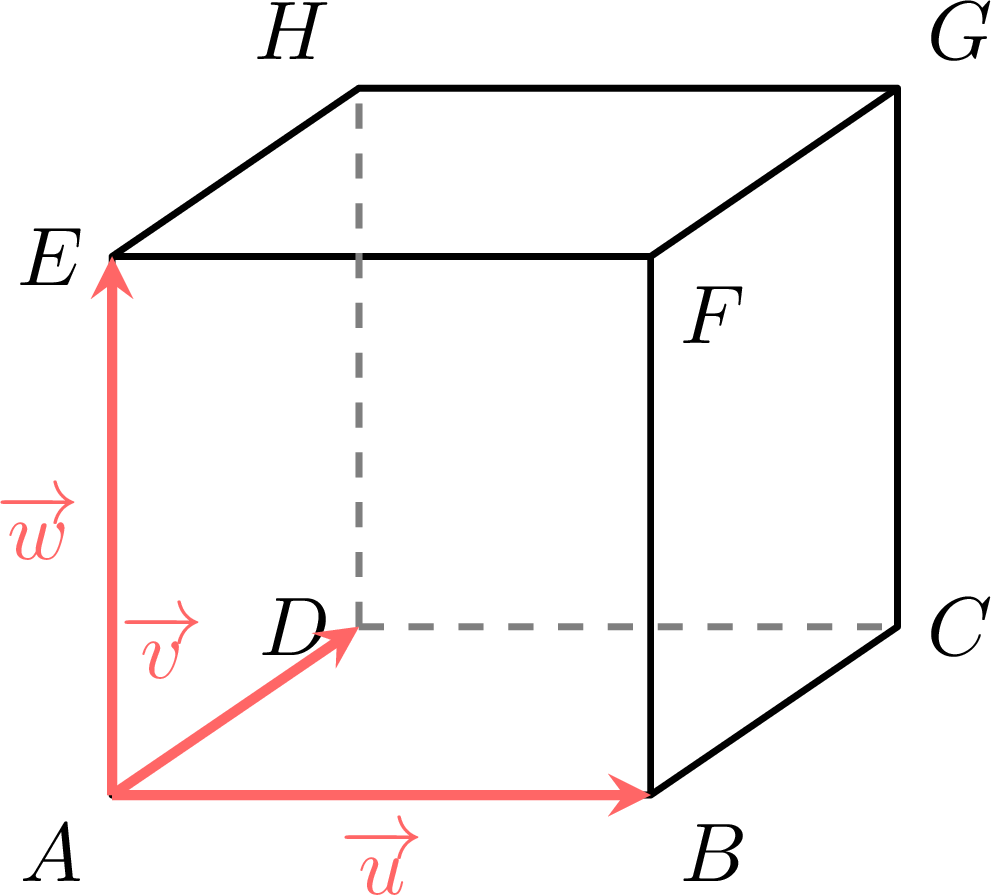
Definition — Vectors and Translations of Space
To two points \(A\) and \(B\) of space is associated the vector \(\Vect{AB}\). When \(A \neq B\), it is characterised by its direction, that of the line \((AB)\), its sense, from \(A\) towards \(B\), and its length \(AB\); when \(A = B\) it is the zero vector \(\Vect{0}\). Two vectors \(\Vect{AB}\) and \(\Vect{CD}\) are equal if and only if \(ABDC\) is a parallelogram, possibly degenerate. Given a vector \(\Vect{u}\), every point \(M\) of space has one and only one image \(M'\) such that \(\Vect{MM'} = \Vect{u}\). The map that sends \(M\) to \(M'\) is the translation of vector \(\Vect{u}\). A vector may therefore be represented from any point of space. Proposition — The Rules of Vector Calculus Carry Over
For all points \(A\), \(B\), \(C\) of space, all vectors \(\Vect{u}\) and \(\Vect{v}\) and all real numbers \(k\) and \(k'\): $$\Vect{AB} + \Vect{BC} = \Vect{AC},$$ $$k(\Vect{u} + \Vect{v}) = k\Vect{u} + k\Vect{v}, \qquad (k + k')\Vect{u} = k\Vect{u} + k'\Vect{u}, \qquad k(k'\Vect{u}) = (kk')\Vect{u}.$$ The first is Chasles' relation. Each of these rules can be checked in a plane: three points always lie in one, and two vectors represented from a same point do too. The rules of plane vector calculus therefore apply to them. Example
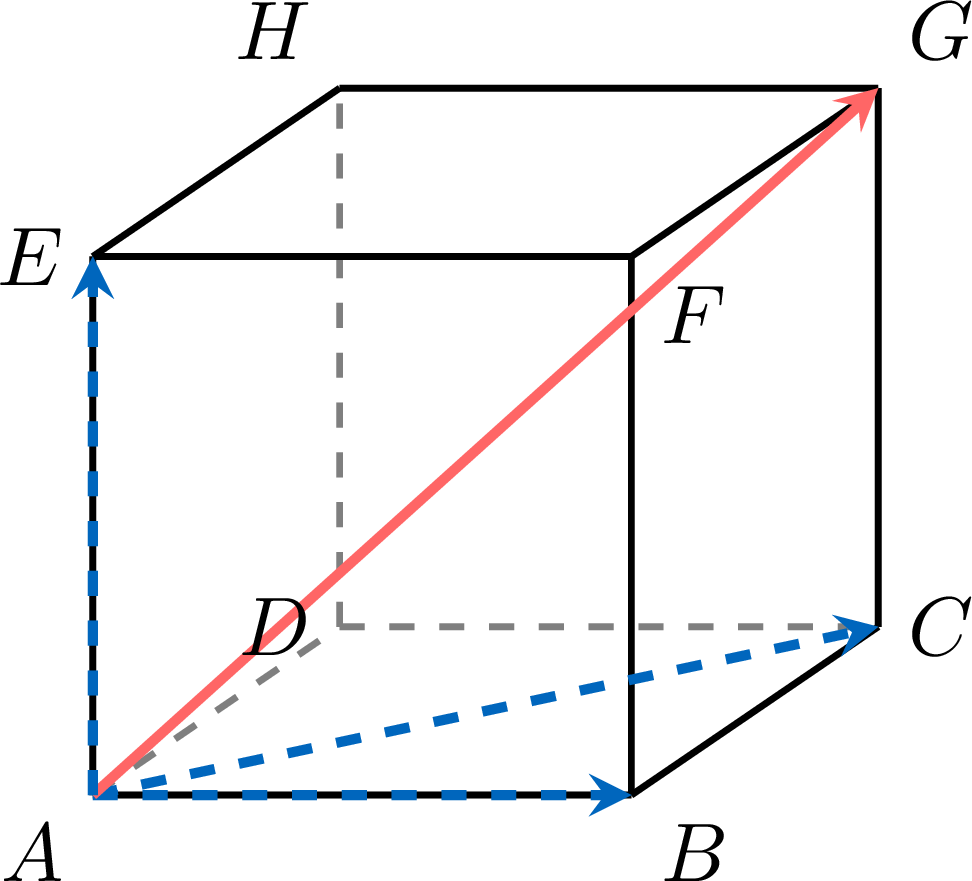
\(ABCDEFGH\) is a cube, in which \([AE]\), \([BF]\), \([CG]\) and \([DH]\) are edges. Simplify \(\Vect{AB} + \Vect{BC} + \Vect{CG}\), then express \(\Vect{AG}\) in terms of \(\Vect{AB}\), \(\Vect{AD}\) and \(\Vect{AE}\).
$$\begin{aligned} \Vect{AB} + \Vect{BC} + \Vect{CG} &= \Vect{AC} + \Vect{CG} &&\text{(Chasles' relation)}\\
&= \Vect{AG} &&\text{(Chasles' relation)} \end{aligned}$$ The face \(ABCD\) is a square, so \(\Vect{BC} = \Vect{AD}\); the quadrilateral \(ACGE\) is a rectangle, so \(\Vect{CG} = \Vect{AE}\). Hence: $$\begin{aligned} \Vect{AG} &= \Vect{AB} + \Vect{BC} + \Vect{CG} &&\text{(result above)}\\
&= \Vect{AB} + \Vect{AD} + \Vect{AE} &&\text{(\(ABCD\) and \(ACGE\) are parallelograms)} \end{aligned}$$ The three edge vectors drawn from \(A\) therefore lead to the opposite vertex \(G\). Along the way, \(\Vect{u} + \Vect{v} = \Vect{AB} + \Vect{AD} = \Vect{AC}\): the first two lead to the far corner of the face they span.
Skills to practice
- Recognising Equal Vectors in a Cube
- Finding the Components of a Vector in Space
- Calculating with Vectors in Space
- Simplifying with Chasles' Relation in Space
I.3
Magnitude and Unit Vectors
The magnitude (or norm) of a vector is its length. It is a scalar quantity, denoted \(\|\Vect{v}\|\). We can calculate it by applying the Pythagorean theorem to its components.
Definition — Magnitude of a Vector
The magnitude of a vector \(\Vect{v}\) is the square root of the sum of the squares of its components. - In 2D, for \(\Vect{v} = \begin{pmatrix} v_1 \\ v_2 \end{pmatrix}\): $$ \|\Vect{v}\| = \sqrt{v_1^2 + v_2^2 }. $$

- In 3D, for \(\Vect{v} = \begin{pmatrix} v_1 \\ v_2 \\ v_3 \end{pmatrix}\): $$ \|\Vect{v}\| = \sqrt{v_1^2 + v_2^2 + v_3^2}. $$
Definition — Unit Vector
A unit vector is a vector \(\Vect{v}\) with a magnitude of 1, such that \(\|\Vect{v}\|=1\). Method — Normalisation
The process of finding a unit vector in the same direction as a given vector is called normalisation. To find the unit vector in the direction of a non-zero vector \(\Vect{v}\), we divide the vector by its own magnitude: $$\frac{\Vect{v}}{\|\Vect{v}\|}.$$ Skills to practice
- Normalising a Vector
I.4
Base Vectors
When we plot vectors in the Cartesian plane, we move first in the \(x\)-direction and then in the \(y\)-direction.
For example, to plot the vector \(\Vect{v}=\begin{pmatrix} 2 \\ 3 \end{pmatrix}\), we move 2 units in the \(x\)-direction, and then 3 units in the \(y\)-direction.
Let \(\Vect{i}=\begin{pmatrix} 1 \\ 0 \end{pmatrix}\) be a translation 1 unit in the positive \(x\)-direction and \(\Vect{j}=\begin{pmatrix} 0 \\ 1 \end{pmatrix}\) be a translation 1 unit in the positive \(y\)-direction. This movement is equivalent to \(2\) times \(\Vect{i}\) plus \(3\) times \(\Vect{j}\): $$\begin{aligned}\Vect{v} & =2 \Vect{i}+3 \Vect{j} \\ \begin{pmatrix} 2 \\ 3 \end{pmatrix} & =2\begin{pmatrix} 1 \\ 0 \end{pmatrix}+3\begin{pmatrix} 0 \\ 1 \end{pmatrix}\end{aligned}$$ 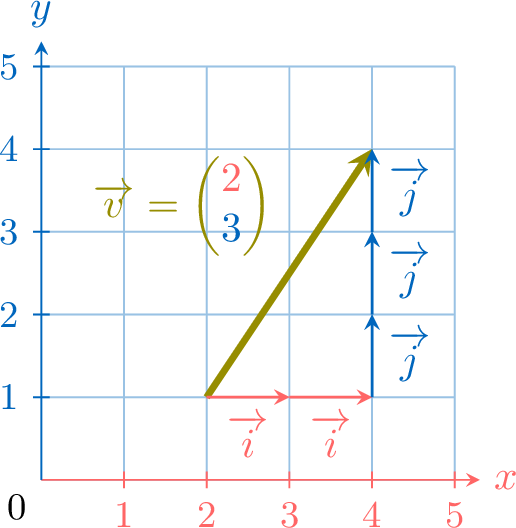
For example, to plot the vector \(\Vect{v}=\begin{pmatrix} 2 \\ 3 \end{pmatrix}\), we move 2 units in the \(x\)-direction, and then 3 units in the \(y\)-direction.
Let \(\Vect{i}=\begin{pmatrix} 1 \\ 0 \end{pmatrix}\) be a translation 1 unit in the positive \(x\)-direction and \(\Vect{j}=\begin{pmatrix} 0 \\ 1 \end{pmatrix}\) be a translation 1 unit in the positive \(y\)-direction. This movement is equivalent to \(2\) times \(\Vect{i}\) plus \(3\) times \(\Vect{j}\): $$\begin{aligned}\Vect{v} & =2 \Vect{i}+3 \Vect{j} \\ \begin{pmatrix} 2 \\ 3 \end{pmatrix} & =2\begin{pmatrix} 1 \\ 0 \end{pmatrix}+3\begin{pmatrix} 0 \\ 1 \end{pmatrix}\end{aligned}$$
Definition — Base Vectors
The standard basis vectors are unit vectors along the coordinate axes. - In 2D: \(\Vect{i} = \begin{pmatrix} 1 \\ 0 \end{pmatrix}\) and \(\Vect{j} = \begin{pmatrix} 0 \\ 1 \end{pmatrix}\). Any vector can be written as $$\Vect{v} = \underbrace{v_1\Vect{i} + v_2\Vect{j}}_{\textcolor{colordef}{\text{unit vector form}}}=\underbrace{\begin{pmatrix} v_1 \\ v_2 \end{pmatrix}}_{\textcolor{colordef}{\text{component form}}}$$
- In 3D: \(\Vect{i} = \begin{pmatrix} 1 \\ 0 \\ 0 \end{pmatrix}\), \(\Vect{j} = \begin{pmatrix} 0 \\ 1 \\ 0 \end{pmatrix}\), and \(\Vect{k} = \begin{pmatrix} 0 \\ 0 \\ 1 \end{pmatrix}\). Any vector can be written as $$\Vect{v} = \underbrace{v_1\Vect{i} + v_2\Vect{j}+ v_3\Vect{k}}_{\textcolor{colordef}{\text{unit vector form}}}=\underbrace{\begin{pmatrix} v_1 \\ v_2\\ v_3 \\ \end{pmatrix}}_{\textcolor{colordef}{\text{component form}}}$$
Example
The standard basis vectors \(\Vect{i}\), \(\Vect{j}\), and \(\Vect{k}\) are all unit vectors. Definition — General Basis
A family of vectors forms a basis if every vector in that space can be uniquely represented as a linear combination of them. - In 2D: Given a basis \((\Vect{u}, \Vect{v})\) of the plane, every vector \(\Vect{w}\) can be uniquely written as: $$\Vect{w} = a\Vect{u} + b\Vect{v}$$ The values \(\begin{pmatrix} a \\ b \end{pmatrix}\) are the coordinates of \(\Vect{w}\) in the basis \((\Vect{u}, \Vect{v})\).
- In 3D: Given a basis \((\Vect{u}, \Vect{v}, \Vect{w})\) of space, every vector \(\Vect{r}\) can be uniquely written as: $$\Vect{r} = a\Vect{u} + b\Vect{v} + c\Vect{w}$$ The values \(\begin{pmatrix} a \\ b \\ c \end{pmatrix}\) are the coordinates of \(\Vect{r}\) in the basis \((\Vect{u}, \Vect{v}, \Vect{w})\).
Example

Skills to practice
- Decomposing a Vector in a Basis of Space
II
The Scalar Product
II.1
The Scalar Product in the Plane
Recappreviously studied — click to reread
Definition — Geometric Scalar Product
The scalar product of two non-zero vectors \(\Vect{u}\) and \(\Vect{v}\) is defined as:$$\Vect{u} \cdot \Vect{v} = \|\Vect{u}\| \|\Vect{v}\| \cos \theta$$ where \(\|\Vect{u}\|\) is the magnitude of \(\Vect{u}\) (also called its norm), \(\|\Vect{v}\|\) is the magnitude of \(\Vect{v}\), and \(\theta\) is the angle between the vectors. If one of the two vectors is the zero vector, the scalar product is \(0\). 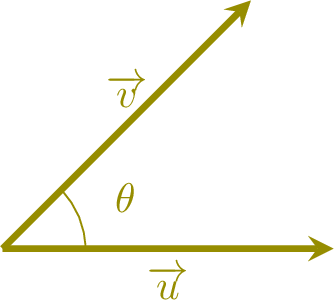
Proposition — Square of a vector
$$\Vect{u} \cdot \Vect{u} = \|\Vect{u}\|^2$$ Proposition — Symmetry
The scalar product is commutative:$$\Vect{u} \cdot \Vect{v} = \Vect{v} \cdot \Vect{u}.$$ Proposition — Bilinearity
The scalar product is linear with respect to each of its vector arguments (property accepted without proof here): - \(\Vect{u} \cdot (\Vect{v} + \Vect{w}) = \Vect{u} \cdot \Vect{v} + \Vect{u} \cdot \Vect{w}\) (distributivity in the second argument);
- \((\Vect{u} + \Vect{v}) \cdot \Vect{w} = \Vect{u} \cdot \Vect{w} + \Vect{v} \cdot \Vect{w}\) (distributivity in the first argument);
- \(\Vect{u} \cdot (k\Vect{v}) = k(\Vect{u} \cdot \Vect{v})\) and \((k\Vect{u})\cdot\Vect{v} = k(\Vect{u}\cdot\Vect{v})\), where \(k\) is a real number.
Definition — Orthogonal Vectors
Two vectors \(\Vect{u}\) and \(\Vect{v}\) are said to be orthogonal if their scalar product is zero:$$\Vect{u} \perp \Vect{v} \iff \Vect{u} \cdot \Vect{v} = 0.$$ Proposition — Scalar Product of Collinear Vectors
Let \(\Vect{u}\) and \(\Vect{v}\) be two non-zero vectors. - If \(\Vect{u}\) and \(\Vect{v}\) are collinear and point in the same direction, then \(\Vect{u} \cdot \Vect{v} = \|\Vect{u}\|\|\Vect{v}\|\).
- If \(\Vect{u}\) and \(\Vect{v}\) are collinear and point in opposite directions, then \(\Vect{u} \cdot \Vect{v} = -\|\Vect{u}\|\|\Vect{v}\|\).
Definition — Orthonormal Basis
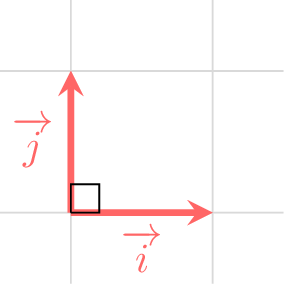
A basis of the plane (or space) is said to be orthonormal if its vectors are pairwise orthogonal and each has a norm equal to 1. - In 2D, the basis \((\Vect{i}, \Vect{j})\) is orthonormal if:$$\Vect{i} \cdot \Vect{j} = 0, \quad \|\Vect{i}\| = 1, \quad \text{and} \quad \|\Vect{j}\| = 1.$$
- In 3D, the basis \((\Vect{i}, \Vect{j}, \Vect{k})\) is orthonormal if:$$\Vect{i} \cdot \Vect{j} = \Vect{j} \cdot \Vect{k} = \Vect{k} \cdot \Vect{i} = 0 \quad \text{and} \quad \|\Vect{i}\| = \|\Vect{j}\| = \|\Vect{k}\| = 1.$$
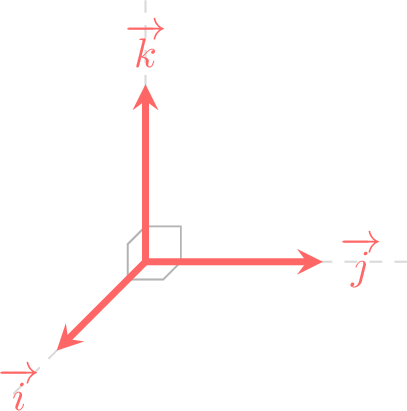
Proposition — Analytical Expressions
In an orthonormal basis, for vectors \(\Vect{u} \begin{pmatrix} x \\ y \end{pmatrix}\) and \(\Vect{v} \begin{pmatrix} x' \\ y' \end{pmatrix}\): - Scalar Product: \(\Vect{u} \cdot \Vect{v} = xx' + yy'\).
- Norm: \(\|\Vect{u}\| = \sqrt{x^2 + y^2}\).
- Distance (in an orthonormal frame): \(AB = \sqrt{(x_B-x_A)^2 + (y_B-y_A)^2}\).
Definition — Orthonormal Coordinate System
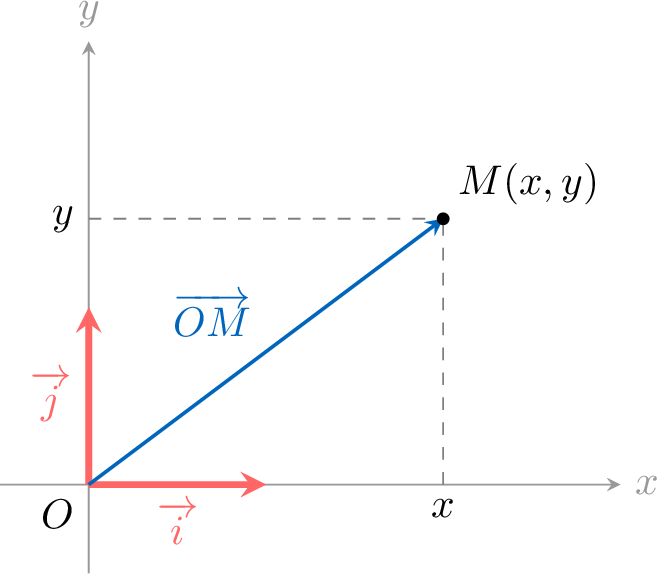
An orthonormal coordinate system of space (or the plane) consists of a point \(O\), called the origin, and an orthonormal basis. - In 2D, it is denoted \((O; \Vect{i}, \Vect{j})\). A point \(M\) has coordinates \((x, y)\) if and only if: $$\Vect{OM} = x\Vect{i} + y\Vect{j}$$
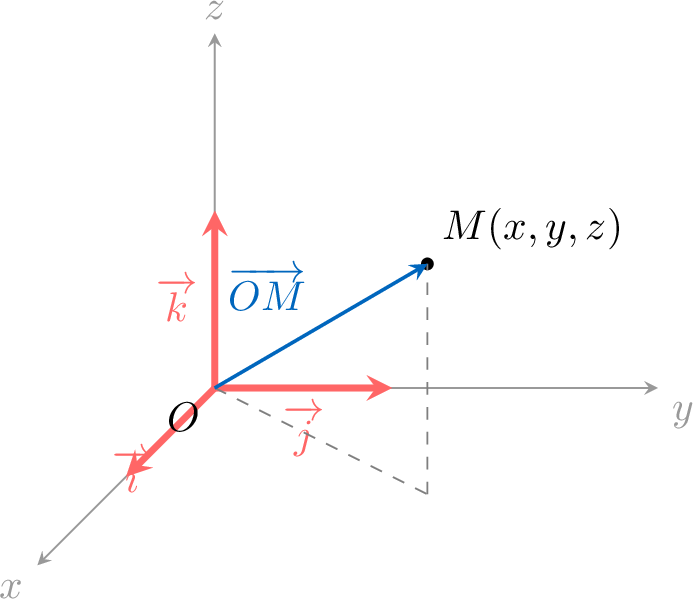
- In 3D, it is denoted \((O; \Vect{i}, \Vect{j}, \Vect{k})\). A point \(M\) has coordinates \((x, y, z)\) if and only if: $$\Vect{OM} = x\Vect{i} + y\Vect{j} + z\Vect{k}$$
Proposition — Calculating an Angle from Coordinates
In an orthonormal basis, for two non-zero vectors \(\Vect{u}\begin{pmatrix} x \\ y \end{pmatrix}\) and \(\Vect{v}\begin{pmatrix} x' \\ y' \end{pmatrix}\), the angle \(\theta\) between them satisfies $$\cos\theta = \frac{\Vect{u} \cdot \Vect{v}}{\|\Vect{u}\|\,\|\Vect{v}\|} = \frac{xx' + yy'}{\sqrt{x^2 + y^2}\,\sqrt{x'^2 + y'^2}},$$ and \(\theta\) is the unique angle of \([0^\circ, 180^\circ]\) with this cosine: \(\theta = \cos^{-1}\left(\dfrac{\Vect{u} \cdot \Vect{v}}{\|\Vect{u}\|\,\|\Vect{v}\|}\right)\). Skills to practice
- The Scalar Product in the Plane
II.2
The Scalar Product in Space
Two Vectors, One Plane
In the cube \(ABCDEFGH\) of edge \(a\), what is \(\Vect{AD} \cdot \Vect{AH}\)? The two vectors are carried by the face \(ADHE\), and in that face the scalar product of the plane applies: the orthogonal projection of \(H\) onto \((AD)\) is \(D\), so \(\Vect{AD} \cdot \Vect{AH} = AD \times AD = a^2\). Nothing else is needed: two vectors of space are always carried by a common plane, and the scalar product of space is the scalar product of that plane. 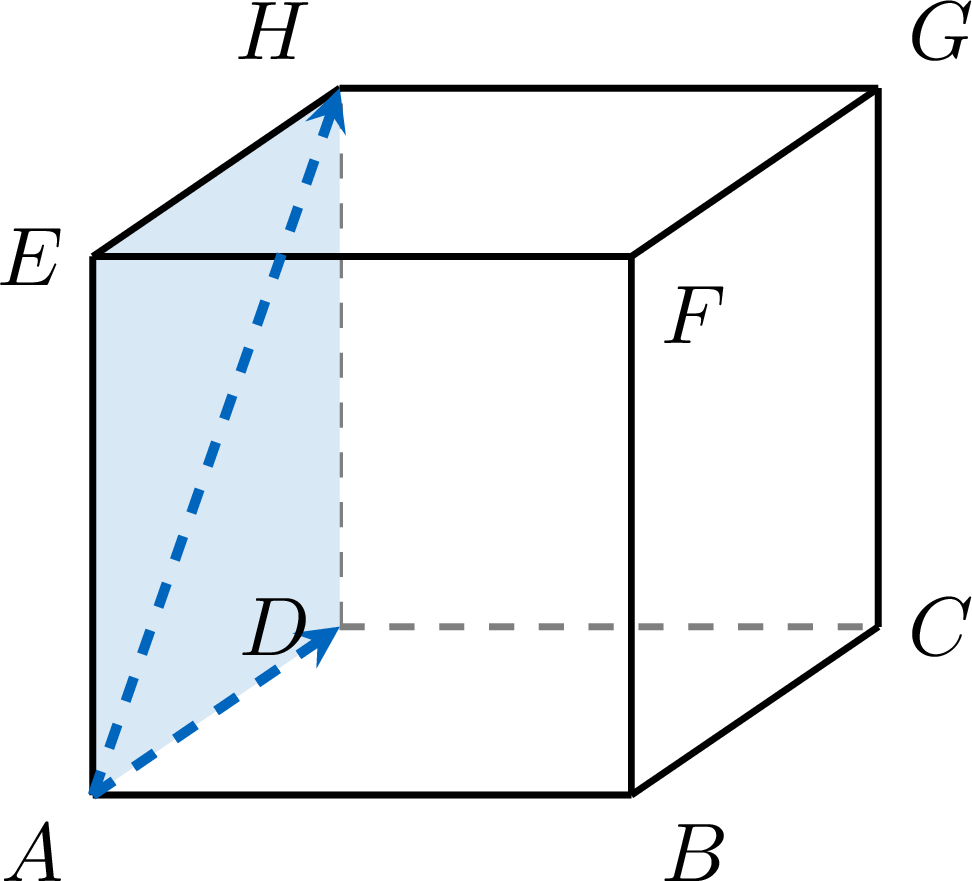
Definition — Scalar Product of Two Vectors of Space
Let \(\Vect{u}\) and \(\Vect{v}\) be two non-zero vectors of space. Represented from a same point \(A\), \(\Vect{u} = \Vect{AB}\) and \(\Vect{v} = \Vect{AC}\), they are carried by a plane containing \(A\), \(B\) and \(C\). The scalar product \(\Vect{u} \cdot \Vect{v}\) is the scalar product of \(\Vect{AB}\) and \(\Vect{AC}\) computed in that plane: $$\Vect{u} \cdot \Vect{v} = \|\Vect{u}\| \times \|\Vect{v}\| \times \cos\Angle{BAC}.$$ When \(A\), \(B\), \(C\) are not aligned, the plane is unique. When they are aligned, every plane containing the line \((AB)\) carries the two vectors, and the angle \(\Angle{BAC}\) is \(0\) or \(\pi\) in all of them: the value does not depend on the plane chosen. If one of the vectors is the zero vector, \(\Vect{u} \cdot \Vect{v} = 0\). Proposition — The Properties of the Plane Carry Over
For all vectors \(\Vect{u}\), \(\Vect{v}\), \(\Vect{w}\) of space and every real number \(k\): - Symmetry: \(\Vect{u} \cdot \Vect{v} = \Vect{v} \cdot \Vect{u}\); square: \(\Vect{u} \cdot \Vect{u} = \|\Vect{u}\|^2\).
- Bilinearity: \(\Vect{u} \cdot (\Vect{v} + \Vect{w}) = \Vect{u} \cdot \Vect{v} + \Vect{u} \cdot \Vect{w}\) and \(\Vect{u} \cdot (k\Vect{v}) = k\,(\Vect{u} \cdot \Vect{v})\), and likewise on the left.
- Identities: \(\|\Vect{u} + \Vect{v}\|^2 = \|\Vect{u}\|^2 + 2\,\Vect{u} \cdot \Vect{v} + \|\Vect{v}\|^2\), \(\|\Vect{u} - \Vect{v}\|^2 = \|\Vect{u}\|^2 - 2\,\Vect{u} \cdot \Vect{v} + \|\Vect{v}\|^2\), and the polarisation formula \(\Vect{u} \cdot \Vect{v} = \tfrac{1}{2}\left(\|\Vect{u} + \Vect{v}\|^2 - \|\Vect{u}\|^2 - \|\Vect{v}\|^2\right)\).
- Orthogonality: \(\Vect{u}\) and \(\Vect{v}\) are orthogonal if and only if \(\Vect{u} \cdot \Vect{v} = 0\); the zero vector is orthogonal to every vector.
- Projection: if \(A \neq B\) and \(H\) is the orthogonal projection of \(C\) onto the line \((AB)\), then \(\Vect{AB} \cdot \Vect{AC} = \Vect{AB} \cdot \Vect{AH}\).
Each statement about two vectors — symmetry, square, identities, polarisation, orthogonality, projection — involves only vectors carried by a common plane, where it was established for vectors of the plane; the definition above says that the scalar product of space is the one of that plane, so the statement holds in space. Bilinearity involves three vectors, which need not lie in a common plane: it is admitted, as it was for vectors of the plane.
Example
\(ABCDEFGH\) is a cube of edge \(a\), in which \([AE]\), \([BF]\), \([CG]\) and \([DH]\) are edges. Compute \(\Vect{AB} \cdot \Vect{AC}\), \(\Vect{AB} \cdot \Vect{AG}\), \(\Vect{AE} \cdot \Vect{AC}\) and \(\Vect{AC} \cdot \Vect{AG}\). 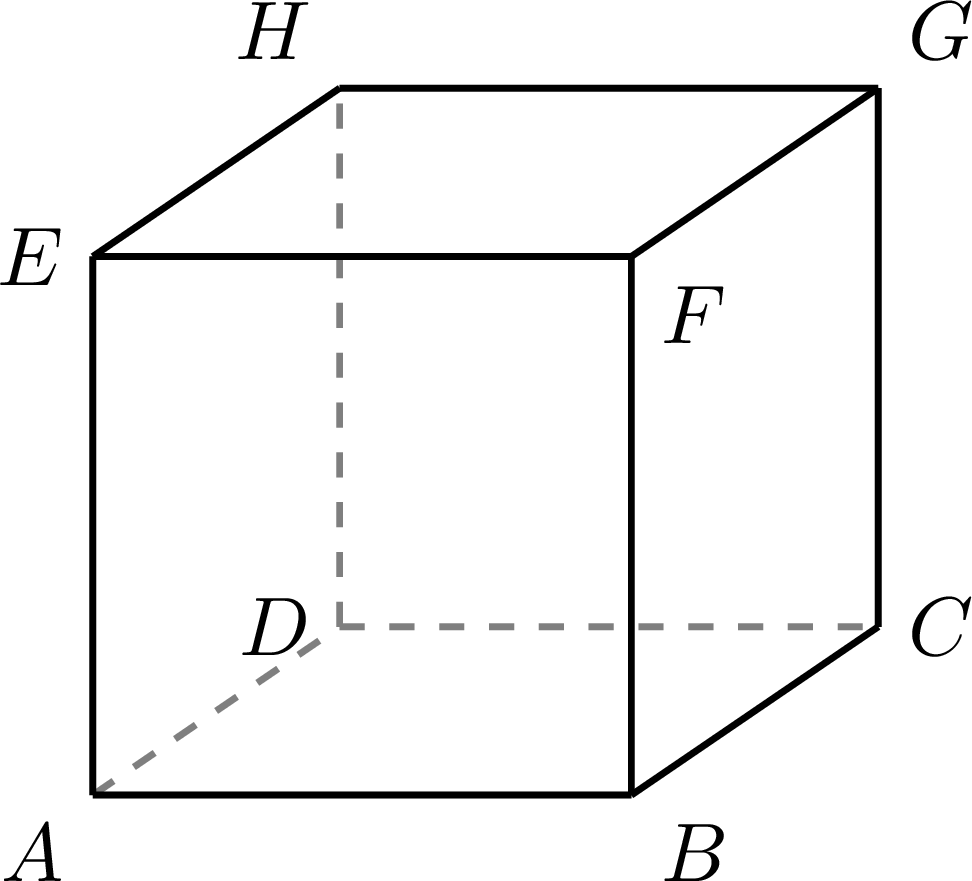
- In the face \(ABCD\), the orthogonal projection of \(C\) onto \((AB)\) is \(B\): \(\Vect{AB} \cdot \Vect{AC} = \Vect{AB} \cdot \Vect{AB} = a^2\).
- The three edges issued from \(A\) are pairwise orthogonal, since the faces are squares: \(\Vect{AB} \cdot \Vect{AD} = \Vect{AB} \cdot \Vect{AE} = \Vect{AD} \cdot \Vect{AE} = 0\), and each has square \(a^2\). With \(\Vect{AG} = \Vect{AB} + \Vect{AD} + \Vect{AE}\): \(\Vect{AB} \cdot \Vect{AG} = \Vect{AB} \cdot \Vect{AB} + \Vect{AB} \cdot \Vect{AD} + \Vect{AB} \cdot \Vect{AE} = a^2\) by bilinearity.
- With \(\Vect{AC} = \Vect{AB} + \Vect{AD}\): \(\Vect{AE} \cdot \Vect{AC} = \Vect{AE} \cdot \Vect{AB} + \Vect{AE} \cdot \Vect{AD} = 0\).
- \(\Vect{AC} \cdot \Vect{AG} = \left(\Vect{AB} + \Vect{AD}\right) \cdot \left(\Vect{AB} + \Vect{AD} + \Vect{AE}\right) = a^2 + a^2 = 2a^2\), the only surviving terms being the two squares.
Proposition — Expressions in an Orthonormal Basis
In an orthonormal basis \((\Vect{i}, \Vect{j}, \Vect{k})\) of space, for \(\Vect{u}(x, y, z)\) and \(\Vect{v}(x', y', z')\): $$\Vect{u} \cdot \Vect{v} = xx' + yy' + zz', \qquad \|\Vect{u}\| = \sqrt{x^2 + y^2 + z^2},$$ and, in an orthonormal coordinate system, the distance between \(A(x_A, y_A, z_A)\) and \(B(x_B, y_B, z_B)\) is $$AB = \sqrt{(x_B - x_A)^2 + (y_B - y_A)^2 + (z_B - z_A)^2}.$$ Convention. In this chapter, coordinates given without further comment are given in an orthonormal basis or coordinate system.
The basis is orthonormal: \(\Vect{i} \cdot \Vect{i} = \Vect{j} \cdot \Vect{j} = \Vect{k} \cdot \Vect{k} = 1\) and \(\Vect{i} \cdot \Vect{j} = \Vect{j} \cdot \Vect{k} = \Vect{k} \cdot \Vect{i} = 0\). By bilinearity, $$\begin{aligned}\Vect{u} \cdot \Vect{v} &= (x\Vect{i} + y\Vect{j} + z\Vect{k}) \cdot (x'\Vect{i} + y'\Vect{j} + z'\Vect{k}) &&\text{(coordinates)}\\
&= xx'\,\Vect{i} \cdot \Vect{i} + yy'\,\Vect{j} \cdot \Vect{j} + zz'\,\Vect{k} \cdot \Vect{k} &&\text{(bilinearity; the six cross terms vanish)}\\
&= xx' + yy' + zz'.\end{aligned}$$ Then \(\|\Vect{u}\|^2 = \Vect{u} \cdot \Vect{u} = x^2 + y^2 + z^2\), and \(AB = \|\Vect{AB}\|\) with \(\Vect{AB}(x_B - x_A, y_B - y_A, z_B - z_A)\).
Example
In an orthonormal basis, \(\Vect{u}(2, -1, 2)\) and \(\Vect{v}(1, 2, -2)\). Are \(\Vect{u}\) and \(\Vect{v}\) orthogonal? If not, give their angle to the nearest \(0.1^\circ\).
$$\begin{aligned}\Vect{u} \cdot \Vect{v} &= 2 \times 1 + (-1) \times 2 + 2 \times (-2) = -4 &&\text{(expression in coordinates)}\end{aligned}$$ The product is not zero: the vectors are not orthogonal. Their norms are \(\|\Vect{u}\| = \sqrt{4 + 1 + 4} = 3\) and \(\|\Vect{v}\| = \sqrt{1 + 4 + 4} = 3\), so $$\cos(\Vect{u}, \Vect{v}) = \frac{\Vect{u} \cdot \Vect{v}}{\|\Vect{u}\|\,\|\Vect{v}\|} = \frac{-4}{9}, \qquad (\Vect{u}, \Vect{v}) \approx 116.4^\circ.$$
Skills to practice
- Recognising Orthogonal Vectors in a Cube
- Calculating Scalar Products in Space
- Calculating an Angle from Coordinates in Space
- Calculating Scalar Products and Angles in Solids
III
The Vector Product
III.1
Definition of the Vector Product
While the scalar product of two vectors results in a scalar, there is a second form of product, defined only in three dimensions, called the vector product or cross product. Given two vectors in three-dimensional space, this operation produces a third vector that is perpendicular to both of the original vectors. The cross product is a fundamental tool in physics (for example, in torque and angular momentum) and in mathematics (for calculating areas, volumes, and describing geometric orientations).
The vector product arises from the problem of finding a vector that is simultaneously perpendicular to two other given vectors. Unlike the scalar product, the vector product is defined exclusively for vectors in three-dimensional space. 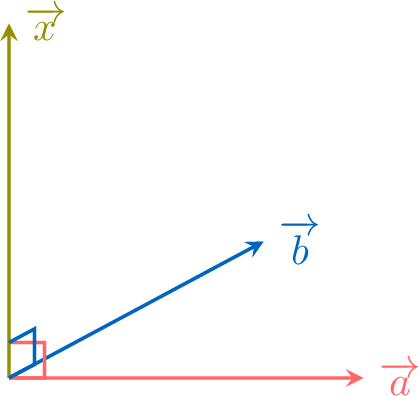
Suppose we want to find a vector \(\Vect{x} = \begin{pmatrix} x \\ y \\ z \end{pmatrix}\) that is perpendicular to both \(\Vect{a} = \begin{pmatrix} a_1 \\ a_2 \\ a_3 \end{pmatrix}\) and \(\Vect{b} = \begin{pmatrix} b_1 \\ b_2 \\ b_3 \end{pmatrix}\). This geometric condition means their scalar products must be zero: $$ \begin{cases} \Vect{a} \cdot \Vect{x} = a_1x + a_2y + a_3z = 0 \\
\Vect{b} \cdot \Vect{x} = b_1x + b_2y + b_3z = 0 \end{cases} $$ By solving this system of linear equations (together with geometric conditions on magnitude and orientation), we can derive the formulas for the components of the vector product.
Definition — Vector (Cross) Product
The vector product of two vectors in space \(\Vect{a} = \begin{pmatrix} a_1 \\ a_2 \\ a_3 \end{pmatrix}\) and \(\Vect{b} = \begin{pmatrix} b_1 \\ b_2 \\ b_3 \end{pmatrix}\) is defined as: $$ \Vect{a} \times \Vect{b} = \begin{pmatrix} a_2b_3 - a_3b_2 \\
a_3b_1 - a_1b_3 \\
a_1b_2 - a_2b_1 \end{pmatrix} $$ The result \(\Vect{a} \times \Vect{b}\) is a vector in three-dimensional space that is perpendicular to both \(\Vect{a}\) and \(\Vect{b}\). 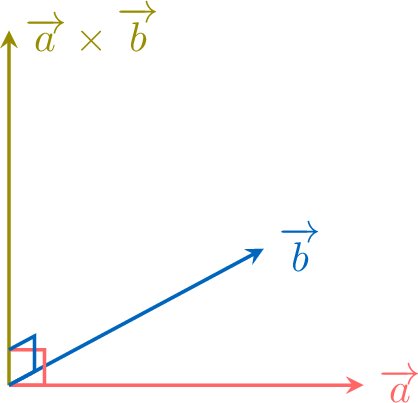
A practical way to remember the formula for the vector product is to express it as a symbolic \(3 \times 3\) determinant using the unit basis vectors \(\Vect{i}\), \(\Vect{j}\), and \(\Vect{k}\): $$ \begin{aligned} \Vect{a} \times \Vect{b} &= \begin{vmatrix} \Vect{i} & \Vect{j} & \Vect{k} \\
a_1 & a_2 & a_3 \\
b_1 & b_2 & b_3 \\
\end{vmatrix} \\
&= \Vect{i} \begin{vmatrix} a_2 & a_3 \\
b_2 & b_3 \end{vmatrix} - \Vect{j} \begin{vmatrix} a_1 & a_3 \\
b_1 & b_3 \end{vmatrix} + \Vect{k} \begin{vmatrix} a_1 & a_2 \\
b_1 & b_2 \end{vmatrix} \\
&= (a_2b_3 - a_3b_2) \Vect{i} - (a_1b_3 - a_3b_1) \Vect{j} + (a_1b_2 - a_2b_1) \Vect{k} \\
&= \begin{pmatrix} a_2b_3 - a_3b_2 \\
a_3b_1 - a_1b_3 \\
a_1b_2 - a_2b_1 \end{pmatrix} \end{aligned} $$
Skills to practice
- Calculating the Vector Product
- Verifying Properties of the Vector Product
III.2
Properties and Geometric Interpretation
Proposition — Right-Hand Rule
The direction of the vector product \(\textcolor{colordef}{\Vect{a}} \times \textcolor{colorprop}{\Vect{b}}\) is determined by the right-hand rule. If you curl the fingers of your right hand in the direction from vector \(\textcolor{colordef}{\Vect{a}}\) to vector \(\textcolor{colorprop}{\Vect{b}}\), your thumb will point in the direction of \(\textcolor{colordef}{\Vect{a}} \times \textcolor{colorprop}{\Vect{b}}\). 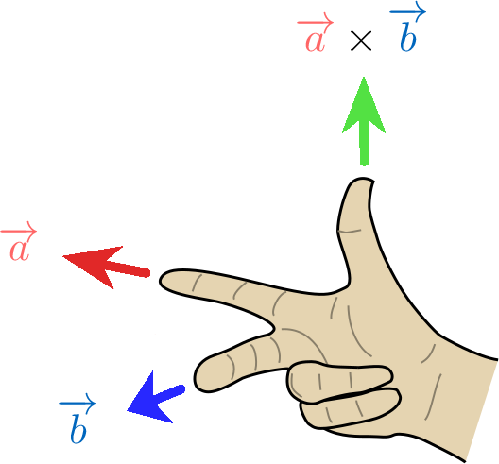
Proposition — Magnitude Formulas
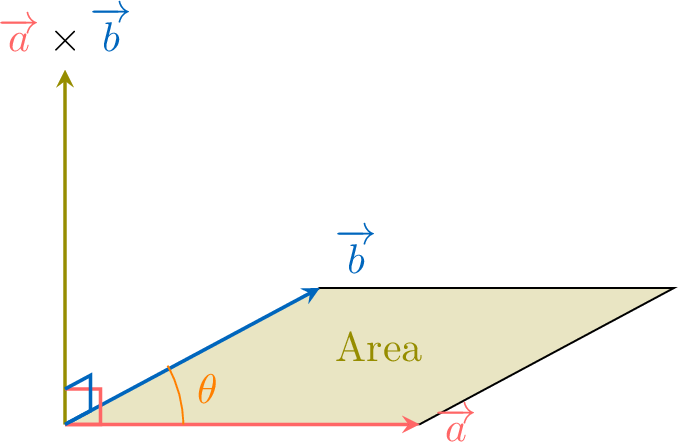
- The magnitude (or length) of the vector product is given by: $$ |\textcolor{colordef}{\Vect{a}} \times \textcolor{colorprop}{\Vect{b}}| = |\textcolor{colordef}{\Vect{a}}|\,|\textcolor{colorprop}{\Vect{b}}| \sin\textcolor{orange}{\theta} $$ where \(\textcolor{orange}{\theta}\) is the angle between vectors \(\textcolor{colordef}{\Vect{a}}\) and \(\textcolor{colorprop}{\Vect{b}}\), with \(0 \le \theta \le \pi\).
- Geometrically, the magnitude of the cross product equals the area of the parallelogram with sides represented by \(\textcolor{colordef}{\Vect{a}}\) and \(\textcolor{colorprop}{\Vect{b}}\): $$ |\textcolor{colordef}{\Vect{a}} \times \textcolor{colorprop}{\Vect{b}}| = \textcolor{olive}{\text{Area}}. $$ Consequently, the area of the triangle formed by \(\textcolor{colordef}{\Vect{a}}\) and \(\textcolor{colorprop}{\Vect{b}}\) is \(\dfrac12 |\textcolor{colordef}{\Vect{a}} \times \textcolor{colorprop}{\Vect{b}}|\).
The magnitude \(|\Vect{v}|\) of the statement is also written \(\|\Vect{v}\|\). Write \(\Vect{a} = \begin{pmatrix} a_1 \\ a_2 \\ a_3 \end{pmatrix}\) and \(\Vect{b} = \begin{pmatrix} b_1 \\ b_2 \\ b_3 \end{pmatrix}\).
- An identity. In the product \(\|\Vect{a}\|^2\|\Vect{b}\|^2 = \left(a_1^2 + a_2^2 + a_3^2\right)\left(b_1^2 + b_2^2 + b_3^2\right)\), the three terms \(a_i^2b_i^2\) also appear in \((\Vect{a} \cdot \Vect{b})^2 = (a_1b_1 + a_2b_2 + a_3b_3)^2\) and cancel in the difference: $$\begin{aligned}[t] \|\Vect{a}\|^2\|\Vect{b}\|^2 - (\Vect{a} \cdot \Vect{b})^2 &= \left(a_2^2b_3^2 + a_3^2b_2^2 - 2a_2b_3a_3b_2\right) + \left(a_3^2b_1^2 + a_1^2b_3^2 - 2a_3b_1a_1b_3\right) \\ &\quad + \left(a_1^2b_2^2 + a_2^2b_1^2 - 2a_1b_2a_2b_1\right) \\ &= (a_2b_3 - a_3b_2)^2 + (a_3b_1 - a_1b_3)^2 + (a_1b_2 - a_2b_1)^2 \\ &= \|\Vect{a} \times \Vect{b}\|^2 && \text{(definition of \(\Vect{a} \times \Vect{b}\))}. \end{aligned}$$
- The magnitude. The angle \(\theta\) is defined for non-zero vectors, which the formula concerns; when \(\Vect{a}\) or \(\Vect{b}\) is the zero vector, \(\Vect{a} \times \Vect{b} = \Vect{0}\) and the parallelogram is flat, of area \(0\). For non-zero vectors, \(\Vect{a} \cdot \Vect{b} = \|\Vect{a}\|\,\|\Vect{b}\|\cos\theta\), so $$\begin{aligned}[t] \|\Vect{a} \times \Vect{b}\|^2 &= \|\Vect{a}\|^2\|\Vect{b}\|^2 - \|\Vect{a}\|^2\|\Vect{b}\|^2\cos^2\theta \\ &= \|\Vect{a}\|^2\|\Vect{b}\|^2\sin^2\theta && \text{(\(\cos^2\theta + \sin^2\theta = 1\))}, \end{aligned}$$ and \(\sin\theta \geq 0\) for \(0 \leq \theta \leq \pi\): \(\|\Vect{a} \times \Vect{b}\| = \|\Vect{a}\|\,\|\Vect{b}\|\sin\theta\).
- The areas. In the parallelogram with sides represented by \(\Vect{a}\) and \(\Vect{b}\), take the side of length \(\|\Vect{a}\|\) as base: the height is \(\|\Vect{b}\|\sin\theta\). When \(\theta\) is acute, it is the side opposite \(\theta\) in a right-angled triangle whose hypotenuse has length \(\|\Vect{b}\|\); when \(\theta\) is obtuse, the same triangle has the angle \(\pi - \theta\), and \(\sin(\pi - \theta) = \sin\theta\); when \(\theta = \frac{\pi}{2}\), the height is \(\|\Vect{b}\| = \|\Vect{b}\|\sin\frac{\pi}{2}\). The area is \(\|\Vect{a}\|\,\|\Vect{b}\|\sin\theta = \|\Vect{a} \times \Vect{b}\|\). A diagonal cuts the parallelogram into two congruent triangles, each of area \(\frac{1}{2}\|\Vect{a} \times \Vect{b}\|\).
Proposition — Properties of the Vector Product
For all vectors \(\Vect{a}\), \(\Vect{b}\), \(\Vect{c}\) of space and every real number \(k\): - Anticommutativity: \(\Vect{b} \times \Vect{a} = -\left(\Vect{a} \times \Vect{b}\right)\).
- Distributivity: \(\Vect{a} \times \left(\Vect{b} + \Vect{c}\right) = \Vect{a} \times \Vect{b} + \Vect{a} \times \Vect{c}\) and \(\left(\Vect{a} + \Vect{b}\right) \times \Vect{c} = \Vect{a} \times \Vect{c} + \Vect{b} \times \Vect{c}\).
- Scalars: \(\left(k\Vect{a}\right) \times \Vect{b} = \Vect{a} \times \left(k\Vect{b}\right) = k\left(\Vect{a} \times \Vect{b}\right)\).
- \(\Vect{a} \times \Vect{a} = \Vect{0}\).
- \(\Vect{a} \cdot \left(\Vect{a} \times \Vect{b}\right) = 0\) and \(\Vect{b} \cdot \left(\Vect{a} \times \Vect{b}\right) = 0\): the vector \(\Vect{a} \times \Vect{b}\) is orthogonal to \(\Vect{a}\) and to \(\Vect{b}\).
- For non-zero vectors \(\Vect{a}\) and \(\Vect{b}\): \(\Vect{a} \times \Vect{b} = \Vect{0}\) if and only if \(\Vect{a}\) and \(\Vect{b}\) are parallel.
Write \(\Vect{a} = \begin{pmatrix} a_1 \\ a_2 \\ a_3 \end{pmatrix}\), \(\Vect{b} = \begin{pmatrix} b_1 \\ b_2 \\ b_3 \end{pmatrix}\), \(\Vect{c} = \begin{pmatrix} c_1 \\ c_2 \\ c_3 \end{pmatrix}\), and use the definition of the vector product component by component.
- Exchanging \(\Vect{a}\) and \(\Vect{b}\) turns the first component \(a_2b_3 - a_3b_2\) into \(b_2a_3 - b_3a_2 = -(a_2b_3 - a_3b_2)\), and likewise for the two others: \(\Vect{b} \times \Vect{a} = -\left(\Vect{a} \times \Vect{b}\right)\).
- The first component of \(\Vect{a} \times \left(\Vect{b} + \Vect{c}\right)\) is $$a_2(b_3 + c_3) - a_3(b_2 + c_2) = (a_2b_3 - a_3b_2) + (a_2c_3 - a_3c_2),$$ the first component of \(\Vect{a} \times \Vect{b} + \Vect{a} \times \Vect{c}\); the two others are treated in the same way. For the second equality: $$\begin{aligned}[t] \left(\Vect{a} + \Vect{b}\right) \times \Vect{c} &= -\Vect{c} \times \left(\Vect{a} + \Vect{b}\right) && \text{(property 1)} \\ &= -\Vect{c} \times \Vect{a} - \Vect{c} \times \Vect{b} && \text{(first equality)} \\ &= \Vect{a} \times \Vect{c} + \Vect{b} \times \Vect{c} && \text{(property 1)}. \end{aligned}$$
- Each component of \(\left(k\Vect{a}\right) \times \Vect{b}\) and of \(\Vect{a} \times \left(k\Vect{b}\right)\) is \(k\) times the corresponding component of \(\Vect{a} \times \Vect{b}\), for instance \((ka_2)b_3 - (ka_3)b_2 = a_2(kb_3) - a_3(kb_2) = k(a_2b_3 - a_3b_2)\).
- By property 1 with \(\Vect{b} = \Vect{a}\): \(\Vect{a} \times \Vect{a} = -\left(\Vect{a} \times \Vect{a}\right)\), so \(2\left(\Vect{a} \times \Vect{a}\right) = \Vect{0}\) and \(\Vect{a} \times \Vect{a} = \Vect{0}\).
- The terms cancel in pairs: $$\begin{aligned}[t] \Vect{a} \cdot \left(\Vect{a} \times \Vect{b}\right) &= a_1(a_2b_3 - a_3b_2) + a_2(a_3b_1 - a_1b_3) + a_3(a_1b_2 - a_2b_1) \\ &= a_1a_2b_3 - a_1a_3b_2 + a_2a_3b_1 - a_1a_2b_3 + a_1a_3b_2 - a_2a_3b_1 \\ &= 0, \end{aligned}$$ and in the same way \(\Vect{b} \cdot \left(\Vect{a} \times \Vect{b}\right) = b_1(a_2b_3 - a_3b_2) + b_2(a_3b_1 - a_1b_3) + b_3(a_1b_2 - a_2b_1) = 0\). A zero scalar product means orthogonal vectors.
- Let \(\theta\) be the angle between the non-zero vectors \(\Vect{a}\) and \(\Vect{b}\). By the magnitude formula (the Proposition “Magnitude Formulas”), \(\|\Vect{a} \times \Vect{b}\| = \|\Vect{a}\|\,\|\Vect{b}\|\sin\theta\) with \(\|\Vect{a}\| \neq 0\) and \(\|\Vect{b}\| \neq 0\), so $$\Vect{a} \times \Vect{b} = \Vect{0} \iff \sin\theta = 0 \iff \theta = 0 \text{ or } \theta = \pi,$$ that is, \(\Vect{a}\) and \(\Vect{b}\) have the same direction, with the same sense or the opposite sense: they are parallel.
Example
Let \(\Vect{a}\) and \(\Vect{b}\) be vectors of space. - Simplify \(\left(\Vect{a} + \Vect{b}\right) \times \left(\Vect{a} - \Vect{b}\right)\).
- Deduce \(\left(\Vect{a} + \Vect{b}\right) \times \left(\Vect{a} - \Vect{b}\right)\) when \(\Vect{a} \times \Vect{b} = \begin{pmatrix} 1 \\ -2 \\ 4 \end{pmatrix}\).
- $$\begin{aligned}[t] \left(\Vect{a} + \Vect{b}\right) \times \left(\Vect{a} - \Vect{b}\right) &= \Vect{a} \times \Vect{a} - \Vect{a} \times \Vect{b} + \Vect{b} \times \Vect{a} - \Vect{b} \times \Vect{b} && \text{(distributivity, scalars)} \\ &= \Vect{0} - \Vect{a} \times \Vect{b} - \Vect{a} \times \Vect{b} - \Vect{0} && \text{(\(\Vect{v} \times \Vect{v} = \Vect{0}\), anticommutativity)} \\ &= -2\left(\Vect{a} \times \Vect{b}\right). \end{aligned}$$ Unlike \((x + y)(x - y) = x^2 - y^2\) for numbers, the two middle terms do not cancel: they are equal.
- \(\left(\Vect{a} + \Vect{b}\right) \times \left(\Vect{a} - \Vect{b}\right) = -2\begin{pmatrix} 1 \\ -2 \\ 4 \end{pmatrix} = \begin{pmatrix} -2 \\ 4 \\ -8 \end{pmatrix}\).
Example
Let \(\Vect{u} = \begin{pmatrix} 2 \\ -4 \\ 6 \end{pmatrix}\), \(\Vect{v} = \begin{pmatrix} -3 \\ 6 \\ -9 \end{pmatrix}\) and \(\Vect{w} = \begin{pmatrix} 1 \\ -2 \\ 4 \end{pmatrix}\). Use the vector product to decide whether \(\Vect{u}\) and \(\Vect{v}\) are parallel, and whether \(\Vect{u}\) and \(\Vect{w}\) are parallel.
$$\Vect{u} \times \Vect{v} = \begin{pmatrix} (-4)(-9) - 6 \times 6 \\
6 \times (-3) - 2 \times (-9) \\
2 \times 6 - (-4)(-3) \end{pmatrix} = \begin{pmatrix} 36 - 36 \\
-18 + 18 \\
12 - 12 \end{pmatrix} = \Vect{0}.$$ The vectors \(\Vect{u}\) and \(\Vect{v}\) are non-zero, so they are parallel: indeed \(\Vect{v} = -\frac{3}{2}\Vect{u}\). $$\Vect{u} \times \Vect{w} = \begin{pmatrix} (-4) \times 4 - 6 \times (-2) \\
6 \times 1 - 2 \times 4 \\
2 \times (-2) - (-4) \times 1 \end{pmatrix} = \begin{pmatrix} -4 \\
-2 \\
0 \end{pmatrix} \neq \Vect{0},$$ so \(\Vect{u}\) and \(\Vect{w}\) are not parallel, although their first two components are proportional: the test uses all three components at once.
Method — Vector Products with Technology
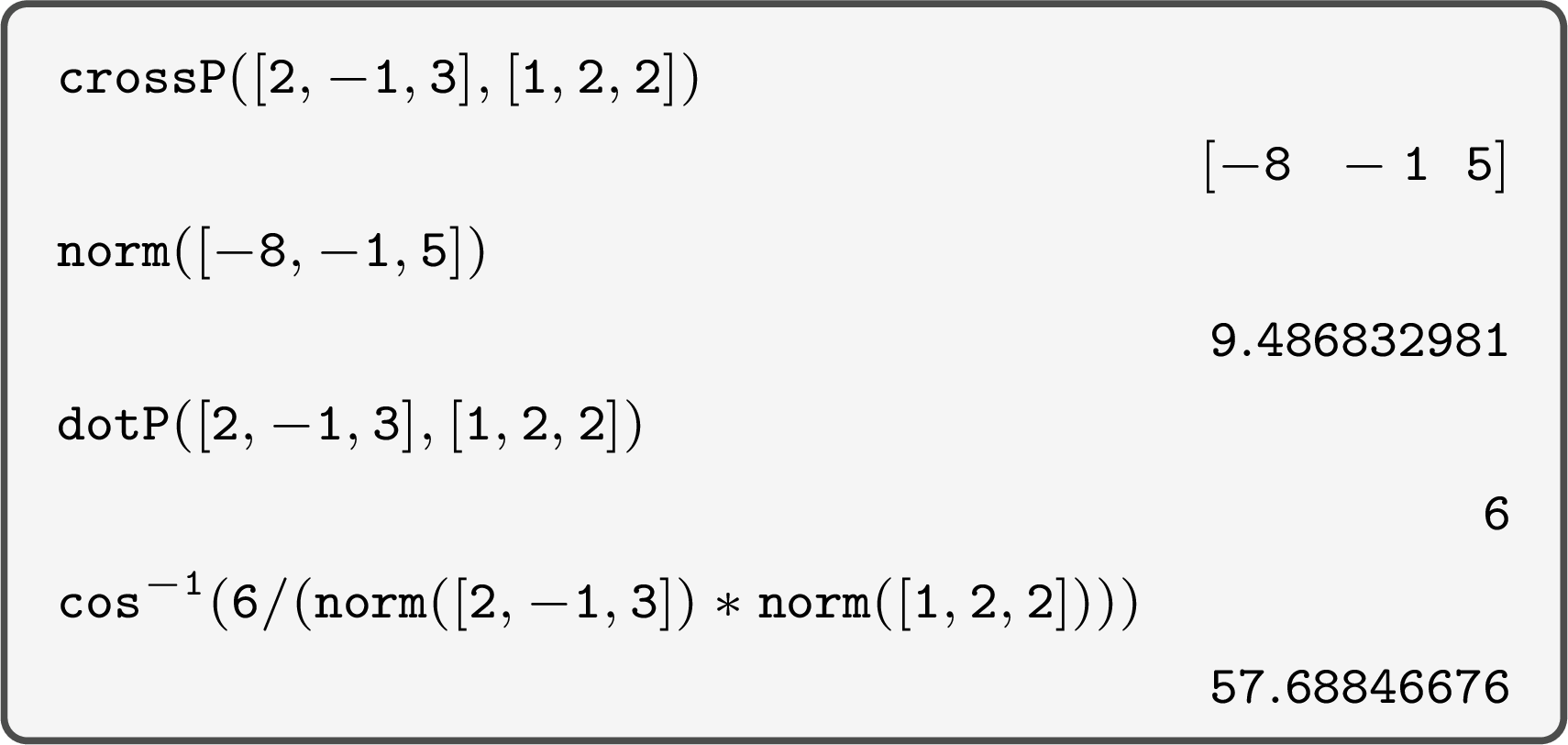
To compute with vectors on a graphing calculator: - Enter each vector as the list of its components between square brackets, for instance \([2, -1, 3]\), from the vector (or matrix) menu.
- Use the vector commands, whose names depend on the model:
dotPfor the scalar product,crossPfor the vector product,normfor the magnitude. An angle is \(\cos^{-1}\left(\dfrac{\Vect{a} \cdot \Vect{b}}{\|\Vect{a}\|\,\|\Vect{b}\|}\right)\), with the calculator in degree mode, or in radian mode when radians are asked. - Write the formula before the value, then report the value read on the screen to 3 significant figures (angles to \(0.1^\circ\)) unless the question asks for another accuracy; keep the unrounded values in the calculator for the next steps.
Skills to practice
- Applying the Right-Hand Rule
- Recognising Properties of the Vector Product
- Using the Properties of the Vector Product
- Calculating Areas with the Vector Product
- Proving with the Properties of the Vector Product
IV
Going further
Skills to practice
- Calculating Areas and Lengths with Technology
- Diagnosing and Correcting Errors
- Proving Geometric Properties with Vectors
- Solving Problems
- Quiz
Jump to section