International Baccalaureate · DP 1: Analysis and Approaches HL
Further Functions
I
Even, Odd and Self-Inverse Functions
I.1
Even and Odd Functions
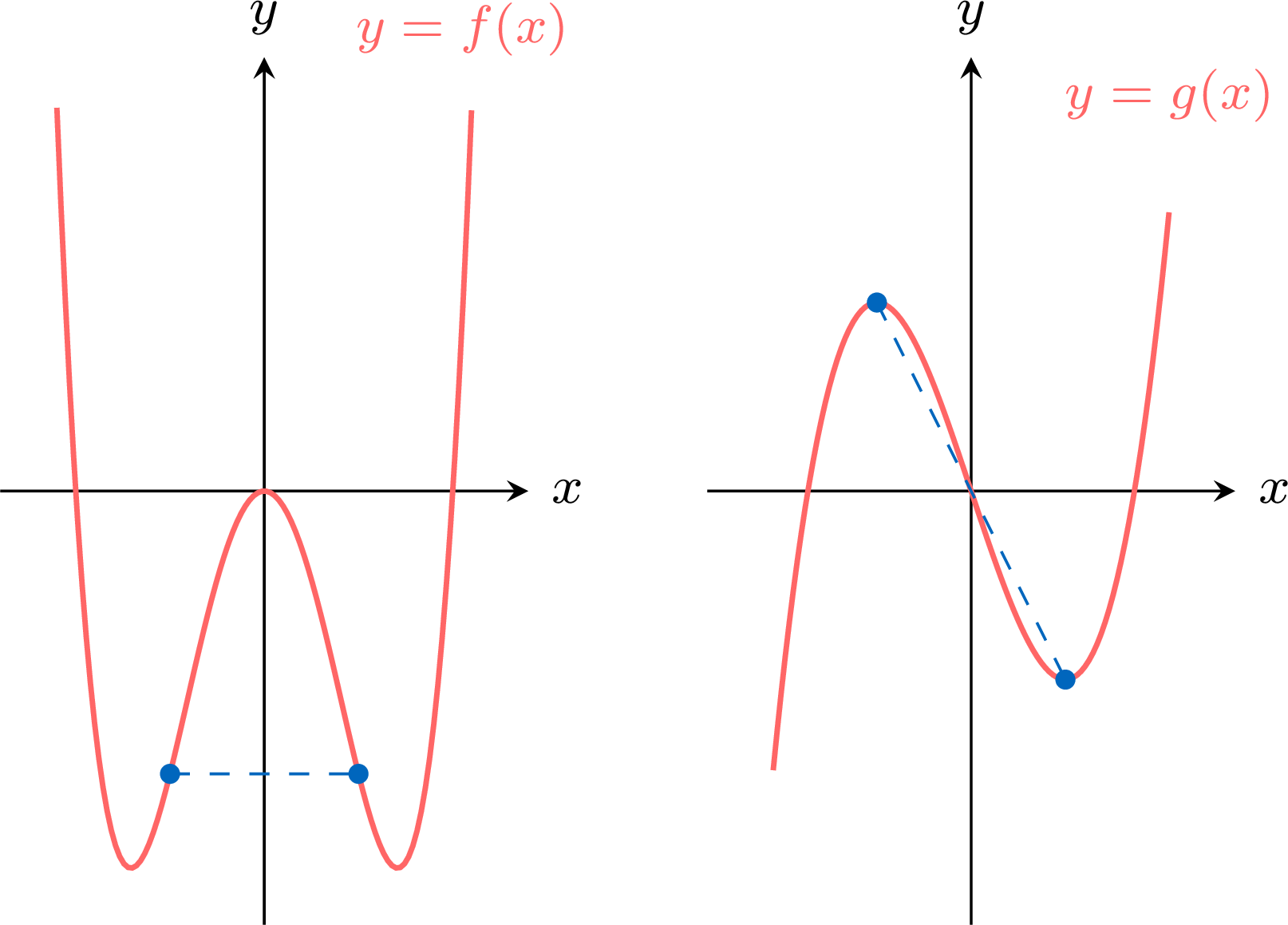
Three functions are defined on \(\R\) by $$f(x) = x^4 - 4x^2, \qquad g(x) = x^3 - 3x \qquad \text{and} \qquad h(x) = x^2 - 2x.$$
- Compute \(f(1)\), \(f(-1)\), \(f(3)\), \(f(-3)\), then \(g(1)\), \(g(-1)\), \(g(3)\), \(g(-3)\), then \(h(1)\), \(h(-1)\), \(h(3)\), \(h(-3)\).
- For each function, compare the value at a number and the value at its opposite. What can be noticed?
- The point \((3, 45)\) lies on the curve of \(f\), and the point \((3, 18)\) on the curve of \(g\). Which other point of each curve can be deduced without any computation? What symmetry of each curve does this suggest?
- \(f(1) = 1 - 4 = -3\) and \(f(-1) = 1 - 4 = -3\); \(f(3) = 81 - 36 = 45\) and \(f(-3) = 81 - 36 = 45\).
\(g(1) = 1 - 3 = -2\) and \(g(-1) = -1 + 3 = 2\); \(g(3) = 27 - 9 = 18\) and \(g(-3) = -27 + 9 = -18\).
\(h(1) = 1 - 2 = -1\) and \(h(-1) = 1 + 2 = 3\); \(h(3) = 9 - 6 = 3\) and \(h(-3) = 9 + 6 = 15\). - The function \(f\) takes the same value at a number and at its opposite; the function \(g\) takes opposite values; the function \(h\) does neither: \(h(-1) = 3\) is neither \(h(1) = -1\) nor \(-h(1) = 1\). For every real \(x\), \((-x)^4 = x^4\) and \((-x)^2 = x^2\), so \(f(-x) = f(x)\); and \((-x)^3 = -x^3\), so \(g(-x) = -x^3 + 3x = -g(x)\).
- Since \(f(-3) = f(3)\), the point \((-3, 45)\) is also on the curve of \(f\): it is the image of \((3, 45)\) under the reflection in the \(y\)-axis. Since \(g(-3) = -g(3)\), the point \((-3, -18)\) is also on the curve of \(g\): it is the image of \((3, 18)\) under the half-turn about the origin. This suggests that the curve of \(f\) is symmetric about the \(y\)-axis and that the curve of \(g\) is symmetric about the origin. Functions that behave like \(f\) are called even, functions that behave like \(g\) are called odd.
Definition — Even Function
Let \(f\) be a function defined on a set \(D\) such that for every \(x\) in \(D\), the number \(-x\) also belongs to \(D\). The function \(f\) is even when, for every \(x\) in \(D\): $$f(-x) = f(x)$$ Graphical interpretation: the curve of an even function is symmetric about the \(y\)-axis. 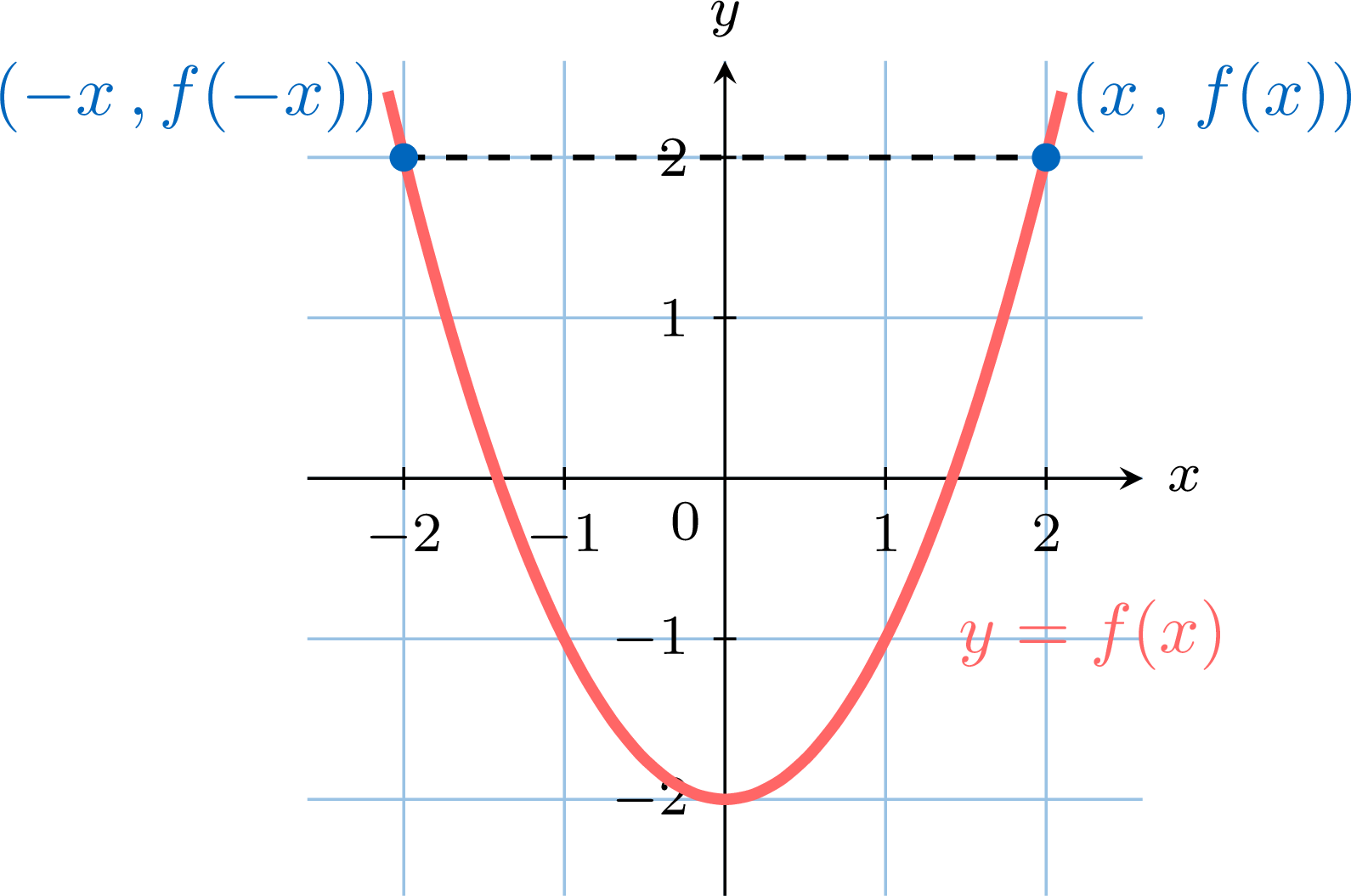
Definition — Odd Function
Let \(f\) be a function defined on a set \(D\) such that for every \(x\) in \(D\), the number \(-x\) also belongs to \(D\). The function \(f\) is odd when, for every \(x\) in \(D\): $$f(-x) = -f(x)$$ Graphical interpretation: the curve of an odd function is symmetric about the origin \(O\). 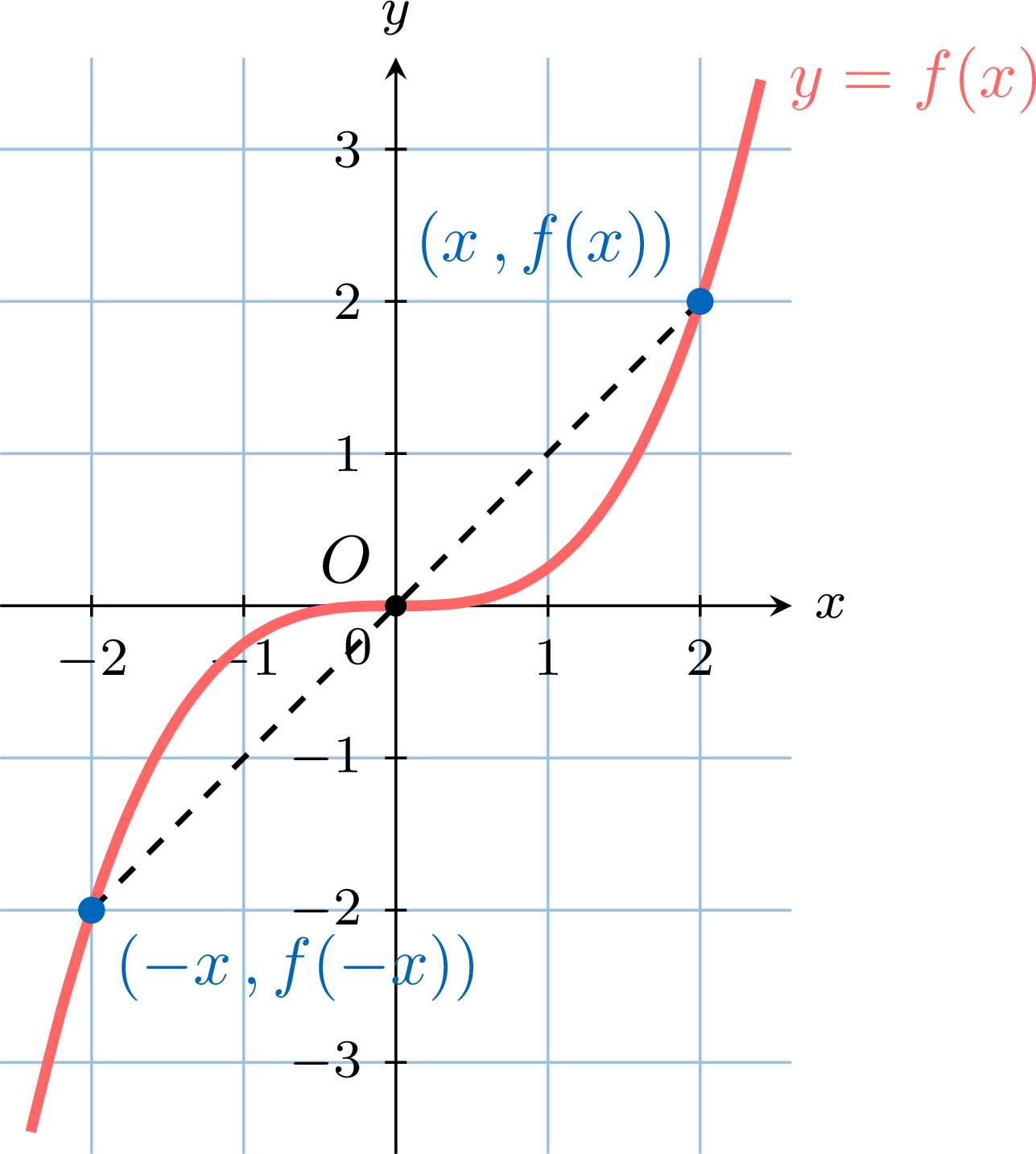
Method — Testing Parity Algebraically
- Check that the domain \(D\) is symmetric about \(0\): for every \(x\) in \(D\), \(-x\) is also in \(D\).
- Compute \(f(-x)\), replacing \(x\) by \(-x\) in the formula, and simplify.
- Compare the result with \(f(x)\) and with \(-f(x)\):
- if \(f(-x) = f(x)\) for every \(x\) in \(D\), then \(f\) is even;
- if \(f(-x) = -f(x)\) for every \(x\) in \(D\), then \(f\) is odd;
- otherwise, exhibit a value \(x_1\) such that \(f(-x_1) \neq f(x_1)\) (so \(f\) is not even) and a value \(x_2\) such that \(f(-x_2) \neq -f(x_2)\) (so \(f\) is not odd): the function \(f\) is neither even nor odd. One single value often does both jobs.
Example
Study the parity of the function \(h\) defined on \(\R\) by \(h(x) = x^2 + x\).
The function \(h\) is defined on \(\R\), which is symmetric about \(0\). For every real \(x\): $$h(-x) = (-x)^2 + (-x) = x^2 - x$$ We test one value: \(h(1) = 2\) and \(h(-1) = 0\).
Since \(h(-1) \neq h(1)\) and \(h(-1) \neq -h(1)\), the function \(h\) is neither even nor odd.
Since \(h(-1) \neq h(1)\) and \(h(-1) \neq -h(1)\), the function \(h\) is neither even nor odd.
Back to the reference functions: the square function is even, the cube and reciprocal functions are odd, and the square root function is neither even nor odd — its domain \([0, +\infty)\) is not symmetric about \(0\), so the parity test cannot even be set up.
Proposition — Sums and Products of Even and Odd Functions
Let \(f\) and \(g\) be two functions defined on the same set \(D\), symmetric about \(0\), and let \(s\) and \(p\) be the functions defined on \(D\) by $$s(x) = f(x) + g(x) \qquad \text{and} \qquad p(x) = f(x)\,g(x).$$ - Sums: if \(f\) and \(g\) are both even, \(s\) is even; if \(f\) and \(g\) are both odd, \(s\) is odd.
- Products: if \(f\) and \(g\) are both even or both odd, \(p\) is even; if one of them is even and the other one odd, \(p\) is odd.
Let \(x\) be a number of \(D\); since \(D\) is symmetric about \(0\), the number \(-x\) also belongs to \(D\).
- Sums. If \(f\) and \(g\) are even: $$\begin{aligned}[t] s(-x) &= f(-x) + g(-x) && \text{(definition of } s\text{)} \\ &= f(x) + g(x) && (f \text{ and } g \text{ even}) \\ &= s(x). \end{aligned}$$ If \(f\) and \(g\) are odd: $$\begin{aligned}[t] s(-x) &= f(-x) + g(-x) && \text{(definition of } s\text{)} \\ &= -f(x) - g(x) && (f \text{ and } g \text{ odd}) \\ &= -\big(f(x) + g(x)\big) && \text{(factor out } -1\text{)} \\ &= -s(x). \end{aligned}$$
- Products. If \(f\) and \(g\) are even, \(p(-x) = f(-x)\,g(-x) = f(x)\,g(x) = p(x)\). If \(f\) and \(g\) are odd: $$\begin{aligned}[t] p(-x) &= f(-x)\,g(-x) && \text{(definition of } p\text{)} \\ &= \big(-f(x)\big)\big(-g(x)\big) && (f \text{ and } g \text{ odd}) \\ &= f(x)\,g(x) && \text{(rule of signs)} \\ &= p(x). \end{aligned}$$ If \(f\) is even and \(g\) is odd (the other case is the same with the roles swapped): $$\begin{aligned}[t] p(-x) &= f(-x)\,g(-x) && \text{(definition of } p\text{)} \\ &= f(x)\big(-g(x)\big) && (f \text{ even, } g \text{ odd}) \\ &= -p(x). \end{aligned}$$
Example
Study the parity of each function on its domain. - \(f(x) = \dfrac{x^3 - 4x}{x^2 - 1}\)
- \(g(x) = \dfrac{x^2}{x - 2}\)
- The denominator \(x^2 - 1\) is zero for \(x = -1\) and \(x = 1\): the domain is \(D_f = \R \setminus \{-1, 1\}\). The two excluded values are opposite, so \(D_f\) is symmetric about \(0\). For every \(x\) in \(D_f\): $$\begin{aligned}[t] f(-x) &= \frac{(-x)^3 - 4(-x)}{(-x)^2 - 1} && \text{(replace } x \text{ by } -x\text{)} \\ &= \frac{-x^3 + 4x}{x^2 - 1} && \big((-x)^3 = -x^3,\ (-x)^2 = x^2\big) \\ &= -\frac{x^3 - 4x}{x^2 - 1} && \text{(factor out } -1\text{)} \\ &= -f(x). \end{aligned}$$ The function \(f\) is odd.
- The denominator \(x - 2\) is zero for \(x = 2\): the domain is \(D_g = \R \setminus \{2\}\). The number \(-2\) belongs to \(D_g\), but its opposite \(2\) does not: \(D_g\) is not symmetric about \(0\), so the test \(g(-x) = \pm g(x)\) cannot even be written for \(x = -2\). The function \(g\) is neither even nor odd.
Example
Without expanding, study the parity of the functions \(h\) and \(k\) defined on \(\R\) by $$h(x) = x^3\left(x^2 + 5\right) \qquad \text{and} \qquad k(x) = \left(x^3 - x\right)\left(x^5 + 2x\right).$$
Each factor is studied on its own, then the Proposition “Sums and Products of Even and Odd Functions” is applied.
- The function \(h\). The cube function \(x \mapsto x^3\) is odd. The function \(x \mapsto x^2 + 5\) is the sum of the even function \(x \mapsto x^2\) and of the constant function \(x \mapsto 5\), which is even since its value at \(-x\) equals its value at \(x\): it is even. So \(h\) is the product of an odd function and an even function: \(h\) is odd.
- The function \(k\). Since \((-x)^3 = -x^3\) and \((-x)^5 = -x^5\), the functions \(x \mapsto x^3\), \(x \mapsto x^5\), \(x \mapsto -x\) and \(x \mapsto 2x\) are odd. As sums of two odd functions, \(x \mapsto x^3 - x\) and \(x \mapsto x^5 + 2x\) are odd. So \(k\) is the product of two odd functions: \(k\) is even.
Example
Let \(a\) be a real number and \(f\) the function defined on \(\R\) by \(f(x) = (x + a)\left(x^2 - 3x\right)\). Find the value of \(a\) for which \(f\) is odd.
The set \(\R\) is symmetric about \(0\). Expanding: $$\begin{aligned}[t] f(x) &= x^3 - 3x^2 + ax^2 - 3ax && \text{(expand)} \\
&= x^3 + (a - 3)x^2 - 3ax, && \text{(collect the terms in } x^2\text{)} \end{aligned}$$ so \(f(-x) = -x^3 + (a - 3)x^2 + 3ax\) and $$f(-x) + f(x) = 2(a - 3)x^2.$$ The function \(f\) is odd when \(f(-x) = -f(x)\), that is \(f(-x) + f(x) = 0\), for every real \(x\).
Check: \(f(x) = (x + 3)\left(x^2 - 3x\right) = x(x + 3)(x - 3) = x^3 - 9x\), a sum of two odd functions.
- A necessary condition. For \(x = 1\), the sum \(f(-1) + f(1)\) equals \(2(a - 3)\): it must be \(0\), so \(a = 3\).
- The converse. For \(a = 3\), \(f(-x) + f(x) = 2 \times 0 \times x^2 = 0\) for every real \(x\): \(f\) is odd.
Check: \(f(x) = (x + 3)\left(x^2 - 3x\right) = x(x + 3)(x - 3) = x^3 - 9x\), a sum of two odd functions.
Skills to practice
- Finding a Parameter from the Parity
- Proving and Using Parity Properties
I.2
Self-Inverse Functions
Three functions are defined by \(f(x) = 6 - x\) for every real \(x\), \(g(x) = \dfrac{12}{x}\) for \(x \neq 0\), and \(h(x) = 2x\) for every real \(x\).
- Compute \(f\big(f(1)\big)\), \(f\big(f(4)\big)\) and \(f\big(f(-3)\big)\).
- Compute \(g\big(g(3)\big)\) and \(g\big(g(-2)\big)\).
- Compute \(h\big(h(5)\big)\).
- Which of the three functions, applied twice, bring every input back to itself? Justify with a general \(x\).
- \(f(1) = 5\) and \(f(5) = 1\), so \(f\big(f(1)\big) = 1\). In the same way, \(f(4) = 2\) and \(f(2) = 4\); \(f(-3) = 9\) and \(f(9) = -3\). Each input comes back.
- \(g(3) = 4\) and \(g(4) = 3\), so \(g\big(g(3)\big) = 3\); \(g(-2) = -6\) and \(g(-6) = -2\), so \(g\big(g(-2)\big) = -2\).
- \(h(5) = 10\) and \(h(10) = 20\): \(h\big(h(5)\big) = 20 \neq 5\).
- For every real \(x\): $$\begin{aligned}[t] f\big(f(x)\big) &= 6 - (6 - x) && \text{(definition of } f\text{)} \\ &= x. \end{aligned}$$ For \(x \neq 0\), \(g(x) = \dfrac{12}{x}\) is not \(0\), and $$\begin{aligned}[t] g\big(g(x)\big) &= \frac{12}{\frac{12}{x}} && \text{(definition of } g\text{)} \\ &= x. \end{aligned}$$ But \(h\big(h(x)\big) = 2 \times 2x = 4x\), which equals \(x\) only for \(x = 0\). So \(f\) and \(g\) undo themselves: each one is its own inverse function, while \(h\) is undone by \(x \mapsto \dfrac{x}{2}\), not by itself. On the graph of \(f\), the points \((1, 5)\) and \((5, 1)\) are reflections of each other in the line \(y = x\).
Definition — Self-Inverse Function
Let \(X\) be a set of real numbers and \(f : X \to X\) a function whose values all lie in \(X\). The function \(f\) is self-inverse, or an involution, when it is bijective and equal to its own inverse function: $$f^{-1} = f.$$ Applying \(f\) twice then brings every input back to itself: \(f\big(f(x)\big) = x\) for every \(x\) in \(X\).For example, \(x \mapsto -x\) and \(x \mapsto 6 - x\) are self-inverse on \(\mathbb{R}\), and for \(k \neq 0\) the function \(x \mapsto \dfrac{k}{x}\) is self-inverse on \(\mathbb{R} \setminus \{0\}\). The function \(x \mapsto x + 1\) is not: applying it twice adds \(2\).
Proposition — Recognising a Self-Inverse Function
Let \(X\) be a set of real numbers and \(f : X \to X\) a function whose values all lie in \(X\). The three statements below are equivalent: - \(f\) is self-inverse;
- \(f\big(f(x)\big) = x\) for every \(x\) in \(X\), that is, \((f \circ f)(x) = x\): \(f \circ f\) is the identity of \(X\);
- the graph of \(f\) is symmetric about the line \(y = x\): whenever the point \((a, b)\) lies on the graph of \(f\), the point \((b, a)\) lies on it too.
- 1 implies 2. If \(f^{-1} = f\), the Definition “Inverse Function” gives \(\left(f^{-1} \circ f\right)(x) = x\) for every \(x\) in \(X\), that is \(f\big(f(x)\big) = x\).
- 2 implies 1. Suppose that \(f\big(f(x)\big) = x\) for every \(x\) in \(X\).
- \(f\) is injective: if \(f(a) = f(b)\), then \(a = f\big(f(a)\big) = f\big(f(b)\big) = b\).
- \(f\) is surjective onto \(X\): every \(y\) in \(X\) satisfies \(y = f\big(f(y)\big)\), so \(y\) is the image of the number \(f(y)\), which lies in \(X\).
- 2 is equivalent to 3. A point \((a, b)\) lies on the graph of \(f\) exactly when \(a\) belongs to \(X\) and \(b = f(a)\). If statement 2 holds and \(b = f(a)\), then \(b\) belongs to \(X\) and \(f(b) = f\big(f(a)\big) = a\): the point \((b, a)\) lies on the graph. Conversely, if statement 3 holds, for every \(a\) in \(X\) the point \(\big(a, f(a)\big)\) lies on the graph, so the point \(\big(f(a), a\big)\) does too, that is \(f\big(f(a)\big) = a\).
Method — Showing that a Function Is Self-Inverse
Let \(f\) be a function defined on a set \(X\). - Check that \(f\) maps \(X\) into \(X\): every value \(f(x)\) belongs to \(X\). For a quotient, check that \(f(x)\) never equals a value excluded from \(X\).
- Compute \(f\big(f(x)\big)\) and simplify it to \(x\) for every \(x\) in \(X\). Another route: find \(f^{-1}\) with the Method “Finding the Inverse Function” and check that \(f^{-1}(x) = f(x)\), with the same domain.
- Check on the graph: it is symmetric about the line \(y = x\).
To show that \(f\) is not self-inverse, one value is enough: a number \(a\) of \(X\) such that \(f\big(f(a)\big) \neq a\).
Example
Show that each function is self-inverse. - \(f(x) = 6 - x\), on \(\mathbb{R}\)
- \(g(x) = \dfrac{2x + 3}{x - 2}\), on \(\mathbb{R} \setminus \{2\}\)
- The values of \(f\) are real numbers, and for every real \(x\), \(f\big(f(x)\big) = 6 - (6 - x) = x\): \(f\) is self-inverse. Its graph is the line of gradient \(-1\) through \((0, 6)\), perpendicular to the line \(y = x\) and symmetric about it.
- Values in \(\mathbb{R} \setminus \{2\}\). The equation \(g(x) = 2\) gives \(2x + 3 = 2(x - 2)\), that is \(3 = -4\): it has no solution, so \(g(x) \neq 2\) for every \(x \neq 2\).
Composition. For \(x \neq 2\): $$\begin{aligned}[t] g\big(g(x)\big) &= \frac{2g(x) + 3}{g(x) - 2} && \text{(definition of } g\text{)} \\ &= \dfrac{\dfrac{2(2x + 3) + 3(x - 2)}{x - 2}}{\dfrac{(2x + 3) - 2(x - 2)}{x - 2}} && \text{(common denominator } x - 2\text{)} \\ &= \frac{7x}{7} && \text{(simplify by } x - 2 \neq 0\text{)} \\ &= x. \end{aligned}$$ So \(g\) is self-inverse. On the graph, the vertical asymptote \(x = 2\) and the horizontal asymptote \(y = 2\) meet at \((2, 2)\), on the line \(y = x\), and the two branches are symmetric about this line.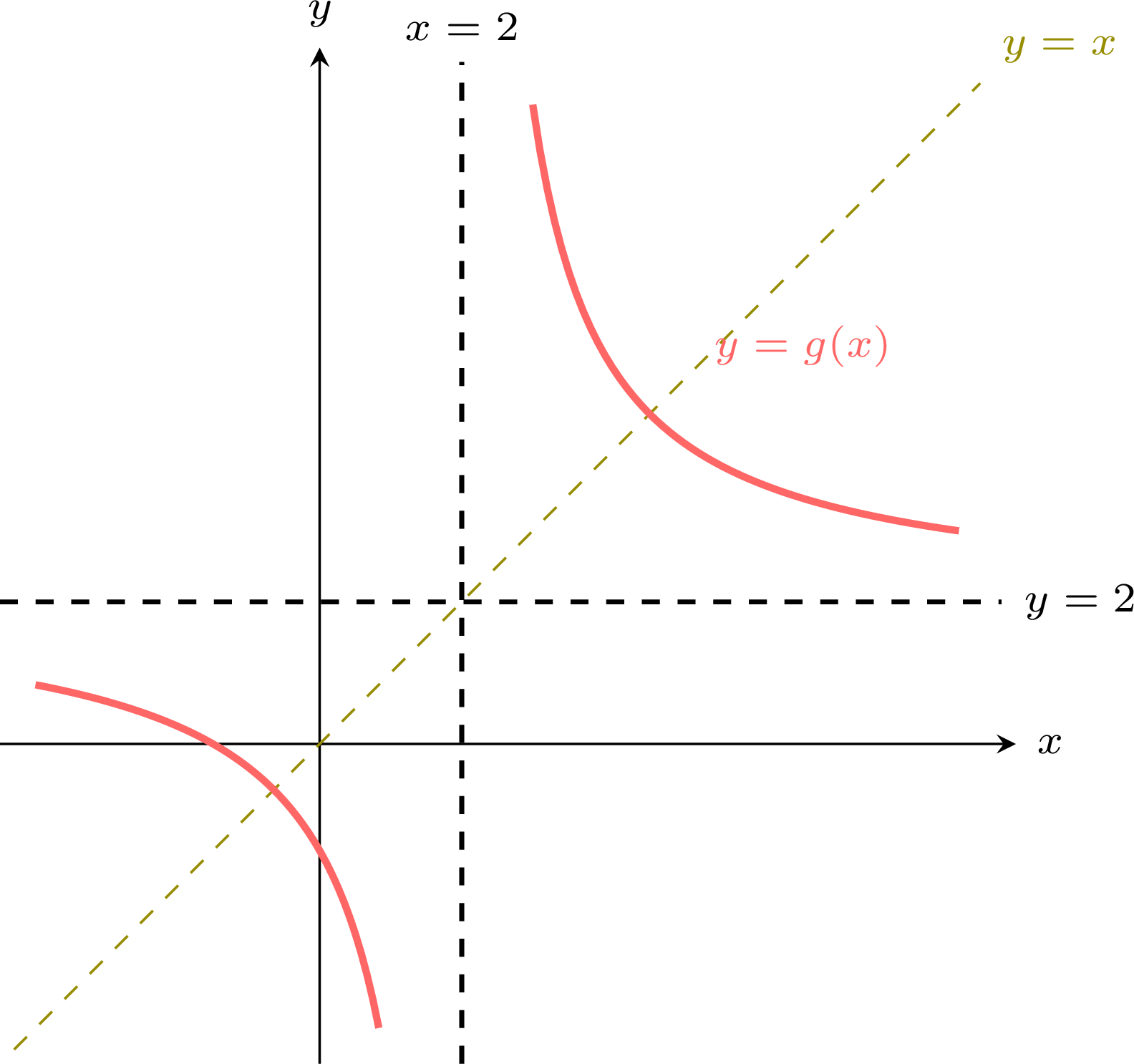
Example
Let \(k\) be a real number, \(k \neq \dfrac{1}{3}\), and \(f(x) = \dfrac{3x + 1}{x + k}\) for \(x \neq -k\). Find the value of \(k\) for which \(f\) is self-inverse.
The condition \(k \neq \dfrac{1}{3}\) excludes the case \(3k = 1\), where the numerator is \(3\) times the denominator and \(f\) is constant. Find \(f^{-1}\) with the Method “Finding the Inverse Function”: for \(y \neq 3\), $$\begin{aligned}[t] y = \frac{3x + 1}{x + k} &\iff y(x + k) = 3x + 1 && (x \neq -k) \\
&\iff x(y - 3) = 1 - ky && \text{(collect the terms in } x\text{)} \\
&\iff x = \frac{1 - ky}{y - 3}. && (y \neq 3) \end{aligned}$$ So \(f^{-1}(x) = \dfrac{-kx + 1}{x - 3}\), defined for \(x \neq 3\). If \(f^{-1} = f\), the two functions have the same domain: \(\mathbb{R} \setminus \{-k\} = \mathbb{R} \setminus \{3\}\), so \(-k = 3\) and \(k = -3\). Conversely, for \(k = -3\): $$f^{-1}(x) = \frac{3x + 1}{x - 3} = f(x):$$ \(f\) is self-inverse for \(k = -3\) only.
The same reasoning applies to \(f(x) = \dfrac{ax + b}{cx + d}\) with \(c \neq 0\) and \(ad - bc \neq 0\): its inverse \(f^{-1}(x) = \dfrac{-dx + b}{cx - a}\) is defined for \(x \neq \dfrac{a}{c}\), so \(f\) can be self-inverse only when \(-\dfrac{d}{c} = \dfrac{a}{c}\), that is \(d = -a\); conversely, when \(d = -a\), bringing \(f\big(f(x)\big) = \dfrac{af(x) + b}{cf(x) - a}\) to the denominator \(cx - a\) gives \(\dfrac{\left(a^2 + bc\right)x}{a^2 + bc} = x\), where \(a^2 + bc = -(ad - bc) \neq 0\): every such function with \(d = -a\) is self-inverse. Graphically, its two asymptotes \(x = -\dfrac{d}{c}\) and \(y = \dfrac{a}{c}\) then meet at a point of the line \(y = x\).
The same reasoning applies to \(f(x) = \dfrac{ax + b}{cx + d}\) with \(c \neq 0\) and \(ad - bc \neq 0\): its inverse \(f^{-1}(x) = \dfrac{-dx + b}{cx - a}\) is defined for \(x \neq \dfrac{a}{c}\), so \(f\) can be self-inverse only when \(-\dfrac{d}{c} = \dfrac{a}{c}\), that is \(d = -a\); conversely, when \(d = -a\), bringing \(f\big(f(x)\big) = \dfrac{af(x) + b}{cf(x) - a}\) to the denominator \(cx - a\) gives \(\dfrac{\left(a^2 + bc\right)x}{a^2 + bc} = x\), where \(a^2 + bc = -(ad - bc) \neq 0\): every such function with \(d = -a\) is self-inverse. Graphically, its two asymptotes \(x = -\dfrac{d}{c}\) and \(y = \dfrac{a}{c}\) then meet at a point of the line \(y = x\).
Example
Let \(f(x) = \sqrt{9 - x^2}\) for \(x\) in \([0, 3]\). Show that \(f\) is self-inverse, and describe its graph.
Values in \([0, 3]\). For \(0 \leq x \leq 3\), \(0 \leq x^2 \leq 9\), so \(0 \leq 9 - x^2 \leq 9\) and \(0 \leq \sqrt{9 - x^2} \leq 3\): \(f\) maps \([0, 3]\) into \([0, 3]\).
Composition. For \(0 \leq x \leq 3\): $$\begin{aligned}[t] f\big(f(x)\big) &= \sqrt{9 - \left(\sqrt{9 - x^2}\right)^2} && \text{(definition of } f\text{)} \\ &= \sqrt{9 - \left(9 - x^2\right)} && \left(9 - x^2 \geq 0\right) \\ &= \sqrt{x^2} \\ &= x. && (x \geq 0) \end{aligned}$$ So \(f\) is self-inverse. Its graph: for \(0 \leq x \leq 3\), the point \(M\big(x, f(x)\big)\) has \(f(x)^2 = 9 - x^2\), so its distance to the origin \(O\) is $$OM = \sqrt{x^2 + f(x)^2} = \sqrt{x^2 + 9 - x^2} = 3.$$ Every point of the graph is at distance \(3\) from \(O\), with two coordinates between \(0\) and \(3\): the graph is the quarter of the circle of centre \(O\) and radius \(3\) lying in the first quadrant. The reflection in the line \(y = x\) sends \(M(x, y)\) to \(M'(y, x)\), at the same distance \(\sqrt{y^2 + x^2} = 3\) from \(O\), still in the first quadrant: the arc is symmetric about the line \(y = x\). 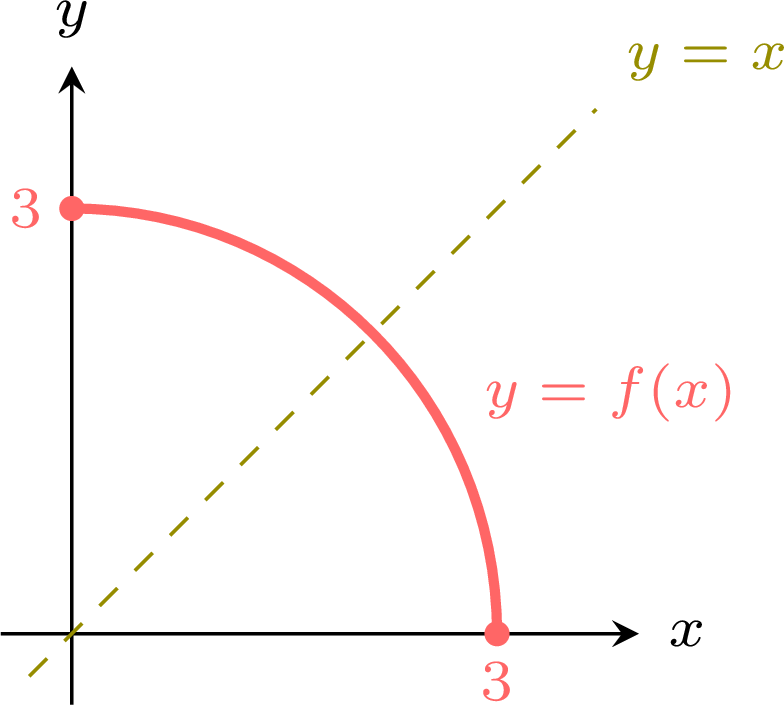
The domain matters: on \([-3, 3]\) the same formula is not self-inverse, since \(f(-3) = 0\) and \(f(0) = 3 \neq -3\).
Composition. For \(0 \leq x \leq 3\): $$\begin{aligned}[t] f\big(f(x)\big) &= \sqrt{9 - \left(\sqrt{9 - x^2}\right)^2} && \text{(definition of } f\text{)} \\ &= \sqrt{9 - \left(9 - x^2\right)} && \left(9 - x^2 \geq 0\right) \\ &= \sqrt{x^2} \\ &= x. && (x \geq 0) \end{aligned}$$ So \(f\) is self-inverse. Its graph: for \(0 \leq x \leq 3\), the point \(M\big(x, f(x)\big)\) has \(f(x)^2 = 9 - x^2\), so its distance to the origin \(O\) is $$OM = \sqrt{x^2 + f(x)^2} = \sqrt{x^2 + 9 - x^2} = 3.$$ Every point of the graph is at distance \(3\) from \(O\), with two coordinates between \(0\) and \(3\): the graph is the quarter of the circle of centre \(O\) and radius \(3\) lying in the first quadrant. The reflection in the line \(y = x\) sends \(M(x, y)\) to \(M'(y, x)\), at the same distance \(\sqrt{y^2 + x^2} = 3\) from \(O\), still in the first quadrant: the arc is symmetric about the line \(y = x\).
Skills to practice
- Finding Parameters and Values of Self-Inverse Functions
- Proving that a Function Is Self-Inverse
II
Graphs and Equations with the Modulus
II.1
The Absolute Value Function
Recappreviously studied — click to reread
Definition — Absolute Value Function
The absolute value function is defined on \(\mathbb{R}\) by \(f(x) = |x|\), the absolute value of \(x\): $$f(x) = |x| = \begin{cases} x & \text{if } x \geq 0 \\
-x & \text{if } x < 0 \end{cases}$$ 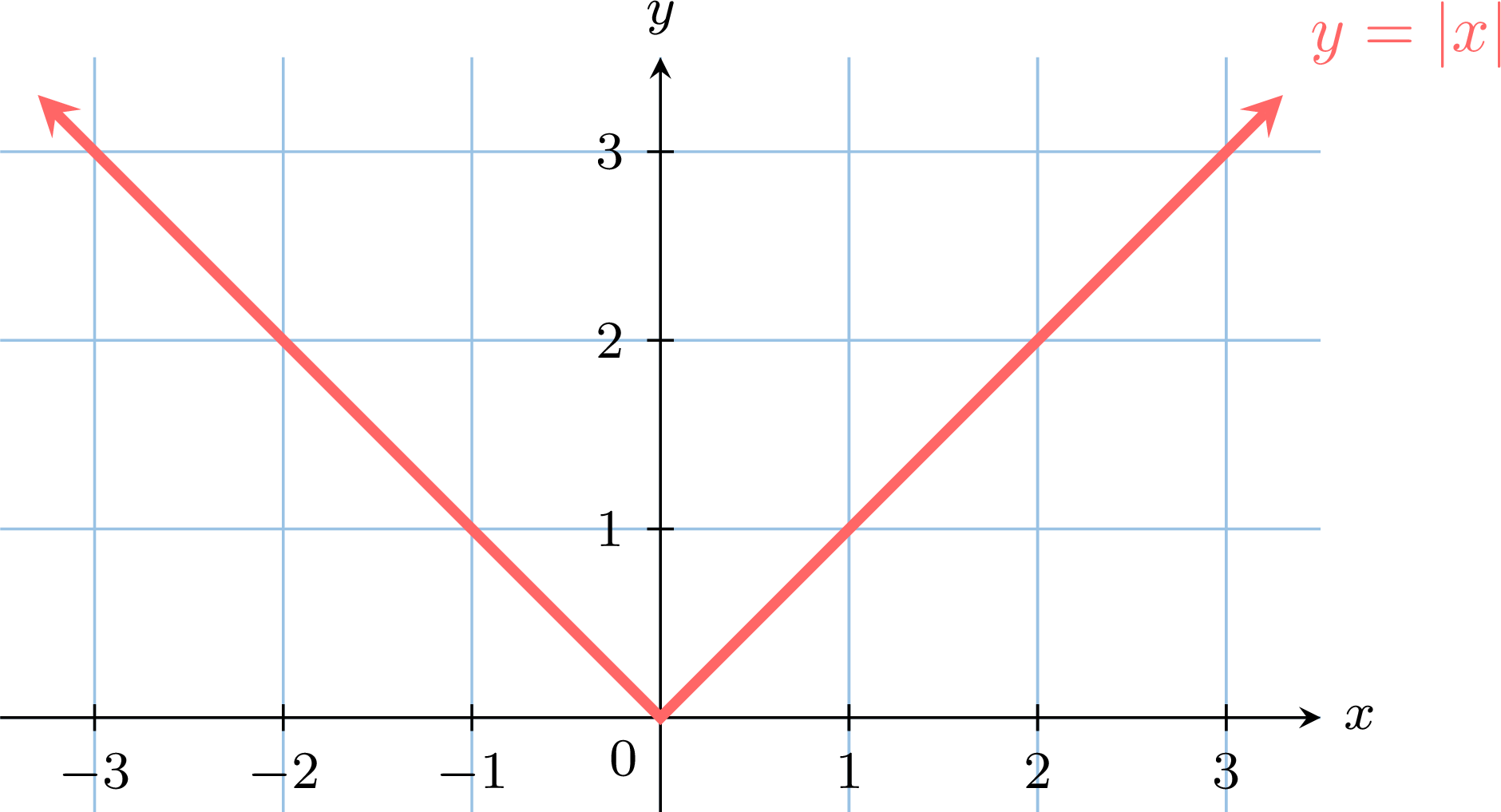
- Domain: all real numbers (\(\mathbb{R}\)).
- Shape: two rays starting from the origin, the line \(y = x\) for \(x \geq 0\) and the line \(y = -x\) for \(x < 0\), which form a “V” with its vertex at \(O\).
- Symmetry: since \(|-x| = |x|\) for every real \(x\), the curve is symmetric about the \(y\)-axis.
Proposition — Properties
- For any real number \(x\), \(|x| \geq 0\), and \(|x| = 0\) only for \(x = 0\).
- The absolute value function is strictly decreasing on \((-\infty, 0]\) and strictly increasing on \([0, +\infty)\); its minimum is \(0\), reached at \(x = 0\).
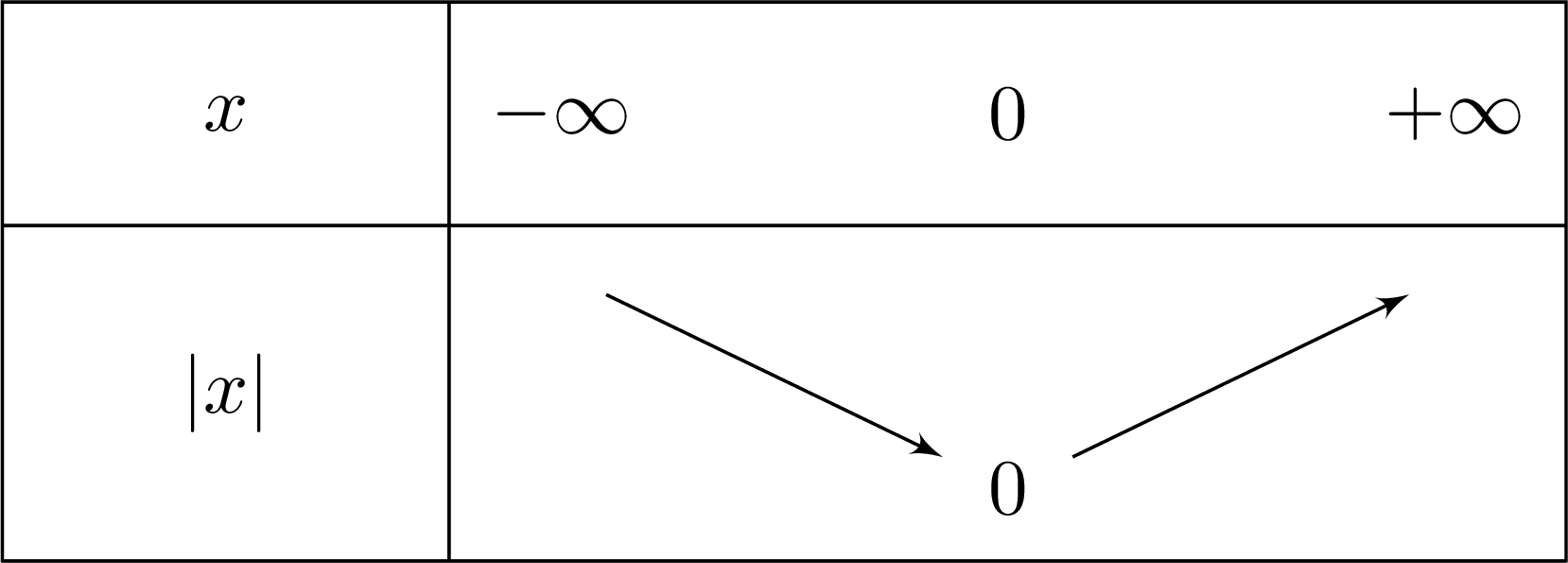
Let \(f(x) = |x|\).
- Sign: if \(x \geq 0\), then \(|x| = x \geq 0\); if \(x < 0\), then \(|x| = -x > 0\). In both cases \(|x| \geq 0\), and \(|x| = 0\) happens only in the first case with \(x = 0\).
- Variations:
- Let \(a\) and \(b\) be two real numbers such that \(0 \leq a < b\). Then \(f(a) = a\) and \(f(b) = b\), so \(f(b) - f(a) = b - a > 0\): \(f(a) < f(b)\). The function is strictly increasing on \([0, +\infty)\).
- Let \(a\) and \(b\) be two real numbers such that \(a < b \leq 0\). Then \(f(a) = -a\) and \(f(b) = -b\) (for \(b = 0\), \(-b = 0 = |0|\) as well), so \(f(b) - f(a) = -b + a = a - b < 0\): \(f(a) > f(b)\). The function is strictly decreasing on \((-\infty, 0]\).
Method — Solving \(|x| \equal k\) and \(|x| \lt k\)
Let \(k\) be a real number. Graphically, the solutions of \(|x| = k\) are the \(x\)-coordinates of the points of the “V” at height \(k\), and the solutions of \(|x| < k\) are the \(x\)-coordinates of the points of the “V” below the horizontal line \(y = k\). Algebraically, \(|x|\) is the distance from \(x\) to \(0\): - if \(k > 0\): \(|x| = k\) has the two solutions \(x = -k\) and \(x = k\); \(|x| < k\) has the solutions \(-k < x < k\), the interval \((-k, k)\); \(|x| > k\) has the solutions \(x < -k\) or \(x > k\);
- if \(k = 0\): \(|x| = 0\) has the single solution \(x = 0\); \(|x| < 0\) has no solution; \(|x| > 0\) is true for every real \(x \neq 0\);
- if \(k < 0\): \(|x| = k\) and \(|x| < k\) have no solution, since \(|x| \geq 0\); \(|x| > k\) is true for every real \(x\).
Proposition — Distance to a Centre
Let \(a\) and \(r\) be two real numbers with \(r > 0\). The number \(|x - a|\) is the distance from \(x\) to the centre \(a\), so: - \(|x - a| = r\) is equivalent to \(x = a - r\) or \(x = a + r\);
- \(|x - a| \leq r\) is equivalent to \(x \in [a - r, a + r]\);
- \(|x - a| < r\) is equivalent to \(x \in (a - r, a + r)\).
Skills to practice
- The Absolute Value Function
II.2
The Graphs of \(y \equal |f(x)|\), \(y \equal f(|x|)\) and \(y \equal \big(f(x)\big)^2\)
Let \(f(x) = x^2 - 2x - 3\). From the values of \(f\), three new functions can be built: \(x \mapsto |f(x)|\), \(x \mapsto f(|x|)\) and \(x \mapsto \big(f(x)\big)^2\). How do their graphs compare with the graph of \(f\)?
- Compute \(f(x)\), \(|f(x)|\), \(f(|x|)\) and \(\big(f(x)\big)^2\) for \(x = -2\), \(0\), \(1\), \(2\) and \(4\).
- For which values of \(x\) is \(|f(x)| = f(x)\)? What happens to the other points of the graph of \(f\)?
- Explain why \(f(|x|)\) takes the same value at \(x\) and at \(-x\). Which part of the graph of \(f\) is enough to draw the graph of \(y = f(|x|)\)?
- For which values of \(x\) is \(\big(f(x)\big)^2 = f(x)\)?
- With \(f(x) = x^2 - 2x - 3 = (x + 1)(x - 3)\):
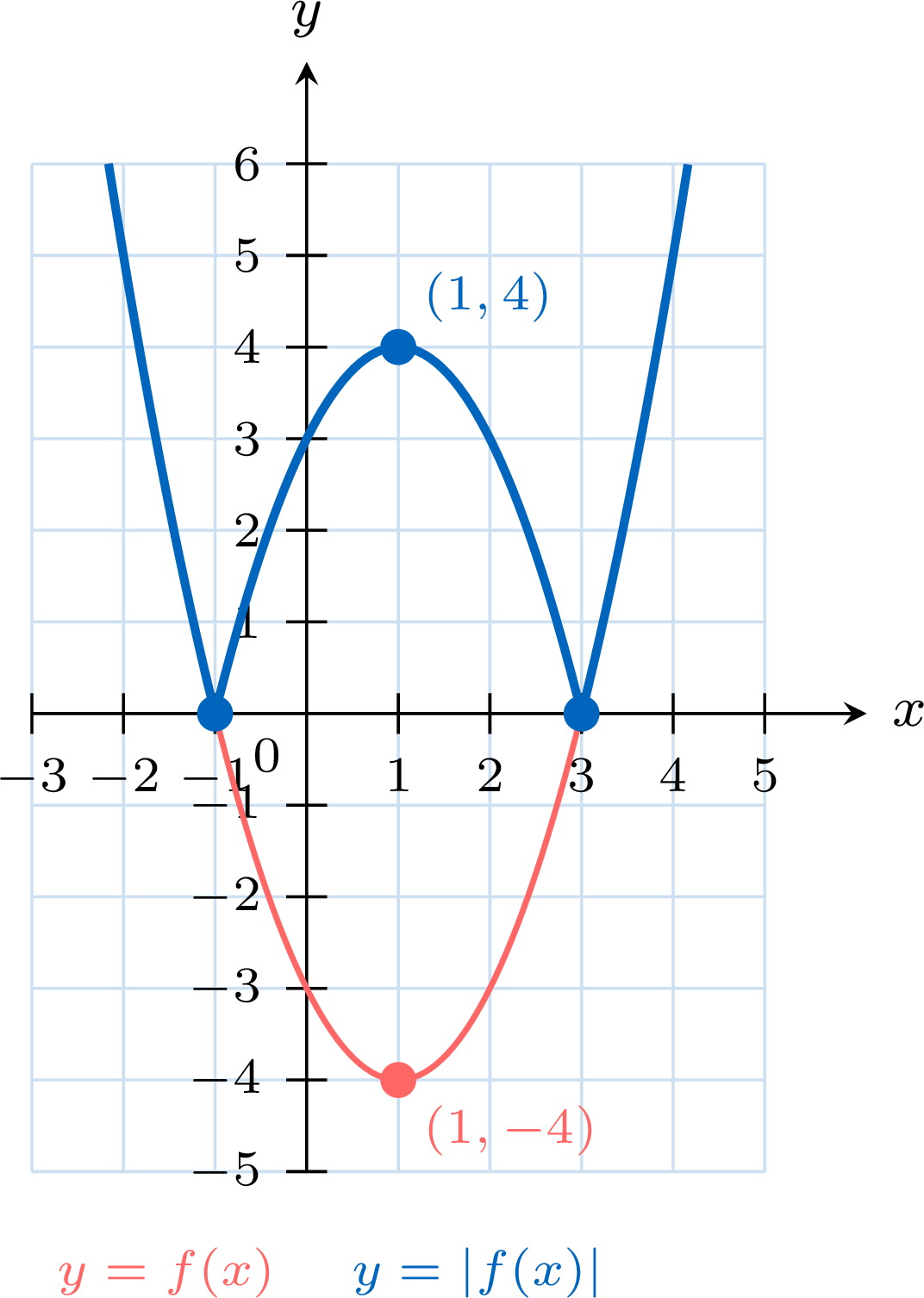
\(x\) \(-2\) \(0\) \(1\) \(2\) \(4\) \(f(x)\) \(5\) \(-3\) \(-4\) \(-3\) \(5\) \(|f(x)|\) \(5\) \(3\) \(4\) \(3\) \(5\) \(f(|x|)\) \(-3\) \(-3\) \(-4\) \(-3\) \(5\) \(\big(f(x)\big)^2\) \(25\) \(9\) \(16\) \(9\) \(25\) - \(|f(x)| = f(x)\) exactly when \(f(x) \geq 0\), that is for \(x \leq -1\) or \(x \geq 3\): there the two graphs coincide. Where \(f(x) < 0\), that is for \(-1 < x < 3\), \(|f(x)| = -f(x)\): the point \((x, f(x))\) is replaced by \((x, -f(x))\), its reflection in the \(x\)-axis. The minimum point \((1, -4)\) becomes the highest point \((1, 4)\) of the reflected arch.
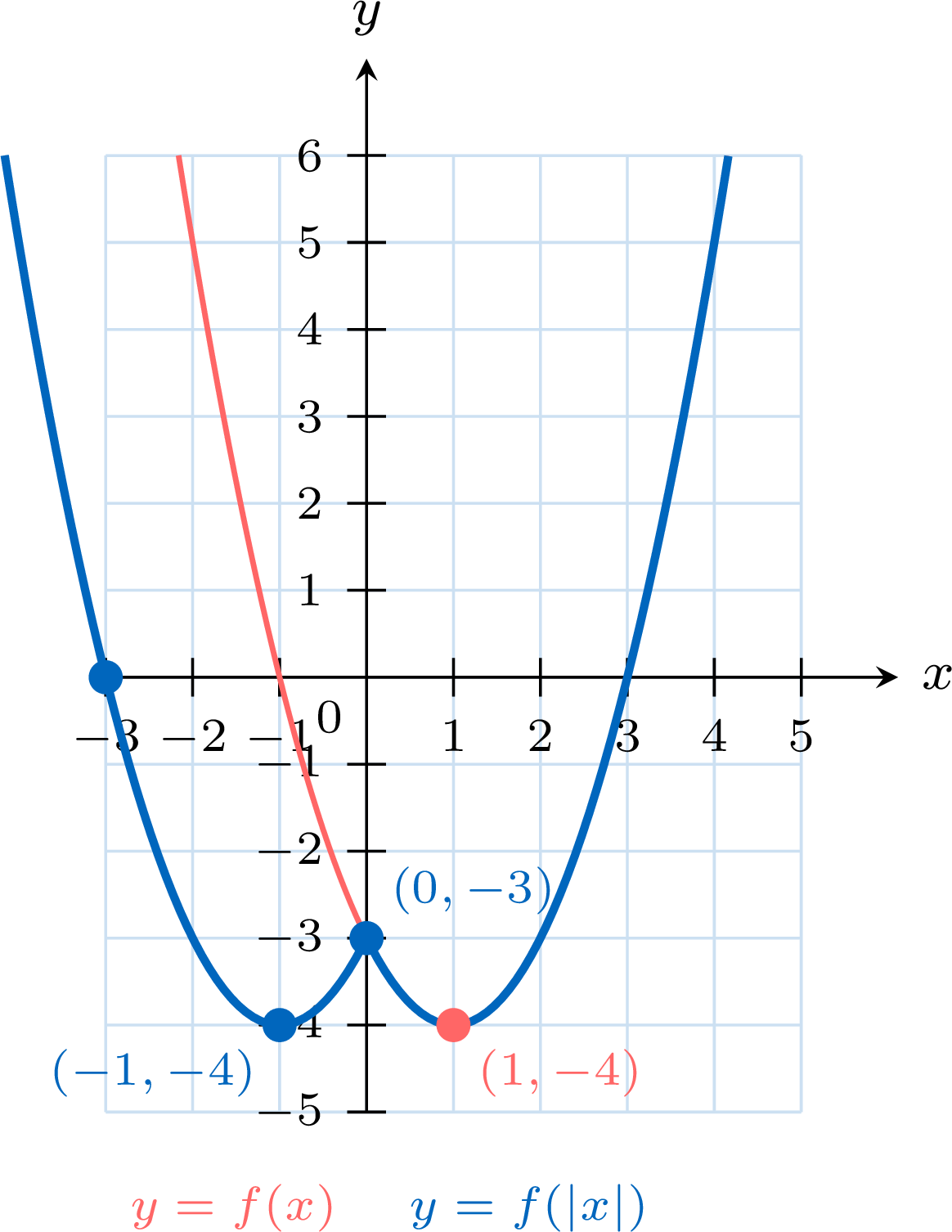
- Since \(|-x| = |x|\), \(f(|-x|) = f(|x|)\). For \(x \geq 0\), \(f(|x|) = f(x)\): the graph of \(y = f(|x|)\) is the graph of \(f\) on the right of the \(y\)-axis, and, on the left, the reflection of this right part in the \(y\)-axis. The part of the graph of \(f\) with \(x < 0\) is not used.
- \(\big(f(x)\big)^2 = f(x) \iff f(x)\big(f(x) - 1\big) = 0 \iff f(x) = 0\) or \(f(x) = 1\): the two graphs meet at the \(x\)-intercepts \((-1, 0)\) and \((3, 0)\), and where \(f(x) = 1\), that is \(x^2 - 2x - 4 = 0\), \(x = 1 - \sqrt{5}\) or \(x = 1 + \sqrt{5}\).
Proposition — The Graph of \(y \equal |f(x)|\)
Let \(f\) be a function. The function \(x \mapsto |f(x)|\) has the same domain as \(f\), and $$|f(x)| = \begin{cases} f(x) & \text{if } f(x) \geq 0, \\
-f(x) & \text{if } f(x) < 0. \end{cases}$$ - Construction: the graph of \(y = |f(x)|\) keeps the part of the graph of \(f\) on or above the \(x\)-axis, and replaces the part below the \(x\)-axis by its reflection in the \(x\)-axis.
- Position and invariant points: the graph lies on or above the \(x\)-axis; its invariant points are the points of the graph of \(f\) on or above the \(x\)-axis, the \(x\)-intercepts among them.
- Turning points: when the graph of \(f\) has no break near \(a\), a local minimum point \((a, m)\) of the graph of \(f\) with \(m < 0\) becomes a local maximum point \((a, -m)\), and a local maximum point \((a, m)\) with \(m < 0\) becomes a local minimum point \((a, -m)\).
- Asymptotes: the vertical asymptotes are the same; a horizontal asymptote \(y = q\) becomes the horizontal asymptote \(y = |q|\).
- Construction. By the definition of the absolute value, \(|f(x)| = f(x)\) when \(f(x) \geq 0\): the point \((x, f(x))\) is kept. When \(f(x) < 0\), \(|f(x)| = -f(x)\): the point \((x, f(x))\) is replaced by \((x, -f(x))\), which has the same \(x\)-coordinate and the opposite \(y\)-coordinate — its reflection in the \(x\)-axis.
- Position. \(|f(x)| \geq 0\) for every \(x\), and \(|f(x)| = f(x)\) exactly when \(f(x) \geq 0\).
- Turning points. Let \((a, m)\) be a local minimum point with \(m < 0\). As the graph of \(f\) has no break near \(a\), \(f(x)\) stays negative for \(x\) close to \(a\), and \(f(x) \geq m\) there. Then \(|f(x)| = -f(x) \leq -m = |f(a)|\): \((a, -m)\) is a local maximum point of the graph of \(y = |f(x)|\). For a local maximum point with \(m < 0\), the inequalities are reversed.
- Asymptotes. \(\big||f(x)|\big| = |f(x)|\): where \(|f(x)|\) becomes as large as desired for one function, it does for the other. Let \(f(x)\) get as close to \(q\) as desired. If \(q > 0\), then \(f(x) > 0\) once \(f(x)\) is close enough to \(q\), so \(|f(x)| = f(x)\) gets as close to \(q = |q|\) as desired. If \(q < 0\), then \(f(x) < 0\) once \(f(x)\) is close enough to \(q\), so \(|f(x)| = -f(x)\) gets as close to \(-q = |q|\) as desired. If \(q = 0\), then \(|f(x)|\), the distance from \(f(x)\) to \(0\), gets as close to \(0 = |q|\) as desired.
Proposition — The Graph of \(y \equal f(|x|)\)
Let \(f\) be a function. The function \(g : x \mapsto f(|x|)\) is defined for every \(x\) such that \(|x|\) belongs to the domain of \(f\), and $$f(|x|) = \begin{cases} f(x) & \text{if } x \geq 0, \\
f(-x) & \text{if } x < 0. \end{cases}$$ - Construction: the graph of \(y = f(|x|)\) keeps the part of the graph of \(f\) on and to the right of the \(y\)-axis, discards the part on its left, and completes the kept part by its reflection in the \(y\)-axis.
- Symmetry: \(g\) is an even function: its graph is symmetric about the \(y\)-axis.
- Invariant points: the points of the graph of \(f\) with \(x \geq 0\), among them the \(y\)-intercept \((0, f(0))\) when \(0\) is in the domain of \(f\); a point of the graph of \(f\) with \(x < 0\) is invariant only where \(f(-x) = f(x)\) (every point, when \(f\) is even).
- Construction. For \(x \geq 0\), \(|x| = x\), so \(g(x) = f(x)\): the graph of \(g\) on the right of the \(y\)-axis is that of \(f\). For \(x < 0\), \(|x| = -x > 0\), so \(g(x) = f(-x)\): the point \((x, g(x)) = (x, f(-x))\) is the reflection in the \(y\)-axis of the point \((-x, f(-x))\) of the kept part. The values of \(f\) at negative numbers are never used.
- Symmetry. If \(x\) is in the domain of \(g\), so is \(-x\), since \(|-x| = |x|\), and $$g(-x) = f(|-x|) = f(|x|) = g(x),$$ which is the definition of an even function (Definition “Even Function”).
- Invariant points. For \(x \geq 0\), \(g(x) = f(x)\). For \(x < 0\) in the domain of \(f\), \(g(x) = f(-x)\), which equals \(f(x)\) exactly when \(f(-x) = f(x)\).
Proposition — The Graph of \(y \equal \big(f(x)\big)^2\)
Let \(f\) be a function. The function \(x \mapsto \big(f(x)\big)^2\) has the same domain as \(f\), and \(\big(f(x)\big)^2 = |f(x)|^2\). - Position: the graph of \(y = \big(f(x)\big)^2\) lies on or above the \(x\)-axis. It meets the \(x\)-axis exactly at the \(x\)-intercepts of \(f\), and never crosses it: at a zero of \(f\) where the graph of \(f\) crosses the axis, the new graph touches it and turns back.
- Invariant points: the points of the graph of \(f\) where \(f(x) = 0\) or \(f(x) = 1\).
- Closer or further: where \(0 < |f(x)| < 1\), \(\big(f(x)\big)^2 < |f(x)|\): the graph is closer to the \(x\)-axis than the graph of \(f\); where \(|f(x)| > 1\), \(\big(f(x)\big)^2 > |f(x)|\): it is further from the \(x\)-axis.
- Turning points: each local maximum or minimum point \((a, m)\) of the graph of \(y = |f(x)|\) gives a local maximum or minimum point \((a, m^2)\), of the same kind, of the graph of \(y = \big(f(x)\big)^2\).
- Asymptotes: the vertical asymptotes are the same; a horizontal asymptote \(y = q\) becomes the horizontal asymptote \(y = q^2\).
Write \(u = |f(x)| \geq 0\), so that \(\big(f(x)\big)^2 = u^2\).
- Position. \(u^2 \geq 0\), and \(u^2 = 0\) exactly when \(u = 0\), that is \(f(x) = 0\). Since \(u^2 \geq 0\) on both sides of such a zero, the graph never passes below the axis: it meets the axis without crossing it.
- Invariant points. \(\big(f(x)\big)^2 = f(x) \iff f(x)\big(f(x) - 1\big) = 0 \iff f(x) = 0\) or \(f(x) = 1\).
- Closer or further. \(u^2 - u = u(u - 1)\), which is negative when \(0 < u < 1\) and positive when \(u > 1\).
- Turning points. On \([0, +\infty)\) the square function is increasing: for \(u, v \geq 0\), \(u \leq v \iff u^2 \leq v^2\). If \(|f(x)| \leq m\) for \(x\) close to \(a\), then \(\big(f(x)\big)^2 \leq m^2\) there, and if \(|f(x)| \geq m\), then \(\big(f(x)\big)^2 \geq m^2\).
- Asymptotes. Where \(|f(x)|\) becomes as large as desired, so does \(|f(x)|^2\). If \(f(x)\) gets as close to \(q\) as desired, then $$\big(f(x)\big)^2 - q^2 = \big(f(x) - q\big)\big(f(x) + q\big),$$ where the second factor stays close to \(2q\): the product gets as close to \(0\) as desired.
Method — Sketching \(y \equal |f(x)|\), \(y \equal f(|x|)\) and \(y \equal \big(f(x)\big)^2\) from the Graph of \(y \equal f(x)\)
Start from the graph of \(f\) with its intercepts, its turning points and its asymptotes. - For \(y = |f(x)|\): keep every part on or above the \(x\)-axis; reflect in the \(x\)-axis every part below it. A turning point \((a, m)\) with \(m < 0\) becomes \((a, -m)\); the vertical asymptotes stay, a horizontal asymptote \(y = q\) becomes \(y = |q|\).
- For \(y = f(|x|)\): erase the part on the left of the \(y\)-axis; reflect in the \(y\)-axis the part with \(x \geq 0\). The point \((0, f(0))\), when \(f\) is defined at \(0\), stays; the graph is symmetric about the \(y\)-axis.
- For \(y = \big(f(x)\big)^2\): mark the \(x\)-intercepts of \(f\), where the new graph touches the axis, and the invariant points where \(f(x) = 1\); square the \(y\)-coordinates of the key points (\((a, m)\) becomes \((a, m^2)\)); draw the graph on or above the axis, closer to the axis than the graph of \(f\) where \(0 < |f(x)| < 1\) and further where \(|f(x)| > 1\); the vertical asymptotes stay, \(y = q\) becomes \(y = q^2\).
Example
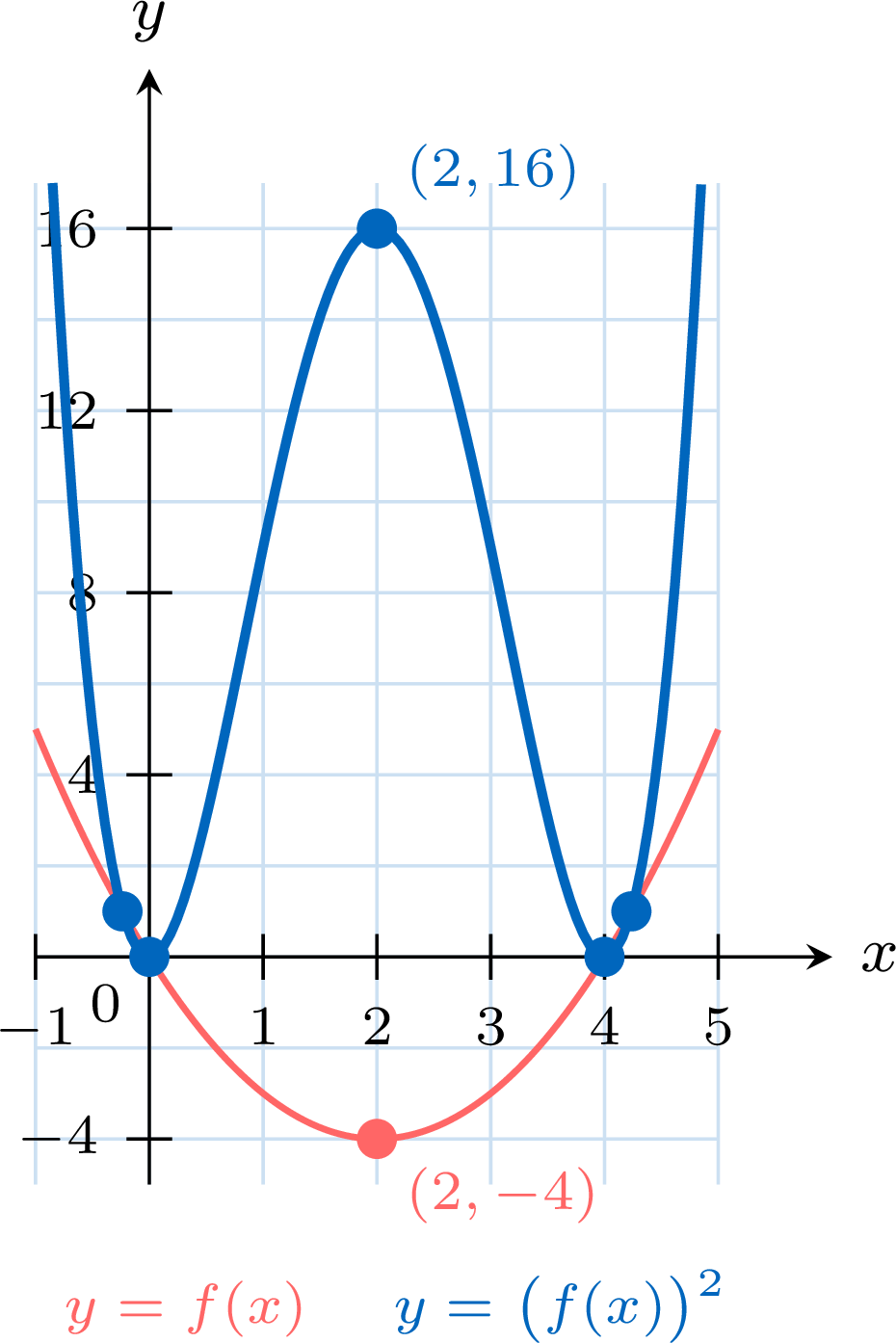
Let \(f(x) = x^2 - 4x\). Sketch, on three diagrams, the graphs of \(y = |f(x)|\), \(y = f(|x|)\) and \(y = \big(f(x)\big)^2\), each with the graph of \(f\).
\(f(x) = x(x - 4)\): the \(x\)-intercepts are \(0\) and \(4\), and the vertex is \((2, f(2)) = (2, -4)\); \(f(x) < 0\) exactly for \(0 < x < 4\).
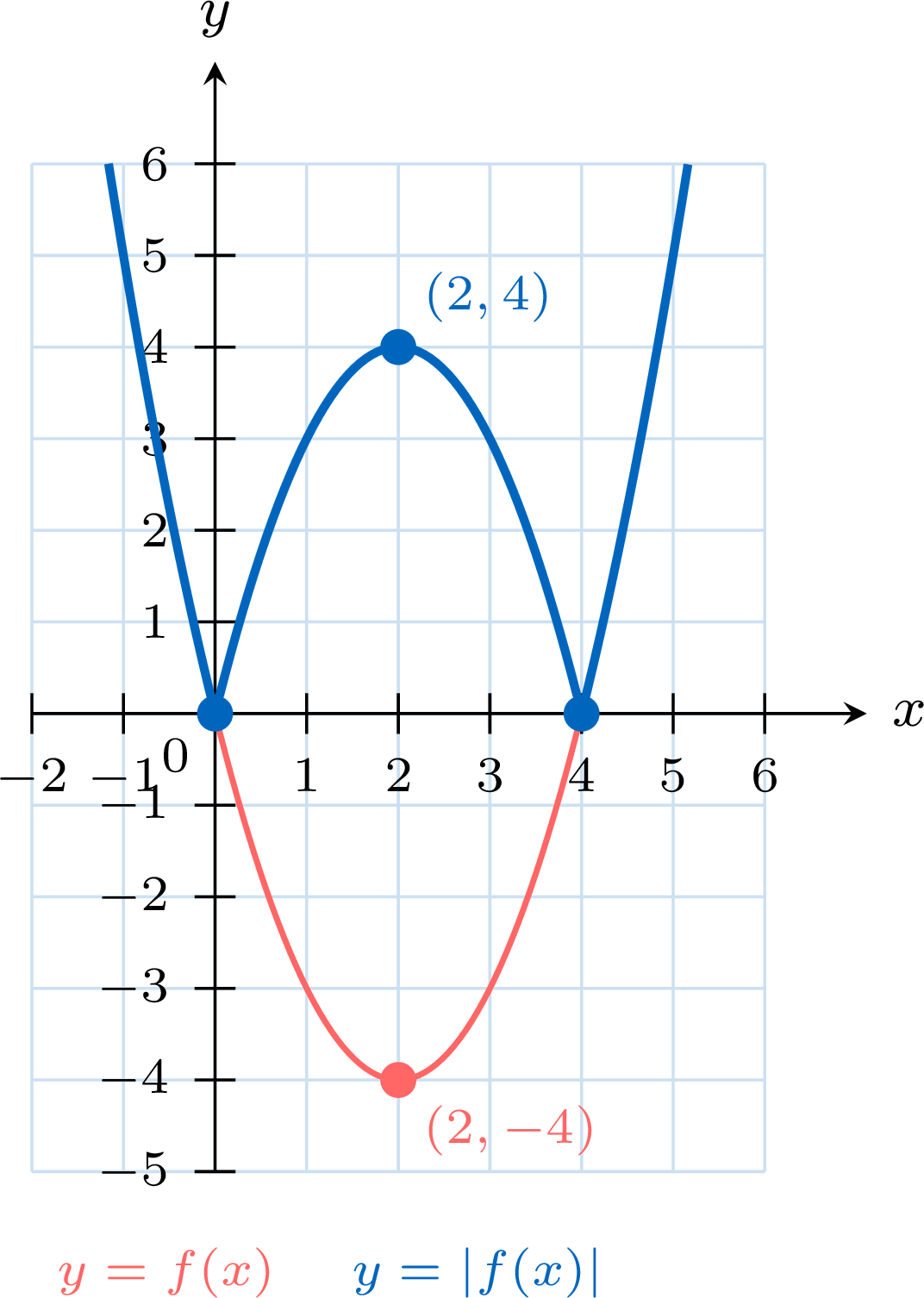
- \(y = |f(x)|\). The arch below the axis, for \(0 < x < 4\), is reflected in the \(x\)-axis: the minimum point \((2, -4)\) becomes the local maximum point \((2, 4)\). The rest of the parabola is kept; the points \((0, 0)\) and \((4, 0)\) are invariant.
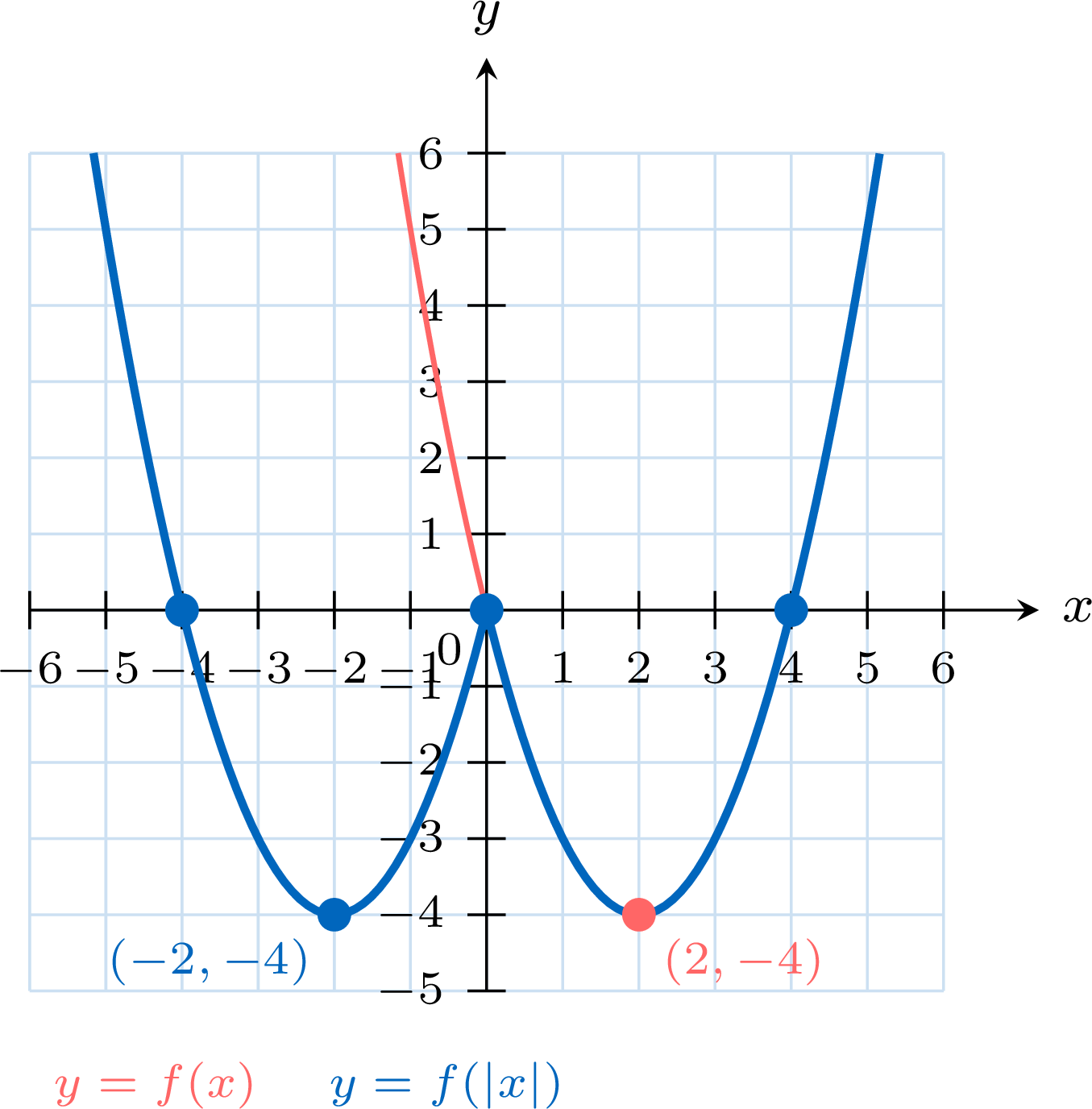
- \(y = f(|x|)\). For \(x \geq 0\), the graph is the graph of \(f\); the part with \(x < 0\) is replaced by the reflection in the \(y\)-axis of the right part. The graph is a “W”: \(x\)-intercepts \(-4\), \(0\) and \(4\), minimum points \((-2, -4)\) and \((2, -4)\). Indeed \(f(|x|) = x^2 - 4|x|\) and, for \(x < 0\), \(f(|x|) = x^2 + 4x = (x + 2)^2 - 4\).
- \(y = \big(f(x)\big)^2\). The graph touches the \(x\)-axis at \((0, 0)\) and \((4, 0)\). The local maximum point \((2, 4)\) of \(y = |f(x)|\) gives the local maximum point \((2, 16)\). The invariant points are \((0, 0)\), \((4, 0)\) and the points where \(x^2 - 4x = 1\). Since \(x^2 - 4x = (x - 2)^2 - 4\), the graph of \(f\) is at height \(1\) where \((x - 2)^2 = 5\), that is \(x = 2 \pm \sqrt{5}\), and at height \(-1\) where \((x - 2)^2 = 3\), that is \(x = 2 \pm \sqrt{3}\). Reading the graph of \(f\), which falls from \(\left(2 - \sqrt{5}, 1\right)\) to the vertex \((2, -4)\) and rises back to \(\left(2 + \sqrt{5}, 1\right)\): it lies between the lines \(y = -1\) and \(y = 1\) for \(2 - \sqrt{5} < x < 2 - \sqrt{3}\) and for \(2 + \sqrt{3} < x < 2 + \sqrt{5}\). On these intervals, apart from the zeros \(0\) and \(4\), \(0 < |f(x)| < 1\) and the new graph is closer to the axis. Where \(|f(x)| > 1\), that is for \(x < 2 - \sqrt{5}\), \(2 - \sqrt{3} < x < 2 + \sqrt{3}\) or \(x > 2 + \sqrt{5}\), it is further. At \(x = 2 \pm \sqrt{3}\), where \(f(x) = -1\), both graphs are at the distance \(1\) from the axis.
Example
Let \(g(x) = |x + 1| - |x - 2|\). Write \(g(x)\) without the absolute value signs on each of the intervals \((-\infty, -1)\), \([-1, 2)\) and \([2, +\infty)\), then sketch the graph of \(g\).
By the definition of the absolute value, \(|x + 1| = x + 1\) when \(x + 1 \geq 0\) and \(-(x + 1)\) otherwise; likewise for \(|x - 2|\). The signs of \(x + 1\) and \(x - 2\): 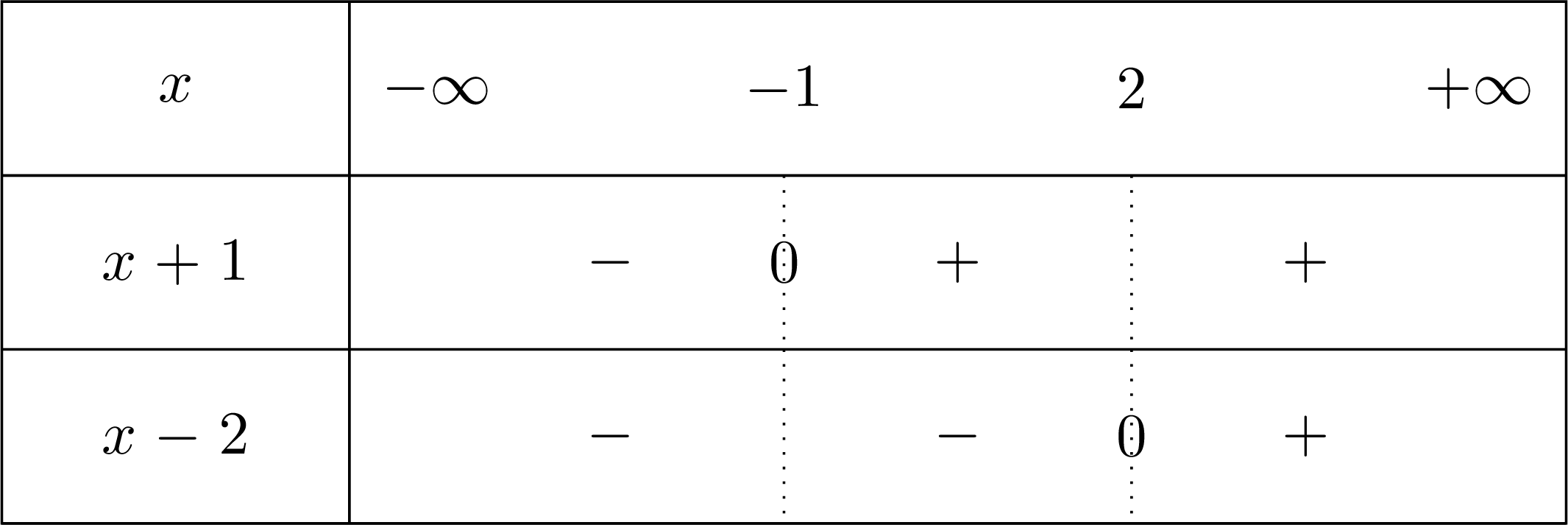
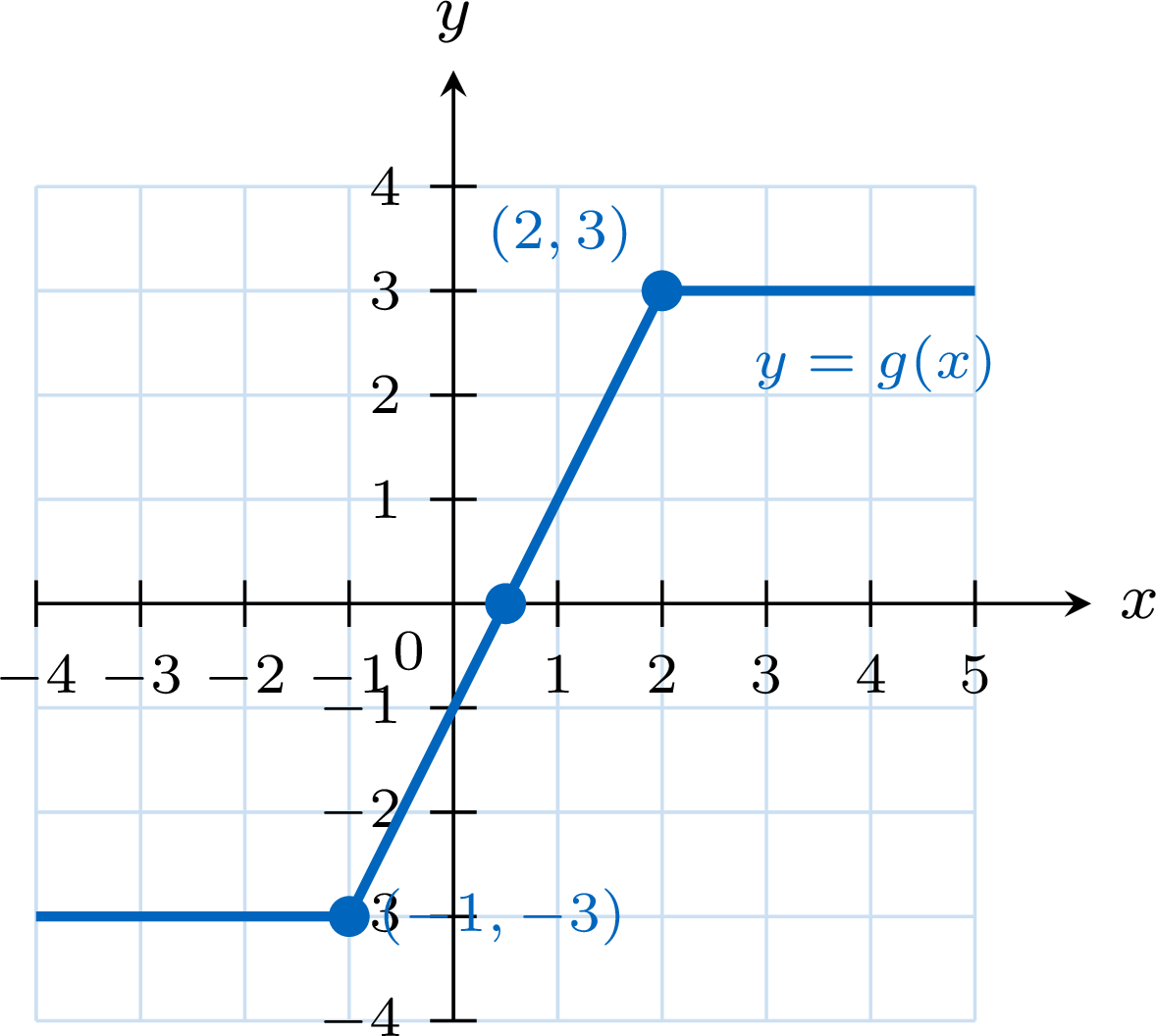
- For \(x < -1\): \(g(x) = -(x + 1) - \big(-(x - 2)\big) = -x - 1 + x - 2 = -3\).
- For \(-1 \leq x < 2\): \(g(x) = (x + 1) - \big(-(x - 2)\big) = x + 1 + x - 2 = 2x - 1\).
- For \(x \geq 2\): \(g(x) = (x + 1) - (x - 2) = 3\).
Example
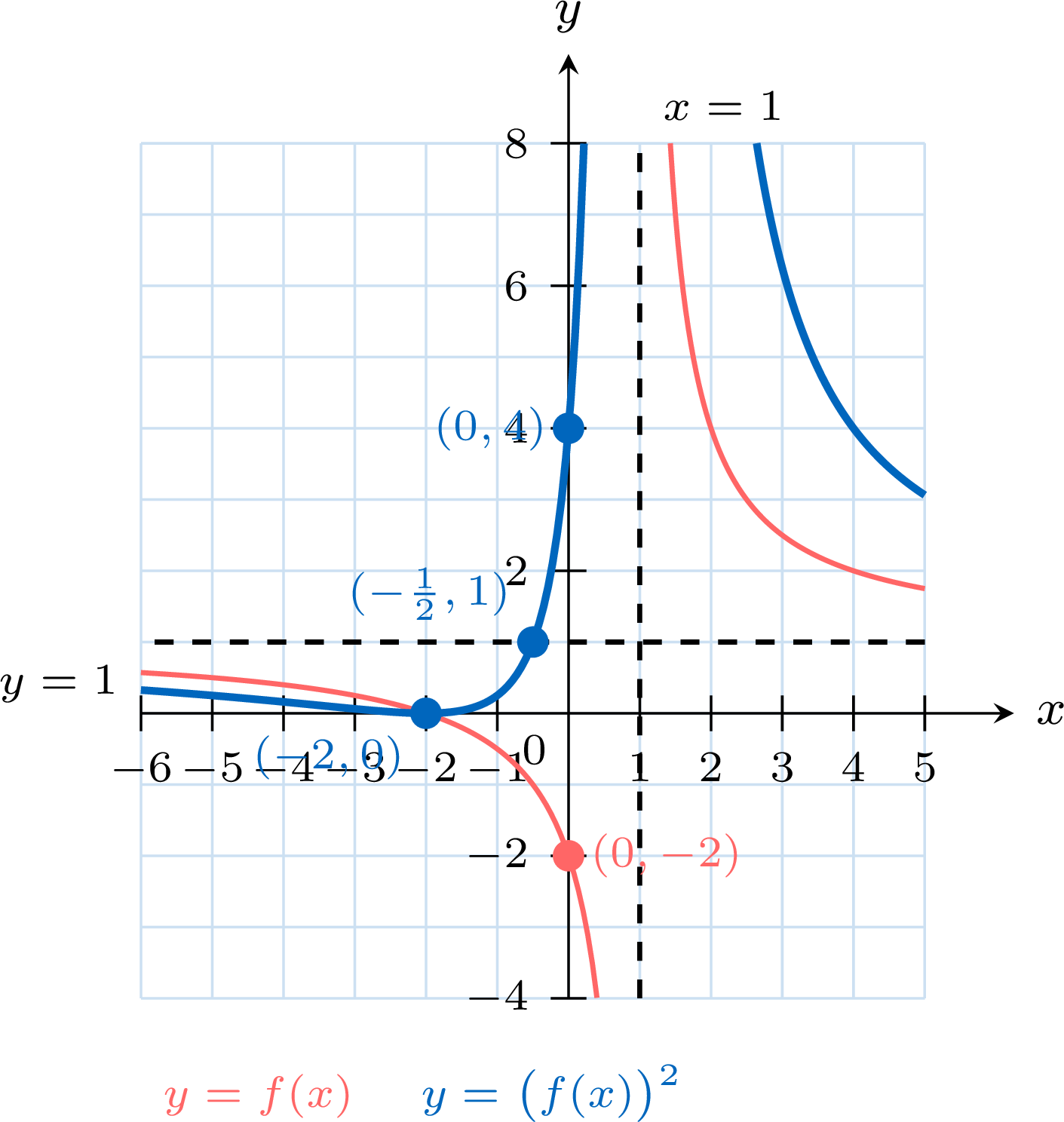
Let \(f(x) = \dfrac{x + 2}{x - 1}\), whose graph has the asymptotes \(x = 1\) and \(y = 1\). Sketch the graph of \(y = \big(f(x)\big)^2\) with the graph of \(f\). - Asymptotes. The vertical asymptote \(x = 1\) stays; the horizontal asymptote \(y = 1\) becomes \(y = 1^2 = 1\).
- Intercepts. \(f(-2) = 0\): the graph of \(y = \big(f(x)\big)^2\) touches the \(x\)-axis at \((-2, 0)\). \(f(0) = -2\), so \(\big(f(0)\big)^2 = 4\): the \(y\)-intercept is \((0, 4)\).
- Invariant points. \(f(x) = 0\) at \(x = -2\); \(f(x) = 1\) has no solution, since \(f(x) = 1 + \dfrac{3}{x - 1}\) and \(\dfrac{3}{x - 1} \neq 0\). The only invariant point is \((-2, 0)\).
- Closer or further. For \(x \neq 1\): $$\begin{aligned}[t] |f(x)| < 1 &\iff |x + 2| < |x - 1| && \text{(multiply by } |x - 1| > 0\text{)} \\ &\iff (x + 2)^2 < (x - 1)^2 && \text{(both sides are } \geq 0\text{)} \\ &\iff 6x + 3 < 0 && \text{(expand, subtract } x^2 + 1\text{)} \\ &\iff x < -\tfrac{1}{2}. \end{aligned}$$ For \(x < -\dfrac{1}{2}\), \(x \neq -2\), the new graph is closer to the \(x\)-axis (at \(x = -2\) both graphs meet the axis), for \(x > -\dfrac{1}{2}\), \(x \neq 1\), it is further; at \(x = -\dfrac{1}{2}\), \(f(x) = -1\) and the point \(\left(-\dfrac{1}{2}, 1\right)\) of the new graph is the reflection of the point \(\left(-\dfrac{1}{2}, -1\right)\) of the graph of \(f\).
- Shape. For \(x < -2\), \(0 < f(x) < 1\): the new graph lies between the axis and the line \(y = 1\), below the graph of \(f\). For \(-2 < x < 1\), \(f(x) < 0\) and \(\big(f(x)\big)^2\) climbs from \(0\) along \(x = 1\); for \(x > 1\), it comes down from the top along \(x = 1\) towards \(y = 1\).
Skills to practice
- Finding Key Features of the New Graphs
- Sketching \(y \equal |f(x)|\), \(y \equal f(|x|)\) and \(y \equal \big(f(x)\big)^2\)
II.3
Modulus Equations and Inequalities
On the number line, \(|x - a|\) is the distance between the numbers \(x\) and \(a\).
- Which numbers \(x\) are exactly as far from \(1\) as from \(7\)? Write this condition as an equation with absolute values and solve it.
- Which numbers \(x\) are closer to \(1\) than to \(7\)?
- Which numbers \(x\) are twice as far from \(0\) as from \(3\)?
- The condition is \(|x - 1| = |x - 7|\). The number equally far from \(1\) and \(7\) is their midpoint, \(x = 4\). Algebraically, two numbers with the same absolute value are equal or opposite: \(x - 1 = x - 7\) is impossible, and \(x - 1 = -(x - 7)\) gives \(2x = 8\), \(x = 4\).
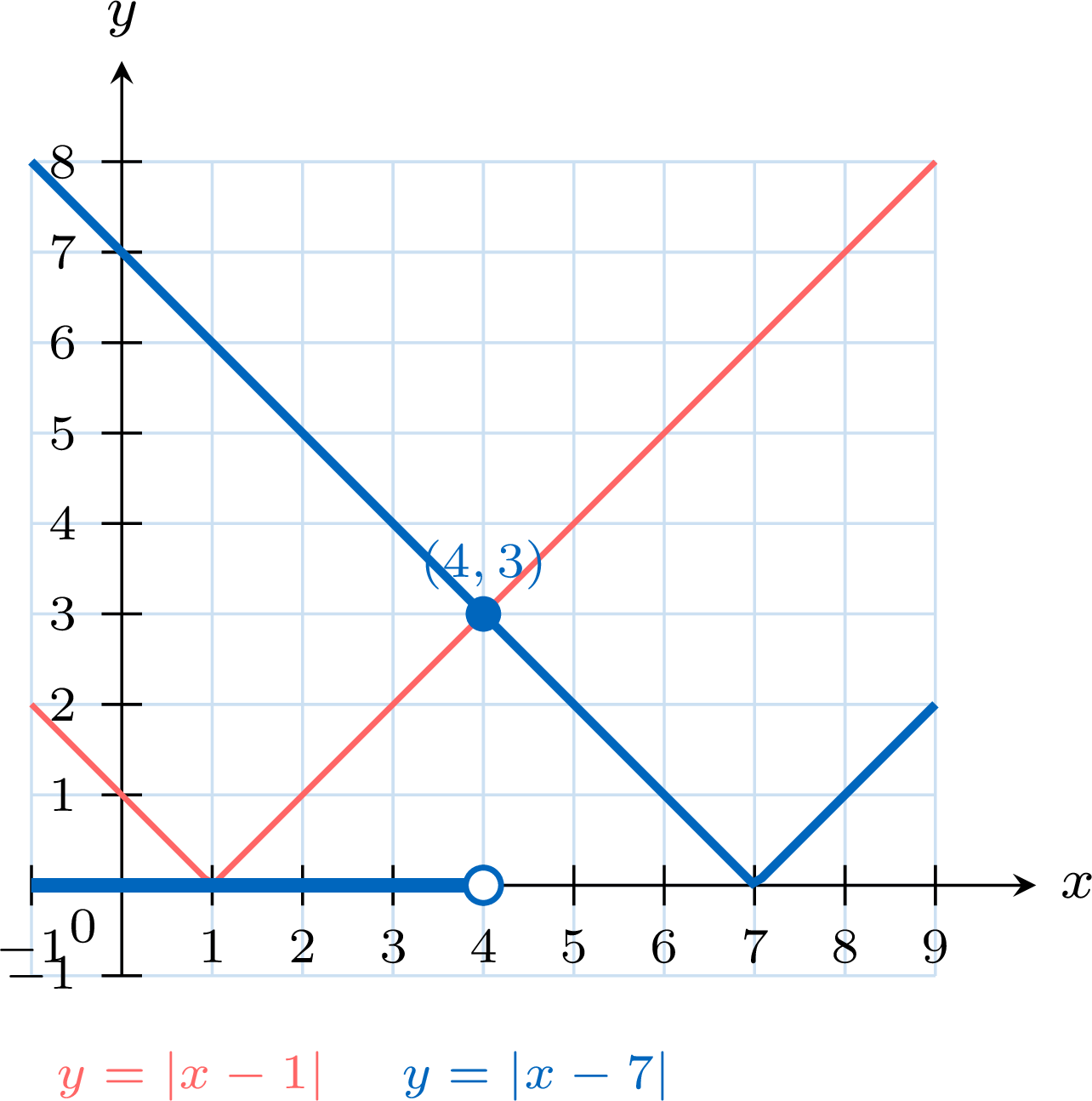
- The condition \(|x - 1| < |x - 7|\) holds on the side of the midpoint where \(1\) lies: \(x < 4\). Squaring both sides, which are \(\geq 0\): $$\begin{aligned}[t] |x - 1| < |x - 7| &\iff (x - 1)^2 < (x - 7)^2 && \text{(both sides are } \geq 0\text{)} \\
&\iff -2x + 1 < -14x + 49 && \text{(expand, subtract } x^2\text{)} \\
&\iff x < 4. \end{aligned}$$ On the graphs, \(y = |x - 1|\) lies below \(y = |x - 7|\) exactly for \(x < 4\):
- The condition is \(|x| = 2|x - 3|\), that is \(|x| = |2(x - 3)|\): the numbers \(x\) and \(2(x - 3)\) have the same absolute value, so they are equal or opposite: \(x = 2(x - 3)\) gives \(x = 6\), and \(x = -2(x - 3)\) gives \(3x = 6\), \(x = 2\). Check: \(|6| = 6 = 2 \times 3\) and \(|2| = 2 = 2 \times 1\). The numbers are \(2\) and \(6\).
Proposition — Rules for Modulus Equations
Let \(A\) and \(B\) be real numbers and \(a\) a real number. - If \(a < 0\), the equation \(|A| = a\) is impossible. If \(a \geq 0\): \(|A| = a \iff A = a\) or \(A = -a\).
- \(|A| = |B| \iff A = B\) or \(A = -B\) \(\iff A^2 = B^2\).
- \(|A| = B \iff B \geq 0\) and (\(A = B\) or \(A = -B\)).
- An absolute value is never negative, so \(|A| = a\) is impossible for \(a < 0\). For \(a \geq 0\), \(|A|\) is \(A\) or \(-A\), so \(|A| = a\) means \(A = a\) or \(-A = a\), that is \(A = a\) or \(A = -a\); conversely \(|a| = |-a| = a\).
- \(|A|\) and \(|B|\) are \(\geq 0\) and \(|A|^2 = A^2\), \(|B|^2 = B^2\). Two numbers that are \(\geq 0\) are equal exactly when their squares are equal, so $$\begin{aligned}[t] |A| = |B| &\iff A^2 = B^2 && \text{(squares of numbers } \geq 0\text{)} \\ &\iff (A - B)(A + B) = 0 && \text{(difference of two squares)} \\ &\iff A = B \ \text{ or } \ A = -B. && \text{(zero product)} \end{aligned}$$
- If \(|A| = B\), then \(B \geq 0\), and \(|A| = |B|\), so \(A = B\) or \(A = -B\) by 2. Conversely, if \(B \geq 0\) and \(A = \pm B\), then \(|A| = |B| = B\).
Proposition — Rules for Modulus Inequalities
Let \(A\) and \(B\) be real numbers and \(a > 0\). - \(|A| < a \iff -a < A < a\), and \(|A| \leq a \iff -a \leq A \leq a\).
- \(|A| > a \iff A < -a\) or \(A > a\), and \(|A| \geq a \iff A \leq -a\) or \(A \geq a\).
- \(|A| < |B| \iff A^2 < B^2\), and likewise with \(\leq\), \(>\) and \(\geq\).
- If \(A \geq 0\), \(|A| < a\) means \(A < a\), and \(-a < 0 \leq A\) holds anyway. If \(A < 0\), \(|A| < a\) means \(-A < a\), that is \(A > -a\), and \(A < 0 < a\) holds anyway. In both cases, \(|A| < a \iff -a < A < a\); the case \(\leq\) is the same.
- \(|A| > a\) is the negation of \(|A| \leq a\), that is of \(-a \leq A \leq a\): \(A < -a\) or \(A > a\). The case \(\geq\) is the negation of \(|A| < a\).
- The square function is strictly increasing on \([0, +\infty)\): for \(u, v \geq 0\), \(u < v \iff u^2 < v^2\). With \(u = |A|\) and \(v = |B|\), and \(|A|^2 = A^2\), \(|B|^2 = B^2\), this gives \(|A| < |B| \iff A^2 < B^2\).
Method — Solving Modulus Equations
- \(|A| = a\), with \(a\) a number: no solution if \(a < 0\); otherwise solve \(A = a\) and \(A = -a\).
- \(|A| = |B|\): solve \(A = B\) and \(A = -B\); or square both sides, \(A^2 = B^2\), and factorise \((A - B)(A + B) = 0\).
- \(|A| = B\), where \(B\) depends on \(x\): solve \(A = B\) and \(A = -B\), then check each candidate in the original equation: a candidate for which \(B < 0\) is rejected.
- A quotient: \(\left|\dfrac{P}{Q}\right| = |B|\) is \(|P| = |B|\,|Q|\), for the values where \(Q \neq 0\).
Method — Solving Modulus Inequalities
- \(|A| < a\) or \(|A| > a\), with \(a > 0\): write the double inequality \(-a < A < a\), or the two inequalities \(A < -a\), \(A > a\).
- \(|A| < B\), where \(B\) depends on \(x\): solve the double inequality \(-B < A < B\), that is \(A > -B\) and \(A < B\). No condition on the sign of \(B\) needs to be added: where \(B \leq 0\), the inequality \(|A| < B\) and the double inequality are both false. Likewise, \(|A| > B\) means \(A < -B\) or \(A > B\). Solving by cases on the sign of \(A\) is equally correct.
- \(|A| < |B|\), or two sides known to be \(\geq 0\): square both sides, which keeps the inequality; bring every term to one side and solve with a sign table.
- A quotient \(\left|\dfrac{P}{Q}\right| \geq a\): exclude the values where \(Q = 0\), then multiply by \(|Q| > 0\), which keeps the inequality: \(|P| \geq a|Q|\). Never multiply both sides by an expression whose sign is unknown.
- Graphically or with technology: find the meeting points of the two graphs (Method “Solving an Equation Graphically with Technology”), then read the intervals on which one graph lies above the other; the meeting points belong to the solution for \(\leq\) and \(\geq\) only. Mind the domain of each side.
Example
Solve \(|3x + 2| = |x - 6|\) in two ways: with \(A = \pm B\), then by squaring. - With \(A = \pm B\). \(3x + 2 = x - 6\) gives \(2x = -8\), \(x = -4\); \(3x + 2 = -(x - 6)\) gives \(4x = 4\), \(x = 1\).
- By squaring. $$\begin{aligned}[t] |3x + 2| = |x - 6| &\iff (3x + 2)^2 = (x - 6)^2 && \text{(Rules for Modulus Equations, 2)} \\ &\iff 9x^2 + 12x + 4 = x^2 - 12x + 36 && \text{(expand)} \\ &\iff 8x^2 + 24x - 32 = 0 \\ &\iff x^2 + 3x - 4 = 0 && \text{(divide by } 8\text{)} \\ &\iff (x + 4)(x - 1) = 0. \end{aligned}$$
Example
Solve \(|x - 6| = 2x\).
The right side depends on \(x\): solve \(x - 6 = 2x\) and \(x - 6 = -2x\), then check (Method “Solving Modulus Equations”, step 3). 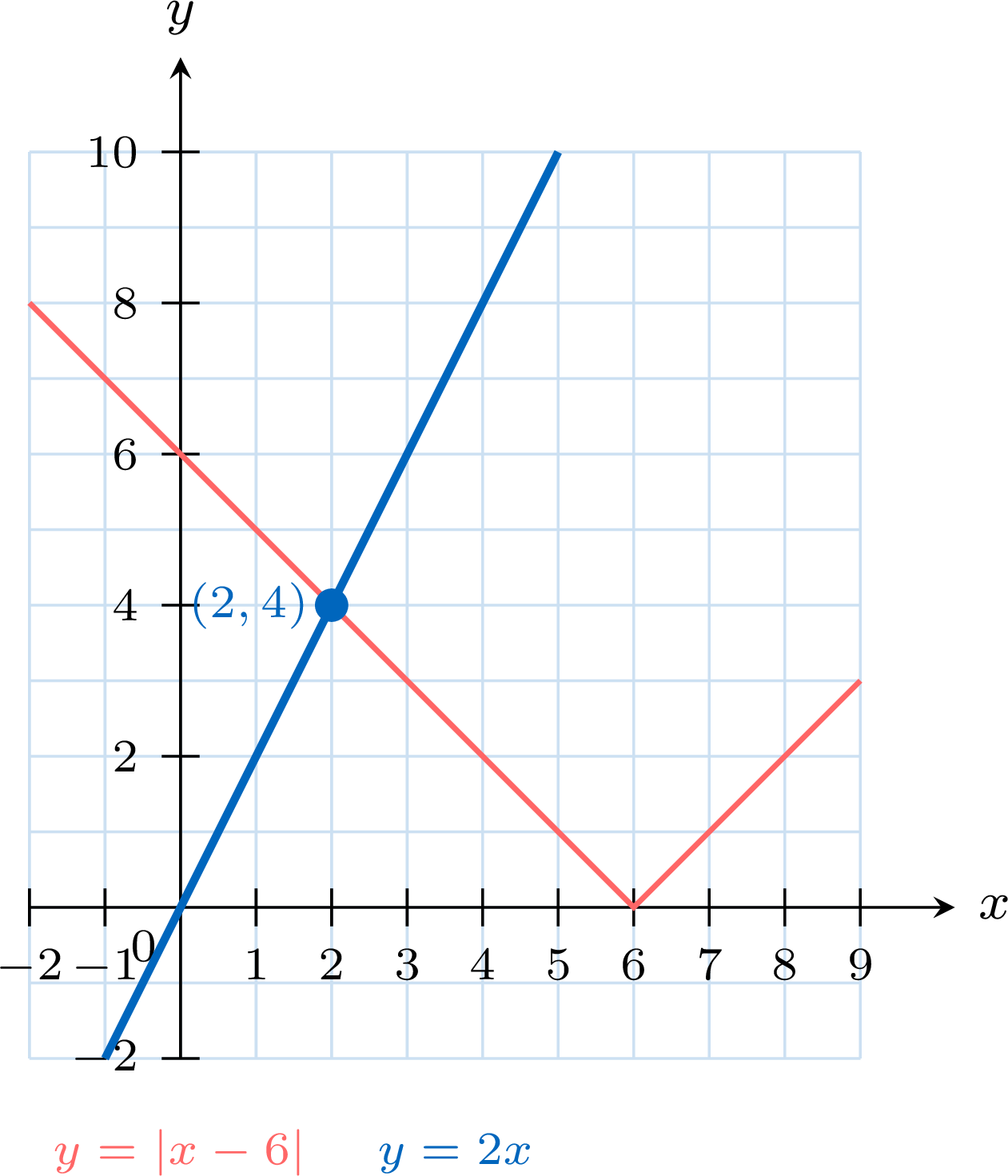
- \(x - 6 = 2x\) gives \(x = -6\). Check: \(|-6 - 6| = 12\), but \(2 \times (-6) = -12\): rejected, since an absolute value is never negative.
- \(x - 6 = -2x\) gives \(3x = 6\), \(x = 2\). Check: \(|2 - 6| = 4 = 2 \times 2\): accepted.
Example
Solve the inequalities \(|2x - 1| \leq 5\) and \(|x + 3| > |2x|\). - \(|2x - 1| \leq 5\). $$\begin{aligned}[t] |2x - 1| \leq 5 &\iff -5 \leq 2x - 1 \leq 5 && \text{(Rules for Modulus Inequalities, 1)} \\ &\iff -4 \leq 2x \leq 6 && \text{(add } 1\text{)} \\ &\iff -2 \leq x \leq 3. && \text{(divide by } 2 > 0\text{)} \end{aligned}$$ The solution is \([-2, 3]\): the numbers whose distance to \(\dfrac{1}{2}\) is at most \(\dfrac{5}{2}\).
- \(|x + 3| > |2x|\). Both sides are \(\geq 0\): $$\begin{aligned}[t] |x + 3| > |2x| &\iff (x + 3)^2 > 4x^2 && \text{(Rules for Modulus Inequalities, 3)} \\ &\iff x^2 + 6x + 9 > 4x^2 && \text{(expand)} \\ &\iff -3x^2 + 6x + 9 > 0 \\ &\iff x^2 - 2x - 3 < 0 && \text{(divide by } -3 < 0\text{: the sign reverses)} \\ &\iff (x + 1)(x - 3) < 0. \end{aligned}$$ A product of two factors is negative between its roots: the solution is \((-1, 3)\). Check: at \(x = 0\), \(|3| = 3 > 0 = |0|\); at \(x = 4\), \(|7| = 7 < 8 = |8|\).
Example
Solve \(\left|\dfrac{x + 2}{x - 1}\right| \geq 2\).
The quotient is defined for \(x \neq 1\). For \(x \neq 1\), \(|x - 1| > 0\), and multiplying by it keeps the inequality: $$\begin{aligned}[t] \left|\frac{x + 2}{x - 1}\right| \geq 2 &\iff |x + 2| \geq 2|x - 1| && \text{(multiply by } |x - 1| > 0\text{)} \\
&\iff (x + 2)^2 \geq 4(x - 1)^2 && \text{(both sides are } \geq 0\text{)} \\
&\iff x^2 + 4x + 4 \geq 4x^2 - 8x + 4 && \text{(expand)} \\
&\iff 3x^2 - 12x \leq 0 \\
&\iff 3x(x - 4) \leq 0 \\
&\iff 0 \leq x \leq 4. && \text{(sign of a product)} \end{aligned}$$ With \(x \neq 1\), the solution is \([0, 1) \cup (1, 4]\). Check: at \(x = 2\), \(\left|\dfrac{4}{1}\right| = 4 \geq 2\); at \(x = 5\), \(\left|\dfrac{7}{4}\right| < 2\); at \(x = 0\), \(\left|\dfrac{2}{-1}\right| = 2\).
Example
Use technology to solve \(|x^3 - 3x^2 + 1| < 2\). Give the endpoints to \(3\) significant figures.
The meeting points come from two cubic equations, \(x^3 - 3x^2 + 1 = 2\) and \(x^3 - 3x^2 + 1 = -2\), whose roots have no simple exact form: technology is the right tool. 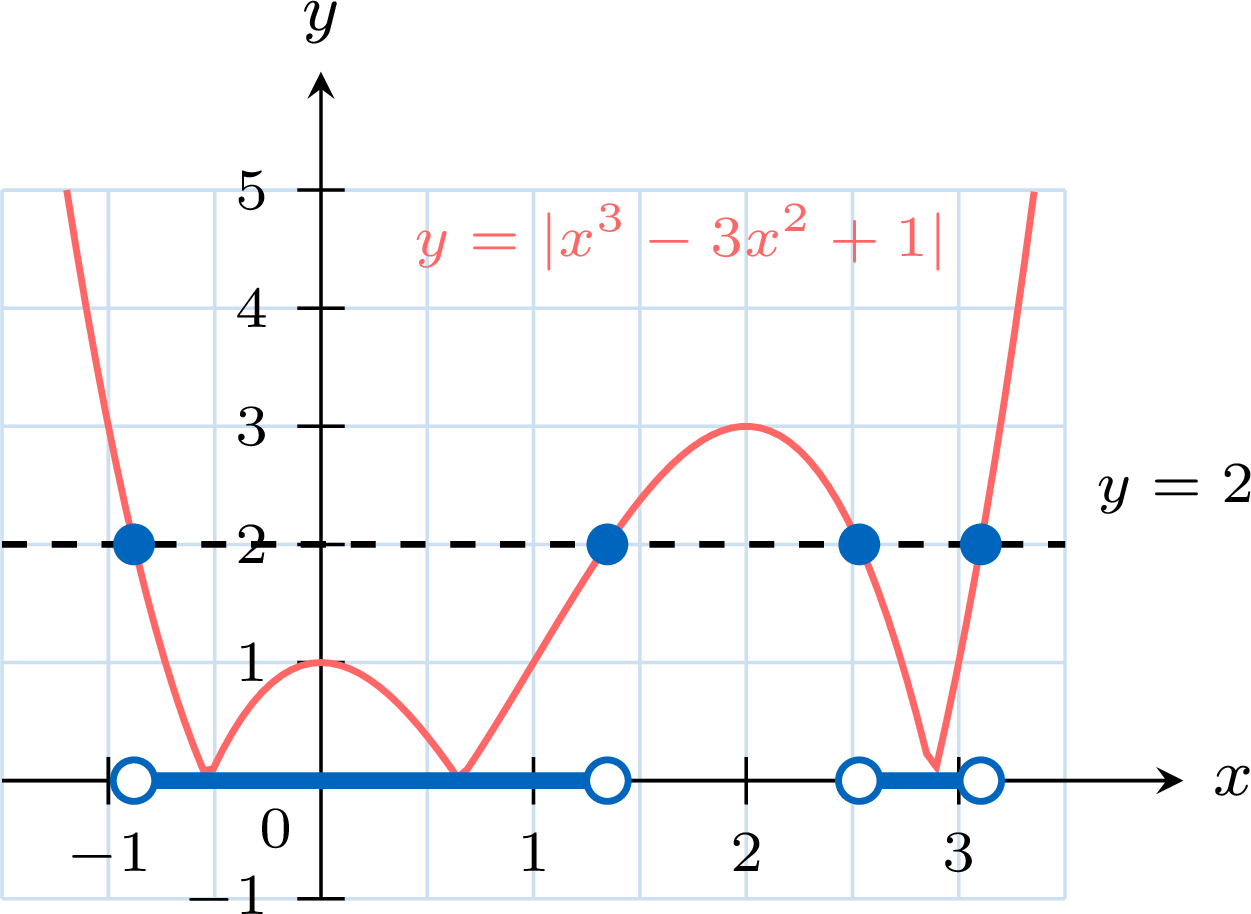
- Enter \(Y_1 = |x^3 - 3x^2 + 1|\) (the function abs) and \(Y_2 = 2\), in the window \(-1.5 \leq x \leq 3.5\), \(-1 \leq y \leq 5\).
- The tool intersection displays \(X = -0.87938524\), \(X = 1.3472964\), \(X = 2.5320889\) and \(X = 3.1038034\). There is no other meeting point: \(x^3 - 3x^2 + 1 = x^2(x - 3) + 1\); for \(x \leq -1\), \(x^2 \geq 1\) and \(x - 3 \leq -4\), so \(x^3 - 3x^2 + 1 \leq -3\); for \(x \geq 3.5\), \(x^2 \geq 12.25\) and \(x - 3 \geq 0.5\), so \(x^3 - 3x^2 + 1 \geq 7.125\): on both sides \(|x^3 - 3x^2 + 1| > 2\).
- The graph of \(Y_1\) lies below the line \(y = 2\) between the first and the second point, and between the third and the fourth: near \(x = 2\) it climbs to \(|8 - 12 + 1| = 3 > 2\).
Skills to practice
- Solving Modulus Inequalities with Technology
- Solving Modulus Equations with a Check
- Solving Modulus Inequalities
III
Rational Functions
III.1
Rational Functions of the Form \(\frac{ax+b}{cx^2+dx+e}\)
A battery of \(12\) volts, whose internal resistance is \(2\) ohms, powers a heating element of resistance \(R\) ohms. The power received by the element, in watts, is $$P(R) = \frac{144R}{(R + 2)^2} = \frac{144R}{R^2 + 4R + 4}, \quad R \geq 0.$$
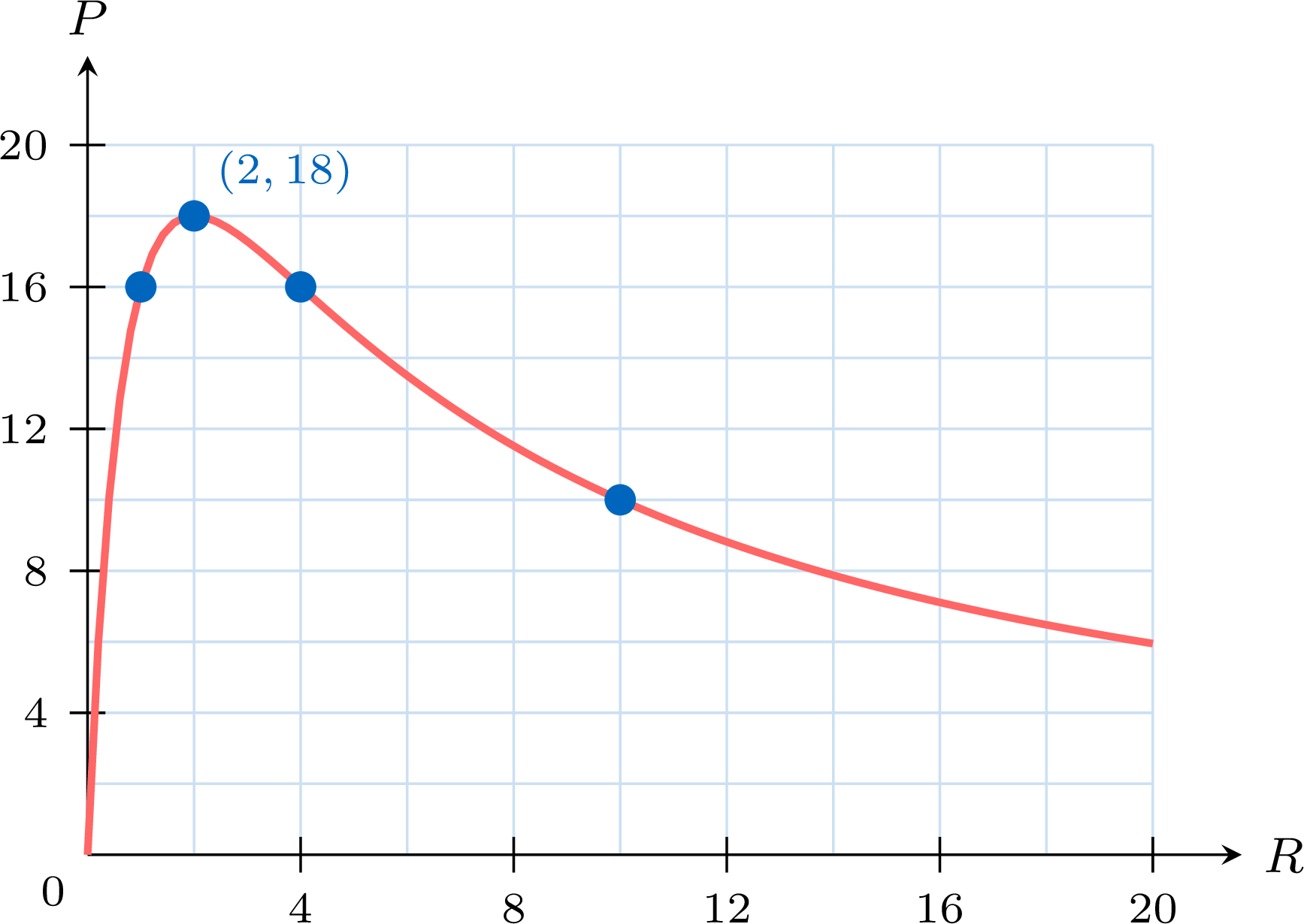
The denominator is now of degree \(2\): the graph still flattens along a horizontal asymptote, but it rises and falls back. This section studies such functions.
- Compute \(P(1)\), \(P(2)\), \(P(4)\) and \(P(10)\).
- What happens to \(P(R)\) when \(R\) becomes very large? Can the power be \(0\) when \(R > 0\)?
- Show that \(18 - P(R) = \dfrac{18(R - 2)^2}{(R + 2)^2}\), and deduce the greatest power that the element can receive.
- \(P(1) = \dfrac{144}{9} = 16\), \(P(2) = \dfrac{288}{16} = 18\), \(P(4) = \dfrac{576}{36} = 16\) and \(P(10) = \dfrac{1440}{144} = 10\): the power rises, then falls.
- For \(R > 0\), dividing the numerator and the denominator by \(R\) gives \(P(R) = \dfrac{144}{R + 4 + \frac{4}{R}}\). When \(R\) becomes very large, the denominator becomes as large as desired, so \(P(R)\) gets as close to \(0\) as desired: \(P(98) = \dfrac{14\,112}{10\,000} \approx 1.41\). The \(R\)-axis is a horizontal asymptote. But for \(R > 0\) the numerator \(144R\) and the denominator \((R + 2)^2\) are both positive: the power is never \(0\).
- For \(R \geq 0\): $$\begin{aligned}[t] 18 - P(R) &= \frac{18(R + 2)^2 - 144R}{(R + 2)^2} && \text{(common denominator)} \\ &= \frac{18R^2 + 72R + 72 - 144R}{(R + 2)^2} && \text{(expand)} \\ &= \frac{18(R^2 - 4R + 4)}{(R + 2)^2} && \text{(factor } 18\text{)} \\ &= \frac{18(R - 2)^2}{(R + 2)^2}. && \text{(perfect square)} \end{aligned}$$ A square is never negative, so \(18 - P(R) \geq 0\), that is \(P(R) \leq 18\), with equality only for \(R = 2\). The greatest power is \(18\) watts, received when the resistance of the element equals the internal resistance of the battery.
Definition — Rational Functions of the Form \(\frac{ax+b}{cx^2+dx+e}\)
Let \(a\), \(b\), \(c\), \(d\) and \(e\) be real numbers, with \(c \neq 0\), and \(a\) and \(b\) not both \(0\). The function $$f(x) = \frac{ax + b}{cx^2 + dx + e}$$ is a rational function with a quadratic denominator. It is defined when \(cx^2 + dx + e \neq 0\): its domain is \(\mathbb{R}\) without the real zeros of the denominator. With the discriminant \(\Delta = d^2 - 4ce\) of the denominator, there are two such zeros if \(\Delta > 0\), one if \(\Delta = 0\), and none if \(\Delta < 0\); the domain is then \(\mathbb{R}\). Proposition — Asymptotes of \(y \equal \frac{ax+b}{cx^2+dx+e}\)
Let \(f(x) = \dfrac{ax + b}{cx^2 + dx + e}\), with \(c \neq 0\), and \(a\) and \(b\) not both \(0\). - The \(x\)-axis, the line \(y = 0\), is a horizontal asymptote of the graph of \(f\).
- If \(p\) is a zero of the denominator and \(ap + b \neq 0\), the line \(x = p\) is a vertical asymptote.
- If \(p\) is a zero of both the numerator and the denominator, then \(a \neq 0\) and the denominator is \(c(x - p)(x - q)\) for a real number \(q\), so that \(f(x) = \dfrac{a}{c(x - q)}\) for every \(x\) of the domain. When \(q \neq p\), the graph of \(f\) is the graph of \(x \mapsto \dfrac{a}{c(x - q)}\) with the point with \(x\)-coordinate \(p\) removed: a hole, drawn as an open circle, and \(x = p\) is not an asymptote. When \(q = p\), the line \(x = p\) is a vertical asymptote.
- The graph meets its horizontal asymptote only where \(ax + b = 0\): at the \(x\)-intercept \(-\dfrac{b}{a}\) when \(a \neq 0\) and \(-\dfrac{b}{a}\) is in the domain, and never otherwise.
- Horizontal asymptote. For \(x \neq 0\), dividing the numerator and the denominator by \(x^2\): $$f(x) = \frac{\frac{a}{x} + \frac{b}{x^2}}{c + \frac{d}{x} + \frac{e}{x^2}}.$$ When \(x\) becomes large, positive or negative, the numbers \(\dfrac{a}{x}\), \(\dfrac{b}{x^2}\), \(\dfrac{d}{x}\) and \(\dfrac{e}{x^2}\) get as close to \(0\) as desired: the numerator gets as close to \(0\) as desired while the denominator gets as close to \(c \neq 0\) as desired. So \(f(x)\) gets as close to \(0\) as desired.
- Vertical asymptotes. Let \(p\) be a zero of the denominator with \(ap + b \neq 0\). As \(x\) gets closer to \(p\), the denominator gets as close to its value \(0\) at \(p\) as desired, while the numerator gets close to the nonzero number \(ap + b\): \(|f(x)|\) becomes as large as desired.
- Common zero. If \(a = 0\), then \(ap + b = b = 0\), which is excluded: so \(a \neq 0\) and \(ax + b = a(x - p)\). By the Factor Theorem, \(x - p\) is a factor of the denominator, whose other factor has degree \(1\): the denominator is \(c(x - p)(x - q)\) with \(q\) real. For \(x\) in the domain, \(x - p \neq 0\) and $$f(x) = \frac{a(x - p)}{c(x - p)(x - q)} = \frac{a}{c(x - q)}.$$ When \(q \neq p\), near \(p\) the values \(f(x)\) get as close to \(\dfrac{a}{c(p - q)}\) as desired: they do not become large, and only the point with \(x\)-coordinate \(p\) is missing. When \(q = p\), the fraction \(\dfrac{a}{c(x - p)}\) becomes as large as desired in absolute value near \(p\).
- Meeting the horizontal asymptote. A quotient is \(0\) exactly when its numerator is \(0\) and its denominator is not: \(f(x) = 0\) exactly when \(ax + b = 0\) with \(x\) in the domain.
Method — Sketching the Graph of \(y \equal \frac{ax+b}{cx^2+dx+e}\)
- Find the real zeros of the denominator with its discriminant (none when the discriminant is negative), factorise the denominator when it has some, and state the domain.
- Draw the asymptotes: the \(x\)-axis, and the line \(x = p\) at each zero \(p\) of the denominator which is not a zero of the numerator. A common zero \(p\) is cancelled first: if the simplified denominator is not \(0\) at \(p\), mark the hole with an open circle; if it still is (a double zero), the line \(x = p\) is a vertical asymptote.
- Find the axes intercepts: the \(y\)-intercept \(f(0) = \dfrac{b}{e}\) (when \(e \neq 0\)) and the \(x\)-intercept \(-\dfrac{b}{a}\) (when \(a \neq 0\) and \(-\dfrac{b}{a}\) is in the domain), the only point where the graph meets its horizontal asymptote.
- Build the sign table of \(f(x)\) with the Method “Sign Table for a Quotient”: the graph lies above the \(x\)-axis where \(f(x) > 0\) and below it where \(f(x) < 0\). On each side of a vertical asymptote, the graph climbs along it where \(f(x) > 0\) and falls along it where \(f(x) < 0\).
- Place the turning points with technology (Method “Reading the Key Features of a Graph on the Screen”); without technology, a few computed values place them only approximately. Then join the points on each interval between the vertical asymptotes: next to a vertical asymptote the graph climbs or falls along it, and for large values of \(x\), positive or negative, it flattens along the \(x\)-axis.
Example
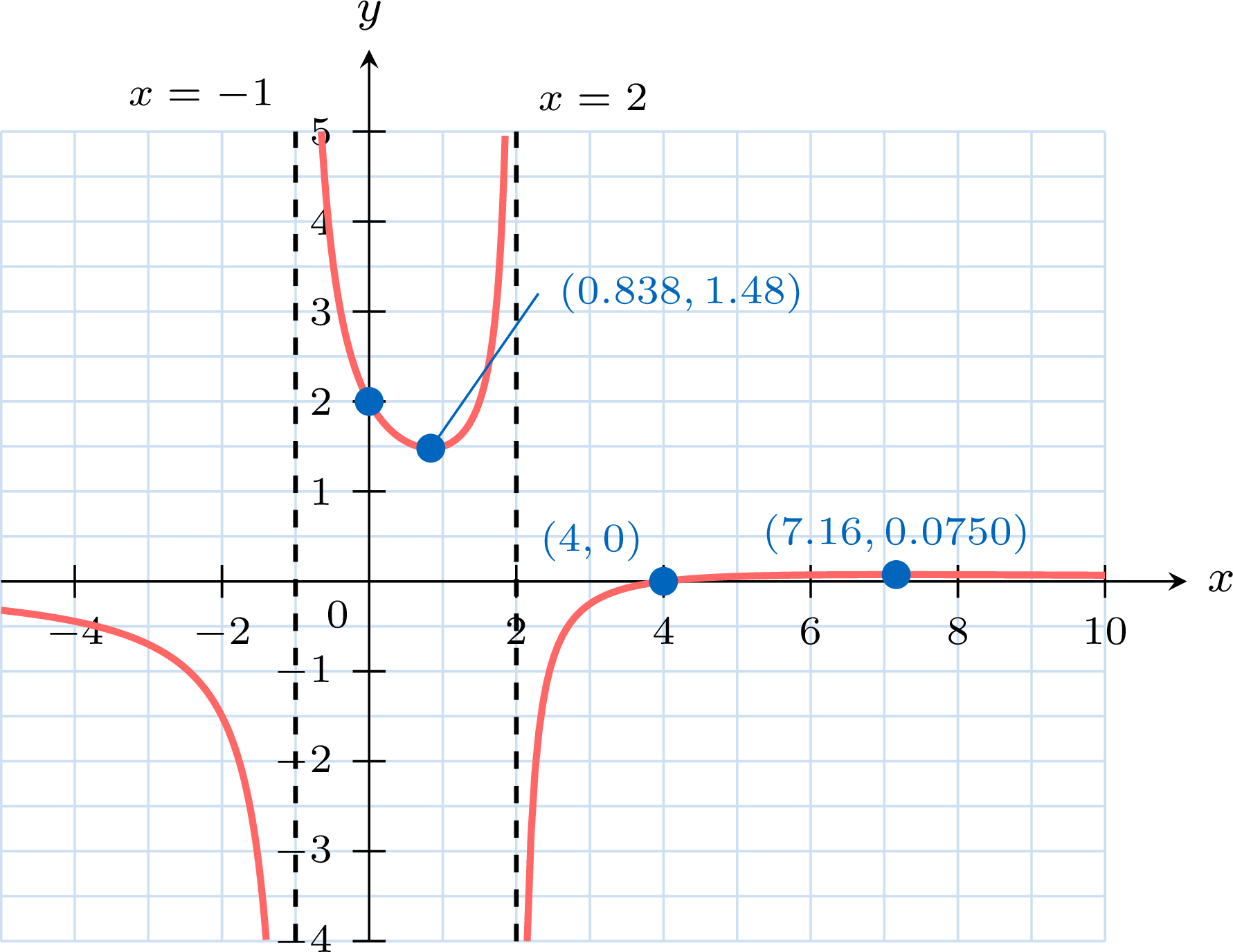
Let \(f(x) = \dfrac{x - 4}{x^2 - x - 2}\). Find the asymptotes and the axes intercepts of its graph, build the sign table of \(f(x)\), use technology to find the turning points, and sketch the graph. - Domain. The discriminant of \(x^2 - x - 2\) is \(1 + 8 = 9\), its zeros are \(-1\) and \(2\), and \(x^2 - x - 2 = (x + 1)(x - 2)\). The domain is \(\mathbb{R} \setminus \{-1, 2\}\).
- Asymptotes. The \(x\)-axis is the horizontal asymptote. The numerator equals \(-5 \neq 0\) at \(-1\) and \(-2 \neq 0\) at \(2\): the vertical asymptotes are \(x = -1\) and \(x = 2\).
- Intercepts. \(f(0) = \dfrac{-4}{-2} = 2\); \(x - 4 = 0\) for \(x = 4\). The graph meets its horizontal asymptote at \((4, 0)\) only.
- Sign table.
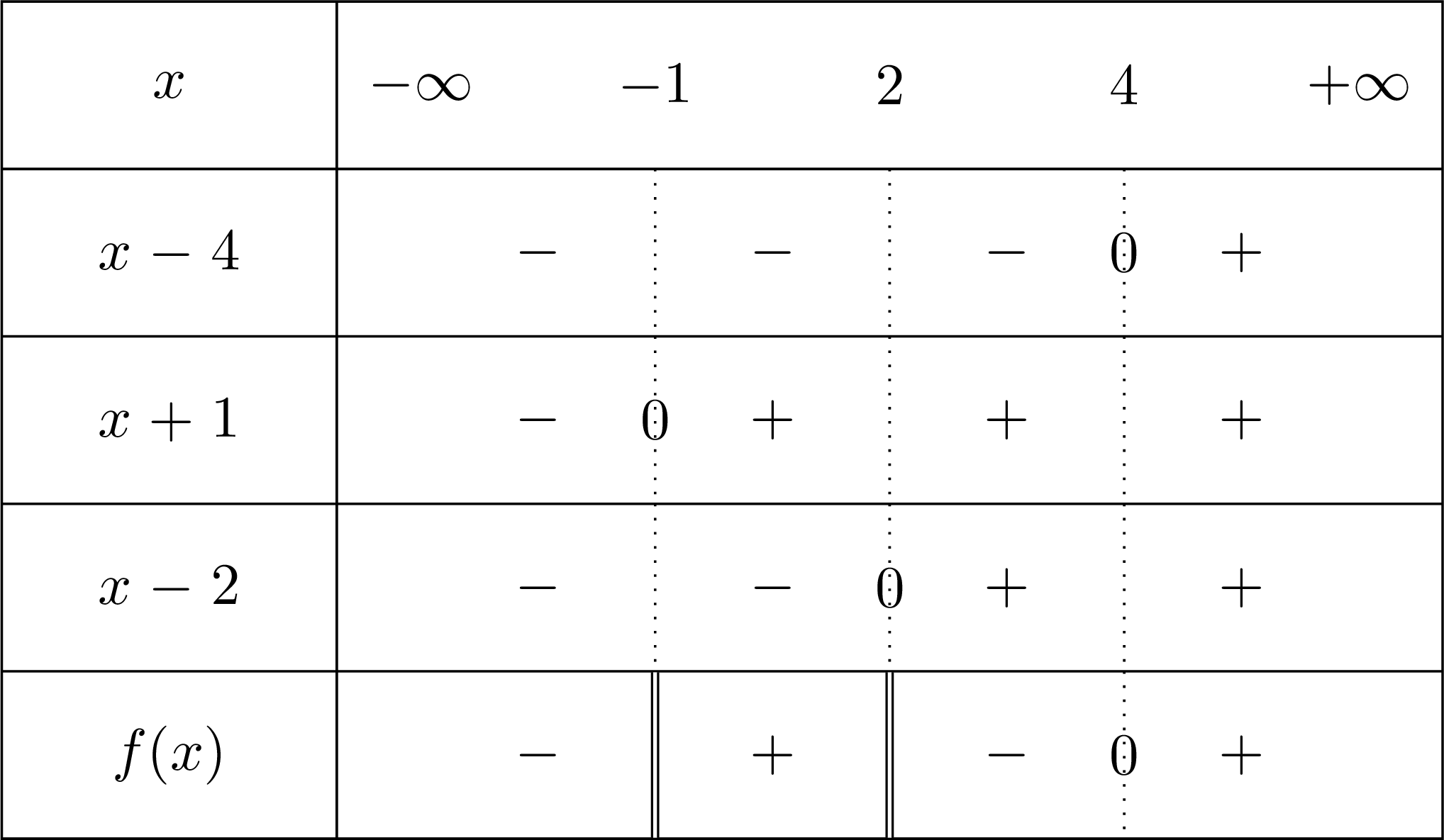
- Technology. With \(Y_1 = \dfrac{x - 4}{x^2 - x - 2}\) in the window \(-5 \leq x \leq 10\), \(-5 \leq y \leq 5\), the minimum tool on the middle branch displays \(X = 0.83772234\), \(Y = 1.4805061\): the local minimum point is \((0.838, 1.48)\). On the right branch, the maximum tool, in the window \(3 \leq x \leq 15\), \(0 \leq y \leq 0.1\), displays \(X = 7.1622777\), \(Y = 0.075049409\): the local maximum point is \((7.16, 0.0750)\). After crossing its asymptote at \((4, 0)\), the graph rises a little, then comes back towards the \(x\)-axis from above.
Example
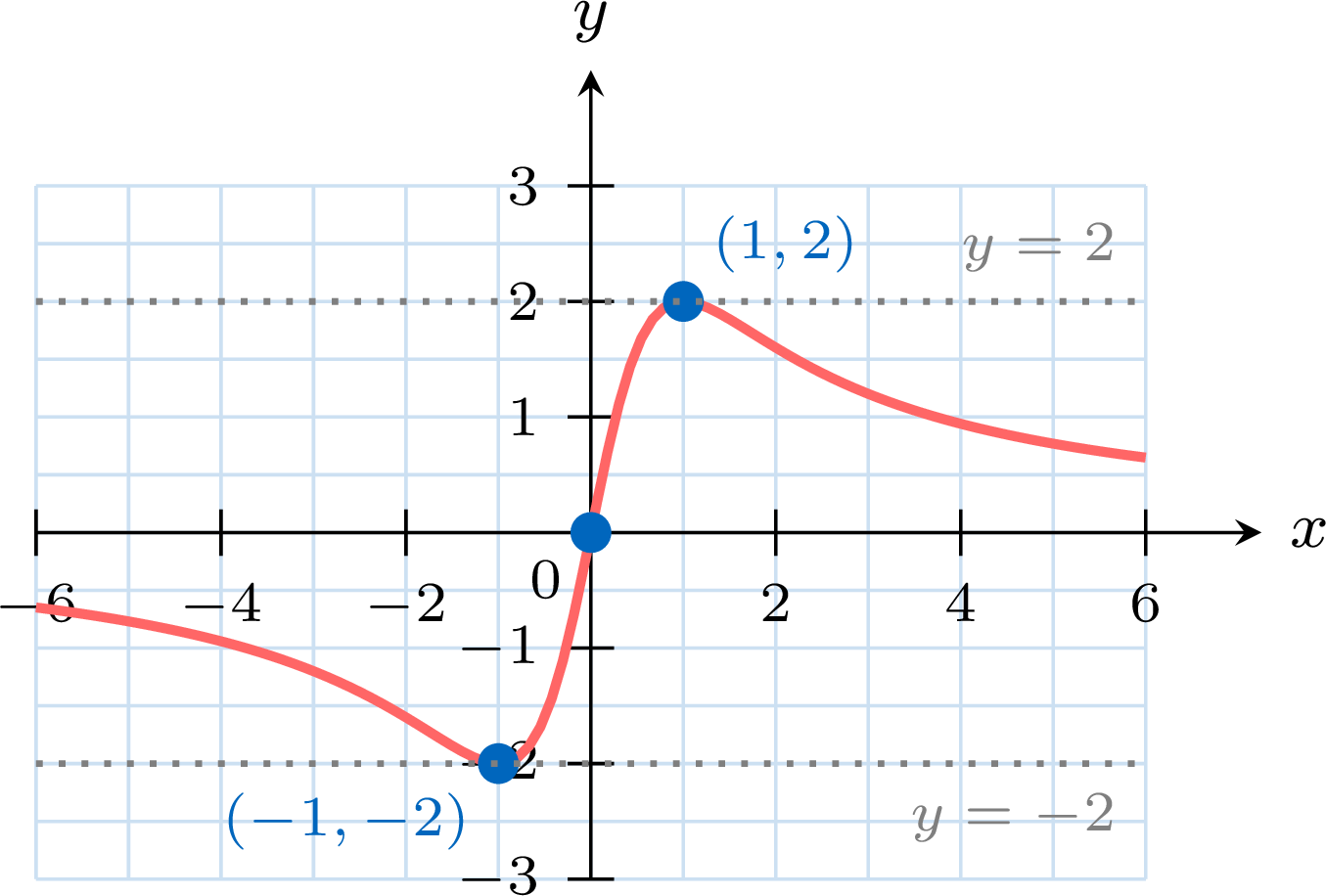
Let \(f(x) = \dfrac{4x}{x^2 + 1}\). Explain why the graph of \(f\) has no vertical asymptote, use technology to find its turning points, then prove that the range of \(f\) is \([-2, 2]\). - No vertical asymptote. For every real \(x\), \(x^2 + 1 \geq 1 > 0\): the denominator is never \(0\) (its discriminant is \(-4 < 0\)), the domain is \(\mathbb{R}\) and there is no vertical asymptote. The \(x\)-axis is the horizontal asymptote, met only at \(x = 0\): the graph passes through the origin. Since \(x^2 + 1 > 0\), \(f(x)\) has the sign of \(x\).
- Technology. With \(Y_1 = \dfrac{4x}{x^2 + 1}\) in the window \(-6 \leq x \leq 6\), \(-3 \leq y \leq 3\), the maximum tool displays a point with \(X \approx 1\), \(Y \approx 2\), and the minimum tool a point with \(X \approx -1\), \(Y \approx -2\): the turning points appear to be \((1, 2)\) and \((-1, -2)\).
- Range, without technology. A number \(k\) is a value of \(f\) when the equation \(\dfrac{4x}{x^2 + 1} = k\) has a solution: $$\begin{aligned}[t] \frac{4x}{x^2 + 1} = k &\iff 4x = k(x^2 + 1) && \text{(multiply by } x^2 + 1 > 0\text{)} \\ &\iff kx^2 - 4x + k = 0. && \text{(collect the terms)} \end{aligned}$$ For \(k = 0\), the solution is \(x = 0\). For \(k \neq 0\), this quadratic equation has a real solution when its discriminant is not negative: \(16 - 4k^2 \geq 0\), that is \(k^2 \leq 4\), that is \(-2 \leq k \leq 2\). So the range of \(f\) is \([-2, 2]\). For \(k = 2\), the equation \(2x^2 - 4x + 2 = 2(x - 1)^2 = 0\) gives \(x = 1\): the maximum is exactly \(f(1) = 2\); likewise the minimum is \(f(-1) = -2\), as the screen suggested.
Example
Let \(f(x) = \dfrac{x + 3}{x^2 + 2x - 3}\). Simplify \(f(x)\), find the asymptotes of its graph, and sketch it.
The denominator has the zeros \(-3\) and \(1\): \(x^2 + 2x - 3 = (x + 3)(x - 1)\), and the domain is \(\mathbb{R} \setminus \{-3, 1\}\). The value \(-3\) is also a zero of the numerator. For \(x\) in the domain: $$\begin{aligned}[t] f(x) &= \frac{x + 3}{(x + 3)(x - 1)} && \text{(factorise)} \\
&= \frac{1}{x - 1}. && (x + 3 \neq 0) \end{aligned}$$ 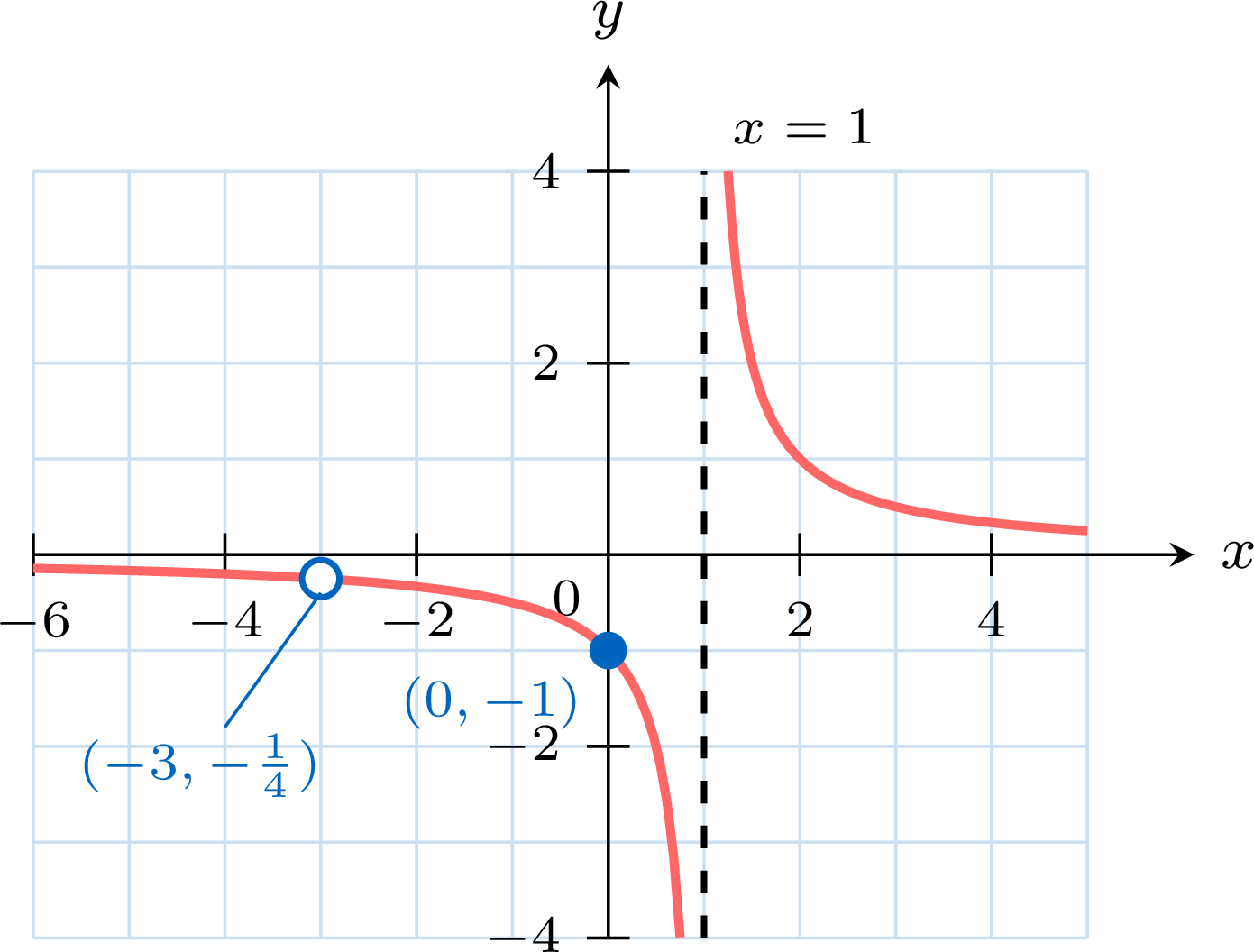
- Asymptotes. The \(x\)-axis and the line \(x = 1\), where the numerator equals \(4 \neq 0\). Near \(x = -3\), \(f(x)\) gets as close to \(\dfrac{1}{-3 - 1} = -\dfrac{1}{4}\) as desired: the line \(x = -3\) is not an asymptote.
- Hole. The graph is the hyperbola \(y = \dfrac{1}{x - 1}\) without the point \(\left(-3, -\dfrac{1}{4}\right)\), drawn as an open circle.
- Intercepts. \(f(0) = -1\). There is no \(x\)-intercept: the numerator is \(0\) only at \(-3\), which is excluded. The graph never meets its horizontal asymptote.
Skills to practice
- Finding Asymptotes, Intercepts and Holes
- Studying and Sketching \(y \equal \frac{ax+b}{cx^2+dx+e}\)
III.2
Rational Functions of the Form \(\frac{ax^2+bx+c}{dx+e}\)
A farmer builds a rectangular pen of area \(32\)~m\(^2\) against a long wall: the wall is one side of the pen, and a fence covers the three other sides. The two sides perpendicular to the wall measure \(x\) metres each.
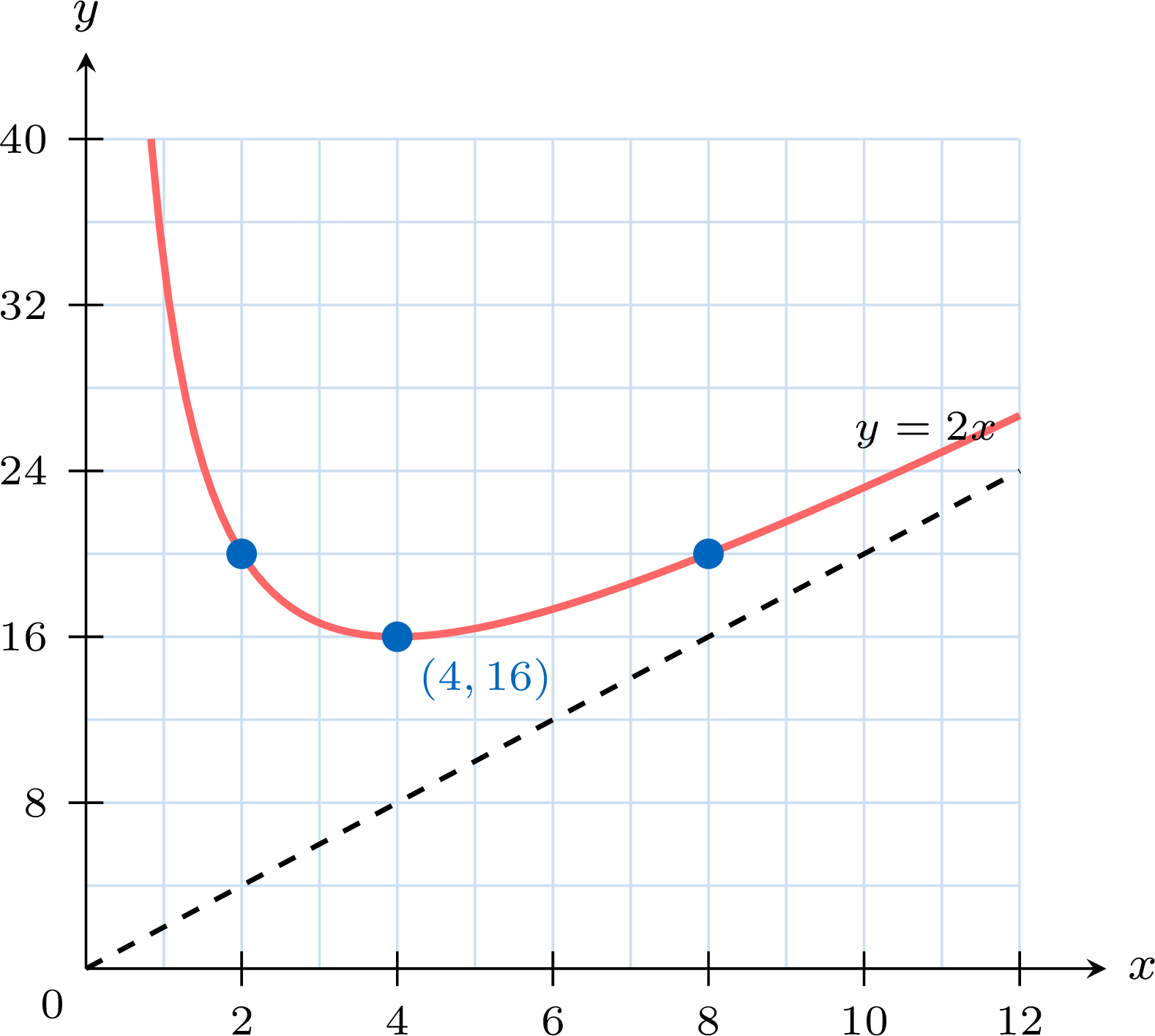
The line \(y = 2x\) plays the part of an asymptote, but it is neither vertical nor horizontal: this section defines such asymptotes.
- Show that the length of fence needed, in metres, is \(L(x) = \dfrac{2x^2 + 32}{x}\), for \(x > 0\).
- Compute \(L(2)\), \(L(4)\), \(L(8)\) and \(L(16)\), and compare each value with \(2x\).
- Show that \(L(x) = 2x + \dfrac{32}{x}\). What happens to the difference \(L(x) - 2x\) when \(x\) becomes very large? Interpret on the graph of \(L\).
- Show that \(L(x) - 16 = \dfrac{2(x - 4)^2}{x}\), and deduce the shortest possible fence.
- The side along the wall measures \(\dfrac{32}{x}\) metres, since the area is \(32\)~m\(^2\). The fence covers two sides of \(x\) metres and this side: $$\begin{aligned}[t] L(x) &= 2x + \frac{32}{x} && \text{(three sides)} \\ &= \frac{2x^2 + 32}{x}. && \text{(common denominator)} \end{aligned}$$
- \(L(2) = 20\), \(L(4) = 16\), \(L(8) = 20\) and \(L(16) = 34\), while \(2x\) equals \(4\), \(8\), \(16\) and \(32\): the differences \(L(x) - 2x\) are \(16\), \(8\), \(4\) and \(2\), halved each time \(x\) doubles.
- Splitting the fraction, \(L(x) = \dfrac{2x^2}{x} + \dfrac{32}{x} = 2x + \dfrac{32}{x}\). The difference \(L(x) - 2x = \dfrac{32}{x}\) is positive and gets as close to \(0\) as desired when \(x\) becomes very large: the graph of \(L\) gets as close as desired to the slanted line \(y = 2x\), staying above it. When \(x\) gets close to \(0\), \(\dfrac{32}{x}\) becomes as large as desired: the \(y\)-axis is a vertical asymptote.
- For \(x > 0\): $$\begin{aligned}[t] L(x) - 16 &= \frac{2x^2 + 32 - 16x}{x} && \text{(common denominator)} \\ &= \frac{2(x^2 - 8x + 16)}{x} && \text{(factor } 2\text{)} \\ &= \frac{2(x - 4)^2}{x}. && \text{(perfect square)} \end{aligned}$$ This is never negative, and it is \(0\) only for \(x = 4\): the shortest fence measures \(16\) metres, with sides of \(4\)~m, \(8\)~m and \(4\)~m.
Definition — Oblique Asymptote
Let \(f\) be a function and \(\mathcal{C}\) its graph. The line \(y = mx + p\), with \(m \neq 0\), is an oblique asymptote of \(\mathcal{C}\) when, as \(x\) becomes as large as desired, positive or negative (in one direction at least), the difference \(f(x) - (mx + p)\) gets as close to \(0\) as desired: the curve gets closer and closer to the slanted line. Where \(f(x) - (mx + p) > 0\), the curve lies above the line; where \(f(x) - (mx + p) < 0\), it lies below. An oblique asymptote is drawn as a dashed line and labelled with its equation. (With \(m = 0\), the line would be a horizontal asymptote. When \(f(x) - (mx + p) = 0\) for every \(x\) of the domain, the graph is the line itself, possibly with holes, not a curve approaching it: the line is not called an asymptote.) Proposition — Asymptotes of \(y \equal \frac{ax^2+bx+c}{dx+e}\)
Let \(f(x) = \dfrac{ax^2 + bx + c}{dx + e}\), with \(a \neq 0\), \(d \neq 0\), and a numerator which is not \(0\) at \(x = -\dfrac{e}{d}\). - There are real numbers \(m\), \(p\) and \(r\), with \(m = \dfrac{a}{d}\) and \(r \neq 0\), such that for every \(x \neq -\dfrac{e}{d}\): $$f(x) = mx + p + \frac{r}{dx + e}.$$ The polynomial \(mx + p\) is the quotient and the number \(r\) the remainder of the division of \(ax^2 + bx + c\) by \(dx + e\).
- The line \(x = -\dfrac{e}{d}\) is a vertical asymptote and the line \(y = mx + p\) is an oblique asymptote of the graph of \(f\).
- The graph lies above the oblique asymptote where \(\dfrac{r}{dx + e} > 0\) and below it where \(\dfrac{r}{dx + e} < 0\): above on one side of the vertical asymptote, below on the other side. It never meets its oblique asymptote.
- The division. By the Proposition “Division With Remainder”, dividing \(ax^2 + bx + c\) by \(dx + e\), of degree \(1\), gives a quotient of degree \(1\), written \(mx + p\), and a remainder of degree less than \(1\), that is a constant \(r\): $$ax^2 + bx + c = (dx + e)(mx + p) + r.$$ Comparing the coefficients of \(x^2\) gives \(a = dm\), so \(m = \dfrac{a}{d} \neq 0\). Substituting \(x = -\dfrac{e}{d}\), the product vanishes and \(r\) equals the value of the numerator at \(-\dfrac{e}{d}\), which is not \(0\): \(r \neq 0\). Dividing by \(dx + e \neq 0\) gives the formula.
- Vertical asymptote. As \(x\) gets closer to \(-\dfrac{e}{d}\), \(mx + p\) gets close to a fixed number, while \(dx + e\) gets as close to \(0\) as desired: since \(r \neq 0\), \(\left|\dfrac{r}{dx + e}\right|\) becomes as large as desired, and so does \(|f(x)|\).
- Oblique asymptote. \(f(x) - (mx + p) = \dfrac{r}{dx + e}\). When \(x\) becomes large, positive or negative, \(|dx + e|\) becomes as large as desired, so this difference gets as close to \(0\) as desired; since \(m \neq 0\), the line \(y = mx + p\) is oblique.
- Position. The difference \(\dfrac{r}{dx + e}\) has the sign of \(r\) where \(dx + e > 0\) and the opposite sign where \(dx + e < 0\): its sign changes only at \(-\dfrac{e}{d}\). It is never \(0\), since \(r \neq 0\).
Method — Finding the Oblique Asymptote
To find the oblique asymptote of the graph of \(y = \dfrac{ax^2 + bx + c}{dx + e}\): - Check the numerator at \(x = -\dfrac{e}{d}\): if it is \(0\), then \(dx + e\) is a factor, and the graph is a line with a hole: it has no vertical asymptote, and the line itself is not called an asymptote (Definition “Oblique Asymptote”).
- Divide the numerator by the denominator, by long division (Method “Division Algorithm”) or by identifying the coefficients in \(ax^2 + bx + c = (dx + e)(mx + p) + r\), to write \(f(x) = mx + p + \dfrac{r}{dx + e}\).
- Read the oblique asymptote \(y = mx + p\) and the vertical asymptote \(x = -\dfrac{e}{d}\); the sign of \(\dfrac{r}{dx + e}\) places the graph above or below the oblique asymptote on each side of the vertical asymptote.
Method — Sketching the Graph of \(y \equal \frac{ax^2+bx+c}{dx+e}\)
- Check the numerator at \(x = -\dfrac{e}{d}\): if it is \(0\), the graph is a line with a hole (Method “Finding the Oblique Asymptote”). Otherwise, draw the asymptotes, the vertical one \(x = -\dfrac{e}{d}\) and the oblique one found with that Method, as dashed lines.
- Find the axes intercepts: the \(y\)-intercept \(\dfrac{c}{e}\) (when \(e \neq 0\)) and the \(x\)-intercepts, solutions of \(ax^2 + bx + c = 0\) (two, one or none, according to the discriminant; none of them is \(-\dfrac{e}{d}\), since the numerator is not \(0\) there).
- Place each branch: above or below the oblique asymptote with the sign of \(\dfrac{r}{dx + e}\); above or below the \(x\)-axis with the sign table of \(f(x)\); on each side of the vertical asymptote, the graph climbs along it where \(f(x) > 0\) and falls along it where \(f(x) < 0\).
- Place the turning points with technology (Method “Reading the Key Features of a Graph on the Screen”); without technology, a few computed values place them only approximately. Then join, each branch getting closer and closer to the oblique asymptote.
Example
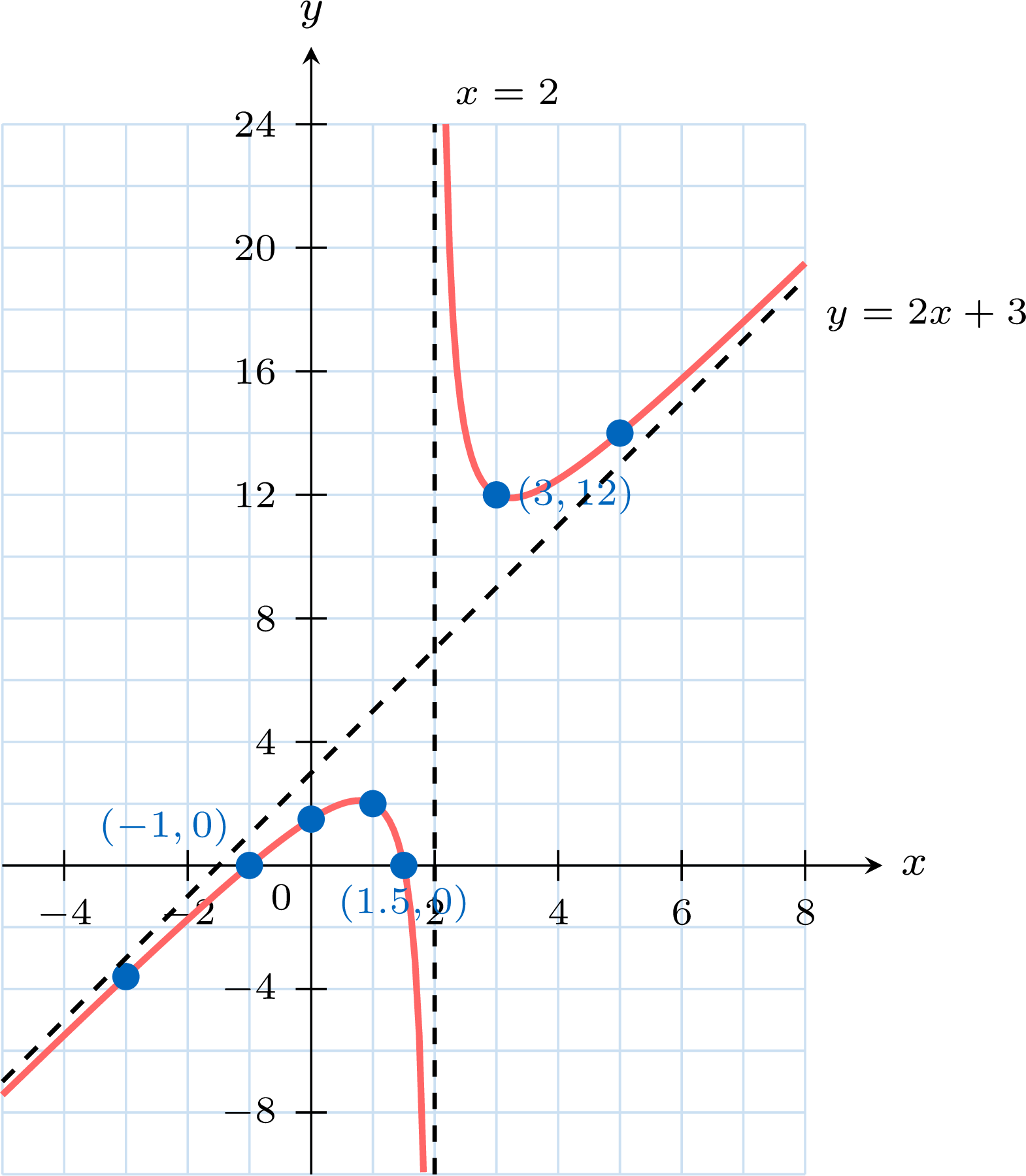
Let \(f(x) = \dfrac{2x^2 - x - 3}{x - 2}\). Find the asymptotes of its graph and its position relative to the oblique asymptote, the axes intercepts and the sign of \(f(x)\), then sketch the graph. - Division. At \(x = 2\) the numerator equals \(8 - 2 - 3 = 3 \neq 0\). The long division of \(2x^2 - x - 3\) by \(x - 2\):
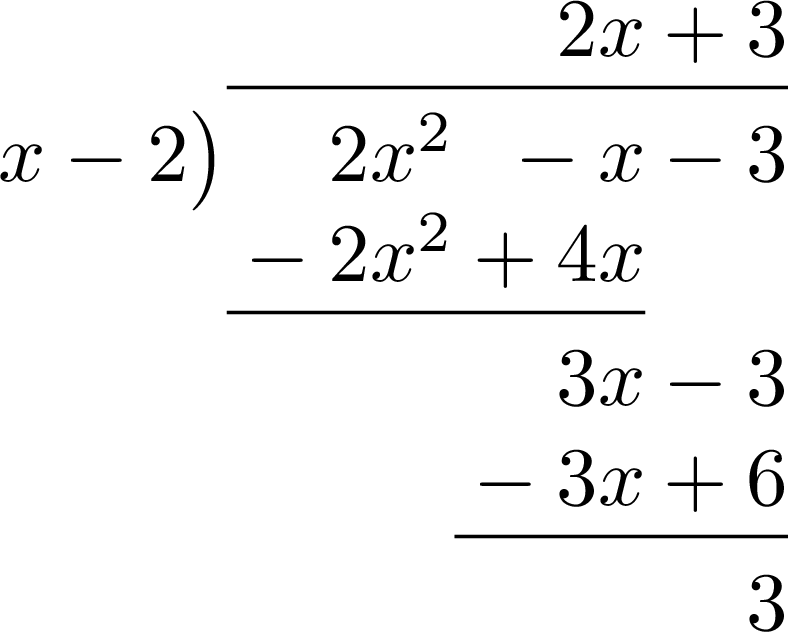
- Asymptotes. The vertical asymptote is \(x = 2\) and the oblique asymptote is \(y = 2x + 3\). For \(x > 2\), \(\dfrac{3}{x - 2} > 0\): the right branch lies above the oblique asymptote; for \(x < 2\), \(\dfrac{3}{x - 2} < 0\): the left branch lies below it.
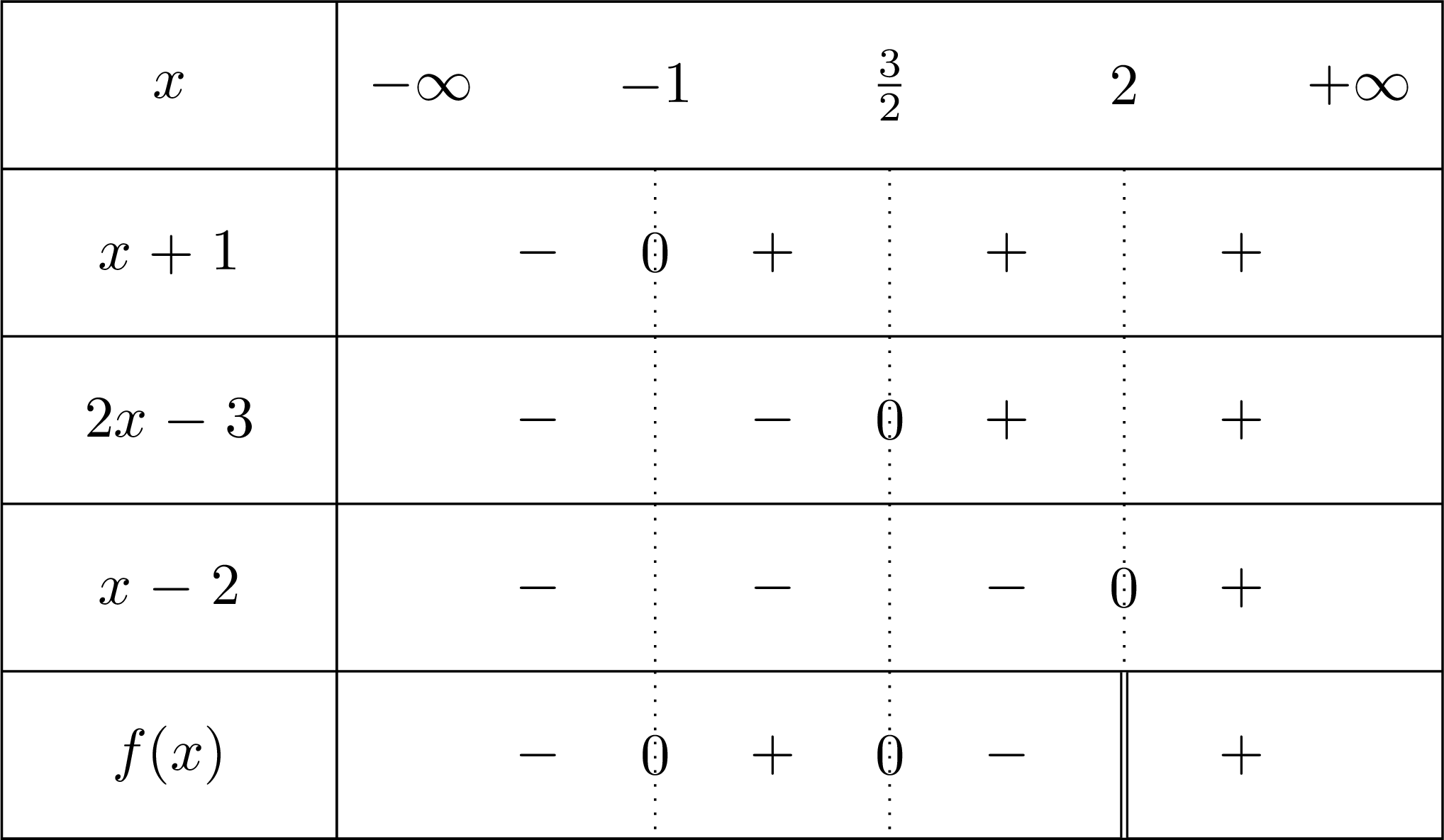
- Intercepts. \(f(0) = \dfrac{-3}{-2} = \dfrac{3}{2}\). The discriminant of \(2x^2 - x - 3\) is \(1 + 24 = 25\), its zeros are \(\dfrac{1 - 5}{4} = -1\) and \(\dfrac{1 + 5}{4} = \dfrac{3}{2}\), and \(2x^2 - x - 3 = (x + 1)(2x - 3)\).
- Sign table.
- Points. \(f(-3) = -\dfrac{18}{5}\), \(f(1) = 2\), \(f(3) = 12\) and \(f(5) = 14\). The left branch rises from below the oblique asymptote, crosses the \(x\)-axis at \(-1\), turns back and crosses it again at \(\dfrac{3}{2}\); the right branch comes down from the top along \(x = 2\), turns and rises along \(y = 2x + 3\).
Example
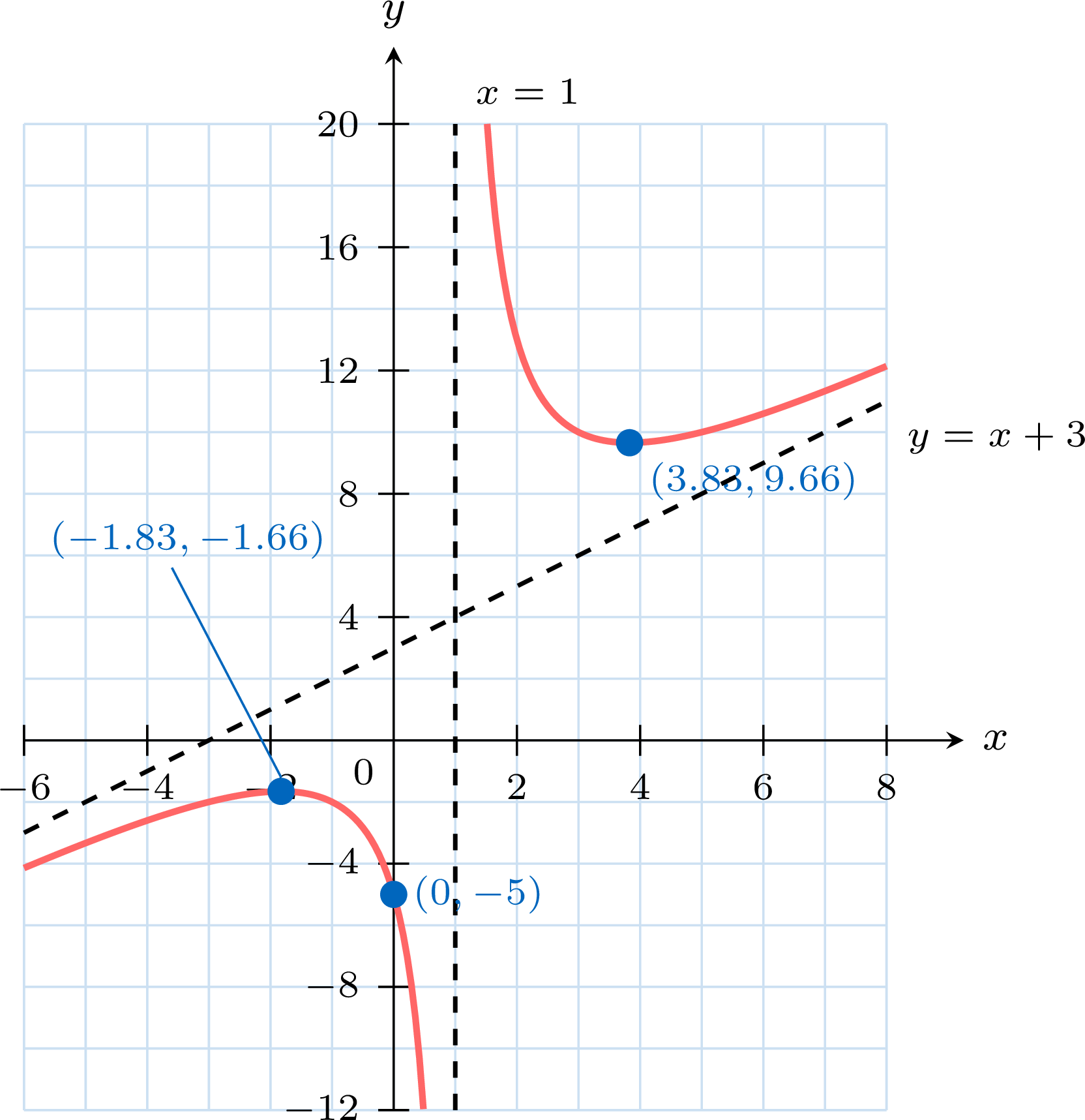
Let \(f(x) = \dfrac{x^2 + 2x + 5}{x - 1}\). Find the asymptotes of its graph, show that it has no \(x\)-intercept, use technology to find its turning points, then find its range. - Asymptotes. At \(x = 1\) the numerator equals \(8 \neq 0\). Identifying \(x^2 + 2x + 5 = (x - 1)(x + p) + r\) gives \(p - 1 = 2\) and \(r - p = 5\), so \(p = 3\) and \(r = 8\): $$f(x) = x + 3 + \frac{8}{x - 1}.$$ The asymptotes are \(x = 1\) and \(y = x + 3\); the graph is above the oblique asymptote for \(x > 1\), below it for \(x < 1\).
- No \(x\)-intercept. The discriminant of \(x^2 + 2x + 5\) is \(4 - 20 = -16 < 0\): the numerator is never \(0\). The \(y\)-intercept is \(f(0) = -5\).
- Technology. With \(Y_1 = \dfrac{x^2 + 2x + 5}{x - 1}\) in the window \(-6 \leq x \leq 8\), \(-12 \leq y \leq 20\), the maximum tool on the left branch displays \(X = -1.8284271\), \(Y = -1.6568542\), and the minimum tool on the right branch displays \(X = 3.8284271\), \(Y = 9.6568542\): the local maximum point is \((-1.83, -1.66)\) and the local minimum point \((3.83, 9.66)\).
- Range. The left branch takes every value up to its maximum, the right branch every value from its minimum: the range is approximately \((-\infty, -1.66] \cup [9.66, +\infty)\), the endpoints to \(3\) significant figures. The exact endpoints, without technology: \(f(x) = k\) becomes \(x^2 + 2x + 5 = k(x - 1)\), that is \(x^2 + (2 - k)x + 5 + k = 0\) (\(x = 1\) is never a solution, since it would give \(8 = 0\)). It has a real solution when its discriminant is not negative: $$\begin{aligned}[t] (2 - k)^2 - 4(5 + k) &\geq 0 \\ k^2 - 8k - 16 &\geq 0. && \text{(expand)} \end{aligned}$$ The zeros of \(k^2 - 8k - 16\) are \(4 \pm 4\sqrt{2}\), so \(k \leq 4 - 4\sqrt{2}\) or \(k \geq 4 + 4\sqrt{2}\): the range is exactly \((-\infty, 4 - 4\sqrt{2}] \cup [4 + 4\sqrt{2}, +\infty)\), with \(4 - 4\sqrt{2} \approx -1.66\) and \(4 + 4\sqrt{2} \approx 9.66\), as on the screen.
Example
The graph of \(f(x) = \dfrac{ax^2 + bx + c}{x - 2}\) has the oblique asymptote \(y = 3x + 1\) and meets the \(y\)-axis at \((0, 4)\). Find \(a\), \(b\) and \(c\).
By the Proposition “Asymptotes of \(y = \frac{ax^2+bx+c}{dx+e}\)”, the quotient of the division by \(x - 2\) is \(3x + 1\): there is a number \(r\) such that \(f(x) = 3x + 1 + \dfrac{r}{x - 2}\). The \(y\)-intercept gives \(r\): $$\begin{aligned}[t] f(0) = 1 + \frac{r}{-2} &= 4 \\
-\frac{r}{2} &= 3 && \text{(subtract } 1\text{)} \\
r &= -6. && \text{(multiply by } -2\text{)} \end{aligned}$$ Then the numerator is $$\begin{aligned}[t] ax^2 + bx + c &= (x - 2)(3x + 1) - 6 && \text{(quotient and remainder)} \\
&= 3x^2 - 5x - 2 - 6 && \text{(expand)} \\
&= 3x^2 - 5x - 8, \end{aligned}$$ so \(a = 3\), \(b = -5\) and \(c = -8\). Check: the numerator equals \(12 - 10 - 8 = -6 \neq 0\) at \(x = 2\), so \(x = 2\) is indeed a vertical asymptote, and \(f(0) = \dfrac{-8}{-2} = 4\). 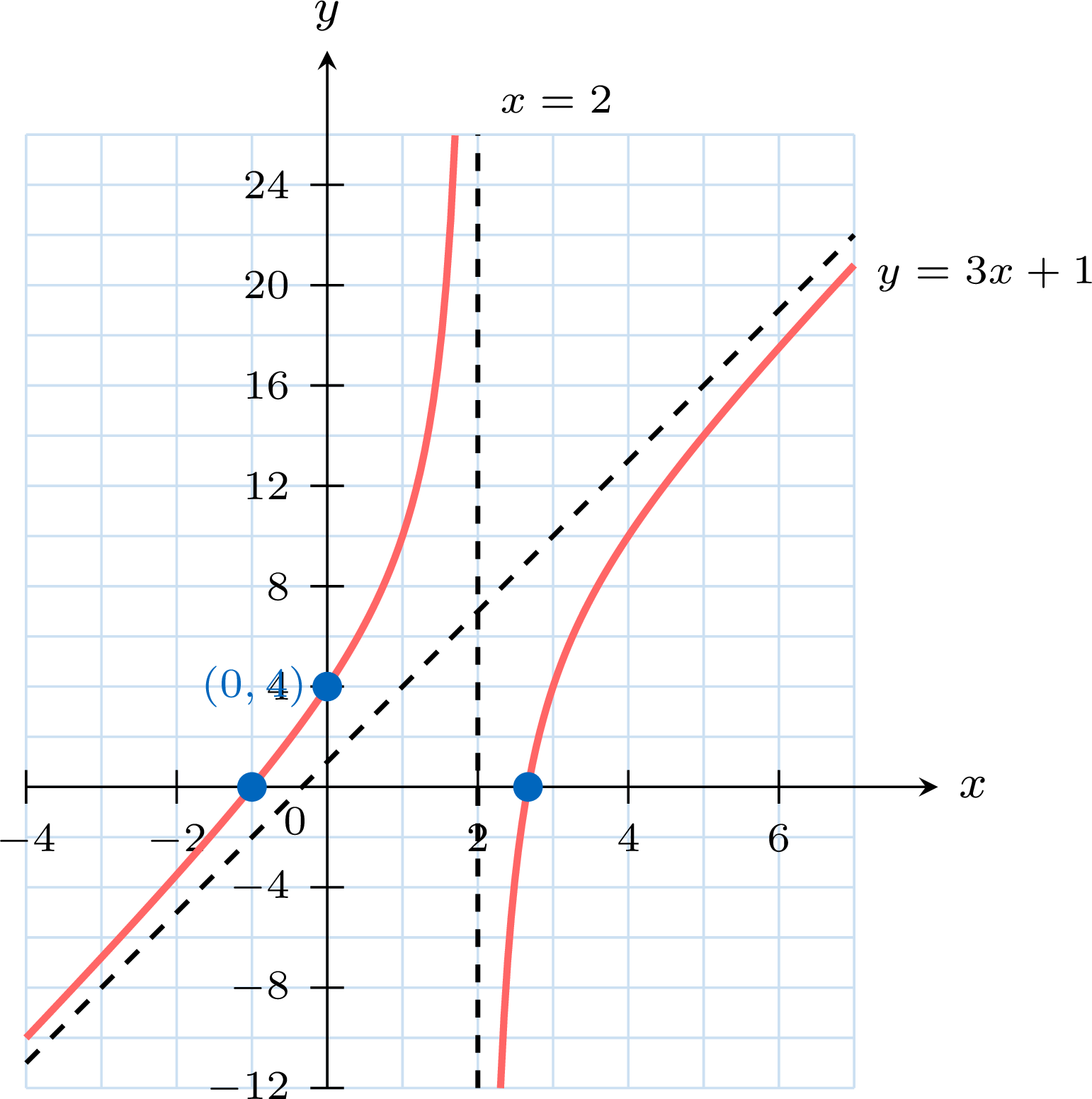
Skills to practice
- Finding the Asymptotes of \(y \equal \frac{ax^2+bx+c}{dx+e}\)
- Studying Rational Functions with Technology
- Studying and Sketching \(y \equal \frac{ax^2+bx+c}{dx+e}\)
III.3
Rational Inequalities
An inequality between rational expressions is not solved like an equation. Multiplying both sides by an expression reverses the inequality where this expression is negative, and its sign changes with \(x\). To solve \(\dfrac{x}{x - 1} \geq 2\), multiplying by \(x - 1\) would give \(x \geq 2x - 2\), that is \(x \leq 2\). But \(x = 0\) satisfies \(x \leq 2\), and \(\dfrac{0}{0 - 1} = 0\) is not greater than or equal to \(2\): for \(x < 1\), \(x - 1 < 0\) and the multiplication reversed the inequality. The solution is in fact \(1 < x \leq 2\). The safe route compares with \(0\): one side, one fraction, one sign table.
Method — Solving a Rational Inequality
To solve an inequality \(f(x) < g(x)\) (or \(\leq\), \(>\), \(\geq\)) where \(f\) or \(g\) is a rational function: - Find the forbidden values, the zeros of the denominators: they are never solutions.
- Move every term to one side, keeping the inequality sign: \(f(x) - g(x) < 0\).
- Write \(f(x) - g(x)\) as one fraction \(\dfrac{N(x)}{D(x)}\) with a common denominator, and factorise \(N(x)\) and \(D(x)\).
- Find the zeros of \(N(x)\) and of \(D(x)\), called the critical values: they cut the number line into the intervals of the sign table. Build the sign table of \(\dfrac{N(x)}{D(x)}\) with the Method “Sign Table for a Quotient”, with a double bar at each zero of \(D(x)\).
- Read the solution: the intervals where the sign is the required one; a zero of \(N(x)\) is included for \(\leq\) and \(\geq\) only, a forbidden value never. Check one value of each interval in the original inequality, or on the graphs.
Example
Solve the inequality \(\dfrac{2x - 1}{x + 2} > x - 2\).
The forbidden value is \(-2\). For \(x \neq -2\): $$\begin{aligned}[t] \frac{2x - 1}{x + 2} - (x - 2) &= \frac{2x - 1 - (x - 2)(x + 2)}{x + 2} && \text{(common denominator)} \\
&= \frac{2x - 1 - x^2 + 4}{x + 2} && \text{(expand)} \\
&= \frac{-x^2 + 2x + 3}{x + 2} && \text{(collect)} \\
&= \frac{(3 - x)(x + 1)}{x + 2}. && \text{(factorise: zeros } -1 \text{ and } 3\text{)} \end{aligned}$$ The inequality becomes \(\dfrac{(3 - x)(x + 1)}{x + 2} > 0\). 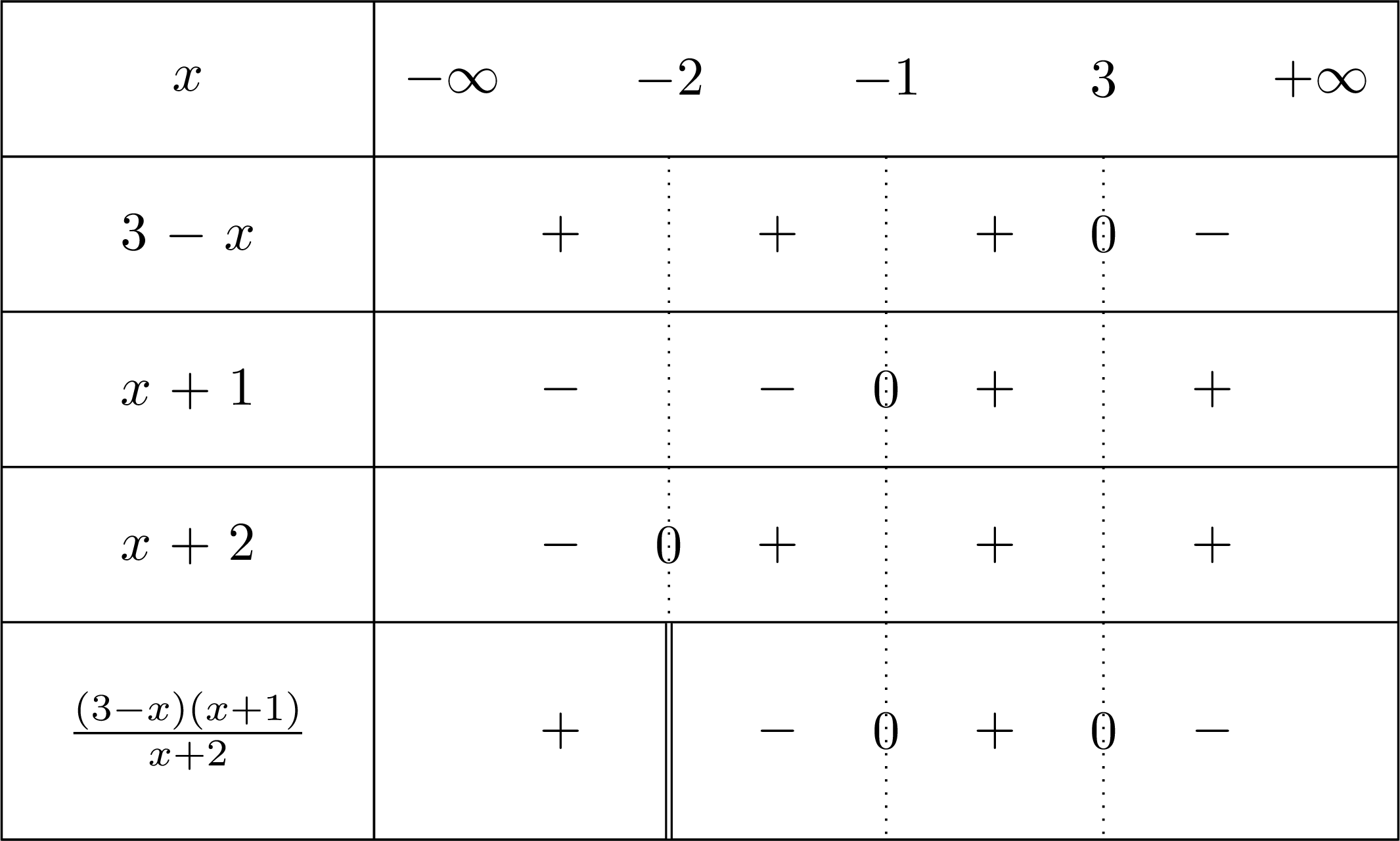
The inequality is strict, so the zeros \(-1\) and \(3\) are excluded, like the forbidden value \(-2\). The solution is \(x < -2\) or \(-1 < x < 3\), that is \((-\infty, -2) \cup (-1, 3)\). Check with \(x = 0\): \(\dfrac{-1}{2} = -0.5 > -2\). On the graphs, the hyperbola lies above the line exactly on these intervals: 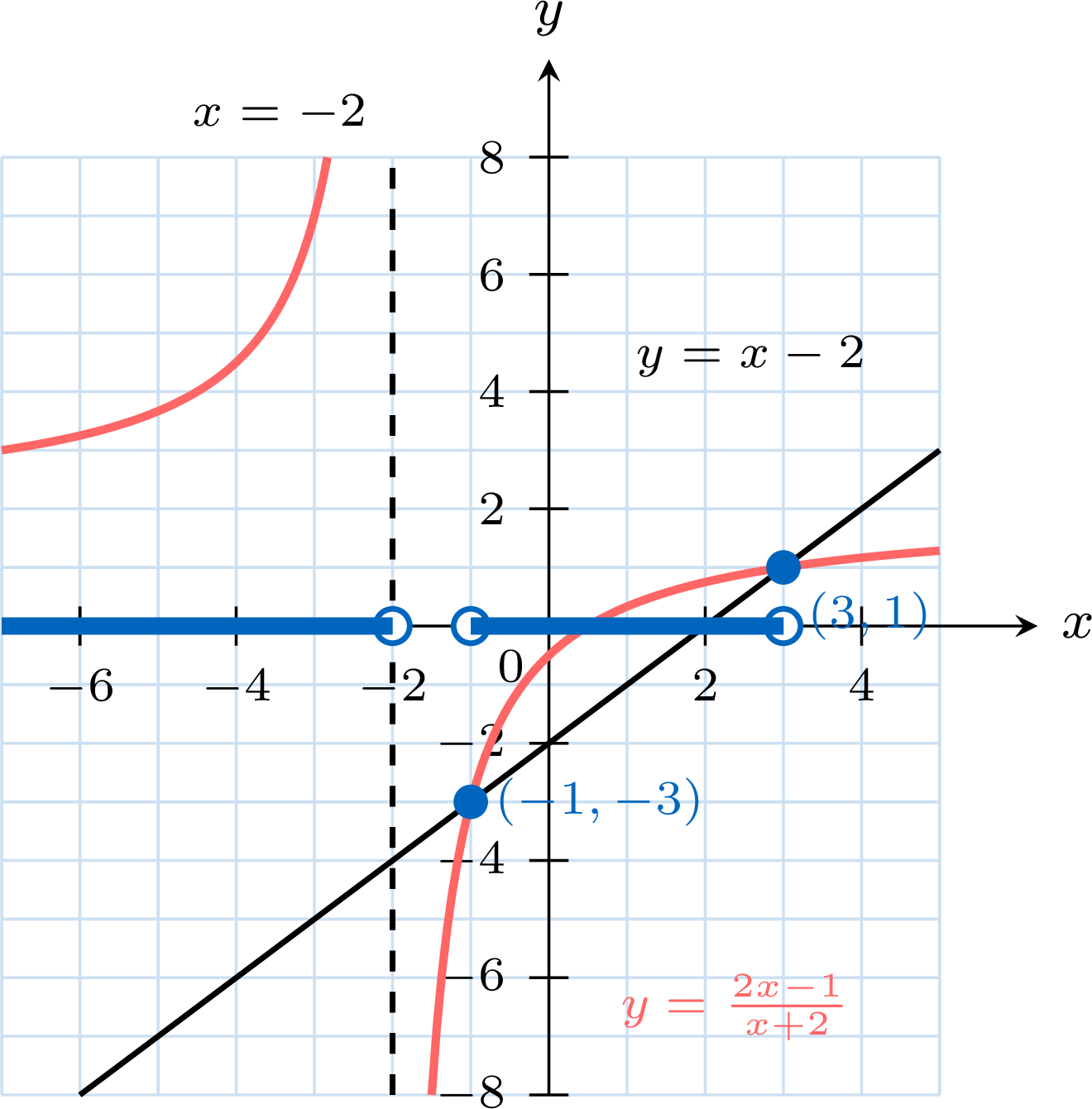
Method — Solving a Rational Inequality with Technology
When the numerator \(N(x)\) has no exact factorisation, to solve \(f(x) > g(x)\) (or \(\geq\), \(<\), \(\leq\)): - Enter both sides: \(Y_1 = f(x)\) and \(Y_2 = g(x)\).
- Find the forbidden values exactly, the zeros of the denominators: the screen may join two branches across a vertical asymptote by an almost vertical segment, which is not part of the graph.
- Find every meeting point with the intersection tool (Method “Solving an Equation Graphically with Technology”), looking on each branch. Written as one fraction, \(f(x) - g(x) = \dfrac{N(x)}{D(x)}\), so the meeting points are among the roots of the polynomial equation \(N(x) = 0\): there are at most as many as the degree of \(N\), and the polynomial solver applied to \(N(x) = 0\) (Method “Solving a Polynomial Equation with the Polynomial Solver”) lists them all, which tells when the search is complete.
- The meeting points and the forbidden values cut the number line into intervals; on each of them, one graph stays above the other. Read where the graph of \(Y_1\) lies above the graph of \(Y_2\), or test one value of each interval.
- Report the solution: the forbidden values are excluded; the meeting points are included for \(\geq\) and \(\leq\) only; the decimal endpoints are given to \(3\) significant figures.
Example
Use technology to solve the inequality \(\dfrac{x + 2}{x - 1} \geq x^2 - 3\), giving the endpoints to \(3\) significant figures.
As one fraction, the inequality reads \(\dfrac{-x^3 + x^2 + 4x - 1}{x - 1} \geq 0\), and neither \(1\) nor \(-1\) is a root of the cubic \(-x^3 + x^2 + 4x - 1\) (they give \(3\) and \(-3\)): no exact factorisation appears, the polynomial solver gives decimal roots only, and technology is needed. The forbidden value is \(1\). With \(Y_1 = \dfrac{x + 2}{x - 1}\) and \(Y_2 = x^2 - 3\) in the window \(-4 \leq x \leq 4\), \(-6 \leq y \leq 10\), the intersection tool displays \(X = -1.6996281\), \(Y = -0.11126416\), then \(X = 0.23912328\), \(Y = -2.9428201\), then \(X = 2.4605049\), \(Y = 3.0540842\). 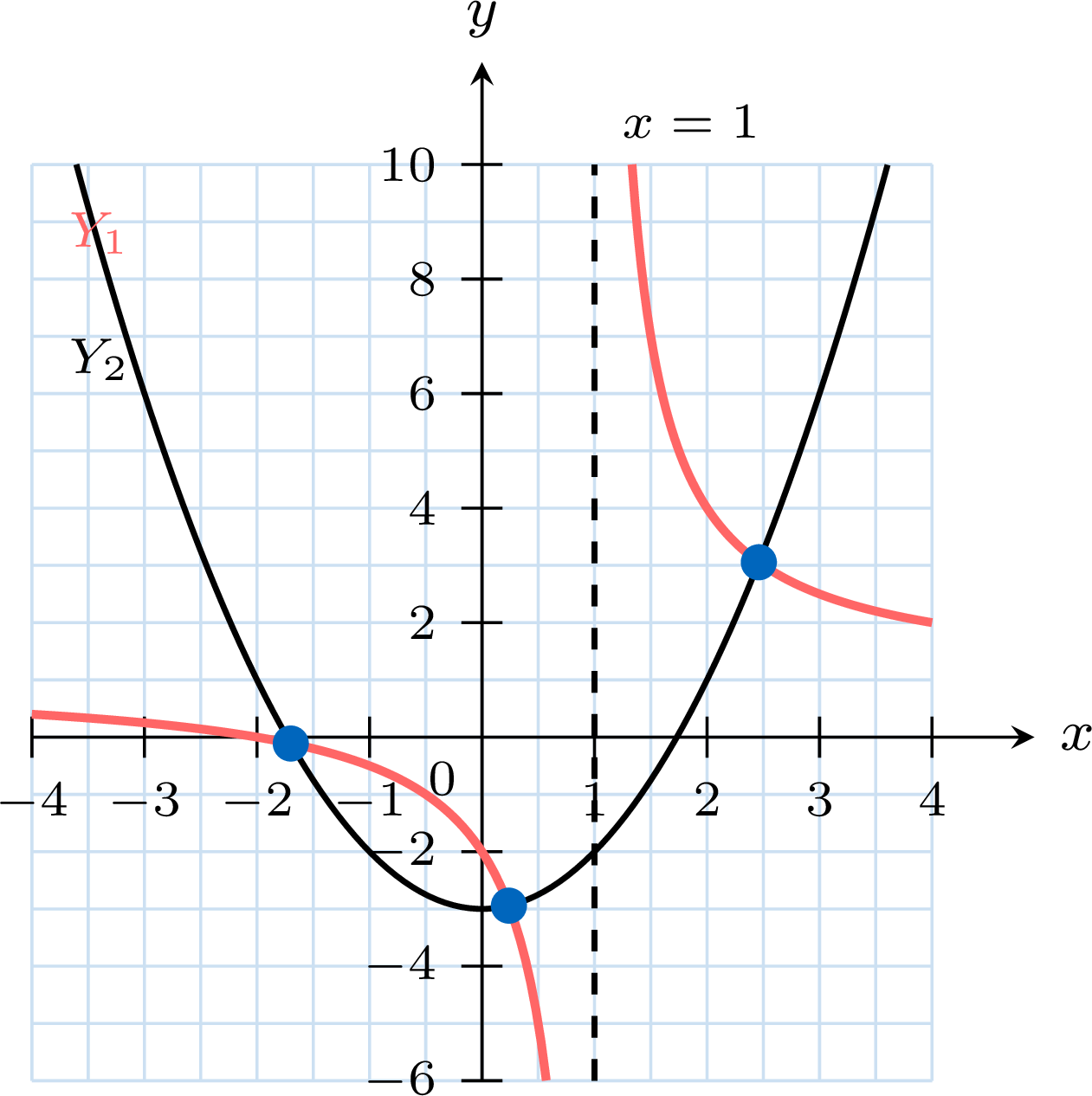
The special values \(-1.70\), \(0.239\), \(1\) and \(2.46\) cut the line into five intervals. One test value in each:
- \(x = -2\): \(Y_1 = 0\) and \(Y_2 = 1\), so \(Y_1 < Y_2\);
- \(x = 0\): \(Y_1 = -2\) and \(Y_2 = -3\), so \(Y_1 > Y_2\);
- \(x = 0.5\): \(Y_1 = -5\) and \(Y_2 = -2.75\), so \(Y_1 < Y_2\);
- \(x = 2\): \(Y_1 = 4\) and \(Y_2 = 1\), so \(Y_1 > Y_2\);
- \(x = 3\): \(Y_1 = 2.5\) and \(Y_2 = 6\), so \(Y_1 < Y_2\).
Skills to practice
- Solving Rational Inequalities with Technology
- Solving Rational Inequalities
IV
Partial Fractions
IV.1
Decomposing into Partial Fractions
Adding two simple fractions is routine: $$\frac{2}{x-1} + \frac{3}{x+2} = \frac{2(x+2) + 3(x-1)}{(x-1)(x+2)} = \frac{5x+1}{(x-1)(x+2)}.$$ The reverse operation — splitting \(\frac{5x+1}{(x-1)(x+2)}\) back into the two simple pieces it came from — is called a partial fraction decomposition. It is a key preparation tool: the study of asymptotes, and later other techniques, become easier once a complicated fraction is written as a sum of simple ones.
Definition — Proper and Improper Rational Fractions
A rational fraction is a quotient \(\dfrac{P(x)}{D(x)}\) of two polynomials with \(D\) not the zero polynomial. It is proper when \(\deg P < \deg D\), and improper when \(\deg P \geq \deg D\). By convention, the zero fraction (\(P = 0\)) is proper. Proposition — Partial Fraction Decomposition
Let \(\dfrac{P(x)}{(x-a)(x-b)}\) be a proper rational fraction with \(a \neq b\). Then there exists a unique pair of real numbers \((A, B)\) such that, for every \(x \neq a, b\): $$\frac{P(x)}{(x-a)(x-b)} = \frac{A}{x-a} + \frac{B}{x-b}.$$
We use twice the following elementary fact: a polynomial of degree at most \(1\) that vanishes at two distinct points is the zero polynomial (if \(cx + d\) vanishes at two distinct points, then \(c = 0\), and then \(d = 0\)).
Putting the right-hand side over the common denominator, the identity to establish means that the polynomials \(P(x)\) and \(A(x-b) + B(x-a)\) — both of degree at most \(1\), since \(P\) is proper — take the same values for every \(x \neq a, b\). Their difference then vanishes at two distinct points, so by the elementary fact the identity is a polynomial identity, valid for all \(x\): $$P(x) = A(x-b) + B(x-a).$$ Finding the only candidates. Suppose the identity holds. Setting \(x = a\) makes the term in \(B\) vanish: $$P(a) = A(a-b), \quad \text{so} \quad A = \frac{P(a)}{a-b}.$$ Setting \(x = b\) makes the term in \(A\) vanish: $$P(b) = B(b-a), \quad \text{so} \quad B = \frac{P(b)}{b-a}.$$ Hence there is no other possible pair: uniqueness is proved.
These values do work. With this choice, the difference \(P(x) - A(x-b) - B(x-a)\) is a polynomial of degree at most \(1\) vanishing at the two distinct points \(x = a\) and \(x = b\): by the elementary fact it is the zero polynomial, which proves existence. (The elementary fact is a special case of a general result: a polynomial of degree \(n\) has at most \(n\) roots.)
Method — Decomposing into Partial Fractions
This Method treats proper fractions whose denominator is the product of two distinct linear factors; an improper fraction is divided first (step 1). - Make the fraction proper: if \(\deg P \geq \deg D\), first perform the long division \(P = D \times Q + R\); then \(\frac{P}{D} = Q + \frac{R}{D}\) with \(\frac{R}{D}\) proper.
- Factorise the denominator into distinct linear factors.
- Write the template with one unknown constant per linear factor — for \((x-a)(x-b)\): \(\frac{A}{x-a} + \frac{B}{x-b}\).
- Determine the constants: multiply through by the denominator, then either evaluate at the roots of the denominator (each evaluation isolates one constant), or expand and equate coefficients.
- Check by recombining the simple fractions.
Example
Decompose \(\dfrac{5x+1}{x^2+x-2}\) into partial fractions.
The fraction is proper (\(1 < 2\)). The denominator factors: \(x^2 + x - 2 = (x-1)(x+2)\). We look for \(A\) and \(B\) such that $$\frac{5x+1}{(x-1)(x+2)} = \frac{A}{x-1} + \frac{B}{x+2},$$ that is, \(5x + 1 = A(x+2) + B(x-1)\): $$\begin{aligned}[t] x = 1 &: \quad 6 = 3A, \ \text{so } A = 2 && {\scriptstyle(\text{evaluate at } x=1)} \\
x = -2 &: \quad -9 = -3B, \ \text{so } B = 3. && {\scriptstyle(\text{evaluate at } x=-2)} \end{aligned}$$ Hence, for \(x \neq 1, -2\): $$\frac{5x+1}{x^2+x-2} = \frac{2}{x-1} + \frac{3}{x+2}.$$ Check: \(\frac{2}{x-1} + \frac{3}{x+2} = \frac{2(x+2)+3(x-1)}{(x-1)(x+2)} = \frac{5x+1}{(x-1)(x+2)}\).
Skills to practice
- Decomposing Rational Fractions
V
Going further
Skills to practice
- Solving Problems
- Quiz
Jump to section