International Baccalaureate · DP 1: Analysis and Approaches HL
Polynomials
I
Polynomials and Their Operations
I.1
Polynomials
Linear and quadratic functions are the first two members of a broader class of functions called polynomials. Polynomials are fundamental in mathematics and are used to model a vast range of phenomena, from the trajectory of a projectile to complex economic trends. The algebra of polynomials covers their operations, factors, roots, and the key theorems that govern their behavior.
Definition — Polynomial
- A polynomial in the variable \(x\) is an algebraic expression of the form$$P(x)=a_nx^n+a_{n-1}x^{n-1}+\dots+a_1 x+a_0,$$ where \(n\) is a non-negative integer and \(a_0, a_1, \dots, a_n\) are constants called the coefficients.
- A polynomial equation in \(x\) is an equation of the form$$a_nx^n+a_{n-1}x^{n-1}+\dots+a_1 x+a_0=0,$$ with \(a_n\neq 0\) and \(n\ge 1\).
- A polynomial function is a function defined for all real numbers \(x\) by$$P(x)=a_nx^n+a_{n-1}x^{n-1}+\dots+a_1 x+a_0.$$
- The degree of the polynomial is the highest power of the variable \(x\) that has a non-zero coefficient; this exponent is \(n\).
- The leading coefficient is the coefficient of the term with the highest power, \(a_n\).
- The constant term is the coefficient without a variable, \(a_0\).
Example
For the polynomial function \(P(x)=2x^4+3x^2+5x+4\), find the degree, the leading coefficient, the coefficient of \(x\), and the constant term.
We can imagine the missing \(x^3\) term as \(0x^3\) and write$$P(x)=2x^4+0x^3+3x^2+5x+4.$$
- The degree is the highest power of the variable \(x\) with non-zero coefficient. Here, the highest power is 4.
- The leading coefficient is the coefficient of the term with the highest power, which is \(2x^4\). Therefore, the leading coefficient is 2.
- The coefficient of \(x\) is the constant multiplying the term \(x\) (or \(x^1\)). In this case, the term is \(5x\), so the coefficient is 5.
- The constant term is the term without a variable. Here, it is 4.
Definition — Names of Low-Degree Polynomials
Polynomials of low degree have special names: | Polynomial function | Degree | Name |
| \(ax+b, \quad a \neq 0\) | 1 | linear |
| \(ax^2+bx+c, \quad a \neq 0\) | 2 | quadratic |
| \(ax^3+bx^2+cx+d, \quad a \neq 0\) | 3 | cubic |
| \(ax^4+bx^3+cx^2+dx+e, \quad a \neq 0\) | 4 | quartic |
Definition — Equality of Polynomials
Two polynomials are equal if the coefficients of each corresponding power of the variable are identical (that is, the coefficient of \(x^k\) is the same in both polynomials for every \(k\)).
This principle is fundamental as it allows us to find unknown constants by equating the coefficients of terms with the same power. This technique is known as identification of coefficients.
Skills to practice
- Classifying Polynomials by Degree
- Reading Degrees and Coefficients
I.2
Operations with Polynomials
Method — Operations with Polynomials
Polynomials can be added, subtracted, and multiplied. The key principle for addition and subtraction is to combine like terms: terms that have the same power of the variable \(x\). Example
For \(P(x) = x^3 - 2x + 4\) and \(Q(x) = 2x^2 + 3x - 5\), find \(P(x)Q(x)\).
To multiply two polynomials, we multiply each term of the first polynomial by each term of the second polynomial.$$ \begin{aligned} P(x)Q(x) &= (x^3 - 2x + 4)(2x^2 + 3x - 5) \\
&= x^3(2x^2 + 3x - 5) - 2x(2x^2 + 3x - 5) + 4(2x^2 + 3x - 5) \\
&= (2x^5 + 3x^4 - 5x^3) - (4x^3 + 6x^2 - 10x) + (8x^2 + 12x - 20) \\
&= 2x^5 + 3x^4 - 5x^3 - 4x^3 - 6x^2 + 10x + 8x^2 + 12x - 20 \\
&= 2x^5 + 3x^4 - 9x^3 + 2x^2 + 22x - 20 \end{aligned} $$ The degree of the product of two non-zero polynomials \(P(x)\) and \(Q(x)\) is the sum of their individual degrees. This is because the leading term of the product \(P(x)Q(x)\) is obtained by multiplying the leading term of \(P(x)\) by the leading term of \(Q(x)\), and when we multiply these terms, their exponents add.
In this specific case, since the degree of \(P(x)\) is 3 and the degree of \(Q(x)\) is 2, the degree of their product is \(3 + 2 = 5\).
In this specific case, since the degree of \(P(x)\) is 3 and the degree of \(Q(x)\) is 2, the degree of their product is \(3 + 2 = 5\).
Skills to practice
- Equating Coefficients
II
Polynomial Division
II.1
The Division Algorithm
Proposition — Division With Remainder
If a polynomial \(P\) is divided by a non-zero polynomial \(D\), then there exist unique polynomials \(Q\) and \(R\) such that$$ P = DQ + R \quad \text{with } R = 0 \text{ or } \deg(R)<\deg(D). $$ Here \(P\) is the dividend, \(D\) is the divisor, \(Q\) is the quotient, and \(R\) is the remainder. The remainder \(R\) may be the zero polynomial. Method — Division Algorithm
The division of one polynomial \(P\) by a nonzero polynomial \(D\) can be performed using a long division algorithm, analogous to the method used for dividing integers: - Divide the leading terms: the leading term of the dividend divided by the leading term of \(D\) gives the next term of the quotient.
- Multiply this term by \(D\) and subtract the result from the dividend: the leading term cancels.
- Repeat with the polynomial obtained, as long as its degree is at least \(\deg(D)\).
- Stop when the polynomial obtained is zero or has a degree smaller than \(\deg(D)\): it is the remainder \(R\), and the terms collected form the quotient \(Q\). Check that \(P = DQ + R\).
Example
$$\begin{array}{ccccccccl} \textcolor{olive}{x^2+3x+5} &=& \textcolor{colordef}{(x+1)}& \times& \textcolor{colorprop}{(x+2)}&+&\textcolor{orange}{3} & \text{ with }& \deg(\textcolor{orange}{3})\lt \deg(\textcolor{colordef}{x+1})\\
\textcolor{olive}{\text{Dividend}}&=& \textcolor{colordef}{\text{Divisor}}&\times&\textcolor{colorprop}{\text{Quotient}}&+&\textcolor{orange}{\text{Remainder}}& \text{ with }& \deg(\textcolor{orange}{\text{Remainder}})\lt \deg(\textcolor{colordef}{\text{Divisor}}) \end{array} $$ 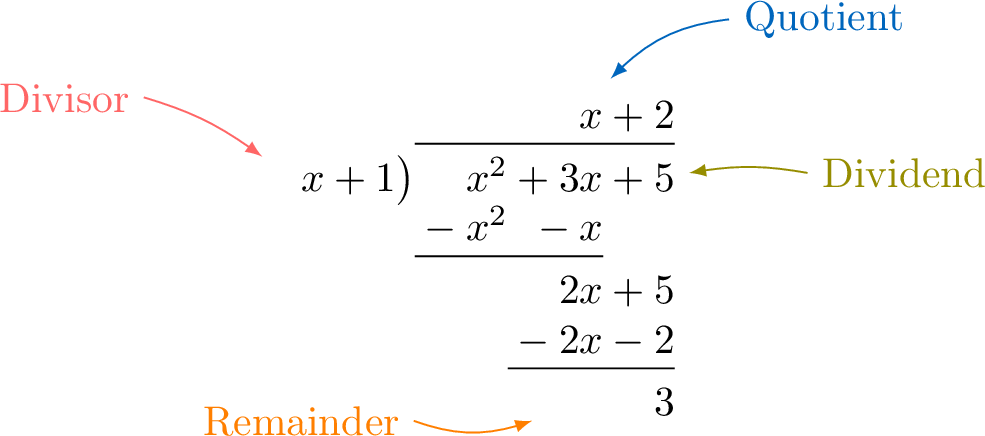
The Division Algorithm describes the result of any polynomial division. A special and important case is when the division is exact, meaning there is no remainder (\(R=0\)). This leads to the concept of a divisor, or factor.
Definition — Divisor of a Polynomial
Let \(P\) and \(D\) be polynomials. We say that \(D\) divides \(P\) if there exists a polynomial \(Q\) such that$$ P(x) = D(x)Q(x). $$ In this case, \(D\) is called a divisor or a factor of \(P\). Proposition — Condition for Divisibility
A nonzero polynomial \(D\) is a divisor of a polynomial \(P\) if and only if the remainder of the division of \(P\) by \(D\) is the zero polynomial (\(R=0\)).
We must prove both directions of the statement.
- (\(\Rightarrow\)): If \(D\) is a divisor of \(P\), then the remainder is zero.
Assume that \(D\) is a divisor of \(P\).
By the definition of a divisor, this means there exists a polynomial \(Q\) such that$$ P(x) = D(x)Q(x). $$ This can be rewritten as \(P(x) = D(x)Q(x) + 0\).
By the Division Algorithm, there is a unique quotient and remainder. Comparing this with the standard form \(P(x) = D(x)Q(x) + R(x)\), we can see by uniqueness that the remainder \(R(x)\) must be \(0\).
- (\(\Leftarrow\)): If the remainder is zero, then \(D\) is a divisor of \(P\).
Assume that the remainder of the division of \(P\) by \(D\) is zero.
By the Division Algorithm, we can write$$ P(x) = D(x)Q(x) + R(x). $$ Substituting \(R(x)=0\) into this equation, we get$$ \begin{aligned} P(x) &= D(x)Q(x) + 0 \\ &= D(x)Q(x). \end{aligned} $$ This is precisely the definition of \(D\) being a divisor of \(P\).
Skills to practice
- Performing Polynomial Division
II.2
The Remainder and Factor Theorems
While the Division Algorithm applies to any polynomial divisor, two powerful theorems emerge when we consider the specific case of dividing by a linear polynomial of the form \((x-k)\).
Proposition — The Remainder Theorem
When a polynomial \(P\) is divided by a linear polynomial of the form \((x-k)\), the remainder is the constant value \(P(k)\).
From the Division Algorithm, when a polynomial \(P(x)\) is divided by the divisor \(D(x) = x-k\), there exists a unique quotient \(Q(x)\) and a remainder \(R(x)\) such that$$ P(x) = (x-k)Q(x) + R(x). $$ We know that the degree of the remainder must be less than the degree of the divisor. Since the degree of the divisor \((x-k)\) is \(1\), the remainder \(R\) is either the zero polynomial or a polynomial of degree \(0\): in both cases a constant, possibly zero; let's call this constant \(r\).
The division equation can therefore be written as$$ P(x) = (x-k)Q(x) + r. $$ This identity is true for all values of \(x\). If we substitute \(x=k\) into the equation, we get$$ \begin{aligned} P(k) &= (k-k)Q(k) + r \\ &= 0 \cdot Q(k) + r \\ &= r. \end{aligned} $$ Thus, the remainder \(r\) is precisely the value of the polynomial when evaluated at \(k\): \(r=P(k)\).
The division equation can therefore be written as$$ P(x) = (x-k)Q(x) + r. $$ This identity is true for all values of \(x\). If we substitute \(x=k\) into the equation, we get$$ \begin{aligned} P(k) &= (k-k)Q(k) + r \\ &= 0 \cdot Q(k) + r \\ &= r. \end{aligned} $$ Thus, the remainder \(r\) is precisely the value of the polynomial when evaluated at \(k\): \(r=P(k)\).
Definition — Root
Let \(P\) be a polynomial.A number \(\alpha\) is a root (or zero) of \(P\) if \(P(\alpha)=0\).
Proposition — The Factor Theorem
For any polynomial \(P\), \((x-\alpha)\) is a factor of \(P\) if and only if \(P(\alpha)=0\).
Let \(P(x)\) be a polynomial and \(\alpha\) be a number.$$\begin{array}{rll} & (x-\alpha) \text{ is a factor of } P(x) & \\
\iff & \text{the remainder of the division of } P(x) \text{ by } (x-\alpha) \text{ is } 0 & {\scriptstyle\text{(by the Condition for Divisibility)}} \\
\iff & P(\alpha) = 0 & {\scriptstyle\text{(by the Remainder Theorem, since the remainder is } P(\alpha))}\end{array}$$
Another proof, which uses neither the Division Algorithm nor the Remainder Theorem. Let \(P(x) = a_n x^n + a_{n-1} x^{n-1} + \dots + a_1 x + a_0\) be a polynomial of degree \(n \geq 1\) (real or complex coefficients, \(a_n \neq 0\)) and let \(\alpha\) be a root of \(P\): \(P(\alpha) = 0\). Then $$\begin{aligned}[t] P(x) &= P(x) - P(\alpha) && \text{(\(P(\alpha) = 0\))}\\
&= \sum_{k=1}^{n} a_k \left(x^k - \alpha^k\right). && \text{(the constant terms \(a_0\) cancel)} \end{aligned}$$ For every integer \(k \geq 1\), the difference of two \(k\)-th powers factors by \(x - \alpha\): $$x^k - \alpha^k = (x - \alpha)\,S_k(x) \quad \text{with} \quad S_k(x) = \sum_{j=0}^{k-1} x^{k-1-j}\alpha^{j} = x^{k-1} + x^{k-2}\alpha + \dots + \alpha^{k-1}$$ (so \(S_1(x) = 1\) and \(S_2(x) = x + \alpha\)), as expanding the product shows: \(x\,S_k(x) = x^k + x^{k-1}\alpha + \dots + x\,\alpha^{k-1}\) and \(\alpha\,S_k(x) = x^{k-1}\alpha + \dots + x\,\alpha^{k-1} + \alpha^k\) share every term but the first of the former and the last of the latter. Hence $$P(x) = (x - \alpha)\,Q(x) \quad \text{with} \quad Q(x) = \sum_{k=1}^{n} a_k\,S_k(x).$$ The leading term of \(Q\) is \(a_n x^{n-1}\) with \(a_n \neq 0\), so \(Q\) is a polynomial of degree \(n - 1\); its coefficients are complex numbers in general, and real numbers when \(\alpha\) and the \(a_k\) are real. So \((x - \alpha)\) is a factor of \(P\). Conversely, if \(P(x) = (x-\alpha)Q(x)\), then \(P(\alpha) = (\alpha - \alpha)Q(\alpha) = 0\).
Proposition — Number of Roots
A polynomial \(P\) of degree \(n \ge 0\) has at most \(n\) distinct roots.
We proceed by induction on the degree \(n\) of the polynomial.
- Base case (\(n=0\)): A polynomial of degree \(0\) is a non-zero constant (\(P(x) = a_0\) with \(a_0 \neq 0\)). It has \(0\) roots. Since \(0 \le 0\), the property holds.
- Inductive step: Suppose that every polynomial of degree \(n\) has at most \(n\) roots. Let \(P\) be a polynomial of degree \(n+1\).
- If \(P\) has no roots, then \(0 \le n+1\), and the property holds.
- If \(P\) has at least one root \(\alpha\), then by the Factor Theorem, we can write: $$ P(x) = (x - \alpha)Q(x) $$ where \(Q\) is a polynomial of degree \(n\). By the inductive hypothesis, \(Q\) has at most \(n\) roots. The roots of \(P\) are \(\alpha\) plus the roots of \(Q\). Therefore, \(P\) has at most \(n+1\) roots.
- Conclusion: By the principle of induction, a polynomial of degree \(n\) has at most \(n\) roots.
A Polynomial Function That Vanishes Everywhere
Let \(P\) be a polynomial function such that \(P(x) = 0\) for every real number \(x\). If one of its coefficients were nonzero, \(P\) would have a degree \(n\) and, by the proposition above, at most \(n\) roots; but every real number is a root of \(P\), and there are infinitely many of them. Hence all the coefficients of \(P\) are zero. Consequently, two polynomial functions that take the same values for every \(x\) have the same coefficients, since their difference vanishes everywhere. This is what legitimates the identification of coefficients: an identity such as \(x^3 - 2x^2 + x - 2 = (x - 2)(ax^2 + bx + c)\), valid for every \(x\), can be read coefficient by coefficient.
Skills to practice
- Deciding Whether a Polynomial Is a Factor
- Applying the Remainder and Factor Theorems
III
Roots of Polynomials
III.1
Complex Numbers
Recappreviously studied — click to reread
Proposition — Properties of the Conjugate
For all complex numbers \(z\) and \(w\): $$\begin{aligned}[t] \conjugate{\conjugate{z}} &= z, \qquad \conjugate{-z} = -\conjugate{z},\\
\conjugate{z + w} &= \conjugate{z} + \conjugate{w}, \qquad \conjugate{z - w} = \conjugate{z} - \conjugate{w},\\
\conjugate{zw} &= \conjugate{z} \; \conjugate{w},\\
\conjugate{\left(\frac{1}{z}\right)} &= \frac{1}{\conjugate{z}} \quad \text{if } z \neq 0, \qquad \conjugate{\left(\frac{z}{w}\right)} = \frac{\conjugate{z}}{\conjugate{w}} \quad \text{if } w \neq 0,\\
\conjugate{z^{\,n}} &= \left(\conjugate{z}\right)^{n} \quad \text{for every natural number } n. \end{aligned}$$ Since \(z^{-n} = \dfrac{1}{z^{n}}\) for \(z \neq 0\), the last property extends to every integer \(n\) when \(z \neq 0\).
Let \(z = a + bi\) and \(w = c + di\) with \(a, b, c, d \in \R\).
Conjugate of the conjugate. \(\conjugate{\conjugate{z}} = \conjugate{a - bi} = a + bi = z\).
Sum. $$\begin{aligned}[t] \conjugate{z + w} &= \conjugate{(a+c)+(b+d)i} && \text{(addition)}\\ &= (a+c)-(b+d)i && \text{(definition of the conjugate)}\\ &= (a-bi)+(c-di) && \text{(regroup)}\\ &= \conjugate{z}+\conjugate{w}. \end{aligned}$$ Product. On one hand, \(zw = (ac-bd)+(ad+bc)i\), so \(\conjugate{zw} = (ac-bd)-(ad+bc)i\). On the other hand, $$\begin{aligned}[t] \conjugate{z}\;\conjugate{w} &= (a-bi)(c-di) && \\ &= ac - adi - bci + bdi^2 && \text{(expand)}\\ &= (ac - bd) - (ad+bc)i. && \text{(\(i^2 = -1\))} \end{aligned}$$ The two results agree: \(\conjugate{zw} = \conjugate{z}\;\conjugate{w}\). Taking \(w = -1\) gives \(\conjugate{-z} = \conjugate{-1}\,\conjugate{z} = -\conjugate{z}\).
Inverse. Let \(z \neq 0\); then \(\conjugate{z} \neq 0\) too (its real and imaginary parts are \(a\) and \(-b\), not both zero). Taking the conjugate of both sides of \(z \times \dfrac{1}{z} = 1\) and using the product property: $$\conjugate{z} \times \conjugate{\left(\frac{1}{z}\right)} = \conjugate{1} = 1,$$ so \(\conjugate{\left(\dfrac{1}{z}\right)}\) is the inverse of \(\conjugate{z}\): \(\conjugate{\left(\dfrac{1}{z}\right)} = \dfrac{1}{\conjugate{z}}\).
Power. For every natural number \(n\), let \(P(n)\) be the property « \(\conjugate{z^{\,n}} = \left(\conjugate{z}\right)^n\) ».
- Base case: with the convention \(z^0 = 1\) for every complex number \(z\), \(\conjugate{z^{\,0}} = \conjugate{1} = 1 = \left(\conjugate{z}\right)^0\), so \(P(0)\) is true.
- Inductive step: suppose \(P(n)\) is true for some natural number \(n\). Then $$\begin{aligned}[t] \conjugate{z^{\,n+1}} &= \conjugate{z^{\,n} \times z} && \text{(\(z^{n+1} = z^n \times z\))}\\ &= \conjugate{z^{\,n}} \; \conjugate{z} && \text{(conjugate of a product)}\\ &= \left(\conjugate{z}\right)^{n} \conjugate{z} && \text{(inductive hypothesis)}\\ &= \left(\conjugate{z}\right)^{n+1}, \end{aligned}$$ so \(P(n+1)\) is true.
- Conclusion: by induction, \(P(n)\) is true for every natural number \(n\).
Proposition — Conjugate, Real and Imaginary Parts
For any complex number \(z = a+bi\) (with \(a, b \in \R\)): $$\begin{aligned}[t] z\conjugate{z} &= a^2 + b^2, \\
z + \conjugate{z} &= 2\,\Re(z), \\
z - \conjugate{z} &= 2i\,\Im(z). \end{aligned}$$ In particular: - \(z\) is a real number if and only if \(\conjugate{z} = z\);
- \(z\) is purely imaginary if and only if \(\conjugate{z} = -z\).
Let \(z = a+bi\) with \(a, b \in \R\). $$\begin{aligned}[t] z\conjugate{z} &= (a+bi)(a-bi) && \\
&= a^2 - (bi)^2 && \text{(\((x+y)(x-y) = x^2 - y^2\))}\\
&= a^2 - b^2 i^2 && \text{(power of a product)}\\
&= a^2 + b^2. \end{aligned}$$ $$\begin{aligned}[t] z + \conjugate{z} &= (a+bi) + (a-bi) \\
&= 2a = 2\,\Re(z),\\
z - \conjugate{z} &= (a+bi) - (a-bi) \\
&= 2bi = 2i\,\Im(z). \end{aligned}$$ Then \(\conjugate{z} = z\) is equivalent to \(z - \conjugate{z} = 0\), that is \(2i\,\Im(z) = 0\), that is \(\Im(z) = 0\): this means exactly that \(z\) is real. Similarly \(\conjugate{z} = -z\) is equivalent to \(z + \conjugate{z} = 0\), that is \(\Re(z) = 0\): this means exactly that \(z\) is purely imaginary.
Proposition — Solving Quadratic Equations with Real Coefficients in \(\mathbb{C}\)
Consider the equation \(az^2 + bz + c = 0\), where \(a, b,\) and \(c\) are real numbers and \(a \neq 0\).Let \(\Delta = b^2 - 4ac\) be the discriminant of this equation.
- If \(\Delta > 0\), the equation has two distinct real solutions: $$ z_1 = \frac{-b - \sqrt{\Delta}}{2a} \quad \text{and} \quad z_2 = \frac{-b + \sqrt{\Delta}}{2a} $$
- If \(\Delta = 0\), the equation has a unique real solution: $$ z_0 = \frac{-b}{2a} $$
- If \(\Delta < 0\), the equation has two conjugate complex solutions: $$ z_1 = \frac{-b - i\sqrt{-\Delta}}{2a} \quad \text{and} \quad z_2 = \frac{-b + i\sqrt{-\Delta}}{2a} $$
- If \(\Delta \neq 0\), the quadratic can be factorized as: \(az^2 + bz + c = a(z - z_1)(z - z_2)\).
Let \(a, b, c\) be real numbers with \(a \neq 0\) and \(\Delta = b^2 - 4ac\). For every complex number \(z\), the canonical form holds in \(\C\) exactly as in \(\R\), since it only uses the rules of algebra: $$\begin{aligned}[t] az^2 + bz + c &= a\left[z^2 + \frac{b}{a}z + \frac{c}{a}\right] && \text{(factor out \(a \neq 0\))}\\
&= a\left[\left(z + \frac{b}{2a}\right)^2 - \frac{b^2}{4a^2} + \frac{c}{a}\right] && \text{(complete the square)}\\
&= a\left[\left(z + \frac{b}{2a}\right)^2 - \frac{\Delta}{4a^2}\right]. && \text{(\(\frac{b^2 - 4ac}{4a^2} = \frac{\Delta}{4a^2}\))} \end{aligned}$$ In each case the bracket factors, and the equation \(az^2 + bz + c = 0\) becomes a product equal to zero.
- \(\Delta > 0\): \(\dfrac{\Delta}{4a^2} = \left(\dfrac{\sqrt{\Delta}}{2a}\right)^2\), so, as a difference of two squares, $$az^2 + bz + c = a\left(z + \frac{b}{2a} - \frac{\sqrt{\Delta}}{2a}\right)\left(z + \frac{b}{2a} + \frac{\sqrt{\Delta}}{2a}\right) = a(z - z_2)(z - z_1).$$
- \(\Delta = 0\): \(az^2 + bz + c = a\left(z + \dfrac{b}{2a}\right)^2 = a(z - z_0)^2\), a product of two equal factors.
- \(\Delta < 0\): \(-\Delta > 0\) and \(\dfrac{\Delta}{4a^2} = -\dfrac{-\Delta}{4a^2} = i^2\,\dfrac{-\Delta}{4a^2} = \left(\dfrac{i\sqrt{-\Delta}}{2a}\right)^2\), so, again as a difference of two squares, $$az^2 + bz + c = a\left(z + \frac{b}{2a} - \frac{i\sqrt{-\Delta}}{2a}\right)\left(z + \frac{b}{2a} + \frac{i\sqrt{-\Delta}}{2a}\right) = a(z - z_2)(z - z_1),$$ and \(z_1\), \(z_2\) are conjugates, since they differ only by the sign of their imaginary part.
Skills to practice
- Complex Numbers
III.2
The Fundamental Theorem of Algebra
The Factor Theorem connects roots to factors, but it does not guarantee that a real polynomial has any real roots (for example, \(P(x)=x^2+1\)). To fully understand the roots of all polynomials, we must consider solutions in the set of complex numbers, \(\mathbb{C}\).
Definition — Multiplicity of a Root
Let \(P\) be a non-zero polynomial, \(\alpha\) a number and \(m \geq 1\) an integer. The number \(\alpha\) is a root of multiplicity \(m\) of \(P\) if $$P(x) = (x - \alpha)^m\,Q(x) \quad \text{for a polynomial } Q \text{ with } Q(\alpha) \neq 0.$$ By the Factor Theorem, \(Q(\alpha) \neq 0\) means that \((x - \alpha)\) is not a factor of \(Q\): the multiplicity is the number of times the factor \((x - \alpha)\) appears in \(P\). A root of multiplicity \(1\) is a simple root, a root of multiplicity \(2\) a double root, a root of multiplicity \(3\) a triple root. Counting the roots with their multiplicity means counting each root as many times as its multiplicity. Example
Let \(P(x) = x^3 - x^2 - 8x + 12\). Show that \(2\) is a root of \(P\), factorise \(P\) completely, and give the multiplicity of each root.
$$\begin{aligned}[t] P(2) &= 2^3 - 2^2 - 8 \times 2 + 12 \\
&= 8 - 4 - 16 + 12 \\
&= 0, \end{aligned}$$ so \(2\) is a root of \(P\) and, by the Factor Theorem, \((x - 2)\) is a factor of \(P\). We perform the long division of \(x^3 - x^2 - 8x + 12\) by \(x - 2\): 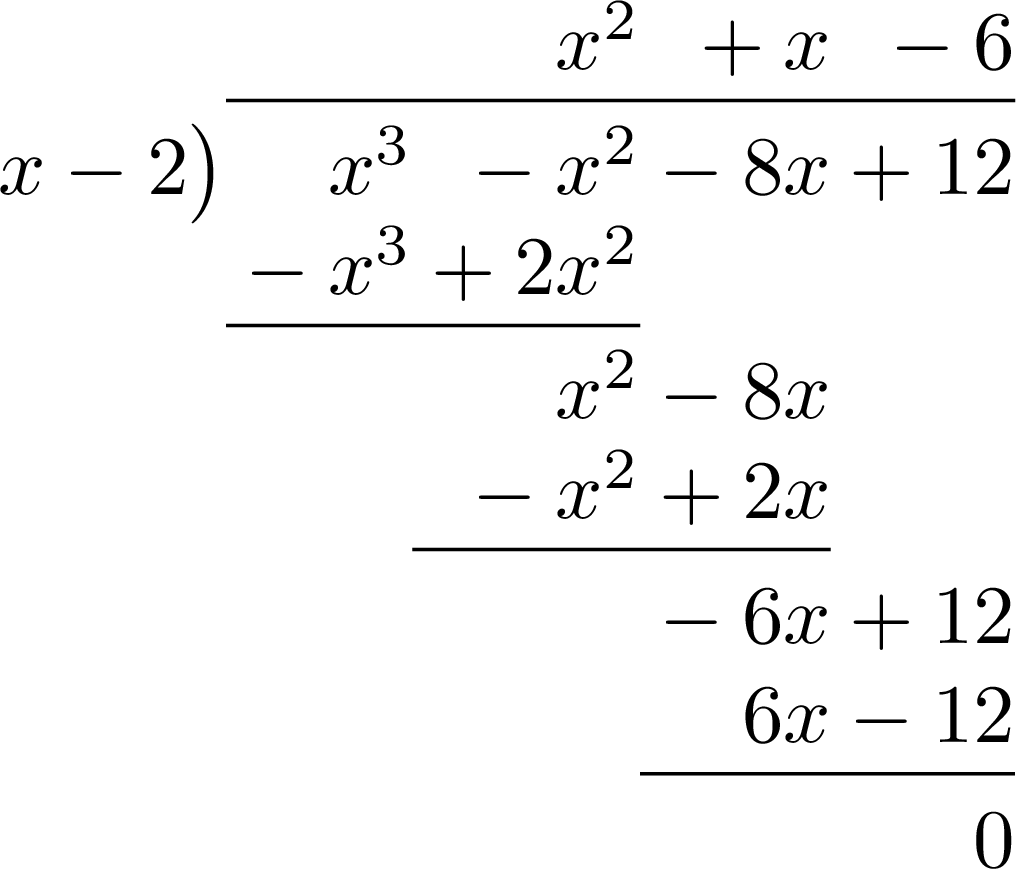
The quotient is \(x^2 + x - 6 = (x - 2)(x + 3)\), so $$\begin{aligned}[t] P(x) &= (x - 2)(x^2 + x - 6) && \text{(long division)} \\
&= (x - 2)(x - 2)(x + 3) && \text{(factorise the quotient)} \\
&= (x - 2)^2(x + 3). \end{aligned}$$ With \(m = 2\) and \(Q(x) = x + 3\), we have \(Q(2) = 5 \neq 0\): \(2\) is a double root of \(P\). With \(m = 1\) and \(Q(x) = (x - 2)^2\), we have \(Q(-3) = 25 \neq 0\): \(-3\) is a simple root. Counted with their multiplicity, the roots of \(P\) number \(2 + 1 = 3\), the degree of \(P\).
Proposition — The Fundamental Theorem of Algebra
Every non-constant polynomial of degree \(n \ge 1\) with complex (in particular, real) coefficients has exactly \(n\) roots in the set of complex numbers \(\mathbb{C}\), provided that roots are counted with their multiplicity.
Note
The proof of this theorem calls for other tools, but its result is fundamental. It guarantees that we do not need to invent new number systems to solve polynomial equations; the complex numbers are algebraically closed in this respect.
Example
Consider the equation \(z^3 - 2z^2 + z - 2 = 0\). - Check that \(2\) is a solution.
- Determine all the solutions of the equation in \(\C\).
- \(2^3 - 2 \times 2^2 + 2 - 2 = 8 - 8 + 2 - 2 = 0\): the number \(2\) is a solution.
- Let \(P(z) = z^3 - 2z^2 + z - 2\), a polynomial of degree \(3\) with the root \(2\). By the Factor Theorem, \(P(z) = (z - 2)\,Q(z)\) with \(Q\) a polynomial of degree \(2\): \(Q(z) = az^2 + bz + c\). We determine \(a\), \(b\), \(c\) by identification of coefficients: $$\begin{aligned}[t] (z - 2)(az^2 + bz + c) &= az^3 + bz^2 + cz - 2az^2 - 2bz - 2c && \text{(expand)}\\ &= az^3 + (b - 2a)z^2 + (c - 2b)z - 2c. && \text{(collect like terms)} \end{aligned}$$ This must equal \(z^3 - 2z^2 + z - 2\) for every \(z\), so $$a = 1, \qquad b - 2a = -2, \qquad c - 2b = 1, \qquad -2c = -2,$$ that is \(a = 1\), \(b = 0\), \(c = 1\) — and the last equation, \(-2c = -2\), is satisfied: the identification is consistent. Hence \(P(z) = (z - 2)(z^2 + 1)\) and $$\begin{aligned}[t] P(z) = 0 &\Leftrightarrow (z - 2)(z^2 + 1) = 0 && \\ &\Leftrightarrow z - 2 = 0 \text{ or } z^2 + 1 = 0 && \text{(zero product)}\\ &\Leftrightarrow z = 2 \text{ or } z^2 = -1 && \\ &\Leftrightarrow z = 2 \text{ or } z = i \text{ or } z = -i. && \text{(solutions of \(z^2 = k\), \(k < 0\))} \end{aligned}$$ The solution set is \(S = \{2, i, -i\}\).
Proposition — Conjugate Root Theorem
If a polynomial \(P(x)\) has real coefficients, and if \(z_0\) is a complex root of the equation \(P(x)=0\), then its conjugate, \(\conjugate{z_0}\), must also be a root.
Let \(P(x) = a_n x^n + \dots + a_1 x + a_0\) where all coefficients \(a_k\) are real numbers.
We assume that \(z_0\) is a root, so \(P(z_0) = 0\). We want to show that \(P(\conjugate{z_0})=0\).$$\begin{aligned} P(\conjugate{z_0}) &= a_n(\conjugate{z_0})^n + \dots + a_1\conjugate{z_0} + a_0 \\ &= a_n\conjugate{z_0^n} + \dots + a_1\conjugate{z_0} + a_0 && \text{(conjugate of a power)} \\ &= \conjugate{a_n}\conjugate{z_0^n} + \dots + \conjugate{a_1}\conjugate{z_0} + \conjugate{a_0} && \text{(coefficients \(a_k\) are real)} \\ &= \conjugate{a_n z_0^n} + \dots + \conjugate{a_1 z_0} + \conjugate{a_0} && \text{(conjugate of a product)} \\ &= \conjugate{a_n z_0^n + \dots + a_1 z_0 + a_0} && \text{(conjugate of a sum)} \\ &= \conjugate{P(z_0)} \\ &= \conjugate{0} = 0.\end{aligned}$$ Thus, if \(z_0\) is a root, then \(\conjugate{z_0}\) must also be a root.
We assume that \(z_0\) is a root, so \(P(z_0) = 0\). We want to show that \(P(\conjugate{z_0})=0\).$$\begin{aligned} P(\conjugate{z_0}) &= a_n(\conjugate{z_0})^n + \dots + a_1\conjugate{z_0} + a_0 \\ &= a_n\conjugate{z_0^n} + \dots + a_1\conjugate{z_0} + a_0 && \text{(conjugate of a power)} \\ &= \conjugate{a_n}\conjugate{z_0^n} + \dots + \conjugate{a_1}\conjugate{z_0} + \conjugate{a_0} && \text{(coefficients \(a_k\) are real)} \\ &= \conjugate{a_n z_0^n} + \dots + \conjugate{a_1 z_0} + \conjugate{a_0} && \text{(conjugate of a product)} \\ &= \conjugate{a_n z_0^n + \dots + a_1 z_0 + a_0} && \text{(conjugate of a sum)} \\ &= \conjugate{P(z_0)} \\ &= \conjugate{0} = 0.\end{aligned}$$ Thus, if \(z_0\) is a root, then \(\conjugate{z_0}\) must also be a root.
Example
Given that \(x = 2+i\) is a root of the polynomial equation \(P(x) = x^3 - 7x^2 + 17x - 15 = 0\), find all roots.
Let the roots be \(r_1, r_2, r_3\). We are given \(r_1 = 2+i\).
- Step 1: Apply the Conjugate Root Theorem. The coefficients of \(P(x)\) are real. Since \(r_1 = 2+i\) is a root, its conjugate \(r_2 = 2-i\) must also be a root.
- Step 2: Form a real quadratic factor. The quadratic factor corresponding to these two roots is \((x - r_1)(x - r_2)\). $$ \begin{aligned} (x - (2+i))(x - (2-i)) &= ((x-2) - i)((x-2) + i)\\ &= (x-2)^2 - i^2 \\ &= x^2 - 4x + 4 - (-1) \\ &= x^2 - 4x + 5. \end{aligned} $$
- Step 3: Find the remaining factor. Since \(P(x)\) is cubic, the remaining factor must be linear. We can write \(P(x) = (x^2 - 4x + 5)(x-k)\). Comparing the constant terms gives $$5 \times (-k) = -15,$$ which implies \(k=3\). The third root is therefore \(r_3=3\).
Skills to practice
- Using the Conjugate Root Theorem
III.3
Sum and Product of the Roots
There is a direct and powerful relationship between the roots of a polynomial equation and its coefficients. We can discover this relationship by comparing the standard form of a polynomial with its factored form.
- Case 1: Quadratic Equation (\(n=2\))
Consider a monic quadratic equation (\(a_2=1\)) with roots \(r_1\) and \(r_2\).$$ \begin{aligned} x^2 + a_1x + a_0 &= (x-r_1)(x-r_2) \\ &= x^2 - (r_1+r_2)x + (r_1r_2).\end{aligned} $$ By equating coefficients, we see:- The sum of the roots is \(r_1+r_2 = -a_1\).
- The product of the roots is \(r_1r_2 = a_0\).
- Case 2: Cubic Equation (\(n=3\))
Consider a monic cubic equation (\(a_3=1\)) with roots \(r_1, r_2, r_3\).$$ \begin{aligned} x^3 + a_2x^2 + a_1x + a_0 &= (x-r_1)(x-r_2)(x-r_3) \\ &= [x^2 - (r_1+r_2)x + r_1r_2](x-r_3) \\ &= x^3 - (r_1+r_2+r_3)x^2 + (r_1r_2+r_1r_3+r_2r_3)x - (r_1r_2r_3).\end{aligned} $$ By equating coefficients, we see:- The sum of the roots is \(r_1+r_2+r_3 = -a_2\).
- The product of the roots is \(r_1r_2r_3 = -a_0\).
Proposition — Vieta's Formulas
For a polynomial equation$$P(x) = a_nx^n + a_{n-1}x^{n-1} + \dots + a_1x + a_0 = 0,$$ if \(P(x) = a_n(x - \alpha_1)(x - \alpha_2)\cdots(x - \alpha_n)\), the roots \(\alpha_1, \alpha_2, \dots, \alpha_n\) (in \(\mathbb{C}\)) being counted with their multiplicity: - The sum of the roots is $$\sum_{i=1}^n \alpha_i = -\frac{a_{n-1}}{a_n}.$$
- The product of the roots is $$\prod_{i=1}^n \alpha_i = (-1)^n \frac{a_0}{a_n}.$$
By hypothesis, $$P(x) = a_n(x - \alpha_1)(x - \alpha_2)\cdots(x - \alpha_n),$$ where \(\alpha_1, \dots, \alpha_n\) are the roots of \(P\), each listed as many times as its multiplicity. For \(n = 1\), \(P(x) = a_1 x + a_0\) has the single root \(\alpha_1 = -\dfrac{a_0}{a_1}\), and both formulas read \(\alpha_1 = -\dfrac{a_0}{a_1}\). Let now \(n \geq 2\).
Expansion. Expanding the product \((x - \alpha_1)(x - \alpha_2)\cdots(x - \alpha_n)\) means choosing, in each of the \(n\) brackets, either \(x\) or \(-\alpha_k\), multiplying the chosen terms, and adding all the products obtained.
Expansion. Expanding the product \((x - \alpha_1)(x - \alpha_2)\cdots(x - \alpha_n)\) means choosing, in each of the \(n\) brackets, either \(x\) or \(-\alpha_k\), multiplying the chosen terms, and adding all the products obtained.
- Choosing \(x\) in every bracket gives \(x^n\).
- A term in \(x^{n-1}\) comes from choosing \(x\) in all the brackets but one, and \(-\alpha_k\) in the remaining bracket: these terms add up to \(-(\alpha_1 + \alpha_2 + \dots + \alpha_n)\,x^{n-1}\).
- The constant term comes from choosing \(-\alpha_k\) in every bracket: \((-\alpha_1)(-\alpha_2)\cdots(-\alpha_n) = (-1)^n\,\alpha_1\alpha_2\cdots\alpha_n\).
Example
Find the sum and product of the roots of \(2x^3 - 7x^2 + 8x - 1 = 0\).
The polynomial is of degree \(n=3\). The coefficients are \(a_3=2, a_2=-7, a_1=8, a_0=-1\).
- Sum of roots: $$ -\frac{a_{n-1}}{a_n} = -\frac{a_2}{a_3} = -\frac{-7}{2} = \frac{7}{2}. $$
- Product of roots: $$ (-1)^n \frac{a_0}{a_n} = (-1)^3 \frac{a_0}{a_3} = (-1)\frac{-1}{2} = \frac{1}{2}. $$
Skills to practice
- Applying Vieta's Formulas
IV
Polynomial Equations
IV.1
Solving Polynomial Equations
The Factor Theorem turns solving an equation into factoring a polynomial — provided a first root can be found. For a polynomial with integer coefficients, the hunt is short: if an integer \(a\) is a root, then the equality \(a_n a^n + \dots + a_1 a = -a_0\) shows that \(a\) divides the constant term \(a_0\). It is therefore enough to test the divisors of \(a_0\).
Method — Solving a Polynomial Equation
To solve \(P(x) = 0\) where \(P\) has integer coefficients and degree at least \(3\): - Hunt a root: use the root given by the statement, or test the divisors of the constant term (\(\pm 1\), \(\pm 2\), …) — an integer root, if there is one, is among them — until the Factor Theorem gives \(P(a) = 0\).
- Factor: write \(P(x) = (x-a)\,Q(x)\), finding the quotient \(Q\) by long division (or by equating coefficients).
- Solve the quotient: if \(Q\) is quadratic, use the discriminant; if \(\deg Q \geq 3\), repeat step 1 on \(Q\).
- Conclude and check: state the solution set and verify it (expand the factorisation, or check the sum and product of the roots).
Example
Solve the equation \(2x^3 - 3x^2 - 11x + 6 = 0\).
Step 1 — hunt a root. An integer root must divide the constant term \(6\): we test \(\pm 1\), \(\pm 2\), \(\pm 3\), \(\pm 6\). Let \(P(x) = 2x^3 - 3x^2 - 11x + 6\): $$P(1) = -6, \qquad P(-1) = 12, \qquad P(2) = -12, \qquad P(3) = 0.$$ By the Factor Theorem, \((x - 3)\) is a factor of \(P(x)\).
Step 2 — factor. We perform the long division of \(2x^3 - 3x^2 - 11x + 6\) by \(x - 3\): 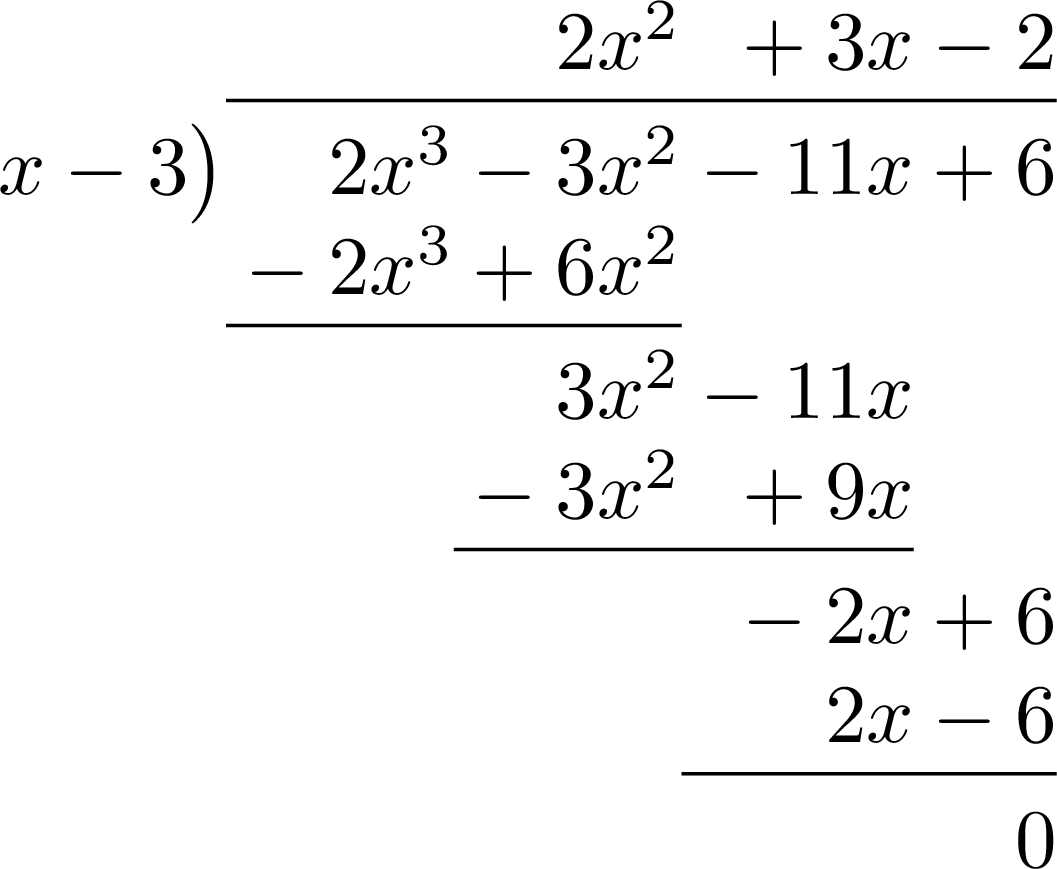
So \(2x^3 - 3x^2 - 11x + 6 = (x-3)\times\textcolor{colordef}{(2x^2+3x-2)}+\textcolor{colorprop}{0}\).
Step 3 — solve the quotient. For \(2x^2 + 3x - 2 = 0\): $$\begin{aligned}[t] \Delta &= 3^2 - 4 \times 2 \times (-2) = 25 && {\scriptstyle(\text{discriminant})} \\ x &= \frac{-3 - 5}{4} = -2 \quad \text{or} \quad x = \frac{-3 + 5}{4} = \frac{1}{2}. \end{aligned}$$ Step 4 — conclude and check. The solution set is \(\left\{-2, \ \frac{1}{2}, \ 3\right\}\), and $$2x^3 - 3x^2 - 11x + 6 = 2(x-3)\left(x - \frac{1}{2}\right)(x+2).$$ Check by the sum of the roots: \(-2 + \frac{1}{2} + 3 = \frac{3}{2} = -\frac{-3}{2}\), as Vieta requires.
Step 2 — factor. We perform the long division of \(2x^3 - 3x^2 - 11x + 6\) by \(x - 3\):
Step 3 — solve the quotient. For \(2x^2 + 3x - 2 = 0\): $$\begin{aligned}[t] \Delta &= 3^2 - 4 \times 2 \times (-2) = 25 && {\scriptstyle(\text{discriminant})} \\ x &= \frac{-3 - 5}{4} = -2 \quad \text{or} \quad x = \frac{-3 + 5}{4} = \frac{1}{2}. \end{aligned}$$ Step 4 — conclude and check. The solution set is \(\left\{-2, \ \frac{1}{2}, \ 3\right\}\), and $$2x^3 - 3x^2 - 11x + 6 = 2(x-3)\left(x - \frac{1}{2}\right)(x+2).$$ Check by the sum of the roots: \(-2 + \frac{1}{2} + 3 = \frac{3}{2} = -\frac{-3}{2}\), as Vieta requires.
Skills to practice
- Factorising and Solving Cubic Equations
- Finding All the Roots from a Complex Root
V
Graphs of Polynomial Functions
V.1
End Behaviour and Multiplicity
Polynomials can be studied algebraically. We now turn our attention to the visual representation of polynomial functions. By understanding the connection between a polynomial's algebraic form (its degree, factors, and roots) and the shape of its graph, we can sketch complex curves and solve inequalities.
When we consider the behaviour of a polynomial function for very large values of \(|x|\) (i.e., as \(x \to \infty\) or \(x \to -\infty\)), the term with the highest power of \(x\) grows much faster than all the other terms combined. This means the leading term dictates the end behaviour of the graph.
Consider the cubic polynomial \(P(x) = 2x^3 + 5x^2 - 10x + 1\). We can factor out the leading term, \(2x^3\), to see what happens for large \(|x|\):$$ P(x) = 2x^3 \left( 1 + \frac{5x^2}{2x^3} - \frac{10x}{2x^3} + \frac{1}{2x^3} \right) = 2x^3 \left( 1 + \frac{5}{2x} - \frac{5}{x^2} + \frac{1}{2x^3} \right) $$ As \(x\) becomes very large (positive or negative), the fractions inside the parentheses, such as \(\frac{5}{2x}\), \(\frac{5}{x^2}\), and \(\frac{1}{2x^3}\), all approach zero.$$ \text{As } |x| \to \infty, \quad \left( 1 + \frac{5}{2x} - \frac{5}{x^2} + \frac{1}{2x^3} \right) \to (1 + 0 - 0 + 0) = 1 $$ Therefore, for very large values of \(|x|\), the function behaves like its leading term:$$ P(x) \approx 2x^3 $$ This general principle allows us to predict the end behaviour of any polynomial.
Consider the cubic polynomial \(P(x) = 2x^3 + 5x^2 - 10x + 1\). We can factor out the leading term, \(2x^3\), to see what happens for large \(|x|\):$$ P(x) = 2x^3 \left( 1 + \frac{5x^2}{2x^3} - \frac{10x}{2x^3} + \frac{1}{2x^3} \right) = 2x^3 \left( 1 + \frac{5}{2x} - \frac{5}{x^2} + \frac{1}{2x^3} \right) $$ As \(x\) becomes very large (positive or negative), the fractions inside the parentheses, such as \(\frac{5}{2x}\), \(\frac{5}{x^2}\), and \(\frac{1}{2x^3}\), all approach zero.$$ \text{As } |x| \to \infty, \quad \left( 1 + \frac{5}{2x} - \frac{5}{x^2} + \frac{1}{2x^3} \right) \to (1 + 0 - 0 + 0) = 1 $$ Therefore, for very large values of \(|x|\), the function behaves like its leading term:$$ P(x) \approx 2x^3 $$ This general principle allows us to predict the end behaviour of any polynomial.
Proposition — End Behaviour of Polynomial Functions
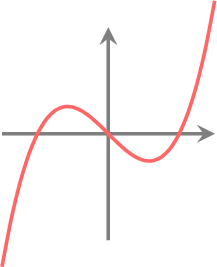
The long-term behaviour of a polynomial graph, as \(x \to \infty\) and \(x \to -\infty\), is determined entirely by its leading term, \(a_nx^n\). - Odd Degree (\(n=1, 3, 5, \dots\)): The graph goes in opposite directions.
- If \(a_n>0\): As \(x \to \infty, y \to \infty\). As \(x \to -\infty, y \to -\infty\). (Bottom-left to top-right)
- If \(a_n<0\): As \(x \to \infty, y \to -\infty\). As \(x \to -\infty, y \to \infty\). (Top-left to bottom-right)
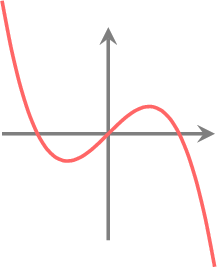
- If \(a_n>0\): As \(x \to \infty, y \to \infty\). As \(x \to -\infty, y \to -\infty\). (Bottom-left to top-right)
- Even Degree (\(n=2, 4, 6, \dots\)): The graph goes in the same direction at both ends.
- If \(a_n>0\): As \(x \to \infty, y \to \infty\). As \(x \to -\infty, y \to \infty\). (Opens upwards)
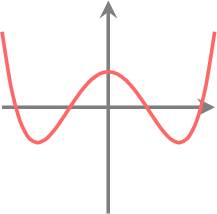
- If \(a_n<0\): As \(x \to \infty, y \to -\infty\). As \(x \to -\infty, y \to -\infty\). (Opens downwards)
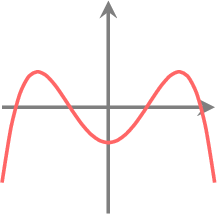
- If \(a_n>0\): As \(x \to \infty, y \to \infty\). As \(x \to -\infty, y \to \infty\). (Opens upwards)
Proposition — Multiplicity of Roots
The way a polynomial graph behaves at an x-intercept is determined by the multiplicity of the corresponding root (i.e., the power of its linear factor). - Multiplicity 1: \((x-k)^1\). The graph cuts the x-axis at \(x=k\).
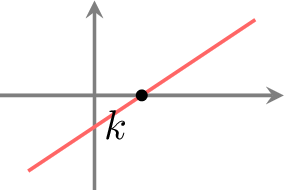
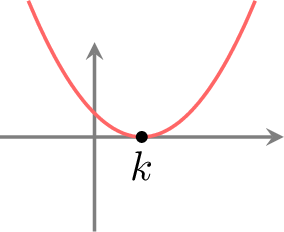
- Multiplicity 2: \((x-k)^2\). The graph touches the x-axis at \(x=k\) (tangent).
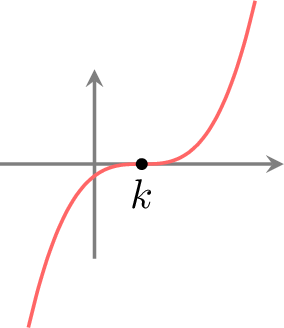
- Multiplicity 3: \((x-k)^3\). The graph has a point of inflection with horizontal tangent on the x-axis at \(x=k\).
Skills to practice
- Reading Factors from a Graph
- Describing the Graph at Its Roots
V.2
Graphs of Cubic Functions
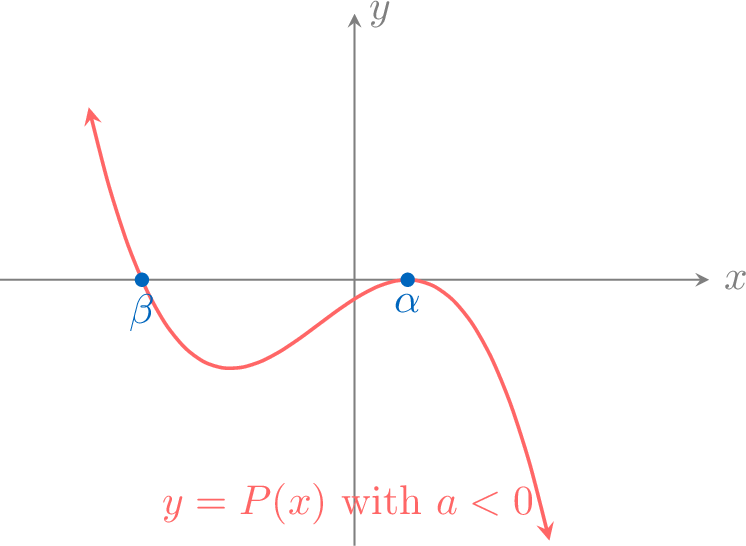
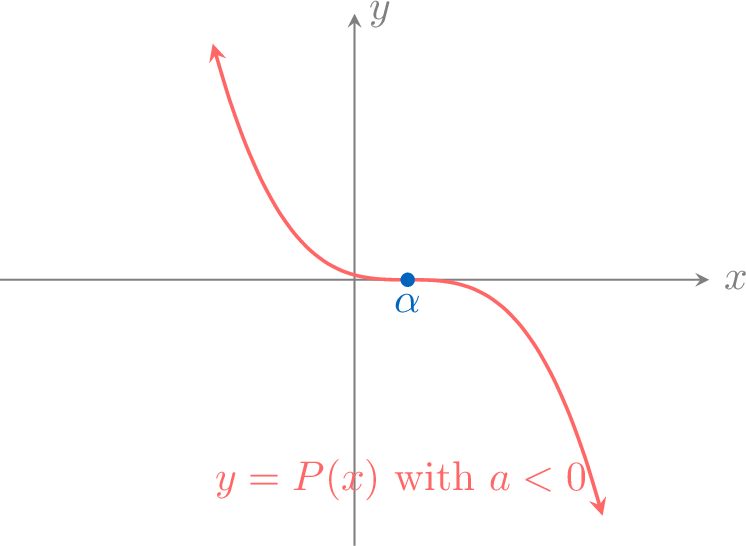
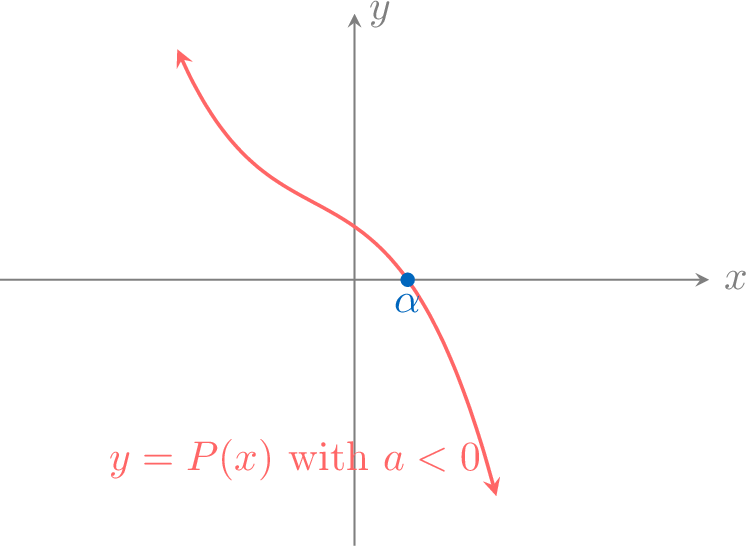
Proposition — Graphs of Cubic Polynomials from Factored Form
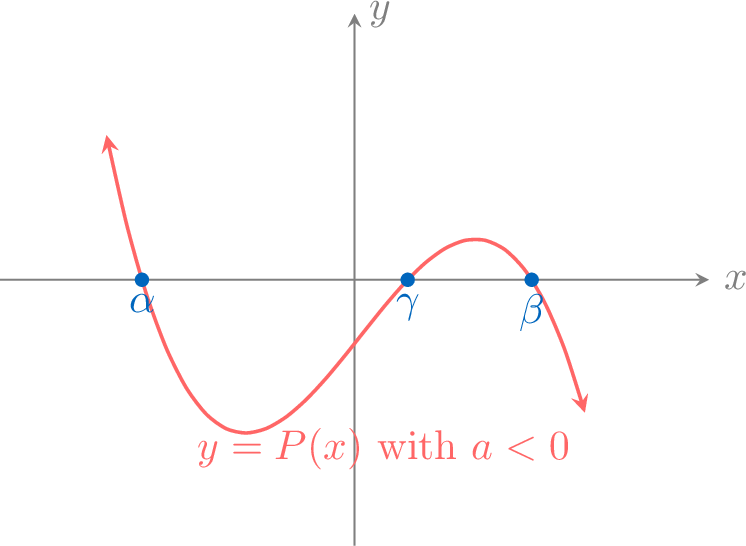
The overall shape and behavior at the x-intercepts of a cubic function \(P(x)\) depend on the sign of its leading coefficient, \(a\), and the multiplicity of its real roots. - Three distinct real roots: \(P(x)=a(x-\alpha)(x-\beta)(x-\gamma)\)
The graph cuts the x-axis at three distinct points.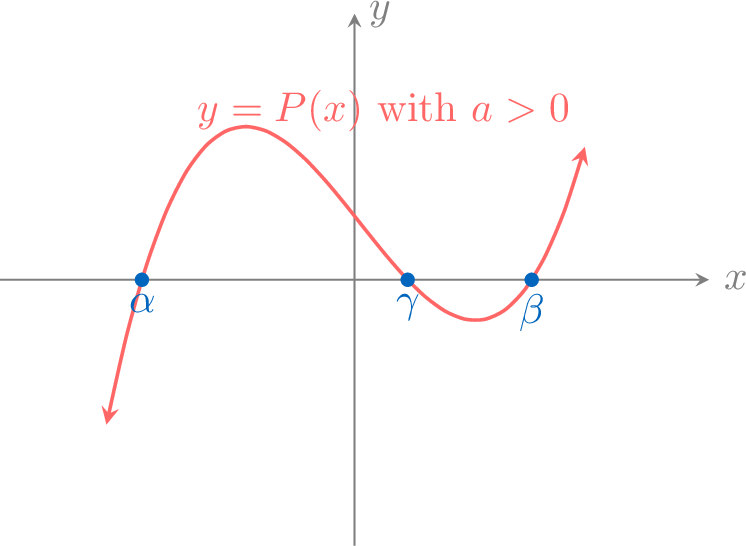
- One repeated and one distinct real root: \(P(x)=a(x-\alpha)^2(x-\beta)\)
The graph touches the x-axis at \(\alpha\) and cuts it at \(\beta\).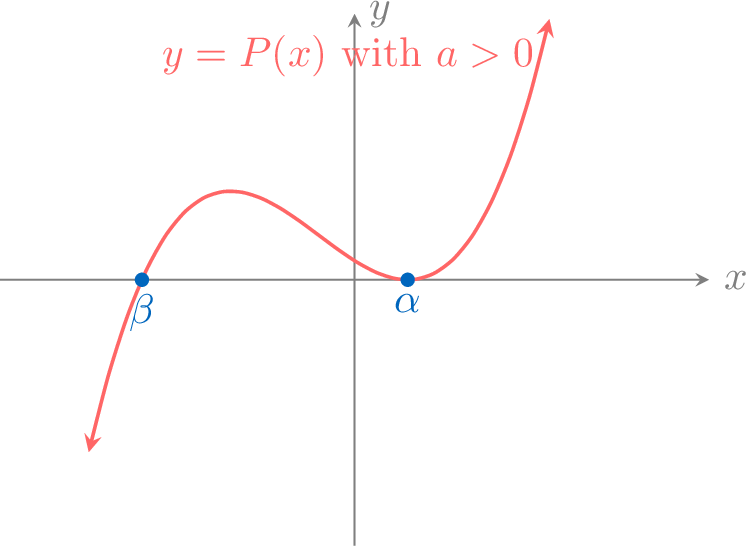
- One real root of multiplicity 3: \(P(x)=a(x-\alpha)^3\)
The graph has a point of horizontal inflection on the x-axis at \(\alpha\).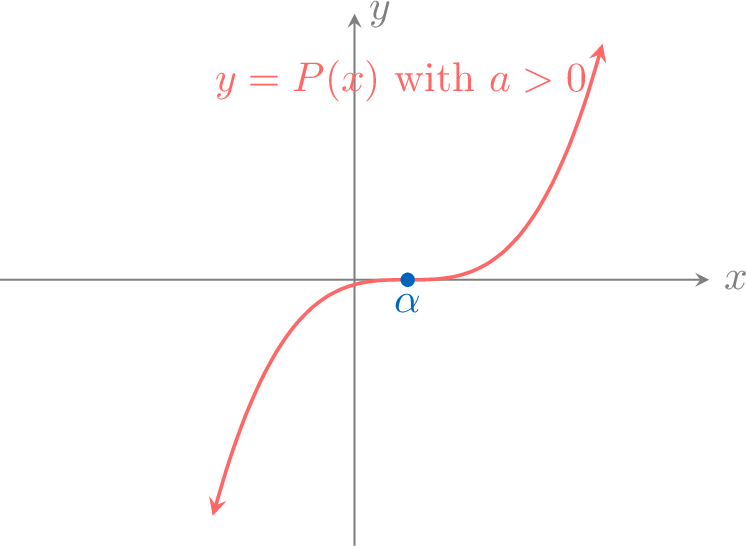
- One real root and two complex roots: \(P(x)=a(x-\alpha)(x^2+Bx+C)\) where \(B^2-4C<0\)
The graph cuts the x-axis at only one point, \(\alpha\).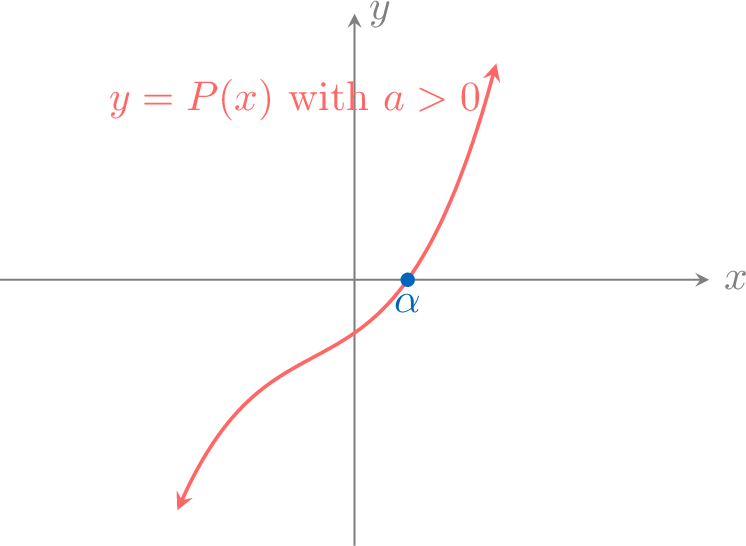
Example
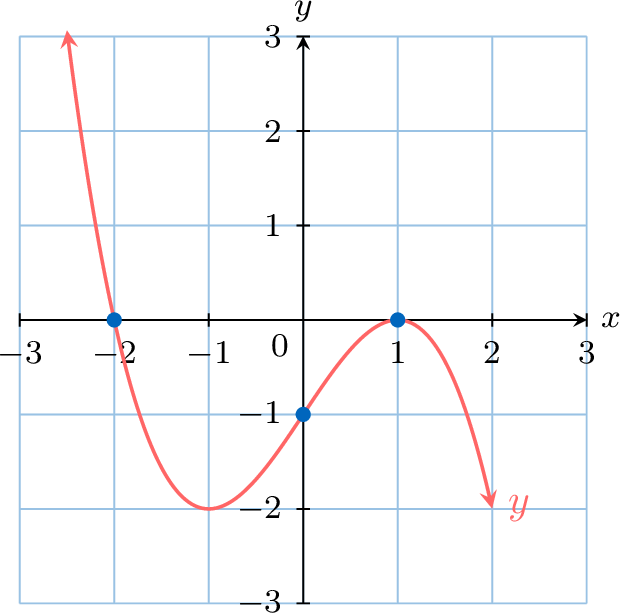
Sketch the graph of \(y = -\frac{1}{2}(x+2)(x-1)^2\). - Roots: The roots are \(x=-2\) (multiplicity 1, so it cuts) and \(x=1\) (multiplicity 2, so it touches).
- y-intercept: When \(x=0\), \(y = -\frac{1}{2}(0+2)(0-1)^2 = -\frac{1}{2}(2)(1) = -1\).
- End Behaviour: The leading term would be \(-\frac{1}{2}x \cdot x^2 = -\frac{1}{2}x^3\). The degree is odd (3) and the leading coefficient is negative. So, as \(x \to \infty, y \to -\infty\) and as \(x \to -\infty, y \to \infty\).
- Sketch:
Skills to practice
- Finding a Cubic from Its Graph
V.3
Graphs of Quartic Functions
A quartic function is a polynomial of degree 4. The principles of end behaviour and multiplicity of roots extend directly to these higher-degree polynomials.
Proposition — Graphs of Quartics from Factored Form
The behaviour of a quartic graph at its x-intercepts is determined by the multiplicity of its roots. For a positive leading coefficient (\(a>0\)): - Four distinct real roots: \(P(x)=a(x-\alpha)(x-\beta)(x-\gamma)(x-\theta)\)
The graph cuts the x-axis at four distinct points.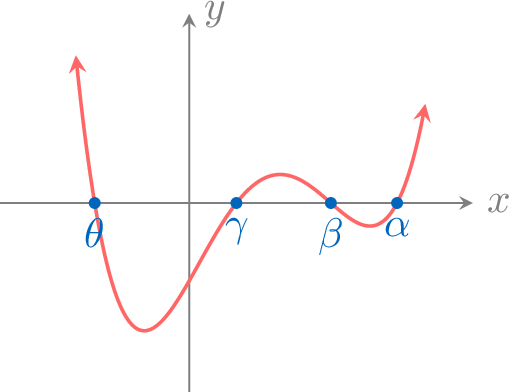
- One double root, two single roots: \(P(x)=a(x-\alpha)^2(x-\beta)(x-\gamma)\)
The graph touches at \(x=\alpha\) and cuts at \(x=\beta\) and \(x=\gamma\).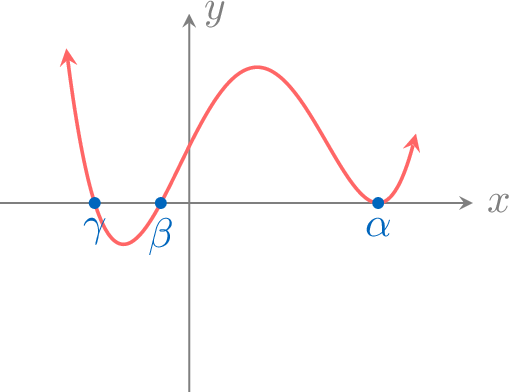
- Two double roots: \(P(x)=a(x-\alpha)^2(x-\beta)^2\)
The graph touches the x-axis at two distinct points.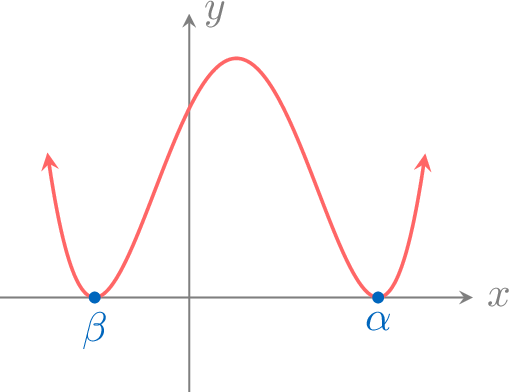
- One triple root: \(P(x)=a(x-\alpha)^3(x-\beta)\)
The graph has a point of inflection at \(x=\alpha\) and cuts at \(x=\beta\).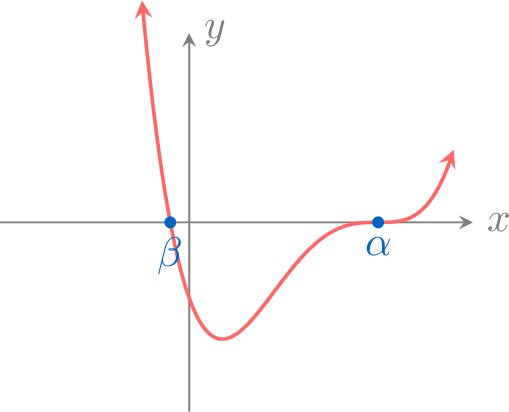
- Two real roots, two complex roots: \(P(x)=a(x-\alpha)(x-\beta)(x^2+c^2)\)
The graph cuts the x-axis at two points.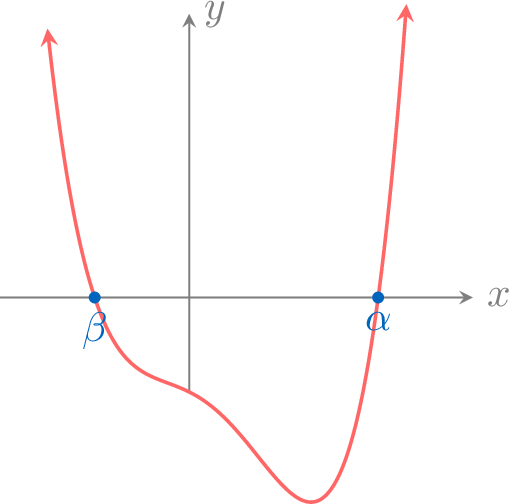
Example
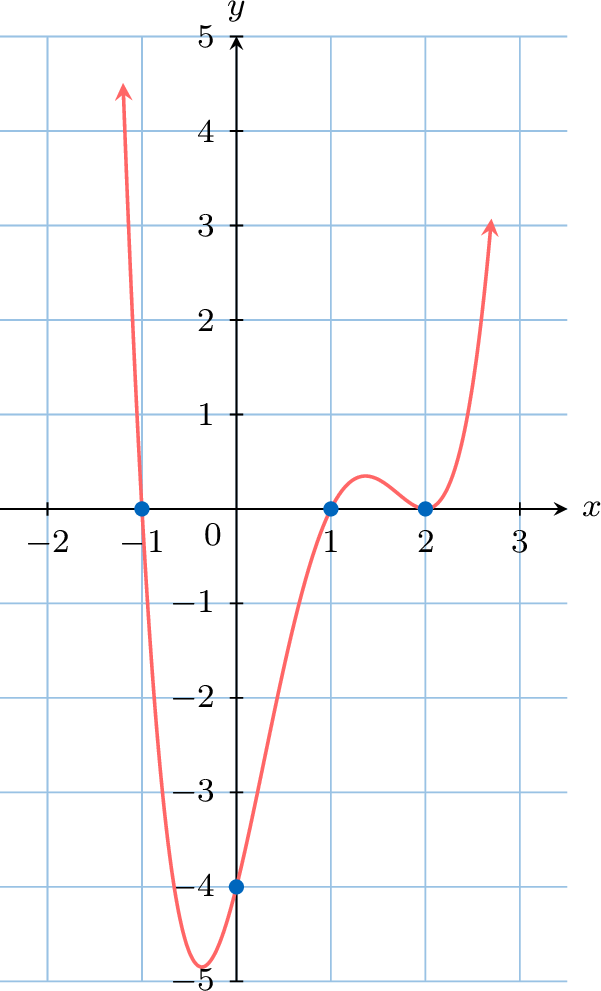
Sketch the graph of \(y = (x+1)(x-1)(x-2)^2\). - Roots and Multiplicities: The roots are at \(x=-1\) (multiplicity 1, cuts the axis), \(x=1\) (multiplicity 1, cuts the axis), and \(x=2\) (multiplicity 2, touches the axis).
- y-intercept: We substitute \(x=0\): $$ y = (0+1)(0-1)(0-2)^2 = (1)(-1)(4) = -4 $$ The y-intercept is at \((0, -4)\).
- End Behaviour: The leading term is found by multiplying the leading terms of the factors: \(x \cdot x \cdot x^2 = x^4\). The degree is 4 (even) and the leading coefficient is positive (+1). Therefore, the graph opens upwards: as \(x \to \infty, y \to \infty\) and as \(x \to -\infty, y \to \infty\).
- Sketch: We draw a smooth curve that starts from the top-left, passes through the intercepts with the correct behaviour, and ends at the top-right.
Skills to practice
- Sketching Cubic and Quartic Graphs
V.4
Polynomial Inequalities
Method — Solving Polynomial Inequalities
To solve an inequality like \(P(x) > 0\) or \(P(x) \le 0\): - Move all terms to one side, keeping the sign of the inequality: \(P(x) > 0\), \(P(x) \ge 0\), \(P(x) < 0\) or \(P(x) \le 0\), with the same sign as the given inequality.
- Find all the real roots of the polynomial \(P(x)\).
- Draw a sign diagram. Mark the roots on a number line.
- Test a value in each of the intervals determined by the roots to determine if \(P(x)\) is positive or negative in that interval.
- Use the sign diagram to state the solution in interval notation.
Example
Solve the inequality \(x^3 - x^2 \ge 12x\). - Rearrange: \(x^3 - x^2 - 12x \ge 0\).
- Find roots: Factorise the polynomial \(P(x) = x^3 - x^2 - 12x\). $$ P(x) = x(x^2 - x - 12) = x(x-4)(x+3) $$ The roots are \(x=-3, x=0, x=4\).
- Draw a Sign Diagram: We mark the roots on a number line and test values in the four resulting intervals. For example, test \(x=5\): \(5(1)(8) > 0\).

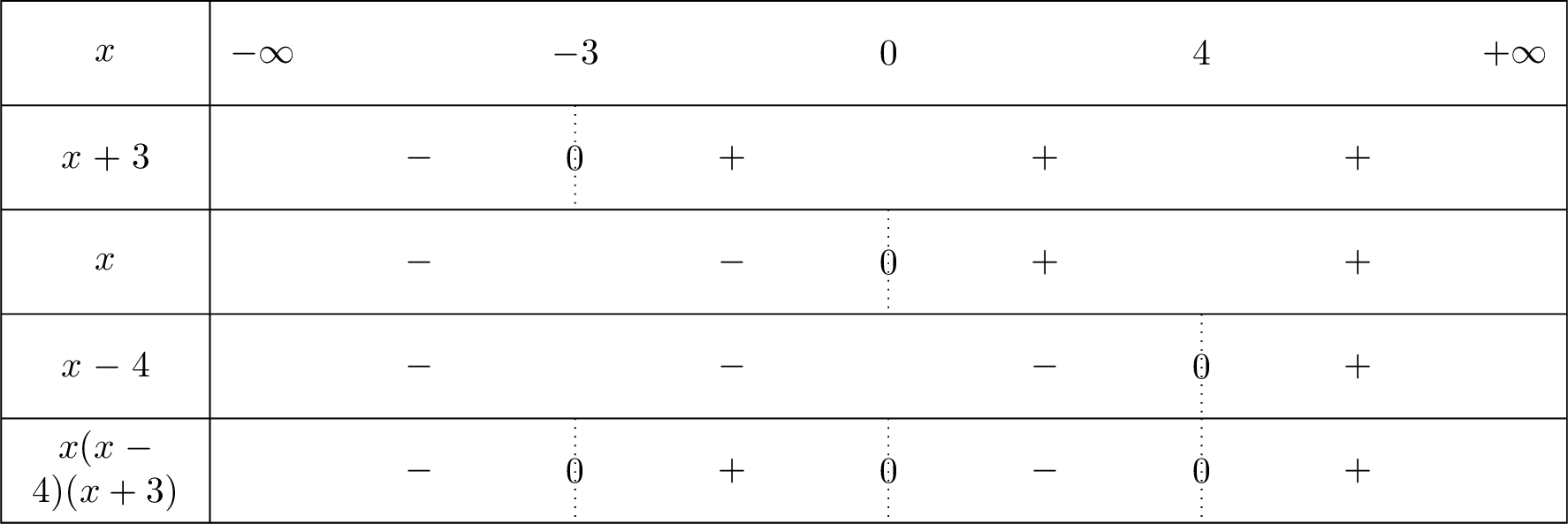
- State Solution: We are looking for where \(P(x) \ge 0\). According to the sign diagram, this occurs for \(x\) values between -3 and 0 (inclusive) and for values greater than or equal to 4. The solution is \(\boldsymbol{[-3, 0] \cup [4, \infty)}\).
Skills to practice
- Recognising the Solution of a Polynomial Inequality
- Solving Polynomial Inequalities
V.5
Equations and Inequalities with Technology
For a cubic equation, one known root is enough: the Factor Theorem leaves a quadratic quotient, which the quadratic formula solves exactly. But most polynomials of degree \(3\) or more have no root that is easy to guess. Technology helps in two ways. The decimal roots given by the polynomial solver can reveal a rational root, which the Factor Theorem then turns into an exact factorisation. And the graph of a polynomial shows at once where it is positive and where it is negative, which solves polynomial inequalities, even when their endpoints have no exact form.
Method — Solving a Polynomial Inequality with Technology
To solve an inequality \(P(x) > Q(x)\) (or \(P(x) \geq Q(x)\), \(P(x) < Q(x)\), \(P(x) \leq Q(x)\)), where \(P\) and \(Q\) are polynomials whose difference \(P - Q\) is not the zero polynomial: - Graph both sides: enter \(Y_1 = P(x)\) and \(Y_2 = Q(x)\). For an inequality \(P(x) > 0\), enter \(Y_1 = P(x)\) alone: the other side is the \(x\)-axis.
- Choose a window that shows every meeting point. The meeting points are the real roots of the polynomial equation \(P(x) - Q(x) = 0\): if \(P - Q\) has degree \(n\), there are at most \(n\) of them. For a degree the polynomial solver accepts, applying it to \(P(x) - Q(x) = 0\) lists all the roots (in complex mode, the non-real ones too): the distinct real roots among them give the number of meeting points to look for. Adjust the window, horizontally and vertically, until each of them is visible.
- Find each meeting point with the intersection tool (with the zero tool for \(P(x) > 0\)) and read its \(x\)-coordinate \(X\).
- Read the solution on the graph: \(P(x) > Q(x)\) where the graph of \(Y_1\) lies above the graph of \(Y_2\), and \(P(x) > 0\) where the graph of \(Y_1\) lies above the \(x\)-axis. Between two consecutive meeting points, the difference \(P(x) - Q(x)\) keeps the same sign, as in a sign diagram; at a meeting point where the graphs touch without crossing, a root of even multiplicity of \(P - Q\), the sign does not change. The meeting points belong to the solution for \(\geq\) and \(\leq\), not for \(>\) and \(<\).
- Report each endpoint exactly when the screen shows an exact value that substitution confirms; otherwise name it by a letter and give its value to 3 significant figures. Write the solution with inequalities or with intervals.
Example
Let \(P(x) = 3x^3 - 13x^2 - 2x + 2\). Use technology to find the zeros of \(P\), then find them exactly.
The polynomial solver, degree \(3\), with \(a = 3\), \(b = -13\), \(c = -2\) and \(d = 2\), displays three roots. 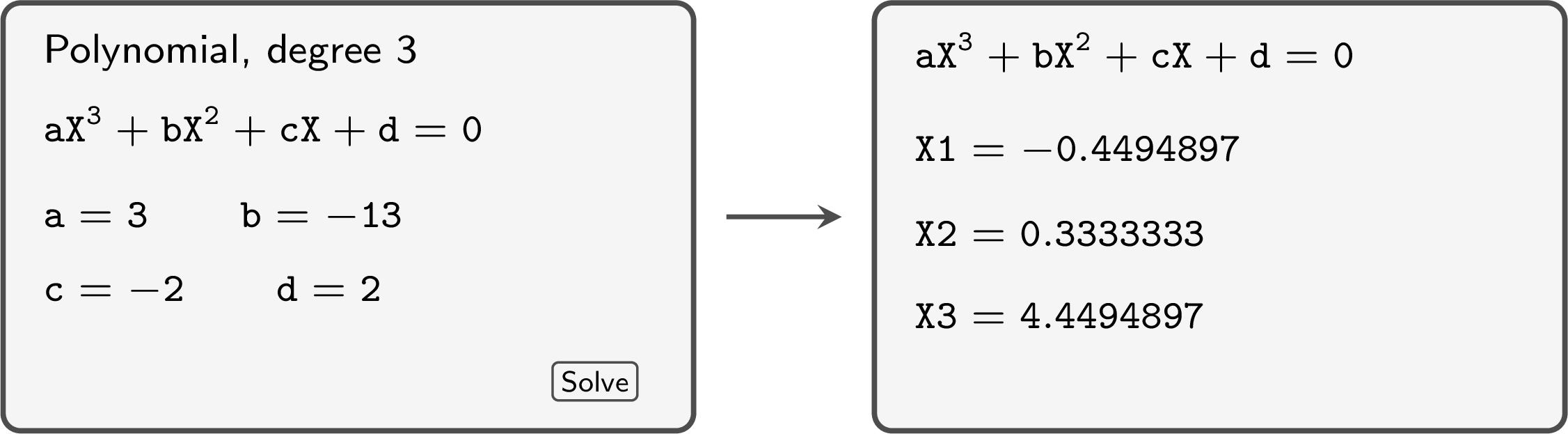
The value \(0.3333333\) suggests the rational root \(\dfrac{1}{3}\), and substitution confirms it exactly: $$\begin{aligned}[t] P\left(\frac{1}{3}\right) &= 3 \times \frac{1}{27} - 13 \times \frac{1}{9} - 2 \times \frac{1}{3} + 2 \\
&= \frac{1}{9} - \frac{13}{9} - \frac{6}{9} + \frac{18}{9} \\
&= 0. \end{aligned}$$ By the Factor Theorem, \(x - \dfrac{1}{3}\) is a factor of \(P\), and so is \(3\left(x - \dfrac{1}{3}\right) = 3x - 1\). Since \(P\) has degree \(3\) and leading coefficient \(3\), \(P(x) = (3x - 1)(x^2 + bx + c)\) for some numbers \(b\) and \(c\): $$\begin{aligned}[t] (3x - 1)(x^2 + bx + c) &= 3x^3 + 3bx^2 + 3cx - x^2 - bx - c && \text{(expand)} \\
&= 3x^3 + (3b - 1)x^2 + (3c - b)x - c. && \text{(collect like terms)} \end{aligned}$$ By identification of coefficients with \(3x^3 - 13x^2 - 2x + 2\): \(3b - 1 = -13\) gives \(b = -4\), and \(-c = 2\) gives \(c = -2\); the coefficient of \(x\) checks: \(3c - b = -6 + 4 = -2\). Hence \(P(x) = (3x - 1)(x^2 - 4x - 2)\). For \(x^2 - 4x - 2 = 0\): $$\begin{aligned}[t] \Delta &= (-4)^2 - 4 \times 1 \times (-2) = 24 && \text{(discriminant)} \\
x &= \frac{4 \pm \sqrt{24}}{2} = \frac{4 \pm 2\sqrt{6}}{2} = 2 \pm \sqrt{6}. && \text{(quadratic formula)} \end{aligned}$$ The zeros of \(P\) are exactly \(2 - \sqrt{6}\), \(\dfrac{1}{3}\) and \(2 + \sqrt{6}\). Check: \(2 - \sqrt{6} \approx -0.4494897\) and \(2 + \sqrt{6} \approx 4.4494897\), the values on the screen.
Example
Use technology to solve the inequality \(2x^3 - 7x^2 + 4 \leq x - 2\).
Both sides are entered, \(Y_1 = 2x^3 - 7x^2 + 4\) and \(Y_2 = x - 2\), and graphed in the window \(-2 \leq x \leq 4.5\), \(-10 \leq y \leq 6\). The difference \(2x^3 - 7x^2 - x + 6\) has degree \(3\), so the graphs meet at most three times: the three meeting points on the screen are all of them. The intersection tool gives \(X \approx -0.8860009\), \(X = 1\) and \(X \approx 3.3860009\); the value \(1\) is exact, since \(2 - 7 + 4 = -1 = 1 - 2\). 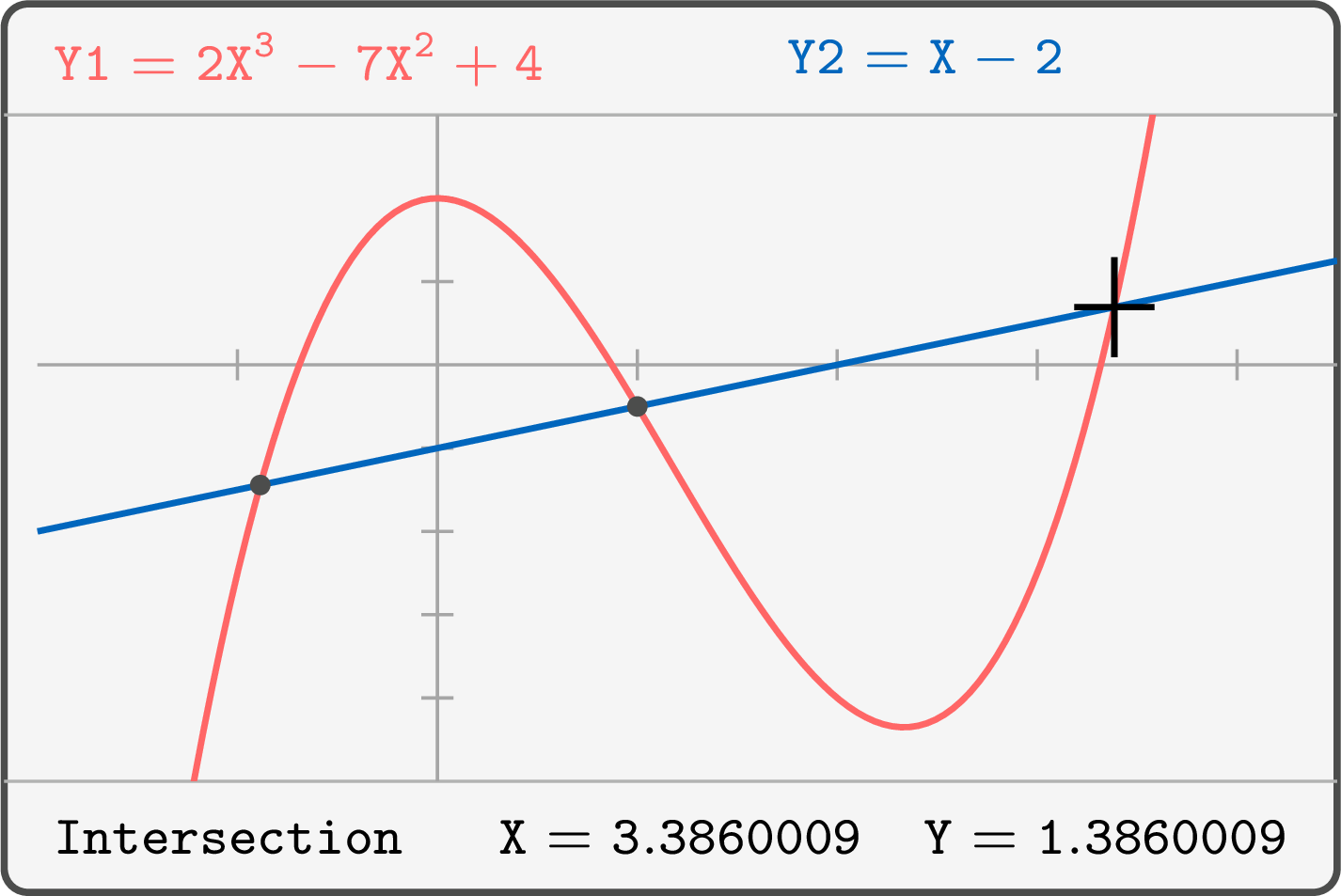
The inequality asks where the cubic lies below or on the line: to the left of the first meeting point, and between the second and the third. The meeting points are included, since the inequality is \(\leq\). Naming \(\alpha \approx -0.8860009\) and \(\beta \approx 3.3860009\) the first and third meeting points, the solution is $$x \leq \alpha \quad \text{or} \quad 1 \leq x \leq \beta, \qquad \text{with } \alpha \approx -0.886 \text{ and } \beta \approx 3.39.$$ The exact root \(1\) also gives \(\alpha\) and \(\beta\) exactly: by the Factor Theorem, \(x - 1\) is a factor of \(2x^3 - 7x^2 - x + 6\), and a long division gives \(2x^3 - 7x^2 - x + 6 = (x - 1)(2x^2 - 5x - 6)\), so \(\alpha = \dfrac{5 - \sqrt{73}}{4}\) and \(\beta = \dfrac{5 + \sqrt{73}}{4}\).
Skills to practice
- Solving Polynomial Equations with Technology
- Solving Polynomial Inequalities with Technology
VI
Going further
Skills to practice
- Diagnosing and Correcting
- Solving Problems without Technology
- Solving Problems with Technology
- Quiz
Jump to section