International Baccalaureate · DP 1: Analysis and Approaches SL
Surds and Exponents
I
Surds and Other Radicals
I.1
Square Roots
Recappreviously studied — click to reread
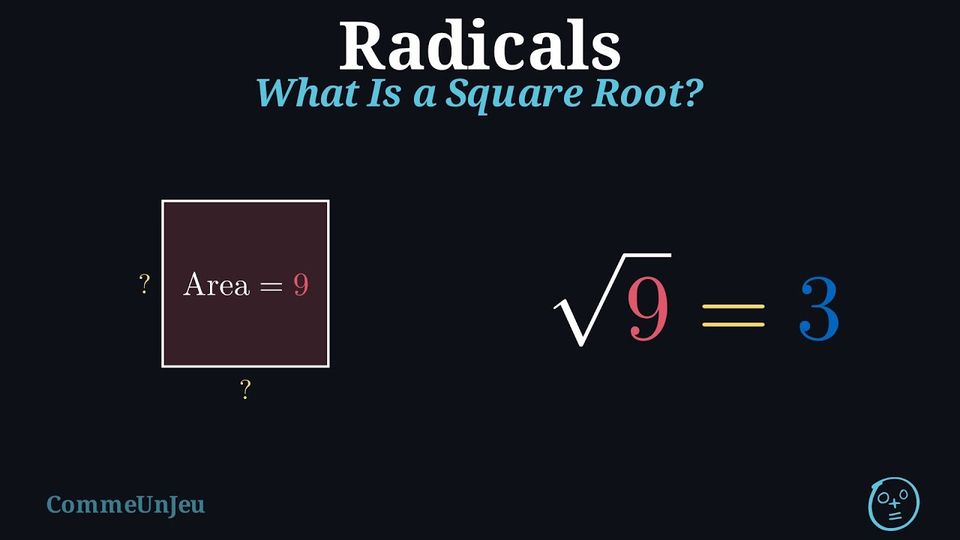
Definition — Square root
The square root of a non-negative number \(a\) (that is, \(a \ge 0\)), written as \(\sqrt{a}\), is the non-negative number that, when multiplied by itself, gives \(a\). $$ \left(\sqrt{a}\right)^2 = a $$
Note
- The square root symbol \(\sqrt{\quad}\) always asks for the non-negative root. For example, \(\sqrt{25} = 5\). It is a common mistake to think that \(\sqrt{25}\) is \(\pm 5\) (read: plus or minus \(5\)).
While it is true that both \(5^2 = 25\) and \((-5)^2 = 25\), the symbol \(\sqrt{25}\) refers only to the positive value, which is \(5\). - Why does a negative number have no square root?
Consider \(\sqrt{-9}\). To find this value, we need a number that, when multiplied by itself, gives \(-9\).- A positive number squared is positive (\(3 \times 3 = 9\)).
- A negative number squared is also positive (\((-3) \times (-3) = 9\)).
Definition — Perfect Squares
A perfect square is an integer that is the square of an integer. The square root of a perfect square is an integer. Skills to practice
- Square Roots
I.2
Cube Roots and nth Roots
Recappreviously studied — click to reread
Just as the square root of a number is the side length of a square with a given area, the cube root \(\sqrt[3]{a}\) of a non-negative number \(a\) is the side length of a cube with volume \(a\). 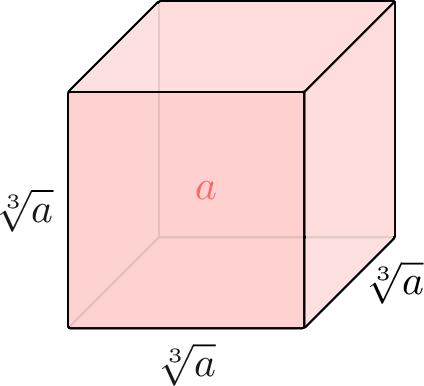
It is the inverse operation of cubing a number (raising it to the power of 3).
Definition — Cube Root
The cube root of a number \(a\), written \(\sqrt[3]{a}\), is the number which, when cubed, gives \(a\): $$\left(\sqrt[3]{a}\right)^3 = a$$
Note
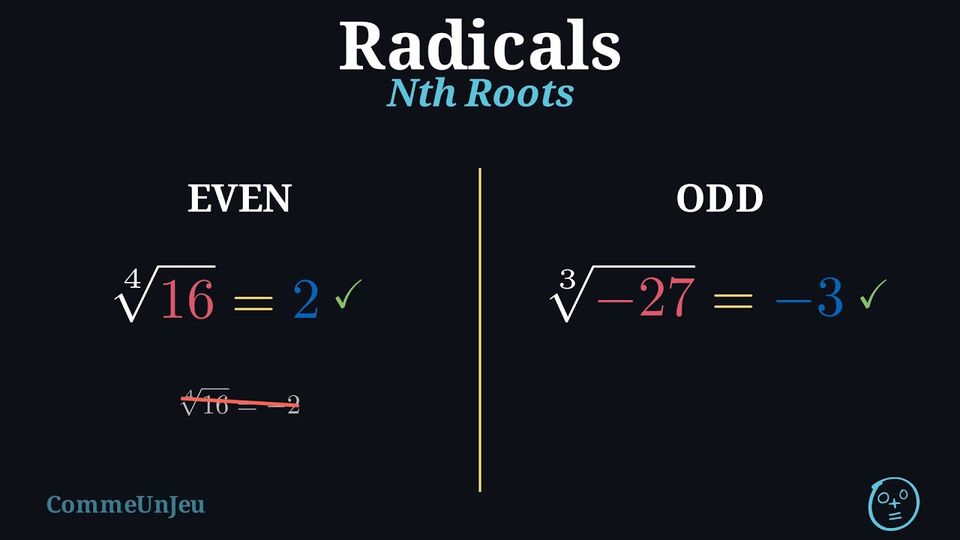
Unlike square roots, cube roots are defined for all real numbers, including negatives. For example, \(\sqrt[3]{-27} = -3\) because \((-3) \times (-3) \times (-3) = -27\).
Definition — Nth Root
The concept of a root can be generalised. For a positive integer \(n\), the nth root of a real number \(a\), written \(\sqrt[n]{a}\), is a number which, when raised to the power of \(n\), gives \(a\), chosen as follows: for an odd \(n\), it is the only real number whose \(n\)th power is \(a\); for an even \(n\), it exists only when \(a \ge 0\), and it is the non-negative number whose \(n\)th power is \(a\). Whenever it exists, $$\left(\sqrt[n]{a}\right)^n = a.$$ The rules for their domains depend on whether the index \(n\) is even or odd. - Even roots (e.g.\ \(\sqrt[2]{a}, \sqrt[4]{a}, \dots\)): an even root of a negative number is not a real number. For even \(n\), \(\sqrt[n]{a}\) is only defined for \(\boldsymbol{a \ge 0}\), and it denotes the non-negative number whose \(n\)th power is \(a\) (e.g.\ \(\sqrt[4]{16} = 2\), not \(-2\)).
- Odd roots (e.g.\ \(\sqrt[3]{a}, \sqrt[5]{a}, \dots\)): an odd root is defined for all real numbers \(a\).
Skills to practice
- Calculating Cube Roots and nth Roots
I.3
Laws of Radicals
Recappreviously studied — click to reread
Proposition — Multiplication Law
For any real numbers \(a,b \ge 0\): $$\textcolor{colorprop} {\sqrt{a} \times \sqrt{b} = \sqrt{ab}} $$
By definition, squaring a square root gives the original number. Look at the square of the expression \(\sqrt{a} \times \sqrt{b}\): $$\begin{aligned}[t] \left(\sqrt{a} \times \sqrt{b}\right)^2 &= (\sqrt{a} \times \sqrt{b}) \times (\sqrt{a} \times \sqrt{b}) && \text{(definition of squaring)} \\
&= (\sqrt{a} \times \sqrt{a}) \times (\sqrt{b} \times \sqrt{b}) && \text{(commutativity)} \\
&= a \times b && \text{(\((\sqrt{a})^2 = a\) and \((\sqrt{b})^2 = b\))} \\
&= ab. \end{aligned}$$ Moreover \(\sqrt{a} \times \sqrt{b} \ge 0\), as a product of two non-negative numbers. So \(\sqrt{a} \times \sqrt{b}\) is the non-negative number whose square is \(ab\): it is the square root of \(ab\).
Proposition — Square Root of a Square
For any real number \(a \ge 0\): $$ \textcolor{colorprop}{\sqrt{a^2} = a} $$
By definition, \(\sqrt{a^2}\) is the non-negative number whose square is \(a^2\). The number \(a\) is non-negative and its square is \(a^2\). So: $$\sqrt{a^2} = a$$
Proposition — Simplifying Law
For any real numbers \(a,b \ge 0\): $$ \textcolor{colorprop}{\sqrt{a^2 b} = a\sqrt{b}} $$
$$\begin{aligned}[t] \sqrt{a^2 b} &= \sqrt{a^2} \times \sqrt{b} && \text{(by Multiplication Law)} \\
&= a \times \sqrt{b} && \text{(by Square Root of a Square Law)} \\
&= a\sqrt{b} \end{aligned}$$
Proposition — Division Law
For any real numbers \(a \ge 0\) and \(b>0\): $$ \textcolor{colorprop}{\sqrt{\frac{a}{b}} = \frac{\sqrt{a}}{\sqrt{b}}} $$
Look at the square of the expression \(\dfrac{\sqrt{a}}{\sqrt{b}}\): $$\begin{aligned}[t] \left(\frac{\sqrt{a}}{\sqrt{b}}\right)^2 &= \frac{\sqrt{a}}{\sqrt{b}} \times \frac{\sqrt{a}}{\sqrt{b}} && \text{(definition of squaring)} \\
&= \frac{(\sqrt{a})^2}{(\sqrt{b})^2} && \text{(multiply the fractions)} \\
&= \frac{a}{b}. && \text{(\((\sqrt{a})^2 = a\) and \((\sqrt{b})^2 = b\))} \end{aligned}$$ Moreover \(\dfrac{\sqrt{a}}{\sqrt{b}} \ge 0\), as a quotient of non-negative numbers (with \(\sqrt{b} > 0\)). So it is the non-negative number whose square is \(\dfrac{a}{b}\): it is the square root of \(\dfrac{a}{b}\).
Example
Simplify \(\sqrt{\dfrac{5}{9}}\).
$$\begin{aligned}[t] \sqrt{\frac{5}{9}} &= \frac{\sqrt{5}}{\sqrt{9}} && \text{(by Division Law)} \\
&= \frac{\sqrt{5}}{3}. && \text{(\(\sqrt{9} = 3\))} \end{aligned}$$ The numerator \(5\) is not a perfect square: the Division Law still applies, and only the denominator becomes a whole number.
Definition — Simplest Radical Form
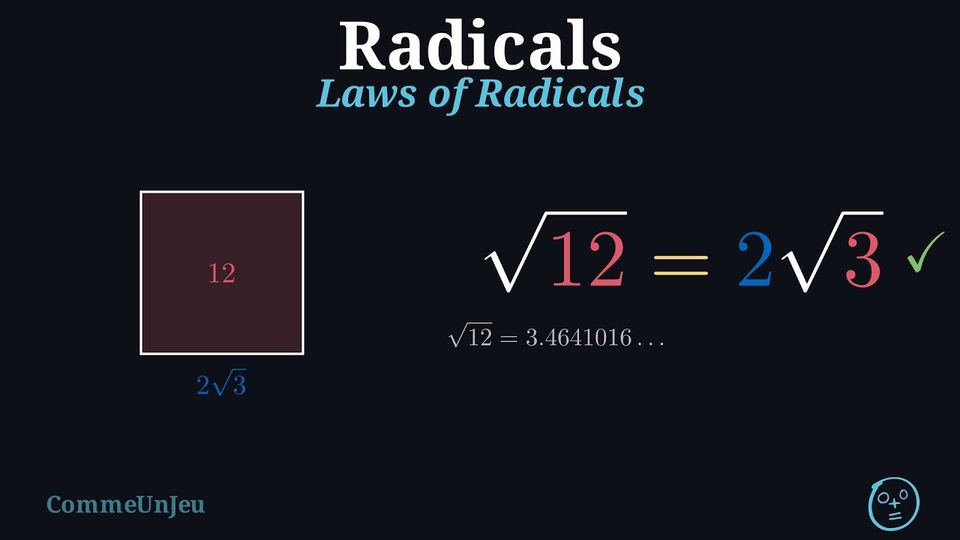
A radical is written in simplest form when the number under the square root sign has no perfect-square factor other than \(1\). For example, \(\sqrt{12}\) is not in simplest form, because \(12 = 4 \times 3\) and \(4\) is a perfect square; its simplest form is \(2\sqrt{3}\). Method — Writing a Radical in Simplest Form
Let \(n \geq 1\) be a whole number. To write \(\sqrt{n}\) in simplest form: - Find the largest perfect square that divides \(n\), and write \(n = a^2 \times b\) with \(a > 0\).
- Split the root with the Multiplication Law: \(\sqrt{n} = \sqrt{a^2} \times \sqrt{b}\).
- Extract the square: \(\sqrt{a^2} = a\) (since \(a > 0\)), so \(\sqrt{n} = a\sqrt{b}\).
Example
Simplify \(\sqrt{72}\).
First, find the largest perfect square factor of \(72\), which is \(36\). $$\begin{aligned}[t] \sqrt{72} &= \sqrt{36 \times 2} && \text{(\(36\) is the largest square factor)} \\
&= \sqrt{6^2 \times 2} && \text{(\(36 = 6^2\))} \\
&= 6\sqrt{2}. && \text{(by Simplifying Law)} \end{aligned}$$ With the smaller square factor \(4\), the result \(\sqrt{72} = \sqrt{4 \times 18} = 2\sqrt{18}\) is not yet in simplest form, because \(18 = 9 \times 2\) still contains a perfect square: taking the largest square factor finishes in one step.
Surds and Exact Values
The square roots \(\sqrt{2}\), \(\sqrt{3}\) or \(\sqrt{12} = 2\sqrt{3}\) are irrational numbers: none of them can be written as a fraction of two integers, so none of them is equal to a terminating decimal. A root of this kind, whose value is irrational, is also called a surd; the word is used for other roots too, such as \(\sqrt[3]{5}\).
- A number written with its roots, such as \(\sqrt{12}\) or \(2\sqrt{3}\), is written in exact form: both are exact values, while a calculator only gives an approximation, \(\sqrt{12} \approx 3.464\).
- Unless a question asks for a decimal value, an answer is given in exact form, with its roots in simplest form: \(2\sqrt{3}\) rather than \(\sqrt{12}\).
Skills to practice
- Deciding Whether an Equality with Radicals Holds
- Writing Square Roots in Simplest Form
I.4
Operations with Radicals
Recappreviously studied — click to reread
Method — Algebraic Operations
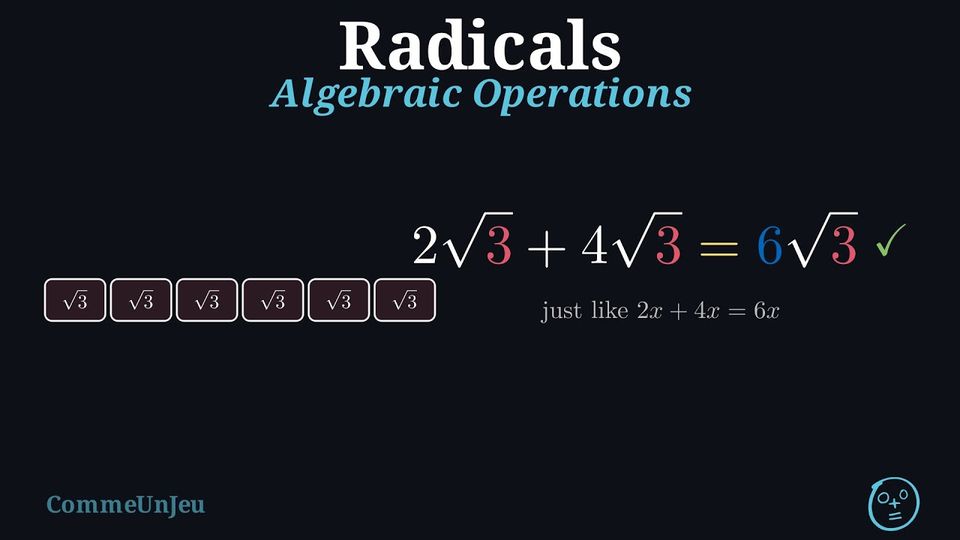
We can perform operations with radicals (square roots) in a similar way to ordinary numbers, provided we respect the radical laws. In particular: - We can add and subtract like radicals (i.e.\ the same number under the root) in the same way that we add and subtract like algebraic terms: $$ \textcolor{colorprop}{c\sqrt{a} + d\sqrt{a} = (c + d)\sqrt{a}} $$
- We can use the usual rules for expanding brackets (such as the distributive law).
Example
Simplify: \(6\sqrt{5} - 2\sqrt{5} + \sqrt{5}\)
Just like \(6x - 2x + x = 5x\), we combine the coefficients of the like radical; the last term is \(\sqrt{5} = 1 \times \sqrt{5}\), with the coefficient \(1\): $$\begin{aligned}[t] 6\sqrt{5} - 2\sqrt{5} + \sqrt{5} &= (6 - 2 + 1)\sqrt{5} && \text{(factor out \(\sqrt{5}\))} \\
&= 5\sqrt{5}. && \text{(\(6 - 2 + 1 = 5\))} \end{aligned}$$
Example
Expand and simplify \(\sqrt{3}(5 - \sqrt{3})\).
$$\begin{aligned}[t] \sqrt{3}(5 - \sqrt{3}) &= (\sqrt{3} \times 5) - (\sqrt{3} \times \sqrt{3}) && \text{(distributive law)} \\
&= 5\sqrt{3} - 3. && \text{(\(\sqrt{3} \times \sqrt{3} = 3\))} \end{aligned}$$
Example
Expand and simplify \((2 + \sqrt{3})(4 - \sqrt{3})\).
Each term of the first bracket multiplies each term of the second one, then the like radicals are collected. $$\begin{aligned}[t] (2 + \sqrt{3})(4 - \sqrt{3}) &= 2 \times 4 - 2\sqrt{3} + 4\sqrt{3} - \sqrt{3} \times \sqrt{3} && \text{(expanding two brackets)} \\
&= 8 - 2\sqrt{3} + 4\sqrt{3} - 3 && \text{(\(\sqrt{3} \times \sqrt{3} = 3\))} \\
&= 5 + 2\sqrt{3}. \end{aligned}$$
Example
Expand and simplify: - \((3 - \sqrt{2})^2\)
- \((\sqrt{5} + \sqrt{2})(\sqrt{5} - \sqrt{2})\)
The identities of algebra hold for radicals: \((a - b)^2 = a^2 - 2ab + b^2\) and \((a + b)(a - b) = a^2 - b^2\).
- With \(a = 3\) and \(b = \sqrt{2}\): $$\begin{aligned}[t] (3 - \sqrt{2})^2 &= 3^2 - 2 \times 3 \times \sqrt{2} + (\sqrt{2})^2 && \text{(square of a difference)} \\ &= 9 - 6\sqrt{2} + 2 && \text{(\((\sqrt{2})^2 = 2\))} \\ &= 11 - 6\sqrt{2}. \end{aligned}$$
- With \(a = \sqrt{5}\) and \(b = \sqrt{2}\): $$\begin{aligned}[t] (\sqrt{5} + \sqrt{2})(\sqrt{5} - \sqrt{2}) &= (\sqrt{5})^2 - (\sqrt{2})^2 && \text{(difference of two squares)} \\ &= 5 - 2 \\ &= 3. \end{aligned}$$
Skills to practice
- Adding and Subtracting Radicals
- Expanding Products with Radicals
- Solving Problems with Radicals
II
Division by Surds
II.1
Rationalizing the Denominator
Recappreviously studied — click to reread
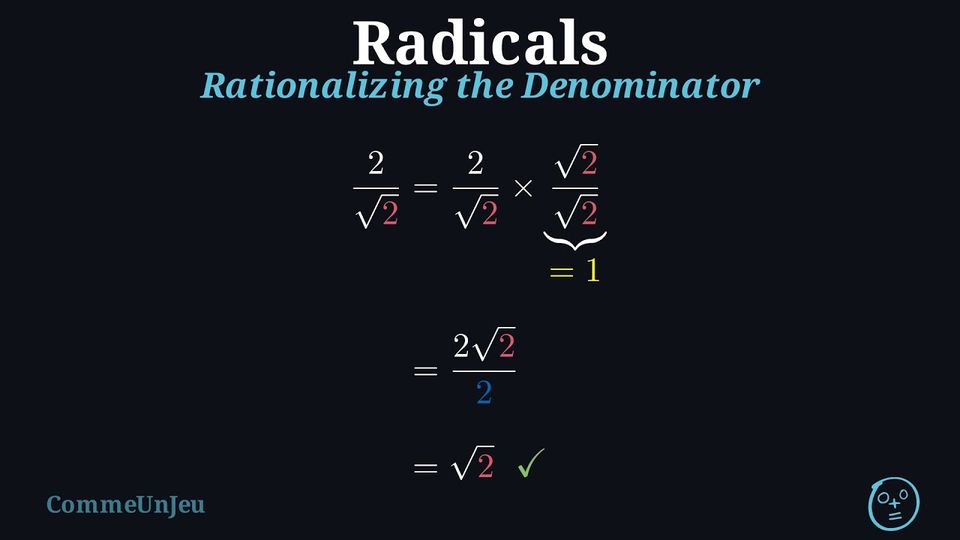
In mathematics, it is standard practice to write expressions without radicals in the denominator. The process of removing a radical from the denominator is called rationalising the denominator. This does not change the value of the expression but converts it to a conventional form which is often easier to work with.
Method — Rationalising a Monomial Denominator
To rationalise a denominator of the form \(\sqrt{a}\) (where \(a>0\)), multiply the numerator and the denominator by \(\sqrt{a}\).$$ \frac{b}{\sqrt{a}} = \frac{b}{\sqrt{a}} \times \frac{\sqrt{a}}{\sqrt{a}} = \frac{b\sqrt{a}}{a} $$ This works because multiplying by \(\frac{\sqrt{a}}{\sqrt{a}}\) is equivalent to multiplying by 1, which does not change the value. Example
Rationalise the denominator of \(\frac{6}{\sqrt{2}}\).
We multiply the numerator and denominator by \(\sqrt{2}\).$$\begin{aligned}[t]\frac{6}{\sqrt{2}} &= \frac{6}{\sqrt{2}} \times \frac{\sqrt{2}}{\sqrt{2}} && \text{(multiply by 1)} \\
&= \frac{6\sqrt{2}}{2} && \text{(\(\sqrt{2} \times \sqrt{2} = 2\))} \\
&= \boldsymbol{3\sqrt{2}}\end{aligned}$$
When the denominator is a binomial containing a square root, such as \(a+\sqrt{b}\), we use a special tool called the conjugate to rationalise it.
Definition — Conjugate
The conjugate of a binomial expression \(x+y\) is \(x-y\): it is obtained by changing the sign of the second term.
The power of the conjugate lies in its product, which follows the difference of squares identity: \((x+y)(x-y) = x^2 - y^2\).$$ (a+\sqrt{b})(a-\sqrt{b}) = a^2 - (\sqrt{b})^2 = a^2 - b $$ For rational \(a\) and \(b\), the result \(a^2 - b\) is a rational number, which achieves our goal.
Method — Rationalising a Binomial Denominator
To rationalise a binomial denominator, multiply the numerator and the denominator by the conjugate of the denominator. Example
Rationalise the denominator of \(\frac{4}{3+\sqrt{5}}\).
The denominator is \(3+\sqrt{5}\). Its conjugate is \(3-\sqrt{5}\). We multiply the numerator and denominator by this conjugate.$$\begin{aligned}[t]\frac{4}{3+\sqrt{5}} &= \frac{4}{(3+\sqrt{5})} \times \frac{(3-\sqrt{5})}{(3-\sqrt{5})} && \text{(multiply by 1)} \\
&= \frac{4(3 - \sqrt{5})}{3^2 - (\sqrt{5})^2} && \text{(\((x+y)(x-y) = x^2 - y^2\))}\\
&= \frac{4(3 - \sqrt{5})}{9 - 5} && \text{(\(3^2 = 9\) and \((\sqrt{5})^2 = 5\))}\\
&= \frac{4(3 - \sqrt{5})}{4} && \text{(\(9 - 5 = 4\))}\\
&= \boldsymbol{3 - \sqrt{5}}\end{aligned}$$
Skills to practice
- Writing with an Integer Denominator
III
Exponents
III.1
Positive Integer Exponents
Recappreviously studied — click to reread
Definition — Powers
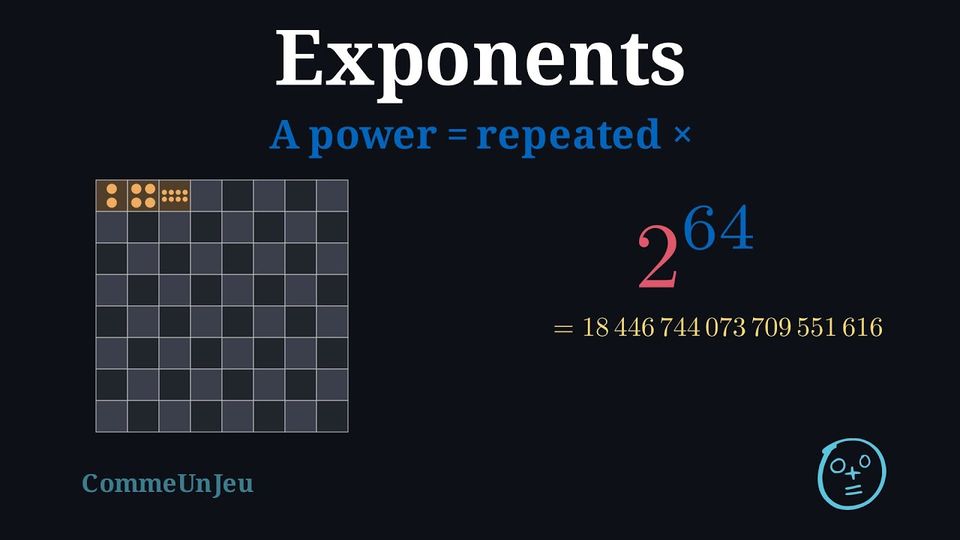
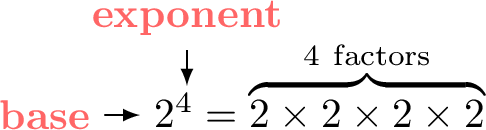
A power is a short way to write a repeated multiplication of a number by itself: For a number \(a\) and a positive whole number \(n\), $$ a^n = \overbrace{a \times a \times \dots \times a}^{n\ \text{factors}}. $$
Definition — Vocabulary
$$ \begin{array}{|c|c|c|c|} \hline \text{Value} & \text{Expanded form} & \text{Exponent notation} & \text{Spoken form} \\
\hline 2 & 2 & 2^1 & 2\ \text{or}\ 2\ \text{to the power of}\ 1 \\
4 & 2 \times 2 & 2^2 & 2\ \text{squared or}\ 2\ \text{to the power of}\ 2 \\
8 & 2 \times 2 \times 2 & 2^3 & 2\ \text{cubed or}\ 2\ \text{to the power of}\ 3 \\
16 & 2 \times 2 \times 2 \times 2 & 2^4 & 2\ \text{to the power of}\ 4 \\
32 & 2 \times 2 \times 2 \times 2 \times 2 & 2^5 & 2\ \text{to the power of}\ 5 \\
\hline \end{array} $$ Proposition — Sign of a Power
For any integer \(n \geq 1\): a power of a negative number is the product of \(n\) negative factors. By the sign rule for a product: - if \(n\) is even, the power is positive;
- if \(n\) is odd, the power is negative.
Example
Give the sign, then the value, of \((-2)^5\) and of \((-10)^4\).
$$\begin{aligned} (-2)^5 &: \text{ the exponent } 5 \text{ is odd, the power is negative};\quad 2^5 = 32, \text{ so } (-2)^5 = \textcolor{colorprop}{-32.}\\
(-10)^4 &: \text{ the exponent } 4 \text{ is even, the power is positive};\quad 10^4 = 10\,000, \text{ so } (-10)^4 = \textcolor{colordef}{+10\,000.} \end{aligned}$$ 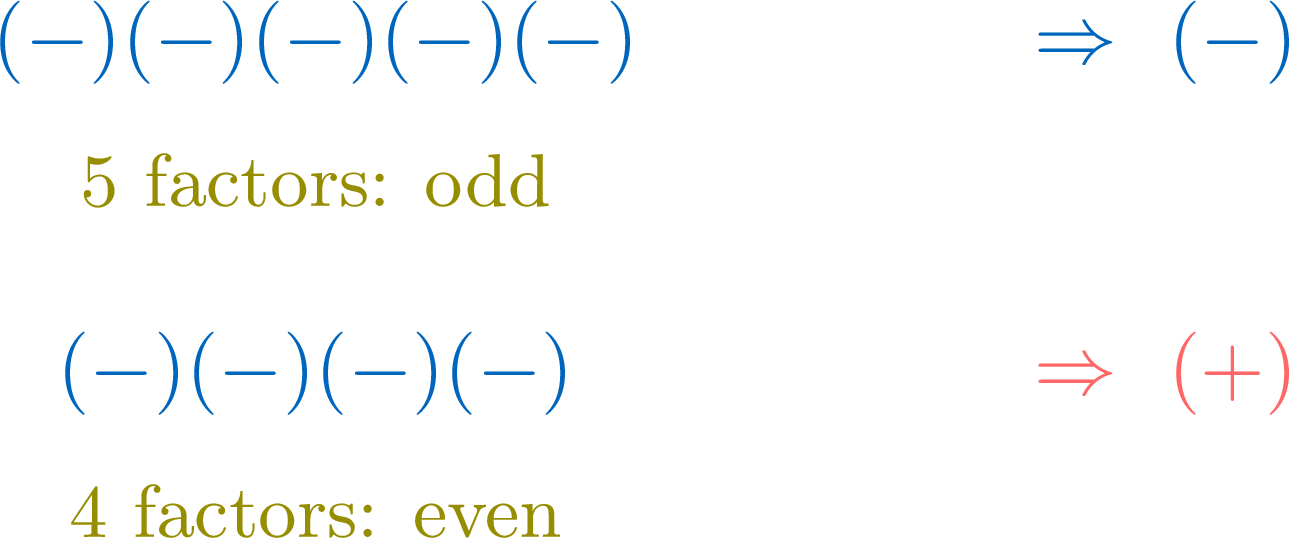
Skills to practice
- Positive Integer Exponents
III.2
Zero and Negative Exponents
Recappreviously studied — click to reread
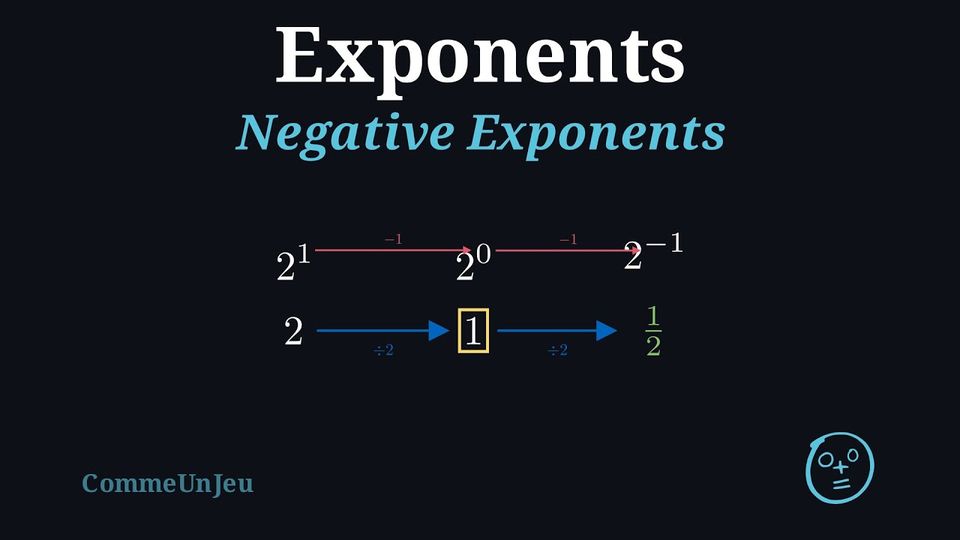
To understand negative exponents, we look at the pattern of multiplying by \(2\): 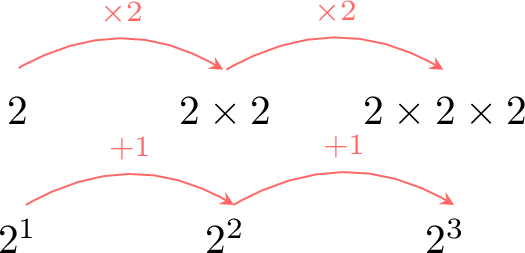
This pattern shows: 
The extended pattern shows:
- \(2^1 = 2\)
- \(2^2 = 2 \times 2\)
- \(2^3 = 2 \times 2 \times 2\)
- \(2^0 = 1\)
- \(2^{-1} = \dfrac{1}{2}\)
- \(2^{-2} = \dfrac{1}{2 \times 2}\)
- \(2^{-3} = \dfrac{1}{2 \times 2 \times 2}\)
Definition — Negative and Zero Exponents
For a non-zero number \(a\) and a positive integer \(n\), we extend exponentiation to negative exponents by: $$\begin{aligned}[t] a^{-n} &= \dfrac{1}{\underbrace{a \times a \times \dots \times a}_{n\ \text{factors}}} \\
&= \dfrac{1}{a^n} \end{aligned} \qquad \text{and} \qquad a^0 = 1 \quad (a \neq 0).$$ In particular, \(a^{-1} = \dfrac{1}{a}\). A negative exponent means we take the reciprocal of the corresponding positive power. Example
Write \(3^{-2}\) as a fraction.
$$\begin{aligned}[t] 3^{-2} &= \dfrac{1}{3 \times 3} \\
&= \dfrac{1}{9} \end{aligned}$$
Skills to practice
- Writing Expressions with Negative Powers as Fractions
III.3
Order of Operations
Recappreviously studied — click to reread
Definition — Order of Operations
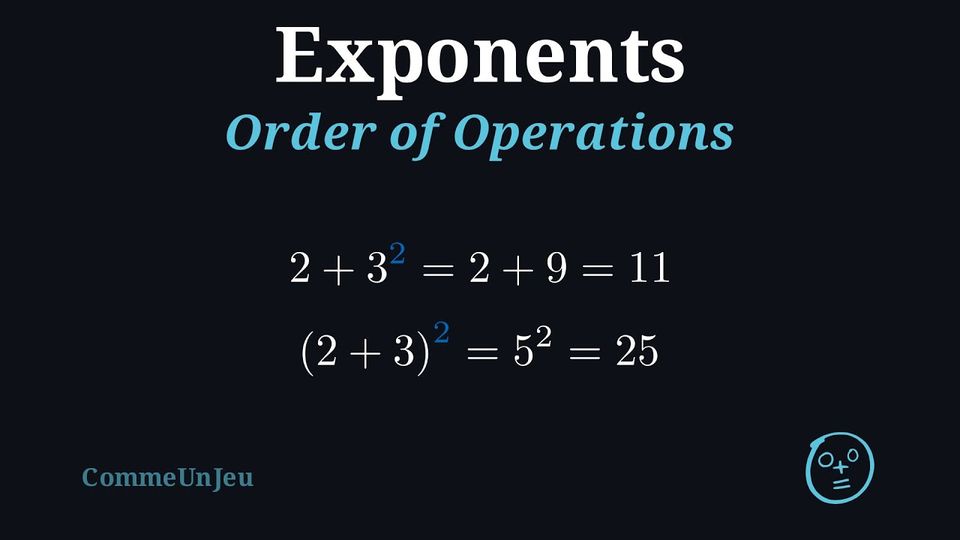
In an expression, the calculations are carried out in this order of operations, remembered with the acronym BEDMAS: - first the calculations in brackets ( ) (also called parentheses), starting with the innermost ones;
- then the exponents (also called indices);
- then the multiplications and divisions, from left to right;
- finally the additions and subtractions, from left to right.
Example
Evaluate \((1+2) \times 2^3 + 4\).
$$ \begin{aligned}[t] (1+2) \times 2^3 + 4 &= \textcolor{colordef}{3} \times 2^3 + 4 && (\text{brackets: } 1+2 = 3) \\
&= 3 \times \textcolor{colordef}{8} + 4 && (\text{exponent: } 2^3 = 8) \\
&= \textcolor{colordef}{24} + 4 && (\text{multiplication: } 3 \times 8 = 24) \\
&= \textcolor{colordef}{28} && (\text{addition: } 24 + 4 = 28) \end{aligned} $$
Skills to practice
- Order of Operations
IV
Laws of Exponents
IV.1
Product of Powers with the Same Base
Recappreviously studied — click to reread
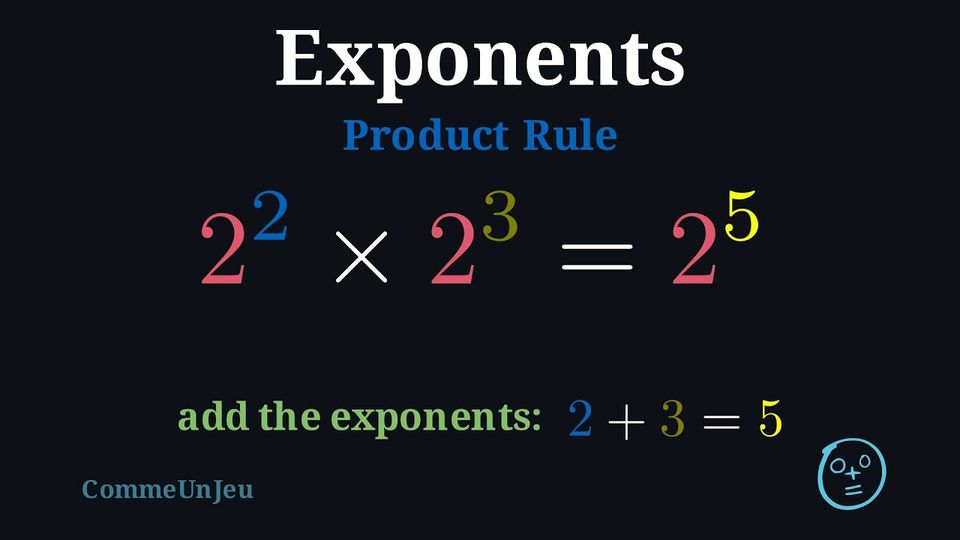
Can \(7^3 \times 7^2\) be written as a single power of \(7\)? We expand: $$\begin{aligned} \textcolor{colordef}{7}^{\textcolor{colorprop}{3}} \times \textcolor{colordef}{7}^{\textcolor{olive}{2}} &= \overbrace{\textcolor{colordef}{7} \times \textcolor{colordef}{7} \times \textcolor{colordef}{7}}^{\textcolor{colorprop}{3}\,\text{factors}} \times \overbrace{\textcolor{colordef}{7} \times \textcolor{colordef}{7}}^{\textcolor{olive}{2}\,\text{factors}} \\
&= \overbrace{\textcolor{colordef}{7} \times \textcolor{colordef}{7} \times \textcolor{colordef}{7} \times \textcolor{colordef}{7} \times \textcolor{colordef}{7}}^{\textcolor{colorprop}{3}+\textcolor{olive}{2}\,\text{factors}} \\
&= \textcolor{colordef}{7}^{\textcolor{colorprop}{3}+\textcolor{olive}{2}} \end{aligned}$$ In general, when a number \(\textcolor{colordef}{a}\) is raised to the power \(\textcolor{colorprop}{m}\) and multiplied by the same number raised to the power \(\textcolor{olive}{n}\), that is $$\textcolor{colordef}{a}^{\textcolor{colorprop}{m}} \times \textcolor{colordef}{a}^{\textcolor{olive}{n}},$$ the result is equal to \(\textcolor{colordef}{a}\) raised to the sum of the exponents: $$\textcolor{colordef}{a}^{\textcolor{colorprop}{m}} \times \textcolor{colordef}{a}^{\textcolor{olive}{n}} = \textcolor{colordef}{a}^{\textcolor{colorprop}{m}+\textcolor{olive}{n}}.$$
Proposition — Exponent Law 1
For \(a\neq 0\) and any integers \(m\) and \(n\), $$\textcolor{colordef}{a}^{\textcolor{colorprop}{m}} \times \textcolor{colordef}{a}^{\textcolor{olive}{n}} = \textcolor{colordef}{a}^{\textcolor{colorprop}{m}+\textcolor{olive}{n}}$$
$$\begin{aligned} \textcolor{colordef}{a}^{\textcolor{colorprop}{m}} \times \textcolor{colordef}{a}^{\textcolor{olive}{n}} &= \overbrace{\textcolor{colordef}{a} \times \cdots \times \textcolor{colordef}{a}}^{\textcolor{colorprop}{m}\ \text{factors}} \times \overbrace{\textcolor{colordef}{a} \times \cdots \times \textcolor{colordef}{a}}^{\textcolor{olive}{n}\ \text{factors}} \\
&= \overbrace{\textcolor{colordef}{a} \times \cdots \times \textcolor{colordef}{a}}^{\textcolor{colorprop}{m}+\textcolor{olive}{n}\ \text{factors}} \\
&= \textcolor{colordef}{a}^{\textcolor{colorprop}{m}+\textcolor{olive}{n}} \end{aligned}$$ Here \(m\) and \(n\) are positive integers; the formula extends to all integers thanks to the definition of negative exponents (accepted without proof).
Example
Simplify \(5^2\times 5^4\).
$$ \begin{aligned} \textcolor{colordef}{5}^{\textcolor{colorprop}{2}} \times \textcolor{colordef}{5}^{\textcolor{olive}{4}} &= \textcolor{colordef}{5}^{\textcolor{colorprop}{2}+\textcolor{olive}{4}} && \text{(same base, add exponents)} \\
&= \textcolor{colordef}{5}^{6}. \end{aligned} $$
Skills to practice
- Simplifying Products of Powers
IV.2
Quotient of Powers with the Same Base
Recappreviously studied — click to reread
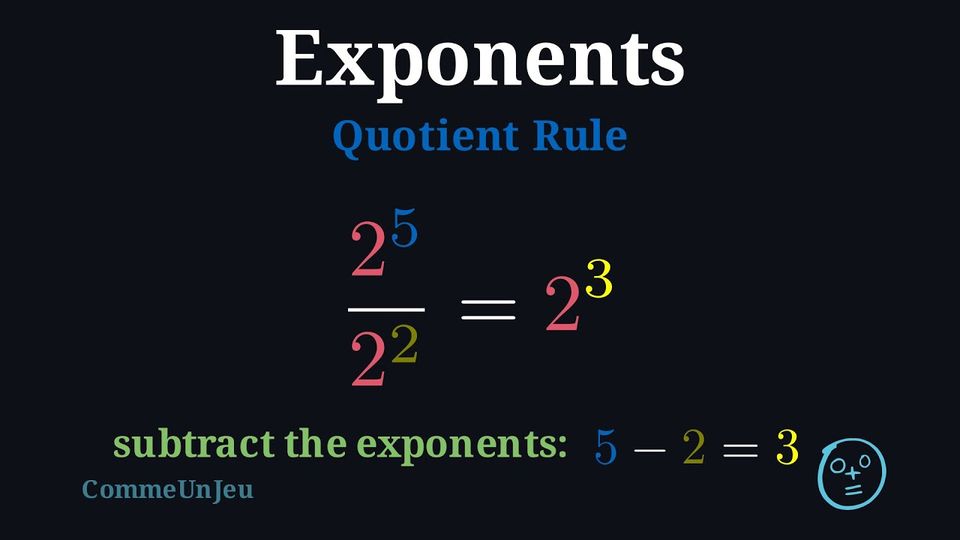
Proposition — Exponent Law 2
For \(a\neq 0\) and any integers \(m\) and \(n\), $$\dfrac{\textcolor{colordef}{a}^{\textcolor{colorprop}{m}}}{\textcolor{colordef}{a}^{\textcolor{olive}{n}}} = \textcolor{colordef}{a}^{\textcolor{colorprop}{m} - \textcolor{olive}{n}}$$ Example
Simplify \(\dfrac{5^7}{5^3}\).
$$\begin{aligned} \dfrac{\textcolor{colordef}{5}^{\textcolor{colorprop}{7}}}{\textcolor{colordef}{5}^{\textcolor{olive}{3}}} &= \textcolor{colordef}{5}^{\textcolor{colorprop}{7} - \textcolor{olive}{3}} \\
&= \textcolor{colordef}{5}^{4} \end{aligned}$$
Example
Simplify \(\dfrac{7^{3}}{7^{5}}\), then write the result as a fraction.
By Exponent Law 2, $$\dfrac{7^{3}}{7^{5}} = 7^{3-5} = 7^{-2} = \dfrac{1}{7^{2}} = \dfrac{1}{49}.$$ Dividing powers can produce a negative exponent: the law and the definition of negative exponents work together.
Skills to practice
- Simplifying Quotients of Powers
IV.3
Power of a Power
Recappreviously studied — click to reread
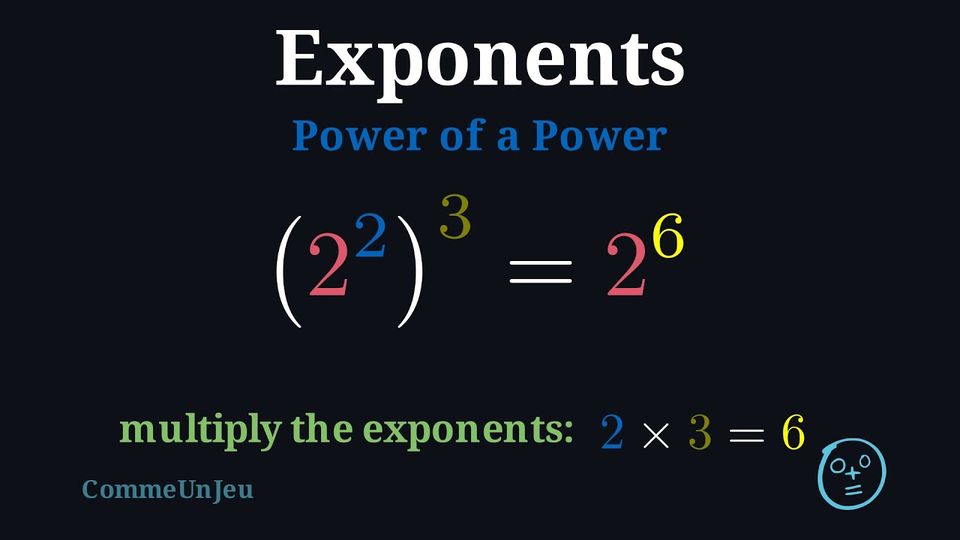
Proposition — Exponent Law 3
For \(a\neq 0\) and any integers \(m\) and \(n\), $$\left(\textcolor{colordef}{a}^{\textcolor{colorprop}{m}}\right)^{\textcolor{olive}{n}} = \textcolor{colordef}{a}^{\textcolor{colorprop}{m} \times \textcolor{olive}{n}}$$ Example
Simplify \(\left(\textcolor{colordef}{5}^{\textcolor{colorprop}{2}}\right)^{\textcolor{olive}{5}}\).
$$\begin{aligned}[t] \left(\textcolor{colordef}{5}^{\textcolor{colorprop}{2}}\right)^{\textcolor{olive}{5}} &= \textcolor{colordef}{5}^{\textcolor{colorprop}{2} \times \textcolor{olive}{5}} \\
&= \textcolor{colordef}{5}^{10} \end{aligned}$$
Skills to practice
- Power of a Power
IV.4
Power of a Product
Recappreviously studied — click to reread
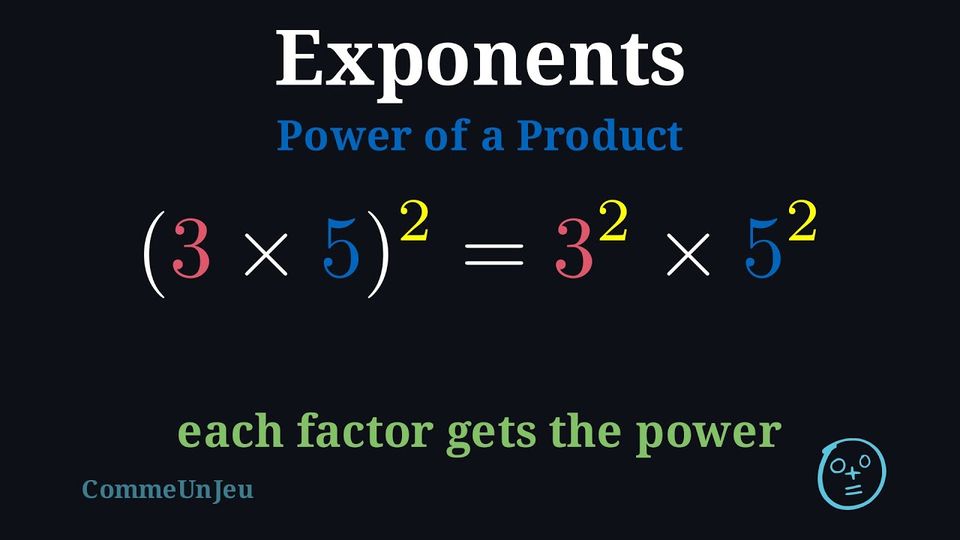
Proposition — Exponent Law 4
For non-zero numbers \(a\) and \(b\), and any integer \(n\), $$\left(\textcolor{colordef}{a}\textcolor{colorprop}{b}\right)^{\textcolor{olive}{n}} = \textcolor{colordef}{a}^{\textcolor{olive}{n}}\, \textcolor{colorprop}{b}^{\textcolor{olive}{n}}$$ Example
Write \((\textcolor{colordef}{2}\times \textcolor{colorprop}{5})^{\textcolor{olive}{3}}\) using a power of each factor.
$$(\textcolor{colordef}{2}\times \textcolor{colorprop}{5})^{\textcolor{olive}{3}} = \textcolor{colordef}{2}^{\textcolor{olive}{3}} \times \textcolor{colorprop}{5}^{\textcolor{olive}{3}}$$
Skills to practice
- Power of a Product
IV.5
Power of a Quotient
Recappreviously studied — click to reread
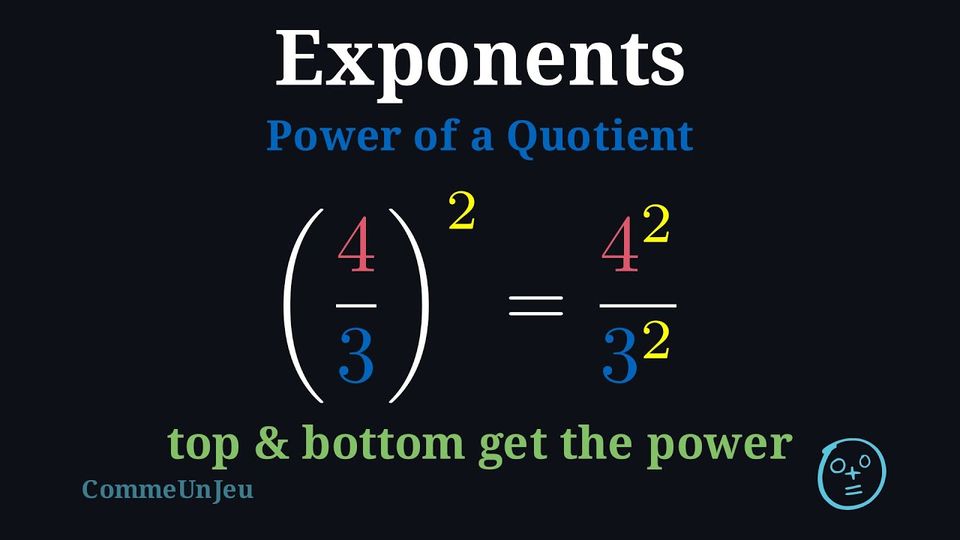
Proposition — Exponent Law 5
For non-zero numbers \(a\) and \(b\), and any integer \(n\), $$\left(\dfrac{\textcolor{colordef}{a}}{\textcolor{colorprop}{b}}\right)^{\textcolor{olive}{n}} = \dfrac{\textcolor{colordef}{a}^{\textcolor{olive}{n}}}{\textcolor{colorprop}{b}^{\textcolor{olive}{n}}}$$ Example
Calculate \(\left(\dfrac{\textcolor{colordef}{5}}{\textcolor{colorprop}{3}}\right)^{\textcolor{olive}{2}}\).
$$\begin{aligned}[t] \left(\dfrac{\textcolor{colordef}{5}}{\textcolor{colorprop}{3}}\right)^{\textcolor{olive}{2}} &= \dfrac{\textcolor{colordef}{5}^{\textcolor{olive}{2}}}{\textcolor{colorprop}{3}^{\textcolor{olive}{2}}} \\
&= \dfrac{25}{9} \end{aligned}$$
Skills to practice
- Power of a Quotient
IV.6
Negative Power of a Quotient
Recappreviously studied — click to reread
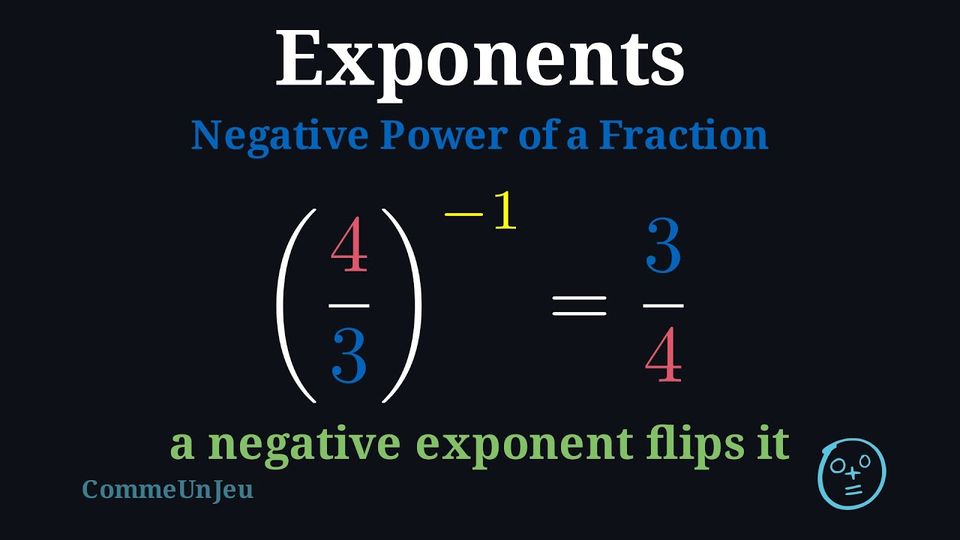
Proposition — Exponent Law 6
For non-zero numbers \(a\) and \(b\), and any integer \(n\), $$\left(\dfrac{\textcolor{colordef}{a}}{\textcolor{colorprop}{b}}\right)^{\textcolor{olive}{-n}} = \left(\dfrac{\textcolor{colorprop}{b}}{\textcolor{colordef}{a}}\right)^{\textcolor{olive}{n}}$$ and in particular, $$\left(\dfrac{\textcolor{colordef}{a}}{\textcolor{colorprop}{b}}\right)^{\textcolor{olive}{-1}} = \dfrac{\textcolor{colorprop}{b}}{\textcolor{colordef}{a}}.$$ Example
Calculate \(\left(\dfrac{\textcolor{colordef}{2}}{\textcolor{colorprop}{7}}\right)^{-2}\).
$$\begin{aligned}\left(\dfrac{\textcolor{colordef}{2}}{\textcolor{colorprop}{7}}\right)^{-2} &= \left(\dfrac{\textcolor{colorprop}{7}}{\textcolor{colordef}{2}}\right)^{2} \\
&= \dfrac{7^2}{2^2}\\
&= \dfrac{49}{4} \\
\end{aligned}$$
Skills to practice
- Raising a Product or a Quotient to a Power
V
Scientific Notation
V.1
Writing and Computing in Scientific Notation
Recappreviously studied — click to reread
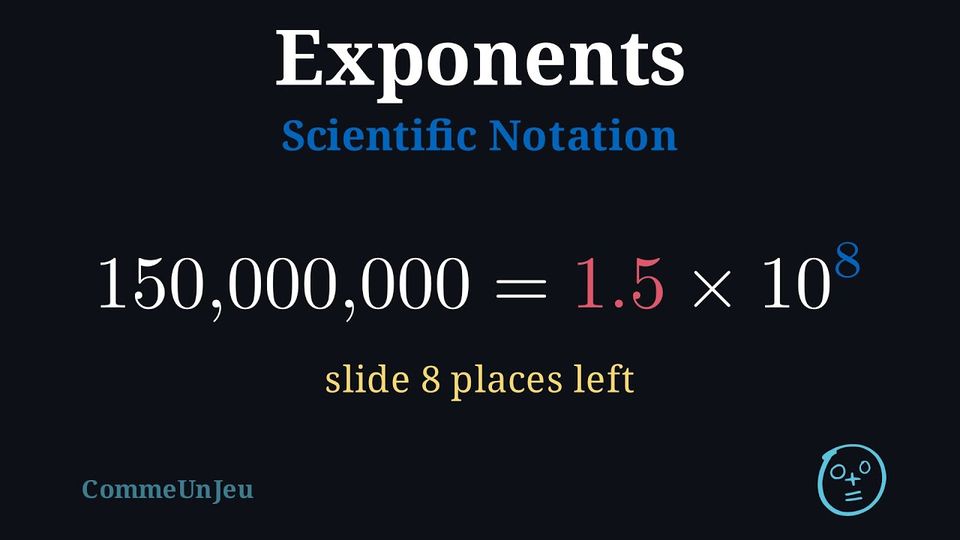
Working with very large or very small numbers can be awkward. The powers of ten rewrite such numbers in a shorter form that is easier to work with: this way of writing numbers is called scientific notation, and it is especially useful in science.
Definition — Scientific Notation
A non-zero decimal number is expressed in scientific notation when it is written in the form: Example
Write \(245\) in scientific notation.
$$\begin{aligned}[t]245 &= 2.45 \times 100 \\
&= 2.45 \times 10^2\end{aligned}$$ So \(245\) in scientific notation is \(2.45 \times 10^2\).
Method — Computing with Scientific Notation
To multiply or divide two numbers written in scientific notation: - Group: multiply (or divide) the coefficients together, and the powers of ten together — with the laws of exponents, \(10^m \times 10^n = 10^{m+n}\) and \(\dfrac{10^m}{10^n} = 10^{m-n}\).
- Put back into scientific notation: if the coefficient obtained, sign apart, is not at least \(1\) and less than \(10\), move its decimal point and adjust the exponent. Moving the point one place to the left adds \(1\) to the exponent: \(15 \times 10^{2} = 1.5 \times 10^{3}\). Moving it one place to the right subtracts \(1\) from the exponent: \(0.5 \times 10^{-3} = 5 \times 10^{-4}\).
Example
Write in scientific notation: \(A = (3 \times 10^{4}) \times (5 \times 10^{-2})\) and \(B = \dfrac{3 \times 10^{2}}{6 \times 10^{5}}\).
$$\begin{aligned}[t] A &= (3 \times 5) \times (10^{4} \times 10^{-2}) \\
&= 15 \times 10^{2} && (10^{4 + (-2)} = 10^{2}) \\
&= 1.5 \times 10^{1} \times 10^{2} && (15 = 1.5 \times 10) \\
&= \textcolor{colordef}{1.5 \times 10^{3}} \end{aligned}$$ The coefficient \(15\) was not between \(1\) and \(10\): the point moves one place to the left, so the exponent goes up by one. $$\begin{aligned}[t] B &= \dfrac{3}{6} \times \dfrac{10^{2}}{10^{5}} && \text{(group)} \\
&= 0.5 \times 10^{-3} && (10^{2 - 5} = 10^{-3}) \\
&= 5 \times 10^{-1} \times 10^{-3} && (0.5 = 5 \times 10^{-1}) \\
&= \textcolor{colordef}{5 \times 10^{-4}} \end{aligned}$$
Scientific Notation on a Calculator
A calculator displays a very large or very small result in scientific notation, in a format of its own: for \(5.2 \times 10^{30}\), the screen may show
5.2E30, 5.2e30 or \(5.2 \times 10^{30}\), depending on the model. -
5.2E30and5.2e30are screen formats, not the scientific notation of mathematics: the result is written \(5.2 \times 10^{30}\), never5.2E30. In the same way, the display3.7E-5is written \(3.7 \times 10^{-5}\). - To key in a number written in scientific notation, the key \(\boxed{\times 10^{x}}\) (named \(\boxed{\text{EXP}}\) or \(\boxed{\text{EE}}\) on some models) enters the power of ten: \(6.02 \times 10^{23}\) is keyed in as \(6.02\ \boxed{\times 10^{x}}\ 23\).
Example
Using a calculator, write in scientific notation \(A = (6.4 \times 10^{5}) \times (3.9 \times 10^{8})\) and \(B = \dfrac{1}{2^{40}}\), the coefficient of \(B\) rounded to two decimal places.
For \(A\), the calculator displays
2.496E14, which is written \(A = 2.496 \times 10^{14}\). The Method gives the same result by hand: $$\begin{aligned}[t] A &= (6.4 \times 3.9) \times (10^{5} \times 10^{8}) && \text{(group)} \\
&= 24.96 \times 10^{13} \\
&= 2.496 \times 10^{14}. \end{aligned}$$ For \(B\), the calculator displays 9.094947018E-13. The coefficient rounded to two decimal places is \(9.09\), so $$B \approx 9.09 \times 10^{-13}.$$ \(0 < B < 1\), so its exponent is negative. Skills to practice
- Writing Numbers in Scientific Notation
- Computing with Scientific Notation without Technology
- Computing with Scientific Notation with Technology
VI
Going further
Skills to practice
- Rationalizing Algebraic Denominators
- Reasoning with Radicals
- Applying Several Radical Skills
- Solving Problems in Scientific Notation
- Quiz
Jump to section