International Baccalaureate · DP 1: Applications and Interpretation SL
Non-Right-Angled Triangle Trigonometry
I
The Unit Circle and the Area of a Triangle
I.1
Sine and Cosine of Any Angle
Definition — Unit circle
The unit circle is a circle with a radius of 1 centred at the origin. Travelled anticlockwise, it is called the trigonometric circle. 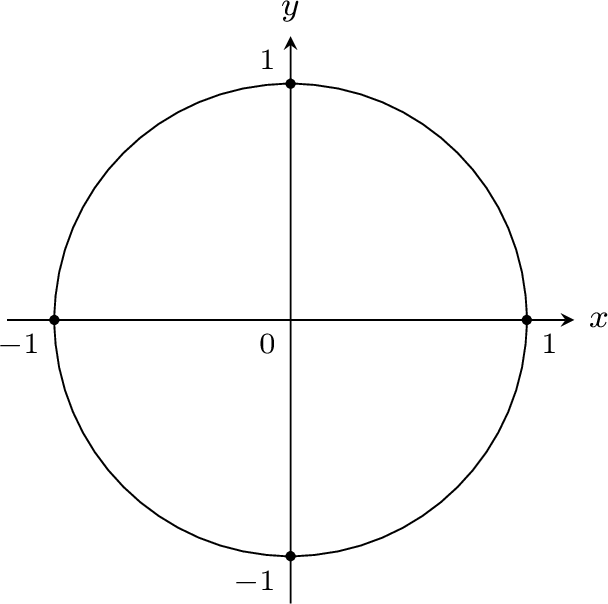
Proposition — Relationship between Angle and Coordinates
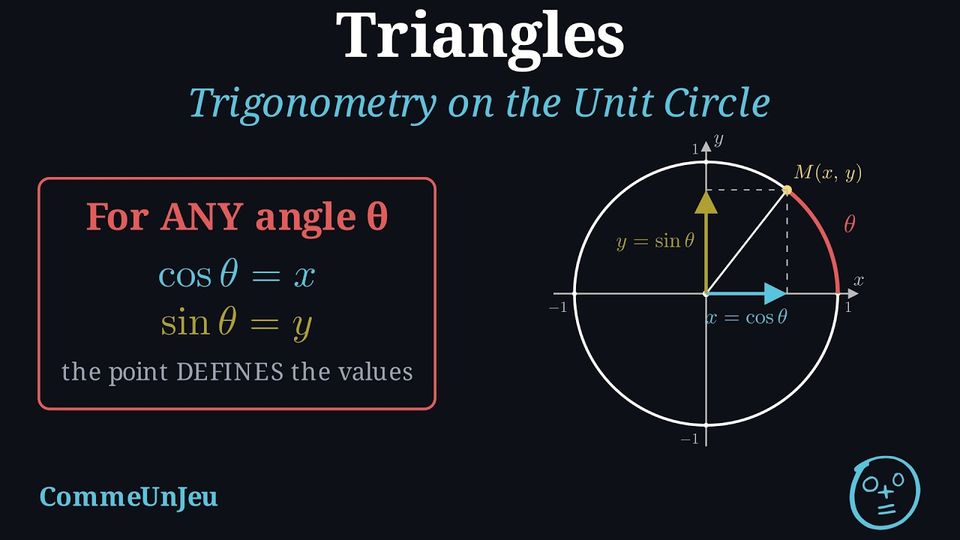
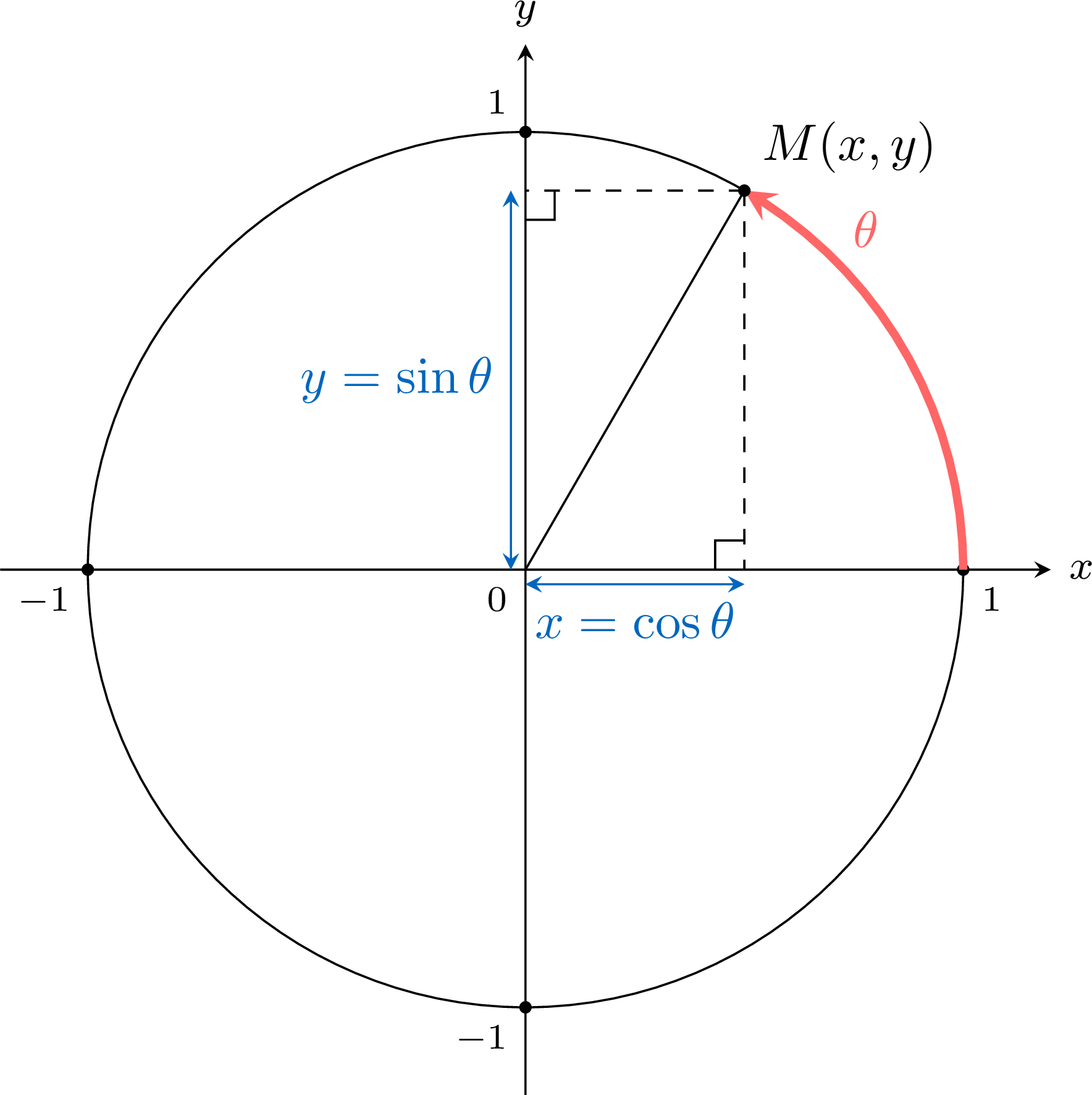
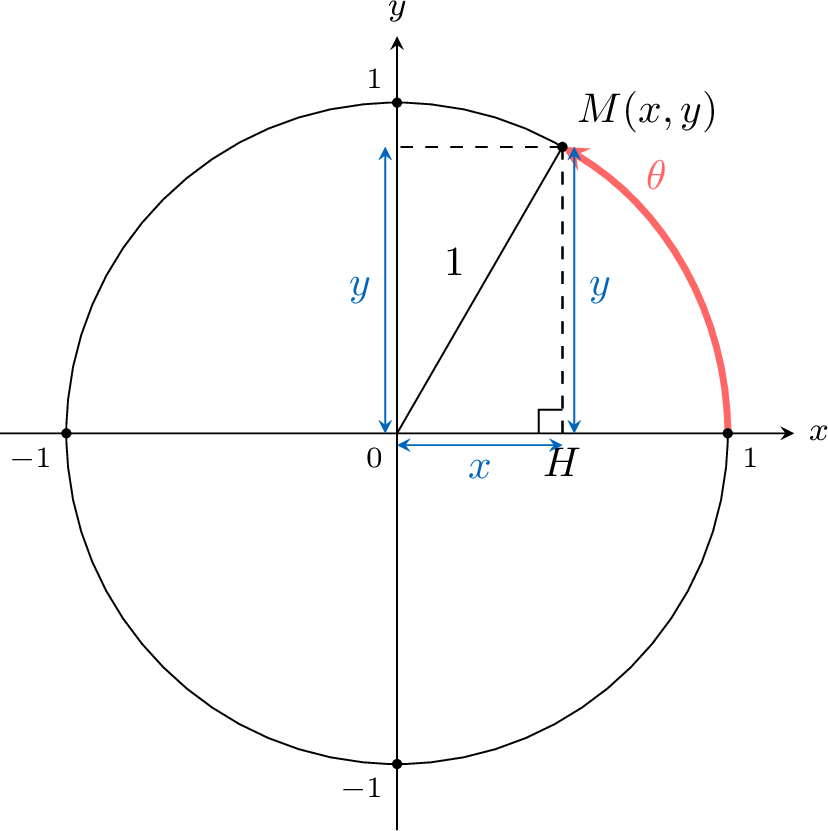
For an angle \(\theta\), measured anticlockwise from the positive \(x\)-axis, \(M(x,y)\) is the corresponding point on the unit circle. - The \(x\)-coordinate is the cosine of the angle: \(\cos \theta = x\)
- The \(y\)-coordinate is the sine of the angle: \(\sin \theta = y\)
Skills to practice
- Finding Angles from a Sine or a Cosine
I.2
The Area Formula
Recappreviously studied — click to reread
How wide is a lake you cannot walk across? Stand at a point \(C\) on the shore from which both ends \(A\) and \(B\) are visible. You measure \(CA=200\,\text{m}\), \(CB=150\,\text{m}\), and the angle between them, \(\Angle{ACB}=70^\circ\). There is no right angle anywhere — so Pythagoras' theorem and the ratios of the right-angled triangle do not apply — yet the distance \(AB\) is fixed by what you measured. 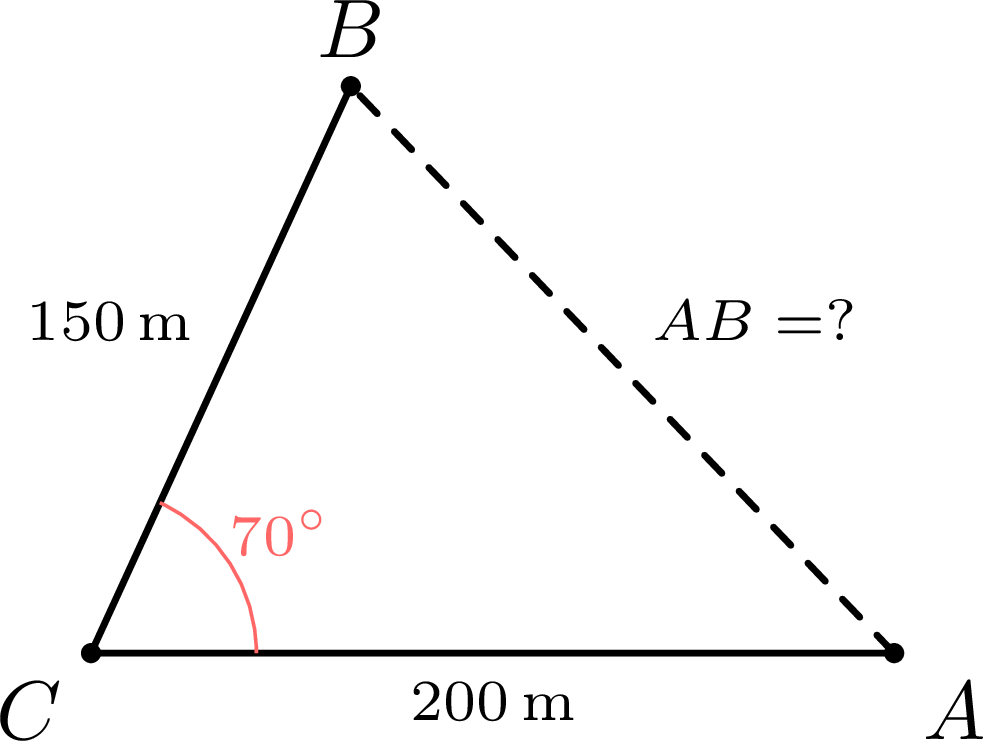
Triangle calculation extends to any triangle: the area formula, the law of sines and the law of cosines compute a missing side or angle even when no angle is a right angle (here \(AB=\sqrt{200^2+150^2-2\cdot200\cdot150\cos 70^\circ}\)).
Everything here builds on two known tools: the ratios of the right-angled triangle — sine, cosine, tangent — and Pythagoras' theorem. No right angle is given, so the proofs manufacture one: each law is obtained by dropping a well-chosen altitude and applying those two tools.
While SOH CAH TOA only applies to right-angled triangles, many real-world problems involve triangles that are not right-angled (also called oblique triangles). To solve these, we use two key results: the Law of Sines and the Law of Cosines.
Convention for labelling triangles: In any triangle \(ABC\), the angles at the vertices are denoted by capital letters (\(A, B, C\)) and the sides opposite them are denoted by the corresponding lowercase letters (\(a, b, c\)). 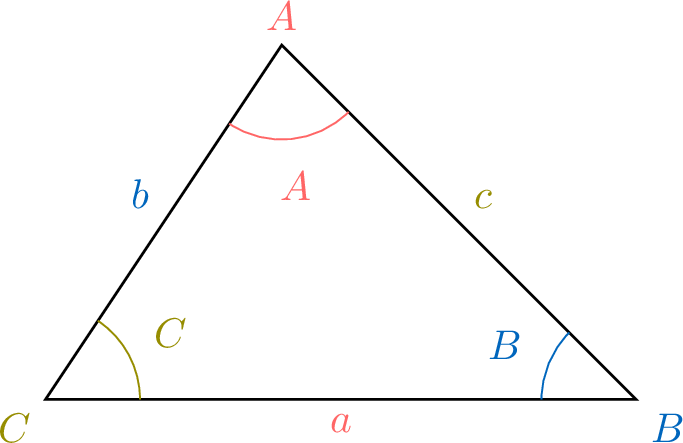
Convention for labelling triangles: In any triangle \(ABC\), the angles at the vertices are denoted by capital letters (\(A, B, C\)) and the sides opposite them are denoted by the corresponding lowercase letters (\(a, b, c\)).
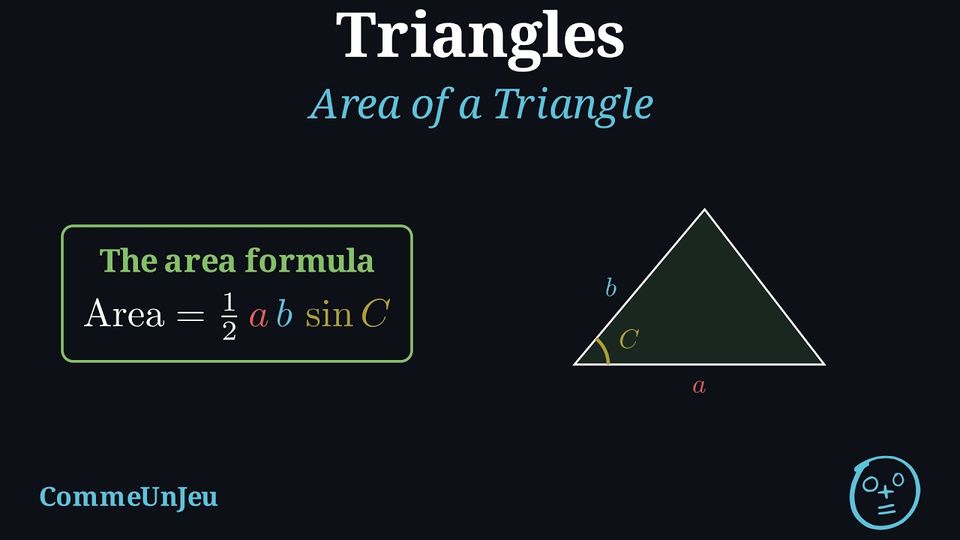
When two sides of a triangle and the angle between them (the included angle) are known, the area can be calculated using a formula involving the sine of this angle. This is particularly useful for non-right-angled triangles, where the height is not given directly.
Proposition — Area Formula
The area of any triangle is half the product of two sides and the sine of their included angle: $$\text{Area} = \frac{1}{2} \times \textcolor{colordef}{\text{side}} \times \textcolor{colorprop}{\text{side}} \times \sin(\textcolor{olive}{\text{included angle}})$$ For example, if the two sides have lengths \(b\) and \(c\) and the included angle is \(A\), then \(\text{Area} = \dfrac12 bc \sin A\). 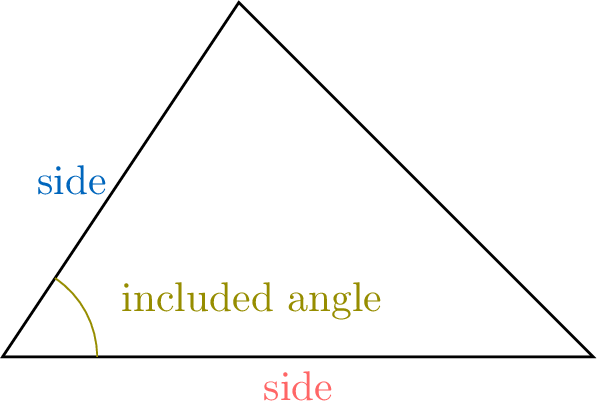
Consider triangle \(ABC\) with base \(a = BC\). Drop a perpendicular height \(h\) from vertex \(A\) to the base \(a\), meeting \(BC\) at point \(H\). 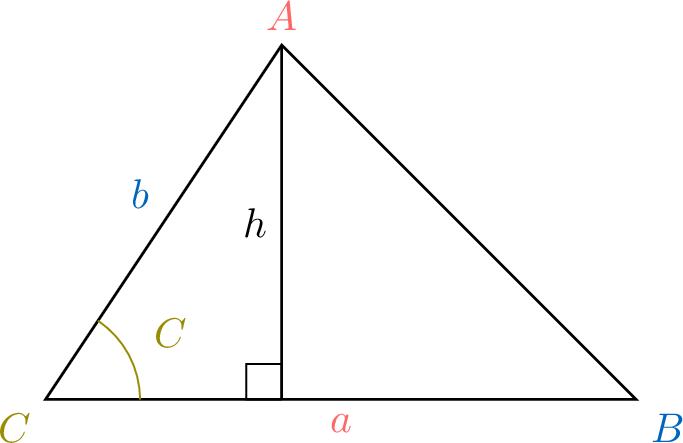
The area of a triangle is given by the standard formula: $$ \text{Area} = \frac{1}{2} \times \text{base} \times \text{height} = \frac{1}{2}ah. $$ In the right-angled triangle \(AHC\), the sine ratio gives: $$ \sin(C) = \frac{\text{opposite}}{\text{hypotenuse}} = \frac{h}{b} \implies h = b\sin(C). $$ Substituting this expression for \(h\) into the area formula gives: $$ \text{Area} = \frac{1}{2}a(b\sin C) = \frac{1}{2}ab\sin C. $$ (The figure places the foot of the altitude inside the triangle — the acute case; if the angle at \(C\) is obtuse, the foot \(H\) falls outside, beyond \(C\); the right-angled triangle \(AHC\) then has the angle \(180^\circ - C\) at \(C\), so the height is \(h = b\sin(180^\circ - C) = b\sin C\): the formula is unchanged.)
The angles of a triangle may be obtuse. For an obtuse angle \(\theta\), we use the values \(\sin\theta = \sin(180^\circ - \theta)\) and \(\cos\theta = -\cos(180^\circ - \theta)\), which a calculator applies automatically; these extended definitions come from the unit circle.
Example
For the triangle 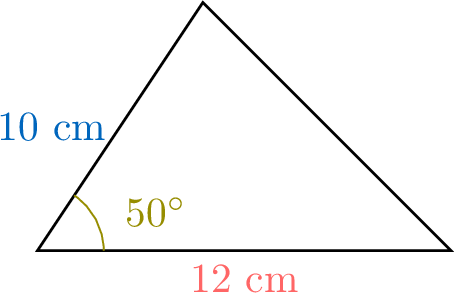 , find the area.
$$\begin{aligned} \text{Area} &= \frac{1}{2} \times \textcolor{colorprop}{10} \times \textcolor{colordef}{12} \times \sin(\textcolor{olive}{50^\circ})\\
& \approx 46 \, \text{cm}^2 \end{aligned}$$
Skills to practice
- Finding the Area of a Triangle
II
The Law of Cosines
II.1
The Law of Cosines
Recappreviously studied — click to reread
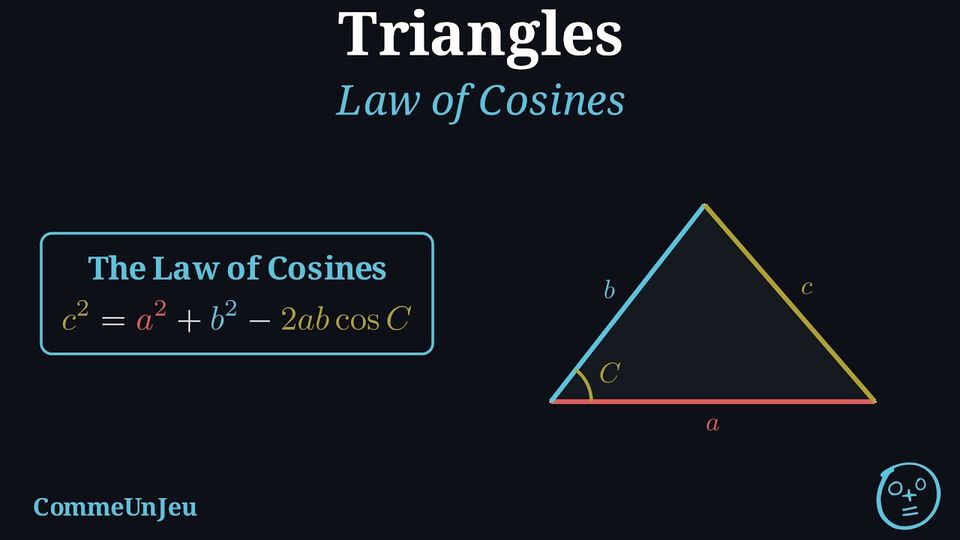
The Law of Cosines (also called Al-Kashi's theorem) relates all three sides of a triangle to one of its angles. It generalises Pythagoras' theorem and is used to solve triangles when given:
- Three sides (SSS).
- Two sides and their included angle (SAS).
Proposition — Law of Cosines
For any triangle with sides \(\textcolor{colordef}{a}\), \(\textcolor{colorprop}{b}\), \(\textcolor{olive}{c}\) and opposite angles \(\textcolor{colordef}{A}\), \(\textcolor{colorprop}{B}\), \(\textcolor{olive}{C}\): $$\textcolor{olive}{c}^2 = \textcolor{colordef}{a}^2 + \textcolor{colorprop}{b}^2 - 2\textcolor{colordef}{a}\textcolor{colorprop}{b} \cos \textcolor{olive}{C}$$ This can be rearranged to find an angle: $$\cos \textcolor{olive}{C} = \dfrac{\textcolor{colordef}{a}^2 + \textcolor{colorprop}{b}^2 -\textcolor{olive}{c}^2}{2\textcolor{colordef}{a}\textcolor{colorprop}{b}}$$ Note that if \(C = 90^\circ\), then \(\cos C = 0\) and the formula reduces to \(c^2 = a^2 + b^2\), Pythagoras' theorem. 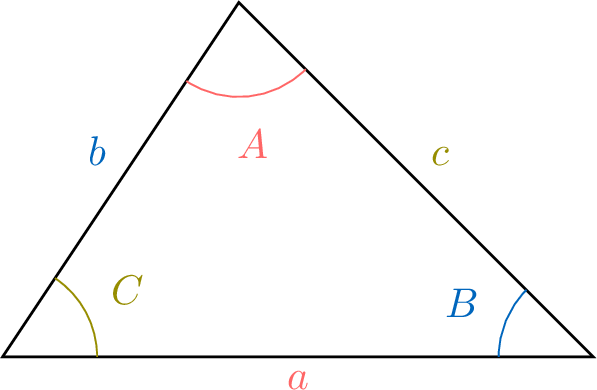
Drop a perpendicular height \(h\) from vertex \(A\) to the side \(a\) (line \(\Line{BC}\)), meeting it at point \(D\). 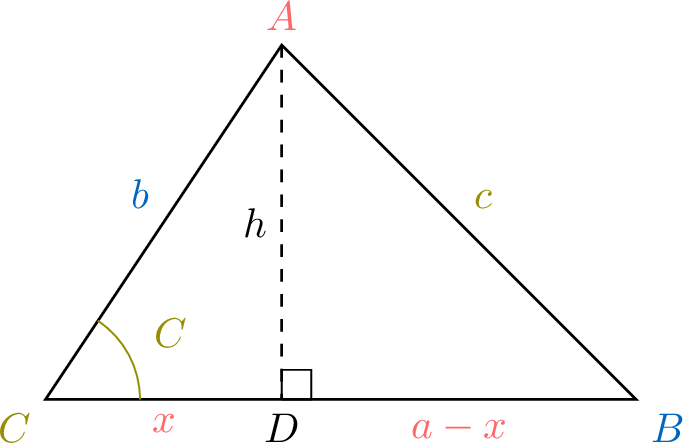
In the right-angled triangle \(ADC\):
- By Pythagoras' theorem, \(h^2 + x^2 = b^2 \implies h^2 = b^2 - x^2\).
- \(\cos(C) = x/b \implies x = b\cos(C)\).
Example
For the triangle 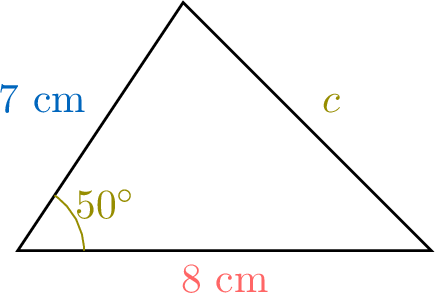 , find side \(c\).
Using the Law of Cosines: $$\begin{aligned} \textcolor{olive}{c}^2 &= \textcolor{colordef}{8}^2 + \textcolor{colorprop}{7}^2 - 2 \times\textcolor{colordef}{8} \times\textcolor{colorprop}{7} \times \cos \textcolor{olive}{50^\circ}\\
\textcolor{olive}{c} &= \sqrt{\textcolor{colordef}{8}^2 + \textcolor{colorprop}{7}^2 - 2 \times\textcolor{colordef}{8} \times\textcolor{colorprop}{7} \times \cos \textcolor{olive}{50^\circ}}\\
\textcolor{olive}{c} &\approx 6.4 \, \text{cm}\\
\end{aligned}$$
Skills to practice
- Finding Sides and Angles with the Law of Cosines
III
The Law of Sines
III.1
The Law of Sines
Recappreviously studied — click to reread
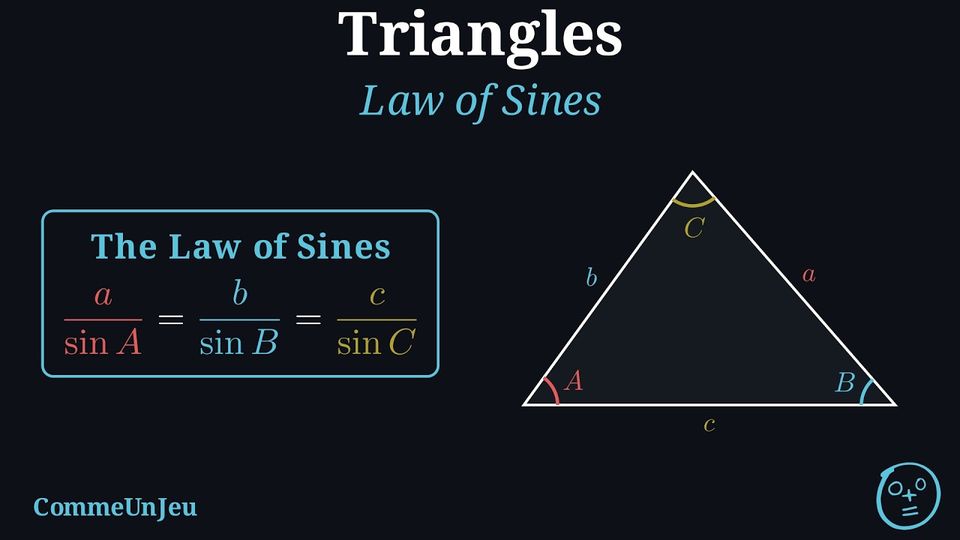
The Law of Sines gives a relationship between the sides of a triangle and the sines of their opposite angles. It solves a triangle as soon as at least one side and its opposite angle are both known, for example:
- Two angles and any side (AAS or ASA).
- Two sides and a non-included angle (SSA), which can lead to the ambiguous case (0, 1, or 2 possible triangles).
Proposition — Law of Sines
For any triangle with sides \(\textcolor{colordef}{a}\), \(\textcolor{colorprop}{b}\), \(\textcolor{olive}{c}\) and opposite angles \(\textcolor{colordef}{A}\), \(\textcolor{colorprop}{B}\), \(\textcolor{olive}{C}\): $$\textcolor{colordef}{\frac{a}{\sin A}} = \textcolor{colorprop}{\frac{b}{\sin B}} = \textcolor{olive}{\frac{c}{\sin C}}$$
The area of the triangle can be expressed in three different ways using the area formula: $$ \text{Area} = \frac{1}{2} bc \sin A = \frac{1}{2} ac \sin B = \frac{1}{2} ab \sin C. $$ Dividing each part of the equality by \(\frac{1}{2}abc\) gives: $$ \frac{bc \sin A}{abc} = \frac{ac \sin B}{abc}= \frac{ab \sin C}{abc}. $$ So $$ \frac{\sin A}{a} = \frac{\sin B}{b}= \frac{\sin C}{c}. $$ Taking the reciprocal of each term gives the Law of Sines: $$ \frac{a}{\sin A} = \frac{b}{\sin B} = \frac{c}{\sin C}. $$
Example
For the triangle 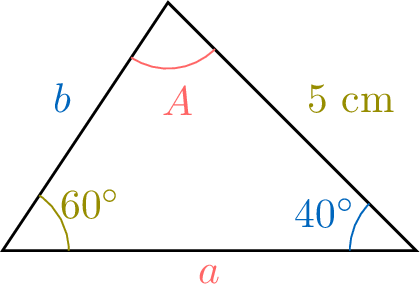 , find side \(a\).
First, find angle \(A\): \(A = 180^\circ - 40^\circ - 60^\circ = 80^\circ\).
Using the Law of Sines with the pair \((a, A)\) and the pair \((c, C)\): $$\begin{aligned} \textcolor{colordef}{\frac{a}{\sin 80^\circ}} &= \textcolor{olive}{\frac{5}{\sin 60^\circ} }\\ a &= 5 \cdot \frac{\sin 80^\circ}{\sin 60^\circ}\\ a &\approx 5.69 \, \text{cm} \end{aligned}$$
Using the Law of Sines with the pair \((a, A)\) and the pair \((c, C)\): $$\begin{aligned} \textcolor{colordef}{\frac{a}{\sin 80^\circ}} &= \textcolor{olive}{\frac{5}{\sin 60^\circ} }\\ a &= 5 \cdot \frac{\sin 80^\circ}{\sin 60^\circ}\\ a &\approx 5.69 \, \text{cm} \end{aligned}$$
Skills to practice
- Finding Sides and Angles with the Law of Sines
IV
Solving Problems with the Laws of Sines and Cosines
IV.1
Solving Real-World Problems
Recappreviously studied — click to reread
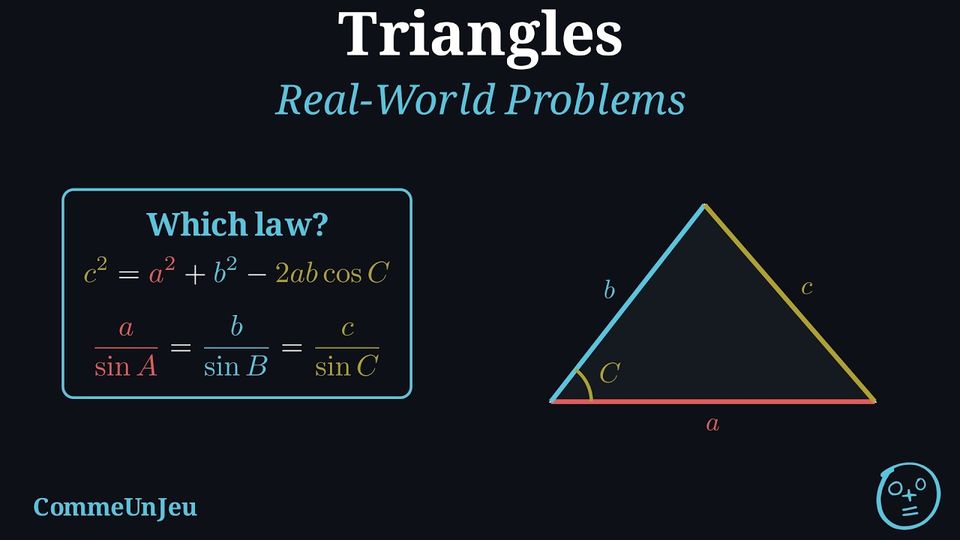
The Laws of Sines and Cosines are powerful tools for solving a wide range of problems involving non-right-angled triangles, especially in real-world contexts. To solve these problems effectively, follow the structured steps below.
Method — Solving Real-World Problems Using Sine and Cosine Laws
- Draw a clear diagram representing the situation described in the problem.
- Label the known and unknown sides and angles in the triangle.
- Identify the configuration (for example, two sides and the included angle for the Law of Cosines, or two angles and a side for the Law of Sines).
- Choose the appropriate law (Law of Sines for ratios of sides to sines of angles, Law of Cosines for relating sides and the cosine of an angle).
- Write and solve the equation, then check that the answer is reasonable (size, units, and shape of the triangle).
Skills to practice
- Solving Contextual Triangle Problems
- Choosing and Justifying the Law
IV.2
Solving Bearing Problems
Recappreviously studied — click to reread
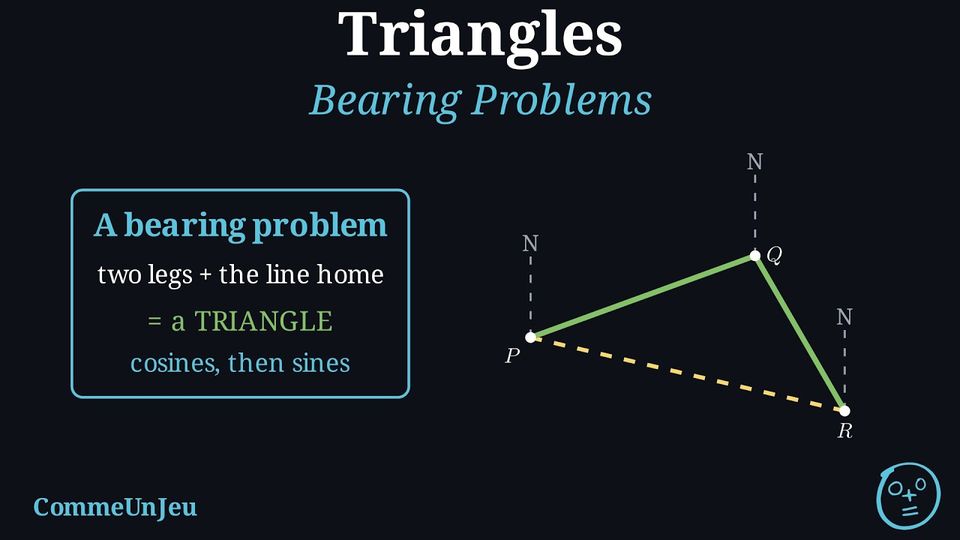
A ship leaves port \(P\) on a bearing of \(070^\circ\) and sails \(40\,\text{km}\), then turns onto a bearing of \(150^\circ\) and sails \(30\,\text{km}\) to \(R\). How far is the ship from port, and on what bearing must it steer to return? You cannot stretch a line across open water — but the two legs and the turn between them form a triangle, and a triangle is something you can calculate. 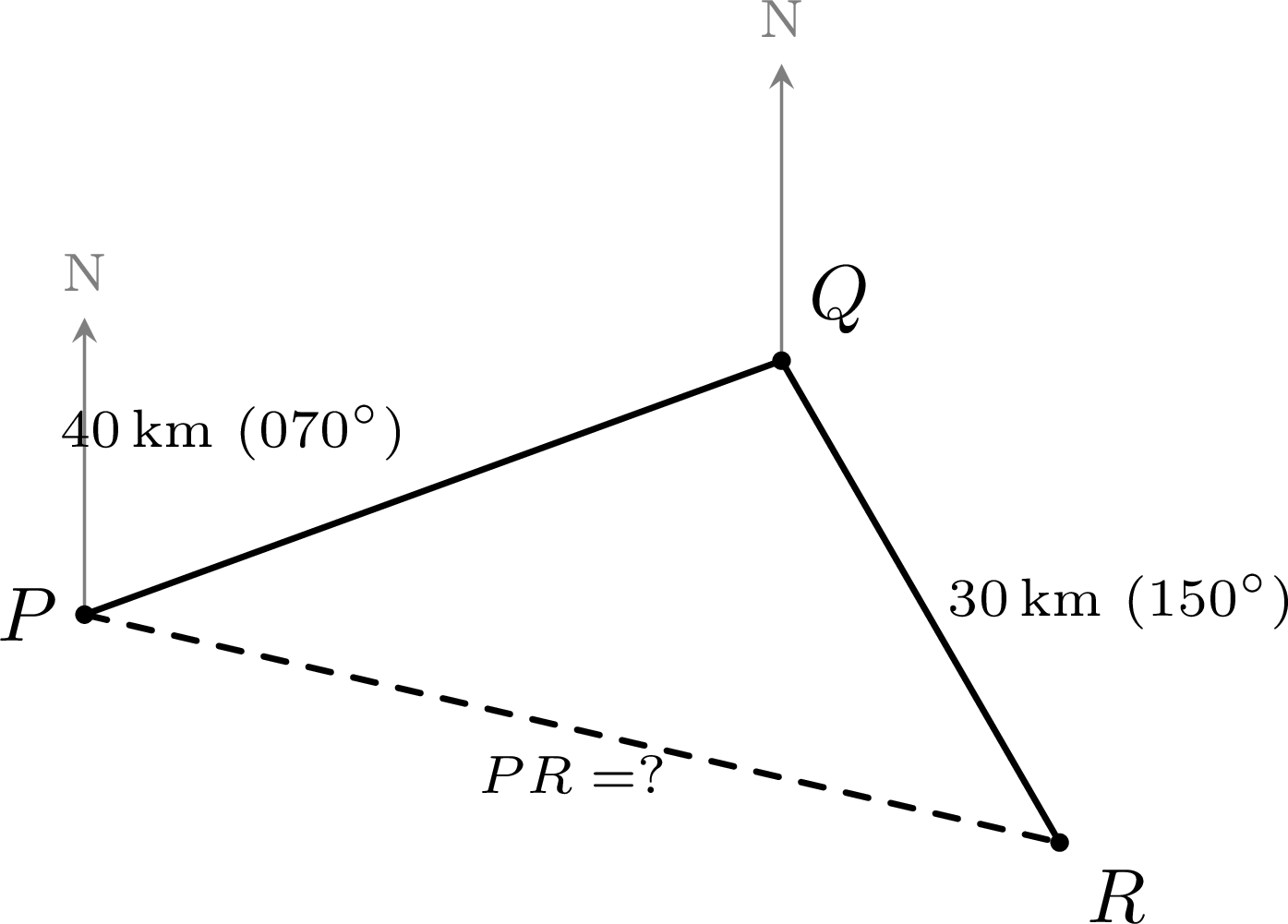
Bearings (three figures, clockwise from North) turn a navigation route into a triangle, which the sine and cosine laws solve — finding the ship's position without ever measuring across the sea.
A bearing problem is a triangle problem in disguise: the legs of the journey and the turn between them form a triangle, and the law of sines and the law of cosines solve it.
Method — Solving a Bearing Problem
- Sketch a Diagram: This is the most important step. Draw a clear diagram with a North line at every point involved. Label all given distances and bearings.
- Find an Interior Angle: Use parallel line properties (for example, alternate interior or co-interior angles) to find at least one angle inside the triangle formed by the journey.
- Apply the Law of Sines or the Law of Cosines: Use the Law of Cosines when two sides and the included angle (SAS) or all three sides (SSS) are known. Use the Law of Sines when two angles and a side (AAS) or two sides and a non-included angle (SSA) are known.
- Calculate and Conclude: Solve for the required distance or bearing. Check that every bearing in the final answer is a three-figure value between \(000^\circ\) and \(360^\circ\), measured clockwise from North.
Method — Finding the North and East Components of a Journey
Unless it runs due North, East, South or West, a journey of length \(d\) on a bearing \(\theta\) is the hypotenuse of a right-angled triangle whose two other sides are its North–South part and its East–West part. - Draw the North–South line at the starting point, the journey, and the East–West segment from the end of the journey to the North–South line: these three segments form the right-angled triangle.
- Find the acute angle \(\alpha\) between the journey and the North–South line: \(\alpha = \theta\) for a bearing between \(000^\circ\) and \(090^\circ\), \(\alpha = 180^\circ - \theta\) between \(090^\circ\) and \(180^\circ\), \(\alpha = \theta - 180^\circ\) between \(180^\circ\) and \(270^\circ\), \(\alpha = 360^\circ - \theta\) between \(270^\circ\) and \(360^\circ\).
- Compute the two parts in the right-angled triangle: the North–South part is \(d\cos\alpha\) (the side adjacent to \(\alpha\)), the East–West part is \(d\sin\alpha\) (the side opposite \(\alpha\)).
- State the directions: north for a bearing below \(090^\circ\) or above \(270^\circ\), south for a bearing between \(090^\circ\) and \(270^\circ\); east for a bearing between \(000^\circ\) and \(180^\circ\), west for a bearing between \(180^\circ\) and \(360^\circ\).
Example
A boat sails \(15\) km from a harbour \(H\) on a bearing of \(125^\circ\). How far south and how far east of \(H\) is it (to \(0.1\) km)? 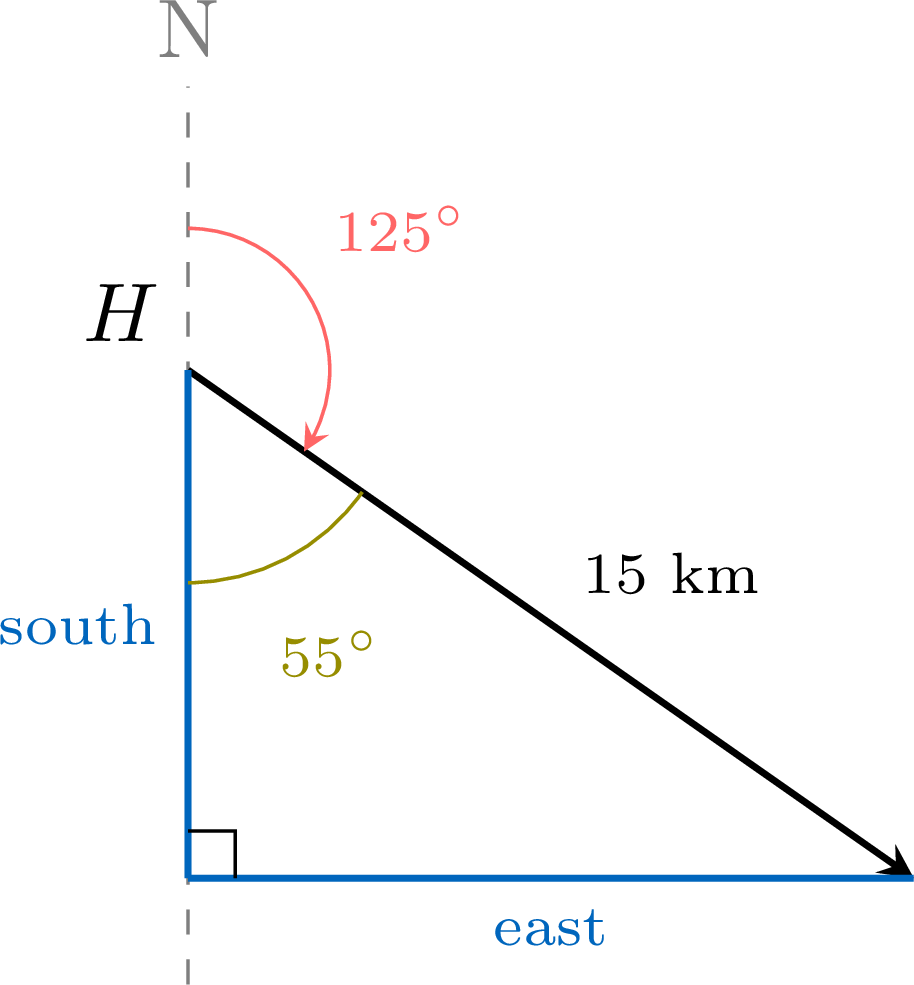
Skills to practice
- Calculating North and East Components
- Calculating Distances from Bearings
V
Going further
Skills to practice
- Reasoning and Problem-Solving
- Solving Exam-Style Problems
- Quiz
Jump to section