International Baccalaureate · DP 2: Applications and Interpretation SL
Quadratic Functions
I
Quadratic Functions and Their Forms
I.1
Standard Form
Recappreviously studied — click to reread
Definition — Quadratic Function
A quadratic function is a function that can be written in the form $$f(x) = ax^2 + bx + c$$ where \(a, b,\) and \(c\) are real numbers and \(\boldsymbol{a \neq 0}\). Skills to practice
- Standard Form
I.2
Vertex Form
Recappreviously studied — click to reread
Definition — Vertex Form
The vertex form of a quadratic function is:$$ f(x) = a(x-h)^2 + k $$ where \(a, h,\) and \(k\) are real numbers and \(\boldsymbol{a \neq 0}\). Proposition — Vertex Form of a Quadratic Function
Every quadratic function \(f(x) = ax^2 + bx + c\) (with \(a \neq 0\)) can be written in vertex form $$f(x) = a(x - h)^2 + k \qquad \text{with} \qquad h = -\frac{b}{2a} \quad \text{and} \quad k = f(h) = c - \frac{b^2}{4a}.$$ This writing is unique: \(h\) and \(k\) are the coordinates of the vertex of the parabola.
We reuse completing the square (Proposition “Completing the Square”): since \(a \neq 0\), we take \(a\) out as a common factor of the first two terms and apply \(x^2 + 2\lambda x = (x + \lambda)^2 - \lambda^2\) with \(\lambda = \dfrac{b}{2a}\): $$\begin{aligned} f(x) &= a\left(x^2 + \frac{b}{a}x\right) + c \\
&= a\left[\left(x + \frac{b}{2a}\right)^2 - \frac{b^2}{4a^2}\right] + c && \text{(completing the square)} \\
&= a\left(x + \frac{b}{2a}\right)^2 - \frac{b^2}{4a} + c. \end{aligned}$$ This is \(a(x - h)^2 + k\) with \(h = -\dfrac{b}{2a}\) and \(k = c - \dfrac{b^2}{4a}\). Replacing \(x\) by \(h\) gives \(f(h) = a \times 0 + k = k\). Uniqueness: if \(f(x) = a(x - h')^2 + k'\) for all \(x\), then expanding gives \(-2ah' = b\) and \(ah'^2 + k' = c\), so \(h' = h\) and \(k' = k\).
Example
Write in vertex form: - \(f(x) = x^2 + 6x - 1\), using the identity \(x^2 + 2\lambda x = (x + \lambda)^2 - \lambda^2\);
- \(g(x) = -2x^2 + 8x - 3\), using \(h = -\dfrac{b}{2a}\) and \(k = g(h)\).
- \(x^2 + 6x = x^2 + 2 \times 3 \times x = (x + 3)^2 - 9\), so $$f(x) = (x + 3)^2 - 9 - 1 = (x + 3)^2 - 10.$$ Here \(h = -3\) and \(k = -10\).
- \(a = -2\), \(b = 8\), \(c = -3\): \(h = -\dfrac{8}{2 \times (-2)} = 2\) and \(k = g(2) = -8 + 16 - 3 = 5\), so $$g(x) = -2(x - 2)^2 + 5.$$ Check: \(-2(x - 2)^2 + 5 = -2(x^2 - 4x + 4) + 5 = -2x^2 + 8x - 3\).
Method — Converting from Standard to Vertex Form
There are two common methods to convert a quadratic function from standard form, \(f(x)=ax^2+bx+c\), to vertex form, \(f(x)=a(x-h)^2+k\). - Method 1: Completing the Square
- Take out the coefficient \(a\) as a common factor of the \(x^2\) and \(x\) terms: \(a(x^2 + \frac{b}{a}x) + c\).
- Inside the brackets, add and subtract the square of half the coefficient of \(x\): \(a\left(x^2 + \frac{b}{a}x + \left(\frac{b}{2a}\right)^2 - \left(\frac{b}{2a}\right)^2\right) + c\).
- Factorise the perfect square: \(a\left(\left(x + \frac{b}{2a}\right)^2 - \left(\frac{b}{2a}\right)^2\right) + c\).
- Distribute \(a\) to the constant term and simplify to get the form \(a(x-h)^2 + k\).
- Method 2: Using the Vertex Formula
- Find the x-coordinate of the vertex using the formula: \(\boldsymbol{h = -\frac{b}{2a}}\).
- Find the y-coordinate of the vertex by substituting \(h\) back into the function: \(\boldsymbol{k = f(h)}\).
- Substitute the values of \(a\), \(h\), and \(k\) into the vertex form: \(f(x) = a(x-h)^2 + k\).
Example
Convert \(f(x) = 2x^2 - 12x + 19\) to vertex form. - Method 1: Completing the Square$$ \begin{aligned}f(x) &= 2(x^2 - 6x) + 19 && \color{gray}\text{(Take out the common factor 2)} \\ &= 2(x^2 - 6x + 9 - 9) + 19 && \color{gray}\text{(Add and subtract } (6/2)^2 = 9) \\ &= 2\left((x-3)^2 - 9\right) + 19 && \color{gray}\text{(Factorise the perfect square)} \\ &= 2(x-3)^2 - 18 + 19 && \color{gray}\text{(Distribute 2)} \\ &= \boldsymbol{2(x-3)^2 + 1}\end{aligned} $$
- Method 2: Using the Vertex Formula
For \(f(x)=2x^2 - 12x + 19\), we have \(a=2, b=-12, c=19\).- Find h: \(h = -\dfrac{b}{2a} = -\dfrac{-12}{2(2)} = \dfrac{12}{4} = 3\).
- Find k: \(k = f(3) = 2(3)^2 - 12(3) + 19 = 2(9) - 36 + 19 = 18 - 36 + 19 = 1\).
- Write in vertex form: With \(a=2, h=3, k=1\), the function is \(\boldsymbol{f(x) = 2(x-3)^2 + 1}\).
Skills to practice
- Converting Standard Form to Vertex Form
I.3
Factored Form
Recappreviously studied — click to reread
Definition — Factored Form
The factored form of a quadratic function, when it exists, is:$$ f(x) = a(x-p)(x-q) $$ where \(a, p,\) and \(q\) are real numbers and \(\boldsymbol{a \neq 0}\). Method — Converting from Standard to Factored Form
To convert from standard form to factored form, find the roots of the function by solving \(f(x)=0\). If the roots are \(p\) and \(q\), the factored form is \(f(x)=a(x-p)(x-q)\). The value of \(a\) is the same as in the standard form. Example
Convert \(f(x) = 2x^2 - 8x + 6\) to factored form.
We solve \(2x^2 - 8x + 6 = 0\). First, divide by 2: \(x^2 - 4x + 3 = 0\).
Two numbers with product \(3\) and sum \(-4\) are \(-1\) and \(-3\), so \(x^2 - 4x + 3 = (x - 1)(x - 3)\), and by the null factor law the roots are \(p = 1\) and \(q = 3\).
The factored form is \(\boldsymbol{f(x) = 2(x-1)(x-3)}\).
Two numbers with product \(3\) and sum \(-4\) are \(-1\) and \(-3\), so \(x^2 - 4x + 3 = (x - 1)(x - 3)\), and by the null factor law the roots are \(p = 1\) and \(q = 3\).
The factored form is \(\boldsymbol{f(x) = 2(x-1)(x-3)}\).
Skills to practice
- Factored Form
II
Graphs of Quadratic Functions
II.1
The Base Parabola: \(y\equal x^2\)
Recappreviously studied — click to reread
Proposition — Key Features
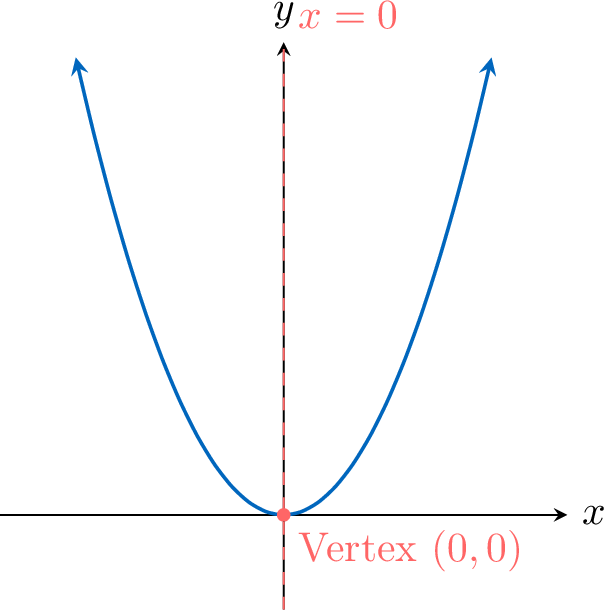
The graph of the function \(f(x)=x^2\) is a parabola with the following properties: - It opens upwards (it is concave up).
- Its axis of symmetry is the line \(x = 0\).
- Its vertex is at the point \((0, 0)\).
Skills to practice
- The Base Parabola: \(y\equal x^2\)
II.2
Vertex Form and Key Features
Recappreviously studied — click to reread
Proposition — Key Features from Vertex Form
The graph of \(y=a(x-h)^2 + k\) is a parabola with: - Direction of opening: Determined by the sign of \(a\).
- If \(a > 0\), it opens upwards (concave up).

- If \(a < 0\), it opens downwards (concave down).

- If \(a > 0\), it opens upwards (concave up).
- Axis of Symmetry: The line \(x = h\).
- Vertex: The point \((h, k)\).
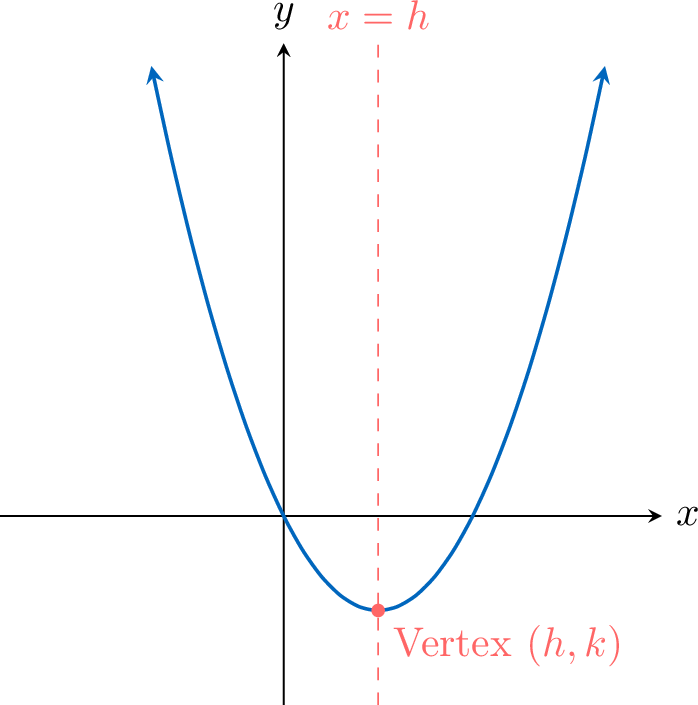
The graph of \(y=a(x-h)^2+k\) is obtained by transforming the graph of \(y=x^2\) as follows:
- Horizontal translation by h: \(y=(x-h)^2\). This moves the vertex from \((0,0)\) to \((h,0)\).
- Vertical stretch by a: \(y=a(x-h)^2\). The direction of opening now depends on the sign of \(a\).
- Vertical translation by k: \(y=a(x-h)^2+k\). This moves the vertex from \((h,0)\) to \((h,k)\).
Proposition — Variations of a Quadratic Function
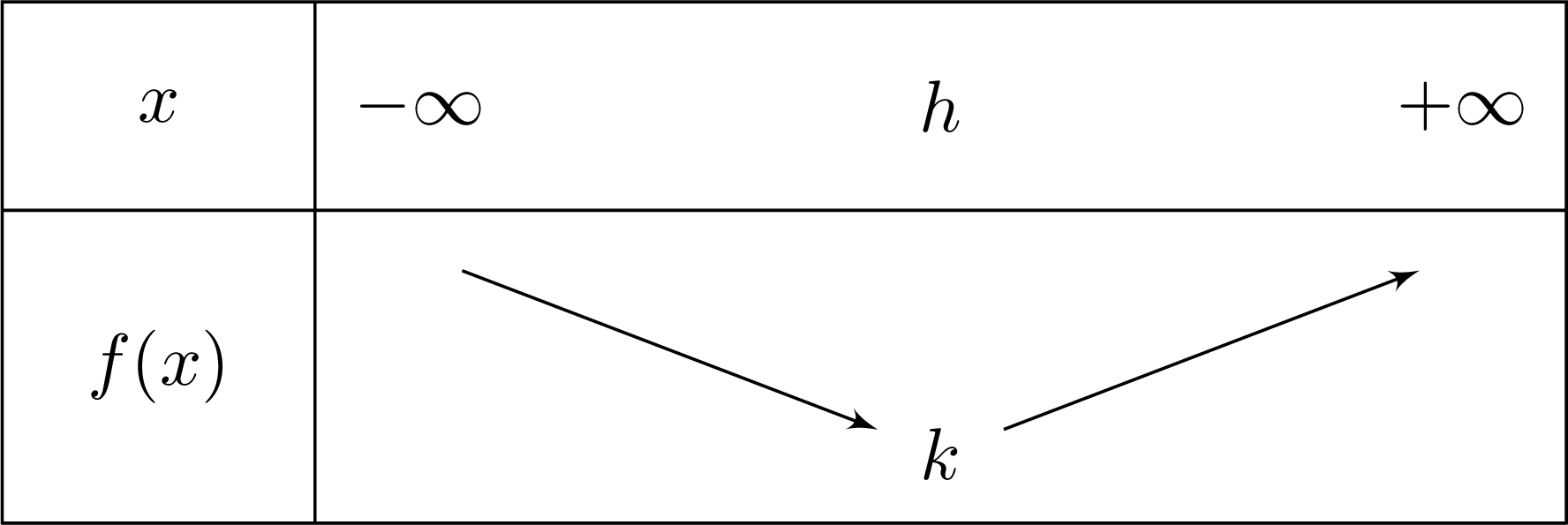
Let \(f(x) = ax^2 + bx + c = a(x - h)^2 + k\) with \(a \neq 0\). - If \(a > 0\), \(f\) is decreasing on \((-\infty, h]\) and increasing on \([h, \infty)\): \(f\) has a minimum, equal to \(k\), reached at \(x = h\).
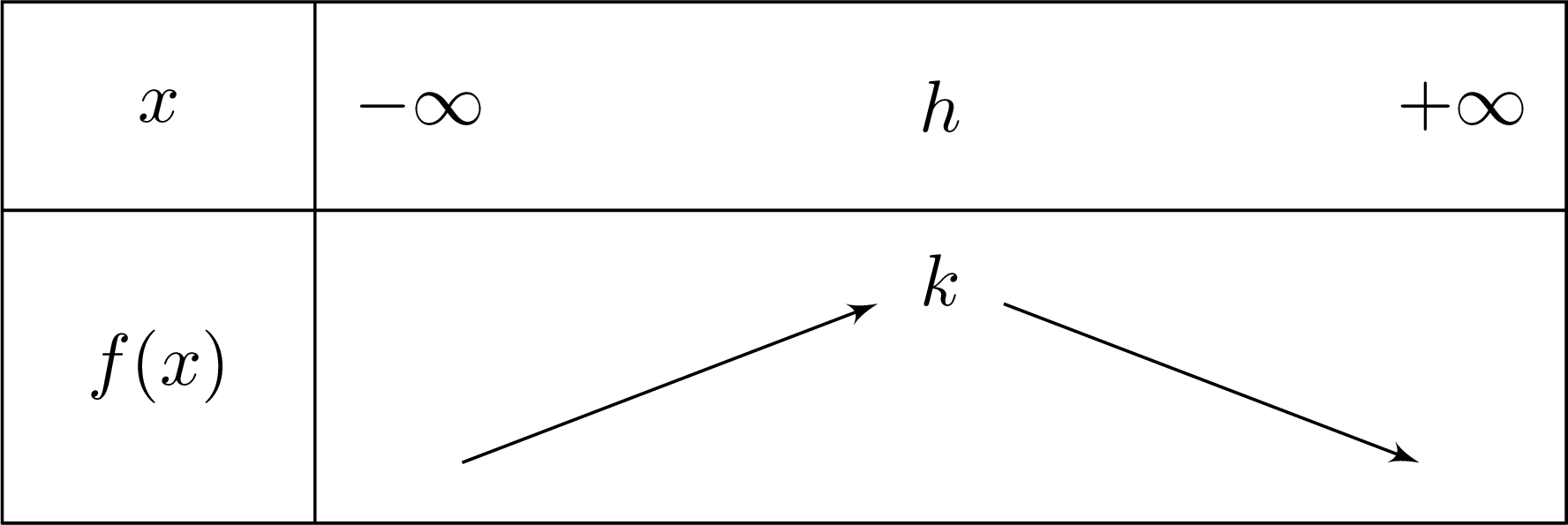
- If \(a < 0\), \(f\) is increasing on \((-\infty, h]\) and decreasing on \([h, \infty)\): \(f\) has a maximum, equal to \(k\), reached at \(x = h\).
Let \(u\) and \(v\) be two real numbers with \(u < v\). Using the vertex form, $$f(u) - f(v) = a\big[(u - h)^2 - (v - h)^2\big] = a\,(u - v)\,(u + v - 2h)$$ by the identity \(A^2 - B^2 = (A - B)(A + B)\) with \(A = u - h\) and \(B = v - h\). Since \(u < v\), the factor \(u - v\) is negative.
- If \(u < v \le h\), then \(u + v - 2h < 0\): the product \((u - v)(u + v - 2h)\) is positive, so \(f(u) - f(v)\) has the sign of \(a\). For \(a > 0\), \(f(u) > f(v)\): \(f\) is decreasing on \((-\infty, h]\). For \(a < 0\), \(f(u) < f(v)\): \(f\) is increasing there.
- If \(h \le u < v\), then \(u + v - 2h > 0\): the product is negative, so \(f(u) - f(v)\) has the sign of \(-a\). For \(a > 0\), \(f\) is increasing on \([h, \infty)\); for \(a < 0\), \(f\) is decreasing there.
Example
Let \(g(x) = -2x^2 + 8x - 3\). Give the variation table of \(g\) and its extremum.
\(a = -2 < 0\), \(h = -\dfrac{8}{2 \times (-2)} = 2\) and \(k = g(2) = 5\) (vertex form \(g(x) = -2(x - 2)^2 + 5\)). Since \(a < 0\), \(g\) is increasing on \((-\infty, 2]\) and decreasing on \([2, \infty)\); its maximum is \(5\), reached at \(x = 2\). 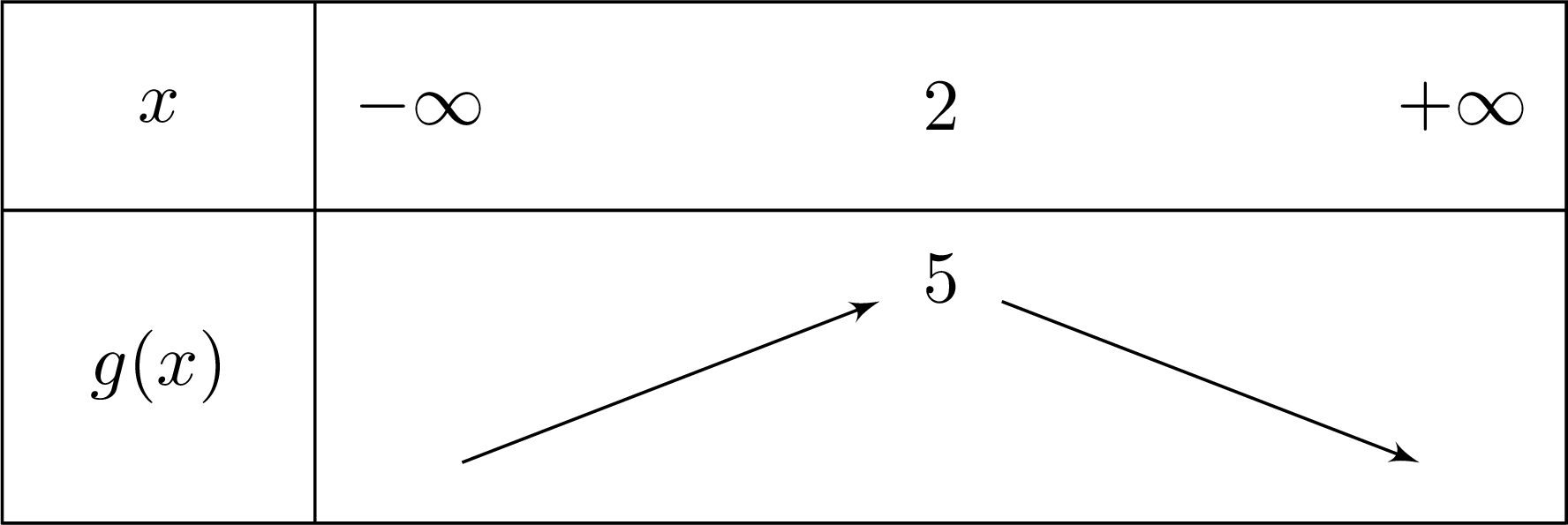
Skills to practice
- Vertex Form and Key Features
II.3
Factored Form and \(x\)-Intercepts
Recappreviously studied — click to reread
Proposition — Key Features from Factored Form
The graph of a quadratic function \(f(x)=a(x-p)(x-q)\) is a parabola with: - Direction of opening: Determined by the sign of \(a\).
- If \(a > 0\), it opens upwards (concave up).
- If \(a < 0\), it opens downwards (concave down).
- If \(a > 0\), it opens upwards (concave up).
- \(x\)-intercepts: The graph meets the \(x\)-axis at \((p, 0)\) and \((q, 0)\).
- If \(p \neq q\), there are two distinct \(x\)-intercepts.
- If \(p=q\), there is only one \(x\)-intercept at \((p,0)\), which is also the vertex. The graph touches the x-axis at this point.
- Axis of Symmetry: The line \(x = \frac{p+q}{2}\).
- Vertex: The point \((\frac{p+q}{2},f(\frac{p+q}{2}))\).
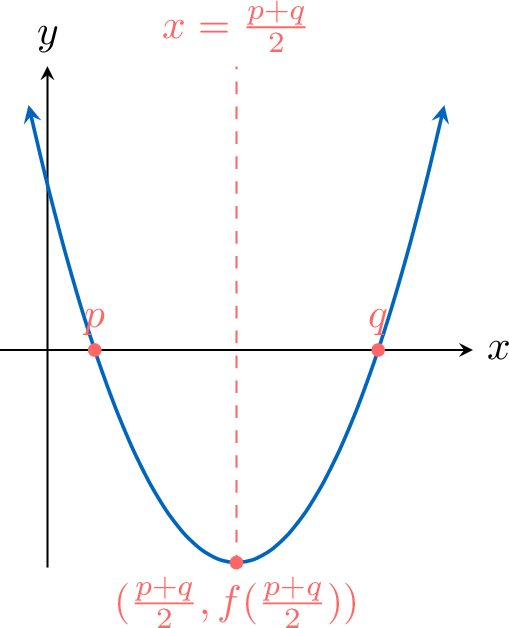
- x-intercepts: The x-intercepts are found by solving \(f(x)=0\). $$ a(x-p)(x-q)=0 $$ By the null factor law, this is true if \(x-p=0\) or \(x-q=0\). Thus, the roots are \(\boldsymbol{x=p}\) and \(\boldsymbol{x=q}\).
- Axis of Symmetry and Vertex: An axis of symmetry at \(x=h\) requires that the function has the same value for any horizontal distance \(d\) to the left or right of the axis. Algebraically, this means \(f(h-d) = f(h+d)\) for any \(d\).
We test the proposed axis of symmetry \(h=\frac{p+q}{2}\). We need to show that \(f\left(\frac{p+q}{2} - d\right) = f\left(\frac{p+q}{2} + d\right)\).- Left side: $$ \begin{aligned} f\left(\frac{p+q}{2} - d\right) &= a\left(\left(\frac{p+q}{2} - d\right) - p\right)\left(\left(\frac{p+q}{2} - d\right) - q\right) \\ &= a\left(\frac{q-p}{2} - d\right)\left(\frac{p-q}{2} - d\right) \\ &= a\left(-\left(\frac{p-q}{2} + d\right)\right)\left(\frac{p-q}{2} - d\right) \\ &= -a\left(\left(\frac{p-q}{2}\right)^2 - d^2\right) \end{aligned} $$
- Right side: $$ \begin{aligned} f\left(\frac{p+q}{2} + d\right) &= a\left(\left(\frac{p+q}{2} + d\right) - p\right)\left(\left(\frac{p+q}{2} + d\right) - q\right) \\ &= a\left(\frac{q-p}{2} + d\right)\left(\frac{p-q}{2} + d\right) \\ &= a\left(-\left(\frac{p-q}{2} - d\right)\right)\left(\frac{p-q}{2} + d\right) \\ &= -a\left(\left(\frac{p-q}{2}\right)^2 - d^2\right) \end{aligned} $$
Skills to practice
- Finding Key Features from Factored Form
II.4
Axis of Symmetry and Vertex
Recappreviously studied — click to reread
Notation
In many textbooks the vertex form (also called completed-square form) is written \(f(x) = a(x - \alpha)^2 + \beta\): the letters \(\alpha\) and \(\beta\) play exactly the roles of \(h\) and \(k\), the coordinates of the vertex. In simple cases, the vertex form is obtained directly from the identity \(x^2 + 2\lambda x = (x + \lambda)^2 - \lambda^2\).
The Proposition “Vertex Form of a Quadratic Function” places the vertex at \(h = -\frac{b}{2a}\); a horizontal line shows it on the graph. On a set of axes, cut the parabola \(y = ax^2 + bx + c\) (with \(a \neq 0\)) by a horizontal line \(y = m\): whenever the line meets the curve twice, the two \(x\)-coordinates are the two solutions of \(ax^2 + bx + c = m\), and their midpoint has the \(x\)-coordinate \(h\), whatever the height \(m\). The vertical line \(x = h\) is the axis of symmetry of the parabola, and the vertex is the point where this axis meets the curve.
Proposition — Axis of Symmetry and Vertex
On a set of perpendicular axes with the same unit on both, let \(\mathcal{P}\) be the parabola of equation \(y = ax^2 + bx + c\) with \(a \neq 0\), and let \(h = -\dfrac{b}{2a}\) and \(k = f(h)\). The line of equation \(x = h\) is the axis of symmetry of \(\mathcal{P}\): for every real number \(t\), the two points of \(\mathcal{P}\) with \(x\)-coordinates \(h - t\) and \(h + t\) have the same \(y\)-coordinate. The point \(S(h, k)\) where the axis meets \(\mathcal{P}\) is its vertex: the lowest point of \(\mathcal{P}\) if \(a > 0\), the highest if \(a < 0\).
The vertex form gives \(f(x) = a(x - h)^2 + k\) with \(h = -\frac{b}{2a}\) and \(k = f(h)\). Then $$f(h + t) = at^2 + k = f(h - t):$$ the points with \(x\)-coordinates \(h - t\) and \(h + t\) are at the same height, symmetric about the line \(x = h\). Moreover \(f(x) - k = a(x - h)^2\) has the sign of \(a\) and vanishes only at \(x = h\): if \(a > 0\), every other point of \(\mathcal{P}\) is above \(S\); if \(a < 0\), below.
Method — Finding the Axis and the Vertex
For the parabola \(y = ax^2 + bx + c\): - read \(a\), \(b\), \(c\) and compute \(h = -\dfrac{b}{2a}\): the axis is the line \(x = h\);
- compute \(k = f(h)\): the vertex is \(S(h, k)\);
- check with two symmetric points: the parabola passes through \((0, c)\), so it must also pass through the mirror point \((2h, c)\), that is \(f(2h) = c\). This is the horizontal line of the opening text, at the height \(m = c\). (If \(b = 0\), the axis is the \(y\)-axis itself and this check says nothing: use another point.)
Example
Determine the axis of symmetry and the vertex of the parabola \(\mathcal{P}\) of equation \(y = x^2 - 6x + 5\), then check with the point \((0, 5)\). 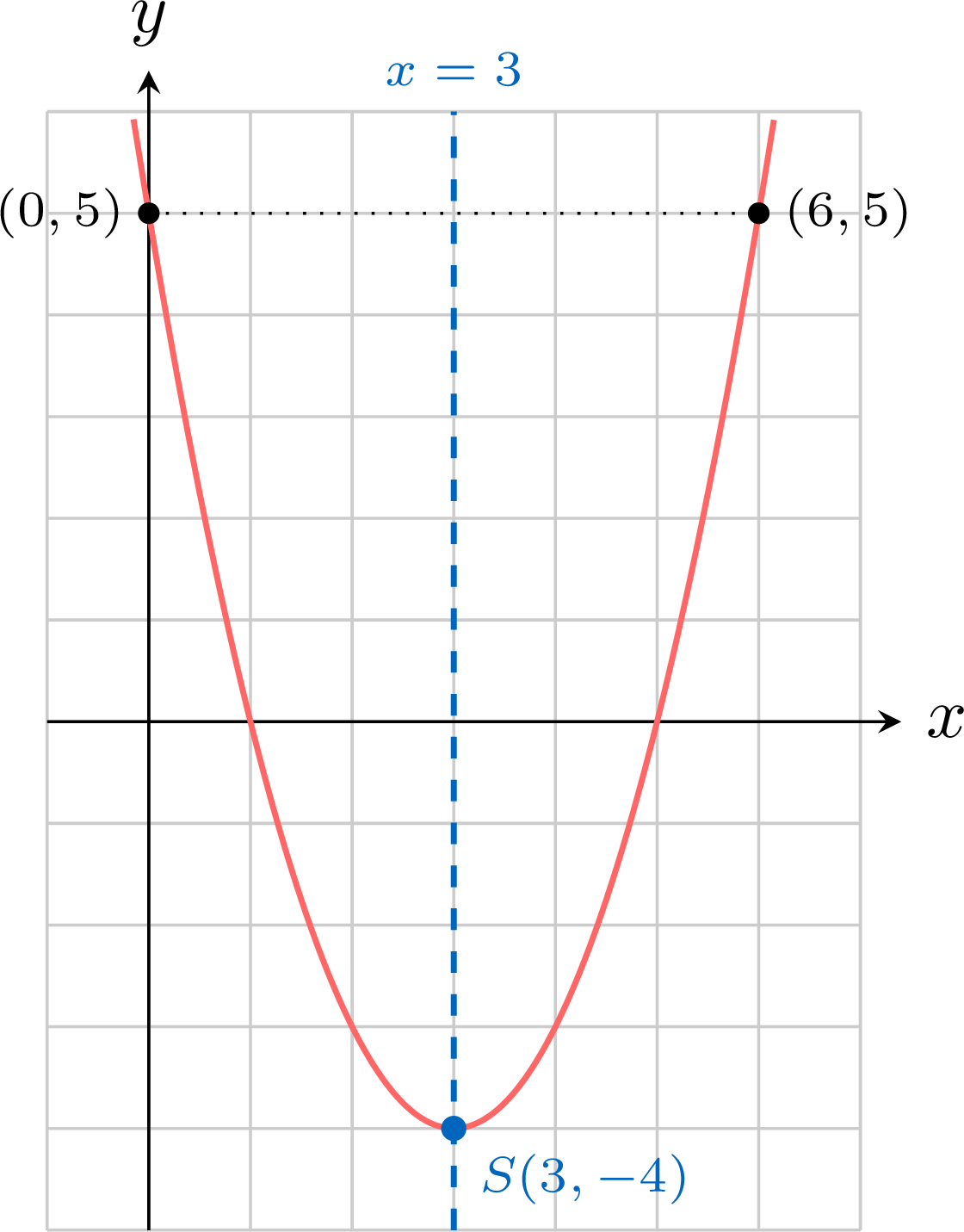
Here \(a = 1\), \(b = -6\), \(c = 5\). $$\begin{aligned}[t] h &= -\frac{b}{2a} = -\frac{-6}{2 \times 1} = 3 && \scriptscriptstyle\text{(axis } x = 3\text{)} \\
k &= f(3) = 3^2 - 6 \times 3 + 5 = -4 && \scriptscriptstyle\text{(vertex } S(3, -4)\text{)} \end{aligned}$$ Since \(a > 0\), \(S\) is the lowest point of \(\mathcal{P}\). Check: the mirror of \((0, 5)\) about the line \(x = 3\) is \((6, 5)\), and \(f(6) = 36 - 36 + 5 = 5\): both points are on \(\mathcal{P}\).
Skills to practice
- Finding the Axis of Symmetry and the Vertex
II.5
Key Features of a Graph with Technology
Recappreviously studied — click to reread
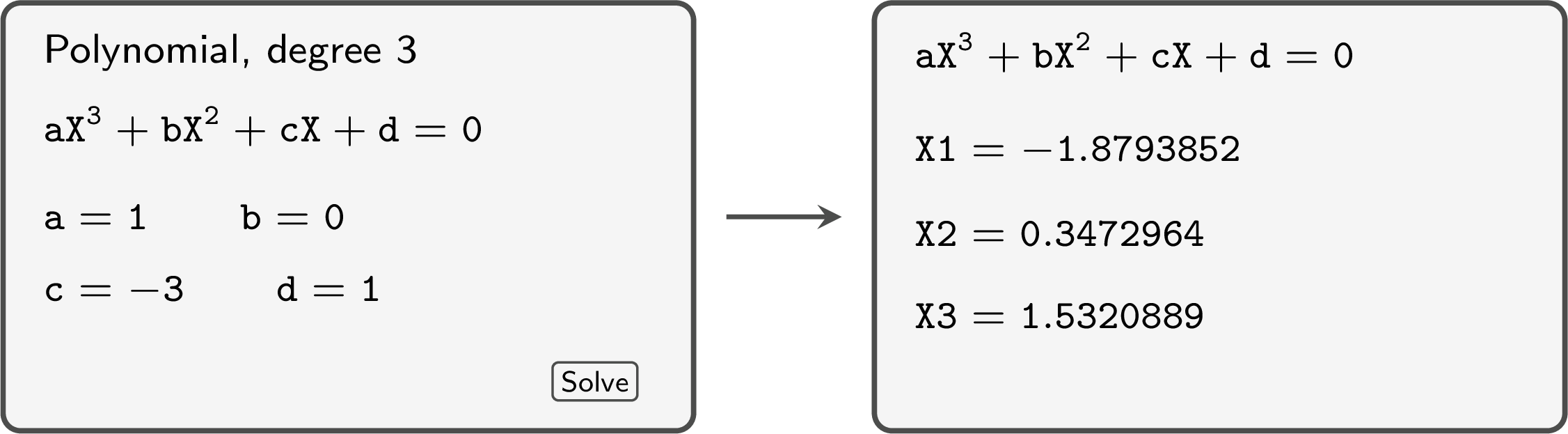
Method — Solving a Polynomial Equation with the Polynomial Solver
The polynomial solver, in the equation menu of a graphing calculator, returns the real roots of an equation \(ax^2 + bx + c = 0\) or \(ax^3 + bx^2 + cx + d = 0\), and of higher degrees on most models. - Rearrange the equation so that one side is \(0\), and expand the other side, its terms in decreasing powers of \(x\).
- Open the polynomial solver and choose the degree: the highest power of \(x\).
- Enter the coefficients in order, each with its sign, and \(0\) for a missing power.
- Solve and read the roots. An equation of degree \(n\) has at most \(n\) real roots; a model set to complex mode may also display roots containing \(i\), which are not real solutions.
- Report a root exactly when the screen shows an exact value, such as an integer that substitution confirms; otherwise give it to 3 significant figures.
Method — Reading the Key Features of a Graph on the Screen
To study the graph of a function \(f\) with a graphing calculator: - Enter \(f(x)\) as the first function (\(Y_1\)) of the function editor.
- Choose the window: the least and greatest values of \(x\) and of \(y\) shown on the screen. Start from the domain the question gives, or from a table of values of \(f\), and adjust until every feature asked for is visible. A window that is too narrow hides an intercept or a turning point; a window that is too wide flattens the curve.
- Read each feature with the analysis tools of the graph menu, never by eye:
- the \(y\)-intercept: the value of \(f\) at \(x = 0\);
- each \(x\)-intercept: the tool zero (or root);
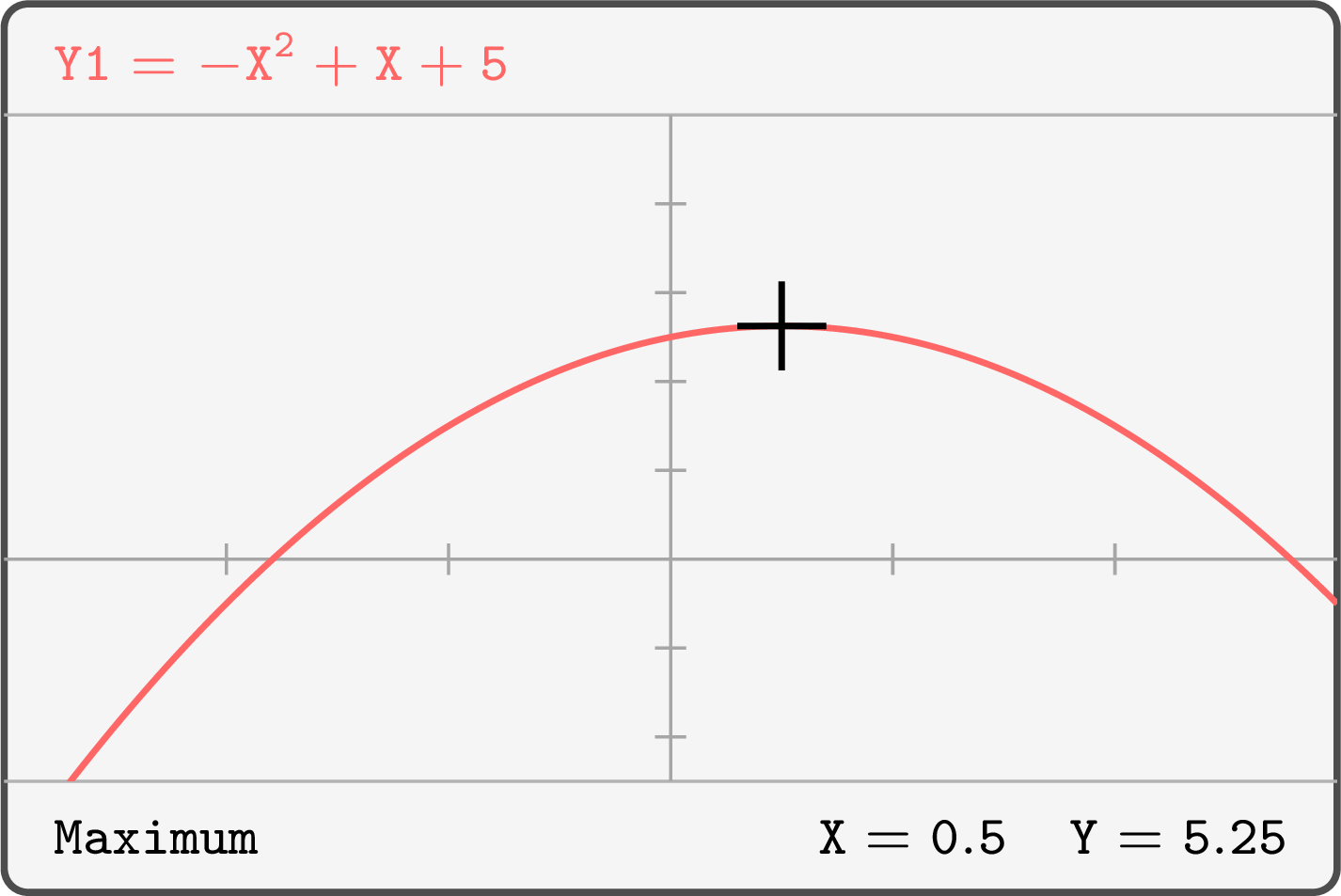
- a local maximum or minimum: the tool maximum or minimum, which gives both coordinates of the turning point.
Example
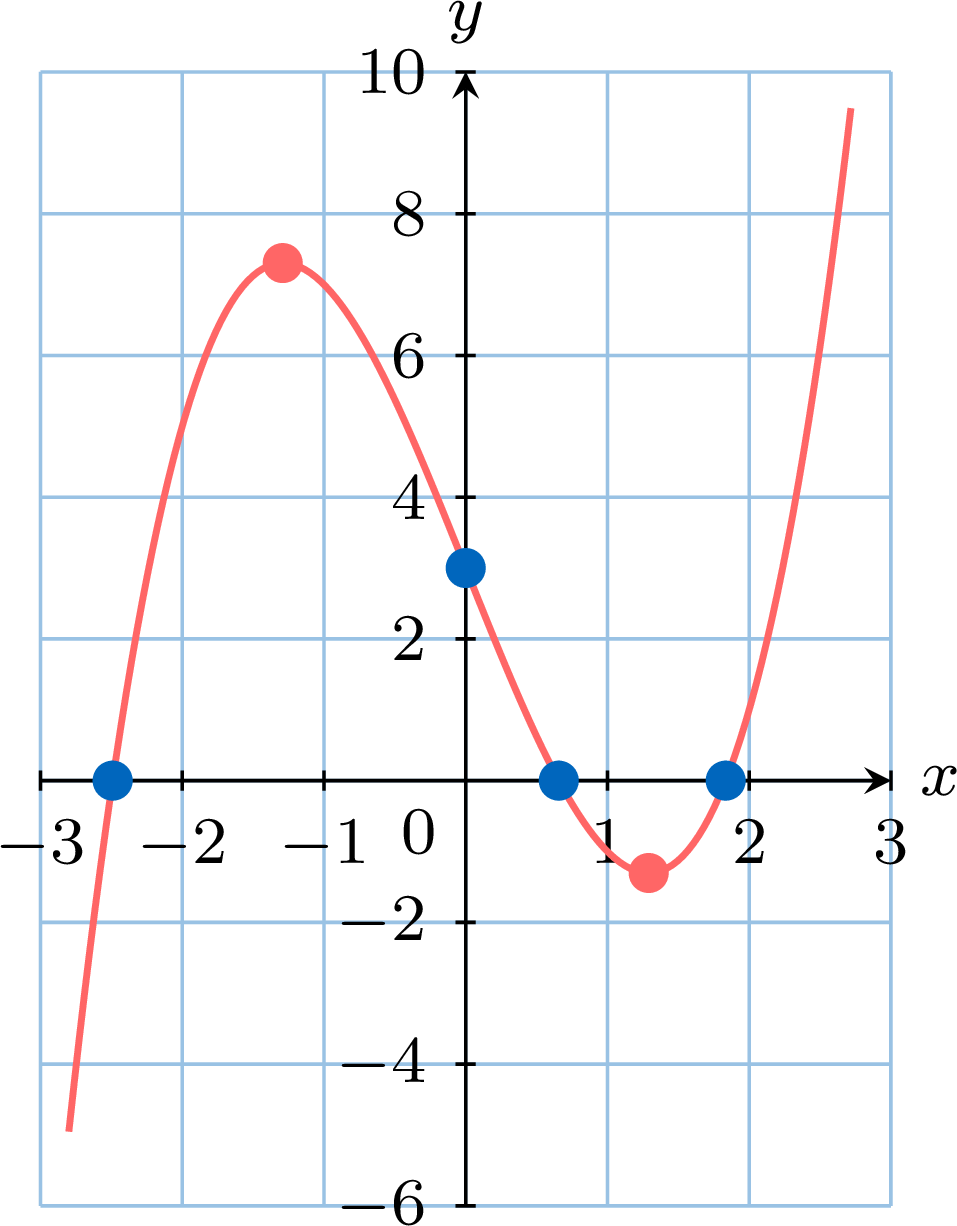
Let \(f(x) = x^3 - 5x + 3\). - Choose a window that shows the intercepts and the turning points of the graph of \(f\).
- Find the \(y\)-intercept and the \(x\)-intercepts of the graph.
- Find the local maximum point and the local minimum point.
- A table of values of \(f(x) = x^3 - 5x + 3\) at the integers guides the choice:
\(x\) \(-3\) \(-2\) \(-1\) \(0\) \(1\) \(2\) \(3\) \(f(x)\) \(-9\) \(5\) \(7\) \(3\) \(-1\) \(1\) \(15\) - The \(y\)-intercept is \(f(0) = 3\). The zero tool, bounded between \(-3\) and \(-2\), then between \(0\) and \(1\), then between \(1\) and \(2\), displays \(-2.4908636\), \(0.6566204\) and \(1.8342432\): the \(x\)-intercepts are \(x \approx -2.49\), \(x \approx 0.657\) and \(x \approx 1.83\). An equation of degree \(3\) has at most three real roots, so none is missing.
- The maximum tool, bounded between \(-2\) and \(0\), displays \(X = -1.2909944\) and \(Y = 7.3033148\); the minimum tool, bounded between \(0\) and \(2\), displays \(X = 1.2909944\) and \(Y = -1.3033148\). The local maximum point is \((-1.29, 7.30)\) and the local minimum point is \((1.29, -1.30)\).
Method — Solving an Equation Graphically with Technology
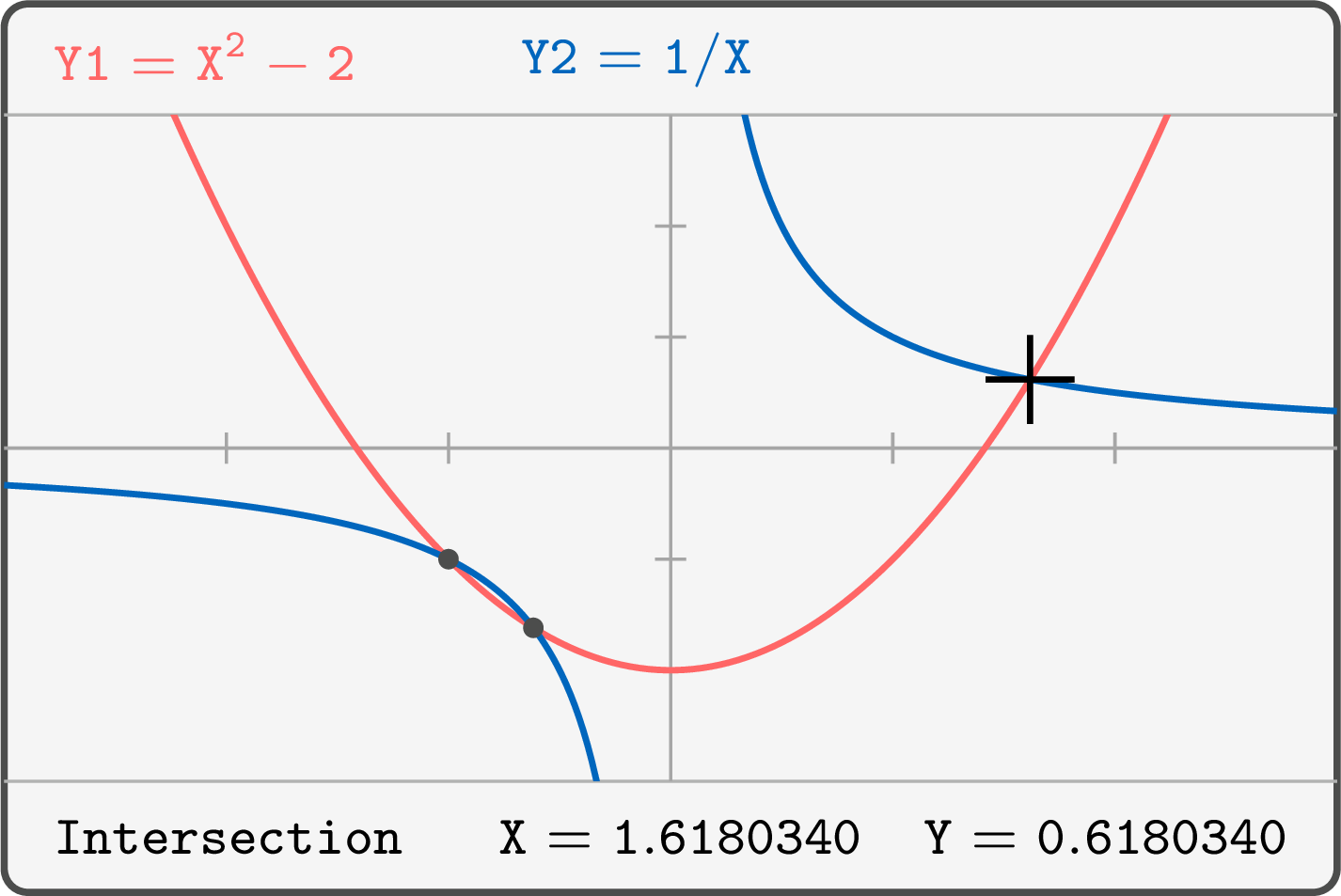
The solutions of an equation \(f(x) = g(x)\) are the \(x\)-coordinates of the points where the graphs of \(f\) and \(g\) meet; the solutions of an equation \(f(x) = 0\) are the \(x\)-intercepts of the graph of \(f\). - Enter each side as a function: \(Y_1 = f(x)\) and \(Y_2 = g(x)\). For an equation \(f(x) = 0\), enter \(f(x)\) alone.
- Choose a window that shows every point of intersection, or every \(x\)-intercept. A table of values of \(f(x) - g(x)\) helps: a change of sign between two consecutive values of \(x\) signals a solution between them, provided the curves have no break between these two values: this holds for polynomials, and for rational functions away from the values that make a denominator zero.
- In the analysis tools of the graph menu, choose intersection (for \(f(x) = 0\): zero), select the curves and give a first guess, or bounds, close to one point. Read the \(x\)-coordinate \(X\) of the point displayed: the \(y\)-coordinate \(Y\) is the common value of the two sides, not a solution.
- Repeat for each point, then report the solutions: exactly when the screen shows an exact value that substitution confirms, otherwise to 3 significant figures.
Skills to practice
- Finding Key Features with Technology
III
The Equation of a Parabola
III.1
Finding the Equation of a Parabola
Recappreviously studied — click to reread
Proposition — Key Features from Standard Form
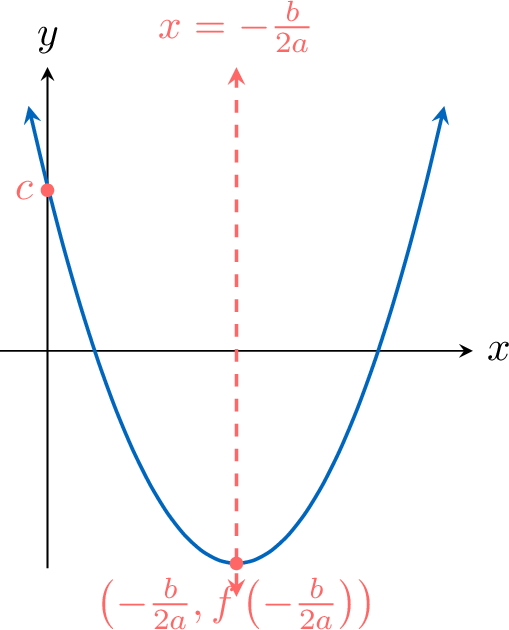
The graph of a quadratic function \(f(x)=ax^2+bx+c\) is a parabola with: - Concavity: Determined by the sign of \(a\).
- If \(a > 0\), concave up.
- If \(a < 0\), concave down.
- If \(a > 0\), concave up.
- Axis of Symmetry: The line \(x = -\frac{b}{2a}\).
- Vertex: The point \(\left(-\frac{b}{2a}, f\left(-\frac{b}{2a}\right)\right)\).
- y-intercept: The point \((0, c)\).
By expanding the vertex form \(f(x) = a(x-h)^2+k\), we get:$$f(x) = a(x^2 - 2hx + h^2) + k = ax^2 - 2ahx + (ah^2+k)$$ Comparing this to the standard form \(f(x)=ax^2+bx+c\), we can equate coefficients:$$b = -2ah \implies h = -\frac{b}{2a}$$ This confirms the formulas for the axis of symmetry and the vertex.
Method — Finding the Equation of a Parabola from Its Graph
A graph gives some key features of a parabola. The equation is written in the form in which these features appear, and one more point of the graph then gives the coefficient \(a\). - Read the features given by the graph or by the statement: the \(x\)-intercepts, the vertex, the \(y\)-intercept, other points.
- Choose the form that contains them:
- two \(x\)-intercepts \(p\) and \(q\): \(y = a(x - p)(x - q)\), the factored form;
- the graph touches the \(x\)-axis at \(p\): \(y = a(x - p)^2\), since the two roots are equal and \((p, 0)\) is the vertex;
- the vertex \((h, k)\): \(y = a(x - h)^2 + k\), the vertex form.
- Find \(a\): substitute the coordinates of another point of the graph and solve the equation obtained, whose unknown is \(a\).
- Check with a point not used yet, or with the direction of the parabola (upwards if \(a > 0\), downwards if \(a < 0\)), and expand when the standard form is asked for.
Example
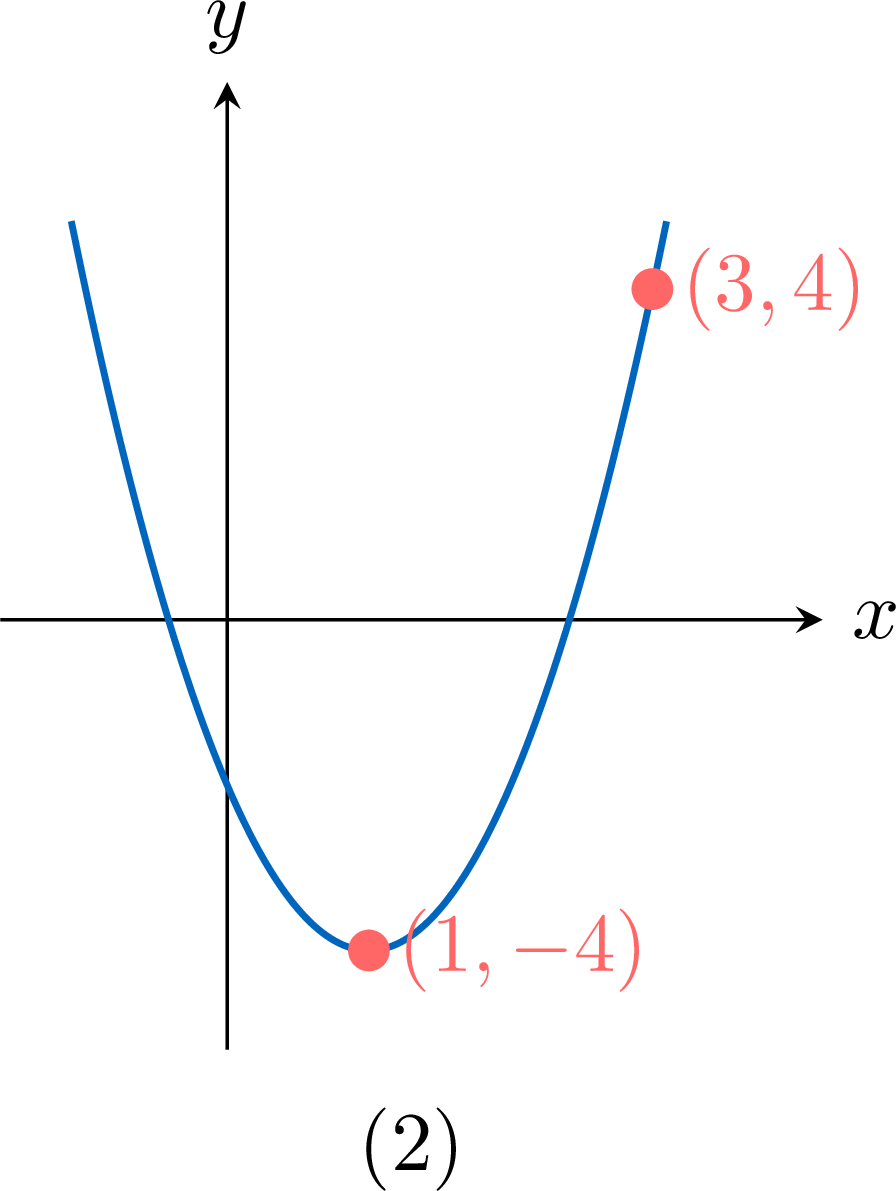
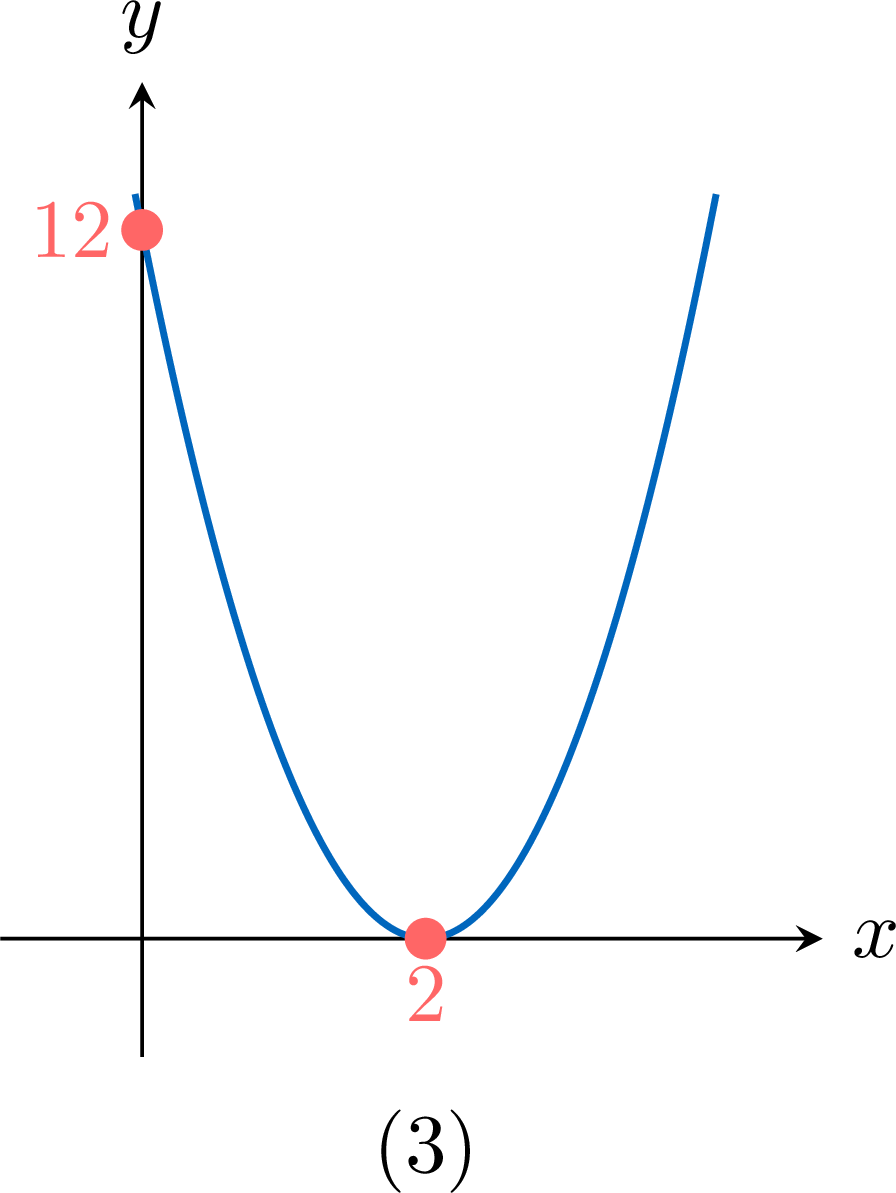
Find, in the form \(y = ax^2 + bx + c\), the equation of each parabola. 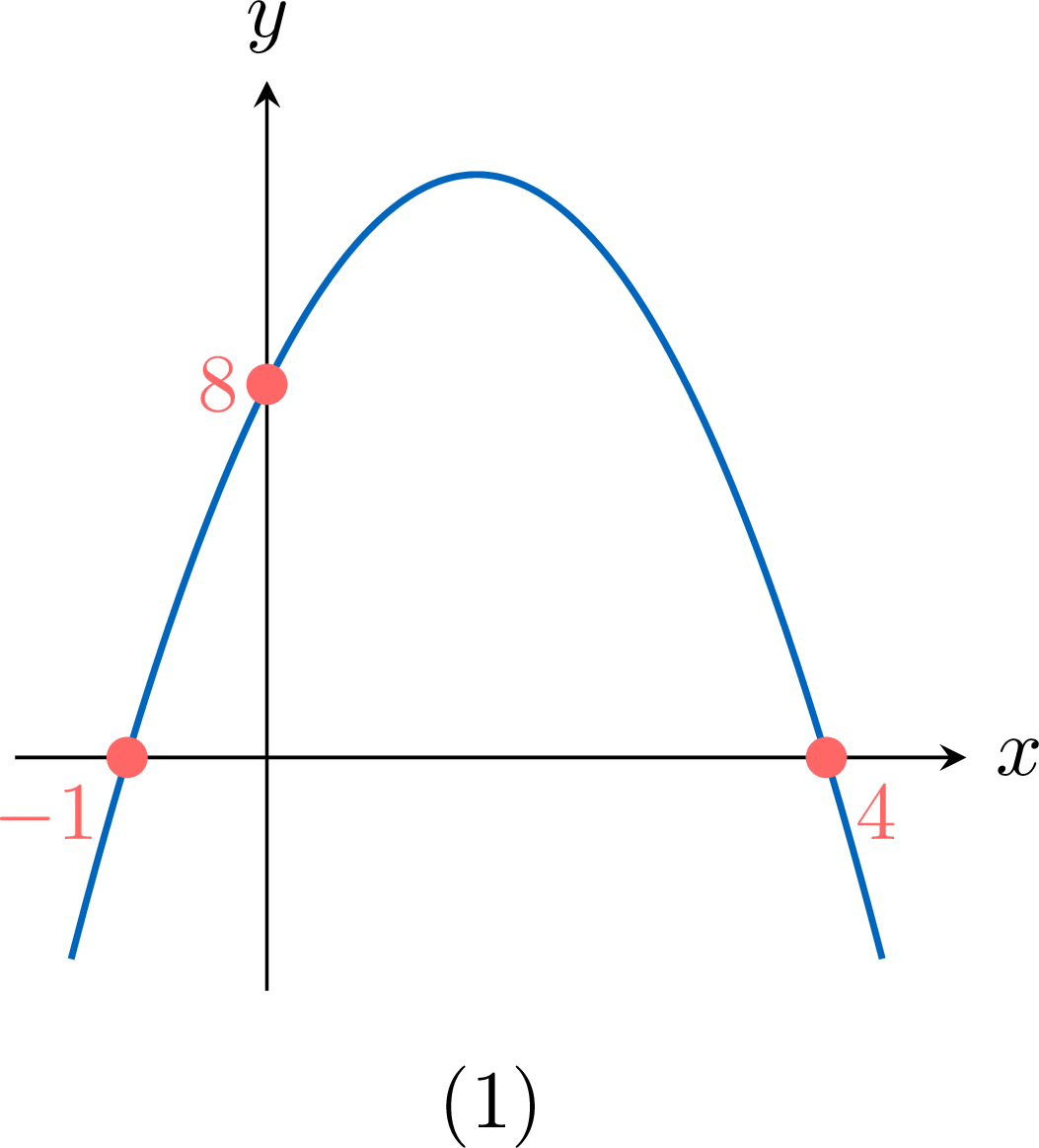
- The \(x\)-intercepts are \(-1\) and \(4\): the factored form is \(y = a(x + 1)(x - 4)\). The \(y\)-intercept, the point \((0, 8)\), gives \(a\): $$\begin{aligned}[t] a(0 + 1)(0 - 4) &= 8\\ -4a &= 8\\ a &= -2. \end{aligned}$$ Then $$\begin{aligned}[t] y &= -2(x + 1)(x - 4)\\ &= -2(x^2 - 3x - 4) && \text{(expand the product)}\\ &= -2x^2 + 6x + 8. && \text{(distribute \(-2\))} \end{aligned}$$ Check: \(a = -2 < 0\), and the parabola opens downwards, as on the graph.
- The vertex is \((1, -4)\): the vertex form is \(y = a(x - 1)^2 - 4\). The point \((3, 4)\) gives \(a\): $$\begin{aligned}[t] a(3 - 1)^2 - 4 &= 4\\ 4a &= 8\\ a &= 2. \end{aligned}$$ Then $$\begin{aligned}[t] y &= 2(x - 1)^2 - 4\\ &= 2(x^2 - 2x + 1) - 4 && \text{(expand the square)}\\ &= 2x^2 - 4x - 2. \end{aligned}$$ Check with the point \((-1, 4)\), the mirror image of \((3, 4)\) about the axis of symmetry \(x = 1\): \(2 \times (-1)^2 - 4 \times (-1) - 2 = 4\).
- The graph touches the \(x\)-axis at \(2\): \(y = a(x - 2)^2\). The \(y\)-intercept, the point \((0, 12)\), gives \(a\): $$\begin{aligned}[t] a(0 - 2)^2 &= 12\\ 4a &= 12\\ a &= 3. \end{aligned}$$ Then $$\begin{aligned}[t] y &= 3(x - 2)^2\\ &= 3(x^2 - 4x + 4) && \text{(expand the square)}\\ &= 3x^2 - 12x + 12. \end{aligned}$$ Check: the constant term \(12\) is the \(y\)-intercept read on the graph.
Skills to practice
- Finding the Equation of a Parabola from Key Features
- Finding the Equation of a Parabola from a Graph
III.2
A Quadratic through Three Points
Recappreviously studied — click to reread
Method — Solving a Linear System with the Equation Solver
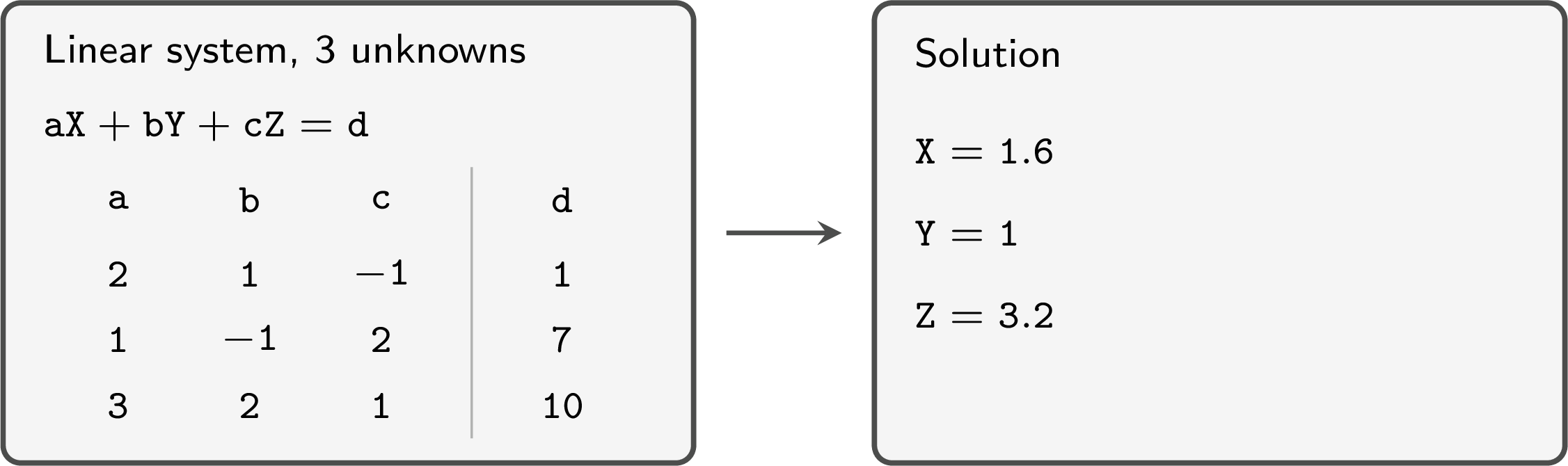
The linear system solver, in the equation menu of a graphing calculator, solves a system of two linear equations in two unknowns, or of three linear equations in three unknowns. - Write each equation in the form \(ax + by = c\) (two unknowns) or \(ax + by + cz = d\) (three unknowns): the unknowns on the left, in the same order in every equation, and the constant on the right.
- Open the linear system solver and choose the number of unknowns.
- Enter the coefficients row by row, one row per equation, each with its sign, and \(0\) for a missing unknown.
- Solve and read the value of each unknown. If the solver reports no solution, or infinitely many, the system has no unique solution.
- Check the solution by substituting it in each original equation, then report each value exactly when the checks hold exactly, otherwise to 3 significant figures.
Example
A ball is thrown upwards. Its height \(h\), in metres, \(t\) seconds after the throw, is recorded three times: \(6.75\) m at \(t = 0.5\), \(9\) m at \(t = 1\) and \(6\) m at \(t = 2\). The height is modelled by \(h(t) = at^2 + bt + c\). - Use technology to find \(a\), \(b\) and \(c\).
- Interpret the parameter \(c\).
- Use technology to find when the ball hits the ground, and state the domain of the model.
- Each reading gives one equation in \(a\), \(b\) and \(c\):
- \((0.5, 6.75)\): \(a \times 0.5^2 + b \times 0.5 + c = 6.75\), that is \(0.25a + 0.5b + c = 6.75\);
- \((1, 9)\): \(a \times 1^2 + b \times 1 + c = 9\), that is \(a + b + c = 9\);
- \((2, 6)\): \(a \times 2^2 + b \times 2 + c = 6\), that is \(4a + 2b + c = 6\).
- \(c = h(0) = 2\): the ball leaves the hand \(2\) m above the ground.
- The ball hits the ground when \(h(t) = 0\), that is \(-5t^2 + 12t + 2 = 0\). The polynomial solver displays \(t = 2.5564660\) and \(t = -0.1564660\). The model describes the ball after the throw, so \(t \ge 0\): the ball hits the ground after about \(2.56\) seconds. The model is used from the throw to the landing, on the domain \(0 \le t \le t_1\), where \(t_1 \approx 2.56\) is the positive solution.
Skills to practice
- A Quadratic through Three Points
IV
The Intersection of Graphs
IV.1
Intersection of Curves
Recappreviously studied — click to reread
A common problem is to find where the graphs of two functions meet. The intersection points are the points \((x,y)\) that satisfy both equations simultaneously. By setting the function rules equal to each other, we can create a new equation to solve for the x-coordinates of these points.
Method — Finding Intersection Points
To find the points of intersection between the graphs of two functions \(f(x)\) and \(g(x)\): - Set the functions equal to each other: \(\boldsymbol{f(x) = g(x)}\).
- Solve this equation for \(x\). The solutions are the \(x\)-coordinates of the intersection points.
- Substitute each \(x\)-coordinate back into either of the original functions (\(f\) or \(g\)) to find the corresponding y-coordinate.
Example
Find the coordinates of the intersection points of the parabola \(f(x) = x^2 - x - 2\) and the line \(g(x) = x+1\).
We find the intersection points by setting \(f(x) = g(x)\) and solving for \(x\).$$ \begin{aligned}f(x) &= g(x) \\
x^2 - x - 2 &= x+1 \\
x^2 - 2x - 3 &= 0 \\
(x-3)(x+1) &= 0\end{aligned} $$ This gives two solutions for \(x\): \(x=3\) and \(x=-1\).
Now we find the corresponding \(y\)-coordinates by substituting these values into the linear function \(g(x)=x+1\): 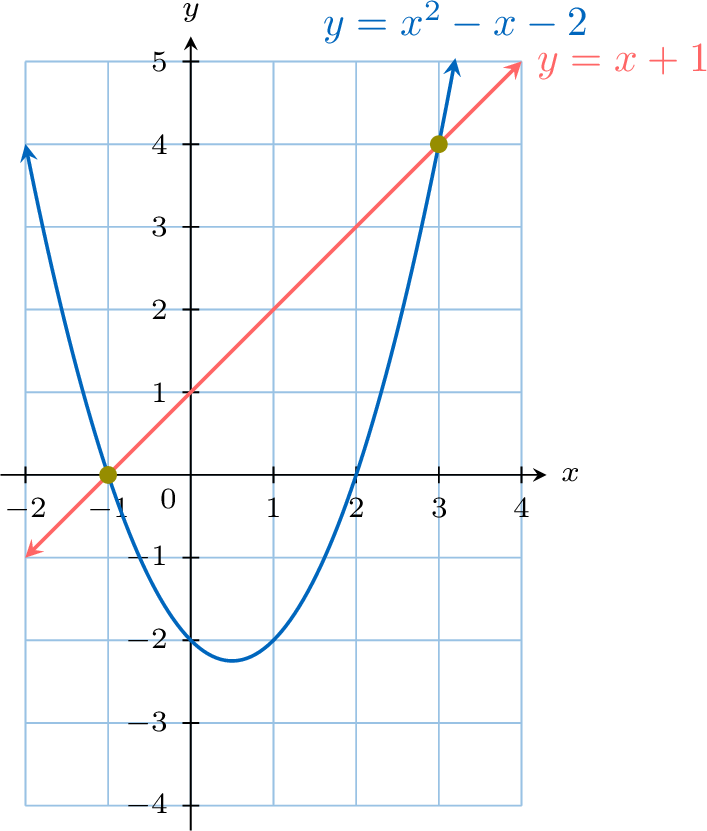
Now we find the corresponding \(y\)-coordinates by substituting these values into the linear function \(g(x)=x+1\):
- If \(x=3\), \(y = 3+1 = 4\).
- If \(x=-1\), \(y = -1+1 = 0\).
Skills to practice
- Intersection of Curves
V
Problem Solving and Optimisation
V.1
Quadratic Optimisation
Recappreviously studied — click to reread
Because the graph of a quadratic function has a vertex that is either the absolute highest point (maximum) or lowest point (minimum) on the graph, quadratic functions are extremely useful for solving optimisation problems. These are problems where we want to find the maximum or minimum value of a certain quantity.
Method — Solving Optimisation Problems
- Read the problem to identify the quantity to be maximised or minimised.
- Define variables and write a quadratic function that models this quantity.
- Find the coordinates of the vertex \((h,k)\) of the parabola.
- \(h = -\frac{b}{2a}\) gives the input value (e.g., time, length, price) where the optimum occurs.
- \(k = f(h)\) gives the optimal (maximum or minimum) value itself.
- Check that \(h\) is an allowed value of the variable (for instance, a length or a time is positive).
- Answer the question in the context of the problem, making sure to include units.
Example
A farmer wants to fence a rectangular area next to a river. He has 120 m of fencing and does not need to fence the side along the river. What dimensions maximise the area? 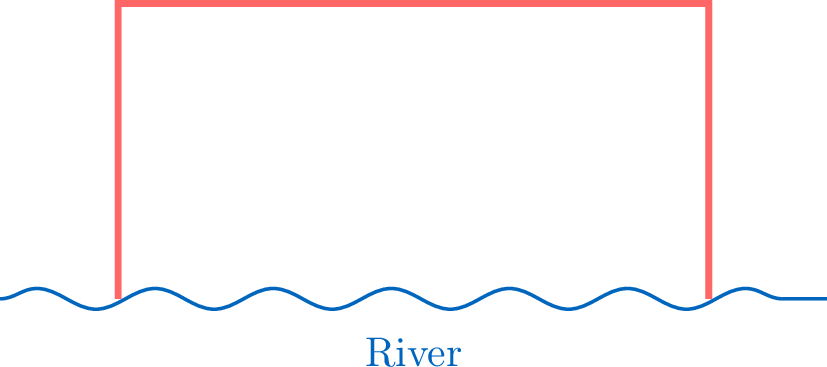
- Define variables and the function: Let \(x\) be the width of the rectangle (perpendicular to the river) and let \(y\) be the length (parallel to the river). The total fencing is 120 m, which covers the two sides of width \(x\) and the one side of length \(y\). The constraint equation is: $$\begin{aligned} 2x + y &= 120 \\ y &= 120 - 2x\end{aligned} $$ The area, \(A\), which we want to maximise, is given by the function: $$\begin{aligned}A(x) &= \text{width} \times \text{length}\\ &= x \cdot y \\ &= x(120 - 2x)\\ &= -2x^2 + 120x\end{aligned} $$
- Analyse the function: This is a quadratic function with \(a=-2\). Since \(a<0\), the parabola opens downwards and has a maximum value at its vertex.
- Find the vertex: The x-coordinate of the vertex gives the width that maximises the area. $$ x_{vertex} = -\frac{b}{2a} = -\frac{120}{2(-2)} = -\frac{120}{-4} = 30 $$ This means the optimal width is 30 m, an allowed value: the width lies between \(0\) and \(60\) m, so that \(y = 120 - 2x\) stays positive.
- Find the dimensions:
- Width: \(x = 30\) m.
- Length: \(y = 120 - 2x = 120 - 2(30) = 60\) m.
- State the conclusion: The dimensions that maximise the area are 30 m by 60 m. The maximum area itself is \(A(30) = 30 \times 60 = 1800 \text{ m}^2\).
Skills to practice
- Solving Optimisation Problems
VI
Quadratic Models
VI.1
The Modelling Cycle
Recappreviously studied — click to reread
Method — 5 Steps of Modelling
You should follow these steps: - Construct: Create a model from data or from a verbal description. This includes choosing a suitable functional form (linear, quadratic, etc.) and determining its parameters.
- Use: Use the model to make predictions.
- Interpolation: Predict within the range of the available data.
- Extrapolation: Predict outside the range of the data (often less reliable).
- Interpret: Explain the meaning of variables and parameters in context (e.g., what does the \(y\)-intercept represent?).
- Evaluate: Assess the validity of the model: compare with data, compute errors, analyse residuals/correlation (if relevant), and check whether the results are realistic.
- Refine: Suggest improvements if the model is inadequate (e.g., “an exponential model grows too fast; a logistic model may be more appropriate”).
Skills to practice
- The Modelling Cycle
VI.2
Quadratic Models
Quadratic models involve variables raised to the power of 2. They are essential for describing phenomena that have a peak or a valley, such as the path of a projectile under gravity, the area of a rectangle with fixed perimeter, or profit functions in economics.
Definition — Quadratic Model
A quadratic model is a function of the form$$ f(x) = ax^2 + bx + c, \qquad a\neq 0. $$ - \(a\) controls the concavity and the vertical stretch/compression.
- \(b\) affects the position of the axis of symmetry.
- \(c\) is the \(y\)-intercept, since \(f(0)=c\).
Example
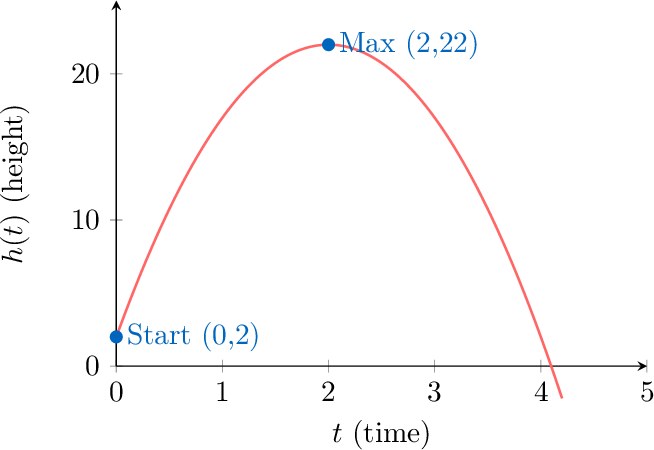
The height of a ball is given by \(h(t) = -5t^2 + 20t + 2\). - Find the release height.
- Find the maximum height.
- Release height: This is the height at \(t=0\). $$ h(0) = -5(0)^2 + 20(0) + 2 = 2 \text{ m}. $$
- Maximum height: The time of maximum height occurs at the vertex \(t = -\frac{b}{2a}\). Here, \(a=-5\) and \(b=20\), so $$ t = -\frac{20}{2(-5)} = 2 \text{ s}. $$ Now evaluate \(h(2)\): $$ h(2) = -5(2)^2 + 20(2) + 2 = -20 + 40 + 2 = 22 \text{ m}. $$
Skills to practice
- Applying Quadratic Models
VII
Going further
Skills to practice
- Finding Intersection Points with Technology
- Solving Problems in Context
Jump to section