International Baccalaureate · DP 2: Applications and Interpretation HL
Kinematics
I
Displacement and Velocity
I.1
Displacement
Kinematics is the study of the motion of objects without considering the forces that cause the motion. Calculus describes motion along a straight line formally. We will develop functions for displacement, velocity, and acceleration, and explore the relationships between them.
Definition — Displacement Function
For an object \(P\) in motion along a straight line, the displacement function \(s(t)\) gives the position of the object (its signed distance from a fixed origin) at any time \(t \ge 0\). 
Example
A particle's displacement from an origin O is given by \(s(t) = t^2 - 4t + 3\) cm for \(0 \le t \le 5\) seconds. - Find the initial displacement.
- Find when the particle is at the origin.
- Initial Displacement (\(t=0\)):
\(s(0) = 0^2 - 4(0) + 3 = 3\) cm. The particle starts 3 cm to the right of the origin (in the positive direction). - At the Origin (\(s(t)=0\)):
\(t^2 - 4t + 3 = 0 \implies (t-1)(t-3) = 0\).
The particle is at the origin at \(t=1\) s and \(t=3\) s.
Skills to practice
- Displacement
I.2
Velocity
Definition — Average Velocity
The average velocity of an object moving in the time interval from \(t=t_1\) to \(t=t_2\) (where \(t_1 < t_2\)) is given by $$\begin{aligned} \text{average velocity} &= \frac{\text{change in displacement}}{\text{change in time}} \\
&= \frac{s(t_2) - s(t_1)}{t_2 - t_1}. \end{aligned}$$ Definition — Velocity Function
The instantaneous velocity \(v(t)\) of an object is the rate of change of its displacement. It is found by differentiating the displacement function \(s(t)\): $$ \textcolor{colordef}{v(t) = s'(t) = \frac{\mathrm{d}s}{\mathrm{d}t}} $$
Note
- If \(v(t) > 0\), the object is moving to the right (in the positive direction).
- If \(v(t) < 0\), the object is moving to the left (in the negative direction).
- If \(v(t) = 0\), the object is instantaneously at rest.
Proposition — Displacement from Velocity
The change in displacement over the interval \([t_1, t_2]\) is the definite integral of the velocity function: $$ s(t_2) - s(t_1) = \int_{t_1}^{t_2} v(t) \,\mathrm{d}t. $$
The velocity is the derivative of the displacement, \(v = s'\), so \(s\) is an antiderivative of \(v\) on \([t_1, t_2]\). By the Fundamental Theorem of Calculus, $$\begin{aligned}[t] \int_{t_1}^{t_2} v(t)\,\mathrm{d}t &= \big[s(t)\big]_{t_1}^{t_2} && \text{(Fundamental Theorem of Calculus, \(s' = v\))}\\
&= s(t_2) - s(t_1). \end{aligned}$$
Skills to practice
- Finding Displacement and Velocity
- Finding Displacement from Velocity
II
Speed and Acceleration
II.1
Speed and Distance
Definition — Speed
The speed of an object is the magnitude of its velocity: \(S(t) = |v(t)|\). Proposition — Distance
The total distance travelled over \([t_1, t_2]\) is the definite integral of the speed: $$ \text{Distance} = \int_{t_1}^{t_2} |v(t)| \,\mathrm{d}t. $$
We prove the formula when \(v\) changes sign at finitely many instants of \([t_1, t_2]\), the case of every motion studied here. Cut the interval at these instants: \(t_1 = c_0 < c_1 < \dots < c_k = t_2\), with \(v\) of one sign on each piece \([c_{i-1}, c_i]\).
- On a piece where \(v \ge 0\), the object moves in the positive direction only, so the distance it travels is the change of position: $$\begin{aligned}[t] s(c_i) - s(c_{i-1}) &= \int_{c_{i-1}}^{c_i} v(t)\,\mathrm{d}t && \text{(displacement from velocity)}\\ &= \int_{c_{i-1}}^{c_i} |v(t)|\,\mathrm{d}t && \text{(\(v = |v|\) on this piece).} \end{aligned}$$
- On a piece where \(v \le 0\), the object moves in the negative direction only, and the distance is \(s(c_{i-1}) - s(c_i) = \displaystyle\int_{c_{i-1}}^{c_i} (-v(t))\,\mathrm{d}t = \int_{c_{i-1}}^{c_i} |v(t)|\,\mathrm{d}t\).
Method — Finding the Total Distance Travelled with Technology
For an object moving along a straight line with velocity \(v(t)\), the displacement from \(t = t_1\) to \(t = t_2\) is \(\displaystyle\int_{t_1}^{t_2} v(t)\,\mathrm{d}t\) and the total distance travelled is \(\displaystyle\int_{t_1}^{t_2} |v(t)|\,\mathrm{d}t\). A graphing calculator evaluates both. - Write the integral first: \(\displaystyle\int_{t_1}^{t_2} |v(t)|\,\mathrm{d}t\) for the distance, \(\displaystyle\int_{t_1}^{t_2} v(t)\,\mathrm{d}t\) for the displacement.
- Enter it with the variable \(X\) of the calculator in place of \(t\), and the absolute-value function for the distance: \(\displaystyle\int_{t_1}^{t_2} |v(X)|\,\mathrm{d}X\). The angle unit is set to radians when \(v\) contains a trigonometric function.
- Or split at the changes of direction: graph \(v\), find its zeros between \(t_1\) and \(t_2\) with the zero tool (the object changes direction where \(v\) changes sign), split \([t_1, t_2]\) at these zeros, integrate \(v\) over each piece, from \(t_1\) to the first zero and from the last zero to \(t_2\) included, and add the absolute values of the results.
- Check and report: the distance is at least the absolute value of the displacement, and equals it only when the object does not change direction. Report both to 3 significant figures, with their units.
Example
A particle moves along a straight line with velocity \(v(t) = 5\sin t - t\) metres per second, for \(0 \le t \le 6\) seconds. - Find the displacement of the particle between \(t = 0\) and \(t = 6\).
- Find the total distance travelled by the particle between \(t = 0\) and \(t = 6\).
The calculator is set to radians, since \(v\) contains \(\sin\).
- The displacement is \(\displaystyle\int_0^6 (5\sin t - t)\,\mathrm{d}t\). The template, with the integrand \(5\sin X - X\) and the bounds \(0\) and \(6\), displays \(-17.800851\). The displacement is about \(-17.8\) m: at \(t = 6\), the particle is \(17.8\) m from its starting point, on the negative side.
Check with an antiderivative: \(\displaystyle\int_0^6 (5\sin t - t)\,\mathrm{d}t = \left[-5\cos t - \frac{t^2}{2}\right]_0^6 = -5\cos 6 - 18 + 5 \approx -17.8\). - The distance is \(\displaystyle\int_0^6 |5\sin t - t|\,\mathrm{d}t\). The template, with the integrand \(|5\sin X - X|\), displays \(29.609835\). The particle travels about \(29.6\) m.
Check by splitting: the zero tool displays the zero \(X = 2.5957391\) of \(v\); \(v\) is positive before it and negative after it, so the particle moves forward, then turns back once. The template displays \(\displaystyle\int_0^{2.5957391} v(t)\,\mathrm{d}t = 5.9044917\) and \(\displaystyle\int_{2.5957391}^{6} v(t)\,\mathrm{d}t = -23.705343\), and $$\begin{aligned}[t] \text{distance} &= |5.9044917| + \left|-23.705343\right| &&\text{(split at the change of direction)}\\ &= 29.609835 \approx 29.6 \text{ m}. \end{aligned}$$ The distance, \(29.6\) m, is greater than \(\left|-17.8\right| = 17.8\) m, since the particle changes direction.
Skills to practice
- Finding the Total Distance
- Finding the Total Distance with Technology
II.2
Acceleration
Definition — Acceleration Function
The acceleration \(a(t)\) of an object is the rate of change of its velocity. It is the second derivative of the displacement function: $$ \textcolor{colordef}{a(t) = v'(t) = s''(t)} $$
The kinematic functions are related through differentiation and integration (integration recovers \(s\) and \(v\) only up to a constant, which is fixed by an initial value). 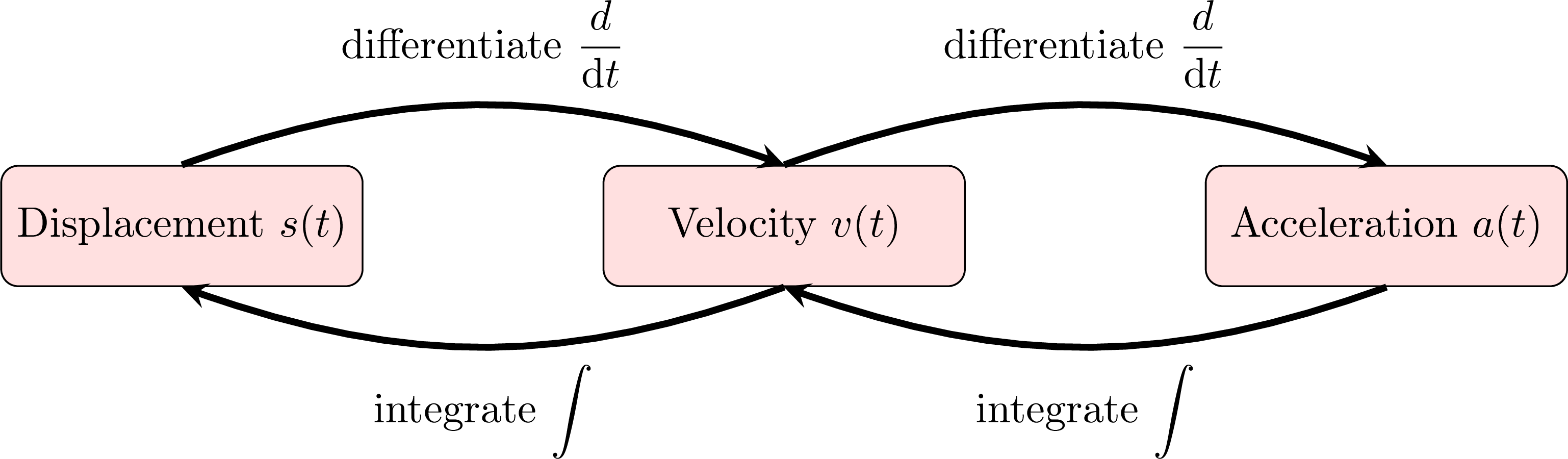
Definition — Dot Notation
When the position of an object on a line is written \(x(t)\), its derivatives with respect to time are also written with dots: $$\textcolor{colordef}{\dot{x} = \frac{\mathrm{d}x}{\mathrm{d}t} \quad\text{and}\quad \ddot{x} = \frac{\mathrm{d}^2x}{\mathrm{d}t^2}}.$$ The dot notation keeps one dot for each derivative, and a dot always means a derivative with respect to time: \(\dot{x}\) is the velocity and \(\ddot{x}\) the acceleration. With the displacement \(s(t)\), \(\dot{s} = v\) and \(\ddot{s} = a\). Example
A particle moves along the \(x\)-axis with position \(x(t) = 2t^3 - 9t^2 + 12t\) metres, for \(t \ge 0\) seconds. - Find \(\dot{x}\) and \(\ddot{x}\).
- Find the times at which the particle is at rest, and the value of \(\ddot{x}\) at these times.
- Differentiating once, then twice, with respect to \(t\): $$\dot{x} = 6t^2 - 18t + 12 \text{ m/s}, \qquad \ddot{x} = 12t - 18 \text{ m/s}^2.$$
- The particle is at rest when its velocity is zero: $$\begin{aligned}[t] \dot{x} = 0 &\iff 6(t^2 - 3t + 2) = 0\\ &\iff 6(t - 1)(t - 2) = 0\\ &\iff t = 1 \text{ or } t = 2. \end{aligned}$$ At \(t = 1\), \(\ddot{x} = 12 - 18 = -6\) m/s\(^2\); at \(t = 2\), \(\ddot{x} = 24 - 18 = 6\) m/s\(^2\). At rest does not mean without acceleration: at \(t = 1\) the particle stops at \(x(1) = 5\) and turns back, at \(t = 2\) it stops at \(x(2) = 4\) and turns back again.
Proposition — Sign Test for Speed
- The speed \(|v(t)|\) is increasing (the motion speeds up) when \(v(t)\) and \(a(t)\) have the same sign.
- The speed \(|v(t)|\) is decreasing (the motion slows down) when \(v(t)\) and \(a(t)\) have opposite signs.
Example
The displacement of a particle is given by \(s(t) = t^3 - 6t^2 + 9t\) cm, for \(t \ge 0\). - Find expressions for the velocity and acceleration.
- Find when the particle's speed \(|v(t)|\) is increasing.
- Velocity and Acceleration: $$ v(t) = s'(t) = 3t^2 - 12t + 9 \;\text{cm/s}, $$ $$ a(t) = v'(t) = 6t - 12 \;\text{cm/s}^2. $$
- Increasing Speed:
We need \(v(t)\) and \(a(t)\) to have the same sign. First, find the roots: $$ v(t) = 3(t^2-4t+3) = 3(t-1)(t-3) = 0 \implies t=1,\; 3, $$ $$ a(t) = 6(t-2) = 0 \implies t=2. $$ We build a sign table for both functions: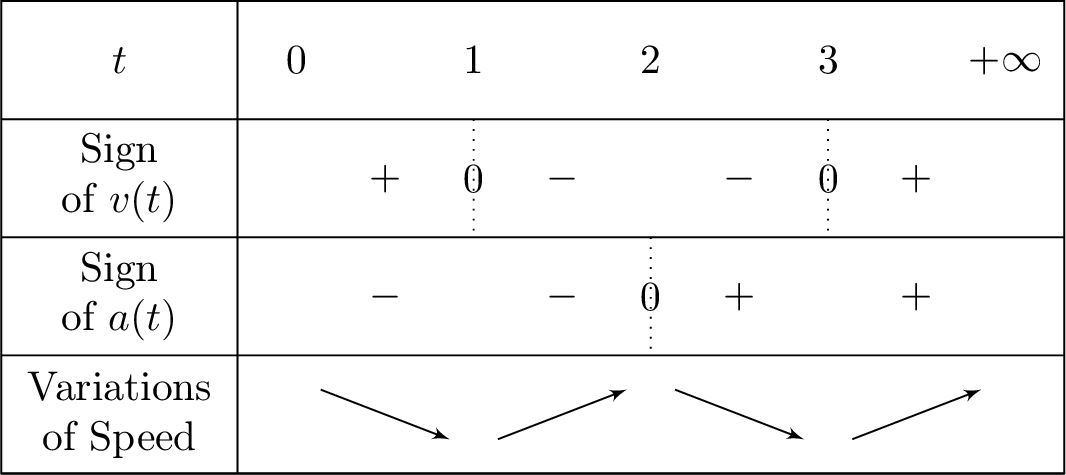
Skills to practice
- Reading Dot Notation
- Finding Velocity, Acceleration and Distance
- Finding Velocity and Distance from Acceleration
II.3
Acceleration in Terms of Displacement
So far \(s\), \(v\) and \(a\) have been functions of time. Some situations give the velocity as a function of the position instead: an object dropped from rest falls faster the further it has fallen, and a braking vehicle loses speed with the distance it covers. The chain rule then turns \(v(s)\) into the acceleration, without ever expressing \(s\) in terms of \(t\).
Proposition — Acceleration in Terms of Displacement
An object moves along a line; its acceleration varies continuously and it is at rest only at isolated instants. - If, while the object moves in one direction, its velocity is a differentiable function of its displacement, \(v = v(s)\), then $$a = v\,\frac{\mathrm{d}v}{\mathrm{d}s}.$$
- If the square of its velocity is a function of its displacement with a continuous derivative, \(v^2 = F(s)\), then at every instant, the instants of rest included, $$a = \frac{\mathrm{d}}{\mathrm{d}s}\left(\frac{1}{2}v^2\right) = \frac{1}{2}F'(s).$$
- The velocity depends on \(t\) through \(s\), so $$\begin{aligned}[t] a &= \frac{\mathrm{d}v}{\mathrm{d}t}\\ &= \frac{\mathrm{d}v}{\mathrm{d}s} \times \frac{\mathrm{d}s}{\mathrm{d}t} && \text{(chain rule)}\\ &= \frac{\mathrm{d}v}{\mathrm{d}s} \times v && \text{(\(\tfrac{\mathrm{d}s}{\mathrm{d}t} = v\)).} \end{aligned}$$
- Differentiate both sides of \(v^2 = F(s)\) with respect to \(t\), with the chain rule on each side: \(2v\,\dfrac{\mathrm{d}v}{\mathrm{d}t} = F'(s)\,\dfrac{\mathrm{d}s}{\mathrm{d}t}\), that is \(2va = F'(s)\,v\). At every instant where \(v \ne 0\), dividing by \(2v\) gives \(a = \frac{1}{2}F'(s)\). An instant of rest is isolated, so it is a limit of instants where \(v \ne 0\); as \(a\) and \(F'(s)\) vary continuously, the equality holds at that instant too.
Example
A particle moves along a line. When its displacement from the origin is \(s\) metres, its velocity is \(v = s^2 + 2s\) m/s. - Find the acceleration of the particle in terms of \(s\).
- Find the velocity and the acceleration of the particle when it is \(1\) m to the right of the origin.
- The velocity is given in terms of \(s\), so $$\begin{aligned}[t] a &= v\,\frac{\mathrm{d}v}{\mathrm{d}s} && \text{(acceleration in terms of displacement)}\\ &= (s^2 + 2s)(2s + 2)\\ &= 2s(s + 1)(s + 2) \text{ m/s}^2. \end{aligned}$$
- \(1\) m to the right of the origin means \(s = 1\): \(v = 1 + 2 = 3\) m/s and \(a = 2 \times 1 \times 2 \times 3 = 12\) m/s\(^2\). The velocity and the acceleration are both positive: by the sign test, the particle is speeding up.
Example
An object oscillates along a line. When its displacement from the centre of the motion is \(s\) metres, its velocity \(v\) m/s satisfies \(v^2 = 36 - 4s^2\). - Find the acceleration of the object in terms of \(s\).
- Find the positions at which the object is at rest, and its acceleration at these positions.
- \(v^2\) is given in terms of \(s\), so the second form applies: $$\begin{aligned}[t] a &= \frac{\mathrm{d}}{\mathrm{d}s}\left(\frac{1}{2}v^2\right) && \text{(acceleration in terms of displacement)}\\ &= \frac{\mathrm{d}}{\mathrm{d}s}\left(18 - 2s^2\right)\\ &= -4s \text{ m/s}^2. \end{aligned}$$
- The object is at rest when \(v^2 = 0\), that is \(36 - 4s^2 = 0\), \(s^2 = 9\): at \(s = 3\) and at \(s = -3\). There, \(a = -4 \times 3 = -12\) m/s\(^2\) and \(a = -4 \times (-3) = 12\) m/s\(^2\): the object is at rest but its acceleration is not zero, and it turns back towards the centre. The form \(a = v\,\frac{\mathrm{d}v}{\mathrm{d}s}\) would not give this: the object passes each position between \(-3\) and \(3\) in both directions, so \(v\) is not a function of \(s\), and at \(s = \pm 3\), where \(v = 0\), \(v = \pm\sqrt{36 - 4s^2}\) has no derivative.
Check: the motion \(s(t) = 3\sin(2t)\) gives \(v = 6\cos(2t)\), \(v^2 = 36 - 36\sin^2(2t) = 36 - 4s^2\), and \(a = -12\sin(2t) = -4s\).
Skills to practice
- Finding the Acceleration from the Velocity
- Using Acceleration in Terms of Displacement
III
Motion in the Plane
III.1
Velocity and Acceleration Vectors
According to Newton's Second Law, \(\sum \Vect{F} = m\Vect{a}\): when a net force acts on an object, it causes an acceleration. To describe such motion, we use calculus. The velocity vector is the derivative of the position vector, and the acceleration vector is the derivative of the velocity vector.
The computations use differential calculus: derivatives of the power functions (\(t^n\) gives \(nt^{n-1}\)), of sine and cosine, and their antiderivatives. Everything transfers to vectors by one simple rule: a vector function is differentiated (or integrated) coordinate by coordinate — each component is an ordinary function of \(t\) and receives the ordinary rules.
Definition — Velocity and Acceleration with Calculus
- The instantaneous velocity \(\Vect{v}(t)\) is the derivative of the position vector \(\Vect{r}(t)\) with respect to time:$$ \Vect{v}(t) = \frac{d\Vect{r}}{\mathrm{d}t} $$ The speed of the object is the magnitude of its velocity vector, \(|\Vect{v}|\).
- The instantaneous acceleration \(\Vect{a}(t)\) is the derivative of the velocity vector \(\Vect{v}(t)\):$$ \Vect{a}(t) = \frac{d\Vect{v}}{\mathrm{d}t} = \frac{d^2\Vect{r}}{\mathrm{d}t^2} $$
Example
A particle of mass \(m\) is launched with an initial velocity of \(\Vect{v}(0) = \begin{pmatrix} 20 \\ 30 \end{pmatrix}\) m/s. The only force acting on it is gravity, which acts downwards. Find the velocity vector \(\Vect{v}(t)\) of the particle at time \(t\). 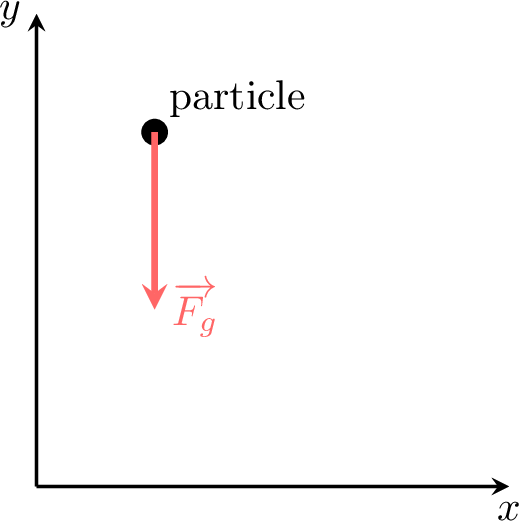
The force of gravity near the Earth's surface is \(\Vect{F_g} = \begin{pmatrix} 0 \\ -mg \end{pmatrix}\), where \(g \approx 9.8\) m/s² is the acceleration due to gravity. According to Newton's Second Law, \(\sum \Vect{F} = m\Vect{a}\). Since gravity is the only force, the acceleration vector \(\Vect{a}(t)\) is:$$ m\Vect{a} = \begin{pmatrix} 0 \\
-mg \end{pmatrix} \implies \Vect{a} = \begin{pmatrix} 0 \\
-g \end{pmatrix} = \begin{pmatrix} 0 \\
-9.8 \end{pmatrix} \text{ m/s²} $$ The acceleration is constant and directed downwards. To find the velocity vector \(\Vect{v}(t)\), we integrate the acceleration vector:$$ \Vect{v}(t) = \int \Vect{a}(t)\, \mathrm{d}t = \int \begin{pmatrix} 0 \\
-9.8 \end{pmatrix} \mathrm{d}t = \begin{pmatrix} C_1 \\
-9.8t + C_2 \end{pmatrix} $$ We use the initial condition \(\Vect{v}(0) = \begin{pmatrix} 20 \\ 30 \end{pmatrix}\) to find the constants of integration \(C_1\) and \(C_2\):$$ \begin{pmatrix} 20 \\
30 \end{pmatrix} = \begin{pmatrix} C_1 \\
-9.8(0) + C_2 \end{pmatrix} \implies \begin{pmatrix} C_1 \\
C_2 \end{pmatrix} = \begin{pmatrix} 20 \\
30 \end{pmatrix} $$ Therefore, the velocity vector at time \(t\) is \(\Vect{v}(t) = \begin{pmatrix} 20 \\ 30 - 9.8t \end{pmatrix}\) m/s.
Method — Studying a Motion in the Plane
An object moves in the plane with position vector \(\Vect{r}(t) = \begin{pmatrix} x(t) \\ y(t) \end{pmatrix}\): the functions \(x\) and \(y\) are its parametric equations. - Velocity: differentiate each coordinate, \(\Vect{v}(t) = \begin{pmatrix} \dot{x}(t) \\ \dot{y}(t) \end{pmatrix}\), where the dot denotes the derivative with respect to time. When \(\Vect{v}(t) \ne \Vect{0}\), the velocity is tangent to the path and points in the direction of motion.
- Speed: \(\|\Vect{v}(t)\| = \sqrt{\dot{x}(t)^2 + \dot{y}(t)^2}\).
- Direction of motion: the object is at rest when \(\Vect{v}(t) = \Vect{0}\). When it moves, \(\Vect{v}(t) \ne \Vect{0}\), it moves parallel to a nonzero vector \(\Vect{w}\) when \(\Vect{v}(t) = k\Vect{w}\) for a real \(k\), perpendicular to \(\Vect{w}\) when \(\Vect{v}(t) \cdot \Vect{w} = 0\), horizontally when \(\dot{y}(t) = 0\).
- From the velocity back to the position: integrate each coordinate and fix the constants with the initial position \(\Vect{r}(0)\) (in the same way, \(\Vect{v}\) is found from \(\Vect{a}\) and \(\Vect{v}(0)\)).
- Path: eliminate \(t\) between \(x(t)\) and \(y(t)\), for instance by writing \(t\) in terms of \(x\) when \(x(t)\) is strictly increasing, to obtain a Cartesian equation; the path is the part of this curve described for the allowed values of \(t\).
Example
A remote-controlled boat starts from the point \((1, 2)\) at \(t = 0\) and moves on a lake with velocity \(\Vect{v}(t) = \begin{pmatrix} 4 \\ 8 - 2t \end{pmatrix}\) m/s, for \(0 \le t \le 6\) seconds. Distances are in metres. - Find the position vector of the boat at time \(t\).
- Find the speed of the boat at \(t = 1\), and the time at which its speed is least.
- Find when and where the boat moves parallel to the \(x\)-axis, and when it moves parallel to the vector \(\begin{pmatrix} 1 \\ 1 \end{pmatrix}\).
- Find a Cartesian equation of the path of the boat.
- Integrating each coordinate of \(\Vect{v}\), then using \(\Vect{r}(0) = \begin{pmatrix} 1 \\ 2 \end{pmatrix}\): $$\begin{aligned}[t] \Vect{r}(t) &= \begin{pmatrix} 4t + C_1 \\ 8t - t^2 + C_2 \end{pmatrix} && \text{(antiderivative of each coordinate)}\\ &= \begin{pmatrix} 1 + 4t \\ 2 + 8t - t^2 \end{pmatrix} && \text{(\(\Vect{r}(0)\) gives \(C_1 = 1\), \(C_2 = 2\)).} \end{aligned}$$
- \(\Vect{v}(1) = \begin{pmatrix} 4 \\ 6 \end{pmatrix}\), so the speed is \(\sqrt{4^2 + 6^2} = \sqrt{52} \approx 7.21\) m/s. In general $$\|\Vect{v}(t)\| = \sqrt{16 + (8 - 2t)^2},$$ least when \((8 - 2t)^2 = 0\), at \(t = 4\): the least speed is \(\sqrt{16} = 4\) m/s.
- Parallel to the \(x\)-axis: \(\dot{y}(t) = 8 - 2t = 0\) at \(t = 4\) (and \(\dot{x} = 4 \ne 0\)), when the boat is at \(\Vect{r}(4) = \begin{pmatrix} 17 \\ 18 \end{pmatrix}\), the point \((17, 18)\).
Parallel to \(\begin{pmatrix} 1 \\ 1 \end{pmatrix}\): \(\Vect{v}(t) = k\begin{pmatrix} 1 \\ 1 \end{pmatrix}\) needs \(4 = 8 - 2t\), so \(t = 2\), with \(\Vect{v}(2) = \begin{pmatrix} 4 \\ 4 \end{pmatrix}\), \(k = 4\). - From \(x = 1 + 4t\), \(t = \dfrac{x - 1}{4}\), and $$\begin{aligned}[t] y &= 2 + 8 \times \frac{x - 1}{4} - \left(\frac{x - 1}{4}\right)^2\\
&= \frac{-x^2 + 34x - 1}{16}, \end{aligned}$$ for \(1 \le x \le 25\) (the values of \(x = 1 + 4t\) for \(0 \le t \le 6\)): the path is an arc of a parabola, highest at \((17, 18)\), where the boat moves parallel to the \(x\)-axis.
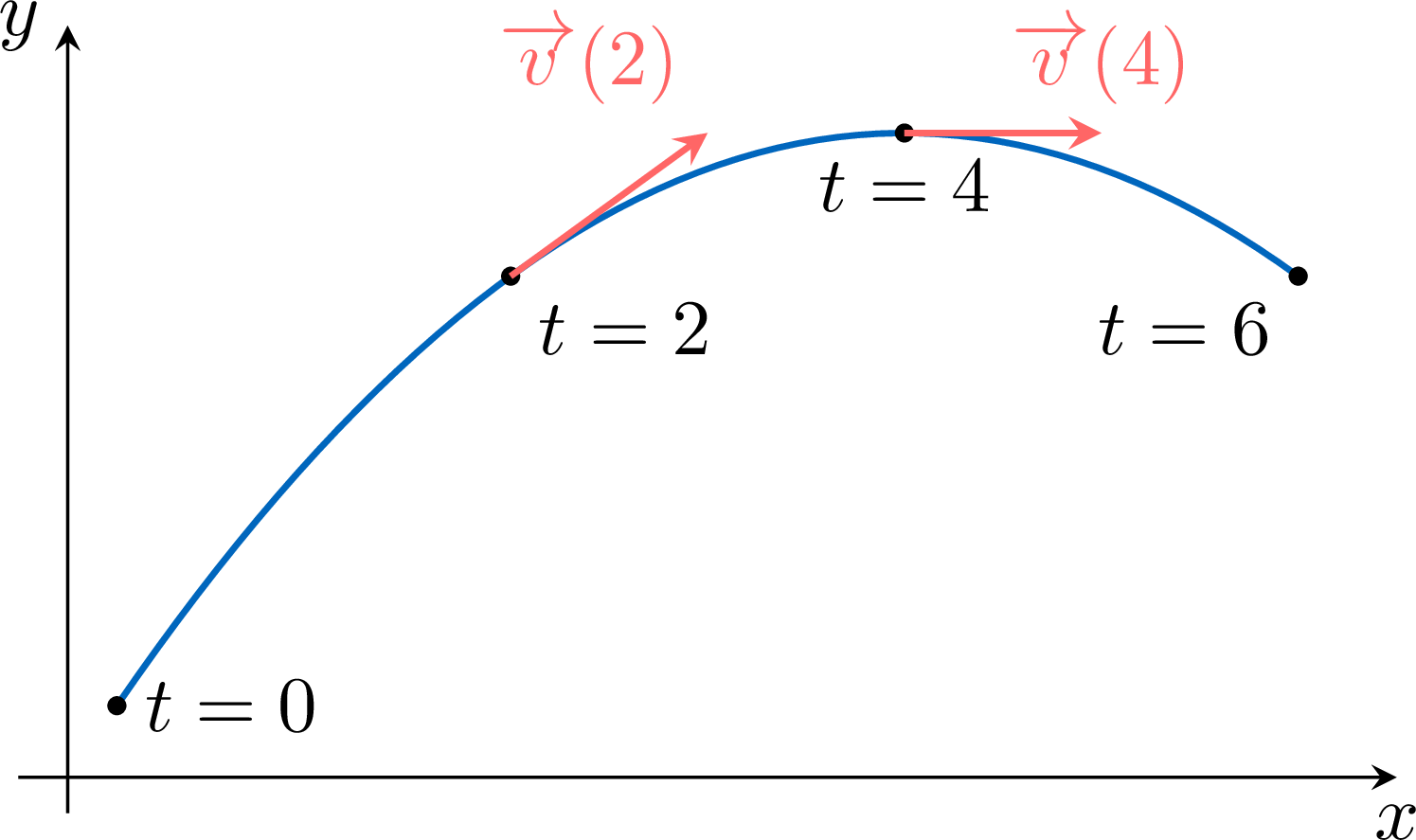
Time Shift
A second object that follows exactly the same motion as a first one, but starts \(k\) seconds later, is at time \(t\) where the first object was at time \(t - k\). If the first object has position \(\Vect{r}(t)\) from \(t = 0\), the second has position \(\Vect{r}(t - k)\) from \(t = k\): every coordinate is shifted in time by \(k\), and so is every interval of time. For example, the boat above released \(3\) seconds later is at \(\begin{pmatrix} 1 + 4(t - 3) \\ 2 + 8(t - 3) - (t - 3)^2 \end{pmatrix}\) for \(3 \le t \le 9\).
Skills to practice
- Interpreting the Velocity Vector
- Computing Velocity and Speed in the Plane
- Studying a Motion in the Plane
III.2
Projectile Motion
A projectile is an object launched into the air that then moves under gravity alone: a ball, a javelin, a jet of water. Air resistance is neglected, so the only force is the weight, and by Newton's second law the acceleration is constant. With the \(x\)-axis horizontal and the \(y\)-axis vertical, pointing upwards, $$\Vect{a} = \begin{pmatrix} 0 \\
-g \end{pmatrix}, \quad g \approx 9.8 \text{ m/s}^2:$$ the horizontal motion has no acceleration, the vertical motion a constant downward one.
Proposition — Equations of Projectile Motion
A projectile launched at \(t = 0\) from the point \((x_0, y_0)\) with initial velocity \(\Vect{v}_0 = \begin{pmatrix} a \\ b \end{pmatrix}\) has, while in flight, the velocity and the position $$\Vect{v}(t) = \begin{pmatrix} a \\
b - gt \end{pmatrix}, \qquad \begin{cases} x(t) = x_0 + at \\
y(t) = y_0 + bt - \frac{1}{2}gt^2. \end{cases}$$ When the projectile is launched with speed \(V\) at the angle of projection \(\theta\) above the horizontal, \(a = V\cos\theta\) and \(b = V\sin\theta\).
Integrating the acceleration coordinate by coordinate, $$\begin{aligned}[t] \Vect{v}(t) &= \begin{pmatrix} C_1 \\
-gt + C_2 \end{pmatrix} && \text{(antiderivatives of \(0\) and \(-g\))}\\
&= \begin{pmatrix} a \\
b - gt \end{pmatrix} && \text{(\(\Vect{v}(0) = \Vect{v}_0\) gives \(C_1 = a\), \(C_2 = b\)).} \end{aligned}$$ Integrating again, \(x(t) = at + D_1\) and \(y(t) = bt - \frac{1}{2}gt^2 + D_2\), and \(\Vect{r}(0) = \begin{pmatrix} x_0 \\ y_0 \end{pmatrix}\) gives \(D_1 = x_0\), \(D_2 = y_0\). Finally \(\Vect{v}_0\) has magnitude \(V\) and makes the angle \(\theta\) with the horizontal, so its coordinates are \(V\cos\theta\) and \(V\sin\theta\).
Method — Solving a Projectile Problem
- Write the equations \(x(t)\), \(y(t)\) and \(\Vect{v}(t)\) of the projectile, with the origin on the ground, so that \(y\) is the height above the ground.
- Greatest height: when \(b > 0\), the projectile rises until its vertical velocity is zero, \(\dot{y}(t) = b - gt = 0\), at \(t = \dfrac{b}{g}\), and the greatest height is \(y\left(\dfrac{b}{g}\right)\), provided it is still in flight then (when \(b \le 0\), it goes down from the start). At the top the velocity is horizontal, not zero, unless the launch is vertical (\(a = 0\)).
- Time of flight: solve \(y(t) = \) the height of the landing level (often \(y(t) = 0\)), a quadratic equation, and keep the root that corresponds to the landing: the positive root when the landing level is below the point of launch, the larger root when the projectile lands on its way down.
- Horizontal distance: \(|x(t) - x_0|\) at the time of landing.
- Speed and direction at a time \(t\): the speed is \(\|\Vect{v}(t)\|\). When \(\dot{x}(t) \ne 0\), the angle \(\alpha\) of the velocity with the horizontal satisfies \(\tan\alpha = \dfrac{|\dot{y}(t)|}{|\dot{x}(t)|}\), above the horizontal when \(\dot{y} > 0\), below when \(\dot{y} < 0\); the sign of \(\dot{x}\) tells whether the projectile moves in the direction of increasing or decreasing \(x\).
Example
A ball is kicked from a point \(1.5\) m above horizontal ground with initial velocity \(\Vect{v}_0 = \begin{pmatrix} 15 \\ 19.6 \end{pmatrix}\) m/s. The origin is on the ground, below the point of launch, and \(g = 9.8\) m/s\(^2\). - Find the launch speed and the angle of projection.
- Find the greatest height reached by the ball.
- Find the time of flight and the horizontal distance travelled.
- Find the speed of the ball when it hits the ground, and the angle at which it hits it.
By the equations of projectile motion, \(x(t) = 15t\), \(y(t) = 1.5 + 19.6t - 4.9t^2\) and \(\Vect{v}(t) = \begin{pmatrix} 15 \\ 19.6 - 9.8t \end{pmatrix}\). 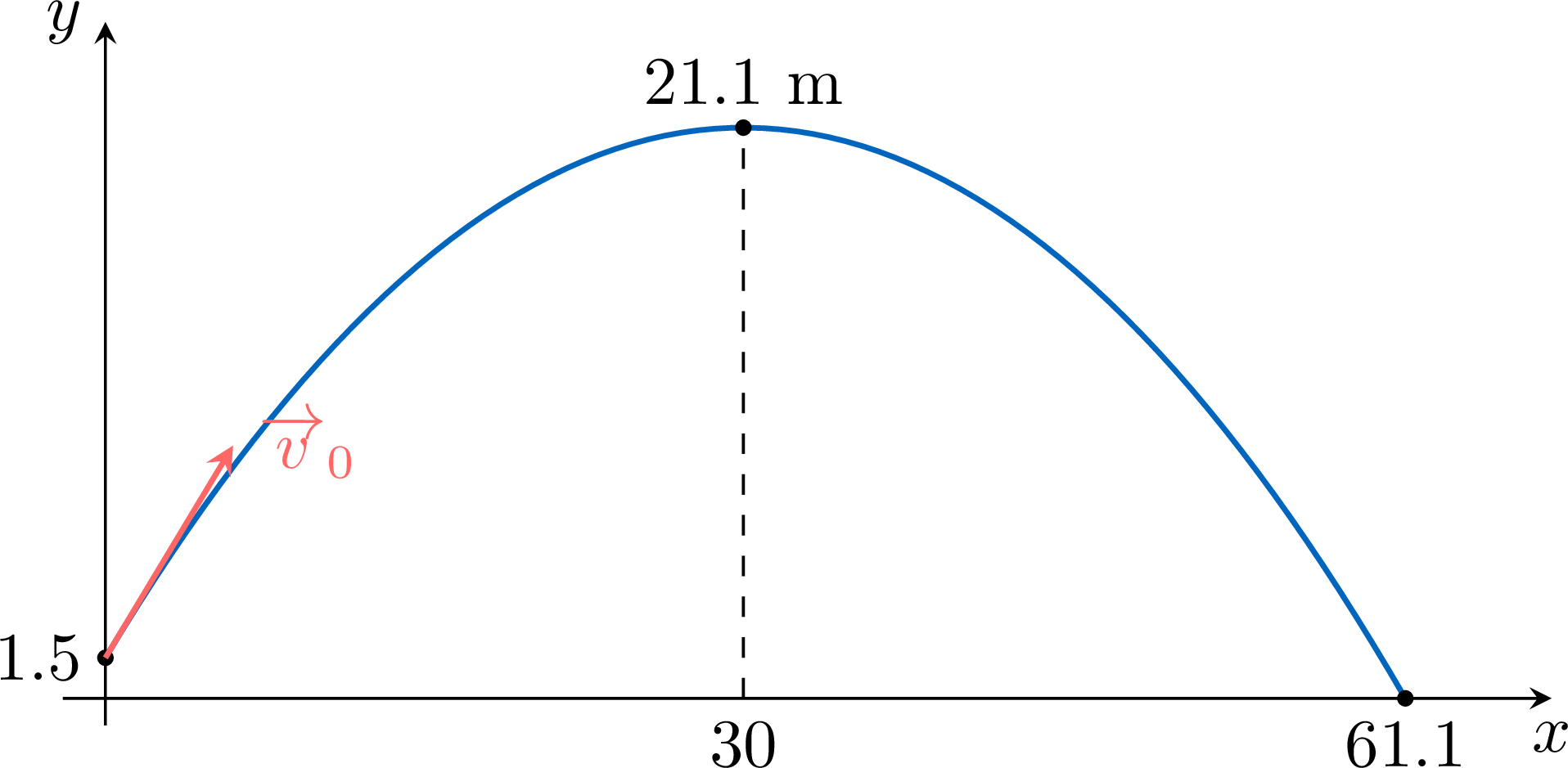
- The launch speed is \(\|\Vect{v}_0\| = \sqrt{15^2 + 19.6^2} = \sqrt{609.16} \approx 24.7\) m/s, and the angle of projection satisfies \(\tan\theta = \dfrac{19.6}{15}\), so \(\theta \approx 52.6^\circ\).
- \(\dot{y}(t) = 19.6 - 9.8t = 0\) at \(t = 2\), and \(y(2) = 1.5 + 39.2 - 19.6 = 21.1\): the greatest height is \(21.1\) m.
- The ball lands when \(y(t) = 0\): $$\begin{aligned}[t] 4.9t^2 - 19.6t - 1.5 = 0 &\iff t = \frac{19.6 \pm \sqrt{19.6^2 + 4 \times 4.9 \times 1.5}}{9.8} &&\text{(quadratic formula)}\\ &\iff t \approx 4.0751 \text{ or } t \approx -0.0751. \end{aligned}$$ The time of flight is about \(4.08\) s (the positive root), and the horizontal distance is \(x(4.0751) \approx 15 \times 4.0751 \approx 61.1\) m.
- At landing, \(\Vect{v} \approx \begin{pmatrix} 15 \\ 19.6 - 9.8 \times 4.0751 \end{pmatrix} \approx \begin{pmatrix} 15 \\ -20.34 \end{pmatrix}\). The speed is \(\sqrt{15^2 + 20.34^2} \approx 25.3\) m/s, and the angle \(\alpha\) below the horizontal satisfies \(\tan\alpha \approx \dfrac{20.34}{15}\), so \(\alpha \approx 53.6^\circ\).
Skills to practice
- Recognizing Projectile Motion
- Computing Projectile Quantities
- Solving Projectile Problems
III.3
Circular Motion
Proposition — Uniform Circular Motion
Let \(R > 0\) and \(\omega > 0\). The object with position vector $$\Vect{r}(t) = \begin{pmatrix} R\cos(\omega t) \\
R\sin(\omega t) \end{pmatrix}$$ moves anticlockwise on the circle of centre \(O\) and radius \(R\), and completes one turn in the period \(T = \dfrac{2\pi}{\omega}\). - Its velocity \(\Vect{v}(t) = R\omega\begin{pmatrix} -\sin(\omega t) \\ \cos(\omega t) \end{pmatrix}\) is perpendicular to the radius, \(\Vect{v}(t) \cdot \Vect{r}(t) = 0\), so tangent to the circle, and its speed is constant: \(\|\Vect{v}(t)\| = R\omega\).
- Its acceleration \(\Vect{a}(t) = -\omega^2\,\Vect{r}(t)\) points towards the centre, with constant magnitude \(\|\Vect{a}(t)\| = R\omega^2 = \dfrac{\|\Vect{v}\|^2}{R}\).
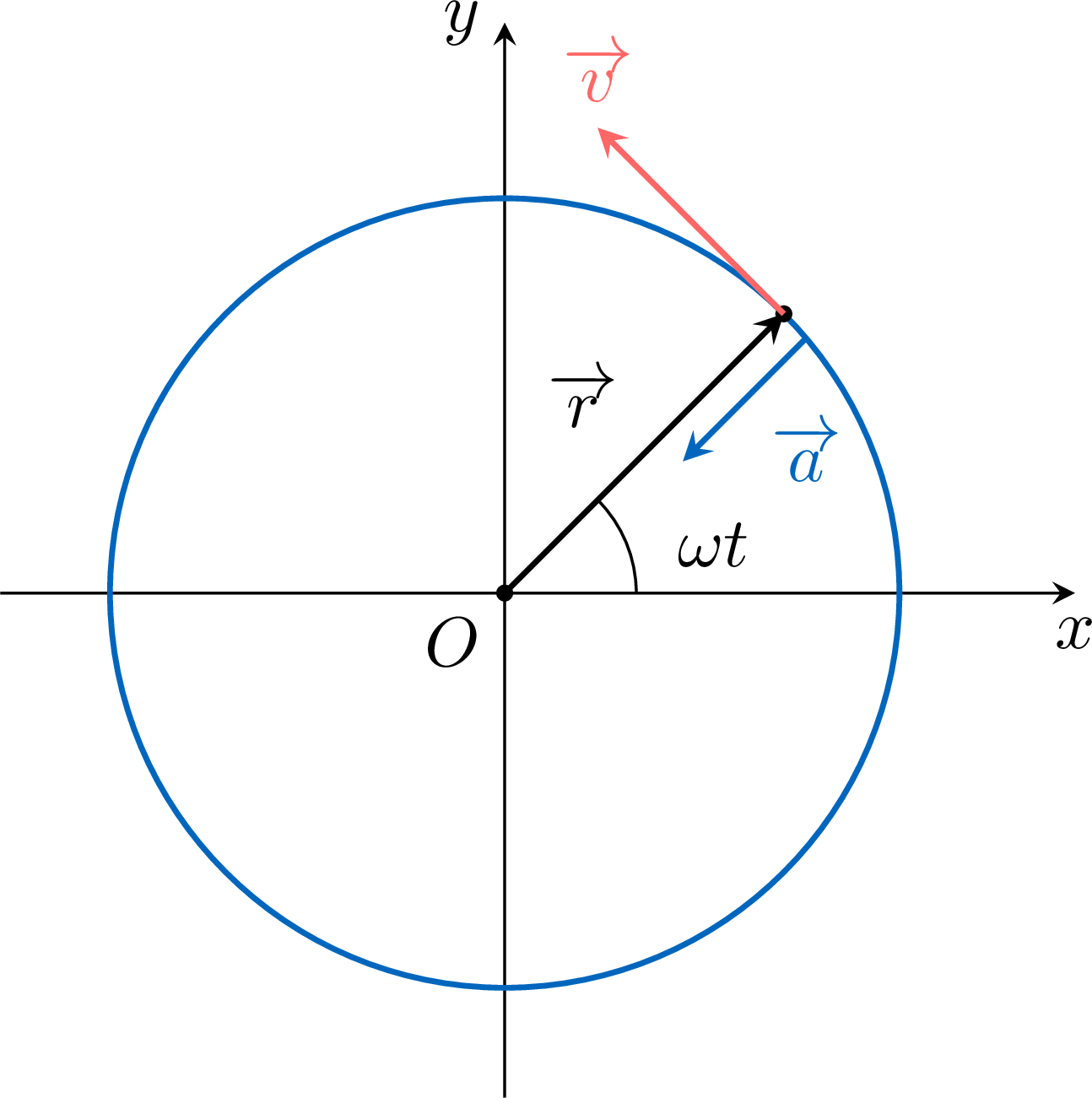
\(x(t)^2 + y(t)^2 = R^2\left(\cos^2(\omega t) + \sin^2(\omega t)\right) = R^2\): the object stays on the circle of centre \(O\) and radius \(R\), at the angle \(\omega t\) from the \(x\)-axis, which increases (anticlockwise) and grows by \(2\pi\) when \(t\) grows by \(\frac{2\pi}{\omega}\). Differentiating with the chain rule, \(\Vect{v}(t) = \begin{pmatrix} -R\omega\sin(\omega t) \\ R\omega\cos(\omega t) \end{pmatrix}\), and $$\begin{aligned}[t] \Vect{v}(t) \cdot \Vect{r}(t) &= -R^2\omega\sin(\omega t)\cos(\omega t) + R^2\omega\cos(\omega t)\sin(\omega t) = 0,\\
\|\Vect{v}(t)\| &= R\omega\sqrt{\sin^2(\omega t) + \cos^2(\omega t)} = R\omega. \end{aligned}$$ Differentiating again, \(\Vect{a}(t) = \begin{pmatrix} -R\omega^2\cos(\omega t) \\ -R\omega^2\sin(\omega t) \end{pmatrix} = -\omega^2\,\Vect{r}(t)\), a negative multiple of \(\Vect{r}(t)\), so directed from the object towards \(O\), and \(\|\Vect{a}(t)\| = \omega^2 R = \dfrac{(R\omega)^2}{R}\).
Example
A car drives round a circular track. Its position vector is \(\Vect{r}(t) = \begin{pmatrix} 40\cos(0.25t) \\ 40\sin(0.25t) \end{pmatrix}\), in metres, where \(t \ge 0\) is the time in seconds. - Find the radius of the track and the time the car takes for one lap.
- Find the velocity vector and the speed of the car.
- Find the position, the velocity and the acceleration of the car at \(t = 2\pi\), and check that the acceleration points towards the centre of the track.
This is uniform circular motion with \(R = 40\) and \(\omega = 0.25\). 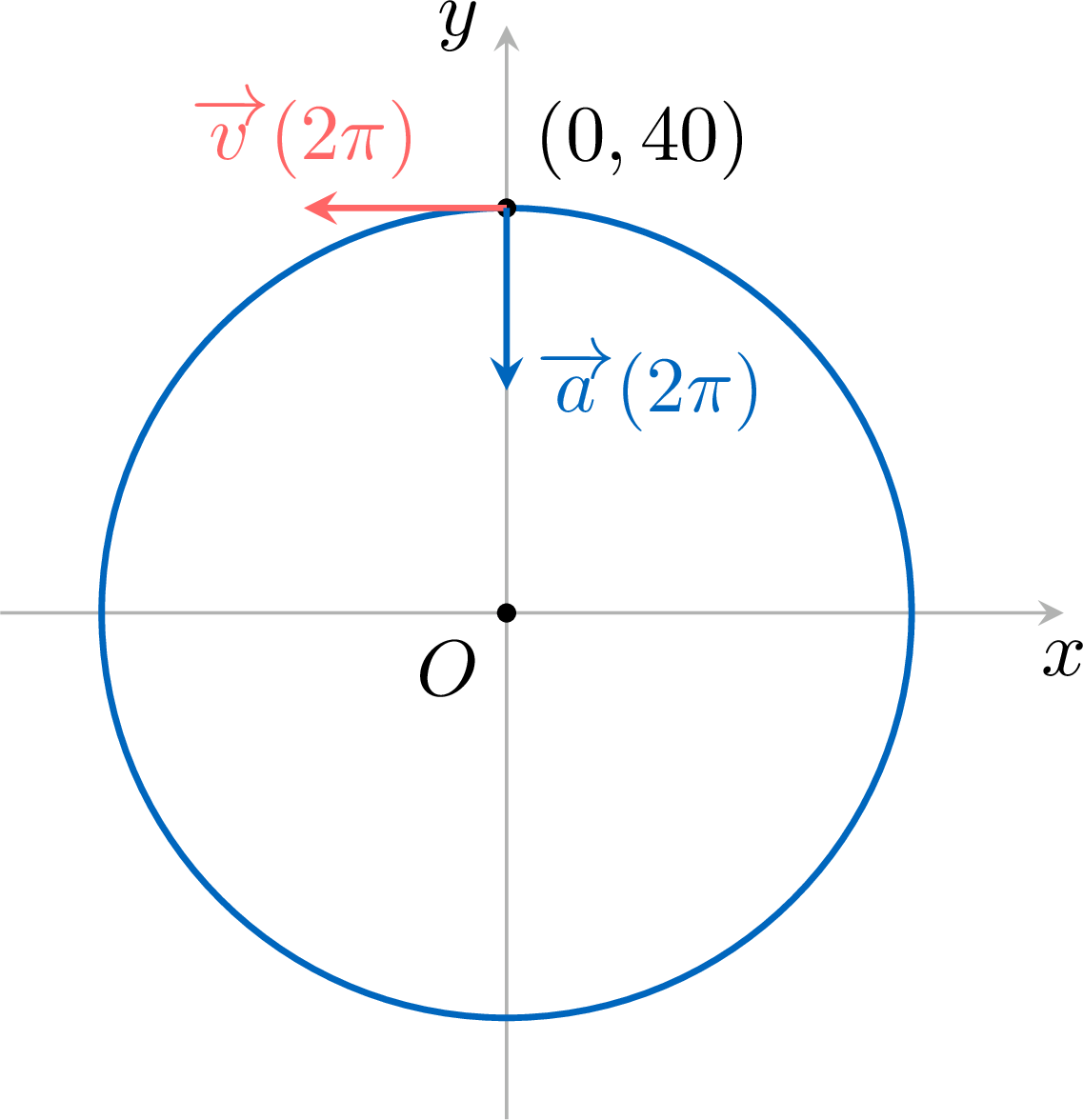
- The radius is \(40\) m, and one lap takes \(T = \dfrac{2\pi}{0.25} = 8\pi \approx 25.1\) s.
- \(\Vect{v}(t) = \begin{pmatrix} -10\sin(0.25t) \\ 10\cos(0.25t) \end{pmatrix}\) (chain rule), and the speed is constant: \(\|\Vect{v}\| = R\omega = 40 \times 0.25 = 10\) m/s.
- At \(t = 2\pi\), \(0.25t = \dfrac{\pi}{2}\), so $$\Vect{r}(2\pi) = \begin{pmatrix} 0 \\ 40 \end{pmatrix}, \quad \Vect{v}(2\pi) = \begin{pmatrix} -10 \\ 0 \end{pmatrix}, \quad \Vect{a}(2\pi) = -0.25^2\begin{pmatrix} 0 \\ 40 \end{pmatrix} = \begin{pmatrix} 0 \\ -2.5 \end{pmatrix}.$$ The car is at the top of the track, moving in the negative \(x\)-direction; its acceleration points straight down, from \((0, 40)\) towards the centre \(O\), with magnitude \(2.5 = \dfrac{10^2}{40}\) m/s\(^2\).
Skills to practice
- Computing Circular Motion Quantities
- Studying Circular Motion
IV
Going further
Skills to practice
- Solving Problems
- Reasoning and Writing Mathematics
- Quiz
Jump to section