International Baccalaureate · DP 2: Applications and Interpretation HL
Vector Applications
I
Equations of Lines
I.1
Direction Vectors
Definition — Direction Vector
A non-zero vector \(\vec{u}\) is a direction vector of a line \(d\) if there exist two distinct points \(A\) and \(B\) on \(d\) such that \(\Vect{u} = \Vect{AB}\). 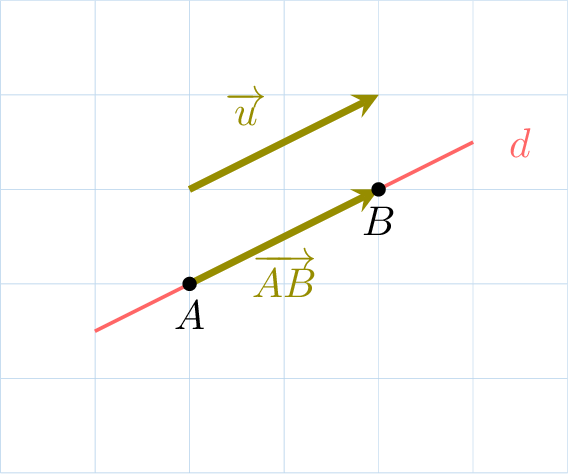
Proposition — Multiple Direction Vectors
A line has an infinite number of direction vectors. If \(\vec{u}\) is a direction vector of line \(d\), then any vector \(k\vec{u}\) (where \(k \neq 0\)) is also a direction vector of \(d\). Definition — Line defined by Point and Vector
The line \(d\) passing through point \(A\) with direction vector \(\vec{u}\) is the set of all points \(M\) such that the vectors \(\Vect{AM}\) and \(\vec{u}\) are collinear.$$\Vect{AM} = k\vec{u} \quad \text{for some } k \in \mathbb{R}$$ Skills to practice
- Direction Vectors
I.2
Vector Equation of a Line
The position of any point on a line can be described by a starting point and a direction of travel. In vector terms, this means that the position vector of any point on the line can be reached by starting with the position vector of a known point and adding a scalar multiple of the line's direction vector. This principle allows us to define a line in both two and three dimensions.
Definition — Vector Equation of a Line
The vector equation of the line is:$$ \textcolor{olive}{\Vect{r}} = \textcolor{colordef}{\Vect{a}} + \textcolor{colorprop}{\lambda\Vect{b}}, \quad \lambda \in \R $$ 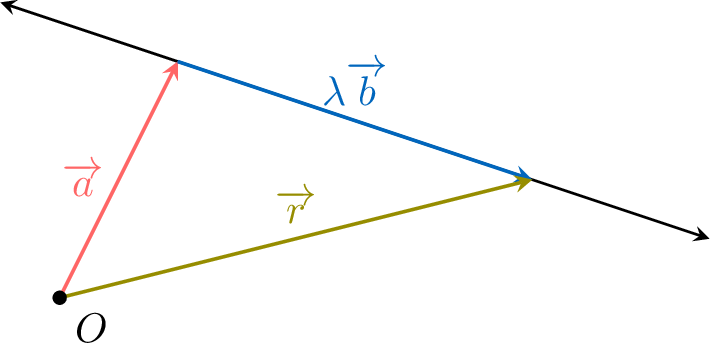
Example
Find the vector equation of the line passing through the point \(A(2, -1)\) with direction vector \(\Vect{b} = \begin{pmatrix} 3 \\ 4 \end{pmatrix}\).
The vector equation is given by \(\Vect{r} = \Vect{a} + \lambda\Vect{b}\). Substituting the point and direction:$$ \Vect{r} = \begin{pmatrix} 2 \\
-1 \end{pmatrix} + \lambda \begin{pmatrix} 3 \\
4 \end{pmatrix}, \quad \lambda \in \R $$ 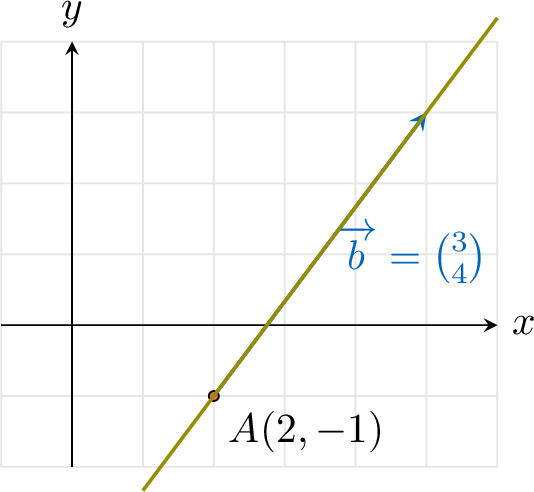
Skills to practice
- Locating Points on a Line
I.3
Parametric Equations
Definition — Parametric Equations of a Line
The parametric equations of a line passing through a point \(A(a_1, a_2, a_3)\) with direction vector \(\Vect{b} = \begin{pmatrix} b_1 \\ b_2 \\ b_3 \end{pmatrix}\) are given by the system:$$ \begin{cases} x = a_1 + \lambda b_1 \\
y = a_2 + \lambda b_2 \\
z = a_3 + \lambda b_3 \end{cases} $$ where the variable \(\lambda \in \mathbb{R}\) is the parameter. Example
Determine the parametric equations of the line passing through \(A(1, -2, 5)\) and \(B(3, 4, -1)\).
First, calculate the direction vector \(\Vect{AB} = \begin{pmatrix} 3-1 \\ 4-(-2) \\ -1-5 \end{pmatrix} = \begin{pmatrix} 2 \\ 6 \\ -6 \end{pmatrix}\).
Using point \(A(1, -2, 5)\) and the direction vector, the equations are:$$ \begin{cases} x = 1 + 2\lambda \\ y = -2 + 6\lambda \\ z = 5 - 6\lambda \end{cases} $$ 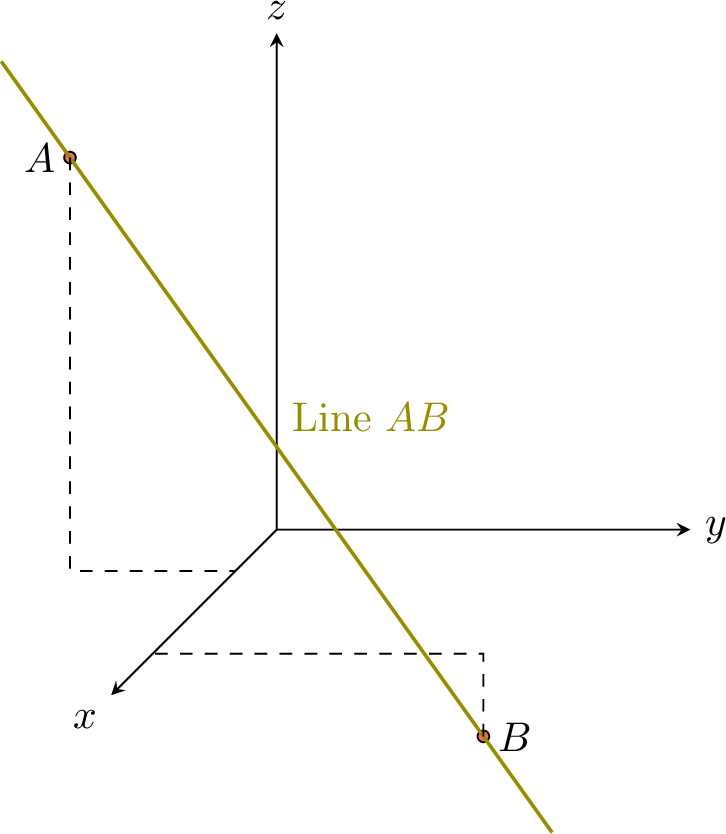
Using point \(A(1, -2, 5)\) and the direction vector, the equations are:$$ \begin{cases} x = 1 + 2\lambda \\ y = -2 + 6\lambda \\ z = 5 - 6\lambda \end{cases} $$
Example
In a coordinate system, \(A(2, 0, -1)\) and \(B(3, 2, 1)\). Determine a parametric representation of the line \((AB)\), then decide whether the point \(C(4, 4, 3)\) belongs to it.
The vector \(\Vect{AB}(3 - 2, 2 - 0, 1 - (-1)) = (1, 2, 2)\) is a direction vector of \((AB)\). With the point \(A\): $$\begin{cases} x = 2 + t \\
y = 2t \\
z = -1 + 2t \end{cases}, \qquad t \in \mathbb{R}.$$ The point \(C\) belongs to \((AB)\) if one value of \(t\) gives its three coordinates: \(2 + t = 4\) gives \(t = 2\), and then \(y = 2 \times 2 = 4\) and \(z = -1 + 2 \times 2 = 3\), which are the coordinates of \(C\). So \(C\) belongs to \((AB)\); it is the point of parameter \(t = 2\).
Skills to practice
- Reading Vector and Parametric Equations
- Writing Equations of Lines
- Using Parametric Equations
I.4
Cartesian Equation of a Line in the Plane
In two dimensions, a line can also be defined by a normal vector. Let \(\Vect{n}\) be a normal vector to the line's direction, so that \(\Vect{b} \cdot \Vect{n} = 0\).Starting from the vector equation ,\(\Vect{r} = \Vect{a} + \lambda\Vect{b}\), we take the scalar product of both sides with the normal vector \(\Vect{n}\):$$ \begin{aligned} \Vect{r}\cdot \Vect{n} &= (\lambda\Vect{b}+\Vect{a} ) \cdot \Vect{n} \\
\Vect{r}\cdot \Vect{n} &= \lambda\Vect{b}\cdot \Vect{n}+\Vect{a} \cdot \Vect{n}&&\text{(distributivity)} \\
\Vect{r}\cdot \Vect{n} &= \Vect{a} \cdot \Vect{n}&&(\Vect{b} \cdot \Vect{n} = 0) \\
\end{aligned} $$ If we let \(\Vect{r} = \begin{pmatrix} x \\ y \end{pmatrix}\) and the normal vector \(\Vect{n} = \begin{pmatrix} a \\ b \end{pmatrix}\), the expression \(\Vect{r} \cdot \Vect{n}\) becomes \(ax+by\). The term \(\Vect{a} \cdot \Vect{n}\) is a constant, which we can call \(C\). This leads to the familiar Cartesian form.
Definition — Cartesian Equation of a Line in 2D
The Cartesian equation of a line in 2D with normal vector \(\Vect{n} = \begin{pmatrix} a \\ b \end{pmatrix} \neq \Vect{0}\) is given by:$$ ax + by = C $$ where \(C\) is a constant. 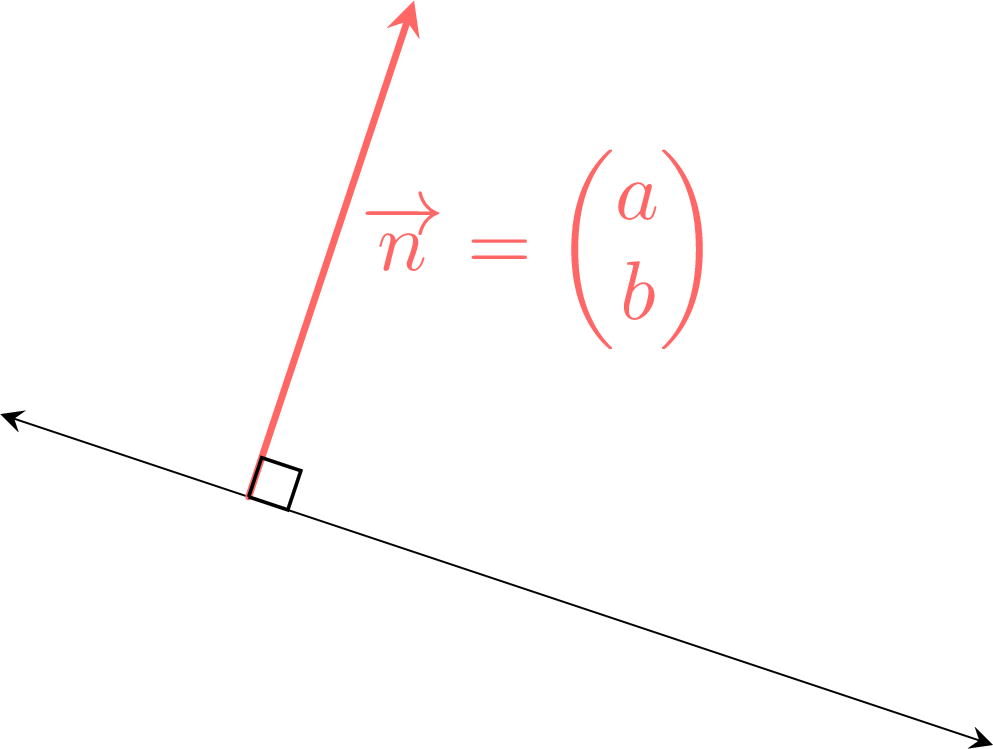
Example
Find the Cartesian equation of the line passing through point \(P(1, 4)\) with normal vector \(\Vect{n} = \begin{pmatrix} 2 \\ -5 \end{pmatrix}\).
The equation is of the form \(2x - 5y = C\). Using point \(P(1,4)\) to find \(C\):$$ 2(1) - 5(4) = C \implies 2 - 20 = C \implies C = -18 $$ The Cartesian equation is \(2x - 5y = -18\). 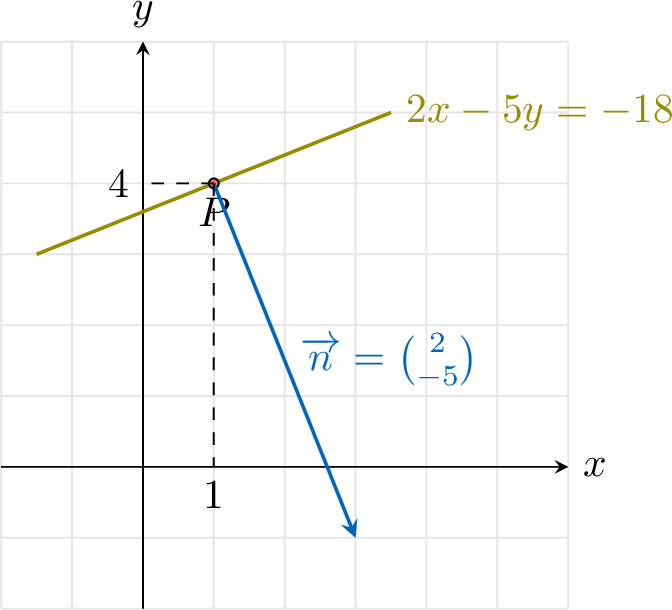
Skills to practice
- Cartesian Equation of a Line in the Plane
II
Distances and Angles Between Lines
II.1
Shortest Distance from a Point to a Line
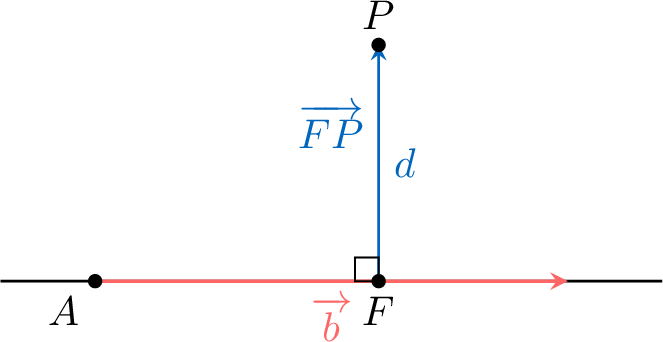
When calculating the shortest distance from a point \(P\) to a line, we are looking for the perpendicular distance.
- In 2D, we can find the foot of the perpendicular \(F\) on the line such that \(\Vect{PF} \cdot \Vect{b} = 0\), where \(\Vect{b}\) is the direction vector of the line. The distance is then the magnitude \(\lVert \Vect{PF} \rVert\).
- In 3D, vector methods involving the cross product are most efficient.
Method — Distance from a Point to a Line in 2D
To find the shortest distance from a point \(P\) to a line passing through \(A\) with direction vector \(\Vect{b}\): - Let \(F\) be a generic point on the line: \(\Vect{f} = \Vect{a} + \lambda \Vect{b}\).
- The vector \(\Vect{PF}\) is perpendicular to the line, so \(\Vect{PF} \cdot \Vect{b} = 0\).
- Solve for \(\lambda\) to find the coordinates of \(F\).
- The shortest distance is \(d = \lVert \Vect{PF} \rVert\).
Example
Find the shortest distance from \(P(1, 4)\) to the line \(\Vect{r} = \begin{pmatrix} 0 \\ -1 \end{pmatrix} + \lambda \begin{pmatrix} 1 \\ 1 \end{pmatrix}\).
Let \(F\) be the foot of the perpendicular on the line. 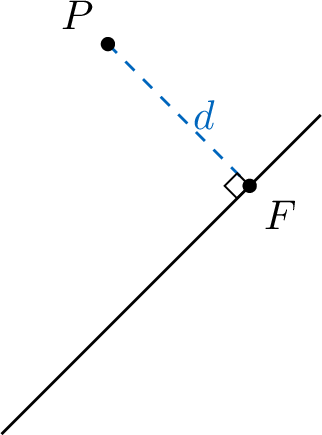
- The coordinates of \(F\) are \((\lambda, -1+\lambda)\).
- The vector \(\Vect{PF} = \begin{pmatrix} \lambda - 1 \\ (-1+\lambda) - 4 \end{pmatrix} = \begin{pmatrix} \lambda - 1 \\ \lambda - 5 \end{pmatrix}\).
- Since \(\Vect{PF} \perp \Vect{b}\), the dot product is zero: $$ \begin{pmatrix} \lambda - 1 \\ \lambda - 5 \end{pmatrix} \cdot \begin{pmatrix} 1 \\ 1 \end{pmatrix} = 0 $$ $$ (\lambda - 1)(1) + (\lambda - 5)(1) = 0 \implies 2\lambda - 6 = 0 \implies \lambda = 3 $$
- Substitute \(\lambda = 3\) back into \(\Vect{PF}\): \(\Vect{PF} = \begin{pmatrix} 3-1 \\ 3-5 \end{pmatrix} = \begin{pmatrix} 2 \\ -2 \end{pmatrix}\).
- The distance is \(d = \sqrt{2^2 + (-2)^2} = \sqrt{8} = 2\sqrt{2}\).
Proposition — Distance from a Point to a Line in 3D
The shortest distance \(d\) from a point \(P\) to a line passing through point \(A\) with direction vector \(\Vect{b}\) is given by:$$ d = \frac{\left\lVert \Vect{AP} \times \Vect{b} \right\rVert}{\left\lVert \Vect{b} \right\rVert} $$ Example
Find the distance from the point \(P(3, 1, 1)\) to the line passing through \(A(1, 2, 3)\) with direction vector \(\Vect{b} = \begin{pmatrix} 1 \\ 0 \\ -1 \end{pmatrix}\). - First, find \(\Vect{AP} = \begin{pmatrix} 3-1 \\ 1-2 \\ 1-3 \end{pmatrix} = \begin{pmatrix} 2 \\ -1 \\ -2 \end{pmatrix}\).
- Calculate the cross product \(\Vect{AP} \times \Vect{b} = \begin{pmatrix} 2 \\ -1 \\ -2 \end{pmatrix} \times \begin{pmatrix} 1 \\ 0 \\ -1 \end{pmatrix} = \begin{pmatrix} (-1)\cdot (-1)-(-2)\cdot (0) \\ (-2)\cdot (1)-(2)\cdot (-1) \\ (2)\cdot (0)-(-1)\cdot (1) \end{pmatrix} = \begin{pmatrix} 1 \\ 0 \\ 1 \end{pmatrix}\).
- Calculate the magnitude \(\lVert \Vect{AP} \times \Vect{b} \rVert = \sqrt{1^2 + 0^2 + 1^2} = \sqrt{2}\).
- Calculate \(\lVert \Vect{b} \rVert = \sqrt{1^2 + 0^2 + (-1)^2} = \sqrt{2}\).
- The distance is \(d = \frac{\sqrt{2}}{\sqrt{2}} = 1\).
Skills to practice
- Calculating the Shortest Distance from a Point to a Line
II.2
Intersecting Lines
Two Lines and Their Positions
In the plane, two lines are either intersecting (one common point), parallel and distinct (no common point) or coincident (the same line). Space adds a fourth case: two lines that are not parallel and have no common point. No plane contains both of them; they are called skew lines. In the cube below, the edges \(\Segment{AB}\) and \(\Segment{CG}\) are carried by skew lines: they never meet, and they do not have the same direction. 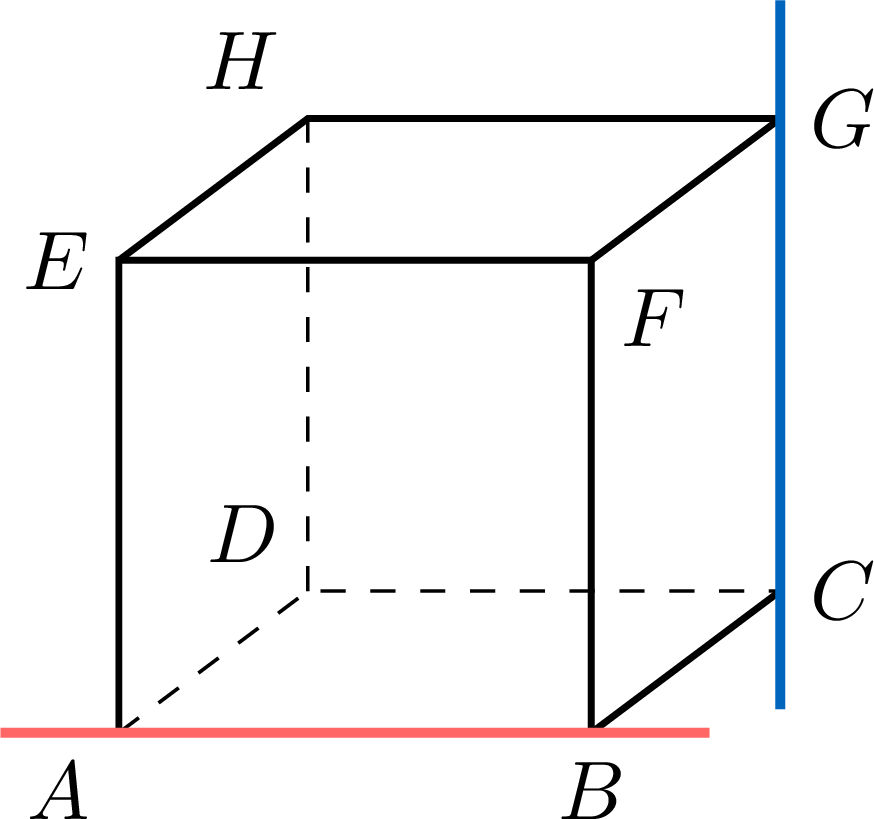
With vector equations, the question “do the lines meet?” becomes a system of equations in the two parameters.
Method — Deciding Whether Two Lines Meet
Let \(d_1: \Vect{r} = \Vect{a}_1 + \lambda\Vect{b}_1\) and \(d_2: \Vect{r} = \Vect{a}_2 + \mu\Vect{b}_2\), with two different parameters: the two points need not be reached for the same value. - Compare the directions. If \(\Vect{b}_2\) is a multiple of \(\Vect{b}_1\), the lines are parallel: they are coincident if the point \(A_2\) lies on \(d_1\), parallel and distinct otherwise.
- Otherwise, equate the coordinates of the two points: \(\Vect{a}_1 + \lambda\Vect{b}_1 = \Vect{a}_2 + \mu\Vect{b}_2\) gives one equation per coordinate, with the two unknowns \(\lambda\) and \(\mu\). Solve two of them that determine \(\lambda\) and \(\mu\) (if a pair gives no single solution, take another pair), by elimination or with the equation solver of a calculator.
- In space, test the third equation with these values. If it holds, the lines meet: the common point is given by \(\lambda\) on \(d_1\), and \(\mu\) on \(d_2\) gives the same point (a check). If it fails, the lines have no common point: they are skew.
Example
Find the point where the lines \(d_1: \Vect{r} = \begin{pmatrix} 1 \\ 5 \end{pmatrix} + \lambda \begin{pmatrix} 1 \\ -2 \end{pmatrix}\) and \(d_2: \Vect{r} = \begin{pmatrix} 1 \\ -2 \end{pmatrix} + \mu \begin{pmatrix} 2 \\ 3 \end{pmatrix}\) meet.
The direction vectors \(\begin{pmatrix} 1 \\ -2 \end{pmatrix}\) and \(\begin{pmatrix} 2 \\ 3 \end{pmatrix}\) are not multiples of each other (the first components would need the factor \(2\), the second ones the factor \(-\frac{3}{2}\)): the lines are not parallel, so they meet. A common point satisfies $$\begin{cases} 1 + \lambda = 1 + 2\mu & (1) \\
5 - 2\lambda = -2 + 3\mu & (2) \end{cases}$$ Equation (1) gives \(\lambda = 2\mu\). Substituting in (2): $$\begin{aligned}[t] 5 - 4\mu &= -2 + 3\mu && \text{(substitution of } \lambda = 2\mu\text{)}\\
7 &= 7\mu, \end{aligned}$$ so \(\mu = 1\) and \(\lambda = 2\). On \(d_1\), \(\lambda = 2\) gives the point \((1 + 2, 5 - 4) = \mathbf{(3, 1)}\). Check on \(d_2\) with \(\mu = 1\): \((1 + 2, -2 + 3) = (3, 1)\).
Example
Show that the lines \(d_1: \Vect{r} = \begin{pmatrix} 1 \\ 0 \\ 1 \end{pmatrix} + \lambda \begin{pmatrix} 2 \\ -1 \\ 3 \end{pmatrix}\) and \(d_2: \Vect{r} = \begin{pmatrix} 5 \\ 3 \\ 2 \end{pmatrix} + \mu \begin{pmatrix} 1 \\ 2 \\ -1 \end{pmatrix}\) meet, and find their common point.
The direction vectors are not multiples of each other (\(2 = 2 \times 1\) but \(-1 \neq 2 \times 2\)): the lines are not parallel. A common point satisfies $$\begin{cases} 1 + 2\lambda = 5 + \mu & (1) \\
-\lambda = 3 + 2\mu & (2) \\
1 + 3\lambda = 2 - \mu & (3) \end{cases}$$ Equation (1) gives \(\mu = 2\lambda - 4\). Substituting in (2): $$\begin{aligned}[t] -\lambda &= 3 + 2(2\lambda - 4) && \text{(substitution)}\\
-\lambda &= 4\lambda - 5\\
\lambda &= 1, \end{aligned}$$ and then \(\mu = 2 - 4 = -2\). Equation (3) with these values: \(1 + 3 \times 1 = 4\) and \(2 - (-2) = 4\). It holds, so the lines meet. On \(d_1\), \(\lambda = 1\) gives the point \((1 + 2, 0 - 1, 1 + 3) = \mathbf{(3, -1, 4)}\). Check on \(d_2\) with \(\mu = -2\): \((5 - 2, 3 - 4, 2 + 2) = (3, -1, 4)\).
Example
Show that the lines \(d_1: \Vect{r} = \begin{pmatrix} 1 \\ 0 \\ -2 \end{pmatrix} + \lambda \begin{pmatrix} 1 \\ 1 \\ 2 \end{pmatrix}\) and \(d_2: \Vect{r} = \begin{pmatrix} -1 \\ 2 \\ 3 \end{pmatrix} + \mu \begin{pmatrix} 3 \\ -1 \\ 1 \end{pmatrix}\) are skew.
Two conditions are needed: the lines are not parallel, and they have no common point.
- The direction vectors are not multiples of each other: the first components would need the factor \(3\), the second ones the factor \(-1\). The lines are not parallel.
- A common point would satisfy $$\begin{cases} 1 + \lambda = -1 + 3\mu & (1) \\ \lambda = 2 - \mu & (2) \\ -2 + 2\lambda = 3 + \mu & (3) \end{cases}$$ Substituting (2) in (1): \(3 - \mu = -1 + 3\mu\), so \(\mu = 1\) and \(\lambda = 1\). Equation (3) with these values: \(-2 + 2 = 0\) but \(3 + 1 = 4\), and \(0 \neq 4\). The system has no solution: the lines have no common point.
Skills to practice
- Recognizing the Relative Position of Two Lines
- Finding the Point of Intersection of Two Lines
- Deciding Whether Two Lines Meet
II.3
Angle Between Two Lines
Two intersecting lines form four angles: two equal acute angles and two equal obtuse angles, or four right angles. The angle between the two lines is the acute or right one, a measure \(\theta\) with \(0^\circ \le \theta \le 90^\circ\); two parallel lines make an angle of \(0^\circ\). Two lines of space that do not meet and are not parallel (skew lines) also have an angle: only their directions count, so it is the angle between two intersecting lines parallel to them.
With direction vectors \(\Vect{b}_1\) and \(\Vect{b}_2\), the angle \(\varphi\) between the vectors lies between \(0^\circ\) and \(180^\circ\) and depends on the direction chosen on each line: replacing \(\Vect{b}_2\) by \(-\Vect{b}_2\) describes the same line but changes \(\varphi\) into \(180^\circ - \varphi\). The angle between the lines is the one of \(\varphi\) and \(180^\circ - \varphi\) that is at most \(90^\circ\). 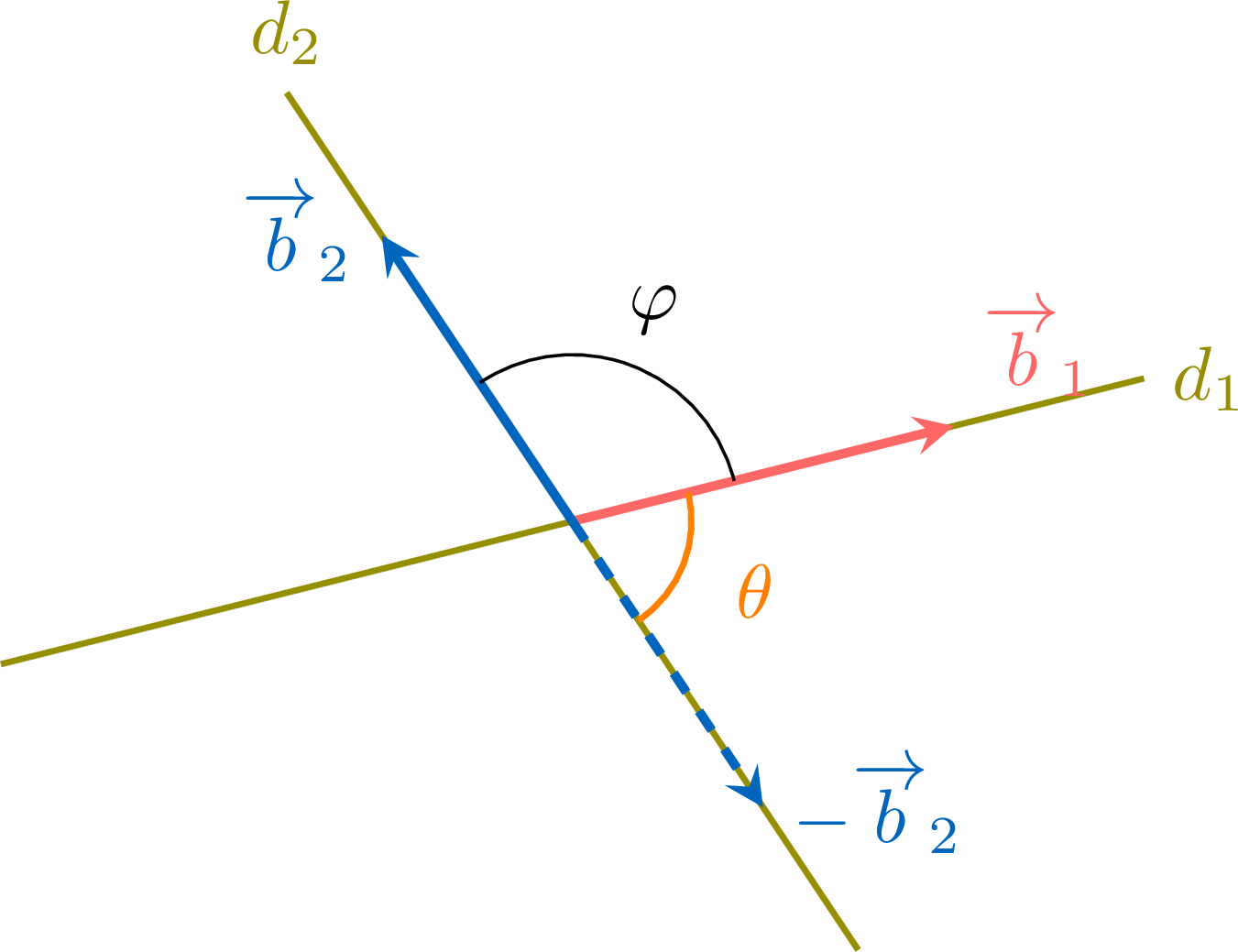
With direction vectors \(\Vect{b}_1\) and \(\Vect{b}_2\), the angle \(\varphi\) between the vectors lies between \(0^\circ\) and \(180^\circ\) and depends on the direction chosen on each line: replacing \(\Vect{b}_2\) by \(-\Vect{b}_2\) describes the same line but changes \(\varphi\) into \(180^\circ - \varphi\). The angle between the lines is the one of \(\varphi\) and \(180^\circ - \varphi\) that is at most \(90^\circ\).
Proposition — Angle Between Two Lines
Let \(d_1\) and \(d_2\) be two lines of the plane or of space, with direction vectors \(\Vect{b}_1\) and \(\Vect{b}_2\) (non-zero, as every direction vector). The angle \(\theta\) between \(d_1\) and \(d_2\), with \(0^\circ \le \theta \le 90^\circ\), is given by $$\cos\theta = \frac{\left|\Vect{b}_1 \cdot \Vect{b}_2\right|}{\left\lVert \Vect{b}_1 \right\rVert \left\lVert \Vect{b}_2 \right\rVert}.$$ In particular, the lines are perpendicular (in space, orthogonal when they do not meet) exactly when \(\Vect{b}_1 \cdot \Vect{b}_2 = 0\).
Let \(\varphi\) be the angle between the vectors \(\Vect{b}_1\) and \(\Vect{b}_2\), with \(0^\circ \le \varphi \le 180^\circ\). By the scalar product, \(\Vect{b}_1 \cdot \Vect{b}_2 = \left\lVert \Vect{b}_1 \right\rVert \left\lVert \Vect{b}_2 \right\rVert \cos\varphi\), and the norms are positive, so $$\cos\varphi = \frac{\Vect{b}_1 \cdot \Vect{b}_2}{\left\lVert \Vect{b}_1 \right\rVert \left\lVert \Vect{b}_2 \right\rVert}.$$ Two cases cover all the possibilities.
- Case 1: \(0^\circ \le \varphi \le 90^\circ\). The angle between the lines is \(\theta = \varphi\), and \(\cos\varphi \ge 0\), so \(\cos\theta = \cos\varphi = |\cos\varphi|\).
- Case 2: \(90^\circ < \varphi \le 180^\circ\). The angle between the lines is \(\theta = 180^\circ - \varphi\), and \(\cos\varphi < 0\), so $$\begin{aligned}[t] \cos\theta &= \cos(180^\circ - \varphi) \\ &= -\cos\varphi && \text{(supplementary angles)}\\ &= |\cos\varphi|. && (\cos\varphi < 0) \end{aligned}$$
Example
Find the angle between the lines \(d_1: \Vect{r} = \begin{pmatrix} 1 \\ 2 \end{pmatrix} + \lambda \begin{pmatrix} 3 \\ 4 \end{pmatrix}\) and \(d_2: \Vect{r} = \begin{pmatrix} 0 \\ 5 \end{pmatrix} + \mu \begin{pmatrix} 5 \\ -12 \end{pmatrix}\), to the nearest \(0.1^\circ\).
The direction vectors are \(\Vect{b}_1 = \begin{pmatrix} 3 \\ 4 \end{pmatrix}\) and \(\Vect{b}_2 = \begin{pmatrix} 5 \\ -12 \end{pmatrix}\), with \(\left\lVert \Vect{b}_1 \right\rVert = \sqrt{3^2 + 4^2} = 5\) and \(\left\lVert \Vect{b}_2 \right\rVert = \sqrt{5^2 + (-12)^2} = 13\). $$\begin{aligned}[t] \Vect{b}_1 \cdot \Vect{b}_2 &= 3 \times 5 + 4 \times (-12) && \text{(scalar product)}\\
&= -33,\\
\cos\theta &= \frac{|-33|}{5 \times 13} && \text{(angle between two lines)}\\
&= \frac{33}{65}, \end{aligned}$$ so \(\theta = \arccos\left(\frac{33}{65}\right) \approx 59.5^\circ\).
The scalar product is negative: the chosen direction vectors make the obtuse angle \(\arccos\left(-\frac{33}{65}\right) \approx 120.5^\circ\), and the absolute value selects its supplement, the angle between the lines.
The scalar product is negative: the chosen direction vectors make the obtuse angle \(\arccos\left(-\frac{33}{65}\right) \approx 120.5^\circ\), and the absolute value selects its supplement, the angle between the lines.
Example
Find the angle between the lines of space $$d_1: \begin{cases} x = 1 + 2t \\
y = -1 + 3t \\
z = 4 + 6t \end{cases} \quad (t \in \mathbb{R}) \qquad\text{and}\qquad d_2: \begin{cases} x = 3 + s \\
y = -2s \\
z = 1 + 2s \end{cases} \quad (s \in \mathbb{R}),$$ to the nearest \(0.1^\circ\).
The coefficients of the parameters give the direction vectors \(\Vect{b}_1 = \begin{pmatrix} 2 \\ 3 \\ 6 \end{pmatrix}\) and \(\Vect{b}_2 = \begin{pmatrix} 1 \\ -2 \\ 2 \end{pmatrix}\), with \(\left\lVert \Vect{b}_1 \right\rVert = \sqrt{4 + 9 + 36} = 7\) and \(\left\lVert \Vect{b}_2 \right\rVert = \sqrt{1 + 4 + 4} = 3\). $$\begin{aligned}[t] \Vect{b}_1 \cdot \Vect{b}_2 &= 2 \times 1 + 3 \times (-2) + 6 \times 2 && \text{(scalar product)}\\
&= 8,\\
\cos\theta &= \frac{|8|}{7 \times 3} && \text{(angle between two lines)}\\
&= \frac{8}{21}, \end{aligned}$$ so \(\theta = \arccos\left(\frac{8}{21}\right) \approx 67.6^\circ\). Here the scalar product is positive: the direction vectors already make an acute angle, and the absolute value changes nothing.
Skills to practice
- Recognizing the Angle Between Two Lines
- Calculating the Angle Between Two Lines
- Solving Problems with the Angle Between Two Lines
III
Lines and Motion
III.1
Motion with Constant Velocity
Proposition — Equation of Motion with Zero Net Force
If the net force on an object is zero, its velocity remains constant. The object's position vector, \(\Vect{r}(t)\), at any time \(t\) is given by the equation:$$ \Vect{r}(t) = \Vect{r_0} + t\Vect{v_0} $$ where \(\Vect{r_0}\) is the initial position vector at \(t=0\) and \(\Vect{v_0}\) is the constant velocity vector. Example
A helicopter is at position \((6, 9, 3)\) and moves with a constant velocity. Ten minutes later, it is at \((3, 10, 2.5)\). Distances are in kilometres. Find the velocity vector and the speed of the helicopter in km/h.
The time taken is 10 minutes, which is \(t=\frac{10}{60} = \frac{1}{6}\) hours. From the equation of motion with constant velocity, \(\Vect{r}(t) = \Vect{r_0} + t\Vect{v_0}\), we have:$$\begin{aligned}[t]\Vect{r}(t) &= \Vect{r_0} + t\Vect{v_0} \\
t\Vect{v_0} &= \Vect{r}(t) - \Vect{r_0} \\
\Vect{v_0} &= \frac{\Vect{r}(t) - \Vect{r_0}}{t} \\
&= \frac{1}{1/6} \begin{pmatrix} 3-6 \\
10-9 \\
2.5-3 \end{pmatrix} \\
&= 6 \begin{pmatrix} -3 \\
1 \\
-0.5 \end{pmatrix} \\
&= \begin{pmatrix} -18 \\
6 \\
-3 \end{pmatrix} \text{ km/h}\end{aligned}$$ The speed is the magnitude of the velocity vector:$$\begin{aligned}[t]\text{Speed} &= |\Vect{v_0}|\\
&= \sqrt{(-18)^2 + 6^2 + (-3)^2} \\
&= \sqrt{324 + 36 + 9} \\
&= \sqrt{369} \\
&\approx 19.2 \text{ km/h}\end{aligned}$$
Example
A boat leaves the point \((2, -1)\) and sails in a straight line at a constant speed of \(15\) km/h, in the direction of the vector \(\begin{pmatrix} 3 \\ 4 \end{pmatrix}\). Distances are in kilometres and time in hours. Find the velocity vector of the boat, its position vector after \(t\) hours, and its position after \(20\) minutes.
The velocity has the direction of the vector \(\begin{pmatrix} 3 \\ 4 \end{pmatrix}\), whose magnitude is \(\sqrt{9 + 16} = 5\), and the velocity itself has magnitude \(15\), the speed: $$\begin{aligned}[t] \Vect{v} &= 15 \times \frac{1}{5}\begin{pmatrix} 3 \\
4 \end{pmatrix} && \text{(speed times the unit vector)}\\
&= \begin{pmatrix} 9 \\
12 \end{pmatrix}. \end{aligned}$$ By the equation of motion with constant velocity, \(\Vect{r}(t) = \begin{pmatrix} 2 \\ -1 \end{pmatrix} + t\begin{pmatrix} 9 \\ 12 \end{pmatrix}\). After \(20\) minutes, \(t = \frac{1}{3}\) and \(\Vect{r}\left(\frac{1}{3}\right) = \begin{pmatrix} 2 + 3 \\ -1 + 4 \end{pmatrix} = \begin{pmatrix} 5 \\ 3 \end{pmatrix}\): the boat is at \((5, 3)\), \(5\) km from its start, as \(15 \times \frac{1}{3} = 5\) confirms.
Definition — Relative Position of Two Moving Objects
Let two objects \(A\) and \(B\) have position vectors \(\Vect{r}_A(t)\) and \(\Vect{r}_B(t)\) at time \(t\). The position of \(B\) relative to \(A\) is the vector $$\Vect{AB}(t) = \Vect{r}_B(t) - \Vect{r}_A(t),$$ and the distance between the objects at time \(t\) is \(D(t) = \left\|\Vect{AB}(t)\right\|\). When both move with constant velocities, \(\Vect{r}_A(t) = \Vect{a} + t\Vect{u}\) and \(\Vect{r}_B(t) = \Vect{b} + t\Vect{v}\), then $$\Vect{AB}(t) = (\Vect{b} - \Vect{a}) + t(\Vect{v} - \Vect{u}):$$ seen from \(A\), the object \(B\) moves with the constant relative velocity \(\Vect{v} - \Vect{u}\). A fixed point is an object with velocity \(\Vect{0}\). Method — Finding When Two Objects Are Closest
Two objects move with constant velocities from the time \(t = 0\). - Write the relative position \(\Vect{AB}(t) = \Vect{r}_B(t) - \Vect{r}_A(t)\), component by component.
- Write the square of the distance \(D(t)^2 = \left\|\Vect{AB}(t)\right\|^2\): it is a quadratic \(\alpha t^2 + \beta t + \gamma\) with \(\alpha > 0\) (unless the two velocities are equal: then the distance never changes, and it is \(D(0)\) at every time).
- Minimise \(D^2\): as \(D \geq 0\), \(D\) is smallest when \(D^2\) is smallest, at the vertex \(t^* = -\dfrac{\beta}{2\alpha}\); with technology, graph \(D\) and read its minimum. If \(t^* < 0\), the objects are already moving apart at \(t = 0\): they are closest at \(t = 0\).
- Conclude: the time of closest approach (\(t^*\), or \(0\) if \(t^* < 0\)), the shortest distance at that time, and if asked the positions of the objects then. Check, when \(t^* \geq 0\): the relative position \(\Vect{AB}(t^*)\) is perpendicular to the relative velocity.
Example
A ship moves with position vector \(\Vect{r}(t) = \begin{pmatrix} -10 \\ 3 \end{pmatrix} + t\begin{pmatrix} 4 \\ -3 \end{pmatrix}\), \(t \geq 0\), in kilometres and hours. A lighthouse stands at \(L(1, 1)\). When is the ship closest to the lighthouse, and how close does it come?
The position of the ship relative to the lighthouse is $$\Vect{r}(t) - \begin{pmatrix} 1 \\
1 \end{pmatrix} = \begin{pmatrix} -11 + 4t \\
2 - 3t \end{pmatrix}.$$ The square of the distance is $$\begin{aligned}[t] D(t)^2 &= (-11 + 4t)^2 + (2 - 3t)^2 && \text{(magnitude)}\\
&= 121 - 88t + 16t^2 + 4 - 12t + 9t^2\\
&= 25t^2 - 100t + 125. \end{aligned}$$ Its vertex is at \(t^* = -\frac{-100}{2 \times 25} = 2\), and \(D(2)^2 = 100 - 200 + 125 = 25\). The ship is closest to the lighthouse after \(\mathbf{2}\) hours, at a distance of \(\mathbf{5}\) km, at the point \((-10 + 8, 3 - 6) = (-2, -3)\). Check: \(\begin{pmatrix} -3 \\ -4 \end{pmatrix} \cdot \begin{pmatrix} 4 \\ -3 \end{pmatrix} = -12 + 12 = 0\), the line of sight from the lighthouse is perpendicular to the path.
Example
Two cyclists ride on a flat field, with position vectors \(\Vect{r}_A(t) = \begin{pmatrix} 2 \\ 1 \end{pmatrix} + t\begin{pmatrix} 3 \\ 1 \end{pmatrix}\) and \(\Vect{r}_B(t) = \begin{pmatrix} 9 \\ -3 \end{pmatrix} + t\begin{pmatrix} 2 \\ 3 \end{pmatrix}\), \(t \geq 0\), in metres and seconds. Find the shortest distance between them and the time when it occurs.
The relative position is $$\Vect{AB}(t) = \Vect{r}_B(t) - \Vect{r}_A(t) = \begin{pmatrix} 7 \\
-4 \end{pmatrix} + t\begin{pmatrix} -1 \\
2 \end{pmatrix} = \begin{pmatrix} 7 - t \\
-4 + 2t \end{pmatrix},$$ so $$\begin{aligned}[t] D(t)^2 &= (7 - t)^2 + (-4 + 2t)^2 && \text{(magnitude)}\\
&= 49 - 14t + t^2 + 16 - 16t + 4t^2\\
&= 5t^2 - 30t + 65. \end{aligned}$$ The vertex is at \(t^* = -\frac{-30}{2 \times 5} = 3\), and \(D(3)^2 = 45 - 90 + 65 = 20\). The cyclists are closest after \(\mathbf{3}\) seconds, at a distance of \(\sqrt{20} = \mathbf{2\sqrt{5}} \approx 4.47\) m; they are then at \((11, 4)\) and \((15, 6)\).
Example
Two drones fly with position vectors \(\Vect{r}_A(t) = \begin{pmatrix} 0 \\ 0 \\ 10 \end{pmatrix} + t\begin{pmatrix} 3 \\ 4 \\ 0 \end{pmatrix}\) and \(\Vect{r}_B(t) = \begin{pmatrix} 40 \\ 10 \\ 30 \end{pmatrix} + t\begin{pmatrix} -2 \\ 3 \\ -1 \end{pmatrix}\), \(t \geq 0\), in metres and seconds. Find, with technology, the time when they are closest and the shortest distance, to \(3\) significant figures.
The relative position is $$\Vect{AB}(t) = \begin{pmatrix} 40 - 5t \\
10 - t \\
20 - t \end{pmatrix},$$ so the distance is $$D(t) = \sqrt{(40 - 5t)^2 + (10 - t)^2 + (20 - t)^2}.$$ Graphing \(D\) for \(t \geq 0\) and asking for its minimum gives \(t^* \approx \mathbf{8.52}\) s and \(D(t^*) \approx \mathbf{11.9}\) m. By hand, the same result comes from the vertex: \(D(t)^2 = 27t^2 - 460t + 2100\), minimal at \(t^* = \frac{460}{54} = \frac{230}{27}\).
Method — Collision or Crossing Paths
Let two objects move along straight paths, \(\Vect{r}_A(t) = \Vect{a} + t\Vect{u}\) and \(\Vect{r}_B(t) = \Vect{b} + t\Vect{v}\). - The objects collide when they are at the same point at the same time: the equation \(\Vect{r}_A(t) = \Vect{r}_B(t)\) has a solution \(t\) during the motion (\(t \geq 0\)), one unknown that must satisfy every coordinate.
- Their paths cross when the two lines meet: \(\Vect{r}_A(t_A) = \Vect{r}_B(t_B)\) with two unknowns \(t_A\) and \(t_B\), which may be different (the intersection of two lines); for the paths actually travelled, \(t_A \geq 0\) and \(t_B \geq 0\).
Example
Boat \(A\) moves according to \(\Vect{r}_A(t) = \begin{pmatrix} 2 \\ 2 \end{pmatrix} + t\begin{pmatrix} 2 \\ 1 \end{pmatrix}\) and boat \(B\) according to \(\Vect{r}_B(t) = \begin{pmatrix} 13 \\ -5 \end{pmatrix} + t\begin{pmatrix} -1 \\ 2 \end{pmatrix}\), \(t \geq 0\), in kilometres and hours. - Show that the paths of the boats cross, and find the crossing point.
- Do the boats collide?
- How much earlier should boat \(B\) have left its starting point, on the same path and at the same velocity, for the boats to collide?
- The paths cross when \(\Vect{r}_A(t_A) = \Vect{r}_B(t_B)\), with two unknowns: $$\begin{cases} 2 + 2t_A = 13 - t_B \\ 2 + t_A = -5 + 2t_B \end{cases}$$ The second equation gives \(t_A = 2t_B - 7\); in the first, \(2 + 4t_B - 14 = 13 - t_B\), so \(t_B = 5\) and \(t_A = 3\). The paths cross at \(\Vect{r}_A(3) = \begin{pmatrix} 8 \\ 5 \end{pmatrix}\), the point \(\mathbf{(8, 5)}\) (check: \(\Vect{r}_B(5) = \begin{pmatrix} 13 - 5 \\ -5 + 10 \end{pmatrix}\)).
- Boat \(A\) passes the crossing point after \(3\) hours, boat \(B\) after \(5\) hours: they are never there at the same time, so they do not collide. The same conclusion comes from \(\Vect{r}_A(t) = \Vect{r}_B(t)\): the first coordinate gives \(2 + 2t = 13 - t\), \(t = \frac{11}{3}\), and the second \(2 + t = -5 + 2t\), \(t = 7\); no single \(t\) satisfies both.
- For a collision at \((8, 5)\), boat \(B\) must reach it at \(t = 3\) instead of \(t = 5\): it should have left \(2\) hours earlier.
Skills to practice
- Calculating Velocity and Speed from Displacement
- Recognizing Closest Approach and Collision
- Calculating the Time and Distance of Closest Approach
- Deciding Whether Two Objects Collide
IV
Going further
Skills to practice
- Diagnosing and Correcting Errors
- Solving Problems
- Quiz
Jump to section