International Baccalaureate · DP 2: Analysis and Approaches SL
Trigonometric Equations and Identities
I
Trigonometric Equations
I.1
Solving Trigonometric Equations
Recappreviously studied — click to reread
Method — Solving a Trigonometric Equation
- Use identities to simplify the equation into a form involving a single trigonometric function, e.g., \(\sin(X)=k\).
- Find one solution \(X_0\) with an inverse function, for example \(X_0 = \arcsin(k)\) (the key \(\sin^{-1}\) of the calculator) for \(\sin X = k\) with \(-1 \leq k \leq 1\). This principal value lies between \(-\frac{\pi}{2}\) and \(\frac{\pi}{2}\) (between \(-90^\circ\) and \(90^\circ\)), so it is negative when \(k < 0\): for example \(\arcsin\left(-\frac{1}{2}\right) = -\frac{\pi}{6}\), which is not in \([0, 2\pi)\).
- Use the symmetry and periodicity of the function to find all solutions within one period.
- Add whole multiples of the period — \(2k\pi\) (that is \(k \times 360^\circ\)) for the sine and the cosine, \(k\pi\) (that is \(k \times 180^\circ\)) for the tangent, \(k\) an integer — to find the general solution or all the solutions in a given interval. A negative principal value gives a solution in \([0, 2\pi)\) once \(2\pi\) is added: \(-\frac{\pi}{6} + 2\pi = \frac{11\pi}{6}\).
Skills to practice
- Solving Basic Trigonometric Equations without Technology
- Solving Basic Equations in Degrees without Technology
- Solving Equations with Transformed Arguments
I.2
Solving with the Unit Circle
How Many Solutions Does a Trigonometric Equation Have?
On the unit circle, one reads at once that \(\dfrac{\pi}{3}\) is a solution of \(\cos(x) = \dfrac{1}{2}\). Is it the only one? An equation of this kind usually has infinitely many solutions, and a question almost never asks for one of them: it asks for all those belonging to a given interval. Two things are therefore needed, and the property below provides both: a way of describing the whole set of solutions, and a way of extracting from it those of the interval asked for.
Proposition — Solving \(\cos(x) \equal \cos(a)\) and \(\sin(x) \equal \sin(a)\)
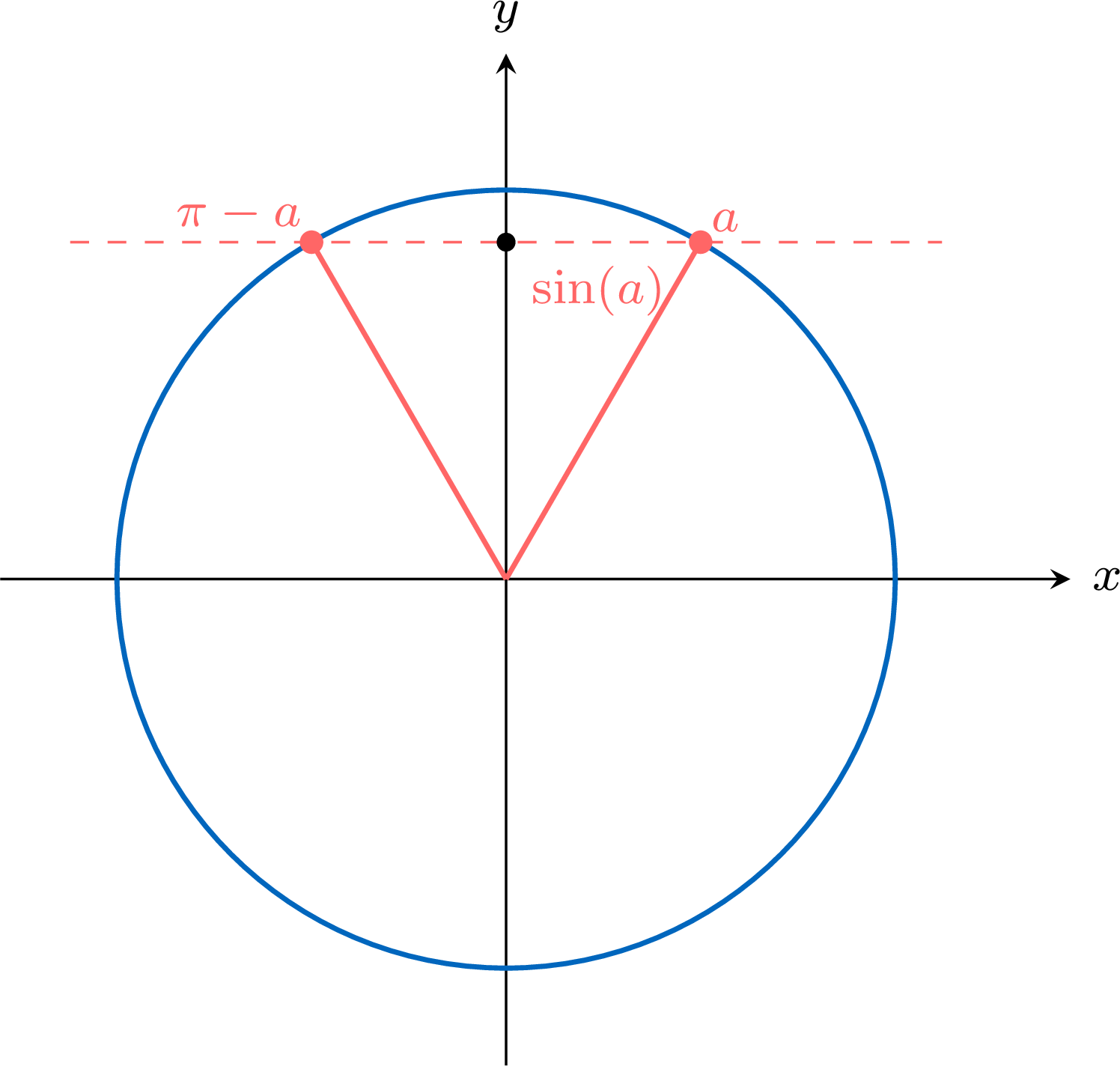
Let \(a\) be a real number. For every real number \(x\): $$\cos(x) = \cos(a) \iff x = a + 2k\pi \ \text{ or } \ x = -a + 2k\pi, \qquad k \in \mathbb{Z};$$ $$\sin(x) = \sin(a) \iff x = a + 2k\pi \ \text{ or } \ x = \pi - a + 2k\pi, \qquad k \in \mathbb{Z}.$$ The unit circle explains both. The points with the same abscissa \(\cos(a)\) are symmetric about the horizontal axis, which gives \(a\) and \(-a\): 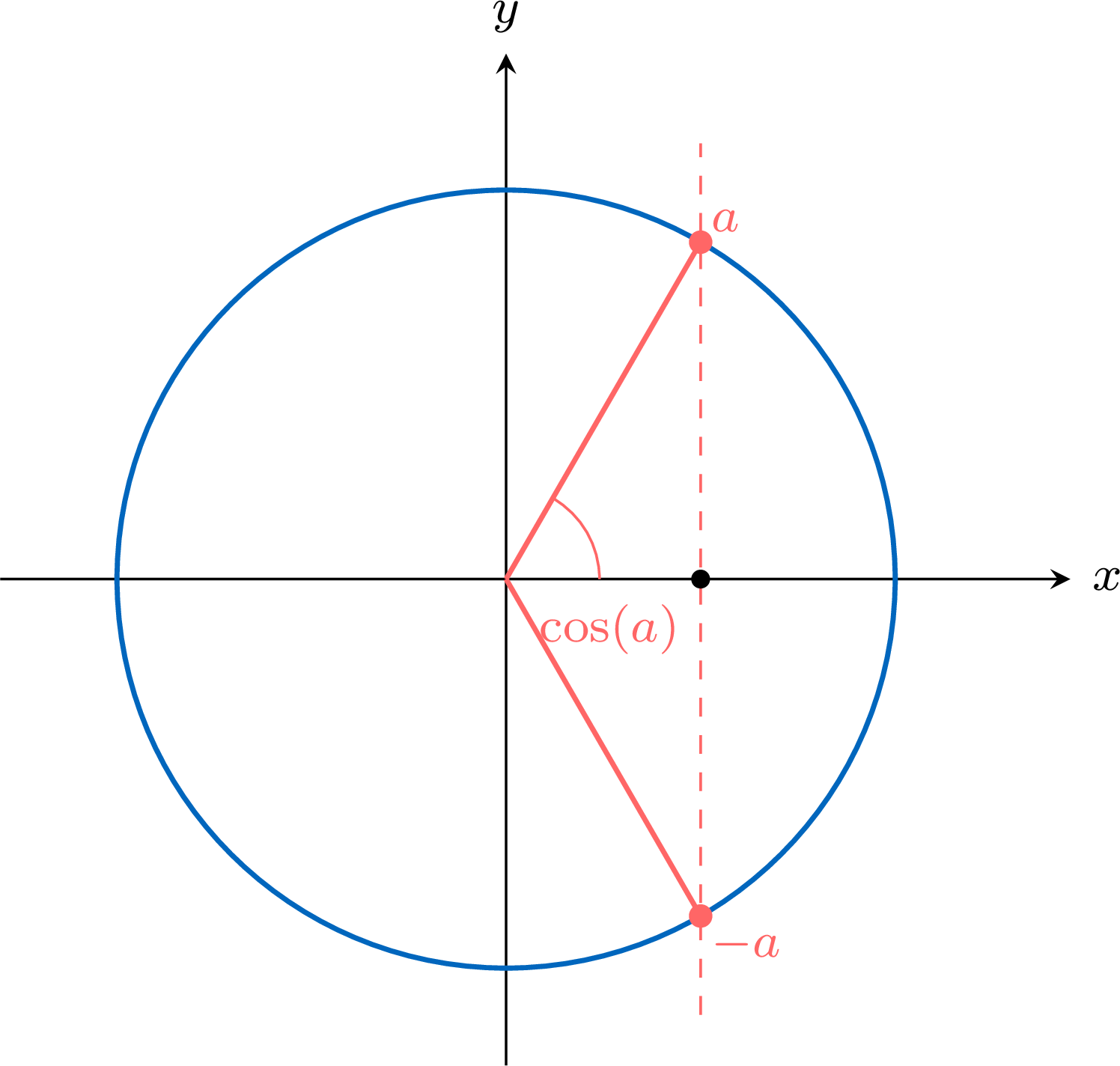
Method — Solving a Trigonometric Equation Using the Unit Circle
This method applies when the equation can be written with a remarkable value on the right-hand side. For a value that is not remarkable, the calculator gives an approximation of one solution and the circle then gives the others. - Write the equation in the form \(\cos(X) = \cos(a)\) or \(\sin(X) = \sin(a)\), where \(a\) is read from the unit circle.
- Write the two families of solutions in \(X\): \(X = a + 2k\pi\) or \(X = -a + 2k\pi\) for the cosine, \(X = a + 2k\pi\) or \(X = \pi - a + 2k\pi\) for the sine (\(k \in \mathbb{Z}\)).
- Go back to \(x\) if \(X\) was an expression such as \(2x\) or \(3x - \frac{\pi}{4}\).
- Select the integers \(k\) for which the solution belongs to the interval required by the question, then list the solutions.
Example
Solve the equation \(2\cos(2x) = 1\) on the interval \([0, 2\pi)\).
For every real number \(x\), denoting by \(k\) an integer: $$\begin{aligned}[t] 2\cos(2x) = 1 &\iff \cos(2x) = \dfrac{1}{2} &&\text{(divide by 2)} \\
&\iff \cos(2x) = \cos\left(\dfrac{\pi}{3}\right) &&\text{(remarkable value)} \\
&\iff 2x = \dfrac{\pi}{3} + 2k\pi \ \text{ or } \ 2x = -\dfrac{\pi}{3} + 2k\pi &&\text{(previous proposition)} \\
&\iff x = \dfrac{\pi}{6} + k\pi \ \text{ or } \ x = -\dfrac{\pi}{6} + k\pi \end{aligned}$$ It remains to select the integers \(k\) giving a solution in \([0, 2\pi)\). For the first family, \(k = -1\) gives \(-\dfrac{5\pi}{6} < 0\), \(k = 0\) gives \(\dfrac{\pi}{6}\), \(k = 1\) gives \(\dfrac{7\pi}{6}\), and \(k = 2\) gives \(\dfrac{13\pi}{6} > 2\pi\). For the second family, \(k = 0\) gives \(-\dfrac{\pi}{6} < 0\), \(k = 1\) gives \(\dfrac{5\pi}{6}\), \(k = 2\) gives \(\dfrac{11\pi}{6}\), and \(k = 3\) gives \(\dfrac{17\pi}{6} > 2\pi\). The solution set is $$\left\{\dfrac{\pi}{6}, \dfrac{5\pi}{6}, \dfrac{7\pi}{6}, \dfrac{11\pi}{6}\right\}.$$
Skills to practice
- Solving an Equation with the Two Families of Solutions
I.3
Equations of Quadratic Type
Method — Solving a Trigonometric Equation of Quadratic Type
An equation such as \(2\cos^2 x - \cos x - 1 = 0\) is a quadratic equation in the unknown \(u = \cos x\); the same holds with \(\sin x\) or \(\tan x\). - Bring every term to one side, and do not divide by \(\sin x\), \(\cos x\) or \(\tan x\) when this number can be \(0\): the solutions for which it is \(0\) would be lost. Factorise instead.
- Solve the quadratic equation in \(u\): by factorising and the Null Factor Law, or with the quadratic formula.
- Keep the admissible values: \(\sin x\) and \(\cos x\) lie between \(-1\) and \(1\), so a value of \(u\) outside \([-1, 1]\) gives no solution; \(\tan x\) takes every real value.
- Solve each basic equation (\(\cos x = u_1\), \(\cos x = u_2\), …) on the interval, with the unit circle when the value is remarkable and with technology otherwise, then list all the solutions in increasing order.
Example
Solve each equation for \(0 \le x \le 2\pi\), giving exact values. - \(2\cos^2 x - \cos x - 1 = 0\);
- \(2\sin^2 x = \sqrt{3}\sin x\);
- \(2\sin^2 x + 5\sin x - 3 = 0\).
- With \(u = \cos x\), the left side is \(2u^2 - u - 1 = (2u + 1)(u - 1)\) (check by expanding: \(2u^2 - 2u + u - 1\)). $$\begin{aligned}[t] 2\cos^2 x - \cos x - 1 = 0 &\iff (2\cos x + 1)(\cos x - 1) = 0 && \text{(factorise)}\\ &\iff \cos x = -\frac{1}{2} \ \text{ or } \ \cos x = 1. && \text{(Null Factor Law)} \end{aligned}$$ Both values lie between \(-1\) and \(1\). On the unit circle, \(\cos x = -\dfrac{1}{2}\) for \(x = \dfrac{2\pi}{3}\) and \(x = \dfrac{4\pi}{3}\), and \(\cos x = 1\) for \(x = 0\) and \(x = 2\pi\). The solutions are \(0\), \(\dfrac{2\pi}{3}\), \(\dfrac{4\pi}{3}\) and \(2\pi\).
- The equation is not divided by \(\sin x\), which can be \(0\): $$\begin{aligned}[t] 2\sin^2 x = \sqrt{3}\sin x &\iff 2\sin^2 x - \sqrt{3}\sin x = 0 && \text{(subtract } \sqrt{3}\sin x\text{)}\\ &\iff \sin x\,(2\sin x - \sqrt{3}) = 0 && \text{(common factor)}\\ &\iff \sin x = 0 \ \text{ or } \ \sin x = \frac{\sqrt{3}}{2}. && \text{(Null Factor Law)} \end{aligned}$$ \(\sin x = 0\) for \(x = 0\), \(\pi\) and \(2\pi\); \(\sin x = \dfrac{\sqrt{3}}{2}\) for \(x = \dfrac{\pi}{3}\) and \(x = \dfrac{2\pi}{3}\). The solutions are \(0\), \(\dfrac{\pi}{3}\), \(\dfrac{2\pi}{3}\), \(\pi\) and \(2\pi\). Dividing by \(\sin x\) would have kept only \(\dfrac{\pi}{3}\) and \(\dfrac{2\pi}{3}\).
- With \(u = \sin x\), the left side is \(2u^2 + 5u - 3 = (2u - 1)(u + 3)\) (check: \(2u^2 + 6u - u - 3\)). $$\begin{aligned}[t] 2\sin^2 x + 5\sin x - 3 = 0 &\iff (2\sin x - 1)(\sin x + 3) = 0 && \text{(factorise)}\\ &\iff \sin x = \frac{1}{2} \ \text{ or } \ \sin x = -3. && \text{(Null Factor Law)} \end{aligned}$$ Since \(-3 < -1\), the equation \(\sin x = -3\) has no solution. \(\sin x = \dfrac{1}{2}\) for \(x = \dfrac{\pi}{6}\) and \(x = \dfrac{5\pi}{6}\): these are the solutions.
Skills to practice
- Solving Equations of Quadratic Type without Technology
I.4
Solving Trigonometric Equations with Technology
The unit circle solves \(\cos x = \dfrac{1}{2}\), because \(\dfrac{1}{2}\) is the cosine of a remarkable angle. In \(3\cos x = 1\), that is \(\cos x = \dfrac{1}{3}\), the value \(\dfrac{1}{3}\) is the cosine of no remarkable angle, and none of the exact methods solves \(2\sin x = x - 1\), where the unknown appears both inside and outside the sine. A graphing calculator approximates such solutions. For \(3\cos x = 1\), the period and the symmetries of the cosine tell how many solutions to look for and check the values read on the screen; for \(2\sin x = x - 1\), the screen shows the solutions, and a comparison of the two sides, interval by interval, confirms that none is missed.
Method — Solving a Trigonometric Equation with Technology
The method “Solving an Equation Graphically with Technology” applies, with the following steps specific to trigonometric functions. - Set the angle mode (Method “Setting the Calculator Mode”): radians when the interval is written with real numbers or with \(\pi\), degrees when it is written in degrees.
- Enter each side as a function, \(Y_1\) = left side and \(Y_2\) = right side, and take the window from the interval: \(x\) runs over exactly the interval given, and \(y\) covers the values of both sides (the values of \(a\sin(bx) + d\) lie between \(d - |a|\) and \(d + |a|\); a tangent has no bounds, and a range around the value sought is enough).
- Count the points of intersection before reading them. For \(\sin(bx) = k\) or \(\cos(bx) = k\) with \(-1 < k < 1\), expect two solutions in each period \(\dfrac{2\pi}{|b|}\) taken with one end only; for \(\tan(bx) = k\), one in each period \(\dfrac{\pi}{|b|}\). Then check whether the two ends of the interval are themselves solutions: \(\sin x = 0\) has three solutions for \(0 \le x \le 2\pi\), namely \(0\), \(\pi\) and \(2\pi\).
- With the intersection tool, read the \(x\)-coordinate of each point, and round as the question asks (to 3 significant figures if it says nothing). For a tangent, the screen may join two branches by a vertical segment at an asymptote: a crossing there is not a solution, since the tangent is not defined at that value.
- Check with the symmetries: the solutions of \(\cos x = k\) go in pairs \(x_0\) and \(2\pi - x_0\) (the cosine is even, of period \(2\pi\)), those of \(\sin x = k\) in pairs \(x_0\) and \(\pi - x_0\) (as \(\sin(\pi - x) = \sin x\)), the two values coinciding, up to a period, when \(k = 1\) or \(k = -1\); adding or subtracting a period gives the others, and only the values that lie in the interval are kept.
Example
Solve each equation with technology, giving the solutions to 3 significant figures. - \(3\cos x = 1\), for \(0 \le x \le 4\pi\);
- \(2\sin x = x - 1\), for \(0 \le x \le 2\pi\).
- The calculator is set to radians. The equation is \(\cos x = \dfrac{1}{3}\), with \(-1 < \dfrac{1}{3} < 1\), and the interval \(0 \le x \le 4\pi\) covers two periods of the cosine: four solutions are expected. With \(Y_1 = 3\cos x\) and \(Y_2 = 1\), in the window \(0 \le x \le 4\pi\) (about \(12.6\)), \(-4 \le y \le 4\), the curves meet four times, and the intersection tool displays \(X = 1.2309594\), \(5.0522259\), \(7.5141447\) and \(11.3354112\). Check with the symmetries: \(2\pi - 1.2309594 \approx 5.0522259\), \(2\pi + 1.2309594 \approx 7.5141447\) and \(4\pi - 1.2309594 \approx 11.3354112\). The solutions are $$x \approx 1.23, \quad x \approx 5.05, \quad x \approx 7.51, \quad x \approx 11.3.$$
- The unknown appears inside and outside the sine: none of the exact methods applies, and technology approximates the solution. With \(Y_1 = 2\sin x\) and \(Y_2 = x - 1\), in the window \(0 \le x \le 2\pi\), \(-3 \le y \le 6\), the curves meet once, and the intersection tool displays \(X = 2.3800613\) and \(Y = 1.3800613\).
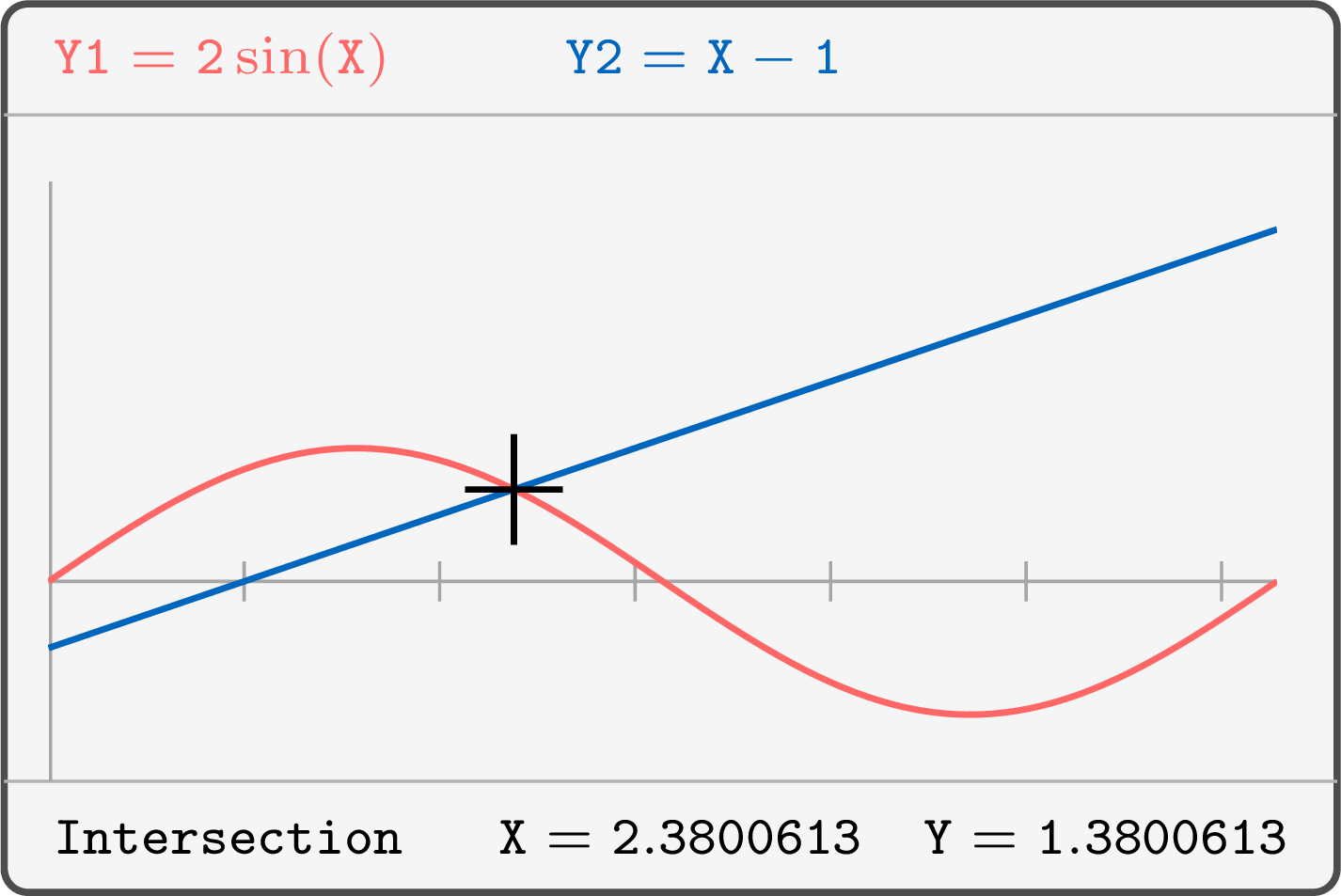
- for \(0 \le x \le 1\): \(x - 1 \le 0 \le 2\sin x\), and the two sides are never both \(0\);
- for \(1 < x \le \dfrac{\pi}{2}\): the sine increases, so \(2\sin x > 2\sin 1 > 1.6 > \dfrac{\pi}{2} - 1 \ge x - 1\);
- for \(\dfrac{\pi}{2} \le x \le \pi\): \(2\sin x\) decreases while \(x - 1\) increases, so the curves meet at most once, at the point displayed;
- for \(\pi \le x \le 2\pi\): \(2\sin x \le 0 < x - 1\).
Skills to practice
- Counting the Solutions on an Interval
- Solving Equations with the Intersection Tool
- Solving Equations in Context with Technology
II
Trigonometric Identities
II.1
The Pythagorean Identity and the Layout of a Proof
Recappreviously studied — click to reread
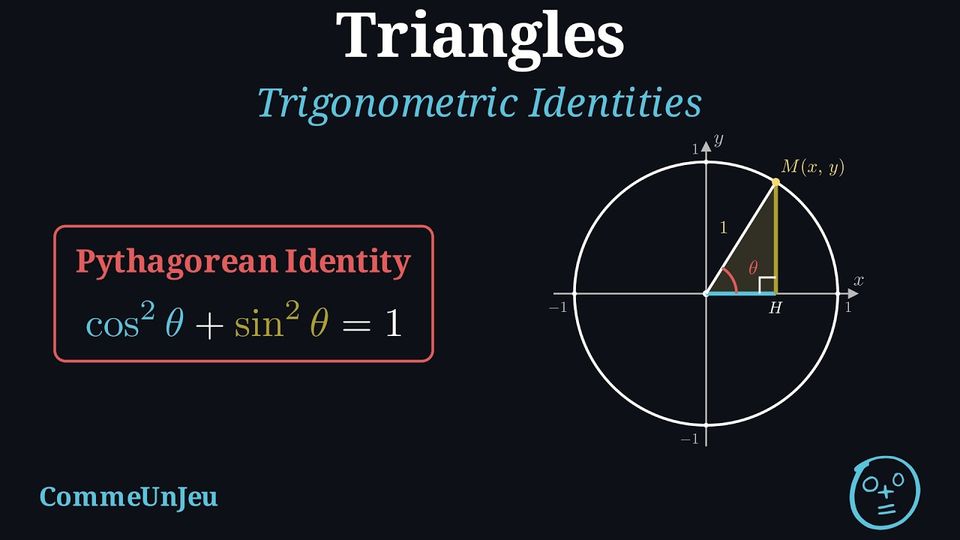
Proposition — Pythagorean Identity
For any angle \(\theta\): $$ \cos^2 \theta + \sin^2 \theta = 1 $$
Equality and Identity: the Sign \(\equiv\)
An equation such as \(2x + 1 = 7\) asks for which values of \(x\) the equality is true (here only for \(x = 3\)); an identity is an equality true for every value of its variables for which both sides are defined. To mark an identity, one may write the sign \(\equiv\), read “is identically equal to”: $$(x - 4)^2 + 3 \equiv x^2 - 8x + 19$$ means that \((x - 4)^2 + 3 = x^2 - 8x + 19\) for every real number \(x\).
A proof that an equality holds (“show that…”) is laid out from one side to the other: start from one side, usually the more complicated one, transform it through a chain of equalities, each justified by a rule already established, and stop when the other side appears.
Do not start from the equality to be proved and transform both sides at once: unless every step is an equivalence, this only shows that the equality implies a true statement, which proves nothing. For instance, squaring both sides of the false equality \(-1 = 1\) gives the true equality \(1 = 1\).
Skills to practice
- The Pythagorean Identity and the Layout of a Proof
II.2
The Other Ratios from One Ratio
Example
- Given that \(\sin\theta = \dfrac{2}{3}\) and \(\dfrac{\pi}{2} < \theta < \pi\), find the exact values of \(\cos\theta\) and \(\tan\theta\), without finding \(\theta\).
- Given only that \(\sin\theta = \dfrac{2}{3}\), find the possible values of \(\tan\theta\).
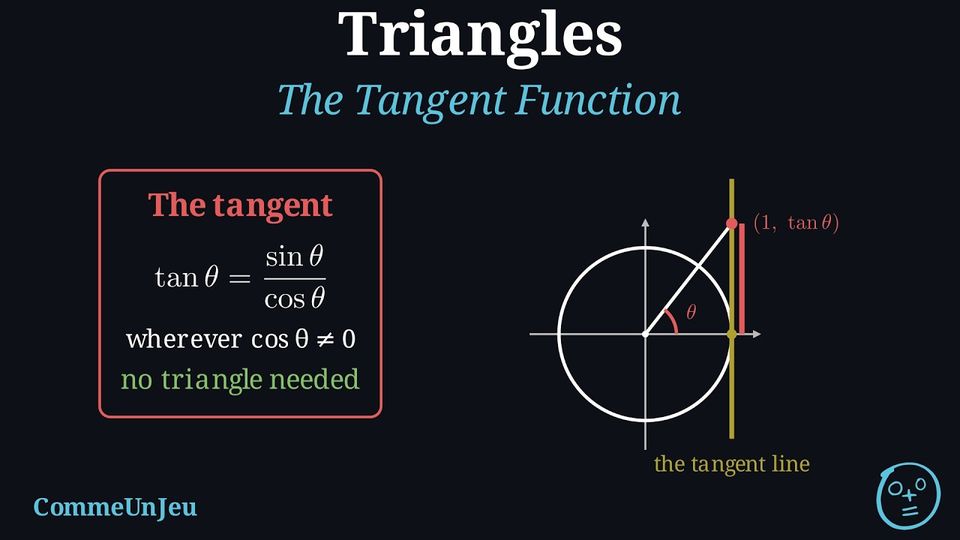
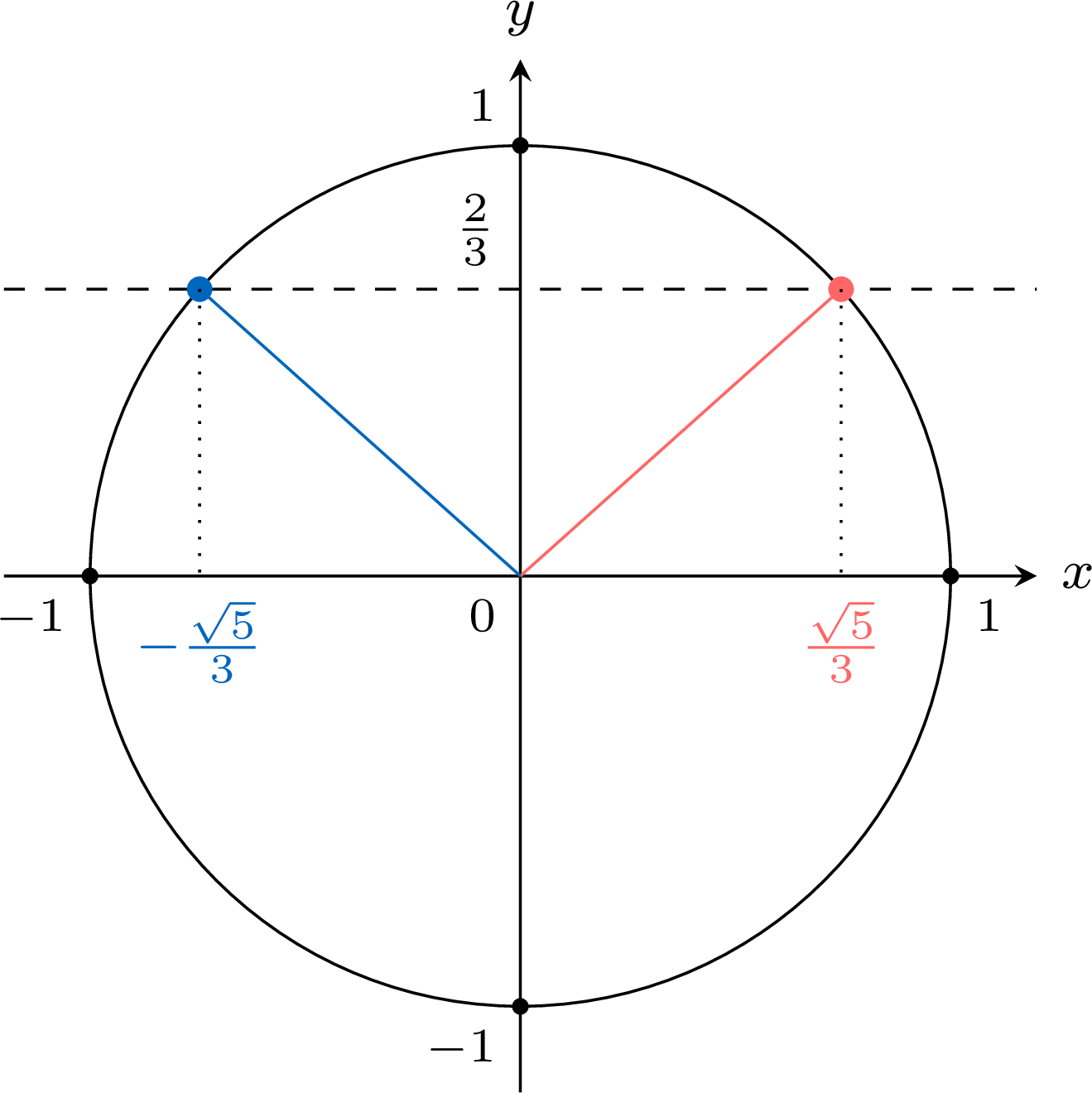
- $$\begin{aligned}[t] \cos^2\theta &= 1 - \sin^2\theta && \text{(Pythagorean identity)}\\ &= 1 - \frac{4}{9} = \frac{5}{9}, \end{aligned}$$ so \(\cos\theta = \dfrac{\sqrt{5}}{3}\) or \(\cos\theta = -\dfrac{\sqrt{5}}{3}\). Since \(\dfrac{\pi}{2} < \theta < \pi\), the point of the unit circle associated with \(\theta\) lies in the second quadrant, where the cosine is negative: \(\cos\theta = -\dfrac{\sqrt{5}}{3}\). Then $$\begin{aligned}[t] \tan\theta &= \frac{\sin\theta}{\cos\theta} && \text{(definition of the tangent)}\\ &= \frac{2}{3} \times \left(-\frac{3}{\sqrt{5}}\right) = -\frac{2}{\sqrt{5}} = -\frac{2\sqrt{5}}{5}. \end{aligned}$$
- Without the quadrant, the Pythagorean identity still gives \(\cos^2\theta = \dfrac{5}{9}\), and both signs are possible: two points of the unit circle have the \(y\)-coordinate \(\dfrac{2}{3}\), one in the first quadrant and one in the second, symmetric about the vertical axis.
Skills to practice
- Finding the Other Two Ratios from One Ratio
III
Double Angle Identities
III.1
The Double Angle Formulas
Recappreviously studied — click to reread
Proposition — Double Angle Formulas
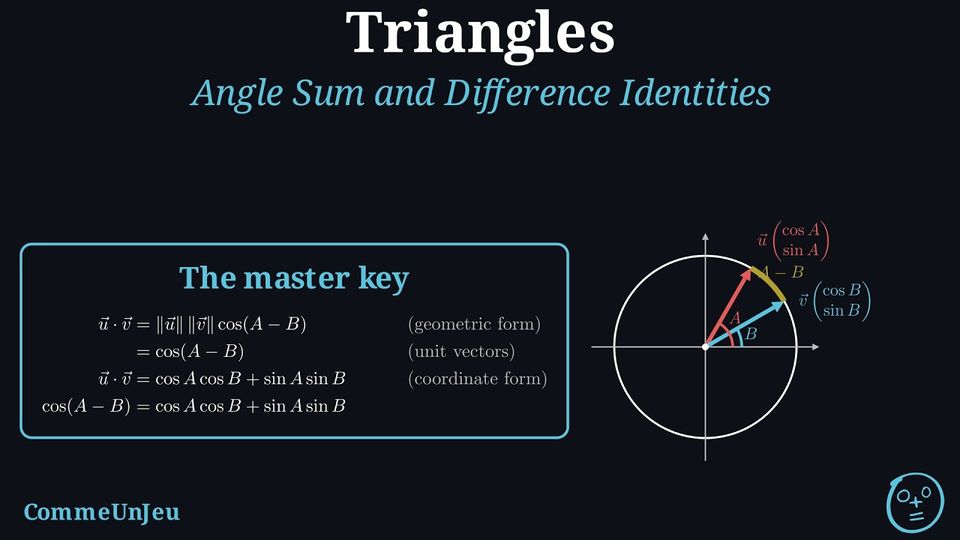
For every real number \(A\): $$\cos 2A = \cos^2 A - \sin^2 A = 2\cos^2 A - 1 = 1 - 2\sin^2 A,$$ $$\sin 2A = 2\sin A\cos A.$$ They are obtained by taking \(B = A\) in the formulas for \(\cos(A + B)\) and \(\sin(A + B)\), which gives \(\sin 2A\) and \(\cos^2 A - \sin^2 A\) (this derivation is proposed in the exercises), then using \(\cos^2 A + \sin^2 A = 1\) for the other two forms of \(\cos 2A\). Example
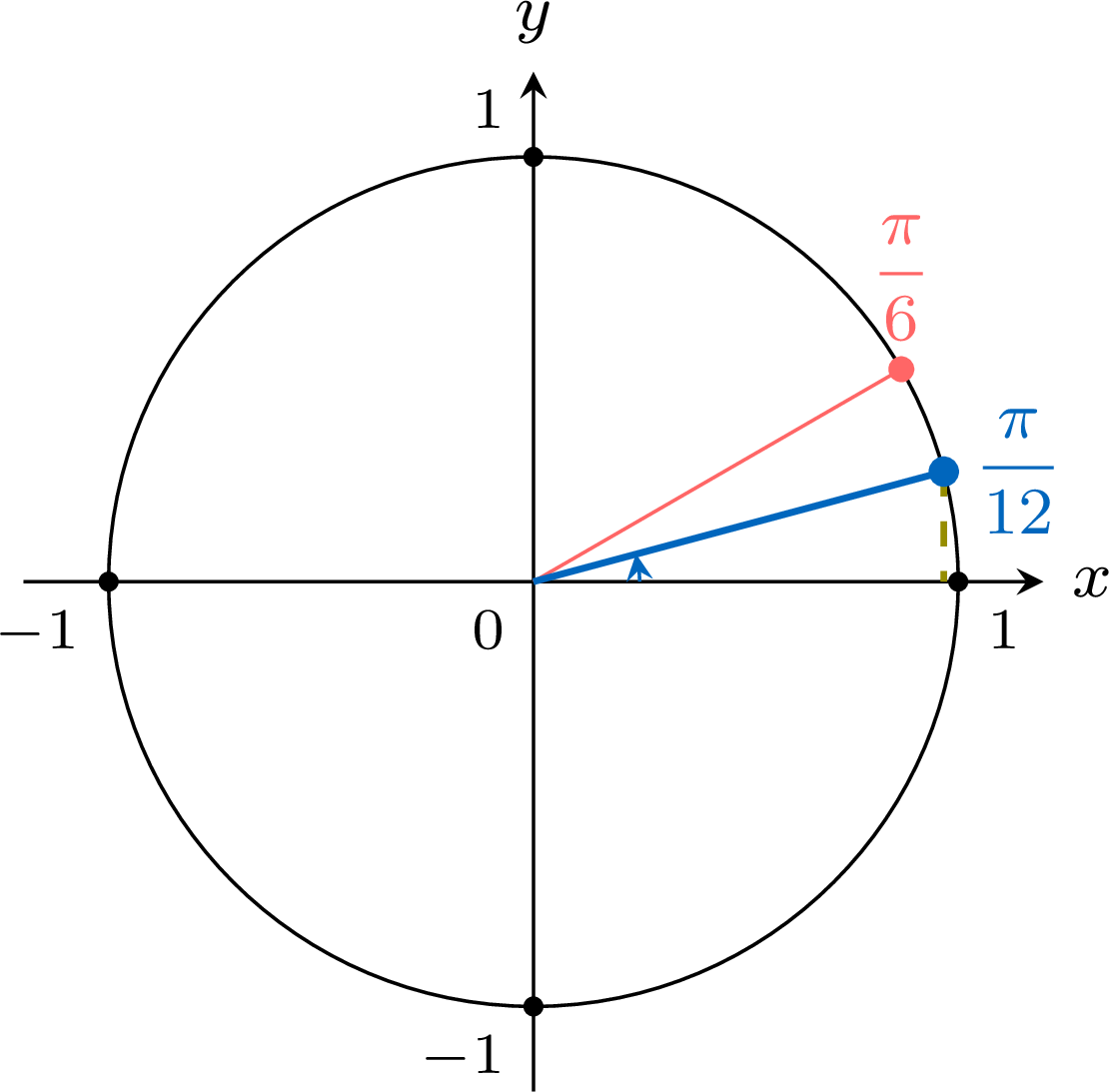
Compute the exact value of \(\cos\dfrac{\pi}{12}\) in two ways: - with an addition formula, writing \(\dfrac{\pi}{12} = \dfrac{\pi}{3} - \dfrac{\pi}{4}\);
- with a double angle formula, since \(2 \times \dfrac{\pi}{12} = \dfrac{\pi}{6}\).
- With the cosine of a difference: $$\begin{aligned}[t] \cos\frac{\pi}{12} &= \cos\left(\frac{\pi}{3} - \frac{\pi}{4}\right) &&\\ &= \cos\frac{\pi}{3}\cos\frac{\pi}{4} + \sin\frac{\pi}{3}\sin\frac{\pi}{4} && \text{(cosine of a difference)}\\ &= \frac{1}{2} \times \frac{\sqrt{2}}{2} + \frac{\sqrt{3}}{2} \times \frac{\sqrt{2}}{2} && \text{(special values)}\\ &= \frac{\sqrt{2} + \sqrt{6}}{4}. \end{aligned}$$
- With \(A = \dfrac{\pi}{12}\), the formula \(\cos 2A = 2\cos^2 A - 1\) gives \(\cos\dfrac{\pi}{6} = 2\cos^2\dfrac{\pi}{12} - 1\), so $$\begin{aligned}[t] \cos^2\frac{\pi}{12} &= \frac{1}{2}\left(1 + \cos\frac{\pi}{6}\right) &&\\ &= \frac{1}{2}\left(1 + \frac{\sqrt{3}}{2}\right) = \frac{2 + \sqrt{3}}{4}. \end{aligned}$$ Since \(\dfrac{\pi}{12} \in \left[0, \dfrac{\pi}{2}\right]\), \(\cos\dfrac{\pi}{12} \ge 0\), hence \(\cos\dfrac{\pi}{12} = \dfrac{\sqrt{2 + \sqrt{3}}}{2}\).
Skills to practice
- The Double Angle Formulas
III.2
Using the Double Angle Formulas
A Picture of the Double Angle Formula for the Sine
For \(0 < \theta < \dfrac{\pi}{2}\), the formula \(\sin 2\theta = 2\sin\theta\cos\theta\) can be seen on the unit circle. Let \(A\) and \(B\) be the points of the unit circle associated with \(-\theta\) and \(\theta\), so that \(\Angle{AOB} = 2\theta\), and let \(M\) be the point where \(\Segment{AB}\) meets the \(x\)-axis. The two points are symmetric about the \(x\)-axis: \(M\) is the midpoint of \(\Segment{AB}\), \(\Segment{AB}\) is perpendicular to \(\Segment{OM}\), and in the right triangle \(OMB\), where \(OB = 1\) and \(\Angle{MOB} = \theta\), \(OM = \cos\theta\) and \(MB = \sin\theta\). So \(AB = 2\sin\theta\). 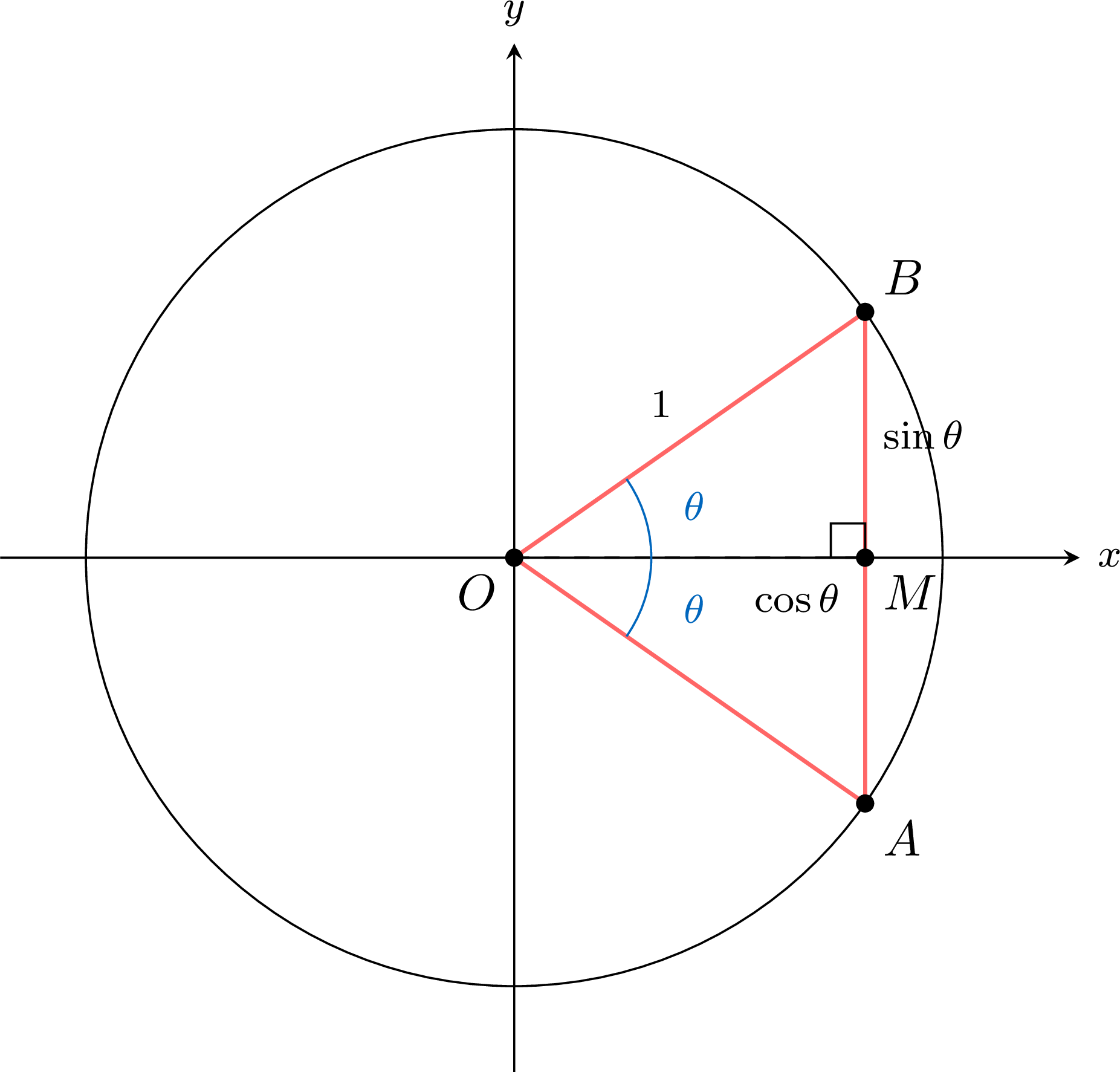
The area of the triangle \(OAB\) can be computed in two ways: $$\begin{aligned}[t] \text{area of } OAB &= \frac{1}{2} \times OA \times OB \times \sin 2\theta && \text{(area formula, with the angle } \Angle{AOB} = 2\theta\text{)}\\
&= \frac{1}{2}\sin 2\theta,\\
\text{area of } OAB &= \frac{1}{2} \times AB \times OM && \text{(base } \Segment{AB}\text{, height } \Segment{OM}\text{)}\\
&= \frac{1}{2} \times 2\sin\theta \times \cos\theta = \sin\theta\cos\theta. \end{aligned}$$ The two results are equal: \(\dfrac{1}{2}\sin 2\theta = \sin\theta\cos\theta\), that is \(\sin 2\theta = 2\sin\theta\cos\theta\). The picture shows the formula only for \(0 < 2\theta < \pi\): there \(\Angle{AOB} = 2\theta\), and the lengths \(OM = \cos\theta\) and \(MB = \sin\theta\) are positive. The double angle formulas themselves hold for every real number.
Example
Given that \(\cos\theta = -\dfrac{1}{3}\) and \(\pi < \theta < \dfrac{3\pi}{2}\), find the exact values of \(\sin 2\theta\), \(\cos 2\theta\) and \(\tan 2\theta\), without finding \(\theta\).
Since \(\pi < \theta < \dfrac{3\pi}{2}\) (third quadrant), \(\sin\theta < 0\). $$\begin{aligned}[t] \sin^2\theta &= 1 - \cos^2\theta && \text{(Pythagorean identity)}\\
&= 1 - \frac{1}{9} = \frac{8}{9}, \end{aligned}$$ so \(\sin\theta = -\dfrac{2\sqrt{2}}{3}\). Then $$\begin{aligned}[t] \sin 2\theta &= 2\sin\theta\cos\theta && \text{(double angle formula)}\\
&= 2 \times \left(-\frac{2\sqrt{2}}{3}\right) \times \left(-\frac{1}{3}\right) = \frac{4\sqrt{2}}{9},\\
\cos 2\theta &= 2\cos^2\theta - 1 && \text{(double angle formula)}\\
&= \frac{2}{9} - 1 = -\frac{7}{9},\\
\tan 2\theta &= \frac{\sin 2\theta}{\cos 2\theta} && \text{(definition of the tangent)}\\
&= \frac{4\sqrt{2}}{9} \times \left(-\frac{9}{7}\right) = -\frac{4\sqrt{2}}{7}. \end{aligned}$$
Skills to practice
- Finding the Ratios of the Double Angle from One Ratio
- Proving Identities with the Double Angle Formulas
IV
Equations and Identities
IV.1
Solving Equations with an Identity
Example
Solve each equation for \(0 \le x \le 2\pi\), giving exact values. First use a double angle formula to write the equation with a single trigonometric function of \(x\), or as a product, then solve it. - \(\cos 2x + 3\sin x = 2\);
- \(\sin 2x = \sqrt{3}\cos x\).
- The form \(\cos 2x = 1 - 2\sin^2 x\) of the double angle formula leaves only \(\sin x\): $$\begin{aligned}[t] \cos 2x + 3\sin x = 2 &\iff 1 - 2\sin^2 x + 3\sin x = 2 && \text{(double angle formula)}\\ &\iff 2\sin^2 x - 3\sin x + 1 = 0 && \text{(every term on one side)}\\ &\iff (2\sin x - 1)(\sin x - 1) = 0 && \text{(factorise)}\\ &\iff \sin x = \frac{1}{2} \ \text{ or } \ \sin x = 1. && \text{(Null Factor Law)} \end{aligned}$$ On the unit circle, \(\sin x = \dfrac{1}{2}\) for \(x = \dfrac{\pi}{6}\) and \(x = \dfrac{5\pi}{6}\), and \(\sin x = 1\) for \(x = \dfrac{\pi}{2}\). The solutions are \(\dfrac{\pi}{6}\), \(\dfrac{\pi}{2}\) and \(\dfrac{5\pi}{6}\).
- The form \(\sin 2x = 2\sin x\cos x\) of the double angle formula leaves a common factor \(\cos x\). The equation is not divided by \(\cos x\), which can be \(0\): $$\begin{aligned}[t] \sin 2x = \sqrt{3}\cos x &\iff 2\sin x\cos x - \sqrt{3}\cos x = 0 && \text{(double angle formula)}\\ &\iff \cos x\,(2\sin x - \sqrt{3}) = 0 && \text{(common factor)}\\ &\iff \cos x = 0 \ \text{ or } \ \sin x = \frac{\sqrt{3}}{2}. && \text{(Null Factor Law)} \end{aligned}$$ \(\cos x = 0\) for \(x = \dfrac{\pi}{2}\) and \(x = \dfrac{3\pi}{2}\); \(\sin x = \dfrac{\sqrt{3}}{2}\) for \(x = \dfrac{\pi}{3}\) and \(x = \dfrac{2\pi}{3}\). The solutions, in increasing order, are \(\dfrac{\pi}{3}\), \(\dfrac{\pi}{2}\), \(\dfrac{2\pi}{3}\) and \(\dfrac{3\pi}{2}\). Dividing by \(\cos x\) would have lost \(\dfrac{\pi}{2}\) and \(\dfrac{3\pi}{2}\).
Skills to practice
- Solving Equations with a Double Angle
- Solving Equations in Degrees with an Identity or a Factorisation
V
Going further
Skills to practice
- Solving Problems
- Quiz
Jump to section