International Baccalaureate · DP 2: Analysis and Approaches SL
The Binomial Theorem
I
Binomial Expansions
I.1
Squares and Cubes of a Binomial
Recappreviously studied — click to reread
Proposition — Perfect Squares Expansion
The square of a sum and the square of a difference can be written as: $$(a+b)^2=a^2+2ab+b^2 \quad\text{and}\quad (a-b)^2=a^2-2ab+b^2.$$ 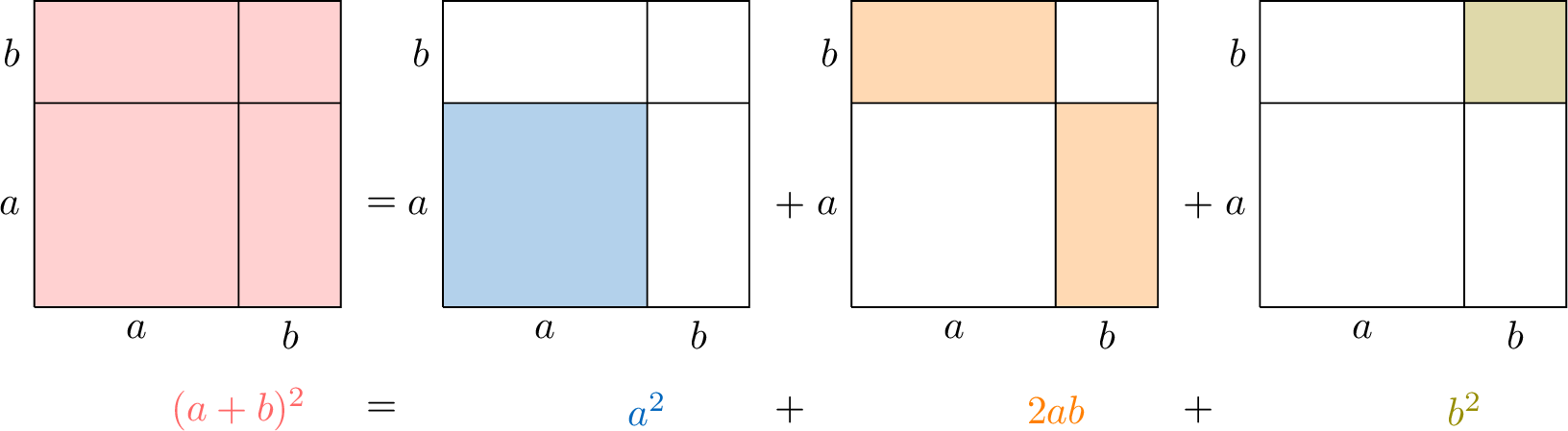
$$\begin{aligned} (a+b)^2 &= (a+b)(a+b) &&\text{(definition of a square)} \\
&= a(a+b)+b(a+b) &&\text{(distributive law)} \\
&= a^2+ab+ab+b^2 &&\text{(expanding)} \\
&= a^2+2ab+b^2 &&\text{(combining like terms)}. \end{aligned}$$ Similarly, $$\begin{aligned} (a-b)^2 &= (a-b)(a-b) &&\text{(definition of a square)} \\
&= a(a-b)-b(a-b) &&\text{(distributive law)} \\
&= a^2-ab-ab+b^2 &&\text{(expanding)} \\
&= a^2-2ab+b^2 &&\text{(combining like terms)}. \end{aligned}$$
Example
Expand and simplify \((x+2)^2\).
Using the formula \((a+b)^2=a^2+2ab+b^2\) with \(a=x\) and \(b=2\): $$\begin{aligned} (\textcolor{colordef}{x}+\textcolor{colorprop}{2})^{2} &=\textcolor{colordef}{x}^{2}+2 \times \textcolor{colordef}{x} \times \textcolor{colorprop}{2}+\textcolor{colorprop}{2}^{2} \\
&=x^{2}+4 x+4. \end{aligned}$$ So \((x+2)^2=x^2+4x+4\).
Proposition — Cube of a Sum and of a Difference
For all numbers \(a\) and \(b\), the cube of a sum is $$(a+b)^3=a^3+3a^2b+3ab^2+b^3.$$ Replacing \(b\) by \(-b\) gives the cube of a difference: $$(a-b)^3=a^3-3a^2b+3ab^2-b^3.$$ 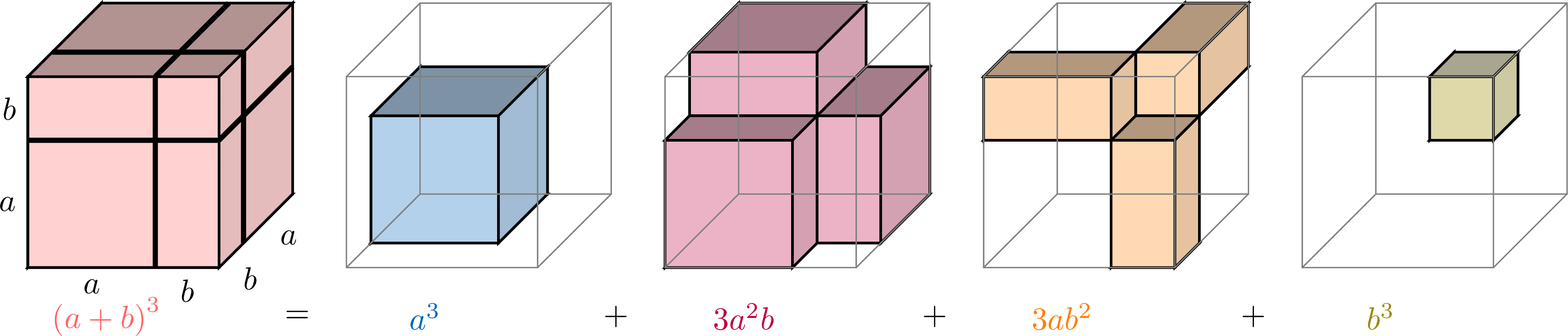
$$\begin{aligned} (a+b)^3 &= (a+b)(a+b)(a+b) &&\text {(cube definition)} \\
&= (a^2+2ab+b^2)(a+b) &&\text {(using the square expansion)} \\
&= (a^2+2ab+b^2)a + (a^2+2ab+b^2)b &&\text {(expanding)} \\
&= a^3+2a^2b+ab^2 + a^2b+2ab^2+b^3 &&\text {(distributive law)} \\
&= a^3+3a^2b+3ab^2+b^3 &&\text {(combining)}\\
\end{aligned}$$
Example
Expand and simplify \((x+2)^3\)
In the identity for the cube of a sum, we substitute \(a=x\) and \(b=2\):$$\begin{aligned}(\textcolor{colordef}{x}+\textcolor{colorprop}{2})^{3}&= \textcolor{colordef}{x}^{3} + 3 \times \textcolor{colordef}{x}^2 \times \textcolor{colorprop}{2} + 3 \times \textcolor{colordef}{x} \times \textcolor{colorprop}{2}^2 + \textcolor{colorprop}{2}^{3} \\
&= x^{3} + 6x^2 + 12x + 8\end{aligned}$$
Skills to practice
- Expanding the Square of a Sum
- Expanding the Square of a Difference
- Expanding the Cube of a Sum
- Expanding the Cube of a Difference
I.2
Factorials and Binomial Coefficients
Definition — Factorial
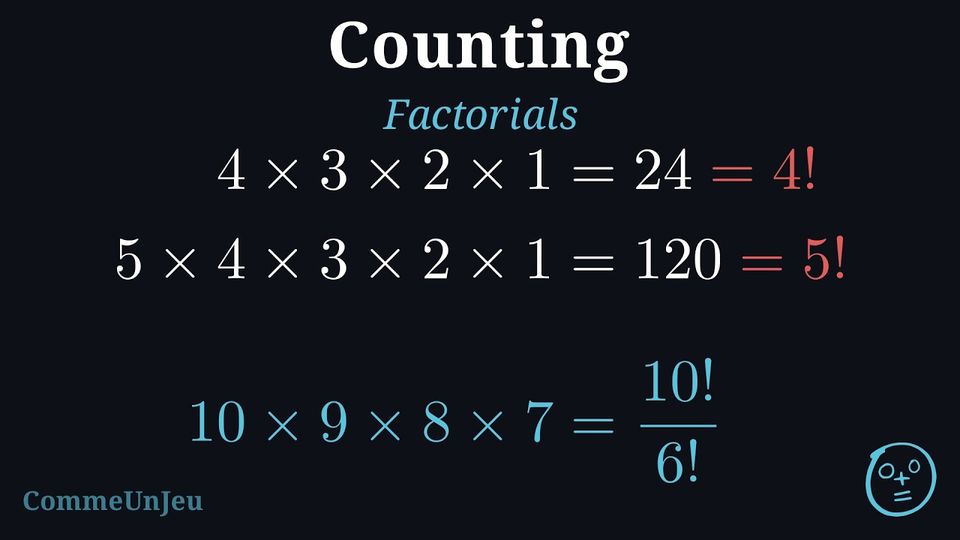
For any integer \(n \geq 1\), \(n!\) (read as "\(n\) factorial") is the product of the integers from \(1\) to \(n\): $$n! = n \times (n-1) \times \dots \times 2 \times 1.$$ By convention, we define \(0! = 1\). Example
Calculate \(4!\).
\(\begin{aligned}[t]4! &= 4 \times 3 \times 2 \times 1\\ &= 24\end{aligned}\)
Definition — Binomial Coefficient
For any integers \(n \geq p \geq 0\), the binomial coefficient \(\binom{n}{p}\) is defined as $$\binom{n}{p} = \frac{n!}{p!(n-p)!}$$ Proposition — First Values and Symmetry
For every natural number \(n\): \(\dbinom{n}{0} = \dbinom{n}{n} = 1\); for \(n \geq 1\), \(\dbinom{n}{1} = \dbinom{n}{n-1} = n\); for \(n \geq 2\), \(\dbinom{n}{2} = \dfrac{n(n-1)}{2}\). For \(0 \leq k \leq n\), $$\binom{n}{k} = \binom{n}{n-k}.$$ Example
Compute \(\dbinom{20}{18}\) and \(\dbinom{50}{49}\) without a calculator.
By symmetry, \(\dbinom{20}{18} = \dbinom{20}{2} = \dfrac{20 \times 19}{2} = 190\) and \(\dbinom{50}{49} = \dbinom{50}{1} = 50\).
Skills to practice
- Evaluating Factorials without Technology
- Evaluating Binomial Coefficients by Simplification
I.3
Pascal's Triangle
Consider the powers of \((a+b)\): $$ \begin{array}{rcccccccccc} (a+b)^1 &=& & & a &+& b\\
(a+b)^2 &=& & 1a^2 &+& 2ab &+& 1b^2\\
(a+b)^3 &=& 1a^3 &+& 3a^2b &+& 3ab^2 &+& 1b^3\\
(a+b)^4 &=& 1a^4 &+& 4a^3b &+& 6a^2b^2 &+& 4ab^3 &+& 1b^4\\
\end{array} $$ Now, when we list only the coefficients of the terms, we get Pascal's triangle: $$ \begin{array}{ccccccccccc} &&&&1&&1&&&&\text{row 1}\\
&&&1&&2&&1&&&\text{row 2}\\
&&1&&3&&3&&1&&\text{row 3}\\
&1&&4&&6&&4&&1&\text{row 4}\\
\end{array} $$ We observe the following pattern.
Definition — Pascal's Triangle
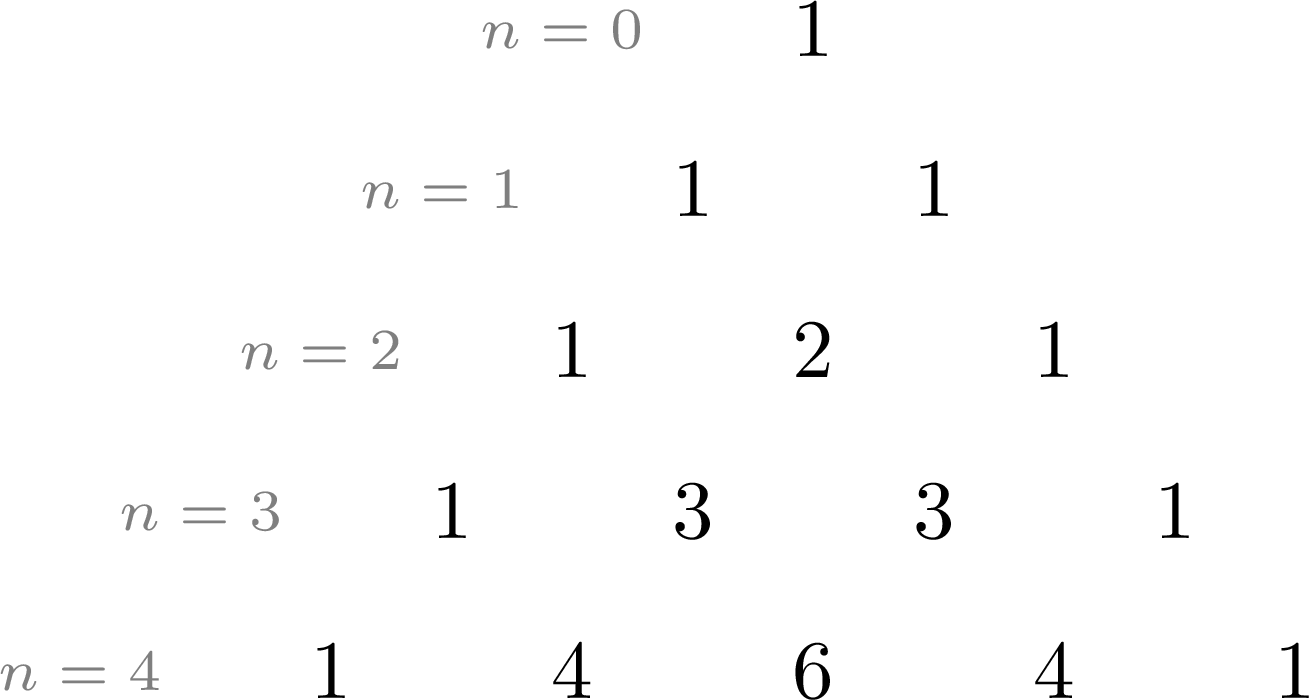
Pascal's triangle is the triangular array of numbers built row by row from row \(0\), which is the single value \(1\); row \(n\) holds \(n + 1\) values, and the rows are numbered \(0, 1, 2, \dots\) - The values at the ends of each row are always \(1\).
- Each interior value is found by adding the two values diagonally above it.
Example
Determine row \(5\) of Pascal's triangle, the rows being numbered from \(0\).
$$ \begin{array}{ccccccccccccccc} &&&&&&1&&&&&&&&\text{row 0}\\
&&&&&1&&1&&&&&&&\text{row 1}\\
&&&&1&&2&&1&&&&&&\text{row 2}\\
&&&1&&3&&3&&1&&&&&\text{row 3}\\
&&1&&4&&6&&4&&1&&&&\text{row 4}\\
&1&&5&&10&&10&&5&&1&&&\text{row 5}\\
\end{array} $$ Row \(0\) is the single value \(1\); each following row starts and ends with \(1\) and its interior values are sums of the two above. So row \(5\) is \(1, 5, 10, 10, 5, 1\).
The Values of the Triangle Are the Binomial Coefficients
Number the rows from \(0\): row \(0\) is \(1\), row \(1\) is \(1, 1\), row \(2\) is \(1, 2, 1\), and so on. In row \(n\), number the positions \(0, 1, \dots, n\) from the left: the value at position \(k\) is the binomial coefficient \(\dbinom{n}{k}\), the number of subsets with \(k\) elements of a set with \(n\) elements, equal to \(\dfrac{n!}{k!\,(n-k)!}\). Row \(n\) therefore reads \(\dbinom{n}{0}, \dbinom{n}{1}, \dots, \dbinom{n}{n}\); its ends are \(1\) because \(\dbinom{n}{0} = \dbinom{n}{n} = 1\), and it is symmetric because \(\dbinom{n}{k} = \dbinom{n}{n-k}\). The rule « each interior value is the sum of the two above it » is a statement about binomial coefficients — Pascal's relation — proved below. 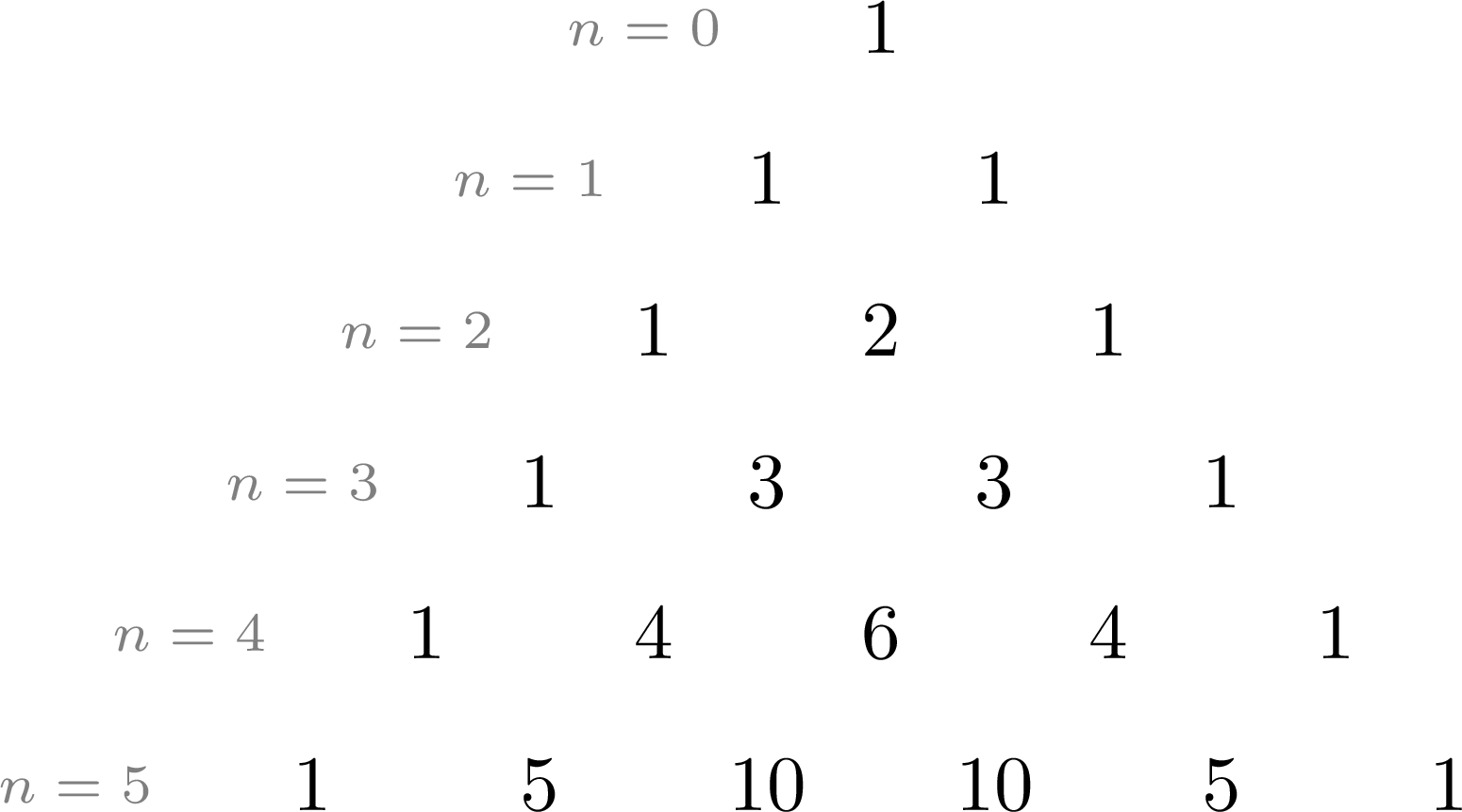
Proposition — Pascal's Relation
For all integers \(n\) and \(k\) with \(0 \leq k < n\): $$\binom{n}{k} + \binom{n}{k+1} = \binom{n+1}{k+1}.$$ In the triangle: the value in row \(n + 1\), position \(k + 1\), is the sum of the two values above it, in row \(n\), positions \(k\) and \(k + 1\). 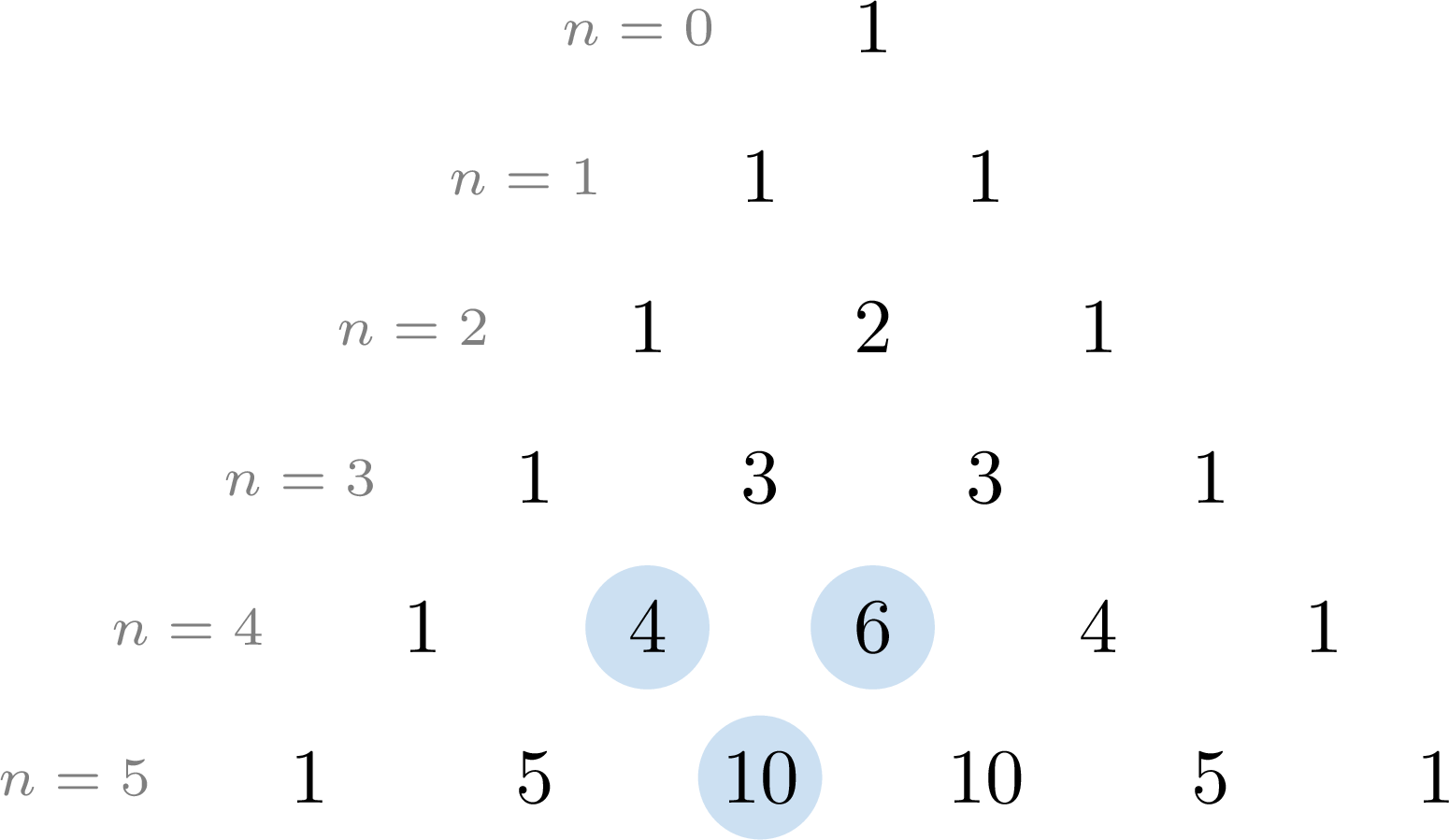
By computation. Since \((k+1)! = (k+1)\,k!\) and \((n-k)! = (n-k)\,(n-k-1)!\), both fractions can be written over the common denominator \((k+1)!\,(n-k)!\): $$\begin{aligned}\binom{n}{k} + \binom{n}{k+1} &= \frac{n!}{k!\,(n-k)!} + \frac{n!}{(k+1)!\,(n-k-1)!} &&\text{(formula)}\\
&= \frac{n!\,(k+1)}{(k+1)!\,(n-k)!} + \frac{n!\,(n-k)}{(k+1)!\,(n-k)!} &&\text{(common denominator)}\\
&= \frac{n!\,\bigl[(k+1) + (n-k)\bigr]}{(k+1)!\,(n-k)!} = \frac{n!\,(n+1)}{(k+1)!\,(n-k)!} &&\text{(same denominator)}\\
&= \frac{(n+1)!}{(k+1)!\,(n-k)!} = \binom{n+1}{k+1}. &&\text{(\((n+1)! = (n+1)\,n!\))}\end{aligned}$$ By counting. Let \(E\) be a set with \(n + 1\) elements and fix one of them, \(e\). The subsets of \(E\) with \(k + 1\) elements are of two kinds, and the two kinds are disjoint: those that contain \(e\) — they are obtained by choosing the \(k\) other elements among the \(n\) elements different from \(e\), \(\dbinom{n}{k}\) subsets — and those that do not contain \(e\) — they are the subsets with \(k + 1\) elements of \(E \setminus \{e\}\), \(\dbinom{n}{k+1}\) subsets. By the additive principle, \(\dbinom{n+1}{k+1} = \dbinom{n}{k} + \dbinom{n}{k+1}\).
Example
Read \(\dbinom{6}{3}\) in Pascal's triangle, then check the value with the formula. 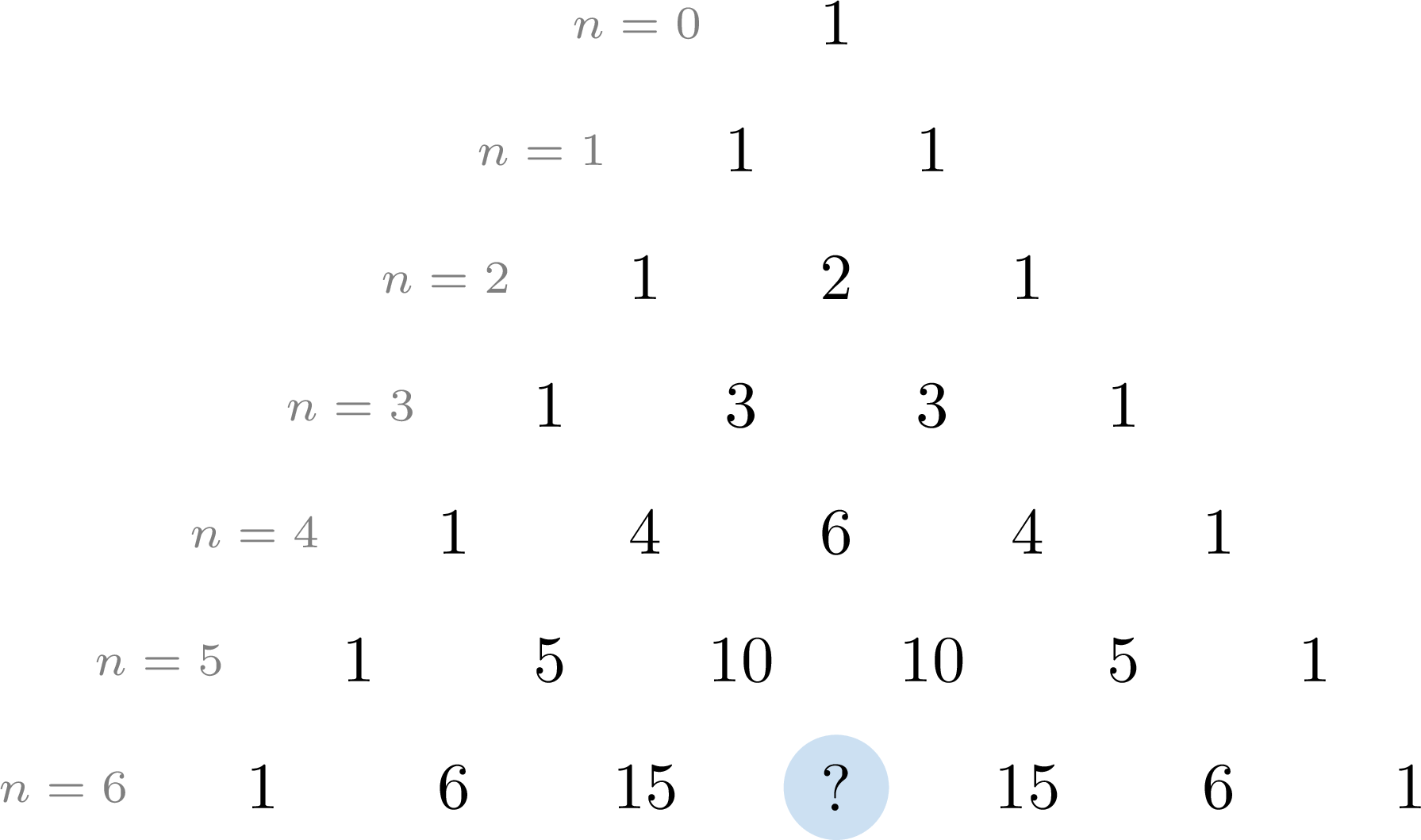
Row \(5\) reads \(1, 5, 10, 10, 5, 1\). By Pascal's relation, position \(3\) of row \(6\) is the sum of positions \(2\) and \(3\) of row \(5\): \(\dbinom{6}{3} = 10 + 10 = 20\). Formula: \(\dbinom{6}{3} = \dfrac{6 \times 5 \times 4}{3 \times 2 \times 1} = 20\). Row \(6\) is \(1, 6, 15, 20, 15, 6, 1\).
Proposition — The Sum of a Row
For every natural number \(n\), $$\sum_{k=0}^{n} \binom{n}{k} = \binom{n}{0} + \binom{n}{1} + \dots + \binom{n}{n} = 2^n:$$ the values of row \(n\) of Pascal's triangle add up to \(2^n\). 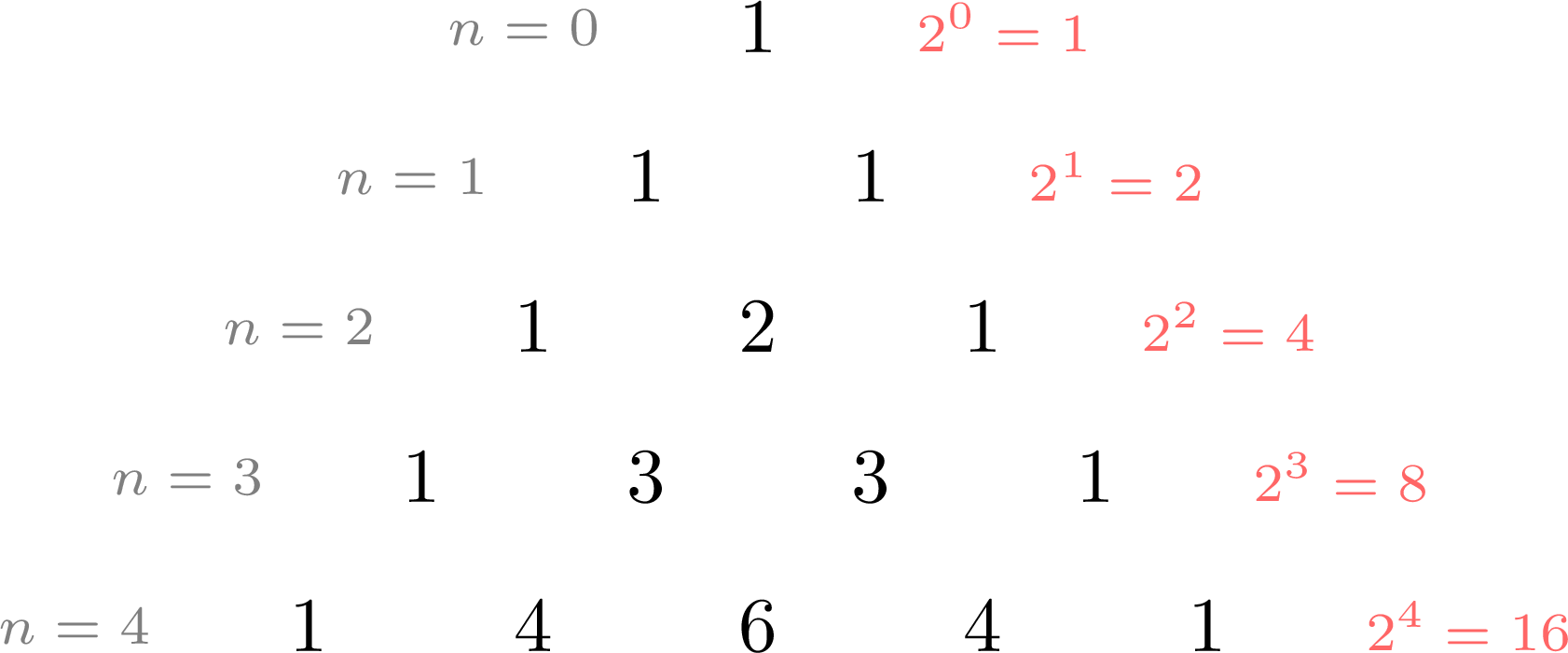
Skills to practice
- Reading Pascal's Triangle
- Building Pascal's Triangle and Using Pascal's Relation
I.4
Expanding with Pascal's Triangle
Proposition — Binomial Expansion
For the binomial expansion of \((a+b)^n\) where \(n \in \mathbb{N}\): - As we look from left to right across the expansion, the powers of \(a\) decrease by \(1\), while the powers of \(b\) increase by \(1\).
- The sum of the powers of \(a\) and \(b\) in each term of the expansion is \(n\).
- The number of terms in the expansion is \(n+1\).
- The coefficients of the terms are row \(n\) of Pascal's triangle.
Example
Find the binomial expansion of \((a+b)^5\).
From the 5th row of Pascal's triangle $$ \begin{array}{cccccccccccc} &&&&1&&1&&&&&\text{row 1}\\
&&&1&&2&&1&&&&\text{row 2}\\
&&1&&3&&3&&1&&&\text{row 3}\\
&1&&4&&6&&4&&1&&\text{row 4}\\
1&&5&&10&&10&&5&&1&\text{row 5} \end{array} $$ we get $$ (a+b)^5= a^5+5a^4b+10a^3b^2+10a^2b^3+5ab^4+b^5. $$
Example
Use Pascal's triangle to expand and simplify \((3x-2)^4\).
Row \(4\) of Pascal's triangle gives the coefficients \(1, 4, 6, 4, 1\) of \((a+b)^4\). Substitute \(a = 3x\) and \(b = -2\), each in brackets: the coefficient \(3\) and the sign of \(-2\) are raised to the powers too. $$\begin{aligned}[t] (3x-2)^4 &= (3x)^4 + 4(3x)^3(-2) + 6(3x)^2(-2)^2 + 4(3x)(-2)^3 + (-2)^4 &&\text{(row \(4\))}\\
&= 81x^4 + 4 \times 27x^3 \times (-2) + 6 \times 9x^2 \times 4 + 4 \times 3x \times (-8) + 16 &&\text{(powers)}\\
&= 81x^4 - 216x^3 + 216x^2 - 96x + 16. \end{aligned}$$ The signs alternate, because the odd powers of \(-2\) are negative. Check at \(x = 1\): \((3 - 2)^4 = 1\) and \(81 - 216 + 216 - 96 + 16 = 1\).
Skills to practice
- Expanding with a Row of Pascal's Triangle
II
The Binomial Theorem
II.1
The Binomial Theorem
Proposition — Binomial Theorem
For any non-negative integer \(n\) and any real numbers \(a\) and \(b\), we have$$\begin{aligned}(a+b)^n&=\sum_{k=0}^{n} \binom{n}{k}a^{\,n-k}b^{\,k}\\
&= \binom{n}{0}a^n b^0 + \binom{n}{1}a^{n-1}b^1 + \binom{n}{2}a^{n-2}b^2 + \dotsb + \binom{n}{n}a^0 b^n\end{aligned}$$ - Combinatorial Argument:
- Case \(n=0\): By convention, \((a+b)^0 = 1\). The formula gives \(\binom{0}{0}a^0b^0 = 1 \times 1 \times 1 = 1\). Thus, the theorem holds.
- Case \(n > 0\): Consider the product$$(a+b)^n = \underbrace{(a+b)(a+b)\dotsm(a+b)}_{\text{\(n\) factors}}.$$ To obtain a term in the expansion, we choose either \(a\) or \(b\) from each factor and multiply the \(n\) choices together.
A term of the form \(a^{n-k}b^k\) appears whenever we choose \(b\) from exactly \(k\) of the \(n\) brackets (and \(a\) from the remaining \(n-k\) brackets).
The number of such choices is precisely \(\binom{n}{k}\), because we must choose which \(k\) positions will contribute a factor \(b\).
Therefore the coefficient of \(a^{n-k}b^k\) is \(\binom{n}{k}\), and summing over all \(k\) from \(0\) to \(n\) gives$$(a+b)^n = \sum_{k=0}^{n} \binom{n}{k}a^{\,n-k}b^{\,k}.$$
- Proof by Induction:
Let \(P(n)\) be the property: \((a+b)^n = \sum_{k=0}^{n} \binom{n}{k} a^{n-k} b^k\).- Base case: For \(n=0\), \((a+b)^0 = 1\).
The formula gives \(\sum_{k=0}^{0} \binom{0}{k} a^{0-k} b^k = \binom{0}{0} a^0 b^0 = 1\).
Thus \(P(0)\) is true. - Inductive step: Assume \(P(n)\) is true for some \(n \ge 0\). Let's compute \((a+b)^{n+1}\): $$(a+b)^{n+1} = (a+b) \sum_{k=0}^{n} \binom{n}{k} a^{n-k} b^k = \sum_{k=0}^{n} \binom{n}{k} a^{n-k+1} b^k + \sum_{k=0}^{n} \binom{n}{k} a^{n-k} b^{k+1}$$ By shifting the index of the second sum (let \(j = k+1\)), we combine the terms: $$(a+b)^{n+1} = \binom{n}{0}a^{n+1} + \sum_{k=1}^{n} \left[ \binom{n}{k} + \binom{n}{k-1} \right] a^{n-k+1} b^k + \binom{n}{n}b^{n+1}$$ Using Pascal's Identity, \(\binom{n}{k} + \binom{n}{k-1} = \binom{n+1}{k}\), and noting that \(\binom{n}{0}=\binom{n+1}{0}\) and \(\binom{n}{n}=\binom{n+1}{n+1}\): $$(a+b)^{n+1} = \sum_{k=0}^{n+1} \binom{n+1}{k} a^{n+1-k} b^k.$$
- Base case: For \(n=0\), \((a+b)^0 = 1\).
Skills to practice
- The Binomial Theorem
II.2
Binomial Coefficients with Technology
Method — Evaluating Binomial Coefficients with Technology
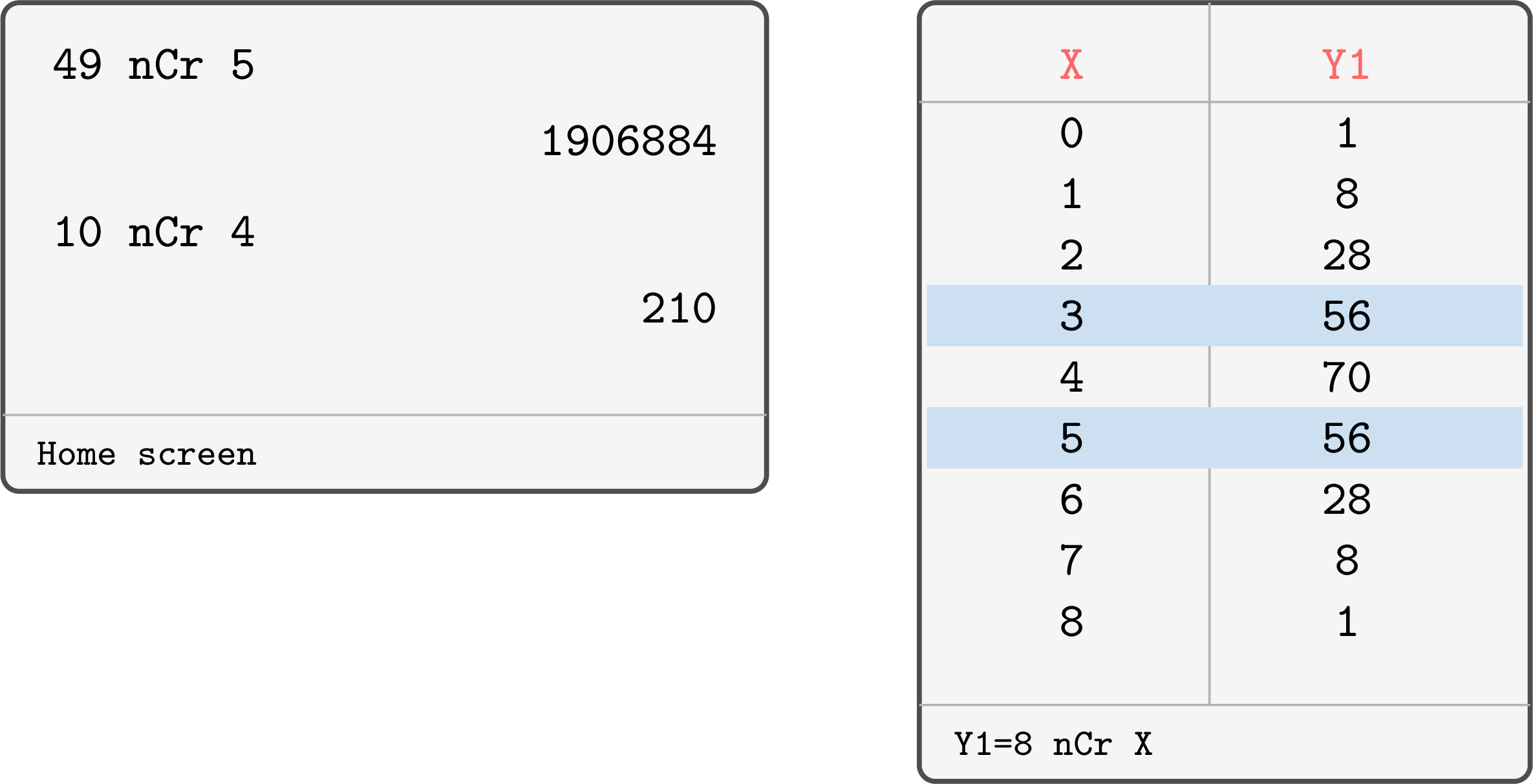
A graphing calculator evaluates \(\dbinom{n}{p}\) directly; this Method and its exercises use the pupil's own graphing calculator, since a simple scientific calculator may have no such command and no table of values. The command is usually written nCr, and is then entered between the two numbers: \(n\), the command, then \(p\), as in 49 nCr 5. A calculator that names it comb takes the function form comb(49,5). The first screen shows \(\dbinom{49}{5} = 1\,906\,884\), the number of Lotto draws, and \(\dbinom{10}{4} = 210\). To find \(p\) when the value of \(\dbinom{n}{p}\) is known, use the table of values of the graphing calculator: - Enter the function \(Y_1 = n\ \mathtt{nCr}\ X\) (
comb(n,X)in function form) in the function menu, with the given value of \(n\). - Display the table of values from \(X = 0\) to \(X = n\), in steps of \(1\): the column \(Y_1\) lists \(\dbinom{n}{0}, \dbinom{n}{1}, \dots, \dbinom{n}{n}\).
- Read every value of \(X\) whose \(Y_1\) is the given value. A value usually appears twice, for \(p\) and for \(n - p\): choosing the \(p\) elements that are taken is the same as choosing the \(n - p\) elements that are left, so \(\dbinom{n}{p} = \dbinom{n}{n-p}\).
Example
- Use technology to evaluate \(\dbinom{20}{8}\).
- Use a table of values to find the values of \(p\) for which \(\dbinom{12}{p} = 495\).
- The command
20 nCr 8gives \(\dbinom{20}{8} = 125\,970\). - The table of \(Y_1 = 12\ \mathtt{nCr}\ X\) for \(X = 0, 1, \dots, 12\) reads:
\(X\) \(0\) \(1\) \(2\) \(3\) \(4\) \(5\) \(6\) \(7\) \(8\) \(9\) \(10\) \(11\) \(12\) \(Y_1\) \(1\) \(12\) \(66\) \(220\) \(495\) \(792\) \(924\) \(792\) \(495\) \(220\) \(66\) \(12\) \(1\)
Skills to practice
- Evaluating Factorials and Binomial Coefficients with Technology
- Finding p from a Binomial Coefficient with Technology
II.3
Terms and Coefficients
Definition — General Term
In the expansion of \((a+b)^n\) given by the binomial theorem, the term $$\binom{n}{k}a^{n-k}b^{k}, \qquad k = 0, 1, \dots, n,$$ is the general term. The integer \(k\) is the power of \(b\), the second term of the binomial. Counted from the left, the general term is the \((k+1)\)th term of the expansion: the first term \(a^n\) has \(k = 0\), the last term \(b^n\) has \(k = n\). Method — Finding a Term or a Coefficient in an Expansion
To find the term in \(x^m\) of an expansion \((a+b)^n\) in which \(a\) and \(b\) are each a number times a power of \(x\), with two different powers (\(x^0 = 1\) included), or its constant term, which is the term in \(x^0\): - Identify \(a\), \(b\) and \(n\), each term of the binomial with its sign and its coefficient: in \(\left(2x - \dfrac{3}{x}\right)^5\), \(a = 2x\), \(b = -\dfrac{3}{x}\) and \(n = 5\).
- Write the general term \(\dbinom{n}{k}a^{n-k}b^{k}\) with \(a\) and \(b\) in brackets, then use the laws of exponents to write it as a number times a single power of \(x\), whose exponent depends on \(k\).
- Solve for \(k\) the equation stating that this exponent equals \(m\) (\(m = 0\) for the constant term). The expansion has a term in \(x^m\) only if the solution is an integer with \(0 \leq k \leq n\).
- Substitute this value of \(k\) in the general term. The coefficient of \(x^m\) is the number in front of \(x^m\), its sign included.
Example
Consider the expansion of \((2x-1)^7\). - Write down its general term.
- Find its third term.
- Find the coefficient of \(x^4\).
- Here \(a = 2x\), \(b = -1\) and \(n = 7\). The general term is $$\binom{7}{k}(2x)^{7-k}(-1)^{k} = \binom{7}{k}\,2^{7-k}(-1)^{k}\,x^{7-k}, \qquad k = 0, 1, \dots, 7.$$
- The third term has \(k = 3 - 1 = 2\): $$\begin{aligned}[t] \binom{7}{2}(2x)^{5}(-1)^{2} &= 21 \times 32x^5 \times 1 &&\text{(\(\tbinom{7}{2} = 21\))}\\ &= 672x^5. \end{aligned}$$
- The exponent of \(x\) is \(7 - k\), and \(7 - k = 4\) gives \(k = 3\): $$\begin{aligned}[t] \binom{7}{3}(2x)^{4}(-1)^{3} &= 35 \times 16x^4 \times (-1) &&\text{(\(\tbinom{7}{3} = 35\))}\\ &= -560x^4. \end{aligned}$$ The coefficient of \(x^4\) is \(-560\): the sign comes from \((-1)^3\).
Example
Find the constant term of the expansion of \(\left(x^2 - \dfrac{2}{x}\right)^6\), and show that this expansion has no term in \(x^5\).
Here \(a = x^2\), \(b = -\dfrac{2}{x}\) and \(n = 6\). The general term is $$\begin{aligned}[t] \binom{6}{k}\left(x^2\right)^{6-k}\left(-\frac{2}{x}\right)^{k} &= \binom{6}{k}\,x^{12-2k}\,\frac{(-2)^k}{x^k} &&\text{(power of a power, of a quotient)}\\
&= \binom{6}{k}(-2)^k\,x^{12-3k} &&\text{(quotient of powers)}. \end{aligned}$$ Constant term: \(12 - 3k = 0\) gives \(k = 4\), and $$\begin{aligned}[t] \binom{6}{4}(-2)^4 &= 15 \times 16 &&\text{(\(\tbinom{6}{4} = 15\))}\\
&= 240. \end{aligned}$$ Term in \(x^5\): \(12 - 3k = 5\) gives \(k = \dfrac{7}{3}\), which is not an integer. The expansion has no term in \(x^5\): its exponents \(12 - 3k\) are \(12, 9, 6, 3, 0, -3, -6\), all multiples of \(3\).
Example
In the expansion of \((1+2x)^n\), where \(n \geq 2\) is an integer, the coefficient of \(x^2\) is \(180\). Find \(n\).
The general term is \(\dbinom{n}{k}1^{n-k}(2x)^{k} = \dbinom{n}{k}2^k x^k\), so the term in \(x^2\) has \(k = 2\) and its coefficient is \(4\dbinom{n}{2}\). $$\begin{aligned}[t] 4\binom{n}{2} = 180 &\iff 4 \times \frac{n(n-1)}{2} = 180 &&\text{(\(\tbinom{n}{2} = \tfrac{n(n-1)}{2}\) for \(n \geq 2\))}\\
&\iff n^2 - n - 90 = 0 &&\text{(divide by \(2\), expand)}\\
&\iff (n - 10)(n + 9) = 0 &&\text{(factorise)}\\
&\iff n = 10 \text{ or } n = -9. \end{aligned}$$ Since \(n \geq 2\), \(n = 10\). Check: \(4\dbinom{10}{2} = 4 \times 45 = 180\).
Example
Find the coefficient of \(x^3\) in the expansion of \((x+2)(1-x)^5\).
The general term of \((1-x)^5\) is \(\dbinom{5}{k}1^{5-k}(-x)^{k} = \dbinom{5}{k}(-1)^k x^k\). In the product, the term in \(x^3\) is \(x\) times the term in \(x^2\) of \((1-x)^5\) (\(k = 2\)) plus \(2\) times its term in \(x^3\) (\(k = 3\)): $$\begin{aligned}[t] x \times \binom{5}{2}(-1)^2x^2 + 2 \times \binom{5}{3}(-1)^3x^3 &= 10x^3 - 20x^3 &&\text{(\(\tbinom{5}{2} = \tbinom{5}{3} = 10\))}\\
&= -10x^3. \end{aligned}$$ The coefficient of \(x^3\) is \(-10\).
Skills to practice
- Recognising Terms and Coefficients
- Writing a Given Term of an Expansion
- Finding a Coefficient or a Constant Term
- Finding a Coefficient in a Product
- Finding an Unknown from a Coefficient
- Justifying Terms and Coefficients
III
Going further
Skills to practice
- Reasoning with the Binomial Theorem
- Solving Problems
- Quiz
Jump to section