International Baccalaureate · DP 2: Analysis and Approaches HL
Definite Integrals: Areas and Volumes
I
Areas
I.1
The Area of a Region
The definite integral \(\int_a^b f(x)\,\mathrm{d}x\) is the signed area between the graph of \(y=f(x)\) and the \(x\)-axis. This means that areas above the x-axis are positive, while areas below are negative.
However, when a problem asks for the geometric area or simply the area of a region, it refers to the physical, positive space the region occupies. In this case, we must ensure that all parts of the region, whether they are above or below the x-axis, contribute a positive value to the total. This total geometric area needs its own method.
However, when a problem asks for the geometric area or simply the area of a region, it refers to the physical, positive space the region occupies. In this case, we must ensure that all parts of the region, whether they are above or below the x-axis, contribute a positive value to the total. This total geometric area needs its own method.
Method — Calculating Geometric Area Bounded by a Curve and the x-axis
To find the total geometric area \(\mathcal{A}\) bounded by a curve \(y=f(x)\) and the x-axis from \(x=a\) to \(x=b\) (\(f\) continuous on \([a, b]\), with finitely many roots in this interval): - Find the \(x\)-intercepts: Determine where the curve meets the \(x\)-axis (the zeros of \(f\)) by solving \(f(x)=0\). Identify any roots \(c_1, c_2, \dots\) that lie within the interval \([a,b]\).
- Split the integral: Divide the main integral into smaller integrals at each intercept found in the previous step: on each sub-interval, \(f\) keeps a constant sign (it is continuous and does not vanish inside).
- Calculate each definite integral: Compute the integral for each sub-interval. Some of these will correspond to positive values (where \(f(x) \ge 0\)) and some to negative values (where \(f(x) \le 0\)).
- Sum the absolute values: The total geometric area is the sum of the absolute values of these integrals. If the integral of a sub-region is negative, take its positive value before adding it to the total.
Example
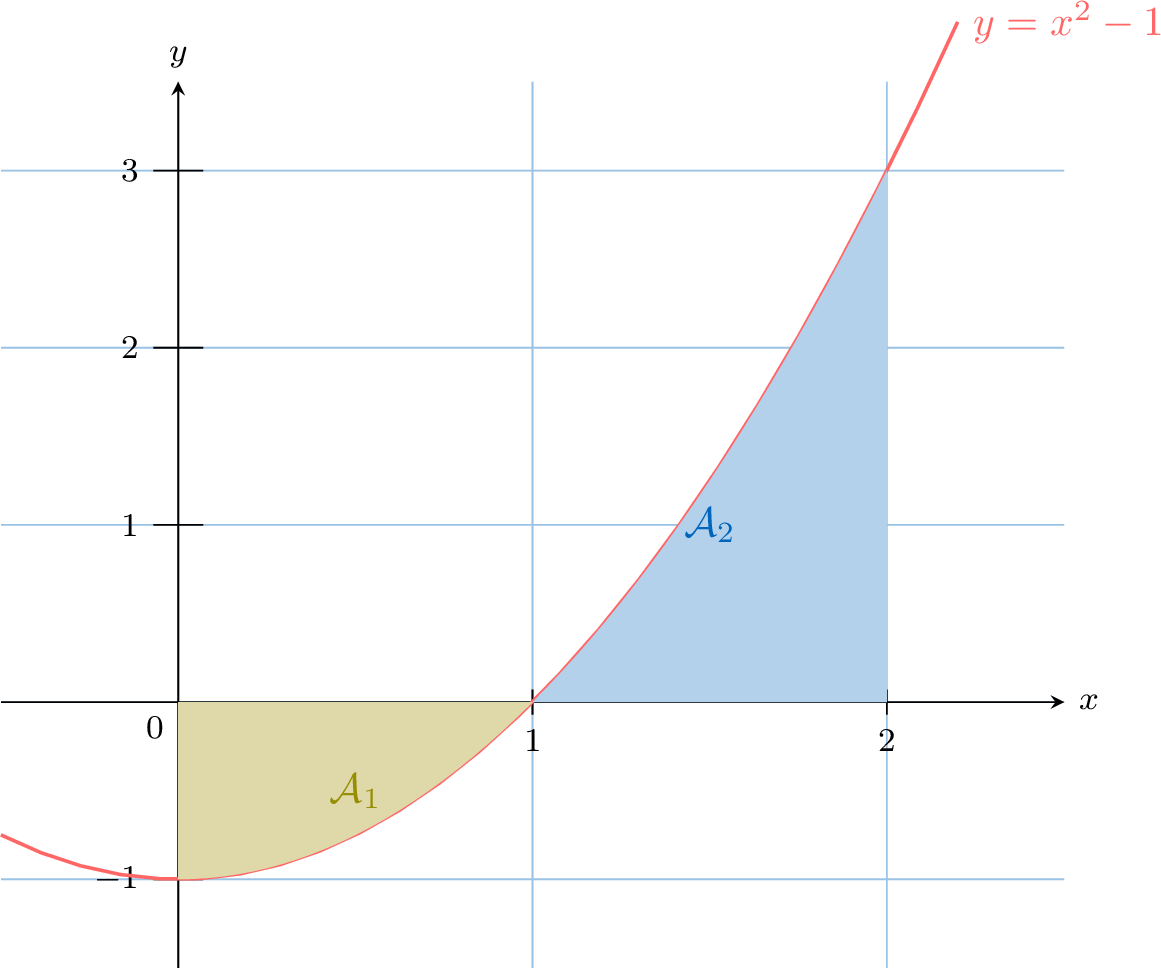
Find the total geometric area between the curve \(y=x^2-1\) and the \(x\)-axis from \(x=0\) to \(x=2\). - Find intercepts: We solve \(f(x)=x^2-1=0\), which gives roots at \(x=1\) and \(x=-1\). The only root within our interval of integration \([0,2]\) is \(x=1\).
- Split the integral: We must split the total area calculation at \(x=1\).
- From \(x=0\) to \(x=1\), the function is below the \(x\)-axis (Area \(\mathcal{A}_1\)).
- From \(x=1\) to \(x=2\), the function is above the \(x\)-axis (Area \(\mathcal{A}_2\)).
- Calculate each integral: $$ \int_0^1 (x^2-1)\, \mathrm{d}x = \left[\frac{x^3}{3}-x\right]_0^1 = \left(\frac{1}{3}-1\right) - 0 = -\frac{2}{3} $$ $$ \int_1^2 (x^2-1)\, \mathrm{d}x = \left[\frac{x^3}{3}-x\right]_1^2 = \left(\frac{8}{3}-2\right) - \left(\frac{1}{3}-1\right) = \frac{2}{3} - \left(-\frac{2}{3}\right) = \frac{4}{3} $$
- Sum the absolute values: $$ \text{Total Area} = \left|-\frac{2}{3}\right| + \left|\frac{4}{3}\right| = \frac{2}{3} + \frac{4}{3} = \frac{6}{3} = 2 $$
Definition — Geometric Area Formula
The total geometric area \(\mathcal{A}\) between the graph of a function \(f(x)\) and the \(x\)-axis from \(x=a\) to \(x=b\) is given by the integral of the absolute value of the function: $$ \mathcal{A} = \int_a^b |f(x)|\, \mathrm{d}x $$
Note
The method of splitting the integral and summing the absolute values is equivalent to this formal definition of the total geometric area.
Integrals over an Unbounded Interval
A region that extends without end can still have a finite area. Let \(f\) be a function continuous on \([a, +\infty)\). When the integral \(\displaystyle\int_a^b f(x)\,\mathrm{d}x\) tends to a finite number \(L\) as \(b\) tends to \(+\infty\), one writes $$\int_a^{+\infty} f(x)\,\mathrm{d}x = L.$$ For example, for every \(b > 1\), $$\begin{aligned}[t] \int_1^b \frac{1}{x^2}\,\mathrm{d}x &= \left[-\frac{1}{x}\right]_1^b\\
&= 1 - \frac{1}{b} \xrightarrow[b \to +\infty]{} 1, \end{aligned}$$ so \(\displaystyle\int_1^{+\infty} \frac{1}{x^2}\,\mathrm{d}x = 1\): the region under the curve \(y = \dfrac{1}{x^2}\) to the right of the line \(x = 1\) is unbounded, and its area is \(1\). 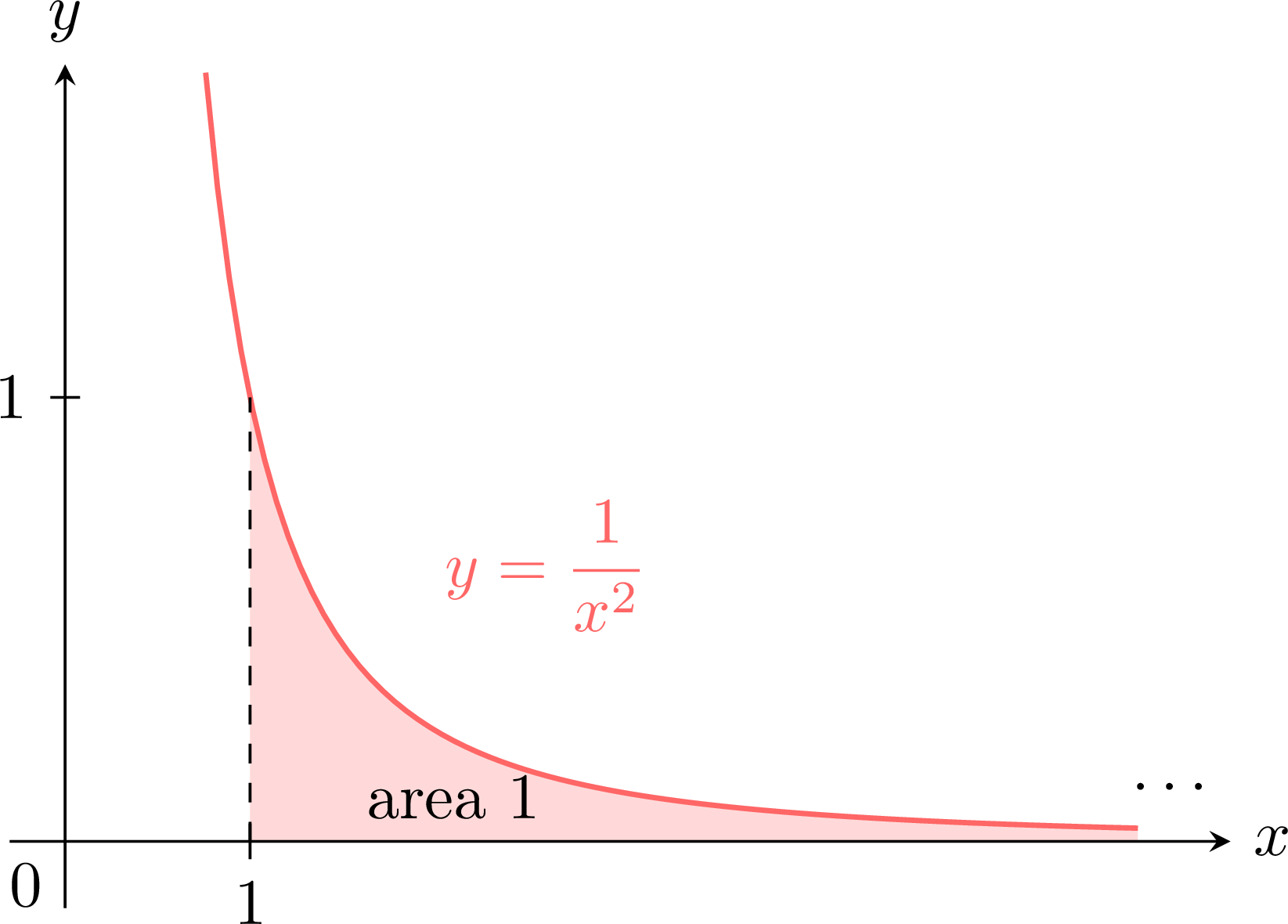
The integral \(\displaystyle\int_{-\infty}^{b} f(x)\,\mathrm{d}x\) is defined in the same way, as \(a\) tends to \(-\infty\), and, when \(\displaystyle\int_{-\infty}^{c} f(x)\,\mathrm{d}x\) and \(\displaystyle\int_{c}^{+\infty} f(x)\,\mathrm{d}x\) both exist, \(\displaystyle\int_{-\infty}^{+\infty} f(x)\,\mathrm{d}x\) is their sum. In particular, when \(f\) is continuous on \([a, b]\) and \(f(x) = 0\) for every \(x < a\) and every \(x > b\), the parts outside \([a, b]\) contribute \(0\) (a jump of \(f\) at \(a\) or at \(b\) changes nothing), and $$\int_{-\infty}^{+\infty} f(x)\,\mathrm{d}x = \int_a^b f(x)\,\mathrm{d}x.$$ These integrals are used here only in these two ways: as the limit of an integral over \([a, b]\), or for a function that is zero outside a bounded interval.
Skills to practice
- Evaluating Areas with Geometric Formulas
- Finding Areas with Antiderivatives
I.2
The Area Between Two Curves
We can extend the concept of finding the area under a single curve to find the area of a region enclosed between two different curves. The area under a curve \(y=f(x)\) is a special case where the second curve is simply the \(x\)-axis, \(y=0\).
The general idea is intuitive: when \(0 \le g(x) \le f(x)\) on \([a, b]\), the area of the region bounded by the upper function \(f(x)\) and the lower function \(g(x)\) is the area under \(f(x)\) minus the area under \(g(x)\). By linearity, this difference is a single integral, and the formula remains valid whenever \(g \le f\) on \([a, b]\), even when the curves go below the \(x\)-axis, since it is the area under the non-negative function \(f - g\): $$\begin{aligned} \textcolor{olive}{\mathcal{A}} &= \textcolor{colordef}{ \int_a^b f(x)\; \mathrm{d}x} - \textcolor{colorprop}{ \int_a^b g(x)\; \mathrm{d}x} \\ &= \int_a^b (f(x)-g(x))\; \mathrm{d}x \end{aligned} $$ 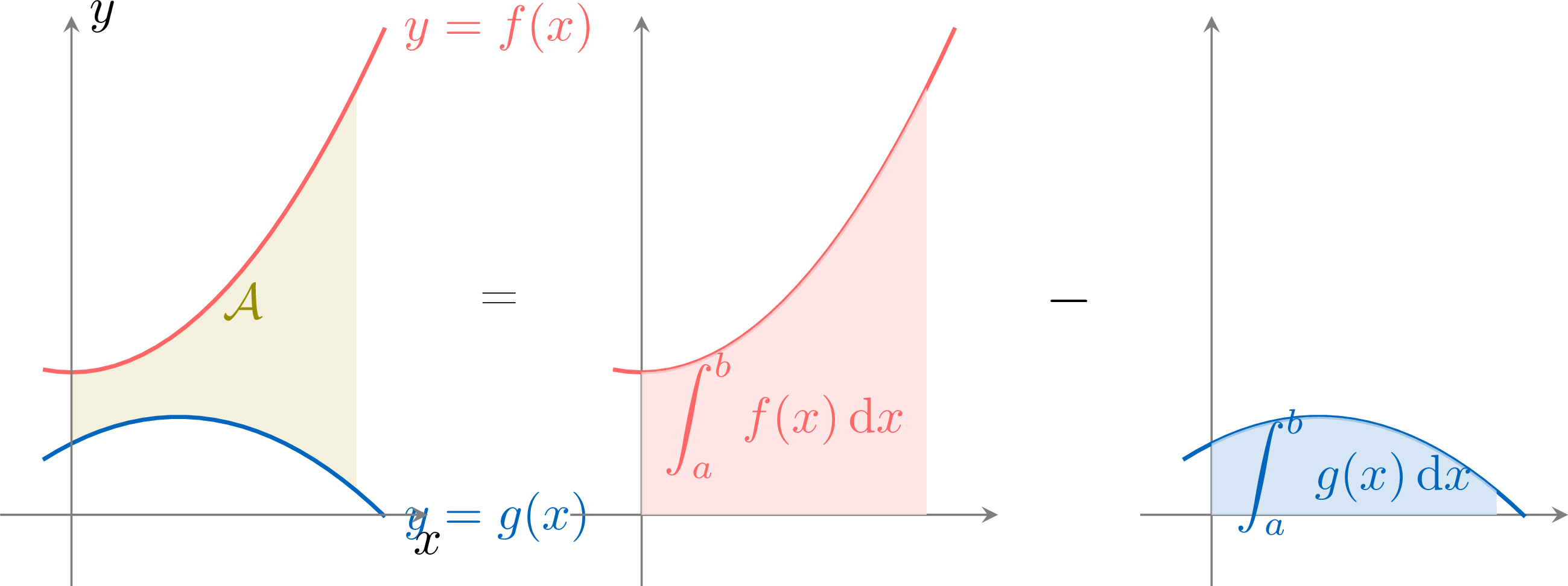
The general idea is intuitive: when \(0 \le g(x) \le f(x)\) on \([a, b]\), the area of the region bounded by the upper function \(f(x)\) and the lower function \(g(x)\) is the area under \(f(x)\) minus the area under \(g(x)\). By linearity, this difference is a single integral, and the formula remains valid whenever \(g \le f\) on \([a, b]\), even when the curves go below the \(x\)-axis, since it is the area under the non-negative function \(f - g\): $$\begin{aligned} \textcolor{olive}{\mathcal{A}} &= \textcolor{colordef}{ \int_a^b f(x)\; \mathrm{d}x} - \textcolor{colorprop}{ \int_a^b g(x)\; \mathrm{d}x} \\ &= \int_a^b (f(x)-g(x))\; \mathrm{d}x \end{aligned} $$
Proposition — Area Between Curves
Let \(f\) and \(g\) be continuous on \([a,b]\). If \(f(x) \geq g(x)\) for all \(x\) in \([a,b]\), the area \(\mathcal{A}\) of the region bounded by the curves \(y=f(x)\) and \(y=g(x)\) and the lines \(x=a\) and \(x=b\) is given by: $$ \mathcal{A} = \int_a^b (f(x)-g(x))\; \mathrm{d}x $$
This can be remembered as the integral of the upper function minus the lower function.
Method — Calculating the Area Between Two Curves
To find the total geometric area enclosed by two curves \(y=f(x)\) and \(y=g(x)\) (\(f\) and \(g\) continuous, with finitely many intersection points on the interval considered): - Find points of intersection. Solve the equation \(f(x)=g(x)\) to find where the curves meet: these points give the bounds \(a\) and \(b\) when they are not given and, when they are, the points inside \([a, b]\) where the upper and lower functions may swap. Choose the consecutive intersection points that bound the region sought.
- Identify the upper and lower function. On each interval between intersection points, determine which function is on top. Between two consecutive intersection points, \(f - g\) is continuous and does not vanish, so it keeps a constant sign: testing one point is enough (a quick sketch helps).
- Set up and evaluate the integral(s). On each interval \([c, d]\) between consecutive intersection points or bounds, calculate \(\int_c^d (\text{upper function} - \text{lower function}) \, \mathrm{d}x\), which is non-negative. The total area is the sum of these integrals.
Example
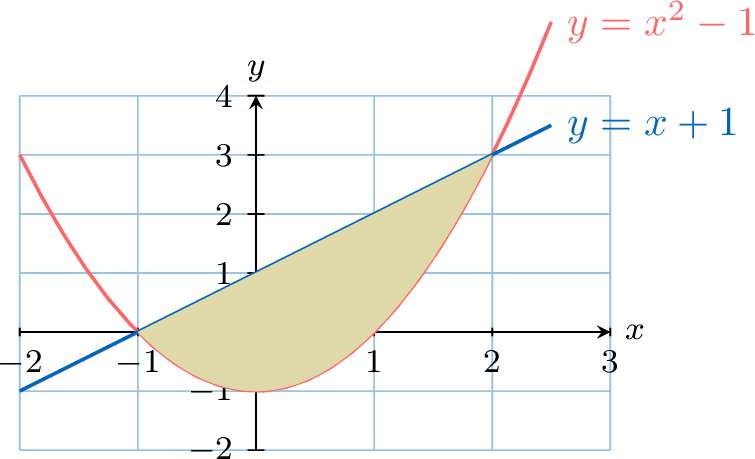
Find the area of the region enclosed by the curves \(y=x+1\) and \(y=x^2-1\). - Find intersection points: We set the two functions equal to each other: $$ x+1 = x^2-1 \iff x^2-x-2=0 \iff(x-2)(x+1)=0 $$ The curves intersect at \(x=-1\) and \(x=2\). These are our limits of integration.
- Identify the upper function: The curves do not meet between \(x=-1\) and \(x=2\), so the difference \((x+1)-(x^2-1)\), which is continuous, keeps a constant sign on \((-1, 2)\): testing one point is enough. At \(x=0\): for \(y=x+1\), \(y(0)=1\); for \(y=x^2-1\), \(y(0)=-1\). Since \(1 > -1\), the line \(y=x+1\) is the upper function on \([-1,2]\).
- Set up and evaluate: $$\begin{aligned} \mathcal{A} &= \int_{-1}^2 \left( (x+1) - (x^2-1) \right)\, \mathrm{d}x \\ &= \int_{-1}^2 (-x^2+x+2)\, \mathrm{d}x \\ &= \left[ -\frac{x^3}{3} + \frac{x^2}{2} + 2x \right]_{-1}^2 \\ &= \left(-\frac{8}{3} + \frac{4}{2} + 4\right) - \left(\frac{1}{3} + \frac{1}{2} - 2\right) \\ &= \left(-\frac{16}{6} + \frac{12}{6} + \frac{24}{6}\right) - \left(\frac{2}{6} + \frac{3}{6} - \frac{12}{6}\right) \\ &= \frac{20}{6} - \left(-\frac{7}{6}\right) \\ &= \frac{27}{6} \\ &= \frac{9}{2} \end{aligned}$$
Skills to practice
- Calculating the Area Enclosed Between Two Curves
I.3
The Area Between Two Curves with Technology
Method — Finding the Area Between Two Curves with Technology
When the points where two curves meet cannot be found by algebra, or when no antiderivative of \(f - g\) is known, a graphing calculator finds the area of the region enclosed by the curves \(y = f(x)\) and \(y = g(x)\). - Graph both functions, \(Y_1 = f(x)\) and \(Y_2 = g(x)\), in a window that shows the whole region.
- Find every point of intersection with the intersection tool, as in the Method “Solving an Equation Graphically with Technology”, and store each \(x\)-coordinate in a memory of the calculator. The bounds keep all their digits: the area is rounded once, at the end. A window alone does not show that no point of intersection is missing: check their number with the degree of \(f(x) - g(x)\) when it is a polynomial, or with the behaviour of the curves outside the window.
- Write the area before evaluating it. Between two consecutive points of intersection \(c\) and \(d\), the area of the part is \(\displaystyle\int_c^d \big(\text{upper function} - \text{lower function}\big)\,\mathrm{d}x\), the upper function being read on the graph; the area of the region is the sum of these parts. Equivalently, the area is \(\displaystyle\int_a^b |f(x) - g(x)|\,\mathrm{d}x\), where \(a\) and \(b\) are the first and the last points of intersection.
- Evaluate with the stored bounds, and report the area to 3 significant figures. The integral \(\displaystyle\int_a^b \big(f(x) - g(x)\big)\,\mathrm{d}x\), taken across a crossing, is not the area: it subtracts the parts where \(g\) is above \(f\).
Example
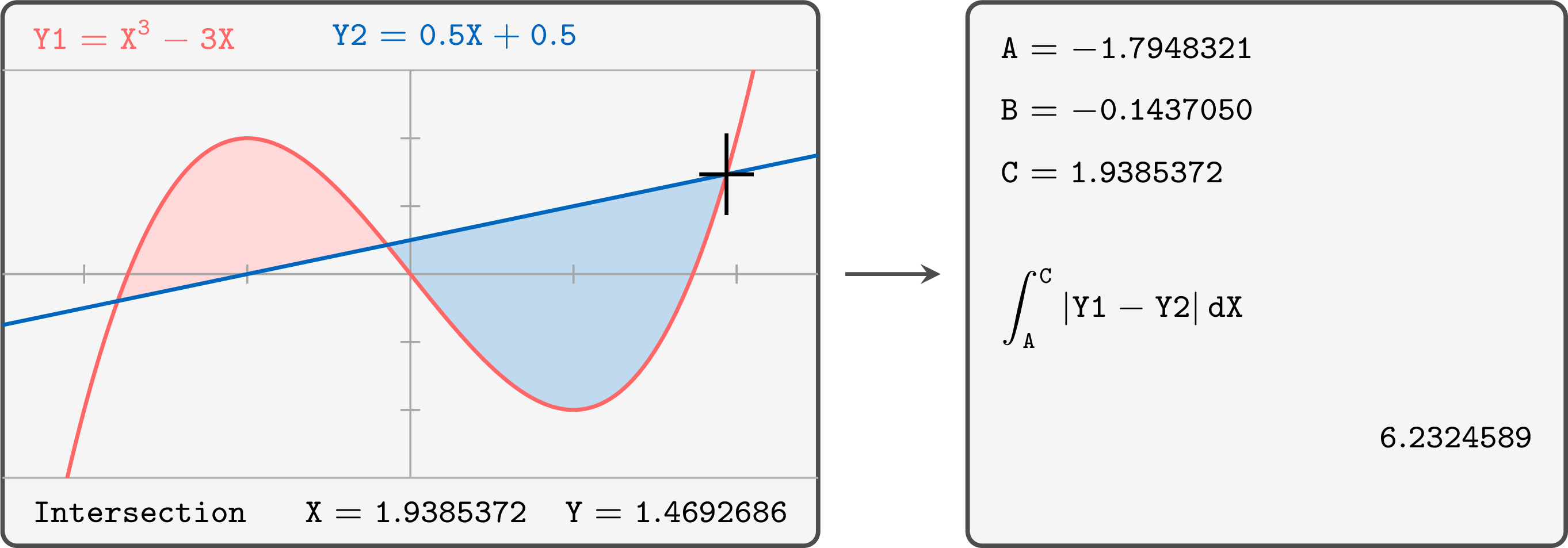
Find the area of the region enclosed by the curves \(y = x^3 - 3x\) and \(y = \dfrac{1}{2}x + \dfrac{1}{2}\). - Points of intersection. In the window \(-2.5 \le x \le 2.5\), \(-3 \le y \le 3\), the line meets the cubic three times. The intersection tool displays \(X = -1.7948321\), \(X = -0.1437050\) and \(X = 1.9385372\), stored as \(A\), \(B\) and \(C\). The equation \(x^3 - 3x = \frac{1}{2}x + \frac{1}{2}\) has degree \(3\), so it has at most three solutions: none is missing.
- Upper function. On \((A, B)\), at \(x = -1\) the cubic gives \(2\) and the line gives \(0\): the cubic is above. On \((B, C)\), at \(x = 1\) the cubic gives \(-2\) and the line gives \(1\): the line is above.
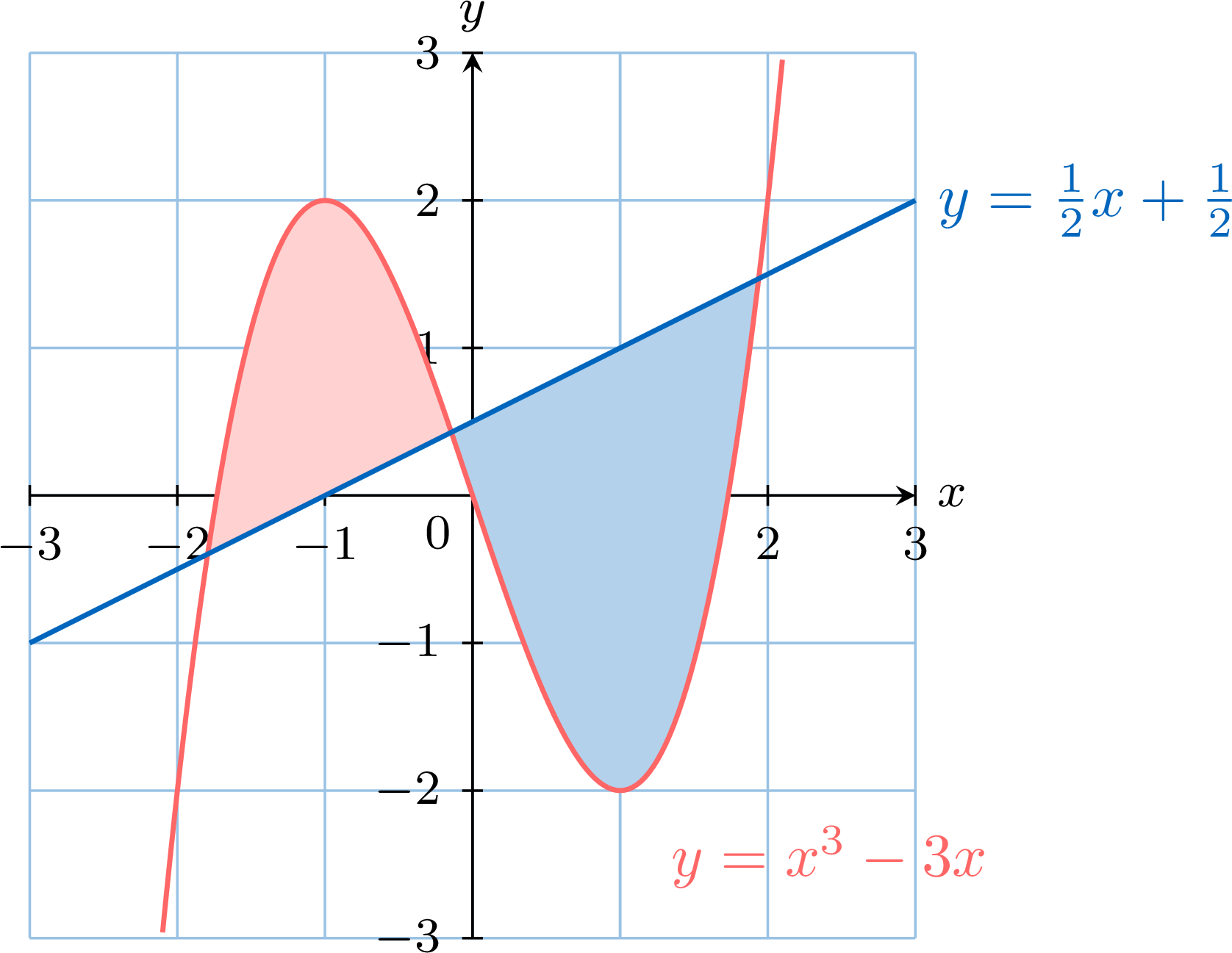
- Area. The region has two parts, so the area is written as a sum before it is evaluated: $$\begin{aligned}[t] \mathcal{A} &= \int_A^B \Big(x^3 - 3x - \big(\tfrac{1}{2}x + \tfrac{1}{2}\big)\Big)\,\mathrm{d}x + \int_B^C \Big(\tfrac{1}{2}x + \tfrac{1}{2} - (x^3 - 3x)\Big)\,\mathrm{d}x &&\text{(upper minus lower)}\\ &\approx 2.1815022 + 4.0509567 &&\text{(values displayed)}\\ &\approx 6.23. \end{aligned}$$ The single integral \(\displaystyle\int_A^C \left|x^3 - 3x - \big(\tfrac{1}{2}x + \tfrac{1}{2}\big)\right|\mathrm{d}x\) displays the same total, \(6.2324589\). The area is \(\mathcal{A} \approx 6.23\) square units.
Skills to practice
- Finding the Area Between Two Curves with Technology
I.4
The Area Between a Curve and the \(y\)-Axis
When a region is bounded by a curve and the \(y\)-axis, it is natural to integrate with respect to \(y\): express \(x\) as a function of \(y\), \(x = g(y)\), and compute \(\int g(y)\,\mathrm{d}y\). For a region to the right of the \(y\)-axis, \(x = g(y) \ge 0\), and this integral is the area; for a region to the left of the axis, \(g(y) \le 0\), and the area is \(\int |g(y)|\,\mathrm{d}y\).
Method — Area Between a Curve and the y-Axis
- Express \(x\) as a function of \(y\): solve the equation of the curve for \(x=g(y)\).
- Identify the \(y\)-bounds \(c\) and \(d\) of the region.
- Integrate with respect to \(y\): \(\displaystyle\mathcal{A}=\int_c^d g(y)\,\mathrm{d}y\) (for \(g(y)\ge0\)).
Example
Find the area of the region bounded by the curve \(y=x^2\) (with \(x\ge0\)), the \(y\)-axis, and the line \(y=4\).
For \(x\ge0\), \(y=x^2\) gives \(x=\sqrt{y}\). The shaded region is bounded by the curve, the \(y\)-axis, and the line \(y=4\): 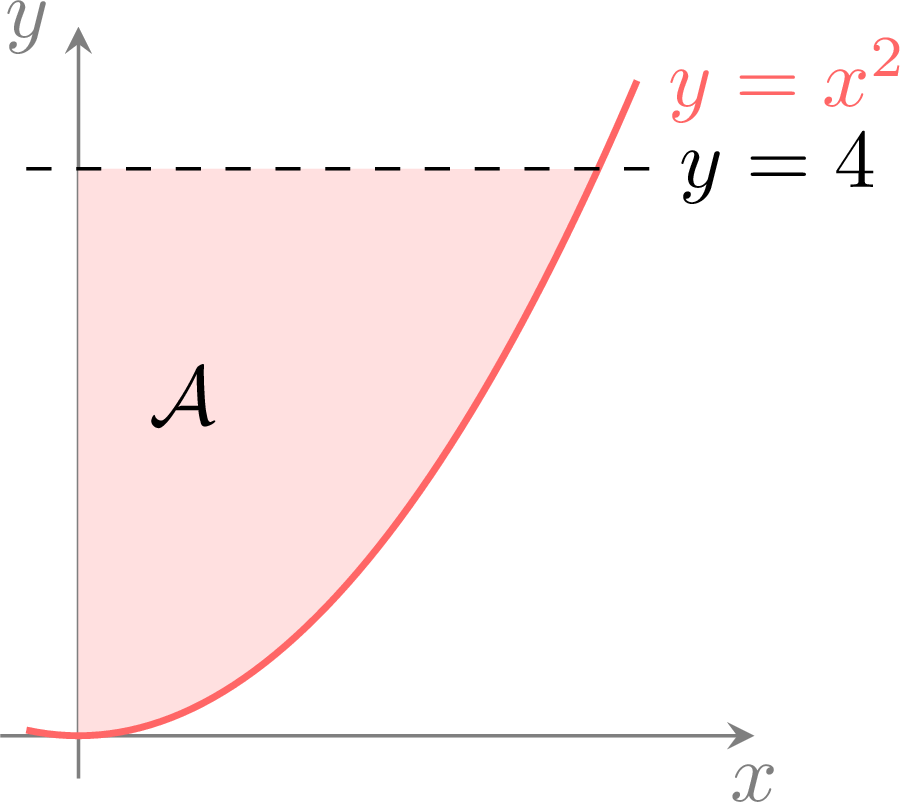
Integrating with respect to \(y\) from \(0\) to \(4\): $$\begin{aligned} \mathcal{A} &= \int_0^4 \sqrt{y}\,\mathrm{d}y &&\text{(area vs the }y\text{-axis)}\\
&= \Big[\tfrac23 y^{3/2}\Big]_0^4 = \tfrac{16}{3} &&\text{(evaluate)} \end{aligned}$$
Skills to practice
- Calculating Areas Against the \(y\)-Axis
II
Volumes of Revolution
II.1
Volumes of Revolution about the \(x\)-Axis
A solid of revolution is a three-dimensional object formed by rotating a two-dimensional shape around an axis. Their exact volume can be found by integration.
Consider the area under the curve \(y=f(x)\) from \(x=a\) to \(x=b\). If we revolve this area \(360^\circ\) (\(2\pi\) radians) around the \(x\)-axis, it sweeps out a solid of revolution. 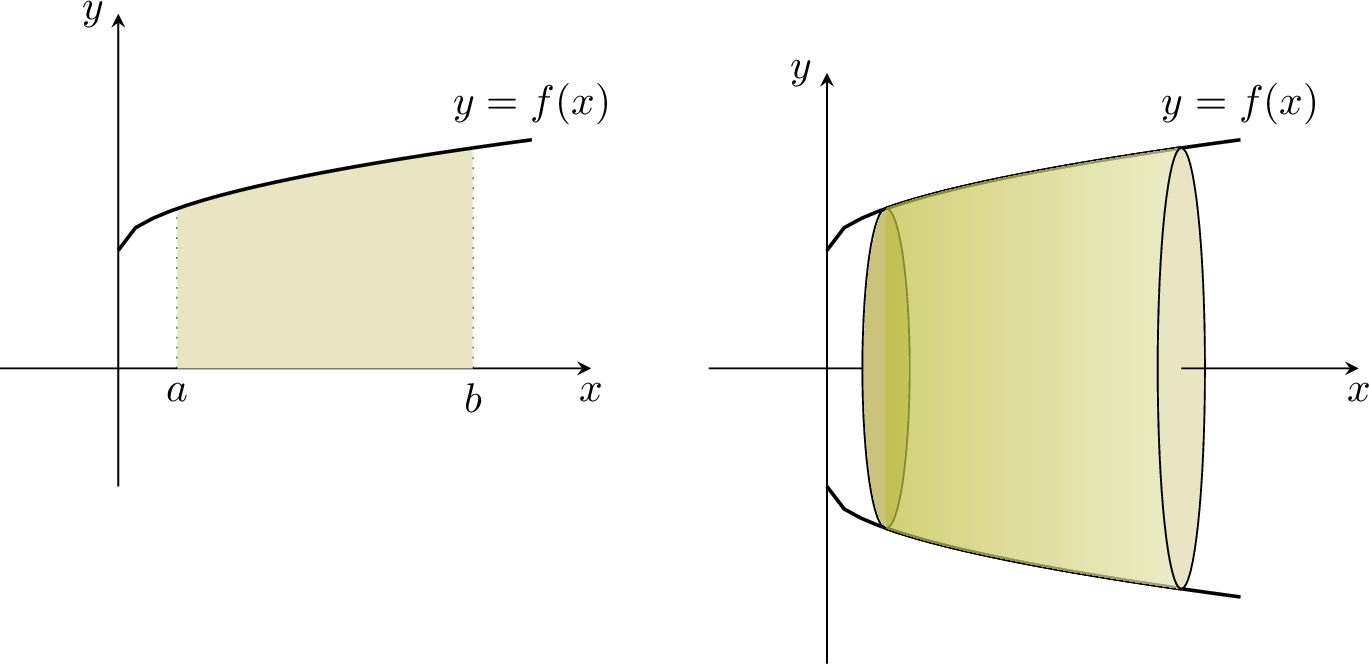
Consider the area under the curve \(y=f(x)\) from \(x=a\) to \(x=b\). If we revolve this area \(360^\circ\) (\(2\pi\) radians) around the \(x\)-axis, it sweeps out a solid of revolution.
Method — The Disc Method
To find the volume of this solid, we use the same strategy as for area: slice the solid into many thin pieces and sum their volumes. In this case, each slice is a thin cylindrical disc. The key insight is that each disc is formed by rotating one of the thin rectangles from a Riemann sum around the \(x\)-axis. 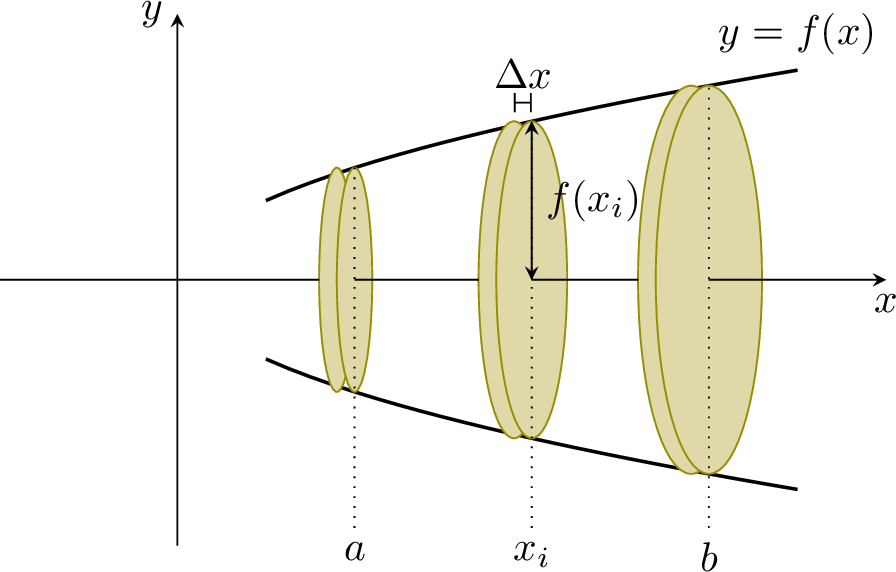
- The radius is the height of the function, \(r = f(x_i)\).
- The height (thickness) of the disc is \(h = \Delta x\).
Proposition — Volume of Revolution about the \(x\)-axis
Let \(f\) be continuous on \([a,b]\), with \(f(x)\geq 0\) on \([a,b]\). The volume \(V\) generated by rotating the region bounded by the curve \(y=f(x)\), the \(x\)-axis, and the lines \(x=a\) and \(x=b\) around the \(x\)-axis is given by: $$ V = \pi \int_a^b [f(x)]^2\, \mathrm{d}x $$ 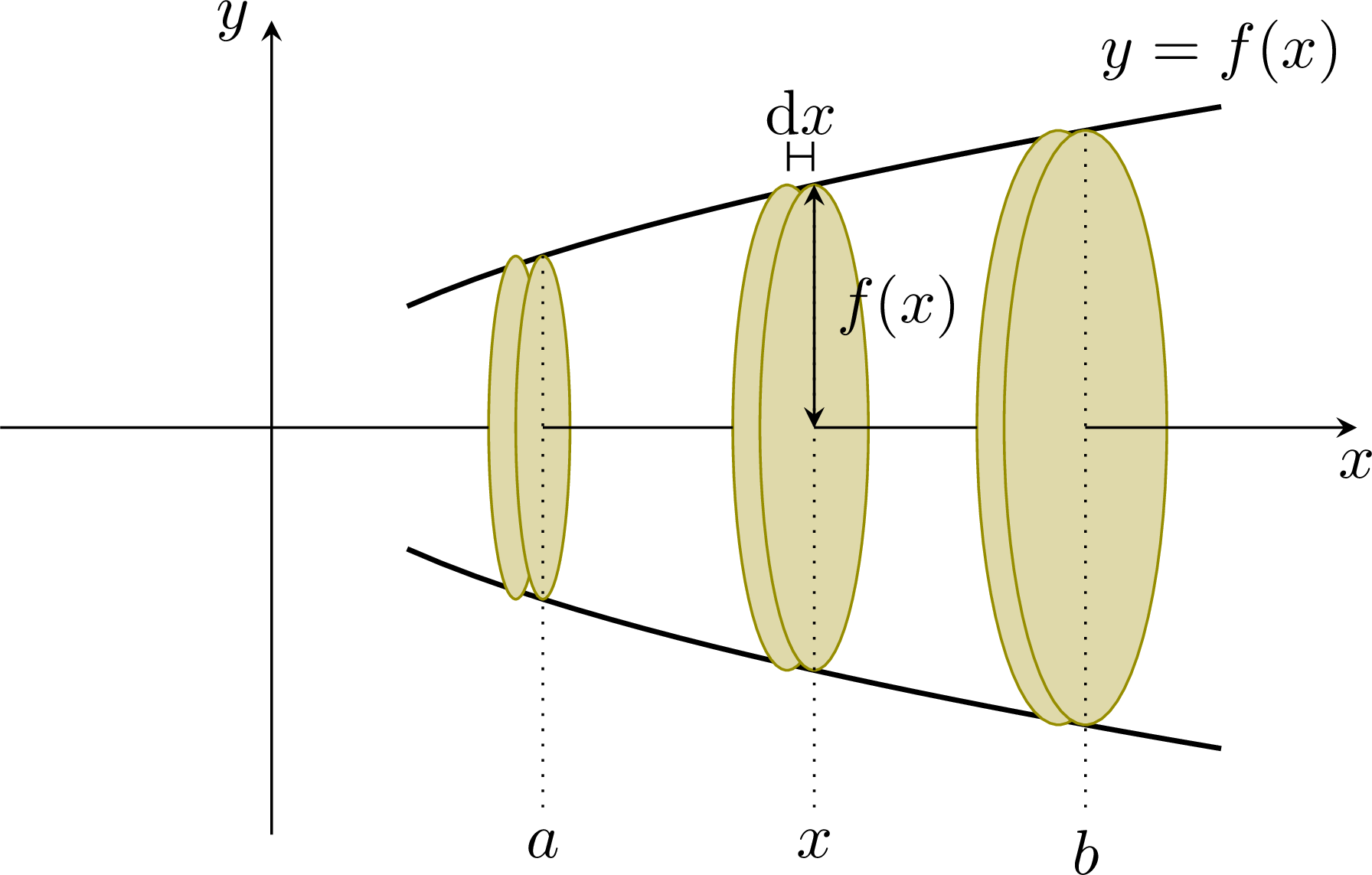
Example
Find the volume of the solid generated by revolving the region under the curve \(y=\sqrt{x}\) from \(x=1\) to \(x=4\) around the \(x\)-axis. 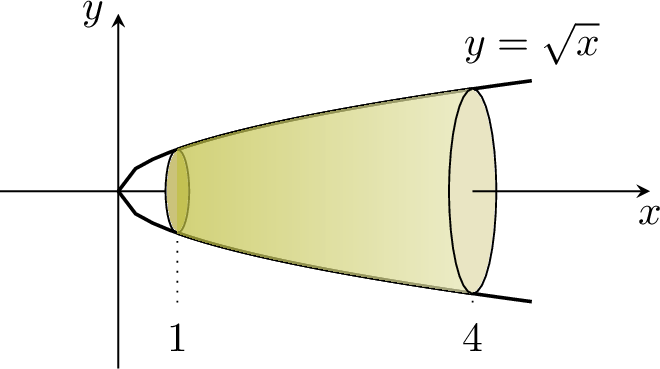
- Identify: The function is \(f(x)=\sqrt{x}\), and the limits are \(a=1\) and \(b=4\).
- Square the function: \([f(x)]^2 = (\sqrt{x})^2 = x\).
- Integrate: We set up and evaluate the integral for the volume: $$\begin{aligned} V &= \pi \int_1^4 x \, \mathrm{d}x \\ &= \pi \left[ \frac{x^2}{2} \right]_1^4 \\ &= \pi \left( \frac{4^2}{2} - \frac{1^2}{2} \right) \\ &= \pi \left( \frac{16}{2} - \frac{1}{2} \right) \\ &= \pi \left( 8 - \frac{1}{2} \right)\\ &= \frac{15\pi}{2} \end{aligned}$$
Skills to practice
- Calculating Volumes of Revolution about the \(x\)-Axis
II.2
Volumes of Revolution about the \(y\)-Axis
Many objects have a vertical axis of symmetry: a vase, a bowl, a funnel. Their volume is a volume of revolution about the \(y\)-axis. The slices are then horizontal discs, of thickness \(\mathrm{d}y\), and the radius of the disc at height \(y\) is the horizontal distance \(x\) from the axis to the curve.
Proposition — Volume of Revolution about the y-axis
Let \(g\) be continuous on \([c,d]\), with \(g(y)\ge 0\) on \([c,d]\). The volume \(V\) generated by rotating the region bounded by the curve \(x=g(y)\), the y-axis, and the lines \(y=c\) and \(y=d\) around the y-axis is given by: $$ V = \pi \int_c^d [g(y)]^2\, \mathrm{d}y $$ 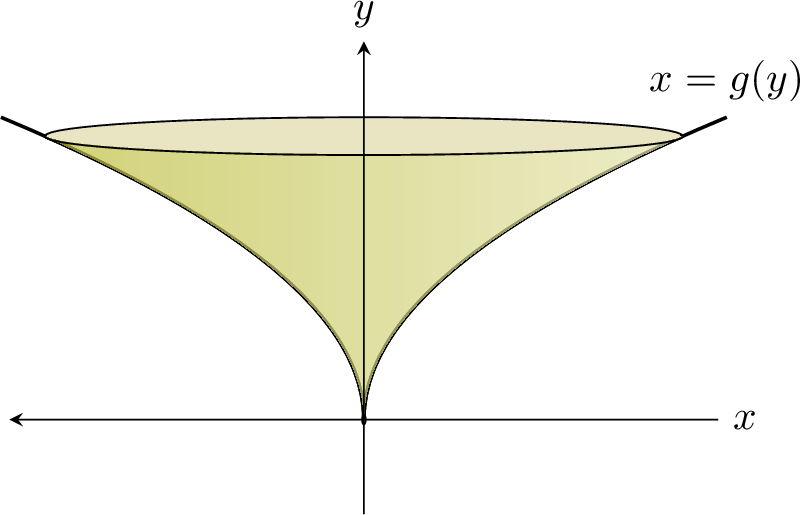
Note
To use this formula, the function must be expressed in the form \(x=g(y)\), where \(y\) is the independent variable. This may require rearranging the function's equation.
Example
Find the volume of the solid generated by revolving the region bounded by the curve \(y=\sqrt{x}\), the y-axis, and the line \(y=2\) about the y-axis. 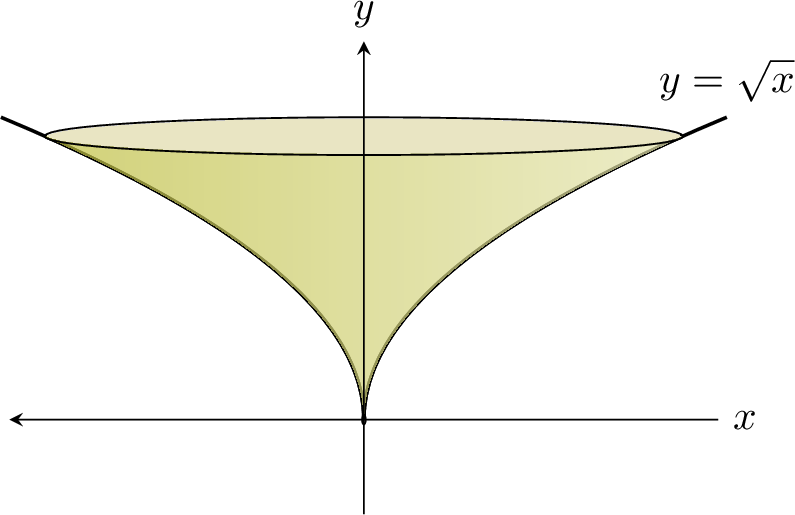
- Rearrange the function: The rotation is around the y-axis, so we need to express \(x\) in terms of \(y\): $$ y = \sqrt{x} \implies x = y^2. $$ So, our function is \(g(y)=y^2\).
- Identify limits: The region is bounded by the y-axis (which corresponds to \(x=0\) and starts at \(y=0\), where the curve meets the axis) and the line \(y=2\). So, our limits are \(c=0\) and \(d=2\).
- Integrate: We set up and evaluate the integral for the volume: $$\begin{aligned} V &= \pi \int_0^2 [g(y)]^2\, \mathrm{d}y \\ &= \pi \int_0^2 (y^2)^2\, \mathrm{d}y \\ &= \pi \int_0^2 y^4\, \mathrm{d}y \\ &= \pi \left[ \frac{y^5}{5} \right]_0^2 \\ &= \pi \left( \frac{2^5}{5} - \frac{0^5}{5} \right)\\ &= \frac{32\pi}{5} \end{aligned}$$
Skills to practice
- Calculating Volumes of Revolution about the \(y\)-Axis
II.3
Volumes Between Two Curves
When a region lies between an outer curve \(y=f(x)\) and an inner curve \(y=g(x)\), with \(0 \le g(x) \le f(x)\), rotating it about the \(x\)-axis produces a washer (annular) cross-section, and \(V=\pi\int\big(f(x)^2-g(x)^2\big)\,\mathrm{d}x\).
Example
The region between \(y=x\) and \(y=x^2\) (from \(x=0\) to \(x=1\)) is rotated about the \(x\)-axis. Find the volume of the solid.
On \([0,1]\), \(y=x\) is the outer curve and \(y=x^2\) the inner one. By the washer rule, $$\begin{aligned} V &= \pi\int_0^1\big(x^2-(x^2)^2\big)\mathrm{d}x &&\text{(outer}^2-\text{inner}^2)\\
&= \pi\int_0^1(x^2-x^4)\,\mathrm{d}x &&\\
&= \pi\Big[\tfrac{x^3}{3}-\tfrac{x^5}{5}\Big]_0^1 = \tfrac{2\pi}{15} &&\text{(evaluate)} \end{aligned}$$
Skills to practice
- Calculating Washer Volumes
II.4
Volumes of Revolution with Technology
Method — Finding a Volume of Revolution with Technology
A graphing calculator evaluates the integral of a volume of revolution once the volume is written. - Write the volume first. For the region between a curve and the axis of rotation: about the \(x\)-axis, \(V = \pi\displaystyle\int_a^b [f(x)]^2\,\mathrm{d}x\); about the \(y\)-axis, \(V = \pi\displaystyle\int_c^d [g(y)]^2\,\mathrm{d}y\), the curve being written \(x = g(y)\). The function is squared, not the integral, and the factor \(\pi\) multiplies the whole integral.
- Simplify the square when it is quick, for example \(\left(\sqrt{x}\right)^2 = x\) or \(\left(e^{-x^2}\right)^2 = e^{-2x^2}\); otherwise enter it as it is, with brackets around the function.
- Enter the integral with the variable \(X\) of the calculator, \(\pi\) typed in front of it. For a rotation about the \(y\)-axis, the variable \(y\) is typed as \(X\): the name of the variable of integration does not change the value of the integral.
- Report the volume to 3 significant figures.
A Region Between Two Curves
For a region between an outer curve \(y = f(x)\) and an inner curve \(y = g(x)\), with \(0 \le g(x) \le f(x)\) on \([a, b]\), rotated about the \(x\)-axis, the volume is written first in the same way, \(V = \pi\displaystyle\int_a^b \big([f(x)]^2 - [g(x)]^2\big)\,\mathrm{d}x\), then entered as a single integral: each function is squared before the subtraction, and the factor \(\pi\) multiplies the whole integral.
Example
The region bounded by the curve \(y = e^{-x^2}\), the \(x\)-axis, the \(y\)-axis and the line \(x = 1.5\) is rotated about the \(x\)-axis. Find the volume of the solid generated.
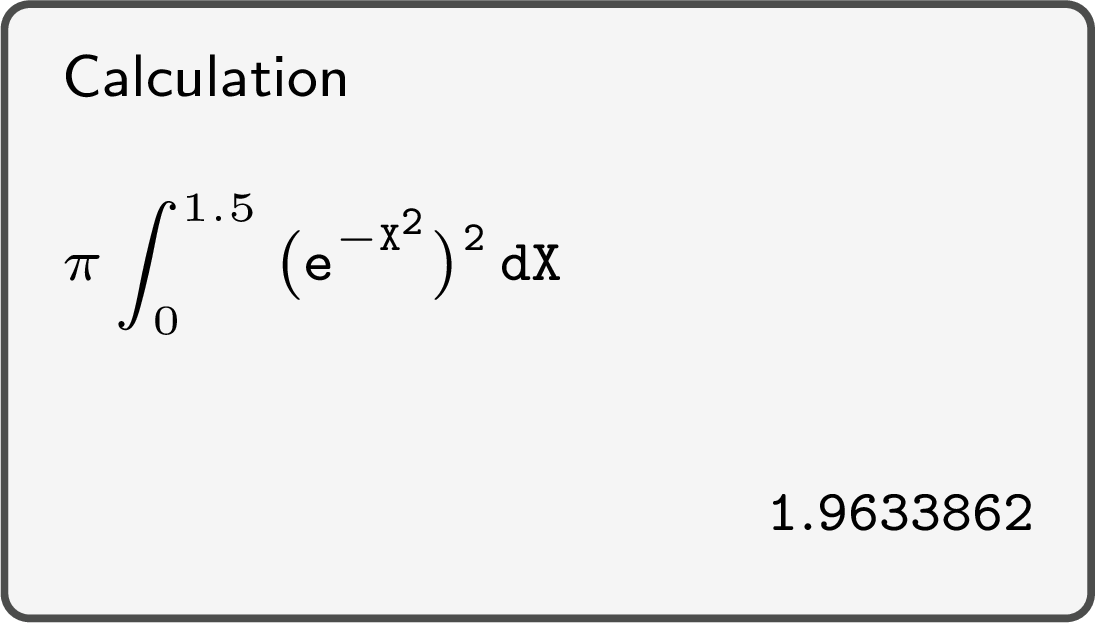
For \(0 \le x \le 1.5\), \(e^{-x^2} > 0\), so the volume is written first, then the square simplified: $$\begin{aligned}[t] V &= \pi\int_0^{1.5} \left(e^{-x^2}\right)^2\mathrm{d}x &&\text{(volume about the } x\text{-axis)}\\
&= \pi\int_0^{1.5} e^{-2x^2}\,\mathrm{d}x. &&\big((e^{u})^2 = e^{2u}\big) \end{aligned}$$ No antiderivative of \(e^{-2x^2}\) can be written with the standard functions: the calculator evaluates the integral. The template, with \(\pi\) in front, the integrand \(e^{-2X^2}\) and the bounds \(0\) and \(1.5\), displays \(1.9633862\). The volume is \(V \approx 1.96\) cubic units.
Two entries give a wrong value: \(\pi\displaystyle\int_0^{1.5} e^{-x^2}\,\mathrm{d}x\), where the function is not squared, displays \(2.6897952\); the integral without the factor \(\pi\) displays \(0.6249652\).
Two entries give a wrong value: \(\pi\displaystyle\int_0^{1.5} e^{-x^2}\,\mathrm{d}x\), where the function is not squared, displays \(2.6897952\); the integral without the factor \(\pi\) displays \(0.6249652\).
Skills to practice
- Finding Volumes of Revolution with Technology
III
Going further
Skills to practice
- Solving Problems without Technology
- Solving Problems with Technology
- Quiz
Jump to section