International Baccalaureate · DP 2: Analysis and Approaches HL
Revision: Probability and Statistics
I
Toolbox: Joint Probability with Trees
Recappreviously studied — click to reread
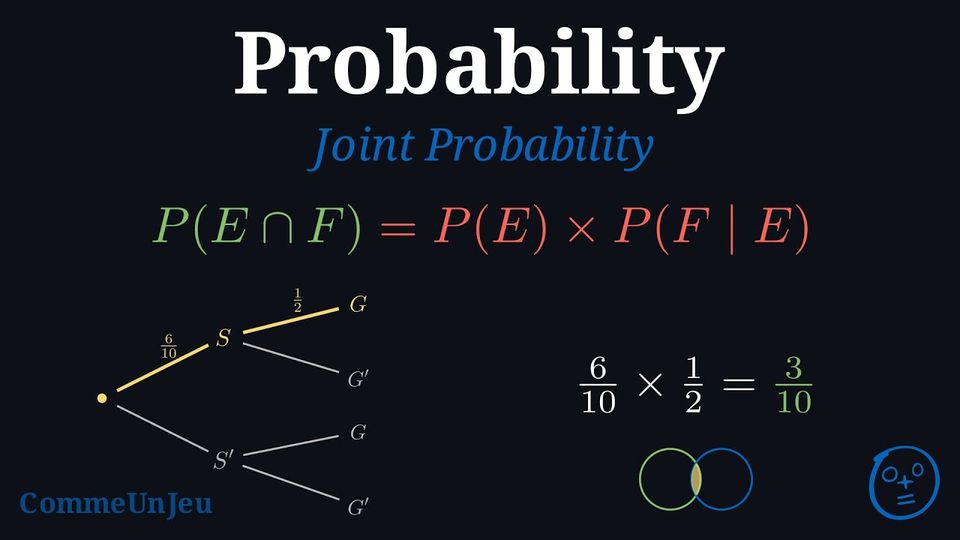
Proposition — Joint Probability Formula
For \(P(E) > 0\) and \(P(F) > 0\) respectively: $$P(E \cap F) = P(E) \times \PCond{F}{E}, \quad P(E \cap F) = P(F) \times \PCond{E}{F}.$$ Example
For this probability tree, 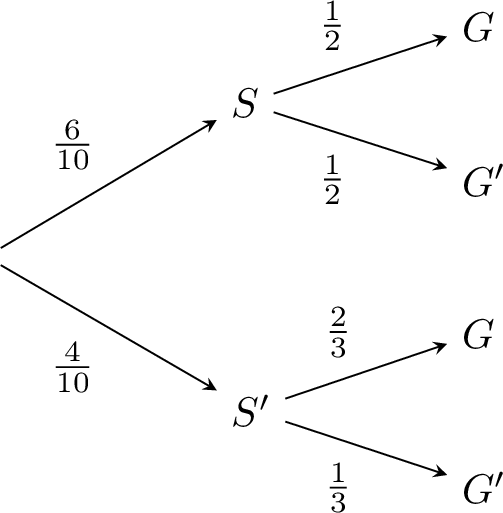
- Path: \(S\) to \(G\) (highlighted):
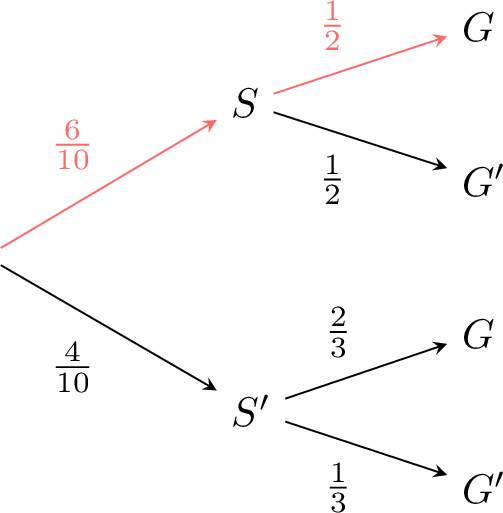
- Calculate: $$\begin{aligned} P(S \cap G) &= P(S) \times \PCond{G}{S}\\ &= \frac{6}{10} \times \frac{1}{2}\\ &= \frac{3}{10}. \end{aligned}$$
Skills to practice
- Calculating Joint Probabilities with Trees
II
Toolbox: Finding an Unknown Mean or Standard Deviation
Recappreviously studied — click to reread
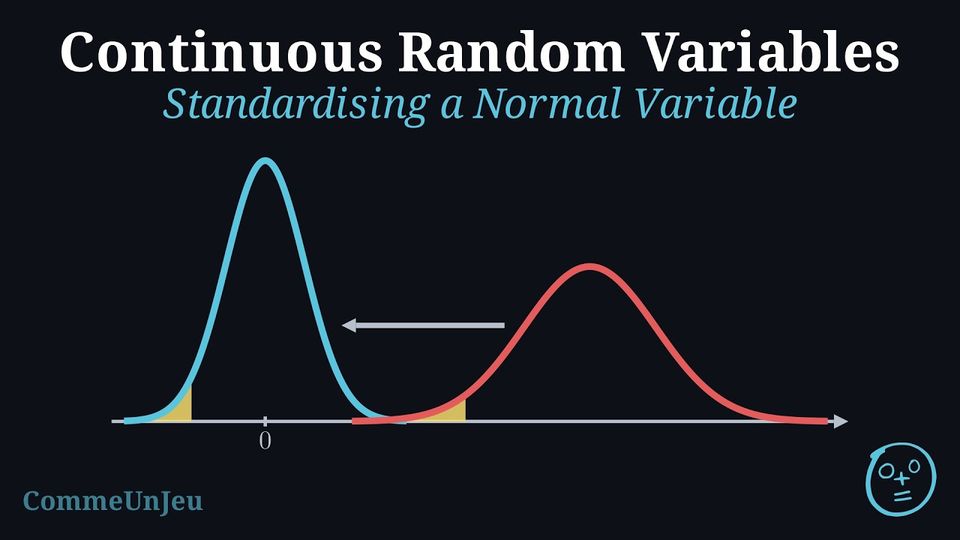
Proposition — Standardising a Normal Variable
If \(X \sim \mathcal{N}(\mu, \sigma^2)\), then the standardised variable $$Z = \frac{X - \mu}{\sigma}$$ follows the standard normal distribution: \(Z \sim \mathcal{N}(0, 1)\). Consequently, for every real number \(x\), $$P(X \leq x) = P(Z \leq z) \qquad \text{where} \qquad z = \frac{x - \mu}{\sigma},$$ and, for \(x_1 < x_2\) with standardised values \(z_1\) and \(z_2\), \(P(x_1 \leq X \leq x_2) = P(z_1 \leq Z \leq z_2)\).The number \(z\) is the standardised value (or \(z\)-value) of \(x\): the number of standard deviations between \(x\) and the mean, positive when \(x > \mu\) and negative when \(x < \mu\).
Method — Finding an Unknown Mean or Standard Deviation
When \(\mu\) or \(\sigma\) is unknown, the inverse normal function cannot be used on \(X\), since it needs both parameters. Standardising moves the condition to \(Z \sim \mathcal{N}(0, 1)\), whose parameters are known. - Write each condition as a left area: \(P(X < x) = p\), where a condition \(P(X > x) = q\) becomes \(P(X < x) = 1 - q\).
- Sketch: place \(x\) on the side of \(\mu\) that \(p\) indicates; a left area less than \(0.5\) puts \(x\) below the mean, so its standardised value is negative.
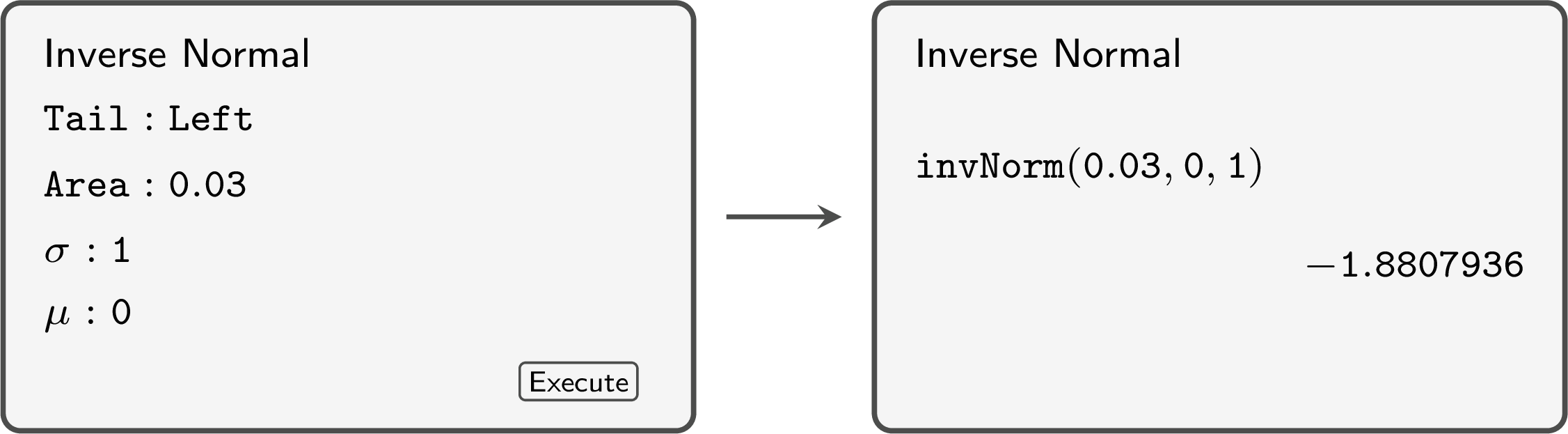
- Standardise and read \(z\): \(P(X < x) = P\left(Z < \frac{x - \mu}{\sigma}\right) = p\), so \(\frac{x - \mu}{\sigma} = z\), where \(z\) is given by the inverse normal function with area \(p\), \(\sigma = 1\) and \(\mu = 0\).
- Solve for the unknown, from \(x - \mu = z\sigma\):
- \(\sigma\) known: \(\mu = x - z\sigma\);
- \(\mu\) known: \(\sigma = \frac{x - \mu}{z}\), which requires \(z \neq 0\). A condition at the median (\(p = 0.5\), so \(z = 0\)) only says that \(x = \mu\) and gives no information on \(\sigma\);
- both unknown: two conditions with different values of \(z\) give the system \(\mu + z_1\sigma = x_1\) and \(\mu + z_2\sigma = x_2\); subtracting the equations gives \(\sigma = \frac{x_2 - x_1}{z_2 - z_1}\), then \(\mu = x_1 - z_1\sigma\).
- Keep \(z\) unrounded in the calculator's memory, round \(\mu\) and \(\sigma\) only at the end, and check: \(\sigma\) must be positive, and the normal cumulative distribution function with the values found must give back the probabilities of the question.
Example
A machine fills jars of honey. The mass \(X\) of honey in a jar, in grams, is normally distributed with standard deviation \(4\) g. - \(3\pourcent\) of the jars contain less than \(450\) g. Find the mean mass \(\mu\), to \(1\) decimal place.
- The machine is set to the mean \(\mu = 456\) g, and a maintenance can reduce the standard deviation. Find the standard deviation \(\sigma\) for which only \(1\pourcent\) of the jars contain less than \(450\) g, to \(3\) significant figures.
- The model is \(X \sim \mathcal{N}(\mu, 4^2)\) with \(\mu\) unknown, and \(P(X < 450) = 0.03\): a small left area, so \(450\) lies below the mean.
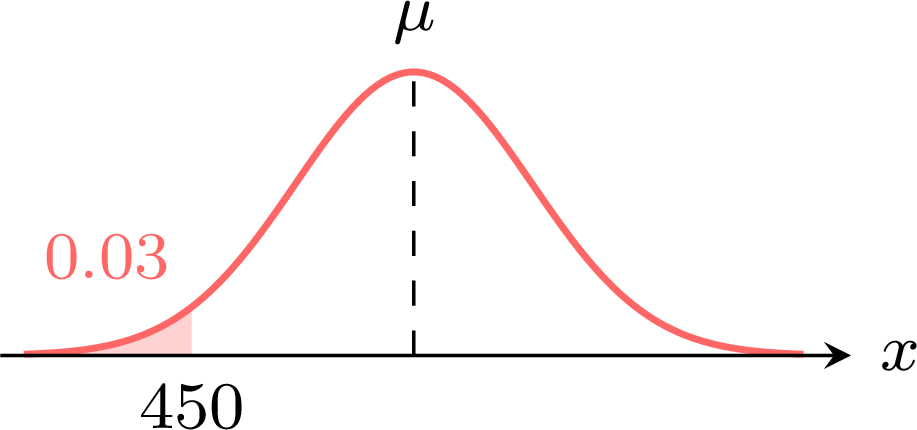
- Now \(\mu = 456\) is known and \(\sigma\) is unknown: \(P(X < 450) = 0.01\), so \(\frac{450 - 456}{\sigma} = z\), where the inverse normal function with area \(0.01\), \(\sigma = 1\) and \(\mu = 0\) gives \(z = -2.3263479\ldots\), which is not zero. Then $$\begin{aligned}[t] \frac{450 - 456}{\sigma} &= z && \text{(standardised value of 450)}\\ \sigma &= \frac{450 - 456}{z}\\ &= \frac{-6}{-2.3263479\ldots}\\ &= 2.5791\ldots \end{aligned}$$ The standard deviation must be reduced to \(\sigma \approx 2.58\) g. It is positive, as it must be: \(450 - 456\) and \(z\) are both negative, since \(450\) lies below the mean.
Skills to practice
- Finding an Unknown Mean or Standard Deviation
III
Exam-Style Questions
Skills to practice
- Working without Technology: Probability and Statistics
- Working with Technology: Probability and Statistics
- Working without Technology: Further Probability
- Working with Technology: Further Probability
Jump to section