International Baccalaureate · DP 2: Analysis and Approaches HL
Revision: Mixed Practice
I
Toolbox: The Sum of an Infinite Geometric Series
Recappreviously studied — click to reread
Proposition — Convergence of a Geometric Series
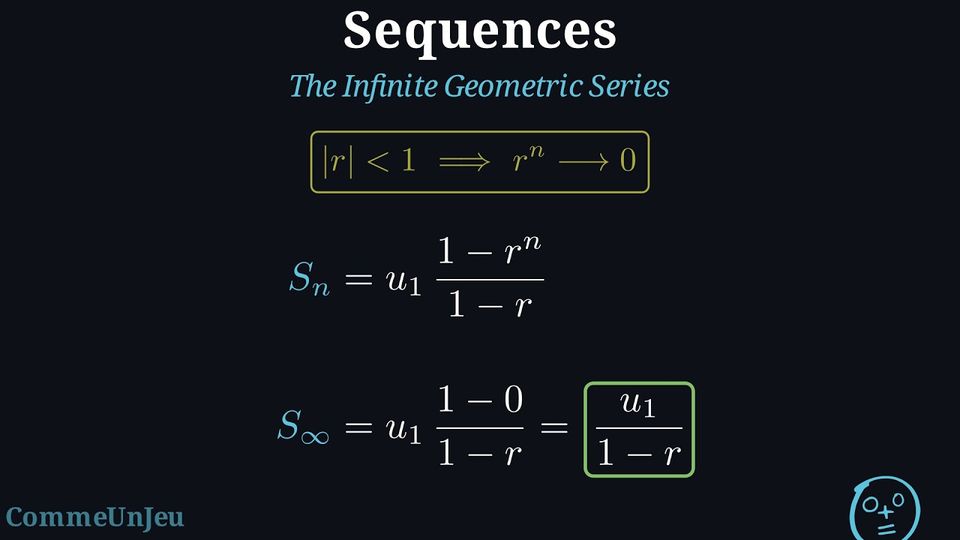
An infinite geometric series (with non-zero first term) converges to a finite sum if and only if its common ratio \(r\) is between -1 and 1, i.e., \(\boldsymbol{|r| < 1}\).If the series converges, its sum to infinity, denoted \(S_\infty\), is given by the formula:$$\boldsymbol{S_\infty = \frac{u_1}{1-r}}$$ where \(u_1\) is the first term and \(|r|<1\).If the sequence starts at \(u_0\), the formula is:$$\boldsymbol{S_\infty = \frac{u_0}{1-r}}$$
Example
Find the sum of the infinite geometric series$$16 + 8 + 4 + 2 + 1 + \cdots$$
The first term is \(u_1 = 16\) and the common ratio is \(r = \dfrac{8}{16} = \dfrac{1}{2}\).
Since \(|r| = \dfrac{1}{2} < 1\), the series converges and the sum-to-infinity formula applies:$$\begin{aligned}[t] S_\infty &= \frac{u_1}{1 - r} && {\scriptstyle(|r| < 1)} \\ &= \frac{16}{1 - \tfrac{1}{2}} = \frac{16}{\tfrac{1}{2}} \\ &= 32. \end{aligned}$$
Since \(|r| = \dfrac{1}{2} < 1\), the series converges and the sum-to-infinity formula applies:$$\begin{aligned}[t] S_\infty &= \frac{u_1}{1 - r} && {\scriptstyle(|r| < 1)} \\ &= \frac{16}{1 - \tfrac{1}{2}} = \frac{16}{\tfrac{1}{2}} \\ &= 32. \end{aligned}$$
Skills to practice
- Calculating the Sum of an Infinite Geometric Series
II
Toolbox: The Inverse Normal Function
Recappreviously studied — click to reread
Definition — Quantile
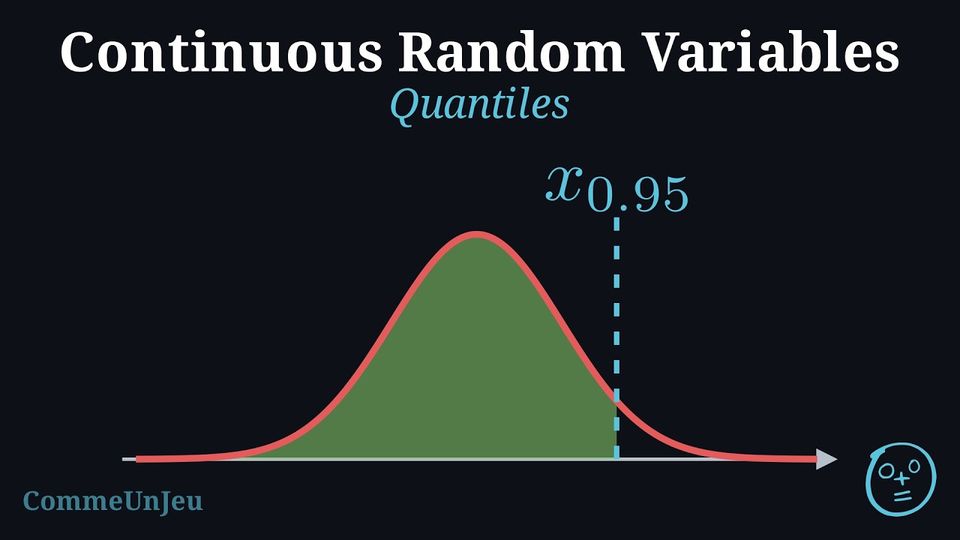
The \(p\)-quantile of a random variable \(X\) is the value \(x_p\) such that \(P(X \leq x_p) = p\). For example, the \(0.95\)-quantile (or 95th percentile) is the value \(x_{0.95}\) below which 95\(\pourcent\) of the distribution's values lie. Method — Finding a Value with the Inverse Normal Function
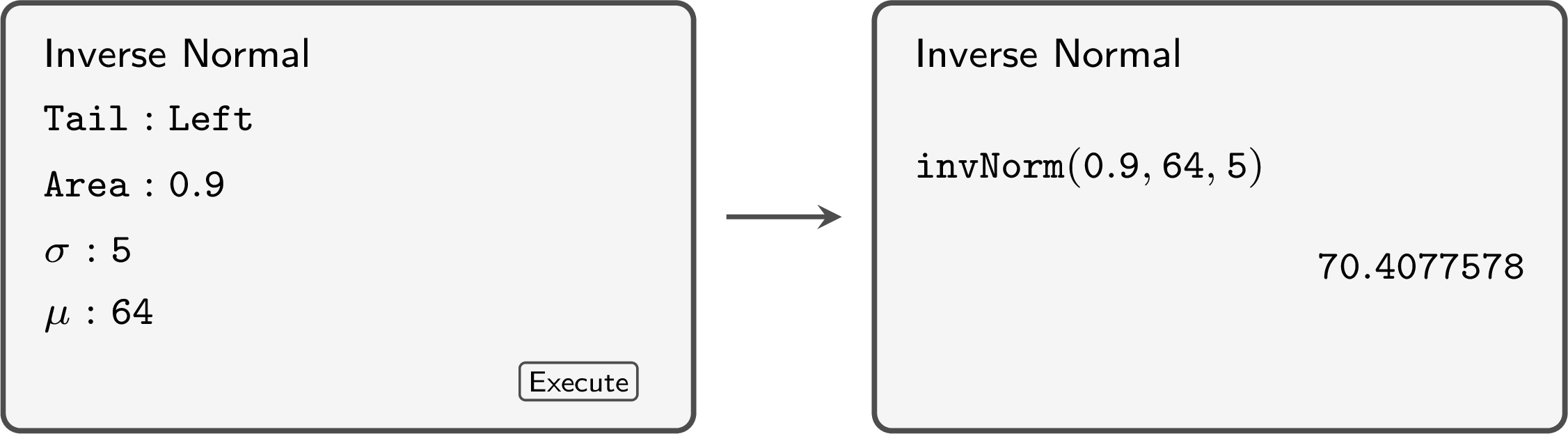
The reverse question gives a probability and asks for a value of \(X\). The inverse normal function of the calculator (Inverse Normal, invNorm) returns the value \(k\) such that \(P(X < k) = p\), for \(0 < p < 1\), from the area \(p\) to the left of \(k\), \(\sigma\) and \(\mu\). - State the model \(X \sim \mathcal{N}(\mu, \sigma^2)\) and name the unknown value \(k\).
- Sketch and shade: place \(k\) on the side of \(\mu\) that the probability indicates — a left area less than \(0.5\) puts \(k\) below the mean — and shade the given area.
- Turn the condition into a left area. The condition \(P(X < k) = p\) is entered as it is; \(P(X > k) = q\) becomes \(P(X < k) = 1 - q\). An interval centred on \(\mu\) that contains the proportion \(p\) of the values leaves \(\frac{1 - p}{2}\) in each tail: its ends are the values with left areas \(\frac{1 - p}{2}\) and \(\frac{1 + p}{2}\).
- Enter the area, \(\mu\) and \(\sigma\), each in its field (the command
invNormtakes the area, \(\mu\), then \(\sigma\); the tail is set to the left, on the models that ask for one), then check the position of \(k\) against the sketch and report it to \(3\) significant figures, or to the precision of the data.
Example
The scores \(X\) on an entrance test are normally distributed with mean \(500\) and standard deviation \(80\). - A scholarship is offered to the top \(12\pourcent\) of the candidates. Find the minimum score for a scholarship.
- The lowest \(5\pourcent\) of the candidates are offered extra support. Find the score below which a candidate is offered support.
The model is \(X \sim \mathcal{N}(500, 80^2)\). 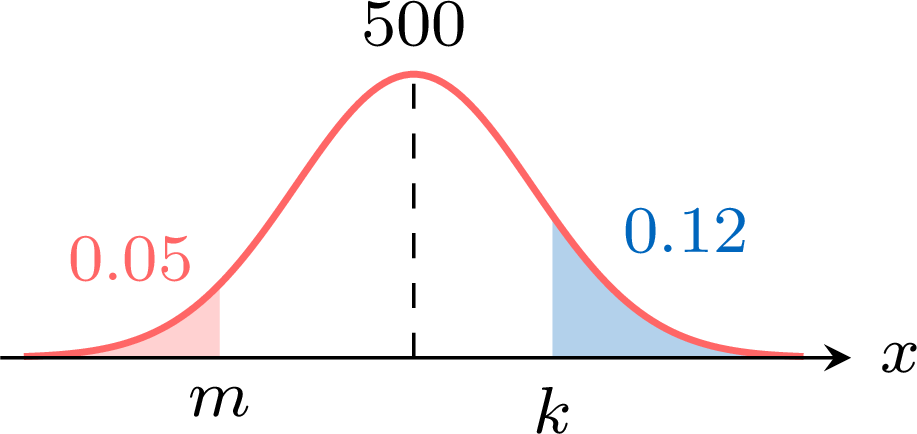
- Let \(k\) be the minimum score: \(P(X > k) = 0.12\). The right tail is small, so \(k\) lies above the mean. As a left area, $$\begin{aligned}[t] P(X < k) &= 1 - P(X > k) && \text{(complementary event)}\\ &= 1 - 0.12\\ &= 0.88. \end{aligned}$$ The inverse normal function with area \(0.88\), \(\sigma = 80\) and \(\mu = 500\) gives \(593.9989\ldots\): the minimum score for a scholarship is about \(594\).
- Let \(m\) be the score: \(P(X < m) = 0.05\), a left tail, so \(m\) lies below the mean. The inverse normal function with area \(0.05\), \(\sigma = 80\) and \(\mu = 500\) gives \(368.4117\ldots\): a candidate who scores below about \(368\) is offered support.
Skills to practice
- Finding a Value with the Inverse Normal Function
III
Exam-Style Questions
Skills to practice
- Working without Technology: Mixed Practice
- Working with Technology: Mixed Practice
Jump to section