International Baccalaureate · DP 2: Analysis and Approaches HL
Revision: Geometry and Trigonometry
I
Toolbox: Arc Length and Sector Area
Recappreviously studied — click to reread
Proposition — Arc Length
On a circle of radius \(r\), an angle of \(\theta\) radians, with \(\theta > 0\), subtends an arc of length \(\ell = r\,\theta\). Equivalently, \(\theta = \dfrac{\ell}{r}\) and \(r = \dfrac{\ell}{\theta}\). 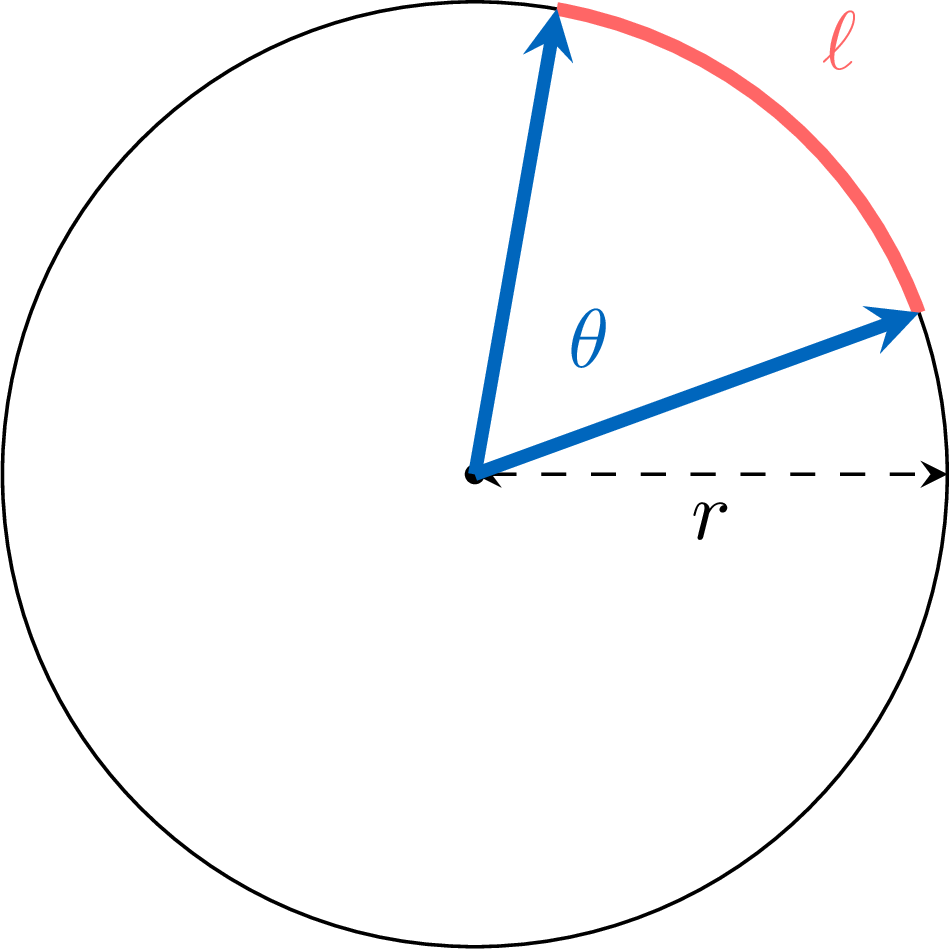
Proposition — Area of a Sector in Radians
A sector is the part of a disc bounded by two radii and the arc between them. On a circle of radius \(r\), the sector of angle \(\theta\) radians, with \(0 < \theta \leq 2\pi\) — the sector whose arc is the one the angle \(\theta\) sweeps — has area \(A = \dfrac{1}{2}\,r^2\,\theta\). With its arc length \(\ell = r\,\theta\), this is also \(A = \dfrac{1}{2}\,\ell\,r\). 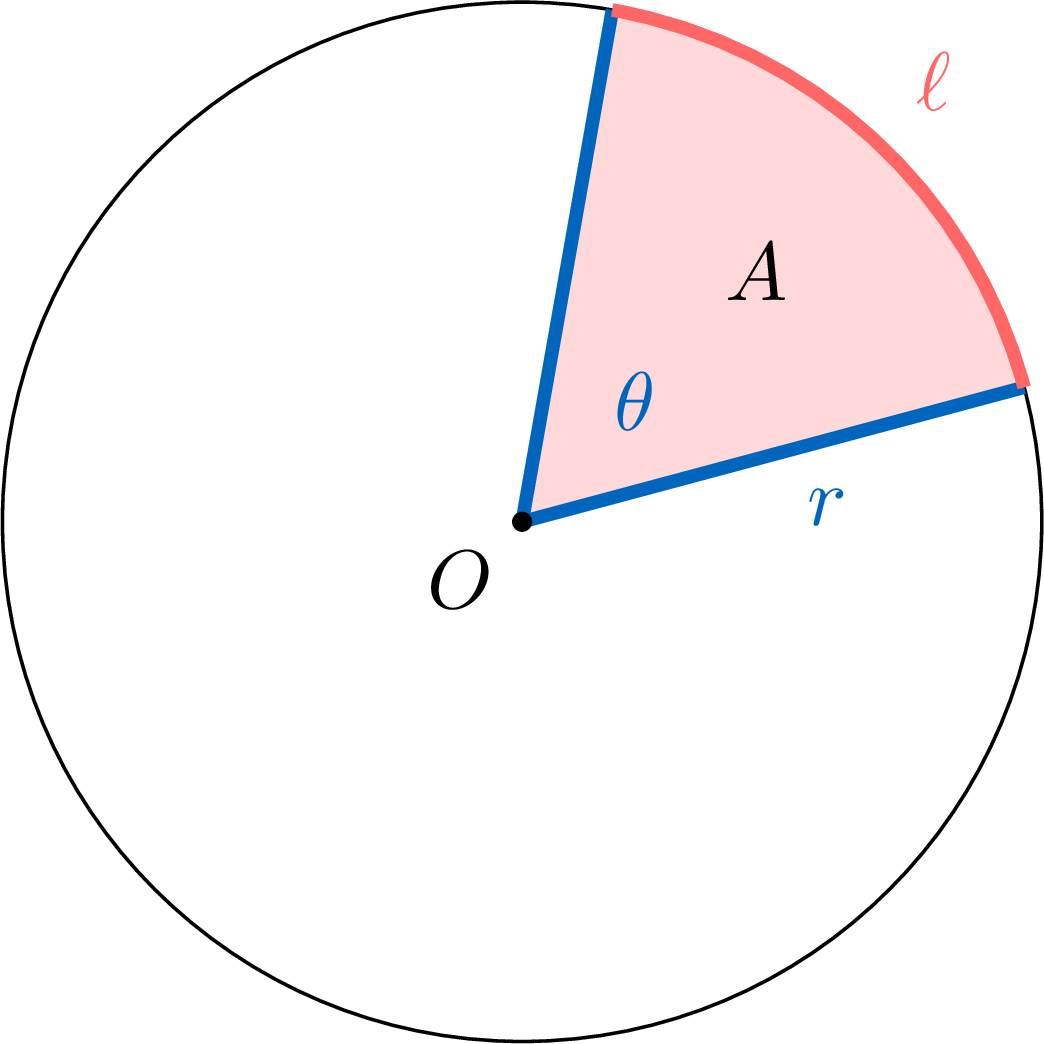
Skills to practice
- Finding Exact Arc Lengths and Sector Areas
II
Toolbox: The Double Angle Formulas
Recappreviously studied — click to reread
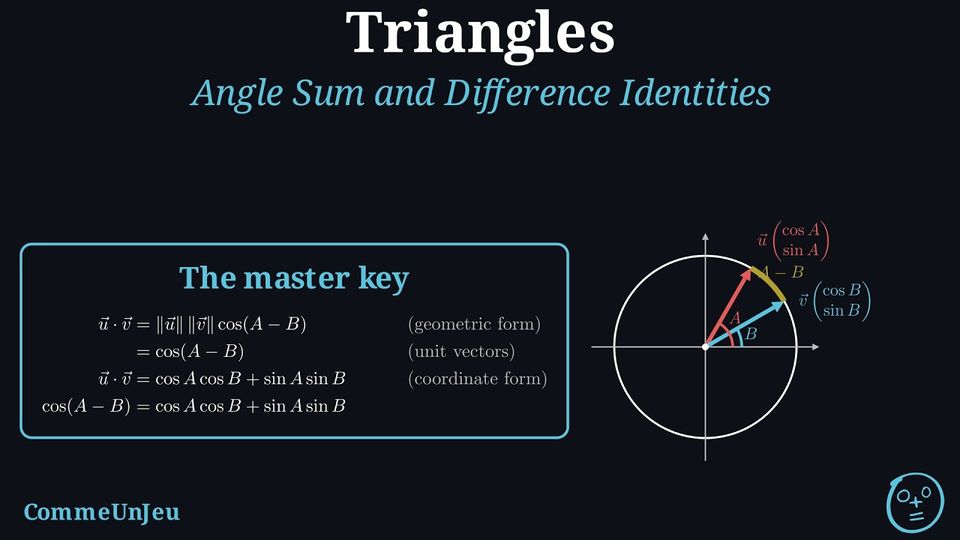
Proposition — Double Angle Formulas
For every real number \(A\): $$\cos 2A = \cos^2 A - \sin^2 A = 2\cos^2 A - 1 = 1 - 2\sin^2 A,$$ $$\sin 2A = 2\sin A\cos A.$$ They are obtained by taking \(B = A\) in the formulas for \(\cos(A + B)\) and \(\sin(A + B)\), which gives \(\sin 2A\) and \(\cos^2 A - \sin^2 A\), then using \(\cos^2 A + \sin^2 A = 1\) for the other two forms of \(\cos 2A\). Example
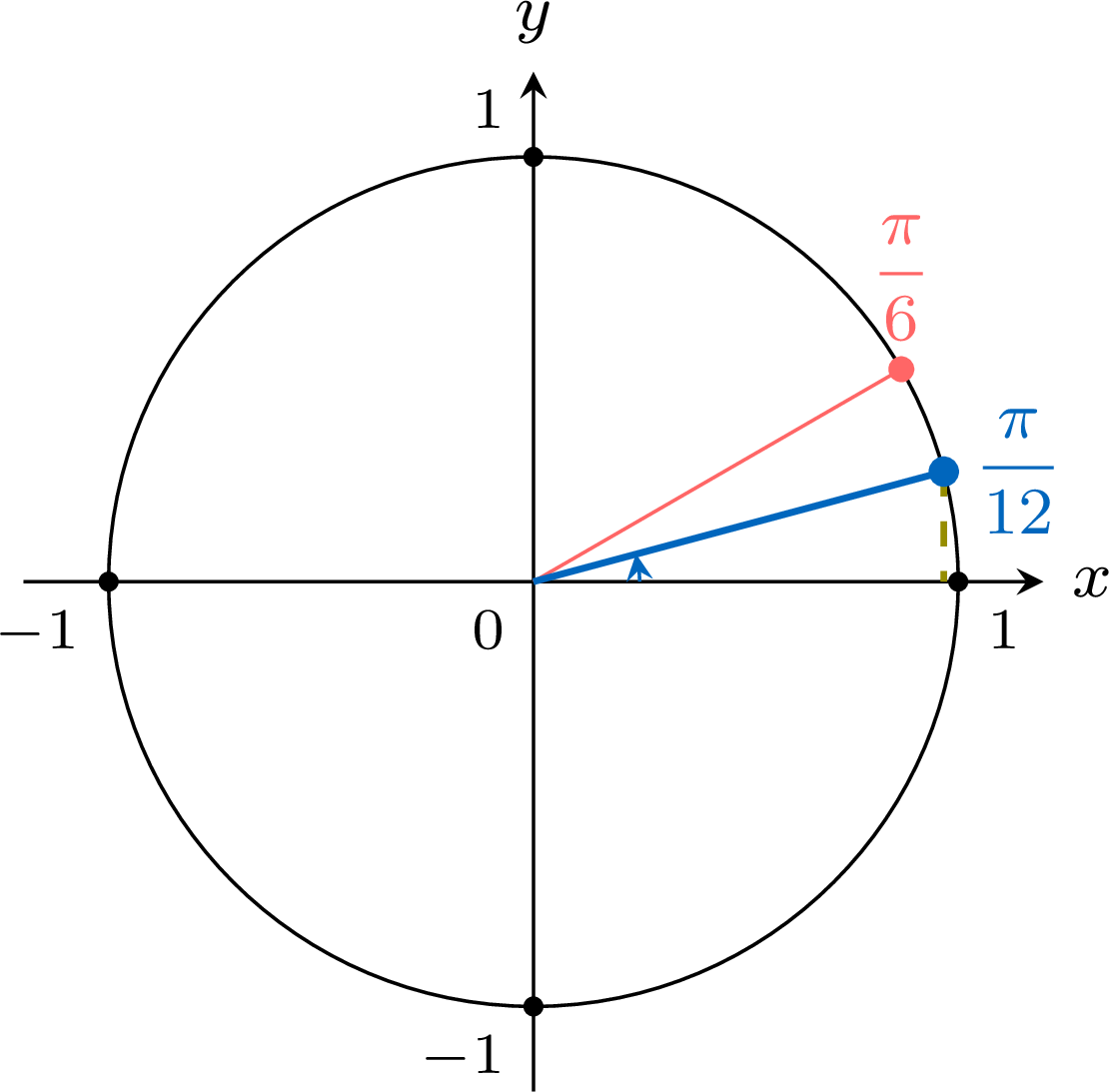
Compute the exact value of \(\cos\dfrac{\pi}{12}\) in two ways: - with an addition formula, writing \(\dfrac{\pi}{12} = \dfrac{\pi}{3} - \dfrac{\pi}{4}\);
- with a double angle formula, since \(2 \times \dfrac{\pi}{12} = \dfrac{\pi}{6}\).
- With the cosine of a difference: $$\begin{aligned}[t] \cos\frac{\pi}{12} &= \cos\left(\frac{\pi}{3} - \frac{\pi}{4}\right) &&\\ &= \cos\frac{\pi}{3}\cos\frac{\pi}{4} + \sin\frac{\pi}{3}\sin\frac{\pi}{4} && \text{(cosine of a difference)}\\ &= \frac{1}{2} \times \frac{\sqrt{2}}{2} + \frac{\sqrt{3}}{2} \times \frac{\sqrt{2}}{2} && \text{(special values)}\\ &= \frac{\sqrt{2} + \sqrt{6}}{4}. \end{aligned}$$
- With \(A = \dfrac{\pi}{12}\), the formula \(\cos 2A = 2\cos^2 A - 1\) gives \(\cos\dfrac{\pi}{6} = 2\cos^2\dfrac{\pi}{12} - 1\), so $$\begin{aligned}[t] \cos^2\frac{\pi}{12} &= \frac{1}{2}\left(1 + \cos\frac{\pi}{6}\right) &&\\ &= \frac{1}{2}\left(1 + \frac{\sqrt{3}}{2}\right) = \frac{2 + \sqrt{3}}{4}. \end{aligned}$$ Since \(\dfrac{\pi}{12} \in \left[0, \dfrac{\pi}{2}\right]\), \(\cos\dfrac{\pi}{12} \ge 0\), hence \(\cos\dfrac{\pi}{12} = \dfrac{\sqrt{2 + \sqrt{3}}}{2}\).
Skills to practice
- Using the Double Angle Formulas
III
Exam-Style Questions
Skills to practice
- Working without Technology: Geometry and Trigonometry
- Working with Technology: Geometry and Trigonometry
- Working without Technology: Further Geometry and Trigonometry
- Working with Technology: Further Geometry and Trigonometry
Jump to section