International Baccalaureate · DP 2: Analysis and Approaches HL
Kinematics
I
Displacement and Velocity
I.1
Displacement
Kinematics is the study of the motion of objects without considering the forces that cause the motion. Calculus describes motion along a straight line formally. We will develop functions for displacement, velocity, and acceleration, and explore the relationships between them.
Definition — Displacement Function
For an object \(P\) in motion along a straight line, the displacement function \(s(t)\) gives the position of the object (its signed distance from a fixed origin) at any time \(t \ge 0\). 
Example
A particle's displacement from an origin O is given by \(s(t) = t^2 - 4t + 3\) cm for \(0 \le t \le 5\) seconds. - Find the initial displacement.
- Find when the particle is at the origin.
- Initial Displacement (\(t=0\)):
\(s(0) = 0^2 - 4(0) + 3 = 3\) cm. The particle starts 3 cm to the right of the origin (in the positive direction). - At the Origin (\(s(t)=0\)):
\(t^2 - 4t + 3 = 0 \implies (t-1)(t-3) = 0\).
The particle is at the origin at \(t=1\) s and \(t=3\) s.
Skills to practice
- Displacement
I.2
Velocity
Definition — Average Velocity
The average velocity of an object moving in the time interval from \(t=t_1\) to \(t=t_2\) (where \(t_1 < t_2\)) is given by $$\begin{aligned} \text{average velocity} &= \frac{\text{change in displacement}}{\text{change in time}} \\
&= \frac{s(t_2) - s(t_1)}{t_2 - t_1}. \end{aligned}$$ Definition — Velocity Function
The instantaneous velocity \(v(t)\) of an object is the rate of change of its displacement. It is found by differentiating the displacement function \(s(t)\): $$ \textcolor{colordef}{v(t) = s'(t) = \frac{\mathrm{d}s}{\mathrm{d}t}} $$
Note
- If \(v(t) > 0\), the object is moving to the right (in the positive direction).
- If \(v(t) < 0\), the object is moving to the left (in the negative direction).
- If \(v(t) = 0\), the object is instantaneously at rest.
Proposition — Displacement from Velocity
The change in displacement over the interval \([t_1, t_2]\) is the definite integral of the velocity function: $$ s(t_2) - s(t_1) = \int_{t_1}^{t_2} v(t) \,\mathrm{d}t. $$
The velocity is the derivative of the displacement, \(v = s'\), so \(s\) is an antiderivative of \(v\) on \([t_1, t_2]\). By the Fundamental Theorem of Calculus, $$\begin{aligned}[t] \int_{t_1}^{t_2} v(t)\,\mathrm{d}t &= \big[s(t)\big]_{t_1}^{t_2} && \text{(Fundamental Theorem of Calculus, \(s' = v\))}\\
&= s(t_2) - s(t_1). \end{aligned}$$
Skills to practice
- Finding Displacement and Velocity
- Finding Displacement from Velocity
II
Speed and Acceleration
II.1
Speed and Distance
Definition — Speed
The speed of an object is the magnitude of its velocity: \(S(t) = |v(t)|\). Proposition — Distance
The total distance travelled over \([t_1, t_2]\) is the definite integral of the speed: $$ \text{Distance} = \int_{t_1}^{t_2} |v(t)| \,\mathrm{d}t. $$
We prove the formula when \(v\) changes sign at finitely many instants of \([t_1, t_2]\), the case of every motion studied here. Cut the interval at these instants: \(t_1 = c_0 < c_1 < \dots < c_k = t_2\), with \(v\) of one sign on each piece \([c_{i-1}, c_i]\).
- On a piece where \(v \ge 0\), the object moves in the positive direction only, so the distance it travels is the change of position: $$\begin{aligned}[t] s(c_i) - s(c_{i-1}) &= \int_{c_{i-1}}^{c_i} v(t)\,\mathrm{d}t && \text{(displacement from velocity)}\\ &= \int_{c_{i-1}}^{c_i} |v(t)|\,\mathrm{d}t && \text{(\(v = |v|\) on this piece).} \end{aligned}$$
- On a piece where \(v \le 0\), the object moves in the negative direction only, and the distance is \(s(c_{i-1}) - s(c_i) = \displaystyle\int_{c_{i-1}}^{c_i} (-v(t))\,\mathrm{d}t = \int_{c_{i-1}}^{c_i} |v(t)|\,\mathrm{d}t\).
Method — Finding the Total Distance Travelled with Technology
For an object moving along a straight line with velocity \(v(t)\), the displacement from \(t = t_1\) to \(t = t_2\) is \(\displaystyle\int_{t_1}^{t_2} v(t)\,\mathrm{d}t\) and the total distance travelled is \(\displaystyle\int_{t_1}^{t_2} |v(t)|\,\mathrm{d}t\). A graphing calculator evaluates both. - Write the integral first: \(\displaystyle\int_{t_1}^{t_2} |v(t)|\,\mathrm{d}t\) for the distance, \(\displaystyle\int_{t_1}^{t_2} v(t)\,\mathrm{d}t\) for the displacement.
- Enter it with the variable \(X\) of the calculator in place of \(t\), and the absolute-value function for the distance: \(\displaystyle\int_{t_1}^{t_2} |v(X)|\,\mathrm{d}X\). The angle unit is set to radians when \(v\) contains a trigonometric function.
- Or split at the changes of direction: graph \(v\), find its zeros between \(t_1\) and \(t_2\) with the zero tool (the object changes direction where \(v\) changes sign), split \([t_1, t_2]\) at these zeros, integrate \(v\) over each piece, from \(t_1\) to the first zero and from the last zero to \(t_2\) included, and add the absolute values of the results.
- Check and report: the distance is at least the absolute value of the displacement, and equals it only when the object does not change direction. Report both to 3 significant figures, with their units.
Example
A particle moves along a straight line with velocity \(v(t) = 5\sin t - t\) metres per second, for \(0 \le t \le 6\) seconds. - Find the displacement of the particle between \(t = 0\) and \(t = 6\).
- Find the total distance travelled by the particle between \(t = 0\) and \(t = 6\).
The calculator is set to radians, since \(v\) contains \(\sin\).
- The displacement is \(\displaystyle\int_0^6 (5\sin t - t)\,\mathrm{d}t\). The template, with the integrand \(5\sin X - X\) and the bounds \(0\) and \(6\), displays \(-17.800851\). The displacement is about \(-17.8\) m: at \(t = 6\), the particle is \(17.8\) m from its starting point, on the negative side.
Check with an antiderivative: \(\displaystyle\int_0^6 (5\sin t - t)\,\mathrm{d}t = \left[-5\cos t - \frac{t^2}{2}\right]_0^6 = -5\cos 6 - 18 + 5 \approx -17.8\). - The distance is \(\displaystyle\int_0^6 |5\sin t - t|\,\mathrm{d}t\). The template, with the integrand \(|5\sin X - X|\), displays \(29.609835\). The particle travels about \(29.6\) m.
Check by splitting: the zero tool displays the zero \(X = 2.5957391\) of \(v\); \(v\) is positive before it and negative after it, so the particle moves forward, then turns back once. The template displays \(\displaystyle\int_0^{2.5957391} v(t)\,\mathrm{d}t = 5.9044917\) and \(\displaystyle\int_{2.5957391}^{6} v(t)\,\mathrm{d}t = -23.705343\), and $$\begin{aligned}[t] \text{distance} &= |5.9044917| + \left|-23.705343\right| &&\text{(split at the change of direction)}\\ &= 29.609835 \approx 29.6 \text{ m}. \end{aligned}$$ The distance, \(29.6\) m, is greater than \(\left|-17.8\right| = 17.8\) m, since the particle changes direction.
Skills to practice
- Finding the Total Distance
- Finding the Total Distance with Technology
II.2
Acceleration
Definition — Acceleration Function
The acceleration \(a(t)\) of an object is the rate of change of its velocity. It is the second derivative of the displacement function: $$ \textcolor{colordef}{a(t) = v'(t) = s''(t)} $$
The kinematic functions are related through differentiation and integration (integration recovers \(s\) and \(v\) only up to a constant, which is fixed by an initial value). 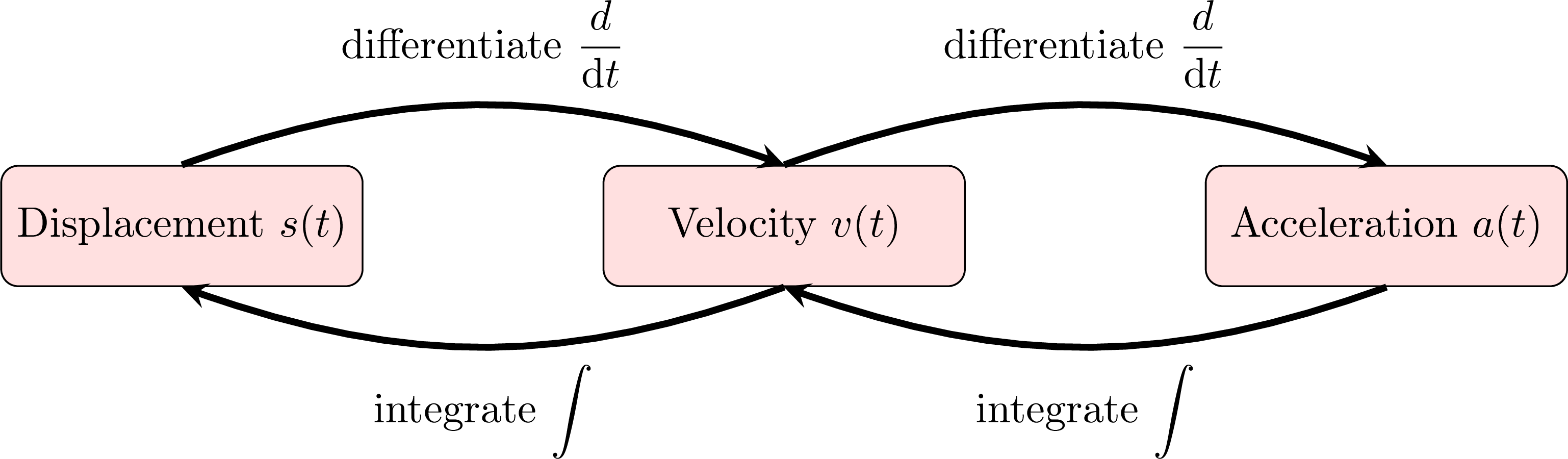
Proposition — Sign Test for Speed
- The speed \(|v(t)|\) is increasing (the motion speeds up) when \(v(t)\) and \(a(t)\) have the same sign.
- The speed \(|v(t)|\) is decreasing (the motion slows down) when \(v(t)\) and \(a(t)\) have opposite signs.
Example
The displacement of a particle is given by \(s(t) = t^3 - 6t^2 + 9t\) cm, for \(t \ge 0\). - Find expressions for the velocity and acceleration.
- Find when the particle's speed \(|v(t)|\) is increasing.
- Velocity and Acceleration: $$ v(t) = s'(t) = 3t^2 - 12t + 9 \;\text{cm/s}, $$ $$ a(t) = v'(t) = 6t - 12 \;\text{cm/s}^2. $$
- Increasing Speed:
We need \(v(t)\) and \(a(t)\) to have the same sign. First, find the roots: $$ v(t) = 3(t^2-4t+3) = 3(t-1)(t-3) = 0 \implies t=1,\; 3, $$ $$ a(t) = 6(t-2) = 0 \implies t=2. $$ We build a sign table for both functions: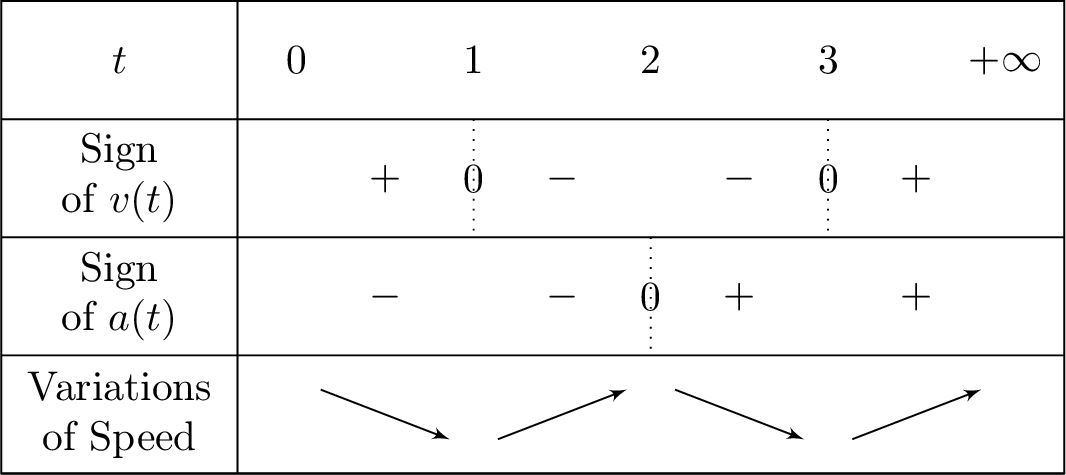
Skills to practice
- Finding Velocity, Acceleration and Distance
- Finding Velocity and Distance from Acceleration
III
Going further
Skills to practice
- Solving Problems
- Writing Mathematics
- Quiz
Jump to section