How to Teach Signed Numbers
This guide is for teachers who use CommeUnJeu with a class, from the first negative numbers in PYP 5 to the four operations and the order of operations in MYP 2. One drawing carries the whole path: a signed number is a team of units, positive or negative, and one positive unit with one negative unit cancel each other out: together they form a zero pair. The guide shows that drawing as the lessons show it, follows it year by year with the figures and videos of the chapters, and says where it stops. In each chapter you will find:
- most sections open with a short video, in English and in French (this guide shows them too, at the head of the passages they belong to);
- the lesson: definitions, methods and worked examples, to project on the board;
- under each section, the skills to practise: groups of exercises corrected at once, each answer followed by a worked correction;
- some exercises are written on paper or on the slate: the pupil draws the units, then writes the calculation, and sends a photo of the page to have it corrected.
One Drawing, from the First Day to the Last
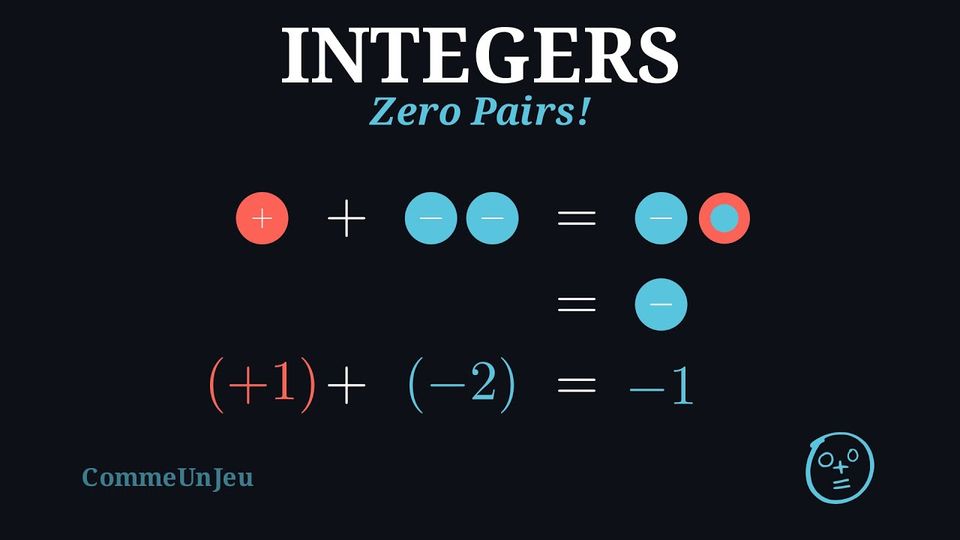
Concrete. The chapters open on a world of particles: positives and negatives, each standing for one unit. In class, pupils draw them: small circles with a plus inside for the positive units, small circles with a minus inside for the negative units. Particles of the same type join forces; a positive and a negative particle cancel each other out and leave nothing: this is a zero pair. 
Pictorial. The sign written in front of a number says which type of units the group contains, once all zero pairs have been cancelled. 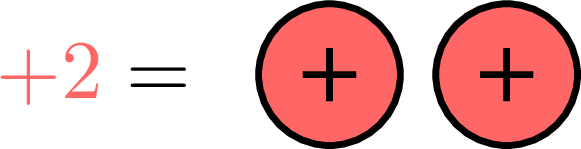

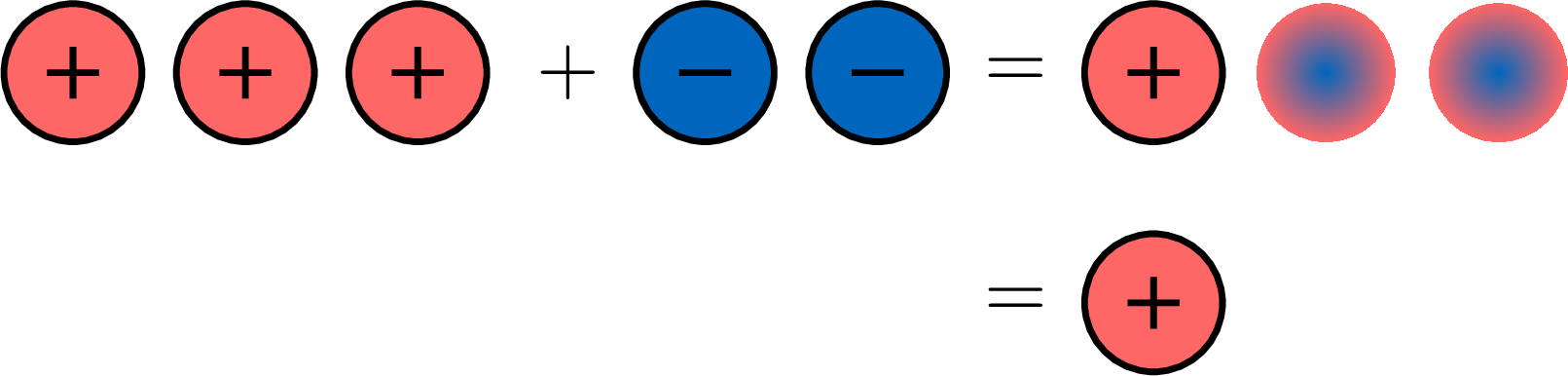
Each meeting is drawn as an equality between drawings, and the calculation is written under the drawing, number under group: three positives meet one negative, one zero pair disappears (the burst), two positives are left. 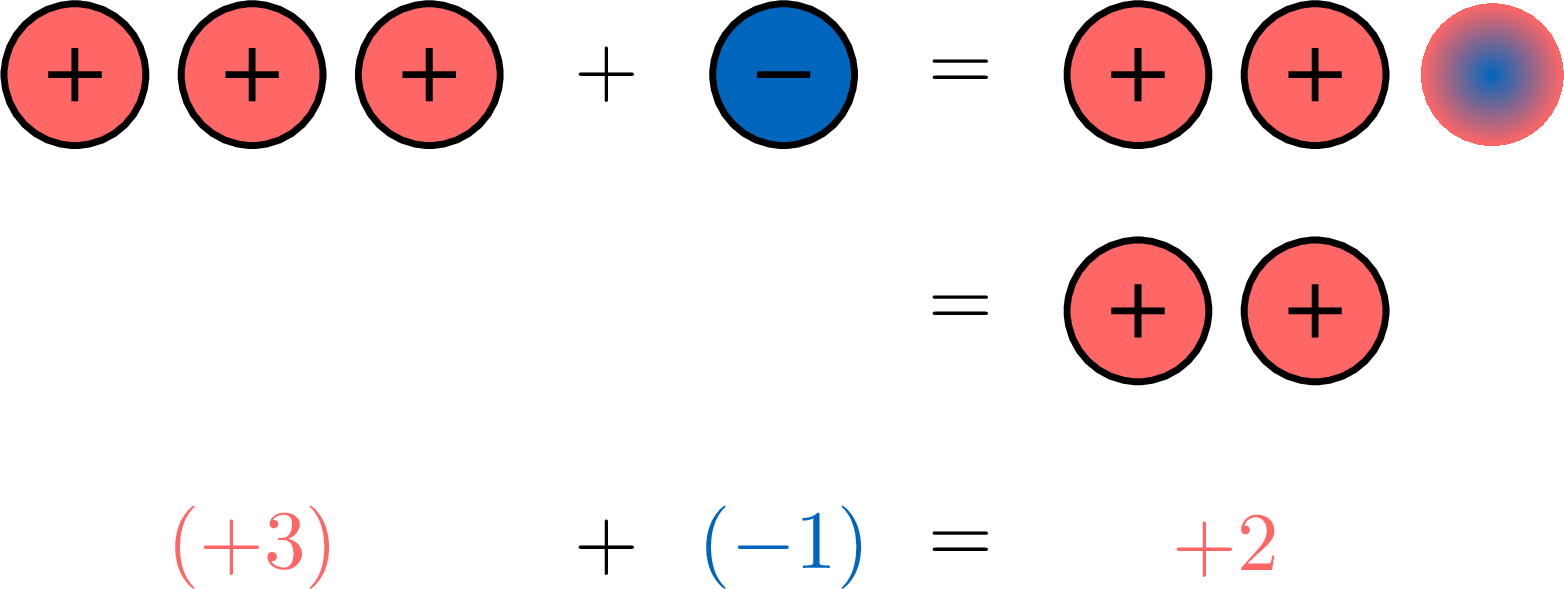
Abstract. The definition follows: the integers are the whole numbers and their opposites. Two integers are opposites if, drawn without zero pairs, they have the same number of units with opposite signs: together they leave nothing, and \((+2)+(-2)=0\). 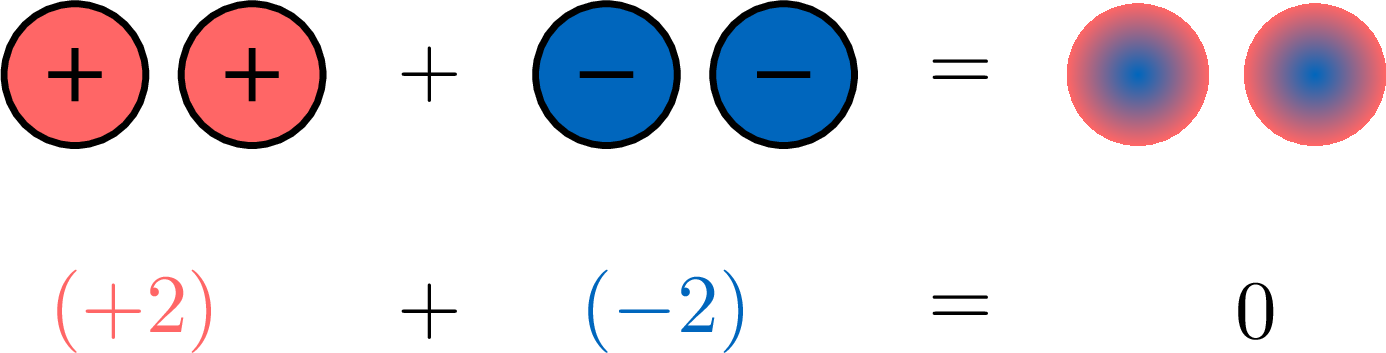
Zero is neither positive nor negative, and it is its own opposite: it is drawn with no unit at all, or with zero pairs only. The key idea of the whole path: a number has several drawings. Three positives and one negative make \(+2\), exactly as two positives do; adding a zero pair to a drawing does not change the number. Ask for it from the first lesson (draw \(-2\) in two ways, draw \(0\) in two ways): the subtraction of a negative number, and later the sign rule of a product, rest on it.
The Gesture: Inserting a Zero
Adding: Put Together, Cancel the Pairs
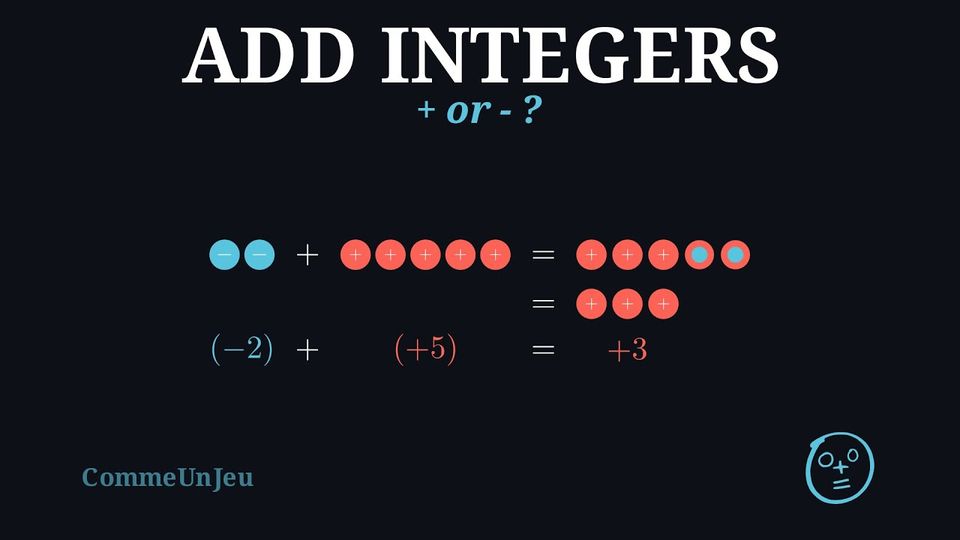
To add, put the units of the two numbers together, set aside the zero pairs (the lessons draw each one as a burst), and count what is left. 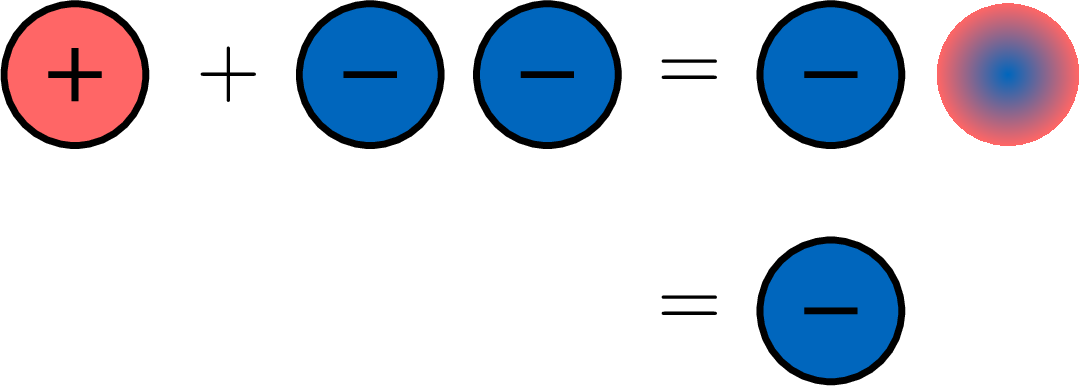
So \((+1)+(-2)=-1\). The rules are then read on the drawings and stated with the distance to zero, so that they still work when the units are no longer drawn: two numbers of the same sign, add the distances to zero and keep the sign; two numbers of opposite signs, subtract the smaller distance from the larger and take the sign of the number with the larger distance; if the distances to zero are equal, the sum is zero. $$\textcolor{colorprop}{(-2)}+\textcolor{colordef}{(+5)}=\textcolor{colordef}{+3} \quad \text{as }5-2=3$$ 
Subtracting: Take Away, and Insert a Zero When Nothing Is There
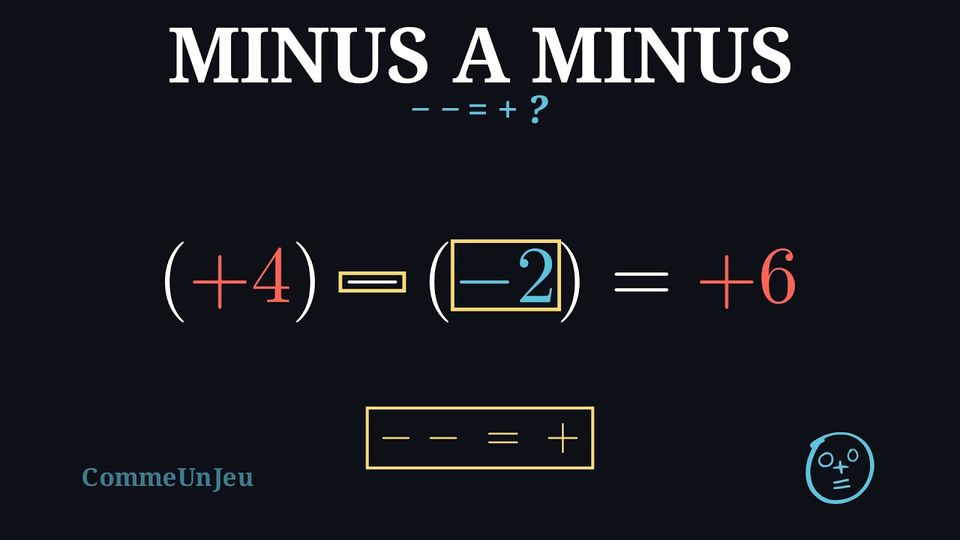
To subtract, take the units away: the lessons cross out the units taken away. The opening problem compares \((+3)-(+2)\) with \((+3)+(-2)\): the two operations leave the same units. 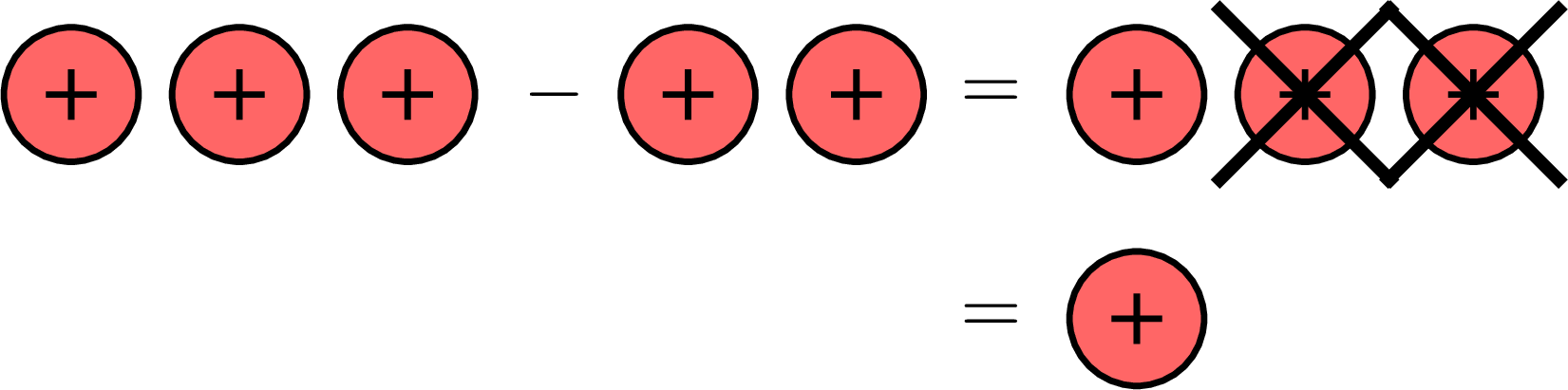

The decisive case is \((+4)-(-2)\): there is no negative unit to take away. Insert two zero pairs first (framed in the lesson): they leave nothing, so the number is still \(+4\), and now two negative units can be taken away. Six positive units are left. 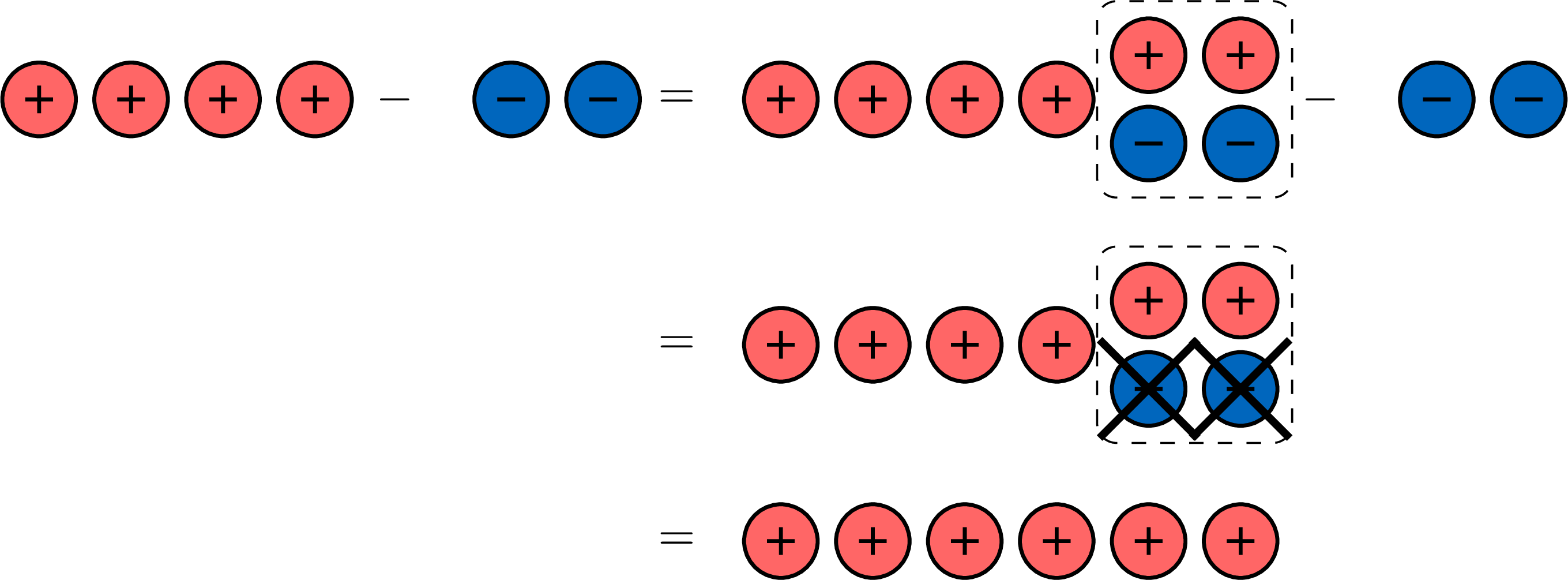
Written with numbers, the zero inserted is \((+2)+(-2)\): $$(+4)-(-2)=(+4)+(+2)+(-2)-(-2)=(+4)+(+2)=+6.$$ Taking away \((-2)\) gave the same result as adding \((+2)\): subtracting a number is adding its opposite, even when there is nothing to take away. This is the gesture to make pupils do by hand, because it comes back for the product of two negative numbers.
The Same Zero for the Product of Two Negatives
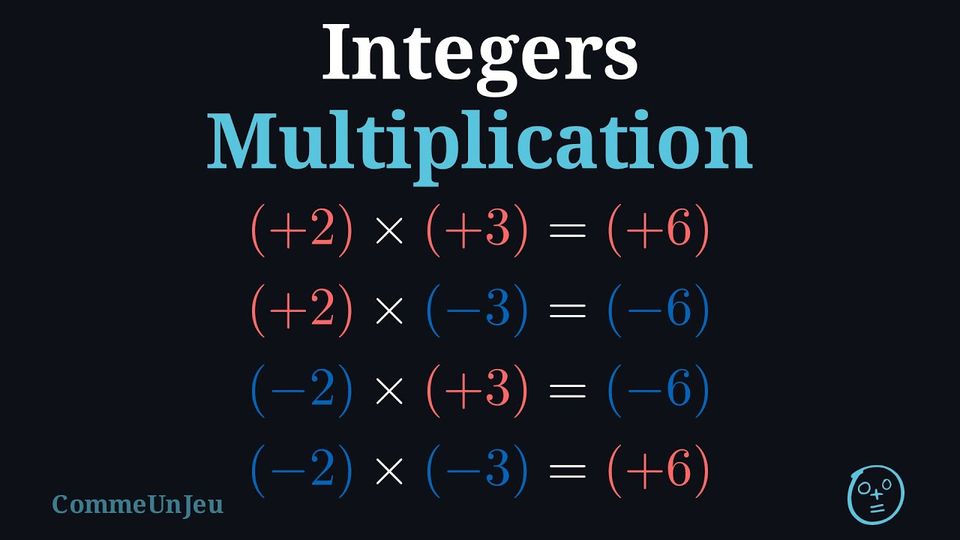
Teacher background. Neither the MYP 1 nor the MYP 2 chapter includes this derivation or its video: MYP 1 meets the sign rules through a pattern (see « Multiplying and Dividing » below). What follows is for you, to answer the pupil who asks why. A positive whole number times a signed number is a repeated addition of teams: 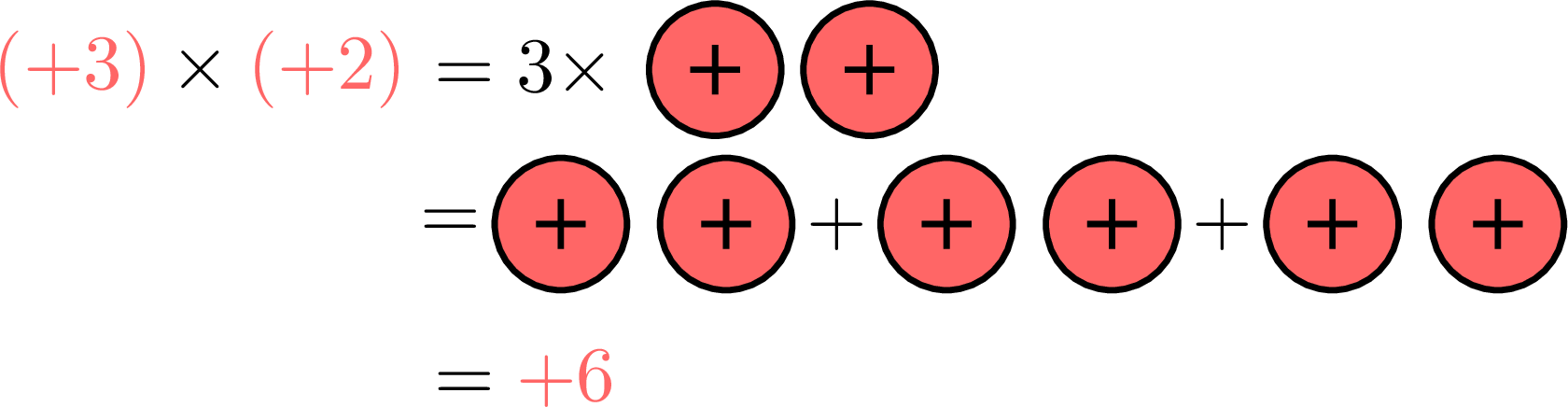
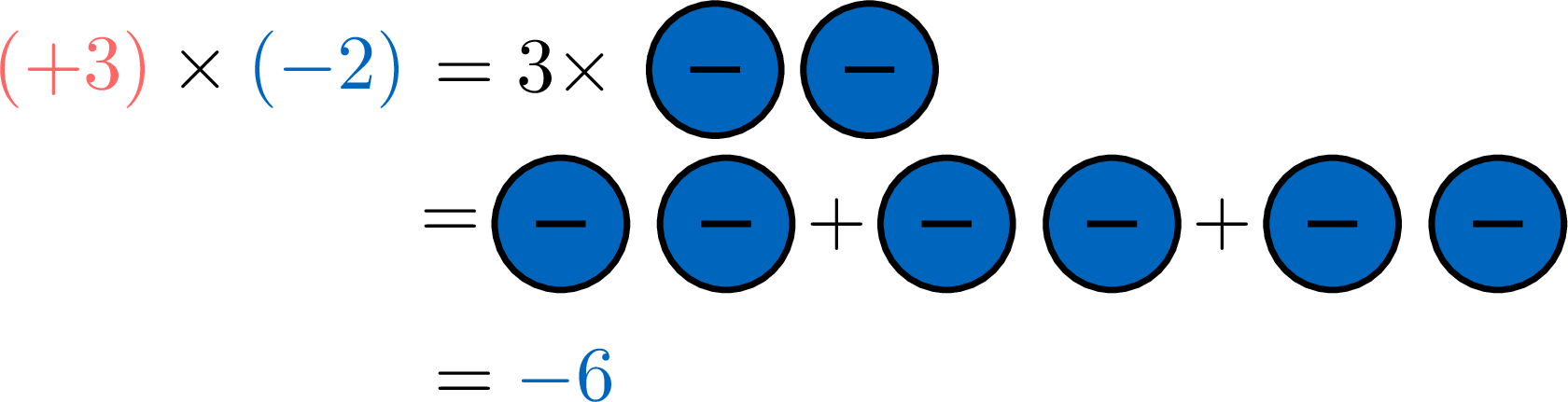
A product such as \((-3)\times(-2)\) is not a repetition: “\(-3\) times” does not mean anything. The units are not asked to show it. The lesson takes the zero pair \((+3)+(-3)=0\) and says what it wants: that the distributive law stay true with signed numbers. $$\begin{aligned} \bigl((+3)+(-3)\bigr)\times(-2)&=0\\
(+3)\times(-2)+(-3)\times(-2)&=0\\
-6+(-3)\times(-2)&=0\\
(-3)\times(-2)&=+6 \end{aligned}$$ The number that, added to \(-6\), gives \(0\) is the opposite of \(-6\): a negative times a negative gives a positive, and it is the only sign that keeps the distributive law true. The rule is not discovered on a drawing: it is forced by the decision to keep the laws of calculation.
The Path, Year by Year
Each chapter takes up the drawing where the year before left it, then goes one step further. The table gives the step and the link to the chapter.
| Year | Chapter | What is new |
| PYP 5 | Temperature and Negative Numbers | degrees Fahrenheit; the units and the zero pair; numbers below zero in situations; the number line through zero; comparing and ordering |
| MYP 1 | Positive and Negative Numbers | zero pairs; adding; subtracting, with the decisive case; multiplying through a pattern; dividing |
| MYP 2 | Integers and Signed Numbers | the sign of a product of several factors; signed decimals; chaining; priorities; naming an expression; the calculator |
Year by Year, with the Figures of the Lessons
The Units First, Then the Situations (PYP 5)
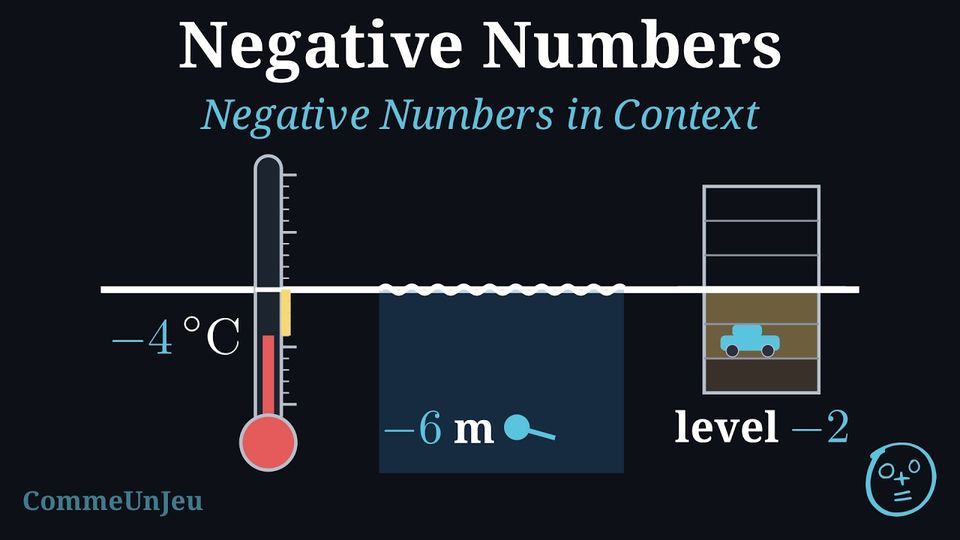
The situations come after the units: a thermometer, a diver, a car park. They are where negative numbers are met. A temperature of \(-4\,^\circ\)C is a position, four degrees below zero, not a fall of four degrees; each step of the scale is one unit. The method “reading a signed number in a situation” writes it in a table, with a row of units under the rows of situations.
| situation | zero | \(3\) above zero | \(3\) below zero |
| temperature | \(0\,^\circ\)C | \(\textcolor{colordef}{3}\,^\circ\)C | \(\textcolor{colorprop}{-3}\,^\circ\)C |
| height | sea level | \(\textcolor{colordef}{3}\) m | \(\textcolor{colorprop}{-3}\) m |
| building | ground floor | level \(\textcolor{colordef}{3}\) | level \(\textcolor{colorprop}{-3}\) |
| units | no unit |  |  |
The Line, the Distance to Zero, Comparing (PYP 5)
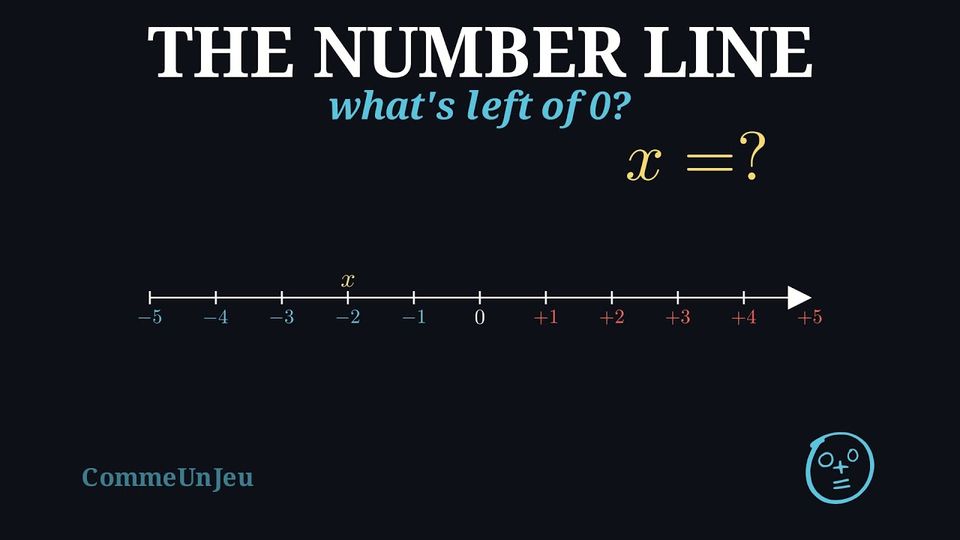
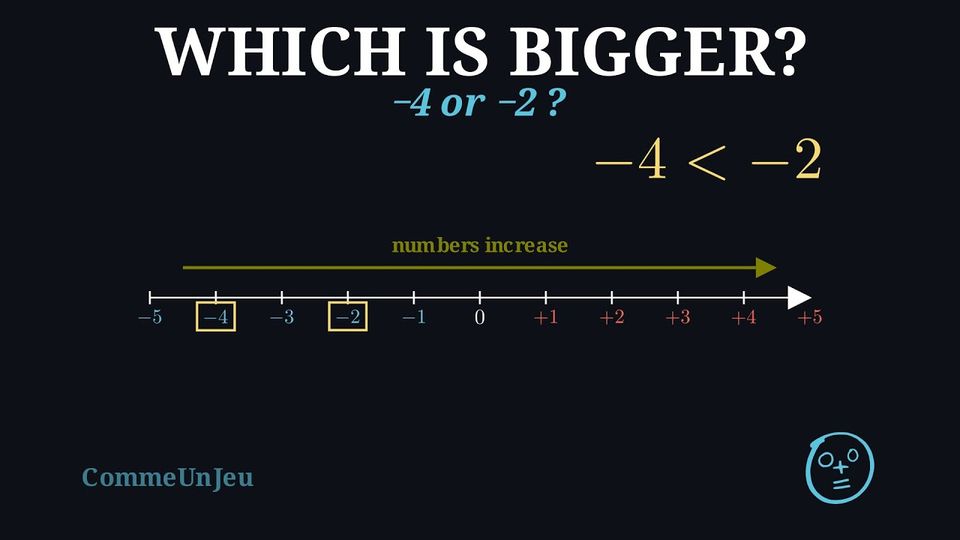
The units do not show that \(-5<-2\): the number line does. With a step of \(1\), the number of steps from zero is the number of units; the distance to zero is the number of units left once all zero pairs are cancelled. 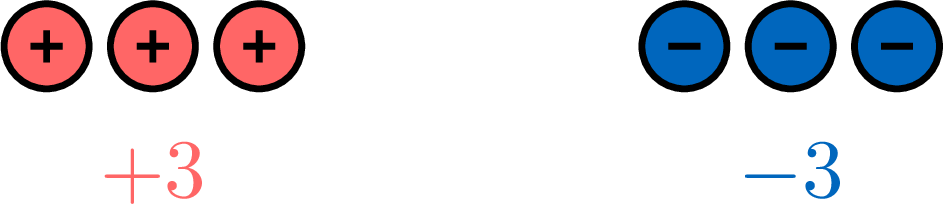
Comparing is taught on the line: of two negative numbers, the one closer to zero is greater. Keep the order on the line and do not let pupils compare collections of units (“more negative units” is not “more”). 
Decimals: Where the Drawing Stops (MYP 2)
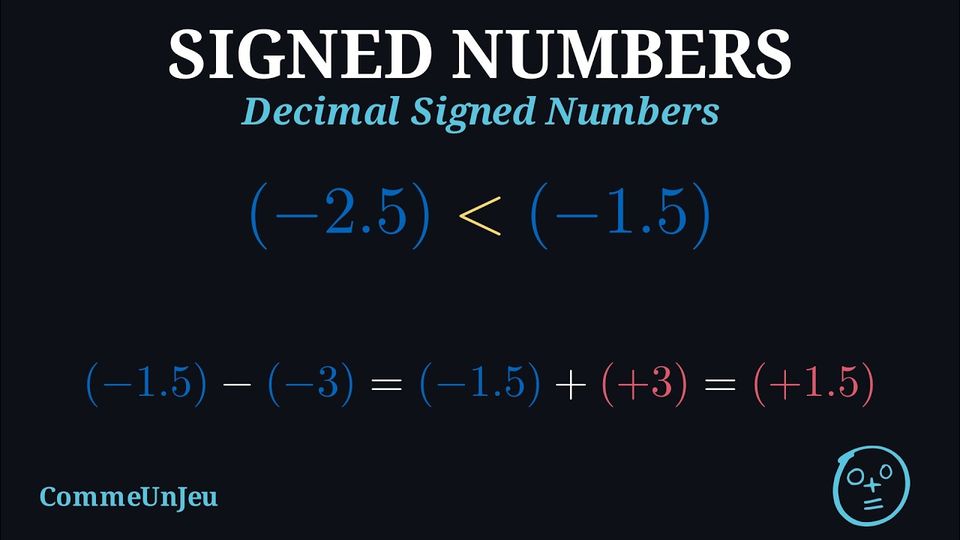
Any number, whole or decimal, can be a signed number, and everything built for the integers applies to it unchanged: opposite, distance to zero, comparison, addition and subtraction. Only the drawing changes: the units are no longer drawn; the rules found with them, stated with the distance to zero, are kept. The number line still works, with subdivisions. Tell pupils that the drawing has done its work: it is not abandoned because it was wrong, but because the rules now stand on their own.
Chaining Additions and Subtractions (MYP 2)
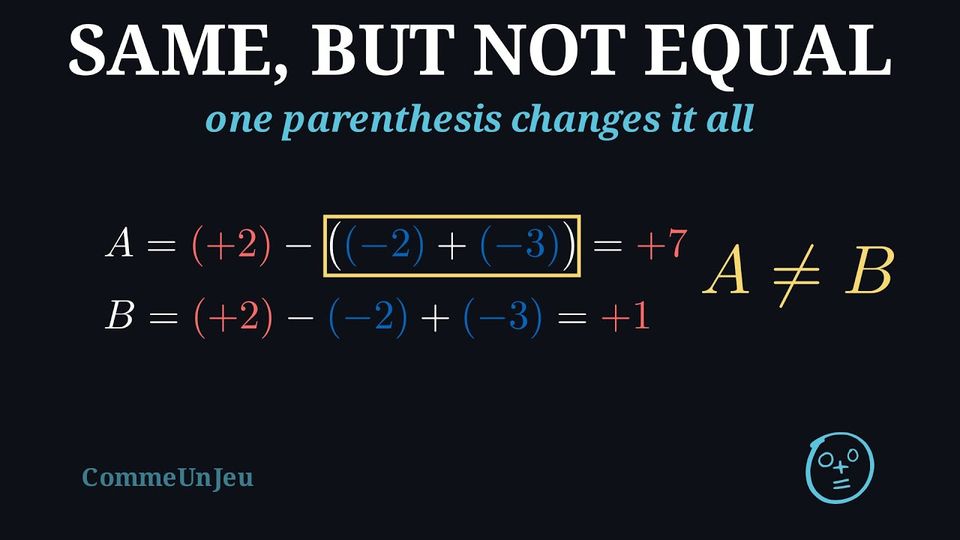
The two teams come back at the level of a calculation: in a sum, gather the positives, then the negatives, and let them meet. $$(+16) + (-11) + (+4) + (-9) = (16 + 4) + (-11 - 9) = (+20) + (-20) = 0.$$
Multiplying and Dividing (MYP 1 and MYP 2)
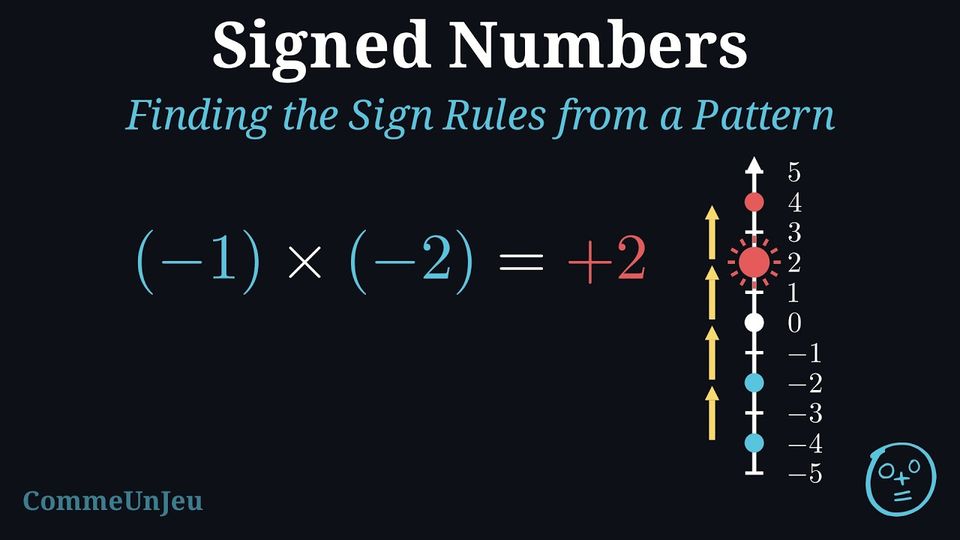
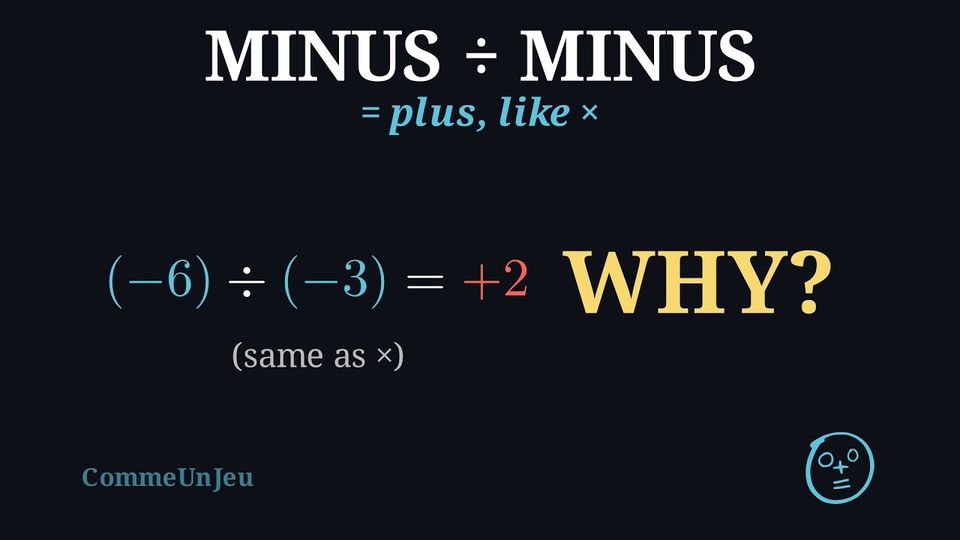
In MYP 1 the sign rules are first met through a pattern: the first factor goes down by \(1\) at each line, and the product goes up by \(2\). $$\begin{aligned}[t] 2\times (-2) &= -4\\
1\times (-2) &= -2 && (\text{up by } 2)\\
0\times (-2) &= 0 && (\text{up by } 2)\\
(-1)\times (-2) &= +2 && (\text{up by } 2) \end{aligned}$$ The lesson ends with a warning worth repeating: a pattern suggests a rule; it does not prove it. For the teacher, the proof is the zero-pair argument above; it is not part of the MYP 1 or MYP 2 chapter. Division is then read from multiplication, its inverse operation, the divisor being nonzero: since \((-3)\times(-2)=+6\), \((+6)\div(-3)=-2\). In MYP 2, for a product of several factors, the sign depends only on the number of negative factors: even gives a positive product, odd a negative one; this parity rule assumes all factors are nonzero, otherwise the product is zero.
Priorities, Naming an Expression, the Calculator (MYP 2)
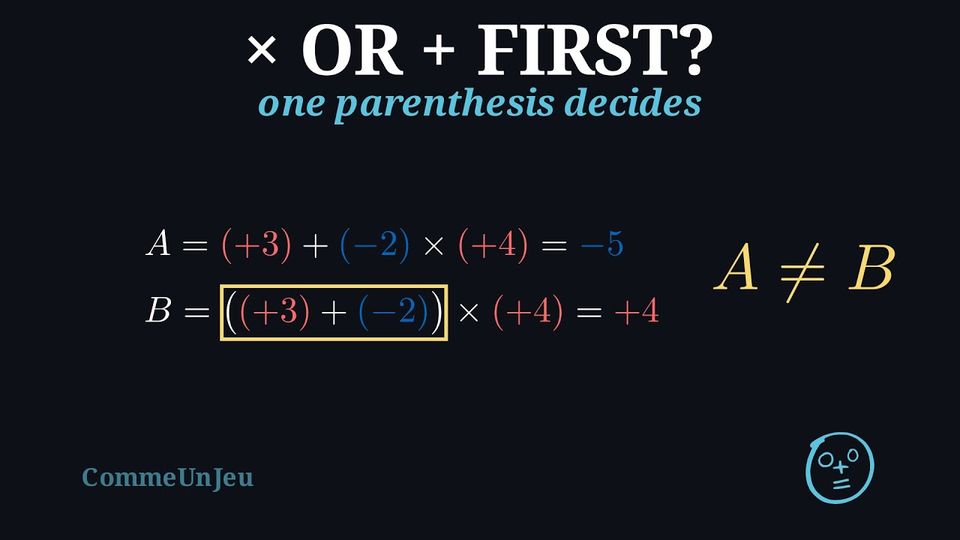
The last units no longer draw: the order of operations with signed numbers, the vocabulary of expressions (sum, difference, product, quotient) and the calculator. On a calculator, in a product or a quotient typed with the \(\times\) and \(\div\) keys, the brackets around a single negative number are not needed, because the sign key makes the number negative; everywhere else, keep them.
Draw First, Then Write
Every calculation with units is done in two moments. First the drawing, as an equality between drawings, line under line; then the calculation with numbers, under the drawing. Here is the order to follow in class, with \((-3)+(+2)\): 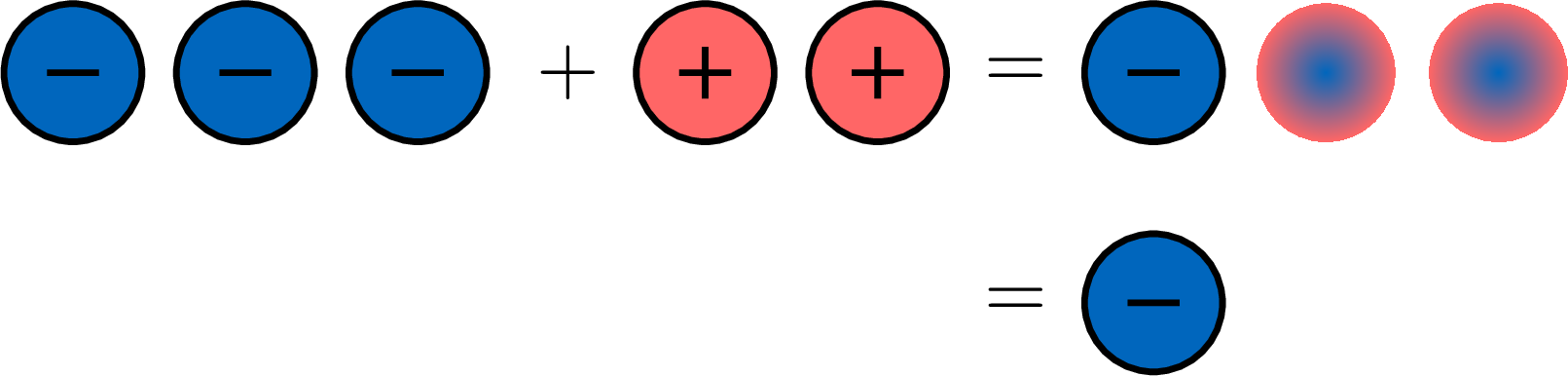
In a subtraction, a unit taken away is crossed out, never circled: the two gestures meet in the same drawing as soon as zero pairs are inserted, and a photo must tell them apart. The written exercises ask for exactly this: draw the units of each number, circle the zero pairs, cross out the units taken away, then write the chain of equalities. They are corrected from a photo of the page or from the slate. Their criteria accept any layout and a drawing in one colour if every sign is legible; they penalise pairs made of two units of the same sign, units taken away that were never drawn, and pairs that change the starting number. The corrections draw the pairs as the lessons do, with bursts, as in the figure above.
- draw three small circles with a minus, then two small circles with a plus;
- circle each zero pair: on paper a circle is the burst of the lessons;
- count what is left: one negative unit;
- write the calculation: \((-3)+(+2)=-1\).
Errors to Watch For, and the Figure That Answers Each
“Minus and minus make plus”, applied to addition: \((-5)+(-3)=+8\). The drawing has no pair to set aside: eight negative units, \(-8\). 
Adding always makes bigger. The sign of the number added decides, not the operation: \((+2)+(-6)=-4\), smaller than \(+2\). 
Taking away more than one has: \((+2)-(+5)\) read as impossible, or as \(3\). Insert at least three zero pairs, then take five positive units away: three negative units are left, \((+2)-(+5)=-3\). Comparing negative numbers like whole numbers: \(-5>-2\). Go back to the line: \(-5\) is further left, so it is smaller. Two signs side by side: \(3+-5\). To distinguish the operation from the sign of the number, write \(3+(-5)\), then simplify to \(3-5\). Every minus sign read as “negative”. The minus sign has three roles: the sign of a number, subtraction, the opposite. \(-a\) is not always negative: if \(a=-3\), then \(-a=3\). Calculator keys. Distinguish the subtraction key from the sign key used to enter a negative number. A temperature read as a change: \(-4\,^\circ\)C read as “it fell by \(4\)”. It is a position, four degrees below zero; changes come later, as differences between two positions. A procedure without meaning: inserting zero pairs because one is told to. Ask why the number does not change, and ask for a prediction without drawing (see the task taken apart below).
One Task Taken Apart: Subtracting a Negative Number
The written exercise asks: calculate \((+4)-(-2)\) twice with units, first adding two zero pairs, then three; cross out the units taken away and circle the zero pairs left; explain why the starting number stays \(+4\) and why the two calculations give the same result; check by adding \((-2)\) to the result; without drawing, predict the result with four zero pairs, and justify. With two pairs, the drawing is the one of the lesson: With three pairs, seven positive and three negative units are drawn; once the two negative units are crossed out, one zero pair is left, and it leaves nothing: \(+6\) again. What to expect on the photos:
- two units taken away from four positive ones, the sign forgotten: \(+2\); the pupil has not inserted any pair;
- the pairs inserted, the negative units crossed out, \(+6\): the strategy taught;
- “minus minus makes plus” and \(+6\) with no drawing: the result is right, the explanation is missing;
- the prediction with four pairs: ask for a justification without redrawing, and accept any explanation that the added pairs sum to zero.
In Class
- Draw before any rule. Small numbers, small circles: the pupils draw, cross out, circle, then write. The rules with the distance to zero come after, read on the drawings.
- Ask for several drawings of the same number, zero included, from the first lesson: it is the idea that subtraction needs.
- Make the decisive case the centre of the subtraction lesson: \((+4)-(-2)\), with two pairs, then three.
- Keep the order on the line and the situations for positions; do not compare collections of units.
- Stop drawing at the right time: with decimals and long calculations, the rules carry the work; say it to the pupils.
- For the product of two negatives: in MYP 1 a pattern suggests the sign rules; if pupils ask why, the teacher background above says what is chosen: we keep the distributive law, and the sign follows.
Going Further
The difficulty of the product of two negatives has a long history. Summaries of Georges Glaeser's study of the rule of signs (Recherches en Didactique des Mathématiques, 1981) identify, among other obstacles, the wish to stretch a model made for addition to multiplication, where it does not apply. A French article by the IREM of Aquitaine, Enseigner les nombres relatifs au collège (Repères-IREM no. 73, 2008, in French), gives a classroom example: a pupil maintained that \((-3)\times(-5)=-15\), because going down \(5\) three times lands at \(-15\); the authors conclude that a strong image of going up and down becomes an obstacle to multiplication. A classroom comparison by Julie Nurnberger-Haag (2015) found better results with a model of moves on a number line than with chips, notably on a set of subtractions and multiplications that require inserting zero pairs. This comparison does not evaluate the approach described in this guide; asking pupils to explain the gesture, not only to perform it, is a teaching recommendation, not a result of that study.