International Baccalaureate · DP 2: Applications and Interpretation HL
Complex Numbers
I
Complex Numbers
I.1
The Number \(i\) and the Set of Complex Numbers
In 1572, the Italian engineer Rafael Bombelli studied the equation $$x^3 = 15x + 4.$$
- Check that \(x = 4\) is a solution.
- Cardano's formula, the great discovery of his century, gives a solution of this equation as $$x = \sqrt[3]{2+\sqrt{-121}} + \sqrt[3]{2-\sqrt{-121}}.$$ The symbol \(\sqrt{-121}\) (Cardano's historical notation, which we will soon abandon) names an impossible number: no real number has a negative square. Yet the equation does have the perfectly real solution \(4\). Bombelli's idea: dare to compute with an “impossible” number \(i\) satisfying \(i^2 = -1\), writing \(\sqrt{-121} = 11i\), and see whether the formula secretly says \(4\).
- Admitting the usual rules of algebra together with \(i^2=-1\), expand \((2+i)^3\). What do you notice? Conclude what value the formula produces when its two cube roots are chosen as \(2+i\) and \(2-i\), which differ only in the sign in front of \(i\), as the formula requires.
Definition — The Imaginary Unit \(i\)
The imaginary unit, denoted by \(i\), is defined as a number such that: $$\textcolor{colordef}{i^2 = -1}$$
Why We Write \(i^2 \equal -1\) and Never \(i \equal \sqrt{-1}\)
The temptation is great to write \(i = \sqrt{-1}\). The following chain of equalities shows why this chapter does not use this notation: $$1 = \sqrt{1} = \sqrt{(-1)\times(-1)} = \sqrt{-1}\times\sqrt{-1} = i \times i = i^2 = -1.$$ Every step looks legal, yet the conclusion \(1 = -1\) is absurd. The faulty step is the third one: the law \(\sqrt{a}\times\sqrt{b} = \sqrt{ab}\) holds only for \(a, b \ge 0\) — exactly the hypothesis that comes with it for square roots. The symbol \(\sqrt{\ }\) keeps its meaning only for non-negative real numbers.
- We define \(i\) by the property \(\textcolor{colordef}{i^2 = -1}\), and we never apply the laws of \(\sqrt{\ }\) to negative numbers.
- Moreover, \(-1\) has two square roots in the complex numbers, \(i\) and \(-i\), and nothing distinguishes one from the other: a symbol \(\sqrt{-1}\) would pretend to choose between two indistinguishable numbers.
Definition — Complex Number and Algebraic Form
A complex number is a number of the form \(z = a + bi\), where \(a\) and \(b\) are real numbers and \(i\) is the imaginary unit. This way of writing \(z\) is called its algebraic form. The set of all complex numbers is denoted by \(\C\).
Note
- \(i\) cannot be a real number, since no real number squared is equal to \(-1\).
- A real number \(a\) is a complex number where \(b=0\), written as \(a = a+0i\). Thus \(\R \subset \C\).
- A number where \(a=0\), such as \(bi\), is called a purely imaginary number.
Definition — Real and Imaginary Parts
For a complex number \(z = a + bi\) (with \(a,b \in \R\)): - \(a\) is the real part of \(z\), denoted \(\Re(z)\).
- \(b\) is the imaginary part of \(z\), denoted \(\Im(z)\).
Example
For \(z = 2+3i\): - \(\Re(2+3i)=2\)
- \(\Im(2+3i)=3\)
Definition — Complex Conjugate
The complex conjugate of \(z = a + bi\) (with \(a,b\in\R\)) is \(\conjugate{z} = a - bi\). The complex conjugate of \(z\) is often denoted as \(\conjugate{z}\) or \(z^{*}\). Example
The complex conjugate of \(2+3i\) is \(\conjugate{2+3i} = 2-3i\). Skills to practice
- Identifying Real and Imaginary Parts
- Finding the Conjugate of a Complex Number
II
Operations with Complex Numbers
II.1
Calculating with Complex Numbers
The arithmetic of complex numbers follows the standard rules of algebra, together with the key relation \(i^2=-1\).
Definition — Algebraic Operations
Let \(z = a+bi\) and \(w = c+di\), where \(a,b,c,d \in \R\). - Addition: $$\begin{aligned}[t] z + w &= (a+bi) + (c+di) \\ &= (a+c)+(b+d)i. \end{aligned}$$
- Subtraction: $$\begin{aligned}[t] z - w &= (a+bi) - (c+di) \\ &= (a-c)+(b-d)i. \end{aligned}$$
- Multiplication: $$\begin{aligned}[t] z \times w &= (a+bi)(c+di) \\ &= ac + adi + bci + bdi^2 \\ &= ac + adi + bci - bd && \text{(\(i^2 = -1\))}\\ &= (ac-bd)+ (ad+bc)i. \end{aligned}$$
- Division (with \(w \neq 0\), so that \(c^2+d^2 \neq 0\) since \(c\) and \(d\) are not both zero): $$\begin{aligned}[t] \dfrac{z}{w} &= \frac{a+bi}{c+di} \\ &= \left(\frac{a+bi}{c+di}\right)\left(\frac{c-di}{c-di}\right) && \text{(multiply by 1)}\\ &= \frac{(a+bi)(c-di)}{(c+di)(c-di)} \\ &= \frac{ac-adi+bci-bdi^2}{c^2-(di)^2} && \text{(expand)}\\ &= \frac{ac-adi+bci+bd}{c^2+d^2} && \text{(\(i^2 = -1\))}\\ &= \frac{(ac+bd) + (bc-ad)i}{c^2+d^2}. \end{aligned}$$
Example
Write \((2+3i)(4-i)\) in the form \(a+bi\).
$$\begin{aligned}[t] (2+3i)(4-i) &= 8 - 2i + 12i - 3i^2 && \text{(expand)}\\
&= 8 + 10i - 3i^2 && \text{(collect like terms)}\\
&= 8 + 10i - 3 \times (-1) && \text{(\(i^2 = -1\))}\\
&= 11 + 10i. \end{aligned}$$
Proposition — Inverse of a Nonzero Complex Number and Zero Product
Let \(z = a + bi\) with \(a, b \in \R\) and \(z \neq 0\) (so that \(a^2 + b^2 \neq 0\)). Then \(z\) has an inverse, the complex number \(\dfrac{1}{z}\) such that \(z \times \dfrac{1}{z} = 1\), and $$\textcolor{colorprop}{\frac{1}{z} = \frac{a - bi}{a^2 + b^2} = \frac{a}{a^2+b^2} - \frac{b}{a^2+b^2}\,i.}$$ Zero product. For all complex numbers \(z\) and \(w\): $$zw = 0 \;\Leftrightarrow\; z = 0 \text{ or } w = 0.$$ Method — Dividing by a Complex Number
To write a quotient \(\dfrac{z}{w}\) (with \(w \neq 0\)) in algebraic form, multiply the numerator and the denominator by the conjugate of the denominator (for \(w = c + di\), the number \(c - di\)): the denominator becomes the real number \(w\conjugate{w} = c^2 + d^2\). This is the same technique used to rationalize a binomial denominator such as \(3+\sqrt{5}\), and the same computation as the inverse \(\dfrac{1}{w} = \dfrac{c - di}{c^2 + d^2}\), since \(\dfrac{z}{w} = z \times \dfrac{1}{w}\). Example
Write \(\dfrac{3+2i}{1-2i}\) in the form \(a+bi\).
$$\begin{aligned}[t] \frac{3+2i}{1-2i} &= \frac{(3+2i)}{(1-2i)} \times \frac{(1+2i)}{(1+2i)} && \text{(multiply by 1)}\\
&= \frac{3 + 6i + 2i + 4i^2}{1^2 - (2i)^2} && \text{(expand; \((x-y)(x+y) = x^2 - y^2\))}\\
&= \frac{-1 + 8i}{1 + 4} && \text{(\(i^2 = -1\))}\\
&= -\frac{1}{5} + \frac{8}{5}i. \end{aligned}$$
Proposition — Powers of \(i\)
The powers of \(i\) repeat in a cycle of length \(4\): $$\textcolor{colorprop}{i^0 = 1, \quad i^1 = i, \quad i^2 = -1, \quad i^3 = -i, \quad i^4 = 1, \;\dots}$$ For any natural number \(n\), the value of \(i^n\) depends only on the remainder of the Euclidean division of \(n\) by \(4\): writing \(n = 4q + r\) with \(q\) the quotient and \(r \in \{0, 1, 2, 3\}\) the remainder, $$i^n = i^{4q+r} = \left(i^4\right)^q \times i^r = 1^q \times i^r = i^r.$$ Example
Compute \(i^{2026}\).
$$\begin{aligned}[t] i^{2026} &= i^{4 \times 506 + 2} && \text{(\(2026 = 4 \times 506 + 2\))}\\
&= \left(i^4\right)^{506} \times i^2 && \text{(\(x^{m+n} = x^m x^n\))}\\
&= 1^{506} \times (-1) && \text{(\(i^4 = 1\), \(i^2 = -1\))}\\
&= -1. \end{aligned}$$
Skills to practice
- Calculating with Complex Numbers
- Dividing Complex Numbers
II.2
Calculating with Technology
Method — Calculating with Complex Numbers with Technology
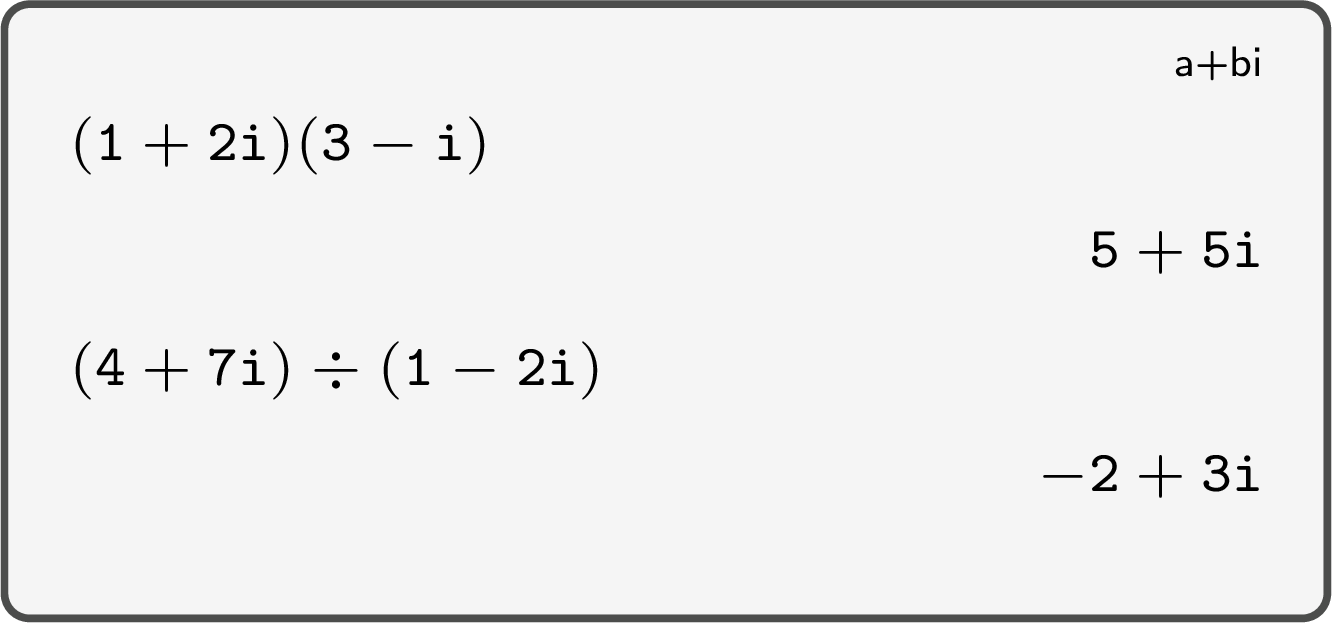
A graphing calculator, or a scientific calculator with a complex mode, computes sums, products, quotients and powers of complex numbers. - Set the mode to complex numbers written in the form \(a + bi\).
- Enter the imaginary unit with its own key, not a variable named \(i\), and put each complex number between brackets: \((1 + 2i)(3 - i)\), \((4 + 7i) \div (1 - 2i)\), \((3 - 2i)^4\).
- Read the result in the form \(a + bi\). Report a part exactly only when it is known to be exact: the screen shows an integer, a fraction or a short decimal, and a check by hand confirms it; otherwise give the real part and the imaginary part each to 3 significant figures.
- Check what the question asks for: when an exact form or a working is required, the screen gives the value to reach, and the computation by hand, with the conjugate for a quotient, gives the working.
Example
Use technology to write each number in the form \(a + bi\), then check the second one by hand. - \((3 - 2i)^4\);
- \(\dfrac{2 + 5i}{3 - 4i}\).
- In complex mode, the input \((3 - 2i)^4\) displays \(-119 - 120i\). Two integers, confirmed by hand with \((3 - 2i)^2 = 5 - 12i\) and \((5 - 12i)^2 = 25 - 120i + 144i^2 = -119 - 120i\): \((3 - 2i)^4 = -119 - 120i\).
- The input \((2 + 5i) \div (3 - 4i)\) displays \(-0.56 + 0.92i\): two short decimals, which the computation by hand, with the conjugate \(3 + 4i\) of the denominator, confirms to be exact: $$\begin{aligned}[t] \frac{2 + 5i}{3 - 4i} &= \frac{(2 + 5i)(3 + 4i)}{(3 - 4i)(3 + 4i)} && \text{(multiply by the conjugate)}\\ &= \frac{6 + 8i + 15i + 20i^2}{3^2 + 4^2} && \text{(expand; \((3 - 4i)(3 + 4i) = 3^2 + 4^2\))}\\ &= \frac{-14 + 23i}{25} && \text{(\(i^2 = -1\))}\\ &= -0.56 + 0.92i. \end{aligned}$$ So \(\dfrac{2 + 5i}{3 - 4i} = -0.56 + 0.92i\) exactly: the working gives the value displayed on the screen.
Skills to practice
- Calculating with Complex Numbers with Technology
III
Equality of Complex Numbers
III.1
Equal Complex Numbers
Proposition — Equality of Complex Numbers
Two complex numbers are equal if and only if their real parts are equal and their imaginary parts are equal: for \(a, b, c, d \in \R\), $$ a+bi=c+di \;\Leftrightarrow\; a=c \text{ and } b=d. $$ Skills to practice
- Solving Equations by Equating Real and Imaginary Parts
IV
Quadratic Equations in \(\mathbb{C}\)
IV.1
Quadratic Equations with Complex Roots
Proposition — Solving equations of the form \(z^2 \equal k\)
Consider the equation \(z^2 = k\), where \(k\) is a real number. - If \(k > 0\), the equation has two distinct real solutions: $$ z_1 = \sqrt{k} \quad \text{and} \quad z_2 = -\sqrt{k} $$
- If \(k = 0\), the equation has a unique real solution: $$ z_0 = 0 $$
- If \(k < 0\), the equation has two conjugate purely imaginary solutions: $$ z_1 = i\sqrt{-k} \quad \text{and} \quad z_2 = -i\sqrt{-k} $$
Proposition — Solving Quadratic Equations with Real Coefficients in \(\mathbb{C}\)
Consider the equation \(az^2 + bz + c = 0\), where \(a, b,\) and \(c\) are real numbers and \(a \neq 0\).Let \(\Delta = b^2 - 4ac\) be the discriminant of this equation.
- If \(\Delta > 0\), the equation has two distinct real solutions: $$ z_1 = \frac{-b - \sqrt{\Delta}}{2a} \quad \text{and} \quad z_2 = \frac{-b + \sqrt{\Delta}}{2a} $$
- If \(\Delta = 0\), the equation has a unique real solution: $$ z_0 = \frac{-b}{2a} $$
- If \(\Delta < 0\), the equation has two conjugate complex solutions: $$ z_1 = \frac{-b - i\sqrt{-\Delta}}{2a} \quad \text{and} \quad z_2 = \frac{-b + i\sqrt{-\Delta}}{2a} $$
- If \(\Delta \neq 0\), the quadratic can be factorized as: \(az^2 + bz + c = a(z - z_1)(z - z_2)\).
Example
Solve in \(\R\), then in \(\C\), the equations \(z^2 + 10 = 0\) and \(z^2 - 4z + 5 = 0\). - \(z^2 + 10 = 0\) is equivalent to \(z^2 = -10\), an equation of the form \(z^2 = k\) with \(k = -10 < 0\). In \(\R\), it has no solution. In \(\C\), its solutions are \(i\sqrt{10}\) and \(-i\sqrt{10}\): \(S = \left\{-i\sqrt{10}, i\sqrt{10}\right\}\).
- For \(z^2 - 4z + 5 = 0\): \(a = 1\), \(b = -4\), \(c = 5\) and $$\Delta = b^2 - 4ac = (-4)^2 - 4 \times 1 \times 5 = 16 - 20 = -4 < 0.$$ In \(\R\), there is no solution. In \(\C\), there are two conjugate solutions: $$\begin{aligned}[t] z_1 &= \frac{-b - i\sqrt{-\Delta}}{2a} = \frac{4 - i\sqrt{4}}{2} = \frac{4 - 2i}{2} = 2 - i, \\ z_2 &= \frac{-b + i\sqrt{-\Delta}}{2a} = \frac{4 + 2i}{2} = 2 + i, \end{aligned}$$ so \(S = \{2 - i, 2 + i\}\) and \(z^2 - 4z + 5 = (z - 2 + i)(z - 2 - i)\). Check: \((2 + i)^2 - 4(2 + i) + 5 = 3 + 4i - 8 - 4i + 5 = 0\).
Example
Use technology to solve the equation \(2z^2 - 3z + 5 = 0\) in \(\C\), then find its solutions exactly.
The calculator is set to complex mode, then the polynomial solver, degree \(2\), receives \(a = 2\), \(b = -3\) and \(c = 5\). 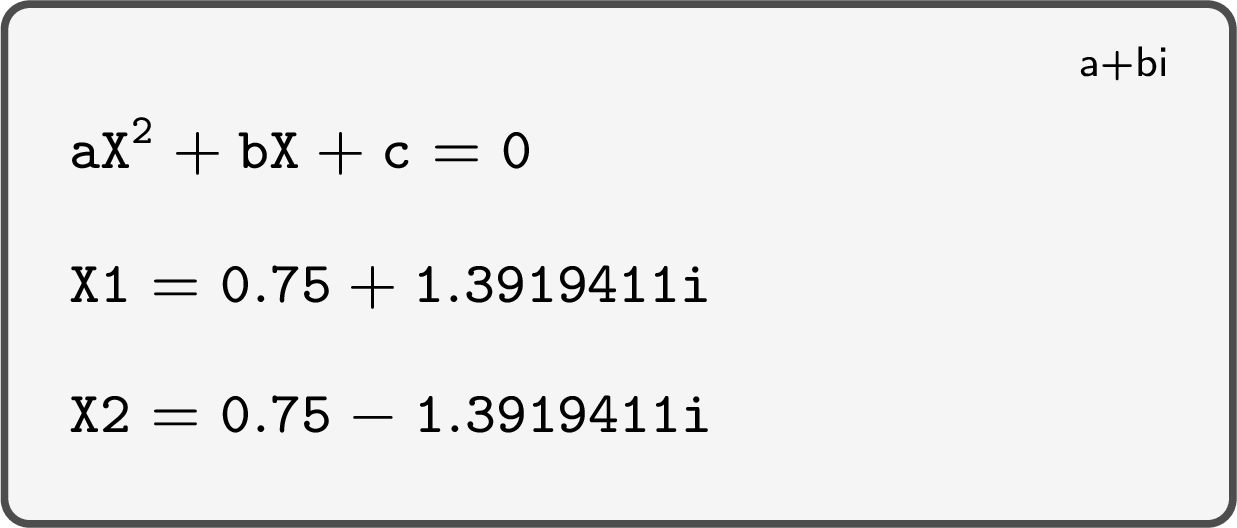
The solutions are \(z \approx 0.75 - 1.39i\) and \(z \approx 0.75 + 1.39i\). Exactly: \(a = 2\), \(b = -3\), \(c = 5\) are real and $$\Delta = b^2 - 4ac = (-3)^2 - 4 \times 2 \times 5 = 9 - 40 = -31 < 0,$$ so the equation has two conjugate complex solutions: $$z_1 = \frac{-b - i\sqrt{-\Delta}}{2a} = \frac{3 - i\sqrt{31}}{4} \quad \text{and} \quad z_2 = \frac{-b + i\sqrt{-\Delta}}{2a} = \frac{3 + i\sqrt{31}}{4}.$$ Since \(\frac{3}{4} = 0.75\) and \(\frac{\sqrt{31}}{4} \approx 1.3919411\), the screen displays approximations of these exact values, and its two roots are conjugates, as the resolution in \(\C\) predicts.
Skills to practice
- Solving Quadratic Equations with Technology
- Solving Quadratic Equations
V
The Complex Plane
V.1
The Complex Plane
The algebraic chapter computed with complex numbers; this one represents them in the plane. Represent each complex number \(a+bi\) by the point with coordinates \((a, b)\).
- Place the points representing \(z_0 = 1\), then \(z_1 = i \times z_0\), then \(z_2 = i \times z_1\), then \(z_3 = i \times z_2\), then \(z_4 = i \times z_3\). What do you observe?
- Now start from \(w_0 = 2+i\) and repeat: place \(w_0\), \(iw_0\), \(i^2w_0\), \(i^3w_0\). What geometric transformation does “multiplying by \(i\)” appear to perform?
- Knowing that \(i^2 = -1\), explain why this transformation, applied twice, must send every point to its reflection through the origin.
We have seen that a complex number can be written in Cartesian (algebraic) form as \(z = a+bi\) where \(a = \Re(z)\) and \(b = \Im(z)\) are both real numbers.
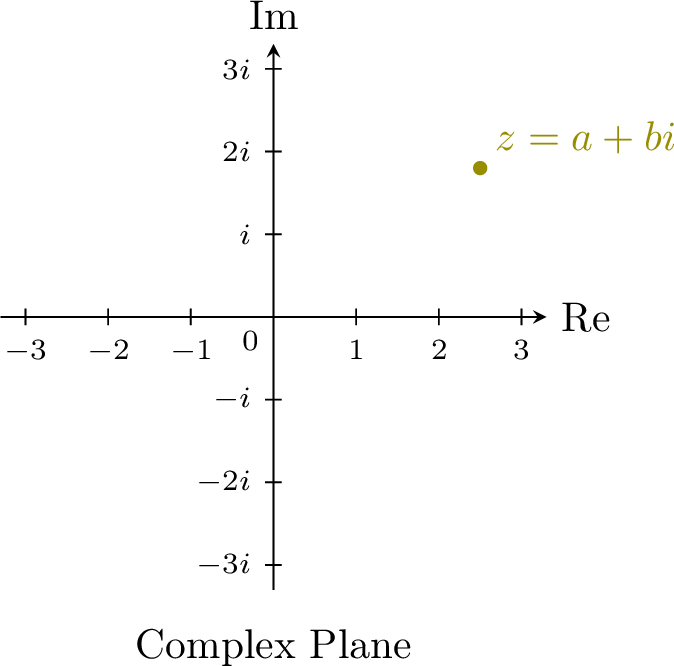
There is a one-to-one correspondence between any complex number \(a+bi\) and the point \((a, b)\).
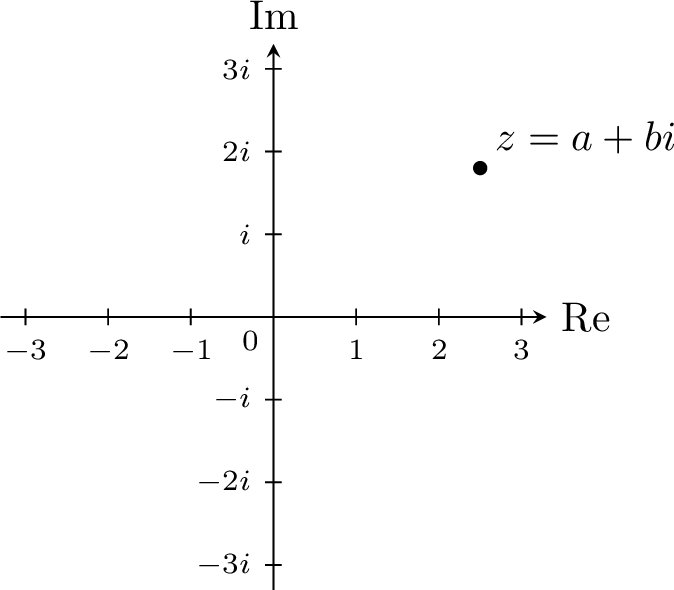
We can therefore plot any complex number on a plane by associating it with a unique point, giving a geometric representation to what was previously an algebraic object. We refer to this plane as the complex plane.
Definition — Complex Plane
The complex plane is the plane formed by the complex numbers, endowed with an orthonormal Cartesian coordinate system such that: - the horizontal \(x\)-axis, called the real axis, consists of the real numbers
- the vertical \(y\)-axis, called the imaginary axis, consists of the purely imaginary numbers.
Definition — Relationship between Cartesian and Complex Representations
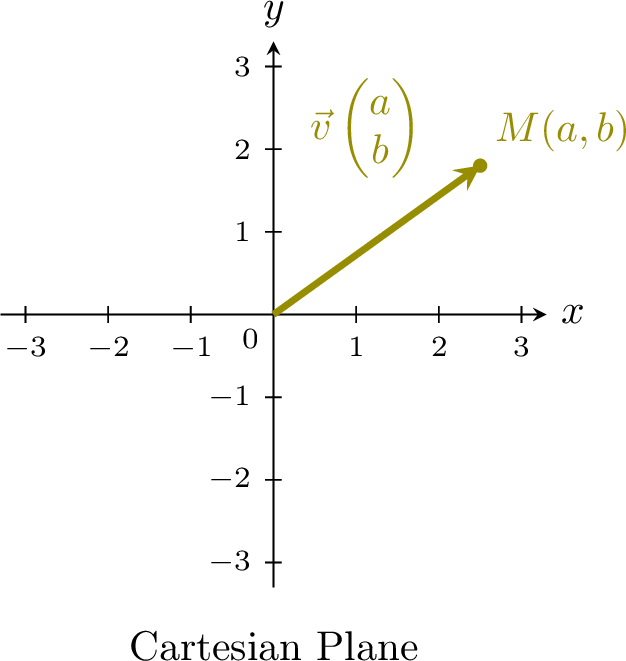
- The point \(M(a, b)\) is the point corresponding to the complex number \(z=a+bi\).
- The vector \(\vec{v} = \begin{pmatrix} a \\ b \end{pmatrix}\) is the position vector representing the complex number \(z=a+bi\).
- The complex number \(z=a+bi\) is the affix of the point \(M(a, b)\) and of the vector \(\vec{v} = \begin{pmatrix} a \\ b \end{pmatrix}\).
Skills to practice
- Reading the Affix of a Point
V.2
Modulus and Argument
Geometrically, a complex number has two key characteristics: its distance from the origin and, when it is non-zero, its direction relative to the positive real axis.
Definition — Modulus
The modulus of a complex number \(z = x+yi\), denoted \(|z|\), is the distance from the origin to its corresponding point in the complex plane. By the Pythagorean theorem, it is defined as: $$|z| = \sqrt{x^2 + y^2}.$$ The modulus is a non-negative real number. 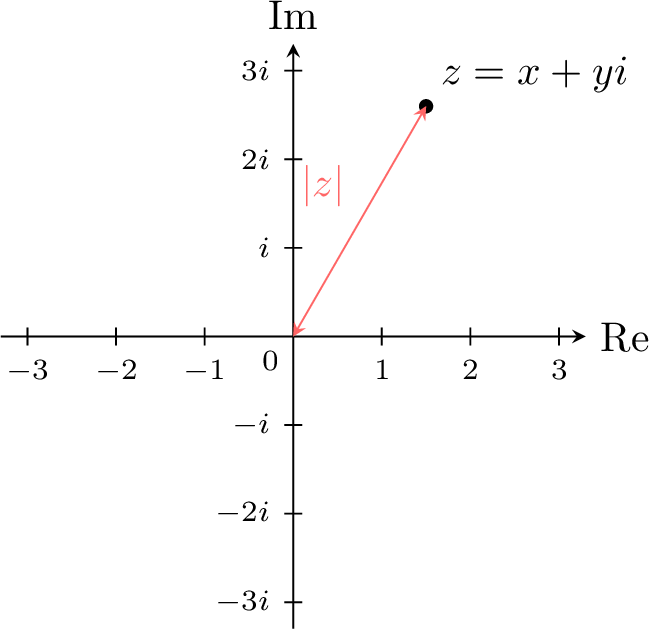
Definition — Argument
The argument of a non-zero complex number \(z\), denoted \(\arg(z)\), is any measure \(\theta\) of the oriented angle between the positive real axis and the vector representing \(z\). 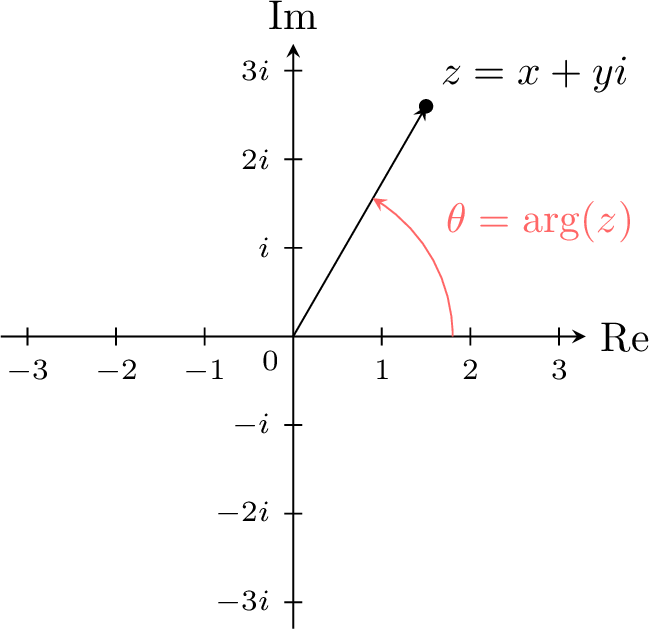
Note
An argument of a complex number is not unique, as any multiple of \(2\pi\) can be added to the angle. To make it unique, we define the principal value of the argument, also called the principal argument, as the unique argument \(\theta\) in the interval \((-\pi, \pi]\).
The argument of \(0\) is undefined.
The argument of \(0\) is undefined.
Example
A non-zero purely imaginary number \(ib\), with \(b\) real, has \(\dfrac{\pi}{2}\) as an argument if \(b > 0\), and \(-\dfrac{\pi}{2}\) if \(b < 0\). 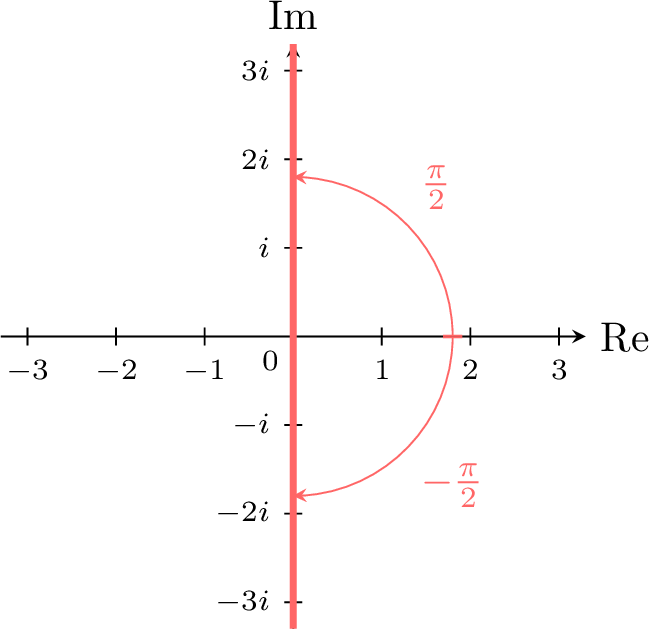
Method — Calculating the Argument
To find an argument \(\theta\) of a non-zero complex number \(z=a+bi\): - Calculate the modulus \(|z| = \sqrt{a^2+b^2}\).
- Factor out the modulus to identify the coordinates of the corresponding point on the unit circle: $$ z = |z| \left( \frac{a}{|z|} + i \frac{b}{|z|} \right). $$
- Identify the angle. Find an angle \(\theta\) that satisfies the system of equations: $$ \begin{cases} \cos(\theta) = \dfrac{a}{|z|} \\ \sin(\theta) = \dfrac{b}{|z|} \end{cases} $$ This value of \(\theta\) is an argument of \(z\).
Example
Find an argument of the complex number \(z = -1+i\sqrt{3}\). - We first calculate the modulus of \(z\): $$|z| = \sqrt{(-1)^2 + (\sqrt{3})^2} = \sqrt{1+3} = 2.$$ We can then factor out the modulus: $$ z = 2 \times \left(-\frac{1}{2} + i\frac{\sqrt{3}}{2}\right). $$
- We are looking for a real number \(\theta\) such that: $$ \begin{cases} \cos(\theta) = -\dfrac{1}{2} \\
\sin(\theta) = \dfrac{\sqrt{3}}{2} \end{cases} $$ The angle \(\theta = \dfrac{2\pi}{3}\) satisfies both equations.
Therefore, an argument of \(z\) is \(\dfrac{2\pi}{3}\).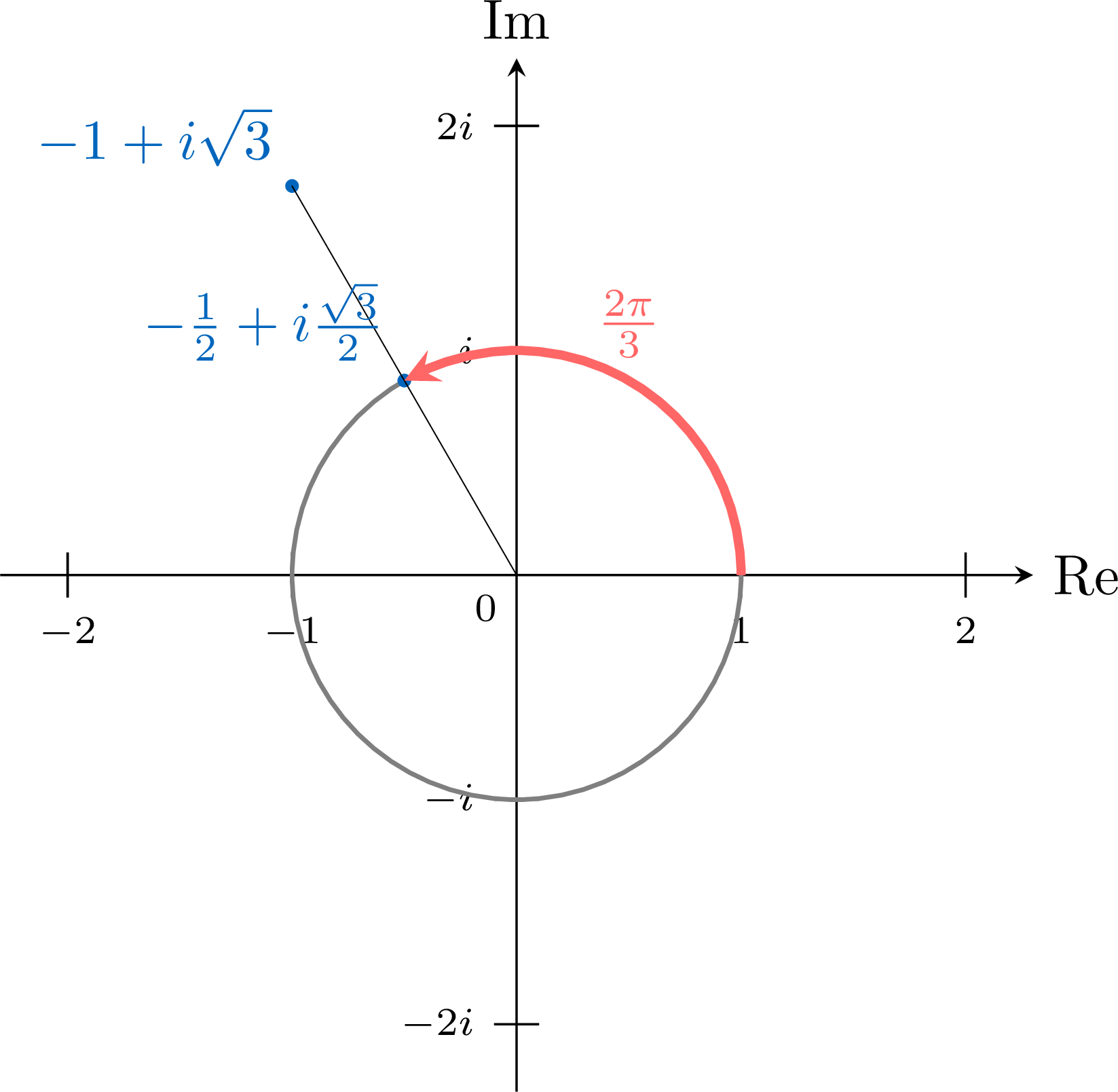
Skills to practice
- Calculating the Modulus and the Argument
VI
Polar and Exponential Forms
VI.1
Unit Modulus Numbers and the Imaginary Exponential
Definition — Unit Circle in the Complex Plane
We denote by \(\mathbb{U}\) the set of all complex numbers with modulus \(1\): $$\mathbb{U}=\{z \in \mathbb{C} \mid |z |=1\}.$$ The points corresponding to the elements of \(\mathbb{U}\) form the unit circle, the circle of radius \(1\) centred at the origin; travelled counterclockwise, it is the trigonometric circle. 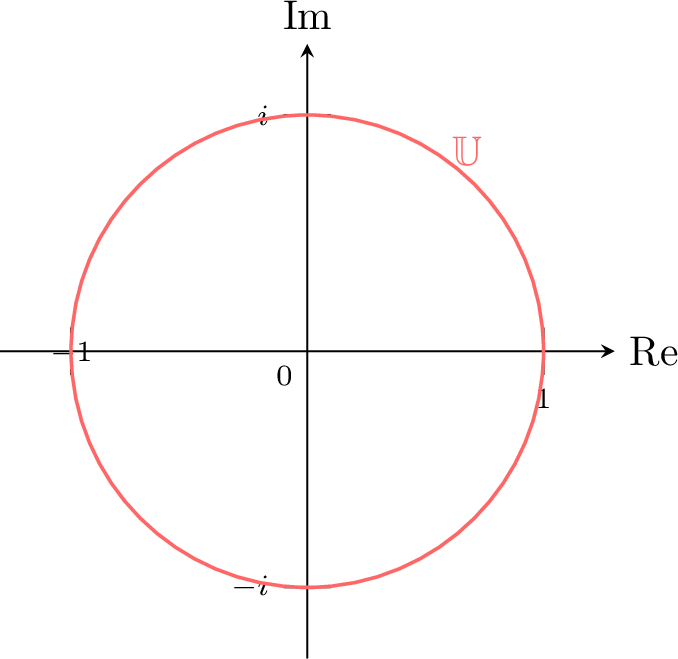
Proposition — Trigonometric Form of Unit Modulus Numbers
If \(z \in \mathbb{U}\), then there exists a real number \(\theta\) such that $$z=\cos\theta+i\sin\theta.$$ Here, \(\theta\) is an argument of \(z\). 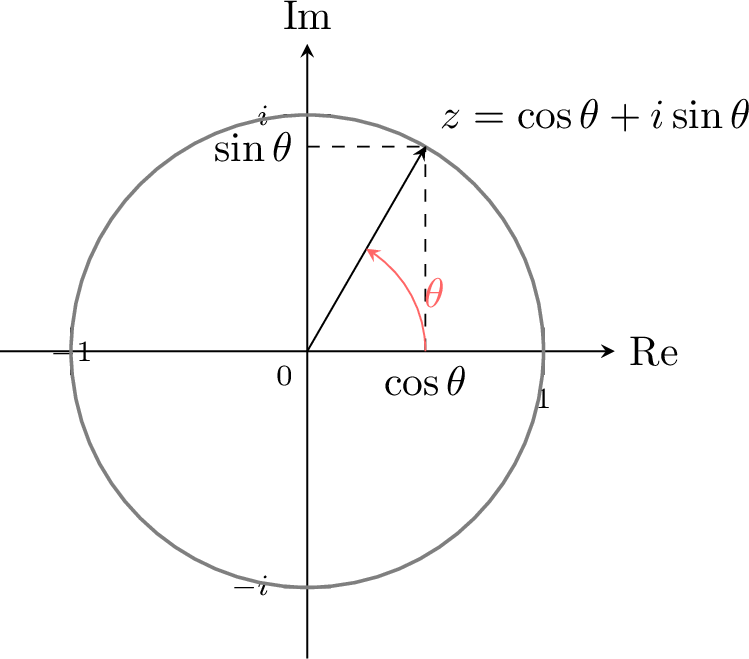
Definition — Imaginary Exponential
For any real number \(\theta\), we define the imaginary exponential, denoted \(e^{i\theta}\), as the complex number $$e^{i\theta} = \cos \theta + i \sin \theta.$$ Proposition — Properties of the Imaginary Exponential
For any real numbers \(\theta\) and \(\theta'\), and for any integer \(n\), the imaginary exponential has the following properties: - Modulus: \(|e^{i\theta}| = 1\)
- Argument: \(\arg(e^{i\theta}) \equiv \theta \pmod{2\pi}\)
- Conjugate: \(\conjugate{e^{i\theta}} = e^{-i\theta}\)
- Product Rule: \(e^{i(\theta+\theta')} = e^{i\theta}\, e^{i\theta'}\)
- Quotient Rule: \(\dfrac{e^{i\theta}}{e^{i\theta'}} = e^{i(\theta-\theta')}\)
- Power Rule: \((e^{i\theta})^n = e^{in\theta}\)
Skills to practice
- Applying the Properties of the Imaginary Exponential
VI.2
Writing in Polar and Exponential Form
Any non-zero complex number can be represented by starting with a number on the unit circle and scaling it by its modulus.
Definition — Polar Form
A non-zero complex number \(z\) with modulus \(r = |z|\) and argument \(\theta\) can be written in polar form as $$ z = r(\cos\theta + i\sin\theta). $$ 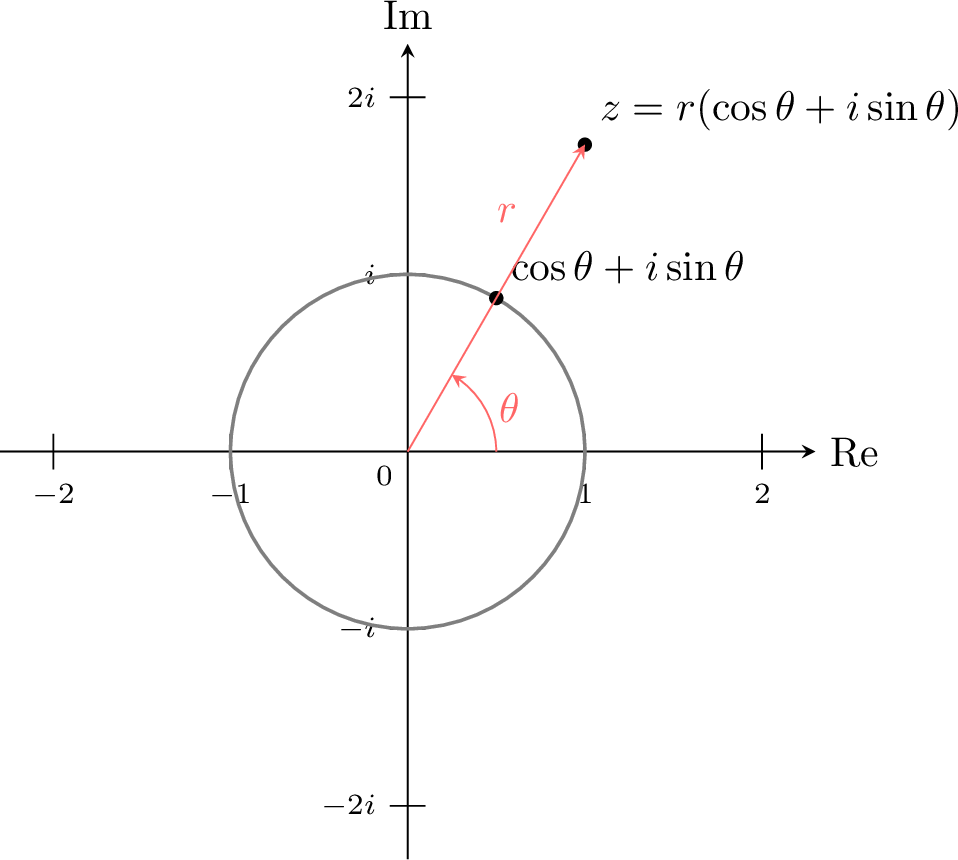
Proposition — Equality in Polar Form
Let \(r > 0\) and \(r' > 0\), and let \(\theta\) and \(\theta'\) be real numbers. Then $$\textcolor{colorprop}{r(\cos\theta + i\sin\theta) = r'(\cos\theta' + i\sin\theta') \iff r = r' \text{ and } \theta \equiv \theta' \pmod{2\pi}.}$$ In particular, if \(z = r(\cos\theta + i\sin\theta)\) with \(r > 0\), then \(r = |z|\) and \(\theta\) is an argument of \(z\). Definition — Euler's Form
Using the imaginary exponential, a non-zero complex number \(z\) with modulus \(r = |z|\) and argument \(\theta\) can be written in Euler's form as $$ z = re^{i\theta}. $$ 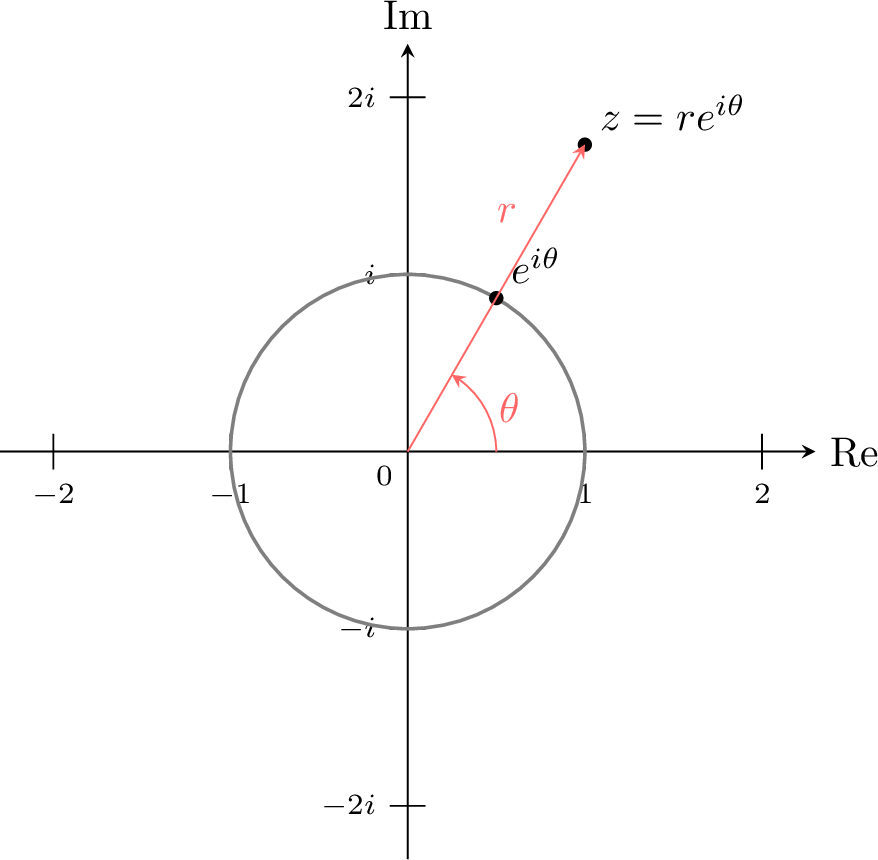
Other Names and Notations
Several names and notations are in common use for the objects of this chapter.
- The complex plane is also called the Argand diagram.
- The polar form \(r(\cos\theta + i\sin\theta)\) is also called the modulus-argument form. It is abbreviated \(r\operatorname{cis}\theta\), where \(\operatorname{cis}\theta = \cos\theta + i\sin\theta\), so that \(\operatorname{cis}\theta = e^{i\theta}\).
- Euler's form \(re^{i\theta}\) is also called the exponential form.
Proposition — Properties of the Modulus
- \(|\conjugate{z}| = |z|\)
- \(|z|^2 = z\conjugate{z}\)
- \(|z_1 z_2| = |z_1|\, |z_2|\)
- \(\left| \dfrac{z_1}{z_2} \right| = \dfrac{|z_1|}{|z_2|}\) provided \(z_2 \neq 0\)
- \(|z^n| = |z|^n\) for any integer \(n\) (with \(z \neq 0\) when \(n < 0\)).
Proposition — Properties of Arguments
For any non-zero complex numbers \(z_1\) and \(z_2\) and any integer \(n\): - for any non-zero complex number \(z\), \(\arg(\conjugate{z}) \equiv -\arg(z) \pmod{2\pi}\)
- \(\arg(z_1 z_2) \equiv \arg(z_1) + \arg(z_2) \pmod{2\pi}\)
- \(\arg\left(\dfrac{z_1}{z_2}\right) \equiv \arg(z_1) - \arg(z_2) \pmod{2\pi}\)
- \(\arg(z^n) \equiv n \arg(z) \pmod{2\pi}\) for any non-zero complex number \(z\).
Method — Converting Between Forms with Technology
A graphing calculator, or a scientific calculator with a complex mode, converts between the algebraic form \(a + bi\), the polar form \(r(\cos\theta + i\sin\theta)\) and Euler's form \(re^{i\theta}\). - Set the angle unit to radians and the mode to complex numbers.
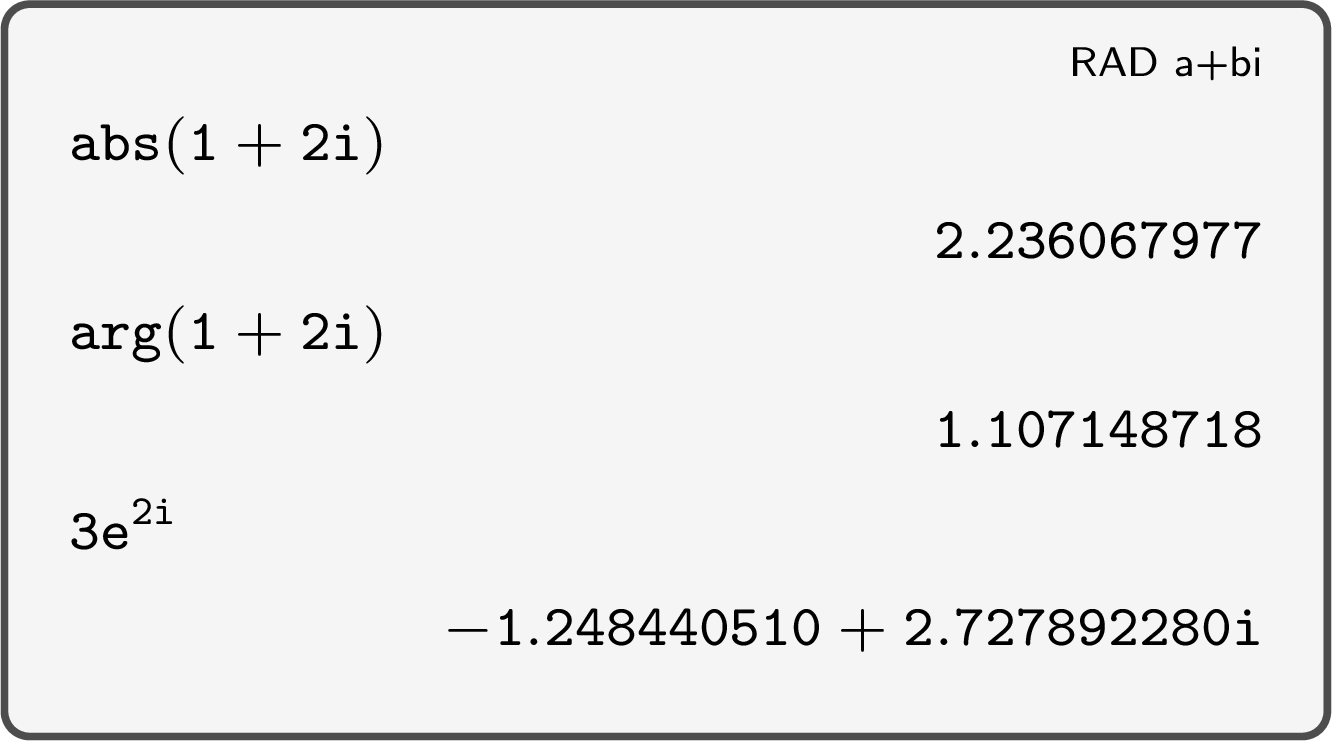
- From \(a + bi\) to the modulus and an argument, for \(z \neq 0\) (the number \(0\) has no argument): the functions \(\mathrm{abs}\) and \(\arg\) (sometimes named \(\mathrm{angle}\)), or the conversion to the display \(r\angle\theta\), give \(|z|\) and an argument; most calculators return the principal argument, the argument in \((-\pi, \pi]\) (check the convention of the device once on \(z = -1\), whose principal argument is \(\pi\)).
- From \(re^{i\theta}\) to \(a + bi\): enter \(re^{i\theta}\) with the keys \(e^{\square}\) and \(i\) (or \(r\angle\theta\)), then convert to the display \(a + bi\).
- Products, quotients and powers are entered directly. The screen shows the argument of the result in its own convention: an argument obtained by adding the arguments of two Euler forms may differ from it by a multiple of \(2\pi\).
- Report each value to 3 significant figures unless it is exact, and check the quadrant: the signs of \(a\) and \(b\) must agree with the argument.
Example
Use technology to answer each question, to 3 significant figures. - Write \(z = -4 - 3i\) in polar form and in Euler's form.
- Write \(w = 2.5e^{2.8i}\) in the form \(a + bi\).
- Deduce the modulus and the principal argument of \(zw\) from parts 1 and 2, then check them on the screen.
- The screen gives \(\mathrm{abs}(-4 - 3i) = 5\) and \(\arg(-4 - 3i) = -2.498091545\), so $$z \approx 5\left(\cos(-2.50) + i\sin(-2.50)\right) = 5e^{-2.50i}.$$ Check: \(a < 0\) and \(b < 0\) place \(z\) in the third quadrant, and indeed \(-\pi < -2.50 < -\dfrac{\pi}{2}\).
- The input \(2.5e^{2.8i}\) displays \(-2.355555852 + 0.837470375i\), so \(w \approx -2.36 + 0.837i\). Check: \(\dfrac{\pi}{2} < 2.8 < \pi\), a second-quadrant argument, and indeed \(a < 0 < b\).
- Write \(\alpha = \arg z \approx -2.498091545\), kept unrounded until the end. With the Euler forms: $$\begin{aligned}[t] zw &= 5e^{i\alpha} \times 2.5e^{2.8i} &&\\ &= 12.5\,e^{i(\alpha + 2.8)}. && \text{(}e^{i\theta}e^{i\theta'} = e^{i(\theta + \theta')}\text{)} \end{aligned}$$ So \(|zw| = 12.5\), and \(\alpha + 2.8 \approx 0.301908455\) is an argument of \(zw\); it lies in \((-\pi, \pi]\), so it is the principal argument: \(\arg(zw) \approx 0.302\). The input \((-4 - 3i) \times 2.5e^{2.8i}\) displays \(11.934634533 + 3.716786053i\), whose modulus is \(12.5\) and argument \(0.301908455\): the screen agrees.
Skills to practice
- Recognising Polar and Exponential Forms
- Converting from Polar to Cartesian Form
- Converting to Polar and Exponential Forms
- Converting Between Forms with Technology
VII
Powers and Geometry
VII.1
De Moivre's Theorem
Proposition — De Moivre's Theorem
For any non-zero complex number \(z = r(\cos\theta + i\sin\theta)\) (with \(r > 0\)) and for any integer \(n\): $$ [r(\cos\theta + i\sin\theta)]^n = r^n(\cos(n\theta) + i\sin(n\theta)). $$ In Euler's form, this is expressed concisely as: $$ (re^{i\theta})^n = r^n e^{in\theta}. $$ Example — Calculating a Power using Euler's Form
Calculate \((1+i\sqrt{3})^5\). - Step 1: Convert to Euler's form.
\(\begin{aligned}[t] r &= |1+i\sqrt{3}| \\ &= \sqrt{1^2 + (\sqrt{3})^2} \\ &= \sqrt{4} \\ &= 2 \end{aligned} \qquad\text{and}\qquad \begin{aligned}[t] \cos\theta &= \frac{1}{2},\quad \sin\theta = \frac{\sqrt{3}}{2} \\ \theta &= \frac{\pi}{3}. \end{aligned}\)
So, \(1+i\sqrt{3} = 2e^{i\frac{\pi}{3}}\). - Step 2: Apply De Moivre's Theorem and convert back.
Using De Moivre's theorem and the identity \(e^{i\varphi} = \cos\varphi+i\sin\varphi\): $$\begin{aligned} (1+i\sqrt{3})^5 &= \left(2e^{i\frac{\pi}{3}}\right)^5 \\ &= 2^5 e^{i\frac{5\pi}{3}} \\ &= 32\left(\cos\left(\frac{5\pi}{3}\right) + i\sin\left(\frac{5\pi}{3}\right)\right) \\ &= 32\left(\frac{1}{2} - i\frac{\sqrt{3}}{2}\right) \\ &= 16 - 16i\sqrt{3}. \end{aligned}$$
Skills to practice
- Applying De Moivre's Theorem
VII.2
Operations as Geometry
Proposition — Addition and Subtraction
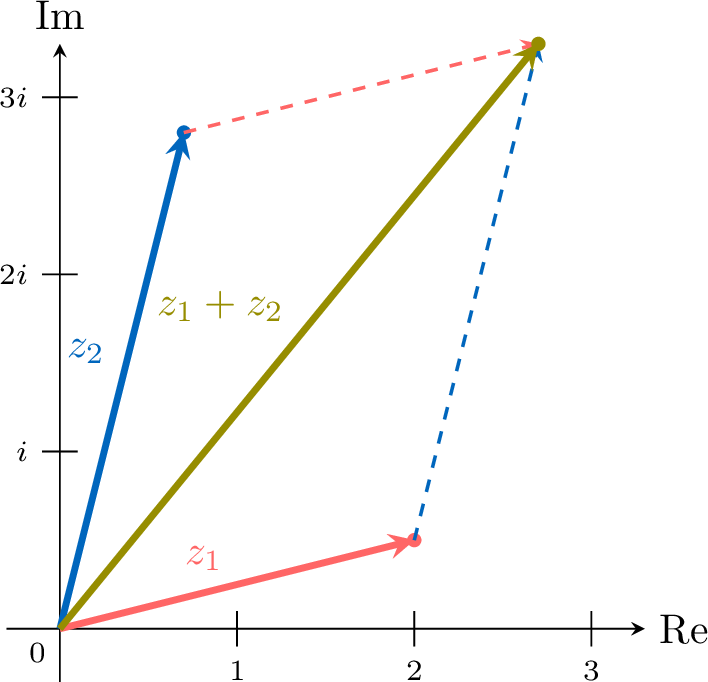
Adding or subtracting complex numbers is equivalent to the vector addition or subtraction of their corresponding position vectors, following the parallelogram law. - Addition (\(z_1+z_2\)): The vector for the sum is the main diagonal of the parallelogram formed by the vectors for \(z_1\) and \(z_2\).
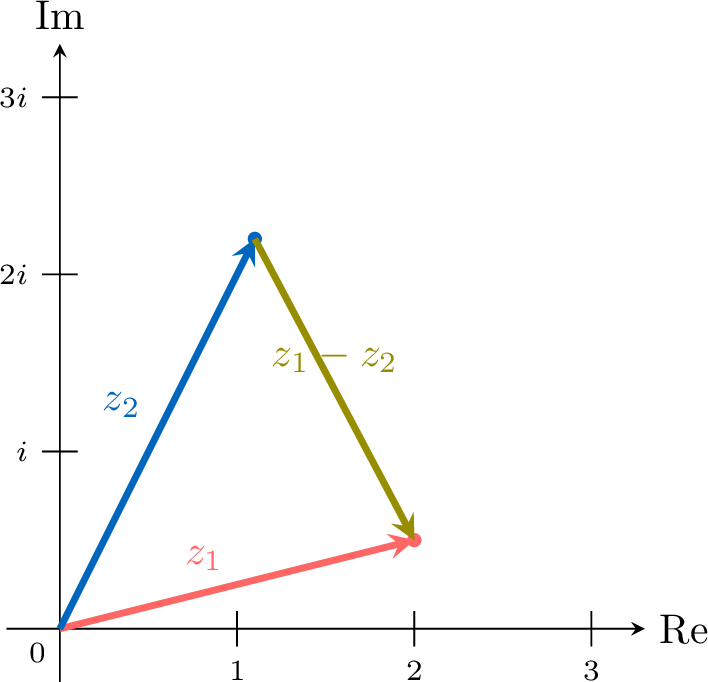
- Subtraction (\(z_1-z_2\)): The vector for the difference is the vector from the point representing \(z_2\) to the point representing \(z_1\).
Proposition — Multiplication and Division
Let \(z_1\) and \(z_2\) be non-zero complex numbers. Multiplying or dividing them acts on their moduli and on their arguments: - Multiplication (\(z_1 z_2\)): Multiply the moduli and add the arguments.
- Division (\(\dfrac{z_1}{z_2}\)): Divide the moduli and subtract the arguments.
Proposition — Fundamental Geometric Transformations
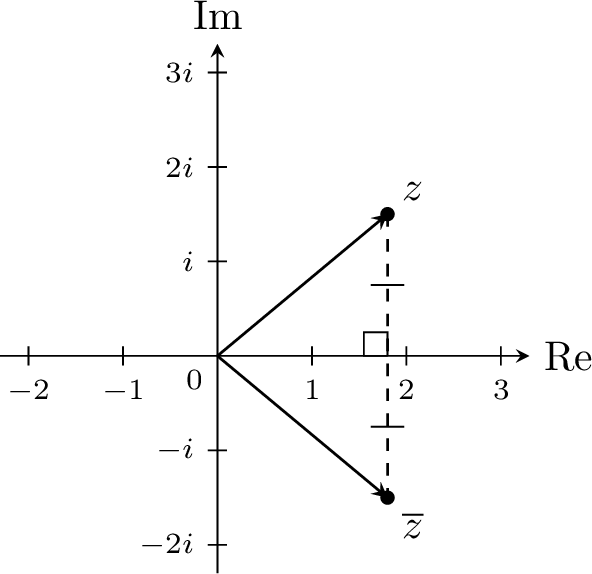
- Conjugate (\(z \to \conjugate{z}\)): a reflection across the real axis.
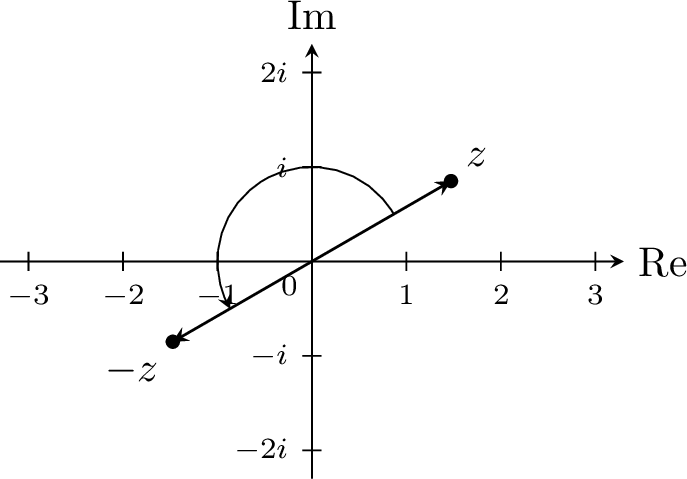
- Negation (\(z \to -z\)): a rotation of \(180^\circ\) (or \(\pi\) radians) about the origin.
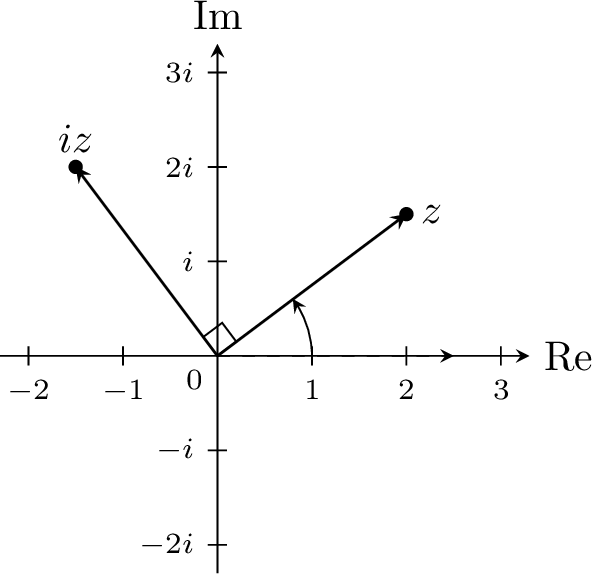
- Multiplication by \(i\) (\(z \to iz\)): a rotation of \(90^\circ\) (or \(\pi/2\) radians) anti-clockwise about the origin.
- Adding \(b\) (\(z \to z + b\)): the translation by the vector of affix \(b\).
- Multiplying by a non-zero real \(k\) (\(z \to kz\)): the homothety of centre \(O\) and ratio \(k\).
Skills to practice
- Visualising Fundamental Transformations
VIII
Frequency and Phase
VIII.1
Adding Sinusoids
Method — Writing \(a\cos(\omega t) + b\sin(\omega t)\) as \(A\cos(\omega t + \varphi)\)
Let \(a\) and \(b\) be real numbers, not both zero, and \(\omega \gt 0\). The signal \(s(t) = a\cos(\omega t) + b\sin(\omega t)\) is a single sinusoid of the same angular frequency \(\omega\): - Amplitude: \(A = \sqrt{a^2 + b^2}\).
- Phase: take \(\varphi\) with \(\cos\varphi = \dfrac{a}{A}\) and \(\sin\varphi = -\dfrac{b}{A}\). Such a \(\varphi\) exists, because \(\left(\dfrac{a}{A}\right)^2 + \left(-\dfrac{b}{A}\right)^2 = 1\): it is an argument of the complex number \(a - ib = Ae^{i\varphi}\). Indeed \(a\cos(\omega t) + b\sin(\omega t) = \mathrm{Re}\left((a - ib)e^{i\omega t}\right) = \mathrm{Re}\left(Ae^{i(\omega t + \varphi)}\right) = A\cos(\omega t + \varphi)\).
- Check with the addition formula \(\cos(x + y) = \cos x\cos y - \sin x\sin y\): $$A\cos(\omega t + \varphi) = A\cos\varphi\cos(\omega t) - A\sin\varphi\sin(\omega t) = a\cos(\omega t) + b\sin(\omega t).$$
Example
Write the first two signals in the form \(A\cos(\omega t + \varphi)\) with \(A \gt 0\), then expand the third one. - \(s(t) = \sqrt{3}\cos t - \sin t\).
- \(u(t) = 5\cos(50t) - 5\sqrt{3}\sin(50t)\).
- \(v(t) = 2\cos\left(\omega t - \dfrac{\pi}{3}\right)\), to write as \(a\cos(\omega t) + b\sin(\omega t)\).
- Here \(a = \sqrt{3}\) and \(b = -1\). $$\begin{aligned}[t] A &= \sqrt{3 + 1} = 2\\ \cos\varphi &= \frac{\sqrt{3}}{2}, \quad \sin\varphi = -\frac{-1}{2} = \frac{1}{2} &&\text{so } \varphi = \frac{\pi}{6}\end{aligned}$$ So \(s(t) = 2\cos\left(t + \dfrac{\pi}{6}\right)\). Check: \(2\cos\left(t + \frac{\pi}{6}\right) = 2\left(\frac{\sqrt{3}}{2}\cos t - \frac{1}{2}\sin t\right) = \sqrt{3}\cos t - \sin t\).
- Here \(a = 5\) and \(b = -5\sqrt{3}\). $$\begin{aligned}[t] A &= \sqrt{25 + 75} = 10\\ \cos\varphi &= \frac{5}{10} = \frac{1}{2}, \quad \sin\varphi = \frac{5\sqrt{3}}{10} = \frac{\sqrt{3}}{2} &&\text{so } \varphi = \frac{\pi}{3}\end{aligned}$$ So \(u(t) = 10\cos\left(50t + \dfrac{\pi}{3}\right)\).
- $$\begin{aligned}[t] v(t) &= 2\left(\cos(\omega t)\cos\frac{\pi}{3} + \sin(\omega t)\sin\frac{\pi}{3}\right) &&\text{(} \cos(x - y) = \cos x\cos y + \sin x\sin y\text{)}\\ &= 2\left(\frac{1}{2}\cos(\omega t) + \frac{\sqrt{3}}{2}\sin(\omega t)\right) &&\text{(} \cos\frac{\pi}{3} = \frac{1}{2}\text{, } \sin\frac{\pi}{3} = \frac{\sqrt{3}}{2}\text{)}\\ &= \cos(\omega t) + \sqrt{3}\sin(\omega t).\end{aligned}$$
Method — Adding Two Sinusoids of the Same Angular Frequency
Let \(A_1 > 0\), \(A_2 > 0\), \(\omega > 0\), and let \(\varphi_1\) and \(\varphi_2\) be real numbers. To write \(s(t) = A_1\cos(\omega t + \varphi_1) + A_2\cos(\omega t + \varphi_2)\) as a single sinusoid: - Write each signal as a real part: \(A_k\cos(\omega t + \varphi_k) = \mathrm{Re}\left(A_k e^{i(\omega t + \varphi_k)}\right) = \mathrm{Re}\left(A_k e^{i\varphi_k}\, e^{i\omega t}\right)\). The number \(A_k e^{i\varphi_k}\) is the complex amplitude of the signal.
- Add the complex amplitudes: \(Z = A_1 e^{i\varphi_1} + A_2 e^{i\varphi_2}\), by hand in the form \(a + bi\), or with technology.
- Write \(Z\) in Euler's form: when \(Z \neq 0\), \(Z = Ae^{i\varphi}\) with \(A = |Z| > 0\) and \(\varphi\) an argument of \(Z\). When \(Z = 0\), the two signals cancel out: \(s(t) = 0\) for every \(t\).
- Conclude: the real part of a sum is the sum of the real parts, so $$s(t) = \mathrm{Re}\left(Ze^{i\omega t}\right) = \mathrm{Re}\left(Ae^{i(\omega t + \varphi)}\right) = A\cos(\omega t + \varphi).$$
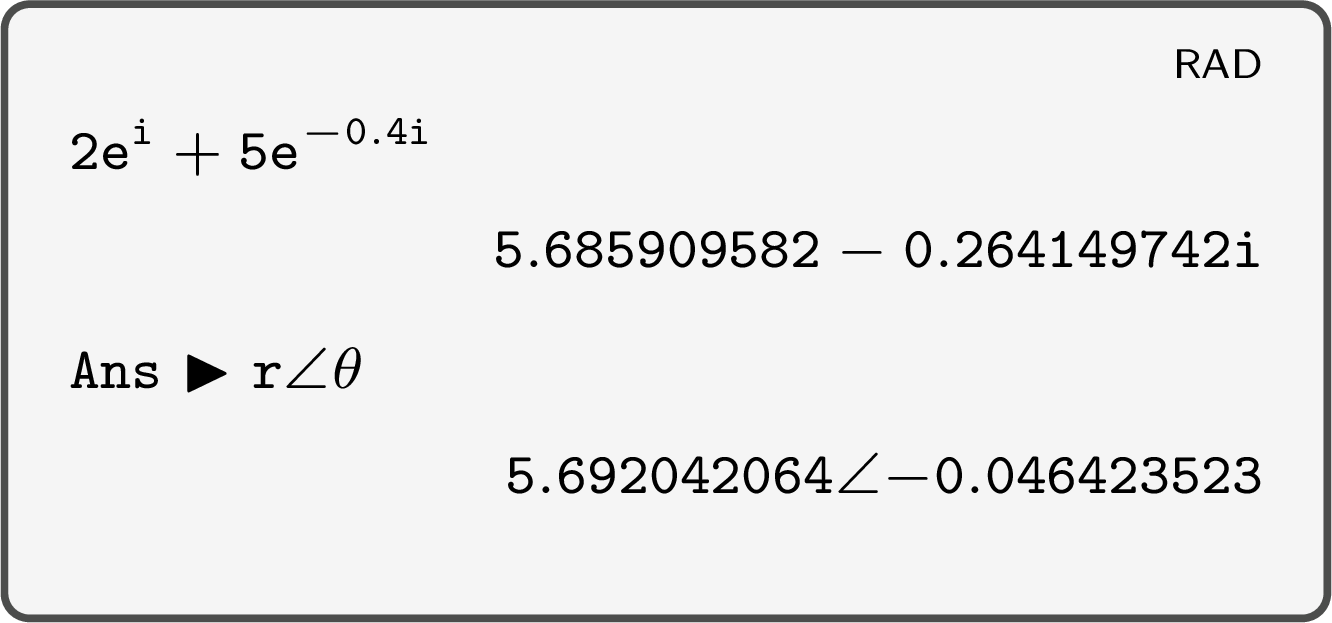
The mock-up adds the complex amplitudes \(2e^{i}\) and \(5e^{-0.4i}\): the sum has modulus \(A \approx 5.69\) and argument \(\varphi \approx -0.0464\).
Example
- With technology, write \(s(t) = 6\cos(2t + 0.5) + 4\cos(2t - 1.2)\) in the form \(A\cos(2t + \varphi)\), with \(A > 0\) and \(\varphi\) in \((-\pi, \pi]\), to 3 significant figures.
- Without technology, write \(u(t) = 3\sin(5t) + 3\sin\left(5t + \dfrac{2\pi}{3}\right)\) in the form \(A\sin(5t + \varphi)\), with \(A > 0\) and \(\varphi\) in \((-\pi, \pi]\).
- The complex amplitudes are \(6e^{0.5i}\) and \(4e^{-1.2i}\), so \(Z = 6e^{0.5i} + 4e^{-1.2i}\). The screen displays \(Z = 6.714926389 - 0.851603112i\), then, converted, \(6.768712158\angle{-0.126148958}\). So $$s(t) = \mathrm{Re}\left(Ze^{2it}\right) \approx 6.77\cos(2t - 0.126).$$ The amplitude \(6.77\) is smaller than \(6 + 4 = 10\): the two signals do not reach their maximum at the same time.
- The complex amplitudes are \(3 = 3e^{0i}\) and \(3e^{i\frac{2\pi}{3}}\). $$\begin{aligned}[t] Z &= 3 + 3e^{i\frac{2\pi}{3}} &&\\ &= 3 + 3\left(-\frac{1}{2} + i\frac{\sqrt{3}}{2}\right) && \text{(}e^{i\theta} = \cos\theta + i\sin\theta\text{)}\\ &= \frac{3}{2} + \frac{3\sqrt{3}}{2}i. \end{aligned}$$ Then \(|Z| = \sqrt{\dfrac{9}{4} + \dfrac{27}{4}} = \sqrt{9} = 3\), and an argument \(\varphi\) satisfies \(\cos\varphi = \dfrac{3/2}{3} = \dfrac{1}{2}\) and \(\sin\varphi = \dfrac{3\sqrt{3}/2}{3} = \dfrac{\sqrt{3}}{2}\), so \(\varphi = \dfrac{\pi}{3}\) and \(Z = 3e^{i\frac{\pi}{3}}\). Taking imaginary parts, $$u(t) = \mathrm{Im}\left(Ze^{5it}\right) = 3\sin\left(5t + \frac{\pi}{3}\right).$$ Check at \(t = 0\): \(u(0) = 0 + 3\sin\dfrac{2\pi}{3} = \dfrac{3\sqrt{3}}{2}\) and \(3\sin\dfrac{\pi}{3} = \dfrac{3\sqrt{3}}{2}\).
Skills to practice
- Writing a Sum of Sinusoids as One Sinusoid
- Solving Problems with Sinusoids
IX
Going further
Skills to practice
- Solving Problems with Technology
- Quiz
Jump to section