International Baccalaureate · DP 2: Applications and Interpretation HL
Revision: Mixed Practice
I
Toolbox: Perpendicular Bisectors and Voronoi Cells
Recappreviously studied — click to reread
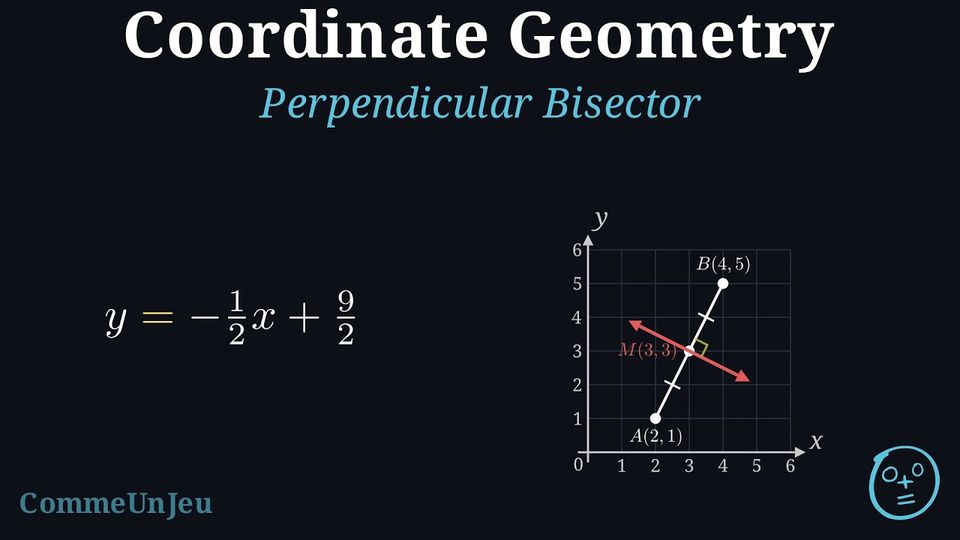
Method — Finding the Equation of a Perpendicular Bisector
To find the equation of the perpendicular bisector of the segment joining \(A(x_A, y_A)\) and \(B(x_B, y_B)\) (with \(A \neq B\)): - Find the gradient of the segment \(\Segment{AB}\) (when \(x_A \neq x_B\)): $$ m_{AB} = \frac{y_B - y_A}{x_B - x_A}. $$
- Find the gradient of the perpendicular line (\(m_\perp\)) when \(m_{AB} \neq 0\): $$ m_\perp = -\frac{1}{m_{AB}}. $$
- Find the midpoint of \(\Segment{AB}\): $$ M = \left(\frac{x_A+x_B}{2}, \frac{y_A+y_B}{2}\right). $$
- Use the point-gradient form with the midpoint \(M(x_M,y_M)\) and the perpendicular gradient \(m_\perp\): $$ y - y_M = m_\perp(x - x_M). $$
- If \(\Segment{AB}\) is horizontal (\(m_{AB}=0\)), then the perpendicular bisector is a vertical line \(x = x_M\).
- If \(\Segment{AB}\) is vertical (\(x_A = x_B\)), then the perpendicular bisector is a horizontal line \(y = y_M\).
Example
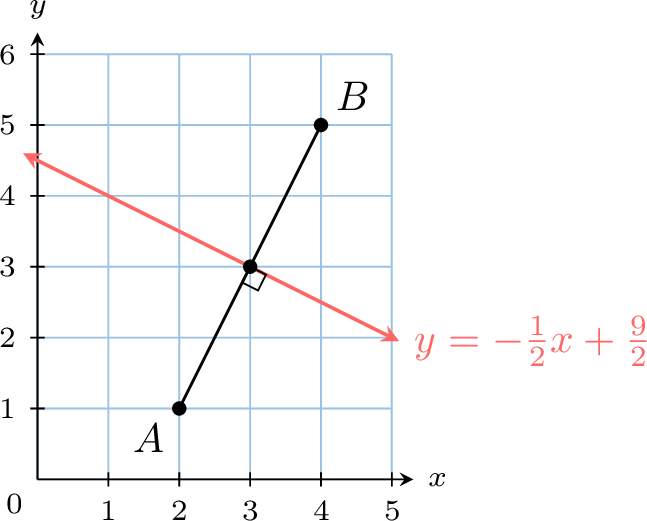
Find the equation of the perpendicular bisector of the line segment with endpoints \(A(2, 1)\) and \(B(4, 5)\). - The gradient of the segment \(\Segment{AB}\) is$$m_{AB} = \frac{5-1}{4-2} = \frac{4}{2} = 2.$$
- The gradient of the perpendicular bisector is \(m_\perp = -\dfrac{1}{2}\).
- The midpoint of \(\Segment{AB}\) is$$M = \left(\frac{2+4}{2}, \frac{1+5}{2}\right) = (3, 3).$$
- Using the point-gradient form \(y-y_1 = m(x-x_1)\) with the point \((3,3)\) and the gradient \(-\dfrac{1}{2}\): $$ \begin{aligned} y-3 &= -\frac{1}{2}(x-3) \\ y-3 &= -\frac{1}{2}x + \frac{3}{2} \\ y &= -\frac{1}{2}x + \frac{3}{2} + 3 \\ y &= -\frac{1}{2}x + \frac{9}{2}. \end{aligned} $$
Method — Constructing a Voronoi Diagram for 3 Sites
To construct the Voronoi diagram of three sites \(A\), \(B\) and \(C\) that are not on one line: - Draw the triangle \(ABC\) (in dashed lines, for clarity).
- Draw the perpendicular bisector of each side of the triangle.
- These three bisectors meet at a single point \(V\), equidistant from \(A\), \(B\) and \(C\): it is the only vertex of the diagram.
- The point \(V\) cuts each bisector into two rays. The edge between the cells of \(A\) and \(B\) is the ray of the bisector of \([AB]\) whose points are nearer to \(A\) and \(B\) than to \(C\): it is the ray starting at \(V\) that points towards the side of the line \((AB)\) where \(C\) is not. Check it with one point of the ray. The two other edges are found in the same way.
Example
Construct the Voronoi diagram for sites \(A\), \(B\), and \(C\). 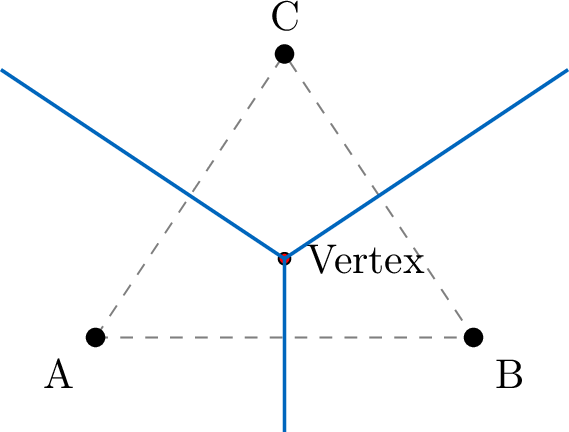
Skills to practice
- Finding the Area of a Voronoi Cell
II
Toolbox: Diagonals and Angles in a Cuboid
Recappreviously studied — click to reread
Proposition — Space Diagonals of a Cuboid
In a cuboid whose three edges from one vertex measure \(a\), \(b\) and \(c\), the four space diagonals have the same length $$d = \sqrt{a^2 + b^2 + c^2}$$ and the same midpoint, the centre of the cuboid. In a cube of edge \(a\), the space diagonals measure \(a\sqrt{3}\). Method — Finding the Angle Between a Line and a Plane
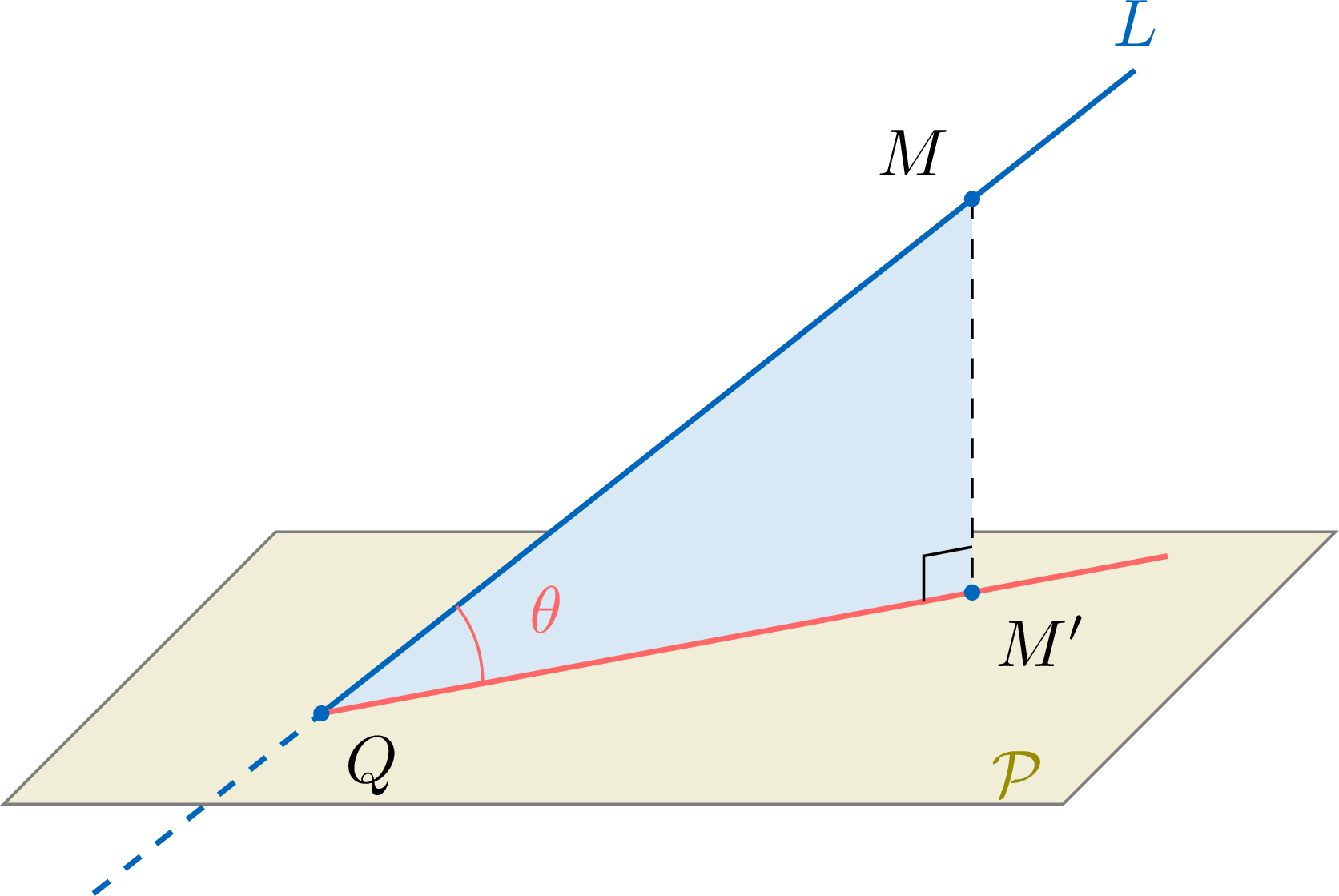
To find the angle \(\theta\) between a line \(\Line{QM}\) and a plane \(\mathcal{P}\) that it meets at \(Q\) — the line being neither perpendicular to the plane, otherwise \(\theta = 90^\circ\), nor contained in it, otherwise \(\theta = 0^\circ\): - project \(M\) on the plane: choose a point \(M\) of the line outside the plane and drop the perpendicular from \(M\) to the plane; its foot \(M'\) is the projection of \(M\), and the line \(\Line{QM'}\) is the projection of the line on the plane. With coordinates, on the \(xy\)-plane, the projection of \(M(x, y, z)\) is \(M'(x, y, 0)\), right below or right above \(M\); on a plane parallel to a coordinate plane — a face of a cuboid placed along the axes, for instance — the coordinate that is constant on the plane takes its value, the other two are kept;
- draw the right-angled triangle \(QM'M\), formed by the segment \(\Segment{QM}\) of the line, its projection \(\Segment{QM'}\) and the perpendicular \(\Segment{MM'}\), right-angled at \(M'\);
- compute two of its sides and use a trigonometric ratio at \(Q\) (SOH-CAH-TOA), for instance \(\tan\theta = \dfrac{MM'}{QM'}\): the result is the acute angle \(\theta\) between the line and its projection.
Example
The pyramid \(SABCD\) has a square base \(ABCD\) in the \(xy\)-plane, with \(A(0, 0, 0)\), \(B(6, 0, 0)\), \(C(6, 6, 0)\) and \(D(0, 6, 0)\), and its apex is \(S(3, 3, 4)\). Calculate the angle between the edge \(\Segment{SC}\) and the base, to the nearest tenth of a degree.
The edge meets the base at \(C\). The projection of \(S(3, 3, 4)\) on the base, the \(xy\)-plane, is \(K(3, 3, 0)\), the centre of the square. The angle sought is \(\theta = \Angle{SCK}\), in the triangle \(CKS\) right-angled at \(K\). 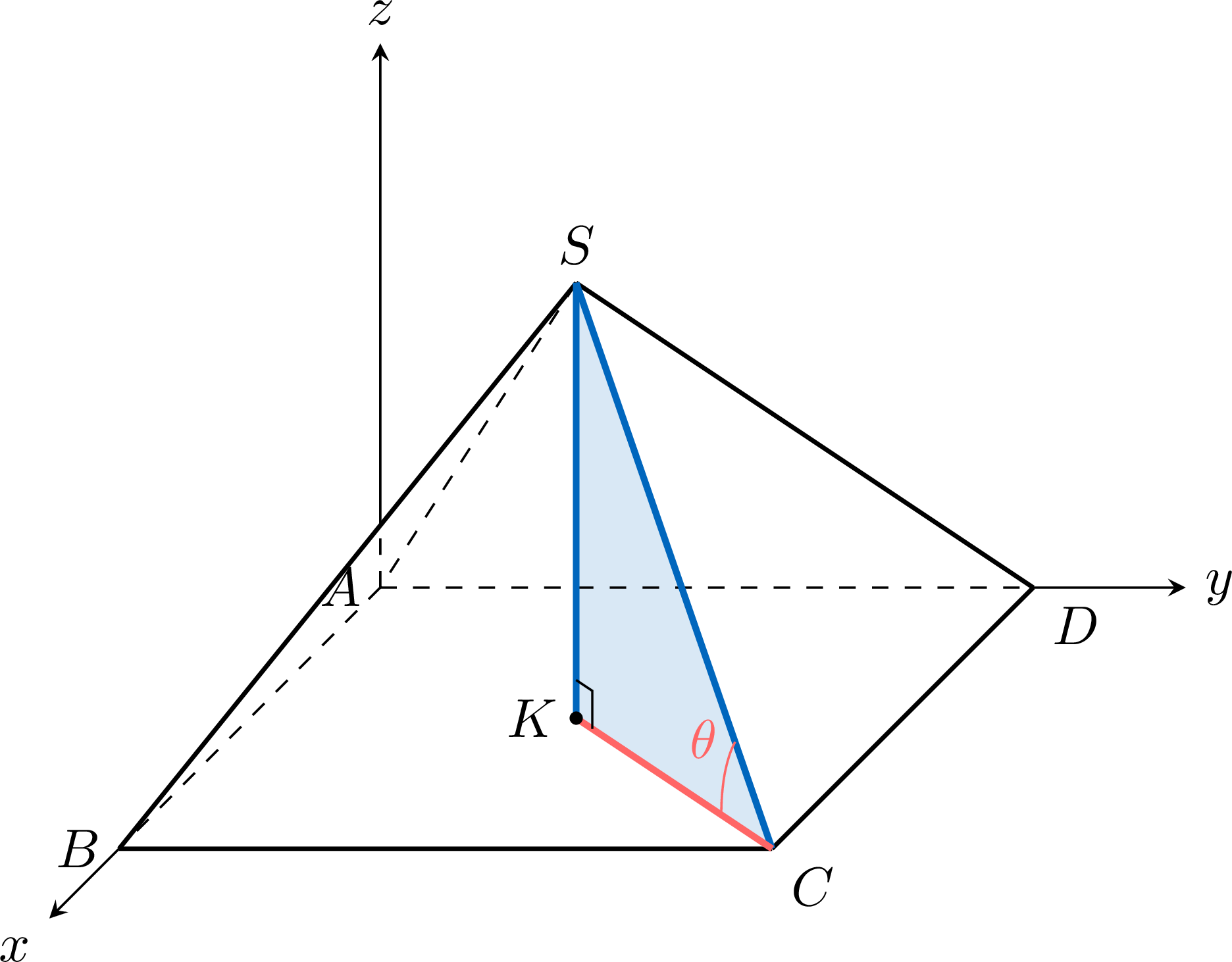
Its sides: \(SK = 4\) and \(CK = \sqrt{(3 - 6)^2 + (3 - 6)^2 + 0^2} = \sqrt{18} = 3\sqrt{2}\). The side \(\Segment{SK}\) is opposite \(\theta\) and \(\Segment{CK}\) adjacent: $$\begin{aligned}[t] \tan\theta &= \frac{SK}{CK} && \text{(opposite over adjacent)}\\
&= \frac{4}{3\sqrt{2}}, \end{aligned}$$ so \(\theta = \tan^{-1}\left(\dfrac{4}{3\sqrt{2}}\right) \approx 43.3^\circ\).
Skills to practice
- Finding the Length of a Space Diagonal
III
Exam-Style Questions
Skills to practice
- Working with Technology: Mixed Practice
Jump to section