International Baccalaureate · DP 2: Applications and Interpretation HL
Paper 3 Workshop
I
Toolbox: Eigenvalues of a 2 × 2 Matrix
Recappreviously studied — click to reread
Definition — Eigenvalues and Eigenvectors
Let \(\mathbf{A}\) be a square matrix. An eigenvector of \(\mathbf{A}\) is a non-zero vector \(\mathbf{x}\) such that:$$ \mathbf{A}\mathbf{x} = \lambda \mathbf{x} $$ where \(\lambda\) is a scalar called the eigenvalue associated with the eigenvector \(\mathbf{x}\). Method — Finding Eigenvalues and Eigenvectors
To find the eigenvalues and eigenvectors of a matrix \(\mathbf{A}\): - Find the eigenvalues (\(\lambda\)): Solve the characteristic equation $$ \det(\mathbf{A} - \lambda \mathbf{I}) = 0, $$ where \(\mathbf{I}\) is the identity matrix. The solutions are the eigenvalues.
- Find the eigenvectors (\(\mathbf{x}\)): For each eigenvalue \(\lambda\), substitute it into $$ \mathbf{A}\mathbf{x} = \lambda\mathbf{x}\text{ or } (\mathbf{A} - \lambda \mathbf{I})\mathbf{x} = \mathbf{0} $$ and solve for the non-zero vector \(\mathbf{x}\).
Example
Find the eigenvalues and corresponding eigenvectors of the matrix$$ \mathbf{A} = \begin{pmatrix} 4 & 2 \\
1 & 3 \end{pmatrix}. $$ - Find eigenvalues: $$\begin{aligned} \det(\mathbf{A} - \lambda \mathbf{I}) &= 0\\ \det\left( \begin{pmatrix} 4 & 2 \\ 1 & 3 \end{pmatrix} - \lambda \begin{pmatrix} 1 & 0 \\ 0 & 1 \end{pmatrix} \right) &= 0\\ \det\left( \begin{pmatrix} 4-\lambda & 2 \\ 1 & 3-\lambda \end{pmatrix} \right) &= 0\\ (4-\lambda)(3-\lambda) - (2)(1) &= 0\\ \lambda^2 - 7\lambda + 12 - 2 &= 0\\ \lambda^2 - 7\lambda + 10 &= 0\\ (\lambda - 5)(\lambda - 2) &= 0 \end{aligned}$$ The eigenvalues are \(\lambda_1 = 5\) and \(\lambda_2 = 2\).
- Find an eigenvector for \(\lambda_1 = 5\): $$\begin{aligned} (\mathbf{A} - 5 \mathbf{I})\mathbf{x} &= \mathbf{0}\\
\left( \begin{pmatrix} 4 & 2 \\
1 & 3 \end{pmatrix} - 5 \begin{pmatrix} 1 & 0 \\
0 & 1 \end{pmatrix} \right)\begin{pmatrix} x \\
y \end{pmatrix} &= \begin{pmatrix} 0 \\
0 \end{pmatrix}\\
\begin{pmatrix} 4-5 & 2 \\
1 & 3-5 \end{pmatrix} \begin{pmatrix} x \\
y \end{pmatrix} &= \begin{pmatrix} 0 \\
0 \end{pmatrix}\\
\begin{pmatrix} -1 & 2 \\
1 & -2 \end{pmatrix} \begin{pmatrix} x \\
y \end{pmatrix} &= \begin{pmatrix} 0 \\
0 \end{pmatrix}\\
\begin{pmatrix} -x + 2y \\
x - 2y \end{pmatrix} &= \begin{pmatrix} 0 \\
0 \end{pmatrix} \end{aligned}$$ This gives \(-x + 2y = 0\) and \(x - 2y = 0\), so \(x = 2y\).
Letting \(y = t\), we have \(x = 2t\), so $$ \mathbf{x} = \begin{pmatrix} x \\ y \end{pmatrix} = \begin{pmatrix} 2t \\ t \end{pmatrix} = t\begin{pmatrix} 2 \\ 1 \end{pmatrix}, \quad t \neq 0. $$ Any vector of the form \(t\begin{pmatrix} 2 \\ 1 \end{pmatrix}\), \(t\neq 0\), is an eigenvector corresponding to the eigenvalue \(5\). - Find an eigenvector for \(\lambda_2 = 2\): $$\begin{aligned} (\mathbf{A} - 2 \mathbf{I})\mathbf{x} &= \mathbf{0}\\
\left( \begin{pmatrix} 4 & 2 \\
1 & 3 \end{pmatrix} - 2 \begin{pmatrix} 1 & 0 \\
0 & 1 \end{pmatrix} \right)\begin{pmatrix} x \\
y \end{pmatrix} &= \begin{pmatrix} 0 \\
0 \end{pmatrix}\\
\begin{pmatrix} 4-2 & 2 \\
1 & 3-2 \end{pmatrix} \begin{pmatrix} x \\
y \end{pmatrix} &= \begin{pmatrix} 0 \\
0 \end{pmatrix}\\
\begin{pmatrix} 2 & 2 \\
1 & 1 \end{pmatrix} \begin{pmatrix} x \\
y \end{pmatrix} &= \begin{pmatrix} 0 \\
0 \end{pmatrix}\\
\begin{pmatrix} 2x + 2y \\
x + y \end{pmatrix} &= \begin{pmatrix} 0 \\
0 \end{pmatrix} \end{aligned}$$ This gives \(2x + 2y = 0\) and \(x + y = 0\), so \(y = -x\).
Letting \(x = t\), we have \(y = -t\), so $$ \mathbf{x} = \begin{pmatrix} x \\ y \end{pmatrix} = \begin{pmatrix} t \\ -t \end{pmatrix} = t\begin{pmatrix} 1 \\ -1 \end{pmatrix}, \quad t \neq 0. $$ Any vector of the form \(t\begin{pmatrix} 1 \\ -1 \end{pmatrix}\), \(t\neq 0\), is an eigenvector corresponding to the eigenvalue \(2\).
Skills to practice
- Finding the Eigenvalues of a 2 × 2 Matrix
II
Toolbox: The Laws of Logarithms
Recappreviously studied — click to reread
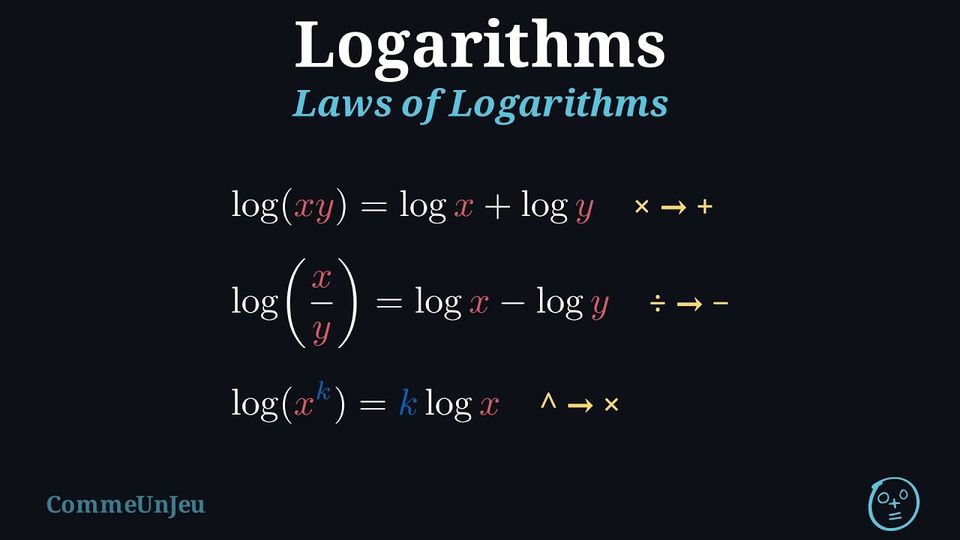
Proposition — Laws of Logarithms
For \(x>0\), \(y>0\), \(a>0\) with \(a\neq 1\), and for any real number \(k\): - Product Rule: \(\log_a (xy) = \log _a x + \log _a y\)
- Quotient Rule: \(\log _a \left(\dfrac{x}{y}\right) = \log _a x - \log_a y\)
- Power Rule: \(\log_a (x^k) = k \log_a x\)
Example
Write as a single logarithm: \(\log (5)+\log (3)\).
\(\begin{aligned}[t]\log (5)+\log (3) &= \log (5\times 3) &&\text{(product rule)} \\&= \log 15\\\end{aligned}\)
Example
For \(a>0\) and \(b>0\), write \(\log\left(\dfrac{a^2 b}{10}\right)\) in terms of \(\log a\) and \(\log b\).
$$\begin{aligned}[t] \log\left(\dfrac{a^2 b}{10}\right) &= \log(a^2 b) - \log 10 &&\text{(quotient rule)}\\
&= \log(a^2) + \log b - \log 10 &&\text{(product rule)}\\
&= 2\log a + \log b - \log 10 &&\text{(power rule)}\\
&= 2\log a + \log b - 1 \end{aligned}$$ The laws also work in this direction: they break a single logarithm into a combination of simpler logarithms.
Skills to practice
- Writing as a Single Logarithm
III
Exam-Style Questions
Skills to practice
- Investigating with Technology: Paper 3
Jump to section