International Baccalaureate · DP 2: Analysis and Approaches SL
Introduction to Differential Calculus
I
Limits
I.1
The Idea of a Limit
The ancient Greek philosopher Zeno of Elea famously argued that motion was impossible. In his paradox of Achilles and the Tortoise, the swift hero Achilles can never overtake a slow tortoise given a head start, because by the time Achilles reaches the tortoise's starting point, the tortoise has already moved a little further ahead. When Achilles covers that new distance, the tortoise has moved ahead again. This process repeats endlessly, suggesting Achilles can never close the gap.
This paradox highlights a profound mathematical problem: how do we handle the infinitely small and the concept of "approaching" a value? It took mathematicians like Augustin-Louis Cauchy and Karl Weierstrass over two millennia to formalize the answer with the concept of the limit. A limit describes the value a function "approaches" as its input gets closer and closer to a certain point. It is a foundational concept in calculus, because it underlies the definitions of both derivatives and integrals.
This paradox highlights a profound mathematical problem: how do we handle the infinitely small and the concept of "approaching" a value? It took mathematicians like Augustin-Louis Cauchy and Karl Weierstrass over two millennia to formalize the answer with the concept of the limit. A limit describes the value a function "approaches" as its input gets closer and closer to a certain point. It is a foundational concept in calculus, because it underlies the definitions of both derivatives and integrals.
Definition — Limit
A function \(f\) has the limit \(L\) as \(x\) approaches \(a\) if the values of \(f(x)\) become arbitrarily close to the single real number \(L\) whenever \(x\) is sufficiently close to \(a\), with \(x \neq a\), from both sides. We write this as:$$ \textcolor{colordef}{\lim_{x \to a} f(x) = L}\quad\text{or}\quad\textcolor{colordef}{f(x) \xrightarrow[x \to a]{} L}\quad\text{or}\quad\textcolor{colordef}{\text{as } x \to a,\ f(x)\to L}$$
The crucial idea of a limit is that it describes the behaviour of a function near a point, not at the point itself. The value of \(f(a)\), or whether it even exists, is irrelevant to the value of the limit.
Consider the function \(f(x) = \dfrac{x^2-1}{x-1}\). At \(x=1\), the function is undefined. However, for any \(x \neq 1\), we can simplify:$$ f(x) = \dfrac{(x-1)(x+1)}{x-1} = x+1. $$ The graph of \(f(x)\) is the line \(y=x+1\) with a "hole" at \(x=1\). As \(x\) gets very close to 1 from either side, the value of \(f(x)\) gets very close to 2. Therefore, \(\displaystyle\lim_{x \to 1} f(x) = 2\), even though \(f(1)\) is not defined. 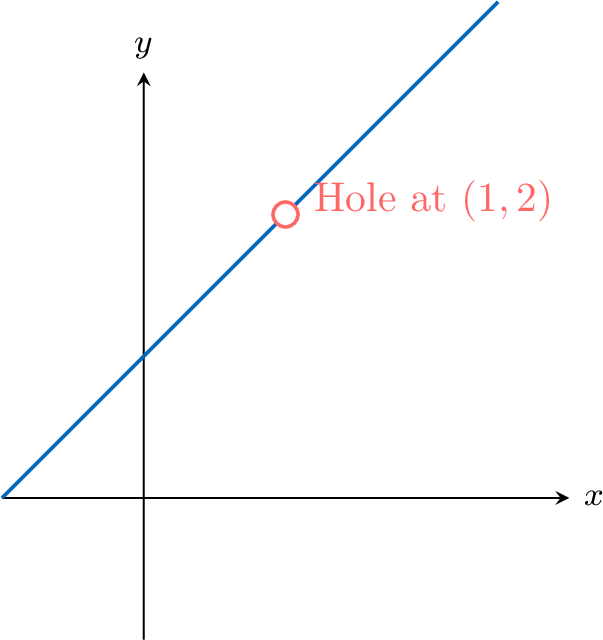
Consider the function \(f(x) = \dfrac{x^2-1}{x-1}\). At \(x=1\), the function is undefined. However, for any \(x \neq 1\), we can simplify:$$ f(x) = \dfrac{(x-1)(x+1)}{x-1} = x+1. $$ The graph of \(f(x)\) is the line \(y=x+1\) with a "hole" at \(x=1\). As \(x\) gets very close to 1 from either side, the value of \(f(x)\) gets very close to 2. Therefore, \(\displaystyle\lim_{x \to 1} f(x) = 2\), even though \(f(1)\) is not defined.
Skills to practice
- Estimating Limits from a Table or a Graph
II
The Derivative
II.1
Average Rate of Change
Take two points \(A\) and \(B\) on the curve of a function \(f\). The line \((AB)\) is called a secant line of the curve. Its slope measures how much \(f\) changes, on average, between the \(x\)-coordinates of \(A\) and \(B\): this is the rate of change of \(f\).
Definition — Rate of Change
The rate of change of a function \(f\) between two points \(A(a, f(a))\) and \(B(b, f(b))\) (with \(a \neq b\)) is the gradient of the secant line \((AB)\).$$ \textcolor{colordef}{\text{Rate of change} = \dfrac{f(b)-f(a)}{b-a}} $$ 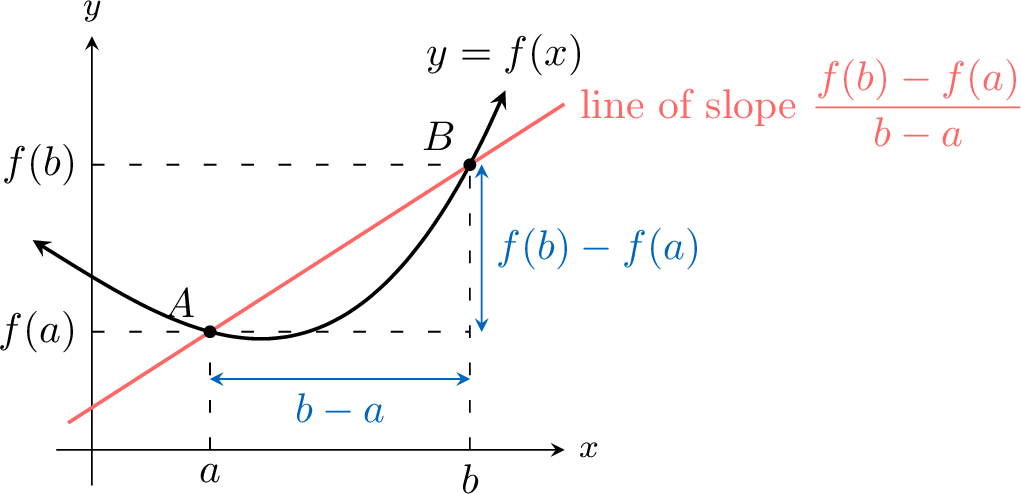
Example
Let \(f(x) = x^2\). - Compute the rate of change of \(f\) between \(1\) and \(3\), and interpret it with the secant line.
- Compute the rate of change of \(f\) between \(-1\) and \(2\).
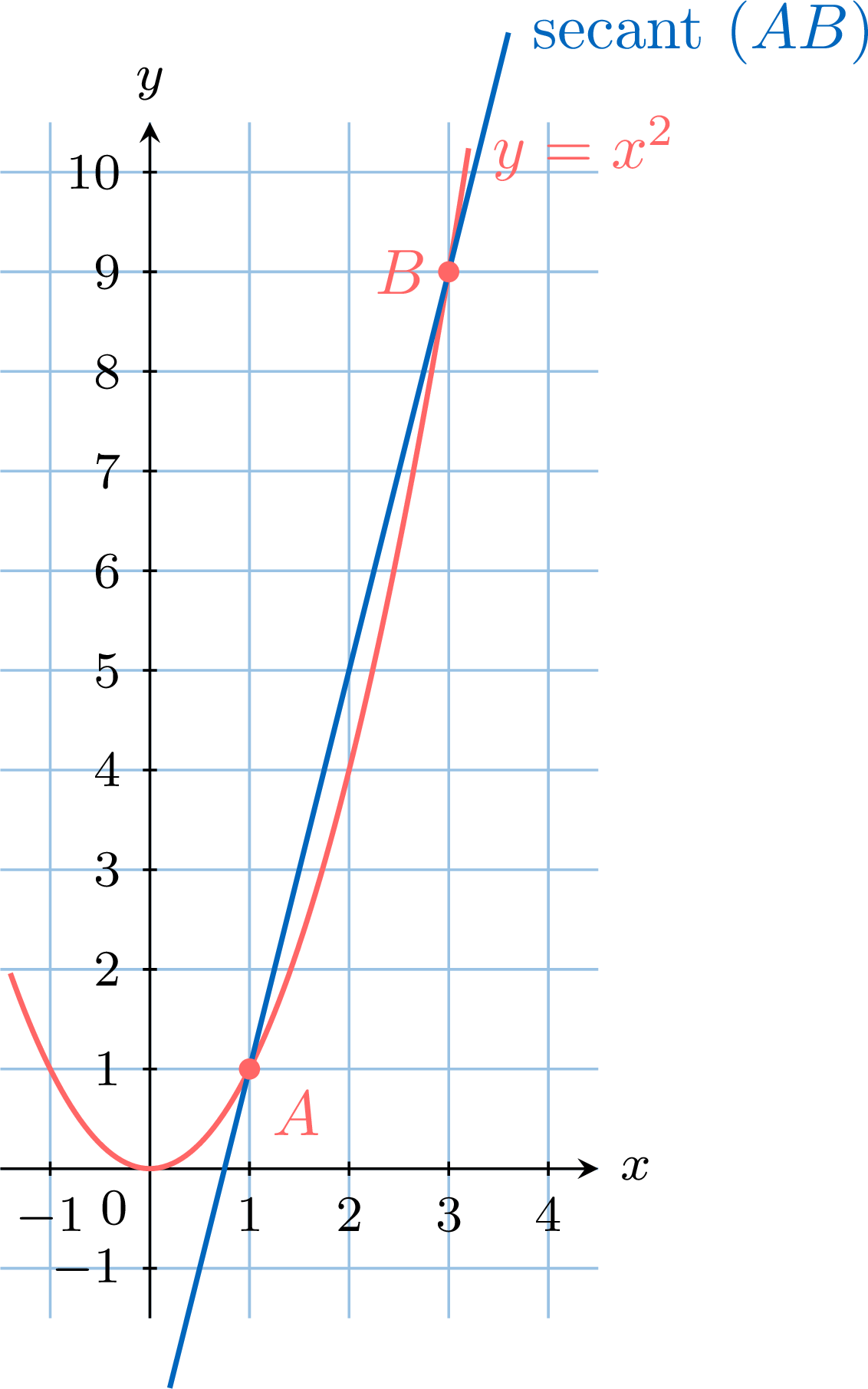
- \(f(1) = 1\) and \(f(3) = 9\), so $$ \dfrac{f(3)-f(1)}{3-1} = \dfrac{9-1}{2} = 4. $$ The secant line through \(A(1, 1)\) and \(B(3, 9)\) has slope \(4\): between \(x = 1\) and \(x = 3\), \(f(x)\) increases on average by \(4\) when \(x\) increases by \(1\).
- \(f(-1) = 1\) and \(f(2) = 4\), so $$ \dfrac{f(2)-f(-1)}{2-(-1)} = \dfrac{4-1}{3} = 1. $$
Definition — Monotonic Function
A function \(f\) is monotonic on an interval \(I\) if it is increasing on \(I\) or decreasing on \(I\): on \(I\), it never changes direction. Proposition — Monotonic Functions and the Sign of the Rate of Change
Let \(f\) be a function defined on an interval \(I\). - \(f\) is increasing on \(I\) if and only if, for all distinct numbers \(a\) and \(b\) of \(I\), \(\dfrac{f(b)-f(a)}{b-a} \geq 0\).
- \(f\) is decreasing on \(I\) if and only if, for all distinct numbers \(a\) and \(b\) of \(I\), \(\dfrac{f(b)-f(a)}{b-a} \leq 0\).
Exchanging \(a\) and \(b\) changes the sign of both \(f(b)-f(a)\) and \(b-a\), so it does not change the rate of change: it is enough to take \(a \lt b\). Then \(b - a \gt 0\), so the rate of change \(\dfrac{f(b)-f(a)}{b-a}\) has the sign of \(f(b)-f(a)\). Hence all the rates of change on \(I\) are positive or zero if and only if \(f(a) \leq f(b)\) whenever \(a \lt b\) in \(I\), that is, if and only if \(f\) is increasing on \(I\). The decreasing case is identical, with \(f(a) \geq f(b)\).
Example
Let \(f(x) = x^2\). - Show that, for all distinct numbers \(a\) and \(b\), the rate of change of \(f\) between \(a\) and \(b\) is \(a + b\).
- Deduce that \(f\) is increasing on \([0, \infty)\) and decreasing on \((-\infty, 0]\).
- The rate of change of \(f\) between \(-1\) and \(3\) is positive. Is \(f\) monotonic on \([-1, 3]\)?
- \(\begin{aligned}[t]\dfrac{f(b)-f(a)}{b-a} &= \dfrac{b^2-a^2}{b-a} \\ &= \dfrac{(b-a)(b+a)}{b-a} \\ &= a+b\end{aligned}\)
- If \(a\) and \(b\) are distinct numbers of \([0, \infty)\), then \(a + b \gt 0\): all the rates of change are positive, so \(f\) is increasing on \([0, \infty)\). If \(a\) and \(b\) are distinct numbers of \((-\infty, 0]\), then \(a + b \lt 0\): all the rates of change are negative, so \(f\) is decreasing on \((-\infty, 0]\).
- Between \(-1\) and \(3\) the rate of change is \(-1 + 3 = 2\), but between \(-1\) and \(0\) it is \(-1 + 0 = -1\). The rates of change on \([-1, 3]\) do not all have the same sign: \(f\) is not monotonic on \([-1, 3]\). One positive rate of change does not prove that \(f\) is increasing: the property asks for all of them.
Skills to practice
- Finding Average Rates of Change
- Finding Average Rates of Change from a Graph
- Calculating Average Rates of Change in Context
- Linking Monotonicity and the Sign of the Rate of Change
- Interpreting Rates of Change
II.2
The Derivative at a Point
To find the rate of change at a single point \(A\), we can examine the average rate of change over a very small interval. Let the second point be \(B(a+h, f(a+h))\), where \(h\) is a small change in \(x\). The gradient of the secant line \((AB)\) is given by:$$ \dfrac{f(a+h) - f(a)}{(a+h)-a} = \dfrac{f(a+h) - f(a)}{h} $$ As we let \(B\) get closer to \(A\), the value of \(h\) approaches 0. The secant line approaches the tangent line at point A. The limit of the secant slopes is the slope of the tangent, which we define as the instantaneous rate of change. 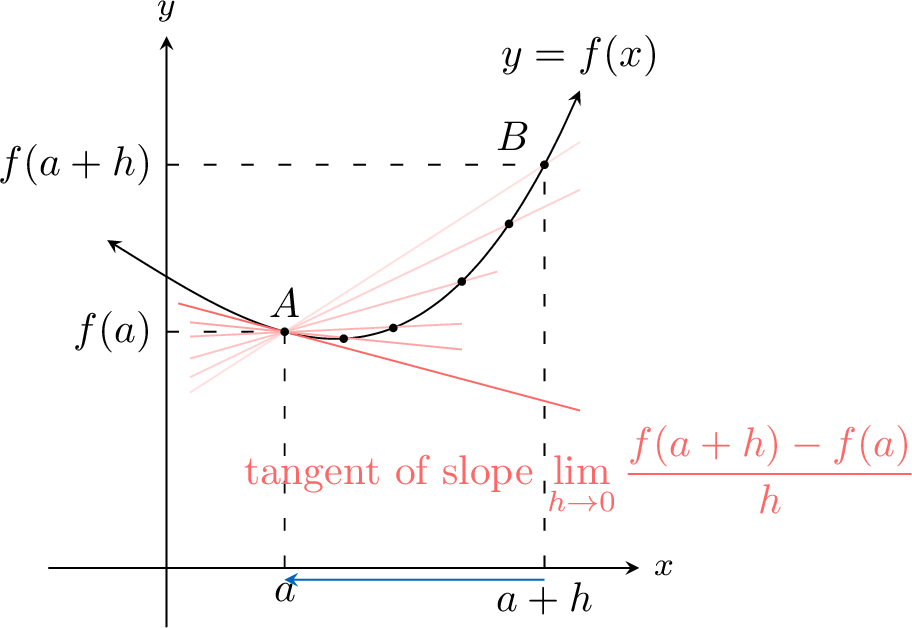
Definition — The Derivative at a Point
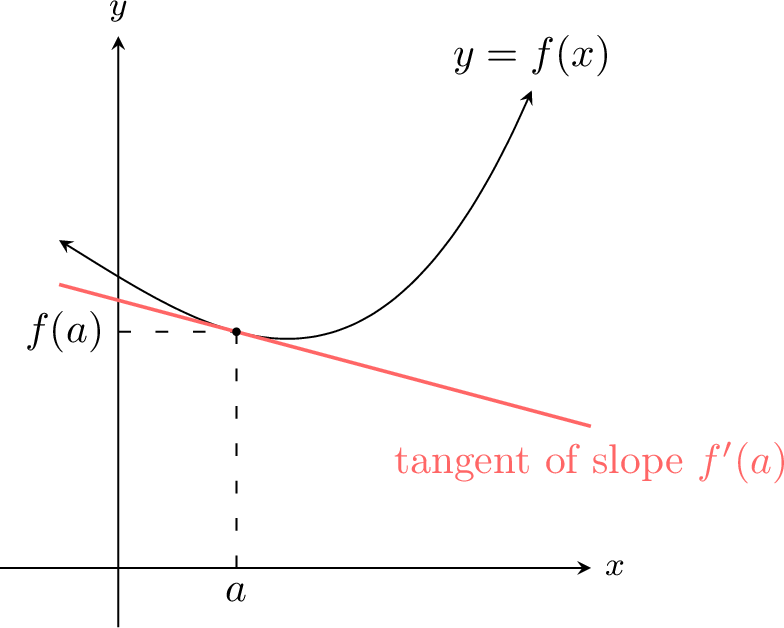
Let \(f\) be a function defined on an interval containing \(a\). When the limit of the rate of change below exists and is a real number, \(f\) is said to be differentiable at \(a\), and that limit is called the derivative of \(f\) at \(a\), written \(f'(a)\):$$ \textcolor{colordef}{f'(a) = \lim_{h \to 0} \dfrac{f(a+h)-f(a)}{h}} $$ Geometrically, \(f'(a)\) is the slope of the tangent line to the graph of \(f\) at the point \((a, f(a))\). It is also the instantaneous rate of change of \(f\) at \(a\).When this limit does not exist, or is infinite, \(f\) is not differentiable at \(a\): the curve has no tangent of finite slope at that point.
Example
Use first principles to find the derivative of \(f(x)=x^2\) at the point \(x=1\).
We evaluate the limit of the rate of change as \(h \to 0\).$$\begin{aligned}\dfrac{f(1+h)-f(1)}{h} &= \dfrac{(1+h)^2 - 1^2}{h} \\
&= \dfrac{(1+2h+h^2) - 1}{h} \\
&= \dfrac{2h+h^2}{h} \\
&= \dfrac{h(2+h)}{h} \\
&= 2+h \quad (\text{for } h \neq 0)\end{aligned}$$ Now, we take the limit:$$ f'(1) = \lim_{h \to 0} (2+h) = 2 $$ The derivative at \(x=1\) is 2. This means the slope of the tangent line to the graph of \(f(x)=x^2\) at the point \((1,1)\) is 2. The diagram below shows how the slope of the secant line from \((1,1)\) to \((1+h, f(1+h))\) approaches the slope of the tangent as \(h\) gets smaller. 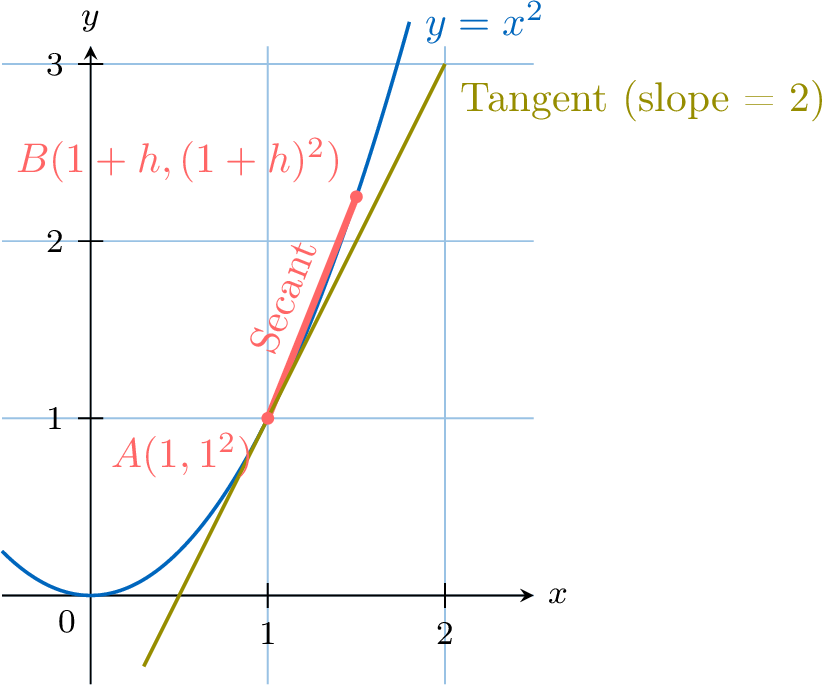
The derivative \(f'(a)\) is an instantaneous rate of change: it tells how fast \(f(x)\) changes at the very moment when \(x = a\). Depending on what \(f\) measures, this number has a concrete meaning.
- Geometry: \(f'(a)\) is the slope of the tangent to the curve at the point with \(x\)-coordinate \(a\).
- Motion: if \(d(t)\) is the distance travelled after \(t\) seconds, the rate of change \(\dfrac{d(t_0+h)-d(t_0)}{h}\) is the average speed between the times \(t_0\) and \(t_0+h\), and \(d'(t_0)\) is the instantaneous speed at time \(t_0\) (the one shown by the speedometer).
- Economics: if \(C(q)\) is the cost of producing \(q\) items, \(C'(q)\) is the marginal cost: approximately the cost of producing one more item beyond \(q\), since \(C(q+1)-C(q) = \dfrac{C(q+1)-C(q)}{1}\) is a rate of change with \(h = 1\), close to \(C'(q)\) when one item is small compared with the quantities produced, so that \(C'\) varies little between \(q\) and \(q+1\).
Example
A ball is dropped from a tower. The distance it has fallen after \(t\) seconds is \(d(t) = 5t^2\) (in metres). - Compute the average speed of the ball between \(t = 2\) and \(t = 3\).
- Using the definition of the derivative, compute \(d'(2)\) and interpret this number.
- The average speed is the rate of change of \(d\) between \(2\) and \(3\): $$ \dfrac{d(3)-d(2)}{3-2} = \dfrac{45 - 20}{1} = 25\ \text{m/s}. $$
- For \(h \neq 0\), $$\begin{aligned} \dfrac{d(2+h)-d(2)}{h} &= \dfrac{5(2+h)^2 - 20}{h} \\ &= \dfrac{20 + 20h + 5h^2 - 20}{h} \\ &= \dfrac{h(20 + 5h)}{h} \\ &= 20 + 5h \xrightarrow[h \to 0]{} 20. \end{aligned}$$ So \(d'(2) = 20\): at the instant \(t = 2\), the ball falls at the instantaneous speed of \(20\ \text{m/s}\). It is smaller than the average speed on \([2, 3]\) because the ball keeps accelerating.
Example
The cost, in euros, of producing \(q\) items in a workshop is \(C(q) = 0.1q^2 + 20q + 500\). - Compute \(C(101) - C(100)\), the cost of the 101st item.
- Using the definition of the derivative, compute \(C'(100)\) and compare it with the previous result.
- \(C(100) = 0.1 \times 10\,000 + 2000 + 500 = 3500\) and \(C(101) = 0.1 \times 10\,201 + 2020 + 500 = 3540.1\). The 101st item costs \(C(101) - C(100) = \Euro 40.1\).
- For \(h \neq 0\), $$\begin{aligned} \dfrac{C(100+h)-C(100)}{h} &= \dfrac{0.1(100+h)^2 + 20(100+h) + 500 - 3500}{h} \\ &= \dfrac{1000 + 20h + 0.1h^2 + 2000 + 20h + 500 - 3500}{h} \\ &= \dfrac{h(40 + 0.1h)}{h} \\ &= 40 + 0.1h \xrightarrow[h \to 0]{} 40. \end{aligned}$$ So \(C'(100) = 40\): the marginal cost at \(q = 100\) is \(\Euro 40\), very close to the actual cost of the 101st item (\(\Euro 40.1\)). The marginal cost is an instantaneous rate of change; it approximates the cost of one more item, which is the rate of change with \(h = 1\).
Skills to practice
- Estimating the Derivative at a Point from Secants and Tangents
II.3
The Derivative Function
By finding the derivative at a general point \(x\) instead of a specific point \(a\), we can construct a new function, \(f'(x)\), whose value at any \(x\) is the slope of the tangent to the original function \(f(x)\) at that point.
The process of finding the derivative using this limit is called differentiation from first principles.
The process of finding the derivative using this limit is called differentiation from first principles.
Definition — The Derivative Function
The derivative function of \(f\), denoted \(f'\), is the function defined by:$$ f'(x) = \lim_{h \to 0} \dfrac{f(x+h)-f(x)}{h} $$ Example
For \(f(x)=x^2\), find \(f'(x)\).
We evaluate the limit of the rate of change.$$\begin{aligned}\dfrac{f(x+h)-f(x)}{h} &= \dfrac{(x+h)^2 - x^2}{h} \\
&= \dfrac{x^2+2xh+h^2-x^2}{h} \\
&= \dfrac{2xh+h^2}{h}\\
&= \dfrac{h(2x+h)}{h}\\
& = 2x+h \quad (\text{for } h \neq 0)\\
&\xrightarrow[h \to 0]{ } 2x.\end{aligned}$$ So$$ f'(x) = \lim_{h \to 0} \dfrac{f(x+h)-f(x)}{h} = 2x $$
While the “prime” notation \(f'(x)\) is compact, an alternative notation developed by Gottfried Wilhelm Leibniz is often more descriptive and versatile, especially when dealing with the chain rule or differential equations.
Definition — Leibniz Notation
Let \(y\) be a function of \(x\), i.e., \(y=f(x)\).The derivative function can be written as:$$ \dfrac{\mathrm{d}y}{\mathrm{d}x}=f'(x)$$ This is read as “dee y by dee x” and represents the derivative of \(y\) with respect to the variable \(x\).
- The term \(\dfrac{\mathrm{d}y}{\mathrm{d}x}\) should be thought of as a single operator, not a fraction. However, it is derived from the idea of the fraction \(\dfrac{\Delta y}{\Delta x}\) as the change in \(x\) becomes infinitesimally small.
- We can also use the notation \(\dfrac{\mathrm{d}}{\mathrm{d}x}[f(x)]\), which is read as “the derivative with respect to \(x\) of \(f(x)\)”.
- At a point \(x_0\), \(\dfrac{\mathrm{d}y}{\mathrm{d}x}(x_0)\) or \(\dfrac{\mathrm{d}f}{\mathrm{d}x}(x_0)\) denotes the derivative number \(f'(x_0)\); when the variable is the time \(t\), one writes \(\dfrac{\mathrm{d}f}{\mathrm{d}t}(t_0) = f'(t_0)\).
Example
For \(y=x^2\), find \(\dfrac{\mathrm{d}y}{\mathrm{d}x}\).
The derivative of \(x^2\) is \(2x\). In Leibniz notation, we write:$$ \dfrac{\mathrm{d}y}{\mathrm{d}x} = 2x $$
Skills to practice
- The Derivative Function
III
Finding Derivatives
III.1
Basic Rules and Power Functions
We begin with the foundational rules that apply to the most common components of functions, such as constants, powers, and simple arithmetic combinations. These rules can be used to differentiate any polynomial function, as well as many other simple functions, without having to use the limit definition each time.
Proposition — Derivatives of the Reference Functions
| Function \(f\) | \(f\) is differentiable for | Derivative \(f'\) |
| \(f(x) = k\) (constant) | all \(x \in \mathbb{R}\) | \(f'(x) = 0\) |
| \(f(x) = x\) | all \(x \in \mathbb{R}\) | \(f'(x) = 1\) |
| \(f(x) = x^2\) | all \(x \in \mathbb{R}\) | \(f'(x) = 2x\) |
| \(f(x) = x^3\) | all \(x \in \mathbb{R}\) | \(f'(x) = 3x^2\) |
| \(f(x) = x^n\) with \(n \in \mathbb{Z}\), \(n \geq 1\) | all \(x \in \mathbb{R}\) | \(f'(x) = nx^{n-1}\) |
| \(f(x) = \dfrac{1}{x}\) | \(x \neq 0\) | \(f'(x) = -\dfrac{1}{x^2}\) |
| \(f(x) = x^n\) with \(n \in \mathbb{Z}\), \(n \leq -1\) | \(x \neq 0\) | \(f'(x) = nx^{n-1}\) |
| \(f(x) = \sqrt{x}\) | \(x > 0\) | \(f'(x) = \dfrac{1}{2\sqrt{x}}\) |
Constant, \(x\) and \(x^2\). For \(f(x) = k\), the rate of change is \(\dfrac{k - k}{h} = 0\); for \(f(x) = x\), it is \(\dfrac{(x+h) - x}{h} = 1\). For \(f(x) = x^2\): $$ \dfrac{(x+h)^2 - x^2}{h} = \dfrac{2xh + h^2}{h} = 2x + h \xrightarrow[h \to 0]{} 2x. $$ Inverse. For \(x \neq 0\) and \(h\) small enough that \(x + h \neq 0\), $$ \dfrac{\frac{1}{x+h} - \frac{1}{x}}{h} = \dfrac{\frac{x - (x+h)}{x(x+h)}}{h} = \dfrac{-h}{h\,x(x+h)} = -\dfrac{1}{x(x+h)} \xrightarrow[h \to 0]{} -\dfrac{1}{x \times x} = -\dfrac{1}{x^2}. $$ Square root. For \(x > 0\), we multiply the numerator and the denominator by \(\sqrt{x+h} + \sqrt{x}\) (the conjugate expression): $$ \dfrac{\sqrt{x+h}-\sqrt{x}}{h} = \dfrac{\left(\sqrt{x+h}-\sqrt{x}\right)\left(\sqrt{x+h}+\sqrt{x}\right)}{h\left(\sqrt{x+h}+\sqrt{x}\right)} = \dfrac{(x+h) - x}{h\left(\sqrt{x+h}+\sqrt{x}\right)} = \dfrac{1}{\sqrt{x+h}+\sqrt{x}} \xrightarrow[h \to 0]{} \dfrac{1}{2\sqrt{x}}. $$ Powers. For \(f(x) = x^3\), since \((x+h)^3 = x^3 + 3x^2h + 3xh^2 + h^3\), $$ \dfrac{(x+h)^3 - x^3}{h} = \dfrac{h(3x^2 + 3xh + h^2)}{h} = 3x^2 + 3xh + h^2 \xrightarrow[h \to 0]{} 3x^2. $$ The general formula \((x^n)' = nx^{n-1}\) for \(n \in \mathbb{Z}\) is admitted: for \(n \geq 1\) the computation follows the same pattern, and for \(n \leq -1\) it follows from the case \(n \geq 1\) and the derivative of the reciprocal of a function.
Proposition — Basic Derivative Rules
- Constant Rule: If \(f(x)=c\), then \(f'(x)=0\).
- Power Rule: If \(f(x)=x^n\), then \(f'(x)=nx^{n-1}\) for any integer \(n\) — at every \(x \neq 0\) when \(n < 0\); for \(n = 0\), \(f\) is constant and \(f' = 0\) (and, admitted, for any real \(n\) when \(x > 0\)).
- Constant Multiple Rule: If \(f(x)=c \cdot u(x)\) with \(u\) differentiable, then \(f'(x)=c \cdot u'(x)\).
- Sum Rule: If \(f(x)=u(x) + v(x)\) with \(u\) and \(v\) differentiable, then \(f'(x)=u'(x) + v'(x)\).
Proof for if \(f(x)=u(x)+v(x)\), then \(f'(x)=u'(x)+v'(x)\):
We evaluate the limit of the rate of change.$$\begin{aligned}\dfrac{f(x+h)-f(x)}{h} &= \dfrac{\left[u(x+h)+v(x+h)\right] - \left[u(x)+v(x)\right]}{h} \\ &= \dfrac{\left[u(x+h)-u(x)\right] + \left[v(x+h)-v(x)\right]}{h} \\ &= \dfrac{u(x+h)-u(x)}{h} + \dfrac{v(x+h)-v(x)}{h} \\ &\xrightarrow[h \to 0]{ } u'(x) + v'(x)\quad \text{(sum of limits)}.\end{aligned}$$ So \( f'(x) = u'(x)+v'(x) \).
The other proofs are done in the exercises.
One Formula for the Powers
The lines of the table from the constant to \(\dfrac{1}{x}\) are one and the same formula, \((x^n)' = nx^{n-1}\), applied with an integer \(n \geq -1\) (at \(x \neq 0\) when \(n \leq 0\)): \renewcommand{\arraystretch}{1.5}
Remembering this single formula is enough to rebuild these lines: writing \(\dfrac{1}{x}\) as \(x^{-1}\) and a constant \(k\) as \(k\,x^0\) lets it be applied term by term. (A constant function also has derivative \(0\) at \(x = 0\), as the table says: the restriction \(x \neq 0\) only comes from the power \(x^{-1}\) in \(0 \times x^{-1}\).)
| \(n\) | \(x^n\) | \(nx^{n-1}\) | line of the table |
| \(-1\) | \(x^{-1} = \dfrac{1}{x}\) | \((-1)\,x^{-2}\) | \(-\dfrac{1}{x^2}\) |
| \(0\) | \(x^0 = 1\) | \(0 \times x^{-1} = 0\) | constant: \(0\) |
| \(1\) | \(x^1 = x\) | \(1 \times x^0 = 1\) | \(1\) |
| \(2\) | \(x^2\) | \(2x^1\) | \(2x\) |
| \(3\) | \(x^3\) | \(3x^2\) | \(3x^2\) |
Proposition — Derivative of a Polynomial of Degree at Most 3
The following functions are differentiable on \(\mathbb{R}\): | \(f(x)\) | \(k\) (constant) | \(x\) | \(x^2\) | \(x^3\) |
| \(f'(x)\) | \(0\) | \(1\) | \(2x\) | \(3x^2\) |
- Sum: \((u + v)' = u' + v'\);
- Constant multiple: \((k\,u)' = k\,u'\).
Example
Find the derivative of \(f(x) = 4x^3 - 5x^2 + 7x - 2\).
We apply the rules to each term:$$\begin{aligned}f'(x) &= \dfrac{\mathrm{d}}{\mathrm{d}x}(4x^3) - \dfrac{\mathrm{d}}{\mathrm{d}x}(5x^2) + \dfrac{\mathrm{d}}{\mathrm{d}x}(7x) - \dfrac{\mathrm{d}}{\mathrm{d}x}(2) \\
&= 4(3x^2) - 5(2x) + 7(1) - 0 \\
&= 12x^2 - 10x + 7\end{aligned}$$
Example
Let \(f(x) = x^3 - 3x^2 + 2\). - Compute \(f'(x)\).
- Give the slope of the tangent to the curve of \(f\) at the points with \(x\)-coordinates \(0\), \(1\) and \(2\).
- Check that \(f'(x) = 3x(x - 2)\), then give the points of the curve where the tangent is horizontal.
- \(\begin{aligned}[t]f'(x) &= 3x^2 - 3 \times 2x + 0 &&\text{(sum and constant multiple)}\\ &= 3x^2 - 6x\end{aligned}\)
- The slope of the tangent at the point with \(x\)-coordinate \(a\) is \(f'(a)\): \(f'(0) = 0\), \(f'(1) = 3 - 6 = -3\) and \(f'(2) = 12 - 12 = 0\).
- \(3x(x - 2) = 3x^2 - 6x = f'(x)\). The tangent is horizontal when \(f'(x) = 0\), that is \(3x(x - 2) = 0\), so \(x = 0\) or \(x = 2\). Since \(f(0) = 2\) and \(f(2) = 8 - 12 + 2 = -2\), the tangent is horizontal at the points \((0, 2)\) and \((2, -2)\).
Skills to practice
- Recognising the Derivative of a Polynomial
- Interpreting Rates, Derivatives and Their Notations
- Applying the Power Rule
- Differentiating Polynomials
- Differentiating Fractional and Negative Powers
- Expanding or Simplifying Before Differentiating
- Finding Gradients with the Derivative
- Writing Up Derivatives and Gradients
III.2
The Derivative at a Point with Technology
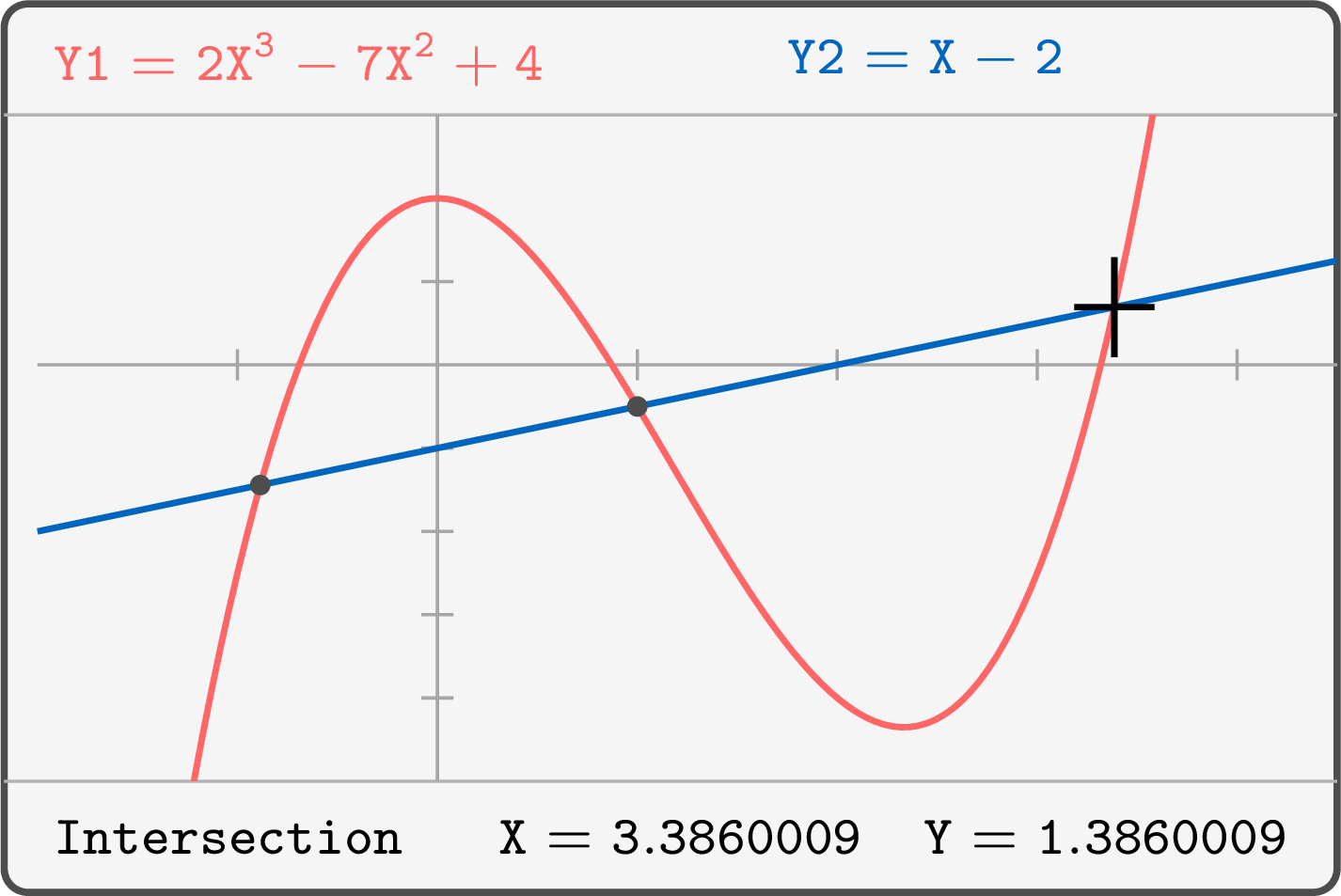
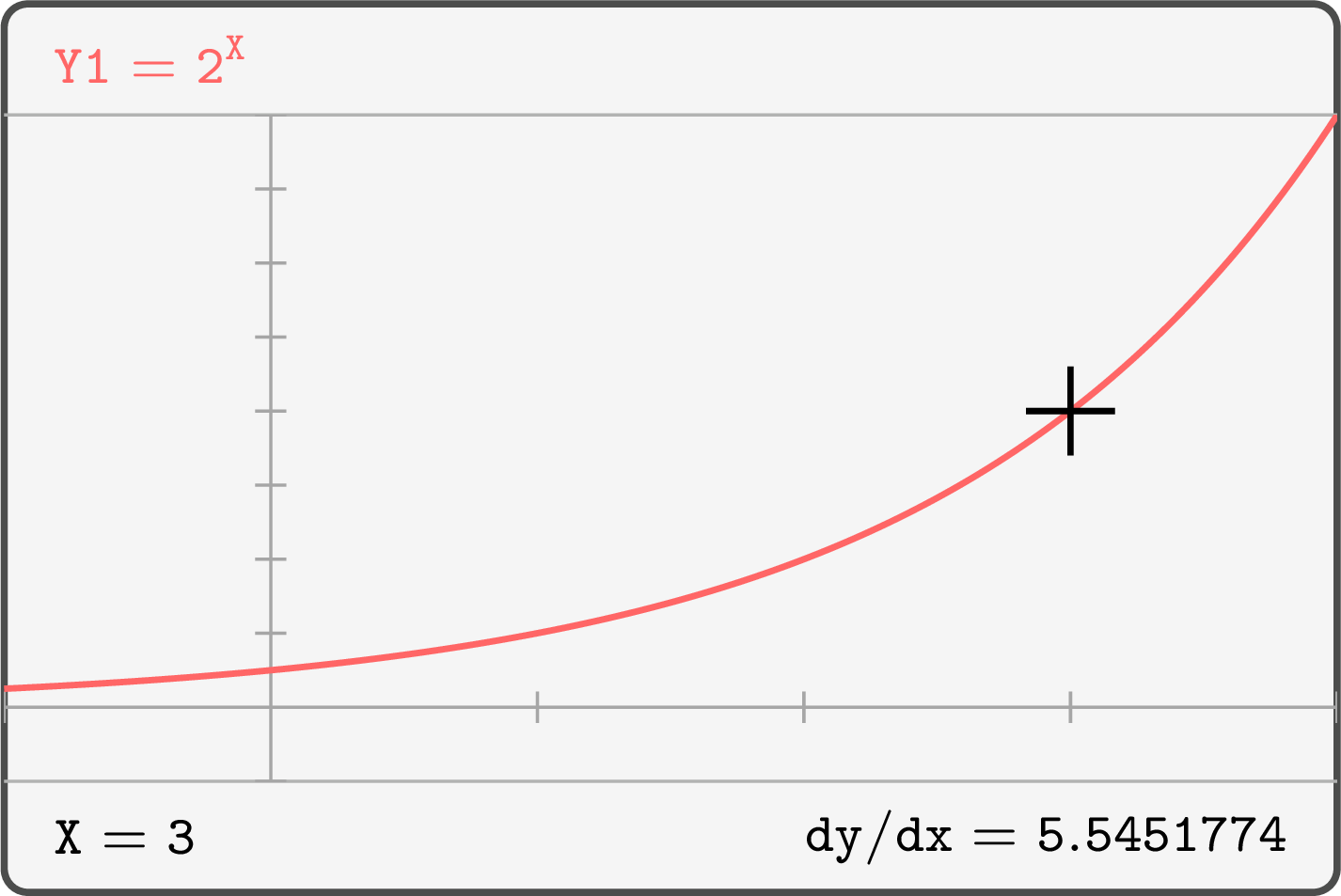
Computing \(f'(a)\) from the limit definition takes several lines of algebra, and for some functions, such as \(x \mapsto 2^x\), algebra alone does not give the limit. A graphing calculator, or graphing software, gives a numerical value of \(f'(a)\) at once. Most models do not differentiate: they compute the rate of change of \(f\) between two values of \(x\) very close to \(a\), one on each side, for example \(a - h\) and \(a + h\) with \(h = 0.001\): $$\dfrac{f(a + h) - f(a - h)}{(a + h) - (a - h)} = \dfrac{f(a + h) - f(a - h)}{2h}.$$ When \(f\) is differentiable at \(a\), this rate of change tends to \(f'(a)\) as \(h\) tends to \(0\), and with \(h = 0.001\) the difference is small: for \(f(x) = x^3\) it is exactly \(h^2 = 0.000001\). The screen shows the exact value, or a value such as \(4.750001\) whose last digit is the error of the method.
When \(f\) is not differentiable at \(a\), the calculator may still display a number. For \(f(x) = |x|\) at \(a = 0\): $$\dfrac{|0.001| - \left|-0.001\right|}{2 \times 0.001} = \dfrac{0.001 - 0.001}{0.002} = 0,$$ although the graph has a corner at the origin and no tangent there. A number read on the screen is a derivative only once the function is known to be differentiable at that point.
When \(f\) is not differentiable at \(a\), the calculator may still display a number. For \(f(x) = |x|\) at \(a = 0\): $$\dfrac{|0.001| - \left|-0.001\right|}{2 \times 0.001} = \dfrac{0.001 - 0.001}{0.002} = 0,$$ although the graph has a corner at the origin and no tangent there. A number read on the screen is a derivative only once the function is known to be differentiable at that point.
Method — Finding a Derivative at a Point with Technology
To find \(f'(a)\) with a graphing calculator: - Check that \(f\) is differentiable at \(a\): \(a\) belongs to the domain of \(f\), and the point with \(x\)-coordinate \(a\) is not one of the usual points where a derivative fails to exist, a break, a corner or a vertical tangent of the graph.
- Use the derivative command of the calculation menu, written \(\frac{\mathrm{d}}{\mathrm{d}x}\) or nDeriv depending on the model: enter the expression of \(f(x)\) in the variable \(X\), then the value \(a\). On the graph screen, the tool \(\mathrm{d}y/\mathrm{d}x\) of the analysis menu gives the same number at the point of the curve where \(x = a\).
- Report the value to 3 significant figures, unless the question asks for another accuracy: a display such as \(4.750001\) is reported as \(4.75\), and \(5.545177444\) as \(5.55\).
Example
Answer with a graphing calculator. - Find the derivative of \(f(x) = x^3 - 2x\) at \(x = 1.5\).
- Find the gradient of the tangent to the curve \(y = \sqrt{x}\) at the point where \(x = 5\), to 3 significant figures.
- The derivative command, applied to \(g(x) = |x - 1|\) at \(x = 1\), displays \(0\). Explain why \(0\) is not \(g'(1)\).
- \(f\) is a polynomial function, differentiable at every real number. The derivative command, with \(X^3 - 2X\) and \(X = 1.5\), displays \(4.75\) (or \(4.750001\) on some models). So \(f'(1.5) \approx 4.75\); the rules of differentiation give the exact value, \(3 \times 1.5^2 - 2 = 4.75\).
- The function \(x \mapsto \sqrt{x}\) has a vertical tangent at the origin only, and \(5 > 0\): it is differentiable at \(5\). The command, with \(\sqrt{X}\) and \(X = 5\), displays about \(0.223607\) (the last digits depend on the model). The gradient of the tangent is \(f'(5) \approx 0.224\).
- A calculator that uses the rate of change of \(g\) between \(0.999\) and \(1.001\) obtains exactly \(0\): $$\dfrac{g(1.001) - g(0.999)}{1.001 - 0.999} = \dfrac{0.001 - 0.001}{0.002} = 0.$$ But \(g\) is not differentiable at \(1\). For \(h \neq 0\), $$\dfrac{g(1 + h) - g(1)}{h} = \dfrac{|h|}{h},$$ which equals \(1\) for \(h > 0\) and \(-1\) for \(h < 0\): the rate of change has no limit as \(h \to 0\). The graph has a corner at \((1, 0)\), and \(0\) is the slope of a chord joining its two branches, not the slope of a tangent.
Example
The number of bacteria in a culture, \(t\) hours after the start of an experiment, is modelled by \(N(t) = 500 \times 1.3^t\). Use technology to find \(N'(4)\), and interpret it in context.
\(N\) is an exponential function, differentiable at every real number, a property admitted here. The derivative command, with \(500 \times 1.3^X\) and \(X = 4\), displays about \(374.669\) (the last digits depend on the model), so \(N'(4) \approx 375\).
\(N'(4)\) is the instantaneous rate of change of \(N\) at \(t = 4\), in bacteria per hour: four hours after the start, the number of bacteria is increasing at a rate of about \(375\) bacteria per hour. It is not the average rate over the first four hours: $$\dfrac{N(4) - N(0)}{4 - 0} = \dfrac{1428.05 - 500}{4} \approx 232 \text{ bacteria per hour},$$ which is smaller, because the growth speeds up.
\(N'(4)\) is the instantaneous rate of change of \(N\) at \(t = 4\), in bacteria per hour: four hours after the start, the number of bacteria is increasing at a rate of about \(375\) bacteria per hour. It is not the average rate over the first four hours: $$\dfrac{N(4) - N(0)}{4 - 0} = \dfrac{1428.05 - 500}{4} \approx 232 \text{ bacteria per hour},$$ which is smaller, because the growth speeds up.
Skills to practice
- Reading a Derivative on the Screen
- Finding a Derivative with Technology
IV
Going further
Skills to practice
- Diagnosing and Correcting Errors
- Solving Problems without Technology
- Solving Problems with Technology
- Quiz
Jump to section