International Baccalaureate · DP 2: Analysis and Approaches HL
Paper 3 Workshop
I
Toolbox: The Law of Total Probability
Recappreviously studied — click to reread
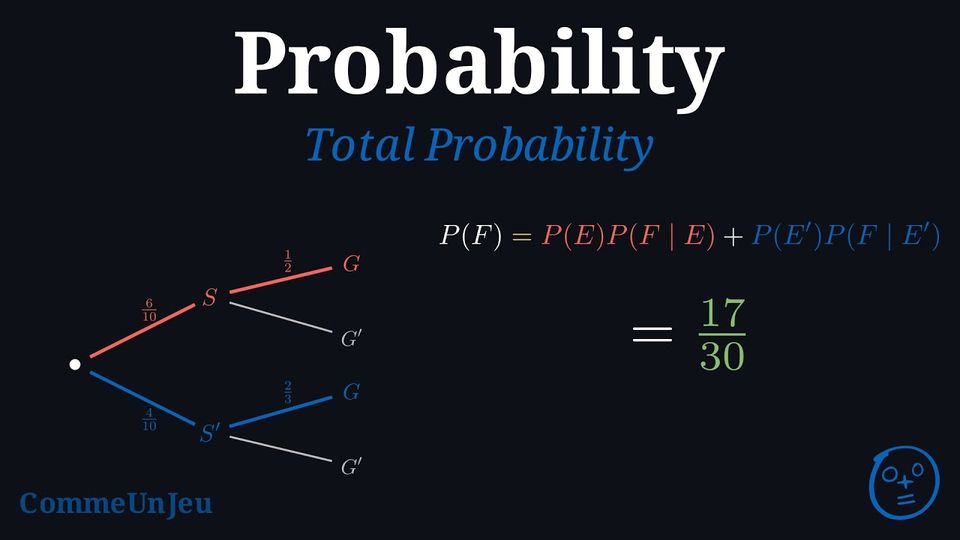
Theorem — Law of Total Probability
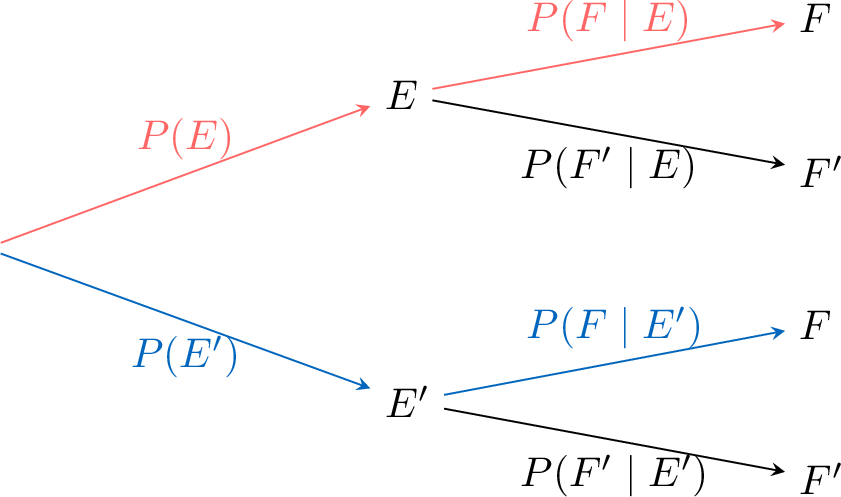
For events \(E\) and \(F\) with \(0 < P(E) < 1\): $$P(F) = P(E) \PCond{F}{E} + P(E') \PCond{F}{E'}.$$ This applies when \(E\) and its complement \(E'\) form a partition of the sample space. More generally, if \((E_1,\dots,E_n)\) is a partition of the sample space into events of non-zero probability, then $$P(F) = \sum_{i=1}^n P(E_i)\PCond{F}{E_i}.$$ Method — Finding \(P(F)\) in a Tree
- Identify all paths to \(F\).
- Multiply probabilities along each path and sum them.
Example
For this probability tree, 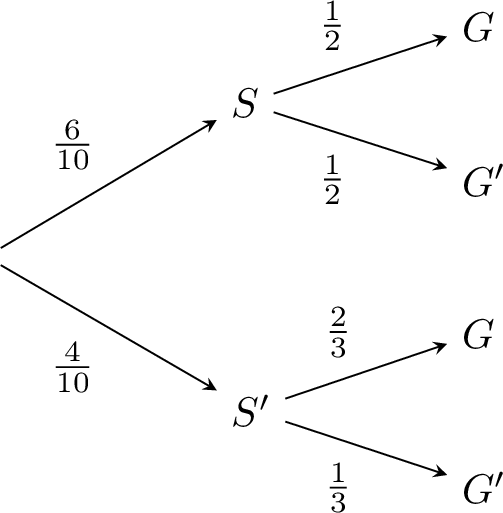
- Paths to \(G\):
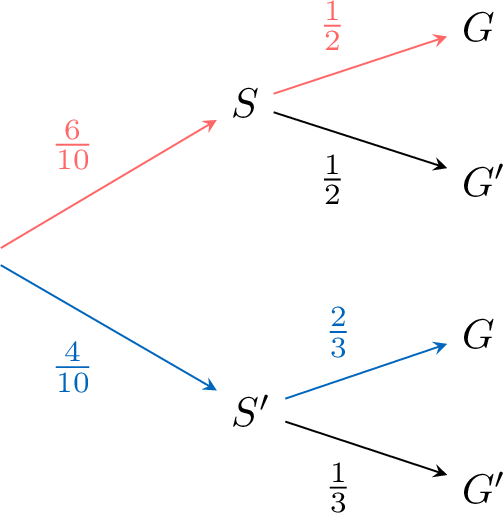
- Calculate: $$\begin{aligned} P(G) &= \textcolor{colordef}{\frac{6}{10} \times \frac{1}{2}} + \textcolor{colorprop}{\frac{4}{10} \times \frac{2}{3}} \\ &= \textcolor{colordef}{\frac{3}{10}} + \textcolor{colorprop}{\frac{8}{30}} \\ &= \textcolor{colordef}{\frac{9}{30}} + \textcolor{colorprop}{\frac{8}{30}} \\ &= \frac{17}{30}. \end{aligned}$$
Skills to practice
- Calculating Probabilities with Trees
II
Toolbox: Solving by Separation of Variables
Recappreviously studied — click to reread
Method — Solving Separable Equations \(\frac{dy}{dx} \equal g(x)h(y)\)
This method applies when the equation can be rearranged so that all terms involving \(y\) are on one side and all terms involving \(x\) are on the other. - Separate: Rearrange the equation into the form \(\dfrac{1}{h(y)}\, \mathrm{d}y = g(x)\, \mathrm{d}x\).
- Integrate: Integrate both sides of the equation with respect to their respective variables: $$ \int \dfrac{1}{h(y)} \, \mathrm{d}y = \int g(x) \, \mathrm{d}x $$
- Solve for \(y\): If possible, solve the resulting equation for \(y\) to get an explicit solution.
Example
Solve \(\dfrac{\mathrm{d}y}{\mathrm{d}x} = -2xy^2\) with the initial condition \(y(1)=1\).
We rearrange and integrate both sides: $$ \begin{aligned} \dfrac{\mathrm{d}y}{\mathrm{d}x} &= -2xy^2 \\
\frac{1}{y^2} \, \mathrm{d}y &= -2x \, \mathrm{d}x \\
\int \frac{1}{y^2} \, \mathrm{d}y &= \int -2x \, \mathrm{d}x \\
\int y^{-2} \, \mathrm{d}y &= \int -2x \, \mathrm{d}x \\
-y^{-1} &= -x^2 + C \\
-\frac{1}{y} &= -x^2 + C \end{aligned} $$ This is the implicit form of the solutions other than \(y = 0\). Using the initial condition \(y(1)=1\): $$ -\dfrac{1}{1} = -(1)^2 + C \implies -1 = -1 + C \implies C = 0 $$ Substituting \(C=0\) gives the particular solution: $$ -\dfrac{1}{y} = -x^2 \implies y = \dfrac{1}{x^2} $$ This solution is defined on \((0, +\infty)\), the interval containing the initial point \(x = 1\). Note that the constant function \(y = 0\) (lost when dividing by \(y^2\)) is also a solution of the equation, but it does not satisfy the initial condition.
Skills to practice
- Finding Particular Solutions by Separation
III
Exam-Style Questions
Skills to practice
- Investigating with Technology: Paper 3
Jump to section